Front matter (continued 7)
Reading edition
Gordon made no attempt to see Constance on the day following his proposal. Impatient as he was to renew his suit, he concluded to let her muse for twenty-four hours on the situation. It occurred to him that he would ask leave to accompany her to church on Sunday morning, but reflecting that it would not be fair to disturb her meditations, he decided instead to attend the service at St. Stephen's and walk home with her after it. Whatever the New Testament language on the subject, would she be able to convince herself that the sundering of such love as theirs would be in keeping with the true spirit of Christianity? It seemed to him that there could be but one answer to this proposition, and as he walked along in the beautiful bracing atmosphere of the autumn day his step was buoyant, for he believed that his happiness would be sealed within a few short hours. Ecstasy ruled his thoughts. Was not the woman of his heart an entrancing prize? Fortune and station she had none, but far more important for him, she was lovable and she was lovely; she was intelligent and she was good.
He had attended service at St. Stephen's once or twice before, and had a bowing acquaintance with Mr. Prentiss; but he knew well and entertained a cordial liking for the latter's assistant, the rector of the Church of the Redeemer, the mission church in the squalid section of the city supported by the larger establishment. St. Stephen's, as the fashionable Episcopalian church of the community, was apt to draw a large congregation, especially when the pew owners were not confronted by wet skies or sidewalks. This brilliant Sunday at the beginning of the social season had drawn most of the regular congregation and also a large contingent of strangers—chiefly women—some of them visitors in Benham, but the majority students and other temporary residents who found the æsthetic music and devotional ritual of St. Stephen's stimulating. Gordon, who was a little late, obtained a seat in the gallery. It had occurred to him that he would be more likely to catch sight of his ladylove from this eminence than if he remained below. His eyes sought at once the so-called free benches where she was accustomed to sit, but she was not in her usual place. After repeated scrutiny of the rows of faces had convinced him of this, he concluded dejectedly that she had not come. Perhaps she had stayed at home hoping he would call. Or had she been loth to display her glasses in public before she had become accustomed to the disfigurement? His glance wandered over the rich flower garden of autumn bonnets, but to no purpose. While in perplexity he reviewed the probable causes of her absence he became aware that the music of the processional had ceased and that Mr. Prentiss was speaking. Ten minutes later, when the congregation rose to take part in the selection from the Psalms, his glance fell on Mrs. Randolph Wilson in one of the front pews. Her profile was almost in a line with his vision. While he looked his heart gave a bound, for he suddenly recognized that the young woman next to her in the gay, attractive bonnet was she for the sight of whom his soul was yearning.
After leaving Constance on the day of their eventful interview, Mrs. Wilson had conceived the plan of presenting her with a new bonnet and jacket. These she brought with her to Lincoln Chambers a little before church time, and placed with her own hands on the surprised recipient. Pleased at the æsthetic progress of her ward, she seized this opportunity to promote it, and also to cater to her own generous instincts at a time when to indulge them was not likely to cause offence. Though astonished, Constance accepted without demur these welcome additions to her toilet, and the donor had the satisfaction of beholding how admirably they became her. Besides, Mrs. Wilson had on the tip of her tongue and was eager to communicate the plan which she had been working out since they separated, and which she imparted to Constance as soon as they were in her brougham on the way to church.
"I have been carefully considering your affairs, my dear, and, in the first place, you are to do nothing for the next six months but get well. I shall insist upon looking after you. You promised me, remember." She paused as though she half expected to encounter opposition to this project, and, though her ward revealed no insubordination, she added the argument which she held in reserve: "For, having deprived you by its counsel of the means of support, it is the Church's duty, and my privilege as a disciple of the Church's cause, to watch over you until you are able to provide for yourself. At the end of the six months, when your eyes are strong again, I wish you to become my private secretary."
On the way from her house she had pictured to herself the astonishment and delight which such an unexpected and splendid proposition must necessarily inspire, and she could not refrain from stealing a sidelong glance at Constance in order to observe the effect it would have on her.
"Your private secretary?"
Mrs. Wilson felt rewarded by the incredulous bewilderment conveyed by the interrogatory, and hastened to explain her benefaction. "It seems almost the interposition of Providence in your behalf," she added. "Last evening—and I was thinking of your noble resolution at the time—my secretary came in to inform me that she was engaged to be married, and to ask me to be on the lookout for someone else. 'The very place for Constance Stuart,' I said to myself at once. 'What could suit her better? And what an admirable arrangement it will be for me!' For, after refusing Mr. Perry's offer, I take for granted that, even when your eyesight is restored, the continuance of your present business relations would be out of the question."
"Oh, yes; entirely so," answered Constance with rueful promptness. "I could not continue in his employment; we should both be unhappy." She was making a confession of what she had been saying to herself all the morning.
"Exactly." Mrs. Wilson beamed over the success of her divination.
"Then we will consider it settled. And I wish to tell you besides that I shall take it upon myself to see that your boy's artistic gift is given full opportunity for expression, and your daughter thoroughly educated. Your salary, I mean, will be sufficient to enable you to give them proper advantages, for I can see that you will be very useful to me."
She was determined to make plain that virtue in this case was to be its own reward, and that the material losses in the wake of renunciation were rapidly being eliminated. At the same time she wished to conceal a too obviously eleemosynary intent.
"I don't see how anything could be nicer for me. And if you think that I should suit—that I could perform the duties properly—I shall be thankful for the position," answered poor Constance.
She had passed another sleepless night. Fixed as was her conviction that separation from her lover was inevitable, she felt deeply sorry for him if not for herself, and dreaded the impending final interview between them. Despite her spiritual exaltation the consciousness that she was letting slip a great chance for her children still haunted her, in that the future by comparison seemed vague and forbidding. For it had been clear to her from the moment of her decision that under no consideration could she remain in Gordon's office. Therefore, though doubtless her friends would help her, the struggle for a livelihood must be begun again.
Mrs. Wilson's amazing, timely offer lifted a great weight from her heart; by it the question of her future employment was disposed of, and disposed of in a way more congenial to her than any she could have imagined possible. It did indeed seem providential that the vacancy should have occurred at this time, and she realized that the certainty that her children would be protected would nerve her for the necessary ordeal of parting, for now there was only selfishness in her desire for marriage. She longed for it to be over with that she might put away once and forever this great temptation.
The thought that Gordon would probably come for his answer that afternoon was uppermost in her mind during the service; but she was in a mood to respond to the beautiful music, and before Mr. Prentiss gave out the text of the sermon she was already thrilling with the joy of her sacrifice on the altar of faith. She prayed that she might be granted strength to renounce this seeming blessing ungrudgingly and to close her ears to the whispers of regret, and as she joined in the jubilant anthem of rejoicing for a risen Lord it seemed to her that the angel of peace brushed her forehead with the wings of heaven's love. The text was "Except a man be born again he shall not enter into the kingdom of heaven." It was a sermon of immortality and hope, and a sermon of the triumph of the spirit over the flesh for the sake of a Christ who had set the great example and conquered self through suffering. It was one of Mr. Prentiss's most happy efforts from the standpoint of orthodoxy, graphic, eloquent, and practical. He set no narrow limits of a creed as the arbiter of truth, but declared that the opportunity to choose between the path of righteousness and the path of self-sufficiency or self-indulgence was offered to every one in the great struggle of modern life; that he who would follow the blessed Lord and Master must shun as evil that which was injurious to the highest interests of human society and thus hateful to God. As she listened Constance could not doubt that he had her in mind. It seemed to her that more than once his glance rested on her encouragingly and fondly. Her brain was transported with ecstasy and zeal. Her opportunity was at hand, and she would serve Christ and mankind faithfully.
Leaving the church under the spell of the sermon, she became suddenly aware that her lover was beside her and was suggesting that he escort her home. At sight of him her chaperone, scenting danger, led the way sedulously toward the brougham, but in the interval Constance decided to take him at his word. Would it not be the simplest course to explain to him quietly on the street that what he asked her was impossible, and thus avoid the pain of a more intimate parting? Therefore she made her excuses to Mrs. Wilson, pleading the radiance of the day and her need of fresh air. She felt so sure of herself that, though she noticed her friend seemed disappointed, it did not occur to her that it was from concern as to the result of the interview until she heard a whispered "Be firm." Constance turned a resolute face toward her, and by a close pressure of the hand gave the desired assurance, then as the stylish equipage rolled away from the church door, she stepped to Gordon's side, sadly conscious that this was to be their last walk together.
Three days later, in the evening, Gordon Perry rang at the house of the Rev. George Prentiss, the comfortable looking and architecturally pleasing rectory in the neighborhood of St. Stephen's. A trim maid ushered him into an ante-room where all parochial visitors were first shown, and asked for his name. There was a nondescript elderly woman in black ahead of him. In his capacity as rector of a large parish, Mr. Prentiss followed the modern methods of other busy professional men. An electric bell at his desk notified the servant that the interview with the last comer was at an end and that the next in order was to be introduced. Gordon had not long to wait. His remaining predecessor's stay was brief. The rector's heartiness was almost apologetic as he strode a pace or two forward to greet his visitor.
"Mr. Perry, I am very glad to see you. I am sorry that you should have been kept waiting. But the clergy cannot afford to be unbusiness-like, can they? We intend to live down that taunt. So my rule is 'first come, first served.'"
"The only proper rule, I am sure."
It was a spacious, well-filled room, the manifest workshop of an industrious man, but furnished with an eye to æsthetic appropriateness as well as utility. Red leather chairs and lounges of goodly proportions, two symmetrical, carved tables covered with documents, books, and pamphlets, warm curtains, an open wood fire, a globe, sundry busts and framed photographs of celebrities, mainly clerical, including a large one of Phillips Brooks and another of Abraham Lincoln, were its distinguishing characteristics.
Mr. Prentiss stepped to one of the tables and opening an oblong Japanese box drew out a handful of cigars.
"Will you smoke, Mr. Perry?" he asked, cheerily.
Gordon took one, and the clergyman, who reserved his use of tobacco for occasions when by so doing he might hope to make clearer that he was human, did the same. As soon as they were lit, Mr. Prentiss with a sweep of his hand indicated two easy chairs on either side of the fire, but after his guest was seated he himself stood with his back to the mantel-piece, his hands behind him, the commanding affable figure of a good fellow. Still he chose to show at the same time what was in his heart at the moment coincident with his manifestations of secular hospitality.
"That woman who just went out has recently buried her only son, the joy and prop of her old age. She came to thank me for a trifling donation I had sent her. Her courage and her trust were beautiful to witness. These humble lives often furnish the most eloquent testimonials of the eternal realities." He spoke with the enthusiasm of his calling, as a doctor or a lawyer might have set before an acquaintance an interesting case. He liked to feel that he was on the same footing with the world of men as they, with respect to privileges no less than responsibilities. For an instant he seemed to muse on the experience, then briskly recurring to the immediate situation said:
"But what can I do for you, Mr. Perry? My assistant, Mr. Starkworth, tells me that you take an active personal interest in the social problems of our community."
This bland presumption of ignorance as to the cause of his visit made Gordon smile. He could not but suspect that it was artificial. Yet the inquiry was by no means hypocritical; for though Mr. Prentiss was fully conscious of his caller's identity, and had given him a correspondingly genial reception, he regarded the episode of the proposed marriage as so completely closed by Constance's decision that he did not choose to believe that Gordon had come for the unseemly purpose of reviving it. It seemed to him far more probable that his advice or assistance was sought in some humanitarian or civic cause.
"Yes," said Gordon slowly, enjoying the development of the opening which occurred to him, "Mr. Starkworth and I have co-operated from time to time, with mutual liking, I think. It is in regard to a social problem that I have come to consult you this evening."
"Ah," said the rector, relieved in spite of his belief, and thereupon he settled himself in the other capacious easy chair and turned a cordially attentive countenance to his guest. "You may feel assured of my interest in anything of that kind."
"It concerns my own marriage," said Gordon.
The challenge was so unmistakable, like a gauntlet thrown at his feet, that Mr. Prentiss was for an instant disconcerted, then irritated. But the pleasant manner of his opponent negatived the aroused suspicion that effrontery lurked behind this slightly sardonic introduction, and he met the attack with a grave but supple dignity.
"Indeed," he said. "I shall be very glad to hear what you have to say, Mr. Perry."
XXII
Gordon drew deeply several times at his cigar, then laid it on the bronze tray for ashes within reach, as though he felt that it might profane his thought.
"I come to you to-night, Mr. Prentiss, as man to man, knowing that you wish truth and justice to prevail, and asking you to believe that I desire the same. We are both of us men of affairs in the modern sense."
The rector bowed.
"Then you as the rector of one of the most influential churches in the city will doubtless agree that religion must be sane and reasonable in its demands to-day or it will lose more followers among the educated—and education is constantly spreading—than it gains from the ignorant and superstitious?"
"Assuredly."
"I, on my side, as a layman—whatever our differences of precise faith and dogma—am glad to bear witness that the present social world could do without true religion less than ever before."
The summary pleased Mr. Prentiss. It was reasonable and progressive. "We are entirely in accord there," he answered heartily.
"As I supposed. Then it obviates the necessity of feeling my way. With some clergymen I should not venture to take anything unorthodox for granted, but I believed that we should readily find a common ground of agreement."
The assertion was regarded by Mr. Prentiss as a compliment. Nevertheless he perceived that it behooved him to mark the limits of his liberality.
"The essence of Christianity has nothing to fear either from the higher criticism or the modern world's lack of interest in moribund dogma. May I not say with Paul 'but this one thing I do, forgetting those things which are behind, and reaching forth to those things which are before'?"
"And from that point of view may I ask why you have felt constrained to separate Mrs. Stuart and me?"
There was a brief pause. The rector had not the remotest intention of shirking responsibility, but he wished the precise truth to appear.
"It was Mrs. Stuart's own decision."
"I asked her in good faith, after an attachment of several years, to become my wife. She loves me fondly, as I do her. She would have married me had you not convinced her that to do so would be a sin."
"I told Mrs. Stuart that from the standpoint of her highest duty as a Christian woman, it would be a sin. Not unpardonable sin, if finite intelligence may venture to distinguish the grades of human error, but conduct incompatible with the highest spirituality—and modern spirituality, Mr. Perry."
There was a doughty ring to the rector's tone, betokening that he was not averse to crossing swords with his visitor.
"Why would it be a sin?"
Mr. Prentiss knocked the ash from his cigar and held up the glowing tip. "Do you not know?" he asked, fixing his gaze squarely on his antagonist, so that he seemed to attack instead of defend.
"Because she has a husband living—a brute of a husband who, after dragging her down, deserted her shamefully; a husband whom she has ceased to love and from whom the law of this community would grant her a divorce."
"Proceed."
"Because the Church has seen fit to stigmatize as evil that which the State sanctions in a matter vitally affecting the earthly happiness of the human sexes."
Waiting briefly to make sure that the indictment was complete, Mr. Prentiss rejoined dryly: "You state the case accurately. My answer is that the Church is merely inculcating the precepts of the Saviour of mankind."
Gordon drew a deep breath. He rejoiced in his opportunity.
"Mr. Prentiss," he said, "you referred just now to the world's lack of interest in moribund dogma; we agreed that the demands of religion to-day must be sane and reasonable. I speak with entire reverence, but I ask whether you honestly believe that the few casual sentences which Christ is reported to have uttered thousands of years ago in Palestine in regard to man's putting away his wife should control complicated modern human society—the Christian civilization of to-day—so as to preclude a pure woman like Mrs. Stuart, under the existing circumstances, from obtaining happiness for herself and her children by becoming my wife? I ask you as an intelligent human being and a just man if this is your opinion?"
There was no hesitation on the rector's part; on the contrary, firm alacrity.
"It is."
"And yet you know that a large portion of the civilized world ignores the doctrine," answered Gordon, curbing his disappointment. He had not expected to encounter this stone wall.
"I do, to its shame and detriment. The Church is not responsible for that."
"Then your argument rests on the letter of Christ's words?"
"It does and it does not." There was triumph in the rector's voice as he laid emphasis on the qualifying negation. He had hoped to lead his censor to this very point. "Nor does the spiritual objection of the woman who has refused to marry you rest solely on that ground. She is an intelligent person, Mr. Perry. She perceives, as I perceive, that what you ask her to consent to do would be evil for the human race as well as contrary to the teachings of our Lord. There is nothing moribund in that attitude. It is vital, timely righteousness. Mrs. Stuart must have set this double reason before you."
Gordon remembered that she had. In his agitation during their final interview, believing that she was laboring under a neurotic delusion, he had given little heed to her argument. Now, as a lawyer, he perceived the ingenuity of the plea, though he still regarded her as the victim of clerical sophistry. Yet he made no immediate response, and Mr. Prentiss took advantage of the opportunity to elucidate the situation.
"Mr. Perry, you are led away by the special merits of your own case. I acknowledge the hardship; I grant the pathos of the circumstances. They present the strongest instance which could be cited in justification of remarriage by a divorced person. But there must be more or less innocent victims on the altar of every great principle. The Lord has demanded this service of His handmaid, and, though her heart is wrung, she rejoices in it."
"I see," said Gordon, "and that presents the real issue. Why should the Church usurp the functions of the State? Why in this age of the world should it decide what is best for the human race in a temporal matter, and substitute an arbitrary and inflexible ethical standard of its own for the judgment of organized society?"
Mr. Prentiss's nostrils dilated from the intensity of his kindled zeal. "Why? For two reasons. First, because the Church declines to regard as a temporal matter an abuse which threatens the existence of the family, the corner-stone of Christian civilization; and second, because the State has flagrantly neglected its duty, allowing divorce to run riot through the nation without uniform system or decent limitations. Is the Church to remain tongue-tied when the stability of the holy bond of matrimony has become dependent on the mere whims of either party?"
"I see the force of your position. I will answer you categorically. As to the first reason, it seems to me untenable. As to the second, you accused me just now of seeing only my side. Let me retaliate, and at the same time suggest that, though you may seem to have a strong case, you do not know the real facts." Gordon, having reached a more dispassionate stage of the argument, remembered his cigar, which he proceeded to relight. But the rector, not accustomed to such colloquial dissent, threw his own in the fireplace and crossed his arms.
"Regarding your first plea in behalf of the Church's interference that the Church does not look on marriage as a temporal concern, let me remind you," continued Gordon, "that marriage is the only matter in the realm of human social affairs where the Church undertakes to nullify by positive ordinance the law of the State—where there is divided authority. In all other social affairs the law of the State is paramount. The Church forbids abstract vices—malice, uncharitableness, lust, selfishness, intemperance, but it does not attempt to define these in terms of human conduct, or to substitute canons for the secular statute book."
"The Church regards marriage as a sacrament."
"The Roman Catholic and the Episcopal. If I may say so, the attitude of both these churches is a foreign influence."
The clergyman drew himself up. "Foreign?"
"Yes, foreign to native American ideas, and I might add foreign to the claims of the first followers of Christianity, for the early Christian Church did not assert the right to perform the marriage ceremony, or to regulate marriage. Its protectorate dates from a later period. But what I had in mind was that it is antagonistic to the spirit both of our forefathers and their descendants. In the early days of New England the service of marriage was performed not by the minister, but by the magistrate, and marriages by clergymen were forbidden. It was the authority of the State, the commonwealth, the considered judgment of the community which was recognized."
Mr. Prentiss nodded. "You are a Unitarian, I judge."
"I was brought up in the Unitarian faith. Like most American men, I believe in the power of the individual to work out his own salvation."
"But what message have you for a world of sinners?" asked the rector, trenchantly.
"I appreciate the force of your criticism. I am conscious that the weakness of Unitarianism—of individual liberty of conscience—is its coldness, that it does not constantly hold out to the degenerate soul the lure of a new spiritual birth. It is for this reason largely that your Church and the Catholic Church have gained fresh converts in this country and this city. Moreover, those churches have promoted among us picturesqueness, color, and sentiment. But, on the other hand, their spirit is autocratic if not aristocratic, and in their love for the pomp of the ages, in their fealty to the so-called vested rights of civilization, they have little sympathy with the rational, every-day reasoning of republican democracy."
Mr. Prentiss pursed his lips. There was no offence in the speaker's manner or tone which would justify a rebuke; on the contrary, they both suggested that he was trying to speak dispassionately. But the conclusions stirred the rector's blood, and he tightened his folded arms.
"You seem to forget that the spirit of Christian philanthropy, of the loving brotherhood of man, is the controlling emotional force in the Episcopal—yes, in the Roman Church to-day. You yourself are familiar, for example, with the work of my Mr. Starkworth in the Church of the Redeemer."
"Yes. But neither Church has compassion on the misery of common humanity when to relieve it would conflict with the hard and fast letter of church law. That is where—and notably in this matter of recognizing divorce—the other Protestant churches, the Presbyterian, the Methodist and the Baptist, have been more tolerant. They have refused to insist that it is for the benefit of mankind that, under all circumstances, men and women unhappily married should remain in durance vile without the possibility of escape, or, having escaped, should be condemned by precept to celibacy for the rest of their lives. And these are sects whose creed is based on the essential sinfulness of human nature."
The rector glowered at Gordon for a moment from under his brows. "Then where will you draw the line?" This was Mr. Prentiss's trump card. It expressed his utter weariness with what he regarded as the foul system of conflicting and irresponsible legislation, unceasingly and scandalously availed of.
"That brings us to your second proposition!" exclaimed Gordon. "As to whether the State is faithless to its duty. Have you a copy of the public laws, Mr. Prentiss?"
"Assuredly." The rector strode across the room and taking down two large volumes from the book-shelf presented them to his visitor. It gratified him to demonstrate by this practical test the broadness of his humanity.
"Do you happen to know the causes for which divorce is granted in this State?"
Mr. Prentiss hesitated. Evidently he had no exact information on the subject, which at this juncture was disconcerting. "For far too many causes; I am sure of that," he replied, stoutly.
"I will read them to you. 'Impotence; adultery; desertion for three years; sentence for felony for two years; confirmed habits of intoxication; extreme cruelty; grossly and wantonly refusing to support wife.'"
The rector listened alertly, hoping to be able to pounce on some conspicuously insufficient provision. Since this did not appear he made a sweeping assertion. "They are all inadequate in my opinion except unfaithfulness to the marriage vow, and I often doubt the wisdom of making an exception there. I am by no means sure that the Roman Church is not right in its refusal to admit the validity of divorce for any cause whatever."
"But what has been the course of history since the Roman Church promulgated its canon at the Council of Trent more than three hundred years ago? The cause of common sense and justice as represented by the State has, in spite of the fierce opposition of the clergy, won victory after victory, until the institution of marriage has been placed under the control of the secular law on most of the Continent of Europe, and the right to divorce and the right to remarry widely recognized—for instance in France, Germany, Switzerland, Norway, Denmark. In France it's a criminal offence for a priest to perform the religious ceremony of marriage until after the civil ceremony."
"Yes, and it was France which during the days of the revolution permitted divorce at the mere option of either party. And there are signs that we are rapidly imitating that same barbaric laxity in the United States, and in this community."
"And if it were, would it be so much more barbarous a condition than the conservatism of the English law of Church and State, which grants divorce to the man whose wife has been guilty of adultery, but withholds it from a woman unless her husband has been guilty of cruel and abusive treatment into the bargain?"
The rector was touched on another sensitive point. He put out the palm of his hand. "I fail to see the relevancy of your comparison, Mr. Perry. However, the American Episcopal Church is not responsible for the flaws in the details of the English establishment. The two are harmonious and their aims are identical, but we do not follow blindly."
"Yet the American Episcopal Church follows its English parent and the Roman Catholic in maintaining that the woman whose husband is an inveterate drunkard, is convicted of murder or embezzlement, kicks and beats her shamefully, or deserts her utterly in cold blood, is guilty of a crime against heaven and against society if she breaks the bond and marries again. Progressive democracy in the person of the State is more lenient, more merciful. It refuses to believe that one relentless, arbitrary rule is adapted to the exigencies of human society. It insists that each case should be judged on its merits, and both relief afforded and fresh happiness permitted when justice so demands. Think of the many poor creatures in the lower ranks condemned by your inexorable doctrine to miserable, lonely lives, who might otherwise be happy!"
Mr. Prentiss's brow contracted as though he were a little troubled by the appeal to his sympathy with the toiling mass. "One wearies of this ever-lasting demand for happiness in this life," he murmured. "Was Christ happy? They are free to disregard the authority of the Church if they see fit," he added. "I for one should not feel justified in refusing the communion to a divorced woman who had remarried."
"But the Catholic Church would and does uniformly; and the high church party in your own church would disapprove of your leniency. The vital point is that both churches and you yourself brand those who disobey as spiritually impure, or at least inferior, a stigma which appalls the best women. And so they are held as in a cruel vice, so you have held her who was to be my wife."
The reversion to the personal equation reminded the rector that this was no academic discussion.
"You have not answered my question yet. Where will you draw the line? Granting for the moment—which I by no means agree to—that gross habits of intoxication, felony, or absolute desertion are valid grounds for breaking the nuptial bond, let me cite the law to you in turn, Mr. Perry." Thereupon Mr. Prentiss stepped to the shelves again, and running through the pages of a book, discovered presently the data of which he was in search. "What do you think of these reasons?" he asked in a scorching tone. "American grounds of divorce: 'When it shall be made to appear, to the satisfaction and conviction of the court, that the parties cannot live in peace and union together, and that their welfare requires a separation,' Utah; 'Voluntarily living separate for one year,' Wisconsin; 'For any cause that permanently destroys the happiness of the petitioner and defeats the purposes of the marriage relation,' Connecticut; 'For any cause in the discretion of the court,' Kentucky; 'Whenever the judge who hears the cause decrees the case to be within the reason of the law, within the general mischief the law intended to remedy, or within what it may be presumed would have been provided against by the legislature establishing the foregoing cause of divorce, had it foreseen the specific case and found language to meet it without including cases not within the same reason, he shall grant the divorce,' Arizona; and in a host of States, 'One year's absence without reasonable cause.'"
"I told you that you seemed to have a good case," said Gordon, smiling. "But I do not think that you understand the facts, understand the real nature of the abuse, for I heartily agree that an abuse exists even from the standpoint of those who maintain that divorce should be granted on the slenderest grounds. As to the extracts which you have just read, I judge that the book is not a recent publication."
"I have reason to believe that it is authoritative."
"Undoubtedly it was so at the time. But several of the provisions in question have been repealed and are no longer law."
"Ah," said the rector. "But you cannot deny that it is still the law that a man and woman may be married in one jurisdiction and adjudged guilty of adultery or bigamy in another; that the marriage tie is broken daily on the most frivolous grounds and with the most indecent haste; and that there is wide and revolting discrepancy between the statutes of the several United States."
Gordon nodded. "I cannot deny the substantial accuracy of the indictment."
"Well, sir, how do you justify it? Is not civil society neglecting its duty?"
"I do not justify the defects in some of the legal machinery, and to this extent I agree that society is derelict. But what I wish to make clear is that nearly all the legal grounds for divorce in the several states are just and reasonable—substantially the same as in this State—and that the abuses against which they afford relief are such as render the relation of husband and wife intolerable. There are a few vague and lax exceptions such as you have cited, but they are fast disappearing. The real and the salient evil lies in the looseness of administration sanctioned in some jurisdictions, by means of which collusive divorces are obtained by pretended residents, and close scrutiny of the facts is avoided by the courts. To permit legal domicile to be acquired by a residence of three months, as in Dakota, is a flagrant invitation to fraud; but that and kindred abuses are defects in the police power, and have only a collateral bearing on the main issue between us, which is whether democracy can ever be induced to reconsider its decision that it is for the best interests of human nature that the innocent wife or husband, to whom a cruel wrong has been done, should be free to break the bond and marry again. There is the real question, Mr. Prentiss. You as a churchman—a foreign churchman I still claim—demand that the woman whose life has been blighted by a husband's brutality, sentenced for heinous crime, abandonment, or degrading abuse of liquor should remain his wife to the end, though he has killed every spark of love in her soul. The Church will never be able to convince the American people or modern democracy that this is spiritual or just."
"And yet a man who has been prohibited by the courts of New York from marrying again has merely to step into New Jersey and his marriage there will be recognized and upheld by the courts of New York. But that you will probably describe as another instance of defect in the police power. The line which you draw is evidently that which any particular body of people—sovereign states I believe they call them—sees fit to establish. The logical outcome of such a theory can only be social chaos. The sanctity of the home is fundamentally imperilled thereby."
"And yet," said Gordon, "the family life of the American people compares favorably with that of any nation in affection, morality, and happiness. More than three-fourths of the applicants for divorce in the United States are women. They have thrown off the yoke of docile suffering which the convention of the centuries has fastened upon them."
"Some of them," interposed the rector with spirited incisiveness. "The shallow, the self-indulgent, the indelicate, the earthly minded. There are many who are still true to the behests of the spirit," he added significantly. It was doubtless an agreeable reflection to him that the one woman in the world for his antagonist was among the faithful.
"On the contrary, I believe that their number is made up largely of the intelligent, the earnest, and the vitally endowed. Democracy maintains that it is no worse for children to be educated where love or legal freedom exists than where there is thinly concealed hate, contempt, or indifference."
It was obvious that neither had been or would be convinced by the other's argument. Probably each had been well aware of this from the first. Gordon had come warm with what he regarded as the unwarranted injustice of the clergyman's successful interference, unable to credit the belief that it would not be withdrawn when the case was coolly laid before him. On his part Mr. Prentiss had listened indulgently, certain of the deep-rooted quality of his convictions, but willing to hear the opposite side stated by a trained antagonist. He had been glad of an opportunity to elucidate the Church's attitude, and had not been without hopes of making cogent to this censor of different faith the civilizing righteousness of the ecclesiastical stand, or at any rate—which would be in the line of progress—the demoralizing insufficiency of the current secular reasons for divorce. Apparently he had failed in both, and moreover had encountered a disposition toward obnoxious radicalism which was disturbing.
"Then I am to presume that you, and so far as you are at liberty to speak for them, the American people" (Mr. Prentiss could be subtly biting when the occasion demanded), "sanction practically indiscriminate divorce?"
Gordon disregarded the sarcastic note. The bare question itself was sufficiently interesting.
"It is true, as you suggested just now, that the American people have gone further in that direction than any other except the French. In France, after the latitude of optional divorce palled, divorce was abolished and was never authorized again, as you may remember, until very recently—1884. In the exuberance of our enthusiasm for personal liberty the legislators in some of our states—especially those of the most recent origin, have shown an inclination to pass laws which justify your conclusion. But there is at present a reaction. The people have become disgusted with the licentious shuffling on and off of the marriage tie by the profligate element of the fashionable rich through temporary residence and collusive proceedings in other states. You and I have a recent flagrant instance in this city in mind. Every good citizen abhors such behavior, Mr. Prentiss. But the public conscience has become aroused, and steps are being taken to reform what I termed the defects in the police power, partly by amendment of the loose provisions by some of the offending states, and partly by provisions in other states, challenging the jurisdictional validity of foreign divorces granted to their own citizens on paltry grounds. It is a misfortune that a national divorce law is only among the remote possibilities. And yet, can there be any doubt that any uniform law which the American people would consent to adopt would necessarily include every one of the grounds already law in this State, and which the Church labels as inadequate?"
Mr. Prentiss twisted in his chair. "If the Church were satisfied that the State was sincere, a reasonable compromise might not be impossible. Some of our thoughtful clergy have been feeling their way toward this."
Gordon shook his head. "But even your Church would yield so little; and the Roman Catholic nothing at all. Would you consent to divorce for gross drunkenness or conviction for felony?"
"If so, what becomes of the spiritual obligation that one takes the other for better or for worse? Shall a woman desert her husband in misery? Is long-suffering devotion to become antiquated?"
"As an obligation, yes. If she loves him still, she will cling to him. But if their natures are totally at variance, if she has been cruelly wronged and disappointed by his conduct, she should have the right to leave him and to wed again. The world of men and women has ceased to believe that individual happiness should be sacrificed until death to the cruel or degenerate vices of another."
"The doctrine of selfish individualism," murmured the rector.
"Mrs. Stuart informed me that you made that cry the basis of your objection. I agree with you that individualism has in many directions been given too free scope, and that modern social science is right in demanding that it should be curbed for the common good. But only when it is for the common good, Mr. Prentiss. Divorce and remarriage are in many instances necessary for the welfare of humanity, for the protection and relief of the suffering and virtuous and the joyous refreshment of maimed, tired lives."
"And how liable they are to become tired with such easy avenues of escape!" Mr. Prentiss hastened to exclaim. "So long as remarriage is stigmatized as a lapse from spiritual grace, young couples will be patient and long-suffering. The truest love is often the fruit of mutual forbearance during the early years of wedlock. It is only one step from what you demand to divorce for general incompatibility. I have yet to hear you disclaim belief that this would be for the common good, Mr. Perry." Mr. Prentiss rolled out the phrase "general incompatibility" with fierce gusto, as though he were scornfully revelling in its felicity as an epitome of his opponent's theory carried to its logical conclusion. He had been sparring for wind, waiting for an opening as it were, and feeling that he had found it, he forced the fighting.
"It is difficult to forecast what is to be the future evolution of the divorce problem," answered Gordon, reflectively. "On one side is the security of the home, as you have indicated, on the other the claims of justice and happiness. Just now respectable society stands a little aghast—and no wonder—at the scandalous lack of reverence for the marriage tie shown by our new plutocracy——"
"Godless people!" interjected the rector.
"And will doubtless mend its fences for the time being so as to refuse divorce except for genuine tangible wrongs, such as those we have discussed. But if you ask me whether I believe that in the end general incompatibility—meaning thereby total lack of sympathy between husband and wife—will be recognized by human society as a valid and beneficial ground, my answer is that the social drift is that way. It will depend on the attitude of the women. They constitute by far the majority of the applicants for divorce, as you know. If they become convinced that it will not be for the welfare and happiness of themselves and their children to remain tied to men utterly uncongenial, the State probably will give them their liberty. But one thing is certain," he added, "the Church will never be able to fasten again upon the world its arbitrary standard."
Gordon rose as he finished. He felt that the interview was at an end, a drawn battle so far as change of opinion was concerned. But he had chosen to complete his bird's-eye glimpse of the possible future with a definite and pointed prediction.
Mr. Prentiss had listened with astonishment to the speculative suggestion. He had expected a disavowal of the license embodied in his taunt, and a floundering attempt at limitation which he hoped would involve his adversary in an intellectual quicksand. Up to this point he had fancied Gordon, though he had disagreed with him. But now, as he also rose, he manifested a shade of haughtiness, as though he were dismissing someone who had come perilously near landing himself outside the pale of the respect which one man owes another of the same class. Ignoring the assertion as to the decay of the Church's power, he said:
"Such an evolution as you predict, sir, would undermine the structure of human society."
"It would be more or less revolutionary, certainly," answered Gordon, blandly. The possibility seemed not to have proper terrors for him, which was puzzling to the clergyman, who was loth to regard this well-appearing young man as a sympathizer with radical social doctrines. He stared at Gordon a moment.
"So long as women are as pure and spiritual minded as Mrs. Stuart the laxity which you seem to invite will be out of the question."
Here was an unequivocal reminder to Gordon of the real fruitlessness of his interview. It was in effect a challenge; and he accepted it as such.
"She will yet become my wife."
Mr. Prentiss shook his head. "I have known her longer than you," he asserted proudly.
For a moment there was silence. Issue had been joined in these two sentences, and further speech was superfluous. It was Gordon who relieved the tension, which seemed almost hostile, by putting out his hand.
"Mr. Prentiss," he said, "we disagree utterly, but that is no reason surely why we should not part with amicable respect for each other's differences of opinion? I know you are actuated solely by the desire to accomplish what you believe to be right."
The manly appeal was instantly reciprocated. The clergyman grasped the outstretched hand and shook it firmly. To agree to disagree gracefully was in keeping with his theories as to the proper attitude of men of affairs.
"Mr. Perry," he said, "I am glad to have made your acquaintance. Believe me, I grieve that the church in my person must stand between you and happiness. If any matter at any time arises where you think I could be of public service, do not hesitate to consult me. I am well aware that we both are laborers in the same vineyard."
Considering that their theological views were nearly as divergent as the poles, and that they were battling for a woman's soul, this was eminently conciliatory and rational on either side.
XXIII
The parting with Gordon had been exceedingly painful for Constance, but she had not wavered. The circumstance that they were in the street had been a serviceable protection, for it forced upon the interview a restraint which must have been lacking had they been indoors. She was enabled to keep her lover at bay, and to meet his protestations of devotion and dismay with the answer that she had made up her mind. At the outset she had explained to him in a few words that she had become convinced that marriage would be inconsistent with her highest spiritual duty and hence must be renounced. Her responses to his arguments and impetuous questions were brief and substantially a repetition of her plea that it was incumbent on them for the good of civilization to stifle their love. He did most of the talking, she listened, and under the influence of her resolution rebuffed him gently from time to time, trying to make plain to him that separation was inevitable. When they had reached Lincoln Chambers she felt it advisable for both their sakes that he should not enter, but that they should part with as little excitement as possible. Of what avail an emotional scene such as would be sure to take place were she to let him in? So she had bidden him good-by then and there, informing him that she was to become Mrs. Wilson's secretary. She had permitted herself finally one last hand clasp and the luxury of saying, "May God bless you, Gordon. You have been the truest friend a woman ever had. I wish you might be more. Good-by." Then she had fled, leaving him standing aghast and still refusing to believe that she could be in earnest.
After she was alone she was free to weep, and weep she did, divining, perhaps, that the surest way to drown her grief was to let sorrow have sway for the moment. When she faced life on the morrow, quiet and resolute, she could not help thinking of the Catholic Sisters of Charity whom she was in the habit of seeing on the street, whose faces so constantly suggested that they had dispensed with earthly happiness. But her elastic nature demanded that she should seek earthly happiness still, and she found herself protesting against the thought that her renunciation might sadden the remainder of her life. Was not her sacrifice for the welfare of society? If so, it behooved her to behold in it a real blessing over which she should rejoice. If it were not a cause for congratulation, a real escape from evil, she was simply worshipping a fetich as Gordon had declared. It was no case of preference for spiritual over mundane things, but of a choice of what was best for her as a human being. Hence she ought to find fresh zest in life itself, not wait for future rewards.
So she sought to deaden her senses to every thought or memory of Gordon, and to take up her new life as a quickening privilege. The first thing to do was to regain the complete use of her eyes, and for this patient idleness during several months would be necessary.
Therefore, without demur, she lived up to her promise to Mrs. Wilson by accepting the funds necessary for her support until such time as she should be able to assume the full duties of her position. Mrs. Wilson made this easier for her by sending her to investigate diverse philanthropic and sociological appeals and employing her on a variety of errands. The present secretary had agreed to remain until Constance could take her place, and was glad to delegate such duties as the latter could perform. Accordingly Constance reported daily for instructions and had the run of the office appropriated to the secretary's use, a pretty room furnished with a convenient but artistic desk, a typewriter and all the paraphernalia for the despatch of a large correspondence. She longed for the day to arrive when this room would be hers, and she could devote herself unreservedly to the furtherance of Mrs. Wilson's wide interests.
One evening, some fortnight after the parting between Constance and Gordon, Loretta came bouncing into Constance's apartment. She had been employed in one place as a nurse during that period, but had completed her engagement the day before. She appeared to be in good spirits, and Constance noticed that she had on a new hat and jacket more gaudy than was her custom, as though she had spent her earnings promptly and freely. Moreover she looked knowing. The cause of this last manifestation was disclosed when, after a few preliminary greetings, she exclaimed:
"And so you've left Gordon Perry, Esq., Counsellor-at-Law!"
"Yes. It wouldn't have been fair to Mr. Perry to ask him to wait. Besides, Mrs. Wilson has invited me to become her private secretary. Miss Perkins is going to be married."
Loretta cocked her head on one side and winked an eye. She appeared amused by this plausible explanation, which apparently was not news to her.
"I guess somebody else is going to be married too."
Constance felt uncomfortable; she scented mischief. But there was nothing to do but look innocent.
"A little bird told me to-day that you had only to nod your head to become Mrs. Gordon Perry, Esq." Enjoying the look of confusion which this bold sally evoked, Loretta approached Constance and peered mockingly into her face.
"It's so, isn't it? You're engaged and you can't deny it. I knew it!"
"Nothing of the kind, Loretta," she managed to articulate with decision.
The little bird was evidently Mrs. Harrity. But the charwoman's gossip could only have been conjecture, and of course her inquisitor knew nothing definite.
"Well, it's your own fault if it isn't. From what I hear he's just crazy to get you." Loretta paused a moment; she was ferreting for information. She seized Constance by the shoulders and fixed her again with her shrewd gaze. "You can't fool me, Constance Stuart. There's something in the wind. I shan't rest until I find out."
Constance noticed that her cheeks were slightly flushed, and her eyes unnaturally bright. Could she have been drinking? Surely not, or her breath would have betrayed her. Doubtless it was only the excitement of deviltry awakened by feminine curiosity. Then it occurred to Constance to tell her. Was it not best to tell her? Loretta would make her life miserable, so she had intimated, if she concealed the truth. And then again, as she was sacrificing her love for a principle, why conceal from this other struggler the vital conclusion she had reached? It might help, or at least stimulate Loretta. She shrank from disclosing her precious secret, but now that she was interrogated, was it not the simplest, the most straightforward course to confess what had happened and explain her reason?
"Sit down, Loretta, and I will tell you."
The girl obeyed, surveying her with an exultant mien. Constance hesitated a moment. It was not easy to begin. "Mr. Perry and I have talked things over. Yes, Loretta, he did ask me to marry him."
Loretta uttered what resembled a whoop of triumph, partly to celebrate her own perspicacity, partly by way of congratulation. "I felt sure of it. I knew he loved you by the way he was carrying on."
"And I loved him, but I'm not going to marry him. We are to see no more of each other for the present. It would be wrong for me to become his wife."
Loretta stared as though she could not believe her ears. "Wrong? Who says so? You don't mean to tell me you've refused him?"
"Yes," said Constance a little sadly, for the genuineness of the surprise expressed recalled her own perplexity in discerning an adequate reason for the sacrifice.
Loretta gasped. "Well, you are a fool, and no mistake! Refuse a man like that who's crazy to marry you and whom you love! Wrong? What's wrong about it?"
"Refuse a man like that who's crazy to marry you!"
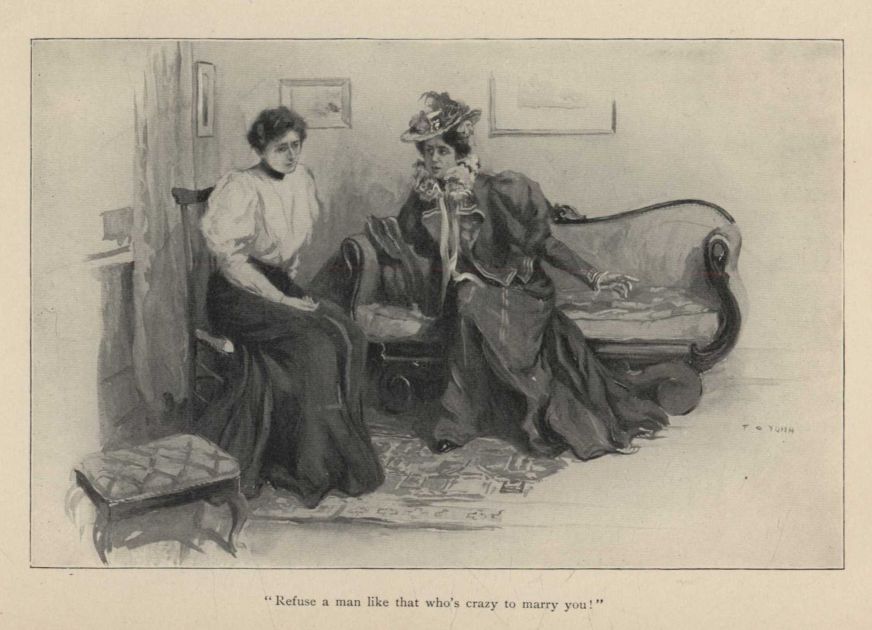
"It's contrary to the law of my church, which forbids a woman who has a husband living from marrying again."
"But he's as good as dead so far as you're concerned," interjected Loretta.
Without heeding this pertinent remark Constance proceeded to state the so-called spiritual objections with succinct fervor. She felt the desire to reiterate aloud their complete potency.
Loretta listened closely, but with obvious bewilderment and disdain. Even now she seemed unable to credit her companion's announcement as genuine.
"If your clergyman won't marry you, get a justice of the peace. That's just as good."
Constance shook her head. "From my point of view remarriage would be sinful—impure."
Loretta leaned back on the lounge where she was sitting and clasped her hands behind her head. She appeared to be at a loss to find words to express her feelings.
"And you mean to tell me that you've let that man go—the man you love and who'd give you a fine home and be a fond husband to you—for such a reason as that?"
"Yes," answered Constance, stanchly.
"Then all I can say is you didn't deserve such luck. He's too good for you."
Loretta's conviction went so deep that she had become grave, and, so to speak, dignified in her language.
"He's too good for any woman I know," Constance felt impelled to assert. "But for both our sakes, all the same, it was my duty not to marry him. Mr. Perry knows my reasons and—and respects them."
Constance had wondered many times what her lover's present emotions were, but she chose to take no less than this for granted.
"If he loves you as much as I guess he does, he must just hate you, Constance Stuart. My! Think of throwing up a chance like that." Then suddenly a thought occurred to Loretta, and leaning forward she asked tensely, "Does she know?"
The suggestion of resentment on Gordon's part had been to Constance like a dash of scalding water. The question just put served as a restorative.
"Mrs. Wilson? It was she who advised me to let him go. She agrees with me entirely."
Loretta looked astonished and disappointed; then she frowned.
"Just because you've been married once? Not if you got a divorce?"
"Never, so long as my husband is alive and we are liable to meet in the flesh."
Constance realized that her phraseology had a clerical sound; still she felt that she had a right to the entire arsenal of the church.
"And she believes that too, does she? Believes that it would be wicked for a good looking, hard-working girl, whose husband had left her in the lurch, and may be dead for all she knows or cares, to get a divorce and marry again? And that's the Church? My! but it's the crankiest thing I ever heard. That's the sort of thing which sets the common folk who use their wits against religion. There's no sense in it. She's a widow; would she refuse to marry again if the right man came along?"
"That's different," said Constance, perceiving that an answer was expected.
"And what's the difference? It's all right to be spliced to another man in three months after the breath is out of the first one's body, as some of them do, but impure to marry again so long as the husband who has dragged you round by the hair of your head is liable to drop in. If it comes to that, and marriages are made in heaven, as the clergy say, what do the dead husbands and wives think about second marriages anyway? I'd be real jealous if I were dead."
"The Church has thought it all out and come to the conclusion that it is the best rule for human society."
Constance spoke with hurried emphasis, hoping to terminate the discussion. She did not desire to argue the matter with Loretta; at the same time she recognized the familiar pertinency of the allusions to dead husbands and wives.
Loretta detected Constance's nervous agitation. "I hate to think it of her," she cried with sudden illumination, "but I believe she has badgered you into it!"
"Nothing of the kind, Loretta. It's my own free choice. Mrs. Wilson simply made clear to me the Church's side."
Loretta sneered. "It's downright cruel, that's what I call it. The Church's side! The Church doesn't recognize divorce, but there's always been ways for the rich—the folk with pull, kings and such—to get the marriages they were tired of pronounced void from the beginning. It was only necessary to show that they had been god-parents to the same child, or were twenty-fifth cousins by affinity, as it's called, or some such tomfoolery. It didn't take Napoleon long when he wished to get rid of Josephine to induce the Catholic Church to declare that they never had been married, though it was a good church wedding before a cardinal. Pshaw! The Church has fooled the people long enough. What we want is justice and common sense."
That same cry for justice, that same appeal to common sense; and from what very different lips! Yet though Constance shrank from the coarseness of the exposition, somehow the naked saliency of the argument was more persuasive than Gordon's subtler plea. Her instinctive compassion for the masses asserted itself. The fact that Loretta should have touched at once the crucial point which Gordon's trained intelligence had emphasized struck her forcibly. And after all, what was she herself but one of the common people? But she said:
"The scandal in Mrs. Wilson's own family has been the greatest grief and mortification to her."
Loretta bridled. "Yes, and when Mrs. Waldo gets her divorce in South Dakota and comes back married again, won't everybody she cares about receive her just the same? In six months she'll be staying in Benham and her mother'll be inviting all the other multi-millionaires to meet her at a big blow-out; see if she don't." She paused, and her eyes took on a crafty look. "What do you suppose she'd say if I were to go back to my man?"
Constance sat bolt upright from apprehension. Loretta's air of mystery, which was accentuated by a whispering tone, conveyed to her the true import of the intimation. Yet she would not seem to understand.
"What do you mean, Loretta?"
"My man; the father of my child. He was in town the other day. He has found out where I am and has been plaguing me to go back to him."
"Did he ask you to marry him?" asked Constance, seeking that solution.
"That's not what he meant. But I've thought of that too—on baby's account. I guess he would if I were set on it. But we're both doing well single, and—" She stopped and laughed sarcastically—"and supposing we didn't like each other and got divorced, I could never marry anyone else."
"No matter about that now, Loretta. Do you love him still?"
"It's love that makes the world go round. There isn't much else worth living for, I guess." She pursed her lips after this enigmatical answer, then suddenly relaxed them in an impetuous outburst. "One thing's sure, Constance Stuart, you don't know what love is or you'd never have sent away Gordon Perry, Esq., Counsellor-at-Law."
"Don't, Loretta," said Constance, imploringly.
"It's true."
"I love him with all my heart. You don't understand."
"Pish! If you'd loved him as a woman loves a man when she does love him, you'd have been married before this. Why, there's times when I feel like going right back to my man, and I'm not what you'd call more than moderately fond of him. If it hadn't been that I didn't want to disappoint her—and you—I'd have done it before this. Now the next time he comes back, I shouldn't wonder if I did." She leaned back again on the sofa with her hands behind her head nodding doggedly, and nursing her intention.
Constance, appalled, went over and sat down beside her. "Oh, but you mustn't, you mustn't! Go to-morrow to see Mrs. Wilson and talk with her. She will give you strength and convince you that unless you marry him such a course would be suicide, a cruel wrong to yourself, dear—you who have done so well."
"I've kept straight chiefly to suit her; but I don't like what she has done to you."
"Please leave me and my affairs out of the question, Loretta. They have nothing to do with your preserving your own self-respect."
"I don't know about that. If she's just like the rest; if that's a sample of the religion and the beauty she prides herself on, I've been fooled, you've been fooled. What's the use of being respectable if, when true love does come, a poor, deserted woman is robbed of it for such a reason as that?"
It surprised Constance that Loretta should take sides so strongly, and she perceived that the girl must have a tenderer feeling for her than she had supposed. This made her all the more anxious to protect her.
"I value your sympathy very much, dear, but it won't help me—it'll only make me dreadfully unhappy if you do wrong."
Loretta looked at her keenly. Then she took out a small phial, similar to that which Constance had observed on another occasion, and swallowed a pellet ostentatiously.
"If you are troubled with the blues these are the things to take. They brace one splendid."
"What are they, Loretta?"
"If you promise to take some right along, I'll tell you." But she evidently was not eager to disclose her secret, for she promptly replaced the phial in her pocket and said, "I'll make a bargain with you, Constance. If you'll marry Gordon Perry, Esq., Counsellor-at-Law, I'll keep straight."
Constance flushed. "But I can't, dear. It's all settled."
"He will come back if you only whistle. You know that."
Constance let her eyes fall. She feared that it was too true. But she could not afford to be pensive. She must be both resolute and resourceful, for the future of this erring sister seemed to be hanging in the balance.
"I can never marry Mr. Perry, Loretta. But——"
"I thought better things of you, Constance. Oh! well then I'll go back to my man."
"If you should do such a thing it would break Mrs. Wilson's heart."
This seemed to Constance in her perplexity the most hopeful appeal, and she was right, for Loretta was obviously impressed by the remark.
"Would it?" she asked. She looked down at her large hands and let them rise and fall in her lap like one nervously touched by sentiment.
"I do not know of anything which would distress her more," continued Constance.
After a moment Loretta said, "He's away now. He won't be on this route again for another four months. So there isn't any danger just yet." She shrugged her shoulders. Then she rose, adding, "I guess I'll go to bed," which was plainly an intimation that this was to be the limit of her present concession.
Constance was relieved, not only that immediate danger was averted, but that the tie which bound Loretta to Mrs. Wilson, however temporarily strained, was still strong and compelling. She rejoiced to think that they were warned, so that they could now keep a closer watch and leave nothing undone to save her from further degeneration. She dismissed the subject by making some inquiries in regard to Loretta's last case. The girl's responses were to the point and brisk, but she did not resume her seat, and evidently had no intention of remaining. Presently she got as far as the door, where she stood discussing for a few moments with her hand on the knob. When at last she opened it and was in the act of departing, she turned her head and uttered this parting shot, which indicated what was still uppermost in her thoughts:
"I guess that you never really loved Gordon Perry, Esq., Counsellor-at-Law, or you couldn't have done it."
This taunt lingered in Constance's mind, though she denied the impeachment to herself. Was it not indeed true, as Loretta said, that it is love which makes the world go round? Only for the sake of righteousness was she justified as a healthy, breathing woman in stifling this instinct. If Loretta in the future were to marry some one other than the father of her child both the Church and Mrs. Wilson would rejoice because the mere ceremony of marriage had been lacking in the first relation; yet she herself was forbidden to marry the man she loved because she was tied to a faithless husband by the mere husk of marriage.
She saw Loretta but two or three times before her convalescence was complete and she had assumed her duties as Mrs. Wilson's secretary, for Loretta was sent for again shortly, and was only at home in the interval between her engagements. But Constance gave Mrs. Wilson forthwith an inkling of Loretta's state of mind, though she tried to believe that the girl's wanton threat was a mere passing ebullition due to resentment of her reason for refusing Gordon. Nevertheless she did not altogether like the expression of her eyes; it suggested excitement, and predominance of that boldness which, though typical, had been much in abeyance during the period of her regeneration. She remembered, too, the bottle of pellets, which indicated that she was taking some drug. So, though she could not believe that she was seriously considering such an abhorrent proceeding, she felt it her duty to put Mrs. Wilson on her guard. They both agreed, however, that the culprit must be handled gingerly and not too much made of the occurrence. Accordingly Mrs. Wilson straightway wrote to Loretta, but her letter was a missive of interest and encouragement, not of reproach or alarm. She deplored in it that she had lately seen but little of her ward, owing to the latter's popularity as a nurse, and urged her to call on her at the first opportunity. She sent her also one or two pretty toilet articles for herself and some new frocks for her baby. Constance said nothing, however, to Mrs. Wilson as to Loretta's attitude toward the church regarding remarriage after divorce, for she could not bear to renew the subject with her patroness. It was settled forever, and her spirit craved peace.
XXIV
It was a great relief to Constance when at last she was once more self-supporting. Her eyes appeared to be as strong as ever, and she found her new work congenial and absorbing. She was not merely Mrs. Wilson's stenographer, but her factotum, expected to exercise a general superintendence over her employer's philanthropic and social concerns, to attend to details, and, through tactful personal interviews, to act as a domestic buffer. The change from the practical severity of a law office, with its dusty shelves of volumes uniformly bound in sheep, its plain furniture and heterogeneous clientage, to her present surroundings was both stimulating and startling. Stimulating because it catered to her yearning for contact with æsthetic influences to have the run of this superb house and to be brought into daily familiar association with all sorts of lavish expenditure in aid of beautiful effects and beneficent purposes. Startling because the true quality of the luxury aimed at was unknown to her until she became a constant eye-witness. In both Mrs. Wilson's and her brother Carleton Howard's establishments a major-domo presided over the purely domestic relations, engaging the numerous servants, and endeavoring to maintain such a competent staff below stairs as to ensure delicious, superabundant food and neat, noiseless service which should emulate as far as possible the automatic impersonality of male and female graven images. All the appointments of the house were captivating; the pantry closets bristled with beautiful cut glass and delicate, superbly decorated china; flowers in great profusion and variety were brought three times a week from Carleton Howard's private nurseries to be tastefully arranged by a maid whose special duty it was to attend to this and to see that those not needed for the decoration of the house should be sent to the destinations indicated by Mrs. Wilson through her secretary—hospitals, friends in affliction or with birthdays, and the like. The spacious bathrooms were lined with artistic tiles; electric lights had been adjusted in the chambers so as to provide perfect facilities for reading in bed; once a week an attendant called to wind all the clocks in the house. Mrs. Wilson's personal appetite was not keen, yet exacting. Her breakfast was served in her own room, and, unless she had company, her other meals were apt to be slight in substance, but were invariably of a delicate, distinguished character as regards appearance if not ingredients. Her steward had instructions that the dinner table should be garnished with flowers and the most luscious specimens of the fruits of the season, though she were alone. When she had guests these effects were amplified, and her mind was constantly on the alert to provide novelty for her entertainments. During the first season of Constance's employment, music between the courses—a harpist, a quartette of violinists, an orchestra—happened to be the favorite special feature of her dinner parties.
That first winter Mrs. Wilson had the influenza and went to Florida for a month for recuperation, carrying her secretary with her. The journey was made in Mr. Howard's private car, and the suite which they occupied at the elaborate modern hotel where they stopped was the most select to be obtained. The spectacle at this winter resort for restless multi-millionaires was another bewildering experience for Constance. The display of toilets and diamonds at night in the vast ornate dining-room was dazzling and almost grotesque in its competitive features. Mrs. Wilson preserved her distinction by a rich simplicity of costume. She had left her most striking gowns at home, and she let Constance perceive that her sensibilities took umbrage at this public cockatoo emulation of wealth. She was even conspicuously simple in regard to her food, as though she wished to shun unmistakably being confounded with the conglomeration of socially aspiring patrons, whose antics jarred on her conceptions of beauty. But Constance could not avoid the reflection that profuse, if not prodigal, expenditure was typical of her companion no less than of them, and that the distinction was simply one of taste. What impressed her was that so many people in the land had merely to sign a check to command what they desired, and that the mania for novel and special comforts, and unique or gorgeous possessions was in the air. On their way home Mrs. Wilson spent a few days in New York shopping, having directed Constance to communicate in advance with several dealers whose business it was to dispose of artistic masterpieces. She bought two pictures at a cost of twenty-five thousand dollars apiece, an antique collar of pearls, and several minor treasures. At the same time she took advantage of the occasion to grant an interview to two persons, a man and a woman, who had solicited her aid in behalf of separate educational charities. To each of these enterprises, after proper consideration, she sent her subscription for five thousand dollars.
Undoubtedly the chief purpose of Mrs. Wilson's stay in New York was to see her daughter. After a three months' residence in South Dakota, Lucille had obtained a divorce on the ground of cruelty, and had promptly married her admirer, Bradbury Nicholson, son of the president of the Chemical Trust. Mrs. Wilson had declined to attend the wedding, which took place in Sioux City three days after the final decree had been entered—a very quiet affair. Lucille had notified her mother that it was to occur, but was not surprised that she did not take the journey. She and her husband had spent four months in Europe to let people get accustomed to the idea that she was no longer Mrs. Clarence Waldo, and recently they had taken up their residence in New York. Her new husband had three millions of his own, and, as Lucille complacently expressed the situation to her mother, society had received them exactly as if nothing had happened.
"I told you how it would be, Mamma," she said. "Everybody understands that Clarence and I were mismated. I am radiantly happy, and, as for your granddaughter, she could not be fonder of Bradbury if he were her own father. He has bought a thousand dollar pony for her. All the Nicholson connection and my old friends have been giving us dinners, which shows that we can't be disapproved of very strongly."
Lucille certainly looked in the best spirits when she came to see her mother. She was exquisitely dressed, and her equipage, which stood at the door during her visit, was in the height of fastidious fashion. So far as externals were concerned, it was manifest that she was making good her promise to be more conservative and decorous. Mrs. Wilson saw fit to mark her abhorrence of her daughter's course by going to a hotel instead of to Lucille's large house on Fifth Avenue. She was not willing to stay under her new son-in-law's roof, but how could she avoid making his acquaintance and dining with him? A definite breach with her only child was out of the question, as she had previously realized; besides her grand-daughter demanded now more than ever her oversight and affection. Consequently on the second day she dined at the new establishment, and consented later to attend a dinner party which was given in her honor, though Lucille kept that compliment from her mother's knowledge until the evening arrived. She had taken pains to secure the most socially distinguished and interesting people of her acquaintance, and the affair was alluded to in the newspapers as one of the most brilliant festivities of the winter. A leopard cannot altogether change its spots, and Lucille's ruling passion was still horses, but she desired to show her mother that she had genuinely improved; so it happened that after the guests had returned to the drawing-room an organ-grinder accompanied by a pleasing black-eyed young woman, both in fresh, picturesque Italian attire, were ushered in. They proved to be no less than two high-priced artists from the grand opera, who, after a few preliminary capers to keep up the illusion, sang thrilling duets and solos. When they had finished came an additional surprise in that the organ was shown to be partially hollow and to contain a collection of enamelled bonbonières which were passed on trays by the servants among the delighted guests. After the company had gone mother and daughter had an intimate talk, in the course of which Lucille, though making no apologies, volunteered the statement that she in common with half a dozen other women of her acquaintance had decided to go into retirement in one of the church sisterhoods during the period of Lent. She explained that the sisters of her new husband, who had high church sympathies, were preparing to do the same and that the project appealed to her. Mrs. Wilson was electrified. It was on her lips to ask Lucille how she could reconcile this new departure with her hasty second marriage, but she shrank from seeming to discourage what might be an awakening of faith or even of æsthetic vitality in her daughter's heart. Still, though she rejoiced in Lucille's apparent happiness and prosperity, she felt stunned at the failure of Providence to vindicate its own just workings. Much as she desired in the abstract that her daughter should be blessed, how was it that so flagrant a violation of the eternal proprieties could result not merely in worldly advancement, but an attractive home? For there was no denying that Bradbury Nicholson was a far more engaging man than his predecessor, and that he and Lucille were at present highly sympathetic in their relations. Would the harmony last? It ought not to, according to spiritual reasoning. And yet on the surface the dire experiment had proved a success and there were indications that permanent domestic joys and stability were likely to be the outcome of what she considered disgrace.
Mrs. Wilson did not condescend to refer to her daughter's immediate past, but when she found that Lucille was brimming over with fresh tidings concerning the other offenders, Clarence Waldo and Paul's wife, she suffered her to unbosom herself. This news was consoling to her from the standpoint of ethical justice. As she already was aware, Mrs. Paul Howard, obdurate in her impatience of delay, had obtained a divorce on the ground of cruelty in Nebraska after six months, the statutory period necessary to acquire residence, and had then married Clarence Waldo. Now rumor reported that the newly wedded couple, who had been spending the present winter in Southern California for the benefit of the second Mrs. Waldo's bronchial tubes, had not hit it off well together, to quote Lucille, and were likely to try again. For according to the stories of people just from Los Angeles she was permitting a Congressman from California, the owner of large silver mines, to dance constant attendance on her, and her husband, quite out of conceit of her to all appearances, was solacing himself with a pretty widow from Connecticut.
"Of course," added Lucille, contemplatively, "if they really intend to obtain a divorce in order to marry again, it will be convenient for them that they happen to be in California, as that is another of the states where one can acquire a legal residence in six months."
Mrs. Wilson's disgust was tempered by a fierce sense of triumph. She was glad to know the facts, but she did not wish to talk about them, especially as she was far from clear in her mind that there was any logical distinction to be drawn between the conduct of these voluptuaries and that of her own child. She tossed her head as much as to say that she desired to drop the unsavory topic. But Lucille was so far blind to any similarity between the cases, or else so far content with the contrast in results between the two remarriages, that she continued in the same vein, which was pensive rather than critical.
"I am thankful that Paul insisted on keeping Helen as a condition of not opposing his wife's Nebraska libel, for it would have been rather trying for the poor child to get used to three fathers in less than three years."
Mrs. Wilson felt like choking. The unpleasant picture intensified her repulsion; yet she knew that speech would be no relief for she would not find Lucille properly sympathetic. Just at that moment her granddaughter came prancing into the room, and ran to her. Mrs. Wilson clasped her to her breast as a mute outlet for her emotions, for she could not help remembering that this child also had two fathers, and what was the difference but one of degree? Yet here was its mother smiling in her face, seemingly without qualms and perfectly happy. How was this peace of mind to be reconciled with the eternal fitness of things?
Meanwhile Lucille was saying, "Tell me about Paul, Mamma. How does he take it? What is he doing?"
Mrs. Wilson sighed. "He was terribly cut up, of course," she answered, gravely. "He feels keenly the family disgrace." She paused intentionally to let the words sink in. "Fortunately for him, he has been invited to run for Congress—that is, if he can get the nomination. It seems there are several candidates, but your uncle tells me Paul has the party organization behind him. The caucuses for delegates do not meet until the early autumn, and in the meantime he hopes to make sufficient friends in the district, which includes some of the small outlying country towns as well as certain wards in Benham."
"It would be nice to have Paul at Washington, for he might be able to get the duties taken off so that our trunks wouldn't be examined when we come from Europe. I suppose it will cost him a lot of money to be elected."
"I have not heard so," said her mother, stiffly. Though Mrs. Wilson's statement was true, certain allusions in her presence by Paul and his father had aroused the suspicion in her mind that elaborate plans to secure the necessary number of delegates were already being laid. The use of money to carry elections was a public evil which she heartily deplored, and which she was loth to believe would be tolerated in her own family.
"He can afford it anyway," continued Lucille, disregarding the disclaimer.
Mrs. Wilson changed the subject. "He was also much absorbed when I left in his new automobile."
Lucille clapped her hands. "A red devil?"
"That name describes its appearance admirably. It is the first one of the kind in Benham, and naturally has excited much attention."
"Bradbury has promised me one for a birthday present."
"I have not ridden with Paul yet," said Mrs. Wilson a little wearily, for the enthusiasm elicited appeared to her disproportionate to the theme. "He has invited me once or twice, but somehow the spirit has failed me."
Lucille gasped. "It's the greatest fun on earth, Mamma. They annihilate time and distance, and you feel with the rush and the wind in your face as though you were queen of the earth. If mine runs well we intend to tour through the continent this summer. Fancy speeding from one capital of Europe to another in a few hours!" She paused, then after a moment's reverie continued, as though stating a really interesting sociological conclusion, "I think it possible, Mamma, that if automobiles had been invented earlier, Clarence and I might not have bored each other. Which wouldn't have suited me at all," she added, "for Bradbury is a thousand times nicer."
Mrs. Wilson was painfully conscious that Bradbury was infinitely nicer, which increased the difficulties in the way of replying to this incongruous observation. She decided to ignore it as essentially flippant, and she rose to go. It was the nearest approach to a review of the past which either had made during her stay in New York.
She hoped that Constance would not appreciate how completely Lucille had rehabilitated herself in a worldly sense, and she tried to counteract the effect of the evidence by letting fall a remark now and again to show that the memory of her daughter's conduct was still a thorn in her side. As a mother she could not but be thankful that her daughter was far happier as Mrs. Bradbury Nicholson than she had been as Mrs. Clarence Waldo. At the same time her being so was a blow to the theory that the exchange of one husband for another ought to end and ordinarily does end in misery; or, in other words, that divorced people who marry again should be and are apt to be unhappy. To be sure, it was early to judge, and the happiness might not last; and at best it should be regarded as a sporadic case of contradiction, a merciful exception to the general rule; but she was glad when the day arrived for removing Constance from the sphere of this influence, fearing perhaps some pointed question from her secretary which would invite her to explain how it was that a person who had deserved so little to be happy as Lucille should have found divorce and remarriage a blessing, if the whole proceeding in deserving cases was fundamentally opposed to the social well-being of civilization. As an antidote, Mrs. Wilson took pains to enlighten her as to the rumored depravity of Clarence Waldo and the late Mrs. Howard.
But Constance asked aloud no such question. Yet necessarily she perceived that Lucille was in the best of spirits, and apparently had suffered no loss of position by her conduct. Constance did not need, however, any reminder from Mrs. Wilson that the late Mrs. Waldo was not a person of the finest sensibilities; moreover she considered the point as definitely settled for herself. Nevertheless as a spectator, if no more, she noted the circumstance that Lucille was already a different woman in consequence of her second marriage, and she detected her reason challenging her conscience with the inquiry which Mrs. Wilson had dreaded, how it appeared that the world would have been better off if Lucille had simply left the husband who had been faithless to her, and remained single instead of marrying. Constance was merely collecting evidence, as it were. All was over between her and Gordon, but as an intelligent, sentient human being she had no intention of playing the ostrich, but insisted on maintaining an open mind.
It was now nearly a year since she had conversed with Gordon. Her sentence had been perpetual banishment from his presence since the fateful Sunday when they had parted. He had written to her that he could not bear to resume the old relation, for now that they knew they had been lovers in disguise, it could not be the old relation. He had declared that the best thing for them both was never to meet, and she had been forced to accept his decision, for he had not been to see her since. Yet he had mitigated the rigor of her punishment, for she chose to regard it as such, by occasional letters, written at irregular intervals, letters which let her know beyond the shadow of a doubt that the love he cherished for her was strong and deep as ever. He sent her beautiful flowers on Christmas and her birthday, and in writing to her he told her briefly whatever of special interest he had been doing. Precious as these communications were to Constance, she was of several minds as to whether to answer them. Her impulse always was to reply at once, if only that she might draw forth another letter; but sometimes her scruples forced her not to let him see how much she cared and to feign indifference by silence. She knew, as Loretta said, that she had only to whistle and he would come to her, and she felt that it would be cruel to give him the smallest encouragement to believe that she could ever alter her decision. This being so, she argued that he ought to marry; he must forget her and chose someone else. She tried to believe that she would rejoice to hear that he was engaged to another woman, but when her thoughts got running in this channel she was apt to break down and realize that she had been trying to deceive herself. In such moments of revulsion she now and then would throw her scruples to the winds and write him about herself and her doings. On two occasions she had suddenly decided that it was necessary for her to see him again; see him without his seeing her. Consequently she had frequented a spot down-town where she knew he would pass, and each time had been rewarded by a close and unobserved glimpse of his dear features. These glimpses, the letters, and the flowers were the bright shining milestones along the itinerary of her much occupied life. Busy and interested as she was in her employment, it sometimes seemed to her that she walked in a trance in the intervals between some word or sign from him.
The flowers were the bright, shining milestone.
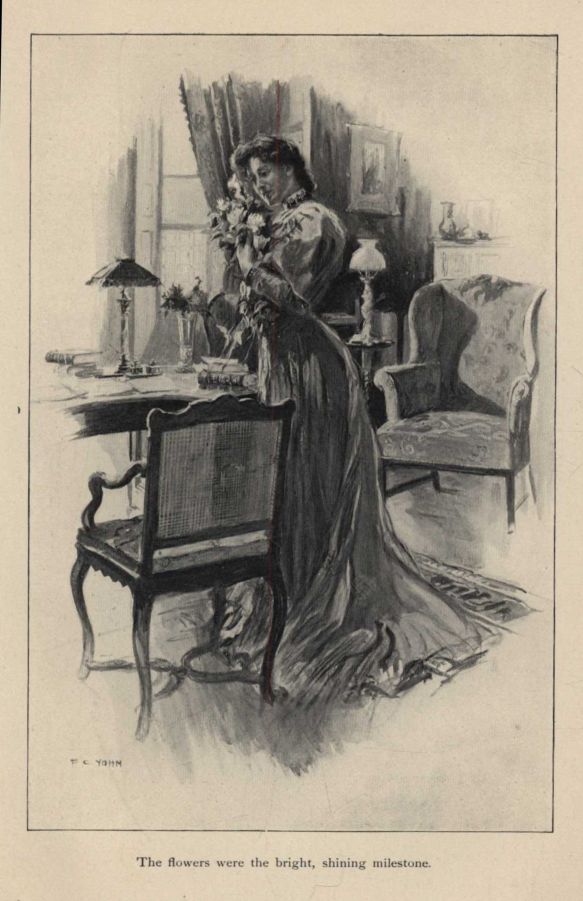
Delighted as she had been to travel, to see such a diverse panorama of national life as her trip to Florida and New York afforded, she was glad to find herself again at home. She had not heard from Gordon during her absence, and she was eager to see the Benham newspapers again in order to ascertain what he had been doing in his new capacity as a legislator. He had written to her the preceding autumn that he had decided to allow the use of his name as a candidate for the State Assembly, and subsequently he had been elected. Before her departure in the early days of the session, she had kept her eyes and ears on the alert for public mention of him, but had been informed that this was the period for committee conferences and that the opportunity for debate would come after the bills had been framed and were before the house. Constance knew that Gordon had the strong support of the Citizens' Club in his canvass, that Hall Collins, Ernest Bent and others affiliated with that organization had conducted rallies in his behalf, and that he was expected to favor progressive legislation. There were certain philanthropic measures in which Mrs. Wilson was interested also before the Assembly, and Constance had twice already prepared letters from her employer to Gordon in reference to these, which was another slight opportunity for keeping in touch with him.
Shortly after Mrs. Wilson's return from her vacation it happened that Paul invited her again to ride in his automobile. Recalling Lucille's enthusiasm, and having been partial all her life to new æsthetic sensations, she concluded to test the exhilaration described by those who doted on these machines. The afternoon chosen was one of those days in the early spring when sky and wind combine to simulate the balminess of summer. It was a satisfaction for Paul to have his aunt beside him both because he admired her and because, seeing that he regarded her as what he called a true sport at bottom, he felt confident that she had only to experience the sensation of speed to become an enthusiast like himself. Therefore, he let his red devil show what it could do, in the hope of carrying her by storm. Equipped with suitable wraps and a pair of goggles, Mrs. Wilson found the process of whirling through the country at a breakneck pace, by the mere compression of a lever, a weird and rather magnetic ordeal. These were the adjectives which she employed to express her gratification to her nephew. She was glad to have tried it, but in her secret soul she had grave doubts if it were the sort of thing she liked. Nevertheless she did her best to appear delighted, for she had in mind to drop a few words of warning in Paul's ear to the effect that it was incumbent on men of his class in the community to preserve their self-respect in the matter of electioneering as an example to the country at large. In the intervals when Paul moderated the speed she endeavored to convey to him clearly but not too concretely the substance of her solicitude. She let him realize that she had him and his campaign in mind, but that she did not intend to meddle beyond the limit of emphasizing a principle unless he were to ask her advice. Paul listened to what she had to say with evident interest, and without interruption. He even let his machine crawl along so as to get the complete benefit of her exposition. When she had set forth her views she turned toward him and said in conclusion, by way of showing that she made no charges but simply desired to put him on his guard: