Front matter (continued 3)
A. B. (Alexander Bertram) Lindsay translation
In the middle of July Stössel inspected the advanced positions we were holding—at least, he visited the left flank, commanded by Fock. This was only natural, for the mere fact of Smirnoff and Kondratenko evincing interest on the right would have been enough to make him ignore it. I assisted at this visit, and was personally assured by Stössel that the attack would certainly fall on the left, while the enemy would merely demonstrate on the right. This inspection was indeed a farce, for all knew that, had Stössel given any orders, which he did not, they would not have been carried out.
We went along the Shininsky Ridge, and at 2 p.m. reached the howitzer battery. It consisted of two howitzers on wooden platforms. On one side was pitched a tent for the men, on the other one for the officer. The heat was unbearable, and not a breath of wind fanned the air. Kuen-san stood just above us, and with glasses we could see what was being done by the enemy. After a few words with his Chief of the Staff, Kondratenko came up to Stössel and, pointing out the desirability of delaying the enemy's work on that side, suggested that a few shells should occasionally be dropped on to them. Stössel agreed and gave the order accordingly; but no sooner had the men begun to load than the General came up, and rudely telling Kondratenko that he was in command there, persuaded Stössel to cancel the order. The incident was enlightening. We moved on, Stössel remarking on more than one occasion that bomb-proofs were necessary, and receiving the invariable reply that they were being made. None, however, were visible, nor had the fire trenches any sort of overhead cover.
Gradually we made our way homewards, back to the railway, and then by train to Port Arthur, to resume again our daily life, and to read the instructive orders in which Stössel gave us the benefit of his experience at the front!
CHAPTER XX
THE ATTACK ON GREEN HILLS
On the morning of July 24 it was rumoured in the town that our best destroyer, the Lieutenant Burakoff, and another, the Boevoy, had been torpedoed during the night. The destruction of the former was particularly disheartening, as she had made several dashes to Yinchow and back, and been of the greatest service, and might have done much more for us still in the hands of her commander, Lieutenant Borodatoff, a most brilliant officer and the pride of the fleet, for she was the best and fastest of her type. The employment of destroyers for night duty was quite useless, and resulted in nothing except the fatigue of the men and the loss of the boats, for on foggy nights the enemy lay in wait for them.
Our patrols on the land-front used now to find proclamations lying about on the ground. These proclamations, written in bad Russian, were left by the Japanese outposts for our consumption, and were deliberate attempts to work on the moral of the men, by enumerating our defeats in Manchuria and reverting to political events in Russia.
On July 25 we on the staff of Colonel Semenoff, who was in command of the right section of the advanced defences, were visited by General Kondratenko. After tea conversation turned on the prospects for the following day. The General, with his elbows on the table, and stirring his tea with a spoon, smiled, and his small expressive eyes lit up. He looked at the speakers and said in his quiet way:
'The 26th is always a fatal date for us in Arthur. On May 26 we abandoned Kinchou; on June 26 we lost Kuen-san; and apparently to-morrow will not be uninteresting. We mustn't forget that it is a great Japanese holiday—the "Chrysanthemum." They are sure to want to do something to please the Mikado.'
'Well, sir, what can be worse than having to remain on the defensive? We ought to attack; with the attacker lies the initiative. And you sit and wait, trying to guess when they will attack. It is an awful state of affairs,' said the keen, impulsive Semenoff.
'Yes; the rôle of the defender is none of the easiest or most advantageous—especially in conditions like ours. Many great errors have been committed, and there is heavy work ahead. To-morrow there will be a decisive and desperate battle, and we must hold our ground. By the way, Semenoff, have you given orders for the outposts to be strengthened, and warned all officers to expect an attack to-morrow?'
'Yes, sir.'
'The reserve will arrive to-night. The Commandant has consented to give us some companies from the reserve battalion, and they must bivouac here in the valley. To-morrow the general reserve will be under your orders. We have very few men, and so you must be particularly careful and economical with it. We must shell Kuen-san well to-day: we don't yet know if the enemy's guns have got into position or not; but in any case it has a telephone and will be their chief observing station, and the battle will be directed from there. Perhaps they'll reply to our shells, and so unmask the position of their guns.'
When he left I accompanied him, while Semenoff, after conducting us to the Lunwantun Valley, went on to the outpost line. We finally arrived at the foot of Rocky Ridge, on which was the howitzer section. Kondratenko was evidently anxious, and was astounded on reaching this place to find that the howitzers had been run down below. 'Why is this? I sent orders that I would shell Kuen-san to-day. Who has altered them?' he asked angrily.
It seemed that Fock had had the howitzers run down. Kondratenko gave instructions for them to be brought back immediately; but while they were being dragged up the very steep ascent it began to get dark, and a cloud settled on the top of Kuen-san. By the time they had been got into position again half of the hill was in cloud, which concealed the enemy's works. It was now useless to attempt to fire. Kondratenko was furious, but did not show it in the presence of the various officers, and as it was now rapidly getting dark, we started to return. On the way back I for the first time saw him angry, and he used no measured language with regard to General Fock's interference. After giving his final instructions to Semenoff, he went back to Port Arthur. Semenoff then expressed his opinion that the idea of not holding on as long as possible to the advanced positions was absurd, though it was common.
He was quite right. For some time before the battle of July 26 I often heard the opinion expressed by officers that a dogged defence of the advanced positions would be detrimental to the ultimate defence of the Fortress. It seemed more and more as if the general inclination was to sit tight in the permanent works as being the easiest course. Having little knowledge as to the state of our bomb-proofs or of their durability, people drew a most rosy picture of the defence of the actual Fortress under a strict blockade. They thought that the bomb-proofs would save them. They compared the defence with that of Sevastopol, but unfortunately forgot that guns and shells are now somewhat different. They forgot that Sevastopol was in direct and unbroken communication with Russia, where the sick could be sent and whence reinforcements could come, and they forgot that, even under these favourable conditions, Sevastopol eventually fell into the enemy's hands. Port Arthur, completely isolated from the world, with a minimum reserve of provisions, ammunition, and men, and with incompleted works, was a trap for the army and fleet. People did not realize that the longer we held the enemy on the advanced positions, the longer time we should have to do in Arthur itself what we had left undone.
Next morning, just as a few men were moving about amongst the horse lines and the camp was beginning to wake up, a distant boom was heard in the direction of Oytse-laza Hill. I looked at my watch: it was past half-past six. After a few moments we heard a second report, somewhat nearer, then a third and a fourth, each louder and nearer, and shells hurtled through the air and burst quite close to our tents. In a very short time the bivouacs had disappeared, for the majority of us had lain down without undressing, and the cannonade started all along the line. The day and the fight of the 26th had begun. The fire of the enemy's bigger guns, the shells of which were loaded with mélinite, was chiefly concentrated on the batteries under Prince Chkheydsey and Skridloff, and covered the tops of our hills with smoke, while the field and mountain guns kept up a hot shrapnel fire on the infantry trenches, preparing the way for an attack. Our own batteries, which were well concealed, replied steadily. At eight o'clock dense columns of Japanese were seen opposite the right wing of Green Hills, and, supported by the fire of their ships, they advanced in the direction of Big Ridge, just as speedily and in as orderly a manner as if at manœuvres. In front, all along the line of Green Hills, crackled incessant and rapidly increasing musketry fire. The infantry attack began. Thinking that our reserves were massed in Lunwantun Valley the enemy endeavoured to shell it and the approaches to it with shrapnel. By nine o'clock the fight grew hotter, and it rained hard. The fire of rifles and guns was at times so mingled that nothing except the rhythmic rat-tat-tat of the machine-guns could be picked out. From all directions down into the valley came orderlies to Colonel Semenoff, who was now at the mouth of the Litangon Valley.
'Ah! They have begun; they all want support at the same time. Look! there are men coming from the right as well as from the left.'
An orderly galloped up with a note; a second, a third, and then a fourth.
'They all ask for reinforcements. Surely, things are not as bad as all this. Here, Zagorovsky, you go off to the left; and Senkevitch, you go to the right. Go off as quickly as you can and find out what has happened.'
Kondratenko now arrived on the scene, and riding up to Semenoff, was, after a short consultation, soon acquainted with the position. Having given general instructions, he went on to the hill in front, into the zone of fire, in order to see for himself the state of affairs. It was now 10 a.m. Suddenly, in the distance, we noticed men in disorder running down from the right peak of Green Hills.
'What are they up to? Surely they are not retiring? Naumenko, do you see them?'
The latter looked through his glasses.
'Yes, sir; they are bolting down the slope of the hill as hard as they can.'
Kondratenko, without answering, put spurs to his horse, and we galloped along the valley; the General was in front, and in his white uniform on his black horse was very conspicuous. We could now clearly see a number of infantry-men against the background of the hill; they were running below in all directions. Kondratenko held up his hand.
'Halt, halt! where are you going to? Where's your officer? What's happened?'
And then up ran an officer, quite blown and scarcely able to speak. On his face were depicted terror and fatigue; he was red from running. His cap was all awry and his hand was shaking.
'Sir, it is awful there—awful. It is impossible to hold on. We have done everything—everything that it is possible, but it is a perfect hell.'
'Where were you?'
'There, sir, there,' he said, pointing.
Meanwhile the men were still bolting down, some helping the wounded, others going by themselves and the bullets were whistling thick over our heads. Big Ridge had been abandoned; High Hill, the extreme point on our right, was, owing to this premature retreat, cut off, but was held by Butusoff with two companies. A portion had been taken by the Japs; they might force their way through the line. The position was critical; in fact, the issue of the fight was in the balance, and the retirement must be stopped immediately. It was only the presence of mind of the General and his personal bravery which saved everything.
'What are you doing? Are you mad? Why, reinforcements are already on their way to help you. Company, follow me!' The men stopped and collected in a group. 'Follow me!'
The men quickly turned back, and those in rear called out to those still further off to return, and they began to double back.
Having collected another company which had just come up, we led them, all puffing and blowing, up the hill. The enemy began firing on us. The General, standing at his full height, and half turning to the enemy, said:
'Men, it is better to die than disgrace yourselves by retreating. Remember that the Tsar and Russia rely upon us. There must be no retirement; we must all die if must be. And now God be with you—advance!'
The men extended, threw themselves down behind the rocks, and opened fire. Just then twenty or so men came dragging along our big clumsy machine-guns, and began to throw up cover for them. The companies who were extended advanced slowly and with great difficulty.
By midday the fight had somewhat abated, and the rattle of musketry was less frequent. The Japanese having seized Big Ridge and a point just opposite us, kept up a broken fire; High Hill was still almost cut off, but Butusoff was obstinately holding his ground with his two Frontier Guard companies. The presence under fire of the General of the Division, his striking coolness and pluck, inspired all with confidence, and improved the spirit of the troops, fatigued by long and constant outpost service. Sitting on one of the spurs behind the hill, sheltered from the bullets, the General was now quietly giving his orders, while Naumenko, on one knee, was writing them down.
'Tell Colonel Semenoff again that he must at once reinforce Butusoff.'
'Very good, sir,' and he wrote it down.
'Sir, Colonel Semenoff sends me to say that he has twice reinforced Colonel Butusoff: the reserves are almost expended,' said Zagorovsky, who had just come up.
'Thank you.'
'Zagorovsky, tell Semenoff to send a section of Petrenko's battery here immediately, at a quick trot. It will be an unpleasant surprise for the enemy on the ridge, and will relieve Butusoff.'
Before the General had finished his orders a mounted scout rode up from the right.
'Sir, Colonel Butusoff orders me to report that he is only holding his own with immense difficulty; the Japanese are climbing up in great strength and firing point-blank.'
'These Frontier Guardsmen are splendid fellows. I know that Butusoff would die rather than retire without orders. Ah, there's the officer commanding the section.'
Semenoff, slightly limping, came up.
'My reserves, sir, are practically finished; we must do a little shuffling, and take the troops from the points where the attack is not being pressed home.'
'Good; I think so too. How well those Frontier Guards are doing!'
'Yes, sir. Butusoff will never retire without orders.'
The guns now galloped along the valley and over the bridge.
'At last. Splendid! now everything will be all right. We will put the fear of God into them on that hill and relieve Butusoff.'
The guns were soon hauled up, and before a quarter of an hour had passed one shot rang out after another. 'Sir,' said the Chief of the Staff, 'you must get behind the hill; the enemy will be opening fire on this at once.' He was right, for in a minute or two shells began to whistle through the air, bursting high up and covering the hill with bullets.
'Things are all right here now; let's go and see what's being done on the left. I want to see General Fock.'
We went down into the valley, mounted our horses and moved off. The road turned sharply to the right, and we came on to Naumoff's battery, which was covering the defile. The enemy's shells were falling all round it. Naumoff had beaten the enemy off during the whole morning, and they were determined, apparently, to destroy his battery; but they found it none too easy, as he had hidden the guns in a fold in the hill. Their shrapnel did not make the slightest impression, and their high explosive shells sang over into the Lunwantun Valley. At last we reached the village of Kodamin, where we found the General in a small Chinese house. The pomp surrounding him—for he had a staff of about fifteen officers and a whole section of orderlies—was a great contrast to the simplicity of the other.
After a frigid greeting and a few formal words Fock went away. We had some food, then rode on to the village of Khodziatun, where Kondratenko had been summoned to attend a Council of War under Stössel. The Generals sat down; Kondratenko stood, a smile on his lips. A quarter of an hour passed, and they were still sitting, and without sign of any conclusion having been reached; apparently Stössel and Fock were determined to get through what they had already decided to do. I looked on the picture with the greatest interest. At last there was a movement; they were going to disperse, and some of them seemed anything but pleased. Coldly saying good-bye, Stössel, with his numerous suite, moved off to the right towards Seven-mile Station, and by four o'clock we were back at the temporary head-quarters of Colonel Semenoff. We found his staff very indignant.
'Our fleet is behaving disgracefully. We have very few guns, and if only our ships had opened a well-directed fire from the sea on the attacking columns, it would have helped us enormously; the Japanese would never take Green Hills.' And so the conversation went on.
As a matter of fact the gunboat division did make an effort to co-operate with the army. It steamed out towards Lunwantun, but was driven back by a superior force; our error lay in our not supporting the gunboats with the guns of our coast batteries. One Japanese cruiser struck a mine and had to be towed away, and one of their gunboats caught fire.
At five o'clock the Japanese gun-fire on Chkheydsey's and Skridloff's batteries became heavier, as did their rifle-fire, and as twilight came on endless columns advanced to the attack. Their gallant infantry came nearer and nearer, but were driven back with appalling losses. They got to within 600 to 800 yards, but were unable to get closer for a decisive assault. Besides our rifle and machine-gun fire from the ridge of Green Hills, the storming columns were under close-range gun-fire from the above-mentioned batteries, the fire of whose guns tore great lines through them, and strewed the valleys and slopes with dead bodies. At 7 p.m. a report came in that High Hill was once more in our possession, but that part of the position was still in the enemy's hands.
'We owe this to Butusoff. If he had retired in the morning we should not have been able to retake the hill. How well his men have behaved! We must relieve them. Send two companies from the reserve at once,' was Kondratenko's comment.
I was sure that the enemy would not repeat the attack that day. Having got to within 600 paces, they spent the night in entrenching and bringing up reserves, so as to be ready for a fresh effort in the morning.
CHAPTER XXI
THE BATTLE CONTINUES
At six o'clock on the 27th, as soon as the morning haze began to lift, the battle was renewed, and the artillery duel commenced. The enemy's fire was concentrated, as on the day before, principally on Prince Chkheydsey's and Skridloff's batteries, which suffered heavily. The morning was bright and sunny, and the light-green hill-slopes, tinted golden by the rays of the early sun, looked anything but a suitable background for the bloody events to come. Our infantry, sitting in their trenches, which, having no head-cover of any sort, were scarcely worthy of the name, awaited the commencement of the assault under a heavy shell-fire. After being directed on to the valley behind us, evidently to search out our reserves, the enemy's gun-fire slackened and rifle-fire commenced; their infantry advanced. But the nearer they came the more they suffered from our two batteries above-mentioned, and they were forced to lie down and entrench. Meanwhile, some of our ships had come out to assist us, but no sooner had they commenced to shell the enemy's lines than, as on the day before, a superior force of the enemy, appearing from behind Kepp Island, compelled them to withdraw to Port Arthur. One result was that the Bayan struck a mine, and was so seriously damaged that she had to be towed into the eastern basin for considerable repairs. At four in the afternoon the enemy's guns again got to work, and at 5 p.m. the fourth attack began. When the sun sank down below the hills, Green Hills still remained in our possession, High Hill and Semaphore Hill were lost; but the Japanese were nearer, and entrenched, ready for further efforts on the following day. So close were they in some places that we could hear their conversation. The day was ours, for we still held Green Hills; but how about the morrow? It was impossible to hold the seven miles length of the right flank with so few guns and men. Our reserves were reduced to one company of sailors and half a company of infantry, and Port Arthur sent no help.
A little later on the Japanese dashed forward and broke through the line—through the very place where Kondratenko had stopped the retirement yesterday. The last of the reserve was immediately sent up, and after some desperate fighting drove the enemy back. But now the reserve was used up, and what were we to do? Naumenko telephoned to Seven-mile Station to say that, to enable us to hold our position to-morrow, more troops must be sent to us; but the reply was vague and unsatisfactory. Through the night the enemy continued to seize and entrench advantageous points, while our men, utterly exhausted from the two days' battle and weakened by heavy losses, were in a bad way.
It seemed, under the circumstances, as if it would be impossible to hold on next day, and therefore best that the rear-guard action we should have to fight should be planned out at once and the successive positions selected. Kondratenko, who with Semenoff was moving about all night from one point to another, recognized this; but no definite reply could be got through the telephone, and he did not like to give orders for a retirement on his own account. At last, within a couple of hours of dawn, Kondratenko had to decide, and he decided that a withdrawal was the only thing to be done. Accordingly, orders were sent to Butusoff to retire, and the route to be followed was told him. These he received only just in time. I had gone to the staff to find out how soon the withdrawal would commence, and found Naumenko still at the telephone, cursing at the impossibility of getting either orders or anything definite. Having other things to see after, he handed me the receiver, saying: 'Tell them we have begun to retire.' I rang and rang, and at last, after about ten minutes, got through:
'General Kondratenko directs me to ask you to tell General Fock that the withdrawal of the right flank has commenced.'
At four o'clock Kondratenko looked at his watch, and calculating that by now ordering the general retirement from Green Hills, Butusoff would have been given time to withdraw from High Hill and occupy a fresh position in rear, he decided to proceed. Just as he was giving the actual order to retire, a note was received from Fock: 'I am withdrawing; you can do as you like.' This masterpiece of military co-operation has been carefully preserved, and is now in Colonel Semenoff's possession.
Under cover of the morning haze, the first and the most difficult part of the retirement was carried out in perfect order and with inconsiderable loss, and our troops took up the new line from the village of Khodziatun to the seashore, along the heights running down into the Lunwantun Valley. The sun then came out and dissipated the mist. Instead of the panic on our part which the enemy expected, they ran up against our infantry holding new positions, and knew that our guns also would open on them from fresh points. During our abandonment of Green Hills they had got into difficulties on our left, for they had tumbled on to our mines. One caused immense loss, blowing a whole crowd of them to pieces, and this, with one or two smaller explosions, put such fear into them that we were able to get our machine-guns away at leisure.
The moment it was light the enemy shelled the positions which yesterday had been occupied by our batteries, but which were now empty. To discover our new gun positions was not so easy; for experience had now taught us how to take advantage of the ground and how to mask our artillery. At 7 a.m. the fresh companies, so urgently asked for during the night, began to arrive from Arthur to cover the further retirement. Bands were playing, and the enemy could not make out whether we were still retiring or were moving to the attack. With us everything was in perfect order; camp kitchens were smoking, and backwards and forwards along the road carts, rickshaws, and stretchers were moving. This was not what the enemy expected after a two-day battle; they thought Kinchou would be repeated.
The further retirement towards Arthur began punctually at 11 a.m., when, covered by a heavy gun and rifle fire, the companies gradually withdrew in perfect order. The enemy pressed our rear-guard hard, but could effect nothing, and by noon we were in sight of the forts. Some of the troops marched direct towards the fortress; others took up the last advanced position on the right flank on the hills of Ta-ku-shan to Sia-gu-shan. Behind Ta-ku-shan commenced the fortress rayon, and the position on it was the last advanced defensive point, and, in connexion with the positions on Wolf's Hills, was of great importance for the further defence of Arthur. Thus did the right flank, under Kondratenko, fight on the 26th and 27th, and retire on July 28. Let us see how General Fock's command—the left flank—fared during these days.
It was noticed on the evening of the 25th that the enemy, in considerable force, was moving across out of Dalny towards this flank. Night passed quietly. Early next morning the Japanese began to press our outposts, which were forced in from the villages of Khumuchino and Khukhaia. The hills all round were enveloped in mist, and from the main position nothing was visible. By 5 a.m. it began to clear, and from Hill 113 it could be seen that the enemy was massing at the village of Sakaiza. Tents were struck and the trenches quickly manned, the cold morning air refreshing the men, tired out with continued outpost work. The mist lifted, and above the horizon of the Pacific Ocean appeared the copper-red segment of the rising sun. The enemy's artillery fire began to develop about 5.30 a.m., and the day's fighting commenced upon Hills 94 and 125, the former being seized by the enemy. We allowed them to mass there, and then swept them off again by our fire from Hill 125. At seven o'clock fifteen companies could be seen advancing in columns in the valley near the village of Khukhaia, close to Upilazy. They were moving towards Hill 125, and as soon as they came under fire they could be seen to extend in successive lines, one battalion remaining in reserve. Having extended, they steadily and quickly advanced to the attack in eleven lines. The distance between their firing-line and Hill 125 quickly decreased. Our men calmly watched them advancing.
'Don't fire without the order,' said the officer in command.
'Wait for the word of command,' repeated the section commanders.
'Twelve hundred!'
'Twelve hundred!' again echoed the section leaders.
The men were dying to fire, but waited quietly, though the shrapnel was screaming over them.
'Section, present—fire!'
'Section, present—fire!'
Volley followed volley, and the machine-guns vomited bullets. The enemy's firing-line could be seen to falter; then the second line melted into it. On they came. Our volleys rang out more frequently, but did not stop the advance; the third line melted into the remnants of the first two. Over our heads shots were screaming and on all sides wounded men were groaning; but the others paid no attention: they heard nothing but
'Section, present—fire!'
The Japanese were now close. As a line began to waver, it was reinforced and carried forward by the next in rear, and so it went on, fresh lines after lines appearing as if there was no end to them. Their firing-line now began to crawl up the hill from all sides. Volleys gave way to 'independent'—crack, crack, crack all round, and the deafening rat-tat-tat of the machine-gun. Now the range was point-blank, the crew of our machine-gun were all down—but—the enemy were repulsed. While they gathered down below for a fresh effort, their guns poured a hail of high-explosive shell on to our trenches, and did their work so well that our trenches were thick with wounded. Their infantry rallied, and again came on in swarms. At noon, though we had only 40 men left out of 150, our men gallantly held their ground. The foe crawled up on all sides; they showed up on the ridge, and dashed in with the bayonet. One of them, mad with fanaticism, got on to the top, shouting: 'How are you, Russkys?'
'Good-bye, Japanese,' was the answer given, as a bayonet was driven through his body, and he was hurled—a flabby mass—over the edge. But now the hill was surrounded on all sides, and it was impossible to hold out much longer. Burnevitch sent for reinforcements, and the men, expecting that they would come every moment, held out for another hour. Notwithstanding their numbers, the enemy could not gain the hill. At last an order was received from Colonel Savitsky 'to retire' on to Height 113. The withdrawal was effected, and then the men worked right through the night to make cover, having during the day learnt the value of good bomb-proofs—if they would not give protection from high-explosive shells, they would at least save them from the splinters.
As soon as it began to get light the outpost line, which had been thrown out the evening before round Hill 113, was called in, and, in expectation of a repetition of the previous day's artillery slaughter, the men were told to take cover in the bomb-proofs. Those destroyed by yesterday's fire had been repaired during the night, for it was recognised that this Hill 113 was the key to the Suantsegan position. At 5 a.m. on the 27th the first shot was fired by a Japanese battery in action behind Inchenzy Station, and the second day's battle had begun. Thinking that we had abandoned the hill, the enemy's infantry advanced to take it, but being hurled back by volleys at close range, they retired to a distance and their guns got to work, and so the bombardment continued till 1 p.m., their gunboats assisting.
The battle for possession of these hills was severe, and the coolness of our men was remarkable. If any of them ran away or if any panic set in, it was the fault of the officers, for any officer whom the men respect and love in peace-time can rely on their steadiness in war. How many Russian officers know and care for their men? For some reason or other they rarely mix among them and know nothing of them or their habits, and bitter are the fruits they reap in war.
In two hours not a vestige of trench remained. The bomb-proofs had kept out the field-gun shells, but were useless against the high explosive. At last an order was received that the little force on Hill 113 was to retire, and taking their dead and wounded, they made their way back under a heavy shrapnel fire. So it went on—the enemy pressing—gradual retirements by us from hill to hill. At night, when the fighting ceased, we were holding the line of Hills 139, 127 and Upilazy. Star after star came out and twinkled in the darkening sky, looking down on the awful shambles, while General Stössel, intoxicated with the 'success' of the two-day battle, congratulated everyone, ordered the bands to play and the troops to cheer, and himself left Seven-mile Station for Arthur to rest.
At a council of war in the evening it was decided to accept battle on the third day. But not a single unit was sent up to the front, the condition of the line on the right on which the real weight of the fighting had fallen was not ascertained. There was no co-ordination as regards command. Each acted independently—Fock on his own account, Kondratenko on his. The only cohesion was expressed in Stössel's categorical order 'to hold on.' That all the 'big wigs' expected us to hold on next day is clear from the fact that when Stössel left after supper that night for Arthur, he made his favourite Savitsky promise to come into Arthur next day to celebrate his 'name's day.' With the departure of the Officer Commanding the District, the staff rested on its laurels and did not worry about arranging for a retirement. The officers commanding independent units and sections of the line had no idea what to do in the event of the unexpected happening, and as our line was spread out for twelve miles in hill country, the unexpected was, to be paradoxical, to be expected. The troops themselves never dreamed that the morning would see a retirement: they were full of confidence and, forgiving him his mistake at Kinchou, still believed in Fock.
Their confidence was entirely misplaced, however, for though the General had agreed at the Council of War to continue fighting on the third day, he did not do so. He suddenly retired.
Kondratenko had been ordered to hold on to the right flank, which, had he been reinforced, he would have done. This sudden retreat of the left therefore might have left him entirely unsupported, and have resulted in the annihilation of his force which would have been taken in flank.
Daybreak came; the telephone rang, and orderlies rode up with the order to retire! This order and the suddenness with which it was delivered stunned the force on the left flank, who so little expected it. Confidence turned to fear, fear to disorder—so much so that the withdrawal turned into a panic-stricken rush to the rear, similar to the retreat to Nangalin.
How different from Kondratenko's orderly retirement!
All round for many miles was now a scene of complete disorder. Units, not having received any orders, retreated as each of their commanding officers thought best. It was a case of every one for himself; and to do full justice to the younger commanders and to the men, I should say that the fact that this retirement did not in all cases turn into a shameful and panic-stricken flight was largely due to them: that things were not worse was also greatly due to the indecision shown by the enemy. Had they energetically pursued, as they did on the right flank, individual commanding officers could not in the surrounding chaos have prevented a panic, and the troops, with Fock at their head, would have passed by Wolf's Hills and have appeared in Arthur that evening. Despite his extreme dislike for the Wolf's Hills position, the enemy's indecision compelled Fock to occupy it, but only temporarily.
When the force reached these hills and saw the trenches, they found a fresh surprise in store for them. They had been previously dug without any care, not on the slopes of the hills which it was necessary to hold, but at their foot: there was no communication between them, and the flat ground in front was densely covered with kiaoling the height of a man. As none of the crop had been cut, large numbers would be able to creep through it unseen, right up to our trenches, and hurling themselves upon us, might drive us out of them. Any retirement, also, would have to be made up the slopes and would be quite exposed. However, there was no time to dig elsewhere when the enemy's attack was expected at any moment. The men were more tired from the disorganization than from fighting or from privations, and on this particular evening the General's depressing influence on his division was more than ever noticeable. Officers and men looked with confidence only towards the Fortress and its forts; they felt that this chaos would end there. The Division knew that it was commanded by a man who was not equal to the task, and who would spoil everything.
By evening all the positions were occupied, and if the divisional staff had happened to mix amongst the bivouacs, and to hear what was being said in the trenches, they would have learned much to their advantage. The orders of the Officer Commanding the District for the night of July 28 were interesting, as showing his absolute ignorance of the situation.
Our troops, now occupying these trenches, such as they were, expected every moment to be attacked, and passed an anxious night. From the Japanese lines we heard nothing, for, true to their usual tactics, the enemy, having thrown out outposts, were resting in calmness and confidence. Their victory on our left flank had been quickly and easily obtained: their leaders were competent and trusted. Indeed, from the time of their landing in the peninsula things had gone without a hitch. At dawn on the 29th they commenced a forward movement. In front of us, taller than a man's height, grew the dense kiaoling: it was so high that it was only by the wavy movement of its surface that it was possible to tell if the enemy were there. All we could do was to fire volleys into it; but whenever we thought we must have done much damage—there was the movement again. In one place they got up so close that it was only by the great gallantry of our infantry that our guns escaped capture.
On July 29 we had the following order:
'Colonel Grigorenko and the officers under him will be good enough to arrange for the immediate construction of durable bomb-proofs on Wolf's Hills. Even though they work twenty-four hours in the day, this must be done, as it is vitally important.
'(Signed by order). 'Reuss, Colonel, 'Chief of the Staff.'
No head cover had been provided along the line of improvised trenches, and but few paths had been made on the slopes. The enemy were concentrating steadily, at any minute the artillery preparation might commence, and then the assault would follow. Everything pointed to an immediate attack, and yet here was our staff, in their usual short-sighted manner, writing of bomb-proofs—bomb-proofs whose construction required much labour and time. This order made many think that the authorities had decided to hold the positions for good [especially as a long line of two-wheeled carts left Arthur with wood, rails, and iron-sheeting], and the men set to work to carry it out, but they had no time. At 2 a.m. on the 30th the Japanese, taking advantage of the natural cover afforded by the crops, attacked in force, and before it was properly light the assault was in full swing. The assaulting columns hid in the kiaoling, and our men in the trenches at the foot of the hills could see nothing but the sea of grain in front of them until the waving stalks parted and the enemy suddenly dashed out.
Blinded and shut in as they were, subject to heavy shrapnel and high-explosive shell-fire, and with an unseen enemy at close quarters, would it have been surprising if our men had fled in panic? Talking afterwards to prisoners, the Japanese officers said openly that if they themselves had been entrusted with the organization of the defence of these hills, and told to make it as easy as possible for the attackers, they could not have done it better than we Russians had done it for them. As soon as the assault began Colonel Laperoff poured a hot fire into the assaulting columns from his guns above, which caused the Japanese heavy losses, in spite of their invisibility. But they came on irresistibly, and by midday our retirement had begun. They forced in particular that portion of the line held by the 13th East Siberian Rifle Regiment. In the afternoon, when the assault was pressed with greater fury, our troops began to quit the position so hurriedly that the guns were left without infantry escort, and nearly fell into the enemy's hands. This all happened in sight of the permanent forts of Port Arthur. As Wolf's Hills were so close to the rayon of the Fortress, we might have been protected by its heavy guns, which could have shelled the enemy in front of this position and more or less have paralysed his advance by enfilade fire from the north-east front. But, thanks to the plan of retirement not having been communicated to Smirnoff, the batteries and forts of Port Arthur did not co-operate in the action.
Having seized Wolf's Hills, the enemy did not pursue further. This caution was quite comprehensible, as directly in rear of these were a number of exposed depressions, where they would have come under the fire of the Fortress guns.
With the loss of this position began the close investment of Port Arthur.
CHAPTER XXII
STÖSSEL HOIST BY HIS OWN PETARD
The following order (No. 439) was published on the 29th by General Stössel:
'To-day the enemy attacked the position held by the 13th East Siberian Rifle Regiment and 4th Reserve Battalion in force, and crept up on to Wolf's Hills, but were hurled back by our guns. Nevertheless, it was impossible for us to hold the position longer, owing to the lack of frontal communications and the number of ravines, which made the enemy's advance easier, and another position has been taken up from Pan-lun-shan, through Temple and Water-Supply Redoubts.'
From this order it might be imagined that the enemy had been defeated, and that we had evacuated Wolf's Hills of our own accord, merely to occupy a new and more advantageous line. That we had retired, badly pressed by the enemy and in complete disorder, does not admit of the slightest doubt.
Had Stössel only conceived what was really in store for Port Arthur, instead of being so firmly convinced that speedy relief was coming from the north, he would by now have been with the 3rd Siberian Corps awaiting him up there. He had received a telegram from Kuropatkin, dated June 18, in which he was ordered immediately to hand over the command to Smirnoff, and to leave Port Arthur in a cruiser. Had he obeyed this order, it would have meant disgrace; on the other hand, if he stayed even in defiance of orders, there was reason to suspect that one victory over the enemy would have reinstated him. He stayed. It was certain that some of the assaults before the relief would be repulsed, and for this he wished to obtain the credit; by that time Kuropatkin would arrive—a month earlier or later would not matter—and would relieve the besieged town. Once that happened, Stössel would be the saviour of Port Arthur. He would have succeeded in defending the Fortress, and no blame of his actions would get a hearing. Nothing succeeds like success.
On the 31st Stössel issued two interesting orders:
'The enemy is landing considerable numbers of troops from ten ships hidden in Louisa Bay, whence they are marching through the water to Pigeon Bay. Apparently they mean to attack the western front. From a letter found on a dead Japanese officer, it is evident that they intend, if possible, to take Port Arthur by August 10. I presume they will attempt an assault. I am convinced that the gallantry of the brave men under my command will repulse the enemy.'
In this order it will be noticed that a more humble tone was adopted. Stössel was convinced that the assault would be on the western front of Angle Hills and Liao-tieh-shan, and he set to work to build Fort No. 6, at enormous cost.
The second order (No. 441) read:
'Commanding Officers and Officers! we are now standing in front of the Fortress, on the last of the previously fortified advanced positions....'
He and General Fock always thought that Angle Hill was not an advanced position of the Fortress, but was quite outside of it. With the original impracticable polygon of the Fortress—not in the least corresponding to the conditions of the ground—the fortification of Angle Hill, as a position of the enceinte, was a necessity. A glance at the map will at once show that 203 Metre Hill, and then Angle Hill, literally cry aloud to be fortified carefully and with permanent works. On the latter should have been a permanent fort, on the former fortifications of strong profile.
As a matter of fact, on Angle Hill we only succeeded in tracing out fortifications for a weak armament, while on to 203 Metre Hill a road was made, and materials and guns were taken up. It should be remembered that it was Velichko himself, one of the most noted military engineers in Russia, who drew out plans for the original polygon. To return to the order:
'... Remember what this means. It means that you must at all costs check the enemy, and not let him reach the forts of the Fortress. I have reason to believe that they will attack over the open in order to gain time, which for them, is all-important. The assault must be repulsed. It will fall on the advanced positions, and you, gentlemen, on these positions must not for a moment dream of letting them break through, though the assault be, as is probable, at night. You must remain at your posts alive or dead. You must hold the enemy till dawn; if they do not retire then the Fortress will finish them. Remember that you are glorious Russian soldiers.'
General Stössel was of opinion that his troops had not yet come within the confines of the Fortress, and were holding the last positions outside it. This order was, therefore, a District Order. As a matter of fact, with the loss of Wolf's Hills the investment of the Fortress proper had begun, and by the Regulations for the Guidance of Commanders of Fortresses the Commandant of the Fortress was now in supreme command. Accordingly, Stössel, having given up his district, and retired with his force within the enceinte of Port Arthur, should have been subordinate to the Commandant. The Commandant of the Fortress, Smirnoff, imagining that, from the moment the troops entered into the Fortress he was in sole command, issued an order on July 31, which, in conjunction with what General Stössel had written, gave the impression that we had two commanders in the one fortress. It was a bad omen. Stössel considered that he was still operating in the district; Smirnoff, considering that Angle Hill, Ta-ku-shan, and Sia-gu-shan were the advanced positions of the Fortress proper, assumed that the blockade had begun, and therefore that all the troops were subordinate to him. On reading the order issued by Stössel, Smirnoff protested, but not very forcibly. Why? Because he had not the smallest idea that a telegram (that of June 18) from the Commander-in-Chief had been hidden from him, or that Stössel had been ordered to leave Arthur and hand over the command to him.
Stössel was now in rather a quandary. He still hoped, of course, that Kuropatkin would listen to and grant his petition,[14] or at least give consent by silence; but at the same time he knew that, in the event of Kuropatkin's original order being confirmed, there was an end to his dream of glory, for he would have to leave Port Arthur in disgrace. If a grand attack, however, should occur while he retained command, and be repulsed, he would be saved. So, characteristically, he now after this protest began to 'hedge' and make friends with Smirnoff. He visited the latter, and said openly: 'Well, my duty is over now. It is for you to act, and I won't interfere with you in any way. The whole defence is absolutely in your hands.'
Smirnoff, in ignorance of the hidden telegram, had every reason to believe in Stössel's sincerity. It never, of course, entered his head that the other was playing a waiting game. Every one was convinced that when the news of the rapid loss of the district which had been entrusted to Stössel reached the Commander-in-Chief and St. Petersburg, he would be shorn of all authority, and everything would be given into General Smirnoff's hands. Every one was also certain that, once the 'District' ceased to exist and its troops came into the Fortress, they came under the direct orders of the Commandant, and therefore Stössel, having neither district nor troops, had no power. Besides the simple logical issue, there was another and more material reason for supposing that Smirnoff, with the cessation of operations in the district, would assume complete control: this was based on an article in the military regulations, in which it is laid down that the Commandant of a besieged fortress must not subordinate himself to the Commander-in-Chief of the field army, but must act as he thinks best—as the person most conversant with the defence of the fortress. Unluckily in our particular case, thanks to the complicated circumstances, to this paragraph was added a rider—an Imperial order, which clearly defined that the Commandant of Port Arthur was subordinate to the Officer Commanding the District; but, of course, when this was written it was only intended to mean before the commencement of military operations. Stössel and his Chief of the Staff were unable to justify any part for themselves to play in the Fortress once the district had ceased to exist: they appeared in it as stars, and, as there was already a Commandant and a Staff existing, they did not know what to do. They well knew that they were not competent to conduct its defence. While waiting for the Commander-in-Chief's answer, they busied themselves with writing the most voluminous orders, which, if things went right for them, would be conclusive evidence of the minute care with which they had gone into every detail of the defence.
At last, with the close investment, the time had come when General Smirnoff could speak with the authority of the commandant of a besieged fortress; the moment had come when he should free himself for ever from Stössel's encroachment and attempts to usurp his authority. Though he knew nothing of the concealed telegram, yet, as the absolute master of the Fortress, being well aware of the work done by the 'band of heroes,' and therefore of the demoralizing and harmful influence exercised by the Generals in the defence, he ought to have stated categorically in Orders that, in accordance with the regulations, he had assumed sole command, and that any harmful interference in the sphere of his duties or authority, or any encroachment on them, would be tried according to military law in the field, and reported to the Commander-in-Chief. General Smirnoff did not do this. Notwithstanding his great strength of will and firmness, he was a true Slav. With all his brilliant qualities as a strategist, tactician, and administrator, he had not sufficient decision to run counter to an Imperial order—the order which had placed him subordinate to Stössel. Though he never lost his head in the most difficult crisis, and impressed every one by his coolness and presence of mind, yet he could not decide to take this all-important step—a step which would have spared Russia the shame of the premature capitulation. He let the present opportunity slip, and subsequent events, which unexpectedly developed, tied his hands. Later he was powerless to control Stössel; then the only thing left was to arrest him and Fock just before the surrender. He failed at the critical moment to play his cards properly, and for his lack of decision paid bitterly.
And so Wolf's Hills had passed into the possession of the enemy. With glasses numbers of them could be seen constructing batteries. Ta-ku-shan and Sia-gu-shan could not long hold out, being liable to be shelled from front and flank from Wolf's Hills. The operations on the advanced positions were over, and the enemy had reached the forts.
FOOTNOTES:
CHAPTER XXIII
THE LOSS OF TA-KU-SHAN HILL
And so the strict blockade of the Fortress, which we had dreaded, had now commenced in grim reality. No sooner had we abandoned Wolf's Hills than the civil population, who felt sure that the fall of the Fortress itself could not now be long postponed, were seized with fresh panic. They had lost confidence in our power of resistance, and those who could afford it, at once took steps to charter Chinese junks for their conveyance to Chifu. The District Staff, being incapable of dealing with the situation, said, in reply to all inquiries, that they had nothing to do with the civil population, who should go to the Commandant. Every one, accordingly, hurried to the Fortress Staff Office, where those who had the right to go away were at once given permission to leave, and we, accordingly, soon saw a long line of carriages stretching along the road to Pigeon Bay. The majority of these, however, returned after a few days, as the Japanese would allow no junks to leave. A few did succeed in evading the enemy's guard-ships and got away to sea; the others were stopped and had to make for land.
Meanwhile there was no news from the north.
On August 4 we had the usual church parade and march past, and the usual martial speech to the troops from General Stössel. The sun was shining, and to see this collection of gaily-dressed ladies and glittering uniforms, one would not have said that an enemy was crouching below the hills within view of the heedless crowd. Its indifference was curious. Was it submission to fate, trust in luck, or stupidity?
The first bombardment from the land side began suddenly on August 7. It was a glorious day, and the churches were filled with crowds attending a service to pray for the safety of Port Arthur, when the booming of guns and shriek of shells commenced. Alarm was at once visible among the kneeling congregation, who got up, then again knelt down. The priest in a trembling voice brought the service to an abrupt end, and every one dispersed in search of safety. The bombardment continued all day, though doing little material damage.
Next morning, from 2 to 5 a.m., we heard heavy musketry fire from the direction of Ta-ku-shan: the enemy, leaving the town and the main defences in peace, were turning their attention to it. This hill corresponded in the east to 203 Metre Hill in the west, and was equally important and equally unfortified. It and Sia-gu-shan, the natural forts of Arthur on the eastern front, had a bad time. In the first place, they had not been made the most of, for in the original plan of defence of Port Arthur they had not been thought to be important points, and so had been neither fortified nor armed as their position with regard to the Fortress warranted, and Smirnoff had only recently succeeded in arming them to a small extent. In the second place, they became, after the abandonment of Wolf's Hills, open to flanking fire, and therefore untenable. The companies of the 13th East Siberian Rifle Regiment sent there went literally to their death, but, together with the gunners, they held on as long as possible. As Ta-ku-shan was not a fort or even a semi-permanent work, but only an artillery position, without casemates or splinter-proofs in which the defenders could get protection during the artillery preparation, it can be easily imagined what the place was like when the enemy turned on to it the fire of both big and small guns. At eight in the evening the last small force on the right flank retired behind the main line of works after a desperate fight. The Japanese attacked fiercely in dense masses, and also pounded the whole of the eastern front, as well as some of the shore batteries. When they at length did succeed in getting possession of Ta-ku-shan and Sia-gu-shan, after heavy loss, we in our turn concentrated such a heavy gun-fire on those hills that they were unable to effect their object of building batteries.
Later in the evening I climbed up on to Golden Hill Battery to see what was to be seen. During supper a telephone message was received instructing us to open fire at once on Ta-ku-shan, firing at intervals of five minutes. Captain Zeitz, who was in command, immediately set to work at the chart and got out the range. Above, men began moving about the guns, while we remained below, sitting in the concrete casemate, which, in spite of its solidity, had been penetrated by a 12-inch shell during the sea bombardment. When after five minutes the battery opened fire with its 11-inch monsters the lamps in the casemate were at once extinguished, and several of the table utensils were smashed by the blast through the open hatch. Hatches and doors were then shut, but to little purpose, for almost every discharge put out the lights and the noise was deafening. I went up on to the battery, and found it quite dark, though the howitzers, their muzzles cocked up, showed clearly against the white masonry. The howitzer crews were moving about with lanterns.
'Number 1!' A streak of flame, a stunning roar, and away sped the steel messenger with its ever-lessening scream up into the air.
Down below in the casemate the telephone rang.
'Short, sir. Please shell the slopes towards the enemy,' was the message.
'Number 2!' Again the roar and shock.
One could scarcely distinguish the shots being fired from the neighbouring sea batteries. Uncle Moshinsky had opened fire, and, further off, Cape Flat and Cross Hill also; in fact, the whole front was rumbling with noise.
'Sir, that shell fell on the saddle of Ta-ku-shan. You are requested to shell the slopes towards the enemy,' again came on the telephone. Captain Zeitz ran down below into the casemate. After consulting the outspread map, he dashed up again and altered the sighting.
'Number 3!' Every five minutes a shot boomed out.
Going to the edge of the glacis, I looked over the steep precipice dropping down to the water. On the sea everything was quiet; the horizon was clear, and nothing was to be seen on the watery expanse lit up by the searchlights. Turning round, I saw the smooth edge of the hill; at an equal distance one from another, the four evil-looking mouths of the howitzers. Two minutes had passed since the last shot; everything in the battery was quiet and dark, and I was alone on the glacis. Down below stretched the town, buried in darkness, with no sign of light or life in street or house; it might have been a city of the dead. Suddenly the battery was lighted up as if it were day: a pillar of flame flashed from the mouth of one of the howitzers, and the blast swept up the pebbles from the ground and hurled them over the cliff.
I went back into the casemate, and found it hot and stuffy. The majority of officers were lying down, as was every one in the battery above, with the exception of Zeitz; but it was impossible to sleep, because of the deafening noise of each shot. I sat down to the table close to a lamp and began to read over my daily 'News' for the Novy Kry. The telephone rang, and orders came that we were to cease fire for half an hour. In the distance shots became fewer and fewer, and in the battery noise gave place to silence. For three hours incessantly the whole of the shore front from Golden Hill had bellowed at Ta-ku-shan.
Next day I was permitted to accompany General Smirnoff upon his inspection, and had the good luck to witness our attempt to recapture Ta-ku-shan. Before giving me permission to accompany him, however, he warned me that by being with him I should probably earn Stössel's ill-will. We first visited A Battery, where the garrison was taking cover from the enemy's rifle fire, and whence we could see the Japs moving about on the hill. Having given his instructions here, the General rode on, and we descended along the road leading from the Fortress into Dalny, where we found ourselves exposed to Ta-ku-shan, and bullets whistled overhead one after another. Smirnoff began to go slower, as if on purpose. Passing through the deep ravine towards B Battery, we saw a group of officers in the distance, amongst whom was General Gorbatovsky. On reaching the battery General Smirnoff gave orders for all the guns on the eastern front to open fire immediately, and for the companies which had been told off to advance and attack Ta-ku-shan. On the hill itself nothing was now visible; the Japanese had hidden. Our batteries were covering it with shrapnel and common shell, which we could see bursting on the slopes.
'Colonel Tokhateloff, order the batteries to shell the top of the hill and behind it: there is certain to be a number of the enemy there. What is the good of firing on the near slope?' said Smirnoff.
The Colonel dashed down into the casemate. He tried to telephone to the further batteries, but could not manage it, as the central exchange would not answer.
'Put me on to A Battery! A Battery! I say, are you all mad? A Battery! A! A! A!'
At last the exchange replied, but time was flying, and the shells, instead of bursting on the top of the position, were still falling on the near slopes. At last those from A Battery began to reach the saddle of the hill.
'Ah! that's right; but only one battery has got the range. Pass the word to the others at once. What are they looking at?' said Smirnoff, getting angry.
Tokhateloff was beside himself; he shouted from the top to the nearest battery, and gave orders to transmit by semaphore. At last they all concentrated their fire on the top of the hill.
It was here and now that I for the first time realized practically the splendid inefficiency of our Fortress telephone system. Owing to its construction, the officer commanding a section of the Fortress artillery not only was unable to issue simultaneous orders to all the batteries under him, but could not even get through quickly to any one of them. In the central exchange they well knew that the Commandant himself was in B Battery on this occasion, and was personally directing the fire. And if it was not even possible for him to issue urgent orders in such a case, what must have happened when a mere section commander wanted to transmit an important order to one of the batteries under him? In some cases messengers actually went and returned before the stations were connected through.
The sun was fairly high when our infantry firing-line got near to the foot of the hill. Our artillery fire had intensified to prepare their way, and the hill-top was hidden by bursting shell. The moment for the assault was at hand, and we all nervously watched the attacking columns. By midday they had begun to ascend the hill, and were with difficulty climbing up the spurs under a burning sun.
'Colonel Tokhateloff, tell the guns to cease fire,' said Smirnoff. Again the Colonel dashed down to carry out the order, a by no means easy task for a corpulent person like himself, and after a long time at the telephone, and much semaphoring, the fire gradually began to stop.
The interesting phase of the attack had begun, and in the battery and far beyond, to left and to right, there was the silence of expectation—the attention of the whole front was directed on the hill, of which our infantry had now seized half. We could see them crawling up higher and higher. Suddenly, from a ravine on the left slope of the hill appeared a column of the enemy, which quickly moved against the flank of our infantry, who, not seeing them, continued to press upwards.
'Sir, sir,' shouted every one, 'look! there are the Japanese!'
'Open fire with shrapnel,' commanded Smirnoff. We watched the Japanese intently, and could clearly see them climbing up, with an officer in front waving a sword.
'Open fire, open fire quickly; a good shot would mow them down,' said Smirnoff angrily.
Captain Vakhneieff tried to get the range.
'No. 1!' It was short.
'No. 2!'
'No. 3!'
Still they dashed forward, though some were seen to fall.
'Why are the other batteries silent? Pass the word to the other batteries,' shouted Gorbatovsky.
Behind us Zaliterny Battery, high up on the hill, opened fire, as did one other battery on the left. But further to the left and on the right there was silence; either these batteries did not see the enemy, or they were asleep. Colonel Tokhateloff, despairing of transmitting the necessary order by telephone, ran out to the gorge of the battery and shouted as loudly as he could and semaphored to them:
'Fire on the column—on the C-O-L-U-M-N—F-I-R-E!'
The fire gradually increased, and shrapnel after shrapnel tore after the Japanese, but it was late; they had got cover behind an outlying spur. Our men were still climbing up—on and on—they would soon be near the top! But they never reached it, for the enemy were too cunning. The moment the attackers became exposed, a ring of musketry fire burst out from the summit. Some of our men fell back, retreating right away down the hill; others could be seen to halt, take cover behind the rocks and folds of the ground, and to crawl along the hollows. More men came up from behind, but it was no good; they stopped gradually, and crawled downwards one by one. The attempt had failed.
The attack of this huge hill could never have succeeded by daylight, nor should it have been undertaken with so few men. To take it, a much larger force—at least one regiment—should have been sent; but although advised of this, General Stössel would have his way. He considered that he knew best, and he alone was responsible for the failure.
Evening came on, and, according to the intelligence reports of the Chinese, there seemed every reason to believe that the Japanese would make a general attack that night. This information was common knowledge, and no one looked forward to the coming of night; we expected an assault, but knew not where the chief blow would fall. However, Chinese information was always most inaccurate and confused, and did not justify the reliance we placed in it.
The morning after this fight the Japanese did a thing which surprised us: they fired on a small party of our stretcher-bearers which had gone out to pick up a wounded man who had lain all night on the slope of the hill, and succeeded in again wounding him and also one of the bearers—an action as disgusting as it was incomprehensible.
The bombardment of Arthur by land was now systematic, lasting generally from 7 a.m. till 11 or 12 noon, and then again from 2 or 3 p.m. to 6 or 7 p.m. The shooting was apparently carried out by 'squares,' as all shells fired at the same time, fell into a comparatively small space. They did their best to destroy the fleet, the port, and the harbour workshops, and their shooting was so good that after two or three 'overs' and 'shorts' they were able to get on.
And now a word as to the press censorship in the Fortress. From August 9 right up to September 8 the Novy Kry printed my notes, under the heading 'News of the Novy Kry.' These notes were based entirely on personal observations or on information received by me in the Fortress Staff Office. By the direction of the Commandant and with the knowledge of Stössel and Reuss, the following procedure was observed.[15] Every day, after going round the line of defences, I went to the Fortress Staff Office, where I was given all the telephone messages of the preceding twenty-four hours up to twelve noon that day. I busied myself with this budget in the office of the Chief of the Staff, in his presence, and under the supervision of Lieutenants Kniazeff or Hammer.
When my account was ready I handed it to Colonel Khvostoff for him to see, and everything that I said relating to the operations of the fleet was given to Lieutenant Mackalinsky of the Navy, attached to the Fortress Staff, to look through. These two then deleted such parts of it as, in their opinion, ought not to be published, and at once returned it to me with permission to send to press. I then despatched it by my orderly to Colonel Artemieff in the Editor's Office, who in his turn cut out such parts as seemed to him suspicious—i.e., parts to which objection might be taken by the censors. After he had done this—it always had to be done by him personally—the manuscript was sent to be set up. Two corrected proofs were sent, one to General Stössel's Office and one to the Naval Office, to be censored. The proofs, when signed by the censors, were returned to the printing-offices, where they were checked by the assistant editor, and sent by him to the type-room to be amended. Thence a revised proof was sent to the editor for checking with the censors' original remarks. It was only after very careful checking of this revised proof with the original that Colonel Artemieff permitted it to be printed.
See what an amount of correction and checking my 'News' was subjected to before it reached the reader. However, notwithstanding all this absurd severity—the almost impossible requirements of two censors, naval and military—General Stössel deemed it so dangerous that he stopped the publication of the Novy Kry for one month!
FOOTNOTES:
CHAPTER XXIV
THE SORTIE OF THE FLEET ON AUGUST 10
For some time previous to the sortie of the fleet on August 10, Admiral Witgeft used to assemble conferences of the Admirals and Captains, at which the question of the fleet breaking through to Vladivostock was thoroughly discussed. The majority were in favour of the fleet putting out to sea. Some urged that we should engage the enemy's fleet, and at the same time operate by making a demonstration towards Dalny as the nearest of the enemy's naval bases. Others thought it more opportune to go out on to the line between Korea and Shantung, where, after a battle, the enemy's communications between Japan and his army might be interrupted. This plan had the advantage that those of our ships which were injured could return to Arthur for repairs. At a Council of War held on July 18 with regard to this question the majority had been opposed to a sortie, their chief arguments being that (1) the fleet would have to take away with it those of its guns which were being used on the land front, and this would reduce the power of the land defence by nearly 30 per cent.; (2) its departure would have a bad effect on the moral of the garrison; (3) most of our destroyers were unfit for a long voyage. Three weeks later, at a Council held on August 7, when it was evident that the enemy, by bombarding the harbour, could cause great damage to the ships, not only above the water-line, but below it, as in the case of the Retvisan, several of those who hitherto had been opposed to the plan of making for Vladivostock altered their opinion.
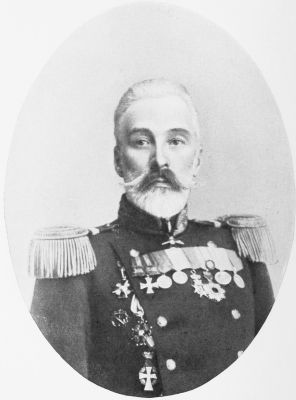
REAR-ADMIRAL GRIGOROVITCH.
The day before the fleet's departure Rear-Admiral Grigorovitch proposed to Admiral Witgeft, at first verbally, and afterwards on paper, that to force its way successfully to Vladivostock the fleet ought to be composed only of the fastest ships, and the slow ones—the Poltava and the Sevastopol—should be left in Arthur to strengthen the shore defences. Rear-Admiral Loschinsky supported this proposal; but he developed the idea by suggesting that when the squadron moved out of Arthur towards Shantung he, with the two battleships, four gunboats, and ten destroyers, should make a demonstration towards Dalny. If the larger part of the Japanese force followed the departing squadron, then his force would be able to bombard Dalny, the naval and principal supply base of the Japanese army. If by some mistake, or owing to other circumstances, the enemy's main force attacked him, then, taking advantage of the mine defences and supported by the coast batteries, he would be able to engage the enemy's force, although superior both in numbers and strength, for a considerable time. Unfortunately, Witgeft did not agree.
'My orders are to go to Vladivostock with the whole squadron, and this I shall do.'
If he had agreed to Grigorovitch's proposal, Togo would not have had a balance of advantage, and his force, being split up by reason of the demonstration at Dalny, would have been weaker than ours. Our squadron would have successfully broken through to Vladivostock without serious injury, and Dalny would have been destroyed by Admiral Loschinsky. If only we had not let slip the excellent opportunities we had had for sinking the enemy's ships, their force would have been considerably weaker than ours.
As the time approached for the squadron's departure, the Admiral and most of the officers were depressed, for the approaching voyage promised little good. They all realized that the squadron was going to sea short of guns (most of those put ashore were left there), and of very much else; they knew that our shells did little destruction, sometimes not even bursting, whilst those, even the 4·7-inch shells, of the enemy caused great havoc, and that, having superior speed, the enemy would have the initiative.
The Admiral was wounded by a splinter of shell bursting on the Cesarevitch the day before the sortie, and, as if foreseeing his near end, his last words to those on shore were: 'Gentlemen, we shall meet in the next world.'
At daybreak on the 10th the fleet steamed out into the outer Roads, and, forming into single-column line ahead, steered for Liao-tieh-shan. The hospital ship Mongolia left exactly at eight o'clock, and overtook the fleet at 8.30. Some Japanese destroyers showing themselves in the direction of Dalny, the Novik was sent towards them, and having rapidly driven them away, the whole fleet started at nearly full speed—a formidable array of yellow-brown vessels, brought up in rear by the Mongolia, glistening white, with the red cross on her funnels.
As the Commandant, from the top of Electric Cliff, watched it steam out, he said:
'May God grant it luck! If only it can vanquish the foe and gain possession of the sea, the Fortress will be saved. But evil will be the day if it is defeated and does not return. How many men, guns and shells has it not taken with it, all of which we badly want!'
Port Arthur's weary day of strained suspense came to an end; the night passed and morning dawned. The signal station at Liao-tieh-shan reported that our squadron was approaching. It did return; but heavens! in what a plight! By the afternoon it was drawn up in the inner roads, less four ships, the Cesarevitch, Askold, Novik, and Diana, which had not returned, and about whose fate no one knew. Admiral Witgeft had been killed. What had happened at sea has been described by others, and I will spare the reader the details of this sad engagement.
Thus weakened by the loss of one of our best battleships and three of our fastest cruisers, the rôle of the fleet might be said to have come to an end, for the sea was held by an enemy powerful in numbers as well as quality, and till the coming of the Baltic fleet our squadron would not be able to engage them in battle. All it could now do was to give us men, guns and ammunition for the land defence. Why the Pacific Ocean fleet, consisting of the best ships in the navy, had done nothing during a seven months' campaign, and why in the end it had been forced to abandon all idea of an active rôle and its chief raison d'être—to get command of the sea and interrupt the Japanese sea communications—are questions which demand an answer.
'Who was to blame?' There is but one answer.
The very essential and fundamental reforms in the navy, which had been pointed out as necessary years ago by the better and more enlightened officers, should have been introduced, and the prehistoric naval customs of the time of Peter the Great should have been consigned to oblivion. To blame the individual for this is impossible: it was the system that was at fault, as well as that official class which, like a thousand-headed hydra, sucks and nibbles at the really healthy organism of Russia. British and German officers will not believe my assertion that everything on Russian ships was neglected save the personnel, which was fairly well looked after materially and moderately well trained. The education of the higher ranks in staff duties, as well as their training in shooting, torpedo and other work, was so neglected that the majority of officers had but the vaguest notion of the practical application of theory. In most cases, owing to their constant transfer from one to another, they did not know even their ships. For three-quarters of the year these were in harbour and hardly any cruising was done, while the officers were made to work so little that at the commencement of the war they did not even know the shores of the Kwantun Peninsula.
The return of the squadron with its mutilated hulls, battered funnels and masts, had a bad effect, and on all sides was heard, 'The end will now soon come!'
CHAPTER XXV
OUR SECOND ATTACK ON TA-KU-SHAN—A FLAG OF TRUCE
The daily land bombardment of the town and port made every one extremely jumpy; for after our fleet's return it seemed likely that the Japanese would again bombard us from the sea, and then our position would not be enviable. There is nothing worse than uncertainty, and it was horrible work wait, wait, waiting, for decisive events, not knowing how, when, or where they would happen.
On August 11 I again accompanied Smirnoff—who was much depressed by the events of the previous day—on his tour of the defences, and witnessed from B battery our second attempt to recapture Ta-ku-shan and Sia-gu-shan. As before, far too small a number of men were told off for this attack, and, to make matters worse, by the time they had reached the foot of the hill they took the wrong direction. Smirnoff watched the failure of this second attack in silence, but his brow was black, for it was indeed a comedy that was being enacted before us. Was it wise to attack such high, precipitous hills with the fewest possible men, when the veriest tyro in military science knew that hills of such importance to us would be held to the last by the enemy? While this foolery went on the Japanese steadily pounded the town and port.
At daybreak on the 12th the bombardment of Angle Hill and a gradual advance of the enemy towards it commenced. Smirnoff placed Kondratenko in command of the western front, while Fock was appointed to command the general reserve. He himself, being convinced that the Japanese, forcing the points on Angle Hill, would sooner or later deliver their main assault on the salient angle of the north-east front, turned all his attention to it and to 203 Metre Hill on the west. Meanwhile, General Stössel seemed to be chiefly impressed with the importance of not tiring the men. His anxiety on this account was evinced by his order of August 12:
'A tired soldier is always sleepy and dull. Men are not to be employed on fatigue for more than five hours in the twenty-four.'
At this time the enemy were putting the last touches to the iron ring which was being welded round the Fortress, and their batteries were daily growing, while our defences were far from ready. If our men were compelled to work hard, it was necessary. They dug, dug, dug without end in the stony soil, but they did it that they might the more easily be able to repulse the assaults, and that they might get protection from the rain of iron and steel which during the five long months was to be showered on them with such wonderful generosity. This was no time to think of resting: every moment was precious. The men realized it, and delved ceaselessly, willingly, knowing that the deeper the trenches, the better it would be for them. But General Stössel's order had the evil effect on their spirit that might have been expected; for, after it, when men were urgently wanted for working-parties, their commanding officers took advantage of it to protest direct to Stössel that they were being overworked.
General Smirnoff was much dissatisfied at this period with the fortification and work on 203 Metre Hill. This hill, which was destined to play such a fateful rôle in the defence of Arthur, was in the salient angle of the western front, and its top, commanding the surrounding heights, overlooked the Fortress, the inner harbour, port, town outer Roads, and the distant sea; yet it was armed only with four 6-inch guns. There were no masonry casements or earth bomb-proofs, and protection against the fire of 6-inch and 11-inch guns was given by sand-bags, stones, earth, and dry cement. The guns had been mounted at the beginning of the campaign, and no strong batteries to protect the garrison from the effect of 11-inch shells had been made; now only one thing could be done—that was to dig caves into the hill.
About midday on the 13th a balloon soared up above Wolf's Hills, and our nearest batteries at once opened fire on it with shrapnel. Whether we made a hit or not it was impossible to say; but after being about half an hour in the air it descended quickly. Chinese spies stated that officers of the Japanese General Staff were making a reconnaissance in it, and had taken some photographs of the Fortress, for General Nogi was surprised at meeting with opposition at so many points which had not been fortified before the war, and which were not shown so in the plans in his possession. The works which checked him, after Smirnoff had been five months in the place, were very probably a considerable surprise.
We had no balloons in the Fortress, nor had we pigeons or wireless telegraphy! No station was rigged up there, and therefore communications were not established.
On the night of August 13 the Japanese attacked Orphan Hill, but were driven back.
As I went round the defences almost every day, I marvelled to see the healthy, happy look of the men, who all looked as if the work agreed with them. Since the beginning of the strict blockade the officers had ceased to drink as much as they did—that is to say, in the main positions, where I never saw any debauchery. On the advanced positions, on the contrary, drinking had been carried on abnormally. Stössel and Fock had deprived the men of their vodka, but the officers were drunk day and night, which, besides being bad for their own health, had a demoralizing effect on the men. Their behaviour may be explained, perhaps, by the fact that they had so poor an example set them by two of their superiors who never had any influence for good. They hated one of the Generals, who abused them on parade and played the buffoon with their men (he was known as the 'Mad Mullah'), and they feared the others. When the strict investment began, and the infantry officers mixed and lived with those of the artillery, who were on a higher plane as regards education and intelligence, all this changed. As soon as the 4th Division entered the Fortress and Fock was appointed to command the Reserve, a great change was also noticeable in that Division.
On August 14 an artillery duel was waged all day. At night and in the early hours of the following morning the Japanese began to concentrate against our left towards Angle Hill, which they attacked at 3 a.m. In spite of being repulsed, they at dawn made a second attack, which met the same fate and caused them heavy loss. After the failure of this second attempt their guns opened fire with shrapnel all along our line, and under cover of it the infantry, with desperate rushes, tried to get close to our positions, evidently with a view to a general assault.
On the night of the 15th-16th desultory firing went on all along the line. On the morning of the 16th a Japanese officer came in with a flag of truce. He bore a letter from Baron Nogi, which ran approximately as follows:
'The Russians have given signal proof of their gallantry, but Arthur will be taken all the same. Therefore, to avoid useless loss of life and any possible violence, murder or looting by Japanese troops fighting their way into the town, which it will be difficult at once to prevent, His Highness the Emperor of Japan suggests a discussion of negotiations for the surrender of the Fortress.'
A Council of War was at once summoned, at which Stössel suggested that no answer should be given, as the proposal that the Fortress should capitulate was a piece of insolence. Smirnoff expostulated, explaining that the elementary rules of military etiquette required that a reply should be sent. Stössel then said:
'Well, if an answer must go, let us send a blank piece of paper or else merely write a joke on it.'
Smirnoff insisted that an answer, and a polite one, should be sent, and he drafted one which was eventually signed by both Stössel and himself:
'The honour and dignity of Russia do not allow of overtures of any sort being made for a surrender.'
The morning of the 17th was very unpleasant, with fog, sleet, and mud. The town was already being bombarded, and the shells could be heard bursting in the harbour. With General Smirnoff's permission, I accompanied the flag-of-truce party taking out the reply: it consisted of Captain Golovan, an officer of the General Staff, and Lieutenant Mackalinsky, of the Fortress Staff. As we went out the passers-by gazed at us with curiosity and wonder, many of them thinking probably this was the end of Arthur. At last we reached the fortifications near the cemetery; on this being reported to the Commandant, he at once ordered the guns to cease fire: so that exactly at nine o'clock we were able to move on. I was told to ride in front with the flag, with one of the mounted scouts, the rest of the party and escort following a short distance behind. We passed our firing-line and piquets and went on some distance, but seeing nothing of the Japanese, I began to get suspicious, for I could not forget how they had fired on our Red Cross at Green Hills; perhaps they were now lying in the kiaoling on either side of us ready to pour in a volley. It was jumpy work.
'Sir, sir, there they are!' whispered the man riding beside me. I looked ahead, but could see nothing. At last, however, I noticed four Japanese dressed in khaki behind a sharp bend in the road on a small pass. They were difficult to distinguish from their surroundings, while we, in our uniform, were very conspicuous. Having approached to within fifty yards, we heard in Russian—
'Halt!'
We stopped.
'Advance one!'
We stood as still as statues, and a man, evidently a non-commissioned officer, came up.
'What do you want?'
We answered.
'All right.' He gave some order to one of the men, who quickly moved off.
We stood and looked at one another. The non-commissioned officer, a broad-shouldered, thick-set man, took out a note-book and, with great coolness, wrote something in it. After ten minutes, an interpreter, with a truculent-looking Captain, and a young Lieutenant, came up. At last Major Yamoaka, who had brought the Japanese message, arrived, accompanied by a mounted orderly with a flag and the Corps interpreter, who, in spite of his high rank, spoke Russian most atrociously. After we had presented our credentials, he took and gave us a receipt for our letter, and in his turn handed us one, for which we gave him a receipt. The interpreter informed us that 'this was a very, very important letter.'[16] When the ceremony of handing over the letters was finished, a shell whistled past towards Ta-ku-shan. Major Yamoaka anxiously asked:
'They are surely not firing?'
To which Lieutenant Mackalinsky quietly answered:
'No, it is probably at sea.'
Later it turned out that the enemy's infantry could be seen to be on the move from one of the batteries, and the non-commissioned officer on duty, unable to restrain himself, had fired at them—a mistake he had to pay for.
Having received the letter, Major Yamoaka arranged the time and place of meeting for further negotiations. We well knew that further negotiations would not take place, but of course made some pleasant reply. We bowed and parted, and as soon as we reached the fortifications on Cemetery Hill and lowered our flag the guns boomed out again along the whole line. Once inside the line a Cossack met us and told me that Stössel wanted to see me. The General had watched us from Jagged Hill. Mackalinsky proceeded to report to the Commandant, and we, with Golovan, going on to General Stössel, found him in a casemate of the battery. He had just breakfasted, and was in a most affable frame of mind, surrounded by the young officers from the nearest batteries. Their laughter and jokes could be heard from a long way off, and the array of empty bottles showed that breakfast had not been a dry meal.
'I didn't want to answer those yellow-skinned scoundrels. I wanted to draw a caricature and sent it back. They wanted the Fortress? I'll show them the Fortress!'
There was general laughter. The youths, under the soothing influence of plentiful liqueurs, forgot their positions as junior officers, and shouted:
'Splendid, sir, splendid; quite right. Your health, sir.'
'And do you know, gentlemen, they took me for a foreigner—a Swiss by birth? By heavens! I am not lying. Quite recently I got a letter from Austria, from some Stössel or other who pretended he was proud of his relation in Arthur. Others write that I only became a Russian subject in 1893. I have got the letter!'
Again there was laughter. The General was in the best of form. Whether he was talking seriously or not I do not know. Presently he thought it was time to return to Arthur, and told me to accompany him: we rode through the arsenal.
'Look what a number of captured guns there are! I took all those in the Chinese War.'
All these guns passed into our hands when we peacefully occupied Arthur!
FOOTNOTES:
CHAPTER XXVI
DEATH OF PRINCE MACHABELLY—ALL-ROUND FIGHTING
I continued daily to send my 'News' to the Novy Kry, but the strictness of the censors deprived it of all interest and sometimes of its accuracy. For instance, on August 17, my article stated that work was being rapidly hurried on all along the defences. This was by no means the case everywhere, for the engineers, spoilt by six years of doing nothing or of only constructing private buildings, neglected the important mobilization works. There were exceptions, for some of the engineer officers did really good work, but the majority did nothing. Then again, as regards the quality of the food which I had praised in my article—it was eatable, but far from nutritious, and the siege had only just begun. Again, I mentioned General Gorbatovsky; but I did not venture to say that this officer, who was always to be found in the section of the defences under his command, never rested, or that he spent day after day on the fortified positions, where by his presence and cheerfulness he inspired the men with confidence. Though the men were cheerful, I had not dared to say that they were physically incapable, and weedy, which was the truth. I did not mention that when officers begged for timber, planks, iron, or material for building bomb-proofs the engineers replied that they had no transport, or else refused the requests of the 'small fry.' Neither could I hint that the only way in which General Smirnoff could make these lazy engineers work was by personally going round and seeing how his orders were being executed.
Many and many a life lies at the door of the engineer officers in Arthur. If St. Petersburg be held responsible for the mistake of cutting down the perimeter of the defences of Port Arthur, the engineers, of whom some left for Russia at the first shot and others were criminally idle, will also have to answer for much. If they had worked hard and conscientiously while the place was in our possession the mistakes committed at St. Petersburg would not have had such dire consequences.
On the 18th there was a lull—an absolute cessation of firing—all day. This was so unusual that it seemed ominous of something worse to follow, and we were filled with forebodings. Indeed, the hospitals, in which the first hints of an approaching assault were usually to be found, were preparing to meet the expected demands of the next few hours. I accompanied General Smirnoff on his afternoon inspection. Having gone round many works and said a cheery word to all he met, he went up on to Danger Hill and we climbed into the look-out station.[17] The sun had already sunk below Liao-tieh-shan, but from the top of the hill we could see everything quite distinctly. After last instructions with regard to the concentration, etc., of the troops on the north-east front we silently made our way back to Arthur, all of us feeling impressed with the uncertainty of what might come.