Front matter (continued 5)
A. B. (Alexander Bertram) Lindsay translation
To fire away our ammunition pointlessly in this manner was unjustifiable, nay suicidal, and the motive for doing so is difficult to comprehend.
The following were some reports received on the 29th:
'There has been gun and rifle-fire all night. A fight is now being waged for the trenches. In Chi-kuan-shan the enemy have blown in the roof and outer wall of the caponier, and are making use of iron shields in the attack. From the opening they have dug a trench to their trenches. The fire is increasing on Erh-lung-shan, Fortification No. 3, and Tumulus.'
On the night of the 29th a heavy bombardment of the position took place, and on the 30th there was a general assault. The following telephone messages will show the progress of the fighting:
From Colonel Naumenko.
11.50 a.m.—'The artillery-fire is increasing. Shrapnel has begun. We are awaiting the attack.'
From Sub-Lieutenant Vonliarliarsky.
12 noon.—'The Japs are storming B Battery.'
12.30 p.m.—'A bayonet fight is going on in B Battery.'
12.50 p.m.—'A Japanese flag has been planted on the parapet of B Battery. It has been torn down, but the Japs are near the guns.'
From Captain Golovan.
1.55 p.m.—'Fortification No. 3 is on fire. Our men are holding the gorge.'
2.10 p.m.—'Fortification No. 3 is burning and the face has been occupied by the Japs. Our men are in the gorge. Chi-kuan-shan, Fortification No. 2 and Kuropatkin Lunette were captured, but have been retaken.'
2.23 p.m.—'Fortification No. 3 has been recaptured.'
From Colonel Semenoff:
11.30 a.m.—'The Japs are in force under Erh-lung-shan.'
12.25 p.m.—'Water Supply Redoubt and trenches are strongly occupied by the Japs.'
1 p.m.—'The Japs are moving in force on Erh-lung-shan.'
2.5 p.m.—'The Japs were driven out of B Battery at 1 p.m. They are on Wolfs Hills in force.'
2.25 p.m.—'From Wolf's Hills the Japs are moving in front of Water Supply Redoubt.'
5.15 p.m.—'The Japs are entrenching themselves in front of the obstacles of Fortification No. 3. They are laying sand-bags along the trench that was ours. They have got storming ladders.'
The third general assault on October 30 was preceded for four days by a cruel bombardment, which began at midday on the 26th, and gradually increased till the night of the 29th. For forty-eight hours the works on the north-east front were incessantly pounded, the enemy deciding to break down and annihilate everything with their fire, and then to dash on the defenders with the bayonet. The night of the 30th was black, and the sky cloudy. Morning came, and the fire increased, and by 10 a.m. the whole front was enveloped in dense smoke: the hills were literally reeking. The whole destructive energy of hundreds of guns was thrown on the portion from B Battery to Fortification No. 3. It seemed as if everything there must be destroyed—every living thing killed, that no one could be left to defend, and that any moment the enemy would dash in to fight in the very streets. Further opposition seemed useless, inhuman. The fire slackened, and then again broke out; shrapnel was poured on to those points that were to be stormed; the other works were paralysed by high explosive shells. The assault began, and the Commandant quickly moved the reserve companies along the ravines to the attacked points. The enemy dashed in with the bayonet, and hand-to-hand fighting ensued. The Commandant followed the progress of the assault and defence on the telephone, and the reserves were massed in time at all the most dangerous points successively.
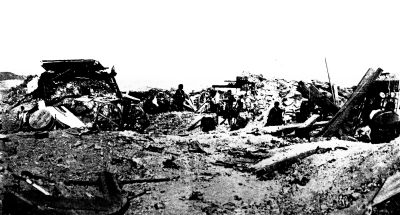
KUROPATKIN LUNETTE AFTER THE ASSAULT IN OCTOBER.
At last the front was again clear. We had survived the third assault, and the crisis was over.
The October attacks were short, but most determined and bloody. As regards their success, it was but slight. The enemy had gained some dozens of yards—no more. Our total loss was Open Caponier No. 2, already quite destroyed by the bombardment. The Japanese had fired over 150,000 shells.
FOOTNOTES:
CHAPTER XXXI
JAPANESE VIEWS. GENERAL FOCK'S MEMORANDUM ON FORTRESS DEFENCE
The October assaults had been repulsed. The third obstinate attempt to get possession of Arthur had been a complete failure, and had cost the enemy more than 10,000 killed and wounded. We breathed freely again. Though tired and utterly worn out, the success instilled fresh life and energy into the whole garrison, and revived their hopes. After all, the Japanese were only human beings, and they must eventually become tired out and have to confess that Arthur was too much for them. The long months of bombardment, the anxious days of assault, the death and the suffering of thousands of our nearest and dearest, as well as that of the enemy, had somehow made us feel attached to these inhospitable mountains and the mournful ocean which silently lapped against the shores of the Kwantun Peninsula. Arthur had become near and dear to us, almost as if it were our native land, in which we had passed our lives. It was painful to think that perhaps the time would come when the Japanese might break in and become masters of it all. Each of us felt in greater or less degree that he was taking part in a historic drama; he realized that the whole world—civilized and uncivilized—was keenly watching every phase of this bloody struggle, and was impatiently waiting the conclusion: for whatever the end was to be, it would have an influence, not only on the future of Russia, but on the future of the world.
But to continue with our chronological narrative: On October 31 the enemy on the eastern front were making preparations to assault Fort Erh-lung-shan and the intermediate works near. They were repulsed in their assault on Chi-kuan-shan, but that fort was in a most critical condition. On the west their assault on Fortification No. 3 was beaten back, with a loss of nearly four companies to them from our gun-fire. On November 1 Stössel excited much indignation by accusing a most excellent officer—Colonel Murman—against whom he had a grudge, of malingering. He appointed a special medical board to examine him, but similar publicity was not given to the finding of this board—an acquittal—as was given to the accusation. On November 2 the following entry was made by the late Colonel Raschevsky in his diary:
'It is interesting to spend a night in Fort Chi-kuan-shan. Here we are all in good spirits, though rifle-fire never for a moment ceases. In the darkness of night, broken only by the detonation of a pyroxyline grenade, the flare of a rocket, or the flash of shrapnel, the dark figures of soldiers doing their best to repair the damage caused by the bombardment of October 30 can be seen swarming about. Wood fires are kept burning in the ditch of the caponier, in order to prevent the enemy breaking through unseen along the ditch towards the gorge. We are waiting to be attacked to-morrow, the Mikado's birthday. It is a strange coincidence that to-morrow is also the anniversary of the Tsar's accession to the throne.'
Raschevsky mentioned wood fires. In properly built forts in Western Europe a number of well-protected electric lights are arranged in the wall of the counter-scarp to light up the whole of the outer ditch of the work. Of course, such a luxury was not to be expected in Arthur, where the Fortress was defended by primitive means and all was left to the bravery and inventiveness of individuals. In many ways the defence suggested mediæval days, when human life was of little value. The Japanese, heroically throwing away their lives in front of Arthur, strewing the ground with their bodies as if they were sacks of earth, showed that we had to deal with enlightened barbarians, inspired by great patriotism and a deep conviction that a victorious campaign, in particular the conquest of Arthur, would give them a permanent economic position on the continent of Asia. I know that I shall be told that I am wrong, but, still, I venture to express my opinion that the Japanese are savages, but enlightened savages, for they knew that they could by their blood relieve an economic crisis in their country. In Japan before the war I often talked with one of the best educated of Japanese. On my asking if Japan really meant to fight us (I was then under the delusion that Arthur was ready and that our War Office was capable), he thought deeply in an apparent effort to answer me. The question was a serious one, one which every Japanese invariably tried to avoid. I had long intended to put it, but had refrained, knowing from experience that I should only receive the kind of reply of which every Japanese is a past-master—a reply—but not an answer. He thought for five minutes and then said: 'Our nation works differently to the way you work in Europe. Our poor do not know what it is to rest. They are thrifty and sober; they have little to eat, and that little is bad; yet most of them are fairly educated. Machinery is beginning to be largely used everywhere, so that small industries are failing, and the proletariat is increasing daily. Our nation is fond of its country and of the Mikado, and wishes much to eat, drink and read, to multiply and to educate their children, etc.—in fact, to live under conditions of certain refinement.' (He was quite right. I have travelled much, and, with the exception of among the English, I have never seen such refinement and culture in domestic life as with the Japanese. Japan is called the 'Country of the Rising Sun'; I think I should not be far from the truth if I called it the 'Country of Children that Never Cry.') 'Politics have taken a serious turn. We have begun to negotiate with Europe. We commenced to watch, to listen to and to learn from Europe: now we have learnt all that there was to teach. On all our ships and in our factories English engineers have for several years gradually been replaced by our own, and we are running these things ourselves; but what we want is land for our growing population and markets for our industries. In Tokio they have been doing their best that the masses should hate the Russians for taking Arthur, and they have been working on the national pride. The school-teacher and the priest have educated and are educating the nation to this end, and every Japanese knows his own national history well, and knows, for instance, that in olden days Korea belonged to Japan, and that one of our Empresses had of her own free-will given it up.'
I listened attentively, and said that Japan would never succeed if she tried a fall with Russia, for that Colossus would crush her. In a couple of months the clamour of war was heard. Having arrived in Arthur, I, like others, at first believed in a happy issue of the campaign. I was convinced that Japan would be annihilated, and I was sorry for her.
The day before the anniversary of the capture[31] of Arthur, Colonel Tirtoff, who was in charge of the Novy Kry till Artemieff's arrival, had asked me to write a leading article. I took one to him the same day, out of which he cut everything unpleasant that I had put in about the English. (I used then to write against them very strongly.) 'Admiral Makharoff is opposed to attacking the English in the press until the war is over. He does not doubt how things will end, but till that time he wishes to be polite; and in Petersburg they are of the same opinion. We must not commit ourselves,' was the advice of Colonel Tirtoff, as he handed back my corrected MS.
The following extract from Order No. 780 issued by General Stössel, published at this time, will not be without interest to the reader:
(1) 'The detachments in each fort and battery will be told off in three reliefs. The first will be on duty and ready for any emergency, being relieved every two hours, between 6 p.m. and 6 a.m. If there are two officers, each will take half the night. Additional to officers commanding sections of the defence, the following officers will be responsible that this order is carried out, and will take steps accordingly: Generals Nickitin, Tserpitsky; Colonels Reuss, Savitsky, Khvostoff and Nekrashevitch-Poklad. General Nickitin, being the senior, will arrange for the tours of duty, and will indicate the sections to be visited and the hours for visits.'
Notwithstanding the fairly heavy losses we had suffered during the bombardments and assaults, especially in the last one, Smirnoff had not abandoned a single important work of the main line. With the exception of Nos. 1 and 2 Redoubts we had held our ground. Yet General Fock continually endeavoured to convince General Stössel and the garrison that Smirnoff did not know how to conduct the defence of the Fortress, and what could have been more subversive of discipline than the following memorandum published at the time by him?—
Memorandum, dated Port Arthur, November 3, 1904.
'A besieged fortress can be compared to a man suffering from gangrene. In the same way that he must sooner or later succumb, so, too, must a fortress fall. The doctor and the commandant should realize this fact from the very first day that the former is summoned to the bedside of the patient, and the latter placed in command of the fortress. This, however, does not prevent the former believing in miracles, or the latter hoping for a happy issue by external relief. And this belief is more necessary for the latter than the former, provided it is not so great as to make him careless. Gangrene attacks a man in his extremities—i.e., in the toes—and it is the doctor's duty to separate the part affected. His task consists in prolonging the patient's life, and the commandant's in postponing the date of the fortress's fall. The doctor must not allow the patient suddenly to die, any more than the commandant must allow the fortress to fall suddenly through some unforeseen circumstance. The patient should succumb gradually, beginning with the extremities, and so should the fall of the fortress be gradual, beginning with its outworks. Successes with the first, as with the second, will depend upon the extent to which the infected member is in time removed, or the attacked position is abandoned. This task is no easy one; the doctor must be a skilled professional to be able to fix the moment when the diseased organ is more harmful than useful; but this alone is insufficient, for the patient must first be persuaded to agree to amputation, as without his consent the operation will be impossible. Who cares to lose a leg or an eye? Some would prefer to die, and the doctor must be able to persuade the invalid that it is possible to get about without a leg, that an American artificial leg will enable him to dance. Nor is it easy for the commandant, who must have a thorough grasp of the situation, to be able to know when an attacked position has inflicted all the loss that it can inflict on the attacker, and to recognize the moment when the balance of superiority passes to the enemy. The skill consists in being able to abandon a position before the final blow is delivered, and at the same time to sell the enemy his success dearly. It must be borne in mind that fortress warfare resembles rear-guard fighting, a fact which does not seem to be appreciated by everyone. But besides eyes the commandant must have character, for commonsense and conscience will call out "Retire!" while sentiment and anger will cry "Hold on!" He does not know what he can get—like the artificial leg—in place of what he loses. With the doctor it is different, because his medical store contains false limbs, the commandant's does not. The doctor amputates the infected organs so as not unnecessarily to waste the life's blood, keeping it for the heart. The commandant abandons by degrees the enceinte of the fortress so as to preserve strength for the keep. The length of a defensive line should correspond to the strength of the garrison. No doctor would torture a patient by attempting to reunite the amputated organs, even though it be a tooth taken out by mistake. And, similarly, no commandant should waste his men in an attempt to recapture a position once yielded to the enemy, even though it were abandoned through carelessness. At Sevastopol we held firmly on to what we had, but we did not once attempt to retake a position; the redoubts Komchatsky, Selenginsky and Volinsky are good examples. Osman Pasha, the celebrated defender of Plevna, never attempted to retake a position; on losing one he hastened to hold out another to our blows. Thus, when we seized Grivitsa Redoubt, he got ready another for us which he named Grivitsa Redoubt No. 2, with which he checked our onslaughts. Would he have held out long if he had attempted with his army of 40,000 to retake the redoubts from us? He was careful of his men, and they served him with their spades. A doctor to perform his task successfully must have more than a true hand and eye; he must make his assistants conform strictly to his requirements, and must also know in detail all their work, and be able to direct them while doing that work. Who could perform a good operation if his assistants did not know how to help him, or through stupidity were to pull the thread or the wool out of a wound? To that there would usually be but one end—death. And so for a commandant, it is not sufficient for him merely to select the site of positions and indicate the style of fortification. What use is a fortified position if its loop-holes are unsuitable for firing, or, instead of giving the firer cover, expose him? The Germans assert that with modern rifles a flying sap cannot approach closer than to within 800 metres, etc., etc.'
This is a sufficiently long quotation to show in which direction Fock's mind was working, and how he took Smirnoff's disinclination to surrender anything. It was poison—slow—but certain poison, which even in October had begun to demoralize the garrison, which was beginning to suffer from scurvy, induced by bad food. The Commandant knew that this memorandum was known to the whole garrison, for copies had been lithographed and freely distributed. But how could he deal with this enemy of the Fortress? He had done everything that was in his power; he had already removed him from duty, and could do no more. The reader must not forget that General Fock had great influence over Stössel, that what he said at this time he said 'by order.' There was only one thing to do, namely, to arrest both of them. Why did Smirnoff not do this? may be asked. Because the garrison was already demoralized. It was tired, it was morally and physically worn out; and if he had arrested Stössel—the Tsar's Ambassador,' as Fock called him—he would not have had the full sympathy of the garrison, but would only have created more dissension and scandal. For what would these partisans of Stössel—the all-powerful—have said in Arthur, if they had found out that he had been arrested by the hated Smirnoff? For he was then literally omnipotent, and the future hopes of many depended on him. When he arrived in Russia, instead of going into confinement as a prisoner of war, hundreds of his friends thought that he was the hero and Smirnoff the intriguer. Read their evidence before the Committee of Inquiry, and you will be amazed to see to what extent men can lie to save their own worthless skins. Therefore, keenly as Smirnoff felt the baneful influence of this effusion of Fock's, he was powerless. To have such a spirit fostered in the Fortress was truly an alarming symptom.
On November 3 there was a heavy bombardment, which resulted in a tremendous fire in the oil stores, covering the surrounding country in dense black smoke.
The following are some entries in Raschevsky's diary:
November 9.—'To-day the Japanese succeeded in blowing up the magazine on Zaredoubt Battery with their 11-inch shells. The explosion was awful, but luckily our shells were not damaged. On B Battery two casemates have again been penetrated by an 11-inch shell which burst in the lower floor.'
November 10.—'To-day we fired from Fortification No. 3, with the mortar improvised by Lieutenant Podgursky, a pyroxyline bomb weighing about 40 pounds. This mortar is very convenient: it makes hardly any noise in firing, but it is difficult to regulate. In any case the effect of the bomb is very great, and with luck should cause the enemy much damage. They have for quite a long time fired at us in the forts from similar guns, and this is the first time that we have retaliated in kind.'
November 12.—'The Japanese seem to be doing nothing. In places where formerly we could not show ourselves without being fired on we can now pass with impunity. This gives rise to the hope that they are in a bad way, and will leave Arthur.'
It was not only Colonel Raschevsky who thought this. Many buoyed themselves up with a firm belief in a speedy relief. Unfortunately these hopes were not destined to be fulfilled.
November 14.—'Chi-kuan-shan Fort, Kuropatkin Lunette, and B Battery are in a most critical state. The latter has been broken down and so battered by 11-inch shells as to be useless. The masonry of the casemates is all crumbling away, and the commandant of the battery is asking that it may be tied together by a wire hawser! I daily get similar original suggestions.'
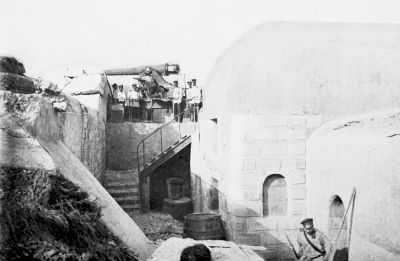
B BATTERY.
On November 18 the following telegram from Lieutenant-General Sakharoff to Stössel was published in orders:
'Admiral Alexeieff is leaving for Petersburg. General Kuropatkin is appointed Commander-in-Chief of the army and fleet. From the troops in the theatre of war and the corps which are now arriving three armies will be formed. The following are appointed to command them: First, Linevitch; second, Gripenberg; third, Kaulbars. The Baltic Fleet has passed the Spanish coast. The Manchurian army commencing to advance on October 5 compelled the enemy to fall back; but, afterwards, having met considerable opposition, and after a series of obstinate battles from October 9 till 17, took up its position on the bank of Liao-ho, in very close touch with the enemy. All three Japanese armies are in front of us in fortified positions. The Commander-in-Chief hopes to attack the enemy and advance, and he is confident that the gallant troops in Arthur will hold out.'
And so the Viceroy went away, and Arthur had to work out its own salvation. His departure from the army added to the depression produced by Sakharoff's telegram. In the garrison it was no secret that between him and Kuropatkin strained relations had for a long time existed, but it was thought that from the date of the retirement at Liao-yang they had assumed a better character. It was well known in the Fortress that Liao-yang had been splendidly fortified, and as regards preparation conceded little to Arthur. It was known that in front of Liao-yang we had 25,000 more men than the enemy, and that Alexeieff had asked for, or insisted on, a forward movement whatever it might cost, in order that the Fortress might be relieved. The Viceroy had strained every nerve towards Arthur, as he well knew that, as well as attracting the attention of a large army, it was a sanctuary for the fleet, which would be a decisive factor in the campaign. He feared the destruction of the fleet in Arthur, for in that he read a bad ending to the war. He knew that upon the fall of the Fortress the fleet would be destroyed, and that once it was destroyed the campaign would be lost, for we should never obtain command of the sea. So long as the sea was not ours, so long as the Japanese could feed their armies from Japan without hindrance, it was useless to think of a successful issue. He realized all this, but whatever the cause his wishes were not accomplished.
FOOTNOTES:
CHAPTER XXXII
HINTS OF SURRENDER. MORE ASSAULTS
From Raschevsky's diary, November 18:
'We have to wait and wait, which makes things very difficult. It is far easier to fight a fierce action which would be decisive than to waste away by slow degrees. Sickness has already begun to break out. The troops seem to be losing their energy, and there is a shortage of supplies; in fact, the state of affairs is daily becoming unendurable, and we are not in a condition to endure any ill-fortune.'
In reality the position of the Fortress, owing to the decrease in energy, was getting alarming. Writing these lines, I can plainly see before me Raschevsky's well-built figure, as he used to report to the Commandant about the progress of work at the front. If the energetic, indefatigable Raschevsky began to feel tired, what must the faint-hearted have felt? Raschevsky did not live, he seemed to boil over with energy, and his eventual loss to the army was irreparable. Arthur was indeed being burned in a slow fire, but no one had been heard to talk of a surrender except chez Stössel. We all longed for a fierce, decisive battle and a quick end—better death than a shameful surrender. Meanwhile the enemy were on the whole silent, occasionally firing at us, gathering together their strength for the future. This lull, this weary uncertainty, was hard to bear. To continue quoting from the diary:
'News has been received from Chinese spies that the seven guns which were lying on the shore of Louisa Bay have been mounted at Nangalin. They also say that the Japanese, annoyed at their want of success in the north, have decided to seize Arthur between November 21 and 26, whatever it may cost, and that if this assault, for which they have about 40,000 men and will use their fleet, is not successful they will not attempt another.'
At this time there occurred one or two episodes which seemed to be indicative that the idea of surrender was already held in certain quarters.
General Smirnoff was now paying special attention to the third line of defence, already armed with naval guns, and having excellently laid out redoubts and deep trenches. On this it was intended to oppose the enemy should we have to withdraw from the second line, and Admiral Wiren was to be appointed to command it. In the middle of November the Commandant unexpectedly received a definite order to cease work, not only on the third but also on the second line (the Fortress works), and at the same time to send men from the main reserve direct to the first line of defences—the forts, and intermediate works—of the north-east front. Though General Smirnoff thoroughly appreciated the important rôle which the second and third lines must play in the future defence, he obeyed the order and also sent the Chinese coolies to the first line, but at the same time continued to carry on the works on the second and third lines energetically, so that by the middle of December they were almost finished. Stössel's definite order to cease work on the second defence line, which was most important, could only mean that he either did not understand the importance of this line, or that, under the influence of General Fock, he had an ulterior motive. The course of later events forced me to suppose that the order was founded on a previously formed conclusion that the Fortress could no longer be held, once the enemy should have established themselves on the part of the first line between Tumulus and B Batteries, from the highest point of which—Eagles' Nest—they could observe and direct the fire of their guns on to any point up to the sea. Another incident, which took place directly after the interruption of communications in April or May, possessed in conjunction with the one just described a curious significance. From the moment when the railway was cut, the majority of the inhabitants had wisely withdrawn their deposits from the Russo-Chinese Bank, and consequently scarcely any ready money remained in hand. The Defence Fund deposit could not be drawn upon, but in the treasure chest of the 3rd Corps there was £120,000. As the Chinese labourers had to be paid almost daily, cash was a necessity, and General Smirnoff asked the Officer Commanding the District, through Colonel Grigorovitch, to advance him £5,000 in order to pay them; but Stössel declined. Then the Commandant himself went to Stössel and tactfully and politely explained to him the absolute necessity of paying the labourers, and he said that if this was not done all the work on the defensive lines would be stopped. The reply he received was: 'The money belongs to the 3rd Corps, and should stay at its credit.'
'But, sir! I have absolutely no money with which to pay the Chinese, and shall have to stop work altogether in two or three days. And, if they find they can't get work here, they'll all leave the place. At present great progress is being made with the defences; the labour is absolutely essential, and I must have money.'
He argued, and tried for a long time to convince the Officer Commanding the District, but when he had done speaking Stössel bluntly refused his request with the words:
'It is nothing to do with me.'
Realizing what menaced the Fortress if money for these labourers was not forthcoming, the Commandant sent General Kondratenko to Stössel to endeavour to get something out of him, if only a small sum. Roman Isidorovitch[32] went and, after great difficulty, eventually got Stössel to lend £1,500 to the Defence Fund. Later it was found necessary to borrow several more thousands of pounds from the Corps treasure chest, but to each request Stössel at first gave a refusal, doing everything in his power to hinder and prevent the money being lent, though the Corps did not require it, the men having nothing to spend their savings on. It was due to this difficulty of getting money, that right up to the strict investment, the works were not made on the liberal scale on which they should have been, but were constructed from hand to mouth according to the money available. It was due to this action of Stössel's that much in the Fortress was found unfinished and unready at the beginning of the blockade. Everything which was incomplete had to be finished anyhow—by the superhuman efforts of men who, since May, had begun to feel the effects of being on short rations.
Early in November, Field-Marshal Oyama joined the besieging army, with orders to ascertain on the spot the reasons for the siege being so long protracted. The enemy were alarmed at the vision of the approaching Baltic Fleet, for, so long as Arthur held out and afforded protection to what remained of the Pacific Ocean Fleet, this, after uniting with Rojdestvensky's squadrons, would shake their position at sea. They were accordingly most anxious to take the place, and at a council of war it was decided that Nogi must seize it at any cost. Fresh troops were pushed up to the front and the tired ones relieved; more guns were mounted, and ammunition was replenished.
All along our front men lived just like every one else—they ate, slept, hoped, and died. To the noise of bursting shells and firing they had long got accustomed. A shell burst; a man—perhaps two or three—were killed. Up came others to separate the wounded from the dead; but there was no bustling, no excitement; it was nothing unusual—merely routine! Habit is indeed wonderful! When a fairly long lull took place we at first enjoyed it, but after a bit began to feel the want of something. It was thus all along, except on the extreme flanks and on the shore-line, where there was almost absolute safety, especially on Tiger's Tail and on Liao-tieh-shan. Of course, in some parts of the front, where the enemy were within 15 to 20 yards of our parapets, life was a little difficile. Neither side dared show up to the other; each was always waiting for a shot. It was particularly so with Erh-lung-shan, Chi-kuan-shan, and Fortification No. 3. Here the merciless, dogged struggle never relaxed for a moment. It was our most vulnerable point, to which the enemy stuck like leeches, daily establishing themselves more firmly. They dug, dug, dug, and burrowed like moles, laid fougasses, exploded mines, pounded us with shells, and showered bullets.
We now started the November 'assault season,' which began on the 20th. It was begun by a bombardment, followed by an assault of several companies, which dashed into the ditch of Fort Erh-lung-shan. After a desperate struggle they were repulsed by 4 p.m., and by dusk all was quiet. The men were so used by now to death and fighting that, except for the conversation in the casemates being afterwards perhaps a little more animated, no change was noticeable. Among the staff-officers alone one saw unusual activity, and telephones were busy. An alarming message was received, also, to the effect that the enemy had fired a mine in the caponier of Fort Chi-kuan-shan, and we had been obliged to withdraw some 8 yards behind the traverse. We had actually given them 8 yards! This was at once reported to the Commandant, who, as usual, when not riding round the defences, was studying the chart on his table or at the telephone: he never had a spare moment, for he was the slave of the telephone. When in his house he could never leave the instrument day or night. He used to doze beside it, always ready to make decisions and give orders, for he was the nerve-centre, the brain of the Fortress.
On November 21 they built a new battery on the north side of Ta-ku-shan. The importance of the hill and its command over the north-east front was always being brought home to us. Had we only fortified it well, and been able to retain it, what a difference it would have made to the Fortress! On the 22nd the enemy hurled themselves at dark against Kuropatkin's Lunette and B Battery, but, being seen in time, were repulsed by reserves taken from the flanks. At midnight they again attacked, and again were hurled back.
The following is an extract from Raschevsky's diary of November 23:
'As usual, we found it very hard to drive the Japs out of the trenches; it took nearly half an hour. It is clear proof of the faulty way in which our trenches are built. They are narrow and deep with revetted banquettes, on which the men firing are like hens on a perch, and it is impossible either to shoot well from them or to give support to any place broken through. Men who want to move along have to squeeze past those manning the trench; it is agony to a wounded man to pull him out along behind the firing-line, and it is very difficult for an officer to get past to control the fire. Generally speaking, our trenches are beneath contempt, and yet new ones are being dug, on the same pattern, and we are forbidden to let the men build them in any other way!'
On November 24 our guns were busy all day destroying the crowning of the glacis of Fort Erh-lung-shan and Fortification No. 3. The enemy continued to advance, and mounted a gun in the ditch of Fortification No 3, with which they battered the caponier, and built a bridge across the deep ditch of the Fort, which was only destroyed with great difficulty. There was heavy firing all night on the 25th, and at dawn on the 26th every gun on the north-east front was in action. The whole line from Tumulus Hill to B Battery was enveloped in thick black smoke from the shells of hundreds of guns concentrated on to a comparatively small space.
The assault began. Living waves of infantry rolled forward against the ruined front, and the moments of the Fortress seemed numbered. Bayonet fighting was the order everywhere, as attack was met by counter-attack. Time after time the enemy threw themselves with extraordinary gallantry and persistence on Forts Erh-lung-shan, Chi-kuan-shan, and B Battery. Thousands were mown down, but the living surged onwards. But it could not go on for ever, and at 3.30 the infantry attack slackened and ceased. We had lost nothing save Caponier No. 2, but the enemy kept pounding us with their guns, and we awaited a fresh attack. At 8 p.m. our searchlights showed up dense columns behind the railway near Tumulus Hill. On they came, and hell was again let loose. Their effort was to break through Cossack Square towards the central wall. They got the hill and reached our guns—on, on they crept. It was the moment for a counter-attack. Bayantseff's Company, commanded by Lieutenant Misnikoff, doubled to the rescue and reached the foot of the hill.
'Company—halt!' shouted Misnikoff. 'Men—in front is glory or death. Pray.' The men crossed themselves.
'Forward!'
It was the work of seconds. The men climbed upwards. 'Hurrah!' 'Hurrah!' was heard, and the Japanese were hurled backwards, bayoneted, and swept from the battery; but again they crept up. A section of quick-firers came to the rescue and saved the day, leaving the hills in our hands. The Fortress had survived a critical moment, for the firing-line had not only sucked up into it the whole of the naval detachment, but the latter's reserve also. All next day and night an incessant stream of wounded poured into Arthur, our losses being more than 1,500 men. In many companies but sixteen men remained. A strange sight could be seen that day, for the slopes below and beyond Tumulus Hill were thickly spread with dead Japanese. A thick, unbroken mass of corpses covered the cold earth like a coverlet.
On the day of the assault the following order had been issued by Major-General Nakamura, who commanded the Japanese force told off for that forlorn hope—a force composed of the bravest men of the whole of the enemy's left flank.
'Our objective is to sever the Fortress in two parts. Not a man must hope to return alive. If I fall, Colonel Watanabe will take over the command; if he also falls, Colonel Okuno will take his place. Every officer, whatever his rank, must consider himself his senior's successor. The attack will be delivered mainly with the bayonet. No matter how fierce the Russian fire, our men will not reply by a single shot until we have established ourselves. Officers will shoot any men who fall out or retire without orders.'
This order shows excellently how relentless our enemy could be in his determination to gain his end. It was issued to a force of brave men—all volunteers. It was read on the threshold of death, and each of those who read it knew well that it was not a joke, but the end. Each well understood that there, on the steep slopes of Tumulus Hill, was his grave. They knew there was no return; that the only issue was death—the death of a hero or the shameful fate of a coward. That is the kind of foe we had to fight.
On the 26th the enemy unexpectedly began to force their way forward on the western front, in front of 203 Metre Hill. On the morning of the 27th they attacked in superior force the hill at Little Pigeon Bay, north of the village of Shan-yan-tau, capturing a small hill in front of the big one. This led to the idea that an attack on the highest point of the western front was intended, and Smirnoff accordingly began to strengthen that flank by bringing up the reserves. On the 27th an attack was delivered between Flat Hill and 203 Metre Hill. During the day a magazine in Fort Erh-lung-shan was exploded. The noise was awful, but the casualties were few.
About 4 p.m. on the 27th a group of Japanese carrying a white flag were seen near Tumulus Battery. The 'Cease fire' sounded, and the parapets of our works were dotted with those who had for long been hiding in the trenches and other holes. Men seemed once again to become men and the past was forgotten. Captain Spredoff went out from Fortification No. 3 to meet the flag party, whose leader handed over a letter written in French asking permission to carry away their wounded. The staff was telephoned to, and while waiting, those who had been deadly enemies looked at each other with unconcealed curiosity and admiration. Around on all sides the dead were lying—endless rows of them. The sight was horrible. They lay, as if alive, with open but glazed, fixed eyes. On their faces were expressed horror, entreaty, agony, anger, and even laughter. They lay face downwards, doubled up, with nails dug into the ground in a last convulsion. They lay with thoughtful, earnest expressions on their faces, upturned to the heavens. They lay on their sides naturally, as if asleep. They lay with clenched fists and wide-open mouths, showing all their teeth. They lay in heaps together, one on the top of another, some looking at others as if in amazement. They lay side by side in several rows. Arms and legs were torn off, heads split in half; some were headless, some were cut in half.... The Japanese looked and looked again, but could find no wounded among the dead, and they slowly and sorrowfully retraced their steps....
FOOTNOTES:
CHAPTER XXXIII
THE FIGHT FOR 203 METRE HILL
We now come to the culmination of the tragedy, and perhaps the bloodiest scene of carnage of the whole war—the fight for, and capture of, 203 Metre Hill. For now the enemy, foiled in their desperate attempts to precipitate matters in the north-east, confined themselves on that side to the slow but sure progress afforded by mine warfare, and turned the whole fury of their attack on to our western front, of which 203 Metre Hill was the key. It was of this hill—the scene of eight days of the most desperate fighting—that Stössel had said in May:
'Why are heavy guns being mounted here? They are quite unnecessary. When necessary, I will send a field battery up, and the devil himself will not be able to come near it: all the approaches to it can be distinctly seen.'
But the Japs knew its value, and knew that if they could take it they would be able to destroy the fleet, which would practically mean the end of the war. Nogi, under pressure from head-quarters, decided to take the hill at all costs, and to take it quickly. He was not afraid of losses; he only wanted 203 Metre Hill.
In November, at the beginning of the attack, the place, though covered with fire and communicating trenches, was, as regards fortification and armament, very weak. Everything possible had been done by Colonel Tretiakoff to protect the 6-inch guns mounted on its highest point by means of improvised protection of rails, beams, sheet-iron, stones, and earth. On the 27th the attack commenced and followed the usual course. For some hours the top of the hill was enveloped in the smoke of the shells bursting over it; then the Japanese quickly, and in lines, crept up the steep slopes, and the assault began. They fought and fought like fiends—fought till exhausted, till they lost consciousness, one of their battalions being literally swept from the face of the earth. It was dark before the last of them was driven off and the fighting ceased; but there was no rest, for all dug throughout the night—in many cases dug their own graves. At dawn a single shot echoed forth from the besieging lines, and in a few seconds the hill was again a smoking crater—the focus of the concentrated fire of many guns, whose shells were bursting in clusters. Then the assault commenced and continued the whole day. The Commandant, keenly observant of what was happening all along the front, was always ready with reserves to forestall the enemy in strength wherever the latter chose to deliver his blow. With a defensive line of eighteen miles the initiative was, of course, with the besiegers, but the Commandant was able to counter. The messages from the hill became more and more urgent. Kondratenko asked and begged for reinforcements, but the local reserves had already all been absorbed into the firing line: only one thing was left—to combine forces; and Smirnoff sent échelons from the main reserve to Tea Valley.
And what were Stössel's staff doing all this time? Some were reading copies of telephone messages sent to the Commandant, and Stössel was breakfasting, writing orders, eating, sleeping, eating again, and again sleeping. What happened at the front he only heard at fourth-hand. He had no telephone to his house—he hated telephones—and having nothing to do, he now took an interest in the Town Guard, and decided to send them up to the trenches on the hill. General Smirnoff protested. He fully appreciated their worth, but he could not allow them to go into the advanced positions, for though very keen and brave, they were ill-disciplined and had little training, so that they could not be expected to take the place of regulars. The Commandant always regarded them as his last military reserve. Having, through the mediation of Kondratenko, persuaded Stössel of this, he insisted on their being appointed to the hospitals as attendants, to replace the regulars, who were sent to the front. Stössel hated these civilian soldiers: why, I do not know.
On the night of the 28th, 203 Metre Hill was still ours, and from dawn next morning it was again the object of the same artillery fire. The whole of the defensive line anxiously watched to see what would take place on its top. For two days now it had withstood the fiercest and most insistent attacks of our gallant foe. Its garrison, already reinforced from the reserve, in spite of bravery which equalled the enemy's, began to melt away. Assaults were delivered first from the left and then from the right. At last the enemy seized the left peak (it is a two-humped hill), and the flag of the Rising Sun fluttered in the smoky air—a few more efforts on their part and the hill must be lost. From the officer commanding the western flank—Colonel Irman—the Commandant received a message that the Japanese had captured the hill. Before taking action, Smirnoff wished to corroborate this, for Colonel Tretiakoff (who was actually on the hill and really conducting the operations there, as Irman, though a most gallant field artilleryman, was ignorant of fortress warfare, and moreover had not that precious gift of a military leader—the gift of quietly and sensibly weighing the surrounding circumstances) reported that a hot fight was being waged on the top, but that he hoped, with the assistance of the reserves, to keep possession of the right and disputed peak. He said the local reserves were exhausted, and asked earnestly for help from the main reserve. Smirnoff, after confirmation, at once sent up a fresh body of men. I must mention that a spectator got a different impression of the progress of the fight, according to his point of view. One onlooker reported that the enemy had seized the hill and our men were in full flight. Another, watching from a different place, reported at the same time that the enemy were falling back. A third said the fighting was over and the hill was ours. Anyone watching from the direction of Pigeon Bay would have said the Japanese had taken it, as the western slope hid the whole field from view. Moreover, the attackers and defenders themselves could not see everything going on—they were too busy in hand-to-hand fighting to observe more than a few yards around. Smirnoff had to sift out the various messages coming in in order to arrive at the truth, and it was not till he had done this, and was sure that we could still hold on to the hill if reinforced, that he threw more men into the fight.
Suddenly an officer arrived in a tremendous hurry, and said that he was instructed by General Stössel to summon General Smirnoff at once to the District Offices for an 'extraordinary' conference. The District Staff had also received Irman's message, and it had made a great impression on all those assembled at the office.
'Irman reports that the Japs have seized 203 Metre Hill,' commenced Stössel at once.
General Fock chimed in:
'It's absurd to try and hold out there longer: we must think of the men. It's all the same: sooner or later we shall have to abandon it. We must not waste men; we shall want them later.'
To Fock Smirnoff replied:
'It is premature to think of abandoning the hill at present. I am pouring in reinforcements, and it is still ours.'
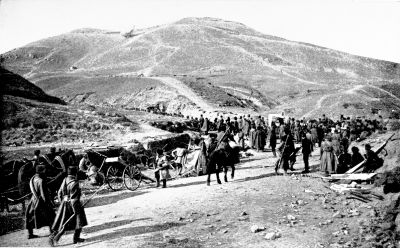
RESERVES WAITING UNDER 203 METRE HILL.
'But Irman—Irman reports—and he knows what he is saying—he reports that the hill is in the enemy's hands, and it is essential for us to take steps to get the men away, to save our reserve, to, to——'
'I repeat, there is no particular danger; I have already taken the necessary steps,' said Smirnoff.
'But Irman, who commands that front, reports steps must be taken. The enemy will break through; he'll force the line, and there'll be a street massacre,' said Stössel and Fock together.
'They cannot break through the line of forts and intermediate works,' answered Smirnoff.
'Oh yes, they can. You must retrench—cut off Tea Valley—and thus prevent a possible dash through.'
'I have already said that to you,' said Fock to Stössel, 'and I urge it being done. It is absolutely necessary to retrench, to cut off into compartments.'
'I quite agree—I quite agree,' echoed Nickitin.
Fock turned to Stössel.
'Sir, won't you order Tretiakoff to remain on the summit of the hill all the time? Let him sit there. Let him see for himself how the men are faring.'
The latter turned to Reuss and told him to telephone to Colonel Tretiakoff on no account to leave the top of the hill.
Smirnoff looked helplessly at those around, his glance now angry, now contemptuous.
'But Tretiakoff is always there! He is himself in immediate command of the fighting.'
This reply changed the current of Stössel's thoughts, for he replied:
'And so with the loss of this hill the days of this place are as good as——'
'Gentlemen, I guarantee that 203 Metre Hill will be ours as long as it can be reinforced without risk to the north-east front. You may feel at ease; I promise you that by morning-tea to-morrow I will give you the hill,' interrupted Smirnoff, his voice trembling.
'But it is all the same necessary that Tea Valley be partitioned off, or they will be able to break through,' was the reply.
'I have not enough men; if I do that I can't hold on to 203 Metre.'
'Take the Town Guard—make use of them,' said Stössel.
Smirnoff, seeing that the only way of getting away was to agree, said:
'All right; but I promise you by morning-tea to-morrow the hill shall be yours. Good-bye,' and departed.
Meanwhile, on the place itself the fight was desperate. One moment success was ours, the next it passed to the foe. At times it seemed as if all were lost. But no! not yet. Gathering themselves together, inspired by their officers, reinforced from the reserve, our men made a final effort and hurled the enemy down. The hill was again ours. What took place there cannot be written of with an ordinary pen—it could only be described in blood. The hopes and fears, the gallantry, the——words fail me. Some of the details are perhaps known to General Tretiakoff, the hero of that spot, and those under him. It was just now, when it seemed to be touch-and-go with the hill, that a rumour was spread to the effect that Kinchou had been recaptured by Russians—by Trans-Baikal Cossacks. It was nonsense, of course, but the men were so worn out and so hungry for good news from the north that the hope of relief by General Kuropatkin, cherished deep down in their hearts, made them believe. The third day's fighting came to an end; darkness set in, and the position was not yet lost. At tea-time on the morning of the 30th it was still ours—Smirnoff had kept his promise.
The fourth day was but a repetition of the preceding three. Shells of all sizes, from 11-inch to small quick-firers, rained upon the place. All cover, or anything that looked as if it might afford shelter, had long ago been turned into heaps of stones, iron, beams, rubbish, and mangled bodies. During the night shelters of sorts had been scraped up, only to be swept away by the first breath of iron which accompanied the morning light. The fury of the assault reached its zenith at 4 p.m. Fortunate it was that the enemy's demonstrations on the east were weak, and so enabled us to withdraw troops from that front to assist here. Bayonet fighting again took place for some hours, but at four the Japanese were compelled to fall back. The hill was still ours, but its slopes were thickly strewed with more dead, more dying. In four days we had, excluding dead, lost 37 officers and 4,000 men wounded. Among the dangerously wounded was the gallant Colonel (now Major-General) Tretiakoff, of the 5th Regiment, wounded in head and chest. When those near him implored him to go to the rear to get his wounds dressed, he refused, muttering, 'I will die where my regiment dies.'
On the morning of December 2, Colonel Irman, on receipt of a message from the top of 203 Metre Hill, telephoned to Smirnoff:
'All the assaults have been repulsed, and the hill is completely in our hands.'
This glad news was soon known, and the town rejoiced, for the enormous importance of this spot to Arthur was recognized by all, and Smirnoff's intention to hold on to it, even though thousands of lives were sacrificed, was appreciated. The north, south, and east fronts had, however, been considerably weakened, every available man that could be moved from them being taken—this hill had greedily swallowed up all, even the reserves of the reserve. The Commandant went to Fort No. 5 to make a detailed reconnaissance of the position, and after a thorough inspection of the enemy's approaches and distribution, he became more than ever convinced that things were in a most critical state. The enemy had got possession of almost all the slopes, and apparently had no idea of withdrawing. They were merely resting—bracing up for a last and final blow. The slope towards the western front, as well as the road joining it to the hill, were in our hands; all the rest was theirs. There was not the slightest doubt that the assault would be renewed with greater force and fury. Four hours Smirnoff spent in the fort, and returned in anything but a happy frame of mind, for the attack might be renewed at any moment. Exactly at midday, after an anxious respite, the bombardment again broke out.
That evening the garrison read the following order (No. 865, of December 2, 1904) by Stössel:
'I have just returned from seeing Colonel Irman. [Stössel had gone to Tea Valley, and made a speech to the men, not apparently realizing that it was no time for words.] 203 Metre Hill is all ours! Let us thank God for it. You—heroes that you are—have done what was impossible, what was only possible to brave men like yourselves. From November 20 to December 2—i.e., for twelve long days—the enemy has repeatedly launched his columns to the attack on A Battery, on B Battery, Kuropatkin Lunette, Erh-lung-shan, Chinese Wall, Chi-kuan-shan, Fortification No. 3, Tumulus Battery, Pan-lun-shan, ending with 203 Metre Hill and the position at Pigeon Bay—i.e., from sea to sea. Day and night they have come on, not sparing themselves; they have fallen under your heavy blows, but you have not yielded to them a rood of ground. What was ours on November 20 is ours to-day. In the Tsar's name, as his aide-de-camp, I thank you. You have delighted him. May God preserve him! Hurrah!'
A white flag was raised on the north-east front this day, and the Japanese asked for a truce to bury their dead. The Commandant at once gave permission, fire ceased, and friend and foe mingled amicably. All at once shots rang out from Erh-lung-shan Fort—it was an awkward moment for us. It turned out that Stössel, annoyed that his permission had not been asked for the dead to be buried, had therefore ordered the firing to recommence. Smirnoff was quite within his rights in not referring the matter, but Stössel's dignity had been hurt. He was now formally asked for permission, and granted one hour's armistice.
On the north-east front a white flag was again raised by the enemy in front of Kuropatkin Lunette. The fire gradually ceased, and we put one up in reply. From both sides officers and men moved out to meet each other, and they met like old friends.
CHAPTER XXXIV
THE LOSS OF THE HILL
While men were slaughtering each other in thousands on this hill the civilized world watched the tape, wondering who would win, what the end would be. How many protested or were even indignant at this legalized butchery? It is said, of course, that war is necessary and inevitable, that it freshens and invigorates national organism. This may be so, but it also brings a step closer the realization of the socialistic dream. Of this I am certain.
December 3 arrived and passed under similar conditions, except that the fight on the hill was, if possible, more exasperated. In the Fortress the feeling of alarm was intensified, and all unemployed men had been got under arms (at the time of the surrender the number of armed men had been increased by 9,000), and the other points denuded, in order to feed the maw of 203 Metre Hill. Even the hospitals gave their contribution. December 4—bright and frosty—ushered in a fresh hell. It was now hardly a fight between men that was taking place on this accursed spot: it was a struggle of human flesh against iron and steel, against blazing petroleum, lyddite, pyroxyline, and mélinite, and the stench of rotting corpses. It was the last day but one of the long-drawn agony.
A shell to-day fell into one of the hospitals full of wounded men, but perhaps the scene of horror inside was hardly increased. Were the enemy getting ferocious in their exasperation, and beginning to ignore humanity? It looked like it. By night our feelings had become deadened by the continued strain; we were almost apathetic.
On the hill our men still held on under the gallant leadership of Colonel Irman, but in spite of his bravery he did not really replace Tretiakoff, and Butusoff, by now well known to the reader, had just before this fight been given a week's leave to rest—a rest which he sadly needed. Captain Veselovsky, of the 26th Regiment, was actually commanding on the hill. The officers with him were Lieutenants Obolensky and Rafalovitch, of the same regiment. While the first-named was calmly doing his duty a splinter tore away his face right down to the lower jaw. On his body there was left a chin fringed with beard and some teeth. Rafalovitch, who was standing alongside, was untouched, being merely covered with earth and blood; but he was quite upset, and asked Semenoff to relieve him for a few hours. The latter telephoned permission, but 'not for more than two or three hours,' as the waste in officers was very great. Rafalovitch appeared at the Staff Head-quarters. He was dirty; his clothes were torn and covered with blood and spotted with whity-red bits of something. This handsome, healthy young fellow was quite unstrung by what he had been through. He was trembling as if in a fever; his eyes were bloodshot and wandering, and he could scarcely speak.
'What's happened? Your face is covered with blood. Are you wounded?'
'No, sir, I am—I am not wounded. It's not my blood; it's Captain Veselovsky's brains,' was the stammering reply jerked out.
'What! Veselovsky killed?'
'Yes, sir. His head was carried away—only not quite: the lower jaw and beard were left—and I was covered with his brains, right in my face. It almost blinded me. I thought I was wounded. Can I go and rest a little?'
'Yes, go, and God be with you. Go and rest, but remember we are short of officers.'
After a few hours a message was received that Obolensky had been killed with a bullet in the head. There was now not a single officer left in the 5th Company of the 26th Regiment; there was only the sergeant-major. He was promoted by telephone to be acting ensign, and Rafalovitch was sent for.
The telephone rang.
'Sir, General Kondratenko wants to speak to you.'
Semenoff took the receiver and listened.
'I think the position so serious that Colonel Butusoff should be sent there.'
'Sir, Butusoff is exhausted, and asked a few days ago for leave to go and rest. I gave it him on the condition that he would at once come if wanted.'
'Tell him that I do not order him to go to 203 Metre Hill, but I would ask him to. We want him there; he is irreplaceable. Say it is my particular request.'
He was at once summoned, and went up to the hill. We knew we should not see him again, and sure enough next day Butusoff, the pride of the Frontier Guards, was mortally wounded in the stomach, and suffered frightful agony till he became unconscious before death.
As the sun rose on December 5 it lit up the two-humped summit of 203 Metre Hill for the last time in the possession of Russian soldiers—a handful of gunners, sappers, and infantry hiding among shapeless mounds of rubbish. This was the last day. On it occurred an incident which might be for ever quoted as an illustration of the 'fog of war.'
That morning Semenoff was watching through a telescope from Obelisk Hill. At ten o'clock he saw that the fighting was at the very top of the hill. At noon he saw our men retiring; the Japanese had gained the top, and our men were dashing down the hill. The enemy did not follow; they did not even open fire, but more and more of them were collecting on top and working as hard as they could, throwing sand-bags together and entrenching themselves. Their flag fluttered in the breeze. A parapet grew up; our men were getting further and further away. It was all quite clear and distinct. Every minute was precious. It was essential to concentrate a heavy fire on the hill and prevent the enemy establishing themselves, or all would be lost. He dashed to the telephone.
'Put me on to the Officer Commanding the Artillery.'
An answer came from the exchange that the line was engaged.
'In General Stössel's name put me on to General Biely.'
He got through.
'Sir, the Japanese are entrenching on the top of 203 Metre Hill. We are retiring; the artillery must shell the hill. Every minute is precious.'
Biely calmly answered that, according to the reports from Irman, the hill was still ours.
'I assure you, sir, the Japanese have got the hill, and are throwing up a parapet. I can see it through my telescope.'
Biely answered as before, and suggested that Semenoff should communicate with the Fortress Staff. Meanwhile the Japanese were feverishly, rapidly continuing to work, and time was going—precious time that never would return.
Semenoff rang up the Fortress Staff. They replied that, according to a report just received from Kondratenko, the hill was still in our hands. Semenoff assured them that our men had abandoned it and the Japanese had seized the summit.
The artillery remained silent: without an order through 'the proper channel' they could not open fire. No one else either saw or knew what was happening. It was only from Semenoff's observation point, and by aid of an excellent telescope, that it could be seen that the Japanese had taken the hill. Semenoff again rang up Biely:
'Sir, open fire on 203 Metre Hill, or it will be too late. There are many Japanese there now. They are entrenching themselves on the top, and we shall not be able to get it back.'
'Perhaps you are mistaken. Why doesn't Irman, who is commanding the western front, send us any word? I——'
But Semenoff rang off. It was already 2 p.m. He rang up Irman's staff and spoke to Kondratenko:
'Sir, the Japanese have occupied the top of 203 Metre Hill, and are building a parapet. We have retreated. I can see it all in my telescope. Fire must be opened on the hill.'
'How is it that I can still see our men in a bomb-proof? And Irman tells me that the hill is ours. I will ask him now,' said Kondratenko.
'I assure you, sir, that the Japanese are on the top.'
'Well, I'll ask Irman at once. If it is so, we must open fire immediately, although I myself clearly see our men, and have asked the Commandant not to fire.'
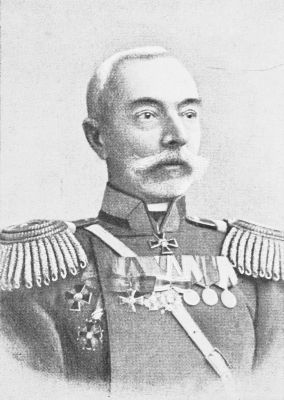
GENERAL BIELY.
This muddle can be very easily explained. It was all caused by the 'point of view.' The Commandant had received information that the Japanese were on the hill, and that our men were retiring; he had been told so often before. However, being convinced that 203 Metre Hill was in possession of the enemy, he ordered Biely to open fire on the top. The order was given, but it took at least an hour before it reached the battery commanders by telephone. Meanwhile Kondratenko telephoned to him and implored him not to open fire, as some of our men were still concentrated on the hill! The Commandant, upon receipt of this message from the Officer Commanding the Defences, at once ordered Biely not to fire. Kondratenko was correct in reporting as he did; he saw what was happening on the hill from his own point of view, and there certainly were some men in the bomb-proof. Semenoff from his position could see well that the Japanese had occupied the top, and were entrenching. So it went on.
Later Kondratenko telephoned to Semenoff and asked him to go to him to arrange a withdrawal of the troops. This was Irman's duty, not Semenoff's. But the former was now useless: after all the strain and confusion, he had quite lost his head. There was again some misunderstanding about the withdrawal. In the evening an unsuccessful attempt was made to regain 203 Metre Hill, and after its failure, Smirnoff decided to abandon it altogether, but to cling on to Flat and Divisional Hills. However, by an error of Kondratenko's, all three were abandoned at the same time. It did not much matter, as with the fall of 203 Metre Hill the two others had no real value. The withdrawal began at dusk, and was carried on without a hitch till 6 a.m. Notwithstanding the fact that every one in Arthur well knew that it must fall sooner or later, that it was not strong enough to resist siege-guns, or to repulse for ever assaults which were constantly being reinforced by fresh columns, the actual end created a deep impression. The lull which now ensued, though, as usual, made the garrison believe in its own strength, in spite of the fact that the last days of the Pacific Ocean Fleet had come.
203 Metre Hill was lost, and with it more than 5,000 Russians.
CHAPTER XXXV
A RETROSPECT ON THE POSITION AT SEA
As soon as the enemy had established themselves on 203 Metre Hill, they began to build an observation station, and connected it to their siege batteries by telephone. December 6 passed in comparative quiet, but towards evening the enemy began to shell our ships. These were lying helplessly under Quail Hill, hoping to get some protection there from the 11-inch shells; but in vain, for from the summit of 203 Metre Hill could be seen the harbour, every ship, and every bursting shell. The huge projectiles could be seen falling one after another, either in the water near the ships, raising great pillars of water, or else striking them. The punishment began. The enemy's siege batteries set to work to destroy the squadron, which perished under the eyes of the whole Fortress, and the sailors now holding the land positions watched, helpless and with sad hearts, as their ships were struck, and one after another our great giants went to the bottom. A column of smoke was seen to shoot up from the Pallada, an explosion was heard, and a fire broke out on her. She struggled for life, Admiral Wiren himself superintending the extinguishing of the fire, but efforts were in vain, and she slowly perished. The Bayan was sunk under Golden Hill; close to Quail Hill lay the Retvisan on her side, and beyond, again, were the Pobieda and Poltava, turrets half a-wash, guns pointing dumbly to the sky. Along-side stuck out the masts of the Zabiyak; the inner harbour was, in fact, a cemetery.
With the loss of 203 Metre Hill, Stössel's determination to surrender the Fortress ripened; in this he was much influenced by ——. The latter, for some incomprehensible reason, did not like the navy; his dislike reached such proportions that, when the sad news of the destruction of the last ship came in, he crossed himself, and, as if greatly relieved, said, 'Thank God—that's the end.' This was said in Stössel's intimate circle, but it soon became known in the garrison. And so Stössel, when the destruction of the ships began on December 7, wrote a letter to Admiral Wiren, in which he categorically insisted on the sunken ships being destroyed, and on those that were able putting out to sea, giving as his reason that with the loss of 203 Metre Hill the defence of Arthur was nearing its end. (The fall of this hill had an enormous significance for the fleet, but was only of secondary importance with regard to the defence of the Fortress.)
To General Stössel's letter Admiral Wiren replied as follows:
'From the Officer Commanding the Squadron of Battleships and Cruisers in Port Arthur to the Officer Commanding the Kwantun Fortified District.
'I have the honour to reply to your letter, No. 2,241 of 7th instant, as follows:
'The sortie of the fleet on August 10 of this year, in order to force its way through to Vladivostock, was made in accordance with an order from the Tsar, communicated in a telegram from the Viceroy, though the opinion of the majority of Admirals and Captains was against such an operation, for—taking into consideration the superiority of the enemy, both in ships, guns, independent cruisers, divisions of destroyers, and speed, as well as the distance to Vladivostock without ports en route, and the necessity of passing the enemy's straits near the island of Tsu-shima—they deemed it impossible.
'If everything went well, our ships, having expended their ammunition in fighting the enemy's battleships and repelling torpedo attacks at night, or being disabled like the Cesarevitch, would have had to seek the sanctuary of a neutral port, and would have become useless for the rest of the campaign. It was doubtful if any ship would ever have reached Vladivostock; the Novik, which was the quickest of them, even though she had great luck, was unable to do so.
'All our ships would have been lost in the middle of August, at a time when the enemy's fleet would have been able (thanks to its above-mentioned superiority and to the fact that, while steaming parallel with us, it was making towards its own ports) to operate so that none of its ships were rendered hors de combat. As the enemy's ships would not have been seriously injured in these fights, they could have renewed, refitted, and repaired at ease before the earliest possible arrival of Admiral Rojdestvensky's squadron in the beginning of January, and could have met it in as good condition as now.
'With the return of our fleet to Port Arthur, after the battle of August 10, with less than half its ammunition, with battered ships, and many disabled guns, this operation of breaking through to Vladivostock became still more impossible. A few days after the squadron's return began the August assaults, in which our naval detachments played an important part, and in which several officers and men were killed. At a conference of flag-officers and Captains on August 19 a minute was drawn up, a copy of which I have the honour to attach. In accordance with this it was decided to assist the Fortress in every possible way, and we have most conscientiously endeavoured so to do. All the guns asked for for the positions have been taken off the ships and mounted, shells of all calibres have been expended on the land batteries, all ratings have worked according to their special calling for the defence of the Fortress, and have taken the most active part in repulsing the attacks in September, in October and, finally, in November on Tumulus Hill, B Battery, and 203 Metre Hill, where many of all ranks were killed.
'Till the capture of the latter the ships were, as far as possible, kept in repair, but they could only have been of assistance to Rojdestvensky's fleet after the relief of Port Arthur by land, which would have enabled us to get ammunition and guns and to refit. Rojdestvensky well knows this.
'The ships of the fleet are now sunk. Save for a small quantity of 47-millimetre and 12-inch ammunition, all the rest has been put on shore. The officers and crews have been sent ashore. The torpedo officers and men are employed making hand grenades and small shells, and many of the engineers are making ammunition; the remainder of the crews, numbering about 500, form the last reserve, and so the squadron to the very end of all its matériel and personnel is helping the Fortress to defend itself. With regard to the sinking of the ships, steps have been taken that uninjured guns should not fall as trophies into the enemy's hands if the Fortress falls. The Sevastopol, which is the only uninjured battleship, I will try to anchor near White Wolf's Hill, where, however, she will, of course, be subject to torpedo attacks and risk being sunk. It is naturally sad to have to lose the fleet thus, but if God enables us to hold out in the Fortress till relieved from the land side, I am sure that impartial men in Port Arthur will say that without the assistance rendered by the fleet it would long ago have fallen into the enemy's hands.'
To show clearly the state the fleet was in in the middle of the strict blockade, when the Viceroy ordered it to break through to Vladivostock after the unlucky attempt on August 10, I will quote an extract from a report of Admiral Wiren's, which fully illustrates its pitiful condition, and clearly shows that it had not a chance of getting through. The report was written after the fight of August 10:
'I have the honour to report that at present the ships of the squadron under my command are in the following state:
'(a) Hulls.
'The repairs to the Peresvet, Pobieda, Retvisan, and Pallada are finished, and to the Poltava and Bayan are being finished. The Sevastopol is being repaired with the aid of caissons, and will be ready in six to seven weeks. External damage to the sides has been covered with sheets, and her interior has, as far as possible, been repaired.
'(b) Guns.
'Since the commencement of the operations two guns have been absolutely disabled.
'After the conference on August 19, the following were put ashore for the land defences: One 6-inch, ten 75-millimetre, nineteen 47-millimetre, eight 37-millimetre, and three searchlights.
'(c) Personnel.
'Captain Boysman of the Peresvet is recovering from wounds, and is on the Mongolia. In the fight of August 10 two officers were killed; in the assaults two more were killed; eleven are wounded and sick.
'In reporting the above-mentioned state of the fleet, and in stating that all my thoughts and desires are aimed towards carrying out the Tsar's orders and your wishes, I consider it my duty to represent the following facts:
'Our fleet, and particularly my squadron, not being able to steam faster than thirteen knots (Sevastopol and Poltava), cannot possibly get through to Vladivostock without a fight, and the result of a fight is not hard to foresee, even if the ships were better than the enemy's in point of fighting—i.e., straight shooting. Even supposing that the fleet steams out of Port Arthur without accident through the mine-fields, which have become more dangerous during the last month, as the enemy have constantly been laying mines (our dredging flotilla, though it has daily trawled, is very weak, has few pinnaces, and what with the destruction of a dredger, a port barge, and two destroyers, has not been able to do much), it is impossible for it to escape notice. Our greatest speed is only thirteen knots.
'The enemy would meet us in three or four divisions:
1. Division of battleships and armoured cruisers 6 ships
2. Division of fast second-class cruisers and one first-class cruiser (Yakuma) 5 ships
3. Coast-defence battleships and one armoured cruiser (Tokiwa) 7 ships
4. Several divisions of destroyers and small torpedo craft.
'We cannot take the initiative in action, as the enemy, having superior speed, can steam away if they do not wish to fight, and can accompany us until it suits them to engage in battle—i. e:
'(a) When our fleet is some seventy miles from Arthur.
'(b) When they can concentrate all their force.
'(c) When they are occupying a favourable position with regard to the sun and the sea.
'As on August 10, the real fighting would again probably commence in the afternoon; and each of the enemy's ships which were seriously injured would be able to fall out for repairs or to make the land without risk, at a time when each of our ships falling out of action, though only temporarily damaged, might become a prize to two, three, or four of their vessels, or at best might run on to a neutral coast, or steam into a neutral port, and be interned for the rest of the campaign.
'Thus they can easily beat us without losing a single big ship, and all damage to ships or guns could be quickly made good in port, after replacing the disabled guns and supplementing the crew. At sunset the big ships would cease fighting, to rest, while two, three, or four destroyer divisions would attack or menace us all night, so that the crews would get no sleep, and we should be forced to waste ammunition till morning. The speed of our fleet would in all probability diminish, as the battered funnels (one of the principal destructions on August 10) increase the expenditure of coal and prevent proper pressure being maintained. If steaming thirteen knots, the voyage to Vladivostock takes four days: it will take longer at less speed—i.e., at eight knots the passage would take six days. On the morning of the second day the enemy's battleships, having repaired and rested, would again, whenever it suited them, fall on our tired fleet, and so on repeat their tactics till the island of Tsu-shima, where a fresh division of four armoured cruisers and destroyers would be waiting for us; and there, close to their shores, their fortresses and ports, the enemy would try and bring on a decisive action. We could not ram, as this operation requires superior speed. Indeed, it would be a miracle if we got to Vladivostock, and, having lost the remainder of our Pacific Ocean Fleet, we would be giving the enemy a fresh victory, and, what is more important, depriving the Baltic Fleet of the possibility of destroying them, since it is weaker than the enemy, both in numbers of ships and of guns, in its many types of vessels, in speed, and in the fact that it will have to force its way through to a base—Vladivostock—without which no fleet can operate.'
CHAPTER XXXVI
A COUNCIL MEETING
On the 8th was held a meeting of the Council of Defence, a meeting which is historic in the annals of this unique body. Up to now at previous meetings many things had been discussed. The plan of the forts and the fortifications had been criticized generally and in detail. The uselessness of our engineers had been pointed out ad nauseam; the disgraceful nature of the concrete work, which, though designed to resist 6-inch shells, was easily destroyed by them, and the insufficiency of the munitions of war, had been discussed. It had been reiterated in no measured terms that Arthur was in no sense a Fortress, but only an entrenched camp. General Fock generally spoke more than the others; his speeches were verbose and not convincing. Each successive meeting was a repetition of the preceding one and the minutes were of no value, as the resolutions entered in on them by Stössel, some of them dictated by others, were at variance with the opinion of the members, and were made with 'one eye on the gallery,' for future use. They were, later on, characterized by Lieutenant-General Froloff, Chief of the Head-quarter Staff, as being 'an apologetic document submitted betimes with a view to later on justifying the surrender.'
The Commandant, knowing from experience that nothing would result from these meetings except endless discussion and waste of time, was unwilling to summon them. He used to do so once a month simply to satisfy General Stössel. Instead of this Council, Smirnoff used to hold daily conferences with the general officers commanding the land defences, the Fortress artillery, and the Fortress engineers, at which all urgent questions were quickly decided.
On the morning of the 8th, Stössel and Reuss went to Kondratenko's quarters. General Biely, commanding the artillery, saw this from the veranda of his hut, and could not understand why they should visit Kondratenko. After a couple of hours they came out, conversing eagerly. Stössel went home, but Reuss went up to Biely. He talked to him eloquently of the critical state of the Fortress, drawing a dark picture of the future. He asserted that, with the destruction of the squadron, Arthur's importance as a fortress had ceased, and that therefore, on account of the suffering wounded and of the exhausted and scurvy-stricken garrison, matters should be put a stop to. Biely was dumb; the object of Stössel's visit to Kondratenko was now clear. Reuss then spoke openly about surrender, and did his best to persuade Biely to agree to it. At last, declaring he was going on to the Commandant, he said good-bye, but he went off in the opposite direction, and shortly afterwards Smirnoff received a note from him to the following effect:
'Owing to the great change in the conditions since the loss of 203 Metre Hill, the Officer Commanding the District requests that you will summon a meeting of the Council to discuss future action for the defence of the Fortress.'
On receiving this, the Commandant presumed that the Council was to meet in order that Generals Fock and Nickitin, who had no duty, might be acquainted with the scheme for the future defence. At 5 p.m. the members met in Smirnoff's room, all except Kondratenko, who was telephoned for. He was unable to come at once, so the discussion went on without him. Smirnoff opened the proceedings:
'As Roman Isidorovitch [Kondratenko] thoroughly knows the scheme for the future defence, I will begin without waiting for him. Well, gentlemen, 203 Metre Hill has fallen. With its fall began the bombardment of our warships, which have been destroyed. Nevertheless, the loss of the hill has not altered the position of the defence. So long as we held Angle Hill, 203 Metre Hill was, with regard to that, a réduit.[33] As soon as we abandoned Angle Hill, 203 Metre Hill became a salient on the western front, which the Japanese had to attack. This salient no longer exists. Our lines over this hill were large, but the enemy's were incomparably greater. For us 203 Metre Hill was only an advanced point, the defence of which was mainly important in order to ensure the safety of our fleet. This defence, on which we had to concentrate all our available strength, gradually weakened us all along the line. I held on to it till the denudation of the other fronts, especially of the north-east, in order to provide reinforcements, became dangerous. From the moment I felt that a further expenditure of men on 203 Metre Hill was more dangerous than useful, I decided to give it up. From what I have said it is clear that, with the fall of the hill, we are forced back on to positions on the main line of defence. The western front, in addition to the permanent and intermediate works, which have hardly been touched, has a lot of ground behind it. To reach this front from 203 Metre Hill by systematic approach (the enemy could not do it by assault) will take at least a month and a half. I have no fear for it.'
'It is essential to strengthen the defence of Liao-tieh-shan, which is the keep of Arthur. The enemy will now turn all his attention to it. It is necessary to strengthen it and defend it,' interrupted Fock.
Kondratenko then entered.
After telling the new-comer what had been said, Smirnoff continued:
'And so, I repeat, I have no fear for the western front, as I am almost certain that Nogi, being for the present satisfied with the capture of 203 Metre Hill and the destruction of the fleet, will not force his way any more in that direction. What he does there will be in the nature of a demonstration; he will turn all his real attention to the north-east front, which has cost him so dear, to the half-destroyed forts and works whose parapets are now almost occupied by him. This is obvious, because, having conducted with the greatest pains a gradual attack against this front for more than three months, and having at last reached the parapets of our works after immense loss, he will never abandon them in order to commence a fresh attack on the almost untouched side. Besides, the enemy know well that behind this front are all the vital parts of the Fortress—the dockyard, workshops, mills, supply depôts, arsenal, magazines, etc. On the western side, however, there is no such attraction for them; on the contrary, there is everything to put them off, so I repeat that I do not fear for it. Our north-east front, from Tumulus Battery to B Battery, however, causes grave anxiety. Chi-kuan-shan Fort and Fortification No. 3 are the most critical, and that is where we must pay all our attention. Owing to this, it is essential to take some of the troops from the west and send them to the east, after drawing on the garrison of Liao-tieh-shan and the forts which have not been attacked. At present on the north-east front a second line has been got ready, running from Tumulus Battery across Vladimir and Mitrofanieff Hills to Nameless Redoubt. The third line on Stonebroken Ridge will soon be finished. I have paid special attention to this, and it will shortly be extremely strong. At present, with the forts and Chinese wall still with us, the naval guns mounted on the third line and the shore front will enable us successfully to carry on an artillery duel, notwithstanding the fact that the enemy is within the Fortress area. But, in any case, it is necessary to concentrate as many men as possible on the north-east front. The main reserve is now a little more than a thousand men. General Gorbatovsky also has a fairly strong reserve, but, owing to the great losses one way and another, we must take troops from Liao-tieh-shan and the forts on the western front. That is the position. I am ready to hear any suggestions that may be put forward.'
Fock replied:
'I urge the importance of strengthening the defence of Liao-tieh-shan. I have already pointed out its strategical importance to the Fortress. It is the keep, you understand, gentlemen—it is the keep of Arthur.'
Smirnoff replied:
'I say that Liao-tieh-shan at present is of no importance to the Fortress. Even if the Japanese occupy it, it will only be of use to them as an observation point, as it is so far away. It will take a very long time to mount guns there, and they will never attempt it, for the simple reason that to shell the Old Town and the north-east front from there is impossible. The Old Town is seven and the north-east front is nine miles away as the crow flies. But let us now get on to those points which are closely connected with the strength of the garrison.'
Fock returned to the charge:
'I urge the necessity not only of holding, but strengthening, the defence of Liao-tieh-shan. It is the keep of Arthur'—but Smirnoff continued:
'At present dysentery is on the decline; typhus, though it exists, is stationary; what is worst of all is the increase of scurvy—that is the scourge that we must fight. The most rational, and the only thing to do is to increase the allowance of meat. This may not stop the epidemic, but it will weaken it. Scurvy is a slow disease, and by increasing the rations we may yet be able to make use of the men who have only got it in the initial stage. We have about 3,500 horses. According to my calculations, not more than 500 are required for the works. The munitions of war and food-supplies are now concentrated all along the defences, and so long-distance transport of them will not be necessary; besides, the Décauville light line,[34] connecting the Old Town with Cossack Square, will to a considerable extent relieve the transport of supplies to the front. I think that, with luck, we may take for food, without harm to the transport of supplies, more than 3,000 horses. I therefore propose to issue to the garrison ½ pound of horse-flesh per man. I have not worked it out exactly, but, roughly, for a garrison of 40,000 men that means fresh meat for forty-eight days at ½ pound per man per day.'
After some discussion it was decided to issue a ½-pound meat ration to those in hospital and ¼ pound to the combatants.
Biely, who knew what was coming, could not for the life of him make out why Smirnoff was beating about the bush so long instead of coming to the main subject of the meeting. Gorbatovsky, in complete ignorance, was quietly awaiting the end of the meeting. Khvostoff was hurriedly writing down notes from which to draw up the minutes. Reuss, who looked as if he were sitting on tin-tacks, suddenly jumped up.
'The Officer Commanding the District has instructed me to ascertain the opinion of the Council as to how long they consider the Fortress should be defended.'
'Excuse me, sir; that question does not permit of discussion. Although we have not an overabundance of ammunition, we have sufficient to repel at least two more heavy assaults, and if the big-gun ammunition runs out we shall have more than 10,000,000 rounds of small-arm ammunition left. When all the ammunition is finished we shall still have our bayonets. Such a question is quite inopportune, premature, and does not permit of discussion. As to the question of how long we can hold out, that is easily decided for us by the Supply Returns.' And, getting up, Smirnoff moved towards the table on which the books were lying. 'Let us see what the Fortress Intendant has to say as to the amount of supplies in the depôts to-day. I see that flour, groats, green food, tea and sugar, will last for more than a month. The question of horse-flesh we have just settled. In addition to this we have sufficient biscuits for more than a month and a half.[35] The question of surrender cannot at present be considered. I cannot allow any discussion with regard to a capitulation before the middle of January at the earliest.'
There was a general movement of assent amongst the members. They all loudly declared the raising of the question to be quite premature. Reuss remained sitting, looking extremely disconcerted.
'Yes, yes; the raising of this question is premature,' said Fock.
Reuss looked at him with unconcealed astonishment.
Smirnoff continued sarcastically:
'At home they are just preparing to celebrate the jubilee of Sevastopol. Our fathers held out for eleven months! We shall not have completed eleven months till January 8, and only then will the son be worthy of his father.'
When they went out into the street Kondratenko turned to Biely.
'What has happened to General Stössel? Has his wound really made such an impression upon him?'
Khvostoff alone was left in the room, scribbling hard at the minutes. Next day these were sent round to all the members for signature. They all signed, but Reuss attached his dissent, in which he protested that the Commandant had decided the question of surrendering the Fortress purely on the basis that Arthur had not held out so long as Sevastopol. With regard to the actual facts he said nothing.
When the minutes were sent to Stössel for his confirmation he first wrote repudiating the instructions which Reuss said he had given about raising the question of surrender; then, agreeing with Fock's opinion as to the immense importance to the fortress of Liao-tieh-shan, he gave definite orders that its garrison should not be weakened, and that it should be defended to the last. He also expressed great astonishment at the Commandant's ignorance in thinking that guns, rifles, and bayonets were used in succession one after another and not together!
'Every soldier knows that guns, rifles, and bayonets are used together. As to surrendering the Fortress, I shall know when the time comes, and I will not permit a street massacre.'
The most important resolution of the meeting—namely, the question of increasing the horse-flesh ration on account of the spread of scurvy—he did not confirm. The garrison continued to be fed on fish for five days per week, receiving ¼ pound of horse-flesh per man only on the other two days.