Front matter (continued 6)
A. B. (Alexander Bertram) Lindsay translation
How can one account for such a decision concerning men suffering from scurvy? Not only was the deprivation cruelty to the sick men, but it tended to reduce the garrison to a state of impotence through disease.
With General Stössel must unquestionably lie the responsibility for the fact that the whole Fortress was slowly converted into a living cemetery (scurvy increased with great strides), and that the way for surrender was thus prepared. Finally, he, to every one's amazement, issued an order that day by which he endeavoured to prevent the Commandant getting in touch in any way with the outside world. This order was as follows (No. 904, dated December 9, 1904):
'Should any Chinese junks approach the shore, the nearest picquet or gendarme post will take steps to guide it into a safe place, and will put a guard on it to see that no one goes near it. Its arrival must be immediately reported to the District Staff, whence further instructions will be awaited. All correspondence found will be at once despatched to the District Staff Office. No junk will be permitted to leave without permission of the District Staff, and permission for anyone to go on board the junks must also be obtained from that office. The despatch of any correspondence whatever in junks is strictly forbidden. Before their departure junks will be carefully inspected, and any correspondence found on them will be confiscated, and the authors will be held responsible.'
The gendarmes were placed in the most impossible position by this order, but their chief, Prince Mickeladsey, knowing what the Officer Commanding the District was worth, and being, properly speaking, subordinate only to the Commandant of the Fortress, continued to obey the orders of the latter.
Admiral Grigorovitch, as before, continued to communicate with Chifu.
FOOTNOTES:
CHAPTER XXXVII
KONDRATENKO'S DEATH AND SOME RESULTS
On December 11 regular winter set in, accompanied by a searching wind. The garrison began to suffer greatly, owing to the bad food and the want of protection from the weather. Scurvy increased very much, in spite of the efforts of the doctors, who were helpless in the absence of a proper food allowance. All that Stössel would vouch-safe to their representations on this subject was: 'As to the surrender of the Fortress, I shall know when that should take place, and I will not permit a street massacre.'
For the next two or three days there was much anxiety in Arthur about Fort Chi-kuan-shan. The enemy had even got into the counter-scarp gallery, whence they had driven our men back with poisonous gas, and so obtained possession of a portion of it. Many were the earnest consultations between Smirnoff and Kondratenko.
The night of the 15th was unusually wild. The snow was driven across the gaunt hills in clouds by the vicious gusts of an icy wind, which moaned as it swept up the gorges—suitable accompaniment to the more deadly sounds in the air, for the Japanese were not resting. Pitch dark though it was, there was sufficient light to distinguish the mass of Chi-kuan-shan Fort as it lay under patches of snow, with the bare rock showing on the lee of the slopes and scarps. The fort seemed deserted, for, save the few sentries on the parapets, not a soul was about—all were under cover, snatching what rest they could. Of the enemy also, busy as they were, nothing could be seen—they had all burrowed. From some casemate below two young officers came up to the main parapet, behind which they stood listening to the enemy delving in their saps. Presently there was a movement in a Japanese trench, and a shower of sparks came fizzing over: a warning shout among our men, and then the detonation of a grenade. The two officers having amused themselves thus for a short time, went down to the counter-mine galleries to listen for the enemy, who were now very close. Meanwhile down below in the bowels of the great fort a different and more pleasant scene was being enacted. General Kondratenko, who had come out to see things for himself this evening, so critical were they, was decorating a non-commissioned officer for gallantry. Warmly congratulating the soldier, he kissed him and pinned the Cross of St. George on his breast.
The concrete casemate in which this little scene took place was a haven of rest after the turmoil above, for here few sounds could be heard, and there was comparative warmth. After the ceremony Kondratenko sat with his head on his hands, silent and apparently depressed; the others discussed matters. Behind a wooden partition a party of sailors were busy filling hand-grenades by a lantern, and cases of pyroxyline were lying strewn about.
'Listen, gentlemen! It is coming!' and all were suddenly silent, for even down here the whistling roar of an 11-inch shell could be heard. It arrived and fell into the ditch behind, destroying the bridge, and the groans and shouts for stretchers could be heard.
When supper was served, Kondratenko would eat nothing. A consultation was started, much being said about Smirnoff's orders for work and Stössel's counter-orders as to not using up the men. In the corners of the casemate some were sleeping, others were quietly talking. Of all the officers present, Colonel Raschevsky was particularly cheerful and talkative.
'Well, gentlemen,' said he, 'this casemate is about the only place in this fort where one can feel fairly safe. The underground shelters are none too satisfactory when 11-inch shells are flying about, though they are good enough against splinters.'
It was now near nine o'clock, and again the noise of a rapidly approaching shell was heard—the fifth since Kondratenko's arrival.
A—a—a—ah!!!
All was confusion, dust, smoke, noise of falling concrete, stones, and splinters of steel, cracking of bursting grenades, cries, the stench of blood, the suffocating gas of high explosives.... In the corner where Kondratenko, Raschevsky, Senkevitch, Zedgenidsey, and Naumenko had just been sitting at the table poring over the map, a bluish flame flickered for a moment over a heap of bodies half buried in débris. All was still, save for the groans of Lieutenant Kraiko (one of whose legs was torn off) and of Potapoff—buried under the ruins. Under this heap of rubbish the others lay dead, killed while in the execution of their duty.
Kondratenko had perished, but wherever Russian is spoken his name will ever be synonymous with duty, unselfishness, bravery, and honour.
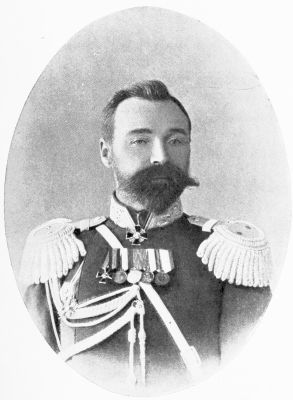
MAJOR-GENERAL KONDRATENKO.
It was about 10 p.m. when Smirnoff received the news on the telephone from Khvostoff. He felt it bitterly. In one moment his best and most reliable assistant had been swept away. Not only was it on account of his skill as a soldier that Kondratenko could not be replaced: there were other ways in which he had been invaluable. His death meant more difficulties and a fresh struggle with Stössel. Roman Isidorovitch had always contrived to smooth over things, thus annulling, to a certain extent, the conflict of orders. But now the inevitable had come to pass: he was no longer there to help.
About eleven o'clock Khvostoff himself arrived, and briefly confirmed his telephone message:
'Sir, an 11-inch shell burst in the officers' compartment in the casemate of Chi-kuan-shan Fort. Generals Kondratenko, Raschevsky, Zedgenidsey,[36] and Senkevitch were killed on the spot. Colonel Naumenko was alive when brought out, but he has died since without regaining consciousness.'
Looking at the practical side of things, Smirnoff's first words were:
'We must go to Stössel at once. —— is next in seniority to Kondratenko, and Stössel will certainly try to give him the vacant appointment. This must at all costs be prevented. I will myself take over the command of the land defences in addition to my duties as Commandant, difficult though it will be. The state of affairs on the north-east front is so serious that I cannot under any circumstances allow —— to have charge. He can be sent to the western front, where the enemy are still a long way off, and he can't do much harm, and where, much as he may want to, he won't be able to surrender anything to them. It is different on the other front, where the Japs are almost sitting on the parapets. There he would undoubtedly surrender one position after another, carrying out his theory of the doctor and the gangrenous patient.'
Arriving at Stössel's house, they found the place locked up; even the orderly supposed to be on duty was asleep. Only after much knocking was he aroused sufficiently to open the door.
'Tell General Stössel that the Commandant has come to see him on urgent business.'
'The General is asleep, sir, and has given the strictest orders that he is not to be disturbed on any pretext whatever. I cannot go to him, sir—I dare not.'
This, if you please, was the man in command of a besieged fortress!
'Let us go to Fock. I will talk to him and tell him what I intend to do,' said Smirnoff.
Stumbling along in the dark, they at last reached Fock's quarters. An orderly appeared, but here again the Commandant was to meet with failure, as after a few moments the man returned to say: 'The General has ordered me to say that he is very ill and in bed with a temperature of 102. He is in a high fever and cannot possibly see you.'
'Let us try Reuss, then,' said Smirnoff quietly.
On the way they met Dmitrevsky (Chief Staff Officer of the 4th Division).
'Colonel, General Fock is on the sick list; meanwhile I propose to appoint Nadein to the western front, and you are to go there as his Chief Staff Officer.'
They arrived at the District Staff Offices, and found Reuss just sitting down to supper. He was surprised and alarmed at such a late visit from the Commandant, who at once said:
'I have just been to Stössel and Fock, but was unable to see either of them. I want you to tell Stössel in the morning that I consider the state of affairs on the north-east front so bad that I am going to command there myself. I have decided to appoint Fock to the western front, but till he is off the sick list (he is very ill at present, with a temperature of 102) I will send General Nadein there, with Dmitrevsky as his Chief Staff Officer. Please tell Stössel of this to-morrow, early, so that there may be no misunderstanding about orders.'
'Very good, sir. I will report it first thing in the morning.'
Next morning a Mass was held for the souls of the departed, at which a great number of officers were present to pay their last tribute to the men they had so respected and loved. The Commandant was there, of course, but Stössel, Fock and Nickitin were conspicuous by their absence. Thinking that the first named would surely come, the priests waited some time before commencing the service, but in vain. While waiting Colonels Semenoff and Kilenin went up to General Smirnoff and said:
'We wish to inform you, sir, that, on behalf of the officers of the garrison, we are sending a deputation to General Stössel to ask that the command of the land defences be left entirely in your hands. We are convinced that only in this event can a successful issue be counted on. If the command should by any chance go to General ——'
'Yes, yes, gentlemen—yes! But you need not worry. I have already taken the necessary steps. Everything will continue as before. Report direct to the Fortress Staff, as you have been doing....'
The service began.
As soon as the service was over Smirnoff and his Chief of the Staff went to see General Stössel, but again found him out. From his house they went straight to ——, whom, to their amazement, they found in the best of health, with no apparent trace of the high fever he had said he was suffering from the previous night. In fact, they had never before seen him in such high spirits.
'Good morning, sir—good morning! What can I do for you? Won't you sit down?' (He had just returned from being with Stössel and Nickitin, and knew full well that he had been put in orders to succeed Kondratenko.)
'I have just been at General Stössel's, but found him out; he had apparently gone to Nickitin's. I must see him to talk over your appointment. The fact of the matter is that Kondratenko has left an unenviable legacy behind him in the state of affairs on the north-east front. I have decided to make use of your military knowledge by sending you to the western front, and I will take command of the eastern myself, as I did during Kondratenko's life.'
'Very good, sir; only you had better inform General Stössel. I hear he thinks of putting me in to command all the land defences, and you will have to hurry or he may have issued the order, and it will then be difficult to get him to change it. The front most certainly ought to be divided up.'
Stössel had already gone to the District Staff Offices and had issued two orders. The first (No. 920) announced the death of Kondratenko and his comrades; the second (No. 921) appointed Fock to command the land defences, vice Kondratenko, and Nadein to officiate in command of the 4th East Siberian Rifle Division, vice Fock. [Colonel Raschevsky was succeeded by Captain A.V. von Schwartz, of the Engineers, an excellent officer who had been in charge of the fortifications of Kinchou.] His deep sleep and Fock's illness together frustrated Smirnoff's good intentions as to the appointment.
However, Smirnoff, knowing nothing of this and never dreaming that he was being fooled, left at once and went again with Khvostoff to Stössel's house. This time they drew him. He received them very coldly and without sitting down.
'What can I do for you, General? You have already been here once to see me.'
'I have decided, sir,' said Smirnoff, 'now that Kondratenko has been killed, to take over the command of the eastern front myself. General Fock is the next senior to Kondratenko, but the state of affairs there is so critical that he would not be able to deal with the many questions there in addition to those arising all along the eighteen miles of front. The western side does not give such cause for anxiety, so I propose to put Fock in command of it, and myself to run the eastern in addition to my duties as Commandant. This is, I think, a sound arrangement, as Fock knows the western and has never been on the eastern front, while all my energies, as you know, have always been directed towards the latter.'
'The defence scheme of the Fortress lays down that one officer shall command the land front. Kondratenko was able to manage it!'
'I always kept him on the western, and myself ran the eastern. This was the case, you will remember, in the assaults during August, September, October, and November ...'
'I have already appointed General Fock in place of Kondratenko,' replied Stössel, raising his voice. 'The order is published. You should know by now, General, that I never alter my orders. I never'—shouting—'alter my orders!'
'But, sir, his appointment——'
But Stössel only roared again, 'I never alter my orders!'
What could Smirnoff do? The reader must remember that, by an order issued in March, Smirnoff was made subordinate to Stössel; that the latter had been appointed Aide-de-Camp to the Tsar, which in the eyes of the troops vested him with great authority, as he could speak in the Emperor's name. What, I ask, could he have done? How should he have acted? It is easy to say now what he should have done, but, taking his position at the time and everything else into consideration, I personally do not see what would have been best to do. Even now, disgusted as he was, the Commandant knew nothing of the official deceit of which Stössel was guilty. [The first that Smirnoff heard of the concealment of the orders was from Kuropatkin himself, when he returned from being a prisoner of war.]
After this interview the two men went totally different ways. They only met once again—on the day on which the last council was held.
More than once when I accompanied Smirnoff on his inspection he said to me:
'I am hindered and opposed at every—literally every—turn in the defence, and if Arthur falls all the shame and all the responsibility will be thrown on me. But, no; I'll defeat them. If Arthur falls, I and all the other Generals will die with it.'
But he did not; the eventual capitulation was for him—the Commandant—as complete a surprise as it was for the rest of the garrison.
Extract of December 17 from Colonel Raschevsky's Diary.[37]
'From 2 p.m. the Japanese have bombarded Chi-kuan-shan Fort and Little Eagle's Nest. An 11-inch shell struck the casemate of the former, wounding three more officers....
'It is rumoured that Fock has issued an order decreasing the garrison of the forts by half, withdrawing half to make up a reserve. This is exactly contrary to General Smirnoff's principle, but Fock seems to think that the inaction and monotony of fort life breeds disease....'
General Fock's first act after taking up his new appointment was, indeed, to decrease the strength of the garrisons of the forts and intermediate works. By degrees he reduced them very considerably. 'It doesn't do to have the men too thick, or one shell will have too many victims, and we shall have no one left to defend Arthur!'
He had always said this, and now his words took shape in deeds. His predecessor, on the other hand, thoroughly agreeing with Smirnoff's principles and wishes, had endeavoured to keep the garrisons at full strength, particularly in places where the forces were at hand-grips. In such places it was absolutely essential to have enough men on the spot to hurl back the enemy at once, should they breach the parapet and storm the works. The moments between the explosion of a mine and the crowning of the crater were so precious that immediate action was necessary with such men as were at hand; there was no time to await reinforcements. The side that crowned a crater first obtained an immense advantage.
FOOTNOTES:
CHAPTER XXXVIII
THE LOSS OF FORT CHI-KUAN-SHAN
The 18th was a lovely day—bright, sunny, and calm. Silence reigned all along the front, save for the usual intermittent rifle fire, and on the forts the sentries alone were to be seen.
Fort Chi-kuan-shan was still in a very critical state. The Japanese held the counter-scarp, and the explosion of their mines was momentarily expected. The garrison had been greatly decreased, and were tired out. It was impossible to find reliefs for the ordinary duties even; much less could this exhausted, weakened body of men be asked to make any special effort that might be done by fresh troops. The feeling among them at the appointment of Fock, who had for long been nicknamed 'The General of Retreats,' was apathetic. He didn't consider it necessary to go to the fort himself to encourage his sorely-tried men; they only knew him by his prophesies of their death and the awful pictures he had painted of the destruction of the forts by the enemy's shells.
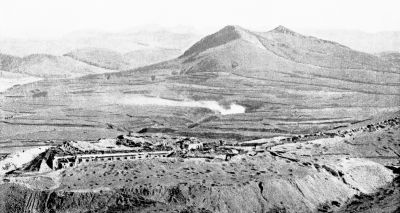
NORTH FORT, CHI-KUAN-SHAN, SHOWING GREEN HILLS IN THE DISTANCE.
It was the day upon which the Japanese had decided to make an end of the fort, and for which they had made all preparations. At 11 a.m.—a time when the trench-guards were usually relieved and there was always noise and movement—their troops told off for the storming were quietly moved up and collected in the last approaches, where they awaited the explosion of the mines. The men told off for this 'forlorn hope' were divided into two parties. One party, who had red bands on their arms, was moved towards the caponiers; on the explosion it was to storm the interior of the fort. On their shoulders the second party from the last approach were to climb. If these did not manage to drive out our men, they were to be reinforced by all their available troops, who were to overcome the garrison by sheer weight of numbers.
Just about a quarter-past one a volcano seemed to burst from the parapet, and with a roar and the shock of an earthquake a huge black cloud of dust and smoke shot up to the sky. This was followed by a second eruption. For a moment there was comparative calm; then the sky commenced to rain beams, boulders, stones, masses of concrete, sacks, bodies, while on the rear of the fort (to catch our reinforcements) fell a hail of shells. Our men, shaken for a moment by the suddenness of all this, and expecting a third explosion, dashed for safety; but they quickly rallied behind the parapet of the prepared retrenchment, from whence they opened a heavy fire on those madly gallant stormers with red bands, who showed themselves on the fort. So impatient were they, and so quick was their advance, that our men could see them being buried under the falling stones and masses of masonry hurled into the air by the explosions.
The nearest batteries—Tumulus, Laperoff's, Zaredoubt, and B—opened a murderous fire on all the approaches, thus paralysing further assaults and preventing the enemy from crowning the craters of their mines. Consequently, this face of the fort, with its destroyed revetment, became neutral ground. Our gunners, shooting splendidly, glued the enemy to the spot, and did not allow them to advance a yard; but their skill was wasted, for General Fock took no advantage of it. He did not reinforce the garrison, as he should have done, and thus enable them to crown the craters, and so again establish themselves on the outer parapet. Meanwhile the enemy were holding on, preparing themselves for another assault, and our men behind the thin parapet of the retrenchment were suffering heavily.
It was the psychological moment, the crisis. Had reinforcements been sent up, they would have turned the scale, and Chi-kuan-shan would have been saved, but General Fock seems to have made up his mind at the first explosion that the fort must be abandoned. To be exact, a reinforcement of a company of sailors from the Pobieda and Peresvet was sent up by Smirnoff; but coming under a heavy fire on their way, few reached the fort, and they were not sufficiently numerous to render much assistance.
So it continued till night. When darkness came on the enemy again dashed to the attack, at the same time turning all their guns on to the ground in our rear to prevent the approach of supports. A hand-to-hand fight ensued. Both sides fought like lions, or rather devils; but the more of the enemy that we killed the more seemed to appear. They even dragged two mountain guns up on to the parapet, and got to work with them at close range, and then the scene, lit up by the cold beams of the searchlights and the dazzling glare of star-shell and rockets, indeed seemed like hell let loose. The fort's hours were numbered, for without reinforcements it could not last for ever—and no reinforcements came.
While it was in its death agony, the higher authorities were engaged in correspondence.
Telephone Message from General Fock to General Gorbatovsky. 7.40 p.m., December 18, 1904.
'General Stössel has given orders that the casemates of Chi-kuan-shan Fort are to be at once mined, and then, if the Japanese do not withdraw from the fort—i.e., from the parapet—the garrison is to retire and the casemates are to be blown up. The enemy are not to be allowed to establish themselves on the parapet, which must be fired on by the guns and the torpedo tube. In view of Captain Stepanoff's report, to the effect that before sunset he and Colonel Mekhmandaroff could see from Big Eagle's Nest only one Jap officer and three men on the parapet laying sand-bags, I leave it to you to hold on to the fort so long as you think necessary. In giving this order, based on my report, General Stössel came to this decision only because he thought that under present circumstances no other course was possible. At sunset a sailor came to me and reported that by the explosion of a bomb thrown by the enemy we had had 15 casualties.'
Telephone Message from General Gorbatovsky to the Staff of the General Officer Commanding Land Front (Fock). 9.35 p.m., December 18, 1904.
'From Chi-kuan-shan it is reported that heavy casualties are occurring from grenades thrown by the enemy. We have not been able to reoccupy the parapet. I therefore propose to avail myself of your permission to blow up the casemates, and I have ordered the garrison to hold on till our sappers have got the mines ready. As a precautionary measure and to cover the garrison during the retirement, please move one company temporarily from the main reserve to the Ice-house. I am just going to Colonel Glagoleff to give the necessary instructions on the spot.'
Telephone Message from Colonel Dmitrevsky (Chief Staff Officer to General Fock) to General Gorbatovsky. 9.40 p.m., December 18, 1904.
'General Fock fully concurs in your opinion about Chi-kuan-shan. He trusts that you will see that the repairs to Kuropatkin Lunette are energetically carried out.'
At 11.30 p.m., in accordance with orders received direct from General Fock, commanding the land defences, the garrison, after destroying the entrance bridge, abandoned the fort, which for four months had been held, despite much desperate and bloody fighting. Although General Gorbatovsky in his message at 9.35 p.m. on December 18 proposed to avail himself of the permission given in the previous messages and to abandon the fort, he never, in fact, gave the order.
At 11 p.m. he visited the fort to ascertain personally the state of affairs, and met the men already retiring. When he told them to go back, they said General Fock had ordered them to withdraw.
Only after four months' awful fighting, tens of thousands of deaths, countless numbers of wounded, a sea of spilt blood, a hell of human sufferings, tears, and sorrows, and owing to the difficulties in which we were, did the enemy succeed in capturing the first of our permanent forts. And even then it would not have been theirs if Fock (this is the deliberate opinion of all the most experienced officers) had reinforced it in time, and had not, on his own responsibility, determined to abandon it when he did. He carried out his theories in practice, and made this unnecessary surrender.
Smirnoff—the Commandant of Port Arthur—only learnt of this deplorable surrender after it had been carried out; for Fock, in direct contravention of the first principles of discipline, did not even inform him of his intention. He knew better than to let Smirnoff have any suspicion of it, and, ignoring him, communicated direct with Stössel.
This is not fiction, but the plain, unvarnished truth.
Early next day General Fock went to the Commandant to report the loss of the fort.
'Who, may I ask, gave you permission to abandon it?' asked Smirnoff.
'I received a direct order to that effect, sir, from General Stössel. It was he who gave the order. How could I have dared to do such a thing on my own responsibility?'
'Perhaps you are unaware, General, that I have been appointed by His Imperial Majesty the Tsar to command this fortress. You, as commanding the land defences, are immediately subordinate to me, and without my permission you have not a shadow of right to abandon anything in my fortress. I am its Commandant, and I alone am responsible.'
'I hunted for you last night, sir; I went to your hut to look for you, but couldn't find you anywhere.' This was incorrect; he had not done so.
'You must have known it was useless to look for me there—I do not follow the example set by some amongst you, and change my quarters every time a chance shell comes near them.[38] Every one knows that I live here, and I only leave this to go out on to the defences. I repeat,' continued Smirnoff, 'you have not the slightest right to give up a fort without my approval. I can reinforce it as much as seems advisable to me. There are more than 30,000 men at this minute bearing arms in the Fortress. Under no circumstances should the fort have been abandoned; it might very easily have been held. Moreover, its surrender has had the worst effect on the whole garrison. You have undermined the principles I have always instilled into the men—that a fort may perish, but never surrender; you have done untold harm. I cannot tell now but what the men will take it into their heads to retire from forts of their own accord. The garrison is worn out and underfed, and to men in this condition an example of this sort is paralysing, and may fatally injure the further defence.[39] Men are but human; they wish to live, and the instinct of self-preservation is always strong in them.'
From Smirnoff Fock went off at once to Stössel. On the 18th a secret meeting of the District Staff was held. The result was the publication in a District Order of an entirely inaccurate version of the circumstances relating to the loss of the fort.
After the sudden abandonment of this strong fort, which was made without permission of, or even reference to, the Council of Defence, the Commandant despatched the following cypher telegram to Kuropatkin, No. 1,282, dated December 20, 1904:
'To the Commander-in-Chief of the Armies and the Fleet.
'On December 15 Major-General Kondratenko, commanding the land defences, was killed. To succeed him General Stössel has appointed Lieutenant-General Fock, though I requested that only the western portion of the front should be entrusted to him, and that I should take, in addition to my other duties, the direct command of the eastern front. My reasons were that on the west the enemy are still some 1,200 yards distant, while in the east they are practically sitting on our parapets. Fock's first action on assuming command was to blow up the casemates in Chi-kuan-shan Fort and abandon it, taking advantage of instructions given to him directly by Stössel. This was done without reference to me, without my knowledge, and without asking either my opinion or that of the Council, and despite my previously expressed views on the subject. General Stössel's systematic ignoring of my rights as Commandant of the Fortress, in particular with regard to administrative matters and the hospitals, has been constant since September; but though my authority is being continually undermined by various orders issued in the Fortress without reference to me, the actual defence has till now suffered little, thanks to the complete agreement of the late Officer Commanding the Land Defences, the Officer Commanding the Artillery, and the Officer Commanding the Engineers with my views. Now, however, that so serious a matter as the surrender of a fort has been decided on without reference to me, and, as it was in my opinion most injurious to the defence, I have the honour to ask that either General Stössel may be ordered to recognize my rights as Commandant at once, in accordance with fortress regulations, and may be forbidden to interfere, or else that I may be relieved of all responsibility for the further defence of the Fortress and of my duties as Commandant.'
Having sent this telegram, General Smirnoff hoped that Port Arthur would live till an answer could be received, which would be at longest in about three weeks; if it should be favourable to him, and the defence should pass entirely into his hands, he felt sure that, in spite of the harm already done by Fock, he would be able to hold out till the end of February.
Alas! the end came just twelve days after the despatch of the above message.
FOOTNOTES:
CHAPTER XXXIX
THE SAPPERS—REWARDS
The provision of technical troops in Port Arthur, their employment, and their reward for the work done are points which deserve some mention. Their provision is a matter which it is in some ways difficult to separate from the ludicrous idea of the way to defend a fortress which held with those in authority.
It was, one would have thought, patent that to defend Port Arthur it was necessary to defend the peninsula from sea to sea and from Kinchou to Liao-tieh-shan, or an area of some eighteen miles in breadth by forty in length. As it was unlikely that an attacking enemy would advance on the Fortress held by a civilized power such as Russia with the same impetuosity as was shown by the Japanese in 1894 against an effete nation, it was equally obvious that as many delaying positions as possible, from the most excellent one of Kinchou right away back to the actual enceinte of the place, should be held. Such is the nature of the country that there is a whole series of positions. Even if general principles were not to be regarded, it might be thought that the manœuvres of the years preceding the war would have shown in actual practice how valuable these positions were to any force defending Port Arthur. The enemy were evidently of opinion that we would take every advantage of what Nature had given us, and would supplement these natural advantages with all the resources of art. It follows, therefore, that in the preparation of these successive positions, quite apart from the defence of the Fortress proper, there was an immense amount of work to be done which would necessitate the skill of technical troops.
Within and round the place itself also, even supposing that all the permanent defences had been ready at the commencement of war, [which they were not by any means], there would be during a siege great scope for the employment of technical troops. It is largely for siege-work that such troops are included in the organization of an army. On the whole, therefore, both the more distant defences of the district and the closer defence of Port Arthur appear to have called for the provision of a very large number of sappers. The district was large, from a point of view of the amount of defensive work that was necessary, and the Fortress was large. Let us see what the higher authorities in St. Petersburg and the local authorities in Arthur apparently thought sufficient.
Of sapper officers not with units there were altogether fifteen in the Engineer Department of the whole district. Of these, the following were not available for general sapper duty: six officers employed in the Naval Construction Yard, and six others specially employed, thus leaving three officers available for sapper duties over the whole area. Of troops for the work over this huge area there was one sapper company—the gallant Kwantun Sapper Company, consisting of 9 officers and 450 non-commissioned officers and men. Even from this number 2 officers were detached and sent up north to Manchuria, and 50 men detached for special duties; that leaves 7 officers and 400 men at the commencement of hostilities! Had the subject ever been considered in St. Petersburg? This number was all that were available for the defensive works on miles of field and semi-permanent positions, on many permanent forts and intermediate works, and for the construction and repair of all defence buildings.
It must be remembered that under the Engineer officers trained technical foremen are required, and that these have to be paid according to their skill. Stössel regarded the more expensive article as unnecessary, and thought it sufficient to employ the ordinary sappers from the company as foremen. The proper employment of these technical troops seems also scarcely to have been grasped. As a rule, for defence works the sappers, both officers and men, do little unskilled manual labour themselves; they organize, supervise, and direct the unskilled labour of the troops or of hired civilians. The extent to which the capabilities and powers of sappers was understood by some of the staff in Arthur is illustrated by the following incident:
When the enemy were on the eve of their assaults on Kinchou the Officer Commanding the Sapper Company got a telegram on May 24 from Arthur:
'To Colonel Jerebtsoff.
'General Stössel directs me to request you immediately to arrange for the blowing up of the southern wall of the town of Kinchou. It should be carried out at once.
'Kondratenko.'
The next morning Jerebtsoff went with his subaltern to inspect this wall. Kinchou was situated in front of the left flank of the position of that name. Like the majority of Chinese towns, it was surrounded with a loopholed stone wall, like a tower of mediæval times. Upon inspection this wall proved to be a solid erection of stone laid in mortar, 19 feet high, 21 feet thick at the bottom, and 19 feet thick at the top. This was what Stössel wanted blown up 'immediately.' To demolish it meant blowing up some 1,435,000 cubic feet of stone masonry!
When Colonel Jerebtsoff went into Arthur to report the impossibility of demolishing this wall at once, he was told:
'We will give you as many men from the 5th East Siberian Rifle Regiment as you like.'
'But, sir,' said the Colonel, 'I shall want more than two men to lay the charge in every chamber. For 1,200 yards of wall I should want not less than 500 chambers—that is, about 1,000 men—and anyhow, even if you give me the men, it is impossible to do the work at once.'
The answer was amusing.
'There's no time to talk, Colonel; you must please go and carry out General Stössel's order.'
Jerebtsoff left by rail that night, but the train was unable to proceed beyond Inchenzy, as the line was fired at by the enemy's gunboats. He therefore had to ride from there to Nangalin, whence he again proceeded on by train. But he never even reached the position at Kinchou, for it was already in the enemy's hands.
Without understanding the rôle of sappers, Stössel during the whole siege threw the Sapper Company about like a ball from hand to hand. It was within this period put under the orders of four separate officers, without rhyme or reason. This anomaly of passing a most valuable technical unit from one officer to another was not only not called for, but did absolute harm, as it enabled people who were totally ignorant of its duties, qualifications and capabilities to issue to it utterly irregular and impossible orders.
That the organization of the sappers in the Fortress in the event of war was not sufficiently thought out and foreseen is shown by the fact that this company, though 'a Fortress Company,' was allotted to work not only in the Fortress, but in the whole district (which was the reason it was not called the 'Port Arthur' Company). It was therefore given a civilian complement, which put it on a different footing to other fortress companies—i.e., it consisted of a field sapper company supplemented by a telegraph detachment of half the strength of a field telegraph company. In consequence, when hostilities commenced, there were neither fortress nor telegraph sappers in the Fortress itself.
The Sapper Company also affords an example of Stössel's system of bestowing rewards. These men had done many gallant deeds, and by May had won thirty Crosses of St. George. When Stössel learnt this, he said to the commanding officer:
'You have got too many crosses in your company: I shall not give you any more.'
Despite many gallant actions done by the sappers at later periods of the siege, and the recommendations made to him, Stössel kept his word: not a single cross was given to the sappers. With regard to the question of rewards in general, space does not permit of a description of the general system of their disposal by Stössel, but to give some slight insight of his methods, the following extract of a letter written to his relations by an officer when a prisoner of war in Japan is quoted. After describing his feelings and the hardships he and his companions had undergone, he continues:
'And to all this is added the knowledge of the insults heaped upon us by the bitter injustice shown to many in the bestowal of rewards. Many unworthy officers who have done nothing to deserve good of their country have been plastered with orders by General Stössel, who wished to help them on. In the majority of cases these were either officers of high rank who were intimate with him, were with him in the China campaign, or were liked for "family reasons." Others were recommended by their immediate commanders more than once, but the reward lists were either lost in the office of the Officer Commanding the District or were purposely overlooked by General Stössel. In the Fortress at the end, counting those who had been recently promoted, there were fourteen General Officers. Of these, those who had already got the Cross of St. George of the fourth class received that of the third class, and those who had not got the fourth class were given it. There was only one General Officer who remained without this order for bravery, and he, need I say, was General Smirnoff, the Commandant!
'The private soldiers were also shamefully treated. Many of those who did countless gallant deeds and were recommended for rewards went to Japan as prisoners of war, having received nothing. Apparently these recommendations received no notice in Stössel's office. The case of Colonel Jerebtsoff, who commanded the only Sapper Company in the Fortress, is also noteworthy. At the beginning of the war he met with much opposition from the other Engineers in his endeavours to get materials, etc., for his company. During the siege he lost 12 officers and 350 men out of his company, of which 5 officers were killed and 2 died, and 100 men were killed. Work was carried on constantly, day and night, from April 14, and from July 1 to the surrender of the Fortress under constant fire. From September 28, during one and a half months, he supervised the sapping and mining works on his portion under incessant fire, and on November 26 went out and worked for four and a half hours under a heavy fire, losing an officer and six men. In short, he did an immense amount of work and showed the greatest gallantry. He was recommended by General Kondratenko in August, after the fighting at Green Hills, for the Order of St. Stanislav, second class, and by Colonel Grigorenko, after the assault of November 26, for the Cross of St. George, fourth class, but he received nothing save a medal of the Order of St. Anne, third class, which he had won in peace-time! And why? Simply because he was a quiet, modest officer, asked for nothing for himself, and thought only of how best to do his duty and look after those under him. And he was one of many!'
CHAPTER XL
THE FALL OF ERH-LUNG-SHAN AND THE LAST COUNCIL
It is not easy to arrive at the truth about the fall of Erh-lung-shan Fort. There are many different accounts, and the loss of this fort is still the subject of keen discussion between various officers. Therefore, to enable the reader to form his own judgment, the evidence of two of the senior men in the Fortress who did not agree is quoted. One is General Smirnoff and the other Gun-Captain Direnkoff. Their evidence is amplified by extracts from the Raschevsky-Schwartz diary. I begin with Direnkoff.
'At 7 p.m. on December 27 the Japs stopped their mining work under the glacis of the salient. This cessation of work did not attract much attention, as it was thought to be temporary. As a matter of fact, the enemy, having reached the desired spot, had stopped excavating in order to load and fire their mines. On this occasion they gave no indication of their intention, and kept on firing 11-inch shells and throwing grenades into the fort as usual. The night passed quietly, with no suspicion of what was to come, on our part. At 7.30 the next morning the first explosion took place, but it was a failure. At eight o'clock a single Japanese dashed out on to our parapet, then rushed back again. Five minutes later I was walking from the inner parapet, and had not quite reached the caponier when a second explosion took place, which shook the whole fort and the hill it was on. The Japs at once opened fire and began hurling a quantity of hand-grenades and bombs, while they set to work to raise a wall of sand-bags on this side of the ditch. Our losses from the explosion were about 100 killed and wounded, several being suffocated by gases in the caponier. The officer commanding sent word to Major-General Gorbatovsky:
'"The Japanese have blown up our advanced parapet. Our losses are very heavy. Please send reinforcements."
'Reinforcements arrived, amounting, I should think, to about 500 men. When darkness came on the enemy's artillery ceased firing, and only the occasional crack of rifles disturbed the silence. The officer commanding ordered the wounded, who were lying about everywhere, to be brought in, and this was finished by about 10 p.m. He then sent word to Gorbatovsky:
'"Erh-lung-shan is surrounded by Japs. What are your orders?"
'The General replied:
'"Do what you can. There are no more reserves to send you."
'The officer commanding then sent fifty men of the Retvisan to drive the Japs from the inner parapet, but the attempt failed and nearly all were killed. The Japs, in addition to occupying this, had crawled into the caponier. Three times our men attempted to turn them out, but were three times driven back. By nine o'clock the Japs had contrived to make a sand-bag parapet in it and to drag a machine-gun and torpedo-tube on to the fort. By ten the garrison was ordered to evacuate the fort. The officer commanding ordered us to take away the breech-blocks from the 37-millimetre guns, and on leaving the forts to give them to General Gorbatovsky, which we did. When we left the fort about 100 men were still in the caponier. I imagine our casualties must have been about 600 killed and wounded. The guns left to the enemy were: three 6-inch (all disabled), one Baranovsky, two field-guns (4-pounders), seven 37-millimetre.
'We also left 300 rifles, a lot of entrenching tools, and 2 unloaded spherical mines; of ammunition: 37-millimetre, 2,000 rounds; Baranovsky, 200 rounds. I don't know what 6-inch ammunition was left. The gunners, by some careless mistake, did not remove the breech-blocks of these guns. Of food supplies we left 30 sacks of biscuits, 400 pounds of bread, 1½ boxes of tinned meat, and a quantity of groats.'
General Smirnoff's evidence about this fort was as follows:
'At last, at 9 a.m. on the 28th, a big explosion took place on the parapet. The enemy opened a heavy fire on the retrenchment; this our men could not stand, and they took cover in the casemates underneath. About 5 p.m. some of the enemy reached the retrenchment, while another portion of them moved along the flank ditches. Though the garrison of the fort consisted of some 7 to 9 officers and 300 men, their moral was so affected by the example of Fort Chi-kuan-shan that the men would not obey their officers, who ordered them out of the casemates back on to the retrenchment; nor did the officers give an example to the men. I sent one company after another from the reserve to reinforce the garrison, and ordered Gorbatovsky to drive out the enemy; but the fresh troops became infected by the others: they were demoralized, and would not put their hearts into a counter-attack.
'When Gorbatovsky told me of this on the telephone, he, not wishing to make it public, sent Captain Stepanoff to report personally to me, and begged permission to abandon the fort, or else all the garrison would be killed. I forwarded this news to Reuss for information, and did not give Gorbatovsky the permission asked for, as I was waiting to see Stepanoff first; but before he had reached me Gorbatovsky received orders direct from General Stössel that the fort was to be abandoned. On withdrawing, our men rallied on the half-prepared position some 300 to 500 paces in rear, from Rocky Ridge to Fortification No. 3.'
From the Raschevsky-Schwartz Diary, December 28.
'At 7 a.m. the enemy began to shell intermittently Fortification No. 3 and Erh-lung-shan Fort, and their miners continued working. At 9 a.m. the noise of work in the mining galleries suddenly ceased, and two charges were exploded in the salient angles of the fort. At the moment of the explosion there was only the gun crew on duty in the casemate; the rest of the men were in their quarters in the gorge. Great blocks of the inner skin of armoured concrete were torn off by the force of the explosion and piled up in the exit, crushing several men. On the parapet, to left and right of the shelter, were two huge craters. To relieve the position to some extent, and to check the enemy's assaulting columns, our batteries were ordered to fire on the approaches in front of the fort; but what good could our fire do when in the Zaredoubt Battery there was only one serviceable 6-inch gun, on Laperoff Hill also only one 6-inch and a 40-millimetre battery, on Mitrofanieff's hill one 40-millimetre battery, and on Tumulus Hill four quick-firing field-guns? All these batteries, though under a heavy shell-fire, did what they could.
'About 11 a.m. the first message from Captain Bulgakoff, commanding the fort, was received by the staff of the section, reporting that the enemy had destroyed the parapet by the great explosion, and had seized it, that our men were panic-struck and were holding the retrenchment with great difficulty. Gorbatovsky then sent up a company at once from the reserves to relieve Bulgakoff, and to drive the Japanese out of the fort. However, despite this reinforcement, the garrison not only failed to hurl back the enemy, but lost the retrenchment. The officers tried to lead a counter-attack, but when, on going out from the retrenchment, the first men were killed, the remainder refused to go on, and bolted from the retrenchment into the quarters in the gorge. Taking advantage of the darkness, small parties of the enemy got round the flanks, threatening to surround the fort from the rear, to seize the gorge ditch, and cut off communication with the Fortress. The enemy's artillery continued firing all day. The communicating roads to the fort were destroyed, but were being repaired all the time by our sappers, especially at night. The abandonment of the fort was begun in the afternoon and finished about two in the morning. On leaving the fort Captain Bulgakoff gave orders to pour kerosene over the bed-boards and set light to the men's quarters and light the long fuses of the mines. At 2 a.m. Gorbatovsky ordered me to go to Fock in the morning and give him my opinion as to the necessity of holding Fortification No. 3 to the end.'
The general opinion of the officers in Arthur was that the loss of Erh-lung-shan Fort was due principally to the bad moral of the garrison, caused by the General's demoralizing influence and the example he had set by Fort Chi-kuan-shan.
At 6 p.m. on December 29 a meeting—the last meeting—of the Council of War took place in the District Staff Offices. All the senior commanders in the Fortress were present:
1. Captain Golovan, Chief Staff Officer 7th East Siberian Rifle Brigade.
2. Lieutenant-Colonel Dmitrevsky, Chief Staff Officer 4th East Siberian Rifle Division.
3. Colonel Khvostoff, Chief of the Fortress Staff.
4. Colonel Reuss, Chief Staff Officer of the Kwantun District.
5. Lieutenant-Colonel Nekrashevitch-Poklad, commanding 25th Regiment.
6. Colonel Petrusha, commanding 28th Regiment.
7. Lieutenant-Colonel Handurin, commanding 15th Regiment.
8. Colonel Semenoff, A.D.C., commanding 26th Regiment.
9. Colonel Savitsky, commanding 14th Regiment.
10. Colonel Griaznoff, commanding ——[40] Regiment.
11. Colonel Mekhmandaroff, commanding 7th East Siberian Rifle Artillery Division.
12. Colonel Irman, commanding 4th East Siberian Rifle Artillery Brigade.
13. Colonel Grigorenko, commanding the Fortress Engineers.
14. Rear-Admiral Wiren.
15. Rear-Admiral Loschinsky.
16. Major-General Gorbatovsky, commanding the eastern front.
17. Major-General Biely, commanding the Fortress Artillery.
18. Major-General Nadein, temporarily commanding 4th East Siberian Rifle Division.
19. Major-General Nickitin (no special appointment).
20. Lieutenant-General Fock, lately commanding 4th East Siberian Rifle Division, now in command of the land defences.
21. Lieutenant-General Smirnoff, Commandant of the Fortress.
22. General Stössel, A.D.C.
It was evening, and the town and front were quiet. The collected members conversed and exchanged opinions in a low tone while waiting for the meeting to commence. Every one was naturally much interested in what was coming, and most guessed why General Stössel had summoned all the senior commanding officers. At last it began. The meeting is recorded for clearness in the following form:
Stössel. 'Gentlemen, I have called you all here to give me your opinion frankly with regard to the actual state of the Fortress and the steps which should be taken in future. When the meeting is over I will read you this paper' (in his hand was a letter).[41] 'Let us commence with the juniors. Captain Golovan, what is your opinion on this question?'
Golovan. 'We must certainly hold out to the very last.'
Dmitrevsky. 'The food is very bad. We have little ammunition now left. I do not see that we can expect anything by continuing the defence.'
Nekrashevitch-Poklad. 'We have no ammunition. Scurvy is on the increase, and the hospitals are full. We have few men to garrison the Fortress works. Under such circumstances, there is little use in carrying on with the defence.'
Petrusha. 'We have held out till now, and we can hold out longer; and then—God's will be done.'
Savitsky and Griaznoff. 'It is very difficult to hold out longer. Everything is going badly.'
Semenoff. 'We must hold out at all costs. My troops are in excellent fettle and the best of spirits.'
Mekhmandaroff. 'We must continue the defence.'
Stössel. 'You must surely know, Colonel, that, having got possession of Erh-lung-shan Fort, the enemy command the neighbouring batteries and works, and can from there shell us. Can you guarantee that the enemy won't mount guns there?'
Mekhmandaroff. 'I cannot guarantee that, but I will swear that I will put any of their guns out of action as soon as they are mounted. As long as we hold on to Rocky Ridge the loss of Erh-lung-shan does not make our general position in any way critical. We can hold out easily for some time. We still have a number of splendid rear-guard positions. We can, and I consider we ought to, hold out—in fact, to defend ourselves to the last moment.'
Irman. 'In any case, we must hold out in the same way as we have already held out. Why, up till now one might say that we have really only been holding field positions, not permanent ones. We can easily hold out longer.'
Grigorenko. 'We must hold out. Let us look at the question on a broader basis. To do the best, I consider we ought to reduce the garrison of all points not being attacked—i.e., Liao-tieh-shan and Signal Hill—and send the troops thus released to the threatened points.'
Fock. 'No, no. Liao-tieh-shan is the keep—it mustn't be touched.'
Reuss. 'As the fleet has ceased to exist, Arthur's rôle of affording a sanctuary to it is over. It is quite unnecessary to the army operating in the north, as that army has concentrated now in great strength. A further defence can only end in a street massacre, which is to be deprecated.'
Wiren and Loschinsky. 'The place must be defended to the bitter end.'
Gorbatovsky. 'If the Fortress is to fall or to capitulate, we must postpone the day as long as possible. We must fight to the last.'
Biely. 'I fail to understand what Dmitrevsky means by saying there is no ammunition. We have plenty to repulse two more big attacks—102,000 shells of our own and 100,000 still available from the fleet, with 8,000,000 rounds of small-arm ammunition. From an artillery point of view, I do not consider we are at all in a critical position. The defence ought to be continued.'
Nadein. 'I also agree. We must continue to hold out.'
Nickitin. 'We must certainly hold out to the last. If our position is bad, that of the enemy is not particularly happy. A further defence is possible, and should be successful, as we have a series of excellent positions, and in the New Chinese Town a number of excellent buildings for the troops.'
Fock. 'A short time ago I was in the trenches. My God! what did I not see? The suffering, the wounds, the sickness—never shall I forget the sights. Who is better or more noble than the private soldier? Who can equal him in gallantry, unselfishness, and endurance? We should not let him die for nothing. We should not let him die unless something is gained thereby. The losses will be greater now if the Japanese mount guns in Erh-lung-shan——'
Mekhmandaroff. 'I have already guaranteed that I will not allow them to bring a single gun into action there.'
Fock. 'Think of the wretched men—hungry, worn out——'
Smirnoff. 'I have heard everything that has been said on the subject, and I consider it my duty to state that, according to regulations, there should be in every fortress secret instructions in which the raison d'être of the fortress in the theatre of war is defined. According to these instructions, the Commandant is to be the judge as to the extent to which the fortress has done its duty—fulfilled its mission. Unfortunately, such instructions do not exist in this fortress. One of the objects of this fortress—to afford a refuge and protection to the fleet—ceased to exist when the fleet was destroyed. The other object—to co-operate in the strategical plans of the main army by keeping employed the Japanese army now laying siege to us—is not finished. No matter what the opinion on the question may be, the Regulations for the Guidance of Commanders of Fortresses definitely require them to hold out till all strength and means are exhausted, which with us is far from the case. Thus we must continue the defence. The scheme of defence conforming to actual circumstances should be as follows: So long as possible we should hold the Chinese Wall, as from behind it we can throw hand-grenades and fire mines. To strengthen our fighting line we must weaken Liao-tieh-shan and Signal Hill.' (Fock shook his head and tried to interrupt.) 'I am sure that we can hold on to the Chinese Wall for a fortnight. Then we will fall back on the second line—i.e., Tumulus Battery, Vladimir, Mitrofanieff, and Nameless Hills. This line has one defect—that it won't be possible to keep the supports and reserves near it, owing to the scarcity of cover. We must therefore regard it as a rear-guard position; but, all the same, we shall be able to hold the enemy on it for a week. Finally, there is the third line on Stonebroken Ridge, running from the left to the northern portion of the town wall, and from the right to Big Hill. It is at present well fortified, and has directly in rear of it a number of buildings, in which the supports and reserves can get cover. Thanks to the strength of this position, we should be able to hold on in it for at least three weeks. By that time our supplies will be running out, and then—not till then' (raising his voice)—'can the question of the Fortress's life be discussed.'
He finished.
Every one remained silent; no one liked to speak. The Commandant had spoken what all knew to be the truth.
Stössel continued: 'In my opinion the second line is extremely weak, and it is in no way important. Well, gentlemen, I see that all of you almost are in favour of a further defence, and we will accordingly carry on. Russian soldiers could not act otherwise. I am extremely grateful to all of you for coming to such a resolution.'
The meeting broke up, and the news of the conclusion reached and of the opinions of individual members was soon spread abroad.
FOOTNOTES:
CHAPTER XLI
THE FALL OF FORTIFICATION NO. 3—THE FAILURE OF THE DEFENCE AND MEDICAL ORGANIZATIONS
The garrison no longer showed the same steadiness that it had shown in the many desperate fights in the beginning of December. This was certainly owing to the example of Fort Chi-kuan-shan. The men's spirits seemed to have gone, and it was too late for the officers to stop the hæmorrhage from the moral wounds caused by Fock. A passionate desire for life was everywhere noticeable, and any attempt to persuade the men that it was their duty to die was now useless.
Early in the morning of the 31st Gorbatovsky was summoned by Fock to confer with him. The latter was, as usual, dilating on the splendid qualities of the men, and the pity it was to make them suffer needlessly, when a great pillar of smoke suddenly shot up from Fortification No. 3, followed by a tremendous explosion.
'I must go back, sir, and I will return at once and let you know what has happened.'
'Yes, come back as soon as you can.'
Gorbatovsky then went off. Without waiting for a report from him, Fock there and then, in the presence of Captain Rodionoff, of the Engineers, wrote out his orders for the abandonment of Fortification No. 3, and sent them off by (I think) a sailor. There was no reference, no word to the Commandant, or even to Stössel. Comment is unnecessary; such action speaks for itself.
What had happened is best seen by reference to the diary:
'December 31.—About 6 a.m. General Gorbatovsky was summoned by General Fock to the third line of defences to confer. At 9 a.m. three successive explosions took place in Fortification No. 3. After a few minutes a telephone message came in from the work to say that the enemy had exploded two charges in the corners of one of the faces. At the moment when the garrison, led by its commanding officer, Captain Spredovy, dashed out of the quarters in the gorge casemate, in order to get out into the interior of the place before the Japanese could seize the parapet, a third charge was fired, which had been laid in the gorge itself. This charge destroyed the gorge casemates, and buried the commanding officer and 140 men under the débris. The fall of this mass of stuff caused the hand-grenades heaped up in the casemates to detonate and set off four mines, laid under the foundations. The wounded and remnants of the garrison were thus shut up in the casemate, with only one small exit into the gorge ditch, through which they had to crawl. Not being able to get into the interior of the work, the garrison could do nothing to hold the position. The enemy perceived this at once, quickly got into the interior of the work, and seized the gorge, where they brought machine-guns. About 10 o'clock we saw a white flag on the fortification. It is not known who raised it. General Stössel and the Fortress Commandant were informed, and within a quarter of an hour the following order was received from General Stössel:
'"In view of the difficulty of getting out of the Fortification, the remainder of the garrison may surrender; those who can escape may try to."
'This order was transmitted by telephone to the work, whence a list of those alive and wounded was telephoned back. The telephone was then cut to prevent the enemy hearing what we said. It was thought that, having seized the fortification, they would try and storm Tumulus Battery. General Gorbatovsky, therefore, ordered the garrison of this battery to be reinforced by one company of infantry, and a company of sailors to be sent into the trenches of the second line from Laperoff's battery along Vladimir and Mitrofanieff Batteries. About eleven o'clock the enemy's fire ceased. Gorbatovsky decided to hold the second line, having Tumulus Battery on the left flank and Eagle's Nest on the right. He told the Commandant of this, and asked leave to carry it out at night....'
From Stössel's order and subsequent dispositions on that day it is clear that he had no idea of the relationship between the second and third lines. Among other things he ordered the left flank of the second line to be held, while part of the third line was held (Stonebroken Ridge and Big Hill). From this it was plain that Stössel had never seen the second line of positions, and had never been on the hills near.
After the fall of Erh-lung-shan Fort the besiegers opened a heavy fire on the north-east front from Tumulus Battery to Eagle's Nest. At 1 p.m. on January 1 they delivered an attack from the fort on Rocky Ridge. Our troops having lost heart, and being badly demoralized, gave way; but our gun-fire checked the enemy's assault, and the position remained in our possession. However, despite the very strict and definite orders given by the Commandant that the Chinese Wall from Rocky Ridge was to be held at all costs (it was quite possible), as soon as dusk came on, the abandonment of this wall and Rocky Ridge began under Fock's orders. The retirement was executed without any interference from the enemy, and we were able to take with us all except the heavier guns. At five o'clock on January 1 our troops were distributed along the second line—Tumulus Battery, Vladimir Battery, Mitrofanieff Hills, Eagle's Nest, the portion of the Chinese Wall behind Chi-kuan-shan Fort, and Kuropatkin Lunette.
The enemy having now arrived at such a position, it seems a fitting moment to mention in what directions the organization of Port Arthur as a fortress had most failed.
By this time most of the many grave defects in the original conception and subsequent execution of the material defences of this stronghold had become only too painfully clear, though it had not needed the test of bitter experience to make the more glaring errors obvious. There were terrible faults in the original tactical arrangement of the defences and in the details of the works themselves.
The main line of permanent forts, the girdle, was much too close to the objects to be protected—i.e., the dockyard and town. The positions fortified by us were so close that, before capturing these positions, the enemy were able to bombard the place, damage our fleet, and demoralize the population. Some points of vital importance were entirely unprovided with permanent works—i.e., 203 Metre Hill, Angle and Long Hills—and were left for an improvised fortification, which was carried out in a scrambling way after the place had been completely invested. So little had these three positions been considered important that until after May 18 no paths to them had ever been made. Accepting the main line originally chosen, such as it was, there were further defects in the forts themselves. They were in many cases badly sited. On the eastern front the enemy had commanding positions within two miles (Ta-ku-shan, Sia-gu-shan), from which the interior of our defence could be seen and fired into, and our communications shelled. This seriously hampered the movement of troops and the transport of munitions. They were also badly designed for their sites, having no good field of fire and much dead ground in front of them. It is not enough to say they were ill-concealed—they were ingenuously conspicuous. As regards armament, our long-range heavy guns, designed to fight the enemy's siege artillery, were placed right in the front, by which all the advantages to be obtained by their ranging power was thrown away. They naturally drew a concentration of the enemy's fire, and were soon rendered useless. They were a positive curse to the works in which they were placed, for they attracted a fire on to these works, to which they could not efficiently reply. In design many of the forts failed. They were not defiladed; they had no covered communications and no proper shelters. The parapets were feebly revetted with stones and sand-bags, and not having sufficient traverses, could be swept by enfilade fire. The concrete was not covered with earth, but was fully exposed. Lastly, such as they were, our forts were not finished and ready by the time they were wanted.
The faults in the choice of position and ground were largely due to the fact that the scheme was originally a paper scheme, worked out on the map instead of on the ground. When the local engineers saw things on the ground, it was too late for any alteration—the scheme had been approved and confirmed. The paucity of works, their half-finished condition, and the absolute lack of many essentials, however, were all due to a cheese-paring, misplaced economy. Money was scarce for the vital defences of Arthur, while millions were being poured out on the palaces and wharves of Dalny, on a well-equipped harbour, which was eventually to help the Japanese.
Let us now turn to the medical organization of the Fortress. Did that correspond to the needs of the besieged Fortress? What influence had that on its fate?
At the beginning of the war, in spite of the growth of the garrison, there were the following hospitals: (1) A mixed hospital of 400 beds; (2) the Reserve Hospital No. 1, 200 beds; (3) the Port Hospital, 40 beds; (4) two small civil hospitals. Of course, this quantity of hammocks could not possibly suffice to meet the needs of a garrison 50,000 strong. If to the garrison be added the fleet, the civilian and native population, the number of beds appears yet more absurd. According to the field service regulations, the proportion of beds to strength of troops should be 1 to 8; the proportion existing at the commencement of the war was 1 to 100! In March was opened the Naval Hospital, 200 beds, increased in July to 500; in April Reserve Hospital No. 6, 210 beds; in May three reserve hospitals, 630 beds; in June three reserve hospitals and a mobile hospital, 630 beds. After the fortnight's assaults in August, when all the hospitals were filled with wounded and were threatened with dysentery, Reserve Hospital No. 11 was opened, with 1,200 beds, in the naval barracks.
Although, when once the war had started, it was daily to be expected that the enemy might land and Port Arthur be thus completely cut off, from the moment the first shot was fired the equipping of the hospitals with medical and other appliances was carried out at snail's pace. During the three months when the Fortress was in direct communication with the capital, no single additional bed was added—that is, omitting the Naval Hospital and the Mongolia, opened within two months of the beginning of the war for a special purpose. The former was arranged for during peace-time and the building had already been finished. It was only with the arrival of the new Commandant and the Sanitary Inspector of the Fortress, Civil Councillor Subotin, that the organization of the medical service was gradually placed on some sort of footing. Their efforts were not particularly fruitful, because, instead of immediately giving effect to the urgent representations and applications of the Commandant, the authorities in the north spilt seas of ink, and continued thus to spend their time till we were cut off. At the beginning of the strict investment (after the fights on the advanced positions) there were only 2,500 beds in the hospitals under the Military and Naval Departments, and in the three hospital buildings taken over by the Red Cross there were only 500 beds, or a total of 3,000—one-third of the proper number. During the period of the strict blockade the number of beds increased. According to official statistics, another 1,500 were added; but this addition can only be taken as nominal, as there were practically no reserves in the medical store depôts at the beginning of the war, and it was impossible to procure any locally. But still, accepting these official figures, during the worst period in Arthur 4,500 sick and wounded could be tended. The minimum figure of sick at the end of the siege, which cannot be disputed, was 15,000; the actual number was more like 18,000. To show how these 'extra' 10,000 to 12,000 suffering soldiers found shelter or relief means the unveiling of the most revolting picture of the siege. About half of these 'extra' cases were distributed somewhere in the hospitals above mentioned, and the remainder were put in hastily-run-up sheds—little cemeteries of living beings. In these during the last month of the siege there were sometimes as many as a thousand sick men crowded together, under the charge of one medical man, often a surgeon, who could only be a helpless spectator of their sufferings.
Just glance at one of these 'infernos' in the month of December. Outside it is freezing; inside, in spite of the musty and sickening stench, the cold is intense. On all sides is filth, nothing but filth, and on it and amongst it crawl millions of greasy grey lice. The silence is only broken by the sighs and groans of the sick and the hungry—for all in here are both sick and hungry. Death, the Liberator, is also here. He is in every corner, at the doors, at the windows, crawling along the floors and on to the bed-boards; he envelops everything—and waits. At the front a man dies suddenly, and all is over. In the hospitals Death is fought. But here, here, everything is in his power—he only has to wait. Second after second, minute after minute, hour after hour, men pass into eternity, into oblivion. There are hundreds of cases of scurvy. They lie side by side on the floor, on the bed-boards, underneath them, just as they were placed when they came in—some in great-coats, some in tunics, some in miserable boots, some barefooted. The faces are shapeless, swollen, and distorted, and upon the yellow skin are large dark blue bruises. The swollen gums, covered with hideous sores, project out of many grinning mouths, and show the lack of teeth, which are continuously falling out.... Here, far away from their friends and relations, forgotten by all, in horrible, complete consciousness, they are silently waiting the end.
And to think that much of this suffering might have been spared these men had the Medical Service been properly organized, had the highest authorities done their duty, instead of busying themselves with writing orders. Things would not have been so bad even if Stössel had confirmed the resolution of the Council of War about the killing of horses on December 8. Feeding the garrison on horses' flesh and white bread would at once have checked the growth of disease; and there were more than 3,000 horses and 3,000,000 pounds of flour in the Fortress.
The hospitals which existed in peace-time and the hospitals which expanded before the strict blockade answered their purpose fairly well. Those which were opened after the commencement of the strict blockade were far from doing so. They had no linen, nor beds, nor medical supplies, to say nothing of a sufficient quantity of trained nurses or doctors. The most disgraceful in this respect were Reserve Field Hospital No. 2, of 1,200 beds, opened for infectious cases and Mobile Field Hospital No. 5 (4th Division, General Fock), situated on Tiger's Peninsula. What could be expected from hospitals opened after the August assaults, when there was nothing left in the place with which to equip them? For the 1,200 beds of No. 2 only four doctors were told off. This hospital was renowned throughout the Fortress for its horrors: there is no need to describe them. A commission was appointed, which found the internal organization and arrangements of the hospital so revolting that the Hospital Inspector was immediately removed, and in his place was appointed M. Menshoff, who had recently been Chief of the Police in Dalny. Of 3,500 patients received into it, 1,500 died. Mobile Hospital No. 5 was little better.
The system of opening a hospital extension on the day of a big attack was hopeless. It led to the sudden concentration of the sick and wounded in the hospitals nearest to where the attack was taking place, and where there was most congestion and appalling confusion. The wounded sometimes received no medical assistance for days together, as the personnel, working as it did for twenty-four hours in the twenty-four, could not cope with such a big influx, and they were carried from one hospital to another, often dying on the road. Meanwhile, the other hospitals, situated some way off from the locality attacked, did not take their share, owing to this inefficient organization.
Many of the doctors made desperate efforts, but when dealing with masses like this individual efforts were drops in the ocean.
Subotin was the Fortress Sanitary Inspector, immediately subordinate to the Commandant, and he did his best; but there was no independent central organization in the Medical Service of the Fortress, which could have looked ahead and taken steps to distribute the sick properly in the hospitals during attacks. The Medical Service was dependent on the combatant authorities, whose hands were much taken up with fighting. What was required was a central administration, which could have foreseen what might happen and have controlled the arrangements. The officer in charge should have been invested with high rank and great authority, and should have had a properly trained personnel. Scurvy first made its appearance in the Fortress at a very early date: as early as April it appeared among the crew of the Pallada, but, thanks to timely and energetic measures, it was then stamped out. Unfortunately, no material preventive measures were taken against its recurrence, with the exception of vague suggestions as to better food and to add green food to the rations, though where better food could be got or vegetables could be bought was difficult to say. The scurvy cases increased from hundreds in October and thousands in November to 10,000 in December. The hospitals were so full of it that men were afraid of going into them, and at the end of the siege preferred to remain on duty, even when sick.
Of 18,000 sick and wounded reported on the day the garrison marched out, 6,000 only were wounded; the balance were cases of scurvy. There were really more, as many men only slightly ill were doing duty. Dr. Kefel, of the Naval Hospital, on making an inspection of the men on one section of the right flank on December 11, found that 21 per cent. of these on duty had scurvy. Exactly a fortnight afterwards, on his inspecting the same section, he found 40½ per cent. suffering from it. These were the same men, for they had not been relieved.
It was pointed out in his report on this that: 'If the spreading of scurvy increases in the above arithmetical progression, then in every fortnight we shall have 200 more on the sick list out of every thousand in the fighting line, and in one and a half months there will be no men left fit for duty....
'If extreme measures are immediately taken, and we make use of all the meat, white bread, and antiscorbutic diet available, we may hope that those who are now well may not catch it, that the slight cases will not become worse, and that the worse cases will do tolerably well. Therefore there are before us two alternatives: to keep our food-supply and have, after a month and a half, not a single serviceable soldier, or to have eaten up our supplies of provisions at the end of six weeks, but during all that time to have kept the garrison in fighting strength. The strategist, not the arithmetician, can decide which is the more advantageous choice to make for the Fortress.'
When this report was laid before General Stössel, with a proposal to increase the ration, he replied: 'There cannot be so many men as this ill in that section. It is nonsense; there are not half that number there.' And so the question remained undecided. It was only at the very end that an order was given for a slight increase.
To the question, 'Was it possible to have avoided this epidemic of scurvy, and could we have checked it with what we had in Port Arthur?' the answer is undoubtedly 'Yes!'
How exactly this could have been done is a harder question to answer. From the moment we were cut off from the north the rations of the garrison were gradually cut short, and by November, when the men were physically and morally weakened, the rations were reduced to the minimum. Instead of bread, biscuits were issued, which could not really be counted as rations for scurvy cases, as to these they were as useful as stones.
The progress of the disease might have been checked if (1) a probable period of resistance had been thought out and fixed; (2) if rational use had been made of all sources of supply—horses, mules, cats, dogs, and flour. In the beginning of December more than 2,000,000 pounds of excellent flour was received. Had 3 pounds of white flour been issued per man, it would have lasted for three months. Half a pound of horse-flesh per man would have lasted for six weeks, though the number of horses for transport purposes would, of course, have been limited.
The first was not done, thanks to the chaos resulting from the harmful interference of Stössel and Fock.
The second was decided on at the council of December 8 (at which, by some incomprehensible oversight, the Sanitary Inspector of the Fortress was not asked to attend), but was not confirmed by Stössel.
CHAPTER XLII
THE LAST DAY BUT ONE
The dawn of January 1, 1905, ushered in an anxious day. All the roads near the forts were now so much under rifle and machine-gun fire that movement on them soon ceased. In the Staff Office of the section it was expected that the enemy would at any moment commence to pound and then storm Eagle's Nest, which was now the key to the position. Sure enough, about nine o'clock the bombardment commenced, shell after shell with clockwork regularity striking the top of the hill. The staff of the section went from their usual observation-place to the dressing station, from which an excellent view of the rearward slope of Eagle's Nest could be seen, and which had a telephone. At noon Captain Galitsinsky, who was in command of the work, began sending in alarming messages to the effect that the enemy, by repeated rushes, were successfully concentrating in force in front of the position, evidently with a view to an assault, and asked that he might be reinforced. The assault soon began, but made at first little progress in face of the garrison's steady fire. General Gorbatovsky, commanding the section, kept the Commandant regularly informed of the progress, and urged that our guns should increase their fire. Our fortress guns poured in a fairly heavy fire, but not so heavy as the circumstances warranted, as we had but few howitzers, which alone could have been effective. Galitsinsky continued anxiously to report the critical condition of the position. Gorbatovsky never left the telephone, talking all the time with either Fock, Biely, or the Commandant: he kept on begging for reserves to be sent up, saying that without reinforcements he could not guarantee the issue. Suddenly some infantry were seen running back from Tumulus Hill, and it was ascertained that the enemy, having climbed a spur in front of Eagle's Nest, had enfiladed some of our trenches. The men in them wavered and then ran. The presence of mind of Captain Stepanoff alone restored order and averted a panic. A party of fifty sailors were sent up to Galitsinsky, followed by a second party somewhat later, and the fight waged hotly, our men with difficulty holding their own.
At midday, while the issue of the fight was in the balance, Rear-Admiral Loschinsky received the following letter, No. 2,544 of January 1:
'The state of the Fortress is becoming so critical that its further resistance cannot be guaranteed. If it becomes necessary to surrender, it is essential that the most important papers and standards be sent away. I am, therefore, directed by General Stössel to ask you whether it will be possible to send a destroyer at any moment to Chifu on board which an officer could be despatched with such papers. If this can be arranged, the destroyer ought to keep under steam ready to depart, as it will be impossible to foresee the precise moment when she will be required. I have the honour to inquire if this can be done?
'Reuss.'
Loschinsky replied to the effect that a destroyer would be kept always ready, and, to ship articles more conveniently, would lie under Electric Cliff. The Statny, under Lieutenant Baron Kasinsky, was told off for this. While this took place the Commandant was occupied issuing orders for the defence of the north-eastern front, and it never entered his head that anyone was then thinking out arrangements in case of a surrender. He was not told of the letter sent to Loschinsky, although the latter, in his capacity of Commander of the coast defences, was immediately under him.
Meanwhile the assault on Eagle's Nest continued, and about 2.30 p.m. the telephone from it ceased to work. Everyone at the dressing station was busy with his glasses watching the top of the hill, which was shrouded in clouds of bursting shrapnel, when, to our intense surprise, Galitsinsky, the commander of the place, suddenly arrived.
'How? What's happened? Why?'
'I was the last to leave. None of our men are there now.'
He looked exhausted, dishevelled, overcome.
The staff were much perturbed, for the loss of this important tactical point decided the fate of the north-east front. Any minute the Japanese might force their way along the valley and commence a massacre. Our guns concentrated their fire on the position that a few hours before had been ours; but soon Lieutenant Malchenko could be discerned riding along the road past our position with a large white flag!
When he was seen, someone laughingly said:
'Looks as if he were taking our New Year greetings to Nogi.'
But he was not armed with empty greetings. Alas! he was taking to Japan an unexpected New Year's gift. He was the bearer of the following letter from General Stössel to General Baron Nogi, dated December, 1904 (no day of the month):
'Being acquainted with the general state of affairs in the theatre of war, I am of opinion that no object is to be gained by further opposition in Port Arthur, and so, to avoid useless loss of life, I am anxious to enter into negotiations for a capitulation. If your Excellency agrees, I would ask you to be so good as to appoint accredited persons to negotiate concerning the terms and arrangements for surrender, and to appoint a spot where they may meet my representatives.'
The despatch of the parlementaire had been decided on directly General Fock had brought word of the capture of Eagle's Nest, and Colonel Reuss had been immediately summoned to translate the above letter into English. No meeting of the Council of War was held. There was no attempt made to persuade Stössel to alter his decision to surrender. The Commandant was not even informed of the intention to despatch a parlementaire.
The decision to give up the Fortress had really matured on the day of the last meeting of the Council of Defence, for General Stössel had that day despatched a telegram to the Tsar, in which he reported that the men had become worn out, and that the Fortress could not possibly hold out more than a few days.[42]
In this he was undoubtedly influenced by the desire to save the lives of his close friends. If any of them had opposed the despatch of the parlementaire, and had informed the Commandant of it, Stössel alone would never have dared to do it. But he was supported, and so risked ignoring Smirnoff and proposing the surrender.
Simultaneously with the despatch of the parlementaire, Rear-Admiral Wiren, commanding the battleship and cruiser division, received the following letter from Colonel Reuss:
'A letter has just been sent by a parlementaire from General Stössel to General Baron Nogi proposing to begin negotiations for a capitulation; there is, therefore, only to-night for you to do what you consider necessary to your ships!'
Admiral Wiren, distinguished and gallant officer that he was, was thunderstruck at such tidings, and immediately went off to Admiral Grigorovitch, to whom it was also news. Thence he went to General Biely, and even to the Commandant, who were both equally thunderstruck at what he told them. From them he went to Stössel, where the information of what had been done was confirmed.
The troops, who very soon heard of it, no longer remained troops. It was absurd to count on their obedience. And is it to be wondered at? They had fought long, obstinately, doggedly, dying and suffering awful agonies. They had been accustomed to expect death, and now—now—what did they not hear? Their hopes rose. They longed for life. They did not wish to die, and no power on earth would have again made them exchange these hopes for death. After the news of the despatch of the parlementaire, it would have been impossible to inspire 30,000 worn-out men, whose minds had already been poisoned by the fatal doctrine of some of their leaders, with the idea that the Fortress should be held to the last, and the senior commanders recognized this. When the Commandant went to the Admirals, and a council was held, with him in the chair, to consider what had best be done to avert a shameful surrender, they all came to the inevitable conclusion that there was not the slightest hope of counting on the obedience of the troops already demoralized and knowing all about the negotiations. The arrest of Stössel, Fock, Reuss and others would have caused dissension in the garrison, perhaps a mutiny, and the last state of the Fortress would have been worse than the first. The Commandant and Admirals accordingly wisely refrained from taking any active steps, in order to avoid the awful scandal, which would only have increased the shame surrounding the surrender, and would have availed nothing.
Admiral Wiren issued orders for the ships under his command to be disabled by charges being exploded in their most vital parts (engines, boilers, etc.), but though every precaution was taken, the last demolitions were only brought off by the morning of January 2. The Sevastopol on that morning was tugged out by the Silacha to a depth of 30 fathoms, and her Kingston valves[43] were opened, with the result that she heeled over to starboard and quietly foundered. It was impossible to blow up the large number of guns in the Fortress as well as its munitions of war, as, according to the terms of the capitulation, all the forts, guns, ammunition, etc., were to be handed over intact. During the afternoon and night several guns were destroyed and much ammunition was buried; but General Biely, by Stössel's direct orders, strictly forbade this, as the enemy had said they would make reprisals if the guns, etc., were found destroyed. Some obeyed, others did not. Certainly most of the Artillery spent the night destroying their weapons and equipment.
From the Raschevsky-Schwartz Diary, January 1, 1905.
'The firing gradually slackened, and about 6 p.m. ceased. Deathly silence took the place of the constant noise of firing and roars of explosions, even the whistling of bullets overhead ceased. Tired and anxious, we went to the dressing station, where we bolted some food, and then went to the New Chinese town to the staff quarters of the section. We had scarcely lain down to snatch a little rest, when a mounted scout arrived with a letter from General Fock, in which he ordered Gorbatovsky immediately to carry out his orders, and abandon the third defensive section, for which he gave no reasons. He added that the section up to Fortification No. 2 was also to be evacuated. [On December 22, Fock, realizing the importance of this section, had ordered me to draw up a scheme for strengthening its defence. I had done this on the 23rd, and had carried the work out in two days.] Nothing was left for us but to obey the orders, and orders to this effect were accordingly issued by eight that evening. And so the whole of the north-eastern front and almost half of the eastern front was in the enemy's hands. The Fortress could no longer hold out, as all roads to the town were in the hands of the Japanese, and from Zaliterny Battery they could demolish the town at leisure. It is inexplicable how anyone understanding the great importance of this section and of B Battery could have ordered their abandonment without a fight.
'At the same time a second message was received, in which it was said that the Japanese had agreed to the negotiations, and had ceased firing, requesting that we also should cease. The horrible day gave place to a warm, quiet night, and the unusual silence seemed uncanny. Suddenly explosion after explosion rang out from the harbour—our battleships being blown up. It was the last straw....'
The letter referred to above, in which General Gorbatovsky was ordered immediately to carry out instructions with regard to the abandonment of the third defensive position and the portion up to Fortification No. 2, is now in his possession. The abandonment of these positions was in no way warranted by circumstances, and to carry out such a retreat without fighting was most demoralizing to the troops. The negotiations for a capitulation were still before us, and had we retained something 'up our sleeve,' we could have bargained obstinately and have threatened to hold out longer, in order to obtain better terms. This threat would not have been an empty one.
At dark two huge conflagrations burst out from Eagle's Nest, lighting up the whole north-east front. Port Arthur lay silent—more silent than it had been for five long months—while the tongues of flame seemed to lick the low clouds which brooded over the Fortress and its triumphant foe. The silence was short-lived, however, for soon several muffled explosions from the direction of the harbour and the forts showed what Wiren was doing to his ships and the artillery to their guns. Another fire broke out near the harbour, and the town lay bathed in its blood-red glow. From the summit of Quail Hill the picture of Port Arthur on its last night—last night as a portion of the Russian Empire—was tragic enough. The place seemed to shudder at each dull explosion, as if it knew that it was near its end. Its former owners, having once more bought it at the cost of thousands of lives, were standing on the threshold of their great holiday and of the long-coveted prize.