Front matter (continued 2)
A. B. (Alexander Bertram) Lindsay translation
'Everything was in such a muddle that it is a wonder any of us are alive to tell the tale. Stössel gave one order and Fock another—every hour brought fresh instructions.'
Fock, who had always declared that Kinchou was quite unassailable, seeing that the enemy had landed and were advancing in earnest to the attack, stated publicly that to give battle at Kinchou would be a crime, that a division there would be merely destroyed. The 15th and 16th East Siberian Rifle Regiments were hurriedly entrained, and moved backwards and forwards, first to Dalny and then back to Port Arthur. The confusion boded ill.
CHAPTER X
THE NAVY LOSE A CHANCE
When describing the repulse of the blockers on the night of May 2, I essayed to bring forward the importance of the work done by the guard-ships, and now a word as to the destruction of the Japanese battleship Hatsuse. From the beginning of the blockade Admiral Loschinsky and the Captain of the Amur had studied the usual course of the enemy's ships, with a view to laying mines along it. This was impossible for some time, owing to the fog and the number of ships, especially destroyers, cruising about. At last, on May 14, during a council held at Admiral Witgeft's, at which Loschinsky was present, the Captain of the Amur asked permission to set to work. Loschinsky turned to Witgeft, as his senior, and asked permission to start this important but risky work. 'As you like; it is entirely your business and you are responsible,' was the reply. Loschinsky then turned to the Captain of the Amur. 'The enemy is not visible; there is scarcely any fog, and what there is will only help us. Go, and God be with you! Lay not less than fifty mines, and none nearer than ten miles.' The Admiral himself did not go on this trip, as the meeting had only just begun and was a very important one. The Amur left at three and returned after five, no one at all suspecting what an invaluable service to the besieged place she had done that day. At eleven o'clock next morning, in sight of the whole Fortress, the Japanese battleship Hatsuse struck a mine and perished even more quickly than the Petropalovsk; the Fuji also was badly damaged. Thus did the Amur avenge the Petropalovsk.
Loschinsky and several others were at the moment with the naval Commander-in-Chief. As the tide was at the flood, those who were present advised Witgeft to take advantage of the favourable conditions, and at once to send out three battleships, all five cruisers, and the destroyers to capture the damaged battleship and its escort of three. 'Everything will be done in its own good time,' was the answer. Even when Balashoff, the Master of the Hunt,[11] hurried up to point out with great earnestness the necessity for the fleet putting out in order to make an end of the Japanese on the sea, Witgeft repeated: 'Wait; everything will be done in its own good time.' Only at 12.30 were orders given to the cruiser division and the destroyers to get up steam. The former could not put out at all, for, being a holiday, their crews were ashore, and it was two o'clock before the destroyers got under way. The Novik, which happened by chance to be under steam, joined them. Out they went at full speed, and, regardless of danger, tried to approach the wounded battleship in broad daylight—but the psychological moment had passed: the enemy had carried out repairs, and opened such a fire that it was impossible to get near, for every destroyer was valuable, and there was no object in throwing them away. They returned.
The garrison and inhabitants were disgusted. The navy had again made a mess of it. Had Witgeft been a man of decision, had he kept his fleet ready for battle, the picture would have been different. For had the fleet gone out at once, the Fuji and the battleship and two cruisers with her would undoubtedly have been destroyed. This would have so weakened the enemy's fleet that the fight on July 11 would have had another result. All the same, the destruction of the Hatsuse greatly influenced the defence afterwards, in particular during the strict blockade. From the moment she was destroyed not a single big ship except the Nisshin and Kasuga, which stood at long range, and threw some 10-inch shells on to Cross Hill, ventured near Port Arthur. The Fortress was thus ensured from the dreadful prospect of being bombarded from the sea, and therefore all the big guns on the sea-front, from the 6-inch up to the 11-inch howitzers, were turned towards the land, and gave invaluable help in the land defence to the end.
After the blowing up of the Hatsuse, the sweeping, blocking, and defence of the Roads was made over to the officer in command of the cruiser division, and the hunt for mines went on day and night. The cruisers went out by turns at night into the outer Roads. This almost invariably called forth an attack by the enemy's destroyers, which, covered by the confusion of the fight, laid mines. Our destroyers were ordered by Witgeft to lie in pairs in Takhe and White Wolf's Bays. Despite Loschinsky's energetic protests that it was the duty of the fortress artillery and guard-ships to wage war against mine-layers, and not the work of the destroyers, which ran great risk of being blown up, Witgeft was immovable. But the wisdom of Loschinsky's advice was proved later, for on one dark, foggy night the Lieutenant Burakoff and the Boevoy were rendered hors de combat by Japanese torpedo-boats, which crept up to them unawares in Takhe Bay. In the middle of May Witgeft gave orders that mines should be laid by junks near Inchenzy and Melankhe, which was done. When the Amur was laying mines west of Liao-tieh-shan she ran on to the mast of a sunken blocker, and damaged herself badly. It was impossible to dock her, as the only dock was occupied, and we had to make use of the Bogatir and afterwards the Reshitelny for this work.
FOOTNOTES:
CHAPTER XI
PREPARATIONS ON THE KINCHOU POSITION
After much hesitation, opposition, many quarrels, alterations, and frequent fresh orders, a column consisting of two regiments and three batteries was formed on May 15, on which evening it moved out of Nangalin station to take the field. The advance-guard, under the general command of Lieutenant-Colonel Laperoff, was composed of the battalions of the 13th Regiment and the 3rd Battery of the 4th East Siberian Rifle Artillery Brigade. At daybreak on the 16th the column got near the Shanshihlipu heights, where, as soon as it was light, the advance-guard heard firing in front. This altogether puzzled Laperoff, for he knew that none of our guns were ahead of him. It turned out that, owing to ignorance of the country, the main body had lost its way, got in front of its advance-guard, and had attempted to occupy these heights, without having reconnoitred them or even despatched scouts in advance. Fock, commanding the 4th Division, had trusted to luck, and we paid the price, especially the 3rd Battery, under Romanovsky, for the enemy had occupied the position before us, and opened a heavy fire on this battery as it came up, almost destroying it.
This battery was admirably supported by, and only got away out of action with the assistance of, the 'bullock battery,' under Lieutenant Sadikoff. On the initiative of this young officer, whom our gunners afterwards dubbed the 'Guardian Angel,' some old Chinese guns had been collected and formed into a battery drawn by bullocks. Laperoff did not know what to do with his advance-guard under the peculiar circumstances, for it was no longer in advance, he received no orders, and the fire was getting hotter. Briefly, the result was that our force had, after heavy casualties, to retire to Nangalin without effecting anything. As soon as the withdrawal began General Fock who had hitherto been with the rear guard, suddenly turned up. When Laperoff reported the mistake and its disastrous result, he began to excuse himself, saying that he had never given the orders, and complained of the inactivity and idleness of his Chief of the Staff. 'Traitors! they are all traitors! They never obey my verbal orders; they only obey written ones.'
This fight showed the superiority of the enemy in artillery preparation, in fire control, and in knowledge of how to use the ground. After taking Shanshihlipu they were able to mask their guns perfectly, but we, not understanding the value of ground, exposed ourselves needlessly, and suffered much. While they, after a tedious sea-voyage, victoriously advanced, we, on our own ground, with every chance of selecting and fortifying the best positions beforehand, only tried to occupy them after the enemy had already done it. So, after the first brush, we withdrew rapidly and with much loss to the celebrated but worthless position at Kinchou.
After carefully watching everything that happened throughout the whole campaign, and thus getting to know and appreciate the Russian soldier under service conditions, I have come to the conclusion that he was not only a hero, but a Titan, and I must say I had never dreamed that he would exhibit the moral and physical strength that he always did. Possessing such qualities, had he only received proper training, and been well led by the more senior of his officers, we would never have witnessed that pitiable slaughter—for which General Fock, with the approval of the Officer Commanding the District—at Kinchou was responsible. The first fight at Shanshihlipu, its failure, and the rapid retreat had a disastrous effect on the moral of the men. They lost that confidence which counts for so much in war.
From the moment of the withdrawal from Shanshihlipu up till May 26 the ground lying in front of Kinchou was never properly reconnoitred. I would lay particular stress on this absence of any regular and well-organized intelligence work, because, operating as we did with our eyes shut, we always allowed the enemy, who was energetic, insistent, and cunning, to take us unawares.
And now to the Kinchou position. The fortification of it was still being carried on solely by the labour of the 5th Regiment, which gallant corps did not belong to General Fock's division, and so was not spared. As has been already mentioned, Colonel Tretiakoff, commanding the regiment and nominally in command of the position, knew well that it was anything but ready even for a temporary defence. As before, so now, especially after Shanshihlipu, he recognized the absolute necessity of masking the guns, which were standing exposed on the highest points, without any attempt at concealment. He fully realized that durable splinter-proofs, and not mere 'hen-coops,' were necessary, that the infantry trenches should be made deeper, and that all the communications should be greatly improved; but his representations still met with little success. Though Fock continued to talk much, he no longer said that he would destroy the whole Japanese army here. On the contrary, he turned round and declared, in self-contradiction, that to attempt to hold the place long would be a crime.
The navy had given us two long-range Canet guns, which had been got into position on the left flank, under the idea that the attack would develop there, which, as a matter of fact, it did. A great deal of labour and time had been expended on doing this, and the guns were splendidly masked. But a few days before the battle General Fock insisted on their being dismounted, taken down, and dragged off to a position on the right. He was told that this flank on Lime Hill was not important, and that the enemy would never attempt to advance that side (which was justified by the event); but he would not reconsider his order. The guns were taken down; there was no time to remount them again, and so they fell, unused and uninjured, with two waggon-loads of ammunition, into the enemy's hands.
The batteries on this most important position, called in the highest military circles the 'key to Arthur,' were commanded by Lieutenants and Sub-Lieutenants, and the command of the artillery was given to a very young officer, one Captain Visokikh. He continually reported that he had not enough ammunition, asked for projectors to light up the Kinchou Valley, and begged for sand-bags, sleepers, rails, beams, etc., for thickening the cover and making the buildings splinter-proof, but without result. I know for a fact that his brother, commanding the 7th Sector in Port Arthur, so well appreciated his helpless position that he, quite illegally, upon his own authority, sent ammunition to him. Tretiakoff, finding that even Stössel would do nothing to assist him, at last went direct to Smirnoff, and telling him everything, asked his help. The latter did everything that he was able so as to delay the fall of Kinchou, if only for a few days; but what he could do was little, for his powers did not extend beyond the Fortress glacis. When some of the necessary materials did arrive, the men worked like slaves to improve the defences, the Fortress artillerymen assisting the men of the 5th Regiment, under the supervision of Colonel Tretiakoff and Captain Schwartz. But it was too late.
Now, shortly before the battle the state of affairs in the district was, to put it mildly, slightly mixed. If the staff issued an order, the General, instead of at once carrying it out, wrote long-winded memoranda and proceeded to do the opposite. Trains stood in the stations ready to start day and night, and, as can be seen from the orders, the wretched 15th Regiment spent its time entraining and detraining, being taken out one day and brought back the next. The authorities seemed to have lost their heads, and orders were only issued to be at once cancelled. The day before the battle was a nightmare of confusion: no one knew what was being done or why it was done. Men were worn out by being 'messed about' uselessly from one place to another, and were never long enough in any place to get to know it. The work on the position which had for a short time been proceeding again had to cease for want of materials. For instance, the frontal battery on Lime Hill, under the command of Lieutenant Solomonoff, to a certain degree important as being able to fire on the approaches to the right flank, was armed with four old Chinese guns. It had no traverses, and no bullet-proof shelter for the gunners or ammunition, and was not connected by telephone with the Commandant.
This was the state of the Kinchou position.
In Port Arthur, after the Viceroy's departure and the assumption of command of the fleet by Witgeft, there was a lull in naval operations; but rapid progress was being made with the repairing of the lame ducks. The battleships and cruisers—too precious to use—lay motionless in the inner Roads, the destroyers, gunboats, and the Novik were alone active. The latter were kept with steam up, and were always cruising about, protecting the mine-trawlers, laying mines, or doing short or long reconnaissances, which were called by the men 'adventures'—a very suitable name. Complete ignorance of the coast generally, pointless tasks, lack of speed, bad engines, absence of well-thought-out plans, a numerous, keen, and powerful enemy, who always operated systematically and cleverly, rendered these expeditions abortive of any result except fatigue, waste of coal, and loss of vessels.
Having served all his time ashore, Witgeft naturally could not give an example of useful activity; moreover, the very weak line he took with junior officers undoubtedly greatly undermined his own authority and naval discipline generally. The attitude of the younger officers towards him and other seniors was deplorable, and noticeable even to outsiders; the juniors not only saw the defects, and the incompetence of their seniors, but they publicly criticized them. At the same time, a great gulf grew between army and navy, and scarcely a day passed without a conflict between the officers of the two services; they insulted each other in the streets. And the position of the sailors was a difficult one, because they themselves were not to blame: it was not their fault that they did little cruising and were generally in port in peace-time; that they had not been taught how to shoot and know their ships; that the only thing required of them was spittle and polish. Like the infantry, the naval officers were not trained for war.
General Stössel, instead of endeavouring to get the two services to pull together, made matters worse, and in his effort to gain personal popularity amongst the younger army officers did not even refrain from making fun of the Officer Commanding the Fleet. However, later on, when soldiers and sailors fought together and were struck down side by side in the trenches, all differences vanished—men recognized men.
On May 20 we had another sea attack, carried out by seven ships and two destroyers. It lasted from shortly after midnight to 2 a.m. The result was immaterial.
CHAPTER XII
THE BATTLE OF KINCHOU COMMENCES[12]
The days passed monotonously. Wherever one looked one saw men—our rough peasants in the guise of soldiers—digging and delving, not in their native heath in the hope of a fruitful harvest, but in the stony, sandy soil of the inhospitable peninsula. It was depressing to watch them, sleepless and hungry, and I often wondered how many would ever again see their fields. The monotony, however, was sometimes broken by General Stössel's orders. On May 23 he wrote:
'Before May 28 all cattle must be removed from the country round the town of Kinchou—i.e., north of the position of that name.'
Remove the cattle from country already in the possession of the enemy? Was it a joke?
On May 24 I went to Kinchou. In the same train was the 15th East Siberian Rifle Regiment, which had only arrived in Arthur on the 20th, but was now on its way back to Nangalin. Lieutenant-Colonel Yolshin, commanding the military communications, was in the officials' carriage, and with him were Captain O., the officers of the 15th Regiment, the railway engineers, and myself. Sitting at the common table in the saloon, conversation turned on coming events. Colonel Yolshin, looking out of the window, said: 'I wonder how long all this will be ours? Can we hold out at Kinchou? Do we know how to? The enemy is advancing in considerable force: scouts report that they have brought with them a quantity of artillery.'
'Can you tell us, Colonel,' said an officer of the regiment, 'why we are being continually taken into Arthur and then back again? The men can't have a square meal and never get any sleep, and we are losing a lot of forage. To-day we have again been sent off suddenly, and the men had to snatch dinner at the station. Why is it all done?'
'There you are. There is the man who knows,' replied Yolshin, pointing to Captain O.
'Yes, I can tell you. I have been made Chief of the Staff of the Rear-Guard, of which your regiment is to form part,' said the newly fledged staff-officer in a smug tone. He then relapsed into the mysterious silence beloved of the staff-officer. He evidently wanted to see what impression he had made on those present, and especially on those junior to himself, and looked at me none too kindly, for it behoved him to be careful of what he said in the presence of a mere civilian, even though an official war correspondent.
I detrained at Tafashin, the head-quarters of the 4th Division, near the Kinchou position, where I attached myself to some Frontier Guards, and with them made a night reconnaissance towards Mount Samson, in front of the position. This was to me exciting and novel, but the main feature of general interest was that, though one of our objects was to investigate Mount Samson if possible, we were suddenly recalled before we reached our objective, as the reconnaissance had been countermanded. We thus nearly lost the advance patrols we had sent on ahead of us, and returned without finding out if there were many enemy on Mount Samson or none at all. I got back to our starting-point at dawn and slept soundly, tired out by the varied and unusual impressions of the night. In my dreams I seemed to hear noises, which got louder and louder, till suddenly I woke. Every one was throwing on his clothes and the alarm was sounding.
'What's up?' I asked, half dazed, for the whole building was trembling from the noise of firing.
'It's nothing; the enemy are bombarding us with the Lord knows how many guns!'
Shrapnel were bursting over the position, and the hills seemed to be smoking from the bursting shells.
Our patrols of the Frontier Guards only returned in the middle of the day, and they reported that the enemy had occupied Mount Samson in considerable force. They had seen their bivouac, guns, and horses, and had heard the noise of work and the ringing of telephones.
At 5 a.m. horses were brought us, and Lieutenant Sirotko suggested that we should go on to the position together. The fire increased, the heaviest falling on the guns under the command of Egoroff. All the batteries on the position kept up a hot fire; but the enemy rained shell after shell on Egoroff's unit, literally plastering it with lead. At times as many as ten shells appeared to be bursting above the battery at once, and it seemed as if it must be swept away. The Japanese field-batteries were a long way off, firing at their longest range. At 6 a.m. the enemy opened fire from some concealed howitzers on the left; we judged them to be of large calibre by the noise of the bursts and the powerful effect of the explosions.
It was difficult to range on the enemy's guns, thanks to the use they made of the ground; we were shooting by guess-work at unseen targets. In addition to this, their fire was extraordinarily accurate and concentrated by turns on each battery. At 6.45 a.m. the fire slacked off, and at 7.45 there was a lull all along the position.
I was struck by the calmness and endurance of the gunners during the whole time of this, their first artillery battle; whence did they get it? No exhibition of fear for their lives was at all visible. It was not that they did not realize the danger, and had not yet seen any wounded, because up to the end of the siege they behaved in the same way—like men. If we bow before the heroes of the late war, we must first bow before the gallant defenders of Port Arthur.
While our leaders were still playing, writing endless letters, long orders, reports, etc., the enemy made the most of the valuable time; while we were thinking about making reconnaissances, issuing orders for them, and then countermanding them, they came right up to Kinchou; while our General was delaying on the Kinchou position they occupied Mount Samson, whence they could see all we did distinctly; they had concentrated the previous night and were getting their guns into position right under our very noses. And we? The majority of the gunners told me that the fire suddenly opened on the position came as a complete surprise, for at 5 a.m., when it commenced, everyone was peacefully asleep.
After this morning's artillery duel silence again reigned. It was only at 3 p.m. that a few guns began to fire on separate bodies of the enemy, which showed up in the valley of Kinchou and near Mount Samson. Lieutenant Solomonoff opened from his battery, but he did not know what was happening, for he was not connected by telephone to the position. He sent off a mounted orderly for information, but the man had to go two miles. At last it was plain, for dense columns could be seen at the foot of Mount Samson, between the nearest peak and the old Chinese houses. The enemy, extended in thick lines and endless ribbons, commenced to advance against our right flank, under cover of the houses, without firing a single shot; but it was only a demonstration. They wanted to attract our attention to, and make us concentrate our reserve on, that flank.
The whole area was not more than two square miles, and everything could be seen distinctly. The history of warfare throughout the whole world cannot produce another instance where such a big fight, and one with such vital consequences to a war generally, has been waged in such a confined arena. We could not make a single move without the enemy seeing it, for from Mount Samson, which we had presented to them, the Japanese saw everything.
At sunset Solomonoff's battery ceased fire, and orders were received that when night came on the companies were to occupy the trenches on the right flank, and 'be particularly vigilant.' Solomonoff declared that if the position were stormed his battery must at once be destroyed. 'We have no bomb-proofs; instead we have tents, which, though pleasant in summer, are not effective in action. I have nowhere to give shelter to the wounded or to protect the ammunition.' By 9 p.m. every one was ready, and the companies fell in. Saying good-bye to Colonel Radetsky (when I next saw him he was lying naked in a cart, dead), we started for the trenches, and in an hour we were in them. Here thousands of men were waiting for the foe; thousands of eyes were trying to penetrate the darkness. In front of us were the enemy, who were close, and clearly about to attack very soon. We waited anxiously, wondering when and where the blow would be delivered. The narrow neck of land joining the Kwantun Peninsula with the mainland gradually became enveloped in a light fog. The movement of the machine-guns could alone be heard, as troops continued noiselessly to occupy the first and second lines of trenches. The men were very silent, peering ahead over the parapet. Towards the centre of the position were heard occasional shots, rockets flashed out, and the beam of a small searchlight swept the front: the large projector had come up too late to be mounted, and was lying in a ravine. Away down in the valley the advance on the town of Kinchou had commenced, and fighting was going on between the enemy and three sections of the 10th Company of the 5th Regiment.
The sky became more and more overcast, and a strong south-east wind blowing in fitful gusts brought up clouds of dust. It was midnight, and it grew darker. Having said good-bye to the Frontier Guards in the trenches, I went on towards the guns on Lime Hill. The Commanding Officer was lying down in his tent, fully dressed. We went on to the battery, and found everything quiet and the sentries by the guns. The air seemed oppressive and charged with electricity, and in the distance we heard the growl of thunder. There was a blinding flash of lightning, then another, and the rattle of thunder shook the earth: we ran to the tent. The rain poured down as if out of a bucket. By 3 a.m. it had stopped and all was silent; the darkness of night was giving place to the rosy light of the approaching day, and a blanket of haze lay over the valley towards Mount Samson.
FOOTNOTES:
CHAPTER XIII
THE BATTLE CONTINUES
Serene and calm dawned May 26, but by five o'clock we were aroused by the relentless sputter of machine-guns and the sound of bursting shrapnel—our réveillé—and all peace was gone. During the night the enemy had deployed their batteries along the heights between Kinchou Bay and Khinoeze Bay,[13] and were now concentrating their fire on us, taking our works in front and flank, while from Kinchou Bay some of their gunboats were pounding our left with 10-inch guns. This bombardment, now commenced, did not cease the whole day. The panorama from Lime Battery before the sun was well up was remarkable. In the dim light the flashes of the enemy's artillery showed up against the dark mass of gigantic Mount Samson like long threads of fire, like golden chains swaying up and down, rocking to and fro. As the sun crept higher the gold gradually faded into silvery white, and the chains seemed to turn into little bunches of fleecy clouds. Higher and higher rose the sun; not a single cloud flecked the delicate turquoise of the heavens. From the ground rose clouds of dirty grey smoke, each followed by a dull roar: the enemy were firing rafales, half of the guns being loaded with shrapnel, fuzed to burst in the air, and half with common shell with percussion fuzes, which, bursting on impact, raised a pillar of dust and suffocating smoke. At present the fighting was limited to an artillery duel, but our position presented an awful sight, for now, under the concentrated fire of more than 150 guns, it was smoking like a crater. Every minute the intensity of this fire increased, the guns being systematically directed on to each of our batteries in turn; it was hellish. Lieutenant Solomonoff, who was coolly directing the fire of his battery, came up to me, and glancing towards our centre batteries, remarked:
'I expected all sorts of things, but nothing quite like this. It is almost incredible. I doubt if any of them will get out alive. They are still shooting hard, but their fire is all over the place, for they can no more see the enemy's batteries than I can; we are firing into the valleys more or less by guess-work. By Jove! how well the enemy mask their guns! And we——'
At that moment a shell burst by a gun on the right. 'Take the wounded to the rear. Steady there, steady! This is nothing.'
'They are ranging on us, sir, and will open on us in a moment,' said the sergeant-major.
'Keep cool. They haven't touched us so far.'
'There's another.'
It was now after nine, and the attack gradually developed. The enemy had indeed got the range to a nicety, and soon began to plaster us—a repetition of what had happened to the centre batteries. A field battery came into action on our right, but being instantly smothered by a murderous fire, the detachments were compelled to move down in rear of the hill under cover. Lieutenant-Colonel Laperoff, commanding the 2nd Battery of the 4th East Siberian Rifle Artillery Brigade, took his unit over to the left flank to a well-concealed bit of ground on the Tafashin Heights, whence he was able to open a useful fire on the gunboats. At this moment the gunboat Bobr appeared in Khinoeze Bay, and crumpled up the enemy's left flank with enfilade fire. Its arrival and its comparatively successful fire had a wonderful effect just then upon us, for it awakened a feeble hope of a successful issue to the battle. We were at the centre of a circle, of which the enemy's guns composed the arc. While they were able, from their distributed position, to concentrate on to us, as a focus, we had to distribute our fire over a great distance in directions diverging like the sticks of a fan. The air-lines of the telephones were destroyed early in the battle, and all fire control or direction was impossible: each battery, under a storm of projectiles, replied spasmodically as it could. They fired because they felt obliged to, but the result was never visible, and so aim could not be corrected. Colonel Tretiakoff, who remained in No. 13 Battery, was helpless: he could not telephone, and most of the orderlies sent off by him never reached their destination: this battery was subjected to such an intense fire that it was impossible to work the guns until the Bobr diverted the attention of the opposing artillery about 10 a.m., by which time all our batteries had suffered sorely.
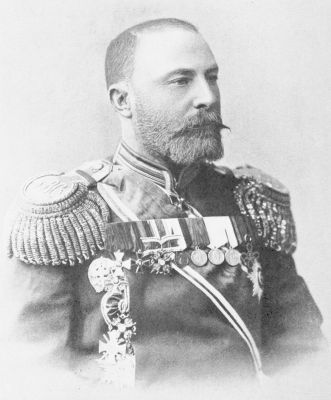
MAJOR-GENERAL TRETIAKOFF.
The infantry attack was now launched, and in spite of our steady rifle and machine-gun fire, the attacking columns fearlessly came on. At times they could be seen to halt and lie down, only, however, to rise again and creep to closer range. Meanwhile, another column was seen to be advancing through the shallow water in Kinchou Bay, in order to turn our left flank; but Lieutenant-Colonel Laperoff was able from the Tafashin Hill to get their range and to hurl them back.
When the attack was at its height, when our batteries were being gradually silenced, when hundreds of men had laid down their lives, and others were in their death-agony, Major-General Nadein, commanding the troops, received from somewhere a report to the effect that the Japanese had been repulsed and were on the run! The news of a victory was instantly telegraphed to General Stössel in Port Arthur, and was at once circulated all over the town. In Stössel's quarters a convivial company gathered to drink champagne.
It is curious to picture the Officer Commanding the District sitting in Arthur, sixty-seven miles off, drinking champagne and babbling of victory, while the first decisive battle of the war was being waged—a battle upon the issue of which depended the future course of events, not least among them the fate of Port Arthur.
The enemy's artillery fire supporting their attacking columns now became unendurable, and the whole of our position was enveloped in black-brown smoke. From Lime Hill I sadly watched our batteries being silenced in rotation. By 10.30 all the ammunition of those of our guns which still possessed gunners was expended, and by midday our artillery position was silent. The whole strength of the enemy's fire was then directed on the infantry trenches held by the 5th Regiment, who were pouring a rifle and machine-gun fire on the attacking columns. The mangled remnants of our artillery began to move off behind the Tafashin Hills, from which fire was opened at times by the field batteries. The Japanese were most skilfully directing their gun-fire and the movements of the attacking columns from Hill 75 and Mount Samson. It was now evident that our position, having lost its guns, could be held no longer unless the 5th Regiment received strong reinforcements.
One hour later General Fock at last arrived on the field of battle by special train. At 1.30 the fire intensified, and the attack was renewed with greater fury. Colonel Tretiakoff sent message after message, begging for two battalions from the reserves; but Fock refused.
While at Kinchou the 5th Regiment literally melted away, defending the ground entrusted to it, the four regiments of the 4th Division—16,000 bayonets—were kept behind the Tafashin Heights, doing nothing, passive spectators of the formal slaughter of their comrades!
Fock arrived on the ground when the fight was practically over, and meeting gunners retiring along the roads to the rear, worn out with ten hours' fighting, said to them, 'Get back to the trenches, cowards! Take rifles and shoot!' The men crawled back utterly exhausted both morally and physically, and, rifle in hand, returned to die under the hail of shells in the trenches. These poor worn-out fellows, quite unfit for any work, were sent back, while 16,000 fresh men were, so to speak, round the corner doing nothing; for the General would not risk his division: it was wanted to defend the district and the Fortress!
At four o'clock there was a lull. The Japanese were evidently preparing for a fresh attack. Every gun on the position was silenced, while the fire of those on the Tafashin Heights was ineffective. The position was still held only by the 5th Regiment, and two companies of the 13th Regiment which had arrived during the night. About twenty companies of the enemy with guns could be seen between Mount Samson and Hill 75, quietly and slowly extending against our right flank. Their advance was quite uninterrupted: they were beyond the range of our infantry, and our guns were silent. After an hour their guns again started to shoot and the attack was renewed. It was plain that the object was to capture the centre from the left, and therefore all the weight of metal was directed against that flank. Tretiakoff saw it was useless to reinforce the left, and he wanted to keep his reserve, although small, in hand. He continued to ask Fock for fresh troops, but in vain. Line after line of the enemy now advanced against the trenches on the left flank. Heavy musketry fire began; rifles got hot; the trenches were full of killed and wounded, whom it was impossible to carry away, for of seventy-two stretcher-bearers only twenty-eight remained. All along the line of trenches the parapets were battered into a shapeless mass, heaped up with dead. It was six o'clock, and it was impossible to hold longer on to the left flank without reinforcements. The companies, reduced in strength, began to withdraw, to hold the second line of trenches. The gun-fire slackened and the fury of the infantry assault increased. Tretiakoff continued to ask for reinforcements. None were sent him.
The Japanese made a desperate advance along the whole line, and the enfeebled regiment was unable to hold them back. Ammunition ran short: it was impossible to replenish the supply. The companies in the centre of the position were in danger of being cut off from the left flank, which was giving way before the enemy's determined advance. Communication between several of the redoubts and lunettes was interrupted, and Tretiakoff felt the position to be desperate. But while daylight lasted a general retirement was impossible, and orders were given to hold on at all costs. Seeing that some of the companies were falling back, he despatched his last orderlies to the rear to explain that a general retirement was out of the question till dusk, and to implore that even one battalion might be sent to enable him to hold the position till nightfall, and so prevent the utter annihilation of his regiment; but he was not reinforced by even a section.
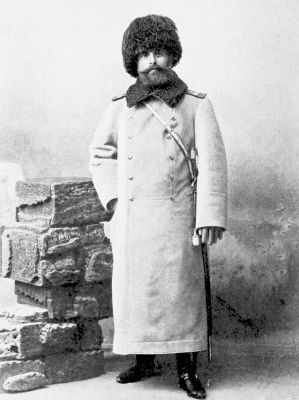
COLONEL LAPEROFF.
While light remained the Japanese refrained from actually charging to close quarters, and contented themselves with pouring a heavy rifle and a gradually slackening artillery fire on the position. The sun was almost setting. At about seven o'clock the 5th and 7th Companies slowly gave way, and no sooner had Stempnevsty's company abandoned its position on the extreme left than it was occupied by the enemy. From that moment the position of the company entrenched in the centre was very critical, as it was taken in a cross fire. The 2nd Infantry scout detachment was surrounded; both its officers were instantly killed, and of 115 rank and file, but eighteen escaped. Having occupied the central batteries, the Japanese opened a steady reverse fire upon our trenches. But the sun was now sinking behind Mount Samson, and under cover of the rapidly increasing darkness, the retirement was carried out. The companies which had held the left flank retreated along the road leading to the Tafashin Heights, and thus covered the retirement of the centre and right. But though the Japanese were now in possession of our batteries, and though their artillery had advanced to a position between Nos. 2 and 3, for some reason or other, they did not press the pursuit, and contented themselves with shooting into our retreating columns.
Lieutenant-Colonel Laperoff, who had all along kept up a fire from his battery on Tafashin, noticed as darkness came on that the Kinchou position was crowded with troops. His guns were excellently placed, and he could have poured a crushing point-blank fire into these masses in the open. But he had no orders, no information as to what was taking place, and though he and his officers strained their eyes endeavouring to make out who these crowds might be, it was impossible to ascertain whether they were friend or foe. That a general retirement had taken place, and that the Japanese had occupied our main position, none of the staff had considered it necessary to inform him. He finally found Fock at the railway-station, and was peremptorily ordered to withdraw his guns.
Darkness came. The day had passed, and with it hundreds of lives—the usual price of every military triumph, on this occasion the price paid for the glory and honour of the 5th East Siberian Rifle Regiment.
FOOTNOTES:
CHAPTER XIV
NANGALIN RAILWAY-STATION
Along the roads and paths and across the fields the remnant of the 5th Regiment dribbled towards the Tafashin Heights. Behind these hills confusion was worse confounded. The whole 4th Division streamed away past this wonderful natural position, the strength of which can be seen at once, even from a map; but no one seemed to have noticed its tactical importance before, and nothing was now done to take advantage of it to resist the invaders further. Back, back streamed all. When it was quite dark, when the men of the different units were thoroughly mixed up in the disorderly retreat, so that control was impossible, some one shouted that the Japanese cavalry were coming. What then happened it is difficult to say, but the infantry opened fire on their own men, there was a lot of miscellaneous shooting, and a convoy of wounded from under Tafashin was taken for the enemy and fired on. Batteries hearing the firing and having no infantry escort hurried off to Nangalin. Colonel Laperoff's battery, marching ahead in good order, was almost swept away by the other batteries galloping on top of it in the dark; all was blind panic till daylight. It was indeed lucky for us that the Japanese did not pursue: the results of such a pursuit are painful to think of, and the enemy might have got into Port Arthur on the heels of the 4th Division.
Nangalin Railway-station presented a scene of dreadful chaos. Trains loaded with wounded were leaving for Arthur. Owing to the suddenness of the retirement and the disorganization, no arrangements for food had been made, and men of all branches of the service, badly wounded and exhausted by the long battle, lay tortured with hunger, thirst, and cold. The dim forms of the gunners of Kinchou could be seen prowling about the platform as they searched for food; others were lying huddled together, sleeping. The first and second class refreshment-rooms were filled with officers, whose numbers were being momentarily increased by fresh arrivals by train, on horseback, on bicycles, and on foot. Nobody knew anything or what to do; every one waited for orders which did not come, for none of the commanders were there. The majority of the senior officers, having eaten, were lying on the floor.
A long train filled with wounded was standing at the platform ready to start; it had been there for some time. The medical officers were performing acrobatic feats in their efforts to pass along from one goods waggon to another, and were doing their best by the dim light of the lamps to alleviate the terrible suffering.
'Tell them to get us some water; the men want something to drink, and we have only got distilled water required for doing the dressings,' said one of the doctors to a railway official.
'There isn't any. We never expected this rush, and what we had has been used. There is only dirty water.'
'But the men are dying of thirst, to say nothing of hunger. How much longer is the train going to stop here? It is torture to the wounded.'
'Captain —— won't allow us to start.'
Opposite the station buildings I saw a group of men gesticulating and heard angry voices. I went towards them, hoping to find out what the delay was.
'... I ask, I demand that the train be started at once. In the name of humanity all haste must be made to get the wounded into a hospital as soon as possible. Every moment with some of them means life or death. It is utterly absurd to talk of issuing rifles to them, and it would take hours.' It was the senior doctor of the hospital train speaking.
Taking advantage of his authority as a staff-officer of the district, Captain —— insisted that the rifles piled up on the platform should be issued to the wounded men. Both men got angry, and the staff-officer, annoyed that a doctor should attempt to question his arrangements, assumed a haughty and peremptory tone.
'Don't torture the wounded. The train is a long one, full of awful cases, and they are lying all on top of one another. There's no room for rifles,' implored the doctor.
The captain was furious, and striding to the telephone, returned after a few minutes to insist on his orders being obeyed; but the medical officer, losing patience at what seemed to him pigheaded cruelty, flatly declined to allow the wounded to be disturbed, and insisted on the immediate despatch of the train.
'Even the regulations of the Peace Conference lay down that wounded sent by hospital trains must be disarmed,' he shouted.
'I care nothing for the Peace Conference, or any other damned conference. I must send these rifles into Port Arthur, to prevent them falling into the enemy's hands,' was the reply.
Boiling with indignation, I could remain no longer a spectator of this disgraceful scene, and walked off along the train. It was an unusually long one. Wrapped in my thoughts, I strolled some way from the station. Suddenly I heard a noise—neither groans nor screams, but more like lowing. Where I was and what had happened suddenly came back to me. It was a very dark night, and close to me were standing some waggons, from which were proceeding these noises. Have you ever, when travelling by rail, stopped in a station or at some siding at night alongside a cattle train, and heard the noise of the cattle? If you have, I need not attempt a further description of the sound of the hospital train at Nangalin station that night. I walked slowly along it. In the unlighted goods-waggons crowds of men were lying about, some on straw and some on the bare floor. One heard choking sighs, groans, sobs, prayers, curses, and calls for help, combined with the howling of men in unbearable physical agony.
'Drink, drink! something to drink—I'm burning!' was jerked out at me in a hoarse voice from an open door. With difficulty I clambered up, and then almost fainted at what I came upon. In the dimly-lighted waggon lay a shapeless heap of men, coats, boots, canteens, great-coats, heads, arms, and the place reeked of blood.
'Sir, a drink—a drink, for God's sake!' The cry stabbed me. From the indistinguishable pile of flesh and—other things—I saw at my feet a blood-stained head, a sheet-white face lit up by two burning eyes, and an arm stretched towards me. I gave it—this thing—my water-bottle. The wounded man seized it with both hands, but after a second let them fall helplessly, his head lolling back on someone's enormous and blood-smeared boots.
'Ach! cold. Cover me.' He was in an ague.
It was sickening, revolting, horrible. I tried to slip out, but involuntarily my eyes were caught by the sight of a grinning face on which danced the expiring light of the flickering wall-lamp. A smile? and amid such surroundings? Stepping carefully across the wounded men, I went up to it. No! it was not grinning: 'twas the play of light and shadow on the face of another cold corpse. The rows of teeth, the half-opened lips, and the fixed, glazed, staring eyes—a ghastly grin indeed.
Along-side, with his face turned towards and almost touching this—this grin—lay another mangled man, groaning piteously and breathing fast. Every now and then he opened his eyes, but apparently did not know where he was. What would have been his feelings, I wonder, if on the way to Arthur he had come to himself? Throwing my handkerchief across the dead face, I jumped out of the waggon and hurried to the station, to find the wrangle still continuing. I was boiling with fierce indignation. I kept hearing the animal noises and groans of hundreds of suffering men imprisoned in this train, which till a few hours before had been, as was amply evident, filled with cattle.
I left this inferno and went off and joined the artillery. We soon started, and marched through the moonlight night, along with troops, transport, and herds of cattle, all hurrying, scurrying towards Port Arthur, passing many Chinese villages, seemingly quite deserted. Once we heard a shout, 'The Japanese cavalry are on us!' By dawn on the 27th, having again gone more than thirty miles, we arrived at the station of Inchenzy. Worn out and hungry, and finding no food at the station, we lay down on the platform. At six o'clock some hot food was provided for the men. The officers were asked to have some refreshment in a saloon carriage, the very one in which, three days ago—little expecting what was in front of us—I had gone to Kinchou. At seven I left for Port Arthur in one of the trains of wounded coming from Nangalin, and at nine o'clock I reached the Fortress. The town was stupefied.
CHAPTER XV
THE LAST OF DALNY
When Dalny heard the heavy fire from the direction of Kinchou early in the morning, little did the people think how that day would end for them. Afraid of what would happen, they had some weeks before asked permission to leave for Port Arthur; but Stössel had strictly refused, and had even sent back one or two families which had started: he had told the Mayor that there was nothing to be alarmed about, that he would send word directly there was any need for them to move. The sound of firing increased, but the town remained quiet—life moved along the usual track. Even if some felt doubtful as to the result of the battle, there was no idea that the 26th would be the last day for them in Dalny. Midday came; the distant firing slackened off, then increased, and the curious collected on the church tower to see what was happening, for no information had been received from the staff of the district. [Stössel was about that time celebrating his 'victory,' not thinking of Dalny.] The sun sank in the west and evening came on; still no news, and complete ignorance as to what was happening at Kinchou. Evening changed to night; the electric lights blazed up in the streets, and Dalny went to bed.
At ten o'clock the last train but one departed from the station. At eleven the empty waggons returned from Nangalin, and brought news of what had happened at Kinchou. Almost at the same time two telegrams were received. One, to the Mayor from Colonel Yolshin, ran as follows:
'The Officer Commanding the District has sanctioned the departure of the inhabitants from Dalny, but not by rail.'
The other telegram was from the District Staff to the same effect, saying that as the trains were required for troops, they could not be used to move civilians. The sleeping town woke up; the police began to arouse the inhabitants, who, greatly alarmed, ran into the streets half dressed, to know what had happened. The news soon spread that our troops had hurriedly retired to Arthur, and that the Japanese cavalry might at any moment enter the town.
Then began an awful and indescribable panic, for the seeds sown by imagination on the soil of fear are prolific. A massacre by the Japanese or Hunhuses was expected. Men, women, and children wandered helplessly and aimlessly about the town, not knowing what to do. Many rushed to the station, only to be told that the railway would not take them. There were practically no horses in the place.
By midnight the majority of the residents had collected on the Upravlensk Square, where the Mayor, having told them of the telegram received from Stössel, proposed that they should abandon the town; he said that he would not be responsible for any that remained. Then the unfortunate inhabitants, leaving all their property to its fate, set out along the shore front towards Shaopingtao. Some were able to hire rickshaws, but the majority went on foot. Those who happened to see the unfortunate women, half dressed, bareheaded and barefooted, with crying children in their arms, will never forget the awful picture; and it might have all been avoided if General Stössel had listened to the constant representations made by the Mayor with regard to a timely departure. All those 470 men, 92 women, and 57 children who hurriedly left Dalny on the night of May 26 owe their misery to General Stössel.
As the flight commenced the Mayor received this last and most noteworthy telegram:
'General Stössel desires you immediately to blow up all the waggons and trucks remaining in Dalny.'
Staff-Captain Zedgenidsey was ordered to Dalny to demolish all the buildings which might be valuable to the Japanese, as, for instance, the breakwaters, docks, cranes, floating material, railway, etc.; but, owing to want of time, nothing, except a few of the railway bridges, was blown up, and all fell into the enemy's hands in complete order. They also got more than 250 waggons and 300 trucks, all full. Besides the numerous town, harbour, and railway buildings, there was an immense amount of private house property, as well as large warehouses stocked with food and stores of all sorts, both public and private. The enemy got possession of them all undamaged, just as they were. After the capture of Arthur the Japanese confessed that by not destroying Dalny we had assisted them enormously in their difficult task of disembarking their siege-train, and that the railway had enabled them easily to get it into position in the investing lines. Russia had spent over £200,000 in breakwaters for the Japanese to land 11-inch howitzers!
The electric lights now shone down on empty streets, for Dalny was deserted. At two o'clock in the morning the last train, a long one of forty-seven waggons, left the station for Nangalin, and early on the morning of the 28th, after more than twenty-four hours' march, the tired and hungry refugees began to straggle into Arthur. Those Arthurites who happened to see this sorrowful procession arrive opened a subscription list to assist these wretched people, who in one night had lost their homes and everything they possessed.
We have often talked over and discussed the result of Stössel's reign, and what he did or did not do during February, March, April, and May, and there is little doubt that he might, by taking reasonable precautions and by wise and timely action as to the choice and fortification of positions, have delayed the fall of the Fortress at least till June 1, 1905.
CHAPTER XVI
THE FATE OF THE FORTRESS
With the fall of Kinchou and the retreat of Fock's entire division towards Arthur, all glances were directed to Lieutenant-General Smirnoff. Those who had believed absolutely in the impregnability of the former position now lost heart, and began as fast as possible to clear out of the place, going in Chinese junks to Chifu. When the battered remnants of the 5th Regiment—the regiment which by its gallant defence of Kinchou had covered itself with everlasting glory, and which had lost more than half its men and two-thirds of its officers—marched into Arthur, it was given a most unexpected, not to say unique, welcome.
'You are a wretched, undisciplined corps of traitors, cowards, and blackguards. I will try the lot of you by court-martial. How did you dare leave Kinchou? Don't dare to show yourselves in Arthur, lest by your presence you infect the whole garrison with your cowardice,' was Stössel's greeting.
The regiment had no divisional commander, and no one dared to take its part. Discipline prevented the officer commanding from replying to Stössel, and he and his officers had to bear these totally undeserved insults. One General put the whole blame of the defeat on the regiment, and assured Stössel (it was not hard to convince him, as he was not at Kinchou) that the abandonment of the position was solely and entirely the fault of the 5th Regiment, and the senseless way in which it had fortified the place.
This cruel and shameful injustice to this gallant regiment was soon known by all the others, and it had a very bad moral effect on the whole garrison.
After the Kinchou débâcle, the Commandant drew up an order as to the distribution of the different units in the Fortress, and on June 1 took it to Stössel for official approval. The latter rudely cut him short, and, without either reading the order or looking at the scheme, said that it was inopportune.
'The publication of any such orders with regard to the distribution of the troops might,' he said, 'become known to the Japanese through their spies. [He had himself, on May 29, issued an order detailing troops to various positions on the hills.] The district under my command has almost entirely passed into the hands of the enemy. Arthur alone remains, I shall take upon myself the defence of the Fortress. Its present staff will be broken up, for it is a useless body. My staff will be sufficient. I will send Colonel Khvostoff to command a battalion. You will be on my staff. It is impossible for two equal commanders to be in one place.'
This was on June 1: we actually held on to the district outside the Fortress for two months after this date.
The Commandant was in an awkward position. Stössel defied him, and the Fortress, which, thanks to his own efforts and skill, was being gradually got into a state of readiness, was to be taken from him and to be commanded by a man who would wreck all. That moment settled the relationship between these two. It was the first act of the tragedy, which ended on January 1. Quietly, and with perfect politeness, Smirnoff answered:
'I was appointed Commandant of this Fortress by the Tsar; the Fortress Staff is the organ of the Commandant, appointed by Imperial orders. I have no intention whatever of resigning either the rights entrusted to me by the Tsar or the duties consequent on them. You, sir, as my commanding officer, can give me general orders relating to the defence of the Fortress, but I remain its master until the Tsar himself deprives me of it. If my removal from the duties of Commandant admits of no delay, you have it in your power to publish an order to that effect.'
During this scene those present anxiously awaited the result, for in those few minutes the fate of Arthur was decided. In an angry voice Stössel replied:
'I do not mean to remove you from duty. You will remain Commandant, but I shall run the Fortress. Whether legal or not is my affair; I will answer for that.'
What could Smirnoff say?
There was a knock at the door; an orderly entered to announce some officers, and the episode was over. But as every wall has ears, this incident was soon known to the whole garrison, and indignation knew no bounds. We were all afraid for the fate of Arthur, and made conjectures as to the action Smirnoff would take. Some declared he would leave on a destroyer; others, in indignation, said that Stössel should be invalided and forced into hospital; others swore that the day and hour had been settled when Smirnoff would surround Stössel's house with a whole regiment and arrest him, as well as Fock and others. The moment would have been an appropriate one, for the discontent in the garrison was very great, and the hatred of Fock and Stössel had much increased since Kinchou. Everything depended on Smirnoff's decision; but to adopt such violent measures was risky—a dangerous precedent for the discipline of the troops. Stössel also had St. Petersburg at his back. Even the Viceroy could not interfere with his recent appointment as Officer Commanding the District, though much against it. Who could say that Stössel's arrest would not have results quite opposite to those wished for? It was most likely that St. Petersburg—that hotbed of the most revolting scandals and intrigues—would represent Stössel's arrest to the Tsar in such a light as to cause an immediate order for his release. Was it not all possible?
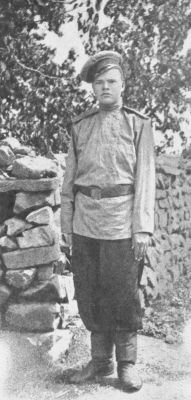
A WOMAN DRESSED AS A SOLDIER, WHO WENT THROUGH SEVERAL FIGHTS.
Finally, Smirnoff, in spite of the many suggestions and proposals, decided to settle the matter as peacefully as possible. He accordingly sent for General Kondratenko and Colonel Reuss, and told them that he recognized the necessity for a division of authority, and so was quite prepared to give up all his powers, save only the actual defence of the Fortress, for which he intended to remain responsible. Reuss expressed regret for all that had happened, and promised to use his power to keep evil influences from getting at Stössel.
Next day Order 285 was issued by the Officer Commanding the District, and clearly showed that Stössel was not inclined to conciliation:
'As the enemy has appeared in the area of the Fortress, and the 4th East Siberian Rifle Division, with its artillery, has joined the troops in it, I now assume supreme command of the defence, and, in order to centralize authority, the Chief of my District Staff will in future be present at the Council of Defence established under the presidency of the Commandant. All resolutions, etc., of the Council will be given to him to report to me for my confirmation.'
Why did he publish the order? Its only result was to take the control of the Fortress from the hands of the real chief, who, according to all regulations, should have been in supreme command. Then, when Fock's entire Division arrived on Wolf's Hills, a council was summoned, at which the question of what further steps were to be taken was brought up—whether the outer positions on Green Hills were to be held, or whether the defence of the advanced fortified positions of the Fortress was now to begin. The Commandant protested against the latter, energetically insisting that the Green Hills must be held, because the Fortress itself was not quite ready, and, what was more important, because Wolf's Hills and Ta-ku-shan and Sia-gu-shan Hills were not fortified, and were most important strategic points. Fock asserted that it was unsound to attempt to hold the enemy on field positions; that it would be a mere waste of men and ammunition, which might be so essential for the defence of the Fortress itself, to which a withdrawal must sooner or later be made. It would be wiser to neglect Wolf's Hills and retire at once into Port Arthur, and so commence its defence with the maximum number of men. Stössel agreed with Fock. Then the Commandant explained his scheme in detail, and pointed out that as soon as the blockade became strict the Japanese would get possession of Wolf's and Sia-gu-shan and Ta-ku-shan Hills; that, in that case, the inner and outer harbours would be impossible for ships, as the waters could be reached by indirect fire, and that none of our works could be successfully held.
Smirnoff's brilliant and lucid statement carried the council, which, by a majority of votes (including Stössel's), decided that Fock's Division should be sent back to occupy the best of the outer positions still in our possession. It is interesting to note that as the country had not even up till now been thoroughly reconnoitred by the District Staff, they were unable to say at the meeting which were the best remaining positions! Of the splendid positions on the heights at Nangalin no one had given a thought. According to the reports of our scouts and reliable Chinese, these were already occupied by the Japanese. Next day some of General Stössel's staff rode out to choose positions. They stopped on the chain of hills named Upilazy, which border on Inchenzy Bay and Green Hills, stretching along the Lunwantun Valley to the little bay of the same name. The hills on the line of these positions, stretching for more than seventeen miles, were commanded by Kuen-san Hill. The positions on the Upilazy chain of hills (ten miles) were held by mixed companies of the four reserve battalions and the 7th Division with two companies of the Frontier Guards. To these were added eight field batteries and one howitzer battery. Fock took up his quarters at the seventh mile (the railway now only ran for twelve miles), and kept on repeating what he had said at the council—that it was only wasting men and ammunition to hold these positions—and was apparently quite ready to retire. Smirnoff, however, insisted on their being held. Engineers were sent to the flanks (there was only one sapper company of 800 men in the Fortress), and the fortification of the seventeen-mile-long positions was commenced. Fock would not hold the right, because he said the enemy would attack his left, and, as the position was too big for one division, Smirnoff sent the mixed companies above mentioned from the Fortress troops to hold the right. Owing to this the left was strongly fortified, but the right hardly at all.
The enemy having now taken complete possession of Dalny, at once used it as their base. There, quietly and comfortably, without any interference from us, they carried out the landing of troops for the investment. Ten transports would arrive daily, bringing everything necessary for the concentrating army. The railway from Dalny and all the rolling-stock was in perfect order, and by it troops, guns, ammunition, provisions, etc., were transported to the front. Everything smiled on them: our fleet did not hinder them in any way; they had command of both sea and the land.
During all this time our intelligence services were very badly run, our only source of information being the Chinese, who, working both for us and the enemy, naturally favoured the latter, as the District Staff paid a starvation wage.
CHAPTER XVII
THE LOSS OF KUEN-SAN HILL
As the sea blockade was at this time very slack, communication with Chifu was easy, and Chinamen could always be found to make the trip. In addition, steamers with provisions often ran into Pigeon Bay. Stössel received inquiries from head-quarters, through Shanghai, as to what he wanted, and was informed that what he required would be sent. But he refused all proffers of assistance, saying we required nothing, and this in the face of Smirnoff's protests that big gun ammunition, preserved meat, vegetables, hospital appliances, etc., were urgently needed. We could at that time have obtained anything we wanted, for merchants and others were offering to run the blockade—at a price. One day a steamer owned by a private Frenchman ran into Pigeon Bay with supplies, among which was a large stock of tinned milk. It was with the greatest difficulty Stössel could be got to take this, yet milk was one of the first things to run out, and he warned the captain not to come again. It was almost impossible to send private letters out of Arthur, for all of them were censored by Stössel's staff, those hinting of the true state of things being destroyed and the writers punished. I myself had experience of this.
With the occupation of Green Hills, Smirnoff set to work to fortify the ground in front of Angle Hill, Wolf's Hills, Ta-ku-shan and Sia-gu-shan Hills. The latter were of immense importance, as they were quite inaccessible, and protected the whole of the western front of the Fortress, but only so long as Wolf's Hills were in our possession. As far as intelligence was concerned everything went on in the old sweet way. The scouting was bad, the information gained was nil, and we remained ignorant of the enemy's position or movements. One good step taken at this time, however, was the formation of a town guard from all the citizens capable of bearing arms.
On June 23 the enemy, having concentrated, began to advance from Siabintao on the extreme right flank along the hills on the seashore. To oppose them two companies of Frontier Guards from Waitselazui, and three companies from Khuankhe-Chjuan were sent. A short engagement ensued; our men held their ground, and the enemy retired. This movement of the Japs was merely a demonstration with the object of finding out the weakness of our right flank. They had excellent information regarding the left from their spies and patrols, and knew well that considerable bodies of infantry and artillery were collected on that side, and that fairly strong fortifications were in course of construction. The weakness of our right was continually pointed out to Fock, but he did not send a single company there, even after this fight on the 23rd. At 5 a.m. on the 26th they opened a heavy gun fire, chiefly on the right, and made a general advance all along the line. At midday they pressed the attack on the centre and right more vigorously, and continued massing against those points till evening. Next day, at daybreak, they hurled all their might against the right. The fighting was obstinate, and the enemy, though considerably stronger than we, were obliged to fall back; we, however, owing to reinforcements not being received in time, were obliged to abandon Kuen-san.
This peak, which was really the key to our positions, for it commanded the whole line, was held by only one company of the 14th Regiment, commanded by Captain Lopatin. Realizing its great tactical importance, and naturally thinking that we did the same and would doggedly hold on to it, the Japanese attacked, after artillery preparation, with almost an entire regiment. But the General did not appreciate its value. Even when the Japs began to press its little garrison, he sent no reinforcements. The company only began to withdraw when it had lost three-fourths of its strength, and when, in spite of the several messages despatched asking for help, no support was given. At the subsequent inquiry upon this affair, Fock so represented the matter to Stössel that he had Lopatin tried by court-martial for abandoning the position prematurely, and without orders. Fock himself escaped blame. Before the sentence could be confirmed by the Tsar, poor Lopatin died of heart failure; but he had been sentenced to the loss of all his rights, and to serve with the prison companies for two years.
By the evening of the 27th the fighting ceased with the capture of Kuen-san and Green Hills. The troops holding the right fell back into the valley of Lunwantun, and occupied the heights in rear; but the loss of the two former made our position critical, as from Kuen-san the Japs could renew the attack, and force us back. There was nothing for it but to attack and at all costs regain possession of those hills. The District Staff accordingly issued, with the greatest precaution, secret orders to that effect. On July 1 I met a young officer in the street.
'Would you care to come with me to Green Hills?' he said casually. 'A night attack has been fixed for to-night on Kuen-san; but it is a great secret.'
As I also heard the move discussed by Chinese shop-assistants, I went at once to the District Staff and told the senior aide-de-camp, for, as the whole town seemed to know this 'secret,' it must, of course, be known now to the enemy.
'Yes, the General let it out, so we have telephoned to cancel the move. In any case it wouldn't have succeeded, as the General was dead against it. The attack will take place another day, and Kondratenko is going to command the right flank. Fock will now only nominally be the senior.'
This reply was only too true, for the General was jealous of Kondratenko, and would not co-operate in any way.
Early in the morning of July 3 our destroyer and gunboat division steamed towards Shaopingtao and opened fire on Green Hills; at the same time our troops advanced from the right flank against them, Kondratenko being in command. The ships did little actual harm, owing to lack of facilities for fire observation and correction. The fight raged all day, our main objective being Kuen-san. On the 4th it was renewed, but though we again got possession of Green Hills, we were unable to capture Kuen-san. The 13th Regiment took two-thirds of it, but could not advance further, as the Japanese threw in heavy reinforcements, and brought up a number of machine-guns. On the night of the 5th we had to withdraw, and abandoned further attempts to retake the position, as one attack alone had cost us 500 men. Green Hills were again ours, but the key to the position, from which all our roads, dispositions, and actions could be seen, and an enemy's artillery fire and infantry advance directed, remained in the hands of the Japanese. On the 7th everything was quiet, and from then onwards for three weeks the enemy did not fire a shot in reply to our occasional bombardments, for they were establishing themselves and fortifying the ground actually won. Smirnoff insisted on the positions recaptured by us being strongly fortified, and sent his best engineer officer, Raschevsky, to supervise, so good progress was made. At midnight of the 8th, in torrents of rain, they made a sudden attack on our centre, but were noticed in time and repulsed. On the 13th our howitzers bombarded the enemy's works for some hours, but drew no reply. On the 14th we made a reconnaissance of the Japanese position under Smirnoff, with like result. Twice only from the 8th to the 26th July did the enemy attack, and then only in small numbers.
CHAPTER XVIII
THE JUNE SORTIE OF THE FLEET
Meanwhile the navy had not been altogether idle, though the result of its activity was not great. By the middle of June the Pallada, in dry dock, was ready to go to sea, and the battleships Cesarevitch and Retvisan—the pride of the Pacific Ocean Fleet—were ready to throw the bandages off their now healed wounds. We were all greatly excited, for if only the fleet could put out at full strength and get the command of the sea, the transport of troops to Dalny, now being carried on daily right under our very noses, would be stopped, and then what might not happen? Important meetings were frequently held at Admiral Witgeft's; but though the ships were ready, the council, attended by all flag officers and captains of ships, was divided into two parties—one for going to sea, the other against it. At the meeting on June 18 a telegram from the Viceroy was communicated, in which the fleet was ordered to steam out and engage the enemy, choosing the most favourable conditions, and taking every precaution. The time chosen for the start was the turn of the tide—daybreak—on June 24; but when the hour came the Pobieda was not ready, and her Captain was ill, so it was put off till dawn the following morning. There were great efforts made to keep this secret, as, owing to the removal of the gendarmerie to Liao-tieh-shan by Stössel, the place swarmed with spies.
At three o'clock, after the twinkling of many lights, a signal was hoisted, and the fleet came to life. At 4.21 the Novik slipped quietly out into the outer Roads, and after her the other ships in turn, the Pallada being the last to pass through the narrows; but the fleet was short of the following guns: one 12-inch, twenty-six 6-inch, and thirty 3-inch, and four of the ships had captains who had not commanded them at sea before. From the highest point of Golden Hill the whole squadron could be distinctly seen in the clear morning air. The channels in its course had been swept for mines, some of which, while being drawn in, had exploded quite close to the ships lying at anchor. Seven mines were found near the Cesarevitch alone! Notwithstanding all our efforts at clearance, the roads were always more or less full of them, and every officer and man going out to sea, though the enemy were miles away, was gambling for his life. This is mentioned because what our sailors had to go through and their great services at Port Arthur are now forgotten in Russia. Russia has forgotten in the whirlwind of the movement for political freedom that for eleven weary months her loyal sons in Arthur tried to save the waning greatness of their native land.
As the Bayan slowly passed out far below, the bitter words I had once heard about the state of the Russian navy, uttered by one of its officers, recurred to me: 'So long as our fleet is purely for parades and peaceful political demonstrations; so long as its Admirals do not serve and work hard in peace-time, doing active duty, and not merely writing orders; so long as the officers are promoted for anything but their capabilities and services; so long as they do not know their ships as the five fingers of their hands; so long as the whole complement of the navy does not like the sea; so long as the Naval Department does not cease trying to economize in what is the essence of a fleet (shooting and cruising); so long as it hesitates to rid the administration of the fleet of venerable, bent old men and "shore admirals"; so long as the Naval College does not turn out men fond of the sea and the navy, we and the senior officers can do nothing, and our fleet will glide down the facile descent of deterioration. I say this from bitter personal experience: I say that we are absolutely unprepared. We will do what we can; we are ready to die—and we must die in the unequal struggle.' As these words came back to my mind, suggested by the Bayan gliding slowly past down below, I looked up from her to the horizon where, far away, could be seen the Japanese ships waiting for ours. Of course they knew we were coming out, and were ready. What did they not know? Probably the opinion just quoted would be no news to them. By one o'clock our ships had moved out into the open sea, where Togo with his whole fleet was awaiting them. The destroyers out ahead, supported by the Novik and Askold, at once engaged the enemy's scouts, which drew off towards their main body. By 6 p.m. the squadron had gone down below the horizon, and could not be seen from the highest points in Arthur, but the booming in the far-away distance sounded like peals of thunder. We were all greatly excited to know how the fight would end.
About nine o'clock the quiet of evening was broken by the growing noise of heavy firing at sea. The fleet, attacked by a cloud of torpedo-boats, and firing with every gun, was retiring rapidly to Arthur. It was not yet visible, but the booming of the 12-inchers, the ceaseless cracking of the smaller guns, sounded louder and louder. We saw the reflection of the searchlights, and then some time later dim specks gradually loomed up, and the squadron itself appeared; the destroyers and Novik formed a rear-guard, covering the retirement with their fire. The fleet steamed in and anchored, let down its torpedo-nets, and with its searchlights wove a regular net of light to seaward. On the way back to port it had been twice attacked by destroyers, but had beaten them off, and had made the outer roads comparatively without mishap. The Sevastopol alone distinguished herself. Getting out of column, she struck a mine and was injured, but was able to reach White Wolf's Bay and anchor. There was not enough water for her to go into the inner harbour, for no one had thought in peace-time of dredging the entrance.
Night soon came down very dark, and all seemed peaceful; but the calm did not last long, for that night the enemy made a madly gallant attempt to torpedo our vessels as they lay in the outer harbour, and hell was let loose. All night long Admiral Togo launched his destroyers to the attack in pairs. Though our whole fleet was one blaze of light, and though the shore searchlights perched up on high lit up the waters to a great distance, the heroic enemy did not desist. On, on they came, fired at from the whole front as the shore lights showed them up afar off; diving one moment into darkness, the next again into the glare, they dashed onwards. The fire of the ships became furious; the ceaseless flash of the guns made them look like torches, but, however brave, however fanatical the enemy, they could not withstand the hail of steel poured on them by the fleet. The destroyers came in very close before they fired their torpedoes, but still it was at ineffective range. Having fired the first torpedo, they turned to starboard, firing a second on the turn, and then at full speed steamed out to sea. The lucky ones got away; others sank in view of the whole Fortress. I sat through the night and watched these attacks till they ceased at dawn.
Next morning, on the flood-tide, our fleet came in to the inner harbour. It had returned, the only result of its sortie being the injuries to the Sevastopol, the expenditure of thousands of shell, and a number of Whitehead torpedoes floating about in the outer Roads. Arthur was disappointed. The following order, issued by the Commander of the fleet before it went to sea, which appeared in the Novy Kry of the 24th, was depressing reading:
'As the ships which were damaged by our treacherous enemy before the outbreak of war have been repaired, the Viceroy has given orders for the fleet to put to sea, so as to assist our comrades on land to defend Arthur. By the help of God and St. Nicholas, the sailor's patron saint, we will endeavour to do our duty, be true to our oath to the Tsar and defeat the enemy, weakened by the destruction of some of his ships on our mines. The Bobr has given us an example of what can be done. May God be with us!
'Witgeft, Rear-Admiral.'
The fleet was there again in its usual place in the western and eastern basins; but what was to be done? Who was to blame because it had returned without having brought on a decisive action? Some of the officers declared that a battle ought to have been brought on, that all the chances were in our favour; others said the opposite, asserting that a heavy engagement would have been the end of the whole fleet. Arthur was divided into two camps: one against the navy, the other in defence of it. I remember those heated quarrels about our naval officers, and the abuse poured upon men who were in no way to blame. The majority of those who spoke so bitterly of the fleet's return ignored the fact that it went to sea very weakly armed. It had met the Japanese fleet of four battleships, six armoured cruisers, six light cruisers, and a number of destroyers and other vessels, about twelve miles out. The fleets got within fifty or sixty cables of each other, and when our ships increased speed so as to shorten the range and bring on an action, the Japanese steamed off. Togo evidently wanted to entice our fleet on and make a torpedo attack during the night, and having thus weakened it, to bring on a decisive engagement in the morning. It was depressing to see our ships driven in again like this, and disheartening to give up all hope of obtaining command of the sea. A strict blockade of the Fortress must come in the future. How long it would last no one could say, but that men, guns, and war material were already scarce with us—more than scarce—we well knew. Still, the hatred shown towards the fleet was not sensible or just. Disappointed with our many misfortunes, people were searching for a scape-goat—for some one on whom they could vent their indignation. They became jumpy, and therefore in no condition to look at things calmly: they were glad to find some one to blame. From what I felt, heard, and saw on all sides—and my opportunities for judging were great, as I moved about in every grade of society in Port Arthur—I came to the conclusion, after the return of the fleet, that its rôle on the sea was over.
During the gradual development of the military situation in the district—when the most prominent features had been the extraordinary errors on the part of General Fock—General Stössel was acting the dictator in Arthur, where, in addition to his main task of interfering at every step with the useful work of General Smirnoff, he lost no opportunity of sowing dissension between the fleet and the army, especially after the squadron's unlucky sortie. Everywhere on shore—in the streets, in the restaurants—there was nothing but abuse and curses for the naval officers, from highest to lowest. Every one accused the sailors of not wishing to put to sea. One result of this was the production of a scurrilous allegory by two anonymous authors. The first described a dream, which he pretended to have had, and in which the enemy, in the shape of a bull, was eventually killed by Russian soldiers. The second narrated another dream, a sequel to the first, in which the navy were represented as hares which bolted and left the soldiers to fight the enemy alone. I happened to read this effusion when I was on board one of the ships, for some one had had it lithographed, and sent a copy to each of the ward-rooms in the fleet, including a copy to Admiral Witgeft. This kind act naturally did not tend to smooth matters between the services. Though the sailors endeavoured to ignore it, at heart they felt the undeserved insult deeply.
CHAPTER XIX
FORTIFYING OUR LINE
The 4th of July showed the Japanese the power and energy of our troops. It illustrated their capabilities not only in defence, but of successfully delivering an attack; for it should be noted that the minimum number of troops on the advanced positions took part in the engagement of that day. Having retaken Big Ridge, Green Hills, and the foot hills of Kuen-san, still holding the defile—the second key to the advanced positions—and having made some progress with the fortifying of all the defensive line, we completely stopped the enemy's forward movement towards the outer forts, on which work was now being pressed on. At this time our mobile shore defences (a division of gunboats) were able to shell the enemy's positions, his rear communications, and his bivouacs, with great success. Thanks to the result of the battle of the 4th, the enemy felt that they were liable to attack themselves; the desperate and well-planned attack of our right flank, under the command of General Kondratenko, on that day had come as a nasty surprise. After Kinchou they had advanced victoriously—as they liked. The battle of June 26, with our abandonment of Kuen-san, confirmed them in the belief that Russians were incapable of taking advantage of and of holding good positions; but the actions of July 3 and 4 made them more careful, and not quite so ready to believe blindly in their lucky star. They now assumed the defensive, and began to construct field fortifications, to build wire entanglements, and to lay mines all along their defence line and captured heights. They became still more careful when our outpost line moved forward, and, attacking their outposts, occupied with our pickets the hills in front of Green Hills, from the foot of Kuen-san to the sea. If only that hill had been still in our hands, our position would have been splendid: under the energetic Kondratenko, we would have very soon turned it into quite a formidable fort, which would have been able to shell the enemy at every point, for all the roads leading from their position to Dalny would have been distinctly visible. But what could we now do? Fock had, knowingly or unknowingly, spoilt everything, and in the face of common sense given up the hill. I repeat, Kuen-san was never properly fortified, and so the Japanese had been able to capture it with small loss. Had it been fortified, they would have paid a long and heavy price for it.
One day when Butusoff, commanding the section on the right flank of Green Hills, was lying on his face on his favourite little hill, and looking intently at the top of Kuen-san through his glasses, I asked him what he thought of it. He had intended for some time to send some scouts there, and so he used to study all the approaches to the top by day.
'Oh, I think a lot of it! So long as Kuen-san belongs to the Japanese, we can do no good here. Remember that they can clearly see everything that we do. Now, look at the top; look up there,' he said, pointing. 'Not there—more to the right; up above that first point.'
'I see!'
'Look! You can see those little poles running all the way down? Those are for telephone-wires. From the top of that hill they will be able to correct the fire of the whole of their batteries, just as they did on Mount Samson. Do you remember? Well, all their batteries are being connected up with telephone to that peak. I stay here by the hour, and I have seen how they have connected up by telephone from one peak to another.'
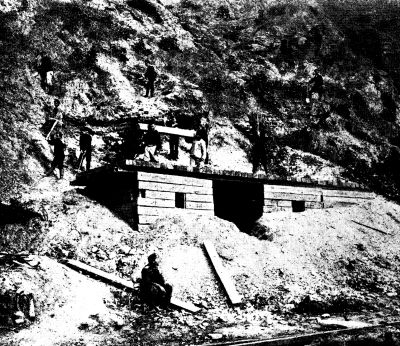
A BOMBPROOF.
Thanks to the fairly successful operations under General Kondratenko, people in the Fortress were now somewhat less nervous, and they began, with their usual optimism, at once to believe that the enemy would be checked for a long time on the advanced works. True, Kondratenko had taken the place of Fock, but the real state of affairs was not understood. Few knew that we might expect a decisive advance any day, and that it was impossible to hold the enemy long on our most absurd line of positions, stretching for seventeen miles, with such forces as were allotted by the District Staff. But however much it was hoped that we would succeed in checking the enemy for a longer or shorter time, every one quite understood that if we were not reinforced from the north the Japanese must sooner or later close up to the Fortress and begin to bombard it.
In view of this, the leading people, especially those with families, began to build for themselves bomb-proofs; but, owing to the lack of the necessary material, labour, and knowledge, most of these were made in a primitive fashion, and would have given absolutely no protection against shells, nor even against splinters; but, ostrich-like, the builders obtained a sense of security from the concealment afforded. Stössel, with his extraordinary ideas on everything, took a different view; in every unofficial way he showed his disapproval of these buildings and made fun of them. However, this did not prevent him having one built for himself in his own courtyard, and also one for the staff-officers of the district. In this the latter took refuge during the bombardment. They might have built ten bomb-proofs each for themselves if they had liked, but why should they interfere with others, especially with those who had wives and children? It was absurd, barbarous. The building of bomb-proofs should have been encouraged. Kinchou had shown what damage could be done by small shells, and what might we not expect from siege-guns? The whole of Arthur should have been turned into a catacomb, for besides the healthy, there were all the sick and wounded to be protected; but, when no proper bomb-proofs had been constructed during six years in the batteries, it is not surprising that none had been built for the hospitals.
While Stössel harried those building bomb-proofs and created general annoyance by his extraordinary sallies and orders, things were elsewhere progressing. The work on Temple and Water-Supply Redoubts, which were destined, after Ta-ku-shan, to play so brilliant a part in the defence, and on which the waves of the August storm were to be broken, were pushed on. General Smirnoff, anticipating the course of operations, decided to fortify, as I have said, beside the main line of defences, the forts which at this time were almost ready—203 Metre Hill, the hills lying in front of Angle, Divisional, Long, and Orphan Hills. It must be remembered that at the time of his arrival in the Fortress there was only one advanced work; this was Temple Redoubt, with capacity for a company.
Much was done to improve this work, and after the destruction of Siu-shuing village, close by, and the construction of two lunettes, it really had some defensive value.
One interesting point was that Stössel and Fock insisted on the fortification of Angle Hill, which was of minor importance, in preference to strengthening 203 Metre Hill, which was of the greatest tactical value. This action was against Smirnoff's opinion, and necessitated the occupation of Pan-lun-shan and the forward slopes of Angle Hill. Work on these could only be useless, but, to avoid unpleasantness, General Smirnoff gave orders that they should be fortified, and he himself, together with Kondratenko, made a thorough examination of the ground, though no one realized better than he the waste of time, men, material, and guns, all of which were so urgently wanted in other parts. In the event Smirnoff's opinion proved correct. Angle Hill had to be abandoned, with its guns, on the first day of the August attack; but 203 Metre Hill held out for long, and it was only after its capture, on December 5, that the Japanese were first able to shell the harbour and shipping.
While we worked hard at the fortifications and swept the Roads for mines, everything went on quietly on the advanced positions now established along Green Hills. The enemy showed no activity, and did not disturb us with a single shot, but, like us, worked hard, getting troops into position and bringing up guns and ammunition to the front lines. Fock especially insisted on Upilazy Ridge being fortified, anticipating that the main attack would be against that flank, and, as he was complete master on that side and was supported by Stössel, he concentrated the greater part of the material, engineers, and sappers there. The right flank, to which he paid no attention, was left to itself. Heaven knows what would have happened on July 26 if Smirnoff had not discovered this in time, and, as already stated, sent Kondratenko there. From July 4 he, with the assistance of some engineer officers, began to get the position on Green Hills into some order; but General Fock was very displeased with his activity, and interfered wherever he could. Had Smirnoff and Kondratenko given way, the results of the fighting on July 26 would have been disastrous, and I am sure that such a rout would have taken place among our men that the enemy would have driven us right into Arthur. (The retirement on Fock's flank was almost a rout.)