Front matter (continued 7)
A. B. (Alexander Bertram) Lindsay translation
FOOTNOTES:
CHAPTER XLIII
THE END
Almost before dawn next morning, on the eastern front near Signal Hill, was sounded the last note in the titanic struggle for Arthur. Some volleys rang out on the quiet air, died away into independent firing, then stopped. Boom! boom! went two guns, and then all was silent. It appeared that the Japanese, thinking that Signal Hill was only held by outposts, decided to seize it under cover of night. They advanced without even taking the usual military precautions. Unfortunately for them the hill was held by a company of infantry, which, having noticed their approach, allowed them to get within short range, and then poured volley after volley into them. Twenty dead and eighty wounded were left on the ground. They wavered, and our men charged with the bayonet. The fight continued for some moments, costing us five wounded and one killed.
At daybreak all the hills on both sides swarmed with men who had recently been foes: they stared at each other fascinated. The two great masses of men differed but little from each other. Both had come here to die, to die without a murmur and obediently. The only difference was that on the one side they died for duty and for an object understood by all, knowing their own superiority; on the other they died for the same reason, but feeling their inferiority. The latter it was who drank the bitter cup. Their one hope now was that they should be spared the fate of being taken prisoners of war. Negotiations were being carried on that day, and, of course, those responsible would spare them the shame of imprisonment. But no! They had to drain the dregs.
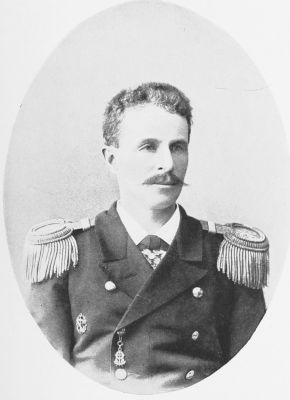
ADMIRAL WIREN.
A carriage was seen driving from the District Staff Office; it proceeded quickly round the central Mandarin Road to the village of Siu-shuing, the place appointed for the meeting. In it was Colonel Reuss, who was escorted on horseback by Colonels Khvostoff, Dmitrevsky, Captains Schesnovitch, Golovan, Student Lebedeff (interpreter), and Malchenko. Before they started, General Stössel, in the presence of Fock, told them all that he had given all instructions and full authority for the conclusion of the capitulation confidentially to Reuss, and that Reuss had also been given a letter for General Baron Nogi. Stössel, Fock, and Reuss were nervous; they were also, it seems, in a great hurry, for no lawyer was asked to look over the terms of capitulation, nor was one present even when the terms were signed.
The Commandant, holding aloof from any participation in the surrender, sent the following cipher telegram to the Commander-in-Chief, dated January 2, No. 1,300:
'General Stössel has entered into negotiations with the enemy for surrendering the Fortress without informing me, and in spite of my opinion and that of the majority of the commanding officers.'
Reuss, with his companions, soon reached the appointed spot. They were met by the Chief of the Staff of the Japanese Army, who handed to them the proposed text of the agreement,[44] written in English. He gave them an hour in which to think it over, and went away. Reuss then read the contents aloud to the others. Golovan began to protest; he was cut short. 'They are the victors; we must submit to their demands.' After a short conference and passionate protests from Khvostoff, Golovan, and Schesnovitch—as a matter of fact their protests were waste of breath, for Reuss alone had plenary powers, the others being only there for show—Reuss agreed to make three alterations: (1) That the garrison should not be made prisoners of war; (2) that officers should be permitted to take their orderlies with them; (3) that the allowance of baggage should be increased. The Japanese returned punctually within the hour, and took away the text of the capitulation with the alterations for consideration. After a quarter of an hour they returned, and said definitely:
'We only agree to the second alteration. Will you sign?'
Reuss pondered for a moment, then said:
'I will.'
I will not bore the reader with the terms of the convention, which are now well known, or the procedure of signing. No sooner was the shameful document signed than Reuss sent a Japanese messenger to Stössel with a note, saying:
'The capitulation is signed, and, in accordance with it, the destruction of all property must be immediately stopped.
Stössel at once replied:
'I have done everything; tell the Japanese.'
The news of the surrender being an accomplished fact soon spread among the garrison. Our men seemed suddenly to change their natures, all discipline went to the winds, and rioting commenced. Some, throwing their arms away, went straight down to the town, which became one vast scene of drunkenness and orgy. The shops and stores were looted, and wholesale robbery was the order of the day. The crowd broke up everything they could, amongst other things the library of the Novy Kry. The officers, seeing that it was hopeless to try and cope with their men, hid from the maddened crowds.
And now a few words as to General Stössel and how he took the surrender. When the riot was reported to him, he at once became alarmed, and asked for a hundred Japanese soldiers as a guard over his house and property. Nogi sent the men, fully armed and equipped. Fearing that matters would become serious, Stössel sent the following note to Smirnoff:
'The strictest steps must be taken at once to deal with the looting which has commenced. I would request you to be so kind as to send out patrols. Reuss tells me that the terms of the surrender are honourable. Please excuse pencil.'
It is difficult to understand what was in his mind when he wrote that note. Was he laughing at the Commandant, or had he gone off his head? As soon as Irman heard of the surrender he went to Smirnoff.
'Is it true, sir, that the Fortress has been surrendered?'
'I know nothing about it. Stössel has done everything without reference to me. Go and ask him.'
Irman went at once to Stössel, and having ascertained that the Fortress had been given up, he asked leave to go to Chifu on a destroyer: he wished to break through to the army in the north. But Stössel flatly refused permission, saying:
'Good heavens! what are you talking about? What are we to do with all the gold vases? How am I to get them away? Why, the Japanese might get them; we must save them.'
'If you want to make certain that the Japanese don't get them, sir, I should throw them into the sea,' was Irman's answer.
Stössel was referring to the gold vases, goblets, spoons, etc., looted from the Pekin Palace which were kept in Arthur. The gold plate had been kept under special arrangements in the quarter-guard of the 12th Regiment, but when this corps left for Manchuria the plate was left behind. On the evening of January 3 a mysterious cart arrived at the quarter-guard, and disappeared in the dark of the night.
Some of the questions put to Stössel later at the Commission of Inquiry, and his replies to them, may help to show how he was occupied at this time. When asked by Major-General Roops why he, contrary to all military regulations, took out of Arthur some thirty-eight cartloads of his own property, he replied:
'I did it with the permission of the Emperor of Japan.'
On being asked why he did not share the fate of the garrison and go into imprisonment, he answered:
'I was ordered not to by Her Imperial Highness the Tsarina.'
He had indeed received a telegram from the Empress in which she had said she would be glad to 'see him in Russia.' The Emperor and Russia did not at that time know what Stössel was!
When he was asked by the Commission why he surrendered Port Arthur on his own responsibility, and did not summon the Council of War to consider the question, he said:
'There was no time for that. I forestalled the Japanese, and did not give them the possibility of breaking into Arthur; I was thus able to prevent a street massacre.'
And this was the cry of all the whole Stössel clique before the Committee of Inquiry.
One extract from the diary and I have finished:
'January 2, 1905.—On the way to the rendezvous of the Japanese Commission appointed to take over, we met an officer of the Japanese General Staff who greeted us in Russian. Ribnikoff at once recognized him to be a man called Ito, who had been in Arthur for several years as a watchmaker!'
Small wonder they beat us!
So it ended—so ended Russian Port Arthur. From its loss—from this mighty struggle, this long-drawn-out nightmare of suffering, this death of all our aspirations—new hope is born to our nation, a hope of better days.
Salus patriæ. Suprema lex est.
FOOTNOTES:
CONCLUSION[45]
As this book leaves the hands of the printer, the columns of the daily press are conveying to the world the terms of the indictment of the chief characters mentioned in it for their share in the surrender of the Fortress of Port Arthur to the Japanese. As this constitutes an official confirmation of much that I have written, I include it in my book, so that the reader may be in a position to judge if the title of my work is justified.
This indictment, I may add, has been drawn up by three separate Commissions, composed of the highest Government officials and experts in military law.
Official Indictment.
Lieutenant-General Stössel, of the retired list, is charged as follows:
1. In that he, having on July 3, 1904, received an order from the Commander-in-Chief of the Army in Manchuria to hand over command of the Fortress of Port Arthur to its Commandant, Lieutenant-General Smirnoff, and to leave the Fortress, disobeyed, and, remaining in the Fortress, retained command of it—an action provided for under Article 255, Book XXII., of the 'Military Code of 1869,' third edition.
2. In that he, in defiance of Order No. 339 of April 27, 1904, by the Viceroy in the Far East, did interfere with the powers and duties of the Commandant of the Fortress, thus undermining the latter's authority, shaking public confidence in him, and so diminishing the defensive capabilities of the Fortress. The following are instances of such interference:
(a) Granting permission over the Commandant's head, and against his orders, for supplies to be taken out of the Fortress.
(b) Appointing Civilian Counsellor Riabinin to the charge of the Medical Department without making him subordinate to the Commandant of the Fortress.
(c) Transferring the Dalny Hospital, in opposition to the Commandant's orders and to the detriment of the public service, to a site selected by himself.
(d) Removing the Chief of the Fire Brigade, Weykanen, from duty.
(e) Sending the Gendarmerie to Liao-tieh-shan.
(f) Closing the printing-offices of the Novy Kry, and ordering the arrest of M. Nojine, who was on the staff of that journal.
(g) Stopping work on the second and third lines of defence.
Provided for under, etc.
3. In that he did not in time take proper steps to increase the quantity of supplies in the Fortress, as follows:
(a) By not supplementing the reserve of vegetables, although this was quite possible.
(b) By not arranging to requisition horses, in accordance with the Mobilization Regulations, and to increase the number of cattle in the Fortress.
(c) By not sanctioning the Commandant's request that the rations of horse-flesh might be increased, a course which was absolutely necessary to maintain the strength of the worn-out garrison.
Provided for under, etc.
4. In that he, during the siege, received and read certain 'Memoranda,' written by Lieutenant-General Fock, which were composed in a derisive and offensive spirit, and of a nature calculated to undermine the authority of, and bring odium upon, several of the Commanders, subvert discipline, and lower the moral of the garrison; and, in spite of their harmful influence upon the defence, took no steps to prevent their publication and circulation among the troops.
Provided for under, etc.
5. In that he, for his personal ends, sent reports to the Commander-in-Chief of the Army in Manchuria on May 27 and 31, and to the Viceroy on May 30, referring to the battle at Kinchou, in which he, in contradiction to the actual facts and to the actions of himself and those present, asserted that 'In this warm corner we fired every shell we had got,' and that 'we retired in perfect order on Nangalin,' and drew up these reports in such a manner as to make it appear that he, General Stössel, had in person acted with great energy and directed operations, while—
(a) During the battle at Kinchou, he—General Stössel—remained in Port Arthur, and personally took no part in the action.
(b) There was a large quantity of ammunition at Nangalin Station for the quick-firing guns, as was known to all the artillery units.
(c) The retirement on Nangalin was carried out in great haste and in complete disorder—so much so that certain units rushed through and broke down the wire entanglement obstacle.
Provided for under, etc.
6. In that he, for his own advantage, and in order to place the actions of his subordinates in the most favourable light, on May 28, 1904, reported to the Commander-in-Chief of the Army in Manchuria that the force under Lieutenant-General Fock 'was falling back gradually towards Wolfs Hills'—a statement directly opposed to facts, as the retirement of the force direct on to Wolf's Hills (the last of the advanced positions) was effected in complete disorder and in great haste along a hilly road, blocked with transport and by the inhabitants of Dalny retreating to Port Arthur.
Provided for under, etc.
7. In that he, for his own advantage, and in order to represent himself as taking a part in various actions (which did not take place), on June 14, 1904, reported in writing to the Commander-in-Chief of the Manchurian Army as to his own great activity in the conduct of the defence, in which report he stated, in opposition to facts: ' ... I always make a point of being in every possible engagement ...'; while from February 8, 1904, to June 14—i.e., up to the date of his letter to General Kuropatkin—not a single engagement with the Japanese took place (except the battle at Kinchou, in which he—General Stössel—took no part) but the bombardments, during which the whole population of Port Arthur were in equal danger.
Provided for under, etc.
8. In that he, in the hope of justifying the prearranged surrender of the Fortress to the enemy, on December 29, 1904, reported to the Tsar in a telegram that: 'By the capture of Fort No. 3 the Japanese have become masters of the whole north-east front, and the Fortress can only hold out for a very few days. We have no artillery ammunition ...'—a report which was not in accordance with the facts, as at the Council of War held on that day (December 29), when the members by a large majority declared themselves in favour of holding out to the last moment, both Major-Generals Biely and Nickitin declared that there was sufficient ammunition in hand for a further defence.
Provided for under, etc.
9. In that he intentionally, improperly, and with false statements recommended:
(a) Lieutenant-General Fock for promotion to the Third Class Order of St. George for the battle which he lost at Kinchou, and in which he displayed complete incompetence;
(b) Major-General Nadein for promotion to the Third Class Order of St. George for the same battle, in which he in no way distinguished himself;
(c) Major-General Reuss for the Fourth Class of the same Order, this officer himself asserting that he had done nothing whatever to merit such a reward.
Provided for under, etc.
10. In that he, while in command of the District, and being the senior officer in a fortress which was being besieged by the Japanese, and of which the Commandant was subordinate to him, decided to surrender the Fortress to the enemy, and, in order to do so, in spite of the opinion of the great majority of the Council of War held on December 29, 1904, in favour of the continuation of the defence (which was in every way possible), and without, in accordance with the Regulations, convening a fresh Council of War, did between 3 and 4 p.m. on January 1, 1905, despatch a parlementaire to General Nogi, commanding the besieging army, proposing to enter into negotiations for the surrender of the Fortress, although all means of defence had not been exhausted, as the fighting strength of the garrison and the amount of war material and of supplies permitted of a continuation of it.
In that he, after this, agreed to the proposal of Lieutenant-General Fock, commanding the land defences, to abandon Little Eagle's Nest, Kuropatkin Lunette, and B Battery without a fight, which action greatly diminished the power of resistance of the Fortress.
In that he, on the following day—January 2, 1905—authorized Colonel Reuss, his Chief of the Staff, to conclude definitely the capitulation without giving him any precise instructions as to the terms to be insisted upon on our side, in consequence of which Colonel Reuss signed, in the village of Siu-shuing, to terms which were disadvantageous and derogatory to the dignity of Russia, in which action General Stössel himself failed to perform his duty according to his oath and to the honour of a soldier.
In that he, having surrendered the Fortress to the enemy, did not share the fate of the garrison by accompanying it into military confinement.
Provided for under, etc.
Major-General Reuss is charged as follows:
1. In that he, while Chief of the Staff of the Kwantun District, and being aware of General Stössel's intention to surrender the Fortress of Port Arthur to the Japanese at a time when the fighting strength of the garrison and the quantity of munitions of war and of supplies assured the possibility of a continuance of the defence, concurred in this intention, and assisted General Stössel in the execution of it—for instance:
(a) At the meeting of the Defence Committee on December 8, 1904, and at the Council of War on December 29, 1904, exaggerating the critical state of affairs, and declaring that further opposition was useless, and that the Fortress should be surrendered.
(b) Prematurely composing and despatching at General Stössel's direction on January 1, 1905, a letter to General Nogi, commanding the Japanese besieging army, in which proposals were made for negotiations for a capitulation.
(c) On the following day, January 2, 1905, without demanding definite instructions from General Stössel regarding the conditions to be insisted on for surrender, going to Siu-shuing village—the place appointed for the negotiations—and raising no objections to the demands put forward by the Japanese representatives, signing that same day to the capitulation of the Fortress upon terms disadvantageous to Russia and derogatory to her dignity, and by such action co-operating with General Stössel in the surrender of the Fortress to the enemy.
Provided for under, etc.
Lieutenant-General Fock is charged as follows:
1. In that he, having received categorical instructions on February 27 and May 19, 1904, to make an obstinate defence, even to a defence with the bayonet, at the Kinchou position, not only with the 5th East Siberian Rifle Regiment, but with the 13th and 14th Regiments, which were close at hand, and disregarding these orders and the fact that General Stössel had himself undertaken the defence of Inchenzy Bay, which was in rear of the position—
(a) When the battle had begun on the morning of May 26, 1904, instead of taking command, did go away to Inchenzy Bay to select a position there for the 15th Regiment, in case the Japanese should land there, and did not arrive at the attacked position till 2 p.m.
(b) Did only send one of the four regiments present at Kinchou into action, and thus did cause its separate destruction.
(c) Did not only fail to make any use of his reserves during the battle, but did stop two battalions which were going up into the fighting line, under orders from General Nadein.
(d) Without having exhausted every means of defence, and without having recourse to the bayonet, did telegraph to General Stössel in Port Arthur, in order to induce him to order a retirement, as to 'the critical position,' and the complete lack of gun ammunition, there being at the time a large quantity of ammunition at the station of Nangalin.
(e) Having, in consequence of this, received instructions from General Stössel to retire at dusk, did commence the retirement in daylight, thus causing many casualties, and ceding to the Japanese the fortified position at Kinchou, without having made use of all the means at his disposal for its protracted defence.
Provided for under, etc.
2. In that he, during the battle of August 21, 1904, having received an order from his immediate Commanding Officer—the Commandant of the Fortress—to send two battalions of the 14th East Siberian Rifle Regiment to the advanced forts on the north-east front, did not at once obey the order, but entered into an untimely argument with the Commandant, and did not himself accompany the last unit of the reserve under his command.
Provided for under, etc.
3. In that he, having no official position in the defence from August 22, 1904, to December 16, 1904, and going round the positions on his own initiative, under the pretext of assisting the defence, but really in a cowardly desire to prove himself superior in bravery, knowledge and ability to the other commanders, did allow himself to discuss affairs and to issue 'Memoranda,' in which he not only offensively criticized the actions of those who were not under his orders—accusing them of incompetence and cowardice—but also spread abroad the idea that the defence of the forts and fortified positions should not be carried to such a length as to cause many casualties, and did act in such a manner that his views and 'Memoranda' became known to the garrison at large (including the soldiers), by which he shook the belief of the troops in the necessity for, and the possibility of, holding the defences to the very last.
Provided for under, etc.
4. In that he, having on December 16, 1904, taken over the duties of Commander of the Land Defences of the Fortress of Port Arthur, and finding it impossible to hold Fort No. 2 any longer, did report this fact personally to the Officer Commanding the District, and did not report it to the Commandant of the Fortress, to whom he was directly subordinate, and having received General Stössel's permission on December 18, 1904, did order that this fort should be abandoned and blown up without informing the Commandant.
Provided for under, etc.
5. In that he, while Commander of the Land Defences of the Fortress, and being aware of General Stössel's intention to surrender the Fortress of Port Arthur to the Japanese before all means of defence had been exhausted, as the fighting strength of the garrison and the amount of supplies and munitions of war assured the possibility of a continuance, concurred in this intention, and assisted General Stössel in the execution of it. For instance:
On December 1, 1904,[46] reporting to General Stössel that it was necessary to send a parlementaire at once to General Nogi with proposals to capitulate, and then, after its despatch, upon his own responsibility, and in spite of the orders of the Commandant, ordering, under threats, General Gorbatovsky, who was in command of the defences on the east front, to abandon Little Eagle's Nest, Kuropatkin Lunette, and B Battery without a fight, which works were accordingly in the evening abandoned by our troops, he—Lieutenant-General Fock—knowing full well that by these dispositions of his he had placed the defence of the Fortress under most disadvantageous conditions should the negotiations for surrender be for any reason broken off, and had enabled the Japanese representatives to demand from us most disadvantageous and degrading terms of capitulation.
Provided for under, etc.
Lieutenant-General Smirnoff is charged as follows:
1. In that he, suspecting, after the surrender to the Japanese of Fort No. 2, the existence of an understanding between Generals Stössel and Fock to reduce the Fortress to such a state as to justify capitulation, and in despite of the responsibility resting upon him under the terms of Article 57 of the 'Regulations for the Guidance of Commanders of Fortresses,' did not immediately deprive General Fock of his command, did not take energetic action to prevent the above-named officers carrying out their plan, and confined himself to despatching a telegram to the Commander-in-Chief, in which he requested that he might be either given full power as Commandant or relieved from all responsibility as such for the future defence of the Fortress.
Provided for under, etc.
2. In that he, having learned on January 1, 1905, of the despatch by General Stössel of a letter to General Nogi containing proposals for negotiations for surrender, in spite of Article 69, Book XXII., of the 'Military Code of 1869,' third edition, and Article 57 of the 'Regulations for the Guidance of Commanders of Fortresses,' did not convene a meeting of the Committee of Defence, did not insist that General Stössel should act in accordance with Article 62 of the above 'Regulations,' and did not carry out the resolution of the Council of War of December 29, 1904, to continue a protracted defence of the Fortress.
Provided for under, etc.
FOOTNOTES:
APPENDIX I
General Fock's Memorandum re the Surrender of Fort No. 2. [Chi-kuan-shan.]
In order that General Fock's motives may not be misunderstood, the Memorandum written by him, in which he essayed to clear himself of the charge of wrongfully abandoning Fort No. 2, is reproduced. It needs, however some elucidation, both for the sake of clearness and accuracy. Those who are not well acquainted with Fock's proceedings in Port Arthur, both as a General and as an individual, and with all the circumstances of the defence, might possibly misunderstand this document, as the authors possessed a great power of persuasion, both with pen and speech, and even now has a considerable number of adherents and advocates.
Memorandum.
'Fort No. 2 was abandoned on December 18, 1904, with General Stössel's permission and by my order. Next day I had a conversation on the subject with General Smirnoff, who said:
'"Why did you surrender the fort? I would have sent you as many reinforcements as you wanted; I have some 30,000 in the Fortress. By abandoning it you have undermined the root of my principle—that no fort should pass into the enemy's hands except after the death of all its defenders."'
In saying this General Smirnoff was quite in the right. Fock did not reinforce the garrison either in time or sufficiently, although quite able so to do. The whole essence of the defence at the end consisted in the use of mobile reserves for the reinforcement of threatened points. It was by his intelligent anticipation of Nogi's tactics and his skillfull movement and employment of reserves that Smirnoff was able so long to check the attack.
' ... Later, when giving evidence before General Roop's Commission, I was asked:
'"Did you take any steps to prevent the example of Fort No. 2 being followed, and to ensure that the principle that a garrison should resist to the last should not be forgotten?"
'I was amazed at such a question, and that a principle, of which I had never before heard and which is not to be found in any text-book on tactics or field-service manual, should be assumed by the Commission to be an irrefutable axiom, to ignore which was a crime.
'But I was still more astonished a short time ago when, in a paper submitted by General Smirnoff to the War Minister and circulated amongst officials and other educated men, I saw the following:
'"The surrender of Fort No. 2 struck at the root of the principle that a fort 'dies, but does not surrender'—a principle preached and reiterated by myself and all those in command. By the example of the surrender of this fort the garrisons of the others were shaken in their belief that forts are 'holies of holies,' only to be captured after the death of the whole garrison defending them, and were led to consider them as just ordinary fortified positions which can be freely abandoned as soon as their defence becomes difficult. This was proved by the abandonment within ten days of Fort No. 3."
'Only when I became aware of this Note of General Smirnoff's did I understand the drift of the question put to me by the Commission; it was not hard then to see the connexion between the two. It was evident, therefore, that in this important question, as in those which had preceded, the Commission was being guided more by this memorandum of the late Commandant of the Fortress than by the desire for an impartial inquiry into facts.'
Though well on in years, General Fock apparently did not know, and was astonished to hear, that 'forts die, but do not surrender,' that 'the bones of a regiment should surround its fallen colours,' that 'a gun must be fought till not a man is left,' etc. Fock did not know this; he had not seen it laid down in any official text-book!
Naturally he did not and could not know it. Knowledge of the sacredness of duty is not acquired by the perusal of manuals and regulations any more than an honourable feeling is acquired by reading books of a high moral tone. The duty and honour of the citizen soldier has no written code as its guide, but only the long, brilliant list of great deeds extending from far-off olden times to the present day. Upon these legends, matured by time, nations, their armies, and individuals are brought up. A sense of duty and honour is not obtained by reading, but is imbibed with the mother's milk and developed by later teaching. I doubt if there could be found in any European army (naturally not in the Japanese, where officers and generals are brought up on the ethics of the chivalrous spirit 'Bushido') a general officer who would be surprised to hear that a fort should not surrender. How could a Russian general be ignorant of it? Surely such an assertion is a stain on all the general officers of the Russian army!
No, it is not so. For General Fock's ignorance of the rudiments of military duty one must seek deeper reasons. He was, it appears, in the Gendarmerie—where the duties were somewhat different to those of the army—for almost five years. Their atmospheres are totally opposed: the work of the one is to fight an external foe: of the other to fight an internal enemy.
One amongst the many surprises so liberally provided for us by the old régime was Fock's sudden reappearance in the army and arrival in the Far East as Officer Commanding the gallant fighting 4th Division, as the friend and adviser of General Stössel, and, indeed, as the sole individual to work out Arthur's destiny. The defence of a fortress is soldiers' and not gendarmes' work.
'... The specific charge against me was framed as follows:
'"In that he, while in command of the Land Defences ordered the abandonment of Fort No. 2 without obtaining the Commandant's permission, and without even letting him know of his intention—an act in which he exceeded his powers, and one which is legislated for by Articles 141 and 145, Book XXII. (third edition), S.V.P., 1869."
'This charge is curiously worded. I was accused of exceeding my powers, and yet the Commission was at the same time well aware that I did not abandon the fort of my own free-will, but with the permission of General Stössel, who, being senior to General Smirnoff, had appointed me to command the Land Defences and issued orders to me direct. Consequently there can be no question of my exceeding my powers.'
According to the exact sense of the regulations on the subject, the Officer Commanding the Land Defences is directly subordinate to the Commandant of the Fortress, and has absolutely no right to abandon forts without his sanction, or without that of the Defence Committee. If General Stössel, having usurped the Commandant's authority, interfered with the defence, and his interference was detrimental to the defence, then Fock should not have obeyed his orders, even though proceeding from the senior officer. On the contrary, he should by every means within his power have endeavoured to counteract such detrimental influence in the same way that Kondratenko did during his lifetime: he should have consulted the Commandant with regard to everything, and have carried out his orders alone. The fact was that Stössel issued all his orders at Fock's instigation, and did nothing without him. He knew so little of what went on at the front that he would never have decided to issue any order himself, and especially such a weighty order as the abandonment of the first fort.
'... However, though the legal accusation of itself falls to the ground, I might perhaps be considered morally guilty of abandoning the fort. The above-quoted Articles of War might be strained, and it might be thought something was wrong about the defence of the fort and its abandonment.
'This prevents my confining myself merely to a straightforward answer to the charge and compels me to ask, "Could the fort have held out longer or not?"
'On going before the Commission for the first time, I was asked:
'"Why did you not defend the fort, and why did you abandon it without a fight, without even waiting for General Gorbatovsky?"
'I never expected the Commission to accuse me of such a thing, and I was so agitated that I could not reply calmly. How could I keep cool when I heard the defenders of the fort so unjustly accused by General Roop, the very officer whose words, twenty years ago, had been law to me and all other combatant officers, when for hours together we used to listen to his appreciations and criticisms of manœuvres? He still spoke as well as ever, weighing every word, but spoke with a sarcastic smile; and now that I have read or heard the evidence of all the General Officers who have been examined, I understand that it is possible even for him to have been led astray.
'The accusation levelled by General Smirnoff against the brave garrison was supported not only by General Officers who took no part in the defence and had not seen it, but even by General Nickitin, to whom the state of the fort was so well known that he refrained from accompanying General Kondratenko along the forts after the Japanese had mined the parapets. (It is to this that we owed his presence in our midst.) As to General Mekhmandaroff, he even asserted that after the explosion of three mines he could still see sentries standing by the parapet. And General Irman, who was at the time on the western front, based his statement on that given by Mekhmandaroff. The evidence given by the other officers was of equal value.
'But however varied the evidence, it all pointed to one thing—that the garrison failed to do its duty, that it did not crown the crater in the parapet. This being so, I should point out that it is usually the attackers who crown craters. At Sevastopol our sappers certainly distinguished themselves by themselves crowning the craters of the unsuccessful attack, but they had not been charged with some fifty hundredweight of pyroxyline, as was the case in Fort No. 2.'
Thus to divert the blame on to the garrison of the fort in order to parry the blow against himself was not creditable. The men did their duty gallantly to the last; they fought till they were ordered to withdraw; they did everything possible, and were in no way to blame for the surrender and had no need of Fock to defend or praise them. If they had not been able to crown the crater by five o'clock, it was Fock alone who was to blame; firstly for having weakened the garrison, secondly for not reinforcing it in time.
'The evidence of the Generals above mentioned was, on the whole, so absurd and so little supported by facts that it does not merit serious attention.'
The evidence of the Generals was founded on facts. They were men who throughout the siege were rarely absent from the attacked front. They were men of honour, whose names are the pride of the army; but this is no reason for treating their evidence as undeserving of attention.
'... That of General Gorbatovsky, however, is different. According to him he went to the fort at 11 p.m., and finding the men leaving it, drove them back, sent for Captain Kwats, who was in command, and threatened him with a court-martial for abandoning it on his own responsibility, and only then found out that the withdrawal was being carried out in accordance with orders from me. This evidence is plausible, and upon it the charge is probably based; for how is it possible to disbelieve the testimony of a General who was in command of the eastern front?
'To judge from it, one would think that the abandonment of the fort came as a complete surprise to him; that he thought it wrong, and, that had he himself been in the fort, it would never have been evacuated. I was unable to rebut this evidence at the time, and to assert that the abandonment was not a surprise; besides, no one present would have believed me. Fortunately for me, however, I was not caught tripping. I asked to see the telephone messages referring to that time, and in going through them came on one which I, and doubtless General Gorbatovsky also, had forgotten. This message clears me of his charge, and throws much light on the part taken by him in the abandonment of the fort; it was from him to the Staff of the Land Defences, and was dated 9.35 p.m., December 18, 1904:
'"From Fort No. 2 it is reported that heavy casualties are occurring from grenades thrown by the enemy. We have not been able to reoccupy the parapet. I therefore propose to avail myself of your permission to blow up the casemates, and I have ordered the garrison to hold out until the sappers have got the mines ready. As a precautionary measure, and to cover the garrison during the retirement, please move a company, temporarily, from the main reserve to the Ice-house. I am just going myself to Colonel Glagoleff to give the necessary instructions on the spot."
'Consequently, at 9.35 that night General Gorbatovsky was not only not opposed to the surrender of the fort, but himself gave orders for it to be abandoned; while at 11 p.m. he was, according to his evidence, horrified at his own order, saw that it was wrong, and talked of courts-martial.
'I hope that a study of all the papers similar to these produced before the Commission will acquit me of the charges preferred against me by General Roop's Commission.'
Quite true! That message was sent by General Gorbatovsky, but only after a telephone message had been received from Fock at 7.40 p.m. to the following effect:
'General Stössel has given orders that the casemates of Fort No. 2 are to be mined at once, and then, if the Japanese do not withdraw from the fort—i.e., from the parapet—the garrison is to leave the fort, and the casemates are to be blown up. The enemy are not to be allowed to establish themselves on the parapet, which must be fired on by the guns and the torpedo tube. In view of Captain Stepanoff's report, to the effect that before sunset he and Colonel Mekhmandaroff could see from Big Eagle's Nest only one Japanese officer and three men on the parapet, laying sand-bags, I leave it to you to hold on to the fort as long as you think necessary. In giving this order, based on my report, General Stössel came to this decision only because he thought that under present circumstances no other course was possible. At sunset a sailor came to me and reported that by the explosion of a bomb thrown by the enemy we had had fifteen casualties.'
As the reader can see for himself, it was impossible to tell from this how Fock meant to act or what he meant to do. Knowing from experience that anything might be expected from him, and that directly after the explosion of the mines during the day he had called the fort lost, Gorbatovsky decided to make all arrangements for a well-organized retirement, and so to avert a possible panic and consequent dash through by the enemy. It was only for this reason that he sent the telegram quoted above by Fock, but he gave no order for the fort to be abandoned.
In reply to his message to Fock, sent at 9.35 p.m., he at once received the following from Colonel Dmitrevsky, Chief of Fock's staff, despatched at 9.40 p.m.:
'General Fock fully concurs in your opinion about Fort No. 2. He trusts that you will see that the repairs to Kuropatkin Lunette are energetically carried out.'
And this was immediately followed by a message to him from Lieutenant Kondrasheff, dated 9.45 p.m., December 18, 1904:
'General Fock, commanding the Land Defences, wishes you to see that all the ammunition and other stores are carried away from Fort No. 2, and that the bridge is destroyed.'
When General Gorbatovsky received these messages he went to the fort. Orders had already been received from General Fock to abandon it, and the withdrawal had begun before his arrival. He had gone to find out the exact state of affairs on the spot, and on reaching it after 11 p.m. he met the retreating garrison. It was such a surprise to him that he 'fell upon' Captain Kwats, threatened to have him tried by court-martial for abandoning the fort without orders, and was in reply informed that it was being left upon an order received direct from Fock.
'However, in order to give a more accurate description of the state of affairs, I will describe the fighting just as I saw and reported it. I described the fight in March to General Roop's Commission, but what I said was doubted.'
Unfortunately, a knowledge of the true state of affairs at the withdrawal from the fort shows that Roop's Commission had formed a true opinion of Fock's account.
'According to General Smirnoff, I so demoralized the men, that on December 18, when the explosion took place, no volunteer could be found among them to crown the crater.
'... I am ashamed, not on my own account, but on account of the gallant defenders of the fort, to read Smirnoff's slander concerning them. For what did he take Captain Kwats, the commanding officer, and the men? Had it been necessary for the garrison to be on the parapet, Kwats would have had no difficulty in finding volunteers even at that critical moment. He need only have shouted, "Follow me—advance!" and they would have dashed after him. As I have said above, my evidence as to the fall of the fort is considered by many to be untrue, and more credit is attached to the evidence of General Mekhmandaroff, who said he saw a man on the rampart after the explosion, etc.'
To say that Fock demoralized the troops would only be to repeat what has frequently been said. In Arthur no one doubted it. It is in vain that he sheds tears for the garrison; it is his own conduct that is questioned, not the gallantry of the men. That Kwats did not dash forward and take men with him to crown the craters is Fock's fault. It required much presence of mind, and the garrison was much upset.
'After the explosion, which took place at noon, the fort was subjected to a heavy fire, and our men ran to the retrenchment and held it. To this timely occupation of the retrenchment I ascribe the death of many of the Japanese "forlorn hope." Having jumped up on to the parapet and seen that we were there to meet them, they hesitated for a moment, but this moment was long enough for them to be wafted into eternity. They were buried under the falling débris of the explosion. At the same time the Japanese guns opened fire on all our near batteries; and when these were silenced, whole regiments of the enemy stormed the parapet, but were repulsed with case shot and rifle-fire. A few men only reached the craters, whence they began throwing grenades, while we, from the glacis and caponier, fired torpedo-heads and bombs.'
The storming by whole Japanese regiments is pure imagination on the part of Fock, who was at the time at least four miles from the scene of action. Mr. Norregaard,[47] who watched the attack, says that, after the destruction of the first party of stormers by the falling débris and the fire of our batteries, the Japs busied themselves clearing the approaches to the fort and did not assault till evening.
'The heroic garrison were almost all annihilated, when a reserve of sailors was sent up to the fort. I regret that I cannot say to what ship they belonged or what officers were with them; I can only say that from first to last they were heroes.
'They had to go from the Chinese Wall through Kuropatkin Lunette, and what was this lunette like by now? Stones, planks, sand-bags, corpses were all jumbled together in the trenches, and at the entrance of that communicating from Fort No. 2 there was not a vestige of a parapet. These men at first ran along the trench, and then, seeing that it was filled up, jumped out to right and left, and under a murderous fire doubled along in the open, officers in front. They rushed to where it entered the fort, which was full of killed and wounded. Some crossed the bridge, others went down into the ditch, jumping from heap to heap.
'They entered the fort in order to fill the thinned ranks of the defenders, and seventeen of them were at once blown up by a mine. With their arrival one might have felt confident that the fort would not easily be seized by the Japanese; but darkness came on and the shouts of "Banzai" could still be heard, mingling into one continuous and increasing roar.
'The wounded now came back less frequently, but those that came told of horrors. From what they said I understood how difficult it was to cross the ditch, and that few would succeed in doing it; and so, fearing that all means of access would be closed, I asked for the bamboo ladders to be sent up, which had been taken from the enemy on November 26, when they tried to storm Fort No. 3.
'The position of the garrison got worse and worse. To get an order taken we had to call for volunteers and offer the Cross of St. George to those who succeeded in carrying it. It was clear to me and to every one else present that the fort could not be held longer under such conditions, and so I thought it my duty to withdraw the remnants of that gallant band at night. I reported this to General Stössel and asked his permission to abandon the fort; he agreed.
'I then ordered Colonel Glagoleff to hold on till night, when, after removing everything possible in the way of supplies, he was to withdraw the men and blow up the fort.
'At 11.30 p.m. the garrison moved out of the fort, which was blown up at 2 a.m., and retired on Kuropatkin Lunette. It had held out for four months, despite the Japanese having seized the caponier in October, and established themselves in the ditch. Military history contains few instances of such a dogged and prolonged defence.
'Next day General Smirnoff had the above quoted conversation with me. In reply to his question as to why I had surrendered the fort, etc., I said:
'"I did not need your men; they would only have hampered me."
'He seemed surprised at this answer and asked, "Why?"
'"Because," I said, "the men would never have reached the place, and then what should I have done? They wouldn't have gone because they couldn't have done it."
'"Ah, your men are wasters—runaways!" said he, and then began to talk of them in his usual manner.
'I quoted a few instances from history to him—among them some of Austerlitz—in order to show him that some things always had been and always would be; and I finished my remarks by saying:
'"It was a pity that you were not taught psychology at the Academy."'
No one denies that the fort was in a very bad way, but such conditions are only to be expected in war where the path to glory is not strewn with roses. As soon as the situation became critical the garrison should have been reinforced, and this Fock did not do. He had decided during the day that the fort could not be held, and for this reason abandoned it.
In repeating his conversation with Smirnoff he perverted the facts, which were, as I have already described in detail in a foregoing chapter. Since he touched on the question of psychology, it would be interesting to know what kind of psychology he himself understood—that of police-work service or of war? Smirnoff certainly did occasionally call the men 'runaways' in conversation with his intimate friends, but he was far from thinking that the troops could be disobedient. In saying that 'the men would never have reached the place, and then what should I have done?' Fock was himself accurately describing the very demoralization of which he was accused of being the cause. During Kondratenko's life there had been no suggestion of such a spirit.
'After this I felt it was useless to attempt to persuade Smirnoff of anything, for the simple reason that both he and Colonel Khvostoff look upon every one who was not a General officer or an officer of the General Staff in the same way that our great-grandmothers looked upon their serf-handmaidens.'
What General Fock meant by this I really cannot tell.
'Our great-grandmothers said and believed that it was impossible for Palashka to fall in love. In the same way General Smirnoff and Colonel Khvostoff believed that the common soldier had no instinct of self-preservation, and that such need not therefore be taken into consideration. It need only, they thought, be reckoned with in Generals and General Staff officers, who alone have a right to possess it.
'Colonel Khvostoff preached this doctrine to General Nickitin in the following words: "Officers of the General Staff are of great value to the Empire, and they should, therefore, take care of their lives."'
'From General Smirnoff's words, "It undermined the root of the principle which I have always insisted on," it is evident that General Stössel did not harass General Smirnoff as much as the latter sometimes makes out. Moreover, all who went through the siege would like to know in what way Smirnoff insisted on the observance of this principle. Principles can be driven into men by orders, speeches, and examples. He did not do it in his orders, for such as he issued were generally taken up with the transfer of nursing-sisters from one hospital to another. And he was wise, for such orders can only be written by leaders like Tsar Peter, Suvoroff, Napoleon, who are well known to their men. He did not attempt it by speeches; for where, when, and to whom could he speak? Church parades were few, and were rarely attended by more than twenty to thirty men per regiment. For a new, unknown man like General Smirnoff there was only one way left—"example"; but this method was out of date, and its uselessness was shown by Gustavus Adolphus, Nakhimoff, Korniloff, Istomin, and therefore it did not find favour with him!
'All this proves that he did not inculcate his principle to the garrison of Arthur, though undoubtedly future generations will know of it through the medium of Roop's Commission.'
It is perfectly true that Smirnoff did not take to speechifying. Together with Kondratenko he worked at the fortifying of the place while General Stössel was haranguing the troops at church parades and writing long orders and detailed telegrams. This principle was not published in orders, as it was well understood by all good officers. Of this there could be no two opinions. Generals Smirnoff, Kondratenko, Gorbatovsky, Irman, and Tretiakoff, who stood at the head of their troops in Arthur, supported by their fearless example—fighting desperately for every inch of ground entrusted to them—and not by their words, this principle, which according to Fock was incomprehensible and silly.
The next generation will know through this Commission how well the garrison of Arthur lived up to that principle, and it will, at the same time, know on whom the responsibility of surrender rests.
'He reproaches the garrison of Fort No. 3 for not hurrying out of the casemate when the explosion took place, though I, and all those at Big Eagle's Nest, saw them fighting for a long time, throwing hand-grenades and stones from the retrenchment.
'But it is odd that he should make such charges against anyone when he himself not only made no haste, but did not attempt to leave his quarters when the explosion took place in Fort No. 3 and Fortification No. 3, and when the Chinese Wall, Rocky Ridge, and Big Eagle's Nest were being stormed. That he did not leave his quarters and was practically a stranger to his troops is borne out by the fact that when, after the surrender, the Japanese were taking over the garrison as prisoners, and he began talking to some of the men, they made rude remarks, and were heard asking their officers "who is that General?" As it was the first time that the majority of officers had seen him, they had to reply: "I don't know; wait, I'll ask." Only after inquiries were they able to tell their men, "That is General Smirnoff, the Commandant of the Fortress."'
Fock, of all people, accused Smirnoff of staying in his quarters, and of being a stranger to the men! In the foregoing pages I have shown by facts what Smirnoff was to the Fortress, what he did for its defence, and how he was thwarted at every turn. As far as is in my power I have tried as clearly and truly as possible to draw the picture of the hopelessness of his position. Fock, suddenly appointed Officer Commanding Land Defences, was indeed the autocrat of the Fortress, for Stössel was to all intents and purposes his subordinate, and Smirnoff was ignored. Having telegraphed to the Commander-in-Chief, Smirnoff awaited the reply, and till it came he was powerless to do anything, for like a wise man he did not want to make bad worse. But had it come, and had it been favourable to him, he would soon have got everything right. Smirnoff invested with authority would have saved Arthur's honour. Very possibly so many sound men, and so many cripples, would not have returned to Russia, so many decorations would not have glittered on the breasts of officers, and the number of widows and orphans might have been greater; but there would have been no need for any Commission such as that of General Roop. The highest tribunal of the nation would have judged those responsible for the lost campaign, but Arthur would have fallen, and not been surrendered.
'I shall be now believed, perhaps, if I say that no one in Arthur knew of the above-quoted principle, and no one heard tell of it from Smirnoff. I only heard it at General Roop's Commission. When asked, "Did you take any steps to prevent the example of Fort No. 2 being followed, and to ensure that the principle that a garrison should resist to the last should not be forgotten?" I at once understood that the defence was degraded to the level of simple treason, and that they were trying to mock me. Was it not mockery indeed to ask me such a question? The Commission knew that the garrison abandoned the fort not of their own free will but by my order. To this insult I replied as follows:
'"No steps were taken or could be taken by me, as the fort was abandoned by my order."
'It would have meant I was to take steps against myself—cunning question indeed. I am satisfied with the defence of that fort; nay, proud of what constitutes one of the most brilliant pages of the defence, and will be quoted as an example. By it one principle was taught, namely, that no soldier will leave his post without orders, and that the officer in supreme command will never sacrifice lives needlessly.
'I wrote this in February or March, before any of us had seen the translations of the books by English authors on the siege of Port Arthur.
'My description of the fighting does not in the least agree with that of either Norregaard or James,[48] and no wonder, as I wrote of what happened under my eyes, and they only wrote what they heard from survivors of the horrors of that day. I was not credited, because with us every one wished, and still wishes, only to believe what will besmirch the fair name of Arthur. This was why only generals were examined by the Commission.'
He was insulted by the question put to him by the Commission, and in his reply stated that in defending that fort he had inculcated the principle that 'no soldier will leave his post without orders, and that the officer in supreme command will never sacrifice lives needlessly'!
To teach this principle in field warfare is right and proper. But in fortress warfare, when the enemy are pressing on the line of defences, when they are storming the forts, when the fall of one fort may bring on the fall of others, and so lead to greater complications, when there is nowhere to retire to (we had the third line made by Smirnoff, but it was ignored by Fock), a fort must indeed 'die and not surrender.' Thus alone can the spirit and strength of the men in the other forts be kept up.
'But I will return once more to the discussion of General Smirnoff's principle. This dogma could only be instilled into the fresh minds of children, and could not be suddenly introduced during war, for, after one fight the bravest troops in the world would refuse to believe in it. The more experienced and braver a man is, the dearer he wants to sell his life.
'But General Smirnoff called the troops "wasters" and "runaways" because they did not remain in the wrecked lodgements upon an order issued by him from his snug room, but ran into others that were whole, and continued fighting. That commanding officer who inspires confidence that he will allow no one to perish needlessly will alone be loved by his officers and men, and may God spare them from feeling that any General is sacrificing their lives for such a principle as that for which I was called to answer.
'But it deserves to be examined that we may thoroughly understand on what lines we are to act in the next war. If the matter is clearly settled one way or the other it may in the future spare commanders, who may find themselves in the same position I was in, the horror, the torments to which I have been subjected in hearing the reproaches levelled at me by such a weighty Commission—reproaches which did not touch only me, but also the heroic defenders of the fort.
'My acquittal, I feel, is due to the fact that the principle was announced by Smirnoff, and not by Suvoroff or by the Tsar Peter, whose nature would have precluded the enunciation of anything so vague, so abstract.
'The birth of pure theory amongst us is synchronous with the arrival upon the scene of a certain type of General, whose influence and work I can best describe indirectly, by quoting a remark made upon its results: "We are ourselves to blame for everything. Where the General was, there were no men; where the men were, there was no General." This was said by a lieutenant-colonel at a conference between the Army and Navy, when remarking on a communication of Lieutenant-Colonel Galkin's, of the General Staff.
'Such are the Generals—the originators of principles similar to that announced by General Smirnoff. The Japanese Generals were different. It is true that their Commander-in-Chief and Generals Commanding armies, like Oyama, Nogi, and others, did not command battalions and companies; but the subordinate Generals led their troops—even scouting parties—in the attack, as we more than once witnessed in Arthur. I mention this because, when I once spoke of Japanese Generals sitting in the advanced trenches, some of our Generals, hearing of the gallantry of the Japanese men from Smirnoff, told me that I was incorrect, and that "the wonderful Japanese soldier did not need the presence of a General." But in action things were different. Even "the wonderful Japanese soldier" required to be set an example by his General. Our—according to many—very ordinary soldiers were grateful even for the fleeting presence of a General whom they only saw passing by.
'Put into simple language, the question asked me by the Commission, as to what steps I had taken to see that the principle that "the garrison of a fort should resist to the last" was not shaken, means that a Commander must not allow a single man to come out of a fort alive.
'(a) If regulations permit the surrender of a fortress under certain conditions, how can they be construed to forbid the abandonment of a fort, when its defenders might be useful in defending other works of the same fortress?
'(b) Is it desirable that a unit told off to the defence of a fort should go to it feeling like men who went across "the Bridge of Sighs" in Venice?
'Was it possible for me to literally carry out this principle in practice?
'Fort No. 2, according to Norregaard, for some hours resembled a "witch's cauldron," vomiting fire, smoke and flames from the bursting of countless shimose shells, hand-grenades and torpedoes. Behind the sand-bags our handful of men were repelling with rifle and machine-gun the numerous assaults. The Japanese cut off their communication with the Fortress; reinforcements were not received, and the number of defenders dwindled. The enemy pounded them continuously, and the hours of the fort were numbered.
'Such was its state at the moment when I had to decide whether to save that handful of brave men, or to sacrifice them for the sake of General Smirnoff's "principle."
'I preferred the first alternative—not from feelings of humanity, but because I could not take the other; every one else in my place would have done the same. To judge my action fairly, it must be borne in mind that I was not sitting before a green-topped Committee table when I had to make this decision, nor in General Smirnoff's comfortable quarters, but was near the Chinese Wall.[49] Far from being in comfort and security, I was at a place that would have suffered the next blow after the fall of Fort No. 2.
'How I should decide this question was vital to the men—if I should become their executioner or would act as they expected me to. It was by no means immaterial to me either; for I should be judged by my action, and upon it would depend in the future how others fought.
'Though General Smirnoff never left his quarters during the fight, it did not prevent him reporting it as follows:
'Page 33. "At 11 p.m. I knew that Fort No. 2 had already been abandoned by our troops and its casemates blown up. This was done by Captain Kwats, who had only been appointed to command it that day, under instructions from Lieutenant-Colonel Glagoleff commanding the section, who was acting on orders received from General Fock, without even waiting for the arrival of General Gorbatovsky, who was in supreme command on that flank.
'Page 34. "Meanwhile General Stössel, feeling that it was a very bad business, issued an order, dated December 27, No. 961, based on untrue reports made to him by Captain Kwats and Colonel Glagoleff, in which he made out that the whole shameful affair was a great exploit.... Ten days later the example of Fort No. 2 was followed by the abandonment of Fort No. 3, which forced the Council of Defence and myself to the conclusion that there was an understanding between Generals Stössel and Fock to reduce the Fortress in the shortest possible time to such a condition as would justify a capitulation."
'As regards General Smirnoff's opinion that the abandonment of Fort No. 2 was due to treachery on the part of General Stössel and myself, I am silent; but I cannot allow him to call its surrender shameful. This opinion of his bears witness to the fact that between him and the defenders of Arthur there was about as much in common as between the baby and the mother who said, "Divide it," when Solomon had ordered half of the baby to be given to each mother.'
The principle of the non-surrender of a fort should be instilled into all soldiers from the day they join. A good soldier knows that he must be the first to lay down his life for his country in war, and remembers during the whole of a campaign that success is founded on a clear appreciation of the principle of self-sacrifice by all, from Commander-in-Chief to private soldier.
War is a death summons.
Death is the soldier's crown.
Every soldier—that is, in the true sense of the word, one who is willing to die in the struggle—sees in death the highest end of his calling. By this feeling he exalts the moral of his comrades to an extent which ensures victory in the end.
Under the circumstances of modern war it is more than ever necessary that this spirit should be instilled into the individual as well as into the mass, for the surroundings of a modern battle are more harrowing than they were in old days. Success in war will be to that side in which this feeling is most deep, which is best equipped, and which possesses the most skilful and heroic leaders.
FOOTNOTES:
APPENDIX II
Extracts from the Official Report on the Kwantun Fortress Artillery, by Major-General Biely, lately Commanding the Fortress Artillery in Port Arthur (submitted after the Capitulation).[50]
When hostilities commenced at Port Arthur, neither the engineer nor artillery preparations for defence were completed, and had hurriedly to be carried out. To make clear how some of the artillery positions came into being needs some explanation.
In 1902 a special Committee sat, by order of the Officer Commanding the District, in order to work out a defence scheme for the district and for Port Arthur itself. After inspections of the ground, carried out in 1902 and 1903, this Committee decided to allot artillery units to the following places:
(a) Yinchow: some fortress artillery, in the old Chinese fort at the mouth of the Liao-ho, to protect the entrance.
(b) Dalny and Talienwan: some field batteries, to protect the mine fields in Talienwan Bay.
(c) Kinchou: twelve batteries, to check the enemy's invasion of the peninsula through the narrow neck between Khinoeze (Hand) and Kinchou Bays.
The advanced positions of Nangalin and Wolf's Hills were noted for field batteries. Plans were made for artillery emplacements immediately in front of the Fortress on Pan-lun-shan ridge, on the height near the temple of Miaosan.
On General Biely's recommendation it was proposed to supplement our own artillery by the following guns, taken by us from the Chinese in 1900: One 28-centimetre,[51] two 24-centimetre, two 21-centimetre, four 120-millimetre, two 150-millimetre, twenty-eight 87-millimetre, more than twenty 75-millimetre, and ten 57-millimetre. We had enough ammunition, spare parts, and gear to render the greater part of these guns useful, and work upon their repair and preparation was started. For the 120-millimetre, 87-millimetre, and 57-millimetre, a supplementary order for shells, fuses, etc., was in 1903 placed in Germany (with Krupp). However, when war broke out some of these guns were not ready owing to deficiency in accessories, etc., and so were not mounted in position, but were placed in reserve; but the 87- and 75-millimetre guns for Talienwan Bay and the Kinchou position were allotted.
General Biely, foreseeing that an enemy, by taking up a position with their ships behind Liao-tieh-shan, would be able to shell the harbour and town with impunity, suggested that one 28-centimetre and two 24-centimetre Chinese guns should be mounted on the top of that hill. This was not agreed to by the Committee, as they considered such an operation by the Japanese fleet to be improbable, and because they were alarmed at the difficulty and cost of the proposal. Similarly, the Committee rejected his recommendation for mounting these guns elsewhere on the shore front—for instance—in the group of batteries on Cross Hill.
Later, after the outbreak of war, the Viceroy gave orders that a 28-centimetre gun should be mounted on the Kinchou position; but this was not done, as it was not ready up to the time we abandoned this position. As will be seen later, this gun, as well as others, were afterwards got up into position on Liao-tieh-shan and Cross Hill.
In 1902 also, as soon as the scale of armament had been settled, General Biely laid great stress upon the early provision of a proper fortress-telephone system, of observation stations, of accurate maps of the neighbouring ground, and of all the apparatus necessary for accurate shooting and fire observation; but, from various causes not under his control, matters hung fire till the end of 1903, when authority was obtained to raise the required sum by selling a quantity of the Chinese artillery. Orders were then at once placed with Krupp, Kunst and Albers, and others, for such articles as could not be procured in Arthur, whilst other material, such as telephones, wire, insulators, etc., were bought locally. By the time war broke out this material had not arrived, which prevented the installation of a new telephone system.
The destruction of our fleet had naturally not been anticipated in the original defence scheme; and the idea of mounting naval guns on shore to supplement the land armament only took shape after the Cesarevitch, Retvisan, and Pallada were damaged on the night of February 8, 1904, and thus condemned to a prolonged inactivity. The first proposal was to mount four of the Retvisan's 6-inch Canet guns on Liao-tieh-shan, where, since the middle of March, two 6-inch (68 cwt.) fortress guns had been in position. The arming of this hill had been shown to be necessary when the enemy's ships from behind it shelled Tiger's Tail Peninsula, and our ships in the western basin on March 10, 22, 23, and April 15. After these guns had been mounted and high-angle fire from our ships in the western basin had been started, the enemy's fleet ceased this bombardment. The armament of the Fortress was naturally much strengthened by the addition of these guns.
Their allotment to batteries was decided by circumstances. The 6-inch and 120-millimetre guns, being powerful and having long range, were placed on those points whence they could best attack the enemy's siege guns. The 47-millimetre, 37-millimetre, and other smaller guns, were placed in the first line in the intermediate works and in the trenches between them, principally with a view to repelling assaults. Except the 2½-inch Baranovsky, these guns only had common shell, but their accuracy, rapidity of fire, and the abundance of stores for them, made them suitable for this purpose. The 75-millimetre guns were told off to the first and second lines as auxiliary armament against the enemy's nearest siege and field batteries.
This system of allotment of naval guns was not very strictly adhered to, for it was felt that they were only lent temporarily, and would have to be returned directly the ships' repairs were completed. For this reason, and owing to the anxiety to mount them as quickly as possible on account of the enemy's rapid advance, the 6-inch Canet guns were mounted on separate batteries, newly built for them, and on such of the forts and positions as were completed. It was not sound; and later, when the Japanese began to pound the forts containing these guns, they were at once silenced, and it was very difficult to remove and replace them. It was in some cases impossible owing to the destruction done by the enemy's fire—for instance, when the bridges over the ditches were damaged.
The fortress howitzers were not mounted in accordance with the authorized armament table, though the character of the ground rendered them essential. The 6-inch howitzers were of little use, having only a short range; for this reason General Smirnoff ordered eight 9-inch coast howitzers to be mounted in two batteries on the land side. They were taken from the coast batteries, where they had been quite idle, and were mounted in rear of the first line, from which position they did excellent work against the enemy's siege batteries, approaches, and places of concentration. They were of the greatest use up to the end of the siege.
For the twenty 6-inch (43 cwt.) guns (latest pattern) which arrived in the Fortress in March and the twenty-one carriages (1877 pattern) new batteries were built. The carriages had to be adapted to the guns, but it was a very difficult operation and not successful, and they were continually under repair.
On the land front new batteries were being constructed right up to the end of the siege, to take either fresh guns from the fleet or repaired Chinese guns, and whenever the plan of defence was changed the guns again had to be moved.
Most of the heights round Port Arthur on which the forts and batteries settled on by the Committee (which had drawn out the scheme for the armament of the Fortress) were placed were sloping on the outer side, while on the inner they ran sharply down into deep ravines. It was, therefore, almost impossible to site these batteries to shoot well and yet to keep them concealed. If they were placed near the top, there was very little ground in rear of the guns, and they were visible; if they were placed further back and down the rear slope, all idea of shelling the approaches up the front slope would have to be given up. This was the reason why permanent batteries and fortifications were placed on open ground where they were visible to the enemy, and why guns were mounted in the open on the permanent forts.
The reserve of guns was originally intended to be organized by units of artillery, but in April it had to be broken up to arm new points. Later on another reserve was formed of guns from the unattacked left flank of the western front and from the central wall.
The Chinese wall, which played such an important part in the defence, merits some description. Along the line of old Chinese batteries, from A up to Tumulus Battery, the Chinese had built a continuous mud wall—a dense mass of clay revetted with stone—14 feet thick at bottom, and 2 to 4 feet thick at top. It was 10½ feet high, and had a banquette all along the inner side; the outer had a slope of about 45°. Where the roads from the town passed through it had traversed openings and gun emplacements. There were three such openings on the eastern front—at A Battery, Wolf's Battery, and in the ravine between Fort Erh-lung-shan and Fortification No. 3. Before the war no one dreamed of this wall being of use, and not only was it not kept in repair, but in places stones and earth were taken from it. It eventually proved most valuable; it is doubtful if we could without it have managed to repulse so successfully some of the assaults. When the eastern front was manned, General Smirnoff had the wall repaired and loopholed; splinter proofs and barbettes for the guns were built, and small guns for repulsing attacks were mounted. It was frequently hammered by the enemy's guns, even by their 11-inch howitzers, but little real damage was done to it, and to the end the enemy could not drive us back from it or breach it beyond repair. Only a small portion of it near Fort Erh-lung-shan was abandoned just before the capitulation, and this was done by General Fock's order, but was not really necessary.
The following tables bear witness to the state of the Fortress on the outbreak of hostilities:
Table I.
Showing the Authorized Armament as laid down by the Committee in 1900, and the Guns actually in the Fortress on January 14, 1904.
Nature of Guns. Number.
Authorized. Actuals.
10-inch of 1877 10 5
9-inch of 1877 12 12
6-inch quick-firing Canet 20 20
6-inch of 1877 (of 68 cwt.) 37 30
6-inch of 1877 (of 43 cwt.) 38 18
42-line 28 24
Heavy guns of 1877 12 12
Light field 233 146
57-millimetre coast 24 28
57-millimetre caponier 84 14
11-inch howitzers of 1877 10 10
9-inch howitzers of 1877 32 32
6-inch field-howitzers 26 24
3-line machine-guns 48 38
Total 614 413[52]
Table II.
Showing Allotment of Guns on Works on January 14, 1904.
In consequence of the conversions and alterations in progress, the coast batteries alone had their armament. There were eighteen[53] coast batteries—Nos. 1, 2, 3, 4, 5, 7, 9, Artillery, Tiger's Tail, Nos. 12, 13, 14, 15, 17, 18, 19, 20, 21. Two were being finished and armed—Nos. 6 and 16.
The armament mounted consisted of:
Mounted.
10-inch guns 5
9-inch guns 12
6-inch Canet 15
6-inch (68 cwt.) 12
57-millimetre coast guns 28
Heavy 4
11-inch howitzers 10
9-inch howitzers 24
——
Total ready for action 110
Being Mounted.
6-inch Canet 5
9-inch howitzers 8
——
Total 13
On the land front only two batteries were armed:
B Battery, 6-inch guns of 68 cwt. 4
G (Sapper) Battery, 6-inch of 68 cwt. 4
——
Total guns ready for action 8
Fort 1 and B (Jagged) Battery and D Battery were under construction.
There were, therefore, only eight guns mounted on the land front.
The remaining guns were distributed in parks, according to sectors or sections, near the batteries for which they were allotted—i.e.:
Section 5: for Fort 1 and the intermediate batteries between Battery 21 and Fort 1. The park near batteries 19 and 20 (four 6-inch of 68 cwt., eighteen light on wheeled carriages, and eight machine-guns).
Section 6: for Fortification 1, Ta-ku-shan Hill, A and B Batteries, Fortification 2, Fort Chi-kuan-shan and Big Hill. The park near the Ice House in front of Big Hill (six 6-inch of 43 cwt., six 57-millimetre caponier, twenty-two light guns on wheels, six light guns on pedestals, eight 6-inch field howitzers, four machine-guns).
Section 7: for Eagle's Nest, rear caponiers of Redoubts Nos. 1 and 2, Fort Erh-lung-shan, Fortification at head of Water Supply Redoubt, Fortification 3. The park near the barracks of the 7th Company (four 6-inch of 43 cwt., twenty light on wheels, four heavy, two machine-guns).
Section 8: for C and G Batteries (Jagged and Sapper), Fort 4 and Fortification 4. The park near G Battery (eight 6-inch of 43 cwt., six 57-millimetre caponier, 24 light on wheels, four machine-guns).
Section 9: for Forts 1 and Chi-kuan-shan, D Battery and Salt Battery, Fortification 5, and Redoubts 3, 4, and 5. The park near D Battery (six 6-inch of 68 cwt., two 57-millimetre caponier, six 42-line, six machine-guns).
In Store and in Reserve: In the park in the Chinese arsenal, 56 light guns on wheels; sixteen 6-inch field howitzers, eighteen 42-line guns, fourteen machine-guns, four heavy guns.
Thus it was intended to mount another 244 guns and 38 machine-guns on the batteries and intermediate works so soon as these were sufficiently advanced to receive them.
The central magazines, being merely Chinese brick buildings, were in no way shell-proof; but of the numerous section magazines required to store ammunition, spare parts, etc., for the decentralized supply, only four had been built and taken over from the engineers in February, 1904 (two on the sea front, Tiger's Peninsula and Battery 17; two on the land front, Big Hill and C Battery).
Table III.
The following were the shells in the Fortress on January 14, 1904:
Guns. Shells.
10-inch 790
9-inch 2,889
6-inch Canet 4,951
6-inch (68 cwt.) 17,512
6-inch (43 cwt.) 10,459
42-line guns 10,925
Heavy guns 2,409
Light guns 41,227
57-millimetre coast 24,078
57-millimetre caponier 3,210
11-inch howitzer 2,004
9-inch howitzer 7,819
6-inch field howitzer 11,981
Cartridge cases for machine-guns 957,615
Table IV.
Taking all cartridges, fuzes, spare parts, and other accessory stores into consideration, the following were the rounds per gun in the Fortress on the outbreak of war:
Guns. Rounds per Gun.
10-inch guns 158
9-inch guns and howitzers 243
6-inch Canet guns 247
6-inch guns (68 cwt. and 43 cwt.) 583
42-line and heavy guns 370
57-millimetre coast guns 860
57-millimetre caponier 230
Light field guns 282
11-inch howitzers 200
6-inch field howitzers 500
In the artillery magazine there were for the 3-inch quick-firing field artillery guns:
Cartridge cases 6,957
Double action fuzes 8,479
Of small ammunition there were:
Cartridges.
3-line rifle 12,621,176
3-line revolver 14,512
4, 2-line revolver 5,357
4, 2-line Berdan 41,635
Chinese 2,122,050
Since the date of our taking over Port Arthur, particularly during the disorders in China in and after 1900, the diplomatic sky had never been really clear, and at times the political barometer alternated between the 'set fair' and 'storm.' In 1903 it was first very unsettled, and then kept steadily falling, which caused us to think seriously of fortifying Port Arthur, not as heretofore, by talk and correspondence, but by deeds.
General Vernander, head of the Engineer Department, rendered no material assistance. He only greatly delayed matters, which had been practically decided on, by fresh proposals and fiddling with details; but the visit of General Kuropatkin, the War Minister to the place in 1903, gave a great impulse to affairs. After being three weeks in Port Arthur he made himself acquainted with all the details on the spot, inspected all the proposed fortifications, gave great encouragement to us, and ordered certain changes to be made. The most important result of his visit, however, was that he changed the order of building the different works laid down by the original authors of the scheme of defence, in accordance with their actual requirements and importance, and gave orders for us to set to work at once simultaneously on all the most important.
Amongst other things, he thought it advisable to strengthen the summit of Ta-ku-shan by building a block-house for 100 men with two or four quick-firing guns in a caponier for flanking the approaches to the main line of works and to the hill itself. He also thought the height near the temple behind the village of Siu-shuing should be strengthened to cover the approach into the valley of the Lun-ho, and to command the village. A block-house with two guns was to be placed on the near peak west of Fort 4, that the foot and slopes of the hills, on which this fort was built, might be shelled, and a trench was to connect up fort and block-house. He considered the interval between Fortification 5 and Fort Erh-lung-shan too great, and said an intermediate work should be made on the summit of the height in front of Fort Erh-lung-shan. To distribute the defence beyond this Fort by occupying Angle Hill and points D and E (High and Long Hills), he did not conceive to be possible without greatly weakening the garrison. But the sudden outbreak of war compelled us to diverge from much that had been intended.
In an order of the Viceroy's, dated February 9, 1904, the Fortress was declared to be in a state of siege, and three days later the reserve men began arriving. According to the artillery mobilization scheme, three weeks was supposed to be sufficient for this arm to be ready for war. But the Committee of Defence of the Kwantun District, to which this scheme was submitted, expressed the opinion that the mobilization would take two months. It was indeed lucky for us the enemy did not attempt a landing in Pigeon Bay the night of the torpedo attack; but they were cautious and none too certain of themselves at that time, and probably thought us stronger than we were.
At all events, for three months they took no decisive action on land, which enabled us, firstly, to mobilize the garrison, receive reserves, munitions and supplies, to look round and to draw up a scheme for the fortification and defence of the Fortress on land, and partly also from sea; and secondly, to get some knowledge of, and be able to appreciate the worth of the enemy and of ourselves. In the fights at Kinchou and on the advanced positions the enemy did not exhibit any extraordinary bravery or superiority over us. On the contrary, what was shown up was our inability to engage them and drive them back.
Our field force, under General Fock, having made a slight attempt to meet the enemy on the position before Kinchou, quickly withdrew on to the prepared position itself, and then, having lost this in sixteen hours, and lost all its guns of position and batteries at Dalny and Talienwan, retired more than hurriedly towards Arthur, and occupied a strong (in the topographical sense) but long position along the hills—Khelaza, Upilazy, Kuen-san. But the force retired from here also on July 30 to the Fortress works, not defending the position on Wolf's Hills, which had to a certain extent been fortified, and which it had been decided to hold.
All the schemes for the defence of Kwantun in general, and of Port Arthur in particular, which had been made out in peace-time, had to be abandoned or altered at the outbreak of war, and all those who drew up these schemes and were helping to carry them out left the district which was destined to be the arena of a long and bloody struggle. The brilliant ten months' defence was due to the fresh actors who appeared on the scene and the plans made out by them. During part of January and all February the arming of the land works and of two coast batteries (6 and 16) was energetically and incessantly carried on, chiefly by night. The work was often interrupted by the enemy's bombardment and attempts to block the harbour.
The following guns were received in January and February:
6-inch guns (43 cwt.) 20
6-inch field howitzers 2
87-millimetre Chinese guns (selected) 20
From the Fleet: 2½-inch guns 15
3-line Maxims 25
In February the following were sent to the fort at Yinchow:
1 officer, 72 men. 4 6-inch guns (43 cwt.). 8 light field guns.
By March the land works had been armed as follows:
Fort No. 1.
6-inch guns (68 cwt.) 4
Light guns 4
Machine-guns 4
Rocket troughs 3
Open Caponier No. 1.
Light guns 4
Fortification No. 1. (Danger Hill).
Light guns 4
A Battery.
6-inch guns (43 cwt.) 6
Light guns 4
Machine-guns 1
Rocket troughs 3
Fortification No. 2.
6-inch field howitzers 2
Light guns 4
B Battery.
6-inch guns (68 cwt.) 4
Light guns 2
Rocket troughs 3
Fort No. 2 (Chi-kuan-shan).
Light guns 4
Machine-guns 3
Open Caponier No. 2.
Light guns 4
Little Eagle's Nest Battery.
42-line guns 3
Kuropatkin Lunette.
6-inch field howitzers 4
87-millimetre Chinese field guns 4
Redoubt No. 1.
Light guns 4
Redoubt No. 2.
6-inch field howitzers 4
Ravine Trench.
Light guns 2
Fort No. 3 (Erh-lung-shan).
6-inch guns (43 cwt.) 4
Light guns 5
Machine-guns 2
Rocket troughs 4
Bridge Battery.
Light guns 2
Fortification No. 3.
Light guns 5
Machine-guns 2
Rocket troughs 6
Tumulus Battery.
42-line guns 2
6-inch field howitzers 4
Light guns 4
Machine-guns 1
Cemetery Battery.
42-line guns 4
Light guns 2
6-inch howitzers 2
Machine-guns 1
Lower Jagged Battery.
6-inch field howitzers 2
C (Jagged) Battery.
6-inch guns (43 cwt.) 4
G (Sapper) Battery.
6-inch guns (68 cwt.) 4
Machine-guns 2
Rocket troughs 2
Fort No. 4.
Light guns 6
Machine-guns 2
Rocket platforms 2
Battery near Fort 4.
6-inch field howitzers 4
Fortification No. 4.
42-line guns 3
Light guns 5
Machine-guns 2
Rocket troughs 2
Tea Trench.
Light guns 2
Rear Redoubt.
Light guns 2
Rear Battery.
6-inch field howitzers 4
Light guns 2
Fort No. 5.
Light guns 5
Naval Baranovsky guns 2
Machine-guns 2
Rocket troughs 2
Pigeon Battery.
Light guns 2
Baranovsky guns 1
D Battery.
6-inch guns (68 cwt.), all round fire 6
Lateral Battery.
Light guns 2
Rocket troughs 2
Flank Battery.
Baranovsky guns 2
Redoubt No. 3.
Light guns 2
Fortification No. 5.
42-line guns 4
Light guns 4
Baranovsky guns 4
Machine-guns 2
Rocket troughs 3
New Battery.
6-inch (43 cwt.) guns 4
Timber Redoubt.
Light guns 4
Machine-guns 2
Advanced Battery.
Light guns 2
Fort No. 6.
42-line guns 4
Light guns 4
Machine-guns 2
Rocket troughs 3
Salt Battery.
Light guns 4
White Wolf Battery.
Light guns 4
Rocket troughs 2
By the Lighthouse on Liao-tieh-shan.
6-inch guns (68 cwt.) 2
Baranovsky guns 2
Sent to the Bays—Pigeon, Louisa, Ten Ships, Shaopingtao Lunwantun, and Takhe.
Baranovsky guns 4
Machine-guns 3
On the Redoubts of the Central Wall.
By the slaughter-house 2 light guns
No. 1 (Artillery) 2 "
No. 2 (Engineer) 2 "
No. 3 (Sapper) 2 "
No. 4 (Powder) 2 42-line guns
Between Batteries 20 and 21 10 light guns
Summary.
Thus, by March 14 there were mounted ready for action on the land front:
6-inch guns (43 cwt. and 68 cwt.) and 42-line guns 60
Light field guns 126
Baranovsky guns 15
87-millimetre Chinese field guns 4
6-inch field howitzers 24
3-line machine-guns 0
——
Total 259
On the sea front, the following guns taken from the ships had been mounted opposite the entrance to the inner roads:
Lighthouse Battery 2 120-millimetre guns
Golden Hill Battery 2 120-millimetre guns
Electric Cliff 2 37-millimetre guns
Battery 16 5 Canet guns
——
Total 11
Total on sea front and in Bays:
Guns 37
Machine-guns 3
Grand total in Fortress:
Guns 362
Machine-guns 33
Of ammunition, all batteries on the land front had 200 and on the sea front 200 or 300 rounds per gun ready. There were also 50 rocket troughs on the former.
The whole perimeter of the Fortress with regard to artillery was divided as follows:
(a) Sea Front.
Section 1 Sectors 1 and 2
Section 2 Sectors 3 and 4
(b) Land Front.
Section 3 Sectors 6 and 7
Section 4 Sectors 8, 9, and 10
Section 5 Sectors 11 and 12
Kinchou.
The following were sent to and mounted on the Kinchou position in February:
42-line guns 2}
6-inch field howitzers 6}
Light field guns 16} 44 guns
Chinese 87-millimetre quick-firing guns 12}
Chinese 87-millimetre guns 8}
3-line maxims 6
Rocket troughs 8
Ammunition was sent to bring up the number of rounds per gun as follows:
Rounds.
42-line, light, and 87-millimetre non-cartridge guns 200
6-inch field howitzers 155
87-millimetre cartridge guns 140
Rockets 400
To fight the guns at Kinchou, a provisional company was formed of 4 officers and 392 non-commissioned officers and men. In February the Port Arthur Sortie Battery of eight 3-inch quick-firing guns and a provisional field battery of four 57-millimetre Chinese guns were also organized.
FOOTNOTES:
APPENDIX III
Showing the 'matériel' and 'personnel' landed from the fleet for the land defence of Port Arthur.
Order No. 70.
In continuation of Order No. 32 of August 20 by Rear-Admiral Prince Ukhtomsky, temporarily in command of the Pacific Ocean Squadron, the following is the detailed list of fortifications, showing the numbers and distribution of naval guns, searchlights, and personnel in them:
The 'Retvisan.'
Names of Batteries. Guns. Search-lights. Personnel.
Guns. Search-lights. Mines.
Battery No. 20 1 24-cm. — 18 — —
Takhe Pipe 6 37-mm. — 12 — —
Fort No. 1 3 47-mm., 6 37-mm. 1 90-cm. 21 10 —
Between Dragon's Back and No. 19 4 47-mm. — 12 — —
Between Dragon's Back and No. 1 1 37-mm. — 2 — —
Takhe Cliff 2 47-mm. — 5 — —
To the right of Fort No. 1 2 47-mm. — 5 — —
To the left of Fort No. 1 2 47-mm. — 5 — —
Open Caponier — 1 40-cm. — 6 —
Dragon's Back 2 6-inch — 12 6 —
A Battery 2 47-mm., 7 37-mm., 1 2½-inch 1 40-cm. 21 6 —
Fortification No. 2 4 47-mm., 2 machine guns 1 40-cm. 21 6 —
Fort No. 2 2 47-mm., 4 37-mm. — 10 — —
The 'Bayan.'
Fort No. 3 12 37-mm. 1 75-cm., 1 40-cm. 19 9 7
Fortification No. 3 2 6-inch, 1 47-mm., 8 37-mm. — 28 — —
Tumulus Battery 2 75-mm., 4 37-mm., 1 120-mm. 1 75-cm., 1 60-cm. 27 13 —
Quail Hill 2 6-inch, 1 120-mm. 1 40-cm. 20 6 —
Rocky Ridge 1 120-mm., 10 75-mm., 2 47-mm., 2 37-mm. — 60 — —
Above Chinese Town 4 47-mm. — 16 — —
Slope of Big Hill 4 47-mm. — 16 — —
The 'Poltava.'
Cemetery Hill 4 75-mm., 4 47-mm., 4 37-mm. — 39 — —
B Battery and under 1 120-mm., 2 47-mm. 1 75-cm., 1 60-cm. 11 13 3
Fort No. 4 4 75-mm., 2 47-mm. 1 40-cm. 39 4 2
Intermediate Battery 2 75-mm., 2 47-mm., 2 37-mm., 2 machine-guns — 37 — —
Fortification No. 4 2 75-mm., 4 37-mm. — 14 2 —
Obelisk Battery 1 6-inch, 8 47-mm. — 32 — —
Council Battery 2 9-pounders — 13 — —
The 'Peresvet.'
Fort No. 5 2 6-inch, 2 75-mm. 1 75-cm., 1 40-cm. 28 11 —
Pigeon Battery 2 75-mm., 4 37-mm. — 30 — —
Triangulation 1 6-inch of 1877 — 15 — —
Fort D (? D Battery) 1 6-inch 1 75-cm. 13 6 —
.
The 'Pallada.'
Fortification No. 5 4 75-mm., 4 47-mm., 10 37-mm. — 62 — —
Wooded Hill 2 75-mm., 4 47-mm., 4 37-mm. 1 60-cm., 1 40-cm. 44 7 —
The 'Pobieda.'
Fort No. 6 2 47-mm. 1 40-cm. 9 6 —
White Wolf 2 37-mm., 2 2½-inch 1 60-cm. — 6 —