Front matter (continued 4)
A. B. (Alexander Bertram) Lindsay translation
At 5 a.m. on August 19 the enemy opened fire from all their batteries on our works, particularly on those of the west and eastern fronts. Gradually increasing their fire, they made a determined attack on the foot-hills of Angle Hill. At 7 a.m. this was repulsed, and then they concentrated their artillery fire chiefly on Angle Hill on the western front, and on B Battery, Little Eagle's Nest, and others on the eastern. General Stössel watched the progress of the fight from Fort No. 1, and General Smirnoff took up his position on Danger Hill, whence he commanded. At noon the fire slackened, only to be shortly renewed with increased ferocity. Having prepared the way with artillery, the Japanese again advanced, but were repulsed everywhere, though they gained possession of a ravine opposite Water Supply Redoubt, and, taking advantage of the darkness, lay concealed in an outer ditch, and fired at some of our outposts. From twilight till morning the town was bombarded, and at 6 p.m. one of the arsenal buildings was set alight. I was again with Smirnoff that day, and, amidst all the turmoil and stress, the thing that disturbed me most was that several shells had fallen into the hospitals. It was right and proper that our forts should be shelled, but that the enemy should be able so early in the siege to fire right into the centre of the Fortress augured ill for the future. Smirnoff was kept tied to the telephone, and we stayed for some time at his quarters. As we were sitting on the balcony we heard a shot fired from Golden Hill. In a few seconds, high up above us, we heard a noise. It grew louder and louder, then something flashed and struck the ground in front, scattering mud and gravel over us.
'That's luck; let us go and look at it,' said Smirnoff.
It was half of a prematurely bursting shell from Golden Hill, weighing some 320 to 360 lb. The iron shells of the 11-inch howitzers on Golden Hill were so cunningly contrived that most of them burst, not in the enemy's lines as intended, but over the town and over our own positions.
At 2 p.m. Kondratenko telephoned to say that the trenches below Angle Hill had been abandoned, and in the evening he came in to report personally. This was the enemy's only gain that day. Night came, and the fire was continued all along the line. While we in the town were kept awake by anxiety and on account of the hideous uproar, how about the men at the front? Those narrow, deep, advanced trenches, which wound about like black ribbons on all sides of the Fortress, were full of men. If we, in the inside, could not sleep, how could these men, whom a shell might at any instant turn into blood and dust? There they lay peering ahead and whispering to each other in their unaccustomed surroundings—tired, strained, and watchful.
The enemy made great efforts during the whole of the night of the 19th to seize Water Supply Redoubt, and held the parapet till daybreak. On the 20th there was desperate fighting round Angle Hill and Water Supply and Pan-lun-shan Redoubts, in which we lost 500 men. At midday we heard that we had lost Angle Hill. When Kondratenko reported this personally, Smirnoff was very angry. It appeared that the men had retired without orders, and had left eight guns of sorts on the hills, which Kondratenko engaged to try and recapture. At 9 p.m. a series of unsuccessful attacks were made on Temple Redoubt, and at midnight on Water Supply and Pan-lun-shan Redoubts, and the enemy got possession of the north-east corner of the former. At daybreak on the 21st two companies of Frontier Guards went to the assistance of Water Supply Redoubt and surprised the enemy, who retired suddenly on their own reserves. They came under fire from Erh-lung-shan Fort, and left more than 1,000 dead on the ground.
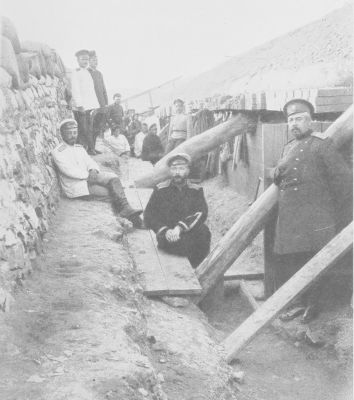
INSIDE A TRENCH ON THE EASTERN FRONT.
It was about this time that the enemy wore us down and captured Pan-lun-shan Redoubt. This redoubt was so important to us that Smirnoff resolved to retake it at all costs, and its recapture was one of the bloodiest fights that had yet occurred. Colonel Prince Machabelly commanded the battalion entrusted with this work, and the redoubt was taken on the night of the 21st. In the midst of the hand to hand fighting, when grenades were bursting on all sides, and machine guns were firing point-blank, the bomb-proofs were set on fire. The place blazed up like a torch, and our men had to retire to trenches in rear. The Japanese could not get into it either, and so it became neutral, Pan-lun-shan Hill remaining in our hands till the fall of 203 Metre Hill in December.
Prince Machabelly, who was killed in this assault, was the beau-ideal of a soldier, and the circumstances under which he met his death were sad. He was under a cloud, having been made a scape-goat for the failure on Wolf's Hills, and having been deprived of the command of his regiment, the 13th East Siberian Rifles, which he had led with such gallantry at Kuen-san. In spite of this he led his companies at the attack of Pan-lun-shan as he had led his battalions on Green Hills; he won the redoubt for us, and was killed in the attempt.
At daybreak on the 21st I had gone with the Commandant up on to Danger Hill. The Japanese were pouring in a heavy fire especially on the north-east front, and General Gorbatovsky, commanding the eastern portion, asked for reinforcements. The enemy was attacking the Redoubts, Kuropatkin Lunette, the Chinese wall, and Big Eagle's Nest in force; the regimental reserves were melting away, and the position was serious. General Smirnoff telephoned to Fock, commanding the main reserve, to send up the last unit—the 14th Regiment—at the double, Fock, however, argued with him. Time was flying, and Gorbatovsky, losing patience, again begged for support, for each moment was precious. Smirnoff, appreciating the seriousness of the situation, repeated his order to Fock, who, to the anger and amazement of the officers standing round, again raised objections. The Commandant, usually calm and self-controlled, then lost his temper.
'Lieutenant Hammer,[18] give me the note-book.' He quickly wrote a message. 'Take this to General Fock and give it to him personally.'
Hammer disappeared. Meanwhile, reports from Gorbatovsky were coming in, each more alarming than the last. The artillery front had suffered heavily, and could only reply weakly to the enemy's guns, and the struggle was being maintained chiefly by the heavy guns of our coast batteries. Considerable bodies of infantry were seen moving out of the villages,[19] and it appeared from what we could see that the Japanese intended to attack, but not till evening. General Gorbatovsky arrived, and greatly excited, reported that the decisive moment was at hand, the troops had suffered terribly from the enemy's guns, the infantry were utterly worn out, and without reinforcements the attack could not be repulsed! He hadn't slept for several days, and had been continually under a very heavy gun-fire, so that he was overtired and painted things somewhat blacker than they really were. General Smirnoff, with his usual sang-froid, replied:
'It is not so bad as that. We must, above all, keep calm. You have been sitting in that hell, and from your immediate surroundings things have seemed to you worse than they really are. You are not quite yourself. Take it easy, we'll soon put matters right.'
'Quite so, sir, but things are very alarming. The Japs are getting possession of the Redoubts, which are in a critical state, and will in all probability deliver an assault on the centre, which has suffered so heavily. Big Eagle's Nest and Zaliterny Battery are out of action; Kuropatkin Lunette is in a critical condition; B Battery has only one serviceable gun and the Naval Battery is also disabled....'
'I agree,' continued Smirnoff, 'matters are very bad, but I have already taken the necessary steps. The 14th Regiment, which is in the main reserve, I have ordered up to the north-east front, to be échelonned by battalions near Big Eagle's Nest and the Ice-house. In addition to this I am getting six naval companies (1200 strong), which I will concentrate at the front in the bomb-proofs of the 9th Regiment. When night comes on the guns must be repaired; where there are none, I'll send field-guns from the general reserve, and we will hurl back the assault. You return now, and at 4 p.m. I will come and give you detailed orders as to what to do.'
Gorbatovsky departed, and at that moment up came Lieutenant Hammer with a note for the Commandant. Instead of at once carrying out Smirnoffs urgent order to move the 14th Regiment up to the north-east front, Fock had written a whole page in reply, in which he expressed his conviction of the danger of the move, especially of a concentration near the Ice-house, which the enemy would doubtless shell! The building was at the foot of the very hill from which the Commandant had issued this order; it was in a well-concealed spot, and was not even being fired at.
The Commandant was furious. 'Here, Hammer, write at once to Fock, and say that if he doesn't immediately carry out my order, I'll remove him from his command.'
At 1 o'clock the artillery attack began to slacken. The enemy, having seized two villages[20] began moving towards the redoubts, and the assault seemed to be near. It should be observed that from the very first, appreciating the weakness of the north-east front, Smirnoff had armed it at the cost of the western, having transferred to it the 9-inch howitzers from Wolf's battery, and mounted a number of the guns received from the fleet. He was convinced that the chief blow would fall here, and more particularly because directly behind this front lay, so to speak, the heart of the Fortress (harbour, dock, commissariat dépôts, chief magazine, mills). Stössel, on the contrary, had always considered that the west side was the more important.
Having sent off Hammer and given his final orders, Smirnoff turned to the officers present.
'Gentlemen, the gun-fire is slackening, and the enemy will rest. The attack won't take place before dark; we can now rest and refresh ourselves.'
On our way down, we met the 14th Regiment, whom Smirnoff greeted, telling them that he would see them again in the evening. Later, when the north-east front was being continually stormed, Smirnoff for a long time could not find one of the battalions of this regiment, and wondered how it could have got lost. After exhaustive inquiries, it turned out that it and the scout company had, with the General's knowledge, remained in barracks! The General himself had not come with the regiment (the last one in the reserve), but had remained in his quarters in the town.
Though a great danger threatened the Fortress that night Smirnoff did not lose his head, his prophecy as to the course of events being fully justified. After giving some more orders he asked us all to breakfast. In the middle of it Stössel turned up in a very agitated state. He refused refreshment, and said: 'Redoubts Nos. 1 and 2 are being captured. Both Eagle's Nest and Zaliterny Battery are in ruins, the adjacent batteries are badly injured, the local reserves are used up, and the enemy are still pounding us. The losses are enormous. It is difficult to hold out. What is to be done?'
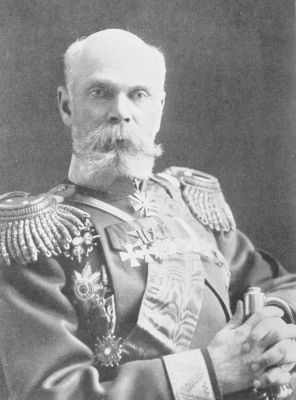
GENERAL GORBATOVSKY.
Just then, unannounced, in walked General Fock, and interrupted:
'Your Excellency, Gorbatovsky is a traitor. He is uselessly wasting the reserves—inviting a slaughter of them by putting them into the trenches. If he does this we'll have to surrender. He is a traitor, sir!'
Smirnoff turned to Stössel, and said quietly:
'I do not know that I fully understand. Gorbatovsky's actions do not quite tally with those of a traitor. For three days and nights he has been constantly under fire, directing the defence, and by his gallantry encouraging the men. I will see to the repulse of the attack; the reserve must be used when necessary.' Then, turning suddenly to Fock: 'And you, sir, it appears, do not intend to obey my orders? To-day, instead of at once carrying them out, you employed your time writing replies.... I never give an order twice. Bear that in mind.'
For his action on this day Fock was removed from his command by Smirnoff, and so, from August 21 right up to December 18, he took no part in the operations, and employed himself in writing long memoranda and giving advice to Stössel.
In the early hours of August 22 the enemy attacked the Redoubts which were held by the naval detachment, and all day long heavy fighting continued round Long Hill, between it and Divisional Hill, round Jagged Hill, and Redoubts Nos. 1 and 2. Redoubt No. 1 changed hands four times during the course of the day, and remained in the enemy's hands, as did No. 2. The Japanese cunningly managed to transfer their field-guns through the kiaoling to the east side, whilst they kept the garrison of Jagged Hill under cover by their heavy shell-fire.
At daybreak on the 23rd all was silence. The enemy had abandoned No. 1 Redoubt, and were retiring from No. 2, both of which, after five days' bombardment, had been reduced to a shapeless heap of ruins. At 11 p.m. that night by moonlight the enemy opened up with two searchlights, one from behind Ta-ku-shan, the other opposite Chi-kuan-shan Fort, and, lighting up our parties who were searching for wounded, kept on firing on them—so much so that after a few hours our humane efforts had to be stopped.
FOOTNOTES:
CHAPTER XXVII
STÖSSEL DISOBEYS—PROGRESS DURING AUGUST
I have mentioned in an earlier chapter how General Stössel was recalled from Port Arthur in June, and I will now explain the circumstances under which this happened.
When the Japanese began landing, and in particular after the débâcle at Kinchou, Stössel began showering telegrams on Kuropatkin, in which he made out affairs to be very critical, and implored for help. Later he sent Lieutenant-Colonel Gurko, of the General Staff, who was on the Fortress Staff, to him with despatches. (Before this Prince Gantimuroff had succeeded in breaking through and returning with despatches.) When Gurko left he reported his departure to the Commandant, and—knowing well what Stössel was like—asked if Smirnoff wished him to give any particular reports to the Commander-in-Chief.
'Tell him,' said Smirnoff, 'everything that you have seen. And if you hear that they want to make a separate command of the District, tell him the best man for it is General Subotin, who knows the peninsula thoroughly.'
In June Captain Odintsoff was also sent to the north by Stössel with very alarming despatches, and he also, in reporting his departure to Smirnoff, was given the same instructions. After reading these despatches, and hearing from Odintsoff a corroboration of what he had heard from Gurko, Kuropatkin came to the conclusion that Stössel must be ill. But before deciding to recall him he consulted others, and after their reply he had no option left him as to how to act. He decided with great regret that he must sever his friendly relations with Stössel, which dated from the time when they had been boys together in the 1st Cadet Corps, and when he used to spend his holidays at the latter's home. Realizing that it was inevitable, he made up his mind to recall his old comrade, but before doing so he unfortunately made for him the appointment of Officer Commanding the District.
On June 18 he sent two cypher messages to Arthur, one addressed to Stössel, ordering him to hand over everything to Smirnoff and leave the place, and the other to Smirnoff. The former, having received both of them, concealed their existence. Shortly afterwards two more telegrams from Kuropatkin to him and Smirnoff were received, brought by a subaltern officer of the reserve on the Lieutenant Burakoff. This time General Stössel came to the conclusion that silence could not longer be kept and that he must act, so he destroyed the messages to Smirnoff, and sent the following letter to Kuropatkin:
'Your despatch of July 2 was handed to me on the positions as I was repelling an attack in force by the enemy. I was anxious to leave Arthur, but as things are at present I consider my presence here essential for the good of the Fatherland and our troops. Every one here knows me, Chinese as well as Russians, and they trust me, knowing that the Japanese will never get into the place save over my dead body. Neither Fock nor Nickitin believes in General Smirnoff, who is unknown to the officers and men, and who calls the latter cowards. He may be all right in his way, but he is a professor and not a fighting general. If you are determined that I should come to Liao-Yang, I will do so on receipt of fresh instructions to that effect from you.'
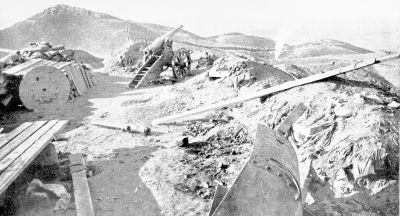
ON THE ATTACKED FRONT: AFTER AN ATTACK.
Meanwhile, as might have been expected, the enemy were not going to wait for the reply to this to come, and, having cut our communications at Kinchou, they occupied Dalny, and before the letter reached Liao-Yang General Nogi had begun to operate on Green Hills. Stössel, of course, was not very sure as to its reception and whether good or evil would result to him. Taking advantage, however, of it being a time of war, he now began reporting direct to the Tsar, to whom he sent telegrams describing an absolutely untrue condition of affairs. He turned the defeats and retirements in the district into victories, and telegrams of congratulation began to come in from their Imperial Majesties.
On the night of the 23rd, the Japanese made the most desperate of all their attacks so far. They made three separate and most determined assaults on Zaredoubt Battery, on the line between it and Big Eagle's Nest, and on Ruchevsky Battery. Though temporarily successful at one or two points, they were finally driven back out of all with shocking slaughter. They then again concentrated a gun-fire on these points, and our men took whatever cover they could find, anxiously awaiting a fourth assault which did not take place. When the sun rose the heaps of corpses in front of the works were revealed. In the heat the smell from them was appalling: even the cotton wool with which our men had plugged their nostrils was not of much avail.
With regard to the firing from the battery on Golden Hill[21] a rather amusing incident occurred. As prematurely bursting iron shells from this battery had somewhat endangered General Stössel he gave orders that it was not to fire. Major-General Biely, commanding the Fortress Artillery, thereupon reported to Smirnoff that the 11-inch howitzers were not to be used, notwithstanding the damage they were doing to the enemy.
'Well, let us go to Stössel,' said Smirnoff; 'you tell him that in future you will use steel shells.'
They accordingly went to the Officer Commanding the District and found him very indignant about the premature bursts of the iron shells.
'May I use steel shells, sir, instead?' asked Biely.
'Will they be all right?'
'Oh, yes.'
'Very well, but are you sure?'
Smirnoff energetically supported Biely and they went out.
'That's splendid,' said Smirnoff, rubbing his hands; 'now you use the iron ones as before because you have not got enough steel shells for the battery, and remember—if there are any premature bursts they are the enemy's!'
Biely did this with the result that Golden Hill continued to be of great service to us, while the occasional premature bursts, which still continued, were put down to the Japanese. Stössel was quite pacified, but, unfortunately, soon found out that he had been deceived, and roundly abused Smirnoff to his suite. He did not interfere, however, as the hill was undoubtedly a great check to the enemy.
The night assault on August 23 on the centre of the north-east front was the finale of the assaults in August, and what General Nogi had said to the correspondent of the Daily Mail when he first saw him: 'You have arrived most luckily, just at the right time, neither too late nor too soon, you will see the end of our victorious campaign,' was not justified by the event.
The results of the eight days' desperate fighting were inconsiderable. On the western front we had lost Angle Hill and its foot-hills, and Pan-lun-shan Redoubt remained neutral. On the eastern front we had lost Redoubts Nos. 1 and 2, but only after an incessant and awful bombardment and most bloody assaults, which cost the Japanese 22,000 killed and wounded. However, they at last learnt that the capture of Arthur was not all plain sailing. They realized that Russians were not Chinese, and it was a complete surprise to them that the Fortress which in January might have been captured by a coup de main had grown into a stronghold against which tens of thousands of men had perished. Proud in the knowledge of their superiority, they had on August 16 suggested that we should capitulate, but upon counting up their losses at a Council of War on the 26th, they came to the sorrowful conclusion that it would be yet some time before they took the place.
Expecting to hear at any moment of the fall of Arthur, Japan had been preparing lanterns and flags to celebrate a great national holiday; but at last she had to confess that, although Russians are by nature negligent and careless, they can in moments of emergency do wonders. In the country of the Rising Sun complaints were raised that the besieging army was not making such progress as it should, and the dissatisfaction almost turned into something worse. The Government of the Mikado acted wisely and promptly, proposing that those who were discontented should go and join the besieging army in order to replace casualties and show how things ought to be done. The amour-propre of the proud Japanese, especially the Samurai, was touched, and whole transports filled with volunteers came to the Kwantun Peninsula.
Later, when the Chinese reported that these newly arrived recruits, which included many old men and mere boys, were being drilled and trained in the Lunwantun Valley, our battleships and Electric Cliff shelled them at long range, just to remind them that Arthur was not yet dead; when the October assault was repulsed, we found amongst the killed and wounded numbers of old and very young men. Strong, indeed, must have been the spirit of the nation, which in the moment of trial could back up its discontent by example and action. During my residence in Japan before the war, I had ventured to write that the Japanese were a nation with a great future; but I was laughed at.
On the 25th, Big Hill, Little Eagle's Nest and B Battery were bombarded, and the enemy were seen to be concentrating behind Sugar Hill. During the night a sortie was made from 203 Metre Hill to recover the guns left on Angle Hill, but we could not bring them in, so they were blown up. The Japanese were now entrenched along the foot-hills of Angle Hill, and on the ridge joining Angle Hill with 203 Metre Hill, and had mounted some thirty guns near two villages.[22] A force of infantry and cavalry also was concentrated north of Pigeon Bay. I rode round with the Commandant on the 25th on his tour round the north-east. The military road was a track of death and destruction. Everywhere were half-dried puddles of blood, broken rifles, haversacks, boots, carts, blood-stained clothes, wheels, horses, broken down gun-carriages, and unrecognizable corpses, and it was ploughed up with shells. The rest-house on Little Eagle's Nest, where not long ago we had spent many careless hours, was burnt to a heap of ruins. At Eagle's Nest the greater part of the bomb-proofs and parapets had been destroyed, and the infantry were sitting about, some above ground and some below; the reserve was behind the steep slope, in various shelters made of corrugated iron or anything which they could get hold of. This improvised cover might protect from the sun, but certainly from nothing else. The officers and men were reduced to shadows, unwashed, and wearing torn uniforms. They asked the Commandant for planks—any sort of timber—to help them with the aid of earth to get some protection. Smirnoff smiled as he heard them; but it was a cynical smile, for, two days previously, he had given the strictest orders that they should be supplied with the very planks for which they were now asking. His order had not been obeyed, and for this the engineers were entirely to blame.
'All right, you shall have the planks to-day. Hammer, make a note of it,' answered Smirnoff.
On the 26th and 27th the enemy continued to mount guns and push forward their works, but there was no general action. Smirnoff and Kondratenko were much exercised about our lack of heavy guns, and, through the agency of Prince Mackalinsky (naval officer attached to the Fortress Staff), arranged for the fleet to supply some. This officer was of the utmost use to us as an intermediary between the Fortress Staff and the Navy; for the Navy as a rule wanted many reasons before they would assist us.
On the night of the 26th we discovered that the enemy had abandoned Nos. 1 and 2 Redoubts, which were full of corpses; but on the night of the 27th these were again occupied by them. At 2 a.m. in the morning of the 28th there was an alarm of a general attack, but it turned out to be an attack on 203 Metre Hill, Long Hill, and Fort No. 4 only.
The 28th passed fairly quietly, with unimportant gun-fire, as did the 29th. On the night of the 29th our communications behind the main line were heavily shelled. During the preceding three days the gendarmes buried 700 Japanese dead in front of our north-east positions. This was done under fire. In the evening of the 29th the enemy entrenched near Water Supply Redoubt, and we temporarily recaptured part of No. 2 Redoubt by a sortie.
That evening, Prince Mickeladsey informed me that he was sending a post to St. Petersburg, and that I could send a telegram. He added: 'But don't talk of it, for if it is known, —— will at once hear of it.'
I wrote out two identical telegrams—one to a relative in St. Petersburg, and one to a friend:
'Arthur is enabled to hold out only by the efforts of Smirnoff and his excellent assistant Kondratenko.... When I can give you details your hair will stand on end. Tell the Tsar this, for it is absolutely necessary that —— should be removed.'
The Prince sent off these telegrams in a special letter with the official stamp, and in a separate packet, addressed to our consul in Chifu. The latter duly received them, but in spite of Prince Mickeladsey's request to despatch my wires to their destination, he never sent them, and gave as his excuse that they would have discredited a great name. He did this notwithstanding the fact that they were enclosed in a letter from the Chief of the Gendarmes in Port Arthur. Nor did he even consider it his duty to report the circumstances to his superiors, although he might have known that there is never smoke without fire. At the end of the siege, when I reached Chifu on the Rastoropny, on board of which I had been sent from Port Arthur, with the knowledge and by the direction of the Commandant and all the Admirals 'as an officer of the Fortress' (Stössel wished, as he expressed it, to 'abolish' me), the consul received a telegram from Port Arthur to the effect that I was a Japanese spy. He accordingly went to all the officers in authority and did everything he could to procure my arrest, and I was only saved by the intervention of the Chinese Governor, who declared that he would send an armed guard to protect me.
On August 30 a shell from one of the batteries blew up a Japanese magazine on the eastern front. General Biely at once gave orders for the battery to pour in a still hotter fire on to the magazine. As far as we could see the shells fell splendidly, preventing the enemy from saving the material, for groups of men could be seen running about in every direction, but at a considerable distance. To the left of Orphan Hill a big-gun battery was brought up by them, but it was very effectively fired on by one of our coast batteries. On the same day General Stössel published the following District Order:
'I have to-day had the honour to receive a telegram from the Tsar to the following effect: "To-day being the christening day of the Heir to the Throne, I appoint you and Colonel Semenoff, commanding the 26th East Siberian Rifle Regiment, to be my Aides-de-camp."'[23]
The following is what the late Colonel Raschevsky thought of this: 'We are all delighted with the latter appointment which is most just (the appointment of Semenoff as A.D.C.), but that Stössel should have received this honour is a proof of how often those in authority are rewarded for the deeds of others.'
By twelve noon all the official world in Arthur was on their way to congratulate the newly appointed A.D.C. I did not wish to go, but was persuaded that it was necessary.
'Go? You must go; if you don't you will make him an enemy for ever. He will put you face downwards and deprive you of the possibility of seeing and collecting the valuable historical material which you are getting,' said the experienced and canny ones. I bowed to the wisdom of this, and went and did as I was advised. In the evening I called on the Commandant. For some time he had been very ill with dysentery, and for the last two days had been told by the doctor that he was on no account to ride. He certainly seemed to be very much thinner than before.
The following Order was issued by General Stössel on the 31st:
'On the night of the 29th and 30th a sortie and an attack on No. 2 Redoubt was again made by the scouts and sailors. The former dashed into the trenches, but the sailors did not do all that was expected of them, and so the attack was unsuccessful and the loss of life wasted. No more such attacks are to be made without my personal sanction on each occasion. Similar sorties would be better carried out under the command of a man like the Chief of the Fortress Staff, who is thoroughly acquainted with the locality.'
With the final capture of Nos. 1 and 2 Redoubts by the Japanese—their greatest success during the month—they gained an enormous advantage. They at once constructed trenches back from both of them, which was, of course, an easier operation than throwing them forward under the gun-fire of our batteries. The Commandant considered it absolutely essential to organize sorties against them, but General Stössel, by every means in his power, opposed this.
The series of assaults culminating on the 23rd of this month were so bloody and had such a great influence on the course of the defence, that they are worthy of further description. It had been evident on the 21st, 22nd and 23rd that the Japanese were preparing to deliver the final blow by a general attack. Our difficulty, in the absence of balloons, was to ascertain where that blow would fall along the extensive front. Chinese reports were quite untrustworthy, and we could not see enough from any of the positions to judge where the enemy was concentrating. The standing kiaoling, the ravines and roughness of the ground greatly assisted the concealment of their movements. On the evening of the 23rd the Commandant, after long and careful inspection of the enemy's positions, ordered the last battalion of the 14th Regiment to Eagle's Nest. This left a main reserve, only two companies strong, under Quail Hill, to cover the valley of the Lun-ho. Two companies! all the rest had been sucked up into the firing-line. He then sent orders to Admiral Wiren to be ready to land a detachment of 800 men from the ships at anchor to form a reserve. It was now 7 p.m., and the darker it got the more silent became the line of front, and the more tense our expectancy.
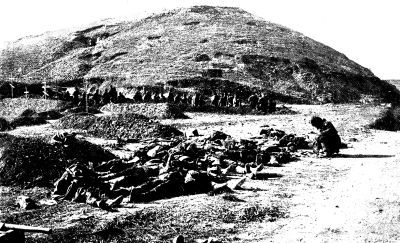
THE ASSAULT REPULSED.
Nogi himself, on the highest point of Wolf's Hills, was gazing fixedly towards Port Arthur hidden in darkness; for having concentrated more than two Divisions, with a strength of over 35,000 men, on the portion from Redoubt No. 2 to B Battery (three and a half miles), and having determined with one blow to seize Chi-kuan-shan Fort, B Battery, and Eagle's Nest, he was anxiously trying to pierce the bloody veil of the future. Smirnoff seemed to divine the thought of his chief enemy as if by inspiration, and despatched his force opposite where Nogi was concentrating. There was this difference, however—that while Nogi was playing with tens of thousands of men—Smirnoff had to count every section.
At 11 p.m. Nogi gave the sign, and a living avalanche of men rolled irresistibly up towards us, and from valley, ditch and ravine the Japanese appeared. Rifles cracked, machine guns spluttered, guns boomed and boomed again, and the air was turned into an inferno of shrieking missiles. The rays of the searchlights flashed up and down, rockets shot up into the sky like enormous fiery snakes, and burst in hundreds of large brilliant balls, eclipsing the light of the eternal stars and blinding the heroic little infantry-men who were attacking us. They ran forward, fell, jumped up again and pressed on, in groups together. In the shimmering rays of the searchlights, the flashes of bursting shells seemed almost blood-red. The noise became a horrible blur of sound—shouts, moans, cheers—clash of arms and detonations. But at last it ended; the clamour gradually died away; the attack had been repulsed. In front of us not a living soul remained—only dead—piles of dead and wounded men. Never shall I forget that night.
At 2 a.m. a second wave started and surged forward, despite the shower of lead and steel poured into it. With incredible efforts it got possession of the Chinese Wall opposite Zaredoubt Battery, and a hand-to-hand fight ensued. The searchlight was turned on to the spot, and lit up a revolting picture; our last two companies of the reserve were sent forward at the double from Quail Hill, and every Japanese by the wall was bayonetted; then the rays glided further afield searching for the enemy, but only lit up a ground strewn with bodies.
At 3 a.m. a third attack commenced, and it seemed as if the passionless, cold-hearted Nogi had sentenced the last of his troops to death. The signal was given, and a fresh wave of living flesh and blood rolled forward. This time it was the attack—the spring—of a maddened, wounded, blood-drunk herd of tigers—not men. Our truly awful fire was of no avail; the mass roared forward with the strength of a tidal wave. On it came, though lit up by rockets and searchlights, on, on it rolled irresistibly; on, right through the breached Chinese Wall, and up on to Zaredoubt and Wolf's Battery, half of which it seized. But the timely arrival of two companies again saved everything, for after a bloody hand-to-hand fight the Japanese were thrown back; they gave way, and fell back on those in rear. It was a critical moment, but our light showed up their thick reserves taking cover in the ravine between Chinese Wall and Zaredoubt Hill, and they were almost destroyed.
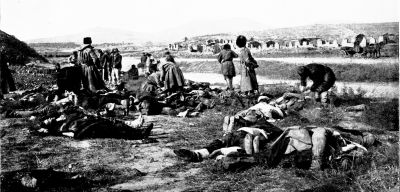
BURIAL-PARTIES AT WORK.
A reddish vapour slowly rose up over this valley of death, and screened the bursting shells and the rays of light. It grew light; the attacks had been repulsed, and not a rood of ground had the enemy got, but the scene on all sides was awful. The rising sun showed up sheaves of corpses on the ground that was still ours. Death had indeed triumphed, and had claimed 22,000 lives.
From this time forward the enemy remained content with the slower advance of regular siege operations.
FOOTNOTES:
CHAPTER XXVIII
AWARDS—SOME PERSONAL NOTES
September opened for us with a minor success. The enemy on the night of the 1st attacked the works under construction by the sailors on Long Hill; during the attack one of their columns moved across a mine between Long Hill and Divisional Hill. The effect was terrific; of a whole mass of live men, in a moment nothing remained.
On September 3 the early morning passed quietly. From 2.30 a.m. the Japanese bombarded the Old Town, and from five o'clock they fired on the New Town, and were seen to be hard at work in Redoubt No. 1, whilst other works were quickly rising from Ta-ku-shan and Palidjuan. A great parade was held in honour of General Stössel's rewards. In the evening, a submarine mine was seen to explode under the starboard bow of the Itsukushima; the cruiser listed some ten degrees, and a fire burst out, but she was able to steam away.
That night 500 dead bodies were buried by the Gendarmes and the Chinese, in front of Eagle's Nest and Kuropatkin Lunette. While thus employed one Gendarme and three Chinamen were wounded.
On the 4th an ineffective assault was made on Water Supply Redoubt. From the 4th to the 6th the enemy were very busy at work on Nos. 1 and 2 Redoubts. On the night of the 6th we made a successful sortie with the bayonet from Water Supply Redoubt, and 600 more dead were buried on the north-eastern front.
On September 6, the following extract of District Orders was issued by General Stössel:
'I have to-day, the 5th, had the great honour to receive from the Tsar the following telegram, sent via Liao-yang, and dated Liao-yang, August 28:
'"As a reward for the gallantry of the Port Arthur garrison, I have given orders that all ranks of the Military and Naval Services defending Port Arthur shall from May 1 till the end of the siege, count every month's service as one year. I promote you to be a Cavalier of the Order of St. George of the 3rd Class, and I await your recommendations for rewards for those who have distinguished themselves in battle.
'"(Signed) Nicholas."'
'The following telegram was received to-day from the Viceroy:
'"Prince Ukhtomsky is to hand over the command of the battleships and cruisers to Captain Wiren, and as soon as the ships are repaired the latter is to endeavour to break through to Vladivostock.
'"Rear Admiral Loschinsky is appointed to command the sea and mining defences."'
This question of the fleet forcing its way to Vladivostock was discussed at a conference of flag officers and captains, and they came to the conclusion that it was an absolute impossibility owing to the state of the ships, the shortage of ammunition and men, and to the general conditions being three times as unfavourable as they were at the time of the sortie of August 10. The squadron had indeed been greatly weakened by the transfer of guns to the land defences, by the casualties among the sailors during the assaults in August, by the impossibility of going into dock for below-water repairs, and by its inequality in speed, all of which deprived it of chances of success. The attempt must have resulted in the destruction of all our ships, as for a whole month the Japanese had been able to repair and rest. An encounter at sea with a force of double its strength, fresh, and with superior speed, to say nothing of the preponderance in destroyers, must have entailed the absolute annihilation of the fleet, and the loss to Arthur of ammunition and several thousand men, whose value had already been well proved.
The appointments of Loschinsky and Wiren met with warm approval. During the siege both had equally distinguished themselves, and had shown themselves to be the most energetic, gallant, and capable of the senior naval officers.
Notwithstanding his weak state of health, Smirnoff to-day went out to see the work on the third artillery line of defence, which had been newly armed with the naval guns. It ran from the northern part of the town wall to Stonebroken Ridge, Spur Hill, and Big Hill. Roads were being made, trees cut down, and the scene was a confusion of digging, blasting, levelling, building. He remarked:
'As soon as this line is finished I shall be happy. I am quite easy about the rest.'
On our way back we met Stössel. 'Aha! so that's it? Wherever we find the war correspondent we find the Commandant, eh ...?' was the rude welcome he gave the man whose energies and capabilities had gained for him the reward of Aide-de-camp to the Tsar!
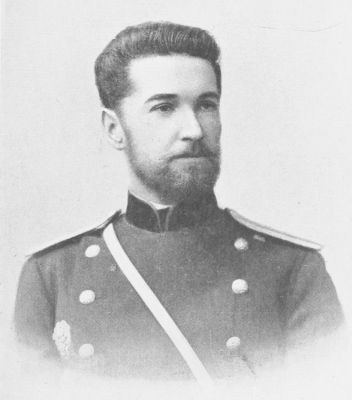
COLONEL RASCHEVSKY.
Aye, and not only was he an aide-de-camp, but he was now a hero, for had he not been promoted to the St. George of the Third Class? Alas! how that Order for gallantry fell in our eyes. It was dreadful to think of the Tsar and the millions of people in Russia who had been deceived by his false reports. But for this I was forced to go and congratulate him, as for his former honour. After a few moments' conversation he turned to me.
'Who writes the "News" in the Novy Kry?'
'I don't know.' I had every right to say this, for, though it was not signed, I well knew that Stössel was aware I wrote it.
'What are you doing with yourself?'
'I am collecting materials with which to write a book.'
The General frowned, and his manner changed.
'And you will, I suppose, only write the truth in it?'
'Only the truth.'
'Ah! all you correspondents are liars! The one who pays most gets the truth.'
'At present and till the end of the campaign, sir, I am in the power of the censors; but later, taking advantage of the Tsar's promise to the press representative of the capital, I shall consider it my duty to write the truth—the whole truth, in order that Russia and the Tsar may be spared another Port Arthur.
'And I wish to remind you, sir, that my name is an unsullied one, and I belong to one of the oldest of the "noble" families.'
Two days later the following District Order appeared:
'As the Novy Kry, although warned more than once, continues to publish information of the distribution and movement of our troops which would be better kept secret, the offices of the paper will be closed for one month.'
Colonel Raschevsky wrote as follows in his diary of that date:
'Stössel has published a stupid order about closing the Novy Kry offices on the pretext that it publishes information about the sorties, patrols, etc., which might be of use to the enemy. It is utterly absurd! The paper passes through the hands of two censors—the Commander of the Port and the Fortress Staff—and suddenly to deprive us, from pure caprice and out of an evident desire to make himself unpleasant to the Commandant, of the only source of information and news from without is,' etc., etc.
CHAPTER XXIX
SEPTEMBER PASSES
With the capture in the preceding month of Nos. 1 and 2 Redoubts the enemy had got close up to our positions, and the salient angle of the north-east front was almost in their hands. I say 'almost,' because the ruins of these works remained the greater part of the time untenanted, neutralized by the gun-fire of both sides. As soon as they were abandoned by us, Smirnoff, appreciating their importance, decided, whatever it cost, to recapture them, and compel the Japs to retake them, and he considered the importance of this warranted the loss of even 2,000 or 3,000 men. He had accordingly arranged for a sortie in force, but Stössel intervened, and prevented this by his Order of August 31, already quoted, in which he would only permit sorties in small parties. To attack these redoubts with small numbers was quite ineffectual, and could only result in useless loss of life, and Smirnoff tried in vain to persuade Stössel to alter his opinion. Had we only been able to recapture those works the effect on the moral of the men would have been great, as they would have realized that they could attack as well as defend; as it was, they had seen nothing but continual retirements ever since the war began. It would not have been impossible, for we possessed an excellent place d'armes in rear and on the flank of these places in Rocky and Water Supply Redoubts.
The Japanese meanwhile did not waste time; they sapped right up to the glacis of the two latter, then started the first parallel, and, surrounding them with trenches, gradually endeavoured to work their way to Water Supply and Temple Redoubts. Here, again, the only course for us was to hamper and delay the enemy's steady trenchwork-advance by means of well-timed night sorties. But not only had Stössel paralyzed any attempt at a sortie in force by his order of the 31st, but he also managed to stop all small sorties by his action after one such had been attempted. Order No. 590 of September 9 read as follows:
'On the night of September 8-9, Lieutenant Endrjievsky, of the 26th East Siberian Rifle Regiment, on his own responsibility, and without even reporting it to his commanding officer, took 100 men of the Scouts and performed various pointless gallant acts. This only shows: (1) That there are officers who do not consider the lives of the soldiers entrusted to them to be of the least value, and do not consider themselves responsible for them; to such gentlemen the sacrifice of a number of men for a quite useless undertaking means nothing; this proves their youth. (2) That in some units strict discipline is not maintained; for anyone to be able to take a company away from a bivouac without the knowledge of the commanding officer is very extraordinary.
'This officer is deprived of his appointment for taking his company out without permission, and for losing 5 men killed and 19 wounded to no purpose; he will not be recommended for any rewards, and will be transferred to the 27th East Siberian Rifle Regiment for duty. Colonel Semenoff, commanding the 26th East Siberian Rifle Regiment, will be good enough to look to the internal discipline of his regiment.'
This order excited intense indignation, all that was most honourable and most sensible in the garrison was outraged. Thus was a gallant young officer, who had risked his life to try and assist us to hold Temple Redoubt a little longer, held up to ridicule. Individual initiative was absolutely frozen up by this treatment, and no one attempted to carry out what, after all, is one of the most dangerous of operations, for all knew what the slightest piece of bad luck would mean for them. Had its author at all considered the after-effect of this order, he would probably not have issued it.
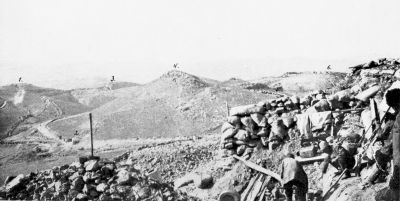
PANORAMA OF NORTH-EAST FRONT. Tumulus Battery. 3. Fortification No. 3. 5. Chinese Wall. Bombproof of the Officer Commanding the Section. 4. Rocky Ridge. 6. Fort, Erh-lung-shan.
It has been said that Stössel was liked by his subordinates, but he was feared, not loved, and he in his turn cared so much for the men under him that he did not consider it necessary to ride round the positions. And yet when telegraphing to the Tsar his thanks for his promotion in the Order of St. George, etc., he said that he had that 'day, on the positions, made the Tsar's telegram known to all.' He never went nearer the front than the barracks of the 10th Regiment, the safest spot in the whole Fortress!
On September 9 I, as usual, accompanied the Commandant on his inspection of the positions. As we went round, the men, taking advantage of the lull, were resting, having, wherever they could, burrowed under ground. The Chinese Wall had been repaired, and was held all along its length by infantry. Life at the front, though possibly exciting, was now neither amusing nor pleasant. The air all round reeked with the mingled stench of decomposing bodies, garlic and disinfectants, for on all sides hung pieces of linen steeped in carbolic acid. At first the men could not eat, but they gradually became acclimatized. Dogs had long ago fled.
On the 15th I spent some time on the splendidly appointed hospital ship Mongolia, and was much struck with the perfection of the arrangements, and the contrast between the comfort and cleanliness on board and the squalor and filth at the front. I met one of the nurses who had served with the Red Cross in the late war in South Africa. I asked her which she thought was worse, this war or the other.
'There, in comparison to what is going on here, things seem trifles: the wounds there were generally small; here they are dreadful.'
Meanwhile, on land, the enemy were, generally speaking, quiet. The reconnoitring patrols of both sides frequently came into contact, and each tried to snatch surprises and ambush the other. But the results were small. They shelled our defences, and we in turn did our best to foil them and delay their siege-works. On the 17th I accompanied Smirnoff on a visit to Colonel Yolshin, who had been wounded, and a good deal was said about the inactivity of our engineers.
If we had only had good men here, in six years what might we not have done, seeing what had been accomplished in four months? Our senior as well as junior engineers entirely forgot that enormous progress has been made of late years in ballistics, and apparently had no knowledge of modern artillery. They quietly pursued the prehistoric dogmas of ancient manuals.
In a fortress with a stony soil like Arthur—soil which cannot be touched with entrenching tools—all the mobilization defence works, especially those of heavy profile, should have, to guard against such assaults as we had experienced, been prepared beforehand. The mobilization works in Arthur were only begun on the arrival of the new Commandant on March 17, up till which time they had not been touched. The whole attention had been directed to the central wall, and on the forts and intermediate works.
There was no mobilization scheme in the Fortress. Perhaps General Bazilevsky knew of one, as he had seen the gradual development of the Fortress works, which had gone on for over ten years. Unfortunately, all records of these matters had been despatched to Harbin, and no one in Arthur, not even the Commandant, knew anything of them. It may be asked why the new Commandant was not entrusted with the plan of mobilization works? Why did General Bazilevsky—if he had such a plan—not give it to Stössel? Why did Kuropatkin when he went round the Fortress not ask for the plan of its works, even though only roughly drawn out? Because in all probability one never existed. As to General Stössel, it is quite possible that he did not know that a fortress ought to have a mobilization scheme, or did not even appreciate what a mobilization scheme was. He knew nothing about the works of the Fortress; they had been entirely under the control of Bazilevsky, who worked absolutely independently, and was subordinate only to the Viceroy. For him, it was a sufficiently important duty to dismiss and abuse the cab-drivers on the streets, to order private soldiers who were improperly dressed back to barracks, and to order men walking about in the streets to keep step. To march out of step he considered such a crime that he thought it necessary even to make a special report on this subject to the Viceroy. He was therefore very busy, and of course could not trouble himself about a defence scheme.
During September 18 and 19 heavy firing took place all along the line, and the attack on Water Supply and Temple Redoubts was fiercely pressed. The enemy mounted artillery within 100 yards of the former, and after changing hands six times, it remained on the 19th a smoking ruin, in the enemy's hands. Temple Redoubt was captured on the 20th, on which day furious attacks were made on Long Hill and 203 Metre Hill, and Pan-lun-shan was shelled. In the evening the first was seized by the Japanese. With the capture of Water Supply Redoubt the town was deprived of the usual water-supply, but Fresh Water Lake and the wells dug by Smirnoff's orders gave us plenty of water for the requirements of the garrison and civil population.
From the early hours of the 21st the Japanese attacked 203 Metre Hill, upon which their gun-fire was also concentrated. The whole of the western front and part of the eastern replied by massed fire. The assault increased; column after column rushed forward on to 203 Metre Hill, covering all its fore hills and slopes with heaps of dead, but at 8.45 a.m. they were repulsed. This assault was distinguished by particular obstinacy. I myself saw how, when their attack was repulsed, instead of retreating, the enemy began to build parapets of their dead and wounded comrades on the granite slopes of the hill, for they had no sand-bags. From this parapet they kept up rifle-fire all day on 203 Metre Hill and its spurs, on Fort No. 5, and on the Military Road, making all communications impossible. From morning till late in the evening the Japanese guns kept up a constant bombardment on 203 Metre Hill, and its position became more critical with every hour. Having got three-quarters of it, they meant to get possession of the rest at all costs: they slowly crawled upwards, fell dead, rolled back, and others dashed forward; they lay concealed and waited for reinforcements, nothing would drive them back. All their thoughts, all their endeavours were to get possession of this hill. Our men began rolling down great boulders from the top. These bounded down, flattened out the dead, and sought out the living, who, in trying to dodge, exposed themselves, and were shot by our men on the look out.
There you have the poetry of war—the reverse of a battle picture.
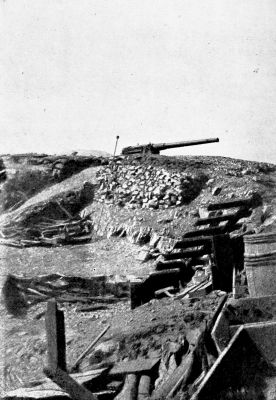
A CANET GUN MOUNTED ON FORT V., SEPTEMBER 22.
The following is what Colonel Raschevsky wrote on the 21st: 'In two days, the 18th and 19th, we have fired 70,000 rounds. As we have for long been short of shells, batteries were often unable to reply to the enemy. From May 26 (the battle at Kinchou) our losses have been: killed, 3,200 men and 59 officers; wounded, 8,500 men and 286 officers. Of the wounded, up to the present not less than 2,500 to 3,000 have recovered and returned to the front.'
During the night of the 21st about 900 corpses were collected under 203 Metre Hill. At 2 a.m. on the 22nd Colonel Tretiakoff reported that the enemy were again advancing on to it, and that our men had great difficulty in holding on. Fort No. 5 was bombarded all day. On the 22nd the town and part of our line were being bombarded, when Smirnoff started to reconnoitre 203 Metre Hill himself. Under a hot fire we reached Fort No. 5 (by courtesy a 'fort,' for it had no masonry shelter, and was even now a ruin), but had to wait until the fire slackened at the enemy's dinner-hour before we could venture to watch over the parapet; he then saw how 203 Metre Hill was surrounded. To relieve Fort No. 5, which was being heavily shelled, he decided to telephone to Electric Cliff to turn their fire on the enemy's guns, but the time taken to get the telephone message through was disheartening. (I have seen an article in the Voenny Sbornik by a M. Timchenko-Ruban, to the effect that the Fortress was supplied with materials for telegraph and telephone construction on a luxurious scale!)
The General was disturbed about the position of 203 Metre Hill, though for that front, as a whole, he had no fear. He thought that the enemy would storm this hill that night, and that they must therefore have large masses of reserves collected somewhere close by: he wanted to find those reserves. His theory was justified, for at 1 p.m. a report was received from an observation post at Pigeon Bay that, from a small peak half a mile away, a good view could be had of a deep ravine running to the foot of 203 Metre Hill, and that in it the enemy's reserve of almost two regiments was hiding, waiting apparently till dark to make a fresh attack on the hill.
Smirnoff at once telephoned to Colonel Khvostoff to send a section of quick-firers from Liao-tieh-shan or Fort No. 6 to shell them, and at the same time told him to warn all guns on the west front to be ready to sweep the south-west foot of 203 Metre Hill, where the enemy were bound to first show themselves on leaving the ravine. The section of quick-firers moved cautiously towards the ravine without being seen from the enemy's siege-batteries. It then suddenly opened rapid fire on the crowd of reserves massed in the ravine, and caused great loss. They were surprised, and, as had been foreseen, bolted out on to the slopes, where they came under the fire of the guns of the west front and scattered in panic, leaving great numbers of dead behind. It was a most skilful and daring operation, for these guns advanced to within one and a half miles of the enemy's outposts and four miles of their siege-guns; the gunners must have been so taken aback that they did not at once open fire, and it was evening before our section was forced to return to Liao-tieh-shan, after a brilliant piece of artillery work.
On that night a pyroxyline mine was rolled into the attack trenches, and caused awful havoc, a number of the enemy being literally blown to atoms and many burnt and wounded. The remainder bolted, and, falling into our wire entanglement, were hurled down the hill. After this they again made two mad efforts to storm the hill from the north-west, but both assaults were repulsed with loss.
On the morning of the 23rd another Japanese battalion, which was in this same ravine, came under the fire of our guns, took to the slopes, and in about ten minutes was also wiped out of existence.
The initiative in thus checking the attack on the almost captured 203 Metre Hill was the conception and work of the Commandant alone, and was due to his true grasp of the situation and his taking the risk of sending guns where most other commanders would have feared to send them.[24]
In Stössel's order of thanks to the troops for their work on this occasion, all the seniors were mentioned by name—except Smirnoff!
From the moment this assault was beaten back, the trenches in front of 203 Metre Hill were gradually evacuated, and the enemy went to earth only on Angle Hill. All their sapping was confined to the north-east. On the western front of the Fortress there now remained in our possession only 203 Metre, Flat, and Divisional Hills.
There was now more interference than ever with Smirnoff's arrangements. No sooner did the Commandant give an order (based on his personal acquaintance with the state of affairs) than it was altered. It was only through the mediation of Kondratenko that a deadlock was prevented; in fact, Kondratenko's chief work now consisted in persuading Stössel that the opinions of one of his friends—always diametrically opposed to Smirnoff's—were detrimental. Every morning and late every evening, after going round the fighting-line, Kondratenko, Biely, Grigorenko, and Khvostoff used to meet the Commandant. All questions as to the defence which were pending were then decided, and the programme of future work for armament, fortification of positions and distribution of troops and their supply was worked out. Each of those present received detailed instructions, and at the following day's meeting reported results. Stössel and his staff never took part in these meetings. Indeed, he, as a rule, did not interfere till after Smirnoff had issued his orders; he then altered them or by his own made it impossible to carry them out. But, notwithstanding this, work continued, for all knew that it was necessary, though the District Staff's interference often caused hopeless confusion, hindered success, and demoralized the garrison.
The following is what Colonel Raschevsky wrote in his diary on September 28:
'What strikes one most on inspecting the fortifications on 203 Metre Hill is the impossible arrangement of the trenches which encircle the whole of the top and have apparently been made under the influence of our "Mad Mullah." Those placed on the steep slopes are deep, narrow, and have a very thick roof. They resemble long dark corridors with narrow slits in the front wall. To hold such trenches is difficult, for they are quite unadapted for defence. The loop-holes have been made tight under the roof, so that to look out of them in a downward direction is impossible, and the field of fire is consequently very small. In fact, all beyond 20 to 25 yards is dead ground, so that an attacking force can get up almost to the position without loss. They are difficult to aim from, as the men cannot stand up straight and have to fire stooping. Generally speaking, their arrangement is such that the attacker is able, with small loss, almost to fall on the defender and take the top of the hill, whence the defence can be driven from under the bomb-proofs. It is only the pluck and coolness of our men in making the most of the 25-yard field of fire, coupled with the indecision shown by the Japanese in the last moments of an attack—for they have not yet displayed dash or made a rapid attack with the bayonet—that has enabled us to hold the hill so long.'
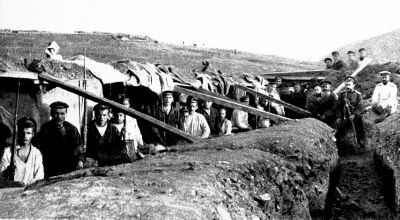
A COMPANY IN THE TRENCHES.
There was none too much ammunition in the Fortress to waste, and yet while we were trying to husband it, the following absurd note was written by Stössel to General Smirnoff. The author's amazing ignorance of the functions of big guns and his want of foresight is by it strikingly illustrated:
'Groups from three to five men can often be seen running about on Pan-lun-shan. The artillery does not shoot. Why? They should never wait for orders to fire at infantry on the run. The artillery seems to want waking up, and it is not the first time this has come to my notice.'
The enemy did not lack humour. I find a note in the diary for the 24th. 'It is said that the Japanese have dropped a letter for us recommending Electric Cliff to fire more carefully lest they should hit Kuropatkin!' Considering his many promises to come down and help us, this was rather smart. But all the same, even our friends the enemy had their disappointments. As Smirnoff said, 'Their General Staff had furnished Tokio with a detailed plan of the Fortress, upon which the plan of the attack was carefully worked out. They expected everything to go as had been ordained, and so have run up against some "snags." Where they never suspected any defences they have found works of strong profile. They have now fought for two months without doing much, though, till the naval guns had all been mounted, I feared for the north-east front. They have fixed upon our weak side all right—the north-east—behind which is our heart.'[25]
The September assaults had contributed their quota to the hospitals, where life had now been very sad for months: not only were the patients suffering, but the whole staff were worn out.
On the 28th the besiegers' attention was turned towards Erh-lung-shan and Chi-kuan-shan Forts and Kuropatkin Lunette, towards which they were burrowing, while the former and Tumulus Battery were bombarded. That day also we were favoured with visitors. In the morning the look-out post on Golden Hill sighted a Japanese destroyer on the horizon from which a boat, flying the French flag, put off in the direction of Arthur. Admiral Loschinsky sent out one of our destroyers, which brought the stranger into port. In her were two men who said they were correspondents of a French and an American paper.
While the Fort Commander, Admiral Grigorovitch, was telephoning their arrival to the Commandant, they informed the officers around them that Kuropatkin had been defeated at Liao-yang and that the Baltic Fleet had returned to Libau. We had received no news for a long time from outside, and this, of course, quickly spread throughout the Fortress, producing an overwhelming impression.
The Commandant at once ordered an aide-de-camp to meet the new-comers and take them to the Fortress Staff Office to be examined, and he requested the Chief of the Staff to let him know the result. He then busied himself with his work. Not hearing of them for two or three hours, he telephoned to the Staff Office for information, and was told that they had been met on the road to the Office by Stössel's aide-de-camp, and had gone to his quarters. Before half an hour had passed in came the orderly with the cards of X.—— and Y.——! The correspondents were inspecting the Fortress, accompanied by Lieutenant Malchenko, and, happening to pass the Commandant's house, they thought they ought to pay him a visit! He did not receive them, needless to say, but rang up the Staff Office.
Colonel Khvostoff arrived, and reported that the foreigners had been with Stössel, had lunched, and had been sent round the Fortress works with Malchenko. They had shown no papers when asked for them by the Port authorities, but had produced a letter they had brought for Stössel, the address of which was most ungrammatically written. Having arrived at Stössel's, they gave him this, which turned out to be a letter from Christoforoff (Christoforoff and Prince Radzivill had brought Stössel the telegram about his appointment as Aide-de-Camp to the Tsar). Stössel asked them to lunch, and after the wine the conversation became intimate. He openly told them the condition of the Fortress, the shortage of ammunition and of supplies. After the feast he gave them permission to go round the works. Excusing himself on the grounds of work at the front which could not be postponed, and to which he had personally to see, he went for a walk in the town (instead of his usual after-lunch snooze).
The Chief of the Staff finished, and every one was for the moment silent. A whirl of ideas flashed through the Commandant's brain. Stössel was interfering in his arrangements, and would make the defence of the place impossible, and his authority was being undermined at every step. This state of things must be stopped.
'Gentlemen, I am going at once to General Stössel, and will try to persuade him that suspicious correspondents must not be allowed to stroll about the town and Fortress. They must be arrested and examined.'
Having reached Stössel's, he pointed out that the arrival of these men, apparently with the blessing of the Japanese and without any papers, necessitated our looking upon them with suspicion, and that they must on no account be permitted to inspect the defences. Stössel replied it was nonsense; that they had brought a letter to him. When it was remarked that this letter was so very badly written that it was hard to believe that a Russian officer could be the author, he replied that neither Christoforoff nor Prince Radzivill were great scholars!
Smirnoff, feeling that Stössel might not wish to compromise himself in the eyes of foreigners, said:
'If, sir, it is inconvenient or awkward for you to arrest them after they have been your guests, I will undertake it as Commandant, and will have them examined. Let all the unpleasantness fall on me. Later, when we find out there is no reason to suspect them, they will blame me, and not you, and will take me for the Russian barbarian.'
'Pooh! they will see very little of the Fortress. There is no harm in it. They will go back and write that we are not yet eating earth, as most of the foreign press seems to think, and that bands are always playing. How could they be spies, when they asked me to let them enlist in the volunteers that they might bark at the Japanese?'
On the 29th, loaded with letters and requests, they left the hospitable shores of Arthur, and when they had gone a short way they were taken up by a Japanese destroyer.
I afterwards met X. —— in Tokio. He showed me a passport given him by the French Consul at Chifu, which was signed by the District Staff on September 28. Beneath was the signature of General Nogi's Staff, dated the 29th! From Nogi, Y. —— went to Nagasaki and X. —— went to Chifu, whence he telegraphed untruths about Stössel to his paper.
The day of their departure Stössel stupefied us. We had become hardened to most things, but the following order by the District Staff, dated September 29, was in its way a gem:
'Yesterday, the 28th, two foreign correspondents, French and German, arrived from Chifu. They were allowed to land without the permission of the Commandant, and without a careful inspection of their papers. They had letters of credit from the Consul, but no official permission to act as war correspondents from the Staff of the army. They came, of course, to ascertain the condition of Arthur, for while in one paper it has been said that we are already eating earth, another has it that bands play and we want nothing. Having detained them for twenty-four hours at the Staff Office under the supervision of an officer, I ordered the Chief of the Staff to examine their papers, and afterwards to send them at once out of the Fortress, as I couldn't permit them to remain.
'Much nonsense is printed in foreign papers, from the capture of Port Arthur to the retirement of Kuropatkin almost as far as Harbin. We are inclined to believe all this, though it is utter nonsense. For instance, we are ready to believe that Kuropatkin has retired to Harbin, till we look at the distance, and see that he must in two days have gone a hundred miles; but our people still believe these things because they appear in a newspaper—a foreign paper at that.
'For the future the Port authorities are requested not to allow anyone to land without the Commandant's or my permission, or without a careful inspection of papers. The Commandant will be responsible for this.'
I think comment on the above is unnecessary.
At this time a rumour was current among our men that Arthur had been sold to the enemy. It was founded on letters from the Japanese saying: 'Why do you hold on? Arthur has been sold to us. We have it here on paper.' For the ignorant masses this was quite convincing.
FOOTNOTES:
CHAPTER XXX
MOLE WARFARE
October 1 was an epoch in the history of the defence of Port Arthur, for it was on that day that the first of the 11-inch shells fell into the Fortress, and so changed the aspect of affairs.
It was during a conference held on the positions that a message was received that an 11-inch shell had fallen in Chi-kuan-shan Fort, destroyed the masonry, and killed and wounded several men. Those who were present suggested that a bombardment had again begun from seaward.
'No, no. These are newly mounted land guns—big guns. I am afraid they will do for the forts and the fleet.'
The majority of those present doubted it.
'You doubt it? It is no use. You will soon see.'
I walked with General Smirnoff back from this conference along the hills. As the bullets were whistling over the deep trench along which we were walking, I could not help thinking that there was nothing worse than this whistling—one got used to shells, but not to this ceaseless squeaking of invisible birds. We had scarcely got on to Mitrofanieff Hill when a pillar of smoke, sand, and stones rose up out of Chi-kuan-shan Fort, as if a gigantic tree had sprouted up and been thrown down. Then, with clockwork regularity, fantastic trees grew up every few minutes in different directions along the north-east front, and we heard the roars of dreadful explosions. Eight of them occurred in Erh-lung-shan and Chi-kuan-shan Forts this day and did great damage to the casemates. They were different to anything I had yet seen.
About two o'clock in the afternoon a bombardment of the town began; the fire was concentrated near the Tifonty Mill and grew heavier every minute. As the area of the falling shells gradually contracted, it became clear that the target was this mill which supplied us all with flour. This was the first day of a special bombardment of the town: there were no 'shorts'; it was a deliberate cannonade. The fire continued steadily, and the mill was struck by several shells.
The result of the foreigners' visit to us was apparent!
The conditions in the besieged Fortress—the wearing, trying uncertainty, the want of confidence, and the constant, unavoidable danger began to tell. The younger men lost their nerve, and suicides commenced.
On October 2, nine 11-inch shells fell in Fort No. 4, and it was reported that a large howitzer was mounted to the right of, and in rear of, Sugar Head.
On October 5 a fire was caused on Tiger's Tail by the enemy's shells. In the morning we attacked Signal Hill, which we had abandoned the day before. After a fierce and bloody fight we recaptured it, and it remained ours till the end of the siege. On this day Raschevsky's diary says:
'The parallels and approaches of the gradual attack against Chi-kuan-shan Fort, Open Caponier No. 3 and No. 2 Battery, have got much closer. The Japanese are working with great perseverance, notwithstanding our fire and occasional sorties. It has been decided to make these oftener and of greater strength.'
And on the 7th he continued:
'... The approaches also are being pushed forward with greater perseverance than ever toward our works; we can, in the daytime, even see the men digging, while we are not strong enough to concentrate our gun-fire on them. The situation of the approaches is particularly dangerous in front of No. 3 Open Caponier, where the distance between the enemy and ourselves is only 50 yards.'
In the afternoon the enemy suddenly began to shell the quarters of Stössel and Smirnoff by rafales from their small guns. Their sudden and extraordinarily accurate shooting is proof that they had learned from the 'correspondents' where Stössel and the Commandant were living, for up to this they had always fired on the Viceroy's house. As soon as the first shells began bursting near Stössel's quarters he at once gave orders that General Volkoff's house, which was at the foot of Quail Hill, should be got ready for him, and he began to move. However, an 11-inch shell happening to strike this house, compelled him to abandon the idea.
On the 8th Raschevsky wrote:
'Since 9 a.m. their big howitzers had been busy firing at our howitzer batteries Nos. 20 and 21. By 1 o'clock they had fired about fifty-five shells at them. The left half of the masonry battery, No. 21, afterwards presented a picture of complete destruction: the concrete is in many places destroyed, and has fallen down in great masses.'
For six days now the town had been bombarded with 11-inch shells—great masses of metal of awful destructive power. Nowhere could we find real safety from them except, perhaps, in the bomb-proofs of Madame Subotin, dug out of the rock. The concrete of the forts, the armour on the battleships, were penetrated clean through. From October 1 life in Arthur was any thing but pleasant. On the evening of the 9th the enemy seemed to be concentrating near Rocky Redoubt, Water-Supply Redoubt, and the village close by.[26] We had made an attack, but as they were in great force, we had to withdraw. They were also active on the west front. The following is the entry in the diary for the 9th:
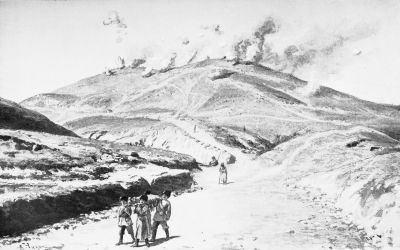
BOMBARDMENT: JAPANESE SHELLS BURSTING ON HILL.
'It was quite quiet up to 12 o'clock. Exactly at noon a salvo was fired at the town. After a short time it was repeated, and then, at 2 o'clock, the enemy turned all his nearest batteries on to the trench in front of Erh-lung-shan Fort, which we had recently recaptured, and we were obliged to abandon it again. To-day a sortie was ordered on the Redoubts with the object of seizing them and some of the Japanese trenches in front. In the event of success the enemy would, of course, have had to evacuate his parallels and approaches to Chi-kuan-shan Fort, from which they were now only 150 yards distant. The attack failed.'
On the 10th the 11-inch shells did much damage on the north-east front. General Stössel published the following order this day:
'On the 7th instant I received the following telegram from the Commander-in-Chief, dated Mukden, September 20:
'"I have received your despatch of September 16, and I congratulate you warmly on your fresh success. We are making energetic preparations for an advance. The 1st Army Corps has already arrived. God be with you! Trust to me to succour you."'
When Kuropatkin received General Stössel's piteous despatch asking that he might be allowed to remain on in Arthur, he had forwarded it to Petersburg, asking what he was to do (Stössel had by this time been made Aide-de-Camp to the Tsar, and had been promoted to the Third-Class Order of St. George), adding that he had already twice recalled him from the Fortress. Petersburg replied that it left the matter entirely to him. Kuropatkin naturally did not think that Stössel had changed his spots by having had the above distinctions conferred on him, but being a clever and experienced diplomat, he did not wish definitely to recall a newly-appointed Imperial aide-de-camp, and so kept silence.
On the 11th and 12th there was fighting round Chi-kuan-shan and Erh-lung-shan forts on the east, as well as Fortification No. 3 and Tumulus Redoubt, where the enemy gained ground. On the west they were entrenching on the slopes of 203 Metre and Long Hill. The following is an extract from the diary for October 12:
'The enemy's approaches are getting closer up. With wonderful energy and perseverance they are digging them towards Chi-kuan-shan Fort, Open Caponier No. 2, and B Battery. Early this morning two additional approaches were made towards Kuropatkin Lunette, and parallels were begun. Our artillery fire is not continuous enough to stop them. Sorties are not often made, and when made few scouts go with them, so that they are carelessly carried out, and have little result; consequently the siege-works are progressing rapidly. In the last parallel in front of B Battery the Japanese have built a thick bomb-proof with a covering of Chinese wood, apparently with the object of protecting the gun crews from hand-thrown grenades.
'We are all alarmed for the condition of the caponier of the main faces of Chi-kuan-shan. They have mined behind the counter-scarp, and evidently mean to blow it up. In anticipation of this we are making two counter-mine galleries from the corners of the caponier, which, running for twelve yards, ought to hit their main gallery, but as the soil here is almost rocky, progress is slow, and we may be late in intersecting the enemy's gallery. In order to ascertain the position of their shaft, and the direction of their gallery, orders have been given for a sortie to-morrow, in which the sappers will take part.'
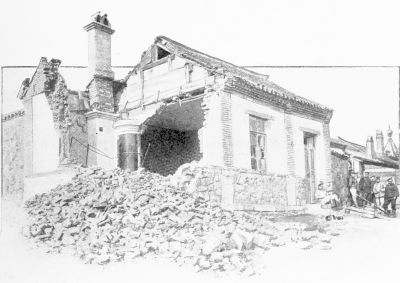
RESULTS OF A BOMBARDMENT.
This sortie failed through the clumsiness and noise of the men who were not specially trained scouts.
From Chi-kuan-shan we made another sortie on the night of the 15th. This also failed, owing to the majority of the men turning tail. Stössel's order about sorties undoubtedly had a good deal to do with the poor spirit shown on this occasion. An attempt was also made to stop the work on the sap-head by firing the war-head of a torpedo charged with 70 pounds of pyroxiline out of a torpedo-tube on the parapet. On the 17th General Gorbatovsky took the place of General Nadein as commander of the right flank of the defences.
In some places now the enemy were face to face with our men, with only a distance of twenty to thirty yards between them. Taking cover behind sand-bags, the Japanese were doggedly continuing step after step, yard after yard, and fresh earth was constantly being thrown up out of the deep saps which hid the men working. Occasionally one would see the glint of a spade, or a black forage cap, and along the communicating trenches here and there would run a Japanese dressed in black.
On the 20th Raschevsky wrote:
'At 3 a.m. a sortie was made from Chi-kuan-shan. Its arrangement was entrusted to me, as its main object was to reconnoitre the enemy's works nearest to the fort: 40 infantry and 5 sappers took part in it. Owing to the failure of the two preceding sorties, this one was most carefully prepared. The men were ordered to go round the foot of the glacis and its slopes, and to dash on to the head of the enemy's three approaches. If possible they were to destroy the works, and not attempt to pursue, but immediately to return. A party of 25 infantry and 3 sappers, under the command of Ensign Marchenko, were to go round the fort from the left, and to lie concealed on the glacis. The other portion, under the command of a non-commissioned officer, was to break through the wire entanglement placed along the glacis of the right face, and to lie down there silently and wait for the signal for the general attack by both parties. The signal was to be a ray of searchlight thrown on to the nearest peak of Ta-ku-shan. The first flash, at 2.45 a.m., was to be a warning for the men to be ready: the second, at 3 a.m., was to be the signal for the general attack. Both parties were then to dash simultaneously down the glacis right on to the appointed place. By doing this we hoped partly to escape the fire of the enemy's machine-guns, which in the previous sorties had fired along the direction of the salient angle of the glacis, and along the slopes under the flanks of the fort. Our men were not to fire till discovered, but directly the Japanese opened fire, the guns and infantry from the neighbouring works were at once to concentrate their fire on their near trenches—not, however, closer than a certain given direction towards the foot of the glacis—in order to divert their attention. At the same time a demonstration was to be made from the covered way of the salient angle by raising dummies up above the glacis, and throwing stones tied with string on to the wire entanglement to make it appear as if we were trying to advance from the centre and not from the sides.
'As all the members of the sortie parties knew beforehand where to go and what to do, everything turned out almost as we had hoped. The sortie was a complete surprise to the enemy, and, when our men dashed on to the heads of their approaches, they were seized with panic. From the glacis I could hear their shouts of fear distinctly, and their fire was comparatively weak, no machine-guns being used. After these shouts we heard a few cheers, and then, after five or ten minutes, our men appeared at the caponier, where they rushed, fearing that the Japanese would recover themselves and get to work with their machine-guns. However, they successfully went down the ladders into the ditch and got round the caponier. They had ascertained that the Japanese were making galleries under the caponier of the fort. The direction of one was along under the axis of the caponier; the direction of the other we did not discover. The heads of their galleries were found covered by bomb-proofs, into one of which a sapper managed to throw a six-pound bomb. We lost 3 killed and 7 wounded, amongst whom, to our great regret, was Marchenko, very dangerously wounded. The result of the sortie was so far very successful, and our countermining will now no longer consist of groping blindly.'
Colonel Raschevsky was inclined to judge our men severely, because they dug slower than the Japanese; he called them absolute children. I cannot agree. The Russian soldier, when he came to Port Arthur, was physically strong, though intellectually starved. By this time he had become physically starved as well. No soldiers of Western Europe would have done what he did.
Extracts from Colonel Raschevsky's Diary.
October 22.—'The Japanese approaches are being particularly developed these days in front of Kuropatkin Lunette. There are scarcely any new ones in front of Chi-kuan-shan, but the men saw from Caponier No. 2 that stones were being carried out from under the glacis; they were evidently from mine-galleries.
'To-day, for the first time, was heard a suspicious knocking in our counter-mines. I myself listened for a long time from both galleries, but could hear nothing. I think it must have been a mistake, and the noise was probably made by some one in the caponier. However, I have told the miners to listen oftener and more carefully.'
'October 23.—The enemy have not yet done anything to seize Open Caponier No. 3, and the position there is most curious. We have dug a trench and are holding two branch ends. At these ends are our sentries; the Japs are behind the sand-bag traverse. Occasionally our men throw hand-grenades at them, but they haven't as yet replied. At this close range it is impossible to prevent constant firing, each trying to spot the other and shoot first.
'Our men resort to the following ruse: one fastens a pole on his back, on this is put a fur cap and round it a great-coat. He then crawls on all fours along the trench. The Japs at once open fire on what they think is a man, and, exposing themselves, give us a target. Generally speaking, the men are in excellent spirits, though things are daily getting worse. It is becoming colder—almost freezing at night, and in the thin bomb-proofs it is uncomfortable, and in the trenches horrible. The danger from the enemy's fire is daily increasing and the food is wretched. But our men don't seem to notice it; on the contrary, they seem to be more light-hearted and full of life.
'A chicken costs 12 roubles, a goose 20, an egg 1, a pound of flour 1, a pound of horse-flesh ½ rouble.'[27]
The Colonel was to-day kinder to the men. His engineer heart had grieved at the slow progress made with the works, and it was quite comprehensible. His one desire was at all costs to interfere with, to delay, the enemy's works, not to give him a chance of seizing the trenches of the fort. In Chi-kuan-shan the men felt uneasy, expecting an explosion, but the countermining was in Raschevsky's capable hands.
On the 24th he wrote:
'Yesterday morning the noise of the enemy working was heard in our left gallery in front of Chi-kuan-shan; this time it was more easy to be certain of than yesterday. Judging from the loudness of it, the enemy cannot be further than 20 to 25 yards away, and are advancing. However, the sounds are very indistinct,' etc.
On the 25th he wrote:
'Since 4 a.m. the enemy has ceased work in front of Chi-kuan-shan, and has not recommenced up to the present. This is very suspicious. We must in any case not stop our work, but must shove on our two galleries and sink two new ones.'
On the 26th:
'At 4 a.m. we suddenly heard the Japs working from the left gallery in front of Chi-kuan-shan, and the thud of their tools seemed much nearer and more distinct. When I listened to it about 9 a.m. it seemed as if they were at work almost 5 feet to the left and a little above. The calculations for a camouflet[28] to destroy their gallery worked to a charge of about 320 pounds of powder, and I at once gave orders for a chamber to be dug out and all the necessary material for tamping it to be got ready.
'After listening most carefully, we all came to the conclusion that the enemy was sinking a shaft from the surface of the glacis with the object of destroying our left gallery. At 8 p.m. the Commandant arrived, and, having listened attentively, said that he wished to fire the first camouflet himself.'
The besiegers had driven a long gallery under this fort so as to blow it up, and the defenders dreaded an explosion any moment. The dangers were much exaggerated, for some one spread a rumour that the Japs were laying a charge of thousands of pounds of dynamite, and the whole fort would be blown into the air. Though this was of course absurd, in their hearts the men believed it and it acted on their spirit.
It was a calm moonlight night when the Commandant went to inspect the fort and the progress in mining. Having received the report of the officer commanding, General Smirnoff went to look at the destruction to the masonry work, which had just been badly breached by 11-inch shells. Then he descended into a subterranean casemate, where he was met by Colonel Grigorenko, the Fortress Chief Engineer, Colonel Raschevsky, Colonel Tretiakoff (an expert in mining), and some junior officers. Having gone down into the low subterranean gallery and crawled to the end, he listened attentively to the work being done by the enemy. From this gallery he crawled through to the next, where he again listened. Not more than 3 to 4 feet of granite can have been between him and the enemy. Every one looked at each other in astonishment; this daring act of Smirnoffs surprised us. Amongst the men the word was passed in an instant: 'The Commandant himself has crawled into the gallery.' Some believed it, some did not; but it made a great impression.
At a conference in the officers' casemate (where General Kondratenko was killed later on) it was decided to load the camouflet without loss of time. The condition of the fort was indeed serious; any hour, any minute, an explosion might take place. It was a question of who could explode their mine first—a game, and a dangerous game! All were nervous; but General Smirnoff calmed every one by a few words.
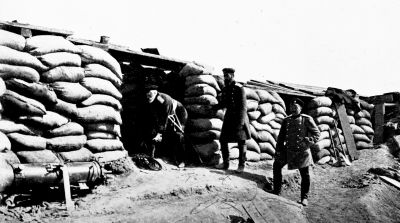
GENERAL SMIRNOFF FIRING THE CAMOUFLET.
Heavy and continual bombardment of the position was carried on on the 26th and 27th. At 11 a.m. on the 27th the Commandant, accompanied by Lieutenant Hammer, arrived in the fort, where everything was ready for firing the camouflet. All the Fortress guns were ordered, in case of a successful explosion, at once to open fire on the enemy's batteries if they should concentrate their fire on the fort. At this time the enemy were methodically shelling this fort, Kuropatkin Lunette, and B Battery with 11-inch shells, which were detonating every two or three minutes. After an inspection of the tamping,[29] the electric leads were extended from the station in the casemate to the outer parapet, when, taking advantage of the interval between the shells, the General went on to the parapet and pressed the firing-key.
Above the caponier rose a cloud of dust and smoke, out of which projected planks, stones, and bodies. We had succeeded,[30] and the garrison breathed again. The awful, weary hours of waiting had passed. Congratulating every one, the General went down into the inner courtyard. His presence as Head of the Fortress at the most dangerous place in the defences soon became known, and inspired every one to further efforts.
On the 28th the Japanese blew a breach through the wall of Caponier No. 3. They followed this up with an assault, but were repulsed. The same afternoon batteries were shelling the road from Little to Big Eagle's Nest, from the saddle of Ta-ku-shan. This only emphasized what the loss of that hill meant to us. One cannot help asking why, when Velichko drew out the plans of the Fortress, he did not insist on Ta-ku-shan being fortified? It was a natural fort! Could he not realize the difficulty of defending a fortress when its roads are under shell-fire from the very commencement, and he our leading Professor of Military Engineering? On the western front there was considerable activity towards Wolf's Hills, the trenches of Siu-shuing village.
So far, Smirnoff had endeavoured to imbue the men with the idea of no surrender, but General Fock now wrote a memorandum in which he persuaded General Stössel to lay mines under our forts in order that they might be blown up when it was decided to abandon them! Smirnoff protested most vehemently, trying to show that mining our own forts (to say nothing of the danger to the men in them) would sap at its very roots the principle that a fort might perish but must never surrender, and would consequently demoralize the troops.
Stössel believed Fock, and insisted. The Commandant then sent Grigorenko to him, who submitted a detailed report, in which he pointed out most clearly that the results of the explosions of such mines would, generally speaking, be inconsiderable, whilst the mines, if laid, would constitute a great danger to the garrison, as a chance 11-inch shell might cause a premature explosion. But Stössel had made up his mind, and ordered chambers to be made in the forts for the laying of charges. In Chi-kuan-shan, however, the Commander, Lieutenant Floroff, said point-blank that so long as he was in the fort it should not be mined.
General Stössel was in the habit of issuing frequent orders direct to General Biely, Commanding the Fortress Artillery, and gave the strictest instructions that not a gun was to be mounted without his special sanction. As he never visited the fronts attacked, and, therefore, could not judge of the state of affairs himself, the result of this order could have been merely to make unpleasantness for General Smirnoff and to interfere with his work. Though things were usually done in the end as Smirnoff wished, all this hindered progress and made matters very difficult. When systematic attacks began before the general assault of October 30, Stössel, ignoring the Commandant, told General Biely to open fire from the north-east front on to the ground near to the fortifications at sunset—at first at intervals, more often between 7 and 8 p.m., and again intermittently from then till 10 p.m. His ostensible reason was that the enemy would attack at that time. Of course, they did not do so, but despite the protests of Smirnoff, Biely, and Kondratenko, he insisted upon this cannonade—an utter waste of ammunition, when every shell was valuable.