CHILDREN’S GAMES. (continued 8)
Reading edition
—Cowes, Isle of Wight (Miss E. Smith)
XIV.
Mother, may I buy some male-scales, mother, mother? Mother, may I buy some male-scales, gentle mother of mine? Where will the money come from, daughter, daughter? Sell my father’s feather bed, mother, mother. Where will your father lie, daughter, daughter? Lie in the boys’ bed, mother, mother. Where will the boys lie, daughter, daughter? Lie in the servants’ bed, mother, mother. Where will the servants lie, daughter, daughter? Lie in the pig-sty, mother, mother. Where will the pigs lie, daughter, daughter? Lie in the washing-tub, mother, mother. Where will we wash our clothes, daughter, daughter? Wash them at the sea-side, mother, mother. Suppose the clothes should float away, daughter, daughter? Take a boat and bring them in, mother, mother. Suppose the boat would go too slow, daughter, daughter? Take a steamboat and bring them in, mother, mother. Suppose the steamboat would go too fast, daughter, daughter? Then take a rope and hang yourself, mother, mother.
—South Shields (Miss Blair, aged 9).
(b) One child stands apart and personates the Mother. The other children form a line, holding hands and facing the Mother. They advance and retire singing the first, third, and alternate verses, while the Mother, in response, sings the second and alternate verses. While the last verse is being sung the children all run off; the Mother runs after them, catches them, and beats them. Either the first or last caught becomes Mother in next game. In the Shropshire game the Mother should carry a stick. In the Norfolk version the Mother sits on a form or bank, the other children advancing and retiring as they sing. After the last verse is sung the children try to seat themselves on the form or bank where the Mother has been sitting. If they can thus get home without the Mother catching them they are safe. The Kentish game is played with two lines of children advancing and retiring. This was also the way in which the London version (A. B. Gomme) was played. In the version sent by Mr. H. S. May a ring is formed by the children joining hands. One child stands in the centre—she represents the Mother. The ring of children say the first, third, and every alternate verse. The child in the centre says the second, fourth, and alternate verses, and the game is played as above, except that when the Mother has said the last verse the children call out, “Good job, too,” and run off, the Mother chasing them as above. The game does not appear to be sung.
(c) This game is somewhat of a cumulative story, having for its finish the making angry and tormenting of a mother. All the versions point to this. One interesting point, that of milk-pails, is, it will be seen, gradually losing ground in the rhymes. Milk-pails were pails of wood suspended from a yoke worn on the milkmaid’s shoulders, and these have been giving place to present-day milk-cans. Consequently we find in the rhymes only four versions in which milk-pails are used. In two versions even the sense of milking-can has been lost, and the South Shields version, sent me by little Miss Blair, has degenerated into “male-scales,” a thoroughly meaningless phrase. The Cowes version (Miss Smith) has arrived at “wash-pan.” The “burden” of the Chirbury version is “a rea, a ria, a roses,” and the Sheffield version is also remarkable: the “I, O, OM” refers, probably, to something now forgotten, or it may be the “Hi, Ho, Ham!” familiar in many nursery rhymes. The game seems to point to a period some time back, when milking was an important phase of the daily life, or perhaps to the time when it was customary for the maids and women of a village to go to the hilly districts with the cows (summer shealings) for a certain period of time. The references to domestic life are interesting. The scarcity of beds, the best or feather bed, and the children’s bed, seeming to be all those available. The feather bed is still a valued piece of household furniture, and is considered somewhat of the nature of a heirloom, feather beds often descending from mother to daughter for some generations. I have been told instances of this. Gregor, in Folk-lore of East of Scotland, p. 52, describes the Scottish box-bed. The “truckle bed” and “footman’s bed” probably refers to the small bed under a large one, which was only pulled out at night for use, and pushed under during the day. Illustrations of these beds and the children’s bed are given in old tales. The proximity of the pig-sty to the house is manifest. The mention of washing-tubs calls to mind the large wooden tubs formerly always used for the family wash. Before the era of laundresses washing-tubs must have constituted an important part of the family plenishing. Washing in the rivers and streams was also a thing of frequent occurrence, hot water for the purpose of cleansing clothes not being considered necessary, or in many cases desirable. Chambers gives a version of the game (Popular Rhymes, p. 36) and also Newell (Games, p. 166). Another version from Buckingham is given by Thomas Baker in the Midland Garner, 1st ser., ii. 32, in which the mother desires the daughter to “milk in the washing-tub,” and the words also appear very curiously tacked on to the “Three Dukes a-riding” game from Berkshire (Antiquary, xxvii. 195), where they are very much out of place.[Addendum]
Mineral, Animal, and Vegetable
A ball is thrown by one player to any one of the others. The thrower calls out at the same time either “mineral,” “animal,” or “vegetable,” and counts from one to ten rather quickly. If the player who is touched by the ball does not name something belonging to that kingdom called before the number ten is reached, a forfeit has to be paid.—London (A. B. Gomme).
This is more usually called “Animal, Vegetable, and Mineral.” See “Air, Fire, and Water.”
Minister’s Cat
The first player begins by saying, “The minister’s cat is an ambitious cat,” the next player “an artful cat,” and so on, until they have all named an adjective beginning with A. The next time of going round the adjectives must begin with B, the next time C, and so on, until the whole of the alphabet has been gone through.—Forest of Dean, Gloucestershire (Miss Matthews); Anderby, Lincolnshire (Miss Peacock).
This is apparently the same game as the well-known “I love my love with an A because she is amiable.” In this game every player has to repeat the same sentence, but using a different adjective, which adjective must begin with the letter A. Various sentences follow. At the next round the adjectives all begin with B; the next C, until a small story has been built up. Forfeits were exacted for every failure or mistake. The formula usually was—
I love my love with an A because she is ( ). I hate her with an A because she is ( ). I took her to the sign of the ( ), and treated her to ( ). The result was ( ).
Mollish’s Land
Cornish name for “Tom Tiddler’s Ground.”—Folk-lore Journal, v. 57.
Monday, Tuesday
A game played with a ball. There are seven players, who each take a name from one of the days of the week. One (Sunday) begins by throwing the ball against a wall, calling out at the same time the name of one of the days, who has to run and catch it before it falls. If this one fails to catch the ball, the first player picks up the ball and tries to hit one of the six with it, who all endeavour to escape being hit. If the player succeeds, he again throws the ball against the wall, calling out another day of the week to catch it. If a player gets hit three times, he is out. The winner is he who has either not been hit at all or the fewest times, or who has been able to stay in the longest. The same game is played with twelve children, who are named after the twelve months of the year.—London and Barnes (A. B. Gomme); Strand Magazine, ii. 519 (F. H. Low).
This game belongs apparently to the ball games used for purposes of divination. Mr. Newell (Games, p. 181) describes a similar game to this, in which the player whose name is called drops the ball; he must pick it up as quickly as possible while the rest scatter. He then calls “Stand!” upon which the players halt, and he flings it at whom he pleases. If he misses his aim, he must place himself in a bent position with his hands against a wall until every player has taken a shot at him. The idea of naming children after the days of the week occurs also in the games of “Gipsy,” “Witch,” and “Mother, Mother, the Pot boils over.”
See “Ball,” “Burly Whush,” “Keppy Ball.”[Addendum]
Moolie Pudding
The game of “Deadelie;” one has to run with the hands locked and “taen” the others.—Mactaggart’s Gallovidian Encyclopædia.
See “Chickidy Hand,” “Deadelie,” “Hunt the Staigie,” “Whiddy.”
More Sacks to the Mill
A very rough game, mentioned in Dean Miles’ MS., p. 180 (Halliwell’s Dictionary). Lowsley (Berkshire Glossary) says this is “a favourite game with children at Christmas-time, when wishing for one of a romping character,” but he does not describe it further. Northall (English Folk Rhymes, p. 354) says that in Warwickshire and Staffordshire boys torture an unfortunate victim by throwing him on the ground and falling atop of him, yelling out the formula, “Bags to [on] the mill.” This summons calls up other lads, and they add their weight.[Addendum]
Mother, may I go out to Play?
I.
Mother, may I go out to play? No, my child, it’s such a wet day. Look how the sun shines, mother. Well, make three round curtseys and be off away. [Child goes, returns, knocks at door. Mother says, “Come in.”] What have you been doing all this time? Brushing Jenny’s hair and combing Jenny’s hair. What did her mother give you for your trouble? A silver penny. Where’s my share of it? Cat ran away with it. Where’s the cat? In the wood. Where’s the wood? Fire burnt it. Where’s the fire? Moo-cow drank it. Where’s the moo-cow? Butcher killed it. Where’s the butcher? Eating nuts behind the door, and you may have the nutshells.
—London (Miss Dendy, from a maid-servant).
II.
Please, mother, may I go a-maying? Why, daughter, why? Because it is my sister’s birthday. Make three pretty curtseys and walk away. Where is your may? I met puss, and puss met me, and puss took all my may away. Where is puss? Run up the wood. Where is the wood? Fire burnt it. Where is the fire? Water quenched it. Where is the water? Ducks have drunk it. Where are the ducks? Butcher killed them. Where is the butcher? Behind the churchyard, cracking nuts, and leaving you the shells.
—Sporle, Norfolk (Miss Matthews).
III.
Please, mother, may we go out to play? Yes, if you don’t frighten the chickens. No, mother, we won’t frighten the chickens. [They all go out and say, “Hush! hush!” to pretended chickens.] Where have you been? To grandmother’s. What for? To go on an errand. What did you get? Some plums. What did you do with them? Made a plum-pudding. What did she give you? A penny. What did you do with it? Bought a calf. What did you do with it? Sold it. What did you do with the money? Gave it to the butcher, and he gave me a penny back, and I bought some nuts with it. What did you do with them? Gave them to the butcher, and he’s behind the churchyard cracking them, and leaving you the shells.
—Sporle, Norfolk (Miss Matthews).
IV.
Mother, mother, may I go to play? No, daughter, no! for fear you should stay. Only as far as the garden gate, to gather flowers for my wedding day. Make a fine curtsey and go your way. [They all curtsey and scamper off, and proceed to plan some mischief. Then they return.] Now where have you been? Up to Uncle John’s. What for? Half a loaf, half a cheese, and half a pound of butter. Where’s my share? Up in cupboard. ’Tisn’t there, then! Then the cat eat it. And where’s the cat? Up on the wood [i.e., the faggots]. And where’s the wood? Fire burnt it. Where’s the fire? Water douted it [i.e., put it out]. Where’s the water? Ox drank it. Where’s the ox? Butcher killed it. And where’s the butcher? Behind the door cracking nuts, and you may eat the shells of them if you like.
—Dorsetshire (Folk-lore Journal, vii. 219).
V.
Please may I go out to play? How long will you stay? Three hours in a day. Will you come when I call you? No. Will you come when I fetch you? Yes. Make then your curtseys and be off.
The girls then scamper off as before, and as they run about the field keep calling out, “I won’t go home till seven o’clock, I won’t go home till seven o’clock.” After they have been running about for some five or ten minutes the Mother calls Alice (or whatever the name may be) to come home, when the one addressed will run all the faster, crying louder than before, “I won’t go home till seven o’clock.” Then the Mother commences to chase them until she catches them, and when she gets them to any particular place in the field where the others are playing, she says—
Where have you been? Up to grandmother’s. What have you done that you have been away so long? I have cleaned the grate and dusted the room. What did she give you? A piece of bread and cheese so big as a house, and a piece of plum cake so big as a mouse. Where’s my share? Up in higher cupboard. It’s not there. Up in lower cupboard. It’s not there. Then the cat have eat it. Where’s the cat? Up in heath. Where’s the heath? The fire burnt it.
[The rest is the same as in the last version, p. 393.]
—Dorsetshire (Folk-lore Journal, vii. 221-222).
VI.
Mother, mother, may I (or we) go out to play? No, child! no, child! not for the day. Why, mother? why, mother? I won’t stay long. Make three pretty courtesies, and away begone. One for mammy, one for daddy, one for Uncle John. Where, child! where, child! have you been all the day? Up to granny’s. What have you been doing there?
[The answer to this is often, “Washing doll’s clothes,” but anything may be mentioned.]
What did she give you?
[The reply is again left to the child’s fancy.]
Where’s my share? The cat ate it [or, In the cat’s belly]. What’s in that box, mother? Twopence, my child. What for, mother? To buy a stick to beat you, and a rope to hang you, my child.
—Cornwall (Folk-lore Journal, v. 55, 56).
VII.
Grandmother, grandmother grey, May I go out to play? No, no, no, it is a very wet day. Grandmother, grandmother grey, May I go out to play? Yes, yes, yes, if you don’t frighten the geese away. Children, I call you. I can’t hear you. Where are your manners? In my shoe. Who do you care for? Not for you.
—Earls Heaton, Yorks. (H. Hardy).
VIII.
Pray, mother, pray, May I go out to play? No, daughter, no, daughter, Not every fine day. Why, mother, why? I shan’t be gone long. Make a fine curtsey And glad git you gone.— Wait for your sister.
—Hurstmonceux, Sussex (Miss Chase).
IX.
Please, mother, please, mother, may I go out to play? No, child, no, child, ’tis such a cold day. Why, mother, why, mother, I won’t stay long. Make three pretty curtseys and off you run.
—Northants (Rev. W. D. Sweeting).
(b) One girl is chosen to act as “Mother,” the rest of the players pretend to be her children, and stand in front of her, not in a line, but in a group. One of them, very frequently all the children ask her the first question, and the Mother answers. When she gives permission for the children to go out they all curtsey three times, and run off and pretend to play. They then return, and the rest of the dialogue is said, the Mother asking the questions and the children replying. At the end of the dialogue the Mother chases and catches them, one after the other, pretending to beat and punish them. In the Northants and Hurstmonceux games there appears to be no chasing. In the London version (Miss Dendy) only two children are mentioned as playing. When the Mother is chasing the girl she keeps asking, “Where’s my share of the silver penny?” to which the girl replies, “You may have the nut-shells.” In the Cornish version, when the Mother has caught one of the children, she beats her and puts her hands round the child’s throat as if she were going to hang her.
(c) Miss Courtney, in Folk-lore Journal, v. 55, says: “I thought this game was a thing of the past, but I came across some children playing it in the streets of Penzance in 1883.” It belongs to the cumulative group of games, and is similar in this respect to “Milking Pails,” “Mother, Mother, the Pot boils over,” &c. There seems to be no other object in the game as now played except the pleasures of teasing and showing defiance to a mother’s commands, and trying to escape the consequences of disobedience by flight, in order that the mother may chase them. The idea may be that, if she is “out of breath,” she cannot chastise so much. Mr. Newell (Games, p. 172) gives versions of a similar game.
Mother Mop
All the players, except one, stand two by two in front of each other, the inner ones forming an arch with their hands united—this is called the “oven.” The odd child is “Mother Mop.” She busies herself with a pretended mop, peel, &c., after the manner of old-fashioned bakers, making much ado in the valley between the rows of children. The oven soon gets demolished, and the last child vanquished becomes “Mother Mop” the next time.—Bitterne, Hants (Mrs. Byford).
It seems probable that the inner rows of children should kneel or stoop down in order that “Mother Mop” should have as much trouble as possible with her oven. The game may have lost some of its details in other directions, as there is no apparent reason why the oven is demolished or broken down.
See “Jack, Jack, the Bread’s a-burning.”
Mother, Mother, the Pot Boils over
A number of girls choose one of their number to represent a witch, and another to be a mother. The Witch stands near the corner of a wall, so that she can peep round. Then the Mother counts the children by the seven days of the week, “Monday,” “Tuesday,” &c., and appoints another girl to act as guardian over them. She then pretends to go out washing, removing to a short distance so as to be within ear-shot of the other children. As soon as the Mother has gone, the old Witch comes and says, “Please, can I light my pipe?” Then the children say, “Yes, if you won’t spit on t’ hearth.” She pretends to light her pipe, but spits on the hearth, and runs away with the girl called Sunday. Then the Guardian, among the confusion, pretends to rush down stairs, and, failing to find Sunday, calls out, “Mother, mother, t’ pot boils over.” The Mother replies, “Put your head in;” the Guardian says, “It’s all over hairs;” the Mother says, “Put the dish-clout in;” the Guardian says, “It’s greasy;” the Mother says, “Get a fork;” the Guardian says, “It’s rusty;” the Mother says, “I’ll come mysen.” She comes, and begins to count the children, Monday, Tuesday, up to Saturday, and missing Sunday, asks, “Where’s Sunday?” the Guardian says, “T’ old Witch has fetched her.” The Mother answers, “Where was you?” “Up stairs.” The Mother says, “What doing?” “Making t’ beds.” “Why didn’t you come down?” “Because I had no shoes.” “Why didn’t you borrow a pair?” “Because nobody would lend me a pair.” “Why didn’t you steal a pair?” “Do you want me to get hung?” Then the Mother runs after her, and if she can catch her thrashes her for letting Sunday go. Then the Mother pretends to go out washing again, and the Witch fetches the other days of the week one by one, when the same dialogue is rehearsed.—Dronfield, Derbyshire (S. O. Addy).
This game was also played in London. The dramatis personæ were a mother, an eldest daughter, the younger children, a witch, and a pot was represented by another child. The Mother names the children after the days of the week. She tells her eldest daughter that she is going to wash, and that she expects her to take great care of her sisters, and to be sure and not let the old witch take them. She is also to look after the dinner, and be sure and not let the pot boil over. The Mother then departs, and stays at a little distance from the others. The eldest daughter pretends to be very busy putting the house to rights, sweeps the floor, and makes everything tidy; the younger children pretend to play, and get in the elder sister’s way. She gets angry with them, and pretends to beat them. Now, the girl who personates the Witch comes and raps with her knuckles on a supposed door. The Witch stooped when walking, and had a stick to help her along.
Come in, says the eldest sister. What do you want? Let me light my pipe at your fire? My fire’s out. Yes! if you’ll not dirty the hearth. No, certainly; I’ll be careful.
While the eldest sister pretends to look on the shelf for something, the Witch “dirties” the hearth, catches hold of Monday and runs off with her; and at this moment the pot boils over. The child who is the pot makes a “hissing and fizzing” noise. The daughter calls out—
Mother, mother, the pot boils over. Take the spoon and skim it. Can’t find it. Look on the shelf. Can’t reach it. Take the stool. The leg’s broke. Take the chair. Chair’s gone to be mended. I suppose I must come myself?
The Mother here wrings her hands out of the water in the washing-tub and comes in. She looks about and misses Monday.
Where’s Monday? Oh, please, Mother, please, I couldn’t help it; but some one came to beg a light for her pipe, and when I went for it she took Monday off. Why, that’s the witch!
The Mother pretends to beat the eldest daughter, tells her to be more careful another time, and to be sure and not let the pot boil over. The eldest daughter cries, and promises to be more careful, and the Mother goes again to the wash-tub.
The same thing occurs again. The Witch comes and asks—
Please, will you lend me your tinder-box? My fire’s out. Yes, certainly, if you’ll bring it back directly. You shall have it in half-an-hour.
While the tinder-box is being looked for she runs off with Tuesday. Then the pot boils over, and the same dialogue is repeated. The Mother comes and finds Tuesday gone. This is repeated for all the seven children in turn, different articles, gridiron, poker, &c., being borrowed each time. Finally, the eldest daughter is taken off too. There is no one now to watch the pot, so it boils over, and makes so much noise that the Mother hears it and comes to see why it is. Finding her eldest daughter gone too, she goes after her children to the Witch’s house. A dialogue ensues between the Witch and the Mother. The Mother asks—
Is this the way to the Witch’s house? There’s a red bull that way! I’ll go this way. There’s a mad cow that way! I’ll go this way. There’s a mad dog that way!
She then insists on entering the house to look for her children. The Witch will not admit her, and says—
Your boots are too dirty. I’ll take my boots off. Your stockings are too dirty. I’ll take them off. Your feet are dirty. I’ll cut them off. The blood will run over the threshold. I’ll wrap them up in a blanket. The blood will run through.
This enrages the Mother, and she pushes her way into the supposed house, and looks about, and calls her children. She goes to one and says—
This tastes like my Monday.
The Witch tells her it’s a barrel of pork.
No, no, this is my Monday; run away home.
Upon this Monday jumps up from her crouching or kneeling posture [the children were generally put by the Witch behind some chairs all close together in one corner of the room], and runs off, followed by all the others and their Mother. The Witch tries to catch one, and if successful that child becomes Witch next time.—A. B. Gomme.
A probable explanation of this game is that it illustrates some of the practices and customs connected with fire-worship and the worship of the hearth, and that the pot is a magical one, and would only boil over when something wrong had occurred and the Mother’s presence was necessary. The pot boils over directly a child is taken away, and appears to cease doing this when the Mother comes in. It is remarkable, too, that the Witch should want to borrow a light from the fire; the objection to the giving of fire out of the house is a well-known and widely-diffused superstition, the possession of a brand from the house-fire giving power to the possessor over the inmates of a house. The mention of the spitting on the hearth in the Sheffield version, and dirtying the hearth in the London version, give confirmation to the theory that the desecration of the fire or hearth is the cause of the pot boiling over, and that the spirit of the hearth or fire is offended at the sacrilege. The Witch, too, may be unable to get possession of a child until she has something belonging to the house. The journey of the Mother to the Witch’s house in search of her children, the obstacles put in her path, and the mention of the spilling of blood on the threshold, are incidents which have great significance. Why the “keeling” or skimming of the contents of the pot should be so difficult a task for the eldest daughter that the Mother is obliged to come herself, is not so clear; the skimming is of course to prevent the pot boiling over, and the pot may be supposed to take the place of the Mother or Guardian of the hearth, and tell when misfortune or trouble is at hand. Or the “boiling over” (which, if continued, would extinguish the fire and sully the stone) may be an offence to the hearth spirit, who ceases then to protect the inmates of the house. Fairies are said to have power over the inmates of a house when the threshold and kitchen utensils are left dirty and uncared for. Thus on the theories accompanying the ancient house ritual, this extraordinary game assumes a rational aspect, and it is not too much to suggest that this explanation is the correct one.
In the game of “Witch” practically the same incidents occur, and nearly the same dialogue, but the significant elements of pot-boiling and fire-protection do not appear in that game. It is not certain whether we have two independent games, or whether “The Witch” is this game, the incidents of pot-boiling and the fire-protection having been lost in its transmission to more modern notions. Although so closely allied, these games are not one at the present day, and are therefore treated separately. Newell (Games, p. 218) gives some versions of “Witch” which show a connection between that game and this. See “Keeling the Pot,” “Witch.”
Mount the Tin
One child throws a tin (any kind of tin will do) to some distance, and then walks towards it without looking round. The other children, in the meantime, hide somewhere near. The child who threw the tin has to guard it, and at the same time try to find those who are hiding. If he sees one he must call the name, and run to strike the tin with his foot. He does this until each one has been discovered. As they are seen they must stand out. The one who was first found has to guard the tin next time. Should one of the players be able to strike the tin while the keeper is absent, that player calls out, “Hide again.” They can then all hide until the same keeper discovers them again.—Beddgelert (Mrs. Williams).
See “New Squat.”[Addendum]
Mouse and the Cobbler
One girl stands up and personates a mother, another pretends to be a mouse, and crouches behind a chair in a corner. The mother says to another player—
Go and get your father’s shirt.
This player goes to the chair to look for the shirt, and is tickled or touched by the one hiding. She rushes back and calls out—
Mother, there’s a mouse. Go and get your father’s coat. There’s a mouse. Go and get your father’s watch and chain. There’s a mouse.
The Mother then goes to see herself. The second time she is scratched and chased. When caught she takes the Mouse’s place.—Deptford, Kent (Miss Chase).
This is evidently the same game as “Ghost in the Garden” and “Ghost in the Copper,” in a decaying stage. There is no raison d’etre for either mouse or cobbler. Probably these words are a corruption of the older “Ghost in the Copper.”
Muffin Man
[Play]
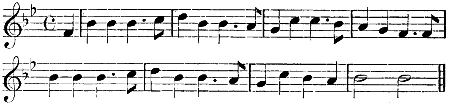
—Earls Heaton (H. Hardy).
[Play]
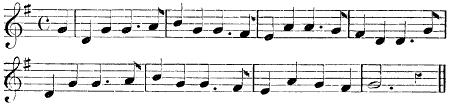
—Congleton Workhouse (Miss A. E. Twemlow).
I.
Have you seen the muffin man, the muffin man, the muffin man, Have you seen the muffin man that lives in Drury Lane O? Yes, I’ve seen the muffin man, the muffin man, the muffin man; Yes, I’ve seen the muffin man who lives in Drury Lane O.
—Earls Heaton, Yorks. (H. Hardy).
II.
O, have you seen the muffin man, The muffin man, the muffin man; O, have you seen the muffin man Who lives in Drury Lane O?
—N. W. Lincolnshire (Rev. —— Roberts).
III.
Have you seen the muffin girl, The muffin girl, the muffin girl? O have you seen the muffin girl Down in yonder lane?
—Congleton Workhouse School (Miss A. E. Twemlow).
IV.
Don’t you know the muffin man? Don’t you know his name? Don’t you know the muffin man That lives in our lane? All around the Butter Cross, Up by St. Giles’s, Up and down the Gullet Street, And call at Molly Miles’s!
—Burne’s Shropshire Folk-lore, p. 571.
V.
Have you seen the nutting girl, The nutting girl, the nutting girl? Have you seen the nutting girl, Down in yonder lane O?
—Holmfirth (H. Hardy).
(b) A ring is formed by the players joining hands; one child, who is blindfolded and holds a stick, stands in the centre. The ring dance round, singing the verse. They then stand still, and the centre child holds out the stick and touches one of the ring. This player must take hold of the stick. Then the Muffin Man asks this player any questions he pleases, “Is the morn shining?” “Is ink white?” &c. The child who holds the stick answers “Yes” or “No” in a disguised voice, and the Muffin Man then guesses who it is. He is allowed three tries. If he guesses right he joins the ring, and the child who was touched takes his place in the centre. In the Yorkshire versions no questions are asked; the blindfolded child goes to any one he can touch, and tries to guess his or her name. The other version, sent by Mr. Hardy, is played in the same way, and sung to the same tune. In the Congleton version (Miss Twemlow), the blindfolded child tries to catch one of those in the ring, when the verse is sung. The lines, with an additional four from Shropshire Folk-lore, are given by Miss Burne among nursery rhymes and riddles.
See “Buff with a Stick,” “Dinah.”
Mulberry Bush
[Play]
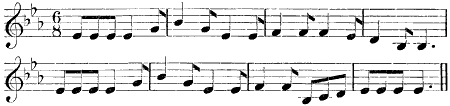
—Miss Harrison.
Here we go round the mulberry bush, The mulberry bush, the mulberry bush, Here we go round the mulberry bush, On a cold and frosty morning. This is the way we wash our hands, Wash our hands, wash our hands, This is the way we wash our hands, On a cold and frosty morning. Here we go round the mulberry bush, The mulberry bush, the mulberry bush, Here we go round the mulberry bush, On a cold and frosty morning. This is the way we wash our clothes, Wash our clothes, wash our clothes, This is the way we wash our clothes, On a cold and frosty morning. Here we go round the mulberry bush, The mulberry bush, the mulberry bush, Here we go round the mulberry bush, On a cold and frosty morning. This is the way we go to school, We go to school, we go to school, This is the way we go to school, On a cold and frosty morning. Here we go round the mulberry bush, The mulberry bush, the mulberry bush, Here we go round the mulberry bush, On a cold and frosty morning.
—Liphook, Hants (Miss Fowler).
(b) The children form a ring, all joining hands and dancing round while singing the first verse. When singing the last line they unclasp their hands, and each one turns rapidly round. They then sing the next verse, suiting their actions to the words they sing, again turning round singly at the last line. This is done with every alternate verse, the first verse being always sung as a chorus or dance in between the different action-verses. The verses may be varied or added to at pleasure. The actions generally consist of washing and dressing oneself, combing hair, washing clothes, baking bread, sweeping the floor, going to and returning from school, learning to read, cleaning boots, and lacing stays. When “going to school,” the children walk two by two in an orderly manner; when “coming home from school,” jumping and running is the style adopted; “lacing stays,” the hands are put behind and moved first one and then the other, as if lacing; “this is the way the ladies walk,” holding up skirts and walking primly; “gentlemen walk,” walking with long strides and sticks. The dressing process and cleaning boots preceded “school.”
(c) This game is well known, and played in almost all parts of England. It is always played in the same way. There is so little variety in the different versions that it appears unnecessary to give more than one here. In the many versions sent the only variants are: In Sporle, Norfolk, Miss Matthews says the game is sometimes called “Ivy Bush,” or “Ivory Bush;” and Mr. C. C. Bell, of Epworth, sends a version, “Here we go round the Mulberry Tree” In Notts it is called “Holly Bush” (Miss Winfield). A version given in the Folk-lore Record, iv. 174, is called the “Gooseberry Bush,” and Halliwell (Popular Nursery Rhymes, p. 224) records a game, the “Bramble Bush.” “The bush,” he says, “is often imaginative, but is sometimes represented by a child in the centre.” Chambers (Popular Rhymes, pp. 134, 135) gives the game as a form of the “Merry-ma-tanzie”—a kind of dance. They sing while moving round to the tune of “Nancy Dawson,” and stopping short with courtesy at the conclusion.
Here we go round the mulberry bush, The mulberry bush, the mulberry bush, Here we go round the mulberry bush, And round the merry-ma-tanzie.
Disjoining hands, they then begin, with skirts held daintily up behind, to walk singly along, singing—
This is the way the ladies walk, The ladies walk, the ladies walk; This is the way the ladies walk, And round the merry-ma-tanzie.
At the last line they reunite, and again wheel round in a ring, singing as before—
Here we go round the mulberry bush, &c.
After which, they perhaps simulate the walk of gentlemen, the chief feature of which is length of stride, concluding with the ring dance as before. Probably the next movement may be—
This is the way they wash the clothes, Wash the clothes, wash the clothes; This is the way they wash the clothes, And round the merry-ma-tanzie.
After which there is, as usual, the ring dance. They then represent washing, ironing clothes, baking bread, washing the house, and a number of other familiar proceedings.
Chambers quotes a fragment of this “little ballet,” as practised at Kilbarchan, in Renfrewshire, which contains the following lines similar to those in this game:—
She synes the dishes three times a day, Three times a day, three times a day; She synes the dishes three times a day, Come alang wi’ the merry-ma-tanzie. She bakes the scones three times a day, Three times a day, three times a day; She bakes the scones three times a day, Come alang wi’ the merry-ma-tanzie. She ranges the stules three times a day, Three times a day, three times a day; She ranges the stules three times a day, Come alang wi’ the merry-ma-tanzie.
This game originated, no doubt, as a marriage dance round a sacred tree or bush. As it now exists it appears to have no other character than the performance of duties such as those enumerated in the description. In no version that I am acquainted with do the elements of love and marriage or kissing occur, otherwise the resemblance it bears to the Scotch “Merry-ma-tanzie” would suggest that it is a portion of that game. This game possesses the centre tree, which is not preserved in “Merry-ma-tansa.” Trees were formerly sacred to dancing at the marriage festival, as at Polwarth in Berwickshire, where the custom once prevailed, which is not unworthy of notice. “In the midst of the village are two thorn trees near to each other; round these every newly-married pair were expected to dance with all their friends; from hence arose the old song, ‘Polwarth on the Green’” (New Statistical Account of Scotland, Polwarth, Berwickshire, ii. 234). Holland (Cheshire Glossary), under “Kissing Bush,” says, “A bush of holly, ivy, or other evergreens, which is hung up in farm kitchens at Christmas, and serves the purpose of mistletoe. The kissing bushes are usually prepared by the farm lads on Christmas Eve, and they are often tastefully decorated with apples, oranges, and bits of gay-coloured ribbon. I have occasionally seen them made upon a framework of hoop iron something in the form of a crown, with a socket at the bottom to hold a lighted candle.” Brand (ii. 15) also describes how in Ireland men and women dance round about a bush in a large ring on the Patron Day. Newell (Games, p. 86), gives this game, and also mentions one in which “barberry bush” is named. The tune in all versions is the same. See “Merry ma-tansa,” “Nettles.”
Munshets or Munshits
Is played by two boys as follows:—One of the boys remains “at home,” and the other goes out to a prescribed distance. The boy who remains “at home” makes a small hole in the ground, and holds in his hand a stick about three feet long to strike with. The boy who is out at field throws a stick in the direction of this hole, at which the other strikes. If he hits it, he has to run to a prescribed mark and back to the hole without being caught or touched with the smaller stick by his playfellow. If he is caught, he is “out,” and has to go to field. And if the boy at field can throw his stick so near to the hole as to be within the length or measure of that stick, the boy at home has to go out to field. A number of boys often play together; for any even number can play. I am told that the game was common fifty years ago. In principle it resembles cricket, and looks like the rude beginning of the game.—Addy’s Sheffield Glossary.
See “Cat,” “Cudgel,” “Kit-cat,” “Tip-cat.”
Musical Chairs
A line of chairs is placed in a row down a room (one chair less than the number of children who are playing) in such a way that every alternate chair only is available on either side for the players to seat themselves. The children walk or dance round the chairs, keeping quite close to them. The piano or other musical instrument is played while they are dancing round. The music is continued for any length of time the player pleases, the children running round the chairs as long as the music goes on. The player stops the music suddenly, when all the children endeavour to take seats. One will be unable to find a seat, and this player remains “out.” A chair is then taken away, and the music and dancing round begins again. There should always be one chair less than the number of players.—A. B. Gomme.
In Ellesmere, Miss Burne says, “Snap-tongs,” called in other circles “Magic Music” or “Musical Chairs,” is thus played. Five players take part; four chairs are set in the middle, and one of the players, who holds a pair of tongs, desires the others to dance round them till the clock strikes a certain hour, which is done by snapping the tongs together so many times. While they dance, a chair is taken away, and the player who cannot find a seat has to become the “snap-tongs” next time.—Shropshire Folk-lore, p. 525.
Nacks
A game in which pegs of wood play a similar part to the well-known object “Aunt Sally.”—Robinson’s Mid Yorkshire Glossary.
Namers and Guessers
Any number of players can play this game. Two are chosen, the one to be Namer, and the other Guesser or Witch. The rest of the players range themselves in a row. The Guesser retires out of sight or to a distance. The Namer then gives each player a secret name. When names have been given to all the players, the Namer calls on the Guesser to come, by saying—
Witchie, witchie, yer bannocks are burnin’, An’ ready for turnin’.
Whereupon he approaches, and the Namer says—
Come, chois me out, come, chois me in, to ——
(naming one by the assumed name). The players all shout, “Tack me, tack me,” repeatedly. The Witch points to one. If the guess is correct the player goes to the Witch’s side, but if it is incorrect he goes to the Namer’s side. This goes on till all the players are ranged on the one side or the other. The two parties then come to a tug, with the Namer and Guesser as leaders. The gaining party then ranges itself in two lines with a space between the lines, each boy holding in his hand his cap or his handkerchief tightly plaited. The boys of the conquered side have then to run between the two lines, and are pelted by the victors. This is called, “Throuw the Muir o’ Hecklepin.”—Keith (Rev. W. Gregor).
This game is practically the same as “Fool, Fool, come to School,” but the secret naming may indicate that this belongs to an earlier form.
See “Fool, Fool,” “Hecklebirnie.”[Addendum]
Neighbour
There is a game called “Neighbour, I torment thee,” played in Staffordshire, “with two hands, and two feet, and a bob, and a nod as I do.”—Halliwell’s Dictionary.
Neiveie-nick-nack
A fireside game. A person puts a little trifle, such as a button, into one hand, shuts it close, the other hand is also shut; then they are both whirled round and round one another as fast as they can, before the nose of the one who intends to guess what hand the prize is in; and if the guesser be so fortunate as to guess the hand the prize is in, it becomes his property; the whirling of the fists is attended with the following rhyme—
Neiveie, neiveie, nick nack, What ane will ye tak, The right or the wrang? Guess or it be lang, Plot awa’ and plan, I’ll cheat ye gif I can.
—Mactaggart’s Gallovidian Encyclopædia.
The Rev. W. Gregor says at Keith this game is played at Christmas, and by two. The stakes are commonly pins. One player conceals a pin, or more if agreed on, in one of his (her) hands. He then closes both hands and twirls them over each other, in front of the other player, and repeats the words—
Nivvie, nivvie-neek-nack, Filk (which) (or filk han’) ’ill ye tack? Tack the richt, tack the left, An’ a’ll deceave ye gehn (if) I can.
The other player chooses. If he chooses the hand having the stake, he gains it. If he does not, he forfeits the stake. Another form of words is—
Nivvie, nivvie-neek-nack Filk (which) will ye tick-tack? Tack ane, tack twa, Tack the best amo’ them a’.
And—
Nivvie, nivvie-nick-nack, Which han’ will ye tack? Tack ane, tack twa, Tack the best amo’ them a’.
Dickinson’s Cumberland Glossary describes this as a boyish mode of casting lots. The boy says—
Neevy, neevy-nack, Whether hand will ta tack, T’topmer or t’lowmer?
Mr. W. H. Patterson (Antrim and Down Glossary) gives the rhyme as—
Nievy, navy, nick nack, Which han’ will ye tak’, The right or the wrang? I’ll beguile ye if I can.
Chambers (Popular Rhymes, p. 117) gives the rhyme the same as that given by Mr. Patterson. In Notes and Queries, 6th Series, vii. 235, a North Yorkshire version is given as—
Nievie, nievie, nack, Whether hand wilta tak, Under or aboon, For a singal half-crown? Nievie, nievie, nick, nack, Whilk han’ will thou tak? Tak the richt or tak the wrang, I’ll beguile thee if I can.
Jamieson (Supp., sub voce) adds: “The first part of the word seems to be from neive, the fist being employed in the game.” A writer in Notes and Queries, iii. 180, says: “The neive, though employed in the game, is not the object addressed. It is held out to him who is to guess—the conjuror—and it is he who is addressed, and under a conjuring name. In short (to hazard a wide conjecture, it may be) he is invoked in the person of Nic Neville (Neivi Nic), a sorcerer in the days of James VI., who was burnt at St. Andrews in 1569. If I am right, a curious testimony is furnished to his quondam popularity among the common people.” It will be remembered that this game is mentioned by Scott in St. Ronan’s Well—“Na, na, said the boy, he is a queer old cull. . . . He gave me half-a-crown yince, and forbade me to play it awa’ at pitch and toss.” “And you disobeyed him, of course?” “Na, I didna disobey him—I played it awa’ at ‘Nievie, nievie, nick-nack.’”
See “Handy-dandy.”
Nettles
Nettles grow in an angry bush, An angry bush, an angry bush; Nettles grow in an angry bush, With my high, ho, ham! This is the way the lady goes, The lady goes, the lady goes; This is the way the lady goes, With my hi, ho, ham! Nettles grow in an angry bush, &c. This is the way the gentleman goes, &c. Nettles grow in an angry bush, &c. This is the way the tailor goes.
—Halliwell’s Nursery Rhymes, 227.
(b) The children dance round, singing the first three lines, turning round and clapping hands for the fourth line. They curtsey while saying, “This is the way the lady goes,” and again turn round and clap hands for the last line. The same process is followed in every verse, only varying what they act—thus, in the third verse, they bow for the gentleman—and so the amusement is protracted ad libitum, with shoemaking, washing clothes, ironing, churning, milking, making up butter, &c., &c.
(c) This game is practically the same as the “Mulberry Bush.” The action is carried on in the same way, except that the children clap their hands at the fourth line, instead of each turning themselves round, as in “Mulberry Bush.” The “High, ho, ham!” termination may be the same as the “I, O, OM” of Mr. Addy’s version of “Milking Pails.”
See “Mulberry Bush,” “When I was a Young Girl.”
New Squat
A ring is made by marking the ground, and a tin placed in the middle of it. One boy acts as keeper of the tin, the other players also stand outside the ring. One of these kicks the tin out of the ring, the others then all run to hide or squat out of sight. The keeper has to replace the tin before looking for the boys. If, after that, he can spy a boy, that boy must come out and stand by the ring. When another boy is spied, he endeavours to reach the ring before the keeper does so, and kick out the tin. If he is successful, any one of the boys who is standing by, having been previously spied, is released from the keeper, and again hides. The object of the keeper is to successfully spy all the boys. When this is accomplished the last boy becomes the keeper.—Earls Heaton, Yorks. (Herbert Hardy).
See “Mount the Tin.”
Nine Holes
Nine round holes are made in the ground, and a ball aimed at them from a certain distance; or the holes are made in a board with a number over each, through one of which the ball has to pass.—Forby’s Vocabulary.
“A rural game,” says Nares, “played by making nine holes in the ground, in the angles and sides of a square, and placing stones and other things upon, according to certain rules.” Moor (Suffolk Words and Phrases) says: “This is, I believe, accurate as far as it goes, of our Suffolk game. A hole in the middle is necessary.” In Norfolk, Holloway (Dict. Prov.) says that nine round holes are made in the ground, and a ball aimed at them from a certain distance. A second game is played with a board having nine holes, through one of which the ball must pass. Nares quotes several authors to show the antiquity of the game. He shows that the “Nine Men’s Morris” of our ancestors was but another name for “Nine Holes.” Nine, a favourite and mysterious number everywhere, prevails in games.
Strutt (Sports, p. 384) also describes the game as played in two ways—a game with bowling marbles at a wooden bridge; and another game, also with marbles, in which four, five, or six holes, and sometimes more, are made in the ground at a distance from each other, and the business of every one of the players is to bowl a marble, by a regular succession, into all the holes, and he who completes in the fewest bowls obtains the victory. In Northamptonshire a game called “Nine Holes,” or “Trunks,” is played with a long piece of wood or bridge with nine arches cut in it, each arch being marked with a figure over it, from one to nine, in the following rotation—VII., V., III., I., IX., II., IIII., VI., VIII. Each player has two flattened balls which he aims to bowl edgeways under the arches; he scores the number marked over the arch he bowls through, and he that attains to forty-five first wins the game (Baker’s Northamptonshire Glossary). In Arch. Journ., xlix. 320, in a paper by Mr. J. T. Micklethwaite, this game is described, and diagrams of the game given which had been found by him cut in a stone bench in the church of Ardeley, Hertfordshire, and elsewhere. He has also seen the game played in London. It is evidently the same game as described by Nares and Moor above.
See “Bridgeboard,” “Nine Men’s Morris.”
Nine Men’s Morris
In the East Riding this game is played thus: A flat piece of wood about eight inches square is taken, and on it twenty-four holes are bored by means of a hot skewer or piece of hot iron.
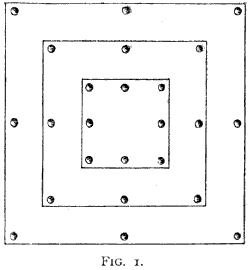
Each of the two players has nine wooden pegs, which are either coloured or shaped differently, and the object of each player is to get three of his own pegs in a straight line (fig. 1). It is called “Merrils.”—Sheffield (S. O. Addy).
Cotgrave’s Dictionarie, 1632, says: “Merelles, le jeu de merelles, the boyish game called merrils, or fiue-pennie morris. Played here most commonly with stones, but in France with pawns or men made of purpose, and termed merelles.” Strutt (Sports, p. 317) says: “This was why the game received this name. It was formerly called ‘Nine Men’s Morris’ and ‘Five-penny Morris,’ and is a game of some antiquity. It was certainly much used by the shepherds formerly, and continues to be used by them and other rustics to the present hour.” An illustration of the form of the merelle table and the lines upon it, as it appeared in the fourteenth century, is given by him, and he observes that the lines have not been varied. The black spots at every angle and intersection of the lines are the places for the men to be laid upon. The men are different in form and colour for distinction’s sake, and from the moving these men backwards and forwards, as though they were dancing a morris, I suppose the pastime received the name of “Nine Men’s Morris,” but why it should have been called “Five-penny Morris” I do not know. The manner of playing is briefly thus:—Two persons, having each of them nine pieces or men, lay them down alternately, one by one, upon the spots, and the business of either party is to prevent his antagonist from placing three of his pieces so as to form a row of three without the intervention of an opponent piece. If a row be formed, he that made it is at liberty to take up one of his competitor’s pieces from any part he thinks most to his own advantage, excepting he has made a row, which must not be touched, if he have another piece upon the board that is not a component part of that row. When all the pieces are laid down they are played backwards and forwards in any direction that the lines run, but can only move from one spot to another at one time. He that takes off all his antagonist’s pieces is the conqueror. The rustics, when they have not materials at hand to make a table, cut the lines in the same form upon the ground and make a small hole for every dot. They then collect stones of different forms or colours for the pieces, and play the game by depositing them in the holes in the same manner that they are set over the dots on the table. Hence Shakespeare, describing the effects of a wet and stormy season, says—
“The folds stand empty in the drowned field, And crows are fatted with the murrain flock— The Nine Men’s Morris is filled up with mud.”
—Midsummer Nights Dream, act ii. sc. 2.
Miss Baker (Northamptonshire Glossary), in describing “Merell” or “Morris,” says:—“On the inclosing of open fields this game was transferred to a board, and continues a fireside recreation of the agricultural labourer. It is often called by the name of ‘Mill’ or ‘Shepherd’s Mill.’” She says the mode of playing now observed is this. Each of the players has nine pieces, or men, differing in colour, or material, from his adversary, for distinction’s sake; which they lay down on the spots alternately, one by one, each endeavouring to prevent his opponent from placing three of his pieces in a line, as whichever does so is entitled to take off any one of his antagonist’s men where he pleases, without breaking a row of three, which must not be done whilst there is another man on the board. After all the pieces are placed on the board, they are moved alternately backwards and forwards along the lines; and as often as either of the players succeeds in accomplishing a row of three, he claims one of his antagonist’s men, which is placed in the pound (the centre), and he who takes the most pieces wins the game. It is played on a board whereon are marked three squares, one being denominated the pound. It is sometimes played with pegs, bits of paper, or wood, or stone. It is called “Peg Morris” by Clare, the Northamptonshire poet.
The ancient game of “Nine Men’s Morris” is yet played by the boys of Dorset. The boys of a cottage, near Dorchester, had a while ago carved a “Marrel” pound on a block of stone by the house. Some years ago a clergyman of one of the upper counties wrote that in the pulling down of a wall in his church, built in the thirteenth century, the workmen came to a block of stone with a “Marrel’s” pound cut on it. “Merrels” the game was called by a mason.—Barnes’ Additional Glossary; Folk-lore Journal, vii. 233.
“‘Nine Men’s Morris,’ in Gloucestershire called ‘Ninepenny Morris,’ was,” says a correspondent in the Midland Garner, “largely practised by boys and even older people over thirty years ago, but is now, as far as I know, entirely disused. Two persons play. Each must have twelve pegs, or twelve pieces of anything which can be distinguished. The Morris was usually marked on a board or stone with chalk, and consists of twenty-four points. The pegs are put down one at a time alternately upon any point upon the Morris, and the first person who makes a consecutive row of three impounds one of his opponent’s pegs. The pegs must only be moved on the lines. The game is continued until one or other of the players has only two pegs left, when the game is won” (1st ser., i. 20). Another correspondent in the same journal (ii. 2) says, “The game was very generally played in the midland counties under the name of ‘Merrilpeg’ or ‘Merelles.’ The twelve pieces I have never seen used, though I have often played with nine. We generally used marbles or draught pieces, and not pegs.”
The following are the accounts of this game given by the commentators on Shakespeare:—
“In that part of Warwickshire where Shakespeare was educated, and the neighbouring parts of Northamptonshire, the shepherds and other boys dig up the turf with their knives to represent a sort of imperfect chess-board. It consists of a square, sometimes only a foot diameter, sometimes three or four yards. Within this is another square, every side of which is parallel to the external square; and these squares are joined by lines drawn from each corner of both squares, and the middle of each line. One party, or player, has wooden pegs, the other stones, which they move in such a manner as to take up each other’s men, as they are called, and the area of the inner square is called the pound, in which the men taken up are impounded. These figures are by the country people called nine men’s morris, or merrils; and are so called because each party has nine men. These figures are always cut upon the green turf, or leys as they are called, or upon the grass at the end of ploughed lands, and in rainy seasons never fail to be choked up with mud” (Farmer). “Nine men’s morris is a game still played by the shepherds, cow-keepers, &c., in the midland counties, as follows:—A figure (of squares one within another) is made on the ground by cutting out the turf; and two persons take each nine stones, which they place by turns in the angles, and afterwards move alternately, as at chess or draughts. He who can play three in a straight line may then take off any one of his adversary’s, where he pleases, till one, having lost all his men, loses the game” (Alchorne).
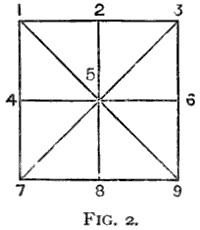
The following is the account of this game given by Mr. Douce in the Illustrations of Shakespeare and of Ancient Manners, 1807, i. 184:—“This game was sometimes called the nine mens merrils from merelles, or mereaux, an ancient French word for the jettons, or counters, with which it was played. The other term, morris, is probably a corruption suggested by the sort of dance which, in the progress of the game, the counters performed. In the French merelles each party had three counters only, which were to be placed in a line in order to win the game. It appears to have been the tremerel mentioned in an old fabliau. See Le Grand, Fabliaux et Contes, ii. 208. Dr. Hyde thinks the morris, or merrils, was known during the time that the Normans continued in possession of England, and that the name was afterwards corrupted into three men’s morals, or nine men’s morals. If this be true, the conversion of morrals into morris, a term so very familiar to the country people, was extremely natural. The Doctor adds, that it was likewise called nine-penny or nine-pin miracle, three-penny morris, five-penny morris, nine-penny morris, or three-pin, five-pin, and nine-pin morris, all corruptions of three-pin, &c., merels” (Hyde’s Hist. Nederluddi, p. 202). Nares says the simpler plan here represented (fig. 2), which he had also seen cut on small boards, is more like the game than the one referred to in the variorem notes of Shakespeare.
Forby has, “Morris, an ancient game, in very common modern use. In Shakespeare it is called ‘nine men’s morris,’ from its being played with nine men, as they were then, and still are called. We call it simply morris. Probably it took the name from a fancied resemblance to a dance, in the motions of the men. Dr. Johnson professes that he knew no more of it than that it was some rustic game. Another commentator speaks of it as common among shepherds’ boys in some parts of Warwickshire. It cannot well be more common there than here, and it is not particularly rustic. Shepherds’ boys and other clowns play it on the green turf, or on the bare ground; cutting or scratching the lines, on the one or the other. In either case it is soon filled up with mud in wet weather. In towns, porters and other labourers play it, at their leisure hours, on the flat pavement, tracing the figure with chalk. It is also a domestic game; and the figure is to be found on the back of some draught-boards. But to compare morris with that game, or with chess, seems absurd; as it has a very distant resemblance, if any at all, to either, in the lines, or in the rules of playing. On the ground, the men are pebbles, broken tiles, shells, or potsherds; on a table, the same as are used at draughts or backgammon. In Nares it is said to be the same as nine-holes. With us it is certainly different.” Cope (Hampshire Glossary) says that “Nine Men’s Morrice” is a game played with counters. He does not describe it further. Atkinson (Glossary of Cleveland Dialect) says under “Merls,” the game of “Merelles,” or “Nine Men’s Morris.” Toone (Etymological Dictionary) describes it as a game played on the green sward, holes being cut thereon, into which stones were placed by the players. Stead’s Holderness Glossary calls it “Merrils,” and describes it as a game played on a square board with eighteen pegs, nine on each side, called in many parts “Nine Men’s Morrice.” See also Sussex Arch. Collections, xxv. 234, and a paper by Mr. J. T. Micklethwaite (Arch. Journ., xlix. 322), where diagrams of this game are given which have been found cut in several places on the benches of the cloisters at Gloucester, Salisbury, and elsewhere.
See “Noughts and Crosses.”
Nip-srat-and-bite
A children’s game, in which nuts, pence, gingerbread, &c., are squandered.—Addy’s Sheffield Glossary.
Nitch, Notch, No-Notch
Children cut a number of slices from an apple, extending from the eye to the tail, broader on the outside than on the inner, which reaches nearly to the core; one piece has a part cut out, making a notch—this is called “Notch;” another is not cut at all—this is called “No-Notch;” while a third has an incision made on it, but not cut out—this is called “Nitch.” The pieces when thus marked are replaced, and the game consists in one child holding the apple, and pointing to one of the pieces, asking another child which he will have, “Nitch, Notch, or No-Notch;” if he guesses right, he has it and eats it; if wrong, the other eats it.—Sussex (Holloway’s Dict. of Provincialisms).
Not
A game where the parties, ranged on opposite sides, with each a bat in their hands, endeavour to strike a ball to opposite goals. The game is called “Not,” from the ball being made of a knotty piece of wood.—Gloucestershire (Holloway’s Dict. of Provincialisms).
See “Hawkey.”
Noughts and Crosses
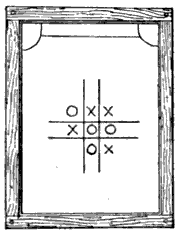
This game is played on slates by school-children. The accompanying diagram is drawn on the slate, and a certain figure (generally twenty) is agreed upon as “game.” There are two players, one takes noughts [O], the other crosses [X]. The three places drawn on the slate above the diagram are for the players each to put down marks or numbers for the games they win, the centre place being for “Old Nick,” or “Old Tom.” The object of the game is for each player to occupy three contiguous places in a row or line with either noughts or crosses, and to prevent his opponent from doing so. The diagram is of course empty when play begins. One player commences by putting his mark into either of the vacant places he prefers, the other player then places his in another, wherever he thinks he has the best opportunity to prevent his opponent getting a “three,” and at the same time to get a three himself; then the first player plays again, and so on alternately until all the squares are occupied, or until one of the players has a “three” in line. If neither player gets a “three,” the game is won by “Old Nick,” and one is scored to his name. In the diagram the result of the game is shown when won by “Old Nick.” Whichever player first wins a game adds “Old Nick’s” score to his own. In some games “Old Nick” keeps all he wins for himself, and then most frequently wins the game.—London (A. B. Gomme).
See “Corsicrown,” “Kit-Cat-Cannio,” “Nine Men’s Morris.”
Nur and Spel
A boys’ game in Lincolnshire, somewhat similar to “Trap Ball.” It is played with a “kibble,” a “nur,” and a “spell.” By striking the end of the spell with the kibble, the nur, of course, rises into the air, and the art of the game is to strike it with the kibble before it reaches the ground. He who drives it the greatest distance wins the game.—Halliwell’s Dictionary.
Strutt (Sports and Pastimes, p. 109) describes this game as “Northern-spell,” played with a trap, and the ball is stricken with a bat or bludgeon. The contest between the players is simply who shall strike the ball to the greatest distance in a given number of strokes. The length of each stroke is measured before the ball is returned, by means of a cord made fast at one end near the trap, the other being stretched into the field by a person stationed there for that purpose, who adjusts it to the ball wherever it may lie.
In a work entitled the Costumes of Yorkshire this game is described and represented as “Nor and Spell.” The little wooden ball used in this game is in Yorkshire called the “Nor,” and the receptacle in which it is placed the “Spell.” Peacock (Manley and Corringham Glossary) gives “knur,” (1) a hard wooden ball, (2) the head. Addy (Sheffield Glossary) says “knur” is a small round ball, less than a billiard ball. It is put into a cup fixed on a spring which, being touched, causes the ball to rise into the air, when it is struck by a trip-stick, a slender stick made broad and flat at one end. The “knur” is struck by the broad part. The game is played on Shrove Tuesday. Brogden (Provincial Words of Lincolnshire) gives it under “Bandy.” It is called “Knur, Spell, and Kibble” in S.-W. Lincolnshire.—Cole’s Glossary.
The following letter relating to this game is extracted from the Worcestershire Chronicle, September 1847, in Ellis’s edition of Brand:—“Before the commons were taken in, the children of the poor had ample space wherein to recreate themselves at cricket, nurr, or any other diversion; but now they are driven from every green spot, and in Bromsgrove here, the nailor boys, from the force of circumstances, have taken possession of the turnpike road to play the before-mentioned games, to the serious inconvenience of the passengers, one of whom, a woman, was yesterday knocked down by a nurr which struck her in the head.”
Brockett says of this game, as played in Durham: It is called “Spell and Ore,” Teut. “spel,” a play or sport; and Germ. “knorr,” a knot of wood or ore. The recreation is also called “Buckstick, Spell, and Ore,” the buckstick with which the ore is struck being broad at one end like the butt of a gun (North Country Words). In Yorkshire it is “Spell and Nurr,” or “Knur,” the ore or wooden ball having been, perhaps, originally the knurl or knot of a tree. The Whitby Glossary also gives this as “Spell and Knor,” and says it is known in the South as “Dab and Stick.” The author adds, “May not ‘tribbit,’ or ‘trevit,’ be a corruption of ‘three feet,’ the required length of the stick for pliable adaptation?”
Robinson (Mid-Yorkshire Glossary), under “Spell and Nur,” says: “A game played with a wooden ball and a stick fitted at the striking end with a club-shaped piece of wood. The ’spell’ made to receive and spring the ball for the blow at a touch, is a simple contrivance of wood an inch or so in breadth and a few inches long. . . . The players, who usually go in and out by turns each time, after a preliminary series of tippings of the spell with the stick in one hand, and catches of the ball with the other, in the process of calculating the momentum necessary for reach of hand, are also allowed two trial ‘rises’ in a striking attitude, and distance is reckoned by scores of yards. The long pliable stick, with a loose club end, used in the game, is called the ‘tribit’ or ‘trivit’ stick. . . . The trevit is, in fact, the trap itself, and the trevit-stick the stick with which the trap is struck.” The tribbit-stick is elsewhere called “primstick,” “gelstick,” “buckstick,” “trippit,” and “trevit.” Atkinson says that “spell” is O.N., “spill” meaning a play or game, and the probability is that the game is a lineal descendant from the Ball-play of the Old Danes, or Northmen, and Icelanders. “Spell and knor” is a corruption of “spell a’ knor,” the play at ball. Nurspel is simply ball-play, therefore which name, taken in connection with the fact that the game is elsewhere called “Spell and Knor,” and not “Knor and Spell,” is significant. There is one day in the year, Shrove Tuesday, when the play is customarily practised, though not quite exclusively.—Atkinson’s Cleveland Glossary.
Easther (Almondbury Glossary) describes it as played with a wooden ball, a spel, and a pommel. Two may play, or two sides. When a player goes in he drives the knor for, say, 100 yards, i.e., five score, and he reckons five. Each person has the same number of strokes previously agreed upon, but generally only one innings. The “spell” is a kind of stage with three or four feet, to drive it into the ground. On the top of this stage is a spring made of steel, containing a cup to receive the “knor,” which is about one or two inches in diameter, and is made of holly or box. The spring is kept down by a sneck, which is tapped by the pommel when the knor is intended to be struck. The pommel is thus formed—the driving part is frequently of ash-root or owler, in shape like half a sugar-loaf split lengthwise, but only three or four inches long, and the handle is of ash, wrapped with a wax band where held, which is in one hand only.
See “Kibel and Nerspel,” “Trap Ball,” “Trippit and Coit.”
Nuts in May
[Play]
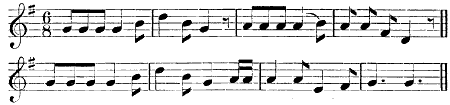
—Shropshire (Miss Burne).
I.
Here we come gathering nuts in May, Nuts in May, nuts in May, Here we come gathering nuts in May, On a fine summer morning. Whom will you have for nuts in May, Nuts in May, nuts in May? Whom will you have for nuts in May, On a fine summer morning? We’ll have —— for nuts in May, Nuts in May, nuts in May, We’ll have —— for nuts in May, On a fine summer morning. Who will you send to fetch her [or him] away, To fetch her away, to fetch her away? Who will you send to fetch her away, On a fine summer morning? We’ll send —— to fetch her away, Fetch her away, fetch her away, We’ll send —— to fetch her away, On a fine summer morning.
—Liphook and Winterton, Hants (Miss Fowler).
II.
Here we come gathering nuts and May [Nuts and May, nuts and May], Here we come gathering nuts and May, On a cold and frosty morning. Pray who will you gather for nuts and May, Pray who will you gather for nuts and May, On a cold and frosty morning? We’ll gather —— for nuts and May, We’ll gather —— for nuts and May, On a cold and frosty morning. Pray who will you send to take her away, Pray who will you send to take her away, On a cold and frosty morning? We’ll send —— to take her away, We’ll send —— to take her away, On a cold and frosty morning.
—Penzance (Mrs. Mabbott).
III.
Here we come gathering nuts in May, Nuts in May, nuts in May, Here we come gathering nuts in May, May, May, May. Who will you have for nuts in May, Nuts in May, nuts in May? Who will you have for nuts in May, May, May, May? [Bessie Stewart] for nuts in May, Nuts in May, nuts in May, [Bessie Stewart] for nuts in May, May, May, May. Very well, very well, so you may, So you may, so you may, Very well, very well, so you may, May, may, may. Whom will you have to take her away, Take her away, take her away? Whom will you have to take her away, Way, way, way? —— —— to take her away, Take her away, take her away, —— —— to take her away, Way, way, way.
—Belfast (W. H. Patterson).
IV.
Here we come gathering nuts in May, Nuts in May, nuts in May, Here we come gathering nuts in May, On a cold and frosty morning. Where do you gather your nuts in May? On Galloway Hill we gather our nuts. Who will you gather for nuts in May? We’ll gather —— for nuts in May. Who will you send to fetch her away? We’ll send —— to fetch her away.
—Bocking, Essex (Folk-lore Record, iii. 169).
V.
Here we go gathering nuts away, Nuts away, nuts away, Here we go gathering nuts away, On a cold and frosty morning.
[Then follow verses beginning—]
Whose nuts shall we gather away? We’ll gather [Minnie Brown’s] nuts away. Whom shall we send to fetch them away?
[And the final verse is—]
We’ll send [Johnny Cope] to fetch them away, Fetch them away, fetch them away, We’ll send [Johnny Cope] to fetch them away, On a cold and frosty morning.
—Newbury, Berks (Mrs. S. Batson).
VI.
Who will go gathering nuts in May, Nuts in May, nuts in May? Who will go gathering nuts in May, At five o’clock in the morning?
—N.-W. Lincolnshire (Rev. —— Roberts).
VII.
Here we come gathering nuts in May, Nuts in May, nuts in May, Here we come gathering nuts in May, On a cold and frosty morning. Who will you have for your nuts in May, Nuts in May, nuts in May? Who will you have for your nuts in May, On a cold and frosty morning? We will have a girl for nuts in May, Nuts in May, nuts in May, We will have a girl for nuts in May, On a cold and frosty morning.
—Earls Heaton, Yorks. (Herbert Hardy).
VIII.
Here we come gathering nuts in May, Nuts in May, nuts in May, Here we come gathering nuts in May, This cold frosty morning. Who will you have for your nuts in May, Nuts in May, nuts in May? Who will you have for your nuts in May, This cold frosty morning? We will have —— for our nuts in May, Nuts in May, nuts in May, We will have —— for our nuts in May, This cold frosty morning. Who will you have to pull her away, Pull her away, pull her away? Who will you have to pull her away, This cold frosty morning? We will have —— to pull her away, Pull her away, pull her away, We will have —— to pull her away, This cold frosty morning.
—Settle, Yorks. (Rev. W. S. Sykes).
IX.
Here we come gathering nuts to-day, Nuts to-day, nuts to-day, Here we come gathering nuts to-day, So early in the morning. Pray, whose nuts will you gather away, Gather away, gather away? Pray, whose nuts will you gather away, So early in the morning? We’ll gather Miss A——’s nuts away, Nuts away, nuts away, We’ll gather Miss A——’s nuts away, So early in the morning. Pray, who will you send to take them away, To take them away, take them away? Pray, who will you send to take them away, So early in the morning? We’ll send Miss B—— to take them away, To take them away, take them away, We’ll send Miss B—— to take them away, So early in the morning.
—Symondsbury, Dorsetshire (Folk-lore Journal, vii. 226-7).
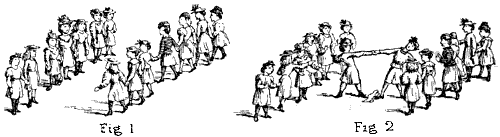
(b) The children form in two lines of equal length, facing one another, with sufficient space between the lines to admit of their walking in line backwards and forwards towards and away from each other, as each line sings the verses allotted to it (fig. 1). The first line sings the first, third, and fifth verses, and the opposite line the second and fourth. At the end of the fifth verse a handkerchief or other mark is laid on the ground, and the two children (whose names have been mentioned, and who are as evenly matched as possible), take each other’s right hand and endeavour to pull each other over the handkerchief to their own side (fig. 2). The child who is pulled over the handkerchief becomes the “captured nut,” and joins the side of her capturers. Then the game begins again by the second line singing the first, third, and fifth verses, while advancing to gather or capture the “nuts,” the first line responding with the second and fourth verses, and the same finish as before. Then the first line begins the game, and so on until all the children are in this way matched one against the other.
(c) Other versions have been sent me, with slight variations: Nuts in May, with the verses ending, “On a fine summer morning,” from Lincoln and Nottinghamshire (Miss M. Peacock); “So early in the morning,” Sporle, Norfolk (Miss Matthews); “Six o’clock in the morning,” Nottingham (Miss Wenfield); “On a cold and frosty morning,” East Kirkby, Lincolnshire (Miss K. Maughan); Barnes (A. B. Gomme), Colchester (Miss G. M. Frances). Nuts and May: “On a bright and sunny morning” (Mr. C. C. Bell); “On a cold and frosty morning,” Forest of Dean (Miss Matthews); “Every night and morning,” Gainford, Durham (Miss Edleston); “We’ve picked [Sally Gray] for nuts in May,” “All on a summer’s morning,” Sheffield (Mr. S. O. Addy). A version by Miss Kimber (Newbury, Berks, and Marlborough, Wilts) ends each verse, “Nuts and May.” In other respects these variants are practically the same. Printed versions not given above are Hersham, Surrey (Folk-lore Record, v. 85); Burne’s Shropshire Folk-lore, p. 516; Sulhampstead, Berks (Antiquary, vol. xxvii., Miss E. E. Thoyts); and Dorsetshire, “Gathering nuts away” (Folk-lore Journal, vii. 225). From Longcot, Berks, a version sent me by Miss I. Barclay has no fourth line to the verses.
(d) This game is probably, unless we except “Mulberry Bush,” the most popular and the most widely played of any singing game. It might almost be called universal. This is shown by the fact that there are few counties where it is not known, and also that important variants, either in the words or in the method of playing, are rarely met with. In all the versions which have been sent there are only the following variations in the words, and these are principally in the refrain, or last line of each verse: “On a cold and frosty morning” ends by far the greater number of versions; “On a fine summer’s morning,” “So early in the morning,” “All on a summer’s morning,” “Five o’clock in the morning,” “On a cold and sunny morning,” coming next in number. The Belfast version ends, “May! May! May!” and a Newbury and Marlborough fourth line is simply a repetition of the second, “Nuts in May, nuts in May.”
In the first line of the verse the only important variant seems to be the Symondsbury “Gathering nuts away” and “Gathering nuts to-day.” “Gathering nuts away” also occurs in one version from Newbury (Berks), “Nuts and May” appearing in the larger number after the more usual “Nuts in May.” In only one version is a specific place mentioned for the gathering. This is in the Bocking version, where Galloway Hill is named, in reply to the unusual question, “Where do you gather your nuts in May?” A player is usually gathered for “Nuts in May.” In three or four cases only is this altered to gathering a player’s “nuts away,” which is obviously an alteration to try and make the action coincide exactly with the words. The game is always played in “lines,” and the principal incidents running throughout all the versions are the same, i.e., one player is selected by one line of players from their opponents’ party. The “selected” one is refused by her party unless some one from the opposite side can effect her capture by a contest of strength. In all versions but two or three this contest takes place between the two; in one or two all the players join in the trial of strength. In another instance there appears to be no contest, but the selected player crosses over to the opposite side. Two important incidents occur in the Bocking and Symondsbury versions. In the Bocking game the side which is victorious has the right to begin the next game first: this also occurs in the Barnes version. In Symondsbury, when one child is drawn over the boundary line by one from the opposite side she has to be “crowned” immediately. This is done by the conqueror putting her hand on the captured one’s head. If this is not done at once the captured one is at liberty to return to her own side. In some versions (Shropshire and London) the player who is selected for “Nuts” is always captured by the one sent to fetch her. Some Barnes children also say that this is the proper way to play. When boys and girls play the boys are always sent to “fetch away” the girls. In Sheffield (a version collected by Mr. S. O. Addy) a boy is chosen to fetch the girl away; and in the Earls Heaton version the line runs, “We’ll have a girl for nuts in May.”
(e) There is some analogy in the game to marriage by capture, and to the marriage customs practised at May Day festivals and gatherings. For the evidence for marriage by capture in the game there is no element of love or courtship, though there is the obtaining possession of a member of an opposing party. But it differs from ordinary contest-games in the fact that one party does not wage war against another party for possession of a particular piece of ground, but individual against individual for the possession of an individual. That the player sent to fetch the selected girl is expected to conquer seems to be implied—first, by a choice of a certain player being made to effect the capture; secondly, by the one sent “to fetch” being always successful; and thirdly, the “crowning” in the Symondsbury game. Through all the games I have seen played this idea seems to run, and it exactly accords with the conception of marriage by capture. For examples of the actual survivals in English, Scottish, Welsh, and Irish customs of marriage by capture see Gomme’s Folk-lore Relics of Early Village Life, pp. 204-210.
The question is, How does this theory of the origin of the game fit in with the term “Nuts in May”? I attribute this to the gathering by parties of young men of bunches of May at the May festivals and dances, to decorate not only the Maypole, May “kissing-bush,” but the doors of houses. “Knots of May” is a term used by children, meaning bunches of May. Thus, a note by Miss Fowler in the MS. of the games she had collected says, “In Bucks the children speak of ‘knots of May,’ meaning each little bunch of hawthorn blossom.” The gathering of bunches of May by parties of young men and maidens to make the May-bush round which the May Day games were held, and dancing and courting, is mentioned by Wilde (Irish Popular Superstitions, p. 52), the game being “Dance in the Ring.” Holland (Cheshire Glossary) says, “May birches were branches of different kinds of trees fastened over doors of houses and on the chimney on the eve of May Day. They were fastened up by parties of young men who went round for the purpose, and were intended to be symbolical of the character of the inmates.” I remember one May Day in London, when the “May girls” came with a garland and short sticks decorated with green and bunches of flowers, they sang—
Knots of May we’ve brought you, Before your door it stands; It is but a sprout, but it’s well budded out By the work of the Lord’s hands,
and a Miss Spencer, who lived near Hampton (Middlesex), told me that she well remembered the May girls singing the first verse of this carol, using “knots” instead of the more usual word “branch” or “bunch,” and that she knew the small bunch of May blossom by the name of “knots” of May, “bringing in knots of May” being a usual expression of children.
The association of May—whether the month, or the flower, or both—with the game is very strong, the refrain “cold and frosty morning,” “all on a summer’s morning,” “bright summer’s morning,” “so early in the morning,” also being characteristic of the early days of May and spring, and suggests that the whole day from early hours is given up to holiday. The familiar nursery rhyme given by Halliwell—
Here we come a-piping, First in spring and then in May,
no doubt also refers to house-to-house visiting of May.
The connection between the May festival and survival in custom of marriage by capture is well illustrated by a passage from Stubbe’s Anatomie of Abuses, p. 148. He says: “Against May Day, Whitsonday, or other time, euery Parishe, Towne and Village assemble themselves together, bothe men women and children, olde and yong, . . . and either goyng all together or diuidyng themselues into companies, they goe some to the Woodes and groves where they spend all the night in plesant pastimes; and in the morning they return bringing with them birch and branches of trees to deck their assemblies withall . . . and then they fall to daunce about it like as the heathen people did. . . . I have heard it credibly reported (and that viva voce) by men of great grauitie and reputation, that of fortie, threescore or a hundred maides going to the wood ouer night, there haue scaresly the third part of them returned home againe undefiled.” Herrick’s Hesperides also describes the festival, and the custom of courting and marriage at the same time.
The tune sung to this game appears to be the same in every version.[Addendum]
END OF VOL. I.
BALLANTYNE PRESS PRINTED BY BALLANTYNE, HANSON AND CO. EDINBURGH AND LONDON