CHILDREN’S GAMES. (continued 6)
Reading edition
—Colchester (from Miss G. M. Frances, Colchester, through Miss Morris).
IX.
We’ve come to see Jenny Jones, Jenny Jones, We’ve come to see Jenny Jones. How is she now? Jenny is washing, washing, washing, Jenny is washing, you can’t see her now.
[Then follow the alternate question and answer; the questions in the same words as the first verse, and the answers in the same form as the second verse, stating that Jenny is
(1) folding,
(2) starching,
(3) ironing,
(4) ill,
(5) dying,
(6) dead;
then the verses proceed with—]
May we come to the funeral? Yes. May we come in red? Red is for soldiers, you can’t come in red. May we come in blue? Blue is for sailors, you can’t come in blue. May we come in white? White is for weddings, you can’t come in white. May we come in black? Black is for funerals, so you can come in that.
—Bocking, Essex (Folk-lore Record, iii. 471).
X.
I come to see poor Jenny Joe, Jenny Joe, Jenny Joe, I come to see poor Jenny Joe, And how is she now? She’s washing, she’s washing, And you can’t see her now. Very well, ladies, ladies, ladies, Very well, ladies, and gentlemen too. I come to see poor Jenny Joe, Jenny Joe, Jenny Joe, I come to see poor Jenny Joe, And how is she now? She’s folding, she’s folding, And you can’t see her now. Very well, ladies, ladies, ladies, Very well, ladies, and gentlemen too. I come to see poor Jenny Joe, Jenny Joe, Jenny Joe, I come to see poor Jenny Joe, And how is she now? She’s ironing, she’s ironing, And you can’t see her now. Very well, ladies, ladies, ladies, Very well, ladies, and gentlemen too.
[Then follow alternate questions and answers in the same manner for—
(1) dying,
(2) dead.
Then—]
I come in my white dress, white dress, white dress, I come in my white dress, and how will that do? White is for wedding, wedding, wedding, White is for wedding, and that won’t do. Very well, ladies, ladies, ladies, Very well, ladies, and gentlemen too. I come in my blue dress, blue dress, blue dress, I come in my blue dress, and how will that do? Blue is for sailors, sailors, sailors, Blue is for sailors, and that won’t do.
[Then follow verses as before, beginning—
Very well, ladies. I come in my red dress. Red is for soldiers, Very well, ladies.
Then—]
I come in my black dress, black dress, black dress, I come in my black dress, and how will that do? Black is for funeral, And that will do To carry poor Jenny to the grave.
—Sporle, Norfolk (Miss Matthews).
XI.
We’re come to see Jenny Jones, Jenny Jones, Jenny Jones, Come to see Jenny Jones, how is she now? Jenny is a-washing, a-washing, a-washing, Jenny is a-washing, you can’t see her now. Very well, ladies, very well, ladies, Very well, ladies, we can’t see her now.
[Then follow the same verses for—
(1) ironing,
(2) badly,
(3) dead;
And the singing proceeds with—]
Please, will white do, white do, white do? Please, will white do, please, will it do? White’s for the weddingers, the weddingers, White’s for the weddingers, that won’t do. Please, will blue do, blue do, blue do? Please, will blue do, please will it do?
[Then follow verses as before, beginning—
Blue’s for the sailors, the sailors, the sailors. Please, will red do, red do? Red’s for the soldiers.
Then—]
Please, will black do, black do, black do? Black’s for the funeral, black will do.
—Northamptonshire (Rev. W. D. Sweeting).
XII.
I’ve come to see how Jenny Jones is to-day. You can’t see her, she’s washing. I’ve come to see how Jenny Jones is to-day. You can’t see her, she’s ironing [she’s starching, she’s brewing, she’s baking, successively]. I’ve come to see how Jenny Jones is to-day. You can’t see her, she’s ill [then she’s worse]. I’ve come to see how Jenny Jones is to-day. You can’t see her, she’s dead!
Chorus.
There’s red for the soldiers, Blue for the sailors, White for the angels [for the baby, Chirbury], And black for the mourners [of poor Jenny Jones].
—Berrington, Chirbury (Shropshire Folk-lore, p. 577).
XIII.
We’ve come to see poor Jenny Jones. Poor Jenny Jones is washing, you can’t see her. We’ve come to see poor Jenny Jones. Poor Jenny Jones is drying, you can’t see her. We’ve come to see poor Jenny Jones. Poor Jenny Jones is starching, you can’t see her. We’ve come to see poor Jenny Jones. Poor Jenny Jones is ironing, you can’t see her. We’ve come to see poor Jenny Jones. Poor Jenny Jones is dead, you can’t see her. What shall we follow, in red, blue, or black? Red’s for the soldier, blue for the sailor, Black for the dead.
—Enborne School, Berks (Miss M. Kimber).
XIV.
Come to see Miss Jenny Jones, Miss Jenny Jones, Miss Jenny Jones; Come to see Miss Jenny Jones, And how is she to-day? Miss Jenny Jones is washing, washing, washing, Miss Jenny Jones is washing, You can’t see her to-day. Farewell, ladies, ladies, ladies, and gentlemen too.
[Miss Jenny Jones is drying, starching, ironing, ill, worse, dying, and dead in turn. Then—]
What shall we dress her in, Dress her in, dress her in? What shall we dress her in, Dress her in red? Red’s what the soldiers wear, The soldiers wear, the soldiers wear, Red’s what the soldiers wear, And that won’t do. What shall we dress her in, Dress her in, dress her in? What shall we dress her in, Dress her in blue? Blue’s what the sailors wear, Sailors wear, sailors wear; Blue’s what the sailors wear, And that won’t do. What shall we dress her in, Dress her in, dress her in? What shall we dress her in, Dress her in black? Black’s what the mourners wear, The mourners wear, the mourners wear; Black’s what the mourners wear, And that won’t do. What shall we dress her in, Dress her in, dress her in? What shall we dress her in, Dress her in white? White’s what the dead wear, The dead wear, the dead wear; White’s what the dead wear, And that will do.
—Liphook, Hants (Miss Fowler).
XV.
Come to see Jinny Jones, Jinny Jones Come to see Jinny Jones, And where is she now? Jinny is washing, is washing, Jinny is washing, And you can’t see her now. Very well, very well, lady, lady, Very well, lady, That will do.
[Then follow—
(1) starching,
(2) ironing,
(3) dying,
(4) dead.]
What shall we follow in, follow in? What shall we follow in? We’ll follow in blue. Blue is for sailors, for sailors, Blue is for sailors, And that won’t do. [or, You can’t follow her so.]
[Then follow—
Red is for soldiers, White is for weddings, Yellow is for babies.] Black is not deep enough, deep enough, That won’t do. What shall we follow in, follow in? We’ll follow her in crape, crape [pronounced cray-ape]. You may follow her in crape, crape, You may follow her in crape, That will do.
—Deptford (Miss E. Chase).
XVI.
I’ve come to see Georgina, Georgina, Georgina, I’ve come to see Georgina, how’s she to-day? She’s upstairs washing, washing, washing, She’s upstairs washing, and can’t get away. O very well, ladies, ladies, ladies, We’ll come another day. We’ve come to see Georgina, Georgina, Georgina, We’ve come to see Georgina, how’s she to-day? She’s upstairs ironing, ironing, ironing, She’s upstairs ironing, and can’t get away.
[Then the two verses are repeated—
O very well, ladies. We’ve come to see Georgina.
Then follows—]
She was coming downstairs with a basin of water, and she fell down and broke her toe, and she’s dead. And what shall we dress her in, dress her in, dress her in? And what shall we dress her in? Dress her in red. Red for the soldiers, soldiers, soldiers, Red for the soldiers, and that shan’t do.
[Then follow blue for the sailors, black for the mourners, and finally—]
What shall we dress her in, dress her in, dress her in? What shall we dress her in? Dress her in white. White for the dead people, dead people, dead people, White for the dead people, and that will do.
—Auchencairn, Kirkcudbright (A. C. Haddon).
XVII.
How’s poor Jenny jo, Jenny jo, Jenny jo? He’s very ill. Oh, very good, very good, very good. How’s poor Jenny jo, Jenny jo, Jenny jo? He’s fallen downstairs and broken his neck. Oh, very good, very good, very good. How’s poor Jenny jo, Jenny jo, Jenny jo? He’s dead. Oh, very good, very good, very good.
—Annaverna, Louth, Ireland (Miss R. Stephen).
(b) Two children stand apart; one, who personates the Mother, stands still and holds out her skirts with both hands; the other personates Jenny Jones, and kneels or stoops down in a crouching position behind her companion’s outstretched skirts. The other players form a line by joining hands. They sing the first, third, and every alternate verse, advancing and retiring in line while doing so. The Mother sings the answers to their questions, standing still and hiding Jenny Jones all the time from view. When the verses are finished, Jenny Jones lies down as if she were dead, and the Mother stands aside. Two of the other players then take up Jenny Jones, one by the shoulders and the other by the feet, and carry her a little distance off, where they lay her on the ground. All the players follow, generally two by two, with their handkerchiefs at their eyes and heads lowered, pretending to grieve.
This is the more general way of playing the game. In those versions where the reply, “Very well, ladies,” occurs, this is sung by the line of children just before they sing, “We’ve come to see Jenny Jones.” Sometimes, as in the Berrington and Chirbury game, two lines of children facing each other advance and retire, singing the verses. They then carry Jenny Jones to a corner, lay her down, stand in a circle round, and sing to her the last verse. In the Hants versions sent by Miss Mendham, six or eight children carry Jenny stretched out and flat, lay her down, cover her over, and then sing the last lines. The rest of the children follow them. In the Irish (Belfast) version the game is played in the same way; the funeral is arranged, when Jenny suddenly comes to life again (W. H. Patterson). In the Southampton version, after the carrying of Jenny by her head and feet to the grave, and the other children following and standing round, Jenny Jones rises up and pursues the children. She is called the Ghost. The children run away in affected terror, calling out, “The Ghost!” Whoever she catches becomes Jenny Jones in the next game. This incident is also played in the Barnes, Northants, Annaverna, co. Louth, Enborne and Liphook versions.
(c) This game is played very generally throughout the country, and I have other versions collected from Earls Heaton (Mr. H. Hardy), Barnes (A. B. Gomme), Cambridge (Mrs. Haddon), Hampshire (Miss Mendham), Frodingham (Miss Peacock), Cowes, Isle of Wight (Miss E. Smith), Sulhampstead, Berks (Miss Thoyts), and Platt, Kent (Miss Burne). These versions are so similar to the Hanwell version, with the exception of the “Very well, ladies,” that it is needless to print them in full; special differences are noted hereafter. In some places the game is said in a sing-song manner.
Some of the versions differ from the general type in two ways—first, in the method of playing; secondly, in the wording of the verses. The differences in the method of playing direct attention to the connection of the game with ancient custom. The game is always played by the players taking sides; but one method is for one side to consist of only two children (Mother and Jenny Jones), and the other side to consist of all the other players; while the other method is for the players to be divided into two sides of about equal numbers, each side advancing and retiring in line when singing their part. Jenny Jones in some cases walks with the girls in her line until the funeral, when she is carried to the grave, and in others she stands alone behind the line. The way of performing the funeral also differs. Generally two of the players carry Jenny to the grave, the rest following two by two; but in one Hampshire version six or eight children carry Jenny, stretched out and flat, to the grave, and cover her over; in Holywood, co. Down, she is carried sitting on the crossed hands of two players; while in some versions no funeral is apparently performed, the words only being sung. Another significant incident is the Ghost. An additional incident occurs in the Liphook version, which represents her being “swung to life again” by two of the players.
These differences may perhaps be immaterial to the meaning and origin of the game, but they are sufficiently indicative of early custom to suggest the divergence of the game in modern times towards modern custom. Thus the players divided line-by-line follow the general form for children playing singing games, and it would therefore suggest itself as the earlier form for this game. The change of the game from the line-by-line action to the mother-and-line action would indicate a corresponding change in the prevailing custom which influenced the game. This custom was the wooing by a band of suitors of girls surrounded by their fellow-villagers, which became obsolete in favour of ordinary marriage custom. The dropping out of this custom would cause the game to change from a representation of both wooing and burial to one of burial only. As burial only the mother-and-line action is sufficient, but the presence of a wooing incident in the earlier form of the game is plainly revealed by the verse which sings, “Fare ye well, ladies,” or, as it has become in the English variant, “Very well, ladies.”
The difference in the wording of the versions is slight, and does not need formal analysis. Domestic occupation is shown throughout, washing and its attendants, drying, folding, starching and ironing being by far the most numerous, brewing, and baking only occurring in one. Illness, dying, and death are the usual forms for the later verses, but illness and dying are lost in several versions. The choosing of colours is in some versions not for the mourners but for the dead maiden, and in these cases (six) white is the colour chosen, for “white’s what the dead wear.”
This question of colours for the dead is a very important one. The dressing of the dead body of a maiden in white by her girl companions, and the carrying of the body by them to the grave, are known village customs, the whole village being invited to the funeral. The rising of the dead lover, and the belief that excessive mourning over a loved one disturbs his or her rest in the grave, thus causing the dead to rise and speak, are shown in old ballads; the belief that spirits of the dead haunt churchyards and places of their former abode may also be adduced in illustration of the ghost incident.
(d) The methods of playing, and the incidents revealed by the verses sung, show that this is perhaps the most realistic of all the singing games, the daily occupation, the illness, death, and burial being portrayed, first, in the words of the rhymes, and secondly, by the accompanying action. The Scottish versions make the opening incident that of a lover coming to the house of the loved one, then proceed to the domestic occupation, and finally to the death incident; while the English versions give the idea of village friends calling upon a favourite companion, and subsequently attending her funeral. That the former is the older of the two versions is confirmed by the great probability of the name “Jenny Jones” being a degraded form of “Janet jo.” There is some evidence for this. The Sporle version gives it as “Jenny Joe,” which is clearly a misunderstood rendering of “Jenny jo.” The corruption of this into “Jenny Jones” is exactly what might be expected from modern English ignorance of the pretty meaning of the word jo, “dear;” and to what lengths this corruption may proceed under such influences may be seen by versions from Earls Heaton, where we have “Jingy Jog;” Leeds, where we get “Jilly Jog;” and the Edinburgh version, where we have “Georgina.”
This would be an argument for the Scottish home of the rhymes, and for the direct borrowing of the name from Scotland by the English villagers. In furtherance of this view the following passage from Chambers may be quoted:—
In the Stewartry of Kirkcudbright, “Janet Jo” is a dramatic entertainment amongst young rustics. Suppose a party has met in a harvest or winter evening round a good peat fire, and it is resolved to have “Janet Jo” performed. Two undertake to personate a goodman and a goodwife; the rest a family of marriageable daughters. One of the lads, the best singer of the party, retires, and equips himself in a dress proper for representing an old bachelor in search of a wife. He comes in, bonnet in hand, bowing, and sings—
Guid e’en to ye, maidens a’, Maidens a’, maidens a’, Guid e’en to ye, maidens a’, Be ye or no. I’m come to court Janet jo, Janet jo, Janet jo, I’m come to court Janet jo, Janet, my jo. Goodwife sings— What’ll ye gie for Janet jo, Janet jo, Janet jo? What’ll ye gie for Janet jo, Janet, my jo? Wooer— I’ll gie ye a peck o’ siller, A peck o’ siller, peck o’ siller, I’ll gie ye a peck o’ siller, For Janet, my jo. Goodwife says— Gae awa’, ye auld carle! Then sings— Ye’se never get Janet jo, Janet jo, Janet jo, Ye’se never get Janet jo, Janet, my jo.
The wooer hereupon retires, singing a verse expressive of mortification, but soon re-enters with a reassured air, singing—
I’ll gie ye a peck o’ gowd, A peck o’ gowd, a peck o’ gowd, I’ll gie ye a peck o’ gowd, For Janet, my jo.
The matron gives him a rebuff as before, and he again retires discomfited, and again enters, singing an offer of “twa pecks o’ gowd,” which, however, is also refused. At his next entry he offers “three pecks o’ gowd,” at which the good wife brightens up and sings—
Come ben beside Janet jo, Janet jo, Janet jo, Ye’re welcome to Janet jo, Janet, my jo.
The suitor then advances gaily to his sweetheart, and the affair ends in a scramble for kisses.—Popular Rhymes, pp. 141, 142.
On the other hand, it must not be overlooked that this game-drama and the game of “Janet Jo” have no connection beyond the name of the heroine and the wooing incident; so that the borrowing, if borrowing there be, might have been by Scotland, who improved the commonplace “Jenny Jones” into the pretty sweetness of her Scottish namesake. The Scottish version of the game leaves out the question of the colours for mourning, but, on the other hand, it contains the very important incident of the restoration of the dead. Chambers (Popular Rhymes, p. 141) suggests that this incident was introduced for the purpose of beginning the game again, but this seems extremely doubtful, in consideration of the Liphook variant, in which Miss Fowler says, “It is no uncommon thing for ‘Jenny Jones’ to be swung into life again;” and the still more significant Southampton version, where “‘Jenny Jones’ appears in the character of the Ghost, and scatters and pursues the surrounding mourners.” This detail is also used by the Northants and Barnes children, the version of whose game is very like the Southampton one. On the whole, the analysis would suggest that there has been a game played by the children of both England and Scotland, the leading incidents of which have been varied in accordance with the conditions of life. Mr. Napier (Folk-lore Record, iv. 474), in his description of the West Scotland example, evidently considered the game to be thoroughly representative of Scottish life, and this, indeed, seems to be the most striking feature of the game in all the variants. The domestic economy which they reveal is in no case out of keeping with the known facts of everyday peasant life, and many a mother has denied to her child’s friends the companionship they desired because of the work to be done.
In most cases the burden of the song rests upon the question of health, but in two cases, namely, Colchester and Deptford, the question is put as to where “Jenny Jones” is at the time of the visit. It is curious that the refrain of “Farewell, ladies,” should appear in such widely separated districts as Scotland, Northamptonshire, Norfolk, Middlesex, Hants, Lincoln, and Barnes.
With reference to the colours for mourning, there is an obvious addition of crape introduced into the Deptford version which is very suggestive of the decadence going on. The four colours used in most versions are red, blue, white, and black, colours which have been known to the people from ancient times. Black is accepted as the correct colour in all versions except five, where white is declared to be the colour which the dead wear. The method of question and answer is adopted for all the rhyme-movements. The tune of the game, with but slight variation, in all the versions is the same as that given from Platt, near Wrotham, except the two which are printed from Northants and Belfast.[Addendum]
Jenny Mac
Jenny Mac, Jenny Mac, Jenny Macghie, Turn your back about to me; And if you find an ill baubee, Lift it up and gie’t to me.
Two girls cross their arms behind their backs, and thus taking hold of each other’s hands, parade along together, by daylight or moonlight, occasionally turning upon their arms, as indicated in the rhyme. Another rhyme for this amusement is—
A basket, a basket, a bonny penny basket, A penny to you, and a penny to me, Turn about the basket.
—Chambers’s Popular Rhymes; p. 123.
See “Basket.”
Jib-Job-Jeremiah
An undescribed Suffolk game.—Moor’s Suffolk Words, p. 238.
Jiddy-cum-jiddy
A northern name for “See Saw.”
Jingle-the-bonnet
A game in which two or more put a halfpenny each, or any piece of coin, into a cap or bonnet. After jingling or shaking them together, they are thrown on the ground; and he who has most heads when it is his turn to jingle, gains the stakes which were put into the bonnet.—Jamieson.
Halliwell (Dictionary) says this is a northern name for the game of “Shake Cap,” and Brockett (North Country Words) speaks of it as a game much practised among the young pitmen and keelmen.
Jingo-ring
Here we go by jingo-ring, jingo-ring, jingo-ring, Here we go by jingo-ring, and round by merry-ma-tansy.
—Sporle, Norfolk (Miss Matthews).
Sung to the “Mulberry” or “Ivy bush” tune.
The children form a ring and dance round singing. At the last word they all fall down.
See “Merry-ma-tansa.”
Jinkie
A game among children, in which they run round a table trying to catch one whose business is by quick turns to elude them.—Jamieson.
Jock and Jock’s Man
A juvenile sport in which the bon camarada is to repeat all the pranks which the leader can perform.—Brockett’s North Country Words.
See “Follow my Gable,” “Follow my Leader.”
Jockie Blind-man
Scotch name for “Blind Man’s Buff.”—Jamieson.
See “Blind Man’s Buff.”
Joggle along
I.
Come all you young men In your youthful ways, And sow your wild oats In your youthful days. Then you’ll be happy, Then you’ll be happy, As you grow old. For the day’s far spent, And the night’s coming on, So give us your arm, and We’ll joggle along.
—Penzance, Cornwall (Mrs. Mabbott).
II.
Come all ye young men, with your wicked ways, Sow all your wild oats in your youthful days, That we may live happy, that we may live happy, That we may live happy when we grow old. The day is far spent, the night’s coming on, Give us your arm, and we’ll joggle along, That we may live happy, &c., &c.
—Cornwall (Folk-lore Journal, v. 57).
(b) There must be an odd number of players at this game. They form into couples, each standing behind the other, making a ring, the girls inside, one boy standing alone in the middle. As they go round they sing the verse. At the end each boy leaves hold of his partner’s arm and catches the arm of the girl in front, the one who is standing in the centre trying in the confusion to get into a place. If he succeeds, the child left out has to be the one in the centre the next time.
(c) Mr. Newell (Games, p. 101) says this game was called the “Baptist Game” in Virginia, where it is said to be enjoyed by pious people who will not dance. The American game is played in the same way as the English one. Mr. Newell gives the tune to which the game was sung. The words are almost identical. This game is played in the same way as “Jolly Miller,” which see.
Johnny Rover
One boy is chosen to be Johnny Rover. The other players stand near him. Rover cries out—
A [I] warn ye ance, A warn you twice; A warn ye three times over; A warn ye a’ t’ be witty an’ wise An flee fae Johnny Rover.
While the words are being repeated all the players are putting themselves on the alert, and when they are finished they run off in all directions, with Rover in full pursuit. If a player is hard pressed he has the privilege of running to “Parley,” the place from which the players started, and which in all games is an asylum. If he is caught before he reaches it, he becomes Johnny Rover for the next game. The one first captured becomes Rover.—Keith (Rev. W. Gregor).
Jolly Fishermen
[Play]
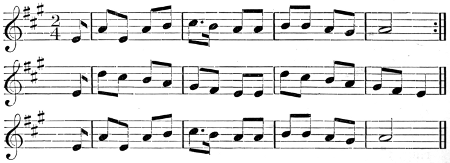
—Tean, North Staffs. (Miss Burne).
I.
They were two jolly fishermen, They were two jolly fishermen, They were two jolly fishermen, And just come from the sea, And just come from the sea. They cast their nets into the sea, And jolly fish caught we, And jolly fish caught we, And jolly fish caught we, They cast their nets into the sea, And jolly fish caught we.
—Tean and Cheadle, North Staffs. (Miss Burne).
II.
There was three jolly fishermen, And they all put out to sea. They cast their nets into the sea, And the [three?] jolly fish caught we.
—North Staffs. Potteries (Mrs. Thomas Lawton).
(b) A circle is formed by joining hands, and two children stand in the centre. They walk round. At the seventh line the two in the centre each choose one child from the ring, thus making four in the centre. They then sing the remaining four lines. The two who were first in the centre then go out, and the game begins again, with the other two players in the centre.
(c) Miss Burne says this game is more often played as “Three Jolly Fishermen.” At Cheadle, North Staffs., a few miles distant from Tean, this game is played by grown-up men and women.
Jolly Hooper
I.
Here comes a [or one] jolly hooper, Ring ding di do do, Ring ding di do do. And who are you looking for, In a ring ding di do do, In a ring ding di do do? I am looking for one of your daughters, In a ring ding di do do, In a ring ding di do do. What shall her name be, In a ring ding di do do, In a ring ding di do do? Her name shall be [Sarah], In a ring ding di do do, In a ring ding di do do. Sarah shall ramble, In a ring ding di do do, In a ring ding di do do, All around the chimney [jubilee] pot in 1881.
—Deptford, Kent (Miss Chase).
II.
I’ve come for one of your daughters, With a ring a ding a my dolly; I’ve come for one of your daughters On this bright shining night. Pray, which have you come for, With a ring a ding a my dolly? Pray which have you come for On this bright shining night? I’ve come for your daughter Mary, With a ring a ding a my dolly; I’ve come for your daughter Mary On this bright shining night. Then take her, and welcome, With a ring a ding a my dolly; Then take her, and welcome, On this bright shining night [incomplete].
—Sheffield (S. O. Addy).
(b) A number of children stand against a wall, and a row of other children face them. They walk backwards and forwards, singing the first and third verses. Then the children who are standing still (against the wall) answer by singing the second and fourth verses. When these are sung the moving line of children take Mary and dance round, singing “some lines which my informant,” says Mr. Addy, “has forgotten.”
(c) I have no description of the way Miss Chase’s game is played. It, too, is probably an incomplete version. The words “Ring ding di do do “show a possible connection between this and games of the “Three Dukes a-riding” type. They may or may not be variants of the same game.
See “Here comes a Lusty Wooer,” “Here comes a Virgin,” “Jolly Rover,” “Three Dukes.”
Jolly Miller
[Play]
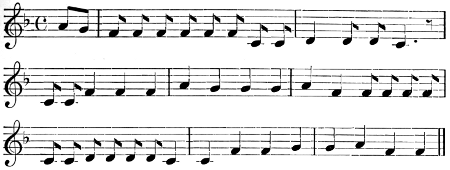
—Epworth, Doncaster (C. C. Bell).
[Play]
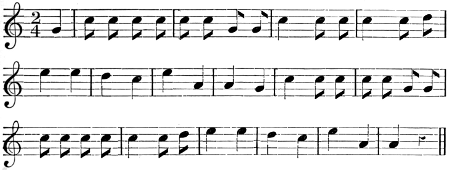
—Earls Heaton (H. Hardy).
[Play]
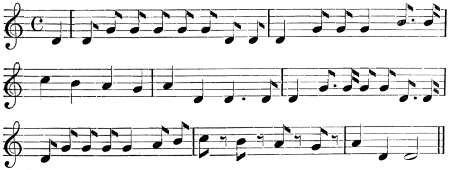
—Derbyshire (Mrs. Harley).
I.
There was a jolly miller, and he lived by himself, As the wheel went round he made his pelf; One hand in the hopper, and the other in the bag, As the wheel went round he took his grab.
—Leicester (Miss Ellis).
II.
There was a jolly miller, he lived by himself, As the mill went round he made his wealth; One hand in the hopper, another in his bag, As the wheel went round he made his grab.
—Liphook, Hants (Miss Fowler).
III.
There was a jolly miller, and he lived by himself, As the wheel goes round he makes his wealth; One hand in his hopper, and the other in his bag, As we go round he makes his grab.
—Monton, Lancashire (Miss Dendy).
IV.
There was a jolly miller, and he lived by himself, As the mill went round he gained his wealth; One hand in the hopper, and the other in the bag, As the mill went round he made his grab. Sandy he belongs to the mill, And the mill belongs to Sandy still, And the mill belongs to Sandy.
—Addy’s Sheffield Glossary.
V.
There was a jolly miller, and he lived by himself, As the wheel went round he made his wealth; One hand in the upper and the other in the bank, As the wheel went round he made his wealth.
—Earls Heaton, Yorks. (Herbert Hardy).
VI.
There was a jolly miller, and he lived by himself, As the wheel went round he made his grab; One hand in the other, and the other in the bag, As the wheel went round he made his grab.
—Nottinghamshire (Miss Winfield).
VII.
There was a jolly miller, and he lived by himself (or by the Dee), The sails went round, he made his ground; One hand in his pocket, the other in his bag.
—North Staffs. Potteries (Miss A. A. Keary).
(b) This game requires an uneven number of players. All the children except one stand in couples arm in arm, each couple closely following the other. This forms a double ring or wheel (fig. 1). The odd child stands in the centre. The children forming the wheel walk round in a circle and sing the verse. When they come to the word “grab,” those children standing on the inside of the wheel leave hold of their partners’ arms, and try to catch hold of the one standing immediately in front of their previous partners. The child in the centre (or Miller) tries (while they are changing places) to secure a partner and place (fig. 2). If he succeeds in doing this, the one then left out becomes the Miller. At Leicester the “odd” child, or “miller,” stands outside the wheel or ring, instead of being in the centre, and it is the outside children who change places. Mr. Addy, in the Sheffield version, says, “The young men stand in the outer ring, and the young women in the inner. A man stands within the inner circle, quite near to it. The men try and grasp the arm of the girl in front of them, and the man in the centre also tries to grasp one; the man he displaces taking his place as Miller. Then the three last lines are sung.”
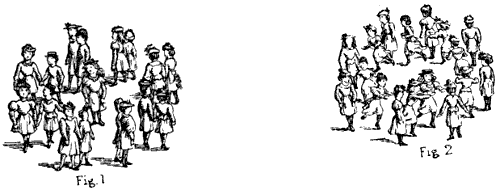
(c) Versions of this game, almost identical with the Leicester version given here (with the exception that the word “wealth” ends the second line instead of “pelf”), have been sent me from East Kirkby, Lincolnshire (Miss K. Maughan); Epworth, Doncaster (Mr. C. C. Bell); Settle, Yorks. (Rev. W. S. Sykes); Derbyshire (Mrs. Harley); Redhill, Surrey (Miss G. Hope); Ordsall, Nottinghamshire (Miss Matthews); Brigg, Lincolnshire (Miss J. Barker); and there are other versions from Hersham, Surrey (Folk-lore Record, v. 86); Cornwall (Folk-lore Journal, v. 57); Derbyshire (Folk-lore Journal, i. 385); Oswestry, Ellesmere (Shropshire Folk-lore, p. 512). Miss Peacock sends a version which obtains at Lincoln, Horncastle, Winterton, and Anderby, Lincolnshire, and in Nottinghamshire; it is identical with the Liphook version. Two versions from Sporle, Norfolk, which vary slightly from the Leicester, have been sent by Miss Matthews. The versions given from Lancashire, Yorks., Nottingham, and North Staffs. have been selected to show the process of decadence in the game. “Hopper” has first become “upper,” and then “other.” Of the North Staffs. Potteries version Miss Keary says, “How it ends I have never been able to make out; no one about here seems to know either.” With the exception of these few variants, it is singular how stereotyped the words of the rhyme have become in this game.
(d) This game may owe its origin to the fact of the miller in olden times paying himself in kind from the corn brought to him to be ground. The miller is a well-known object of satire in old ballads and mediaeval writers. It is, however, probable that the custom which formerly prevailed at some of the public festivals, of catching or “grabbing” for sweethearts and wives, is shown in this game. For instance, to account for a Scottish custom it is said that St. Cowie, patron saint of two parishes of Campbeltown, proposed that all who did not find themselves happy and contented in the marriage state, should be indulged with an opportunity of parting and making a second choice. For that purpose he instituted an annual solemnity, at which all the unhappy couples in his parish were to assemble at his church; and at midnight all present were blindfolded and ordered to run round the church at full speed, with a view of mixing the lots in the urn. The moment the ceremony was over, without allowing an instant for the people present to recover from their confusion, the word “Cabbay” (seize quickly) was pronounced, upon which every man laid hold of the first female he met with. Whether old or young, handsome or ugly, good or bad, she was his wife till the next anniversary of this custom (Guthrie’s Scottish Customs, p. 168). Another old wedding superstition is alluded to by Longfellow:—
“While the bride with roguish eyes, Sporting with them, now escapes and cries, ‘Those who catch me, married verily this year will be.’”
See “Joggle Along.”[Addendum]
Jolly Rover
[Play version 1 (as printed), version 2]
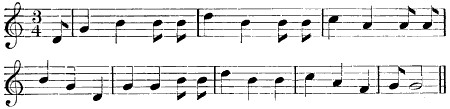
—Derbyshire (Mrs. Harley).
Here comes one jolly rover, jolly rover, jolly rover, Here comes one jolly rover, jolly rover, jolly rover, A roving all day. And what do you rove for, rove for, rove for? And what do you rove for? Lily white and shining. I rove for my pleasure, my pleasure, my pleasure, I rove for my pleasure, my pleasure, my pleasure, Lily white and shining. And what is your pleasure, your pleasure, your pleasure? What is your pleasure? Lily white and shining. My pleasure’s for to marry you, to marry you, to marry you, My pleasure’s for to marry you, Lily white and shining. So through the kitchen and through the hall, I choose the fairest of them all, The fairest one that I can see Is ——, so come to me.
—Derbyshire (Mrs. Harley).
(b) A long row of children walk to and fro. One child, facing them on the opposite side, represents the Rover. He sings the first, third, and fifth verses. The row of children sing the second and fourth in response. After the fifth verse is sung the Rover skips round the long row, singing the sixth verse to the tune of “Nancy Dawson,” or “Round the Mulberry bush.” He chooses one of them, who goes to the opposite side with him, and the game goes on until all are rovers like himself.
See “Here comes a Lusty Wooer,” “Jolly Hooper.”
Jolly Sailors
I.
Here comes one [some] jolly, jolly sailor boy, Who lately came on shore; He [they] spent his time in drinking wine As we have done before. We are the Pam-a-ram-a-ram, We are the Pam-a-ram-a-ram, And those who want a pretty, pretty girl, Must kiss her on the shore, Must kiss her on the shore.
—Warwick (from a little girl, through Mr. C. C. Bell).
II.
He was a jolly, jolly sailor boy, Who had lately come ashore; He spent his time in drinking wine As he had done before. Then we will have a jolly, jolly whirl, Then we will have a jolly, jolly whirl, And he who wants a pretty little girl Must kiss her on the shore.
—Forest of Dean, Gloucestershire (Miss Matthews).
III.
Here comes one jolly sailor, Just arrived from shore, We’ll spend our money like jolly, jolly joes, And then we’ll work for more. We’ll all around, around and around, And if we meet a pretty little girl We’ll call her to the shore.
—Northants (Rev. W. D. Sweeting).
IV.
Here comes four jolly sailor boys, Just lately come ashore; They spend their days in many merry ways, As they have done before. Round, round the ring we go, Round, round the ring, And he that choose his bonny, bonny lass Must kiss her on the floor.
—Raunds (Northants Notes and Queries, i. 232).
V.
Here come three jolly, jolly, jolly boys As lately come from shore; We will spend our time on a moonlight night As we have done before. We will have a round, a round, a round, We will have a round, a round, a round; Let the lad that delights in a bonny, bonny lass, Let him kiss her on the ground.
—Earls Heaton, Yorks. (Herbert Hardy).
VI.
Here comes three jolly, jolly sailors, Just arrived on shore; We’ll spend our money like merry, merry men, And then we’ll work for more. Hurrah for the round, round ring, Hurrah for the round, round ring; And he that loves a pretty, pretty girl, Let him call her from the ring.
—Shipley, Horsham (Notes and Queries, 8th series, i. 210, Miss Busk).
(b) This game is played at Warwick as follows:—The children form a large ring, clasping hands and standing still. One child walks round inside the ring, singing the verses. This child then chooses another from the ring, bending on one knee and kissing her hand. The lines are then repeated, the two walking arm in arm round the inside of the ring. Another child is chosen out of the ring by the one who was chosen previously. This goes on until all are chosen out of the ring, walking two by two round inside. When the ring will no longer hold them, the two walk round outside. At Northants the ring walks round, and the child is outside the ring. Partners are chosen, and the two walk round outside the ring. The first two walk together till there is a third, then the three walk together till there is a fourth, then they go in couples. In the Northants version, from Raunds, four boys stand in the centre of the ring. When the verses are sung they choose four girls, and then take their places in the ring. The four girls then choose four lads, and so on. At Earls Heaton the children stand against a wall in a line. Another child walks up and down singing the verses, and chooses a partner. He spreads a handkerchief on the ground, and they kneel and kiss.
(c) The Shipley version is a “Kiss in the Ring” game. A version sent by the Rev. W. Slater Sykes from Settle, Yorkshire, is almost identical with the Earls Heaton version. Northall (Folk Rhymes, p. 369) says “to kiss on the floor”—i.e., not in secret. He gives the words of a sort of musical catch, sung in the Midlands, similar in character to this game, which may once have been used in some courting game. Mr. Newell (Games, p. 124) gives a version sung in the streets of New York, and considers it to be a relic of antiquity, a similar round being given in Deuteromelia, 1609.[Addendum]
Jowls
A game played by boys, much the same as “Hockey,” and taking its name, no doubt, from the mode of playing, which consists in striking a wooden ball or knorr from the ground in any given direction with a sufficiently heavy stick, duly curved at the striking end.—Atkinson’s Cleveland Glossary.
It is also given in Yorkshire Glossary (Whitby).
See “Bandy,” “Doddart,” “Hockey.”
Jud
A game played with a hazel nut bored and run upon a string.—Dickinson’s Cumberland Glossary.
Probably the same game as “Conkers.”
See “Conkers.”
Keeling the Pot
Brockett mentions that a friend informed him that he had seen a game played amongst children in Northumberland the subject of which was “Keeling the Pot.” A girl comes in exclaiming, “Mother, mother, the pot’s boiling ower.” The answer is, “Then get the ladle and keel it.” The difficulty is to get the ladle, which is “up a height,” and the “steul” wants a leg, and the joiner is either sick or dead (Glossary North Country Words). A sentence from Love’s Labours Lost, “While greasy Joan doth keel the pot,” illustrates the use of the term “keel.”
See “Mother, Mother, the Pot Boils over.”
Keppy Ball
In former times it was customary every year, at Easter and Whitsuntide, for the mayor, aldermen, and sheriff of Newcastle, attended by the burgesses, to go in state to a place called the Forth, a sort of mall, to countenance, if not to join in the play of “Keppy ba” and other sports. This diversion is still in part kept up by the young people of the town (Brockett’s North Country Words). It is also mentioned in Peacock’s Manley and Corringham Glossary, and in Ross and Stead’s Holderness Glossary.
Mr. Tate (History of Alnwick) says that a favourite pastime of girls, “Keppy ball,” deserves a passing notice, because accompanied by a peculiar local song. The name indicates the character of the game; “kep” is from cepan, Anglo-Saxon, “kappan,” Teut., “to catch or capture;” for when the game was played at by several, the ball was thrown into the air and “kepped,” or intercepted, in its descent by one or other of the girls, and it was then thrown up again to be caught by some other. But when the song was sung it was played out by one girl, who sent the ball against a tree and drove it back again as often as she could, saying the following rhymes, in order to divine her matrimonial future:—
Keppy ball, keppy ball, Coban tree, Come down the long loanin’ and tell to me, The form and the features, the speech and degree Of the man that is my true love to be. Keppy ball, keppy ball, Coban tree, Come down the long loanin’ and tell to me How many years old I am to be. One a maiden, two a wife, Three a maiden, four a wife, &c.
The numbers being continued as long as the ball could be kept rebounding against the tree.
The following from Halliwell’s Nursery Rhymes, p. 298, is also used for ball divination. To “cook” is to toss or throw.
Cook a ball, cherry tree; Good ball, tell me How many years I shall be Before my true love I do see? One and two, and that makes three; Thankee, good ball, for telling of me.
See “Ball,” “Cuckoo,” “Monday.”
Kibel and Nerspel
This game was played at Stixwold seventy years ago. It resembled “Trap, Bat, and Ball.” Kibel = bat, ner = ball of maplewood, spel = trap, with a limock (pliant) stick fastened to it. The score was made by hitting the ner a certain distance, but not by the striker running, as in “Rounders.”—Miss M. Peacock.
See “Nur and Spell.”
King by your leave
“A playe that children have, where one sytting blyndefolde in the midle, bydeth so tyll the rest have hydden themselves, and then he going to seeke them, if any get his place in the meane space, that same is kynge in his roome.”—Huloet, 1572.
See “Hide and Seek.”
King Cæsar
One player is chosen to be King Cæsar by lot or naming. All the others stand in two rows, one row at each end of the ground. A line is drawn on the ground in front of them to mark “dens.” All the players must keep within this line. King Cæsar stands in the middle of the ground. Any number of the players can then rush across the ground from one den to another. King Cæsar tries to catch one as they run. When he catches a boy he must count from one to ten in succession before he leaves hold of the boy, that boy in the meantime trying to get away. If King Cæsar succeeds in holding a boy, this boy stays in the centre with him and assists in catching the other players (always counting ten before a captive is secured). The dens must always be occupied by some players. If all the players get into one den, King Cæsar can go into the empty den and say, “Crown the base, one, two, three,” three times before any of the other players get across to that den. If he succeeds in doing this, he can select a boy to run across from one den to the other, which that boy must do, King Cæsar trying to catch him. Other and bigger boys can help this one to get across, to save him from being captured, either by carrying him or running across with him. The game ends when all have been captured and are in the centre. King Cæsar and the other captured boys can leave the centre if they each successively catch three players.—Barnes (A. B. Gomme).
This game is called “King-sealing” in Dorsetshire.
See “King of Cantland,” “Lamploo.”
King Come-a-lay
A game played by boys. Two sets of boys, or sides, strive which can secure most prisoners for the King.—Shetland (Jamieson).
King of Cantland
A game of children, in which one of a company, being chosen King o’ Cantland, and two goals appointed at a considerable distance from each other, all the rest endeavoured to run from one goal to the other; and those whom the King can seize in their course, so as to lay his hand upon their heads (which operation is called winning them), become his subjects, and assist him in catching the remainder.—Dumfries (Jamieson). Jamieson adds: “This game is called ‘King’s Covenanter’ in Roxburgh.” He also refers to the game of “King and Queen of Cantelon,” recorded by Mactaggart. He considers the origin of this game to be representative of the contentions about the “Debatable Lands” on the border. This game was played at University Coll. School, London, under the name of “Kings” (A. Nutt).
See “How many miles to Barley Bridge?” “King Cæsar.”
King o’ the Castle
One boy is chosen as King. He mounts on any convenient height, a knoll, or dyke, or big stone, and shouts—
A’m King o’ the Castle, An’ fah (who) ’ll ding (knock) me doon?
The players make a rush at the King, and try to pull him down. A tussle goes on for a longer or a shorter time, according to the strength of the King and his skill in driving off his assailants. The boy that displaces the King becomes King, and is in his turn assaulted in the same way. The game may go on for any length of time. Another form of words is—
I’m the King o’ the Castle, An’ nane can ding me doon.
—Keith (Rev. W. Gregor).
Other words sung by the Scotch children are—
I, Willy Wastle, Stand on my castle, And a’ the dogs o’ your toon Will no drive Willie Wastle doon.
Chambers (Popular Rhymes, p. 114) records the tradition that when Oliver Cromwell lay at Haddington he sent to require the governor of Home Castle, in Berwickshire, to surrender; the governor is said to have replied in the above quatrain of juvenile celebrity.
The London version is for the boys to run up a hillock, when one of them declares as follows—
I’m the King of the Castle; Get down, you dirty rascal,
whereupon he pushes down his companions. If another boy succeeds in getting his place he becomes King, and repeats the doggerel (G. L. Gomme). This is a very popular boys’ game. Newell (Games, 164) mentions it as prevalent in Pennsylvania.
See “Tom Tiddler’s Ground.”
King Plaster Palacey
The players are a King and his three sons named White Cap, Red Cap, Brown Cap. Red Cap says, “Plaster Palacey had a son, whose name was old daddy White Cap.” White Cap, in an injured voice, says, “Me, sir?” The King says, “Yes, sir.” White Cap answers, “You’re a liar, sir.” The King then says, “Who then, sir?” White Cap answers, “Old daddy Red Cap.”—Deptford, Kent (Miss Chase).
The game as given above is obviously incomplete, and no description as to how the game was played was sent me. Newell (Games, p. 145), describes a game, “The Cardinal’s Hat,” which is probably a variant of the original game, of which the above is only a fragment. I remember once witnessing a game in which a ball was passed from player to player, and in which the dialogue was similar. When one player was told that the ball was in his possession, the answer was, “What, me, sir?” “Yes, you, sir.” “Not I, sir.” “Who then, sir?” “White Cap, sir;” the questions and answers were again repeated for Red Cap, and Blue Cap. When it was Black Cap’s turn, I think the ball was thrown by this player to some one else; whoever was hit by the ball had to chase and capture one, who became questioner; but my recollection of the game is too slight for me to be certain either of the dialogue or the way the game terminated (A. B. Gomme). A game described in Suffolk County Folk-lore, p. 62, is apparently a version of this. It is there described as a forfeit game.
King William
[Play]
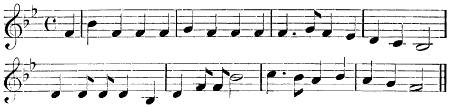
—Earls Heaton, Yorks. (H. Hardy).
I.
King William was King David’s son, And all the royal race is run; Choose from the east, choose from the west, Choose the one you love the best. Down on this carpet you shall kneel While the grass grows in yonder field; Salute your bride and kiss her sweet, Rise again upon your feet.
—Hanging Heaton, Yorks. (H. Hardy).
II.
King William was King David’s son, All the royal race is run; Choose from the east, choose from the west, Choose the one that you love best; If she’s not here to take her part, Choose another with all your heart.
—Sheffield (S. O. Addy).
(b) In Sheffield a ring of young men and women is formed. A man goes inside the ring and walks round within it, whilst the others sing the verse. The young man then chooses a sweetheart, and the two walk round arm-in-arm within the ring, whilst the same verses are sung. When the singing is ended, the girl picks a young man, and so they all pair off.
(c) Mr. Addy entitles this game “Kiss in the Ring.” It appears, however, from this description to lack the two principal elements of most “kiss-in-the-ring” games—the chase between pursued and pursuer, and the kissing in the ring when the capture is made. In the Hanging Heaton version two children kneel and kiss in the middle of the ring. Mr. Newell (Games, p. 73), in describing a game with a similar rhyme, mentions a version which had been sent him from Waterford, Ireland. He says, “We learn from an informant that in her town it was formerly played in this peculiar manner. Over the head of a girl who stood in the centre of a ring was held a shawl, sustained by four others grasping the corners.” The game then proceeded as follows—
King William was King George’s son, From the Bay of Biscay O! Upon his breast he wore a star— Find your way to English schools. Down on the carpet you must kneel; As the grass grows in the field, Salute your bride and kiss her sweet, And rise again upon your feet.
Then followed the game-rhyme, repeated with each stanza—
Go choose you east, go choose you west,
apparently the same as last four lines of Sheffield version. King William is then supposed to enter—
The first girl that I loved so dear, Can it be she’s gone from me? If she’s not here when the night comes on, Will none of you tell me where she’s gone?
He then recognises the disguised girl—
There’s heart beneath the willow tree, There’s no one here but my love and me.
“He had gone to the war, and promised to marry her when he came back. She wrapped a shawl about her head to see if he would recognise her.” This was all the reciter could recollect; the lines of the ballad were sung by an old woman, the ring answering with the game-rhyme.
This version seems to indicate clearly that in this game we have preserved one of the ceremonies of a now obsolete marriage-custom—namely, the disguising of the bride and placing her among her bridesmaids and other young girls, all having veils or other coverings alike over their heads and bodies. The bridegroom has to select from among these maidens the girl whom he wished to marry, or whom he had already married, for until this was done he was not allowed to depart with his bride. This custom was continued in sport as one of the ceremonies to be gone through after the marriage was over, long after the custom itself was discontinued. For an instance of this see a “Rural Marriage in Lorraine,” in Folk-lore Record, iii. 267-268. This ordeal occurs in more than one folk-tale, and it usually accompanies the incident of a youth having travelled for adventures, sometimes in quest of a bride. He succeeds in finding the whereabouts of the coveted girl, but before he is allowed by the father to take his bride away he is required to perform tasks, a final one being the choosing of the girl with whom he is in love from among others, all dressed alike and disguised. Our bridal veil may probably originate in this custom.
In the ballad from which Mr. Newell thinks the game may have originated, a maid has been given in marriage to another than her chosen lover. He rides to the ceremony with a troop of followers; the bride, seeing him approach, calls on her maidens to “take off her gold crown and coif her in linen white,” to test her bridegroom’s affection. This incident, I think, is not to test “affection,” but the ordeal of recognising his bride, however disguised, and the fact that “the hero at once recognises his love, mounts with her on horseback, and flees to Norway,” may be considered to support my view.
See also Brand, vol. ii. p. 141, under “Care Cloth.”
King’s Chair
Two children join hands, by crossing their arms, so as to form a seat. A third mounts on the crossed arms, and clasps the carriers round their necks, while they move on saying—
King, King Cairy (carry) London lairy, Milk an bread, In the King’s chairie.
This game is played at Keith, without the words. The words are used at Fochabers.—Rev. W. Gregor.
Jamieson says, “Lothian children, while carrying one of their number in this manner, repeat the following rhyme—
Lend me a pin to stick i’ my thumb, To carry the lady to London town.”
He says this method of carrying is often used as a substitute for a chair in conveying adult persons from one place to another, especially when infirm. In other counties it is called “Queen’s Cushion” and “Queen’s Chair,” also “Cat’s Carriage.”
Brockett (North Country Words) says, “‘King’s Cushion,’ a sort of seat made by two persons crossing their hands, in which to place a third. The thrones on the reverses of the early Royal Seals of England and Scotland consist of swords, spears, snakes, &c., placed in the manner of a ‘King’s Cushion.’”
The method used is for both children to grasp the wrist of his left hand with the right, while he lays hold of the right wrist of his companion with his left hand. This way of hoisting or carrying is still used by schoolboys when they desire to honour a boy who has distinguished himself in the playground or schoolroom.
See “Carry my Lady to London.”
Kirk the Gussie
A sort of play. The Gussie is a large ball, which one party endeavours to beat with clubs into a hole, while another party strives to drive it away. When the ball is lodged in the hole it is said to be “Kirkit.”—Jamieson.
Kiss in the Ring
[Play]
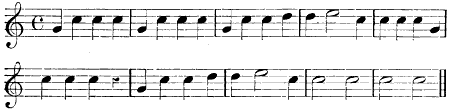
—Nottingham (Miss Youngman).
[Play]
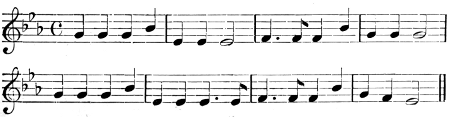
—Lancashire (Mrs. Harley).
[Play]
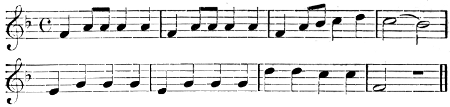
—Earls Heaton, Yorks. (H. Hardy).
I.
I sent a letter to my love, And on the way I dropped it; And one of you have picked it up And put it in your pocket.
—Dorsetshire (Folk-lore Journal, vii. 213); Penzance (Mrs. Mabbott).
II.
I wrote a letter to my love, and on the way I lost it. Some one has picked it up. Not you, not you (&c.), but you!
—Much Wenlock (Shropshire Folk-lore, p. 512).
III.
I lost my supper last night, and the night before, And if I lose it this night, I shall never have it no more.
—Berrington (Shropshire Folk-lore, p. 512).
IV.
I’ve come to borrow the riddle (= sieve), There’s a big hole in the middle. I’ve come to borrow the hatchet, Come after me and catch it.
—Chirbury (Shropshire Folk-lore, p. 512).
V.
Down by the greenwood, down by the greenwood, Down by the greenwood tree, One can follow, one can follow, One can follow me. Where must I follow? where must I follow? Follow, follow me. Where must I follow? where must I follow? Follow, follow me.
—Earls Heaton (H. Hardy).
VI.
Mr. Monday was a good man, He whipped his children now and then; When he whipped them he made them dance, Out of Scotland into France; Out of France into Spain, Back to dear old England again. O-u-t spells “out,” If you please stand out. I had a little dog and his name was Buff, I sent him after a penn’orth of snuff, He broke the paper and smelled the snuff, And that’s the end of my dog Buff. He shan’t bite you—he shan’t bite you—he shan’t bite you, &c., &c.—he shall bite you all over.
—Dorsetshire (Folk-lore Journal, vii. 213).
VII.
I sent a letter to my love, I carried water in my glove, And by the way I dropped it. I did so! I did so! I had a little dog that said “Bow! wow!” I had a little cat that said “Meow! meow!” Shan’t bite you—shan’t bite you— Shall bite you.
—Cornwall (Folk-lore Journal, v. 52).
VIII.
I sent a letter to my love, I carried water in my glove, I dript it, I dropped it, and by the way I lost it.
—Hersham, Surrey (Folk-lore Record, v. 87).
IX.
I have a pigeon in my pocket, If I have not lost it; Peeps in, peeps out, By the way I’ve lost it; Drip, drop, By the way I’ve lost it.
—Earls Heaton (H. Hardy).
X.
I have a pigeon in my pocket, It peeps out and in, And every time that I go round I give it a drop of gin. Drip it, drop it, drip it, drop it.
—Settle, Yorkshire (Rev W. S. Sykes).
XI.
I sent a letter to my love, I thought I put it in my glove, But by the way I dropped it. I had a little dog said “Bow, wow, wow!” I had a little cat said “Mew, mew, mew!” It shan’t bite you, It shall bite you.
—Bexley Heath (Miss Morris).
XII.
I sent a letter to my love, And by the way I droppt it; I dee, I dee, I dee, I droppt it, And by the way I droppt it.
—Keith (Rev. W. Gregor).
XIII.
I had a little dog, it shan’t bite you, Shan’t bite you, shan’t bite you, Nor you, nor you, nor you. I had a little cat, it shan’t scratch you, Shan’t scratch you, nor you, nor you. I wrote a letter to my love, and on the way I dropped it. And one of you have picked it up and put it in your pocket. It wasn’t you, it wasn’t you, nor you, nor you, but it was you.
—London (A. B. Gomme).
XIV.
I have a little dog and it lives in my pocket. It shan’t bite you, &c. Now you’re married I hope you’ll enjoy First a girl and then a boy; Seven years gone, and two to come, So take her and kiss her and Send her off home.
—Wolstanton, North Staffs. Potteries (Miss A. A. Keary).
(b) In Dorsetshire a ring is formed by all the players joining hands except one. The odd player, carrying a handkerchief, commences to walk slowly round the outside of the ring, repeating the words; then, touching each one with her handkerchief as she passes, she says, “Not you,” “not you,” “not you,” &c., &c., till the favoured individual is reached, when it is changed to “But you!” and his or her shoulder lightly touched at the same time. The first player then runs round the ring as fast as he can, pursued by the other, who, if a capture is effected (as is nearly always the case), is entitled to lead the first player back into the centre of the ring and claim a kiss. The first player then takes the other’s place in the ring, and in turn walks round the outside repeating the same formula.—Folk-lore Journal, vii. 212; Penzance (Mrs. Mabbott).
In Shropshire, as soon as the player going round the ring has dropped the handkerchief on the shoulder of the girl he chooses, both players run opposite ways outside the ring, each trying to be the first to regain the starting-point. If the one who was chosen gets there first, no kiss can be claimed. It is often called “Drop-handkerchief,” from the signal for the chase. The more general way of playing (either with or without words), as seen by me on village greens round London, is, when the handkerchief has been dropped, for the player to dart through the ring and in and out again under the clasped hands; the pursuer must follow in and out through the same places, and must bring the one he catches into the ring before he can legally claim the kiss.
Elworthy (West Country Words), in describing this game, says: “The person behind whom the handkerchief is dropped is entitled to kiss the person who dropped it, if he or she can catch him or her, before the person can get round the ring to the vacant place. Of course, when a girl drops it she selects a favoured swain, and the chase is severe up to a point, but when a girl is the pursuer there often is a kind of donkey race lest she should have to give the kiss which the lad takes no pains to avoid.” Mr. Elworthy does not mention any words being used, and it is therefore probable that this is the “Drop-handkerchief” game, which generally has no kissing. It also, in the way it is played, resembles “French Jackie.” In the Wolstanton game, Miss Keary says: “If the owner of the handkerchief overtakes the one who is bitten as they run round, they shake hands and go into the middle of the ring, while the others sing the marriage formula.” In Berkshire (Antiq. xxvii. 255) the game is played without words, and apparently no handkerchief or other sign is used. Miss Thoyts says the young man raises his hat when he embraces the young woman of his choice. To “throw (or fling) the handkerchief” is a common expression for an expected proposal of marriage which is more of a condescension than a complimentary or flattering one to the girl. “Kiss in the Ring” is probably a relic of the earliest form of marriage by choice or selection. The custom of dropping or sending a glove as the signal of a challenge may have been succeeded by the handkerchief in this game. Halliwell, p. 227, gives the game of “Drop Glove,” in which a glove is used. For the use of handkerchiefs as love-tokens see Brand, ii. 92.
See “Drop Handkerchief,” “French Jackie.”
Kit-Cat
A game played by boys. Three small holes are made in the ground, triangularly about twenty feet apart, to mark the position of as many boys, each of whom holds a small stick, about two feet long. Three other boys of the adverse side pitch successively a piece of stick, a little bigger than one’s thumb, called Cat, to be struck by those holding the sticks. On its being struck, the boys run from hole to hole, dipping the ends of their sticks in as they pass, and counting one, two, three, &c., as they do so, up to thirty-one, which is game. Or the greater number of holes gained in the innings may indicate the winners, as at cricket. If the Cat be struck and caught, the striking party is out, and another of his sidesmen takes his place, if the set be strong enough to admit of it. If there be only six players, it may be previously agreed that three put outs shall end the innings. Another mode of putting out is to throw the Cat home, after being struck, and placing or pitching it into an unoccupied hole, while the in-party are running. A certain number of misses (not striking the Cat) may be agreed on to be equivalent to a put out. The game may be played by two, placed as at cricket, or by four, or I believe more.—Moor’s Suffolk Words; Holloway’s Dict. of Provincialisms.
Brockett (North Country Words, p. 115) calls this “‘Kitty-Cat,’ a puerile game.
Then in his hand he takes a thick bat, With which he used to play at ‘Kit-Cat’”
—Cotton’s Works, 1734, p. 88.
See “Cat and Dog,” “Cudgel,” “Munshets,” “Tip-Cat.”
Kit-Cat-Cannio
A sedentary game, played by two, with slate and pencil, or pencil and paper. It is won by the party who can first get three marks (o’s or x’s) in a line; the marks being made alternately by the players o or x in one of the nine spots equidistant in three rows, when complete. He who begins has the advantage, as he can contrive to get his mark in the middle.—Moor’s Suffolk Words.
The same game as “Nought and Crosses,” which see.
Kittlie-cout
A game mentioned but not described by a writer in Blackwood’s Magazine, August 1821, as played in Edinburgh. He mentions that the terms “hot” and “cold” are used in the game. The game of “Hide and Seek.”—Jamieson.
Knapsack
One boy takes another by the feet, one foot over each shoulder, with his head downwards and his face to his back, and sets off running as fast as he can. He runs hither and thither till one or other of the two gets tired.—Keith (Rev. W. Gregor).
Knights
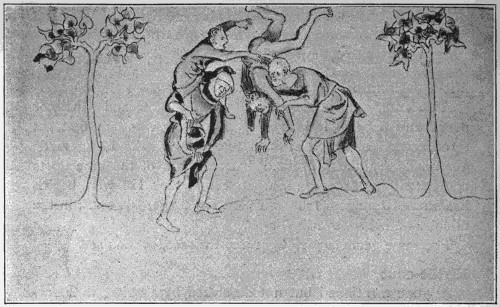
Two big boys take two smaller ones on their shoulders. The big boys act as horses, while the younger ones seated on their shoulders try to pull each other over. The “horses” may push and strike each other with their shoulders, but must not kick or trip up with their feet, or use their hands or elbows. The game is usually won by the Horse and Knight who throw their opponents twice out of three times (G. L. Gomme). Strutt (Sports, p. 84) describes this, and says, “A sport of this kind was in practice with us at the commencement of the fourteenth century.” He considers it to bear more analogy to wrestling than to any other sport. He gives illustrations, one of which is here reproduced from the original MS. in the British Museum. The game is also described in the Rev. J. G. Wood’s Modern Playmate, p. 12.
Knocked at the Rapper
The girl who spoke of this game, says Miss Peacock, could only remember its details imperfectly, but as far as she recollects it is played as follows:—The players dance round a centre child, leaving one of their number outside the circle. The dancers sing to the one in their midst—
Here comes ——, He knocked at the rapper, and he pulled at the string, Pray, Mrs. ——, is —— within?
At “is —— within,” the child outside the circle is named. The centre child says—
O no, she has gone into the town: Pray take the arm-chair and sit yourself down.
The ring of children then sing—
O no, not until my dearest I see, And then one chair will do for we.
Then all sing—
My elbow, my elbow, My pitcher, and my can: Isn’t —— —— a nice young girl?
Mentioning the supposed sweetheart.
Isn’t —— —— as nice as she?
Mentioning the outside child.
They shall be married when they can agree.
Then the inside and outside children each choose a companion from the circle, and the rest repeat:—
My elbow, my elbow, &c.
When the words have been sung a second time, the four children kiss, and the two from the circle take the places of the other, after which change the game begins again.—North Kelsey, Lincolnshire (Miss M. Peacock).
Knor and Spell
See “Nur and Spell.”
Lab
A game of marbles (undescribed).—Patterson’s Antrim and Down Glossary.
See “Lag.”
Lady of the Land
[Play version 1, version 2]
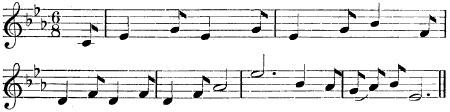
—Tong, Shropshire (Miss R. Harley).
I.
Here comes the lady of the land, With sons and daughters in her hand; Pray, do you want a servant to-day? What can she do? She can brew, she can bake, She can make a wedding cake Fit for you or any lady in the land. Pray leave her. I leave my daughter safe and sound, And in her pocket a thousand pound, And on her finger a gay ring, And I hope to find her so again.
—Somerset and Dorset Notes and Queries, i. 133.
II.
There camed a lady from other land, With all her children in her hand— Please, do you want a sarvant, marm? Leave her. I leaves my daughter zafe and zound, And in her pocket a thousan pound, And on her finger a goulden ring, And in her busum a silver pin. I hopes when I return, To see her here with you. Don’t’e let her ramble; don’t’e let her trot; Don’t’e let her car’ the mustard pot.
The Mistress says softly—
She shall ramble, she shall trot, She shall carry the mustard pot.
—Dorset County Chronicle, April 1889; Folk-lore Journal, vii. 228.
III.
Here comes an old woman from Baby-land, With all her children in her hand. Pray take one of my children in.
[Spoken]
What can your children do?
[Sung]
One can bake, one can brew, And one can bake a lily-white cake. One can sit in the parlour and sing, And this one can do everything.
—Tong, Shropshire (Miss R. Harley).
IV.
Here comes a poor woman from Baby-land With three small children in her hand. One can brew, the other can bake, The other can make a pretty round cake. One can sit in the garden and spin, Another can make a fine bed for the king; Pray, ma’am, will you take one in?
—Halliwell’s Nursery Rhymes, p. 72.
V.
Here is a poor widow from Sandy Row, With all her children behind her. One can knit and one can sew, And one can make the winder go. Please take one in. Now poor Nellie she is gone Without a farthing in her hand, Nothing but a guinea gold ring. Good-bye, Nellie, good-bye!
—Belfast (W. H. Patterson).
VI.
Here comes an old woman from Baby-land, With six poor children by the hand. One can brew, one can bake, And one can make a lily-white cake; One can knit, one can spin, And one can make a bed for a king. Please will you take one in? [choose out one] Now poor —— she is gone Without a farthing in her hand, Nothing but a gay gold ring. Good-bye! Good-bye! Good-bye, mother, good-bye!
—Isle of Man (A. W. Moore)
VII.
Here comes a poor widow from Sandalam, With all her children at her hand; The one can bake, the other can brew, The other can make a lily-white shoe; Another can sit by the fire and spin, So pray take one of my daughters in. The fairest one that I can see Is pretty [Mary] come to me. And now poor [Mary] she is gone Without a guinea in her hand, And not so much as a farthing. Good-bye! Good-bye, my love, good-bye!
—Forest of Dean, Gloucester (Miss Matthews).
VIII.
Here comes an old woman from Cumberland, With seven poor children in her hand; One can sing, the other can sew; One can sit up in the corner and cry, Alleluia! Choose the fairest you can see. The fairest one that I can see is ——, come to me. Now my daughter —— gone, A thousand pound in her pocket and a gold ring on her finger. Good-bye, mother, good-bye!
—Berkshire (Miss Thoyts, Antiquary, xxvii. 254).
IX.
There was an old woman from Sandyland With all her children in her hand. One can knit and one can sow [sew], One can make a lily-white bow. Please take one in.
When all the children have been taken in, the Old Woman says—
There was an old woman from Sandiland With no children by the hand. Will you give me one?
—Ballynascaw School, co. Down (Miss C. N. Patterson).
(b) The first Dorsetshire game is played as follows:—Two girls are chosen, the one to represent a lady and the other a mother, who is supposed to be taking her children out to service. She has one or more of them in each hand, and leads them up to the lady, saying or singing the first verse. The dialogue then proceeds, and the verse is repeated until all the children are similarly disposed of. A few days are supposed to pass, after which the mother calls to see her children, when the lady tells her she cannot see them. At last she insists upon seeing them, and the children are all “sat down” behind the lady, and the mother asks one child what the lady has done to her; and she tells her “that the lady has cut off her nose, and made a nose-pie, and never give her a bit of it.” Each one says she has done something to her and made a pie, and when all have told their tale “they all turn on her and put her to prison.”
The second Dorsetshire game somewhat differs. One child takes seven or eight others whom she pretends are her children. Another child, presumably a mistress in want of servants, stands at a distance. The first child advances, holding the hand of her children, saying the first verse. The dialogue is concluded, and as the woman and her children are supposed to be out of hearing, the last couplet is said or sung. This process is gone through again until the mistress has engaged all the children as her servants, when she is supposed to let them all out to play with the mustard pots, which are represented by sticks or stones, in their hands.
The other versions are played as follows:—The children form a line, the one in the middle being the mother, or widow; they advance and retire, the mother alone singing the first verse. One child, who is standing alone on the opposite side, who has been addressed by the widow, then asks [not sings] the question. The mother, or widow, sings the reply, and points to one child when singing the last line, who thereupon crosses over to the other side, joining the one who is standing alone. This is continued till all have been selected. The Ballynascaw version (Miss Patterson) is played in a similar way. One child sits on a bank, and the others come up to her in a long line. The “old woman” says the first five lines. No question is asked by the “lady,” she simply takes one child. The “old woman” shakes hands with this child, and says good-bye to her. When all the children have been “taken in” by the one who personates the “lady,” the “old woman” says the other three lines, and so one by one gets all the children back again. The Berkshire version (Miss Thoyts) is said, not sung, and is played with two leaders, “old woman” and “lover.” As the lover chooses a child, that one is sent behind him, holding round his waist. Each child as she goes says, “Good-bye, mother, good-bye,” and pretends to cry. Finally they all cry, and the game ends in a tug of war. This tug is clearly out of place unless only half the children are selected by one side. Miss Thoyts does not say how this is done.
(c) This game is called “School-teacher” in Belfast. The corruption of “Lady of the Land,” to “Babyland,” “Babylon,” and “Sandiland,” is manifest. It appears to be only fragmentary in its present form, but the versions undoubtedly indicate that the origin of the game arises from the practice of hiring servants. Mr. Halliwell has preserved another fragmentary rhyme, which he thinks may belong to this game.
I can make diet bread Thick and thin, I can make diet bread Fit for the king; (No. cccxliv.)
which may be compared with the rhyme given by Chambers (Popular Rhymes, p. 136), and another version given by Halliwell, p. 229.
If these rhymes belong to this game it would have probably been played by each child singing a verse descriptive of her own qualifications, and I have some recollection, although not perfect, of having played a game like this in London, where each child stated her ability to either brew, bake, or churn. It is worth noting that the Forest of Dean and Berkshire versions have absorbed one of the “selection” verses of the love-games. Mr. Halliwell, in recording the Nursery Rhymes, Nos. cccxliii. and cccxliv., as quoted above, says, “They are fragments of a game called ‘The Lady of the Land,’ a complete version of which has not fallen in my way.” Mr. Udal’s versions from Dorsetshire are not only called “The Lady of the Land,” but are fuller than all the other versions, though probably these are not complete. Mr. Newell (Games, pp. 56-58) gives some versions of this game. He considers the original to have been a European game (he had not found an English example) in which there were two mothers, a rich and a poor one; one mother begging away, one by one, all the daughters of the other.
(d) This game no doubt originates from the country practice of hiring servants at fairs, or from a dramatic “Hirings” being acted at Harvest Homes. The “Good-bye” of mother and daughters belongs, no doubt, to the original game and early versions, and is consistent with the departure of a servant to her new home. The “lover” incident is an interpolation, but there may have been a request on the part of the “mother” to the “lady” not to allow the girl followers or sweethearts too soon. As to the old practice of hiring servants, Miss Burne has noted how distinctly it stamps itself upon local custom (Shropshire Folklore, pp. 461, 464). That the practice forms the groundwork of this game is well illustrated by the following descriptive passage. “They stay usually two or three dayes with theire friends, and then aboute the fifth or sixth day after Martynmasse will they come to theire newe masters; they will depart from theire olde services any day in the weeke, but theire desire (hereaboutes) is to goe to theire newe masters eyther on a Tewsday or on a Thursday; for on a Sunday they will seldome remoove, and as for Monday, they account it ominous, for they say—
Monday flitte, Neaver sitte;
but as for the other dayes in the weeke they make no greate matter. I heard a servant asked what hee could doe, whoe made this answeare—
I can sowe, I can mowe, And I can stacke; And I can doe, My master too, When my master turnes his backe.”
—Best’s Rural Economy of Yorks., 1641; Surtees Society, pp. 135-136.
In Long Ago, ii. 130, Mr. Scarlett Potter mentions that in South Warwickshire it was customary at harvest-homes to give a kind of dramatic performance. One piece, called “The Hiring,” represents a farmer engaging a man, in which work done by the man, the terms of service, and food to be supplied, are stated in rhymes similar to the above. See “Lammas.”[Addendum]
Lady on the Mountain
[Play first, second part]
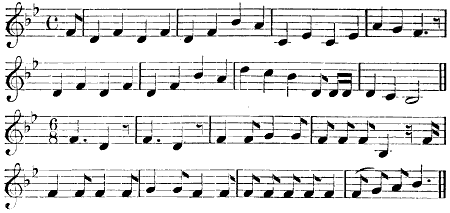
—Barnes, Surrey (A. B. Gomme).
I.
There stands a lady on the mountain, Who she is I do not know; All she wants is gold and silver, All she wants is a nice young man. Choose one, choose two, choose the fairest one of the two. The fairest one that I can see, Is pretty ——, walk with me.
—Barnes, Surrey (A. B. Gomme).
II.
There lives a lady on the mountain, Who she is I do not know; All she wants is gold and silver, All she wants is a nice young man. Choose one, choose two, Choose the fairest of the few. Now you’re married I wish you joy, Father and mother you must obey; Love one another like sister and brother, And pray, young couple, come kiss one another.
—Colchester (Miss G. M. Frances).
III.
Here stands a lady on a mountain, Who she is I do not know; All she wants is gold and silver, All she wants is a nice young man. Choose you east, and choose you west, Choose you the one as you love best. Now Sally’s got married we wish her good joy, First a girl and then a boy; Twelve months a’ter a son and da’ter, Pray young couple, kiss together.
—Berrington (Shropshire Folk-lore, pp. 509, 510).
IV.
Stands a lady on the mountain, Who she is I do not know; All she wants is gold and silver, All she wants is a nice young beau. Take her by the lily-white hand, Lead her across the water; Give her kisses, one, two, three, For she is her mother’s daughter.
—Shipley, Horsham (Notes and Queries, 8th series, i. 210, Miss Busk).
V.
There stands a lady on a mountain, Who she is I do not know; All she wants is gold and silver, All she wants is a nice young man. Now she’s married I wish her joy, First a girl and then a boy; Seven years after son and daughter, Pray young couple kiss together. Kiss her once, kiss her twice, Kiss her three times three.
—Wrotham, Kent (Miss D. Kimball).
VI.
There stands a lady on the ocean [mountain], Who she is I do not know her; All she wants is gold or silver, All she wants is a nice young man. Choose once, choose twice, Choose three times over. Now you’re married I wish you joy, First a girl and then a boy; Seven years old a son and daughter, Play and cuddle and kiss together. Kiss her once, kiss her twice, Kiss her three times over.
—Deptford (Miss Chase).
VII.
There stands a lady on the mountain, Who she is I do not know: Oh! she wants such gold and silver! Oh! she wants such a nice young man! Now you’re married I wish you joy, First a girl and then a boy; Seven years after a son and a daughter, Kiss your bride and come out of the ring.
—Berkshire (Miss Thoyts, Antiquary; xxvii. 254).
(b) A ring is formed, one child in the centre. The ring sing the first verse, and then the centre child chooses one from the ring. The chosen pair kiss when the ring has sung the second. The first child then joins the ring, and the game begins again. In the Barnes version the centre child calls one to her from the ring by singing the second verse and naming the child she chooses.
(c) A version from Lady C. Gurdon’s Suffolk County Folk-lore (p. 62) is the same as previous versions, except that it ends—
Now you’re married you must be good Make your husband chop the wood; Chop it fine and bring it in, Give three kisses in the ring.
Other versions are much the same as the examples given.
(d) This game has probably had its origin in a ballad. Miss Burne draws attention to its resemblance to the “Disdainful Lady” (Shropshire Folk-lore, p. 561), and Halliwell mentions a nursery rhyme (No. cccclxxix.) which is very similar. Mr. Newell (Games, p. 55) prints words and tune of a song which is very similar to that ballad, and he mentions the fact that he has seen it played as a round by the “Arabs of the street.” He considers it to be an old English song which has been fitted for a ring game by the addition of a verse.
See “Lady on Yonder Hill.”
Lady on Yonder Hill
I.
Yonder stands a lovely lady, Whom she be I do not know; I’ll go court her for my beauty, Whether she say me yea or nay. Madam, to thee I humbly bow and bend. Sir, I take thee not to be my friend. Oh, if the good fairy doesn’t come I shall die.
—Derbyshire (Folk-lore Journal, i. 387).
II.
There stands a lady on yonder hill, Who she is I cannot tell; I’ll go and court her for her beauty, Whether she answers me yes or no. Madam, I bow vounce to thee. Sir, have I done thee any harm? Coxconian! Coxconian is not my name; ’tis Hers and Kers, and Willis and Cave. Stab me, ha! ha! little I fear. Over the waters there are but nine, I’ll meet you a man alive. Over the waters there are but ten, I’ll meet you there five thousand. Rise up, rise up, my pretty fair maid, You’re only in a trance; Rise up, rise up, my pretty fair maid, And we will have a dance.
—Lady C. Gurdon’s Suffolk County Folk-lore, p. 65.
(b) In the Suffolk game the children form a ring, a boy and girl being in the centre. The boy is called a gentleman and the girl a lady. The gentleman commences by singing the first verse. Then they say alternately the questions and answers. When the gentleman says the lines commencing, “Stab me,” he pretends to stab the lady, who falls on the ground. Then he walks round the lady and sings the last verse, “Rise up,” and lifts up the lady. In the Derbyshire game only three children play, the lover, lady, and fairy. The girl stands a little distance off. The lover says the first four lines, then approaches the lady, falls on one knee, and says the next line. The lady replies, and retires further away. The lover then falls on the ground and says the next line. As this is said the good fairy appears, touches the fallen lover with her hand, and he is immediately well again.
(c) This is a curious game, and is perhaps derived from a ballad which had been popular from some more or less local circumstance, or more probably it may be a portion of an old play acted in booths at fair times by strolling players. It is not, as far as I can find out, played in any other counties. The lines—
Over the water at the hour of ten, I’ll meet you with five thousand men; Over the water at the hour of five, I’ll meet you there if I’m alive,
are portions of a dialogue familiar to Mr. Emslie, and also occur in some mumming plays. It may also be noted that the curing of illness or death from a stab is an incident in these plays, as is also the method of playing. The first lines are similar to those of “Lady on the Mountain,” which see.
Lag
A number of boys put marbles in a ring, and then they all bowl at the ring. The one who gets nearest has the first shot at the marbles. He has the option of either “knuckling doon” and shooting at the ring from the prescribed mark, or “ligging up” (lying up)—that is, putting his taw so near the ring that if the others miss his taw, or miss the marbles in the ring, he has the game all to himself next time. If, however, he is hit by the others, he is said to be “killed.”—Addy’s Sheffield Glossary.
Lammas
A party of boys take a few straws, and endeavour to hold one between the chin and the turned-down under-lip, pronouncing the following rhyme—
I bought a beard at Lammas fair, It’s a’ awa’ but ae hair; Wag, beardie, wag!
He who repeats this oftenest without dropping the straw is held to have won the game (Chambers’ Popular Rhymes, p. 115). This game-rhyme has an interesting reference to Lammas, and it may also refer to the hiring of servants. Brockett (North Country Words, p. 221) says, “At a fair or market where country servants are hired, those who offer themselves stand in the market-place with a piece of straw or green branch in their mouths to distinguish them.”
Lamploo
A goal having been selected and bounds determined, the promoters used to prepare the others by calling at the top of their voices—
Lamp! Lamp! Laa-o! Those that don’t run shan’t play-o!
Then one of the “spryest” lads is elected to commence, thus:—First touching the goal with his foot or leaning against it, and clasping his hands so as to produce the letter W in the dumb alphabet, he pursues the other players, who are not so handicapped, when, if he succeeds in touching one without unclasping his hands, they both make a rush for the goal. Should either of the other boys succeed in overtaking one of these before reaching that spot, he has the privilege of riding him home pick-a-back. Then these two boys (i.e., the original pursuer and the one caught), joining hands, carry on the game as before, incurring a similar penalty in case of being overtaken as already described. Each successive boy, as he is touched by the pursuers, has to make for the goal under similar risks, afterwards clasping hands with the rest, and forming a new recruit in the pursuing gang, in whose chain the outside players alone have the privilege of touching and thus adding to their numbers. Should the chain at any time be broken, or should the original pursuer unclasp his hands, either by design or accident, the penalty of carrying a capturer to the goal is incurred and always enforced. In West Somerset the pursuing boys after starting were in the habit of crying out the word “Brewerre” or “Brewarre;” noise appearing to be quite as essential to the game as speed.—Somerset and Dorset Notes and Queries, i. 186 (1888).
Another correspondent to the same periodical (i. 204) says that an almost identical game was played at the King’s School, Sherborne, some fifty years ago. It was called “King-sealing,” and the pursuing boy was obliged by the rules to retain his hold of the boy seized until he had uttered—
One, two, three, four, five, six, seven, eight, nine, ten. You are one of the king-sealer’s men.
If the latter succeeded in breaking away before the couplet was finished, the capture was incomplete.
The second game described is almost identical with “King Cæsar,” played at Barnes.
About twenty years ago the game was common in some parts of Bedfordshire and Hertfordshire, where it was sometimes called “Chevy Chase.”—Folk-lore Journal, vii. 233.
See “Chickidy Hand,” “Hunt the Staigie,” “King Cæsar,” “Whiddy.”
Lang Larence
That is, “Long Lawrence,” an instrument marked with signs, a sort of teetotum. A “Long Lawrence” is about three inches long, something like a short ruler with eight sides; occasionally they have but four. On one side are ten x’s, or crosses, forming a kind of lattice-work; on the next, to the left, three double cuts, or strokes, passing straight across in the direction of the breadth; on the third, a zig-zag of three strokes one way, and two or three the other, forming a W, with an additional stroke or a triple V; on the fourth, three single bars, one at each end and one in the middle, as in No. 2, where they are doubled; then the four devices are repeated in the same order. The game, formerly popular at Christmas, can be played by any number of persons. Each has a bank of pins or other small matters. A pool is formed; then in turn each rolls the “Long Lawrence.” If No. 1 comes up the player cries “Flush,” and takes the pool; if No. 2, he puts down two pins; if No. 3, he says “Lave all,” and neither takes nor gives; if No. 4, he picks up one. The sides are considered to bear the names, “Flush,” “Put doan two,” “Lave all,” “Sam up one.” It has been suggested that the name “Lawrence” may have arisen from the marks scored on the instrument, not unlike the bars of a gridiron, on which the saint perished.—Easthers’s Almondbury Glossary.