CHILDREN’S GAMES. (continued 5)
Reading edition
See “Hop-scotch.”
Hick, Step, and Jump
The game of “Hop, step, and jump.”—Somerset (Holloway’s Dict. of Provincialisms).
See “Half-Hammer.”
Hide and Seek (1)
A writer in Blackwood’s Magazine, August 1821, p. 36, mentions this as a summer game. It was called “Ho, spy!” the words which are called out by those boys who have hidden. He says the watchword of “Hide and seek” was “hidee,” and gives as the rhyme used when playing—
Keep in, keep in, wherever you be, The greedy gled’s seeking ye.
This rhyme is also given by Chambers (Popular Rhymes, p. 122). Halliwell gives the rhyme as—
Hitty titty indoors, Hitty titty out, You touch Hitty titty, And Hitty titty will bite you.
—Nursery Rhymes, p. 213.
At Ashford-in-the-Water the words used were—
One a bin, two a bin, three a bin, four, Five a bin, six a bin, seven, gie o’er; A bunch of pins, come prick my shins, A loaf brown bread, come knock me down. I’m coming!
—Reliquary, viii. 57.
The words are said by the one who has to find the person hidden.
In Scotland the game is called “Hospy,” and is played by boys only, and it can be played only in a village or hamlet in which there is the means of hiding. A Spy is chosen, and a spot, called Parley, is fixed upon at which the Spy stands till all the other players are hid, and to which he can run when pursued. When the players are hid, the cry, “Hospy,” i.e., “Ho! spy!” is raised by them. The Spy then sets out to find them. The moment he detects one he turns and runs with all his might to the Parley, pursued by the one he has discovered. If he is overtaken, he must carry on his back the pursuer to the Parley. The same thing is gone through till all the players are discovered.—Keith (Rev. W. Gregor).
Jamieson says, “‘Hy Spy,’ a game resembling ‘Hide and Seek,’ but played in a different manner. The station, which in England is called Home, is here the Den, and those who keep it are the Seekers, and are called the Ins. Those who hide themselves, instead of crying ‘Hoop,’ as in England, cry ‘Hy spy;’ and they are denominated the Outs. The business of the Ins is, after the signal is given, to lay hold of the Outs before they can reach the den. The captive then becomes one of the Ins; for the honour of the game consists in the privilege of hiding oneself.” Jamieson adds, “Hy is still used in calling after a person, to excite attention, or when it is wished to warn him to get out of the way.” Strutt describes it as “Harry-Racket,” or “Hide and Seek” (Sports, p. 381).
At Cork two sides are chosen for Spy; one side hides while the other side hunts. When the hunters see one of the hidden players, they call out, “I spy ——,” and the child’s name. The player called must run after the Spy and try to catch him before he reaches his Den; if he succeeds, the one caught must go to the opposite side of players, then next time the spies hide, and those who have been hiding, spy (Miss Keane). A more general form of the game is for one child to hide, and to make a noise in a disguised voice to give notice of his whereabouts, or to call out “Whoop!” or “Coo!” Until this noise or call is made, the searchers may not seek him. If when spied or discovered the hider cannot reach home before being caught, he again has to hide (A. B. Gomme).
(b) In the parish church of Bawdrip is a monument to Edward Lovell, his wife Eleanor (née Bradford), and their two daughters Maria and Eleanor. The inscription touching the latter is:—“Eleanora . . . obiit Jun. 14, 1681. Hanc, subito et immaturo (ipsos pene inter hymenæos) fato correptam, mœstissimus luxit maritus, et in gratam piamq. parentum sororis et dilectissimæ conjugis memoriam, monumentum hoc erigi voluit.” Tradition connects this sudden death—“ipsos pene inter hymenæos”—with the story of the bride playing at “Hide and Seek.” It is curious that, in Haynes Bayly’s song, the bridegroom’s name should be Lovell. There is no mention on the monument of the name of the bereaved husband. The father, Edward Lovell, was fourteen years rector of Bawdrip and fellow of Jesus College, Cambridge, and died in 1675, and so could not have been present at the wedding, as represented in the song. He came from Batcombe, near Castle-Cary; at which latter place the Lovells were seated in very early days.—Notes and Queries, 4th Ser., ix. 477.
Cope (Hampshire Glossary) calls the game “I spy I.” Lowsley (Berkshire Glossary) says, “In playing this game, the seeker has to call out ‘I spy!’ to the one he finds before he may start for home.” It is called “Hy Spy” in Patterson’s Antrim and Down Glossary; Evans’ Leicestershire Glossary, “Hide and Wink;” Barnes’ Dorset Glossary, “Hidy Buck.”
In Pegge’s Alphabet of Kenticisms the game is given as “Hide and Fox.” Cf. “Hide Fox, and all after,” i.e., let the fox hide and the others go to seek him; Hamlet, iv. 2, 32. In Stead’s Holderness Glossary, “Hed-o.” In the North Riding it is “Lam-pie-sote-it,” also called “Felto” in Robinson’s Whitby Glossary. He also mentions that the hidden child cries “How-ly” to the finder. Apparently the same as the south country “Whoop,” a signal to the finder to begin the search. Addy (Sheffield Glossary) says this game is called “Felt and Laite.” Holland (Cheshire Glossary) speaks of it as “I Spy.”
See “Davie Drap.”
Hide and Seek (2)
[Play]

—London.
I.
Beans and butter, Come home to supper, ’Tis all ready done.
—Hampshire (Miss Mendham).
II.
Little pigs come to supper, Hot boiled beans and ready butter.
—Northall’s Folk Rhymes, p. 409.
III.
Hot beans and butter! Please to come to supper!
—Much Wenlock (Shropshire Folklore, p. 525).
IV.
Hot boiled beans, and very good butter, Ladies and gentlemen, come to supper.
—London (A. B. Gomme).
V.
Vesey vasey vum, Buck aboo has come! Find it if you can and take it home, Vesey vasey vum.
—Newlyn West, near Penzance (Folk-lore Journal, v. 49).
One child hides an article, while those who are to search for it go in another room (or out of the way somewhere). When it is hidden, they are called to find it by one of the above rhymes being sung or said. The searchers are enabled more readily to find the hidden article by being told “hot,” “very hot,” “scorching,” “burning,” or “cold,” “very cold,” and “freezing,” when near to or far from the hidden article. Sometimes several may agree to hide the article, and only one to be the finder. In the Penzance game one child is blindfolded, other children hide something, then shout the words. Search is then made for the hidden object: when found, the finder in his turn is blindfolded. There appears to be some mistake in the description of this game.
Hinch-Pinch
The name of an old Christmas game mentioned in Declaration of Popish Impostures, 1603.
Hinmost o’ Three
A game played on village greens.—Dickinson’s Cumberland Glossary, Supplement.
Hirtschin Hairy
The players (boy or girl) cower down on their haunches, “sit doon curriehunkers,” and hop round and round the floor like a frog, clapping the hands first in front and then behind, and crying out, “Hirtschin Hairy.” It is sometimes called “Hairy Hirtschin.” In Lothian the players try to knock each other over by hustling against one another.—Rev. W. Gregor.
Same game as “Harie Hutcheon.”
See “Curcuddie,” “Cutch-a-cutchoo,” “Hop-frog.”
Hiry-hag
A boys’ game, in which several, joining hands, endeavour to catch another, who, when caught, is beaten with caps, the captors crying out—
Hiry-hiry-hag, Put him in a bag, &c.
—Ross and Stead’s Holderness Glossary.
Hiss and Clap
All the boys are requested to leave the room, when the girls take their seats, leaving a vacant place on the right side of each girl for the gentleman of her choice. Each boy in turn is then summoned by another who acts as doorkeeper, and asked to guess which lady he imagines has chosen him for her partner. Should he guess rightly he is allowed to take his seat by the lady who has chosen him, while the other girls loudly clap hands. Should he guess wrongly he is hissed, and sent out of the room by the doorkeeper.—Cork, Ireland (Miss Keane).
At Long Eaton in Nottinghamshire Miss Youngman records a similar game to this, with a rhyme that is probably taken from a popular song or ballad. The successful candidate for the girl’s choice claims a kiss, but if unsuccessful he is beaten out of the room with knotted handkerchiefs.[Addendum]
Hitch Jamie; Hitch Jamie, Stride and Loup
The boyish play of “Hop, Step, and Jump.”—Atkinson’s Cleveland Glossary.
Brockett (North Country Words) calls this “Hitch.”
See “Half-Hammer,” “Hick, Step, and Jump.”
Hitchapagy
An undescribed Suffolk game.—Halliwell’s Dictionary.
Hitchy Cock Ho
An undescribed Suffolk game.—Moor’s Suffolk Words.
Hity Tity
The Somerset name for “See-Saw.”
Hoatie, Hots
When a number of boys agree to have a game at the Pearie or peg-top, a circle is drawn on the ground, within which all the tops must strike and spin. If any of them bounce out of the circle without spinning, it is called a Hoatie. The punishment to which the Hoatie is subjected consists in being placed in the ring, while all the boys whose tops ran fairly have the privilege of striking—or, as it is called, “deggin”—it till it is either split or struck out of the circle. If either of these take place, the boy to whom the Hoatie belonged has the privilege of playing again.—Upper Lanarkshire (Jamieson).
See “Gully,” “Hoges.”
Hob-in-the-Hall
An old game mentioned by Wycherley (Plain Dealer, 1677).
Hockerty Cokerty
The same game as “Cockerty-hooie.”
Hockey
This game is played with a solid indiarubber ball from two to two and a half inches in diameter. The players each have a bent or hooked stick or “hockey.” They take opposite sides. The object of the game is for each side to drive the ball through their opponents’ goal. The goals are each marked by two poles standing about eight to ten feet apart, and boundaries are marked at the sides. The ball is placed in the middle of the ground. It is started by two players who stand opposite each other, the ball lying between their two sticks. They first touch the ground with their hockey-sticks, then they touch or strike their opponents’ stick. This is repeated three times. At the third stroke they both try to hit the ball away. The ball may only be played by a hockey-stick, and a goal is gained when the ball is played between the posts by the opposing party.—Barnes (A. B. Gomme).
(b) In Ross and Stead’s Holderness Glossary this game is described under the name of “Shinnup.” Robinson (Mid Yorkshire Glossary) gives it under “Shinnops,” a youth’s game with a ball and stick, heavy at the striking end, the player manœuvring to get as many strokes as possible and to drive the ball distances. “Shinnoping” is also used for the game in operation. “Jowling,” or “Jowls,” is given in Robinson’s Whitby Glossary, as a game played much the same as “Hockey.” “Baddin” is the name given to it in Holland’s Cheshire Glossary. Another name is “Doddart” (Brockett, North Country Words).
(c) An old custom in vogue in bygone days was Rotherham Fair, or what was called “Whipping Toms,” which took place in the Newarkes every Shrove Tuesday. So soon as the pancake bell rang men and boys assembled with sticks having a knob or hook at the end. A wooden ball was thrown down, and two parties engaged in striving which could get the ball by striking it with their sticks to one end of the Newarke first—those who did so were the victors. This game was called “Shinney,” or “Hockey.” About one o’clock the Whipping Toms appeared on the scene of action. These were three men clad in blue smock frocks, with very long waggon whips, who were accompanied by three men with small bells. They commenced driving the men and boys out of the Newarkes. It was very dangerous sometimes; they would lash the whip in such a manner round the legs of those they were pursuing as to throw them down, which produced laughter and shouting. Some would stop, and turn to the whipper and say, “Let’s have a pennyworth,” and he would guard and parry off the lashes with his shinney stick. When the whipper was successful in lashing him he demanded his penny, and continued lashing until he paid. This was continued until five o’clock, then the game terminated. This was suppressed, I believe, in 1847. At that period it was a prevalent idea that it could not be abolished, as it was connected with an “old charter.” It is believed in the town that this custom was to commemorate the driving out of the Danes from the Newarkes at the time they besieged Leicester.—Leicester (Robert Hazlewood).
See “Bandy,” “Camp,” “Football,” “Hood,” “Hurling.”
Hoges
“The hoges,” a boy’s game played with “peeries” (peg-tops). The victor is entitled to give a certain number of blows with the spike of his peerie to the wood part of his opponent’s.—Patterson’s Antrim and Down Glossary.
See “Gully,” “Hoatie.”
Ho-go
A game played with marbles. The first player holds up a number in his closed hand and says, “Ho-go;” the second says, “Handfull;” the first then says, “How many?” The other guesses. If he should guess correctly he is entitled to take them all; but otherwise he must give the difference between the number he guessed and the number actually held up to make.—Lowsley’s Berkshire Words. It is also called “How many eggs in a basket?”—London (J. P. Emslie).
See “Hairry my Bossie.”
Hoilakes
The name of a game of marbles which are cast into a hole in the ground.—Easther’s Almondbury and Huddersfield Glossary.
Holy Bang
A game with marbles, which consists in placing a marble in a hole and making it act as a target for the rest. The marble which can hit it three times in succession, and finally be shot into the hole, is the winning ball, and its owner gets all the other marbles which have missed before he played.—London (Strand Magazine, ii. 519).
See “Bridgeboard,” “Capie Hole,” “Hundreds.”
Honey Pots
[Play]
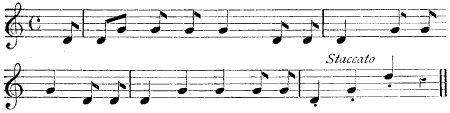
—London (J. P. Emslie).
A number of children stoop down in a row, clasping their hands under their legs. One child stands in front of them, and acts as owner or seller; another acts as purchaser (fig. 1). The purchaser inquires—
Have you any honey pots for sale? Yes, plenty; will you walk round and taste them?
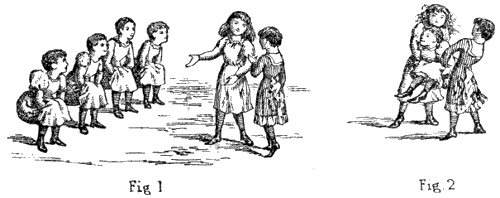
The purchaser goes round, pretending to taste each one in turn, inquiring the price and weight; finds fault with several, one being too sweet and the other not fresh enough, and so on. When one honey pot is discovered to the purchaser’s taste, she is lifted by the purchaser and owner, or by two children who act as weights or scales, and then swung by her arms backwards and forwards to estimate her weight and price (fig. 2). As long as the child can keep her hands clasped, so long is the swinging kept up; and as many times as they count, so many is the number of pounds she weighs. The seller sometimes said, when each one was bought—
Take her and bake her, And into pies make her, And bring her back When she is done.
They were not brought back, and the “owner” had to catch and bring back each one. When sold, the honey pot is taken to the other side, or “home” of the purchaser. The game goes on till all the honey pots are sold.—London (A. B. Gomme).
In Sporle, a girl clasps her hands under her legs to form a seat, and two others swing her by the arms, saying—
Honey pot, honey pot, over the river; When the old cat dies you shall have the liver.
—Miss Matthews.
In a version sent by Miss Chase, and told her by a London maidservant, the children sit as in “Hunt the Slipper.” One steps in a corner out of earshot; the rest are named “Gooseberry Tart,” “Cherry Tart,” &c., by another, who recalls the child in the corner with—
Fool, fool, come to school, Pick me out a [cherry tart, as the case may be].
If he chooses the wrong one he is told—
Go back and learn your A, B, C.
If rightly—
Take him and bake him, And give me a piece When he’s done.
The child is then led off in a squatting position. Later the one who named them pretends tasting, and says, “Very nice,” or “You must be baked longer,” when another squatting walk and wait takes place.
A version sent by Mr. J. P. Emslie is similar to the other London versions—
“Buy my fine honey to-day. Which shall I buy? Taste ’em and try.
The child would then go round, pretending to taste, saying, ‘Don’t like that one,’ till one was approved. That one was then swung round to the tune given, the words being—
An apple for the king and a pear for the queen, And a good jump over the bowling green.
At the last bar they swung the child higher and higher, and at the last note they swung it as high as they could. I believe the last note in the music should be G, but it was raised to give effect.”
In Scotland the game is called “Hinnie Pigs,” and is played as follows. The boys sit down in rows, hands locked beneath their hams. Round comes one of them, the honey merchant, who feels those who are sweet and sour, by lifting them by the arm-pits and giving them three shakes. If they stand these without the hands unlocking below they are then sweet and saleable, fit for being office-bearers of other ploys.—Mactaggart’s Gallovidian Encyclopædia.
In Ross and Stead’s Holderness Glossary this is described as a girls’ game, in which two carry a third as a pot of honey to market. It is mentioned by Addy (Sheffield Glossary) and by Holland (Cheshire Glossary). Mr. Holland adds, “If the hands give way before twenty is reached it is counted a bad honey pot; if not, it is a good one.”
In Dublin the seller sings out—
Honey pots, honey pots, all in a row, Twenty-five shillings wherever you go— Who’ll buy my honey pots?
—Mrs. Lincoln.
The game is mentioned by a writer in Blackwood’s Magazine, August 1821, p. 36, as being played in Edinburgh when he was a boy.
Hood
A game played at Haxey, in the Isle of Axholme, on the 6th of January. The Hood is a piece of sacking, rolled tightly up and well corded, and which weighs about six pounds. This is taken into an open field on the north side of the church, to be contended for by the youths assembled for that purpose. When the Hood is about to be thrown up, the Plough-bullocks or Boggins, as they are called, dressed in scarlet jackets, are placed amongst the crowd at certain distances. Their persons are sacred, and if amidst the general row the Hood falls into the hands of one of them, the sport begins again. The object of the person who seizes the Hood is to carry off the prize to some public-house in the town, where he is rewarded with such liquor as he chooses to call for. This pastime is said to have been instituted by the Mowbrays, and that the person who furnished the Hood did so as a tenure by which he held some land under the lord. How far this tradition may be founded on fact I do not know, but no person now acknowledges to hold any land by that tenure.—Stonehouse’s Isle of Axholme, p. 291.
W. J. Woolhouse (Notes and Queries, 2nd series, v. 95) says when the Hood is thrown up by the Chief of the Boggons or by the officials, it becomes the object of the villagers to get the Hood to their own village, the other eleven men, called Boggons, being stationed at the corners and sides of the field, to prevent, if possible, its being thrown out of the field; and should it chance to fall into any of their hands, it is “boggoned,” and forthwith returned to the chief, who again throws it up, as at the commencement of the game. The next day is occupied by the Boggons going round the villages singing as waits, and they are regaled with hot furmenty; from some they get coppers given them, and from others a small measure of wheat. The day after that they assume the character of Plough-bullocks, and at a certain part of Westwood-side they “smoke the Fool”—that is, straw is brought by those who like, and piled in a heap, a rope being tied or slung over the branches of the tree next to the pile of straw; the other end of the rope is fastened round the waist of the Fool, and he is drawn up and fire is put to the straw, the Fool being swung to and fro through the smoke until he is well-nigh choked, after which he goes round and collects whatever the spectators choose to give him. The sport is then at an end till the next year. The land left by Lady Mowbray was forty acres, which are known by the name of “Hoodlands,” and the Boggons’ dresses and the Hood are made from its proceeds.
In the contiguous parish of Epworth a similar game is played under the same name, but with some variations. The Hood is not here carried away from the field, but to certain goals, against which it is struck three times and then declared free. This is called “wyking” the Hood, which is afterwards thrown up again for a fresh game.—Notes and Queries, 6th series, vii. 148.
See “Football,” “Hockey.”
Hoodle-cum-blind
Name for “Blind Man’s Buff.”—Baker’s Northamptonshire Glossary.
Hoodman Blind
Name for “Blind Man’s Buff.” Mentioned in Hamlet, iii. 4; Merry Devil of Edmonton; and Wise Women of Hogsden.
Hooper’s Hide
Name for “Blind Man’s Buff.”—Nares’ Glossary.
Hop-crease
The game of “Hop-scotch.”—Halliwell’s Dictionary.
Hop-frog
The players bend as though about to sit on a very low stool, then spring about with their hands resting on their knees.—Dorsetshire (Folk-lore Journal, vii. 234).
Miss Peacock says that a game called “Hop-frog over the Dog” is played at Stixwould, Lincolnshire, in the same way as “Leap-frog.”
See “Curcuddie,” “Cutch-a-cutchoo,” “Harie Hutcheon,” “Hirtschin Hairy.”
Hop-score
Game of “Hop-scotch.”—Hunter’s Glossary of Hallamshire.
Hop-scotch
A game, the object of which is to eject a stone, slate, or “dump” out of a form linearly marked on the ground in different directions, by hopping without touching any of the lines.—Halliwell’s Dictionary.
In the plan (fig. 8) the players first lay the stone on the back of the hand, and walk through the plan, stepping into each division, throw it up and catch it. Then the stone is thrown back from No. 7 outside No. 1. Now it is placed on the toe, and the child walks through again, throwing up the foot when out, to catch the stone in the hand. Another way, done on the same plan, is for the player to place the stone in No. 1, leave it there, and hop into each division and back, then place it in No. 2, and repeat the hopping, and so on through all the figures. There is no kicking of the stone, as is usual in London.—Roxton, St. Neots (Miss Lumley).
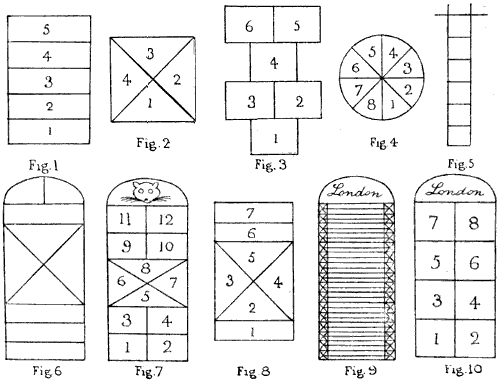
From Crockham Hill, Kent, Miss Chase sends four versions. In the first plan (fig. 1) the game is:—Throw stone into No. 1. Hop from No. 1 to No. 5 and back. Then pick it up. So on successively. After having thrown it into No. 5, begin to reverse by throwing stone into No. 1 while standing at No. 5—return with it on your thumb. Throw into No. 2—return with stone on your eye. Throw into No. 3—return with stone in your palm. Throw into No. 4—return with stone on your head. Throw into No. 5—return with stone on your back. In each case, upon reaching the goal without dropping it, throw up and catch it as it falls.
In the second plan (fig. 2) the game is:—Throw stone into No. 1. Pick it up. Hop, not touching lines, from No. 1 to No. 4, and “out.” Throw stone into No. 2. Do as before. And so successively into Nos. 3 and 4. Next balance stone on shoe, then on the palm of hand, then on the back of hand, then on the head, then on the shoulder, then on the eye (tilt head back to keep it from falling). In each case walk round once with it so balanced and catch at end.
In the third plan (fig. 3) the game is:—Put pebble in No. 1. Pick up. Hop, having one foot in No. 2 and the other in No. 3. Step into No. 4. Hop, having one foot in No. 5 and the other in No. 6. Jump round. Go back as you came. Then with stone on shoe, walk through the figure, kick it up and catch at the close. Place stone on eyelid; walk through the same figure, dropping it off into hand at close. This is called “jumping.”
In the fourth plan (fig. 4) the game is:—Throw stone into No. 1. Pick it up. Hop from No. 1 to No. 8, not touching lines. So successively into Nos. 2, 3, 4, &c. Walk into No. 1 with stone on foot, and out at No. 8. Kick it up and catch it. The same with stone on thumb. Toss it up and catch. Again with stone on your back. Straighten up, let it slide into your hand.
In Stead’s Holderness Glossary, this is described as a boys’ or girls’ game, in which the pavement is chalked with numbered crossed lines, and a pebble or piece of crockery is propelled onward by the foot, the performer hopping on one leg, the number reached on the chalk-line being scored to him or her. At Whitby it is called “Pally-ully,” and played with rounded pieces of pot the size of a penny. Divisions are chalked on the pavement, and the “pally-ullies” are impelled within the lines by a hop on one leg, and a side shuffle with the same foot (Whitby Glossary). It is sometimes called “Tray-Trip.” Atkinson describes the figure as oblong, with many angular compartments (Cleveland Glossary). Jamieson defines “Beds” as “Hop-scotch,” a game denominated from the form, sometimes by strangers called squares. In Aberdeen the spaces marked out are sometimes circular.
Mrs. Lincoln sends a diagram of the game from Dublin (fig. 6). Addy (Sheffield Glossary) under the name of “Hop-score” says it is a game in which certain squares are drawn or scored on the ground. The piece of stone which is pushed with the foot is called the “scotch.” Elworthy (West Somerset Words) says a piece of tile is kicked over lines and into squares marked on the ground. It is called “Hickety-Hackety,” also “Huckety.” Cope (Hampshire Glossary) says it is played in Hants. Moor (Suffolk Words and Phrases) describes this game under the name of “Scotch-hob,” by hopping and kicking a bit of tile from bed to bed of a diagram which he gives (fig. 5, here printed). Brockett (North Country Words) calls it “Beds.” Barnes (Dorset Glossary) only says “hopping over a parallelogram of scotches or chalk-lines on the ground.” F. H. Low, in Strand Magazine, ii. 516, says the divisions are respectively named onesie, twosie, threesie, foursie, and puddings. It is called “Hop-bed” at Stixwold in Lincolnshire (Miss Peacock), “Hop-score” in Yorkshire (Halliwell, l.c.), and “Hitchibed” in Cleveland, Yorks. (Glossary of Cleveland Words). Strutt describes it (Sports, p. 383); and Wood’s Modern Playmate, p. 32, gives a diagram similar to one seen on a London pavement by A. B. Gomme (see fig. 7). Mr. Emslie has sent me figs. 9 and 10, also from London streets. Newell (Games, p. 188) speaks of it as a well-known game in America.
Mr. Elworthy (West Somerset Words) says, “Several of these (diagrams marked on the ground) are still to be seen, scratched on the ancient pavement of the Roman Forum.” Mr. J. W. Crombie says, “The game of ‘Hop-scotch’ was one of considerable antiquity, having been known in England for more than two centuries, and it was played all over Europe under different names. Signor Pitré’s solar explanation of its origin appeared improbable to him, for not only was the evidence in its favour extremely weak, but it would require the original number of divisions in the figure to have been twelve instead of seven, which was the number indicated by a considerable body of evidence. It would seem more probable that the game at one time represented the progress of the soul from earth to heaven through various intermediate states, the name given to the last court being most frequently paradise or an equivalent, such as crown or glory, while the names of the other courts corresponded with the eschatological ideas prevalent in the early days of Christianity.” Some such game existed before Christianity, and Mr. Crombie considered that it had been derived from several ancient games. Possibly the strange myths of the labyrinths might have had something to do with “Hop-scotch,” and a variety of the game played in England, under the name of “Round Hop-scotch,” was almost identical with a game described by Pliny as being played by the boys of his day. Mr. Crombie also said he “believed that the early Christians adopted the general idea of the ancient game, but they not only converted it into an allegory of heaven, with Christian beliefs and Christian names; they Christianised the figure also; they abandoned the heathen labyrinth and replaced it by the form of the Basilicon, the early Christian church, dividing it into seven parts, as they believed heaven to be divided, and placing paradise, the inner sanctum of heaven, in the position of the altar, the inner sanctum of their earthly church.”
See “Hap the Beds.”[Addendum]
Hop, Step, and Jump
See “Half-Hammer.”
Hornie
A game among children in which one of the company runs after the rest having his hands clasped and his thumbs pushed out before him in resemblance of horns. The first person whom he touches with his thumbs becomes his property, joins hands with him, and aids in attempting to catch the rest: and so on until they are all made captives. Those who are at liberty still cry out, “Hornie, Hornie.”—Lothian (Jamieson).
Jamieson says: “Whether this play be a vestige of the very ancient custom of assuming the appearance and skins of animals, especially in the sports of Yule, or might be meant to symbolise the exertions made by the devil (often called ‘Hornie’) in making sinful man his prey, and employing fellow-men as his coadjutors in this work, I cannot pretend to determine.”
See “Hunt the Staigie,” “Whiddy.”
Hornie Holes
A game in which four play, a principal and an assistant on each side. A. stands with his assistant at one hole, and throws what is called a Cat (a piece of stick, and frequently a sheep’s horn), with the design of making it alight in another hole at some distance, at which B. and his assistant stand ready to drive it aside. The bat or driver is a rod resembling a walking-stick.
The following unintelligible rhyme is repeated by a player on the one side, while they on the other are gathering in the Cats, and is attested by old people as of great antiquity:—
Jock, Speak, and Sandy, W’ a’ their lousy train Round about by Errinborra, We’ll never meet again. Gae head ’im, gae hang ’im, Gae lay ’im in the sea; A’ the birds o’ the air Will bear him companee. With a nig-nag, widdy- [or worry-] bag, And an e’endown trail, trail; Quoth he.
—Jamieson.
The game is also called “Kittie-cat.”
See “Cat and Dog,” “Cudgel,” “Tip-cat.”
Horns
“A’ Horns to the Lift,” a game of young people. A circle is formed round a table, and all placing their forefingers on the table, one cries, “A’ horns to the lift! Cat’s horns upmost!” If on this any one lift his finger, he owes a wad, as cats have no horns. In the same manner, the person who does not raise his fingers when a horned animal is named is subjected to a forfeit.—Jamieson.
Hot Cockles
At Sheffield a boy is chosen for a Stump, and stands with his back against a wall. Another boy bends his back as in “Leapfrog,” and puts his head against the Stump. The cap of the boy who bends down is then taken off, and put upon his back upside down. Then each of the other boys who are playing puts the first finger of his right hand into the cap. When all the fingers are put into the cap, these lines are sung—
The wind blows east, the wind blows west, The wind blows o’er the cuckoo’s nest. Where is this poor man to go? Over yond cuckoo’s hill I O.
Then the boy whose back is bent jumps up, and the others run away crying out, “Hot cockles.” The boy who is caught by the one whose back was first bent has to bend his back next time, and so on.—S. O. Addy.
At Cork a handkerchief is tied over the eyes of one of the company, who then lays his head on a chair, and places his hand on his back with the palm uppermost. Any of the party come behind him and give him a slap on his hand, he in the meantime trying to discover whose hand it is that strikes.—Miss Keane.
“Hot Cockles” is an old game, practised especially at Christmas. One boy sits down, and another, who is blindfolded, kneels and lays his head on his knee, placing at the same time his open hand on his own back. He then cries, “Hot cockles, hot!” Another then strikes his open hand, and the sitting boy asks who strikes. If the boy guessed wrongly, he made a forfeit; but if rightly, he was released.—Notes and Queries, 4th series, ix. 262.
The sport is noticed by Gay—
As at hot-cockles once I laid me down, I felt the weighty hand of many a clown; Buxoma gave a gentle tap, and I Quick rose and read soft mischief in her eye.
Halliwell describes it rather differently. The blindfolded boy lies down on his face, and, being struck, must guess who it is that hit him. A good part of the fun consisted in the hardness of the slaps, which were generally given on the throne of honour. He quotes from a MS. play as follows—
It is edicted that every Grobian shall play at Bamberye hott cockles at the four festivals. Indeed a verye usefull sport, but lately much neglected to the mollefieinge of the flesh.
—Halliwell’s Dictionary.
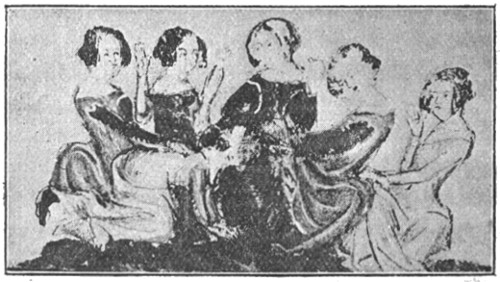
Nares’ Glossary also contains quotations from works of 1639, 1653, and 1697 which illustrate the game. Mr. Addy says “that this game as played in Sheffield is quite different from that described under the same title in Halliwell’s Dictionary. Aubrey (p. 30) speaks of ‘Hot Cockles’ as a game played at funerals in Yorkshire, and the lines here given show that this was the game. The lines—
Where is this poor man to go? Over yond cuckoo’s hill I O,
embodies the popular belief that the soul winged its way like a bird, and they remind one of the passing of the soul over Whinny Moor (see funeral dirge in Aubrey’s Remains of Gentilisme, p. 31). Grimm mentions the cuckoo hill (Gauchsberg). He says, ‘Originally in Gauchsberg the bird himself may very well have been meant in a mystic sense which has fallen dark to us now’ (Teut. Myth., ii. 681). We know, too, the old belief that the cuckoo tells children how many years they have to live. These lines are also sometimes said, in addition to those given above—
Elder belder, limber lock, Three wives in a clock; Sit and sing, and call a spring, O-u-t spells out.
The boy who bends down is supposed to be undergoing a great penalty.” Strutt (Sports, p. 394) describes this game, and gives an illustration which is here reproduced from the original MSS. in the Bodleian.
This game may have originated from a custom at funerals of practising spells for the safe and speedy passage of the departing spirit to its destination, or from divination mysteries to foretell who would be the next among the mourners to follow the dead body to the grave. The spirit of prophecy was believed to exist in a dying person. See “Handy Croopen.”[Addendum]
How many Miles to Babylon
I.
King and Queen of Cantelon, How many miles to Babylon? Eight and eight and other eight. Will I get there by candle-light? If your horse be good and your spurs be bright. How mony men have ye? Mae nae ye daur come and see.
—Chambers’ Popular Rhymes, p. 124; Mactaggart’s Gallovidian Encyclopædia.
II.
How many miles to Babylon? Three score and ten. Will we be there by candle-light? Yes, and back again. Open your gates and let us go through. Not without a beck and a boo. There’s a beck, and there’s a boo, Open your gates and let us go through.
—Nairn, Scotland (Rev. W. Gregor).
III.
How far to Banbury Cross? Four score and ten. Can I get there by candle-light? Yes, if your legs are long and light. Please to let me go? Not without you bend and bow [pronounced bo]. Here’s my bend [curtseys], And here’s my bow [touches forehead], Now will you let me go?
—Fernham and Longcot (Miss I. Barclay).
IV.
How many miles to Babylon? Three score and ten. Can we get there by candle-light? Yes, and back again. Open your gates as wide as you can, And let King George and his family go through. Not without a back, not without a bow, Not without a curtsey, and then I’ll let you through.
—South Shields (Miss Blair).
V.
How many miles to Babylon? Three score and ten. Can I get there o’ candle-light? There and back again. Here’s my black [raising one foot], And here’s my blue [raising the other], Open the gates and let me through.
—Annaverna, Ravendale, co. Louth, Ireland (Miss R. Stephen).
VI.
How many miles to Barney Bridge? Three score and ten. Will I be there by candle-light? Yes, if your legs are long. A curtsey to you, another to you, If you please will you let the king’s horses go through? Yes, but take care of your hindmost man.
—Belfast (W. H. Patterson).
VII.
How many miles to Gandigo? Eighty-eight almost, or quite. Can I [we] get there by candle-light? Yes, if your legs are long and light. Open the gate as high as the sky, And let the king and his queen go by.
—Dorsetshire (Folk-lore Journal, vii. 230, 231).
VIII.
How many miles to Banbury? Three score and ten. Can I get there by candle-light? Yes, and back again. But mind the old witch doesn’t catch you.
—London (Miss Dendy).
IX.
How many miles to Barley Bridge? Three score and ten. Can I get there by candle-light? Yes, if your legs be long. A courtesy to you, and a courtesy to you, If you please will you let the king’s horses through? Through and through shall they go, For the king’s sake; But the one that is the hindmost Will meet with a great mistake.
—Halliwell’s Popular Rhymes, p. 217.
X.
How many miles to Barney Bridge? Three score and ten. Will I be there by Candlemass? Yes, and back again. A curtsey to you, another to you, And pray, fair maids, will you let us through? Thro’ and thro’ shall you go for the king’s sake, But take care the last man does not meet a mistake.
—Dublin (Mrs. Lincoln).
XI.
How many miles to Burslem? Three score and ten. Can we get there by candle-light? Yes, and back again. Open the gates so wide, so wide, And let King George aside, aside; The night is so dark we cannot see, Thread the needle and go through.
—Isle of Man (A. W. Moore).
XII.
How many miles to Banbury Cross? Three score and ten. Shall we get there by midnight? Yes, if you run well. Then open your gates as wide as the sky, And let King George and his men pass by. It is so dark we cannot see, so thread the needle Nancy, Thread the needle Nancy. One, two, three.
—Warwick (from a little girl living near Warwick, through Mr. C. C. Bell).
XIII.
How many miles to London? Three score ten. Can I get there by candle-light? Yes, and back again. Open the gate and let me through. Not unless you’re black and blue. Here’s my black and here’s my blue, Open the gates and let me through. Dan, Dan, thread the needle; Dan, Dan, sew.
—Suffolk County Folk-lore, p. 63.
XIV.
How many miles to Babylon? Three score and ten. Shall I be there by candle-light? Yes, there and back again. Open the gates as wide as high, And let King George and his family pass by.
—Wales (Folk-lore Record, v. 88).
XV.
How many miles to - Barley Bridge?
Banbury?
London?
Four score and ten [or, Fifty miles and more]. Shall we be there by candle-light? Oh, yes, and back again. [Or, at Market Drayton. Shift your feet with nimble light, And you’ll be there by candle-light.] Open the gates as wide as the sky, And let King George and his lady go by.
—Market Drayton, Ellesmere, Whitchurch, (Burne’s Shropshire Folk-lore, p. 522).
XVI.
How many miles to Bethlehem? Three score and ten. Shall we get there by candle-light? Yes, there and back again. So open the gates and let King George and his family go through.
—Hayton, near York (H. Hardy).
XVII.
How far is it to Babylon? Three score miles and ten. Can I get there by candle-light? Yes, there and back again.
—Sporle, Norfolk (Miss Matthews).
XVIII.
How many miles to Babylon? Three score and ten. Can you get there by candle-light? O yes, and back again.
—Hanbury, Staffordshire (Miss E. Hollis).
XIX.
Open the gates as wide as high, And let King George and I go by; It is so dark I cannot see To thread my grandmother’s needle.
—Surrey (Folk-lore Record, v. 88).
(b) There are two methods of playing this game, one in which a King and Queen are represented, and the other in which gates of a city are represented. Of the first Chambers and Mactaggart practically give the same account. The latter says, “Two of the swiftest boys are placed between two ‘doons’ or places of safety; these, perhaps, are two hundred yards distant. All the other boys stand in one of these places or doons, when the two fleet youths come forward and address them with the rhyme. When out, they run in hopes to get to Babylon or the other doon, but many get not near that place before they are caught by the runners, who ‘taens’ them, that is, lay their hands upon their heads, when they are not allowed to run any more in that game, that is, until they all be taened or taken.”
The Norfolk game seems to resemble the Scotch, though in a much less complete form. Miss Matthews describes it as follows:—“A line of children is formed, and the two standing opposite it sing the questions, to which the line reply; then the two start off running in any direction they please, and the others try to catch them.”
The second method of playing is best described by the Rev. Walter Gregor, from the Nairn game, which is known as “The Gates of Babylon.” Mr. Gregor writes as follows:—“This game may be played either by boys or girls. Two of the players join hands, and stand face to face, with their hands in front as if forming a gate. Each of these has a secret name. The other players form themselves into a line by clasping each other round the waist from behind. They go up to the two that form the gate, and the leader asks the first question, as in version No. 2. The dialogue then proceeds to the end. The two then lift their arms as high as they can, still joined, and the line of players passes through. All at once the two bring their arms down on one and make him (or her) prisoner. The prisoner is asked in a whisper, so as not to disclose the secret name, which of the two is to be chosen. The one so captured takes his (or her) stand behind the one chosen. The same process is gone through till all the players are taken captive, and have stationed themselves behind the one or the other of the two forming the gate. The last one of the line goes through three times. The first time the word ‘breakfast’ is pronounced; the second time ‘dinner;’ and the third time ‘supper.’ The player then chooses a side. The two sides have then a tug of war. The game ends at this point with girls. With boys the conquered have to run the gauntlet. The victors range themselves in two lines, each boy with his cap or handkerchief tightly plaited in his hand, and pelt with all their might the vanquished as they run between the lines. The boys of Nairn call this running of the gauntlet, ‘through fire an’ watter.’”
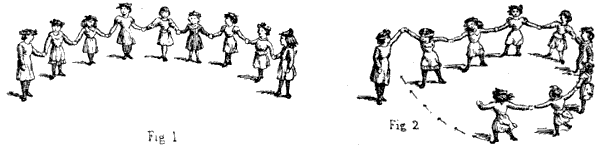
The method of playing the Warwick, Fernham, and Louth versions is practically the same. The children stand in half-circle beginning with the two tallest at either end. All clasp hands. The two at one end question those at the other end alternately (fig. 1). At the last line the two that have been answering hold their hands up to form a bridge, and all the others thread through, still holding hands (the bridge advancing slowly) (fig. 2). The Louth version is also sometimes played as “Oranges and Lemons.” This is also the case with the Belfast, South Shields, Ellesmere, and Dublin versions. Miss Burne also gives a second method of playing this game at Ellesmere: she says, “The whole number of players stand in two rows facing each other, each player joining hands with the one opposite. The pair at the lower end parley with the pair at the top, and then run under the extended arms of the others, receiving thumps on the back as they go, till they reach the upper end, and become the top couple in their turn.” The Hanbury version is played in a similar way. Two lines stand close together holding handkerchiefs across. The questions are asked and answered by the top and bottom players. Then two children run under the line of handkerchiefs. The Dorset version is played by as many as like standing, two and two, opposite each other, each of them taking with the right hand the right hand of the other; then the two that are the King and Queen say or sing the first question, to which the others reply, and the dialogue ends in this manner. Then all the other pairs hold up their hands as high as they can, and the King and Queen run through the archway and back again, and so on with the next pair, and other pairs in turn. The Isle of Man version is played, Mr. Moore says, the same as other “Thread the Needle” games.
(c) The game is evidently dramatic in form, and perhaps is illustrative of some fact of history, such as the toll upon merchandise entering a walled town. The changes in the words of the different versions are not very great, but they show the influence of modern history upon the game. The appearance of King George evidently points to the date when it was frequently played, though the older versions are doubtless those in which his Majesty does not do duty. Mactaggart has the following quaint note which perhaps may supply the origin, though it seems a far cry to the Crusaders:—“This sport has something methinks of antiquity in it; it seemeth to be a pantomime of some scenes played off in the time of the Crusades. ‘King and Queen o’ Cantilon’ evidently must be King and Queen of Caledon, but slightly changed by time. Then Babylon in the rhyme, the way they had to wander and hazard being caught by the infidels, all speak as to the foundation of the game” (Mactaggart’s Gallovidian Encyclopædia).
In the Gentleman’s Magazine for December 1849, in a review of the Life of Shirley, it is stated that in many parts of England the old game of “Thread the Needle” is played to the following words, which refer to the gate of the city of Hebron, known as the “needle’s eye.”
How many miles to Hebron? Three score and ten. Shall I be there by midnight? Yes, and back again. Then thread the needle, &c.
The game is also described in Notes and Queries, iv. 141, as played in the same way as above, and the writer adds there are subsequent evolutions by which each couple becomes in succession the eye of the needle.
Howly
A street game played by boys in a town, one of them hiding behind a wall or house-end, and crying “Howly” to the seekers.—Atkinson’s Cleveland Glossary.
See “Hide and Seek.”
Huckie-buckie down the Brae
Children in Lothian have a sport in which they slide down a hill, sitting on their hunkers (Jamieson). The well-known custom at Greenwich is probably the same game, and there are examples at Tumbling Hill, a few miles from Exeter, at May Pole Hill, near Gloucester, and other places.
Huckle-bones
Holloway (Dict. of Provincialisms) says that the game is called “Huckle-bones” in East Sussex and “Dibs” in West Sussex. Parish (Dict. of Sussex Dialect) mentions that huckle-bones, the small bone found in the joint of the knee of a sheep, are used by children for playing the game of “Dibs;” also Peacock’s Manley and Corringham Glossary. Barnes (Dorset Glossary) says, “A game of toss and catch, played mostly by two with five dibs or huckle-bones of a leg of mutton, or round pieces of tile or slate.” Halliwell’s description is clearly wrong. He says it was a game formerly played by throwing up the hip-bone of some animal, on one side of which was a head of Venus and on the other that of a dog. He who turned up the former was the winner (Dictionary). Miss J. Barker writes that “Huckle-bones” is played in Hexham; and Professor Attwell (Barnes) played the game as a boy, and is still a proficient in it; he played it recently for my benefit with his set of real huckle-bones (A. B. Gomme); and see Notes and Queries, 9th ser., iv. 378, 379.
The figures or sets are practically the same as those described under “Fivestones.” The game is very ancient. In the Sanctuarie of Salvation, &c., translated from the Latin of Levinus Lemnius by Henry Kinder (8vo, London, printed by H. Singleton), p. 144, we read, “These bones are called ‘huckle-bones’ or ‘coytes.’” For further information relating to this game, as played by the ancients, the reader may consult Joannis Meursii Ludibunda, sive de Ludis Græcorum, Liber singularis (8vo, Lugd. Bat. 1625), p. 7, and Dan. Souterii Palamedes, p. 81; but more particularly, I Tali ed altri Strumenti lusori degli antichi Romani, discritti da Francesco de ’Ficoroni, 4to, Rom. 1734. Against the suggestion that the modern game is derived directly from the Romans, is the fact that it is known in countries never traversed or occupied by the Romans. Thus Dr. Clarke, in his Travels in Russia, 1810, p. 106, says: “In all the villages and towns from Moscow to Woronetz, as in other parts of Russia, are seen boys, girls, and sometimes even old men, playing with the joint-bones of sheep. This game is called ‘Dibbs’ by the English. It is of very remote antiquity; for I have seen it very beautifully represented on Grecian vases; particularly on a vase in the collection of the late Sir William Hamilton, where a female figure appeared most gracefully delineated kneeling upon one knee, with her right arm extended, the palm downwards, and the bones ranged along the back of her hand and arm. In this manner the Russians play the game.”
See “Dalies,” “Fivestones.”[Addendum]
Hummie
The game otherwise called “Shinty.” The shinty or hummie is played by a set of boys in two divisions who attempt to drive with curved sticks a ball, or what is more common, part of the vertebral bone of a sheep, in opposite directions (Blackwood’s Magazine, August 1821, p. 36). If one of the adverse party happens to stand or run among his opponents, they call out “Hummie, keep on your own side.”—Jamieson.
Hundreds
A game at marbles, which is carried on until one of the players scores 100 or some other high number agreed upon. Any number can play, but it is best described for two players, A. and B. First the players taw up to a hole; if both get in, they repeat the process until one is left out, say B.; then A. counts 10. Should both fail, the nearest goes first. He may now lay his taw about the hole or fire at the other, on hitting which he counts another 10. He now goes for the hole again, and failing, lies where he happens to stop. If he misses, B. from his present position tries to get into the hole, and failing, lies still; but if he reaches the hole, he counts 10, and proceeds as A. had done. The one who first gets the 100 (or other number) now goes in for his “pizings,” which performance takes place thus:—The loser, so far, is lying about, and the winner goes back to “drakes,” and again tries to lodge in the hole; and if he succeeds, the game is up. If not, he lies still, and the loser tries for the hole; if he gets in he counts another 10, or if he should succeed in hitting the winner he scores his adversary’s 100 to his own number, and then goes on for his “pizings” as the other had done. In failure of either securing the game thus, the process is repeated at “drakes.” When, however, the one who is on for his “pizings” manages to taw into the hole, the game is concluded.—Easther’s Almondbury and Huddersfield Glossary.
Hunt the Hare
A game among children, played on the ice as well as in the fields (Brockett’s North Country Words). Strutt (Sports, p. 381) says “Hunt the Hare” is the same game as “Hunt the Fox.” In this game one boy is permitted to run out, and having law given to him—that is, being permitted to go to a certain distance from his comrades before they pursue him—their object is to take him, if possible, before he can return home.
See “Hare and Hounds.”
Hunt the Slipper
[Play]
—Lancashire (Mrs. Harley).
All the players but one sit on the floor in a circle with their legs crossed (Turkish fashion), one acting as Chief, all pretending to work at making or mending shoes. The other player brings a slipper to the Chief Cobbler, and desires it to be mended, saying—
Cobbler, cobbler, mend my shoe, Get it done by half-past two.
The child walks away, and returns in a few moments and asks whether the shoe is ready. The Cobbler says, “Not quite; call again in an hour’s time,” or makes any other excuse which occurs to him. When the child calls again, she is told it has been sent home. After several pretences the child declares an intention to search for it. The Cobblers in the ring then all place their hands under their knees, and pass the slipper secretly from one to another in such a way as to prevent the owner of the shoe getting it for some time. The Cobbler from whom the slipper is taken becomes the owner next time (Barnes, A. B. Gomme). In the Nottinghamshire version (Miss Peacock) the rhyme is—
Cobbler, cobbler, mend my shoe, Give it a stitch and that will do.
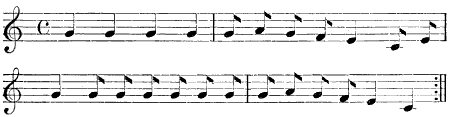
Versions from Wakefield, Liphook, Ellesmere, and other places are practically the same as the Barnes game, but Mr. Udal gives an elaboration of the Dorsetshire game in the Folk-lore Journal, vii. 238. One Lancashire version (Miss Dendy) reverses the characters by making the Cobbler run round the ring, and the children requiring the shoe to be mended, call out, “Blackie, come mend my slipper.” Mrs. Harley, in another Lancashire version, gives the words sung to the tune printed as—
Pass on, pass on, passy on the slipper; The best fun we ever had was passing on the slipper.
Holloway (Dict. of Provincialisms) says this game was well known in Somerset, Hants, Sussex, but now is almost out of fashion. He describes it as being played without words. The child who has to find the shoe stands in the centre of the circle. The chief amusement arises from the one in the circle who has the slipper striking the one who stands up (the searcher) while he or she is steadily looking for it in an opposite direction. Strutt (Sports, p. 387) also describes this game.[Addendum]
Hunt the Staigie
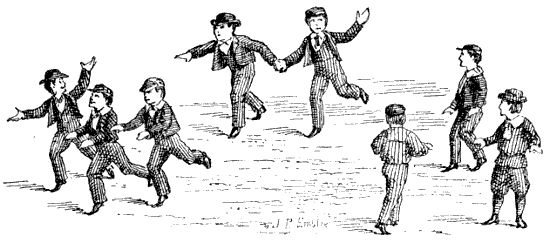
A boys’ game. One is chosen to be the Staigie (little stallion). The other players scatter themselves over the playground. The Staigie locks his fingers into each other. He then repeats the words—
Hunt the Staigie, Huntie, untie, staige, Ailleman, ailleman, aigie,
and rushes off with his hands locked, and tries to touch one of the players. He must not unlock his hands till he has caught one. When he has captured one, the two join hands and hunt for another. When another is caught, he joins the two. This goes on till all are hunted down.—Keith (Rev. W. Gregor).
See “Chickidy Hand,” “Whiddy.”
Hunting
[Play]
—Earls Heaton (Herbert Hardy).
[Play]
—Epworth (C. C. Bell).
I.
Oh, a-hunting we will go, a-hunting we will go; We’ll catch a little fox and put him in a box, And never let him go.
—Bath (Miss Large).
II.
Hunting we will go, brave boys, Hunting we will go; We’ll catch an old fox And put him in a box, For a-hunting we will go. Halt! shoulder arms! fire!
—Horncastle, North Kelsey, Lincoln (Miss Peacock).
III.
O have you seen the Shah, O have you seen the Shah? He lights his pipe on a star-light night, O have you seen the Shah? For a-hunting we will go, A-hunting we will go; We’ll catch a fox and put him in a box, A-hunting we will go.
—Epworth, Doncaster (C. C. Bell).
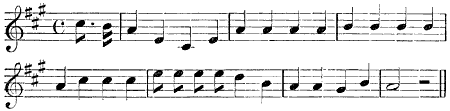
(b) The players march two by two, all singing. The first pair let go hands, separate, and skip widely apart, still singing. Gradually, in this manner, two separate lines are formed, until, following each other and singing, the pairs come together again, join hands, and march and sing in couplets linked.
The Bath game is played by the children standing in two rows facing each other, and clapping hands and singing the verse. At the same time the two children facing each other at the top of the lines join hands and trip down and up between the lines. Their hands are unclasped, and the two children run down the outside of the lines, one running on each side, and meet at the bottom of the lines, where they stand. The two children now standing at the top proceed in the same way: this is continued until all the children have done the same. A ring is then formed, when the children again clap and sing. Any number can play at this game.
In the Epworth version the children range themselves in double rank at one end of the room or playground, and march down to the other end hand in hand. At the bottom they loose hands and divide, the first rank turning right, the second left, and march back in two single files to the other end again, where they re-form as at first, and repeat their manœuvre, singing the verses alternately.
The Lincolnshire game is played by the children walking two and two in a circle round one of their companions, singing. The players then stand facing the child in the centre, and place their hands on their partners’ shoulders. After the lines are sung the centre child cries out, “Halt! Shoulder arms! Fire!” at which words each child kisses his partner. If the commander sees any one hesitate, or avoid kissing, he runs forward and takes the defaulter’s place, leaving him to fill the middle position.
Similar versions are played at Earls Heaton (Mr. Hardy), Forest of Dean (Miss Matthews), Ellesmere (Burne, Shropshire Folk-lore, p. 574), Derbyshire (Folk-lore Journal, i. 386).
Hurling
A game played with a ball. The players are divided into two equal parties, each of which tries to secure and keep the ball in their possession. The prize is a ball made of cork, covered with silver.—Courtney’s West Cornwall Glossary.
In Taylor’s Antiquitates Curiosæ, p. 144, it is stated:—“The game of hurling consisted in throwing or hurling a ball of wood about three inches in diameter, and covered with plated silver, sometimes gilt. On the ball was frequently a Cornish motto allusive to the game, and signifying that fair play was best. Success depended on catching the ball dexterously when dealt, and conveying it away through all the opposition of the adverse party, or, if that was impossible, to throw it into the hands of a partner, who, in his turn, was to exert his utmost efforts to convey it to his own goal, which was often three or four miles distant from that of his adversaries.”
T. Durfey’s Collin’s Walk through London, 1690, p. 192, says: “Hurling is an ancient sport us’d to this day in the countys of Cornwall and Devon, when once a year the hardy young fellows of each county meet; and a cork ball thinly plated with silver being thrown up between ’em, they run, bustle, and fight for it, to the witty dislocating of many a shrew’d neck, or for the sport of telling how bravely their arms or legs came to be broke, when they got home.” It is fully described by Carew in his Survey of Cornwall, 1602, p. 73.
It is also a very ancient Irish game, and Mr. Kinahan says: “Many places are called after it: such as, Killahurla, the hurlers’ church; Gortnahurla, the field of the hurlers; Greenanahurla, the sunny place of the hurlers; this, however, is now generally corrupted into hurling-green. The hurling-green where the famous match was played by the people of Wexford against those of Cather (now divided into the counties of Carlow and Wicklow), and where the former got the name of yellow bellies, from the colour of the scarfs they wore round their waist, is a sunny flat on the western side of North Wicklow Gap, on the road from Gorey to Trinnahely. There are also many other different names that record the game.”—Folk-lore Journal, ii. 266.
See “Bandy,” “Camp,” “Football,” “Hockey,” “Hood,” “Shinty.”
Hurly-burly
An undescribed boys’ game. In it the following rhyme is used—
Hurly-burly, trumpy trace, The cow stands in the market-place; Some goes far, and some goes near, Where shall this poor sinner steer?
—Patterson’s Antrim and Down Glossary.
For a similar rhyme see “Hot Cockles.”
Huss
Children play a game which is accompanied by a song beginning—
Hussing and bussing will not do, But go to the gate, knock, and ring— Please, Mrs. Brown, is Nellie within?
—Parish’s Dictionary of the Sussex Dialect.
Hustle Cap
A boys’ game, played by tossing up halfpence. It is mentioned in Peregrine Pickle, cap. xvi. Cope (Hampshire Glossary) says, “Halfpence are placed in a cap and thrown up, a sort of ‘pitch-and-toss.’”
Hynny-pynny
A peculiar game at marbles, sometimes called “Hyssy-pyssy,” played in some parts of Devon and Somerset. A hole of some extent was made in an uneven piece of ground, and the game was to shoot the marbles at some object beyond the hole without letting them tumble into it. The game occasionally commenced by a ceremony of no very delicate description, which sufficed to render the fallen marble still more ignominious.—Halliwell’s Dictionary.
Isabella
[Play]
—Ogbourne, Wilts (H. S. May).
[Play]
—Earls Heaton (H. Hardy).
[Play]
—London (A. B. Gomme).
I.
Isabella, Isabella, Isabella, Farewell! Last night when we parted I left you broken-hearted, And on a green mountain, There stands a young man. Could you love him? Could you love him? Could you love him? Farewell! Choose one, love, Choose one, love, Choose one, love, Farewell! Take a walk, love, Take a walk, love, Take a walk, love, Farewell! In the ring, love, In the ring, love, In the ring, love, Farewell! Put the ring on, Put the ring on, Put the ring on, Farewell! Go to church, love, Go to church, love, Go to church, love, Farewell! Take a kiss, love, Take a kiss, love, Take a kiss, love, Farewell! Shake hands, love, Shake hands, love, Shake hands, love, Farewell!
—Enborne, Newbury (M. Kimber).
II.
Isabella, Isabella, Isabella, Farewell! Last night when I departed I left her broken-hearted; Upon the steep mountain There stands a young man. Who’ll you choose, love? Who’ll you choose, love? Who’ll you choose, love? Farewell! Go to church, love, Go to church, love, Go to church, love, Farewell! Say your prayers, love, Say your prayers, love, Say your prayers, love, Farewell! Put your ring on, Put your ring on, Put your ring on, Farewell! Come back, love, Come back, love, Come back, love, Farewell! Roast beef and plum pudding, Roast beef and plum pudding, Roast beef and plum pudding, For our dinner to-day. Kiss together, love, Kiss together, love, Kiss together, love, Farewell!
—Ogbourne, Wilts (H. S. May).
III.
Isabella, Isabella, Isabella, Farewell! Last night when I departed I left you broken-hearted Broken-hearted on the mountain, On the mountain, Farewell! Choose your loved one, choose your loved one, Choose your loved one, Farewell! Kiss your hand, love, kiss your hand, love, Kiss your hand, love, Farewell! Go to church, love, go to church, love, Go to church, love, Farewell! Say your prayers, love, say your prayers, love, Say your prayers, love, Farewell! Come to dinner, love, come to dinner, love, Come to dinner, love, Farewell! What have you for dinner, for dinner, for dinner, What have you for dinner, for dinner to-day? Roast beef and plum pudding, plum pudding, plum pudding, Roast beef and plum pudding, plum pudding to-day.
—Southampton (Mrs. W. R. Carse).
IV.
Isabella, Isabella, Isabella, Farewell! Last night I met you downhearted and sad, And down by the river I met your young man. Choose a lover, choose a lover, Choose a lover, Farewell! Walk to church, love, walk to church, love, Walk to church, love, Farewell! Come to the ring, love, come to the ring, love, Come to the ring, love, Farewell! Give a kiss, love, give a kiss, love, Give a kiss, love, Farewell!
—West Grinstead, Sussex (Notes and Queries, 8th Series, i. 249, Miss Busk).
V.
Arabella! Arabella! Arabella! Farewell! Last night when we parted I left you broken-hearted Down by the mill-side. Who’ll you have, love? Who’ll you have, love? Who’ll you have, love? Farewell! Go to church, love, Go to church, love, Go to church, love, Farewell! Come back, love, Come back, love, Come back, love, Farewell! Shake hands, love, Shake hands, love, Shake hands, love, Farewell! Take a kiss, love, Take a kiss, love, Take a kiss, love, Farewell!
—Platt School, near Wrotham, Kent (Miss Burne).
VI.
Isabella, Isabella, Isabella, Farewell! Last night when we parted I left you broken-hearted, And on the green meadow You was standing alone. Choose a sweetheart, choose a sweetheart, Choose a sweetheart, fair maid. Take her hand, love, take her hand, love, Take her hand, love, fair maid. Kneel down, love, kneel down, love, Kneel down, love, fair maid. Take a kiss, love, take a kiss, love, Take a kiss, love, fair maid. Now you’re married I wish you joy, First a girl and then a boy, Seven years after son and daughter; Pray, young couple, come kiss together. Kiss her once, kiss her twice, kiss her three times over.
—From a London nursemaid, 1878 (A. B. Gomme).
VII.
Isabella, Isabella, Isabella, Farewell! Last night when we parted I believed you broken-hearted, As on the green mountain You stands [qy. sang] like a lark. Go to church, love, go to church, love, Go to church, love, Farewell! In the ring, love, in the ring, love, In the ring, love, Farewell! Give a kiss, love, give a kiss, love, Give a kiss, love, Farewell! Isabella, Isabella, Isabella, Farewell!
—Fernham and Longcot (Miss I. Barclay).
VIII.
Isabella, Isabella, Isabella, Farewell! Last night when I departed I left her broken-hearted; On the hill yonder there stands your young man. Fetch him here, love, fetch him here, love, Fetch him here, love, Farewell! Shut the gates, love, shut the gates, love, Shut the gates, love, Farewell! Open the gates, love, open the gates, love, Open the gates, love, Farewell! Go to church, love, go to church, love, Go to church, love, Farewell! Show your ring, love, show your ring, love, Show your ring, love, Farewell!
—Hanbury, Staffs. (Miss E. Hollis).
IX.
The trees are uncovered, uncovered, uncovered, The trees are uncovered, Isabella, for me! Last night when we parted we were all broken-hearted, Isabella, Isabella, Isabella, for me! Then give me your hand, love, your hand, love, your hand, love, Then give me your hand, love, and a sweet kiss from you.
—Earls Heaton (Herbert Hardy).
X.
When the trees are uncovered, Isabellow, for me. Last night when we parted She was nigh broken-hearted, Isabellow, Isabellow, Isabellow, for me. Your hand, love, your hand, love, Then give me your hand, love, Take a sweet kiss from me.
—Winterton, Nottinghamshire and Yorkshire (Miss Peacock).
XI.
Isabella, Isabella, Isabella, Farewell! Last night when we parted I left you broken-hearted, And down by the river you saw your young man. In the stream, love, in the stream, love, In the stream, love, Farewell! Go to church, love, go to church, love, Go to church, love, Farewell. In the ring, love, in the ring, love, In the ring, love, Farewell!
—Long Eaton, Nottinghamshire (Miss Youngman).
XII.
Elizabella, Farewell! Last night as we parted She left me broken-hearted, And on a green mountain She looked like a dove. Choose your loved one, Choose your loved one, Choose your loved one, Farewell! Go to church, love, Farewell! Say your prayers, love, Farewell! In the ring, love, Farewell! Shake hands, loves, Shake hands, loves, Farewell! Give a kiss, loves, Give a kiss, loves, Farewell!
—Liphook, Hants (Miss Fowler).
XIII.
Last night when we parted She was nigh broken-hearted, To-morrow we gather And a bright welcome be. Then give me your hand, love, Your hand, love, your hand, love, Then give me your hand, love, Isabella for me. Isabella, Isabella, Isabella for me.
—North Derbyshire (S. O. Addy).
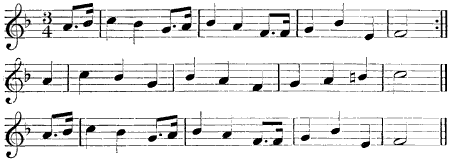
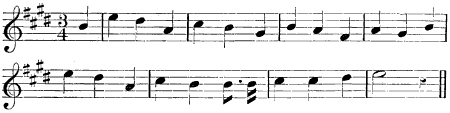
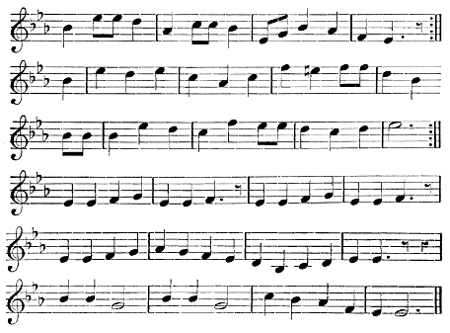
(b) In the Enborne, Newbury, version (Miss Kimber) a ring is formed by the children (boys and girls) joining hands. Another child stands in the centre. The ring of children walk round while singing the verses. The singing is confined to the ring. When the centre child is told to “choose,” she selects a boy from the ring, who goes into the centre and they stand together. At the next verse these two children walk out of the ring arm-in-arm. When the next verse is sung they return, and again stand in the centre. At the next verse the boy pretends to put a ring on the girl’s finger. They walk out of the ring when told to go to church (two children in the ring unclasping hands to let them walk out, and again clasping hands after they return), and kiss each other and shake hands when the two next verses are sung. The child who was first in the centre then joins the ring, and the game proceeds in the same way with the second child, who chooses in his turn. All the other versions follow the same rules, suiting their actions to the words, except Ogbourne, Wilts, in which the two children in the centre sing the verse, “roast beef and plum pudding.” They stand face to face, take hold of each other’s hands, and sway their arms from side to side. The ring then sing the concluding verse. In those versions where “say your prayers” and “kneel down” occur, the two centre children kneel, and hold their open hands together in front of them to imitate a book. In the London version (A. B. Gomme) a handkerchief was laid on the ground, and the two children stood on each side of it and clasped hands across it. In the Fernham and Longcot version the one child leads the other out of the ring at “go to church,” with a graceful half-dancing motion, and back again in the same way. The first child joins the ring while the refrain is sung. In the Hanbury version the centre child pretends to be weeping; another child stands outside the ring and goes into it; when the two meet they kiss. In the North Derbyshire version (Mr. S. O. Addy) a ring is formed of young men and women, a young man being in the centre. He chooses a young woman at the singing of the fifth line, and then joins the ring, the girl remaining in the centre.
(c) The tunes of all versions are very similar. The tune of the Newbury game (Miss Kimber) is the same as the first part of the Ogbourne tune printed (Mr. H. S. May); that from Nottingham (Miss Youngman) is the same as the first part of the London version. This is also the case with the Hanbury, Staffs. (Miss E. Hollis) and Fernham and Longcot game. What difference there is is very slight. The Platt, Kent, game (Miss Burne), is sung to the same tune as “Green Gravel,” given ante, p. 170. The first portion only of the tune is repeated for all verses sung after the first verse. The Barnes game is sung to the same tune as the Earls Heaton (Mr. Hardy), which is printed ante. A version played at Barnes is almost identical with the Southampton version, and another collected by Miss Thoyts in Berkshire (Antiquary, vol. xxvii. p. 193) is similar to the Hanbury version. The first lines run—Choose your lover; Open the gates; Go to church, love; Kneel down, love; Say your prayers, love; Put on the ring; Stand up, love; In the ring, love; Kiss together, love.
(d) The words of all the versions are sufficiently similar to analyse without a special form. The game appears to be purely a love and marriage game, and has probably had its origin in a ballad, and this idea is strengthened by the fact that only one version (London) has the marriage formula sung at the end, and this is probably an arbitrary addition. The lover is represented as lonely and disconsolate, and the remedy suggested is to choose a sweetheart. The marriage ceremony is of the simplest description—the clasping of hands and the kissing within the circle probably implying the betrothal at a spot sacred to such functions, similar to the Standing Stones of Stenness. Whatever may have been the original intention of these stones, they came in more recent times to be the resort of lovers, who joined their right hands through the hole in the altar stones in the belief that this ceremony would add additional solemnity to the betrothal. Miss Gordon Cumming, in her Tour in the Hebrides, mentions the fact of the marriage ceremony being of the simplest—a man and woman standing facing each other and clasping hands over a particular stone. Walking arm-in-arm is a sign in Dorsetshire that a couple are married. The mention of the “roast beef and plum pudding” for dinner has probably had its origin in the wedding dinner or breakfast, and the inviting of friends to assemble for the wedding dinner. The word “Isabella” may have been originally something quite different from the name of a girl. I am inclined to think the word was not the name of a person at all; possibly it was something addressed to a particular person in words the sense of which are now lost, and the nearest idea to it was this name. The same thing may also apply to the word “farewell,” and hence the incongruity of the first few lines in nearly all versions.[Addendum]
Jack’s Alive.
A number of people sit in a row, or on chairs round a parlour. A lighted wooden spill or taper is handed to the first, who says—
Jack’s alive, and likely to live; If he dies in your hand you’ve a forfeit to give.
The one in whose hand the light expires has to pay a forfeit. As the spill is getting burnt out the lines are said very quickly, as everybody is anxious not to have to pay the forfeit.—Addy’s Sheffield Glossary.
At Egan, in Derbyshire, a number of persons sit round a fire; one of them lights a stick, twirls it round, and says—
Little Nanny Cockerthaw, What if I should let her fa’?
The others reply—
Nine sticks and nine stones Shall be laid on thy bare back bones If thou shouldst let fa’ Little Nanny Cockerthaw.
If the ember or lighted stick goes out whilst any one is twirling it round, and whilst the lines are being said, he has to lie on the floor, when stones, chairs, or other articles of furniture are piled upon him.—S. O. Addy.
Mactaggart calls it “Preest Cat,” and says that it is an ingleside game. A piece of stick is made red in the fire; one hands it to another, saying—
About wi’ that, about wi’ that, Keep alive the preest cat.
Then round is handed the stick, and whomsoever’s hand it goes out in, that one is in a wad, and must kiss the crook, the cleps, and what not, ere he gets out of it.
Lilly cuckoo, lilly cuckoo, Sticks and stanes lie at thy weary banes If thou fa’, for a’ I blaw, Lilly cuckoo, lilly cuckoo.
This rhyme is common in the “Preest Cat” sport toward the border. Anciently, when the priest’s cat departed this life, wailing began in the country side, as it was thought it became some supernatural being—a witch, perhaps, of hideous form—so to keep it alive was a great matter.—Mactaggart’s Gallovidian Encyclopædia.
He also refers to a game called “Robin-a-Ree,” much like “Preest Cat,” only in passing the burnt stick round the ring the following rhyme is said—
Robin-a-Ree, ye’ll no dee wi’ me, Tho’ I birl ye roun’ three times and three; O Robin-a-Ree, O Robin-a-Ree, O dinna let Robin-a-Reerie dee.
Robin-a-Ree occurs in an old song.—Mactaggart’s Gallovidian Encyclopædia.
In Cornwall it is known as “Robin’s a-light,” and is played around the fire. A piece of stick is set on fire and whirled around rapidly in the hand of the first player, who says, “Robin’s a-light, and if he go out I will saddle your back.” It is then passed to the next, who says the same thing, and so on. The person who lets the spark die out has to pay a forfeit.—Scilly (Courtney’s West Cornwall Glossary). A rhyme at Lostwithiel is known as follows—
Jack’s alive, and likely to live; If he die in my hand a pawn (forfeit) I’ll give.
—(J. W.)
Jamieson (Dictionary) says, “To do ‘Dingle-dousie,’ a stick is ignited at one end and given as a plaything to a child.” Elworthy (West Somerset Words) does not give this as a game, but says a burning stick was whirled round and round very quickly, so as to keep up the appearance of a ribbon of fire. Miss Burne (Shropshire Folk-lore, p. 530), says, “Children wave a burning stick in the air, saying—
A girdle o’ gold, a saddle o’ silk, A horse for me as white as milk,
an evident relic of divinations or incantations practised with bonfires.” Halliwell (Nursery Rhymes, p. 213) gives the rhyme as—
Jack’s alive, and in very good health, If he dies in your hand you must look to yourself;
the game being played in the same way as the Sheffield version (see also Halliwell’s Dictionary and Moor’s Suffolk Words).
(b) This is a very significant game, and its similarity in miniature to the old tribal custom of carrying the fiery cross to rouse the clans at once suggests the possible origin of it. The detention of the fiery cross through neglect or other impediment was regarded with much dread by the inhabitants of the place in which it should occur. This subject is discussed in Gomme’s Primitive Folkmoots, p. 279 et seq.[Addendum]
Jack, Jack, the Bread’s a-burning
Jack, Jack, the bread’s a-burning, All to a cinder; If you don’t come and fetch it out We’ll throw it through the winder.
These lines are chanted by players that stand thus. One places his back against a wall, tree, &c., grasping another, whose back is toward him, round the waist; the second grasps a third, and so on. The player called Jack walks apart until the conclusion of the lines. Then he goes to the others and pokes at or pats them, saying, “I don’t think you’re done yet,” and walks away again. The chant is repeated, and when he is satisfied that the bread is “done” he endeavours to pull the foremost from the grasp of the others, &c.—Warwickshire (Northall’s Folk Rhymes, p. 390).
See “Mother Mop.”
Jack upon the Mopstick
See “Bung the Bucket.”
Jackysteauns
A game among school-girls, played with small pebbles, and sometimes with plum or cherry stones (Dickinson’s Cumberland Glossary). “A children’s game, played with five white pebbles called Jackstones,” says Mr. Patterson (Antrim and Down Glossary). The game is called “Jack.”
See “Fivestones,” “Hucklebones.”
Jauping Paste-eggs
A youthful amusement in Newcastle and the neighbourhood at Easter. One boy, holding an egg in his hand, challenges another to give blow for blow. One of the eggs is sure to be fractured in the conflict, and its shattered remains become the spoil of the conqueror.
See “Conkers.”
Jenny Jones
[Play]
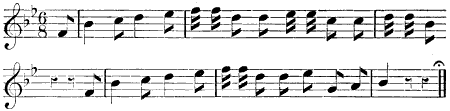
—Platt, near Wrotham, Kent (Miss Burne).
[Play]
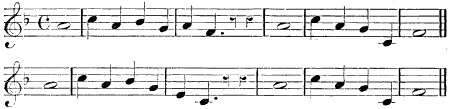
—Northants (Rev. W. D. Sweeting).
[Play]
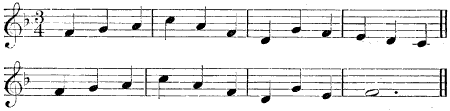
—Belfast (W. H. Patterson).
I.
I’m come to court Janet jo, Janet jo, Janet jo, I’m come to court Janet jo, How’s she the day? She’s up the stair washin’, Washin’, washin’, She’s up the stair washin’, Ye canna see her the day.
[Then follow verses, the words of which are not given by Chambers, representing Jenny as bleaching, drying, and ironing clothes. At last they say—]
Janet jo’s dead and gane, Dead and gane, dead and gane; Janet jo’s dead and gane, She’ll never come hame!
—Chambers’ Popular Rhymes, pp. 140-41.
II.
I’m come to court Janet jo, Janet jo, Janet jo, Come to court Janet jo, How is she the day? She’s butt the house washing, washing, washing She’s butt the house washing, You can’t see her to-day. Fare ye well, ladies, ladies, ladies, Fare ye well, ladies, For I must away.
—West Scotland (Folk-lore Record, iv. 474).
III.
We’ve come to court Jinny jo, Jinny jo, Jinny jo, We’ve come to court Jinny jo, Is she within? Jinny jo’s washing clothes, Washing clothes, washing clothes, Jinny jo’s washing clothes, You can’t see her to-day. So fare ye well, ladies, O ladies, O ladies, So fare ye well, ladies And gentlemen too.
[These verses are repeated for—
(1) drying clothes,
(2) starching,
(3) ironing,
(4) ill,
(5) dying.
Then—]
Jinny jo’s lying dead, Lying dead, lying dead, Jinny jo’s lying dead, You can’t see her to-day. So turn again, ladies, Ladies, ladies, ladies, So turn again, ladies, And gentlemen too. What shall we dress her in? Dress her in, dress her in? What shall we dress her in? Shall it be red? Red’s for the soldiers, The soldiers, the soldiers, Red’s for the soldiers, And that will not do.
[Various other colours are suggested in the same way, but are found unsuitable—black because “black’s for the mourners,” green because “green’s for the croppies,” and so on till at last white is named.]
White’s for the dead people, Dead people, the dead people, White’s for the dead people, And that will just do.
—Belfast (Notes and Queries, 7th series, xii. 492, W. H. Patterson).
IV.
I came to see Jenny jo, Jenny jo, Jenny jo, I came to see Jenny jo, is she within? Jenny jo’s washing clothes, washing clothes, washing clothes, Jenny jo’s washing clothes, and ye can’t see her to-day. Oh but I’m sorry, I’m sorry, I’m sorry, Oh but I’m sorry, I can’t see her to-day. Farewell ladies, O ladies, O ladies, Farewell ladies, and gentlemen too.
[Then the same verses are repeated for—
(1) starching clothes,
(2) smoothing clothes,
(3) dead,
the four lines above being repeated after each, and the verses proceed with—]
What shall we dress her in, dress her in, dress her in? What shall we dress her in? Shall it be black? Black for the sweeps, the sweeps, the sweeps, Black for the sweeps, and that shall not do. What shall we dress her in, dress her in, dress her in? What shall we dress her in? Shall it be blue? Blue for the sailors, sailors, sailors, Blue for the sailors, and that shall not do. What shall we dress her in, dress her in, dress her in? What shall we dress her in? Shall it be red? Red for the soldiers, soldiers, soldiers, Red for the soldiers, and that shall not do. What shall we dress her in, dress her in, dress her in? What shall we dress her in? Shall it be orange? Orange for the Orange-men, Orange-men, Orange-men, Orange for the Orange-men, and that shall not do. What shall we dress her in, dress her in, dress her in? What shall we dress her in? Shall it be white? White for the corpse, the corpse, the corpse, White for the corpse, and that will just do. We have lost a soldier, soldier, soldier, We have lost a soldier, and the Queen has lost a man. We will bury him in the bed of glory, glory, glory, We will bury him in the bed of glory, and we’ll never see him any more.
—Holywood, co. Down (Miss C. N. Patterson).
V.
I’ve come to see Jenny jo, Jenny jo, Jenny jo, I’ve come to see Jenny jo, How is she now? Jenny jo is washing clothes, washing clothes, washing clothes, Jenny jo is washing clothes, You can’t see her now. I’ve come to see Jenny jo, Jenny jo, Jenny jo, I’ve come to see Jenny jo, How is she now? Jenny jo is ironing clothes, ironing clothes, ironing clothes, Jenny jo is ironing clothes, You can’t see her now. I’ve come to see Jenny jo, Jenny jo, Jenny jo, I’ve come to see Jenny jo, How is she now? Jenny jo is sick, my dear, sick, my dear, sick, my dear, Jenny jo is sick, my dear, You can’t see her now. I’ve come to see Jenny jo, Jenny jo, Jenny jo, I’ve come to see Jenny jo, How is she now? Jenny jo is underboard, underboard, underboard, Jenny jo is underboard, You can’t see her now.
—Lismore (Miss F. Keane, collected from Miss Ward, National Schoolmistress).
VI.
We’ve come to see Jenny Jones, Jenny Jones, Jenny Jones, We’ve come to see Jenny Jones, And how is she now? O Jenny is washing, O washing, O washing, O Jenny is washing, And you can’t see her now. Very well, ladies, ladies, ladies, Very well, ladies, and gentlemen too. We’ve come to see Jenny Jones, Jenny Jones, Jenny Jones, We’ve come to see Jenny Jones, And how is she now? O Jenny is starching, O starching, O starching, O Jenny is starching, And you can’t see her now. Very well, ladies, ladies, ladies, Very well, ladies, and gentlemen too. We’ve come to see Jenny Jones, Jenny Jones, Jenny Jones, We’ve come to see Jenny Jones, And how is she now? O Jenny is ironing, O ironing, O ironing, O Jenny is ironing, And you can’t see her now. Very well, ladies, ladies, ladies, Very well, ladies, and gentlemen too. We’ve come to see Jenny Jones, Jenny Jones, Jenny Jones, We’ve come to see Jenny Jones, And how is she now? O Jenny is ill, O ill, O ill, O Jenny is ill, And you can’t see her now. Very well, ladies, ladies, ladies, Very well, ladies, and gentlemen too. We’ve come to see Jenny Jones, Jenny Jones, Jenny Jones, We’ve come to see Jenny Jones, And how is she now? O Jenny is dying, O dying, O dying, O Jenny is dying, And you can’t see her now. Very well, ladies, ladies, ladies, Very well, ladies, and gentlemen too. We’ve come to see Jenny Jones, Jenny Jones, Jenny Jones, We’ve come to see Jenny Jones, And how is she now? O Jenny is dead, Is dead, is dead, O Jenny is dead, And you can’t see her now. Very well, ladies, ladies, ladies, Very well, ladies, and gentlemen too. What shall we lay her in, lay her in, lay her in? What shall we lay her in? Shall it be red? Red is for soldiers, soldiers, soldiers, Red is for soldiers, and that won’t do. Very well, ladies, ladies, ladies, Very well, ladies, and gentlemen too. What shall we lay her in, lay her in, lay her in? What shall we lay her in? Shall it be blue? Blue is for sailors, sailors, sailors, Blue is for sailors, and that won’t do. Very well, ladies, ladies, ladies, Very well, ladies, and gentlemen too. What shall we lay her in, lay her in, lay her in? What shall we lay her in? Shall it be black? Black is for mourners, mourners, mourners, Black is for mourners, and that won’t do. Very well, ladies, ladies, ladies, Very well, ladies, and gentlemen too. What shall we lay her in, lay her in, lay her in? What shall we lay her in? Shall it be white? White’s what the dead wear, dead wear, dead wear, White’s what the dead wear, and that will just do.
—Hanwell, Middlesex, 1878 (A. B. Gomme).
VII.
We’ve come to see poor Jenny Jones, poor Jenny Jones, poor Jenny Jones, We’ve come to see poor Jenny Jones, how is she to-day? Poor Jenny is washing, washing, washing, Poor Jenny is washing, washing hard to-day. What time can we see her? At one o’clock.(Clock strikes one.) We’ve come to see poor Jenny Jones, poor Jenny Jones, poor Jenny Jones, We’ve come to see poor Jenny Jones, how is she to-day? Poor Jenny is starching, starching, starching, Poor Jenny is starching, you can’t see her to-day. When can we see her? At two o’clock.(Clock strikes two.) We’ve come to see poor Jenny Jones, poor Jenny Jones, poor Jenny Jones, We’ve come to see poor Jenny Jones, how is she to-day? Poor Jenny is folding, folding, folding, Poor Jenny is folding, you can’t see her to-day. When can we see her? At three o’clock.(Clock strikes three.) We’ve come to see poor Jenny Jones, poor Jenny Jones, poor Jenny Jones, We’ve come to see poor Jenny Jones, how is she to-day? Poor Jenny is ironing, ironing, ironing, Poor Jenny is ironing, you can’t see her to-day. When can we see her? At four o’clock.(Clock strikes four.) We’ve come to see poor Jenny Jones, poor Jenny Jones, poor Jenny Jones, We’ve come to see poor Jenny Jones, how is she to-day? Poor Jenny is poorly, poorly, poorly, Poor Jenny is poorly, you can’t see her to-day. When can we see her? At five o’clock.(Clock strikes five.) We’ve come to see poor Jenny Jones, poor Jenny Jones, poor Jenny Jones, We’ve come to see poor Jenny Jones, how is she to-day? Poor Jenny is dying, dying, dying, Poor Jenny is dying, you can’t see her to-day. When shall we see her? (Come) at six o’clock.(Clock strikes six.) We’ve come to see poor Jenny Jones, poor Jenny Jones, poor Jenny Jones, We’ve come to see poor Jenny Jones, how is she to-day? Poor Jenny is dead, dead, dead, Poor Jenny is dead, you can’t see her to-day. What colour will you have for the funeral for poor Jenny Jones? Red? Red is for the soldiers, soldiers, soldiers, Red is for the soldiers, and that won’t do. Blue? Blue is for the sailors, sailors, sailors, Blue is for the sailors, and that won’t do. Pink? Pink is for the babies, babies, babies, Pink is for the babies, and that won’t do. White? White is for a wedding, a wedding, a wedding, White is for a wedding, and that won’t do. Black? Black is for the mourners, mourners, mourners, Black is for the mourners, and that will do. Poor Jenny Jones is dead, dead, dead, Poor Jenny Jones is dead, and lies in her grave.
—Southampton (from nursemaid of Mrs. W. R. Carse).
VIII.
We’ve come to see Jenny Jones, Jenny Jones, Jenny Jones, We’ve come to see Jenny Jones, is she at home? Jenny Jones is scrubbing, scrubbing, scrubbing, Jenny Jones is scrubbing, you can’t see her now.
[Then follow verses asking alternately “Is she at home?” in the same words as the first verse, and answering that she is
(1) washing,
(2) ill,
(3) dying,
(4) dead;
all of them in the same form as the second verse. Then the verses continue with—]
Jenny Jones is dead, she is dead, she is dead, Jenny Jones is dead, you can’t see her now. We’ll come to the funeral, funeral, funeral, We’ll come to the funeral, and how shall we dress? You can come in yellow, in yellow, in yellow, You can come in yellow, that’s how you can dress. Yellow’s for jealousy, jealousy, jealousy, Yellow’s for jealousy, so that won’t do. You can come in green, in green, in green, You can come in green, that’s how you can dress. Green’s forsaken, forsaken, forsaken, Green’s forsaken, so that won’t do. You can come in white, in white, in white, You can come in white, that’s how you can dress. White’s for weddings, weddings, weddings, White’s for weddings, so that won’t do. You can come in black, in black, in black, You can come in black, that’s how you can dress. Black is for funerals, funerals, funerals, Black is for funerals, so black will do.