CHILDREN’S GAMES. (continued 2)
Reading edition
See “Tig.”
Capie-Hole
A hole is made in the ground, and a certain line drawn, called a Strand, behind which the players must take their stations. The object is at this distance to throw the bowl into the hole. He who does this most frequently wins. It is now more generally called “The Hole,” but the old designation is not quite extinct. It is otherwise played in Angus. Three holes are made at equal distances. He who can first strike his bowl into each of these holes thrice in succession wins the game (Jamieson). It is alluded to in The Life of a Scotch Rogue, 1722, p. 7.
See “Bun-hole.”
Carrick
Old name for “Shinty” in Fife.—Jamieson.
Carry my Lady to London
I.
Give me a pin to stick in my thumb To carry my lady to London. Give me another to stick in my other To carry her a little bit farther.
—Belfast (W. H. Patterson).
II.
London Bridge is broken, And what shall I do for a token? Give me a pin to stick in my thumb And carry my lady to London.
—Notes and Queries, 4th series, xii. 479.
III.
Give me a pin to stick in my chin (? cushion) To carry a lady to London; London Bridge is broken down And I must let my lady down.
—Northall’s English Folk Rhymes, p. 353.
(b) In this game two children cross hands, grasping each other’s wrists and their own as well: they thus form a seat on which a child can sit and be carried about. At the same time they sing the verse.[Addendum]
Carrying the Queen a Letter
The King and Queen have a throne formed by placing two chairs a little apart, with a shawl spread from chair to chair. A messenger is sent into the room with a letter to the Queen, who reads it, and joins the King in a courteous entreaty that the bearer of the missive will place himself between them. When he has seated himself on the shawl, up jumps the King and Queen, and down goes the messenger on the floor.—Bottesford and Anderly (Lincolnshire), and Nottinghamshire (Miss M. Peacock).
(b) This is virtually the same game as “Ambassador,” described by Grose as played by sailors on some inexperienced fellow or landsman. Between the two chairs is placed a pail of water, into which the victim falls.
Cashhornie
A game played with clubs by two opposite parties of boys, the aim of each party being to drive a ball into a hole belonging to their antagonists, while the latter strain every nerve to prevent this.—Jamieson.
Castles
A game at marbles. Each boy makes a small pyramid of three as a base, and one on the top. The players aim at these from a distant stroke with balsers, winning such of the castles as they may in turn knock down (Lowsley’s Glossary of Berkshire Words). In London, the marble alluded to as “balser” was called “bonsor” or “bouncer” (J. P. Emslie).
See “Cockly Jock,” “Cogs.”
Cat and Dog
An ancient game played in Angus and Lothian. Three play, and they are provided with clubs. These clubs are called “dogs.” The players cut out two holes, each about a foot in diameter, and seven inches in depth. The distance between them is about twenty-six feet. One stands at each hole with a club. A piece of wood about four inches long and one inch in diameter, called a Cat, is thrown from the one hole towards the other by a third person. The object is to prevent the Cat from getting into the hole. Every time that it enters the hole, he who has the club at that hole loses the club, and he who threw the Cat gets possession both of the club and of the hole, while the former possessor is obliged to take charge of the Cat. If the Cat be struck, he who strikes it changes places with the person who holds the other club; and as often as these positions are changed one is counted in the game by the two who hold the clubs, and who are viewed as partners.—Jamieson.
(b) This is not unlike the “Stool-Ball” described by Strutt (Sports and Pastimes, p. 76), but it more nearly resembles “Club-Ball,” an ancient English game (ibid., p. 83). The game of “Cat,” played with sticks and a small piece of wood, rising in the middle, so as to rebound when struck on either side, is alluded to in Poor Robin’s Almanack for 1709, and by Brand. Leigh (Cheshire Glossary) gives “Scute” as another name for the game of “Cat,” probably from scute (O.W.), for boat, which it resembles in shape.
See “Cudgel,” “Kit-cat,” “Tip-cat.”
Cat-Beds
The name of a game played by young people in Perthshire. In this game, one, unobserved by all the rest, cuts with a knife the turf in very unequal angles. These are all covered, and each player puts his hand on what he supposes to be the smallest, as every one has to cut off the whole surface of his division. The rate of cutting is regulated by a throw of the knife, and the person who throws is obliged to cut as deep as the knife goes. He who is last in getting his bed cut up is bound to carry the whole of the clods, crawling on his hands and feet, to a certain distance measured by the one next to him, who throws the knife through his legs. If the bearer of the clods let any of them fall, the rest have a right to pelt him with them. They frequently lay them very loosely on, that they may have the pleasure of pelting.—Jamieson.
Cat’s Cradle
One child holds a piece of string joined at the ends on his upheld palms, a single turn being taken over each, and by inserting the middle finger of each hand under the opposite turn, crosses the string from finger to finger in a peculiar form. Another child then takes off the string on his fingers in a rather different way, and it then assumes a second form. A repetition of this manœuvre produces a third form, and so on. Each of these forms has a particular name, from a fancied resemblance to the object—barn-doors, bowling-green, hour-glass, pound, net, fiddle, fish-pond, diamonds, and others.—Notes and Queries, vol. xi. p. 421.
The following forms are those known to me, with their names. They are produced seriatim.
1. The cradle. 2. The soldier’s bed. 3. Candles. 4. The cradle inversed, or manger. 5. Soldier’s bed again, or diamonds. 6. Diamonds, or cat’s eyes. 7. Fish in dish. 8. Cradle as at first.
The different orders or arrangements must be taken from the hands of one player by another without disturbing the arrangement.—A. B. Gomme.
(b) Nares suggests that the proper name is “Cratch Cradle,” and is derived from the archaic word cratch, meaning a manger. He gives several authorities for its use. The first-made form is not unlike a manger. Moor (Suffolk Words) gives the names as cat’s cradle, barn-doors, bowling-green, hour-glass, pound, net, diamonds, fish-pond, fiddle. A supposed resemblance originated them. Britton (Beauties of Wiltshire, Glossary) says the game in London schools is called “Scratch-scratch” or “Scratch-cradle.”
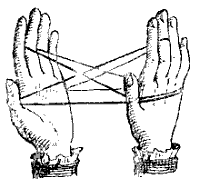
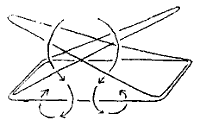
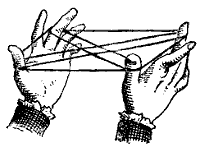
Cat’s Cradle “Taking off” Soldier’s Bed
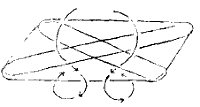
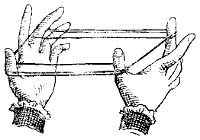
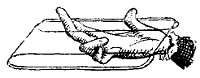
“Taking off” Candles “Taking off”
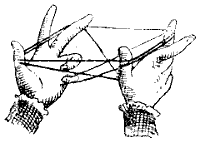
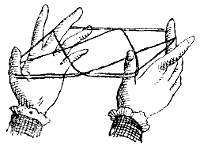
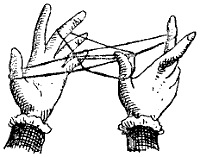
Cat’s Cradle (upside down) Cat’s Eyes Fish.
The game is known to savage peoples. Professor Haddon noted it among the Torres Straits people, who start the game in the same manner as we do, but continue it differently (Journ. Anthrop. Inst., vol. xix. p. 361); and Dr. Tylor has pointed out the significance of these string puzzles among savage peoples in Journ. Anthrop. Inst., ix. 26.
Cat-gallows
A child’s game, consisting of jumping over a stick placed at right angles to two others fixed in the ground.—Halliwell’s Dictionary.
(b) In Ross and Stead’s Holderness Glossary this is called “Cat-gallas,” and is described as three sticks placed in the form of a gallows for boys to jump over. So called in consequence of being of sufficient height to hang cats from. Also mentioned in Peacock’s Manley and Corringham Glossary and Elworthy’s West Somerset Words, Brogden’s Provincial Words, Lincs., Dickinson’s Cumberland Glossary, Atkinson’s Cleveland Glossary, Brockett’s North Country Words, Evans’ Leicestershire Glossary, Baker’s Northants Glossary, and Darlington’s South Cheshire Glossary. On one of the stalls in Worcester Cathedral, figured in Wright’s Archæological Essays, ii. 117, is a carving which represents three rats busily engaged in hanging a cat on a gallows of this kind.
Cat i’ the Hole
A game well known in Fife, and perhaps in other counties. If seven boys are to play, six holes are made at certain distances. Each of the six stands at a hole, with a short stick in his hand; the seventh stands at a certain distance holding a ball. When he gives the word, or makes the sign agreed upon, all the six change holes, each running to his neighbour’s hole, and putting his stick in the hole which he has newly seized. In making this change, the boy who has the ball tries to put it into an empty hole. If he succeeds in this, the boy who had not his stick (for the stick is the Cat) in the hole to which he had run is put out, and must take the ball. There is often a very keen contest whether the one shall get his stick, or the other the ball, or Cat, first put into the hole. When the Cat is in the hole, it is against the laws of the game to put the ball into it.—Jamieson.
(b) Kelly, in his Scottish Proverbs, p. 325, says, “‘Tine cat, tine game;’ an allusion to a play called ‘Cat i’ the Hole,’ and the English ‘Kit-cat.’ Spoken when men at law have lost their principal evidence.”
See “Cat and Dog,” “Cudgel,” “Kit-cat.”[Addendum]
Cat after Mouse
This game, sometimes called “Threading the Needle,” is played by children forming a ring, with their arms extended and hands clasped; one—the Mouse—goes outside the circle and gently pulls the dress of one of the players, who thereupon becomes the Cat, and is bound to follow wherever the Mouse chooses to go—either in or out of the ring—until caught, when he or she takes the place formerly occupied in the ring by the Cat, who in turn becomes Mouse, and the game is recommenced.—Dorsetshire (Folk-lore Journal, vii. 214).
(b) Played at Monton, Lancashire (Miss Dendy); Clapham Middle-Class School (Miss Richardson); and many other places. It is practically the same game as “Drop Handkerchief,” played without words. It is described by Strutt, p. 381, who considers “Kiss-in-the-Ring” is derived from this “Cat and Mouse.”
Catchers
One bicken is required in this game, and at this a lad must stand with a bat and ball in hand. He hits the ball away along the sand. Another boy picks it up and asks the striker “How many?” who replies—
Two a good scat, Try for the bat.
The ball is then thrown to the bicken, and if it does not come within the distance named—two bats—the striker again sends the ball away, when the question is again asked—
Three a good scat, Try for the bat.
And so on until the boy standing out throws the ball in to the required distance.—Old newspaper cutting without date in my possession (A. B. Gomme).
Chacke-Blyndman
Scotch name for “Blindman’s Buff.”—Jamieson.
Chance Bone
In Langley’s abridgment of Polydore Vergile, f. 1., we have a description of this game: “There is a game also that is played with the posterne bone in the hinder foote of a sheepe, oxe, gote, fallow, or redde dere, whiche in Latin is called talus. It hath foure chaunces: the ace point, that is named Canis, or Canicula, was one of the sides; he that cast it leyed doune a peny, or so muche as the gamers were agreed on; the other side was called Venus, that signifieth seven. He that cast the chaunce wan sixe and all that was layd doune for the castyng of Canis. The two other sides were called Chius and Senio. He that did throwe Chius wan three. And he that cast Senio gained four. This game (as I take it) is used of children in Northfolke, and they cal it the Chaunce Bone; they playe with three or foure of those bones together; it is either the same or very lyke to it.”
See “Dibs,” “Hucklebones.”
Change Seats, the King’s Come
In this game as many seats are placed round a room as will serve all the company save one. The want of a seat falls on an individual by a kind of lot, regulated, as in many other games, by the repetition of an old rhythm. All the rest being seated, he who has no seat stands in the middle, repeating the words “Change seats, change seats,” &c., while all the rest are on the alert to observe when he adds, “the king’s come,” or, as it is sometimes expressed, change their seats. The sport lies in the bustle in consequence of every one’s endeavouring to avoid the misfortune of being the unhappy individual who is left without a seat. The principal actor often slily says, “The king’s not come,” when, of course the company ought to keep their seats; but from their anxious expectation of the usual summons, they generally start up, which affords a great deal of merriment.—Brand’s Pop. Antiq., ii. 409.
(b) Dr. Jamieson says this is a game well-known in Lothian and in the South of Scotland. Sir Walter Scott, in Rob Roy, iii. 153, says, “Here auld ordering and counter-ordering—but patience! patience!—We may ae day play at Change seats, the king’s coming.”
This game is supposed to ridicule the political scramble for places on occasion of a change of government, or in the succession.
See “Musical Chairs,” “Turn the Trencher.”
Checkstone
Easther’s Almondbury Glossary thus describes this game. A set of checks consists of five cubes, each about half an inch at the edge, and a ball the size of a moderate bagatelle ball: all made of pot. They are called checkstones, and the game is played thus. You throw down the cubes all at once, then toss the ball, and during its being in the air gather up one stone in your right hand and catch the descending ball in the same. Put down the stone and repeat the operation, gathering two stones, then three, then four, till at last you have “summed up” all the five at once, and have succeeded in catching the ball. In case of failure you have to begin all over again.
(b) In Nashe’s Lenten Stuff (1599) occurs the following: “Yet towards cock-crowing she caught a little slumber, and then she dreamed that Leander and she were playing at checkstone with pearls in the bottom of the sea.”
A game played by children with round small pebbles (Halliwell’s Dictionary). It is also mentioned in the early play of Apollo Shroving, 1627, p. 49.
See “Chucks,” “Fivestones.”
Cherry Odds
A game of “Pitch and Toss” played with cherry-stones (Elworthy’s West Somerset Words). Boys always speak of the stones as “ods.”
Cherry-pit
“Cherry-pit” is a play wherein they pitch cherry-stones into a little hole. It is noticed in the Pleasant Grove of New Fancies, 1657, and in Herrick’s Hesperides. Nares (Glossary) mentions it as still practised with leaden counters called Dumps, or with money.
Chicamy
Chicamy, chickamy, chimey O, Down to the pond to wash their feet; Bring them back to have some meat, Chickamy, chickamy, chimey O.
—Crockham Hill, Kent (Miss Chase).
The children sing the first line as they go round and round. At the second line they move down the road a little, and turn round and round as they end the rhyme.
Chickidy Hand
Chickidy hand, Chickidy hand, The Warner, my Cock, Crows at four in the morning.
Several boys, placing their clasped fists against a lamp-post, say these lines, after which they run out, hands still clasped. One in the middle tries to catch as many as possible, forming them in a long string, hand in hand, as they are caught. Those still free try to break through the line and rescue the prisoners. If they succeed in parting the line, they may carry one boy pig-a-back to the lamp-post, who becomes “safe.” The boy caught last but one becomes “it” in the next game.—Deptford, Kent (Miss Chase).
See “Hunt the Staigie,” “Stag Warning,” “Whiddy.”
Chinnup
A game played with hooked sticks and a ball, also called “Shinnup.” Same as “Hockey.”
Chinny-mumps
A school-boys’ play, consisting in striking the chin with the knuckles; dexterously performed, a kind of time is produced.—Addy’s Sheffield Glossary.
Chock or Chock-hole
A game at marbles played by “chocking” or pitching marbles in a hole made for the purpose, instead of shooting at a ring (Northamptonshire, Baker’s Glossary). Clare mentions the game in one of his poems.
Chow
A game played in Moray and Banffshire. The ball is called the Chow. The game is the same as “Shinty.” The players are equally divided. After the Chow is struck off by one party, the aim of the other is to strike it back, that it may not reach the limit or goal on their side, because in this case they lose the game, and as soon as it crosses the line the other party cry Hail! or say that it is hail, as denoting that they have gained the victory. In the beginning of each game they are allowed to raise the ball a little above the level of the ground, that they may have the advantage of a surer stroke. This is called the “deil-chap,” perhaps as a contraction of “devil,” in reference to the force expended on the stroke. It may, however, be “dule-chap,” the blow given at the “dule” or goal.—Jamieson.
See “Hockey.”
Chuck-farthing
Strutt says this game was played by boys at the commencement of the last century, and probably bore some analogy to “Pitch and Hustle.” He saw the game thus denominated played with halfpence, every one of the competitors having a like number, either two or four; a hole being made in the ground, with a mark at a given distance for the players to stand, they pitch their halfpence singly in succession towards the hole, and he whose halfpenny lies the nearest to it has the privilege of coming first to a second mark much nearer than the former, and all the halfpence are given to him; these he pitches in a mass toward the hole, and as many of them as remain therein are his due; if any fall short or jump out of it, the second player—that is, he whose halfpenny in pitching lay nearest to the first goer’s—takes them and performs in like manner; he is followed by the others as long as any of the halfpence remain (Sports, pp. 386, 387). There is a letter in the Spectator, supposed to be from the father of a romp, who, among other complaints of her conduct, says, “I have catched her once at eleven years old at ‘Chuck-farthing’ among the boys.”
Chuck-hole, Chuck-penny
Same game as “Chuck-farthing,” with this difference, that if the pennies roll outside the ring it is a “dead heat,” and each boy reclaims his penny.—Peacock’s Manley and Corringham Glossary; and see Brogden’s Lincolnshire Words.
Chucks
A game with marbles played by girls (Mactaggart’s Gallovidian Encyclopædia). A writer in Blackwood’s Magazine, August 1821, p. 36, says “Chucks” is played with a bowl and chucks—a species of shells (Buccinum lapillus) found on the sea-shore [“bowl” here probably means a marble]. Brockett (North Country Words) says this game is played by girls with five sea-shells called chucks, and sometimes with pebbles, called chuckie-stanes. Jamieson says a number of pebbles are spread on a flat stone; one of them is tossed up, and a certain number must be gathered and the falling one caught by the same hand.
See “Checkstones,” “Fivestones.”[Addendum]
Church and Mice
A game played in Fifeshire; said to be the same with the “Sow in the Kirk.”—Jamieson.
Click
Two Homes opposite each other are selected, and a boy either volunteers to go Click, or the last one in a race between the Homes does so. The others then proceed to one of the Homes, and the boy takes up his position between them. The players then attempt to run between the Homes, and if the one in the middle holds any of them while he says “One, two, three, I catch thee; help me catch another,” they have to stay and help him to collar the rest until only one is left. If this one succeeds in getting between the Homes three times after all the others have been caught, he is allowed to choose the one to go Click in the next game; if he fails, he has to go himself.—Marlborough, Wilts (H. S. May).
See “Cock.”
Click, Clock, Cluck
A man called Click came west from Ireland, A man called Click came west from Ireland, A man called Click came west from Ireland, Courting my Aunt Judy. A man called Clock came west from Ireland, A man called Clock came west from Ireland, A man called Clock came west from Ireland, Courting my Aunt Judy. A man called Cluck came west from Ireland, A man called Cluck came west from Ireland, A man called Cluck came west from Ireland, Courting my Aunt Judy.
—Isle of Man (A. W. Moore).
These verses and the game are now quite forgotten, both in English and Manx. It was sung by children dancing round in a ring.
Clowt-clowt
“A kinde of playe called clowt-clowt, to beare about, or my hen hath layd.”—Nomenclator, p. 299.
Clubby
A youthful game something like “Doddart.”—Brockett’s North Country Words.
Coal under Candlestick
A Christmas game mentioned in Declaration of Popish Impostures, p. 160.
Cob
A game at marbles played by two or three boys bowling a boss marble into holes made in the ground for the purpose, the number of which is generally four.—Baker’s Northamptonshire Glossary.
Cobbin-match
A school game in which two boys are held by the legs and arms and bumped against a tree, he who holds out the longest being the victor.—Ross and Stead’s Holderness Glossary.
Cobble
A name for “See-saw.”—Jamieson.
Cobbler’s Hornpipe
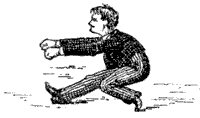
This was danced by a boy stooping till he was nearly in a sitting posture on the ground, drawing one leg under him until its toe rested on the ground, and steadying himself by thrusting forward the other leg so that the heel rested on the ground; the arms and head being thrown forwards as far as possible in order to maintain a balance. The thrust-out leg was drawn back and the drawn-in leg was shot out at the same time. This movement was repeated, each bringing down to the ground of the toe and heel causing a noise like that of hammering on a lapstone. The arms were moved backwards and forwards at the same time to imitate the cobbler’s sewing.—London (J. P. Emslie).
Cob-nut
The children in Yorkshire have a game which is probably an ancient English pastime. Numerous hazel-nuts are strung like the beads of a rosary. The game is played by two persons, each of whom has one of these strings, and consists in each party striking alternately, with one of the nuts on his own string, a nut of his adversary’s. The field of combat is usually the crown of a hat. The object of each party is to crush the nuts of his opponent. A nut which has broken many of those of the adversary is a Cob-nut.—Brand, ii. 411; Hunter’s Hallamshire Glossary.
(b) This game is played in London with chestnuts, and is called “Conquers.” In Cornwall it is known as “Cock-haw.” The boys give the name of Victor-nut to the fruit of the common hazel, and play it to the words: “Cockhaw! First blaw! Up hat! Down cap! Victor!” The nut that cracks another is called a Cock-battler (Folk-lore Journal, v. 61). Halliwell describes this game differently. He says “it consists in pitching at a row of nuts piled up in heaps of four, three at the bottom and one at the top of each heap. The nut used for the pitching is called the Cob. All the nuts knocked down are the property of the pitcher.” Alluding to the first described form, he says it “is probably a more modern game,” and quotes Cotgrave sub voce “Chastelet” as authority for the earlier form in the way he describes it (Dictionary). Addy says the nuts were hardened for the purpose. When a nut was broken it was said to be “cobbered” or “cobbled” (Sheffield Glossary). Evans’ Leicestershire Glossary also describes it. Darlington (South Cheshire Words) says this game only differs from “Cobblety-cuts” in the use of small nuts instead of chestnuts. George Eliot in Adam Bede has, “Gathering the large unripe nuts to play at ‘Cob-nut’ with” (p. 30). Britton’s Beauties of Wiltshire gives the Isle of Wight and Hants as other places where the game is known.
See “Conquerors.”
Cock
One boy is chosen Cock. The players arrange themselves in a line along one side of the playground. The Cock takes his stand in front of the players. When everything is ready, a rush across the playground is made by the players. The Cock tries to catch and “croon”—i.e., put his hand upon the head of—as many of the players as he can when running from one side of the playground to the other. Those caught help the Cock in the rush back. The rush from side to side goes on till all are captured. To “croon” was the essential point in capturing. When a boy was being pursued to be taken prisoner, his great object was, when he came to close quarters with his pursuers, to save his head from being touched on the crown by one of them.—Nairn (Rev. W. Gregor).
At Duthil, Strathspey, this game goes by the name of “Rexa-boxa-King.” When the players have ranged themselves on one side of the playground, and the King has taken his stand in front of them, he calls out “Rexa-boxa-King,” or simply “Rexa,” when all the players rush to the other side. The rush from side to side goes on till all are captured. The one last captured becomes King in the next game.—Rev. W. Gregor.
See “Click.”
Cock-battler
Children, under the title of “Cock-battler,” often in country walks play with the hoary plantain, which they hold by the tough stem about two inches from the head; each in turn tries to knock off the head of his opponent’s flower.—Cornwall (Folk-lore Journal, v. 61).
In the North, and in Suffolk, it is called “Cocks,” “a puerile game with the tough tufted stems of the ribwort plantain” (Brockett’s North Country Words). Moor (Suffolk Words) alludes to the game, and Holloway (Dictionary of Provincialisms) says in West Sussex boys play with the heads of rib grass a similar game. Whichever loses the head first is conquered. It is called “Fighting-cocks.”
Cock-fight
This is a boys’ game. Two boys fold their arms, and then, hopping on one leg, butt each other with their shoulders till one lets down his leg. Any number of couples can join in this game.—Nairn (Rev. W. Gregor).
Cock-haw
See “Cob-nut.”
Cock-stride
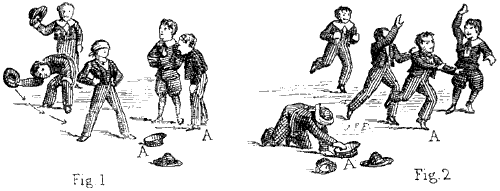
One boy is chosen as Cock. He is blindfolded, and stands alone, with his legs as far apart as possible. The other boys then throw their caps as far as they are able between the extended legs of the Cock (fig. 1). After the boys have thrown their caps, and each boy has taken his stand beside his cap, the Cock, still blindfolded, stoops down and crawls in search of the caps (fig. 2). The boy whose cap he first finds has to run about twenty yards under the buffeting of the other boys, the blows being directed chiefly to the head. He becomes Cock at the next turn of the game.—Rosehearty, Pitsligo (Rev. W. Gregor).
Cockertie-hooie
This game consists simply of one boy mounting on the neck of another, putting a leg over each shoulder and down his breast. The boy that carries takes firm hold of the legs of the one on his neck, and sets off at a trot, and runs hither and thither till he becomes tired of his burden. The bigger the one is who carries, the more is in the enjoyment to the one carried.—Keith (Rev. W. Gregor).
See “Cock’s-headling.”
Cockle-bread
Young wenches have a wanton sport, which they call moulding of Cocklebread; viz. they gett upon a Table-board, and then gather-up their knees and their coates with their hands as high as they can, and then they wabble to and fro with their Buttocks as if the[y] were kneading of Dowgh, and say these words, viz.:—
My Dame is sick and gonne to bed, And I’le go mowld my cockle-bread.
In Oxfordshire the maids, when they have put themselves into the fit posture, say thus:—
My granny is sick, and now is dead, And wee’l goe mould some cockle-bread. Up with my heels, and down with my head, And this is the way to mould cocklebread.
—Aubrey’s Remains, pp. 43, 44.
To make “Barley bread” (in other districts, “Cockley bread”) this rhyme is used in West Cornwall:—
Mother has called, mother has said, Make haste home, and make barley bread. Up with your heels, down with your head, That is the way to make barley bread.
—Folk-lore Journal, v. 58.
The Westmoreland version is given by Ellis in his edition of Brand as follows:—
My grandy’s seeke, And like to dee, And I’ll make her Some cockelty bread, cockelty bread, And I’ll make her Some cockelty bread.
The term “Cockelty” is still heard among our children at play. One of them squats on its haunches with the hands joined beneath the thighs, and being lifted by a couple of others who have hold by the bowed arms, it is swung backwards and forwards and bumped on the ground or against the wall, while continuing the words, “This is the way we make cockelty bread.”—Robinson’s Whitby Glossary, p. 40.
The moulding of “Cocklety-bread” is a sport amongst hoydenish girls not quite extinct. It consists in sitting on the ground, raising the knees and clasping them with the hand, and then using an undulatory motion, as if they were kneading dough.
My granny is sick and now is dead, And we’ll go mould some cocklety bread; Up with the heels and down with the head, And that is the way to make cocklety bread.
—Hunter’s MSS.; Addy’s Sheffield Glossary.
(b) The Times of 1847 contains a curious notice of this game. A witness, whose conduct was impugned as light and unbecoming, is desired to inform the court, in which an action for breach of promise was tried, the meaning of “mounting cockeldy-bread;” and she explains it as “a play among children,” in which one lies down on the floor on her back, rolling backwards and forwards, and repeating the following lines:—
Cockeldy bread, mistley cake, When you do that for our sake.
While one of the party so laid down, the rest sat around; and they laid down and rolled in this manner by turns.
These lines are still retained in the modern nursery-rhyme books, but their connection with the game of “Cockeldy-bread” is by no means generally understood. There was formerly some kind of bread called “cockle-bread,” and cocille-mele is mentioned in a very early MS. quoted in Halliwell’s Dictionary. In Peele’s play of the Old Wives’ Tale, a voice thus speaks from the bottom of a well:—
Gently dip, but not too deep, For fear you make the golden beard to weep. Fair maiden, white and red, Stroke me smooth and comb my head, And thou shalt have some cockell-bread.
Cockly-jock
A game among boys. Stones are loosely placed one upon another, at which other stones are thrown to knock the pile down.—Dickinson’s Cumberland Glossary.
See “Castles.”
Cock’s-headling
A game where boys mount over each other’s heads.—Halliwell’s Dictionary.
See “Cockertie-hooie.”
Cock-steddling
A boyish game mentioned but not described by Cope in his Hampshire Glossary. He gives as authority Portsmouth Telegraph, 27th September 1873.
Codlings
A game among youngsters similar to “Cricket,” a short piece of wood being struck up by a long stick instead of a ball by a bat. Also called “Tip and Go” or “Tip and Slash.”—Robinson’s Whitby Glossary.
See “Cudgel.”
Cogger
A striped snail shell. It is a common boyish pastime to hold one of these shells between the last joints of the bent fingers, and forcibly press the apex against another held in a similar manner by an opponent, until one of them, by dint of persevering pressure, forces its way into the other; and the one which in these contests has gained the most victories is termed the Conqueror, and is highly valued (Northamptonshire, Baker’s Glossary). The game is known as “Fighting Cocks” in Evans’ Leicestershire Glossary. In London it was played with walnut shells.
Cogs
The top stone of a pile is pelted by a stone flung from a given distance, and the more hits, or “cogglings off,” the greater the player’s score.—Robinson’s Whitby Glossary.
Apparently the same game as “Cockly-jock.”
Common
A game played with a ball and crooked stick (cut from a tree or hedge), with a crook at the end (same game as “Hurl”).—Dublin (Mrs. Lincoln).
Mr. Patterson (Antrim and Down Glossary) mentions this as “Hockey;” the same as “Shinney.” “Called in some districts,” he adds, “‘Comun’ and ‘Kamman,’ from the Irish name for the game.”
Conkers
The same game as “Cogger.” The game is more generally called “playin at sneel-shells.”—Ross and Stead’s Holderness Glossary.
Conquerors or Conkers
I.
Cobbly co! My first blow! Put down your black hat, And let me have first smack!
—Burne’s Shropshire Folk-lore, p. 531.
II.
Obli, obli O, my first go; And when the nut is struck, Obli, obli onker, my nut will conquer.
—Notes and Queries, 5th series, x. 378.
III.
Cobblety cuts, Put down your nuts.
—Darlington’s Folk-speech of South Cheshire.
IV.
Obbly, obbly onkers, my first conquers; Obbly, obbly O, my first go.
—Lawson’s Upton-on-Severn Words and Phrases.
V.
Hobley, hobley, honcor, my first conkor; Hobbley, hobbley ho, my first go; Hobley, hobley ack, my first crack.
—Chamberlain’s West Worcestershire Glossary.
(b) This game is played with horse chestnuts threaded on a string. Two boys sit face to face astride of a form or a log of timber. If a piece of turf can be procured so much the better. One boy lays his chestnut upon the turf, and the other strikes at it with his chestnut; and they go on striking alternately till one chestnut splits the other. The chestnut which remains unhurt is then “conqueror of one.” A new chestnut is substituted for the broken one, and the game goes on. Whichever chestnut now proves victorious becomes “conqueror of two,” and so on, the victorious chestnut adding to its score all the previous winnings. The chestnuts are often artificially hardened by placing them up the chimney or carrying them in a warm pocket; and a chestnut which has become conqueror of a considerable number acquires a value in schoolboys’ eyes; and I have frequently known them to be sold, or exchanged for other toys (Holland’s Cheshire Glossary). The game is more usually played by one boy striking his opponent’s nut with his own, both boys standing and holding the string in their hands. It is considered bad play to strike the opponent’s string. The nut only should be touched. Three tries are usually allowed.
(c) For information on various forms of this game, see Notes and Queries, 1878. See also Elworthy’s West Somerset Words. The boy who first said the rhyme has first stroke at Oswestry. The game is elsewhere called “Cobbet” (Meole Brace) and “Cobbleticuts” (Burne’s Shropshire Folk-lore, p. 531). In “Conquer-nuts” “obbly” was probably “nobbly” or “knobbly,” expressing the appearance of the string of nuts; and “onkers” was probably invented as a rhyme to “conquers” (Upton-on-Severn Words and Phrases, by R. Lawson).
Contrary, Rules of
I.
Here I go round the rules of contrary, Hopping about like a little canary. When I say “Hold fast,” leave go; When I say “Leave go,” hold fast.
—Cornwall (Folk-lore Journal, v. 52).
II.
Here we go round the rules of contrary, When I say “Hold fast!” let go, and when I say “Let go!” hold fast.
—London (A. B. Gomme).
(b) A ring is formed by each child holding one end of a handkerchief. One child stands in the centre and acts as leader. The ring moves round slowly. The leader says the words as above while the ring is moving round, and then suddenly calls out whichever he chooses of the two sayings. If he says “Hold fast!” every one must immediately let go the corner of the handkerchief he holds. They should all fall to the ground at once. When he says “Let go!” every one should retain their hold of the handkerchief. Forfeits are demanded for every mistake.
This game, called “Hawld Hard,” is commonly played about Christmas-time, where a number hold a piece of a handkerchief. One then moves his hand round the handkerchief, saying, “Here we go round by the rule of Contrairy; when I say ‘Hawld hard,’ let go, and when I say ‘Let go,’ hawld hard.” Forfeits are paid by those not complying with the order.—Lowsley’s Berkshire Glossary.
Cop-halfpenny
The game of “Chuck-farthing.”—Norfolk and Suffolk (Holloway’s Dict. of Provincialisms).
Corsicrown
A square figure is divided by four lines, which cross each other in the crown or centre. Two of these lines connect the opposite angles, and two the sides at the point of bisection. Two players play; each has three men or flitchers. Now there are seven points for these men to move about on, six on the edges of the square and one at the centre. The men belonging to each player are not set together as at draughts, but mingled with each other. The one who has the first move may always have the game, which is won by getting the three men on a line.—Mactaggart’s Gallovidian Encyclopædia.
See “Kit Cat Cannio,” “Noughts and Crosses.”
Cots and Twisses
A flat stone is obtained called a Hob, upon which those who are playing place equal shares of Cots and Twisses. Cots are brass buttons, and Twisses bits of brass—a Twiss of solid brass being worth many Cots. Each player provides himself with a nice flat [key] stone, and from an agreed pitch tosses it at the Hob. If he knocks off any of the Cots and Twisses nearer to the players than the Hob is, he claims them. The other players try to knock the Hob away with their key-stones from any Cots and Twisses that may not have been claimed; and if any key-stone touches Hob after all have thrown, the owner cannot claim any Cots and Twisses.—Earls Heaton (Herbert Hardy).
Each player selects a Cast or stone to pitch with; on another stone, called the Hob, the Cots and Twys are placed; at some distance Scops are set in the ground. First the players pitch from the Hob to the Scop, and the one who gets nearest goes first. He then pitches at the Hob, and if he knocks off the stakes he has them, provided his Cast is nearer to them than the Hob is; in failure of this, the other player tries. In pitching up, one Cast may rest on another, and if the boy whose stone is underneath can lift it up to knock the other Cast away, it has to remain at the place to which it has been struck; if he does not succeed in doing this, the second player may lift off his Cast and place it by the first. Whoever knocks off the stakes, they go to the boy whose Cast is nearest to them. The Hob and Scop are usually three yards apart. The Cot was a button off the waistcoat or trousers, the Twy one off the coat, and, as its name implies, was equal to two Cots. Formerly, when cash was much more rare than now it is amongst boys, these formed their current coin. The game about 1820 seems to have been chiefly one of tossing, and was played with buttons, then common enough. Now, metal buttons being rare, it is played with pieces of brass or copper of any shape. The expression, “I haven’t a cot,” is sometimes used to signify that a person is without money.—Easther’s Almondbury and Huddersfield Glossary.
See “Banger,” “Buttons.”
Course o’ Park
The game of “Course of the Park” has not been described, but is referred to in the following verse:—
“Buff”’s a fine sport, And so’s “Course o’ Park.”
—The Slighted Maid, 1663, p. 50.
Crab-sowl, Crab-sow
A game played with a bung or ball struck with sticks (Brogden’s Provincial Words, Lincolnshire). This is played on Barnes Common, and is apparently a form of “Hockey” (A. B. Gomme).
Crates
The game of “Nine Holes.” This is the game described by John Jones, M.D., in his book called The Benefit of the Auncient Bathes of Buckstones, 1572, p. 12, as having been played by ladies at Buxton for their amusement in wet weather. See Pegge’s Anonymiana, 1818, p. 126, and Addy’s Sheffield Glossary.
Cricket
A description of this game is not given here; its history and rules and regulations are well known, and many books have been devoted to its study. The word “Cricket” is given in Lawson’s Upton-on-Severn Words and Phrases as a low wooden stool. He continues, “The game of ‘Cricket’ was probably a development of the older game of ‘Stool-ball,’ a dairymaid’s stool being used for the wicket.” Wedgwood (Etym. Dict.) suggests that the proper name for the bat was “cricket-staff,” A.-S. criec, a staff.
See “Bittle-battle,” “Stool-ball.”
Crooky
An old game called “Crooky” was formerly played at Portarlington, Queen’s co., and Kilkee, co. Clare. Fifty years ago it was played with wooden crooks and balls, but about twenty-five years ago, or a little more, mallets were introduced at Kilkee; while subsequently the name was changed to “Croquet.” I have heard it stated that this game was introduced by the French refugees that settled at Portarlington.—G. H. Kinahan (Folk-lore Journal, ii. 265).
Cross and Pile
The game now called “Heads and Tails” (Halliwell’s Dictionary). See Nomenclator, p. 299; Addy’s Sheffield Glossary. Strutt points out that anciently the English coins were stamped on one side with a cross. See also Harland’s Lancashire Legends, p. 139.
Cross-bars
A boys’ game.—Halliwell’s Dictionary.
Cross-questions
Nares (Glossary) mentions this game in a quotation from Wilson’s Inconstant Lady, 1614. “Cross Questions and Crooked Answers” was a popular game at juvenile parties. The players sit in a circle, and each is asked in a whisper a question by the one on his left, and receives also in a whisper an answer to a question asked by himself of the person on his right. Each player must remember both the question he was asked and the answer he received, which have at the conclusion of the round to be stated aloud. Forfeits must be given if mistakes are made.—A. B. Gomme.
Cross Tig
One of the players is appointed to be Tig. He calls out the name of the one he intends to chase, and runs after him. Another player runs across between Tig and the fugitive, and then Tig runs after this cross-player until another player runs across between Tig and the fugitive; and so on. Each time a player crosses between Tig and the player he is following he leaves the original chase and follows the player who has crossed. When he captures, or, in some places, touches one of the players he is following, this player becomes Tig, and the game begins again.—Ireland (Miss Keane).
This game is known in and near London as “Cross Touch.”
Cry Notchil
This is an old game where boys push one of their number into a circle they have made, and as he tries to escape push him back, crying, “No child of mine!” (Leigh’s Cheshire Glossary). He adds, “This may be the origin of the husband’s disclaimer of his wife when he ‘notchils’ her.” To “cry notchil” is for a man to advertise that he will not be answerable for debts incurred by his wife.
Cuck-ball
A game at ball. The same as “Pize-ball.” It is sometimes called “Tut-ball.”—Addy’s Sheffield Glossary.
See “Ball.”
Cuckoo
A child hides and cries “Cuckoo.” The seekers respond—
Cuckoo cherry-tree, Catch a bird and bring it me.
—Burne’s Shropshire Folk-lore, p. 222.
Halliwell calls this a game at ball, and the rhyme runs—
Cuckoo cherry tree, Catch a bird and bring it me; Let the tree be high or low, Let it hail, rain or snow.
See “Hide and Seek.”
Cuddy and the Powks
Two boys join hands and feet over the back of a third, the which creeps away with them on hands and knees to a certain distance; and if able to do this, he, the Cuddy, must have a ride as one of the powks on some other’s back.—Mactaggart’s Gallovidian Encyclopædia.
Cudgel
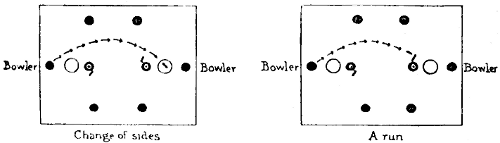
Four or more boys can play this game, and sides are chosen. Two holes are made in the ground at a distance of about eight or ten feet apart. A ring about a foot in diameter is made round each hole. A boy stands at each hole with a stick, which he puts into the hole to guard it. Two other boys stand behind the holes, who act as bowlers. One of these throws a small piece of wood shaped like a Cat, and tries to pitch it into the hole. The boy guarding the hole tries to hit it with his stick. If he succeeds, he and the boy at the other hole run to each other’s places. Should the boy who throws the piece of wood succeed in getting it into the hole, the batsmen are out. Should the Cat fall into the ring or a span beyond, one of the bowlers picks it up, and both run to a hiding-place. They then agree as to which of them should hold the Cat. This must be carried in such a way that it cannot be seen by the batsmen, both boys assuming the same attitude. Both boys then resume their previous places. They kneel down, still keeping the same attitudes. The batsmen, keeping their sticks in the holes, then agree which of the two holds the Cat. One batsman runs across and puts his stick into the hole behind which the boy kneels whom they consider has the Cat, the other then running to his place. If they are right in their guess, the holder of the Cat throws it across the ground for the opposite bowler to put it in the hole before the second batsman reaches it. If they guess wrongly, the holder of the Cat puts it into the hole as soon as the batsman runs, and they then become the batsmen for the next game. If the batsmen leave their holes unguarded with the stick, the catsmen can at any time put them “out,” by putting the Cat in a hole. If more than two boys on a side play, the others field as in “Cricket.”—Barnes (A. B. Gomme).
See “Cat and Dog.”
Curcuddie
I.
Will ye gang to the lea, Curcuddie, And join your plack wi’ me, Curcuddie? I lookit about and I saw naebody, And linkit awa’ my lane, Curcuddie.
—Chambers’ Popular Rhymes, p. 139.
II.
Will ye gang wi’ me, Curcuddie, Gang wi’ me o’er the lea? I lookit roun’, saw naebody; Curcuddie, he left me.
—Biggar (William Ballantyne).
(b) This is a grotesque kind of dance, performed in a shortened posture, sitting on one’s hams, with arms akimbo, the dancers forming a circle of independent figures. It always excites a hearty laugh among the senior bystanders; but, ridiculous as it is, it gives occasion for the display of some spirit and agility, as well as skill, there being always an inclination to topple over. Each performer sings the verse (Chambers; Mactaggart’s Gallovidian Encyclopædia).
Mr. Ballantyne says that each one apart tried to dance by throwing out their feet and jumping sideways.
(c) The first syllable of this word is, says Jamieson, undoubtedly the verb curr, to sit on the houghs or hams. The second may be from Teut. kudde, a flock; kudd-en, coire, convenire, congregari, aggregari; kudde wijs, gregatim, catervatim, q. to curr together. The same game is called Harry Hurcheon in the North of Scotland, either from the resemblance of one in this position to a hurcheon, or hedge-hog, squatting under a bush; or from the Belg. hurk-en to squat, to hurkle.—Jamieson.
See “Cobbler’s Hornpipe,” “Cutch-a-Cutchoo.”
Curly Locks
[Play]
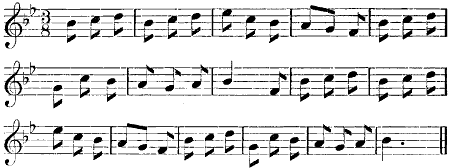
I.
Curly locks, curly locks, Wilt thou be mine? Thou shalt not wash dishes Nor yet feed the swine; But sit on a fine cushion And sew a fine seam, And feed upon strawberries, Sugar and cream.
—Earls Heaton (Herbert Hardy).
II.
Bonny lass, canny lass, Wilta be mine? Thou’s nowder wesh dishes Nor sarra the swine: But sit on thy crippy, &c.
—Dickinson’s Cumberland Glossary.
(b) Two children, a girl and a boy, separate from their fellows, who are not particularly placed, the boy caressing the girl’s curls and singing the verses.
(c) This game is evidently a dramatic representation of wooing, and probably the action of the game has never been quite completed in the nursery. The verses are given as “nursery rhymes” by Halliwell, Nos. cccclxxxiii. and ccccxciv. The tune is from Rimbault’s Nursery Rhymes, p. 70. The words given by him are the same as the Earls Heaton version.
Currants and Raisins
Currants and raisins a penny a pound, Three days holiday.
This is a game played “running under a handkerchief;” “something like ‘Oranges and Lemons.’”—Lincoln (Miss M. Peacock).
Cushion Dance
[Play]
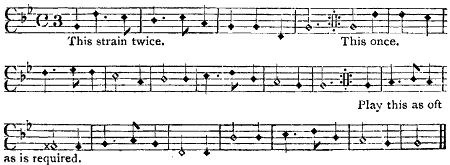
—Dancing Master, 1686.
This music is exactly as it is printed in the book referred to.
(b) The following is an account of the dance as it was known in Derbyshire amongst the farmers’ sons and daughters and the domestics, all of whom were on a pretty fair equality, very different from what prevails in farm-houses of to-day. The “Cushion Dance” was a famous old North-country amusement, and among the people of Northumberland it is still commonly observed. The dance was performed with boisterous fun, quite unlike the game as played in higher circles, where the conditions and rules of procedure were of a more refined order.
The company were seated round the room, a fiddler occupying a raised seat in a corner. When all were ready, two of the young men left the room, returning presently, one carrying a large square cushion, the other an ordinary drinking-horn, china bowl, or silver tankard, according to the possessions of the family. The one carrying the cushion locked the door, putting the key in his pocket. Both gentlemen then went to the fiddler’s corner, and after the cushion-bearer had put a coin in the vessel carried by the other, the fiddler struck up a lively tune, to which the young men began to dance round the room, singing or reciting to the music:—
Frinkum, frankum is a fine song, An’ we will dance it all along; All along and round about, Till we find the pretty maid out.
After making the circuit of the room, they halted on reaching the fiddler’s corner, and the cushion-bearer, still to the music of the fiddle, sang or recited:—
Our song it will no further go! The Fiddler: Pray, kind sir, why say you so? The Cushion-bearer: Because Jane Sandars won’t come to. The Fiddler: She must come to, she shall come to, An’ I’ll make her whether she will or no.
The cushion-bearer and vessel-holder then proceeded with the dance, going as before round the room, singing “Frinkum, frankum,” &c., till the cushion-bearer came to the lady of his choice, before whom he paused, placed the cushion on the floor at her feet, and knelt upon it. The vessel-bearer then offered the cup to the lady, who put money in it and knelt on the cushion in front of the kneeling gentleman. The pair kissed, arose, and the gentleman, first giving the cushion to the lady with a bow, placed himself behind her, taking hold of some portion of her dress. The cup-bearer fell in also, and they danced on to the fiddler’s corner, and the ceremony was again gone through as at first, with the substitution of the name of “John” for “Jane,” thus:—
The Lady: Our song it will no further go! The Fiddler: Pray, kind miss, why say you so? The Lady: Because John Sandars won’t come to. The Fiddler: He must come to, he shall come to, An’ I’ll make him whether he will or no!
The dancing then proceeded, and the lady, on reaching her choice (a gentleman, of necessity), placed the cushion at his feet. He put money in the horn and knelt. They kissed and rose, he taking the cushion and his place in front of the lady, heading the next dance round, the lady taking him by the coat-tails, the first gentleman behind the lady, with the horn-bearer in the rear. In this way the dance went on till all present, alternately a lady and gentleman, had taken part in the ceremony. The dance concluded with a romp in file round the room to the quickening music of the fiddler, who at the close received the whole of the money collected by the horn-bearer.
At Charminster the dance is begun by a single person (either man or woman), who dances about the room with a cushion in his hand, and at the end of the tune stops and sings:—
Man: This dance it will no further go. Musician: I pray you, good sir, why say you so? Man: Because Joan Sanderson will not come to. Musician: She must come to, and she shall come to, And she must come whether she will or no.
Then the following words are sung as in the first example:—
Man: Welcome, Joan Sanderson, welcome, welcome. Both: Prinkum-prankum is a fine dance, And shall we go dance it once again, And once again, And shall we go dance it once again? Woman: This dance it will no further go. Musician: I pray you, madam, why say you so? Woman: Because John Sanderson will not come to. Musician: He must come to, and he shall come to, And he must come whether he will or no.
And so she lays down the cushion before a man, who, kneeling upon it, salutes her, she singing—
Welcome, John Sanderson, &c.
Then, he taking up the cushion, they take hands and dance round singing as before; and this they do till the whole company is taken into the ring. Then the cushion is laid down before the first man, the woman singing, “This dance,” &c., as before, only instead of “come to,” they sing “go fro,” and instead of “Welcome, John Sanderson,” &c., they sing “Farewell, John Sanderson, farewell,” &c., and so they go out one by one as they came in.—Charminster (Notes and Queries, ii. 517, 518).
This description is almost the same as a seventeenth century version. The dance is begun by a single person (either man or woman), who, taking a cushion in his hand, dances about the room, and at the end of the tune he stops and sings:—
This dance it will no further go.
The Musician answers:
I pray you, good sir, why say you so? Man: Because Joan Sanderson will not come to. Musician: She must come to, and she shall come to, And she must come whether she will or no.
Then he lays down the cushion before a woman, on which she kneels, and he kisses her, singing—
Welcom, Joan Sanderson, welcom, welcom.
Then he rises, takes up the cushion, and both dance, singing—
Prinkum-prankum is a fine dance, And shall we go dance it once again, Once again, and once again, And shall we go dance it once again.
Then, making a stop, the wo(man) sings as before—
This dance, &c. Musician: I pray you, madam, &c. Woman: Because John Sanderson, &c. Musician: He must, &c.
And so she lays down the cushion before a man, who, kneeling upon it, salutes her, she singing—
Welcom, John Sanderson, &c.
Then, he taking up the cushion, they take hands and dance round, singing as before. And thus they do till the whole company are taken into the ring. And then the cushion is laid before the first man, the woman singing, “This dance,” &c. (as before), only instead of “come to,” they sing “go fro,” and instead of “Welcom, John Sanderson,” &c., they sing “Farewel, John Sanderson, farewel, farewel;” and so they go out one by one as they came in. Note, that the woman is kiss’d by all the men in the ring at her coming in and going out, and the like of the man by the woman.—The Dancing Master: London, printed by J. P., and sold by John Playford at his shop near the Temple Church, 1686, 7th edition.
Another version gives the words as follows:—
We’ve got a new sister in our degree, And she’s welcome into our companee, companee. Mrs. Sargesson says she weänt come to, We’ll make her whether she will or no, Will or no, will or no, We’ll maäke her whether she will or no.
Children form a ring with one in the middle, who lays a cushion on the ground. They sing the first two lines, and the child in the centre points at one, and the others dance round singing the other lines, the centre child dragging the imaginary Mrs. Sargesson on to the cushion by force, kissing her, and leaving her in the centre. Then Mrs. Sargesson points at one in the ring, and the game begins again.—East Kirkby, Lincolnshire (Miss Maughan). The tune sung is the same as the “Mulberry Bush.”
Miss Baker (Northamptonshire Glossary) says the Cushion Dance is still continued, with some variations, and generally closes the evening’s amusements. One of the young men endeavours secretly to bring in a cushion, and locks the doors, to prevent the escape of the young maidens; then all the party unite hands and dance round three times to the left and three times to the right, after which the company all seat themselves, except the young man who holds the cushion. He advances to the fiddler, and says—
This dance it will no further go. Fiddler: Why say you so? why say you so? Cushion-holder: Because the young women will not come to. Fiddler: They must come to, they shall come to, And tell them I say so.
The cushion-holder then goes to the girl he fancies most, and drops the cushion at her feet. She kneels down with him on the cushion, and he salutes her, and they then rise and dance round and round to the fiddler. The girls then go through the same thing, saying, “young men,” and then “a young man,” &c., until the whole company have gone through the same ceremony, which concludes with all dancing round three times, as at the commencement.
The Norfolk and London versions are reduced to a simple “Kiss in the Ring” game, with the following verse:—
Round the cushion we dance with glee, Singing songs so merrily; Round the cushion we dance with glee, Singing songs so merrily; Yet the punishment you must bear If you touch the cushion there.
—Sporle, Norfolk (Miss Matthews).
(c) Selden, in his Table Talk, thus refers to this game:—“The Court of England is much altered. At a solemn dancing first you have the grave measures, then the Cervantoes and the Golliards, and this is kept up with ceremony. At length to Trenchmore and the Cushion Dance; and then all the company dance, lord and groom, lady and kitchen-maid, no distinction. But in King Charles’s time there has been nothing but Trenchmore and the Cushion Dance,” &c. The “Whishin Dance” (an old-fashioned dance, in which a cushion is used to kneel upon), mentioned by Dickinson (Cumberland Glossary), is probably the same game or dance, “whishin” meaning cushion. Brockett (North Country Words) mentions “Peas Straw,” the final dance at a rustic party; something similar to the ancient “Cushion Dance” at weddings. It is also recorded in Evans’ Leicestershire Glossary, and by Burton in the following passage from the Anatomy of Melancholy: “A friend of his reprehended him for dancing beside his dignity, belike at some cushen dance.” In the version from East Kirkby, Lincolnshire, the expression “in our degree” in the first line of the verse is apparently meaningless, and it is probably a corruption of “highdigees, highdegrees,” a dialect word for roystering, high spirits, merriment, dancing, romping. Elworthy (Somerset Words) gives this word, and quotes the following line from Drayton:—
Dance many a merry round and many a highdegy.
—Polyolbion, Bk. xxv., l. 1162.
(d) The transition from a dance to a pure game is well illustrated by the different versions, and the connection of the dance with the ceremony of marriage is obvious. A curious account of the merry-makings at marriages is given in Coverdale’s Christen State of Matrimony, 1543: “After the banket and feast there beginneth a mad and unmannerly fashion; for the bride must be brought into an open dauncing-place. Then is there such a running, leaping, and flinging among them that a man might think all these dauncers had cast all shame behinde them, and were become starke mad, and out of their wits, and that they were sworne to the devil’s daunce. Then must the bride keep foote with all dauncers, and refuse none, how scabbed, foule, drunken, rude, and shameless soever he be. . . . After supper must they begin to pipe and daunce again of anew. And though the young persons come once towards their rest, yet can they have no quietness.”—1575 edit., fol. 59, rev. 60. Edward L. Rimbault, writing in Notes and Queries, vi. 586, says it was formerly the custom at weddings, both of the rich as well as the poor, to dance after dinner and supper. In an old Court masque of James I.’s time, performed at the marriage ceremony of Philip Herbert and Lady Susan (MS. in the writer’s possession), it is directed that, at the conclusion of the performance, “after supper” the company “dance a round dance.” This was “dancing the bride to bed.” William Chappell (Notes and Queries, ii. 442) says, “I have a tune called ‘A round dance to dance the bride to bed.’ It dates from about 1630, or earlier, and resembles that of ‘The Hunt is up.’” Dancing was considered so essential at weddings (according to Grose) that if in a family the youngest daughter should chance to be married before her elder sisters, they must dance at her wedding without shoes. May not the custom of throwing of old and worn-out shoes after the bride have arisen from the practice of dancing? The danced-out shoes may have been the ones used. It is curious that the cushion is used in the marriage ceremonies of the Brahmins. Mr. Kearns, in his Marriage Ceremonies of the Hindoos of the South of India, p. 6, says that a stool or cushion is one of the preparations for the reception of the bridegroom, who on entering the apartment sits down on the stool which is presented to him. He says, “I step on this for the sake of food and other benefits, on this variously splendid footstool.” The bride’s father then presents to him a cushion made of twenty leaves of cúsa grass, holding it up with both hands and exclaiming, “The cushion! the cushion! the cushion!” The bridegroom replies, “I accept the cushion,” and taking it, places it on the ground under his feet, while he recites a prayer. It is probable that we may have in the “Cushion Dance” the last relics of a very ancient ceremony, as well as evidence of the origin of a game from custom.
Cutch-a-Cutchoo
Children clasp their hands under their knees in a sitting posture, and jump thus about the room. The one who keeps up longest wins the game.—Dublin (Mrs. Lincoln).
(b) In Notes and Queries, x. 17, “E. D.” says this amusement was fashionable sixty years ago, and from the low dresses worn then by ladies he mentions its indecency. He gives extracts from a satire called Cutchacutchoo, or the Jostling of the Innocents, 2nd ed., Dublin, in which the game and position are mentioned—
Now she with tone tremendous cries Cutchacutchoo. Let each squat down upon her ham, Jump like a goat, puck like a ram.
“Uneda,” at same reference (x. 17), speaks of it as a known game in Philadelphia. The analogy which this game has to some savage dances is curious; a correspondent in Notes and Queries, ix. 304, draws attention to the illustration, in Richardson’s Expedition to Arctic Shores (vol. i. p. 397), of a dance by the “Kutchin-Kutcha” Indians, a parallel to the name as well as the dance which needs some research in America.
See “Curcuddie,” “Hop-frog.”
Cutters and Trucklers
A remembrance of the old smuggling days. The boys divide into two parties; the Trucklers try to reach some given point before the Cutter catches them.—Cornwall (Folk-lore Journal, v. 60).
Dab
Dab a prin in my lottery book; Dab ane, dab twa, dab a’ your prins awa’.
A game in which a pin is put at random in a school-book, between the leaves of which little pictures are placed. The successful adventurer is the person who puts the pin between two leaves including a picture which is the prize, and the pin itself is the forfeit (Blackwood’s Magazine, Aug. 1821, p. 36). This was a general school game in West London in 1860-1866 (G. L. Gomme).
Dab-an-thricker
A game in which the dab (a wooden ball) is caused to spring upwards by a blow on the thricker (trigger), and is struck by a flat, bottle-shaped mallet fixed to the end of a flexible wand, the distance it goes counting so many for the striker.—Ross and Stead’s Holderness Glossary.
This is the same as “Knur and Spell.”
Dab-at-the-hole
A game at marbles (undescribed).—Patterson’s Antrim and Down Glossary.
Dalies
A child’s game, played with small bones or pieces of hard wood. The dalies were properly sheep’s trotters.—Halliwell’s Dictionary.
Evidently the same game as “Fivestones” and “Hucklebones.”
Davie-drap
Children amuse themselves on the braesides i’ the sun, playing at “Hide and Seek” with this little flower, accompanying always the hiding of it with this rhyme, marking out the circle in which it is hid with the forefinger:—
Athin the bounds o’ this I hap, My black and bonny davie-drap; Wha is here the cunning yin My davie-drap to me will fin.
—Mactaggart’s Gallovidian Encyclopædia.
The davie-drap is a little black-topped field-flower.
Deadily
A school game, not described.—Mactaggart’s Gallovidian Encyclopædia.
Diamond Ring
My lady’s lost her diamond ring; I pitch upon you to find it!
Children sit in a ring or in a line, with their hands placed together palm to palm, and held straight, the little finger down-most between the knees. One of them is then chosen to represent a servant, who takes a ring, or some other small article as a substitute, between her two palms, which are pressed flat together like those of the rest, and goes round the circle or line placing her hands into the hands of every player, so that she is enabled to let the ring fall wherever she pleases without detection. After this she returns to the first child she touched, and with her hands behind her says the above words. The child who is thus addressed must guess who has the ring, and the servant performs the same ceremony with each of the party. They who guess right escape, but the rest forfeit. Should any one in the ring exclaim “I have it!” she also forfeits; nor must the servant make known who has the ring until all have guessed under the same penalty. The forfeits are afterwards cried as usual.—Halliwell’s Nursery Rhymes, p. 223.
(b) This game was a general favourite at juvenile parties years ago. The hands were held in the posture described by Halliwell, but any child was pitched upon for the first finder, and afterwards the child in whose hands the ring was found had to be finder. There was no guessing; the closed hands were looked into (A. B. Gomme). Mr. Addy has collected a similar game called “My lady’s lost a gold ring,” and Mr. Newell (Games and Songs of American Children, p. 150) has another, “Hold fast my gold ring.”[Addendum]
Dibbs
A game played with the small knuckle-bones taken from legs of mutton; these bones are themselves called “dibs” (Lowsley’s Glossary of Berkshire Words). Holloway’s Dictionary says five of these bones are used by boys, with which they play a game called “Dibs” in West Sussex.
See “Check-stones,” “Fivestones,” “Hucklebones.”
Dinah
[Play]
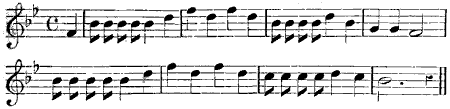
No one in the house but Dinah, Dinah, No one in the house I know, I know; No one in the house but Dinah, Dinah, Playing on the old banjo.
A ring is formed, and a girl stands blindfolded inside. As the verse is sung and finished, Dinah goes to any one in the ring, and, if successful in guessing her name, takes her place, the other taking the place of Dinah, the game going on as before.—Earls Heaton (Herbert Hardy).
“Dinah” was a Christy Minstrel song in the “fifties.” It is probable that the game, which resembles “Buff,” has been played to the tune of the song. Singing a chorus would soon follow.
See “Buff,” “Muffin Man.”
Dip o’ the Kit
A rustic game, undescribed and marked as obsolescent.—Peacock’s Manley and Corringham Glossary.
Dish-a-loof
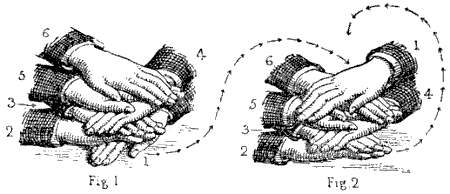
A singular rustic amusement. One lays his hand down on a table, another clashes his upon it, a third his on that, and so on (fig. 1). When all the players have done this, the one who has his hand on the board pulls it out and lays it on the one uppermost (fig. 2): they all follow in rotation, and so a continual clashing and dashing is kept up; hence the name “Dish.” Those who win the game are those who stand out longest—viz., those who are best at enduring pain. Tender hands could not stand it a moment: one dash of a rustic “loof” would make the blood spurt from the tip of every finger. It is a piece of pastime to country lads of the same nature as “Hard Knuckles” (Mactaggart’s Gallovidian Encyclopædia). This is a well-known game for small children in London. After each child’s hands have been withdrawn and replaced on top as many times as possible without deranging the order, a general scramble and knocking of hands together ends the game (A. B. Gomme). Jamieson (Etymological Dict.) gives this as a sport of children.
See “Dump,” “Green Grass,” “Hot Cockles.”
Doddart
A game played in a large level field with a bent stick called “doddart.” Two parties, headed by two captains, endeavour to drive a wooden ball to their respective boundaries (Halliwell’s Dictionary). Brockett (North Country Words) adds to this that the captains are entitled to choose their followers by alternate votes. A piece of globular wood called an “orr” or “coit” is thrown down in the middle of the field and driven to one of two opposite hedges—the alley, hail-goal, or boundary. The same game as “Clubby,” “Hockey,” “Shinney,” “Shinneyhaw.”
Doncaster Cherries
One boy kneels, holding a long rope, the other end of which is held by another boy; the other players stand round about with handkerchiefs in hands, knotted. The one who holds the rope-end and standing cries out—
Doncaster cherries, ripe and sound; Touch ’em or taste ’em— Down, you dogs!
—Earls Heaton, Yorkshire (H. Hardy).
This is evidently a version of “Badger the Bear,” with a different and apparently degraded formula.
Dools
A school game. The dools are places marked with stones, where the players always remain in safety—where they dare neither be caught by the hand nor struck with balls. It is only when they leave these places of refuge that those out of the doons have any chance to gain the game and get in; and leave the doons they frequently must—this is the nature of the game. Now this game seems to have been often played in reality by our ancestors about their doon-hills.—Mactaggart’s Gallovidian Encyclopædia.
Down in the Valley
I.
Down in the valley where the green grass grows Stands E—— H——, she blows like a rose. She blows, she blows, she blows so sweet. In came F—— S—— and gave her a kiss. E—— made a pudding, she made it nice and sweet, F—— took a knife and fork and cut a little piece. Taste of it, taste of it, don’t say nay, For next Sunday morning is our wedding day. First we’ll buy a money box, Then we’ll buy a cradle; Rock, rock the bottom out, Then we’ll buy another. Bread and cheese all the week, cork on Sunday, Half a crown on Saturday night, and a jolly good dance on Monday.
—Cowes, Isle of Wight (Miss E. Smith).
II.
Down in the meadows where the green grass grows, To see —— blow like a rose. She blows, she blows, she blows so sweet. Go out, ——; who shall he be? —— made a pudding, She made it so sweet, And never stuck a knife in Till —— came to eat. Taste, love, taste, love, don’t say nay, For next Monday morning is your wedding day. He bought her a gown and a guinea gold ring, And a fine cocked hat to be married in.
—West Haddon, Northamptonshire; Long Itchington, Warwickshire (Northants Notes and Queries, ii. 105).
III.
Down in the valley the violets grow. Dear little ——, she blows like a rose. She blows, she blows, she blows so sweet. Come along in. Buy a shawl, buy a new black shawl, A bonnet trimmed with white and a new parasol. Oh dear, oh dear, what can I do, For next Monday morning is my wedding due.
—Shipley, Horsham; Notes and Queries, 8th series, i. 210 (Miss Busk).
(b) The children form a ring by joining hands, one child standing in the centre. They dance round. At the mention of the second name one from the ring goes into the centre. The two kiss at the end of the verse, and the first child takes the place in the ring, and the game begins again.
See “All the Boys,” “Oliver, Oliver, follow the King.”[Addendum]
Drab and Norr
A game similar to “Trippit and Coit.”—Halliwell’s Dict.
Draw a Pail of Water
[Play]
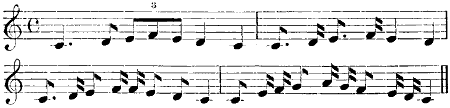
—Sporle, Norfolk (Miss Matthews).
I.
Draw a pail of water For my lady’s daughter; My father’s a king and my mother’s a queen, My two little sisters are dressed in green, Stamping grass and parsley, Marigold leaves and daisies. One rush, two rush, Pray thee, fine lady, come under my bush.
—Halliwell’s Nursery Rhymes, Games, cclxxxvii.
II.
Draw a pail of water, Send a lady a daughter; One o’ my rush, two o’ my rush, Please, young lady, creep under the briar bush.
—Liphook, Hants (Miss Fowler).
III.
Draw, draw water, For my lady’s daughter; One in a rush, Two in a bush, Pretty my lady, pop under the bush.
—Berrington and Ellesmere (Shropshire Folk-lore, p. 521).
IV.
Draw a bucket o’ water For a lady’s daughter; One and a hush, two and a rush, Please, young lady, come under my bush.
—Fochabers (Rev. W. Gregor).
V.
Draw a bucket of water For a lady’s daughter; One in a bush, Two in a bush, Three in a bush, Four in a bush, And out you go.
—Crockham Hill, Kent (Miss Chase).
VI.
Drawing a bucket of water For my lady’s daughter; Put it in a chestnut tree, And let it stay an hour. One of you rush, two may rush, Please, old woman, creep under the bush; The bush is too high, the bush is too low, Please, old woman, creep under the bush.
—Hampshire (Miss Mendham).
VII.
Draw a pail of water For a lady’s daughter; Give a silver pin for a golden ring— Oh pray, young lady, pop under.
—Northants (Rev. W. D. Sweeting).
VIII.
Draw a bucket of water For my lady’s daughter; One go rush, and the other go hush, Pretty young lady, bop under my bush.
—Sporle, Norfolk (Miss Matthews).
IX.
Draw a bucket of water For the farmer’s daughter; Give a gold ring and a silver watch, Pray, young lady, pop under.
—Sporle, Norfolk (Miss Matthews).
X.
Draw a bucket of water For my lady’s daughter; A guinea gold ring And a silver pin, So pray, my young lady, pop under.
—Haydon (Herbert Hardy).
XI.
Draw a bucket of water To wash my lady’s garter; A guinea gold ring And a silver pin, Please, little girl, pop under.
—Earls Heaton (Herbert Hardy).
XII.
See-saw, a bucket of water, To wash my lady’s garter. One in a rush, and two in a bush, To see a fine lady pop under a bush.
—Anderby, Lincolnshire, and Nottinghamshire near the Trent (Miss Peacock).
XIII.
One we go rush, Two we go push; Lady come under the corner bush.
—Shepscombe, Gloucestershire (Miss Mendham).
XIV.
Sift the lady’s oaten meal, sift it into flour, Put it in a chest of drawers and let it lie an hour. One of my rush, Two of my rush, Please, young lady, come under my bush. My bush is too high, my bush is too low, Please, young lady, come under my bow. Stir up the dumpling, stir up the dumpling.
—Belfast (W. H. Patterson).
XV.
Sieve my lady’s oatmeal, Grind my lady’s flour; Put it in a chestnut, Let it stand an hour. One may rush, two may rush; Come, my girls, walk under the bush.
—Halliwell’s Nursery Rhymes, Games, cclxxxviii.
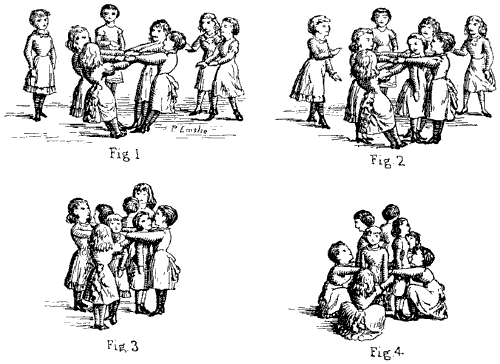
(b) The Berrington version of this game is played as follows:—Two girls face each other, holding each other by both hands. Two others face each other, holding both hands across the other two. They see-saw backwards and forwards, singing the lines (fig. 1). One girl gets inside the enclosing hands (fig. 2), and they repeat till all four have “popped under” (fig. 3), when they “jog” up and down till they fall on the floor! (fig. 4). At Ellesmere only two girls join hands, and as many “pop under” as they can encircle. The Lincolnshire and Norfolk versions are played practically in the same way. In the Liphook version the children stand in two and two opposite to each other; the children on one side of the square hold hands up at the third line, and the other two children run under the hands of the first two. There is no pause, but the verse is sung time after time, so that the four children are nearly always moving. In the other Hampshire version four girls stand in a square, each holding the hands of the one opposite to her, pulling each other’s hands backwards and forwards singing the lines. Two arms are then raised, and one girl comes under; this is repeated till all four girls have come under the arms, then their arms encircle each other’s waists and they dance round. In the Scottish version there are only two girls who join hands and pull each other backwards and forwards, repeating the words. Halliwell describes a different action to any of these. A string of children, hand in hand, stand in a row. A child stands in front of them as leader; two other children form an arch, each holding both of the hands of the other. The string of children pass under the arch, the last of whom is taken captive by the two holding hands. The verses are repeated until all are taken.—Halliwell’s Nursery Rhymes, cclxxxvii.
(c) The analysis of the game rhymes is as follows:—
No. Halli- well’s Version. Liphook (Hants). Shrop- shire. Focha- bers (Scot- land). Hamp- shire. North- ants. Norfolk (1). Norfolk (2). Haydon. Earls Heaton. Lincoln- shire and Notting- hamshire. Glouces- tershire. Belfast. Halli- well’s Version (No. 2). Crockham Hill.
1. Draw a pail of water. Draw a pail of water. Draw, draw water. Draw a bucket o’ water. Drawing a bucket of water. Draw a pail of water. Draw a bucket of water. Draw a bucket of water. Draw a bucket of water. Draw a bucket of water. See saw, a bucket of water. — — — Draw a bucket of water.
2. — — — — — — — — — — — — Sift the lady’s oatmeal. Sieve my lady’s oatmeal. —
3. — — — — — — — — — — — — Sift it into flour. Grind my lady’s flour. —
4. For my lady’s daughter. Send a lady a daughter. For my lady’s daughter. For a lady’s daughter. For my lady’s daughter. For a lady’s daughter. For my lady’s daughter. For the farmer’s daughter. For my lady’s daughter. — — — — — For a lady’s daughter.
5. — — — — — — — — — To wash my lady’s garter. To wash my lady’s garter. — — — —
6. — — — — Put it in a chestnut tree. — — — — — — — Put it in a chest of drawers. Put it in a chestnut. —
7. — — — — Let it stay an hour. — — — — — — — Let it lie an hour. Let it stand an hour. —
8. My father’s a king and my mother’s a queen. — — — — — — — — — — — — — —
9. My two little sisters are dressed in green. — — — — — — — — — — — — — —
10. Stamping grass and parsley. — — — — — — — — — — — — — —
11. Marigold leaves and daisies. — — — — — — — — — — — — — —
12. One rush, two rush. One o’ my rush, two o’ my rush. One in a rush, two in a bush. One and a hush, two and a rush. One of you rush, two may rush. — One go rush and the other go hush. — — — One in a rush and two in a bush. One we go rush, two we go push. One of my rush, two of my rush. One may rush, two may rush. One in a bush, two in a bush, three in a bush, four in a bush.
13. — — — — — Give a silver pin for a golden ring. — Give a gold ring and a silver watch. A guinea gold ring and a silver pin. A guinea gold ring and a silver pin. — — — — —
14. Pray thee, fine lady, come under my bush. Please, young lady, creep under the _briar_ bush. Pretty my lady, pop under the bush. Please, young lady, come under my bush. Please, old woman man, creep under the bush. Pray, young lady, pop under. Pretty young lady, bop under my bush. Pray, young lady, pop under. Pray, young lady, pop under. Please, little girl, pop under. To see a fine lady pop under a bush. Lady, come under the corner bush. Please, young lady, come under my bush. Come, my girls, walk under the bush. —
15. — — — — The bush is too high, the bush is too low. — — — — — — — My bush is too high, my bush is too low. — —
16. — — — — Please, old woman, creep under the bush. — — — — — — — Please, young lady, come under my bow. — —
17. — — — — — — — — — — — — Stir up the dumpling. — —
18. — — — — — — — — — — — — — — And out you go.
No. Halliwell’s Version. Liphook (Hants). Shropshire. Fochabers (Scotland). Hampshire. Northants. Norfolk (1). Norfolk (2).
1. Draw a pail of water. Draw a pail of water. Draw, draw water. Draw a bucket o’ water. Drawing a bucket of water. Draw a pail of water. Draw a bucket of water. Draw a bucket of water.
2. — — — — — — — —
3. — — — — — — — —
4. For my lady’s daughter. Send a lady a daughter. For my lady’s daughter. For a lady’s daughter. For my lady’s daughter. For a lady’s daughter. For my lady’s daughter. For the farmer’s daughter.
5. — — — — — — — —
6. — — — — Put it in a chestnut tree. — — —
7. — — — — Let it stay an hour. — — —
8. My father’s a king and my mother’s a queen. — — — — — — —
9. My two little sisters are dressed in green. — — — — — — —
10. Stamping grass and parsley. — — — — — — —
11. Marigold leaves and daisies. — — — — — — —
12. One rush, two rush. One o’ my rush, two o’ my rush. One in a rush, two in a bush. One and a hush, two and a rush. One of you rush, two may rush. — One go rush and the other go hush. —
13. — — — — — Give a silver pin for a golden ring. — Give a gold ring and a silver watch.
14. Pray thee, fine lady, come under my bush. Please, young lady, creep under the _briar_ bush. Pretty my lady, pop under the bush. Please, young lady, come under my bush. Please, old woman man, creep under the bush. Pray, young lady, pop under. Pretty young lady, bop under my bush. Pray, young lady, pop under.
15. — — — — The bush is too high, the bush is too low. — — —
16. — — — — Please, old woman, creep under the bush. — — —
17. — — — — — — — —
18. — — — — — — — —
No. Haydon. Earls Heaton. Lincolnshire and Nottinghamshire. Gloucestershire. Belfast. Halliwell’s Version (No. 2). Crockham Hill.
1. Draw a bucket of water. Draw a bucket of water. See saw, a bucket of water. — — — Draw a bucket of water.
2. — — — — Sift the lady’s oatmeal. Sieve my lady’s oatmeal. —
3. — — — — Sift it into flour. Grind my lady’s flour. —
4. For my lady’s daughter. — — — — — For a lady’s daughter.
5. — To wash my lady’s garter. To wash my lady’s garter. — — — —
6. — — — — Put it in a chest of drawers. Put it in a chestnut. —
7. — — — — Let it lie an hour. Let it stand an hour. —
8. — — — — — — —
9. — — — — — — —
10. — — — — — — —
11. — — — — — — —
12. — — One in a rush and two in a bush. One we go rush, two we go push. One of my rush, two of my rush. One may rush, two may rush. One in a bush, two in a bush, three in a bush, four in a bush.
13. A guinea gold ring and a silver pin. A guinea gold ring and a silver pin. — — — — —
14. Pray, young lady, pop under. Please, little girl, pop under. To see a fine lady pop under a bush. Lady, come under the corner bush. Please, young lady, come under my bush. Come, my girls, walk under the bush. —
15. — — — — My bush is too high, my bush is too low. — —
16. — — — — Please, young lady, come under my bow. — —
17. — — — — Stir up the dumpling. — —
18. — — — — — — And out you go.
The analysis shows that the majority of the variants retain four principal incidents of what must have been the original form of the game, and the fact of the Gloucestershire version having come down with only two of the incidents, namely, the two most common to all the variants (12 and 14), shows that the game has been in a state of decadence. The four principal incidents, Nos. 1, 4, 12, and 14, point distinctly to some water ceremonial; and if it may be argued that the incidents which occur in only one or two of the variants may be considered to have belonged to the original type, we shall be able to suggest that this game presents a dramatic representation of ancient well-worship. The incidents which occur in one version only are those given by Mr. Halliwell, and unfortunately the locality from which he obtained this variant is unknown. Still it is an earlier version than those which are now printed for the first time, and may without doubt be looked upon as genuine. Taking all the incidents of the various versions as the means by which to restore the earliest version, it would appear that this might have consisted of the following lines:—
Draw a pail of water For a lady’s daughter; Her father’s a king, her mother’s a queen, Her two little sisters are dressed in green, Stamping grass and parsley, marigold leaves and daisies; Sift the lady’s oatmeal, sift it into flour, Put it in a chestnut tree, let it lie an hour; Give a silver pin and a gold ring, One and a hush! two and a rush! Pray, young lady, pop under a bush; My bush is too high, my bush is too low, Please, young lady, come under my bow!
(d) This restoration of the words, though it probably is far from complete, and does not make so good a game rhyme as the reduced versions, nevertheless shows clearly enough that the incidents belong to a ceremonial of primitive well-worship. The pulling of the hands backwards and forwards may be taken to indicate the raising of water from a well. If this is conceded, the incidents might be grouped as follows:—
(1.) Drawing of water from a well.
(2.) For a devotee at the well.
(3.) Collecting flowers for dressing the well.
(4.) Making of a cake for presentation.
(5.) Gifts to the well [the silver pin, gold ring, and probably the garter].
(6.) Command of silence.
(7.) The presence of the devotee at the sacred bush.
All these are incidents of primitive well-worship (see Gomme’s Ethnology and Folk-lore, pp. 82-103). Garland dressing is very general; cakes were eaten at Rorrington well, Shropshire (Burne’s Shropshire Folk-lore, p. 433); pins and portions of the dress are very general offerings; silence is strictly enforced in many instances, and a sacred tree or bush is very frequently found near the well.
The tune of the Hampshire game (Miss Mendham’s version) is practically the same as that of the “Mulberry Bush.”
Newell (Games of American Children, p. 90) gives a version of this game.[Addendum]
Drawing Dun out of the Mire
Brand, quoting from “an old collection of satires, epigrams, &c.,” says this game is enumerated among other pastimes:
At shove-groat, venter-point, or crosse and pile, At leaping o’er a Midsummer bone-fier, Or at the drawing Dun out of the myer.
So in the Dutchesse of Suffolke, 1631:
Well done, my masters, lends your hands, Draw Dun out of the ditch, Draw, pull, helpe all, so, so, well done. [They pull him out.]
They had shoved Bishop Bonner into a well, and were pulling him out.
We find this game noticed at least as early as Chaucer’s time, in the Manciple’s Prologue:
Then gan our hoste to jape and to play, And sayd, sires, what? Dun is in the mire.
Nares (Glossary) says this game was a rural pastime, in which Dun meant a dun horse, supposed to be stuck in the mire, and sometimes represented by one of the persons who played.
Gifford (Ben Jonson, vol. vii. p. 283), who remembered having played at the game (doubtless in his native county, Devonshire), thus describes it:—“A log of wood is brought into the midst of the room: this is Dun (the cart horse), and a cry is raised that he is stuck in the mire. Two of the company advance, either with or without ropes, to draw him out. After repeated attempts they find themselves unable to do it, and call for more assistance. The game continues till all the company take part in it, when Dun is extricated of course; and the merriment arises from the awkward and affected efforts of the rustics to lift the log, and sundry arch contrivances to let the ends of it fall on one another’s toes.”
Drop Handkerchief
This is a game similar to Cat and Mouse, but takes its name from the use of the handkerchief to start the pursuit. Various rhyming formulæ are used in some places. In Monton, Lancashire (Miss Dendy), no rhyme is used.
The children stand in a ring. One runs round with a handkerchief and drops it; the child behind whom it is dropped chases the dropper, the one who gets home first takes the vacant place, the other drops the handkerchief again.
In Shropshire the two players pursue one another in and out of the ring, running under the uplifted hands of the players who compose it: the pursuer carefully keeping on the track of the pursued (Burne’s Shropshire Folk-lore, p. 512).
The Dorsetshire variant is accompanied by a rhyme:
I wrote a letter to my love; I carried water in my glove; And by the way I dropped it— I dropped it, I dropped it, I dropped it, &c.
This is repeated until the handkerchief is stealthily dropped immediately behind one of the players, who should be on the alert to follow as quickly as possible the one who has dropped it, who at once increases her speed and endeavours to take the place left vacant by her pursuer. Should she be caught before she can succeed in doing this she is compelled to take the handkerchief a second time. But if, as it more usually happens, she is successful in accomplishing this, the pursuer in turn takes the handkerchief, and the game proceeds as before.—Symondsbury (Folk-lore Journal, vi. 212).
Jack lost his supper last night, And the night before; if he does again to-night, He never will no more—more—more—more. I wrote a letter to my love, And on the way I dropt it; Some of you have picked it up, And got it in your pocket—pocket—pocket—pocket. I have a little dog, it won’t bite you— It won’t bite you—it won’t bite you— It will bite you.