CHILDREN’S GAMES. (continued 3)
Reading edition
—Leicestershire (Miss Ellis).
The Forest of Dean version is the same as the Dorsetshire, except that the child who is unsuccessful in gaining the vacant place has to stand in the middle of the ring until the same thing happens to another child.—Miss Matthews.
In Nottinghamshire the children form in a ring; one walks round outside the ring singing and carrying a handkerchief:
I wrote a letter to my love, and on the way I dropt it; One of you has picked it up and put it in your pocket. It isn’t you, it isn’t you, &c. &c.; it is you.
The handkerchief is then dropped at some one’s back, the one at whose back the handkerchief was dropped chasing the other.
Or they say:
I lost my supper last night, I lost it the night before, And if I lose it again to-night, I’ll knock at somebody’s door. It isn’t you, it isn’t you, &c. &c.; it’s you.
—Miss Winfield.
At Winterton and Lincoln the children form a circle, standing arms-length apart. A child holding a handkerchief occupies the centre of the ring and sings:
Wiskit-a-waskit, A green leather basket; I wrote a letter to my love, And on the way I lost it; Some of you have picked it up, And put it in your pocket. I have a little dog at home, And it shan’t bite you,
(Here the singer points to each child in turn)
Nor you, nor you, nor you; But it shall bite you.
Then she drops the handkerchief before her chosen playmate, who chases her in and out of the ring under the arms of the other children until she is captured. The captor afterwards takes the place in the centre, and the original singer becomes a member of the circle.—Miss M. Peacock.
The Deptford version of the verse is as follows:—
I had a little dog whose name was Buff, I sent him up the street for a penny’orth of snuff, He broke my box and spilt my snuff, I think my story is long enough— ’Tain’t you, and ’tain’t you, and ’tis you!
—Deptford, Kent (Miss Chase).
A Staffordshire and Sharleston version gives some altogether different formulæ:—
What colour’s the sky? Blue. Look up again. Like a W. Follow me through every little hole that I go through.
—Staffordshire (Rev. G. T. Royds, Rector of Haughton).
At Sharleston the centre child says, “What colour is t’ sky?” The other answers, “Blue.” Centre child says, “Follow me true.” Here the centre child runs in and out between the others until the one who was touched catches her, when they change places, the first joining the children in the ring.—Sharleston (Miss Fowler).
At Beddgelert, Wales (Mrs. Williams), this game is called Tartan Boeth. It is played in precisely the same manner as the English game, but the words used are:
Tartan Boeth, Oh ma’en llosgi, Boeth iawn Hot Tart. Oh, it burns! very hot!
At the words, “Very hot!” the handkerchief is dropped.
(b) In this game no kissing takes place, and that this is no mere accidental omission may be shown by Mr. Udal’s description of the Dorsetshire game. He was assured by several persons who are interested in Dorset Children’s Games that the indiscriminate kissing (that is, whether the girl pursued runs little or far, or, when overtaken, whether she objects or not) with which this game is ordinarily associated, as played now both in Dorset and in other counties, was not indigenous to this county, but was merely a pernicious after-growth or outcome of later days, which had its origin in the various excursion and holiday fêtes, which the facilities of railway travelling had instituted, by bringing large crowds from the neighbouring towns into the country. He was told that thirty years ago such a thing was unknown in the country districts of Dorset, when the game then usually indulged in was known merely as “Drop the Handkerchief” (Folk-lore Journal, vii. 212).
In other cases the rhymes are used for a purely kissing game, for which see “Kiss in the Ring.”[Addendum] [Addendum] [Addendum]
Dropping the Letter
An undescribed Suffolk boys’ game.—Moor’s Suffolk Words, p. 238.
Duck under the Water
Each child chooses a partner, and form in couples standing one before the other, till a long line is formed. Each couple holds a handkerchief as high as they can to form an arch. The couple standing at the end of the line run through the arch just beyond the last couple standing at the top, when they stand still and hold their handkerchief as high as possible, which is the beginning of the second arch; this is repeated by every last couple in succession, so that as many arches as are wanted can be formed.—East Kirkby, Lincolnshire (Miss K. Maughan).
Miss Baker (Northamptonshire Glossary) says the game is played in that county. Formerly in the northern part of the county even married women on May Day played at it under the May garland, which was extended from chimney to chimney across the village street.
Duck at the Table
A boys’ game, played with round stones and a table-shaped block of stone.—Patterson’s Antrim and Down Glossary.
Probably the same as Duckstone.
Duck Dance
[Play]
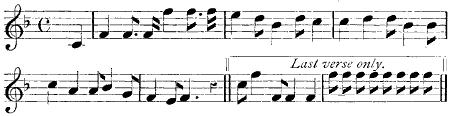
—London (A. B. Gomme).
I saw a ship a sailin’, A sailin’ on the sea, And oh, it was laden With pretty things for me [thee]. There were comfits in the cabin, And apples in the hold; The sails were made of silk, And the masts were made of gold. Four and twenty sailors That sat upon the deck, Were four and twenty white mice With chains about their necks. The captain was a duck, With a packet on his back; And when the ship began to move, The captain cried “Quack! quack!”
—Northamptonshire, Revue Celtique, iv. 200; Halliwell’s Nursery Rhymes, No. ccclxxvii.
(b) A number of little girls join hands and form a ring. They all jump round and sing the verses. The game ends by the girls following one of their number in a string, all quacking like ducks.—Northamptonshire.
(c) Halliwell does not include it among his games, but simply as a nursery paradox. The tune given is that to which I as a child was taught to sing the verses as a song. We did not know it as a game. The “Quack, quack!” was repeated as another line to the notes of the last bar given, the notes gradually dying away (A. B. Gomme).
Duck Friar
The game of “Leap-frog.”—Apollo Shroving, 1627, p. 83.
Ducks and Drakes
A pastime in which flat stones or slates are thrown upon the surface of a piece of water, so that they may dip and emerge several times without sinking (Brockett’s North Country Words). “Neither cross and pile nor ducks and drakes are quite so ancient as hand dandy” (Arbuthnot and Pope, quoted in Todd’s Johnson).
Halliwell gives the words used in the game both formerly and at the present day. If the stone emerges only once it is a duck, and increasing in the following order:—
2. A duck and a drake,
3. And a halfpenny cake,
4. And a penny to pay the old baker,
5. A hop and a scotch is another notch,
6. Slitherum, slatherum, take her.
—Halliwell’s Dictionary.
Hen-pen, Duck and mallard, Amen.
—Somersetshire (Holloway’s Dict. of Provincialisms).
A duck and a drake And a white penny cake.
—Hampshire (Holloway’s Dict. of Provincialisms).
A duck and a drake And a penny white cake, And a skew ball.
—Peacock’s Manley and Corringham Glossary.
Moor (Suffolk Words and Phrases) gives the names for the number of times the stone emerges, as (1) “a duck;” (2) “a duck an’ a drake;” if thrice, “a duck an’ a drake an’ a fi’epenny cake;” four times is “a duck an’ a drake an’ a fi’epenny cake, an’ a penny to pah the baker.” If more than four, “a duck,” “a duck an’ a drake,” &c., are added. These distinctions are iterated quickly to correspond in time as nearly as may be with the dips of the stone. A flattish stone is evidently the best for this sport.
(b) This game is also given by Mr. Addy in his Sheffield Glossary, and by Holland (Cheshire Glossary), Brogden (Provincial Words, Lincolnshire), Lowsley (Berkshire Glossary), Nares’ Glossary, and Baker’s Northants Glossary. Miss Courtenay gives “Scutter” and “Tic Tac Mollard” as Cornish names for the game (West Cornwall Glossary). See also Halliwell’s Nursery Rhymes, p. 139, and Strutt’s Sports and Pastimes, p. 326.
Butler, in his Hudibras (p. ii. canto iii. l. 302), makes it one of the important qualifications of his conjurer to tell—
What figur’d slates are best to make On wat’ry surface duck or drake.
The following description of this sport is given by Minucius Felix, ed. 1712, p. 28, which evinces its high antiquity: “Pueros videmus certatim gestientes, testarum in mare jaculationibus ludere. Is lusus est, testam teretem, jactatione fluctuum lævigatam, legere de litore: eam testam plano situ digitis comprehensam, inclinem ipsum atque humilem, quantum potest, super undas irrorare: ut illud jaculum vel dorsum maris raderet, vel enataret, dum leni impetu labitur; vel summis fluctibus tonsis emicaret, emergeret, dum assiduo saltu sublevatur. Is se in pueris victorem ferebat, cujus testa et procurreret longius, et frequentius exsiliret.”
“From this pastime,” says Moor, “has probably arisen the application of the term to a spendthrift—of whose approaching ruin we should thus speak: ‘Ah, he’ave made fine ducks and drakes of a’s money, that a’ have.’”—Suffolk Words.
Duckstone
A large stone called the Duckstone or Duck-table is placed on the ground, generally with a wall for a background, but this is of little consequence. Several boys take a stone each, and a place pretty near the Duckstone is chosen for “home.” One of the boys puts his stone on the Duckstone, and he is called the Tenter. He has to guard the home and catch the other boys if he can. Each boy in turn throws his stone at the stone on the Duck-table and immediately runs home. The Tenter tries to catch him before he can touch the wall or post or whatever is chosen for the home. If the Tenter can catch him he becomes Tenter, and puts his stone on the Duckstone, and the original Tenter takes his turn in throwing. One rule of the game is that the Tenter’s stone must always be on the Duck-table when he is trying to catch a boy, so if it is knocked off it must be replaced before he can try to catch the boy running “home.” The chance of getting home is increased for the boy who knocks it off.—North-West Lincolnshire (Rev. —— Roberts and Miss Peacock).
(b) Similar versions are from Earls Heaton (Herbert Hardy), Ireland (Folk-lore Journal, ii. 265), Peacock (Mauley and Corringham Glossary). Addy (Sheffield Glossary) gives this game with the following addition: If a duck falls short of the Duckstone, and the one whose duck is on the stone sees that he can wand or span with his hand the distance between the duck thus thrown and the Duckstone, he shouts out “Wands,” and if he can wand or span the distance he takes his duck off, and the duck thus thrown is put on. Holland (Cheshire Glossary), Darlington (South Cheshire), Baker (Northants Glossary), and Brogden (Provincial Words, Lincolnshire), also give this game. Elworthy (West Somerset Words) calls it “Duck,” and “Ducks off” and “Cobbs off” in Dorsetshire. In London the boy repeats the words, “Gully, gully, all round the hole, one duck on,” while he is playing (Strand Magazine, November 1891). Newell (Games, p. 188) calls it “Duck on a Rock.”
Duffan Ring
Name for “Cat and Mouse” in Cornwall.—Folk-lore Journal, v. 57.
Dumb Crambo
An undescribed game mentioned in Moor’s Suffolk Words, p. 238.
Dumb Motions
Two sides are chosen, which stand apart from each other inside the line of their den. One side chooses a trade, and goes to the opposite side imitating working at the trade and giving the initial letters of it. If the opposite side guesses the name of the trade, the players run to their own den, being chased by their opponents. If any of the players are caught they must go to the opposite side. In turn the opposite side chooses a trade, and imitates the actions practised.—Cork, Ireland (Miss Keane).
This is called “An Old Woman from the Wood” in Dorsetshire. The children form themselves into two ranks.
The first rank says: Here comes an old ’oman from the wood. The second party answers: What cans’t thee do? First Party:Do anythin’. Second Party: Work away.
This the children proceed to do, some by pretending to sew, some to wash, some to dig, some to knit, without any instruments to do it with. If the opposite side guess what they are doing, they change sides. This game, Miss Summers believes, is very old, and has been played by several generations in the village of Hazelbury Bryan.—Dorsetshire (Folk-lore Journal, vii. 230).
See “Trades.”
Dump
A boys’ amusement in Yorkshire, in vogue about half a century ago, but now believed to be nearly obsolete. It is played in this manner. The lads crowd round and place their fists endways, the one on the other, till they form a high pile of hands. Then a boy, who has one hand free, knocks the piled fists off one by one, saying to every boy as he strikes his fist away, “What’s there, Dump?” He continues this process till he comes to the last fist, when he exclaims:—
What’s there? Cheese and bread, and a mouldy halfpenny! Where’s my share? I put it on the shelf, and the cat got it. Where’s the cat? She’s run nine miles through the wood. Where’s the wood? T’ fire burnt it. Where’s the fire? T’ waters sleekt (extinguished) it. Where’s the water? T’ oxen drank it. Where’s the oxen? T’ butcher killed ’em. Where’s the butcher? Upon the church tops cracking nuts, and you may go and eat the shells; and them as speaks first shall have nine nips, nine scratches, and nine boxes over the lug!
Every one then endeavours to refrain from speaking in spite of mutual nudges and grimaces, and he who first allows a word to escape is punished by the others in the various methods adopted by schoolboys. In some places the game is played differently. The children pile their fists in the manner described above; then one, or sometimes all of them, sing:
I’ve built my house, I’ve built my wall; I don’t care where my chimneys fall!
The merriment consists in the bustle and confusion occasioned by the rapid withdrawal of the hands (Halliwell’s Nursery Rhymes, p. 225). Compare Burne’s Shropshire Folk-lore, p. 529.
Northall (Folk Rhymes, p. 418) gives the following rhymes as said in Warwickshire while the fists are being piled on one another:—
Here’s one hammer on the block, My men, my men; There’s one hammer, &c., my man John. Dibble the can, blow bellows, blow, Fire away, lads, for an hour or so.
See “Dish-a-loof,” “Sacks.”[Addendum]
Dumps
A game at marbles or taw, played with holes scooped in the ground (Roxburgh, Jamieson). Grose gives dump as signifying “a deep hole of water” (Provincial Glossary).
Dust-point
A game in which boys placed their points in a heap, and threw at them with a stone. Weber and Nares give wrong explanations. It is alluded to in Cotton’s Works, 1734, p. 184.
I’ll venter on their heads my brindled cow, With any boy at dust-point they shall play.
—Peacham’s Thalia’s Banquet, 1620.
Nares (Glossary) suggests that this game and blow-point resembled the game of Push-pin. See also Halliwell’s Dictionary.
Eller Tree
A number of young men and women stand in a line, a tall girl at one end of the line representing the tree. They then begin to wrap round her, saying, “The old eller tree grows thicker and thicker.” When they have all got round her (the tree), they jump all together, calling out, “A bunch of rags, a bunch of rags,” and try to tread on each other’s toes.—Sheffield, Yorks (S. O. Addy).
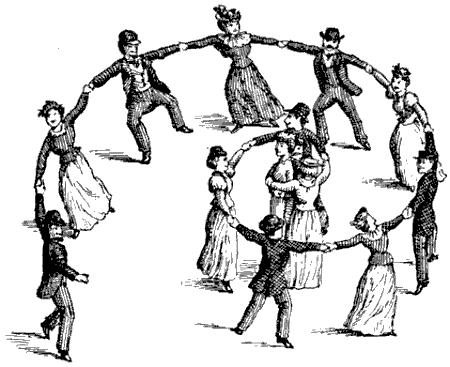
(b) The tree is the alder. It abounds in the North of England more than in any other part of the kingdom, and seems always to have been there held in great respect and veneration. Many superstitions also attach to the tree. It is possible from these circumstances that the game descends from an old custom of encircling the tree as an act of worship, and the allusion to the “rags” bears at least a curious relationship to tree worship. If this conclusion is correct, the particular form of the game preserved by Mr. Addy may be the parent form of all games in which the act of winding is indicated. There is more reason for this when we consider how easy the notion of clock-winding would creep in after the old veneration for the sacred alder tree had ceased to exist.
See “Bulliheisle,” “Wind up the Bush Faggot,” “Wind up the Watch.”
Ezzeka
Old Ezzeka did one day stand Upon a barrel top; The bung flew out, and all at once It went off with a pop.
—Dronfield (S. O. Addy).
This game is usually played in a house or schoolroom, by boys and girls. A boy or girl is chosen who is considered to be able to stand a joke. He sits on a chair. A stool is put behind, upon which a boy called “Ezzeka” stands. Then the other boys and girls in the room sing the lines. As they are finished, Ezzeka, who has a bottle of water in his hand, takes out the cork, and pours the water upon his victim’s head. This game may be compared with the game of “King Arthur” mentioned by Brand (Pop. Antiq., ii. 393).
Father’s Fiddle
This is a boys’ game. One boy says to another, “Divv (do) ye ken (know) aboot my father’s fiddle?” On replying that he does not, the questioner takes hold of the other’s right hand with his left, and stretches out the arm. With his right hand he touches the arm gently above the elbow, and says, “My father had a fiddle, an’ he brook (broke) it here, an’ he brook it here” (touching it below the elbow), “an’ he brook it throw the middle,” and comes down with a sharp stroke on the elbow-joint.—Keith, Fochabers (Rev. W. Gregor).
This is probably the same game as that printed by Halliwell, No. cccxxxv., to which the following rhyme applied:—
My father was a Frenchman, He bought for me a fiddle; He cut me here, he cut me here, He cut me right in the middle.
Feed the Dove
An undescribed game mentioned in an old poem called Christmas (i. 285), quoted in Ellis’s Brand, i. 517: “Young men and maidens now at ‘Feed the Dove’ (with laurel leaf in mouth) play.”
Find the Ring
O the grand old Duke of York He had ten thousand men, He marched them up the hill ago And he marched them down again. And when they were up they were up, And when they were down they were down, And when they were half-way up the hill They were neither up nor down.
—Sheffield (S. O. Addy).
A ring of chairs is formed, and the players sit on them. A piece of string long enough to go round the inner circumference of the chairs is procured. A small ring is put upon the string, the ends of which are then tied. Then one of the players gets up from his chair and stands in the centre. The players sitting on the chairs take the string into their hands and pass the ring round from one to another, singing the lines. If the person standing in the centre can find out in whose hand the ring is, he sits down, and his place is taken by the one who had the ring. The game is sometimes played round a haycock in the hayfield.
Miss Dendy sends a similar rhyme from Monton, Lancashire, where it is known simply as a marching game. For similar rhymes, see Halliwell’s Nursery Rhymes, p. 3.
See “Paddy from Home,” “Tip it.”
Fippeny Morrell
“Twice three stones, set in a crossed square, where he wins the game that can set his three along in a row, and that is fippeny morrell I trow.”—Apollo Shroving, 1626.
See “Nine Men’s Morice,” “Noughts and Crosses.”
Fire, Air, and Water
The players seat themselves in a circle. One of the players has a ball, to which a string is fastened. He holds the string that he may easily draw the ball back again after it is thrown. The possessor of the ball then throws it to one in the circle, calling out the name of either of the elements he pleases. This player must, before ten can be counted, give the name of an inhabitant of that element. When “Fire” is called, strict silence must be observed or a forfeit paid.—Cork, Ireland (Miss Keane).
The players were seated in a half-circle, and the possessor of the ball faced the others. There was no string attached to the ball, but it was necessary that it should hit the child it was thrown to. When “Fire” was called, “Salamander” and “Phœnix” were allowed to be said. The third time “Fire” was called, silence was observed, and every player bowed the head. We called it “Earth, Air, Fire, and Water.” A forfeit had to be paid for every mistake.—London (A. B. Gomme).
It seems probable that a survival of fire-worship is shown by this game.
Fivestones
This game was played by a newspaper boy at Richmond Station for me as follows:—He had five square pieces of tile or stone about the size of dice. He took all five pieces in the palm of the hand first, then threw them up and caught them on the back of the hand, and then from the back of the hand into the palm. Four of the stones were then thrown on the ground; the fifth was thrown up, one stone being picked up from the ground, and the descending fifth stone caught in the same hand; the other three pieces were next picked up in turn. Then two were picked up together in the same manner twice, then one, then three, then all four at once, the fifth stone being thrown up and caught with each movement. All five were then thrown up and caught on the back of the hand, and then thrown from the back and caught in the palm. When he dropped one, he picked it up between his outstretched fingers while the other stones remained on the back of the hand; then he tossed and caught it likewise. Then after throwing up the five stones and catching them on the back of the hand and the reverse, all five being kept in the palm, one was thrown up, and another deposited on the ground before the descending stone was caught. This was done to the three others in turn. Then with two at a time twice, then one and three, then all four together, then from the palm to the back of the hand, and again to the palm. This completed one game. If mistakes were made another player took the stones. Marks were taken for successful play. This boy called the game “Dabs.”—A. B. Gomme.
In South Notts this game was called “Snobs.” It was played with small stones or marbles. There were nine sets of tricks. First One-ers (of which there were five in the set), then Two-ers (two in set), Three-ers (three in set), Four-ers (four in set), Four Squares (four in set), Trotting Donkeys (eight in set, I believe), Fly-catchers (six or seven in set), Magic (five in set), and Magic Fly-catchers (five in set). One-ers is played thus:—The five stones are thrown into the air and caught on the back of the hand. If all are caught they are simply tossed up again and caught in the hollow of the hand, but if any are not caught they have to be picked up, one by one, another stone being at the same time thrown into the air and caught with the one picked up in the hand. Two-ers, Three-ers, and Four-ers, are played in the same way, except that the stones not caught on the back of the hand have to be arranged in twos, threes, and fours respectively by the hand on which the caught stones are lying meanwhile, and then each lot has to be picked up altogether. If the number that fall when the stones are first thrown up won’t allow of this, the player has to drop the required number (but no more) from his hand. In Magic the play is just the same as in One-ers, except that instead of only throwing up a single stone and catching it as the others are in turn picked up, the whole number, except those remaining to be picked up, are thrown and caught. In Four Squares, four of the stones are arranged in a square, each of them is then picked up, whilst the remaining stone is flung upwards and caught; the one picked up is then tossed up, and the one originally tossed up is put down in the place of the other, which is caught as it descends, and the process repeated “all round the square.” Trotting Donkeys is similarly played, except that the four stones are arranged in a line—not in a square—and I believe there is some other slight difference, but I forget what. Fly-catchers is played like One-ers, except that the stone thrown into the air while the others are being picked up, is not simply caught by being allowed to fall into the hand, but by an outward movement of the hand is pounced on, hawk-fashion, from above. Magic Fly-catchers is played in precisely the same way, except that as in simple Magic, not one stone, but all are thrown up and caught—that is, if there are four on the ground one only is thrown up for the first, two for the second, three for the third, and so on until they are all picked up. This is, of course, the most difficult part of all, and, in fact, only experts were expected to do it. Every failure means “out,” and then your opponent has his turn. The winner is the one who gets through first. Such is the game as I remember it, but I have an uneasy suspicion that I have missed something out. I seem to remember one trick in which all the stones on the ground had to be picked up at once where they lay—scrambled up so to speak. Or it may be (and, in fact, I think it was) that sometimes, to add to the difficulty of the game, we picked up the groups of two, three, and four in Two-ers, Three-ers, and Four-ers in this fashion, instead of first placing them together.—Epworth, Doncaster (C. C. Bell).
In Wakefield the set of pot checks, which represents five hucklebones, now consists of four checks and a ball about the size of a large marble. The checks are something like dice, but only two opposite sides are plain, the other four being fluted. The table played on is generally a doorstep, and it is made ready by drawing a ring upon it with anything handy which will make a mark. There are twelve figures or movements to be gone through as follows. Some have special names, but I do not learn that all have.
1. The player, taking the checks and ball in the right hand, throws down the checks, keeping the ball in the hand. If any check fall outside the ring the player is “down.” There is skill needed in the throwing of the checks in this and the following movements, so that they may be conveniently placed for taking up in the proper order. The checks being scattered, the player throws up the ball, takes up one check, and catches the ball as it comes down, or, as it is sometimes played, after it has bounced once from the step. This is repeated till all the checks are taken up.
2. As the last figure, but the checks are taken up two at a throw.
3. As the last, but at the first throw one check, called the Horse, is taken up, and at the second the remaining three checks at once, called the Cart.
4. As before, but all the checks taken up together.
5. Called Ups and Downs. The checks are taken up at one throw, and set down outside the ring at the next. This is done first with one, then with two, and so on.
6. Each check is touched in turn as the ball is thrown.
7. The checks are separately pushed out of the ring.
8. Each check in turn is taken up and knocked against the ground.
9. Each check is taken up and tapped upon another.
10. The checks are first arranged three in a line, touching each other, and the fourth placed at the top of that at one end of the row. This is called the Cradle. It has to be taken down check by check, and if, in taking one, another is moved, the player is out.
11. Like the last, but the checks are put one above another to make a Chimney.
12. Called the Dish-clout—I know not why, unless it be that it wipes up the game. The movement used in taking up the checks is thus described:—“Take hold of the sleeve of the right hand with the left; throw up the ball, and twist your right hand underneath and over your left, and catch the ball. With the hand still twisted throw up the ball and untwist and catch it.” The checks are picked up in the course of the twisting.
These I am told are the orthodox movements; and I do not doubt that in them there is much of very old tradition, although the tenth and eleventh must have been either added or modified since pot checks came into use, for the figures could not be built up with the natural bones. Some other movements are sometimes used according to fancy, as for example the clapping of the ground with the palm of the hand before taking up the checks and catching the ball.—J. T. Micklethwaite (Arch. Journ., xlix. 327-28).
I am told that in the iron districts of Staffordshire, the round bits of iron punched out in making rivet holes in boiler plates are the modern representatives of hucklebones.—Ibid.
In Westminster four stones are held in the right hand, a marble is thrown up, and all four stones thrown down, and the marble allowed to bounce on the hearthstone or pavement, and then caught in the same hand after it has rebounded. The marble is then thrown up again, and one of the four stones picked up, and the marble caught again after it has rebounded. This is done separately to the other three, bringing all four stones into the hand. The marble is again bounced, and all four stones thrown down and the marble caught. Two stones are then picked up together, then the other two, then one, then three together, then all four together, the marble being tossed and caught with each throw. An arch is then formed by placing the left hand on the ground, and the four stones are again thrown down, the marble tossed, and the four stones put separately into the arch, the marble being caught after it has rebounded each time; or the four stones are separately put between the fingers of the left hand in as straight a row as possible. Then the left hand is taken away, and the four stones caught up in one sweep of the hand. Then all four stones are thrown down, and one is picked up before the marble is caught. This is retained in the hand, and when the second stone is picked up the first one is laid down before the marble is caught; the third is picked up and the second laid down, the fourth picked up and the third laid down, then the fourth laid down, the marble being tossed and caught again each time. The stones have different names or marks (which follow in rotation), and in picking them up they must be taken in their proper order, or it is counted as a mistake. The game is played throughout by the right hand, the left hand only being used when “arches” is made. The marble should be thrown up about the same height each toss, and there should be little or no interval between the different figures.—Annie Dicker.
I saw this game played in Endell Street, London, W.C., by two girls. Their game was not so long nor so complete as the above. They did not throw all four stones down as a preliminary stage, but began with the second figure, the four gobs being placed in a square ∷, nor were they particular as to which stones they picked up. They knew nothing of numbering or naming them. Their marble was called a “jack.” They had places chalked on the pavement where they recorded their successful “goes,” and the game was played in a ring.—A. B. Gomme.
An account sent me from Deptford (Miss Chase) is doubtless the same game. It begins with taking two “gobs” at once, and apparently there are eight stones or gobs to play with. The marble or round stone which is thrown up is called a “tally.” The directions for playing are—
We take twoses, We take threeses, We take fourses, We take sixes, We take eights.
Chain eggs—i.e., to pick up one and drop it again until this has been done to each stone. Arches—i.e., gobs in a row. This was described by the player as “while the tally is up to sweep the whole row or line off the ground into the arch of the finger and thumb before catching the tally.”
(b) These games are variants of one common original. It is the same game as that described by F. H. Low in the Strand Magazine, ii. 514, as played in the London streets. The marble there is called a “buck.” “Pegsy” was the name of the No. 5 stage of the Wakefield version, and this varies too, inasmuch as it was the same gob which is picked up and then laid down before catching the buck.
Mr. Kinahan says, “‘Jackstones,’ played with three or four small stones that are thrown up in the air and caught again, seems to have been a very ancient game, as the stones have been found in the crannogs or lake-dwellings in some hole near the fireplaces, similar to where they are found in a cabin at the present day. An old woman, or other player, at the present time puts them in a place near the hob when they stop their game and go to do something else” (Folk-lore Journal, ii. 266). In the Græco-Roman saloon, British Museum, is a statue originally composed of two boys quarrelling at the game of “Tali” (see Townley Gallery, i. 305; Smith’s Dict. Greek and Roman Antiq., s.v. Talus), and it is interesting to note that in the Deptford game the marble is called a “Tally.”
Mr. Kinahan’s note suggests that “Fivestones” may be an independent game, instead of a derivative from “Hucklebones.” If this is so, we have interesting evidence of the spread or transmission of one game from at least two centres. Professor Attwell, in Notes and Queries, 8th ser., iv. 201, suggests that “Hucklebones” was introduced into Europe by the Romans, and was spread throughout the countries which formed the empire by means of Roman colonists and soldiers. Mr. Newell (Games, pp. 190-93) describes a similar game to “Fivestones” played in Boston under the name of “Otadama,” or “Japanese Jacks.” This game is of Japanese origin, “Tedama” (that is, “Handballs”) being its proper name. He says there can be no doubt that the two forms of this amusement are branches of the same root; and we thus have an example of a game which, having preserved its essential characteristics for thousands of years, has fairly circumnavigated the globe, so that the two currents of tradition, westward and eastward, from Europe and Asia, have met in America.
See “Checkstones,” “Dibs,” “Hucklebones,” “Jackstones.”[Addendum]
Flowers
Sides are chosen; each side must have a “home” at the top and bottom of the ground where the children are playing. One side chooses a flower and goes over to the other side, the members of which stand in a row facing the first side. The first side states the initial letters of the flower it has chosen, and when the second side guesses the right flower they run and try to catch as many of the opposite side as they can before they reach their home. The captives then become members of the side which captured them.—Bitterne, Hants (Mrs. Byford).
Follow my Gable
[Play]
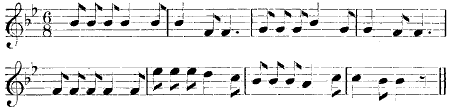
—Earls Heaton, Yorkshire.
[Play]
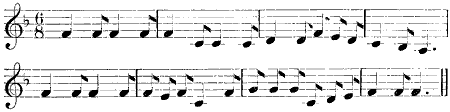
—Redhill, Surrey.
I.
Follow my gable ’oary man, Follow my gable ’oary man, I’ll do all that ever I can To follow my gable ’oary man. We’ll borrow a horse and steal a gig, And round the world we’ll have a jig, And I’ll do all that ever I can To follow my gable ’oary man.
—Earls Heaton, Yorks (Herbert Hardy).
II.
Holy Gabriel, holy man, Rantum roarum reeden man, I’ll do all as ever I can To follow my Gabriel, holy man.[3]
—Redhill, Surrey (Miss G. Hope).
III.
I sell my bat, I sell my ball, I sell my spinning-wheel and all; And I’ll do all that ever I can To follow the eyes of the drummer man.
—Luton, Bedfordshire (Mrs. Ashdown).
(b) In the Yorkshire version a ring is formed with one child in the middle as the ’Oary Man. Whatever he, or she, does, all in the ring must mimic, going round and singing at the same time. Any one found late in changing the action or idle in obeying the caperings of the central child becomes the ’Oary Man in place of the child taking that part. Both girls and boys play. In the Redhill version, Holy Gabriel kneels in the middle of the circle. He acts as leader, and always had the fiddle as his instrument, though he now usually plays the pianoforte as his first instrument. The other children choose any instrument they like. Holy Gabriel pretends to play the fiddle, and all the other children play their own instruments until Holy Gabriel changes his to one of theirs, when that one must immediately begin to play the fiddle, and continue until Holy Gabriel takes another instrument or returns to the fiddle. This is done in vigorous pantomime. In the Luton variant the children sit in a semicircle, the Drummer faces them. He plays the drum; all the other children play on any other instrument they like. If the other players do not at once change their instrument, or neglect to sing the lines, a forfeit is demanded.
(c) Mr. Hardy says some sing this game, “Follow my game an holy man.” Mr. Hardy once thought it was the remnant of a goblin story of a hoary man of the gable or house-roof, who presided over the destinies of poor cottagers, and he had begun to make out the folk tale. The fairy would sometimes come down, and, playing his antics, compel whomsoever observed him to follow him in a mimicking procession. Miss Hope writes of “Holy Gabriel” that the game is played at Mead Vale, a small village in Surrey, but is unknown at larger villages and towns a few miles off. Some of the women who played it in their youth say that it began in the Primitive Methodist school at Mead Vale. It is played at Outword, also a remote village, and was introduced there by a stonemason, who stated that he had learned it from a cousin who had been in America. Further inquiry by Miss Hope elicited the fact that the cousin had learned the game, when a boy, in his native place in Lancashire. He did not know whether it was a well-known game there. This information points perhaps to a modern origin, but in such cases it must be borne in mind that people are very fond of suggesting recent circumstances as the cause of the most ancient traditions or customs. The obvious analogy to the incident in the myth of the Pied Piper, and to the Welsh custom at St. Almedha Church, near Brecknock, recorded by Giraldus Cambrensis, where the imitation of a frenzied leader is carried out as a religious ceremony, rather suggests that in this game we may have a survival of a ceremonial so common among early or uncultured people, the chief incident of which is the frenzied dancing of a god-possessed devotee.
Follow my Leader
This is a boys’ game. Any number can take part in it. It requires a good extent of country to play it well. The boy who is the swiftest runner and the best jumper is chosen as Leader. He sets out at a good speed over the fields, tries to jump as many ditches or burns, jumping such from one side to the other again and again, to scramble over dykes, through hedges, over palings, and run up braes. The others have to follow him as they can. This steeplechase continues till the followers are all tired out.—Keith (Rev. W. Gregor).
This is a very general game among schoolboys, but in Hereford it was a town custom occurring once in seven years on 11th October (Folk-lore Journal, v. 75).
Fool, Fool, come to School
This game is played under the name of “Foolie, Foolie” at Duthil, Strathspey. The players are placed in a row, either standing or sitting. Two are chosen, the one as Namer and the other as Foolie. Foolie withdraws, if not out of sight, at least out of range of hearing. The Namer then gives a name secretly to each player. When this is done, he calls on Foolie—Foolie, Foolie, come to your schoolie.
Foolie pays no attention to this call. It is again repeated, but with the same results. This goes on for several times. At last the Namer calls out—
Foolie, Foolie, come to your schoolie; Your bannocks are burnin’ an’ ready for turnin’.
Foolie always obeys this call, comes and stations himself beside the Namer. A little chaffing generally goes on against Foolie. The Namer says, “Come chise me oot, come chise me in, tae” so and so, naming one by the assumed fancy name. Foolie makes choice of one. If the choice falls right, the one so chosen steps from the line and stands beside Foolie. If the choice falls wrong, the one named remains in the line. All the players’ names are called out in this way. If any stand unchosen by Foolie, the Namer then goes up to each and asks if he wants, e.g., “an aipple,” “an orange,” “a kirk,” “a cottage,” &c. Each one whispers what he wants. The same question is put to Foolie. If he answers, e.g., “orange,” the one so named steps out and stands beside Foolie. All not first chosen are gone over in this way. Those left unchosen take their stand beside the Namer. There is then a tug-of-war, with the Namer and Foolie as the leaders.—Keith (Rev. W. Gregor).
In Hants the children stand vis-à-vis, as in a country dance. One of the number is sent out of earshot, and the others decide with the Captain as to the name of the bird each wishes to personate. The Captain then calls to the child who is out, “Tom Fool, Tom Fool, come home from school, and pick me out a blackbird,” “cuckoo,” or other bird. If Tom Fool is wrong in his guessing after three trials, he is condemned to run the gauntlet, being pelted with gloves or handkerchiefs not too mercifully.—Bitterne, Hants (Miss Byford).
In Sussex there is the same action with the following words, but there is no chasing or hitting—
Of all the birds in the air, Of all the fishes in the sea, You can pick me out [ ]
If the children fail to do so, they say—
Poor fool, been to school, Learn more in a week; Been there seven years And hasn’t learnt a bit.
—Hurstmonceux, Sussex (Miss Chase).
The same game is played indoors in Cornwall, the reply being—
Fool, fool, go back to school And learn your letters better.
—Cornwall (Folk-lore Journal, v. 99-80).
See “Namers and Guessers.”[Addendum] [Addendum]
Foot and Over
One boy out of a number stoops in the position for “Leap-frog” at an agreed fixed line. From the players he chooses a Leader and a Foot. The Leader first leaps over the stooping boy at a foot from the line; the other players then leap in turn each at a foot further from the line, the stooping boy moving forward from the line for each player; finally the Foot leaps as far as the distance leapt by the last boy. If this is accomplished, the Leader hops from the line and then leaps; the followers hop and leap each a foot further than each other; finally the Foot hops and leaps as far as the distance covered by the last boy. If this is accomplished, the Leader hops twice and then leaps; the same process going on until one of the boys fails, who then takes the place of the stooping boy, and the game begins again. If the Foot covers any longer distance than the Leader, the Leader stoops down.—Earls Heaton, Yorks. (H. Hardy).
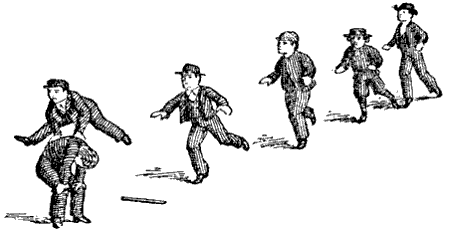
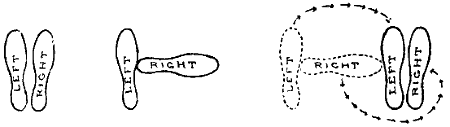
1st position2nd position3rd position
This game is general. Mr. Emslie describes the London version somewhat differently. After all the boys had jumped over the first boy’s back, a cry of “Foot it” was raised, and the boy who had given the back placed one of his feet at a right angle to the other, and in this way measured a “foot’s length” from the starting-place. All the boys then “overed” his back from the original line, the last one crying “Foot it,” and then the measuring ceremony was again gone through, and the game commenced again, and continued in the same manner until one of the boys failed to “over” the back, when he became Back.[Addendum]
Football
The modern game of “Football” is too well known to need description here, and, like “Cricket,” it has become no longer a children’s game. As to its origin, there are many ball games, such as “Camping,” which have been suggested as the original form of “Football.” Every school almost had some peculiarity in the method of playing, and Eton, Winchester, Uppingham, and Rugby are well-known examples. It is not a little interesting to note, now that “Football” has settled down into a national game organised by county committees, that one of the forms of play officially recognised is the old Rugby game, the other form, known as the “Association,” being arrived at by agreement of those interested in the game.
To illustrate the ancient origin of the game, and its serious import as a local contest rather than a sport, some examples may be given. It is still (1877) keenly contested at Workington on Easter Tuesday on the banks of, and not unfrequently in, the river Derwent (Dickinson’s Cumberland Glossary). At Derby there was a football contest between the parishes of All Saints’ and St. Peter’s. The ball was thrown into the market-place from the Town Hall. The moment it was thrown the “war cries” of the rival parishes began, and the contest, nominally that of a football match, was in reality a fight between the two sections of the town; and the victors were announced by the joyful ringing of their parish bells (Dyer’s Popular Customs, p. 75). At Chester-le-Street the game was played between what were termed “up-streeters” and “down-streeters,” one side endeavouring to get the ball to the top of the town, whilst their opponents tried to keep it near the lower or north end. At one o’clock the ball was thrown out from near the old commercial hotel, the Queen’s Head, in the centre of the town, and it has often been received by over three and four hundred people, so great was the interest taken in this ancient sport. At Asborne the struggle was between the “up’ards” and “down’ards.” At Dorking the divisions were between the east and west ends of the town, and there was first a perambulation of the streets by the football retinue composed of grotesquely dressed persons. At Alnwick the divisions were the parishes of St. Michael’s and St. Paul’s. At Kirkwall the contest was on New Year’s Day, and was between “up the gates” and “down the gates,” the ball being thrown up at the Cross. At Scarborough, on the morning of Shrove Tuesday, hawkers paraded the streets with parti-coloured balls, which were purchased by all ranks of the community. With these, and armed with sticks, men, women, and children repaired to the sands below the old town and indiscriminately commenced a contest. The following graphic account of Welsh customs was printed in the Oswestry Observer of March 2, 1887: “In South Cardiganshire it seems that about eighty years ago the population, rich and poor, male and female, of opposing parishes, turned out on Christmas Day and indulged in the game of ‘Football’ with such vigour that it became little short of a serious fight. The parishioners of Cellan and Pencarreg were particularly bitter in their conflicts; men threw off their coats and waistcoats and women their gowns, and sometimes their petticoats. At Llanwenog, an extensive parish below Lampeter, the inhabitants for football purposes were divided into the Bros and the Blaenaus. A man over eighty, an inmate of Lampeter Workhouse, gives the following particulars:—In North Wales the ball was called the Bêl Troed, and was made with a bladder covered with a Cwd Tarw. In South Wales it was called Bél Ddu, and was usually made by the shoe-maker of the parish, who appeared on the ground on Christmas Day with the ball under his arm. The Bros, it should be stated, occupied the high ground of the parish. They were nicknamed ‘Paddy Bros,’ from a tradition that they were descendants from Irish people who settled on the hills in days long gone by. The Blaenaus occupied the lowlands, and, it may be presumed, were pure-bred Brythons. The more devout of the Bros and Blaenaus joined in the service at the parish church on Christmas morning. At any rate, the match did not begin until about mid-day, when the service was finished. Then the whole of the Bros and Blaenaus, rich and poor, male and female, assembled on the turnpike road which divided the highlands from the lowlands. The ball having been redeemed from the Crydd, it was thrown high in the air by a strong man, and when it fell Bros and Blaenaus scrambled for its possession, and a quarter of an hour frequently elapsed before the ball was got out from among the struggling heap of human beings. Then if the Bros, by hook or by crook, could succeed in taking the ball up the mountain to their hamlet of Rhyddlan they won the day; while the Blaenaus were successful if they got the ball to their end of the parish at New Court. The whole parish was the field of operations, and sometimes it would be dark before either party scored a victory. In the meantime many kicks would be given and taken, so that on the following day some of the competitors would be unable to walk, and sometimes a kick on the shins would lead the two men concerned to abandon the game until they had decided which was the better pugilist. There do not appear to have been any rules for the regulation of the game; and the art of football playing in the olden time seems to have been to reach the goal. When once the goal was reached, the victory was celebrated by loud hurrahs and the firing of guns, and was not disturbed until the following Christmas Day. Victory on Christmas Day, added the old man, was so highly esteemed by the whole countryside, that a Bro or Blaenau would as soon lose a cow from his cow-house as the football from his portion of the parish.”
(b) In Gomme’s Village Community, pp. 241-44, the position of football games as elements in the traditions of race is discussed, and their relationship to a still earlier form of tribal games, where the element of clan feuds is more decidedly preserved, is pointed out.
Forfeits
Forfeits are incurred in those games in which penalties are exacted from players for non-compliance with the rules of the game; “Buff,” “Contrary,” “Crosspurposes,” “Fire, Air, and Water,” “Follow my Gable,” “Genteel Lady,” “Jack’s Alive,” “Old Soldier,” “Twelve Days of Christmas,” “Turn the Trencher,” “Wadds,” and others. These games are described under their several titles, and the formula for forfeits is always the same. Small articles belonging to the players must be given by them every time a forfeit is incurred, and these must be redeemed at the close of the game. They are “cried” in the following manner:—One of the players sits on a chair having the forfeits in her lap. A child kneels on the ground and buries his face in his hands on the lap of the person who holds the forfeits. The “crier” then takes up indiscriminately one of the forfeits, and holding it up in the sight of all those who have been playing the games (without the kneeling child seeing it), says—
Here’s a very pretty thing and a very pretty thing, And what shall be done to [or, by] the owner of this very pretty thing?
The kneeling child then says what the penance is to be. The owner of the forfeit must then perform the penance before the other players, and then another forfeit is “cried.”
The more general penances imposed upon the owners of the forfeits are as follows, but the list could be very much extended:—
Bite an inch off the poker.
Kneel to the prettiest, bow to the wittiest, and kiss the one you love best.
Stand in each corner of the room, sigh in one, cry in another, sing in another, and dance in the other.
Put yourself through the keyhole.
Place two chairs in the middle of the room, take off your shoes, and jump over them.
Measure so many yards of love ribbon.
Postman’s knock.
Crawl up the chimney.
Spell Opportunity.
Miss Burne mentions one penance designed to make the victim ridiculous, as when he is made to lie on his back on the floor with his arms extended, and declare—
Here I lie! The length of a looby, The breadth of a booby, And three parts of a jackass!
—Shropshire Folk-lore, pp. 526-27.
(c) Halliwell gives, in his Nursery Rhymes, pp. 324-26, some curious verses, recorded for the first time by Dr. Kenrick in his Review of Dr. Johnson’s Shakespeare, 1765, on “rules for seemly behaviour,” in which the forfeits imposed by barbers as penalties for handling razors, &c., are set forth. Although “barbers’ forfeits” are not of the same nature as the nursery forfeits, it is possible that this general custom among so important a class of the community in early times as barbers may have suggested the game. Both Forby in his Vocabulary of East Anglia and Moor in his Suffolk Words bear testimony to the general prevalence of barbers’ forfeits, and it must be borne in mind that barbers were also surgeons in early days. A curious custom is also recorded in another East Anglian word-list, which may throw light upon the origin of the game from popular custom. “A forfeit is incurred by using the word ‘water’ in a brew-house, where you must say ‘liquor;’ or by using the word ‘grease’ in a chandlery, where it is ’stuff’ or ‘metal.’ The forfeit is to propitiate the offended genius loci” (Spurden’s East Anglian Vocabulary). The element of divination in the custom is perhaps indicated by a curious note from Waldron, in his Description of the Isle of Man (Works, p. 55), “There is not a barn unoccupied the whole twelve days, every parish hiring fiddlers at the public charge. On Twelfth Day the fiddler lays his head on some of the wenches’ laps, and a third person asks who such a maid or such a maid shall marry, naming the girls then present one after another; to which he answers according to his own whim, or agreeable to the intimacies he has taken notice of during this time of merriment. But whatever he says is as absolutely depended on as an oracle; and if he happen to couple two people who have an aversion to each other, tears and vexation succeed the mirth. This they call cutting off the fiddler’s head; for after this he is dead for the whole year.” Redeeming the forfeits is called “Crying the Weds,” in Burne’s Shropshire Folk-lore, p. 526. See “Wadds.”[Addendum]
Fox
Fox, a fox, a brummalary How many miles to Lummaflary? Lummabary? Eight and eight and a hundred and eight. How shall I get home to-night? Spin your legs and run fast.
Halliwell gives this rhyme as No. ccclvii. of his Nursery Rhymes, but without any description of the game beyond the words, “A game of the fox.” It is probably the same game as “Fox and Goose.”
Fox and Goose (1)
In Dorsetshire one of the party, called the Fox, takes one end of the room or corner of a field (for the game was equally played indoors or out); all the rest of the children arrange themselves in a line or string, according to size, one behind the other, the smallest last, behind the tallest one, called Mother Goose, with their arms securely round the waist of the one in front of them, or sometimes by grasping the dress.
The game commences by a parley between the Fox and Goose to this effect, the Goose beginning.
“What are you after this fine morning?”
“Taking a walk.”
“With what object?”
“To get an appetite for a meal.”
“What does [will] your meal consist of?”
“A nice fat goose for my breakfast.”
“Where will you get it?”
“Oh, I shall get a nice morsel somewhere; and as they are so handy, I shall satisfy myself with one of yours.”
“Catch one if you can.”
A lively scene follows. The Fox and Mother Goose should be pretty evenly matched; the Mother with extended arms seeking to protect her Brood, while the Fox, who tries to dodge under, right and left, is only allowed in case of a successful foray or grasp to secure the last of the train. Vigorous efforts are made to escape him, the Brood of course supplementing the Mother’s exertions to elude him as far as they are able, but without breaking the link. The game may be continued until all in turn are caught.—Folk-lore Journal, vii. 217-18.
In Lancashire the children stand in line behind each other, holding each other by the waist. One stands facing them and calls out—
My mother sits on yonder chimney, And she says she must have a chicken.
The others answer—
She can’t have a chicken.
The one then endeavours to catch the last child of the tail, who when caught comes behind the captor; repeat until all have changed sides.—Monton, Lancashire (Miss Dendy).
A version of this game played at Eckington, Derbyshire, is played as follows:—A den is chalked out or marked out for the Fox. A larger den, opposite to this, is marked out for the Geese. A boy or a girl represents the Fox, and a number of others the Geese. Then the Fox shouts, “Geese, Geese, gannio,” and the Geese answer, “Fox, Fox, fannio.” Then the Fox says, “How many Geese have you to-day?” The Geese reply, “More than you can catch and carry away.” Then the Geese run out of the den, and the Fox tries to catch them. He puts as many as he catches into his den (S. O. Addy).
(b) This game is a very general one at Christmas time. It is practically the same as “Gled Wylie,” and “Hen and Chickens,” and the “Hawk and Chickens” of Mr. Newell’s Games and Songs of American Children, pp. 155-56. By referring to these games it will be seen that the whole group are mimic representatives of farmyard episodes, though the animal characters are giving way to more domestic affairs, as shown in the Pins and Needles version of “Hen and Chickens.” It is possible that the different animals which are victims to the Fox appearing in the different games may arise from local circumstances, and that in this case a real distinction exists between the various names by which this game is known. A game called “Wolf and Deer,” similar to “Fox and Geese,” is given in Winter Evening Amusements, by R. Revel. The last one at the end of the tail may, if she has no other chance of escape, try and place herself before the Deer or Hen. She is then no longer to be hunted; all the others must then follow her example until the deer becomes the last of the line. The game then terminates by exacting a forfeit for each lady whom the Wolf has suffered to escape his clutches (pp. 64, 65).
See “Gled Wylie,” “Hen and Chickens,” “Old Dame.”[Addendum]
Fox and Geese (2)
A game known by this name is played with marbles or pegs on a board on which are thirty-three holes, or on the pavement, with holes scraped out of the stones. To play this game there are seventeen pieces called Geese, and another one either larger or distinguished from the Geese by its colour, which is called the Fox. The Fox occupies the centre hole, and the Geese occupy nine holes in front, and four on each side of him. The vacant holes behind are for the Geese and Fox to move in. The game is for the Geese to shut up the Fox so that he cannot move. All the pieces can be moved from one spot to another in the direction of the lines, but cannot pass over two holes at once. The Geese are not permitted to take the Fox. The Fox’s business is to take all, or as many of the Geese as will prevent him from being blockaded. The Fox can take the Geese whenever there is a vacant space behind them, which he passes to, then occupies.
This game has been very popular among schoolboys in all ages. Mr. Micklethwaite, in a paper on the Indoor Games of School Boys in the Middle Ages (Arch. Journ. xlix. 322), gives instances of finding figures of this game cut “in the cloister benches of Gloucester Cathedral and elsewhere, and there are several on the twelfth century tomb at Salisbury, miscalled Lord Stourton’s,” and also at Norwich Castle. For the date of these boards, Mr. Micklethwaite says for the last three centuries and a half cloisters everywhere in England have been open passages, and there have generally been schoolboys about. It is therefore not unlikely that they should have left behind them such traces as these play-boards. But if they are of later date they would not be found to be distributed in monastic cloisters with respect to the monastic arrangement, and we do find them so. Strutt describes the game (Sports, p. 319).
See “Nine Men’s Morris,” “Noughts and Crosses.”
Fox in the Fold
“The Tod (Fox) i’ the Faul (Fold).” This game is commonly played by boys. Any number of boys join hands and stand in a circle to form the Faul. The boy that represents the Tod is placed within the circle. His aim is to escape. To effect this he rushes with all his force, increased by a run, against the joint hands of any two of the players. If the rush does not unloose the grasp, he hangs on the two arms with all his weight, pressing and wriggling. If he fails he makes a rush at another two, always selecting those players he thinks weakest. When he does break through he rushes off at the top of his speed, with all the players in full cry, till he is caught and brought back. The game begins anew with another boy as Tod.—Keith (Rev. W. Gregor).
See “Bull in the Park,” “Frog in the Middle.”
Fox in the Hole
All the players are armed with handkerchiefs. One of the players is chosen for Fox, who has his den marked out. The Fox hops out on one leg, with his handkerchief ready to strike. The players gather round him and attack him. If he can strike one of his assailants without putting his foot to the ground from his hopping position, the player so struck is chased by the others into the den, and he then becomes the Fox for another round of the game.—Cork (Miss Keane).
Halliwell (Nursery Rhymes, p. 228) describes the game in practically the same manner, but adds that when the Fox is coming out he says—
The Fox gives warning It’s a cold and frosty morning,
after which he is at liberty to hop out and use his handkerchief.
(b) This game is alluded to in Soliman and Perseda, 1599; Florio, p. 480; Herrick, i. 176. See Halliwell’s Dictionary. Professor Mayor communicated to the Gentleman’s Magazine of 1848 (ii.), p. 147, the following early allusions to the game from old dictionaries:—
Gouldman, London, MDCLXIV.—“Ascoliasmus, Empusæ ludus: a kind of play wherein boys lift up one leg and hop with the other, where they beat one another with bladders tied to the end of strings. Fox to thy hole.”
Holyoke, MDCLXXVII.—“Empusa. παρὰ τὸ ἑνἱ ποδἱζειν, quòd uno incedat pede. Hence empusam agere is used for a play, hopping on one leg; with us, Fox to his hole.”
Id. “Ascoliasmus. A kind of play that children use when they hop on one leg, called Fox to thy hole.”
Cambridge Dict. MDCXCIII.—“Ascol. A kind of play wherein boys hopping on one leg beat one another with gloves or pieces of leather, and is called Fox to thy hole.”
Coles, 7th ed. 1711.—“Ascol. The play called Fox to the hole.—Empus. Ludus Empusæ. Scotch hoppers, or Fox in the hole.”
A similar game to this is played at Earls Heaton, Yorkshire (Mr. Hardy), and called “Goose and Gander.” Two players, the Goose and the Gander, stand in a ring, each on one leg. They hop out in turn, and try to catch one of the other players without letting their other leg touch the ground. If they fail in this they get “strapped” back to the ring. When either are successful, the player who is caught takes the place of either Goose or Gander in turn. The game is also mentioned in Useful Transactions in Philosophy, 1708-9.
French Jackie
This game is played either by boys or girls or by both together. One is chosen to stand alone; the other players join hands and form a circle. The one outside the circle goes round it and touches on the back one of the circle. He then runs off round the circle, and the one who was touched runs off in the opposite direction round the circle. The aim of each player is to reach the vacant place in the circle first. The one left out has to repeat the same action. The game may go on for any length of time.—Keith (Rev. W. Gregor).
At Barnes this game is called “Gap.” It is known as “French Tag” in the Forest of Dean, Gloucestershire (Miss Matthews), and “Tap-back” at Bitterne, Hants (Mrs. Adam).
French and English
The children choose sides under a leader, and a boundary line is made in the middle of the ground dividing the French and English territory. A handkerchief is then placed in the back part of each territory to represent a flag. The object is to obtain as many flags from the opposite side as possible. If a person is captured before having seized a flag, he is taken prisoner, and must be rescued by one of his own side. Thus, for instance, an Englishman enters the French territory and tries to reach the flag. If he is seen by the French before he reaches the flag, he is taken prisoner and is placed near the flags, and the next Englishman rescues him instead of taking a flag. As soon as the flag is taken, one of the party must put another handkerchief in its place. A player cannot be taken prisoner after having obtained the handkerchief or flag. The winning side is decided by counting the flags and prisoners.—Bitterne, Hants (Mrs. Byford).
This is a very general game, and is known as “Scotch and English” in the north, where some interesting details occur, for which see “Scotch and English.”
French Blindman’s Buff
The children kneel in a circle, one standing blindfolded in the middle. The kneeling children shout, “Come point to me with your pointer.”—Monton, Lancashire (Miss Dendy).
See “Buff,” “Dinah,” “Muffin Man.”
Friar-rush
A Christmas game, mentioned in the Declaration of Popish Impostures, 1603.
Frincy-francy
A game played between the dances at balls in farm-houses. A chair was placed in the middle of the barn or room; the master of the ceremonies led to the chair a young woman, who sat down and named the young man whom she was willing should kiss her. This he did, and then took the seat which the lady vacated. He then called out the name of some favourite girl, who was led up to him; there was another kiss. The girl then took the seat, and so on (county of Down). The same game is called “Frimsey-framsey” in parts of the county of Antrim.—Patterson’s Antrim and Down Glossary.
Compare “Cushion Dance.”
Frog-lope
Name for “Leap-frog.”—Addy’s Sheffield Glossary.
Frog in the Middle
One child is seated on the ground with his legs under him; the other players form a ring round. They then pull or buffet the centre child or Frog, who tries to catch one of them without rising from the floor. The child who is caught takes the place of the centre child. Another method of playing the game is similar to “Bull in the Park.” The child in the centre tries to break out of the ring, those forming it keeping the Frog in the ring by any means in their power, while still keeping their hands clasped. They sometimes sing or say—
Hey! hey! hi! Frog in the middle and there shall lie; He can’t get out and he shan’t get out—hey! hey! hi!
They dance round when saying this, all keeping a watch on the Frog, who suddenly makes a rush, and tries to break through the ring.—London (A. B. Gomme).
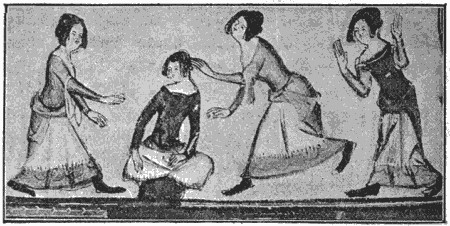
Strutt describes this game, and gives an illustration from a fourteenth century MS. which is here reproduced from the original (Sports, p. 303). Newell (Games of American Children, p. 171) also mentions it, and gives the rhyme as—
Frog in the sea, can’t catch me!
Gap
The same as “French Jackie.” This game is called “Tap-back” or “Tat-back” at Bitterne, Hants.
Garden Gate
Children join hands and form a ring. One child stands inside the ring; this child walks round and asks one of the circle, called the Keeper—
Have you the key of the garden gate? Open and let me go through.
The Keeper replies—
My next-door neighbour’s got the key; Ask him and he’ll give it to you.
This is repeated by each one in the circle. Then the inside child comes again to the Keeper and says—
None of the neighbours have got the key, So you must let me go through.
The Keeper answers—
I’ve lost the key of the garden gate, And cannot let you through.
Then all the ring say—
You must stop all night within the gate, Unless you have strength to break through.
The child inside then attempts to break through, and if he succeeds in breaking any of the clasped hands the one who first gives way has to take the place in the centre.—Roxton, St. Neots (Miss Lumley).
See “Bull in the Park.”
Gegg
“To smuggle the Gegg,” a game played by boys in Glasgow, in which two parties are formed by lot, equal in number, the one being denominated the Outs, the other Ins. The Outs are those who go out from the den or goal, where those called the Ins remain for a time. The Outs get the Gegg, which is anything deposited, as a key, a penknife, &c. Having received this, they conceal themselves, and raise the cry, “Smugglers!” On this they are pursued by the Ins; and if the Gegg (for the name is transferred to the person who holds the deposit) be taken, they exchange situations—the Outs become Ins and the Ins Outs. This play is distinguished from “Hy-spy” only by the use of the Gegg. One of the Ins who is touched by one of the Outs is said to be taken, and henceforth loses his right to hold the Gegg. If he who holds the Gegg gets in the den, the Outs are winners, and have the privilege of getting out again. The Outs, before leaving the den, shuffle the Gegg, or smuggle it so between each other that the Ins do not know which person has it. He who is laid hold of, and put to the question, is supposed to deny that he has the Gegg: if he escapes with it, he gets out again.—Jamieson.
Genteel Lady
A player begins thus:—“I, a genteel lady (or gentleman) came from that genteel lady (or gentleman) to say that she (or he) owned a tree.” The other players repeat the words in turn, and then the leader goes over them again, adding, “with bronze bark.” The sentence goes round once more, and on the next repetition the leader continues, “with golden branches.” He afterwards adds, “and silver leaves,” “and purple fruit,” “and on the top a milk-white dove,” and, finally, “mourning for the loss of his lady-love.”
If a player should fail in repeating the rigmarole, there is a fine to pay. A “pipe-lighter” is stuck in her hair, and she must say “one-horned lady” instead of “genteel lady.” When a second horn is added, of course she says “two-horned,” and so forth. Some players wear half-a-dozen before the conclusion of the game. The game is called “The Wonderful Tree.”—Anderby, Lincolnshire (Miss M. Peacock).
In some parts of Yorkshire it is customary to say “no-horned lady” instead of “genteel lady” at the beginning of the game.
When we played this game we said “always genteel” after “genteel lady,” and varied the formula. For instance, the first player would say, “I, a genteel lady, always genteel, come from a genteel lady, always genteel, to say she lives in a house with twelve windows,” or words were used beginning with the letter A. Each player must repeat this, and add something else in keeping with a house; or sentences had to be made in which words beginning with the letter A must be said, the other players doing the same alphabetically.—London (A. B. Gomme).
Mr. Newell, in writing of this game, says that the “lamp-lighter” or “spill” was lighted when placed in the hair of the players who made mistakes. He does not mention forfeits being exacted.—Games, p. 139.
Ghost at the Well
One of the party is chosen for Ghost (if dressed in white so much the better); she hides in a corner; the other children are a mother and daughters. The eldest daughter says:—
“Mother, mother, please give me a piece of bread and butter.”
M. “Let me (or ‘leave me’) look at your hands, child. Why, they are very dirty.”
E. D. “I will go to the well and wash them.”
She goes to the corner, the Ghost peeps up, and she rushes back, crying out—
“Mother! mother! I have seen a Ghost.”
M. “Nonsense, child! it was only your father’s nightshirt I have washed and hung out to dry. Go again.”
The child goes, and the same thing happens. She returns, saying—
“Yes! mother! I have seen a ghost.”
M. “Nonsense, child! we will take a candle, and all go together to search for it.”
The mother picks up a twig for a candle, and they set off. When they come near to the Ghost, she appears from her hiding-place, mother and children rush away in different directions, the Ghost chases them until she has caught one, who in her turn becomes Ghost.—West Cornwall (Miss Courtney, Folk-lore Journal, v. 55).
This game was “Ghost in the Copper” in London. It was played in the same way as above. Chairs formed the copper, and the ghost crouched down behind. The “Mother” was “washing” at a tub, also formed with two chairs. The eldest daughter was told she could not go to school to-day; she must stop at home and help hang up the clothes. The other children go to play. The Mother said, “Here, Jane, take this (pretending to give her a garment out of the wash-tub) and put it in the copper, and push it down well with the stick.” Jane goes to the copper and pretends to take off the lid. When she puts the washed garment in, and pokes down with the stick, the Ghost jumps up. She cries out as above, the Mother saying, “Nonsense, child! it’s only some of the boiling clothes.” The child goes again, and the game proceeds as above. It is generally played now as “Ghost.”—A. B. Gomme. It is mentioned by Newell (Games, p. 223).[Addendum]
Giants
A Giant is chosen, and he must be provided with a cave. A summer-house will do, if there is no window for the Giant to see out of. The others then have to knock at the door with their knuckles separately. The Giant rushes when he thinks all the children have knocked, and if he succeeds in catching one before they reach a place of safety (appointed beforehand) the captured one becomes Giant.—Bitterne, Hants (Mrs. Byford). See “Wolf.”
Giddy
Giddy, giddy, gander, Who stands yonder? Little Bessy Baker, Pick her up and shake her; Give her a bit of bread and cheese, And throw her over the water.
—Warwickshire.
(b) A girl being blindfolded, her companions join hands and form a ring round her. At the word “Yonder” the blindfolded girl points in any direction she pleases, and at line three names one of the girls. If the one pointed at and the one named be the same, she is the next to be blinded; but, curiously enough, if they be not the same, the one named is the one. Meanwhile, at line four, she is not “picked up,” but is shaken by the shoulders by the still blindfolded girl; and at line five she is given by the same “bread and cheese,” i.e., the buds or young leaves of what later is called “May” (Cratægus oxyacantha); and at line six she is taken up under the blinded girl’s arm and swung round.—Warwickshire (Notes and Queries, 6th Ser., viii. 451).
Gilty-galty (or gaulty)
A boy’s game. One boy is chosen, who says:—
Gilty-galty four-and-forty, Two tens make twenty.
He then counts one, two, three, four, &c., up to forty, having his eyes covered by his hands, and the others hide while he is saying the “nominy.” At the conclusion he uncovers his eyes, and if he sees any boys not yet hidden they have to stand still. He seeks the rest, but if he moves far away from his place, called the “stooil” (stool), one of the hidden boys may rush out and take it, provided he can get there first. Should he fail in this he also has to stand aside; but if any one succeeds, then all run out as before, and the same boy has to say the “nominy” again. On the other hand, if he finds all the boys without loosing his “stooil,” the boy first caught has to take his place and say the “nominy.” The game was thus played in 1810, and is so still, both here and at Lepton.—Easther’s Almondbury and Huddersfield Glossary.
Gipsy
I charge my children, every one, To keep good house while I am gone. You, and you [points], but specially you [or sometimes, but specially Sue], Or else I’ll beat you black and blue.
One child is selected for Gipsy, one for Mother, and one for Daughter Sue. The Mother says the lines, and points to several children to emphasise her words. During her absence the Gipsy comes in, entices a child away, and hides her. This process is repeated till all the children are hidden, when the mother has to find them.—Halliwell (Nursery Rhymes, p. 228).
See “Mother, Mother, the Pot Boils Over,” “Witch.”
Gled-wylie
The name of a singular game played at country schools. One of the largest of the boys steals away from his comrades, in an angry-like mood, to some dykeside or sequestered nook, and there begins to work as if putting a pot on a fire. The others seem alarmed at his manner, and gather round him, when the following dialogue takes place:—
They say first to him—
What are ye for wi’ the pot, gudeman? Say what are ye for wi’ the pot? We dinna like to see ye, gudeman, Sae thrang about this spot. We dinna like ye ava, gudeman, We dinna like ye ava. Are ye gaun to grow a gled, gudeman? And our necks draw and thraw?
He answers—
Your minnie, burdies, ye maun lae; Ten to my nocket I maun hae; Ten to my e’enshanks, and or I gae lye, In my wame I’ll lay twa dizzen o’ ye by.
The mother of them, as it were, returns—
Try’t than, try’t than, do what ye can, Maybe ye maun toomer sleep the night, gudeman; Try’t than, try’t than, Gled-wylie frae the heugh, Am no sae saft, Gled-wylie, ye’ll fin’ me bauld and teugh.
After these rhymes are said the chickens cling to the mother all in a string. She fronts the flock, and does all she can to keep the kite from her brood, but often he breaks the row and catches his prey.—Mactaggart’s Gallovidian Encyclopædia.
Evidently denominated from the common mode of designating the kite among the vulgar (Jamieson). “The Greedy Gled’s seeking ye,” is one of the lines of a rhyme used in “Hide and Seek” in Edinburgh. Glead, or Gled, is also a Yorkshire and Cheshire name for a kite. “As hungry as a Glead” (Glossary, by an Old Inhabitant).—Leigh (Cheshire Glossary).
See “Fox and Goose,” “Hen and Chickens,” “Hide and Seek.”
Glim-glam
The play of “Blind Man’s Buff.”—Banffshire, Aberdeen (Jamieson).
Gobs
A London name for the game of “Hucklebones.”
See “Fivestones.”
Green Grass
[Play]
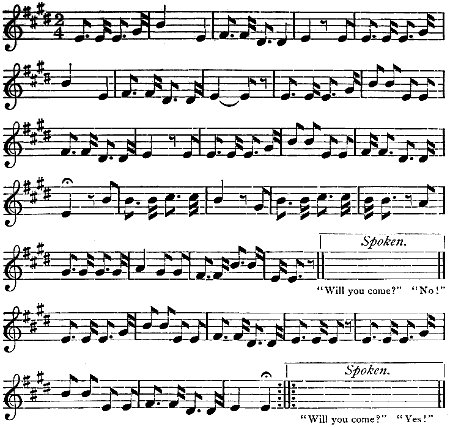
—Middlesex (Miss Collyer).
[Play]
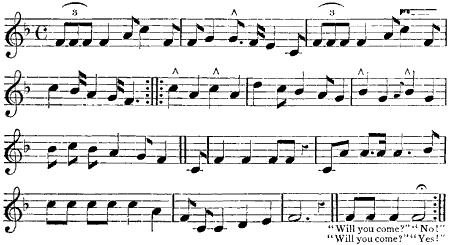
—London (A. B. Gomme).
[Play]
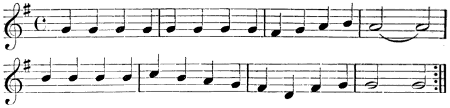
—Congleton (Miss A. E. Twemlow).
I.
A dis, a dis, a green grass, A dis, a dis, a dis; Come all you pretty fair maids And dance along with us. For we are going roving, A roving in this land; We’ll take this pretty fair maid, We’ll take her by the hand. Ye shall get a duke, my dear, And ye shall get a drake; And ye shall get a young prince, A young prince for your sake. And if this young prince chance to die, Ye shall get another; The bells will ring, and the birds will sing, And we’ll clap hands together.
—Chamber’s Popular Rhymes, pp. 137-38.
II.
A-diss, a-diss, a-green grass, A-diss, a-diss, a-dass; Come, my pretty fair maid, And walk along with us. For you shall have a dik-ma-day, You shall have a drāgon; You shall have a nice young man With princes for his thēgan (or sēgan).
—Lanarkshire (W. G. Black).
III.
A dish, a dish, a green grass, A dish, a dish, a dish, Come all you pretty maidens And dance along wi’ us. For we are lads a roving, A roving through the land, We’ll take this pretty fair maid By her lily white hand. Ye sall get a duke, my dear, An ye sall get a drake, An ye sall get a bonny prince For your ain dear sake. And if they all should die, Ye sall get anither; The bells will ring, the birds will sing, And we’ll clap our hands together.
—Biggar (W. Ballantyne).
IV.
Dissy, dissy, green grass, Dissy, dissy, duss, Come all ye pretty fair maids And dance along with us. You shall have a duck, my dear, And you shall have a drake, And you shall have a nice young man To love you for your sake. If this young man should chance to die And leave the girl a widow, The birds shall sing, the bells shall ring, Clap all your hands together.
—Yorkshire (Henderson’s Folk-lore, Northern Counties, p. 27).
V.
Dossy, dossy green grass, Dossy, dossy, doss, Come all ye pretty fair maids And dance upon the grass. I will give you pots and pans, I will give you brass, I will give you anything For a pretty lass. I will give you gold and silver, I will give you pearl, I will give you anything For a pretty girl. Take one, take one, the fairest you can see. You shall have a duck, my dear, You shall have a drake, You shall have a young man Apprentice for your sake. If this young man shall wealthy grow And give his wife a feather, The bells shall ring and birds shall sing And we’ll all clap hands together.
—Roxton, St. Neots (Miss Lumley).
VI.
Walking up the green grass, A dust, a dust, a dust! We want a pretty maiden To walk along with us. We’ll take this pretty maiden, We’ll take her by the hand, She shall go to Derby, And Derby is the land! She shall have a duck, my dear, She shall have a drake, She shall have a nice young man A-fighting for her sake! Suppose this young man was to die, And leave the poor girl a widow; The bells would ring and we should sing, And all clap hands together!
—Berrington (Shropshire Folk-lore, p. 511).
VII.
Tripping up the green grass, Dusty, dusty, day, Come all ye pretty fair maids, Come and with me play. You shall have a duck, my dear, And you shall have a swan, And you shall have a nice young man A waiting for to come. Suppose he were to die And leave his wife a widow, Come all ye pretty fair maids, Come clap your hands together! Will you come? No! Naughty man, he won’t come out, He won’t come out, he won’t come out, Naughty man, he won’t come out, To help us in our dancing. Will you come? Yes! Now we’ve got our bonny lad, Our bonny lad, our bonny lad, Now we’ve got our bonny lad, To help us in our dancing.
—Middlesex (Miss Collyer).
VIII.
Stepping on the green grass Thus, and thus, and thus; Please may we have a pretty lass To come and play with us? We will give you pots and pans, We will give you brass, No! We will give you anything For a bonny lass. No! We will give you gold and silver, We will give you pearl, We will give you anything For a pretty girl. Yes! You shall have a goose for dinner, You shall have a darling, You shall have a nice young man To take you up the garden. But suppose this young man was to die And leave this girl a widow? The bells would ring, the cats would sing, So we’ll all clap together.
—Frodingham and Nottinghamshire (Miss M. Peacock).
IX.
Stepping up the green grass, Thus, and thus, and thus; Will you let one of your fair maids Come and play with us? We will give you pots and pans, We will give you brass, We will give you anything For a pretty lass. No! We won’t take your pots and pans, We won’t take your brass, We won’t take your anything For a pretty lass. Stepping up the green grass, Thus, and thus, and thus; Will you let one of your fair maids Come and play with us? We will give you gold and silver, We will give you pearl, We will give you anything For a pretty girl. Yes! Come, my dearest [Mary], Come and play with us, You shall have a young man Born for your sake. And the bells shall ring And the cats shall sing, And we’ll all clap hands together.
—Addy’s Sheffield Glossary.
X.
Up and down the green grass, This, and that, and thus; Come all you fair maids And walk along with us. Some will give you silver, Some will give you gold, Some will give you anything For a pretty lass. Don’t you think [boy’s name] Is a handsome young man? Don’t you think Miss [child who has been choosing] Is as handsome as he? Then off with the glove And on with the ring; You shall be married When you can agree. Take hold of my little finger, Maycanameecan, Pray tell me the name Of your young man.
—Hurstmonceux, Sussex (Miss Chase).
XI.
Here we come up the green grass, Green grass, green grass, Here we come up the green grass, Dusty, dusty, day. Fair maid, pretty maid, Give your hand to me, I’ll show you a blackbird, A blackbird on the tree. We’ll all go roving, Roving side by side, I’ll take my fairest ——, I’ll take her for my bride. Will you come? No! Naughty miss, she won’t come out, Won’t come out, won’t come out, Naughty miss, she won’t come out, To help us with our dancing. Will you come? Yes! Now we’ve got our bonny lass, Bonny lass, bonny lass, Now we’ve got our bonny lass, To help us with our dancing.
—London (A. B. Gomme).
XII.
Here we go up the green grass, The green grass, the green grass; Here we go up the green grass, So early in the morning. Fair maid, pretty maid; Give your hand to me, And you shall see a blackbird, A blackbird on the tree; All sorts of colours Lying by his side, Take me, dearest [——], For to be my bride— Will you come? No! Naughty old maid, she won’t come out, She won’t come out, To help us with our dancing— Will you come? Yes! Now we’ve got the bonny lass, Now we’ve got the bonny lass, To help us with our dancing.
—Liphook, Hants (Miss Fowler).
XIII.
Trip trap over the grass, If you please, will you let one of your [eldest] daughters come, Come and dance with me? I will give you pots and pans, I will give you brass, I will give you anything For a pretty lass— No! I will give you gold and silver, I will give you pearl, I will give you anything For a pretty girl. Take one, take one, the fairest you may see. The fairest one that I can see Is pretty [Nancy], come to me; You shall have a duck, my dear, And you shall have a drake, And you shall have a young man, Apprentice for your sake. If this young man should happen to die, And leave this poor woman a widow, The bells shall all ring and the birds shall all sing, And we’ll clap hands together.
—Halliwell’s Popular Nursery Rhymes, cccxxxii.
XIV.
Will you take gold and silver, or will you take brass, Will you take anything for a pretty lass? No! we’ll not take gold and silver, no! we’ll not take brass; We’ll not take anything for a pretty lass. Will you take the keys of school, or will you take brass? Will you take anything for a pretty lass? Yes! we’ll take the keys of school; yes! we will take brass; We will take anything for a pretty lass. Come, my dear [Mary Anne], and give me your right hand, And you shall have a duck, my dear, You shall have a drake; You shall have a nice young man To fiddle for your sake. The birds will sing, the bells will ring, And we’ll all clap hands together.
—Congleton Workhouse School (Miss A. E. Tremlow).
(c) The popular version of this game is played by the greater number of the children forming a line on one side with joined hands, and one child (sometimes two or more) facing them, advancing and retiring while singing the verses. When he asks the question, “Will you come?” one girl on the opposite side answers “No!” and afterwards “Yes!” When this is said, she goes to the opposite side, and the two dance round together while singing the next verse. The game begins again by the two singing the verses, and thus getting a third child to join them, when the game proceeds for a fourth, and so on.
The Congleton and London versions are played by two lines of children of about equal numbers. In the Lincolnshire version the above description answers, except that when the last line is sung every one claps hands. In the Sussex version the child at the end of the line is taken over by the child who sings the verses, and they lock their little fingers together while singing the remainder.
Addy (Sheffield Glossary) says:—“Two children advance and retire on one side. When the opposite side says ‘Yes!’ the two take the first child in the row and dance round with her, singing the remaining verse. This is called ‘the wedding.’”
The Lanarkshire version is quite a different one, and contains rather remarkable features. Mr. Black says that the game was played entirely by girls, never by boys, and generally in the months of May or June, about forty years ago. The children sang with rather mincing and refined voices, evidently making an effort in this direction. They walked, with their hands clasped behind their backs, up and down the road. Each child was crowned with rushes, and also had sashes or girdles of rushes.
Mr. Ballantyne says in his boyhood it was played by a row of boys on one side and another of girls opposite. The boys selected a girl when singing the third verse.
In the Roxton version, one child at the end of the line of children acts as “mother.” One child advances as “suitor,” and says the three first verses. The “mother” replies with the next line. The “suitor” chooses a girl and says the next verse, and then all the children sing the last verse. This is the same action as in Halliwell’s version.
(d) The analysis of the game-rhymes is on pp. 164-67. This analysis presents us with a very good example of the changes caused by the game-rhymes being handed down by tradition among people who have forgotten the original meaning of the game. The first line in the Scotch version contains the word “dis,” which is not known to the ordinary vocabulary. Another word, of similar import, is “dik-ma-day” in the Lanarkshire version. Two other words occur, namely, “thegan” in the Lanarkshire, and “maycanameecan” in the Sussex versions, which are also not to be found in ordinary vocabularies. The two last words appear only once, and cannot, therefore, be used for the purpose of tracing out an original form of the game-rhyme, because on the system of analysis adopted they may be arbitrary introductions and totally unconnected with the original rhymes. This, however, is not the case with the two first-mentioned words, and I am inclined to consider them as forming part of the earliest version. The word “dis” is carried through no less than ten out of the fourteen variants, the gradation in the forms being as follows:—