CHILDREN’S GAMES. (continued 7)
Reading edition
See “Teetotum.”
Leap Candle
The young girls in and about Oxford have a sport called “Leap Candle,” for which they set a candle in the middle of a room in a candlestick, and then draw up their coats into the form of breeches, and dance over the candle back and forth, saying the words—
The taylor of Bicester he has but one eye, He cannot cut a pair of green galagaskins If he were to die.
This sport, in other parts, is called “Dancing the Candlerush” (Aubrey’s Remaines of Gentilisme and Judaisme, p. 45). Halliwell (Rhymes, p. 65) has a rhyme—
Jack be nimble, And Jack be quick, And Jack jump over The candlestick,
which may refer to this game. Northall (Folk Rhymes, p. 412) says in Warwickshire a similar game is called “Cock and Breeches.”
Leap-frog
One boy stoops down sideways, with his head bent towards his body, as low as possible. This is called “Tucking in your Tuppeny.” Another boy takes a flying leap over the “frog,” placing his hands on his back to help himself over. He then proceeds to a distance of some four or five yards, and, in his turn, stoops in the same manner as the first boy, as another frog. A third boy then leaps first over frog No. 1, and then over frog No. 2, taking his place as frog No. 3, at about the same distance onwards. Any number of boys may play in the game. After the last player has taken his leap over all the frogs successively, frog No. 1 has his turn and leaps over his companions, taking his place as the last in the line of frogs. Then No. 2 follows suit, and so on, the whole line of players in course of time covering a good distance.—London (G. L. Gomme).
Leap-frog is known in Cornwall as “Leap the Long-mare” (Folk-lore Journal, v. 60), and in Antrim and Down as “Leap the Bullock” (Patterson’s Glossary).
See “Accroshay,” “Loup the Bullocks,” “Spanish Fly.”[Addendum]
Leap the Bullock
See “Leap-frog,” “Loup the Bullocks.”
Leaves are Green
The leaves are green, the nuts are brown, They hang so high they will not come down; Leave them alone till frosty weather, Then they will all come down together.
—Berkshire (Miss Thoyts, Antiquary, xxvii. 254).
These lines are sung while the children dance round in a circle. When the last words are sung, the children flop down upon the ground. The tune sung is, Miss Thoyts says, that of “Nuts in May.”
Lend Me your Key
Please will you lend us your key? What for? Please, our hats are in the garden. Yes, if you won’t steal any beans. Please, we’ve brought the key back; will you lend us your frying-pan? What to do with? To fry some beans. Where have you got them? Out of your garden.
—Earls Heaton (H. Hardy).
One child represents an old woman, and the other players carry on the dialogue with her. At the end of the dialogue the children are chased by the old woman.
See “Mother, Mother, may I go out to Play,” “Witch.”
Letting the Buck out
This game was played seventy years ago. A ring being formed, the “Buck” inside has to break out, and reach his “home,” crying “Home!” before he can be caught and surrounded. Afterwards these words were sung—
Circle:
Who comes here?
Buck:
Poor Johnny Lingo.
Circle:
Don’t steal none of my black sheep, Johnny Lingo, For if you do I shall put you in the pinder pin-fold.
—Stixwold, Lines. (Miss M. Peacock).
See “Who goes round my Stone Wall?”
Level-coil
Nares, in his Glossary, says this is “a game of which we seem to know no more than that the loser in it was to give up his place to be occupied by another.” Minshew gives it thus: “To play at levell coil, G. jouer à cul levé: i.e., to play and lift up your taile when you have lost the game, and let another sit down in your place.” Coles, in his English Dictionary, seems to derive it from the Italian leva il culo, and calls it also “Pitch-buttock.” In his Latin Dictionary he has “level-coil, alternation, cession;” and “to play at level coil, vices ludendi præbere.” Skinner is a little more particular and says, “Vox tesseris globulosis ludentium propria:” an expression belonging to a game played with little round tesseræ. He also derives it from French and Italian. It is mentioned by Jonson, Tale of a Tub, iii. 2:—
“Young Justice Bramble has kept level-coyl Here in our quarters, stole away our daughter.”
Gifford says that, in our old dramatists, it implies riot and disturbance. The same sport is mentioned by Sylvester, Dubartas, IV. iv. 2, under the name of level-sice:—
“By tragick death’s device Ambitious hearts do play at level-sice.”
In the margin we have this explanation: “A kinde of Christmas play, wherein each hunteth the other from his seat. The name seems derived from the French levez sus, in English, arise up.” Halliwell’s Dictionary says that Skelton, ii. 31, spells it levell suse.
Libbety, Libbety, Libbety-lat
A child stands before a hassock, and as if he were going up stairs, he puts on it first his right and then his left foot, gradually quickening his steps, keeping time to the words—
Libbety, libbety, libbety-lat, Who can do this? and who can do that? And who can do anything better than that?
—Cornwall (Folk-lore Journal, v. 59).
Limpy Coley
A boy’s game undescribed.—Patterson’s Antrim and Down Glossary.
Little Dog I call you
A number of girls stand in a line with their backs to a wall. One of their number is sent away to a distance, but remains within call. Another girl, who stands in front of the line, asks the girls one by one what they would like if they could obtain their desires. After she has asked every one, she tells them to turn their faces to the wall, and calls after the girl who was sent away, saying, “Little Dog, I call you.” The girl replies, “I shan’t come to please you.” “I’ll get a stick and make you,” is the rejoinder. “I don’t care for that.” “I’ve got a rice pudding for you.” “I shan’t come for that.” “I’ve got a dish of bones.” “I’ll come for that.” The Dog then comes. The girls have been previously told not to laugh whilst the one who stands out is talking to the Dog. Then the girl says to the Dog—
All the birds in the air, All the fishes in the sea, Come and pick me out (for example) The girl with the golden ball.
If the girl who desired the golden ball laughs, the Dog picks her out. If nobody laughs, he guesses who the girl is that has wished for the golden ball. If the Dog guesses correctly, she goes and stands behind him, and if he guesses incorrectly she goes and stands behind the one who has been asking the questions. They continue this until they get to the last girl or girl at the end of the row, who must have desired to be—
A brewer or a baker, Or a candlestick maker, Or a penknife maker.
Then the questioner says—
All the birds in the air, All the fishes in the sea, Come pick me out A brewer or a baker, Or a candlestick maker, Or penknife maker.
If the Dog guesses the right one, he takes that girl on his side, she standing behind him. Then they draw a line and each side tries to pull the other over it.—Sheffield (S. O. Addy). The game, it will be seen, differs in several ways from the other games of “Fool, Fool, come to School” type. The “fool” becomes a definite Dog, and the players wish for any thing they choose; the Dog has apparently to find out their wishes.
See “All the Birds,” “Fool, Fool.”
Lobber
There are three or more players on each side, two stones or holes as stations, and one Lobber. The Lobber lobs either a stick about three inches long or a ball—(the ball seems to be a new institution, as a stick was always formerly used)—while the batsman defends the stone or hole with either a short stick or his hand. Every time the stick or ball is hit, the boys defending the stones or holes must change places. Each one is out if the stick or ball lodges in the hole or hits the stone; or if the ball or stone is caught; or if it can be put in the hole or hits the stone while the boys are changing places. This game is also played with two Lobbers, that lob alternately from each end. The game is won by a certain number of runs.—Ireland (Folk-lore Journal, ii. 264).
See “Cat,” “Cudgel,” “Kit-Cat,” “Rounders.”
Loggats
An old game, forbidden by statute in Henry VIII.’s time. It is thus played, according to Stevens. A stake is fixed in the ground; those who play throw Loggats at it, and he that is nearest the stake wins. Loggats, or loggets, are also small pieces or logs of wood, such as the country people throw at fruit that cannot otherwise be reached. “Loggats, little logs or wooden pins, a play the same with ninepins, in which the boys, however, often made use of bones instead of wooden pins” (Dean Miles’ MS.; Halliwell’s Dictionary). Strutt refers to this game (Sports, p. 272).
London
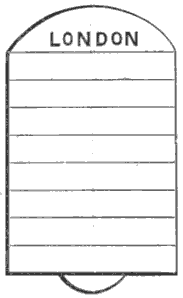
A diagram (similar to Fig. 9 in “Hopscotch”) is drawn on a slate, and two children play. A piece of paper or small piece of glass or china, called a “chipper,” is used to play with. This is placed at the bottom of the plan, and if of paper, is blown gently towards the top; if of glass or china, it is nicked with the fingers. The first player blows the paper, and in whichever space the paper stops makes a small round o with a slate pencil, to represent a man’s head. The paper or chipper is then put into the starting-place again, and the same player blows, and makes another “man’s head” in the space where the paper stops. This is continued until all the spaces are occupied. If the paper goes a second time into a space already occupied by a “head,” the player adds a larger round to the “head,” to represent a “body;” if a third time, a stroke is drawn for a leg, and if a fourth time, another is added for the second leg; this completes a “man.” If three complete men in one space can be gained, the player makes “arms;” that is, two lines are drawn from the figures across the space to the opposite side of the plan. This occupies that space, and prevents the other player from putting any “men” in it, or adding to any already there. When all the spaces are thus occupied by one player, the game is won. Should the paper be blown on to a line or outside the plan, the player is out; the other player then begins, and makes as many “men” in her turn, until she goes on a line or outside. Should the paper go into “London,” the player is entitled to make a “head” in every space, or to add another mark to those already there.—Westminster (A. B. Gomme). This game resembles one described by F. H. Low in Strand Mag., ii. 516.
London Bridge
[Play]
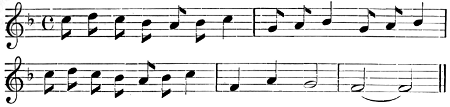
—Wrotham, Kent (Miss D. Kimball)
[Play]
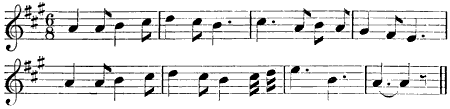
—Rimbault’s Nursery Rhymes, p. 34.
[Play version 1, version 2]
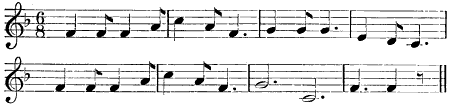
—Enborne School, Berks. (Miss M. Kimber).
I.
London Bridge is broken down, Grant said the little bee,[4] London Bridge is broken down, Where I’d be. Stones and lime will build it up, Grant said the little bee, Stones and lime will build it up, Where I’d be. Get a man to watch all night, Grant said the little bee, Get a man to watch all night, Where I’d be. Perhaps that man might fall asleep, Grant said the little bee, Perhaps that man might fall asleep, Where I’d be. Get a dog to watch all night, Grant said the little bee, Get a dog to watch all night, Where I’d be. If that dog should run away, Grant said the little bee, If that dog should run away, Where I’d be. Give that dog a bone to pick, Grant said the little bee, Give that dog a bone to pick, Where I’d be.
—Belfast, Ireland (W. H. Patterson).
II.
London Bridge is broken down, Dance o’er my lady lee, London Bridge is broken down, With a gay lady. How shall we build it up again? Dance o’er my lady lee, How shall we build it up again? With a gay lady. Silver and gold will be stole away, Dance o’er my lady lee, Silver and gold will be stole away, With a gay lady. Build it up with iron and steel, Dance o’er my lady lee, Build it up with iron and steel, With a gay lady. Iron and steel will bend and bow, Dance o’er my lady lee, Iron and steel will bend and bow, With a gay lady. Build it up with wood and clay, Dance o’er my lady lee, Build it up with wood and clay, With a gay lady. Wood and clay will wash away, Dance o’er my lady lee, Wood and clay will wash away, With a gay lady. Build it up with stone so strong, Dance o’er my lady lee, Huzza! ’twill last for ages long, With a gay lady.
—[London][5] (Halliwell’s Nursery Rhymes, clii.).
III.
London Bridge is broaken down, Is broaken down, is broaken down, London Bridge is broaken down, My fair lady. Build it up with bricks and mortar, Bricks and mortar, bricks and mortar, Build it up with bricks and mortar, My fair lady. Bricks and mortar will not stay, Will not stay, will not stay, Bricks and mortar will not stay, My fair lady. Build it up with penny loaves, Penny loaves, penny loaves, Build it up with penny loaves, My fair lady. Penny loaves will mould away, Mould away, mould away, Penny loaves will mould away, My fair lady. What have this poor prisoner done, Prisoner done, prisoner done, What have this poor prisoner done? My fair lady. Stole my watch and lost my key, Lost my key, lost my key, Stole my watch and lost my key, My fair lady. Off to prison you must go, You must go, you must go, Off to prison you must go, My fair lady.
—Liphook, Hants (Miss Fowler).
IV.
Where are these great baa-lambs going, Baa-lambs going, baa-lambs going, Where are these great baa-lambs going? My fair lady. We are going to London Bridge, London Bridge, London Bridge, We are going to London Bridge, My fair lady. London Bridge is broken down, Broken down, broken down, London Bridge is broken down, My fair lady.
[Then verses follow, sung in the same way and with the same refrain, beginning with—]
Mend it up with penny loaves. Penny loaves will wash away. Mend it up with pins and needles. Pins and needles they will break. Mend it up with bricks and mortar, Bricks and mortar, that will do.
[After these verses have been sung—]
What has this great prisoner done, Prisoner done, prisoner done, What has this great prisoner done? My fair lady. Stole a watch and lost the key, Lost the key, lost the key, Stole a watch and lost the key, My fair lady. Off to prison you must go, You must go, you must go, Off to prison you must go, My fair lady.
—Hurstmonceux, Sussex (Miss Chase).
V.
Over London Bridge we go, Over London Bridge we go, Over London Bridge we go, Gay ladies, gay! London Bridge is broken down, London Bridge is broken down, London Bridge is broken down, Gay ladies, gay! Build it up with lime and sand, Build it up with lime and sand, Build it up with lime and sand, Gay ladies, gay!
[Then follow verses sung in the same manner and with the same refrain, beginning with—]
Lime and sand will wash away. Build it up with penny loaves. Penny loaves’ll get stole away. O, what has my poor prisoner done? Robbed a house and killed a man. What will you have to set her free? Fourteen pounds and a wedding gown. Stamp your foot and let her go!
—Clun (Burne’s Shropshire Folk-lore, pp. 518-19).
VI.
London Bridge is broken down, Broken down, broken down, London Bridge is broken down, My fair lady. Build it up with iron bars, Iron bars, iron bars, Build it up with iron bars, My fair lady.
[Then follow verses with the same refrain, beginning with—]
Build it up with pins and needles. Pins and needles rust and bend. Build it up with penny loaves. Penny loaves will tumble down. Here’s a prisoner I have got. What’s the prisoner done to you? Stole my watch and broke my chain. What will you take to let him out? Ten hundred pounds will let him out. Ten hundred pounds we have not got. Then off to prison he must go.
—Kent (Miss Dora Kimball).
VII.
London Bridge is falling down, Falling down, falling down, London Bridge is falling down, My fair lady. Build it up with mortar and bricks, Mortar and bricks, mortar and bricks, Build it up with mortar and bricks, My fair lady.
[Then follow verses in the same style and with the same refrain, beginning with—]
Bring some water, we’ll wash it away. Build it up with silver and gold. Silver and gold will be stolen away. We’ll set a man to watch at night. Suppose the man should fall asleep? Give him a pipe of tobacco to smoke. Suppose the pipe should fall and break? We’ll give him a bag of nuts to crack. Suppose the nuts were rotten and bad? We’ll give him a horse to gallop around, &c.
—Enborne School, Berks (M. Kimber).
VIII.
London Bridge is broken down, Gran says the little D, London Bridge is broken down, Fair la-dy. Build it up with lime and stone, Gran says the little D, Build it up with lime and stone, Fair la-dy.
[Then follow verses beginning with the following lines—]
Lime and stone would waste away. Build it up with penny loaves. Penny loaves would be eaten away. Build it up with silver and gold. Silver and gold would be stolen away. Get a man to watch all night. If the man should fall asleep? Set a dog to bark all night. If the dog should meet a bone? Set a cock to crow all night. If the cock should meet a hen? Here comes my Lord Duke, And here comes my Lord John; Let every one pass by but the very last one, And catch him if you can.
—Cork (Mrs. B. B. Green).
IX.
London Bridge is broken down, Broken down, broken down, London Bridge is broken down, My fair lady.
[Other verses commence with one of the following lines, and are sung in the same manner—]
Build it up with penny loaves. Penny loaves will melt away. Build it up with iron and steel. Iron and steel will bend and bow. Build it up with silver and gold. Silver and gold I have not got. What has this poor prisoner done? Stole my watch and broke my chain. How many pounds will set him free? Three hundred pounds will set him free. The half of that I have not got. Then off to prison he must go.
—Crockham Hill, Kent (Miss E. Chase).
(b) This game is now generally played like “Oranges and Lemons,” only there is no “tug-of-war” at the end. Two children hold up their clasped hands to form an arch. The other children form a long line by holding to each other’s dresses or waists, and run under. Those who are running under sing the first verse; the two who form the arch sing the second and alternate verses. At the words, “What has this poor prisoner done?” the girls who form the arch catch one of the line (generally the last one). When the last verse is sung the prisoner is taken a little distance away, and the game begins again. At Clun the players form a ring, moving round. They sing the first and alternate verses, and chorus, “London Bridge is broken down.” Two players outside the ring run round it, singing the second and alternate verses. When singing “Penny loaves’ll get stole away,” one of the two outside children goes into the ring, the other remains and continues her part, singing the next verse. When the last verse is sung the prisoner is released. The Berkshire game (Miss Kimber) is played by the children forming two long lines, each line advancing and retiring alternately while singing their parts. When the last verse is begun the children form a ring and gallop around, all singing this last verse together. In the Cork version (Mrs. Green) the children form a circle by joining hands. They march round and round, singing the verses to a sing-song tune. When singing, “If the cock should meet a hen,” they all unclasp hands; two hold each other’s hands and form an arch. The rest run under, saying the last verse. The “arch” lower their hands and try to catch the last child.
(c) The analysis of the game-rhymes is on pp. 342-45. It appears from this analysis that the London version is alone in its faithful reflection of an actual building episode. Three other versions introduce the incident of watching by a man, and failing him, a dog or cock; while five versions introduce a prisoner. This incident occurs the greatest number of times. It is not surprising that the London version seems to be the most akin to modern facts, being told so near the spot indicated by the verses, and on this account it cannot be considered as the oldest of the variants. There remain the other two groups. Both are distinguished by the introduction of a human element, one as watchman, the other as prisoner. The watchman incident approaches nearer to modern facts; the prisoner incident remains unexplained by any appeal to modern life, and it occurs more frequently than the others. In only one case, the Shropshire, is the prisoner ransomed; in the others he is sent to prison. Besides this main line of criticism brought out by the analysis there is little to note. The Hurstmonceux version begins with taking lambs over London Bridge, and the Shropshire version with the players themselves going over; but these are doubtless foreign adjuncts, because they do not properly prefix the main incident of the bridge being broken. The Belfast version has a curious line, “Grant said the little bee or dee,” which the Cork version renders, “Gran says the little D.” To these there is now no meaning that can be traced, but they help to prove that the rhyme originated from a state of things not understood by modern players. In all the versions with the prisoner incident it comes quite suddenly, without any previous indication, except in the Kent version, which introduces the exclamation, “Here’s a prisoner I have got!” As the analysis shows the prisoner incident to be a real and not accidental part of the game, and the unmeaning expressions to indicate an origin earlier than modern players can understand, we can turn to other facts to see if the origin can be in any way traced.
ANALYSIS OF GAME-RHYMES.
No. Belfast. Halliwell. Liphook. Hurst- monceux. Shrop- shire. Kent. Enborne. Cork. Crockham Hill.
1. — — — Where are these great baa-lambs going? — — — — —
2. — — — My fair lady. — — — — —
3. — — — We are going to L. B. — — — — —
4. — — — — Over L. B. we go. — — — —
5. L. B. is broken down. L. B. is broken down. L. B. is broken down. L. B. is broken down. L. B. is broken down. L. B. is broken down. — L. B. is broken down. L. B. is broken down.
6. — — — — — — L. B. is falling down. — —
7. Grant said the little bee. — — — — — — Says the little D. —
8. — Dance o’er my lady lee. — — — — — — —
9. — — My fair lady. My fair lady. — My fair lady. My fair lady. Fair lady. My fair lady.
10. — With a gay lady. — — Gay ladies, gay. — — — —
11. Where I’d be. — — — — — — — —
12. — How shall we build it up again? — — — — — — —
13. Stones and lime will build it up. — Build it up with bricks and mortar. Mend it up with bricks and mortar. Build it up with lime and sand. — Build it up with mortar and bricks. Build it up with lime and stone. —
14. — — Bricks and mortar will not stay. — Lime and sand will wash away. — Mortar and bricks will waste away. Lime and stone would waste away. —
15. — — Build it up with penny loaves. Mend it up with penny loaves. Build it up with penny loaves. Build it up with penny loaves. — — Build it up with penny loaves.
16. — — Penny loaves will mould away. Penny loaves will wash away. Penny loaves’ll get stole away. Penny loaves will tumble down. — — Penny loaves will melt away.
17. — — — — — — Build it up with silver and gold. Build it up with silver and gold. Build it up with silver and gold.
18. — Silver and gold will be stole away. — — — — Silver and gold will be stolen away. Silver and gold would be stolen away. Silver and gold I have not got.
19. — Build it up with iron and steel. — — — — — — —
20. — Iron and steel will bend and bow. — — — — — — —
21. — — — Mend it up with pins and needles. — Mend it up with pins and needles. — — —
22. — — — Pins and needles they will break. — Pins and needles rust and bend. — — —
23. — Build it up with wood and clay. — — — — — — —
24. — Wood and clay will wash away. — — — — — — —
25. — Build it up with stone so strong. — — — — — — —
26. Get a man to watch all night. — — — — — — We’ll set a man to watch all night. Set a man to watch all night.
27. Perhaps that man might fall asleep. — — — — — Suppose the man should fall asleep. If the man should fall asleep. —
28. — — — — — Here’s a prisoner I have got. — — —
29. — — What has this poor prisoner done? What has this great prisoner done? O, what has my poor prisoner done? What’s the prisoner done to you? — — What has this poor prisoner done?
30. — — Stole my watch and lost my key. Stole a watch and lost the key. — Stole my watch and broke my chain. — — Stole my watch and broke my chain.
31. — — — — Robbed a house and killed a man. — — — —
32. — — — — — — Give him a pipe of tobacco to smoke. — —
33. — — — — — — Suppose the pipe should fall and break. — —
34. — — — — — — We’ll give him a bag of nuts to crack. — —
35. — — — — — — Suppose the nuts were rotten and bad. — —
36. Get a dog to watch all night. — — — — — — Set a dog to bark all night. —
37. If that dog should run away. — — — — — — If the dog should meet a bone. —
38. Give that dog a bone to pick. — — — — — — — —
39. — — — — — — — Set a cock to crow all night. —
40. — — — — — — — If the cock should meet a hen. —
41. — — — — What will you have to set her free? What will you take to let him out? — — How many pounds will set him free?
42. — — — — Fourteen pounds and a wedding gown. Ten hundred pounds will let him out. — — Three hundred pounds will set him free.
43. — — — — — Then a hundred pounds we have not got. — — The half of that I have not got.
44. — — Off to prison you must go. Off to prison you must go. — Then off to prison you must go. — — Then off to prison he must go.
45. — Huzza! it will last for ages long. — — — — — — —
46. — — — — — — — — —
47. — — — — Stamp your foot and let her go. — — — —
48. — — — — — — We’ll give him a horse to gallop around. — —
49. — — — — — — — Here comes my lord Duke, let everyone pass by but the very last one. —
No. Belfast. Halliwell. Liphook. Hurstmonceux. Shropshire.
1. — — — Where are these great baa-lambs going? —
2. — — — My fair lady. —
3. — — — We are going to L. B. —
4. — — — — Over L. B. we go.
5. L. B. is broken down. L. B. is broken down. L. B. is broken down. L. B. is broken down. L. B. is broken down.
6. — — — — —
7. Grant said the little bee. — — — —
8. — Dance o’er my lady lee. — — —
9. — — My fair lady. My fair lady. —
10. — With a gay lady. — — Gay ladies, gay.
11. Where I’d be. — — — —
12. — How shall we build it up again? — — —
13. Stones and lime will build it up. — Build it up with bricks and mortar. Mend it up with bricks and mortar. Build it up with lime and sand.
14. — — Bricks and mortar will not stay. — Lime and sand will wash away.
15. — — Build it up with penny loaves. Mend it up with penny loaves. Build it up with penny loaves.
16. — — Penny loaves will mould away. Penny loaves will wash away. Penny loaves’ll get stole away.
17. — — — — —
18. — Silver and gold will be stole away. — — —
19. — Build it up with iron and steel. — — —
20. — Iron and steel will bend and bow. — — —
21. — — — Mend it up with pins and needles. —
22. — — — Pins and needles they will break. —
23. — Build it up with wood and clay. — — —
24. — Wood and clay will wash away. — — —
25. — Build it up with stone so strong. — — —
26. Get a man to watch all night. — — — —
27. Perhaps that man might fall asleep. — — — —
28. — — — — —
29. — — What has this poor prisoner done? What has this great prisoner done? O, what has my poor prisoner done?
30. — — Stole my watch and lost my key. Stole a watch and lost the key. —
31. — — — — Robbed a house and killed a man.
32. — — — — —
33. — — — — —
34. — — — — —
35. — — — — —
36. Get a dog to watch all night. — — — —
37. If that dog should run away. — — — —
38. Give that dog a bone to pick. — — — —
39. — — — — —
40. — — — — —
41. — — — — What will you have to set her free?
42. — — — — Fourteen pounds and a wedding gown.
43. — — — — —
44. — — Off to prison you must go. Off to prison you must go. —
45. — Huzza! it will last for ages long. — — —
46. — — — — —
47. — — — — Stamp your foot and let her go.
48. — — — — —
49. — — — — —
No. Kent. Enborne. Cork. Crockham Hill.
1. — — — —
2. — — — —
3. — — — —
4. — — — —
5. L. B. is broken down. — L. B. is broken down. L. B. is broken down.
6. — L. B. is falling down. — —
7. — — Says the little D. —
8. — — — —
9. My fair lady. My fair lady. Fair lady. My fair lady.
10. — — — —
11. — — — —
12. — — — —
13. — Build it up with mortar and bricks. Build it up with lime and stone. —
14. — Mortar and bricks will waste away. Lime and stone would waste away. —
15. Build it up with penny loaves. — — Build it up with penny loaves.
16. Penny loaves will tumble down. — — Penny loaves will melt away.
17. — Build it up with silver and gold. Build it up with silver and gold. Build it up with silver and gold.
18. — Silver and gold will be stolen away. Silver and gold would be stolen away. Silver and gold I have not got.
19. — — — —
20. — — — —
21. Mend it up with pins and needles. — — —
22. Pins and needles rust and bend. — — —
23. — — — —
24. — — — —
25. — — — —
26. — — We’ll set a man to watch all night. Set a man to watch all night.
27. — Suppose the man should fall asleep. If the man should fall asleep. —
28. Here’s a prisoner I have got. — — —
29. What’s the prisoner done to you? — — What has this poor prisoner done?
30. Stole my watch and broke my chain. — — Stole my watch and broke my chain.
31. — — — —
32. — Give him a pipe of tobacco to smoke. — —
33. — Suppose the pipe should fall and break. — —
34. — We’ll give him a bag of nuts to crack. — —
35. — Suppose the nuts were rotten and bad. — —
36. — — Set a dog to bark all night. —
37. — — If the dog should meet a bone. —
38. — — — —
39. — — Set a cock to crow all night. —
40. — — If the cock should meet a hen. —
41. What will you take to let him out? — — How many pounds will set him free?
42. Ten hundred pounds will let him out. — — Three hundred pounds will set him free.
43. Then a hundred pounds we have not got. — — The half of that I have not got.
44. Then off to prison you must go. — — Then off to prison he must go.
45. — — — —
46. — — — —
47. — — — —
48. — We’ll give him a horse to gallop around. — —
49. — — Here comes my lord Duke, let everyone pass by but the very last one. —
(d) This game is universally acknowledged to be a very ancient one, but its origin is a subject of some diversity of opinion. The special feature of the rhymes is that considerable difficulty occurs in the building of the bridge by ordinary means, but without exactly suggesting that extraordinary means are to be adopted, a prisoner is suddenly taken. The question is, What does this indicate?
Looking to the fact of the widespread superstition of the foundation sacrifice, it would seem that we may have here a tradition of this rite. So recently as 1872, there was a scare in Calcutta when the Hooghly Bridge was being constructed. The natives then got hold of the idea that Mother Ganges, indignant at being bridged, had at last consented to submit to the insult on condition that each pier of the structure was founded on a layer of children’s heads (Gomme’s Early Village Life, p. 29). Formerly, in Siam, when a new city gate was being erected, it was customary for a number of officers to lie in wait and seize the first four or eight persons who happened to pass by, and who were then buried alive under the gate-posts to serve as guardian angels (Tylor’s Primitive Culture, i. 97). Other instances of the same custom and belief are given in the two works from which these examples are taken; and there is a tradition about London Bridge itself, that the stones were bespattered with the blood of little children. Fitzstephen, in his well-known account of London of the twelfth century, mentions that when the Tower was built the mortar was tempered with the blood of beasts. Prisoners’ heads were put on the bridge after execution down to modern times, and also on city gates.
These traditions about London, when compared with the actual facts of contemporary savagery, seem to be sufficient to account for such a game as that we are now examining having originated in the foundation sacrifice. Mr. Newell, in his examination of the game, gives countenance to this theory, but he strangely connects it with other games which have a tug-of-war as the finish. Now in all the English examples it is remarkable that the tug-of-war does not appear to be a part of the game; and if this evidence be conclusive, it would appear that this incident got incorporated in America. It is this incident which Mr. Newell dwells upon in his ingenious explanation of the mythological interpretation of the game. But apart from this, the fact that the building of bridges was accompanied by the foundation sacrifice is a more likely origin for such a widespread game which is so intimately connected with a bridge.
This view is confirmed by what may be called the literary history of the game. The verses, as belonging to a game, have only recently been recorded, and how far they go back into tradition it is impossible to say. Dr. Rimbault is probably right when he states “that they have been formed by many fresh additions in a long series of years, and [the game] is perhaps almost interminable when received in all its different versions” (Notes and Queries, ii. 338). In Chronicles of London Bridge, pp. 152, 153, the author says he obtained the following note from a Bristol correspondent:—“About forty years ago, one moonlight night in the streets of Bristol, my attention was attracted by a dance and chorus of boys and girls, to which the words of this ballad gave measure. The breaking down of the Bridge was announced as the dancers moved round in a circle hand in hand, and the question, ‘How shall we build it up again?’ was chanted by the leader while the rest stood still.” This correspondent also sent the tune the children sang, which is printed in the Chronicles of London Bridge. This was evidently the same game, but it would appear that the verses have also been used as a song, and it would be interesting to find out which is the more ancient of the two—the song or the game; and to do this it is necessary that we should know something of the history of the song. A correspondent of Notes and Queries (ii. 338) speaks of it as a “lullaby song” well known in the southern part of Kent and in Lincolnshire. In the Gentleman’s Magazine (1823, Part II. p. 232) appeared the following interesting note:—
The projected demolition of London Bridge recalls to my mind the introductory lines of an old ballad which more than seventy years ago I heard plaintively warbled by a lady who was born in the reign of Charles II., and who lived till nearly the end of that of George II. I now transcribe the lines, not as possessing any great intrinsic merit, but in the hope of learning from some intelligent correspondent the name of the author and the story which gave rise to the ballad, for it probably originated in some accident that happened to the old bridge. The “Lady Lea” evidently refers to the river of that name, the favourite haunt of Isaac Walton, which, after fertilising the counties of Hertford, Essex, and Middlesex, glides into the Thames.
London Bridge is broken down, Dance over the Lady Lea; London Bridge is broken down, With a gay lady [la-dee]. Then we must build it up again. What shall we build it up withal? Build it up with iron and steel, Iron and steel will bend and break. Build it up with wood and stone, Wood and stone will fall away. Build it up with silver and gold, Silver and gold will be stolen away. Then we must set a man to watch, Suppose the man should fall asleep? Then we must put a pipe in his mouth, Suppose the pipe should fall and break? Then we must set a dog to watch, Suppose the dog should run away? Then we must chain him to a post.
The two lines in italic are all regularly repeated after each line.—M. Green.
Another correspondent to this magazine, in the same volume, p. 507, observes that the ballad concerning London Bridge “formed, in my remembrance, part of a Christmas Carol, and commenced thus—
Dame, get up and bake your pies, On Christmas-day in the morning.
The requisition goes on to the dame to prepare for the feast, and her answer is—
London Bridge is fallen down, On Christ-mas day in the morning, &c.
The inference always was, that until the bridge was rebuilt some stop would be put to the Dame’s Christmas operations; but why the falling of London Bridge should form part of a Christmas Carol at Newcastle-upon-Tyne I am at a loss to know.” Some fragments were also printed in the Mirror for November 1823; and a version is also given by Ritson, Gammer Gurton’s Garland. The Heimskringla (Laing, ii. 260, 261) gives an animated description of the Battle of London Bridge, when Ethelred, after the death of Sweyn, was assisted by Olaf in retaking and entering London, and it is curious, that the first line of the game-rhyme appears—
London Bridge is broken down, Gold is won and bright renown; Shields resounding, War-horns sounding, Hild is shouting in the din; Arrows singing, Mail-coats ringing, Odin makes our Olaf win.
If this is anything more than an accidental parallel, we come back to an historical episode wherein the breaking down and rebuilding of London Bridge occur, and it looks as if the two streams down which this tradition has travelled, namely, first, through the game, and second, through the song, both refer to the same event.
Dr. Rimbault has, in his Nursery Rhymes, p. 34, reconstructed a copy of the original rhyme from the versions given by Halliwell and the Mirror, and gives the tune to which it was sung, which is reprinted here. The tune from Kent is the one generally used in London versions. The tune of a country dance called “London Bridge” is given in Playford’s Dancing Master, 1728 edition.[Addendum]
Long-duck
A number of children take hold of each other’s hands and form a half-circle. The two children at one end of the line lift up their arms, so as to form an arch, and call “Bid, bid, bid,” the usual cry for calling ducks. Then the children at the other end pass in order through the arch. This process is repeated, and they go circling round the field.—Addy’s Sheffield Glossary.
See “Duck Dance.”
Long Tag
See “Long Terrace.”
Long-Tawl
A game at marbles where each takes aim at the other in turn, a marble being paid in forfeit to whichever of the players may make a hit.—Lowsley’s Berkshire Glossary.
Long Terrace
Every player chooses a partner. The couples stand immediately in front of each other, forming a long line, one remaining outside of the line on the right-hand side, who is called the “Clapper.” The object of the game is for the last couple to reach the top of the line, each running on different sides, and keeping to the side on which they are standing. The object of the Clapper is to hit the one running on the right side of the line, which, if he succeeds in doing, makes him the Clapper, and the Clapper takes his place. [The next last couple would then presumably try and reach the top.]—East Kirkby, Lincs. (Miss K. Maughan).
A similar game to this is played at Sporle, Norfolk (Miss Matthews). It is there called “Long Tag.” The players stand in line behind one another, and an odd one takes her place somewhere near the front; at a given signal, such as clapping of hands, the two at the back separate and try to meet again in front before the one on the watch can catch them; they may run where they please, and when one is caught that one becomes the one “out.”
See “French Jackie.”
Loup the Bullocks
Young men go out to a green meadow, and there on all-fours plant themselves in a row about two yards distant from each other. Then he who is stationed farthest back in the “bullock rank” starts up and leaps over the other bullocks before him, by laying his hands on each of their backs; and when he gets over the last one leans down himself as before, whilst all the others, in rotation, follow his example; then he starts and leaps again.
I have sometimes thought that we (the Scotch) have borrowed this recreation from our neighbours of the “Green Isle,” as at their wakes they have a play much of the same kind, which they call “Riding Father Doud.” One of the wakers takes a stool in his hand, another mounts that one’s back, then Father Doud begins rearing and plunging, and if he unhorses his rider with a dash he does well. There is another play (at these wakes) called “Kicking the Brogue,” which is even ruder than “Riding Father Doud,” and a third one called “Scuddieloof.”—Mactaggart’s Gallovidian Encyclopædia.
Patterson (Antrim and Down Glossary) mentions a game called “Leap the Bullock,” which he says is the same as “Leap-frog.”
Dickinson’s Cumberland Glossary Supplement, under “Lowp,” says it means a leap or jump either running or standing. The various kinds include “Catskip”—one hitch, or hop, and one jump; “Hitch steppin”—hop, step, and lowp; a hitch, a step, and a leap; “Otho”—two hitches, two steps, and a leap; “Lang spang”—two hitches, two steps, a hitch, a step, and a leap.
See “Accroshay,” “Knights,” “Leap-frog.”
Lubin
[Play]
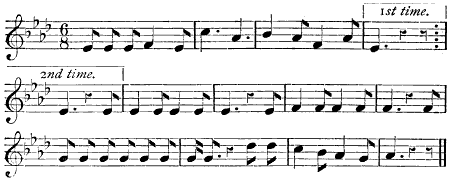
—Hexham (Miss J. Barker).
[Play]
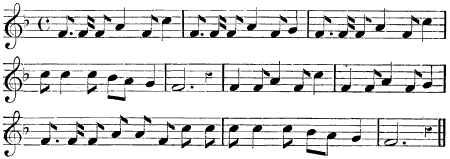
—Doncaster (Mr. C. Bell).
[Play]
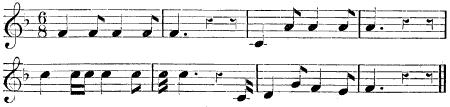
—London (A. B. Gomme).
[Play]
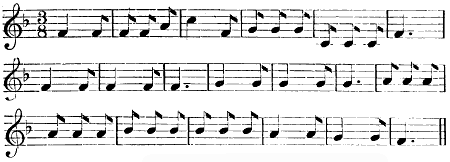
—Dorsetshire (Miss M. Kimber).
[Play]
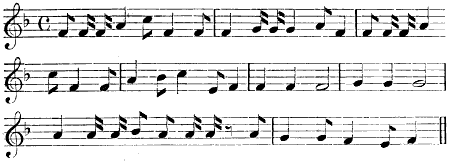
—Sporle, Norfolk (Miss Matthews).
I.
Here we dance lubin, lubin, lubin, Here we dance lubin light, Here we dance lubin, lubin, lubin, On a Saturday night. Put all the right hands in, Take all the right hands out, Shake all the right hands together, And turn yourselves about. Here we dance lubin, lubin, lubin, Here we dance lubin light, Here we dance lubin, lubin, lubin, On a Saturday night. Put all your left hands in, Take all your left hands out, Shake all your left hands together, And turn yourselves about. Here we dance lubin, lubin, lubin, Here we dance lubin light, Here we dance lubin, lubin, lubin, On a Saturday night. Put all your right feet in, Take all your right feet out, Shake all your right feet together, And turn yourselves about. Here we dance lubin, lubin, lubin, Here we dance lubin light, Here we dance lubin, lubin, lubin, On a Saturday night. Put all your left feet in, Take all your left feet out, Shake all your left feet together, And turn yourselves about. Here we dance lubin, lubin, lubin, Here we dance lubin light, Here we dance lubin, lubin, lubin, On a Saturday night. Put all your heads in, Take all your heads out, Shake all your heads together, And turn yourselves about. Here we dance lubin, lubin, lubin, Here we dance lubin light, Here we dance lubin, lubin, lubin, On a Saturday night. Put all the [Marys] in, Take all the [Marys] out, Shake all the [Marys] together, And turn yourselves about. Here we dance lubin, lubin, lubin, Here we dance lubin light, Here we dance lubin, lubin, lubin, On a Saturday night. Put all yourselves in, Take all yourselves out, Shake all yourselves together, And turn yourselves about.
—Oxford and Wakefield (Miss Fowler).
II.
II. Now we dance looby, looby, looby, Now we dance looby, looby, light; Shake your right hand a little, And turn you round about. Now we dance looby, looby, looby; Shake your right hand a little, Shake your left hand a little, And turn you round about. Now we dance looby, looby, looby; Shake your right hand a little, Shake your left hand a little, Shake your right foot a little, And turn you round about. Now we dance looby, looby, looby; Shake your right hand a little, Shake your left hand a little, Shake your right foot a little, Shake your left foot a little, And turn you round about. Now we dance looby, looby, looby; Shake your right hand a little, Shake your left hand a little, Shake your right foot a little, Shake your left foot a little, Shake your head a little, And turn you round about.
—Halliwell (Popular Rhymes, p. 226).
III.
Fal de ral la, fal de ral la, Hinkumbooby round about. Right hands in and left hands out, Hinkumbooby round about; Fal de ral la, fal de ral la, Hinkumbooby round about. Left hands in and right hands out, Hinkumbooby round about; Fal de ral la, fal de ral la, Hinkumbooby round about. Right foot in and left foot out, Hinkumbooby round about; Fal de ral la, fal de ral la, Hinkumbooby round about. Left foot in and right foot out, Hinkumbooby round about; Fal de ral la, &c. Heads in and backs out, Hinkumbooby round about; Fal de ral la, &c. Backs in and heads out, Hinkumbooby round about; Fal de ral la, &c. A’ feet in and nae feet out, Hinkumbooby round about; Fal de ral la, &c. Shake hands a’, shake hands a’, Hinkumbooby round about; Fal de ral la, &c. Good night a’, good night a’, Hinkumbooby round about; Fal de ral la, &c.
—Chambers (Popular Rhymes, pp. 137-139).
IV.
This is the way we wash our hands, Wash our hands, wash our hands, To come to school in the morning. This is the way we wash our face, Wash our face, wash our face, To come to school in the morning. Here we come dancing looby, Lewby, lewby, li. Hold your right ear in, Hold your right ear out, Shake it a little, a little, And then turn round about. Here we come dancing lewby, Lewby, lewby, li, &c.
—Eckington, Derbyshire (S. O. Addy).
V.
How do you luby lue, How do you luby lue, How do you luby lue, O’er the Saturday night? Put your right hand in, Put your right hand out, Shake it in the middle, And turn yourselves about.
—Lady C. Gurdon’s Suffolk County Folk-lore, p. 64.
[Repeat this for “left hand,” “right foot,” “left foot,” “heads,” and “put yourselves in.”]
VI.
Can you dance looby, looby, Can you dance looby, looby, Can you dance looby, looby, All on a Friday night? You put your right foot in, And then you take it out, And wag it, and wag it, and wag it, Then turn and turn about.
—Addy’s Sheffield Glossary.
VII.
Here we dance luby, luby, Here we dance luby light, Here we dance luby, luby, All on a Wednesday night.
—Ordsall, Nottinghamshire (Miss Matthews).
VIII.
Here we go lubin loo, Here we go lubin li, Here we go lubin loo, Upon a Christmas night.
—Epworth, Doncaster (C. C. Bell).
IX.
Here we go looby loo, Here we go looby li, Here we go looby loo, All on a New-Year’s night.
—Nottingham (Miss Winfield).
X.
Here we come looby, looby, Here we come looby light, Here we come looby, looby, All on a Saturday night.
—Belfast (W. H. Patterson).
XI.
Here we come looping, looping [louping?], Looping all the night; I put my right foot in, I put my right foot out, I shake it a little, a little, And I turn myself about.
—Hexham (Miss J. Barker).
XII.
Christian was a soldier, A soldier, a soldier, Christian was a soldier, and a brave one too. Right hand in, right hand out, Shake it in the middle, and turn yourself about.
—Sporle, Norfolk (Miss Matthews).
XIII.
Friskee, friskee, I was and I was A-drinking of small beer. Right arms in, right arms out, Shake yourselves a little, and little, And turn yourselves about.
—Cornwall (Folk-lore Journal, v. p. 49).
XIV.
I love Antimacassar, Antimacassar loves me. Put your left foot in, Put your right foot out, Shake it a little, a little, a little, And turn yourself about.
—Dorsetshire (Miss M. Kimber).
(b) A ring is formed and the children dance round, singing the first verse. They then stand till, sing the next verse, and, while singing, suit the action to the word, each child turning herself rapidly round when singing the last line. The first verse is then repeated, and the fourth sung in the same way as the second, and so on.
Another way of playing is that the children do not dance round and round. They form a ring by joining hands, and they then all move in one direction, about half way round, while singing the first line, “lubin;” then back again in the opposite direction, while singing the second line, “light,” still keeping the ring form, and so on for the third and fourth lines. In each case the emphasis is laid upon the “Here” of each line, the movement being supposed to answer to the “Here.”
The Dorsetshire version (Miss M. Kimber) is played by the children taking hands in pairs, forming a ring, and dancing round. At Eckington (S. O. Addy) the children first pretend to wash their hands, then their face, while singing the words; then comb their hair and brush their clothes; then they join hands and dance round in a ring singing the words which follow, again suiting their actions to the words sung.
In the Scottish version a ring is formed as above. One sings, and the rest join, to the tune of “Lillibullero,” the first line. As soon as this is concluded each claps his hand and wheels grotesquely, singing the second line. They then sing the third line, suiting the action to the word, still beating the time; then the second again, wheeling round and clapping hands. When they say “A’ feet in, and nae feet out,” they all sit down with their feet stretched into the centre of the ring.
(c) The other variants which follow the Halliwell version are limited to the first verse only, as the remainder of the lines are practically the same as those given in Miss Fowler’s version which is written at length, and three or four of these apparently retain only the verse given. A London version, collected by myself, is nearly identical with that of Miss Fowler, except that the third line is “Shake your —— a little, a little,” instead of as printed. This is sung to the tune given.
The incidents in this game are the same throughout. The only difference in all the versions I have collected being in the number of the different positions to be performed, most of them being for right hands, left hands, right feet, left feet, and heads; others, probably older forms, having “ears,” “yourselves,” &c. One version, from Eckington, Derbyshire, curiously begins with “washing hands and face,” “combing hair,” &c., and then continuing with the “Looby” game, an apparent “mix-up” of “Mulberry Bush” and “Looby.” Three more versions, Sporle, Cornwall, and Dorsetshire, also have different beginnings, one (Dorsetshire) having the apparently unmeaning “I love Antimacassar.”
(d) The origin and meaning of this game appears somewhat doubtful. It is a choral dance, and it may owe its origin to a custom of wild antic dancing in celebration of the rites of some deity in which animal postures were assumed. The Hexham version, “Here we come louping [leaping]” may probably be the oldest and original form, especially if the conjecture that this game is derived from animal rites is accepted. The term “looby,” “lubin,” or “luby” does not throw much light on the game. Addy (Sheffield Glossary) says, “Looby is an old form of the modern ‘lubber,’ a ‘clumsy fellow,’ ‘a dolt.’” That a stupid or ridiculous meaning is attached to the word “looby” is also shown by one of the old penances for redeeming a forfeit, where a player has to lie stretched out on his back and declare,
Here I lie The length of a looby, The breadth of a booby, And three parts of a jackass.
The Scottish forms of the game bear on the theory of the game being grotesque. The fact of the players having both their arms extended at once, one behind and one in front of them, and the more frequent spinning round, suggest this. Then, too, there is the sudden “sit down” posture, when “all feet in” is required.
In the version given by Halliwell there is more difficulty in the game, and possibly more fun. This version shows the game to be cumulative, each player having to go through an additional antic for each verse sung. This idea only needs to be carried a little further to cause the players to be ridiculous in their appearance. This version would be more difficult to perform, and they would be exhausted by the process, and the constant motion of every member of the body. Attention, too, might be drawn to the word “Hinkumbooby” occurring in Chambers’s version. Newell (Games, p. 131) mentions that some sixty years ago the game was danced deliberately and decorously, as old fashion was, with slow rhythmical movement.[Addendum]
Lug and a Bite
A boy flings an apple to some distance. All present race for it. The winner bites as fast as he can, his compeers lugging at his ears in the meantime, who bears it as well as he can, and then he throws down the apple, when the sport is resumed (Halliwell’s Dictionary). Brogden’s Lincolnshire Provincial Words says “Luggery-bite” is a game boys play with fruit. One bites the fruit, and another pulls his hair until he throws the fruit away. The game is also played in Lancashire (Reliquary).
See “Bob-Cherry.”
Luggie
A boys’ game. In this game the boys lead each other about by the “lugs,” i.e., ears; hence the name (Patterson’s Antrim and Down Glossary). Jamieson says that the leader had to repeat a rhyme, and if he made a mistake, he in turn became Luggie. The rhyme is not recorded.
Luking
The West Riding name for “Knor and Spell.” Playing begins at Easter.—Henderson’s Folk-lore, p. 84.
See “Nur and Spell.”
Mag
A game among boys, in which the players throw at a stone set up on edge.—Barnes (Dorset Glossary).
Magic Whistle
All the players but three sit on chairs, or stand in two long rows facing each other. One player sits at one end of the two rows as president; another player is then introduced into the room by the third player, who leads him up between the two rows. He is then told to kneel before the one sitting at the end of the row of players. When he kneels any ridiculous words or formula can be said by the presiding boy, and then he and those players who are nearest to the kneeling boy rub his back with their hands for two or three minutes. While they are doing this the boy who led the victim up to the president fastens a string, to which is attached a small whistle, to the victim’s coat or jacket. It must be fastened in such a way that the whistle hangs loosely, and will not knock against his back. The whistle is then blown by the player who attached it, and the kneeling boy is told to rise and search for the Magic Whistle. The players who are seated in the chairs must all hold their hands in such a way that the victim suspects it is in their possession, and proceeds to search. The whistle must be blown as often as possible, and in all directions, by those players only who can do so without the victim being able to either see or feel that he is carrying the whistle with him.—London (A. B. Gomme).
This game is also called “Knight of the Whistle.” The boy who is to be made a Knight of the Order of the Whistle, when led up between the two rows of players, has a cloak put round his shoulders and a cap with a feather in it on his head. The whistle is then fastened on to the cloak. This is described by the Rev. J. G. Wood (Modern Playmate, p. 189). Newell (Games, p. 122) gives this with a jesting formula of initiation into knighthood. He says it was not a game of children, but belonged to an older age.
See “Call-the-Guse.”
Magical Music
A pleasant drawing-room evening amusement.—Moor’s Suffolk Words.
Probably the same as “Musical Chairs.”
Malaga, Malaga Raisins
A forfeit game. The players sat in a circle. One acquainted with the trick took a poker in his right hand, made some eccentric movements with it, passed it to his left, and gave it to his next neighbour on that side, saying, “Malaga, Malaga raisins, very good raisins I vow,” and told him to do the same. Should he fail to pass it from right to left, when he in his turn gave it to his neighbour, without being told where the mistake lay, he was made to pay a forfeit.—Cornwall (Folk-lore Journal, v. 50).
“Malaga raisins are very good raisins, but I like Valencias better,” is the saying used in the London version of this game, and instead of using a poker a paper-knife is used, and it is played at the table. Other formulæ for games of this kind are, “As round as the moon, has two eyes, a nose, and a mouth.” These words are said while drawing on a table with the forefinger of the left hand an imaginary face, making eyes, nose, and mouth when saying the words. The fun is caused through those players who are unacquainted with the game drawing the imaginary face with the right hand instead of the left. Another formula is to touch each finger of the right hand with the forefinger of the left hand, saying to each finger in succession, “Big Tom, Little Tom, Tommy, Tom, Tom.” The secret in this case is to say, “Look here!” before commencing the formula. It is the business of those players who know the game to say the words in such a way that the uninitiated imagine the saying of the words correctly with particular accents on particular words to be where the difficulty lies. If this is well done, it diverts suspicion from the real object of these games.—A. B. Gomme.
Marbles
Brand considers that marbles had their origin in bowls, and received their name from the substance of which the bowls were formerly made. Strutt (Sports, p. 384) says, “Marbles have been used as a substitute for bowls. I believe originally nuts, round stones, or any other small things that could easily be bowled along were used as marbles.” Rogers notices “Marbles” in his Pleasures of Memory, l. 137:—
“On yon gray stone that fronts the chancel-door, Worn smooth by busy feet, now seen no more, Each eve we shot the marble through the ring.”
Different kinds of marbles are alleys, barios, poppo, stonies. Marrididdles are marbles made by oneself by rolling and baking common clay. By boys these are treated as spurious and are always rejected. In barter, a bary = four stonies; a common white alley = three stonies. Those with pink veins being considered best. Alleys are the most valuable and are always reserved to be used as “taws” (the marble actually used by the player). They are said to have been formerly made of different coloured alabaster. See also Murray’s New English Dict.
For the different games played with marbles, see “Boss Out,” “Bridgeboard,” “Bun-hole,” “Cob,” “Hogo,” “Holy Bang,” “Hundreds,” “Lag,” “Long-Tawl,” “Nine Holes,” “Ring Taw.”
Mary Brown
I.
Here we go round, ring by ring, To see poor Mary lay in the ring; Rise up, rise up, poor Mary Brown, To see your dear mother go through the town. I won’t rise, I won’t rise [from off the ground], To see my poor mother go through the town. Rise up, rise up, poor Mary Brown, To see your dear father go through the town. I won’t rise, I won’t rise [from off the ground], To see my dear father go through the town. Rise up, rise up, poor Mary Brown, To see your dear sister go through the town. I won’t rise, I won’t rise from off the ground, To see my dear sister go through the town. Rise up, rise up, poor Mary Brown, To see your dear brother go through the town. I won’t rise, I won’t rise up from off the ground, To see my dear brother go through the town. Rise up, rise up, poor Mary Brown, To see your dear sweetheart go through the town. I will rise, I will rise up from off the ground, To see my dear sweetheart go through the town.
—Barnes, Surrey (A. B. Gomme).
II.
Rise up, rise up, Betsy Brown, To see your father go through the town. I won’t rise up upon my feet, To see my father go through the street. Rise up, rise up, Betsy Brown, To see your mother go through the town. I won’t rise up upon my feet, To see my mother go through the street.
[Then follow verses for sister, brother, and lover. When this last is sung, she says—]
I will rise up upon my feet, To see my lover go through the street.
—Ninfield, Sussex, about sixty years ago (Charles Wise).
III.
Rise daughter, rise daughter, off of your poor feet, To see your dear mother lie dead at your feet. I won’t rise, I won’t rise off of my poor feet, To see my dear mother lie dead at my feet. Rise daughter, rise daughter, off of your poor feet, To see your poor father lie dead at your feet. I won’t rise, I won’t rise off of my poor feet, To see my poor father lie dead at my feet. Rise daughter, rise daughter, off of your poor feet, To see your dear sister lie dead at your feet. I won’t rise, I won’t rise off of my poor feet, To see my poor sister lie dead at my feet. Rise daughter, rise daughter, off of your poor feet, To see your poor brother lie dead at your feet. I won’t rise, I won’t rise off of my poor feet, To see my poor brother lie dead at my feet. Rise daughter, rise daughter, off of your poor feet, To see your dear sweetheart lie dead at your feet. I will rise, I will rise off of my poor feet, To see my dear sweetheart lie dead at my feet.
—Barnes, Surrey (A. B. Gomme).
IV.
Rise daughter, rise daughter, Rise from off your knees, To see your poor father lie Down at yonder trees. I won’t rise, I won’t rise, From off my knees, To see my poor father lie Down at yonder trees.
[The verses are then repeated for mother, sister, brother, and sweetheart. When this is said the girl sings—]
I will rise, I will rise, From off my knees, To see my sweetheart lie Down at yonder trees.
—Hurstmonceux, Sussex (Miss Chase).
V.
Here we all stand round the ring, And now we shut poor Mary in; Rise up, rise up, poor Mary Brown, And see your poor mother go through the town.
[Then follow verses the same as in the Barnes version, No. 1, and then—]
Rise up, rise up, poor Mary Brown, To see the poor beggars go through the town. I will not stand up upon my feet To see the poor beggars go through the street.
[Two other verses are sometimes added, introducing gentleman and ladies. All versions, however, conclude with the girl saying—]
Rise up, rise up, poor Mary Brown, And see your poor sweetheart go through the town. I will get up upon my feet, To see my sweetheart go through the street.
—Halliwell’s Nursery Rhymes, p. 218.
(b) The children form a ring, one child laying or kneeling down in the centre. The ring sing the first, third, fifth, and alternate verses; the girl in the middle answers with the second, fourth, and so on alternately. At the last verse the girl jumps up and breaks through the ring by force; another girl takes her place in the ring, and the game begins again. The Sussex version of “Mary Brown” (Chas. Wise) is played by the children standing in line and advancing and retiring towards the lying or kneeling child. The Barnes version of “Rise, Daughter” is also played in this way. The “daughter” lays down, and at the end of the game joins the line, and another lays down. In the Hurstmonceux version, when the last verse is sung, the girl in the middle rises and picks a boy out of the ring; he goes in the middle with her, and they kiss. The version given by Halliwell is played in the same way as the Barnes version.
(c) Halliwell (Game Rhymes, p. 219) gives a version of a Swedish ballad or ring dance-song, entitled “Fair Gundela,” he considers this may be a prototype of the English game, or that they may both be indebted to a more primitive original. The Swedish game rather gives the idea of a maiden who has sought supernatural assistance from a wise woman, or witch, to ask after the fate of those dear to her, and the English versions may also be dramatic renderings of a ballad of this character. Mr. Jacobs’ More English Fairy Tales, p. 221, considers this game to have originated from the Tale of the “Golden Ball.”
Mary mixed a Pudding up
Mary mixed a pudding up, She mixed it very sweet, She daren’t stick a knife in Till John came home at neet [ = night]. Taste John, taste John, don’t say nay, Perhaps to-morrow morning will be our wedding-day. The bells shall ring and we shall sing, And all clap hands together (round the ring). Up the lane and down, It’s slippery as a glass, If we go to Mrs. —— We’ll find a nice young lass. Mary with the rosy cheeks, Catch her if you can; And if you cannot catch her, We’ll tell you her young man.
—Hanging Heaton (Herbert Hardy).
A ring is formed by the children joining hands, one child in the centre. The first verse is sang. Two children from the ring go to the one in the centre and ask her who is her love, or as they say here [Yorks.], “who she goes with;” after that the rest is sung.
See “All the Boys.”
Merrils
See “Nine Men’s Morris.”
Merritot, or the Swing
This sport, which is sometimes called “Shuggy-shew” in the North of England, is described as follows by Gay:—
“On two near elms the slackened cord I hung, Now high, now low, my Blouzalinda swung.”
So Rogers, in the Pleasures of Memory, l. 77:—
“Soar’d in the swing, half pleas’d and half afraid, Through sister elms that wav’d their summer shade.”
Speght, in his Glossary, says, “‘Meritot,’ a sport used by children by swinging themselves in bell-ropes, or such like, till they are giddy.” In Mercurialis de Arte Gymnastica, p. 216, there is an engraving of this exercise.
Halliwell quotes from a MS. Yorkshire Glossary, as follows:—“‘Merrytrotter,’ a rope fastened at each end to a beam or branch of a tree, making a curve at the bottom near the floor or ground in which a child can sit, and holding fast by each side of the rope, is swung backwards and forwards.”
Baker (Northamptonshire Glossary) calls “Merrytotter” the game of “See-saw,” and notes that the antiquity of the game is shown by its insertion in Pynson, “Myry totir, child’s game, oscillum.”
Chaucer probably alludes to it in the following lines of the Miller’s Tale—
“What eileth you? some gay girle (God it wote) Hath brought you thus on the merry tote.”
Merry-ma-tansa
[Play]
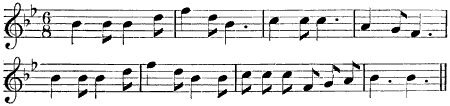
—Biggar (Wm. Ballantyne).
I.
Here we go round by jingo-ring, Jingo-ring, and jingo-ring, Here we go round by jingo-ring, About the merry-ma-tansa. Come name the lad you like the best, Like the best, like the best, Come name the lad you like the best, About the merry-ma-tansa. Guess ye wha’s the young gudeman, The young gudeman, the young gudeman, Come guess ye wha’s the young gudeman About the merry-ma-tansa. Honey’s sweet and so is he, So is he, so is he, Honey’s sweet and so is he, About the merry-ma-tansa.
[Or—
Crab-apples are sour and so is he, So is he, so is he, Crab-apples are sour and so is he, About the merry-ma-tansa.] Can she bake and can she brew? Can she shape and can she sew, ‘Boot a house can a’ things do? About the merry-ma-tansa? She can bake and she can brew, She can shape and she can sew, ’Boot a house can a’ things do, About the merry-ma-tansa. This is the way to wash the clothes, Wash the clothes, wash the clothes, This is the way to wash the clothes, About the merry-ma-tansa.
[Then follows verses for wringing clothes, ironing, baking bread, washing hands, face, combing hair, washing and sweeping the house, and a number of other things done in housekeeping. The boy then presents the girl with a ring, and they all sing—]
Now she’s married in a goud ring, A gay goud ring, a gay goud ring, Now she’s married in a goud ring, About the merry-ma-tansa. A gay goud ring is a dangerous thing, A cankerous thing, a cankerous thing, A gay goud ring is a dangerous thing, About the merry-ma-tansa. Now they’re married we wish them joy, Wish them joy, wish them joy, Now they’re married we wish them joy, About the merry-ma-tansa. Father and mother they must obey, Must obey, must obey, Father and mother they must obey, About the merry-ma-tansa. Loving each other like sister and brother, Sister and brother, sister and brother, Loving each other like sister and brother, About the merry-ma-tansa. We pray this couple may kiss thegither, Kiss thegither, kiss thegither, We pray this couple may kiss thegither, About the merry-ma-tansa.
[If any lad was left without a partner, the ring sing—]
Here’s a silly auld man left alone, Left alone, left alone, He wants a wife and can’t get none, About the merry-ma-tansa.
—Biggar (William Ballantyne).
II.
Here we go the jingo-ring, The jingo-ring, the jingo-ring, Here we go the jingo-ring, About the merry-ma-tansie. Twice about, and then we fa’, Then we fa’, then we fa’, Twice about, and then we fa’, About the merry-ma-tansie. Guess ye wha’s the young goodman, The young goodman, the young goodman, Guess ye wha’s the young goodman, About the merry-ma-tansie. Honey is sweet, and so is he, So is he, so is he, Honey is sweet, and so is he, About the merry-ma-tansie.
[Or—
Apples are sour, and so is he, So is he, so is he, Apples are sour, and so is he, About the merry-ma-tansie.] He’s married wi’ a gay gold ring, A gay gold ring, a gay gold ring, He’s married wi’ a gay gold ring, About the merry-ma-tansie. A gay gold ring’s a cankerous thing, A cankerous thing, a cankerous thing, A gay gold ring’s a cankerous thing, About the merry-ma-tansie. Now they’re married, I wish them joy, I wish them joy, I wish them joy, Now they’re married, I wish them joy, About the merry-ma-tansie. Father and mother they must obey, Must obey, must obey, Father and mother they must obey, About the merry-ma-tansie. Loving each other like sister and brother, Sister and brother, sister and brother, Loving each other like sister and brother, About the merry-ma-tansie. We pray this couple may kiss together, Kiss together, kiss together, We pray this couple may kiss together, About the merry-ma-tansie.
—Chambers’ Popular Rhymes, pp. 132-134.
(b) At Biggar (Mr. Ballantyne) this game was generally played on the green by boys and girls. A ring is formed by all the children but one, joining hands. The one child stands in the centre. The ring of children dance round the way of the sun, first slowly and then more rapidly. First all the children in the ring bow to the one in the centre, and she bows back. Then they dance round singing the first and second verses, the second verse being addressed to the child in the centre. She then whispers a boy’s name to one in the ring. This girl then sings the third verse. None in the ring are supposed to be able to answer, and the name of the chosen boy is then said aloud by the girl who asked the question. If the name is satisfactory the ring sing the fourth verse, and the two players then retire and walk round a little. If the name given is not satisfactory the ring sing the fifth verse, and another child must be chosen. When the two again stand in the centre the boys sing the sixth verse. The girls answer with the seventh. Then all the ring sing the next verses, imitating washing clothes, wringing, ironing, baking bread, washing hands, combing hair, &c., suiting their actions to the words of the verses sung. The boy who was chosen then presents a ring, usually a blade of grass wrapped round her finger, to the girl. The ring then sing the ninth, tenth, eleventh, and twelfth verses. When all have chosen, if any lad is left without a partner, the last verse is sung.
The version recorded by Chambers is similar in action, but there are some important differences in detail. The centre child acts as mistress of the ceremonies. The ring of children dance round her, singing the verses. At the end of the first line of the second verse they all courtesy to her, and she returns the compliment. At the conclusion of this verse she selects a girl from the ring and asks her her sweetheart’s name, which is imparted in a whisper. Upon this the child in the centre sings the third verse, the ring dancing round as before. If the ring approves her choice, they sing the fourth verse as in the Biggar version, and if they disapprove, the fifth. Chambers does not say whether another child is selected, if this is the case; but it is probable, as he says, the marriage is finally concluded upon and effected by the ring singing the verses which follow. When singing the first line of the eighth verse all the ring unclasps hands for a moment, and each child performs a pirouette, clapping her hands above her head.
(c) It seems very clear from both the versions given that this is a ceremonial dance, round or at a place sacred to such ceremonies as betrothal and marriage. The version given by Chambers suggests this the more strongly, as the child in the centre acts as mistress of the ceremonies, or “go-between,” the person who was the negotiator between the parents on either side in bringing a marriage about. The courtesying and bowing of those in the ring to her may show respect for this office. On the other hand, there is the more important office of priest or priestess of “the stones” suggested by the action of the game, and the reverence to the centre child may be a relic of this. The fact that she asks a girl to tell her her sweetheart’s name, and then announces the name of the girl’s choice for approval or disapproval by the ring in both versions, points to the time when consent by relations and friends on both sides was necessary before the marriage could be agreed upon—the inquiry regarding the qualifications of the proposed wife, the recital of her housewifely abilities, and the giving of the ring by the boy to the girl are also betrothal customs. It is to be noted that it was a popular belief in ancient times that to wed with a rush-ring was a legal marriage, without the intervention of a priest or the ceremonies of marriage. Poore, Bishop of Salisbury (circa 1217), prohibited the use of them—
“With gaudy girlonds or fresh flowers dight About her necke, or rings of rushes plight.”
—Spenser’s Queen.
And Shakespeare alludes to the custom in the lines—“As fit as ten groats for the hand of an attorney, as Tib’s rush for Tom’s forefinger.”—All’s Well that Ends Well. The rejoicing and bestowal of the blessing by the ring of friends give an almost complete picture of early Scotch marriage custom. A version of this game, which appeared in the Weekly Scotsman of October 16, 1893, by Edgar L. Wakeman, is interesting, as it confirms the above idea, and adds one or two details which may be important, i.e., the “choose your maidens one by one,” and “sweep the house till the bride comes home.” This game is called the “Gala Ship,” and the girls, forming a ring, march round singing—
Three times round goes the gala, gala ship, And three times round goes she; Three times round goes the gala, gala ship, And sinks to the bottom of the sea.
They repeat this thrice, courtesying low. The first to courtesy is placed in the centre of the circle, when the others sing:—
Choose your maidens one by one, One by one, one by one; Choose your maidens one by one— And down goes (all courtesy) Merrima Tansa!
She chooses her maidens. They take her to a distance, when she is secretly told the name of her lover. The remainder of the girls imitate sweeping, and sing several stanzas to the effect that they will “sweep the house till the bride comes home,” when the bride is now placed within the circle, and from a score to a hundred stanzas, with marching and various imitations of what the lucky bride accomplishes or undergoes, are sung. Each one closes with “Down goes Merrima Tansa” and the head-ducking; and this wonderful music-drama of childhood is not concluded until the christening of the bride’s first-born, with—
Next Sunday morn to church she must gae, A babe on her knee, the best of ’a— And down goes Merrima Tansa!
Jamieson gives the game as a ring within which one goes round with a handkerchief, with which a stroke is given in succession to every one in the ring; the person who strikes, or the taker, still repeating this rhyme:—
Here I gae round the jingie ring, The jingie ring, the jingie ring, Here I gae round the jingie ring, And through my merry-ma-tanzie.
Then the handkerchief is thrown at one in the ring, who is obliged to take it up and go through the same process. He also mentions another account of the game which had been sent him, which describes the game as played in a similar manner to the versions given by Chambers.
Stewart, in his Ben Nevis and Glencoe, p. 361, records the following rhyme:—
Here we go with merry shout, Up and down and round about, And dance a merry-ma-tandy,
but he does not describe the game in detail.[Addendum] [Addendum]
Milking Pails
[Play Monton, London version]
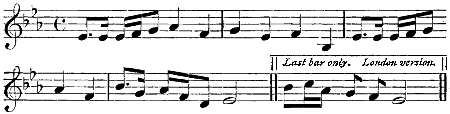
—Monton, Lancashire (Miss Dendy); London (A. B. Gomme).
[Play]
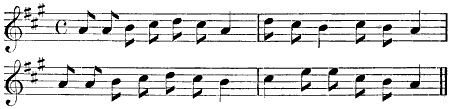
—Earls Heaton, Yorks. (H. Hardy).
I.
Mary’s gone a-milking, Mother, mother, Mary’s gone a-milking, Gentle sweet mother o’ mine. Take your pails and go after her, Daughter, daughter, Take your pails and go after her, Gentle sweet daughter o’ mine. Buy me a pair of new milking pails, Mother, mother, Buy me a pair of new milking pails, Gentle sweet mother o’ mine. Where’s the money to come from, Daughter, daughter, Where’s the money to come from, Gentle sweet daughter o’ mine? Sell my father’s feather bed, Mother, mother, Sell my father’s feather bed, Gentle sweet mother o’ mine. What’s your father to sleep on, Daughter, daughter, What’s your father to sleep on, Gentle sweet daughter o’ mine? Put him in the truckle bed, Mother, mother, Put him in the truckle bed, Gentle sweet mother o’ mine. What are the children to sleep on, Daughter, daughter, What are the children to sleep on, Gentle sweet daughter o’ mine? Put them in the pig-sty, Mother, mother, Put them in the pig-sty, Gentle sweet mother o’ mine. What are the pigs to lie in, Daughter, daughter, What are the pigs to lie in, Gentle sweet daughter o’ mine? Put them in the washing-tubs, Mother, mother, Put them in the washing-tubs, Gentle sweet mother o’ mine. What am I to wash in, Daughter, daughter, What am I to wash in, Gentle sweet daughter o’ mine? Wash in the thimble, Mother, mother, Wash in the thimble, Gentle sweet mother o’ mine. Thimble won’t hold your father’s shirt, Daughter, daughter, Thimble won’t hold your father’s shirt, Gentle sweet daughter o’ mine. Wash in the river, Mother, mother, Wash in the river, Gentle sweet mother o’ mine. Suppose the clothes should blow away, Daughter, daughter, Suppose the clothes should blow away, Gentle sweet daughter o’ mine? Set a man to watch them, Mother, mother, Set a man to watch them, Gentle sweet mother o’ mine. Suppose the man should go to sleep, Daughter, daughter, Suppose the man should go to sleep, Gentle sweet daughter o’ mine? Take a boat and go after them, Mother, mother, Take a boat and go after them, Gentle sweet mother o’ mine. Suppose the boat should be upset, Daughter, daughter, Suppose the boat should be upset, Gentle sweet daughter o’ mine? Then that would be an end of you, Mother, mother, Then that would be an end of you, Gentle sweet mother o’ mine.
—London Nursemaid, 1876 (A. B. Gomme).
II.
Mary’s gone a-milking, a-milking, a-milking, Mary’s gone a-milking, mother, dear mother of mine. Where did she get her money from, daughter, daughter? Where did she get her money from, daughter, dear daughter of mine?
[Then follow verses sung in the same manner, beginning with the following lines—]
Sold her father’s feather bed, feather bed. What will your father lie on, lie on? Lay him in the pig-sty, pig-sty. Where will the pigs lie, daughter? Lay them in the wash-tub, mother. What shall I wash in, wash in? Wash in a thimble, mother. A thimble won’t hold my night-cap. Wash by the sea-side, mother. Suppose the clothes should blow away? Get a boat and go after them, mother. But suppose the boat should turn over? Then that would be an end of you, mother.
—Bocking, Essex (Folk-lore Record, iii. 169).
III.
Mother, please buy me a milking-can, A milking-can, a milking-can! Mother, please buy me a milking-can, With a humpty-dumpty-daisy!
[Then follow verses sung in the same manner, beginning—]
Where’s the money to come from, to come from? Sell my father’s feather bed. Where’s your father going to lie? Lie on the footman’s bed. Where’s the footman going to lie? Lie in the cowshed. Where’s the cows going to lie? Lie in the pig-sty. Where’s the pig going to lie? Lie in the dolly-tub. And what am I to wash in? Wash in a thimble. A thimble wunna hold a cap. Wash in an egg-shell. An egg-shell wunna hold a shirt. Wash by the river-side. Suppose the clothes should float away? Get a boat and fetch them back. Suppose the boat should overthrow? Serve you right for going after them!
—Berrington, Oswestry, Chirbury (Burne’s Shropshire Folk-lore, p. 515).
IV.
Mother, will you buy me a milking-can, A milking-can, a milking-can? Mother, will you buy me a milking-can, To me, I, O, OM? Where’s the money to buy it with, To buy it with, to buy it with, Where’s the money to buy it with, To me, I, O, OM?
[Then the following verses—]
Sell my father’s feather bed. Where will your father sleep? My father can sleep in the boys’ bed. Where will the boys sleep? The boys can sleep in the pig-sty. Where will the pigs sleep? The pigs can sleep in the wash-tub. Where shall I wash my clothes? You can wash them in a thimble. A thimble is not large enough. You can wash them in an egg-shell. An egg-shell would not hold them. You can wash them by the river side. But what if I should fall in? We’ll get a rope and pull you out, To me, I, O, OM.
—Sheffield (S. O. Addy).
V.
Mother, come buy me two milking-pails, Two milking-pails, two milking-pails, Mother, come buy me two milking-pails, O sweet mother o’ mine.
[Then verses beginning with the following lines—]
Where shall I get my money from, O sweet daughter o’ mine? Sell my father’s feather beds. Where shall your father sleep? Sleep in the servant’s bed. Where shall the servant sleep? Sleep in the washing-tub. Where shall I wash the clothes? Wash them in the river. Suppose the clothes float away? Take a boat and go after them. Suppose the boat upsets? Then you will be drownded.
—London (Miss Dendy).
VI.
Mother, come buy me a milking-can, Milking-can, milking-can, Mother, come buy me a milking-can, O mother o’ mine. Where can I have my money from, O daughter o’ mine? Sell my father’s bedsteads. Where must your father sleep? Sleep in the pig-sty. Where must the pig sleep? Sleep in the washing-tub. What must I wash in? Wash in your thimble. What must I sew with? Sew with your finger. What will you say if I prick me? Serve you right, serve you right.
—Monton, Lancashire (Miss Dendy).
VII.
Mother, will you buy me a pair of milking-cans, Milking-cans, milking-cans, Mother, will you buy me a pair of milking-cans, O gentle mother of mine? But where shall I get the money from? Sell my father’s feather bed. But where, O where, will your father lie? Father can lie in the girls’ bed. But where, O where, shall the girls then lie? The girls can lie in the boys’ bed. But where, O where, shall the boys lie? The boys may lie in the pig-sty. Then where, O where, will the pigs lie? The pigs may lie in the washing-tub. Then where, O where, shall we wash our clothes? We can wash by the river side. The tide will wash the clothes away. Get the prop and follow them.
—Sheffield (Miss Lucy Garnett).
VIII.
Mother, buy some milking-cans, Milking-cans, milking-cans. Where must our money come from? Sell our father’s feather bed.
[This goes on for many more verses, articles of furniture being mentioned in each succeeding verse.]
—Earls Heaton (Herbert Hardy).
IX.
Buy me a milking-pail, my dear mother. Where’s the money to come from, my dear daughter? Sell father’s feather bed. Where could your father sleep? Sleep in the pig-sty. What’s the pigs to sleep in? Put them in the washing-tub. What could I wash the clothes in? Wash them in your thimble. Thimble isn’t big enough for baby’s napkin. Wash them in a saucer. A saucer isn’t big enough for father’s shirt. Wash by the river side, wash by the river side.
—Crockham Hill, Kent (Miss Chase).
X.
Please, mother, buy me a milking-can, Milking-can, milking-can, Please, mother, buy me a milking-can, My dear mother. Where can I get the money from? Sell father’s feather bed. Where shall your father sleep? Sleep in the boys’ bed. Where shall the boys sleep? Sleep in the pig-sty. Where shall the pigs sleep? Sleep in the washing-tub. What shall I wash with? Wash in an egg-shell. The egg-shell will break. Wash in a thimble. Thimble’s not big enough. Wash by the river side. Suppose the things should float away? Get a boat and go after them. Suppose the boat should be upset? Then you’ll be drowned, Drowned, drowned, Then you’ll be drowned, And a good job too.
—Enborne, Berks. (Miss M. Kimber).
XI.
Please, mother, buy me a milk-can, A milk-can, a milk-can, Please, mother, do. Where’s the money coming from, Coming from, coming from, What shall I do? Sell father’s feather bed, Feather bed, feather bed, Please mother, do. Where shall the father sleep? Sleep in the servants’ bed. Where shall the servants sleep? Sleep in the pig-sty. Where shall the pig sleep? Sleep in the washing-tub. What shall I wash in? Wash in a thimble. The shirts won’t go in. Wash by the river side. Supposing if I fall in? Good job too!
—Hartley Wintney, Winchfield, Hants (H. S. May).
XII.
Mother, buy the milk-pail, mother, dear mother of mine. Where’s the money to come from, children, dear children of mine? Sell father’s feather bed, mother, dear mother of mine. Where’s your father to sleep in? Father can sleep in the servant’s bed. Where’s the servant to sleep in? Servant can sleep in the pig-sty. Where’s the pig to sleep in? The pig can sleep in the wash-tub. Where shall we wash our clothes? Wash our clothes at the sea-side. If our clothes should swim away? Then take a boat and go after them. O what should we do if the boat should sink? O then we should all of us be at an end.
—Swaffham, Norfolk (Miss Matthews).
XIII.
We want to buy a wash-pan, wash-pan, wash-pan, We want to buy a wash-pan, early in the morning. Where will you get the money from, money from, money from? We’ll sell my father’s feather bed, feather bed, feather bed. Where will your father sleep? Father’ll sleep in the boys’ bed. Where will the boys sleep? Boys will sleep in the girls’ bed. Where will the girls sleep? Girls will sleep in the pig-sty. Where will the pigs sleep? Pigs will sleep in the washing-pan.