CHILDREN’S GAMES. (continued 4)
Reading edition
dis
dass
dish
diss[y]—duss
dossy
this —thus
—dust
—dust[y]
No. Scot- land (Cham- bers). Lanark- shire. Biggar. York- shire. Roxton. Shrop- shire. Lincoln- shire, Froding- ham. Sussex, Hurst- monceux. Middle- sex. London. Hants, Liphook. Halli- well. Shef- field.
1. A-dis, a-dis, a green grass. A-dis, a-dis, a green grass. A dish, a dish, a green grass. Dissy, dissy, green grass. Dossy, dossy, green grass. — — — — — — — —
2. — — — — — Walking up the green grass. Stepping up the green grass. Up and down the green grass. Tripping up the green grass. Here we come up the green grass. Here we go up the green grass. Trip, trap, over the grass. Stepping up the green grass.
3. A-dis, a-dis, a-das. A-dis, a-dis, a-dass. A dish, a dish, a dish. Dissy, dissy, duss. Dossy, dossy, doss. A dust, a dust, a dust. Thus, and thus, and thus. This, and that, and thus. — — — — Thus, and thus, and thus.
4. — — — — — — — — Dusty, dusty day. On a dusty, dusty day. — — —
5. — — — — — — — — — — So early in the morning. — —
6. Come all ye pretty maids. Come my pretty fair maid. Come all ye pretty maids. Come all ye pretty maids. Come all ye pretty maids. We want a pretty maiden. Please may we have a pretty lass. Come all ye fair maids. Come all ye pretty maids. Fair maid, pretty maid. Fair maid, pretty maid. Please let one of your daughters come. Will you let one of your fair maids.
7. And dance along with us. And walk along with us. And dance along with us. And dance along with us. Dance upon the grass. To walk along with us. To come and play with us. And walk along with us. Come and with us play. — — Come and dance with me. Come and play with us.
8. For we are going a-roving. — For we are lads a roving. — — — — — — [See below.] — — —
9. We’ll take this maid by the hand. — We’ll take this pretty fair maid by the hand. — — We’ll take her by the hand. — — — Give your hand to me. Give your hand to me. Take one, take the fairest you can see. —
10. — — — — — — — — — — — Pretty [ ] come to me. —
11. — — — — — She shall go to Derby. — — — — — — —
12. You shall have a duke, my dear. You shall have a dik-ma-day. Ye sall get a duke. You shall have a duck. You shall have a duck. (after No. 19) She shall have a duck, my dear. — — You shall have a duck. — — You shall have a duck, my dear. —
13. — — — — I will give pots and pans. — We will give you pots and pans. — — — — I will give you pots and pans. We will give you pots and pans.
14. — — — — ..... brass. — ..... brass. — — — — ..... brass. ..... brass.
15. — — — — ..... gold and silver. — ..... gold and silver. Some will give us silver ..... gold. — — — ..... gold and silver. ..... gold and silver.
16. — — — — ..... pearl. — ..... pearl. — — — — ..... pearl. ..... pearl.
17. — — — — ..... anything. — ..... anything. — — — — ..... anything. ..... anything.
18. — — — — — — — — — I’ll show you a blackbird. You shall see a blackbird. — —
19. — — — — For a pretty lass. — For a pretty lass. — — — — For a pretty girl. For a pretty lass.
20. You shall have a drake. You shall have a dragon. Ye sall get a drake. You shall have a drake. You shall have a drake. She shall have a drake. You shall have a goose for dinner. — You shall have a swan. — — You shall have a drake. —
21. — — — — — — — Take hold of my finger. — — — — —
22. — — — — — — — Maycana- meecan. — — — — —
23. — — — — — — — — — — All sorts of colours lying by his side. — —
[8.] — — — — — — — — — We’ll all go roving. — — —
24. And ye shall get a young prince. You shall have a nice young man. Ye sall get a bonny prince. You shall have a nice young man. You shall have a young man. She shall have a nice young man. You shall have a nice young man. — You shall have a nice young man. — — You shall have a young man. You shall have a nice young man.
25. — — — — — — — Pray tell me the name of your young man. — — — — —
26. — — — — — — — — — I’ll take [ ] for my bride. Take [ ] for my bride. — —
27. A young prince for your sake. — For your ain sake. To love you for your sake. — A fighting for her sake. — — A waiting for to come. — — — —
28. — — — — Apprentice for your sake. — — — — — — Apprentice for your sake. Born for your sake.
29. — — — — — — To take you up the garden. — — — — — —
30. If this young prince should die. — If they all should die. If this young man should chance to die. — Suppose this young man was to die. Suppose this young man was to die. — Suppose he were to die. — — If this young man should happen to die. —
31. — — — — If this young man should wealthy grow. — — — — — — — —
32. Ye shall get another. — Ye sall get anither. — — — — — — — — — —
33. — — — And leave the girl a widow. — And leave the girl a widow. And leave the girl a widow. — And leave his wife a widow. — — And leave the poor woman a widow. —
34. — — — — And give his wife a feather. — — — — — — — —
35. Bells will ring and birds sing. — The bells will ring, birds will sing. Birds shall sing and bells ring. Bells shall ring and birds sing. Bells ring and we shall sing. Bells would ring, cats would sing. — — — — Bells shall ring, birds shall sing. Bells shall ring, cats shall sing.
36. — — — — — — — — Come all ye pretty fair maids. — — — —
37. We’ll all clap hands together. — We’ll clap hands together. Clap all your hands together. We’ll all clap hands together. And all clap hands together. So we’ll all clap hands together. — Come clap your hands together. — — We’ll all clap hands together. We’ll all clap hands together.
38. — With princes for his thegan. — — — — — — — — — — —
39. — — — — — — — Don’t you think [ ] a nice young man? — — — — —
40. — — — — — — — Don’t you think [ ] as handsome as he? — — — — —
41. — — — — — — — Then off with the glove, on with the ring. — — — — —
42. — — — — — — — You shall be married when you can agree. — — — — —
43. — — — — — — — — — Naughty miss, she won’t come out. Naughty old maid, she won’t come out. — —
44. — — — — — — — — — To help us with our dancing. To help us with our dancing. — —
45. — — — — — — — — — Now we’ve got our bonny lass. Now we’ll get our bonny lass. — —
46. — — — — — — — — — To help us with our dancing. To help us with our dancing. — —
No. Scotland (Chambers). Lanarkshire. Biggar. Yorkshire. Roxton. Shropshire. Lincolnshire, Frodingham.
1. A-dis, a-dis, a green grass. A-dis, a-dis, a green grass. A dish, a dish, a green grass. Dissy, dissy, green grass. Dossy, dossy, green grass. — —
2. — — — — — Walking up the green grass. Stepping up the green grass.
3. A-dis, a-dis, a-das. A-dis, a-dis, a-dass. A dish, a dish, a dish. Dissy, dissy, duss. Dossy, dossy, doss. A dust, a dust, a dust. Thus, and thus, and thus.
4. — — — — — — —
5. — — — — — — —
6. Come all ye pretty maids. Come my pretty fair maid. Come all ye pretty maids. Come all ye pretty maids. Come all ye pretty maids. We want a pretty maiden. Please may we have a pretty lass.
7. And dance along with us. And walk along with us. And dance along with us. And dance along with us. Dance upon the grass. To walk along with us. To come and play with us.
8. For we are going a-roving. — For we are lads a roving. — — — —
9. We’ll take this maid by the hand. — We’ll take this pretty fair maid by the hand. — — We’ll take her by the hand. —
10. — — — — — — —
11. — — — — — She shall go to Derby. —
12. You shall have a duke, my dear. You shall have a dik-ma-day. Ye sall get a duke. You shall have a duck. You shall have a duck. (after No. 19) She shall have a duck, my dear. —
13. — — — — I will give pots and pans. — We will give you pots and pans.
14. — — — — ..... brass. — ..... brass.
15. — — — — ..... gold and silver. — ..... gold and silver.
16. — — — — ..... pearl. — ..... pearl.
17. — — — — ..... anything. — ..... anything.
18. — — — — — — —
19. — — — — For a pretty lass. — For a pretty lass.
20. You shall have a drake. You shall have a dragon. Ye sall get a drake. You shall have a drake. You shall have a drake. She shall have a drake. You shall have a goose for dinner.
21. — — — — — — —
22. — — — — — — —
23. — — — — — — —
[8.] — — — — — — —
24. And ye shall get a young prince. You shall have a nice young man. Ye sall get a bonny prince. You shall have a nice young man. You shall have a young man. She shall have a nice young man. You shall have a nice young man.
25. — — — — — — —
26. — — — — — — —
27. A young prince for your sake. — For your ain sake. To love you for your sake. — A fighting for her sake. —
28. — — — — Apprentice for your sake. — —
29. — — — — — — To take you up the garden.
30. If this young prince should die. — If they all should die. If this young man should chance to die. — Suppose this young man was to die. Suppose this young man was to die.
31. — — — — If this young man should wealthy grow. — —
32. Ye shall get another. — Ye sall get anither. — — — —
33. — — — And leave the girl a widow. — And leave the girl a widow. And leave the girl a widow.
34. — — — — And give his wife a feather. — —
35. Bells will ring and birds sing. — The bells will ring, birds will sing. Birds shall sing and bells ring. Bells shall ring and birds sing. Bells ring and we shall sing. Bells would ring, cats would sing.
36. — — — — — — —
37. We’ll all clap hands together. — We’ll clap hands together. Clap all your hands together. We’ll all clap hands together. And all clap hands together. So we’ll all clap hands together.
38. — With princes for his thegan. — — — — —
39. — — — — — — —
40. — — — — — — —
41. — — — — — — —
42. — — — — — — —
43. — — — — — — —
44. — — — — — — —
45. — — — — — — —
46. — — — — — — —
No. Sussex, Hurstmonceux. Middlesex. London. Hants, Liphook. Halliwell. Sheffield.
1. — — — — — —
2. Up and down the green grass. Tripping up the green grass. Here we come up the green grass. Here we go up the green grass. Trip, trap, over the grass. Stepping up the green grass.
3. This, and that, and thus. — — — — Thus, and thus, and thus.
4. — Dusty, dusty day. On a dusty, dusty day. — — —
5. — — — So early in the morning. — —
6. Come all ye fair maids. Come all ye pretty maids. Fair maid, pretty maid. Fair maid, pretty maid. Please let one of your daughters come. Will you let one of your fair maids.
7. And walk along with us. Come and with us play. — — Come and dance with me. Come and play with us.
8. — — [See below.] — — —
9. — — Give your hand to me. Give your hand to me. Take one, take the fairest you can see. —
10. — — — — Pretty [ ] come to me. —
11. — — — — — —
12. — You shall have a duck. — — You shall have a duck, my dear. —
13. — — — — I will give you pots and pans. We will give you pots and pans.
14. — — — — ..... brass. ..... brass.
15. Some will give us silver ..... gold. — — — ..... gold and silver. ..... gold and silver.
16. — — — — ..... pearl. ..... pearl.
17. — — — — ..... anything. ..... anything.
18. — — I’ll show you a blackbird. You shall see a blackbird. — —
19. — — — — For a pretty girl. For a pretty lass.
20. — You shall have a swan. — — You shall have a drake. —
21. Take hold of my finger. — — — — —
22. Maycana- meecan. — — — — —
23. — — — All sorts of colours lying by his side. — —
[8.] — — We’ll all go roving. — — —
24. — You shall have a nice young man. — — You shall have a young man. You shall have a nice young man.
25. Pray tell me the name of your young man. — — — — —
26. — — I’ll take [ ] for my bride. Take [ ] for my bride. — —
27. — A waiting for to come. — — — —
28. — — — — Apprentice for your sake. Born for your sake.
29. — — — — — —
30. — Suppose he were to die. — — If this young man should happen to die. —
31. — — — — — —
32. — — — — — —
33. — And leave his wife a widow. — — And leave the poor woman a widow. —
34. — — — — — —
35. — — — — Bells shall ring, birds shall sing. Bells shall ring, cats shall sing.
36. — Come all ye pretty fair maids. — — — —
37. — Come clap your hands together. — — We’ll all clap hands together. We’ll all clap hands together.
38. — — — — — —
39. Don’t you think [ ] a nice young man? — — — — —
40. Don’t you think [ ] as handsome as he? — — — — —
41. Then off with the glove, on with the ring. — — — — —
42. You shall be married when you can agree. — — — — —
43. — — Naughty miss, she won’t come out. Naughty old maid, she won’t come out. — —
44. — — To help us with our dancing. To help us with our dancing. — —
45. — — Now we’ve got our bonny lass. Now we’ll get our bonny lass. — —
46. — — To help us with our dancing. To help us with our dancing. — —
What the meaning of this word is it may be impossible to ascertain, though probably Mr. Newell may be correct in his suggestion that it represents the old English word “adist,” the opposite of “ayont,” meaning “this way,” “come hither” (Games of American Children, p. 51). But the point really is, that the version which contains the oldest word-forms would probably be the purest in other respects. The analysis of the whole game confirms this view, as the Scottish and Yorkshire versions are nearly parallel, while the discrepancies begin to creep in with the Shropshire version, reaching their last stage in the versions recorded by Halliwell and from Congleton. Following this line of argument, “dik-ma-day” becomes first “duke, my dear,” and then “duck, my dear.” Turning next to the import of the rhymes, apart from special words used, it is curious to note that “dis” is only converted into “dusty,” and hence into “dusty day,” in two versions out of the fourteen. The Lincolnshire version agrees with Halliwell’s version in making some curious offers for a pretty lass, but these rhymes are probably an innovation. In the same way the incidents numbered 39-40, occurring in the Sussex version, and 43-46 occurring in the London and Hants versions, are borrowings from other games, and not original portions of this. The Congleton version is evidently incomplete.
(e) Henderson, in describing the curious rites accompanying the saining or blessing of a corpse in the Scottish Lowlands, states that empty dishes are arranged on the hearth as near as possible to the fire, and after certain ceremonies in connection therewith have been performed, the company join hands and dance round the dishes, singing this burden:—
A dis, a dis, a dis, A green griss; A dis, a dis, a dis.
—Folk-lore of Northern Counties, p. 54.
This rhyme is, it will be seen, the same as the first two lines of the game, the word “griss” in the burial-rhyme becoming “grass” in the game-rhyme, “grisse” being the old form for “grass” or herb (Halliwell, Provincial Glossary, quotes a MS. authority for this). This identification of the game-rhyme would suggest that the game originally was a child’s dramatic imitation of an old burial ceremony, and it remains to be seen whether the signification of the words would carry out this idea.
In the first place, the idea of death is a prominent incident in the game, appearing in seven out of the fourteen versions. In all these cases the death is followed by the clapping of hands and bell-ringing, and in five cases by the singing of birds. Clapping of hands occurs in two other cases, and bell-ringing in one other case, not accompanied by the death incident. Now it is singular that the burial-rite which has just been quoted is called Dish-a-loof; and a reference to the game of “Dish-a-loof” [under that title], will show that it derives its name from the clapping of hands. In the ceremony, as described by Henderson, although songs and games are part of the burial-ceremony, there is no specific mention of hand-clapping; but it is conceivable that the action at one time formed part of the ceremony, and hence the name “Dish-a-loof.” This would not account for the promise of a duck, drake, &c., as in incidents Nos. 12 and 20; nor for the promise of a young prince or young man; but these incidents might very well be variants of some earlier forms which are not now discoverable, especially as love-games were played at funerals, and as the tendency, in the less complete forms of the game as they have come down to us, is in the direction of transposing the game into a complete love-game. The use of rushes in the Lanarkshire game might indicate the funeral garland (Aubrey’s Remaines, pp. 109, 139). For clapping of hands to indicate bell-tolling or bell-ringing at times of death see Napier’s Folklore, p. 66. Henderson (p. 63) says the “passing bell” was supposed in former times to serve two purposes: it called on all good Christians within hearing to pray for the departing spirit, and it scared away the evil spirits who were watching to seize it, or at least to scare and terrify it.
On the whole evidence from the rhymes, therefore, I should be disposed to class this game as originally belonging to burial, and not love, rites.[Addendum]
Green Gravel
[Play]
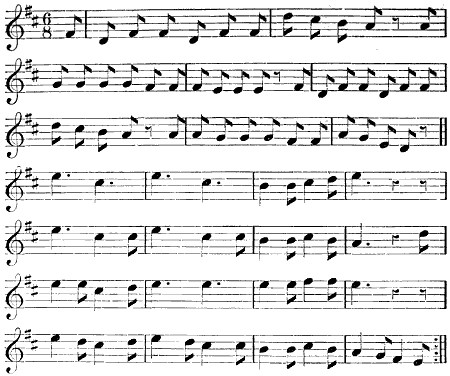
—Madeley, Shropshire (Miss Burne).
[Play]
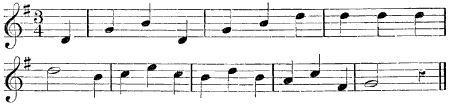
—Earls Heaton (H. Hardy).
[Play]
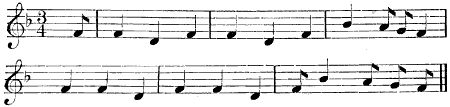
—Sporle, Norfolk (Miss Matthews).
[Play]

—Redhill, Surrey (Miss G. Hope).
[Play]
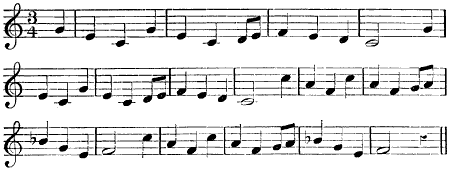
—Lancashire (Mrs. Harley).
[Play]
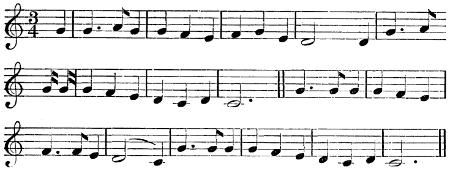
—Derbyshire (Mrs. Harley).
I.
Green gravel, green gravel, your grass is so green, The fairest young damsel that ever was seen; We washed her, we dried her, we rolled her in silk, And we wrote down her name with a glass pen and ink. Dear Annie, dear Annie, your true love is dead, And we send you a letter to turn round your head.
—Belfast (W. H. Patterson).
II.
Green gravel, green gravel, the grass is so green, The fairest young lady that ever was seen; I’ll wash you in milk, And I’ll clothe you with silk, And I’ll write down your name with a gold pen and ink. O Sally, O Sally, your true love is dead, He sent you a letter to turn round your head.
—Berrington, Oswestry (Shropshire Folk-lore p. 510).
III.
Around the green gravel the grass is so green, All the pretty fair maids are plain to be seen; Wash them in milk, and clothe them in silk, Write their names down with a gold pen and ink. All but Miss “Jenny,” her sweetheart is dead; She’s left off her wedding to turn back her head. O mother, O mother, do you think it is true? O yes, child! O yes, child! Then what shall I do? We’ll wash you in milk, and dress you in silk, And write down your name with a gold pen and ink.
—Derbyshire and Worcestershire (Mrs. Harley).
IV.
Green gravel, green gravel, The grass is so green, Such beautiful flowers As never were seen. O Annie [or any name], O Annie, Your sweetheart is dead! He has sent you a letter To turn back your head.
—Earls Heaton, Yorkshire (H. Hardy).
V.
Green gravel, green gravel, The grass is so green, The fairest young damsels As ever were seen. O ——, O ——, your true love is dead; He sent you a letter To turn round your head. Green gravel, green gravel, The grass is so green, The dismalest damsels As ever were seen. O ——, O ——, your true love’s not dead; He sends you a letter To turn back your head.
—Lincoln, Winterton, and Wakefield (Miss Fowler and Miss Peacock).
VI.
Green gravel, green gravel, the grass is so green, The fairest young lady [damsel] that ever was seen. O ——, O ——, your true love is dead; He’s sent you a letter to turn round your head.
—Redhill, Surrey (Miss G. Hope); Lancashire (Mrs. Harley).
VII.
Green meadows, green meadows, your grass is so green, The fairest young damsel that ever was seen; O Mary, O Mary, your sweetheart is dead; We’ve sent you a letter to turn back your head.
Or,
Green gravel, green gravel, the grass is so green, and following on as above.
—Sporle, Norfolk (Miss Matthews).
VIII.
Green grover, green grover, your grass is so green, The prettiest young lady that ever was seen. O ——, O ——, your true love is dead; I send you this letter, so turn round your head.
—Gainford, Durham (Miss Eddleston).
IX.
Green gravels, green gravels, The grass is so green, And all the pretty maidens Are not to be seen, Except —— (said twice), And she’s not [?] to be seen, So I send you a letter to turn round your head.
—Hampshire (Miss E. Mendham).
X.
Green gravels, green gravels, the grass is so green, Fine pencils, fine pencils, as ever were seen. O Mary! O Mary! your true love is dead, And he’s sent you a letter to turn round your head.
—Wales (Byegones, 1890).
XI.
Yellow gravel, yellow gravel, The grass is so green, The fairest young lady That ever was seen. O ——, O ——, Your true love is dead; I send you a letter to turn round your head.
—Cowes, Isle of Wight (Miss E. Smith).
XII.
Green gravel, green gravel, the grass is so green, Said the fairest young damsel that ever I’ve seen. O mother, O mother, my true-love is dead, He sent me this letter to turn round my head. O mother, O mother, do you think this is true? O yes, love! O yes, love! And what shall I do? I’ll wash you in butter-milk, I’ll dress you in silk, I’ll write down your name with my gold pen and ink.
—Isle of Man (A. W. Moore).
XIII.
Green gravel, green gravel, the grass is so green, The flowers are all faded and none to be seen. O [Dolly], O [Dolly], your sweetheart is dead, He’s sent you a letter to turn back your head. Wallflowers, wallflowers, growing up so high, We are but little, and we shall have to die! Excepting [Dolly Turner], she’s the youngest girl. O for shame, and fie for shame, and turn your back to home again.
—Madeley, Shropshire (Miss Burne).
XIV.
Green gravel, green gravel, the grass is so green, The fairest young lady that ever was seen. As I went up Miss Betsey’s stairs to buy a frying-pan, There sat Miss Betsey a-kissing her young man. She pulled off her glove and showed me her ring, And the very next morning the bells did ring. Dear Betsey, dear Betsey, your true love is dead, He’s sent you a letter to turn back your head.
—Summertown, Oxford (A. H. Franklin, Midland Garner, vol. ii. p. 32).
XV.
Round the green gravel the grass grows green, All pretty fair maids are fit to be seen; Wash them in milk, and clothe them in silk, And write down their names with pen and black ink— Choose one, choose two, choose the fairest daughter. Now, my daughter, married to-day, Like father and mother they should be, To love one another like sister and brother— I pray you now to kiss one another. Now my daughter Mary’s gone, With her pockets all lined with gold; On my finger a gay gold ring— Good-bye, Mary, good-bye. Now this poor widow is left alone, Nobody could marry a better one; Choose one, choose two— Choose the fairest daughter.
—Sheffield (S. O. Addy).
XVI.
Round the green gravel the grass is so green, And all the fine ladies that ever were seen; Washed in milk and dressed in silk, The last that stoops down shall be married. [Johnnie Smith] is a nice young man, And so is [Bessie Jones] as nice as he; He came to the door with his hat in his hand, Inquiring for [Miss Jones]. She is neither within, she is neither without, She is up in the garret a-walking about. Down she came, as white as milk, With a rose in her bosom as soft as silk. Silks and satins be ever so dear, You shall have a kiss [gown?], my dear, So off with the glove and on with the ring— To-morrow, to-morrow, the wedding begins.
—Forest of Dean, Gloucestershire (Miss Matthews).
XVII.
Around a green gravill The grass is so green, And all the fine ladies Ashamed to be seen. They wash ’em in milk And dress ’em in silk— We’ll all cou’ don’ together. My elbow, my elbow, My pitcher and my can; Isn’t —— A nice young gell? Isn’t —— As nice as her— They shall be married with a guinea-gold ring. I peep’d through the window, I peep’d through the door, I seed pretty —— A-dancin on the floor; I cuddled her an’ fo’dled her, I set her on my knee; I says pretty —— Won’t [ëe?] you marry me. A new-swept parlour, An’ a new-made bed, A new cup and saucer Again we get wed. If it be a boy, he shall have a hat, To follow with his mammy to her na’, na’, na’; If he be a gell, she shall have a ring, To follow with her mammy to her ding, ding, ding.
—Wakefield (Miss Fowler).
(c) The more general way of playing this game is to form a ring of children simply. The children walk round singing the verse as in the Belfast version, and when the last line is sung, the child whose name is mentioned turns round, facing the outside of the ring and having her back to the centre. She continues to hold hands with the others, and dances round with them in that position. This is repeated until all the children have “turned” their backs to the inside of the ring. Here the game ends in many cases, but another verse is sung in the Lincoln, Winterton, and Wakefield versions from Miss Peacock, and this was sung also in the London version. The second verse thus terminates the game, with the players one by one reversing their position and facing the centre of ring as at first. In the Forest of Dean and Wakefield versions the action of the game is somewhat different. A child stands in the centre of the ring of children, without apparently taking much part in the game, except to name the children in turn. In the Wakefield version, however (Miss Fowler, No. xvii.), a little boy stands in the middle of a circle of girls who sing the first verse. At “We’ll all cou’ don’ together,” all crouch down, as if in profound respect, then rising slowly, sing the next verse. After “My pitcher and my can,” each child mentions her own name. At “Isn’t —— as nice as her?” each mentions her sweetheart’s name, and the child thus chosen goes into the circle. At the end of the fourth verse they all clap hands, and the one that is sweetheart to him in the middle kisses him. The “crouching down” is also done in the Forest of Dean version when singing the fourth line. The last one to stoop has to name her sweetheart. When this is done, the children all dance round and sing the other lines.
(d) The analysis of the game-rhymes is on pp. 178-181. The most constant formulæ of this game-rhyme are shown by this analysis to be Nos. 1, 6, 7, 13, 15, 18, 23, and the variants, though important, are not sufficient to detract from the significance of the normal version. It is evidently a funeral game. The green gravel and the green grass indicate the locality of the scene; “green,” as applied to gravel, may mean freshly disturbed, just as green grave means a freshly made grave. The tenant of the new grave is the well-loved lady of a disconsolate lover, and probably the incidents of washing and dressing the corpse, and putting an inscription on the place where it is laid, are indicated by Nos. 13 and 15. The dirge, or singing to the dead, is indicated by Nos. 18, 23, and 26, and the beauty of the first line is in complete accord with the mournful music. That No. 26 occurs in only two variants, Derbyshire and the Isle of Man, is curious, as the pathos of this appeal is very apparent in the movement of the game. The communion with the dead which is indicated by No. 23 is by no means considered impossible by the peasantry. In confirmation of this being a representation of an old funeral ceremony, it may be pointed out that the action of turning backwards during the singing of the dirge is also represented in the curious funeral ceremony called “Dish-a-loof,” which is described in Henderson’s Folk-lore of the Northern Counties, p. 53. Henderson’s words are: “All the attendants, going out of the room, return into it backwards, repeating this rhyme of ’saining.’” The additional ceremony of marriage in four of the games is clearly an interpolation, which may have arisen from the custom of playing love and marriage games at funerals and during the watching with the corpse, or may be a mere transition to the more pleasant task of love-making as the basis of a game. The Derbyshire incident (No. 24) may indicate indeed that the funeral is that of a young bride, and in that case the tendency to make the game wholly a marriage game is accounted for. The decay which has set in is apparent by the evident attempt to alter from “green gravel” to “green grover” and “yellow gravel” (Nos. 4 and 5), and to introduce pen and black ink (No. 17). The addition of the incongruous elements from other games (Nos. 27-31) is a frequent occurrence in modern games, and is the natural result of decadence in the original form of the game. Altogether this game-rhyme affords a very good example of the condition of traditional games among the present generation of children.
No. Belfast. Shrop- shire. Derby- shire. Earls Heaton, Yorks. Lin- coln- shire. Redhill, Surrey. Sporle, Norfolk. Gainford, Durham. Hants. Wales. Isle of Wight. Isle of Man. Made- ley. Oxford- shire. Shef- field. Forest of Dean. Wake- field.
1. Green gravel. Green gravel. — Green gravel. Green gravel. Green gravel. — — Green gravels. Green gravel. — Green gravel. Green gravel. Green gravel. — — —
2. — — Around the green gravel. — — — — — — — — — — — Round the green gravel. Round the green gravel. Around the green gravill.
3. — — — — — — Green meadows. — — — — — — — — — —
4. — — — — — — — Green grover. — — — — — — — — —
5. — — — — — — — — — — Yellow gravel. — — — — — —
6. Your grass is so green. The grass is so green. The grass is so green. The grass is so green. The grass is so green. The grass is so green. Your grass is so green. Your grass is so green. The grass is so green. The grass is so green. The grass is so green. The grass is so green. — — — — —
7. The fairest damsel ever seen. — — — Fairest damsel ever seen. Fairest damsel ever seen. Fairest damsel ever seen. — — — — Fairest damsel ever I’ve seen. — — — — —
8. — The fairest young lady ever seen. — — — — — Prettiest young lady ever seen. — — Fairest young lady ever seen. — — Fairest young lady ever seen. — All fine ladies ever were seen. —
9. — — All pretty maids are plain to be seen. — — — — — — — — — — — All pretty fair maids are fit to be seen. — —
10. — — — Such beautiful flowers ever seen. — — — — — — — — Flowers all faded, none to be seen. — — — —
11. — — — — — — — — All pretty maidens are _not_ to be seen. — — — — — — — All fine ladies ashamed to be seen.
12. — — — — — — — — — Fine pencil as ever was seen. — — — — — — —
13. Washed her, dried her, rolled her in silk. — — — — — — — — — — — — — — — —
14. — Wash you in milk, clothe in silk. Wash them in milk, clothe in silk. — — — — — — — — [Wash you in butter-milk, dress in silk.] (After No. 26.) — — Wash them in milk, clothe in silk. Washed in milk, dressed in silk. Wash ’em in milk, dress in silk.
15. Wrote name in glass pen and ink. — — — — — — — — — — — — — — — —
16. — Write name in gold pen and ink. Write names in gold pen and ink. — — — — — — — — [Write name with my gold pen and ink.] (After No. 26.) — — — — —
17. — — — — — — — — — — — — — — Write names with pen and black ink. — —
18. Your true love is dead. True love is dead. Her sweet- heart is dead. Sweet- heart is dead. True love is dead. True love is dead. Sweet- heart is dead. True love is dead. — True love is dead. True love is dead. True love is dead. Sweet- heart is dead. True love is dead. (After No. 25.) — — —
19. — — — — — — — — Except —— she’s not to be seen. — — — — — — — —
20. — — — — — — — — — — — — — Betsy kissing her young man. — — —
21. — — — — — — — — — — — — — — Choose the fairest daughter. — —
22. — — — — — — — — — — — — — — — Last to stoop down shall be married. We’ll all cow down together.
23. He sent letter to turn your head. He sent letter to turn your head. — He sent letter to turn your head. He sent letter to turn your head. He sent letter to turn your head. We sent letter to turn your head. I send letter to turn your head. I send letter to turn round your head. He’s sent letter to turn head. I send you letter to turn round your head. He sent this letter to turn my head. I’ve sent letter to turn your head. [He sent letter to turn back your head.] (After No. 25.) — — —
24. — — She’s left off her wedding to turn back her head. — — — — — — — — — — — — — —
25. — — — — — — — — — — — — — She showed her ring and bells did ring. Married to-day so kiss one another. He came to inquire, down she came, so off with glove and on with ring, to-morrow the wedding begins. They shall be married with gold ring.
26. — — Mother, is it true; What shall I do? [Then repeat Nos. 14 & 16.] — — — — — — — — Mother, is it true? What shall I do? — — — — —
27. — — — — True love not dead, he sends letter to turn your head. — — — — — — — — — — — —
28. — — — — — — — — — — — — [Wall- flowers verses follow.] — — — —
29. — — — — — — — — — — — — — — Poor widow left alone, and choose the fairest daughter. — —
30. — — — — — — — — — — — — — — — — [Dancing, cuddling, asking to marry.]
31. — — — — — — — — — — — — — — — — [Furnish- ing.]
32. — — — — — — — — — — — — — — — — [If a boy, he’s to have a hat; if a girl, a ring.]
No. Belfast. Shropshire. Derbyshire. Earls Heaton, Yorks. Lincolnshire. Redhill, Surrey. Sporle, Norfolk. Gainford, Durham. Hants.
1. Green gravel. Green gravel. — Green gravel. Green gravel. Green gravel. — — Green gravels.
2. — — Around the green gravel. — — — — — —
3. — — — — — — Green meadows. — —
4. — — — — — — — Green grover. —
5. — — — — — — — — —
6. Your grass is so green. The grass is so green. The grass is so green. The grass is so green. The grass is so green. The grass is so green. Your grass is so green. Your grass is so green. The grass is so green.
7. The fairest damsel ever seen. — — — Fairest damsel ever seen. Fairest damsel ever seen. Fairest damsel ever seen. — —
8. — The fairest young lady ever seen. — — — — — Prettiest young lady ever seen. —
9. — — All pretty maids are plain to be seen. — — — — — —
10. — — — Such beautiful flowers ever seen. — — — — —
11. — — — — — — — — All pretty maidens are _not_ to be seen.
12. — — — — — — — — —
13. Washed her, dried her, rolled her in silk. — — — — — — — —
14. — Wash you in milk, clothe in silk. Wash them in milk, clothe in silk. — — — — — —
15. Wrote name in glass pen and ink. — — — — — — — —
16. — Write name in gold pen and ink. Write names in gold pen and ink. — — — — — —
17. — — — — — — — — —
18. Your true love is dead. True love is dead. Her sweet- heart is dead. Sweet- heart is dead. True love is dead. True love is dead. Sweet- heart is dead. True love is dead. —
19. — — — — — — — — Except —— she’s not to be seen.
20. — — — — — — — — —
21. — — — — — — — — —
22. — — — — — — — — —
23. He sent letter to turn your head. He sent letter to turn your head. — He sent letter to turn your head. He sent letter to turn your head. He sent letter to turn your head. We sent letter to turn your head. I send letter to turn your head. I send letter to turn round your head.
24. — — She’s left off her wedding to turn back her head. — — — — — —
25. — — — — — — — — —
26. — — Mother, is it true; What shall I do? [Then repeat Nos. 14 & 16.] — — — — — —
27. — — — — True love not dead, he sends letter to turn your head. — — — —
28. — — — — — — — — —
29. — — — — — — — — —
30. — — — — — — — — —
31. — — — — — — — — —
32. — — — — — — — — —
No. Wales. Isle of Wight. Isle of Man. Madeley. Oxfordshire. Sheffield. Forest of Dean. Wakefield.
1. Green gravel. — Green gravel. Green gravel. Green gravel. — — —
2. — — — — — Round the green gravel. Round the green gravel. Around the green gravill.
3. — — — — — — — —
4. — — — — — — — —
5. — Yellow gravel. — — — — — —
6. The grass is so green. The grass is so green. The grass is so green. — — — — —
7. — — Fairest damsel ever I’ve seen. — — — — —
8. — Fairest young lady ever seen. — — Fairest young lady ever seen. — All fine ladies ever were seen. —
9. — — — — — All pretty fair maids are fit to be seen. — —
10. — — — Flowers all faded, none to be seen. — — — —
11. — — — — — — — All fine ladies ashamed to be seen.
12. Fine pencil as ever was seen. — — — — — — —
13. — — — — — — — —
14. — — [Wash you in butter-milk, dress in silk.] (After No. 26.) — — Wash them in milk, clothe in silk. Washed in milk, dressed in silk. Wash ’em in milk, dress in silk.
15. — — — — — — — —
16. — — [Write name with my gold pen and ink.] (After No. 26.) — — — — —
17. — — — — — Write names with pen and black ink. — —
18. True love is dead. True love is dead. True love is dead. Sweet- heart is dead. True love is dead. (After No. 25.) — — —
19. — — — — — — — —
20. — — — — Betsy kissing her young man. — — —
21. — — — — — Choose the fairest daughter. — —
22. — — — — — — Last to stoop down shall be married. We’ll all cow down together.
23. He’s sent letter to turn head. I send you letter to turn round your head. He sent this letter to turn my head. I’ve sent letter to turn your head. [He sent letter to turn back your head.] (After No. 25.) — — —
24. — — — — — — — —
25. — — — — She showed her ring and bells did ring. Married to-day so kiss one another. He came to inquire, down she came, so off with glove and on with ring, to-morrow the wedding begins. They shall be married with gold ring.
26. — Mother, is it true? What shall I do? — — — — —
27. — — — — — — — —
28. — — — [Wall- flowers verses follow.] — — — —
29. — — — — — Poor widow left alone, and choose the fairest daughter. — —
30. — — — — — — — [Dancing, cuddling, asking to marry.]
31. — — — — — — — [Furnish- ing.]
32. — — — — — — — [If a boy, he’s to have a hat; if a girl, a ring.]
(e) Other versions, actually or practically identical with the Redhill (Surrey) version, have been sent by Miss Blair (South Shields); Mr. H. S. May, Ogbourne and Manton (Wilts); Mrs. Haddon (Cambridge); Mrs. Harley (Lancashire); and Miss Burne, Platt, near Wrotham (Kent). There are also similar printed versions in Folk-lore Journal, vi. 214 (Dorsetshire); Folk-lore Record, v. 84 (Hersham, Surrey). Northall prints a version in his Folk Rhymes, 362-3, identical with No. 17. The tune of the Platt version sent by Miss Burne, and the Ogbourne and Manton (H. S. May), are almost identical, except the termination. This seems to be the most general tune for the game. The Lancashire tune is the same as the London version.
Miss Burne says of the Madeley version: “I never knew ‘Green Gravel’ and ‘Wallflowers’ played together as in this way elsewhere (I had not got this variant when I wrote Shropshire Folk-lore), except at Much Wenlock, where they reverse the two verses, and only sing one line (the last) of ‘Green Gravel.’ But I feel sure they must have been meant to go together (see my note in Shropshire Folk-lore, p. 510), and I can explain them, I think. The ring of girls are dancing on the green grass plot in the middle of an old-fashioned sixteenth-century walled garden: each gets the news of her lover’s death, and ‘turns her face to the wall,’ the old token of hopeless sorrow. Then they apostrophise the wallflowers in the border surrounding the grass plot against the old high wall; and here another variant explains the lament (second line)—
Wallflowers, wallflowers, growing up so high, We shall all be maidens [and so], we shall all die;
Except the youngest (who will meet with another lover), whether as an instance of the proverbial luck of the ‘youngest born,’ or as a piece of juvenile giddiness and inconstancy, I cannot say; but considering the value set on true love and hopeless constancy in the ballad-lore, and the special garland which distinguished the funerals of bereaved but constant maidens, and the solemnity of betrothal in old days, the latter seems probable, especially considering the ‘for shame.’”
The incidents of washing a corpse in milk and dressing it in silk occur in “Burd Ellen,” Jamieson’s Ballads, p. 125.
“Tak up, tak up my bonny young son, Gar wash him wi’ the milk; Tak up, tak up my fair lady, Gar row her in the silk.”
[Addendum]
Green Grow the Leaves (1)
[Play]
—Earls Heaton (Mr. Hardy).
I.
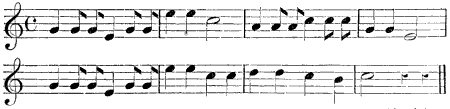
Green grow the leaves (or grows the ivy) round the old oak tree, Green grow the leaves round the old oak tree, Green grow the leaves round the old oak tree, As we go marching on. Bless my life I hardly knew you, Bless my life I hardly knew you, Bless my life I hardly knew you, As we go marching on.
—Lincolnshire and Nottinghamshire (Miss Peacock).
II.
Green grow the leaves on the old oak tree, I love the boys and the boys love me, As we go marching on.
—Sharleston (Miss Fowler).
III.
I love the boys and the boys love me, I love the boys and the boys love me, I love the boys and the boys love me, As we go marching home. Glory, glory, hallelujah! Glory, glory, hallelujah! Glory, glory, hallelujah! As we go marching home. The old whiskey bottle lies empty on the shelf, The old whiskey bottle lies empty on the shelf, The old whiskey bottle lies empty on the shelf, As we go marching home.
—Earls Heaton, Yorkshire (Herbert).
(b) In Lincolnshire and Nottinghamshire the game is played by the children forming a circle and dancing round, singing. The first and third lines are sung three times. Partners are chosen during the singing of the last line. Miss Peacock adds, “The rest wanting, as my informant had forgotten the game.” In the Sharleston version the children march round two by two, in a double circle, with one child in the centre, singing the verse. At the conclusion, the children who are marching on the inner side of the circle leave their partners and take the place of one in front of them, while the centre child endeavours to get one of the vacant places, the child turned out taking the place of the one in the centre, when the game begins again. In the Earls Heaton version there is the circle of children, with one child in the centre, who chooses a partner after the lines have been sung.
(c) From this it would seem that while the Lincolnshire and Nottinghamshire words appear to be the most complete, the action has been preserved best at Sharleston. The acting of this version is the same as that of “The Jolly Miller.” The third variant is evidently an imitation of the song, “John Brown.”
Green Grow the Leaves (2)
[Play]
—Northants (R. S. Baker).
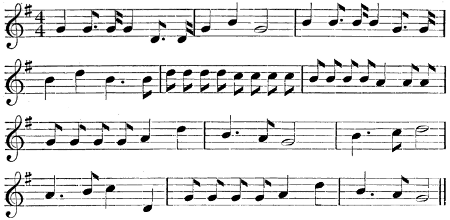
Green grow the leaves on the hawthorn tree, Green grow the leaves on the hawthorn tree, We jangle and we wrangle and we never can agree, But the tenor of our song goes merrily, merrily, merrily, The tenor of our song goes merrily.
—R. S. Baker (Northants Notes and Queries, ii. 161).
(b) One couple is chosen to lead, and they go off, whither they will, followed by a long train of youths and maidens, all singing the refrain. Sometimes the leaders part company, and branch off to the right or left; the others have to do the same, and not until the leaders meet can they join again. They march arm in arm.
(c) Mr. R. S. Baker, who records this, says a Wellingborough lady sent him the tune and words, and told him the game was more like a country dance than anything else, being a sort of dancing “Follow My Leader.”
Gully
A sink, or, failing that, a particular stone in the pavement was the “Gully.” Some boy chosen by lot, or one who volunteered in order to start the game, laid his top on the ground at some distance from the “Gully.” The first player then spun his top, pegging at the recumbent top, so as to draw it towards the “Gully.” If he missed the top, he stooped down and took up his own top by pushing his hand against it in such a manner that the space between his first and second finger caught against the peg and forced the top into the palm of his hand. He then had “a go” at the recumbent top (I forget what this was called), and sent his own top against it so as to push it towards the “Gully.” If he missed, he tried again and again, until his own top could spin no longer. If he did not hit the top with his own while it was spinning, his top had to be laid down and the other one taken up, and its owner took his turn at pegging. When a spinning-top showed signs of exhaustion, and the taking it up might kill it, and it was not very far from the down-lying top, its owner would gently push it with his finger, so as to make it touch the other top, and so avoid putting it into the other’s place. This was called “kissing,” and was not allowed by some players. When one player succeeded in sending the top into the “Gully,” he took it up and fixed it by its peg into a post, mortar of a wall, or the best place where it could be tolerably steady. Holding it by one hand, he drove the peg of his own top as far as he could into the crown of the victim top. This was called “taking a grudge.” He then held either his own or the victim top and knocked the other against the wall, the object being to split the victim. He was allowed three “grudges.” If the top did not give way, the other players tried in turn. If the top did not split, it was returned to its owner, but any boy who succeeded in splitting it through the middle, so that the peg fell out, took possession of the peg. I have seen a top split at the side in such a way as to be quite useless as a top, though no peg was gained. I remember, too, a schoolfellow of mine drawing from his pocket some seven or eight pegs, the trophied memorials of as many tops.—London (J. P. Emslie).
See “Hoatie,” “Hoges,” “Peg-top.”
Hairry my Bossie
This is a game of chance. The players are two, and may be boys or girls, or a boy and a girl. The stakes may be pins, buttons, marbles, or anything for which children gamble. One player puts a number, one, two, three or more, of the articles to be gambled for into the hollow of the closed hand, and says, “Hairry my bossie;” the other answers, “Knock ’im down,” upon which he puts his closed hands down with a blow on his knees, and continues to strike them upwards and downwards on the knee, so as to give the opponent in play an idea of the number of objects concealed by the sound given forth. He then says, “How many blows?” and gets the reply, “As many’s goes.” A guess is then made. If the guess is correct the guesser gets the objects. If the guess is incorrect the guesser has to make up the difference between the number guessed and the real number. The players play alternately. This game was played for the most part at Christmas.—Keith (Rev. W. Gregor).
(b) Hairry = “rob,” Bossie = “a wooden bowl,” commonly used for making the leaven in baking oat-cakes, and for making “brose.”
This is a very general game amongst schoolboys.
Half-Hammer
The game of “Hop-step-and-jump,” Norfolk. This game is played in the west of Sussex, but not in the east. It is played thus by two or more boys. Each boy in his turn stands first on one leg and makes a hop, then strides or steps, and lastly, putting both feet together, jumps. The boy who covers the most ground is the victor.—Halliwell’s Dictionary.
Han’-and-Hail
A game common in Dumfries, thus described by Jamieson. Two goals called hails, or dules, are fixed on at about a distance of four hundred yards. The two parties then place themselves in the middle between the goals or dules, and one of the players, taking a soft elastic ball, about the size of a man’s fist, tosses it into the air, and, as it falls, strikes it with his palm towards his antagonists. The object of the game is for either party to drive the ball beyond the goal which lies before them, while their opponents do all in their power to prevent this. As soon as the ball is gowf’t, that is, struck away, the opposite party endeavour to intercept it in its fall. This is called keppan’ the ba’. If they succeed in this attempt, the player who does so is entitled to throw the ball with all his might towards his antagonists. If he kep it in the first bound which it makes off the ground, called a stot, he is allowed to haunch, that is, to throw the ball by bringing his hand with a sweep past his thigh, to which he gives a stroke as his hand passes, and discharging the ball at the moment when the stroke is given. If the ball be caught in the second bounce, the catcher may hoch the ball, that is, throw it through below one of his houghs. If none of the party catch the ball, it must be gowf’t in the manner before described. As soon as either of the parties succeed in driving the ball, or, as it is called, hailin’ the dules, the game then begins by one of the party which was successful throwing the ball towards the opposing goal and the other party striving to drive it back.
Hand in and Hand out
A game played by a company of young people who are drawn up in a circle, when one of them, pitched upon by lot, walks round the band, and, if a boy, hits a girl, or, if a girl, she strikes a boy whom she chooses, on which the party striking and the party struck run in pursuit of each other till the latter is caught, whose lot it then becomes to perform the same part. A game so called was forbidden by statute of Edward IV.—Halliwell’s Dictionary.
See “Drop Handkerchief.”
Handy-Croopen
A game in which one of the players turns his face to the wall, his hand resting upon his back. He must continue in position until he guesses who struck his hand, when the striker takes his place.—Orkney and Shetland (Jamieson’s Dictionary).
See “Hot Cockles.”
Handy Dandy
I.
Handy dandy, Sugary candy— Top or bottom? Handy spandy, Jack a dandy— Which good hand will you have?
—Halliwell’s Dictionary: Nursery Rhymes, p. 216.
II.
Handy dandy riddledy ro— Which will you have, high or low?
—Halliwell’s Nursery Rhymes, p. 216.
III.
Handy pandy, Sugary candy, Which will you have— Top or bottom?
—London (A. B. Gomme).
IV.
Handy pandy, Jack a dandy, Which hand will you have?
—Burne’s Shropshire Folk-lore, p. 530.
(b) The hands are closed, some small article is put in one of them behind the back of the player. The closed fists are then turned rapidly round one another while the rhyme is being said, and they are then placed one on top of the other. A guess is then made by any one of the players as to which hand the object is in. If correct, the guesser obtains the object; if incorrect, the player who performs “Handy dandy” keeps it.
(c) This game is mentioned in Piers Plowman, p. 69 of Wright’s edition. Douce quotes an ancient MS. which curiously mentions the game as “men play with little children at ‘handye-dandye,’ which hand will you have” (ii. 167). Johnson says: “‘Handy dandy,’ a play in which children change hands and places: ‘See how yon justice rails upon yon simple thief! Hark, in thine ear: change places, and, handy dandy, which is the justice, which is the thief?” (King Lear, iv. 6). Malone says, “‘Handy dandy’ is, I believe, a play among children, in which something is shaken between two hands, and then a guess is made in which hand it is retained.” See Florio’s Italian Dictionary, 1598: “Bazzicchiare, to shake between the hands; to play ‘Handy dandy.’” Pope, in his Memoirs of Cornelius Scriblerus, in forbidding certain sports to his son Martin till he is better informed of their antiquity, says: “Neither cross and pile, nor ducks and drakes, are quite so ancient as ‘Handy dandy,’ though Macrobius and St. Augustine take notice of the first, and Minutius Foelix describes the latter; but ‘Handy dandy’ is mentioned by Aristotle, Plato, and Aristophanes.” Browne, in Britannia’s Pastorals (i. 5), also alludes to the game.
See “Neiveie-nick-nack.”
Hap the Beds
A singular game, gone through by hopping on one foot, and with that foot sliding a little flat stone out of an oblong bed, rudely drawn on a smooth piece of ground. This bed is divided into eight parts, the two of which at the farther end of it are called the Kail-pots. If the player then stands at one end, and pitches the smooth stone into all the divisions one after the other, following the same on a foot (at every throw), and bringing it out of the figure, this player wins not only the game, but is considered a first-rate daub at it; failing, however, to go through all the parts so, without missing either a throw or a hop, yet keeping before the other gamblers (for many play at one bed), still wins the curious rustic game.—Mactaggart’s Gallovidian Encyclopædia.
A game called “The Beds,” mentioned by a writer in Blackwood’s Magazine, August 1821, p. 36, as played in Edinburgh when he was a boy by girls only, is described as a game where a pitcher is kicked into chalked divisions of the pavement, the performer being on one leg and hopping.
See “Hop-scotch.”
Hard Buttons
Several boys place one button each close together on a line. The game consists in hitting a particular button out of this line with the nicker without touching the others. This is generally played in London streets, and is mentioned in the Strand Magazine, ii. 515.
See “Banger,” “Buttons.”
Hare and Hounds
A boys’ game. One boy is chosen as the Hare. He carries with him a bag filled with strips of paper. The rest of the boys are the Hounds. The Hare has a certain time (say fifteen minutes) allowed him for a start, and he goes across country, scattering some paper on his way in order to indicate his track. He may employ any manœuvre in order to deceive his pursuers, but must keep up the continuity of his paper track-signs. The Hounds follow him and try to catch him before he gets home, which is a place agreed upon beforehand.—London (G. L. Gomme).
In Cornwall the leader, when at fault, says—
Uppa, uppa, holye! If you don’t speak My dogs shan’t folly.
—Courtney (Folk-lore Journal, v. 73).
Other versions of this holloa are—
Whoop, whoop, and hollow! Good dogs won’t follow Without the hare cries, Peewit.
—Halliwell’s Nursery Rhymes, p. 66.
Sound your holler, Or my little dog shan’t foller.
—Northall’s English Folk Rhymes, p. 357.
This game is played in Wales under the name of “Hunt the Fox.” The Fox has a certain time given him for a start, the other players then go after him.—Beddgelert (Mrs. Williams).
Harie Hutcheon
A game among children, in which they hop round in a ring, sitting on their hams.—Jamieson.
See “Curcuddie,” “Cutch-a-cutchoo,” “Hirtschin Hairy.”
Hark the Robbers
[Play]
—Tong, Shropshire (Miss R. Harley).
I.
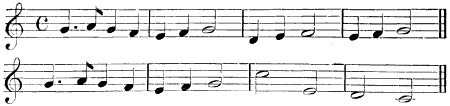
Hark the robbers coming through, Coming through, Hark the robbers coming through, My fair lady. What have the robbers done to you, Done to you, What have the robbers done to you, My fair lady? You have stole my watch and chain, Watch and chain, You have stole my watch and chain, My fair lady. Half-a-crown you must pay, You must pay, Half-a-crown you must pay, My fair lady. Half-a-crown we cannot pay, Cannot pay, Half-a-crown we cannot pay, My fair lady. Off to prison you must go, You must go, Off to prison you must go, My fair lady.
—Deptford, Kent (Miss Chase).
II.
Here are the robbers coming through, Coming through, coming through, Here are the robbers coming through, My fair lady. What will the robbers do to you, Do to you, do to you, What will the robbers do to you, My fair lady? Steal your watch and break your chain, Break your chain, break your chain, Steal your watch and break your chain, My fair lady. Then they must go to jail, Go to jail, go to jail, Then they must go to jail, My fair lady.
—Belfast (W. H. Patterson).
III.
Hark the robbers Coming through, coming through, My fair lady. They have stolen my watch and chain, Watch and chain, watch and chain. Off to prison they shall go, They shall go, they shall go, My fair lady.
—Wolstanton, Stoke-on-Trent (Miss A. A. Keary).
IV.
Hark the robbers coming through, Coming through, coming through, Hark the robbers coming through, My fair lady. What’s the robbers done to you, Done to you, done to you, What’s the robbers done to you, My fair lady? They have stole my watch and chain, Watch and chain, watch and chain, They have stole my watch and chain, My fair lady. What’s the price will set you free, Set you free, set you free, What’s the price will set you free, My fair lady? Half-a-guinea will set me free, Will set me free, will set me free, Half-a-guinea will set me free, My fair lady. Half-a-guinea you shall not have, Shall not have, shall not have, Half-a-guinea you shall not have, My fair lady. Let’s join hands, it is too late, ’Tis too late, ’tis too late, Let’s join hands, it is too late, My fair lady.
—Tong, Shropshire (Miss R. Harley).
V.
Hark at the robbers going through, Through, through, through; through, through, through; Hark at the robbers going through, My fair lady. What have the robbers done to you, You, you, you; you, you, you? What have the robbers done to you, My fair lady? Stole my gold watch and chain, Chain, chain, chain; chain, chain, chain; Stole my gold watch and chain, My fair lady. How many pounds will set us free, Free, free, free; free, free, free? How many pounds will set us free, My fair lady? A hundred pounds will set you free, Free, free, free; free, free, free; A hundred pounds will set you free, My fair lady. We have not a hundred pounds, Pounds, pounds, pounds; pounds, pounds, pounds; We have not a hundred pounds, My fair lady. Then to prison you must go, Go, go, go; go, go, go; Then to prison you must go, My fair lady. To prison we will not go, Go, go, go; go, go, go; To prison we will not go, My fair lady.
—Shipley, Horsham (Notes and Queries, 8th Series, i. 210, Miss Busk).
VI.
See the robbers coming through, Coming through, coming through, See the robbers coming through, A nice young lady. Here’s a prisoner we have got, We have got, we have got, Here’s a prisoner we have got, A nice young lady. How many pounds to set her free, Set her free, set her free, How many pounds to set her free, A nice young lady? A hundred pounds to set her free, Set her free, set her free, A hundred pounds to set her free, A nice young lady. A hundred pounds we cannot give, We cannot give, we cannot give, A hundred pounds we cannot give, A nice young lady. Then to prison she must go, She must go, she must go, Then to prison she must go, A nice young lady. If she goes we’ll go too, We’ll go too, we’ll go too, If she goes we’ll go too, A nice young lady. Round the meadows we will go, We will go, we will go, Round the meadows we will go, A nice young lady.
—Settle, Yorks. (Rev. W. S. Sykes).
VII.
O what has this poor prisoner done, Poor prisoner done, poor prisoner done? O what has this poor prisoner done, So early in the morning? She stole my watch and lost my key, Lost my key, lost my key, She stole my watch and lost my key, So early in the morning. How many pounds to set her free, Set her free, set her free? How many pounds to set her free, So early in the morning? Five hundred pounds to set her free, Set her free, set her free, Five hundred pounds to set her free, So early in the morning. Five hundred pounds we have not got, Have not got, have not got, Five hundred pounds we have not got, So early in the morning. So off to prison she must go, She must go, she must go, So off to prison she must go, So early in the morning. If she go then I’ll go too, I’ll go too, I’ll go too, If she go then I’ll go too, So early in the morning. So round the meadows we must go, We must go, we must go, So round the meadows we must go, So early in the morning.
—Sporle, Norfolk (Miss Matthews).
(b) In the Deptford version two girls join hands, holding them up as an arch for the other players to tramp through. The first two verses are sung first by one and then by the other of the two girls. At the finish of these the girl then going through the arch is stopped, and the third, fourth, and fifth verses are sung by the two girls alternately. Then finally both girls sing the last verse, and the child is sent as prisoner behind one or other of the two girls. The verses are then begun again, and repeated afresh for each of the troop marching through the arch until all of them are placed behind one or other of the two girls. The two sides thus formed then proceed to tug against each other, and the strongest side wins the game.
The Belfast version is practically the same, except that the verses are not sung as a dialogue, but by all the players together, and the prisoner, when caught, has the choice of sides, by being asked, “Which will you have, a golden apple or golden pear?” and according to the answer given is sent behind one of the leaders. The Norfolk and Shropshire games are different. Miss Matthews thus describes the Norfolk game: “Two girls take hold of hands, and another, the prisoner, stands between them. The rest form themselves into a line opposite, and advance and retreat while singing the first verse, the gaolers singing the next verse, and so on alternately. [At the end of the last verse but one] the children break the line, form themselves into a ring, and dance round the prisoner, singing the final verse.” Miss Harley describes the Shropshire version as follows: “The first six verses are sung by the alternate parties, who advance and retire, tramping their feet, at first, to imitate the robbers. The last verse is sung altogether going round in a ring.” In the Shipley version, Miss Busk says: “The children form themselves into two lines, while two or three, representing the robbers, swagger along between them. When the robbers sing the last verse they should have attained the end of the lines [of children], as during the parley they were safe; having pronounced the defiance they run away. The children in the lines rush after them, and should catch them and put them in prison.”
(c) The analysis of this game is easy. The Deptford, Belfast, and Wolstanton versions are clearly enough dramatic representations of the capture of a robber, and probably the game dates from the period of the prevalence of highway robbery. The Wolstanton version shows us that the game is breaking up from its earlier form, while the Norfolk and Shropshire versions show a fresh development into the mere game for children, apart from its original significance. The action of the game confirms this view. The Norfolk action seems to be the most nearly perfect in its dramatic significance, and the Shropshire action comes next. The action of the other games seems to have been grafted on to the superior form of “Oranges and Lemons.” It is probable that this fact has preserved the words more completely than in the other cases, where the force of the robber action would become less and less as actual experience of robbers and robbery died out. Altogether, this game supplies a very good example of the change produced in games by changes in the actual life which gave rise to them. It is singular that the verses of this game also enter into the composition of “London Bridge is broken down.” It is probable, therefore, that it may be an altered form of the game of “London Bridge.” The refrain, “My fair lady,” occurs in both games.
See “London Bridge.”
Hats in Holes
A boys’ game. The players range their hats in a row against the wall, and each boy in turn pitches a ball from a line at some twenty-five feet distance into one of the hats. The boy into whose hat it falls has to seize it and throw it at one or other of the others, who all scamper off when the ball is “packed in.” If he fails to hit he is out, and takes his cap up. The boy whose cap is left at the last has to “cork” the others, that is, to throw the ball at their bent backs, each in turn stooping down to take his punishment.—Somerset (Elworthy’s Dialect).
See “Balls and Bonnets.”
Hattie
A game with preens, pins, on the crown of a hat. Two or more may play. Each lays on a pin, then with the hand they strike the side of the hat time about, and whoever makes the pins by a stroke cross each other, lifts those so crossed.—Mactaggart’s Gallovidian Encyclopædia.
Hawkey
A game played by several boys on each side with sticks called “hawkey bats,” and a ball. A line is drawn across the middle of the ground from one side to the other; one party stands on one side of the line and the opposite party on the other, and neither must overstep this boundary, but are allowed to reach over as far as their bats will permit to strike the ball. The object is to strike the ball to the farther end to touch the fence of the opposing party’s side, when the party so striking the ball scores one, and, supposing nine to be the game, the party obtaining that number first of course wins the game.—West Sussex (Holloway’s Dict. of Provincialisms).
See “Bandy,” “Doddart,” “Hockey.”
Headicks and Pinticks
This game was played only at Christmas. The number of players was two. The stakes were pins. One player laid in the hollow of the hand, or on one of the forefingers, a pin, and then placed the other forefinger over it so as to conceal it. He then held up his hand to his opponent and said, “Headicks or pinticks?” His opponent made a guess by pointing with his finger and saying “Headicks,” or “Pinticks.” If the guess was correct he gained the pin, but if it was incorrect he forfeited one. The players played alternately.—Keith (Rev. W. Gregor).
Another version seems to be “Headim and Corsim.” Pins are hid with fingers in the palms of the hands; the same number is laid alongside them, and either “Headim” or “Corsim” called out by those who do so. When the fingers are lifted, if the heads of the pins hid and those beside them be lying one way when the crier cried “Headim,” then that player wins; but if “Corsim,” the one who hid the pins wins. This is the king of all the games at the preens.—Mactaggart’s Gallovidian Encyclopædia.
The editors of Jamieson’s Dictionary say that the name should be “Headum and Corsum.”
Heads and Tails
That plan for deciding matters by the “birl o’ a bawbee.” The one side cries “Heads” (when the piece is whirling in the air) and the other “Tails,” so whichever is uppermost when the piece alights that gains or settles the matter, heads standing for the King’s head and tails for the figure who represents Britannia.—Mactaggart’s Gallovidian Encyclopædia. This is a general form of determining sides or beginning a game all over the country.
Hecklebirnie
A play among children in Aberdeenshire. Thirty or forty children in two rows, joining opposite hands, strike smartly with their hands thus joined on the head or shoulders of their companion as he runs the gauntlet through them. This is called “passing through the mires of Hecklebirnie.”—Jamieson.
The editors of Jamieson append a lengthy note connecting the name of this game with the northern belief that the wicked were condemned to suffer eternal punishment in Hecla, the volcanic mountain in Iceland.
See “Namers and Guessers.”
Hen and Chicken
Chickery, chickery, cranny crow, I went to the well to wash my toe, When I got back a chicken was dead.
This verse is said by the Hen to her Chickens, after which they all go with the Hen to search for the dead Chicken. On their way they meet the Fox. The following dialogue between the Fox and Hen ensues, the Hen beginning:—
What are you doing? Picking up sticks. What for? To make a fire. What’s the fire for? To boil some water. What’s the water for? To boil some chickens in. Where do you get them from? Out of your flock. That I’m sure you won’t.
—Derbyshire (Folk-lore Journal, i. 386).
The game is played in the usual manner of “Fox and Goose” games. One is chosen to be the Hen, and one to be the Fox. The rest are the Chickens. The Chickens take hold of each other’s waists, the first one holding the Hen’s waist. At the end of the dialogue the Fox tries to get hold of one of the chickens. If he succeeds in catching them, they all with the Fox try to dodge the Hen, who makes an effort to regain them.
It is known at Winterton under the name of “Pins and Needles.” The players stand in a row, one behind another, with one of the party as their Leader. Another player, called “Outsider,” pretends to scratch the ground. The Leader asks, the questions, and the Outsider replies—
What are you scratching for? Pins and needles. What do you want your pins and needles for? To mend my poke. What do you want your poke for? To put some sand in. What do you want your sand for? To sharpen knives with. What do you want your knives for? To cut all the little chickens’ heads off with.
Here the Outsider tries to dodge past the Leader to catch one of the children at the further end of the row, the Leader meanwhile attempting to bar her progress. When at last she succeeds, the child caught takes her place, and the game is recommenced.—Winterton (Miss M. Peacock).
See “Fox and Goose,” “Gled-wylie.”[Addendum] [Addendum] [Addendum]
Here comes a Lusty Wooer
[Play]
—Rimbault’s Nursery Rhymes.
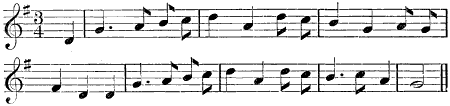
Here comes a lusty wooer, My a dildin, my a daldin; Here comes a lusty wooer, Lily bright and shine a’. Pray who do you woo? My a dildin, my a daldin; Pray who do you woo? Lily bright and shine a’. For your fairest daughter, My a dildin, my a daldin; For your fairest daughter, Lily bright and shine a’. Then there she is for you, My a dildin, my a daldin; Then there she is for you, Lily bright and shine a’.
—Ritson (Gammer Gurton’s Garland, 1783).
Northall says this game is played after the manner of the “Three Dukes” (Folk Rhymes, p. 383). Halliwell (Nursery Rhymes, p. 98) has a version, and Rimbault (Nursery Rhymes) gives both words and tune. It is also contained in The Merrie Heart (p. 47). See “Jolly Hooper,” “Jolly Rover.”
Here comes One Virgin
Here comes one Virgin on her knee, On her knee, on her knee, Here comes one Virgin on her knee, Pray what will you give her? When did you come? I came by night and I came by day, I came to steal poor Edie away. She is too old, she is too young, She hasn’t learnt her virgin tongue. Let her be old or let her be young, For her beauty she must come. In her pocket a thousand pounds, On her finger a gay gold ring. Good-bye, good-bye, my dear.
—Hurstmonceux, Sussex (Miss Chase).
One child stands by herself, and the rest of the players range themselves in line. The child sings the first verse and the line replies, the four succeeding verses being alternately sung. After the last line the girl tries to pull one whom she has chosen from the line toward her. If not successful, she must try again. If she is, they both stand in the middle, and commence singing the words again with—
Here come two virgins on their knees, &c.
Probably a degraded version of “Three Lords from Spain.”
Here I sit on a Cold Green Bank
Here I sit on a cold green bank On a cold and frosty morning. We’ll send a young man [or woman] to take you away, To take you away, We’ll send a young man to take you away, On a cold and frosty morning. Pray tell me what his name shall be? [or] Pray, whom will you send to take me away? We’ll send Mr. —— to take you away.
The children form a ring around one of the party, who sits in the middle, and says the two first lines. Then those in the circle dance round her, singing the next four lines. This is repeated three times, with the refrain, “On a cold,” &c., after which the dancing and singing cease, and the child is asked, “Sugar, sweet, or vinegar, sour?” Her answer is always taken in a contrary sense, and sung, as before, three times, whilst the children circle round. The one in the middle then rises to her feet. The boy (or girl) named advances and kisses her, they change places, and the game begins again.—Cornwall (Folk-lore Journal, v. 56-57).
Here stands a Young Man
I.
Here stands a young man who wants a sweetheart, With all his merry maids round him; He may choose from east, he may choose from west, He may choose the prettiest girl that he loves best. Now this young couple is married together, We propose they kiss each other.
—Glapthorn (Northants Notes and Queries, i. 214, A. Palmer).
II.
Here stands a young lady [lass] who wants a sweetheart, Wants a sweetheart, wants a sweetheart, And don’t know where to find one, find one, find one. Choose the prettiest that you loves best. Now you’re married I wish you joy, First a girl and then a boy, Seven years after son and daughter, Pray you come to kiss together.
—Longcot, Berkshire (Miss I. Barclay).
(b) A ring is formed by the players joining hands, one child standing in the centre. The ring dance round singing the first four lines. At the fourth line the child in the centre chooses one from the ring, who goes into the centre with her. The marriage formula or chorus is then sung, the two kiss, and the one who was first in the centre joins the ring, the second one choosing another in her turn. Played by both boys and girls.
See “Sally Water,” “Silly Old Man.”
Here we go around, around
[Play]
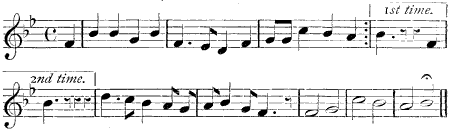
Our shoes are made of leather, Our stockings are made of silk, Our pinafores are made of calico, As white as any milk. Here we go around, around, around, And we shall touch the ground.
—Barnes and London Streets (A. B. Gomme).
A ring is formed by the children joining hands. They walk round singing the first four lines. They then dance round quickly and sit down suddenly, or touch the ground with their clothes.
A version of this game from Liphook, Hants, almost identical in words, has been sent by Miss Fowler, and another from Crockham Hill, Kent, by Miss Chase.
Here’s a Soldier
Here’s a soldier left his lone [qy. alone], Wants a wife and can’t get none. Merrily go round and choose your own, Choose a good one or else choose none; Choose the worst or choose the best, Or choose the very one you like best. What’s your will, my dilcy dulcy officer? What’s your will, my dilcy dulcy dee? My will is to marry, my dilcy dulcy officer; My will is to marry, my dilcy dulcy dee. Come marry one of us, my dilcy dulcy officer; Come marry one of us, my dilcy dulcy dee. You’re all too old and ugly, my dilcy dulcy officer; You’re all too old and ugly, my dilcy dulcy dee. Thrice too good for you, sir, my dilcy dulcy officer; Thrice too good for you, sir, my dilcy dulcy dee. This couple got married, we wish them good joy, Every year a girl and a boy, And if that does not do, a hundred and two, We hope the couple will kiss together.
—Annaverna, co. Louth (Miss R. Stephen).
(b) One child stands in the middle, the others dance round singing. The one in the middle chooses another before the four last lines are sung. Then the rest dance round singing these lines, and kiss each other.
(c) It is evident that these words comprise two distinct games, which have become mixed in some inexplicable fashion. The first six lines and the last four are one game, a ring form, with the marriage formula and blessing. The other portion of the game is a dialogue game, evidently having had two lines of players, questions being asked and answers given. It is, in fact, a part of the “Three Dukes” game. The first part is a kiss-in-the-ring game, a version of “Here stands a Young Man,” “Silly Old Man,” and “Sally Water.”[Addendum]
Hewley Puley
Take this, What’s this? Hewley Puley. Where’s my share? About the kite’s neck. Where’s the kite? Flown to the wood. Where’s the wood? The fire has burned it. Where’s the fire? The water’s quenched it. Where’s the water? The ox has drunk it. Where’s the ox? The butcher has killed it. Where’s the butcher? The rope has hanged him. Where’s the rope? The rat has gnawed it. Where’s the rat? The cat has killed it. Where’s the cat? Behind the door, cracking pebble-stones and marrow-bones for yours and my supper, and the one who speaks first shall have a box on the ear.
—Halliwell’s Nursery Rhymes, p. 222.
The children are seated, and the questions are put by one of the party who holds a twisted handkerchief or something of the sort in the hand. The handkerchief was called “hewley puley,” and the questions are asked by the child who holds it. If one answers wrongly, a box on the ear with the handkerchief was the consequence; but if they all replied correctly, the one who broke silence first had that punishment.
For similar rhymes see “Dump,” “Mother, may I go out?”
Hey Wullie Wine
I.
Hey Wully wine, and How Wully wine, I hope for hame ye’ll no incline; Ye’ll better light, and stay a’ night, And I’ll gie thee a lady fine. Wha will ye gie, if I wi’ ye bide, To be my bonny blooming bride, And lie down lovely by my side? I’ll gie thee Kate o’ Dinglebell, A bonny body like yersell. I’ll stick her up in the pear-tree Sweet and meek, and sae is she: I lo’ed her ance, but she’s no for me, Yet I thank ye for your courtesy. I’ll gie thee Rozie o’ the Cleugh, I’m sure she’ll please thee weel eneugh. Up wi’ her on the bane dyke, She’ll be rotten or I’ll be ripe: She’s made for some ither, and no me, Yet I thank ye for your courtesy. Then I’ll gie ye Nell o’ sweet Sprinkell, Owre Galloway she bears the bell. I’ll set her up in my bed-head, And feed her wi’ milk and bread; She’s for nae ither, but jist for me, Sae I thank ye for your courtesy.
—Mactaggart’s Gallovidian Encyclopædia.
II.
I maun ride hame, I maun gang hame, And bide nae langer here; The road is lang, the mirk soon on, And howlets mak’ me fear. Light doon and bide wi’ us a’ night, We’ll choose ye a bonnie lass; Ye’ll get your wull and pick o’ them a’, And the time it soon wull pass. Which ane will ye choose, If I with you will bide? The fairest and rarest In a’ the kintra side.
A girl’s name was then mentioned. If the lad was pleased with the choice made, he replied—
I’ll set her up on a bonnie pear-tree, It’s tall and straight, and sae is she; I’d keep wauken a’ night her love to be.
If he was not pleased, he replied in one or other of the next three verses—
I’ll set her up ayont the dike, She’ll be rotten ere I be ripe, The corbies her auld banes wull pike. I’ll set her up on a high crab-tree, It’s sour and dour, and so is she; She may gang to the mools unkissed by me. Though she be good and fair to see, She’s for another, and no for me; But I thank you for your courtesie.
When a girl took the place of the lad, she replied in one or other of the three following, according as she was angry or pleased—
I’ll put him in a riddle And riddle him o’er the sea, And sell to Johnny Groat’s For a Scotch bawbee. I’ll set him up on my lum-head [chimney], And blaw him up wi’ pouther and lead; He’ll never be kissed though he be dead. I’ll set him up at my table head, Feed him wi’ sweet milk and bread, If he likes gang hame on his fine steed.
—Biggar (Wm. Ballantyne).
(b) In Biggar, all the players were seated round the hearthstone, lads on one side, lassies the other; one lad rising up said the first verse, then one acting as “maister” said the next verse. The young man then said the next two lines, to which the other replied in the two following, and naming at the close any girl he thought would be acceptable. If the lad was pleased he sang the next verse. If he was not pleased with the girl offered him he replied in either of the three following verses. The first of the three was generally said if the girl was thought to be too old; if bad-tempered, the second. If the lad found no fault, but wished to politely refuse, he sang the last verse. The girl then was asked in her turn, and the same formula gone through, she saying either of the three last verses given. Forfeits were demanded for every refusal, and were cried at the end of the game.
(c) Mr. Ballantyne writes: “This game was a great favourite in my father’s house. This was a forfeit game, forfeits being called ‘wadds.’” Chambers, Popular Rhymes, p. 124, gives a version of this game. It is practically the same as Mr. Ballantyne’s version, with only a few verbal differences. Mactaggart says, “The chief drift of this singular game seemed to be to discover the sweethearts of one another,” and such discoveries are thought valuable, but not so much as they were anciently. In any case, it appears to me that the game is an early one, or, at all events, a reflection of early custom.
Hickety, Bickety
Hickety, bickety, pease-scone, Where shall this poor Scotchman gang? Will he gang east, or will he gang west, Or will he gang to the craw’s nest?
—Chambers (Popular Rhymes, p. 122).
One boy stands with his eyes bandaged and his hands against a wall, with his head resting on them. Another stands beside him repeating the rhyme, whilst the others come one by one and lay their hands upon his back, or jump upon it. When he has sent them all to different places he turns round and calls, “Hickety, bickety!” till they have all rushed back to the place, the last in returning being obliged to take his place, when the game goes on as before.
Chambers adds, “The ‘craw’s nest’ is close beside the eye-bandaged boy, and is therefore an envied position.” Newell, Games, p. 165, refers to this game.
See “Hot Cockles.”
Hickety-hackety
The game of Hop-scotch, played with a piece of tile, which has to be kicked by the player with the foot on which he hops over lines into various squares marked on the ground.—Somersetshire (Elworthy’s Dialect).