The Conversion of Aunt Sarah
Reading edition
Larger Image
By Archibald Marshall.
I.

When young Lord Otterburn vowed before the altar of Grace Church, 114th Avenue, Chicago, to endow Miss Sadie M. Cutts with all his worldly goods, that fortunate young lady obtained a husband of attractive appearance, agreeable manners, and a sweet temper; a coronet, a beautiful but dilapidated castle in Northumberland, surrounded by an unproductive estate, and a share in the family attentions of Aunt Sarah. In exchange for these blessings she brought, as her contribution to the happiness of the married state, a warm appreciation of her husband's good qualities, a dowry which, when reckoned in dollars, touched seven figures, a frank and fearless character, and a total ignorance of the importance of Aunt Sarah in the domestic well-being of the noble house of Otterburn.
She was not left long in ignorance on this point. She had only had time to refurnish the whole of Castle Gide, to instal electric light, to rebuild the stables, adapting part of them to the requirements of a stud of motor-cars, to take the gardens in hand, and to relet most of the farms, when Aunt Sarah was upon the newly-married couple with a proposal for a visit.
"And who is Aunt Sarah, anyway?" inquired Lady Otterburn, when her husband handed her that lady's letter over the breakfast-table.
"Aunt Sarah," replied Otterburn, "is the bane of the existence of all the members of my family who can afford to keep their heads above water."
"Sounds kind of cheering," observed her ladyship. "How does she get her clutch in?"
"She proposes herself for short visits, and has never been known to leave any house where the cooking is decent and the beds comfortable under a month. She is my Uncle Otterburn's widow, and, having been left exceedingly poor, exercises the right of demanding bed and board from members of my family in rotation as often as it is convenient to her."
"If she's poor," said Lady Otterburn, "it won't harm us to give her a shake-down and a sandwich or two as often as she wants 'em. I apprehend she'll make herself agreeable in return."
"That's where you make a mistake," replied Otterburn. "Aunt Sarah has never been known to make herself agreeable in her life. In fact, she prides herself upon doing the reverse. She'll tell you before you have known her two minutes that she always says what she thinks. And she won't be telling you a lie."
"Two can play at that game," said Lady Otterburn. "Most times I say what I think myself."
"But you only think pleasant things," replied her husband. "My flower of the prairie!"
Now, Chicago is not exactly a prairie, but the young Countess of Otterburn was pretty and graceful enough to deserve the most high-flown compliments, and appreciated them when they came from her husband. She therefore graciously accepted his latest flight of imagination, and told him to write to Aunt Sarah and invite her to come to Castle Gide and stay as long as she found it convenient.
Aunt Sarah came a week later with a considerable amount of luggage, but no maid. The motor-omnibus was sent to the station to meet her, in spite of her nephew's warnings.
"She'll arrive as cross as can be," he said. "She hates motors of every description, and I don't suppose has ever been on one in her life."
"Then it's time she tried it," said Lady Otterburn. "There isn't a horse in the place that could draw a buggy fourteen miles to the depôt and back and bring her here in time for dinner."
"Well, you'll see," said Otterburn. "She'll tell us what she thinks of us when she gets here."
She did. The powerful motor-omnibus drew up before the door of Castle Gide—at which Lord and Lady Otterburn were standing to receive their guest—having completed the seven-mile journey from the station in about five-and-twenty minutes. The driver and the footman beside him wore expressions of apprehensive discomfort, and the latter jumped down off his seat to open the door at the back of the vehicle with some alacrity.
There emerged a tall and formidable-looking old lady, with an aquiline nose and abundant, well-arranged grey hair. She wore an imposing bonnet and a dress not of the latest fashion, which rustled richly. There was a cloud on her magnificent brow, her mouth was firmly closed, and she showed no signs of agreeable feeling at arriving thus at her journey's end.
Larger Image
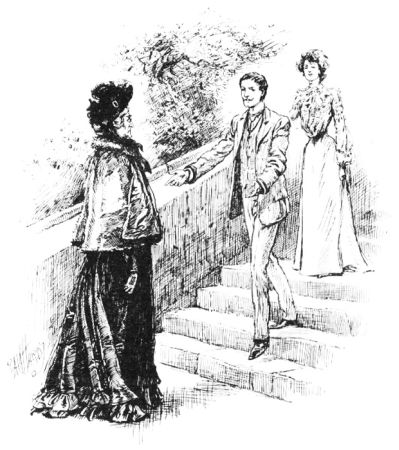
"'HOW DO YOU DO, AUNT SARAH?' SAID OTTERBURN."
"How do you do, Aunt Sarah?" said Otterburn, hastening down the steps to greet her. "Very pleased to see you again. Hope the old 'bus brought you along comfortably."
"No, Edward," replied Aunt Sarah, rigidly, "the old 'bus, as you term it, did not bring me along comfortably. I had vowed never to trust myself to one of these detestable new inventions, and I am surprised at your sending such a contrivance to meet me. This, I suppose, is your wife. How do you do, my lady? I shall probably be able to tell better how I like your appearance when I have recovered from the perilous journey to which I have been subjected. I should like to be shown at once to my room. I am much too upset by my late experience to think of joining you downstairs to-night."
"Why, certainly," said Lady Otterburn. "I'll take you upstairs, and you shall have your supper just when and how you please—right here and now if you prefer it. I want that you should make yourself at home in this house."
Aunt Sarah transfixed her with a haughty glare.
"Considering that this house was my home for five-and-thirty years," she said, "I think I can promise to do that. Thank you, Lady Otterburn. I will not detain you any longer. This was the third best bachelor's room in my day; I know my way about it well. No doubt you have other more important guests for whom the better rooms are reserved. I will wish you good-night."
"My!" said the Countess of Otterburn, on the other side of a firmly-closed door. "She's a peach!"
II.
The most consistently disagreeable people are not without their moments of relenting, and Aunt Sarah came downstairs about noon of the following day in a far better humour than she had carried to her room on her arrival at Castle Gide. In the first place she had discovered that the erstwhile bachelor rooms had been converted into a perfect little suite, with the appointments of which even a luxury-loving old lady determined to find fault with everything could hardly quarrel. During her voluntary seclusion she had been made as comfortable and waited on as well as if she were a rich woman in her own house, and the little dinner which had been served to her in the privacy of her own bijou salon was far superior to any meal that had ever been served to her before in Castle Gide, even when she had been mistress of it. Morning tea, therefore, found Aunt Sarah mollified, a dainty breakfast served to put her almost into an attitude of peace and goodwill towards mankind, and a glass of pale sherry and a dry biscuit after her toilet had been made and the morning papers read sent her downstairs with the definite intention of being civil to her nephew's wife, whom she had come to Castle Gide prepared cordially to hate.
This frame of mind lasted for several hours. Lady Otterburn devoted herself to the old lady's entertainment, and, to her husband's unconcealed astonishment, roused more than once a grim chuckle of amusement, as she rattled her clever Transatlantic tongue across the luncheon-table. Aunt Sarah pleased! Aunt Sarah laughing! Aunt Sarah allowing someone else to monopolize the conversation! He had known her all his life, but such a spectacle had hitherto been denied him.
"My dear, you're a marvel," he said to his American countess when luncheon was over and Aunt Sarah had retired to her own apartments, still in high good-humour. "You bowled me over the first time we met. That was nothing. But Aunt Sarah! I couldn't have believed it possible. I wish I had asked all my uncles and aunts and cousins to see it."
"You don't know enough to run when you're in a hurry," replied Lady Otterburn. "You'd find her a real beautiful woman if you all took her the right way."
"Well, we shall see," said Otterburn. "You've had a grand success so far, but the experience of years teaches me that seasons of calm in Aunt Sarah's life are not lasting. Much depends on the afternoon nap."
Alas! Aunt Sarah's afternoon nap was a troubled one. It may have been the lobster salad, of which she had eaten too largely; it may have been the iced hock-cup, of which she had drunk too freely, that disturbed her slumbers. Whatever it was she came down again what time the tea-table was spread in the hall with her usual inclination to make herself disagreeable strongly in the ascendant, and, if possible, augmented by the reaction from her previous state of amiability. The first audacious sally made by her hostess, which would have been received with tolerant amusement at the luncheon-table, only drew a scandalized glare from Aunt Sarah, and the ominous words: "I must ask you to remember in whose presence you find yourself, if you please."
Lady Otterburn may have been surprised at this sudden change of atmosphere, but she seemed entirely unconcerned, and took no notice of her husband's surreptitious kick underneath the tea-table, which said as plain as speech, "I told you so." She talked with gay wit, but gave no opportunity for a further rebuke. But Aunt Sarah's twisted temper was not to be softened by the most searching tact, and her next contribution to the sociability of the occasion was the remark, "This tea is positively not fit to drink. In my day Withers would not have dared to keep such stuff in his shop."
"He don't keep it now," answered her hostess. "I have it bought in China and shipped overland. It costs four dollars the pound."
"I have no doubt it is expensive," retorted Aunt Sarah, "although there is no occasion to poke your money down my throat. It is the way it is made. No servant can be trusted to make tea. I always have two teapots and make it myself. I find it is never fit to drink unless I do so."
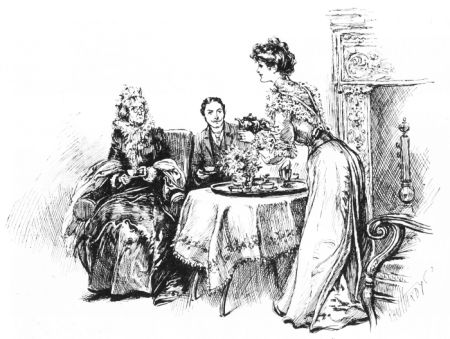
"I'd just love to have you make some for yourself," said Lady Otterburn. "I'll ring the bell for two more teapots. It's too bad you shouldn't have it as you like it."
Larger Image
"I'LL RING THE BELL FOR TWO MORE TEAPOTS."
Aunt Sarah, who was secretly rather ashamed of having mistaken caravan-borne tea for that sold by the village grocer, suffered herself to be softened again, and became almost amiable when her hostess insisted upon drinking from the fresh brew which was presently made, and declared that it was a great improvement on the old.
"I think it is better," admitted Aunt Sarah. "I may say that I have never yet met anyone who could make tea as I can. You will excuse me for having commented on yours, but, as Edward knows, I always say what I think."
Edward did know it to his cost. But again he was astonished at the sight of Aunt Sarah charmed back to good-humour when apparently in one of her most relentless moods, and with further astonishment he reminded himself that his experience did not afford a precedent for her apologizing for any word of blame that may have fallen from her lips. But he had no time to ponder on these things. Developments were proceeding.
"You find it a good plan always to say what you think?" asked Lady Otterburn, sweetly.
"It is the only honest plan," replied Aunt Sarah. "If everybody would do it instead of telling lies on all occasions, great or small, there would be a good deal less hypocrisy in the world than there is now."
"Well, I guess you are right," said Lady Otterburn. "I guess I'll commence right away and follow your example. And so will Edward. Now, mind, Edward, don't you dare to say a single word that you don't mean, and just you tell your Aunt Sarah exactly what you think as long as she's with us. And so will I. And all the people who are coming this evening shall be told to do the same."
"Eh? What?" exclaimed Aunt Sarah.
III.
When Aunt Sarah came down into the great hall at twenty minutes to nine that evening she found it full of young men and women who had arrived about an hour before, and whom she had kept waiting ten minutes for their dinner. She did not apologize for her late appearance. That was not her custom. She singled out a young man of the company and said, "How do you do, Henry? I am pleased to see you at Castle Gide again. You used to come here frequently in happier times."
"They were not happier times for me, Aunt Sarah," replied the young man, rather nervously. "My chief recollection of them is that I was generally sent to bed before dinner for getting into mischief."
"Ah!" said Aunt Sarah. "That is the way to treat mischievous boys. And you don't bear malice."
"I am afraid I do," said the young man. "I was treated most unjustly."
"By whom, pray?" inquired Aunt Sarah, beginning to bridle.
"Very occasionally by Uncle Otterburn," said the young man. "Invariably by you."
"Upon my word!" exclaimed Aunt Sarah. "That is a pretty way to talk!"
"He must say what he thinks, you know," said Lady Otterburn. "We are all going to play at that as long as we are together. Anybody who is convicted of an insincere speech is to pay half a crown to the hospital fund. Here is the box. It contains a contribution from Edward, who told Lady Griselda that she was not at all late when she came down five minutes ago. Edward, take Aunt Sarah in to dinner. She has kept us waiting for nearly a quarter of an hour."
"Have I got into a company of lunatics?" inquired Aunt Sarah, as she took her nephew's arm.
Larger Image
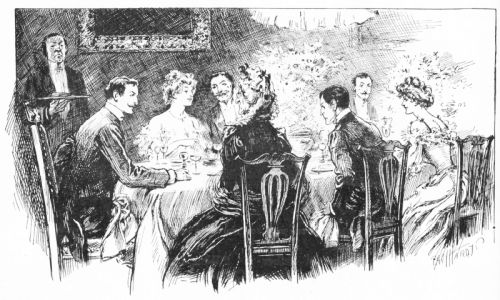
"THERE WAS A REGULAR HUBBUB OF CONVERSATION ROUND THE DINNER-TABLE."
No member of the party with the exception of Aunt Sarah had reached middle-age. Most of the men were contemporaries of Otterburn's, the years of whose pilgrimage were thirty. Some of them were married and had their wives with them, but the majority were unattached, and there were several girls, some English and some American. Otterburn's grouse-moors were the ostensible excuse for their finding themselves collected at Castle Gide, but they were so well mixed that they would probably have succeeded in enjoying themselves even if there had been no shooting to occupy the days. There was a regular hubbub of conversation round the dinner-table on this first evening, and loud peals of laughter, rising above the din and clatter of twenty tongues all moving at once, seemed to indicate that Lady Otterburn's game was adding to the gaiety of the occasion.
"No," said a demure young lady, in answer to a request from her neighbour. "I will not play accompaniments for you after dinner. It is quite true, as you say, that I read music extraordinarily well. I have always politely denied it before, but I know I do. Your singing, however, is so distasteful to me that I am sorry I cannot oblige you."
"I have got a good voice," said her neighbour, "and I have studied under the best masters."
"You have not profited by your studies," replied the lady; "and your voice, so far from being good, is very thin and of no quality whatsoever."
"I guess," said a fair American, surveying the company, "that we're a good-looking crowd round this table. And, among all the women, I have a conviction that I go up for the beauty prize. I have had to hug that conviction in secret for a very long time, and now it's out."
Thus and thus was the House of Truth built up stone by stone, and Aunt Sarah's position was pitiable. Hitherto she had made her mark in whatever society she found herself by sheer insistence on her right to be frankly and critically disagreeable. On any ordinary occasion she would have had the whole tableful of young people prostrate under the terror of her biting tongue, and not a whit would she have cared for consequent unpopularity so long as she had made herself acknowledged as the dominating spirit of the assembly. Now she was met and foiled by the dexterous use of the very weapons which she had wielded so long and so unmercifully, and no arrogant speech could she make but its sting was removed by an equally outspoken reply.
Thus, to her right-hand neighbour, a young man with smooth black hair and a preternaturally solemn face: "I don't know who you are, but by your long upper lip I should judge you to be a Mortimer."
"My name and appearance are both undoubtedly Mortimer," he replied, gravely. "My character, I am happy to say, is not."
"Perhaps you do not know," said Aunt Sarah, "that I am a Mortimer?"
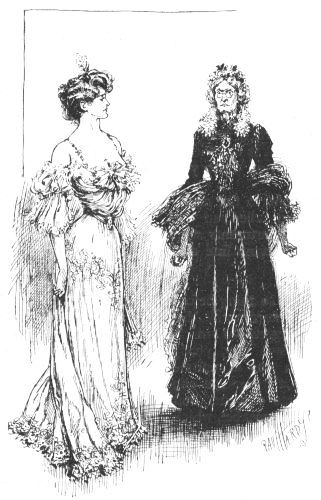
Larger Image
"'I WILL NOT STAND THIS INSOLENT BEHAVIOUR ANY LONGER,' SHE SAID."
"I am perfectly aware of it," was the answer. "It would cost me half a crown to congratulate you on the fact."
"And may I ask what fault you have to find with the family whose name you have the honour of bearing?"
"They are insufferably cantankerous and domineering."
"Not all of them," interrupted Otterburn, anxious above all desire for unsullied truth to avert the impending storm which was gathering around him. "You must not take his criticisms as personal, Aunt Sarah."
"Pass the box this way," said the solemn young man. "Otterburn will contribute another half-crown."
Before dinner was half-way through Aunt Sarah was in as black a rage as had ever darkened even her Olympian brow. By the time the ladies left the room she had delivered herself of as many insulting speeches as it usually took her a day to achieve, and her average output was no small one. But it was all to no purpose. Her most ambitious efforts, instead of striking a chill of terror to the hearts of her listeners, were warmly applauded, with an air of the utmost politeness, and from every quarter she received as good as she gave. It took her some time to realize that she was affording considerable amusement to her nephew's guests, but when she did arrive at that state of knowledge she could hardly command herself sufficiently to leave the room without doing bodily hurt to someone.
"I will not stand this insolent behaviour any longer," she said to Lady Otterburn when the door of the dining-room had been closed behind them. "How dare you treat me in this way?"
"Why, bless me, Aunt Sarah," exclaimed Lady Otterburn, in well-feigned surprise, "you said yourself that if everyone spoke the truth always, as you pride yourself on doing, it would be a real lovely thing. We are all speaking the truth under a penalty, and you are speaking it so well that you haven't been fined once."
"Psshtschah!" is the nearest possible orthographic rendering of the exclamation of contempt and disgust that forced itself from Aunt Sarah's lips. "I have had enough of this insensate folly," she continued. "I shall go straight to my room, and if I do not receive more respectful treatment in this house, where I so long reigned as undisputed mistress, I shall leave it to-morrow. Do you understand me?"
"I understand you very well," said Lady Otterburn. "And I will ask you to try and understand me. The respect which you demanded as mistress of this house is now due to me, and I look to receive it from my guests. If you discover that it is not within your power to grant it I shall not press you to prolong your visit."
Aunt Sarah again gave vent to the exclamation indicated above, and sailed up the broad staircase to her own apartments with anger and disgust marked on every line and curve of her figure.
IV.
Aunt Sarah had never been so angry before in her life. She was an extraordinarily disagreeable old woman—disagreeable in a masterly, cold-blooded, incisive way, partly because disagreeable speech was a genuine expression of her nature, partly because she had discovered in the course of years that she gained more by being disagreeable, which came easy to her, than by being pleasant, which did not. One of the weapons of her armoury was the feigning of anger, and few could stand upright before her wrath. But for this very reason she had seldom been opposed in such a way as to make her really angry, and now that this had happened to her she was almost beside herself with rage.
When she reached the cosy little sitting-room which had been devoted to her special use, having closed the door with a bang which re-echoed along the corridors, she found herself surrounded by just that atmosphere of personal comfort in which her sybaritic old soul delighted. A cheerful fire burned in the grate. Before it was drawn up the easiest of easy chairs. At the side of the chair stood a table upon which was a tray containing those refreshments, solid and liquid, with which Aunt Sarah loved best to fortify herself for the hours of darkness, a collection of papers and magazines, and half-a-dozen new books. The gay chintz curtains were close-drawn, and the electric lights behind their rosy shades threw just the right amount of light upon this pleasant interior.
Aunt Sarah had often before left a company of people in displeasure and retired to her own apartment with a bang of the door behind her. But once shut in by herself the expression of her face had usually changed, and with a grim chuckle at her own astuteness, and the remembrance of her effective departure, she had settled herself down with a mind wiped clean of emotion to the enjoyment of her own society.
But to-night Aunt Sarah took no delight in her own society, nor did her angry old face change as she closed the door on the cosy warmth of her room. It is true that she sat down in the easy chair in front of the fire. Women do not pace the room in their rage as is the custom with men. All the same, a consuming rage held her. It had in it a tinge of helplessness, and it shook her wiry old frame like an ague. Aunt Sarah was beaten, and she had the sense to recognise it.
By-and-by she began to feel rather alarmed at her state of mind. Helpless anger is not a soothing emotion, and Aunt Sarah, in spite of her well-nourished vigour, was an old woman. It was very uncomfortable to be so angry, and it was still more uncomfortable to realize that her power of keeping her own personality in the ascendant had been wrested from her by "a chit of a low-born foreigner," as she expressed it to herself.
When her anger had tired her sufficiently the feeling of helplessness increased, and sorely against her will Aunt Sarah began to pity herself. She fought against the feeling of self-pity for some time—she was made of sterner stuff than those who cherish it as a mild luxury—but it overpowered her at last. She suddenly saw herself old and, for all her many relations and acquaintances, friendless—worse than friendless, feared and disliked. She was also, for the time being, homeless. She had let her little box of a house in London for the winter, and had intended to stay at Castle Gide for at least a month. If she carried out her threat of leaving the next morning she had nowhere to go to, and she was accustomed to run things so close that she actually had not the money to take her to some place suitable to her exalted station and to keep herself there for four weeks.
Then she suddenly realized that in the depths of her queer, twisted heart she was fond of her nephew; also that her nephew's American bride had brought her both deference and entertainment as long as she had treated her with ordinary courtesy. She also discovered that she had a sentiment for Castle Gide, which had been her own home for thirty-five years, that was not wholly dependent upon its capabilities of affording her the degree of luxurious living which she most appreciated. At this point something happened which had not happened for fully half a century. Two large tears trickled down Aunt Sarah's face. She knew herself for a lonely, disagreeable old woman, very, very poor.
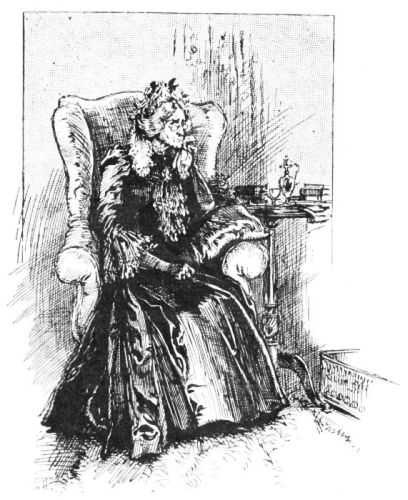
Larger Image
"SHE KNEW HERSELF FOR A LONELY, DISAGREEABLE OLD WOMAN."
When Otterburn came out of the dining-room with the rest of the men he drew his wife a little aside and said to her: "Look here, old lady, I don't think we can carry this on. I am afraid Aunt Sarah will have a fit if we bait her much more. Her eyes rolled most unpleasantly at dinner. Where is she, by-the-bye?"
"She has gone upstairs looking mighty ugly," replied her ladyship. "She is going to express her baggage home to-morrow."
"Oh, she mustn't do that," said Otterburn. "She has always gone on like that, and her bark is worse than her bite. You go and calm her down, and we'll stop this game."
"We've won," said Lady Otterburn. "But I don't feel very spry over the victory. She is an old lady, and I guess we'll just have to let her play by herself as long as she camps here. I'll go up to her right now."
So Lady Otterburn entered Aunt Sarah's room just in time to catch her drying the two tears aforesaid and a few more that had followed them. A wave of compunction passed over her, and she felt that she and her husband and their guests had all behaved with the most unmannerly brutality.
"Dear Aunt Sarah," she said, "I hate that you should be all alone up here while we are enjoying ourselves downstairs. Won't you come down and hear Mrs. Vanhooten sing? They call her the nightingale of Cincinnati in the States."
Now, if Lady Otterburn had followed the impulse that came to her to kneel by the side of the old woman and mix tears, she would almost certainly have been repulsed and would have found Aunt Sarah once more encased in a full suit of prickles; for, however much in a moment of weakness that redoubtable old lady may have pitied herself, she certainly would have permitted no one else to pity her. But Lady Otterburn was a young woman of considerable tact as well as generosity of feeling, and her method of approach proved to be the best she could have chosen.
"Not to-night," replied Aunt Sarah. "I confess to being slightly upset at what has occurred, and I do not feel equal to mixing with your guests at present."
"I guess we must have offended you with our little game," said Lady Otterburn. "But we didn't mean any harm, and we have left off playing it now."
"It has served its purpose," said Aunt Sarah, slowly. "I have been thinking matters over since I came upstairs. It is not easy for a woman of my age and character to confess herself in the wrong, but as far as you are concerned, my dear, I—I—really think that by showing mutual respect and consideration we may, perhaps, get on very well together."
The speech had not ended quite in the manner Aunt Sarah had intended when she began it, but the habits of a lifetime are not changed in a moment, and its underlying meaning was, at any rate, clear. Aunt Sarah had come as near as she had ever done in her life to an unreserved apology for her behaviour.
Lady Otterburn was prepared to meet her a good deal more than half-way.
"Of course, you feel seeing me here in your place," she said. "I don't wonder. But both Edward and I want you to look upon Castle Gide as your home just the same as before." (This was not strictly true so far as Edward was concerned, but it must be admitted to have been generous.) "And I'm new to this country and to a position to which you were born. There are so many ways in which you could help, Aunt Sarah."
"My dear," said the old woman, "any help I can give you you shall have. But I think you are quite capable of holding your own anywhere, and—and of adorning any position."
So the treaty of peace was concluded, and the Countess and the Dowager Countess of Otterburn spent a pleasant hour together talking amicably of many things.
When Aunt Sarah came downstairs the next morning she found everybody very anxious to please her. The general attitude of the party was that of people who had committed a breach of courtesy and were ashamed of themselves. Probably this attitude drove compunction into Aunt Sarah's soul more completely than any other could have done. She met advances with amiability, and exercised her fearless tongue and her undoubtedly sharp intellect to the general amusement rather than to the general terrifying of the company. By the time that the house-party broke up she had discovered, possibly to her amazement, that ascendency could be maintained as completely and far more pleasantly by force of character combined with wit and good-humour than by force of character supported by aggressive arrogance alone.
And thus, fortified by experience of its efficacy, Aunt Sarah's conversion was permanent. This is not to say that from a most objectionable old woman she changed at a bound into an exceedingly attractive one. The simile of the leopard and the Ethiopian still holds good. But there was an all-round improvement in her attitude towards the world at large which, whenever she found herself at Castle Gide, was an improvement which seemed to approach the miraculous.
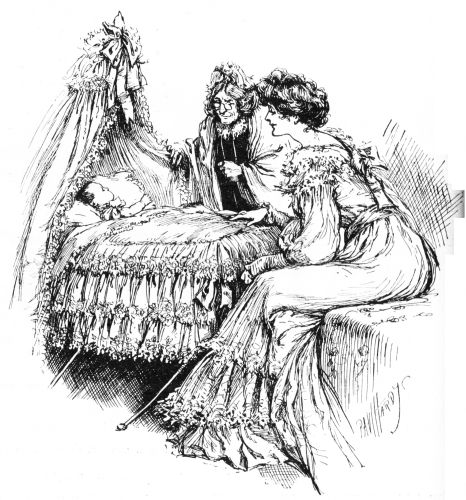
Larger Image
"THE TWO LADIES OTTERBURN WORSHIPPING TOGETHER AT A CRADLE SHRINE."
A year after the events of this story, when the two Ladies Otterburn had been worshipping together for an hour at a cradle shrine plentifully bedecked with lace, the younger of them said to her husband:—
"Dear Aunt Sarah! She has a real loving heart. I guess it was warped by her never having a baby of her own."