Solutions to the Puzzles in the December Number.
Reading edition
TRACKING THE FUGITIVES.
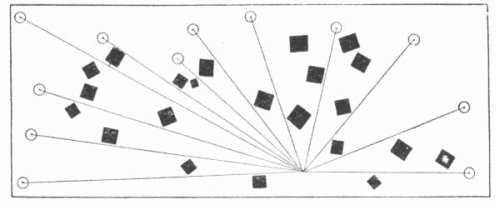
The solution of this amusing problem is as follows: The fugitive started from station No. 1 on foot, carrying the child; at station No. 2 he mounted a bicycle and, still carrying the child, rode to No. 3; there he placed the child in a wheelbarrow; as indicated by the marks of the legs of the wheelbarrow, he stopped before reaching No. 4 and put down the child, who walked by his side to the station; thence he continued his journey on a tricycle, which also carried the child; at No. 5 he changed his tricycle for a monocycle (that is, a single-wheeled cycle, such as is used by trick-riders), but the child which he was carrying caused him to lose his balance and he fell; he then took the child in his arms and carried it to No. 6; thence he started holding the child by the hand, but farther on he again took it in his arms and so completed the journey at No. 7.
THE QUARRELSOME BROTHERS.
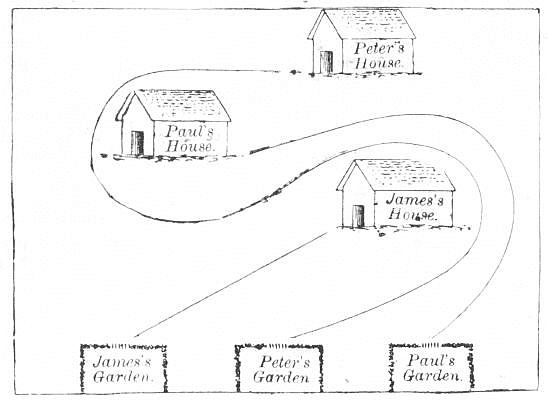
The solution of this problem will be found in the above sketch. Of course, the problem may be solved by drawing the lines the reverse way.
TO RECONSTRUCT THE CLOWN.
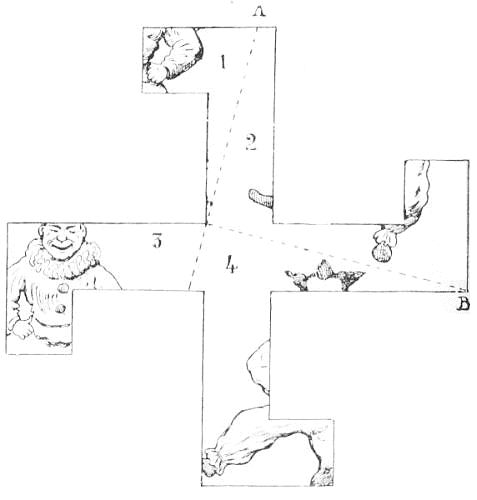
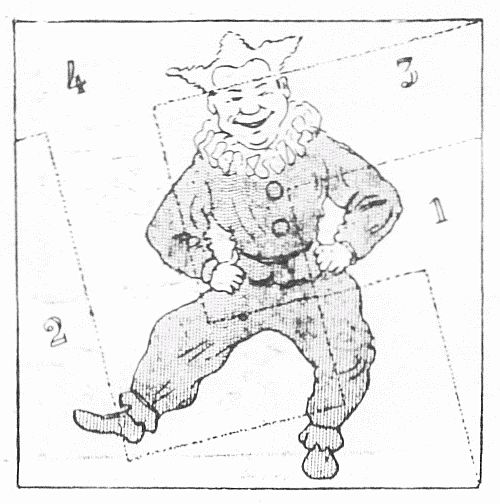
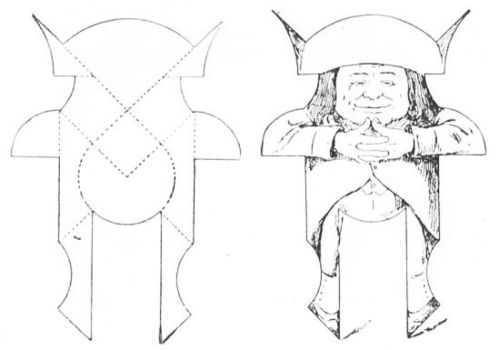
The reader will see, by inspection of the accompanying drawings, that the only way to solve this problem is by making a cut along the dotted line "A" before making that along the dotted line "B." This is the only possible method of obtaining four pieces with two cuts of the scissors. This being done, the method of rejoining the pieces so as to form the clown, as shown in the smaller diagram, will easily be followed, the pieces being numbered in order to show more readily where they fall.
A STRANGE SIGNATURE.
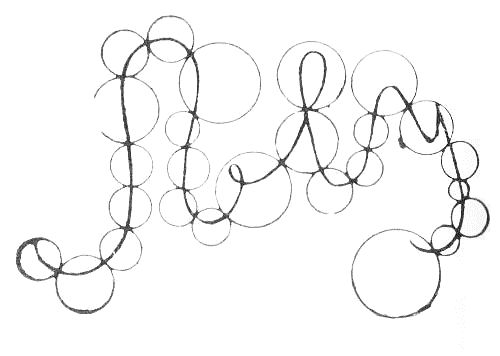
It will be seen that the signature is that of the celebrated French General, Marshal Ney.
TO MAKE A HEN OUT OF AN APPLE.
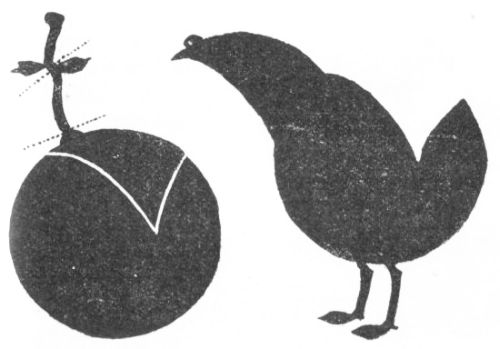
The white lines on the diagram given above of the apple will show in what manner the piece is to be cut out of it, which, being placed in its proper position, forms the neck and head of the hen. The stem being cut off and divided into two parts, as shown by the dotted lines, will give the legs, which, when attached to the body, complete the figure.
TO TURN THIS MAN INTO ANOTHER.
Larger Image
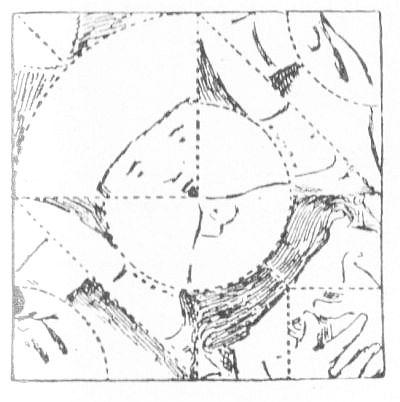
This problem is one of the most difficult of our collection. The dotted lines in the first of the accompanying three illustrations show how the original sketch has to be divided, while the other two show the manner in which the pieces require to be put together in order to form the new figure.
Larger Image
A CURIOUS MENAGERIE.
Unlike the preceding one, this problem is quite easy, and no doubt many hundreds of our readers will have found the correct solution. In order to obtain this it is only necessary to take the last triangle and paste upon its three sides the three other triangles, so as to complete the cat, the dog, and the cock, at the same time producing one large triangle composed of four small ones. The three summits of these triangles are then brought together, thus forming a pyramid. The menagerie, with the swan, the eagle, and the rabbit complete, will then be found to have been reconstructed.
A STRANGE GEOMETRICAL FIGURE.
Larger Image
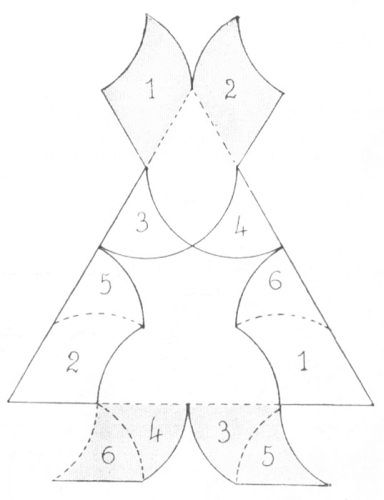
The following design gives the solution of this curious problem. The dotted lines show in which way the figure is to be cut, and the numbers indicate the new position of the pieces.
THE FACETIOUS SCHOOLBOY.
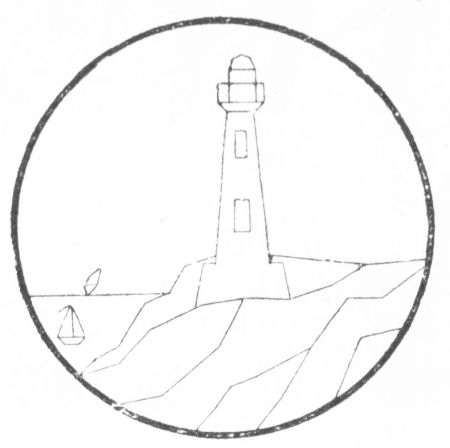
Our readers will see by a glance at the accompanying drawing what features of the original landscape it was necessary to preserve in order to solve the problem, and which were produced by the schoolboy's pencil and must accordingly be removed. The drawing represents a light-house built on the edge of a cliff.
ROUND THE CAPSTAN.
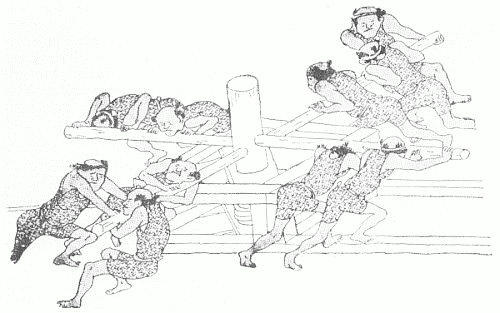
This drawing gives the solution of the problem, showing to what bodies the respective heads and legs should be attached.
THE SIGNS OF THE ZODIAC.
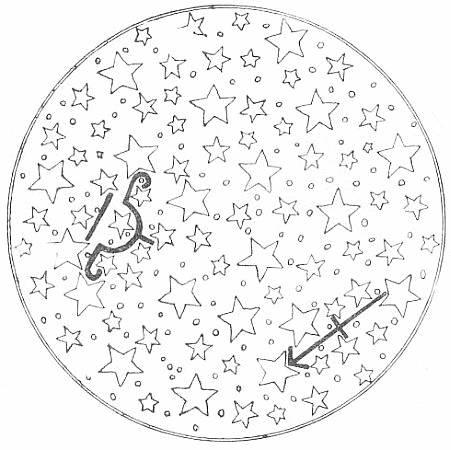
The two signs of the Zodiac which it is necessary to choose, and the method of placing them among the stars and dots, are here shown.
TO COMPLETE THE BIRDS.
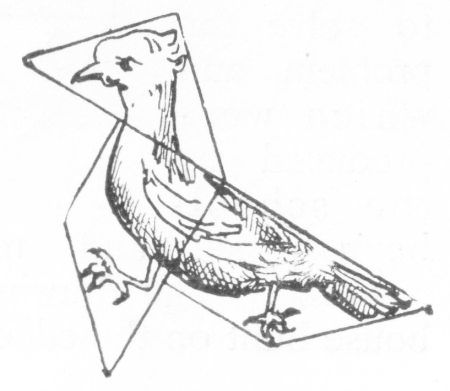
Cut the paper into an exact square just containing the birds and fold it in the well-known manner of making a "paper bird," when the two birds will appear, one as shown, and the other on the reverse.
TO MAKE A FLOWER OUT OF FOUR FREAKS.
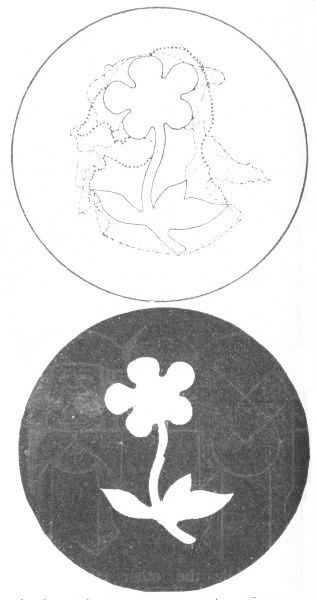
The method of making a flower out of the four grotesque heads which were represented in the diagram is one of the simplest of the series. All that is required is to cut out the four heads, remove the white part, and place them one upon the other. The space left empty then forms the flower, as will be easily understood by inspecting the two designs here given. Each figure is represented by a dotted line.
THE SERPENT AND THE FILE.
Roll the strip of paper in a spiral, and the pieces of the serpent will be joined, while the file will disappear.
A BLOT OF INK.
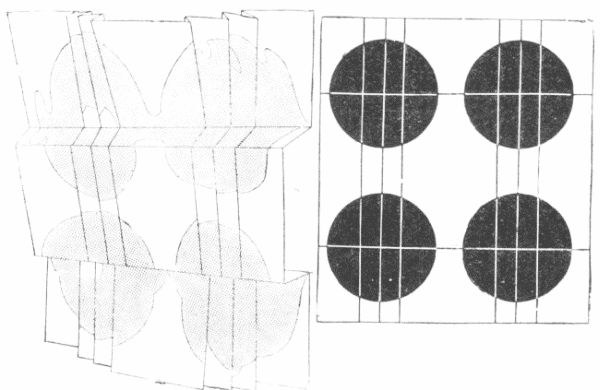
Four black discs will be obtained by making six folds the long way of the design and two across it, as shown in the two accompanying drawings.
WHAT ANIMAL IS THIS?
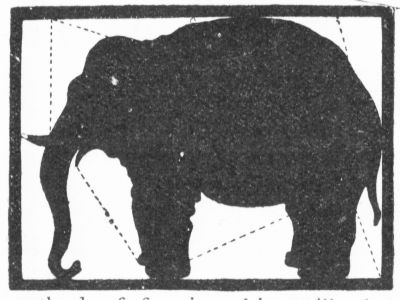
The animal is an elephant, as the reader can see for himself, and the method of forming him will also be readily apparent without further explanation.
THE CASTLE IN THE FOREST.
Larger Image
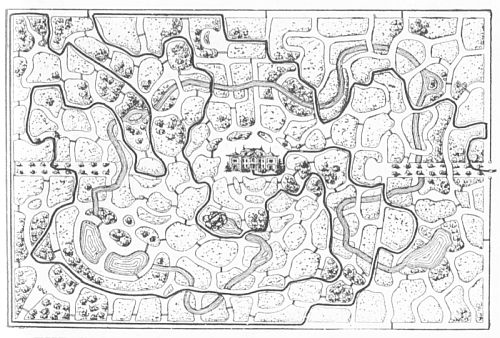
The outline shows the track which is to be followed by the traveller in order to penetrate the forest and reach the castle in the centre.
A MOTOR-CAR PROBLEM.
The following is the series of eighteen movements which are required to transfer motor-cars from one shed into the other:—
Move car No. 5 into the refuge.
Move No. 2 into the place of No. 5.
Move No. 3 into the space between the refuge and the lower shed.
Move No. 5 into the place of No. 3.
Move No. 3 into the place of No. 2.
Move No. 2 into the refuge.
Move No. 6 into the space between the refuge and the upper shed.
Move No. 2 into the place of No. 6.
Move No. 6 into the refuge.
Move No. 3 into the lower shed in the place of No. 5.
Move No. 1 into the space between the refuge and the lower shed.
Move No. 6 into the upper shed in the place of No. 1.
Move No. 1 in the place of No. 2 in the upper shed.
Move No. 3 into the space between the refuge and the upper shed.
Move No. 4 into the refuge.
Move No. 3 into the place of No. 4 in the lower shed.
Move No. 1 into the lower shed.
Move No. 4 into the upper shed.
THE RIFLE RANGE.
The point is shown in the diagram below:—