Illustrated Interviews. LXXX.—M. CURIE, THE DISCOVERER OF RADIUM.
Reading edition
By Cleveland Moffett.
Very well do I remember my first impression of M. Curie. It was in the Rue Cuvier, at the Sorbonne Laboratories in Paris, where he was lecturing that day in the big amphitheatre, while I waited in an adjoining room among the air-pumps and electrical apparatus. Suddenly a door opened and there came a burst of applause, a long clapping of hands, and at the same moment a tall, pale man, slightly bent, walked slowly across the room.
On this occasion I simply made an appointment to see M. Curie the next morning at the École de Physique; but I profited by the opportunity to ask his assistant, M. Danne, some preliminary questions about radium. Was it true, could it be true, that this strange substance gives forth heat and light ceaselessly and is really an inexhaustible source of energy? Of course, I had read all this, but I wanted to hear it from the mouth of one who knew.
Larger Image
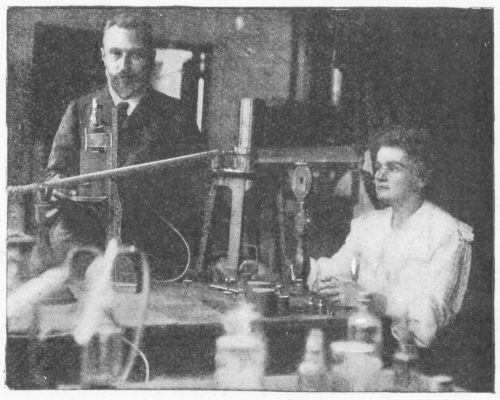
M. AND MME. CURIE USING THEIR APPARATUS FOR MEASURING THE INTENSITY OF RADIUM.
From a Photo.
"It is quite true," said M. Danne, "that pure radium gives out light and heat without any waste or diminution that can be detected by our most delicate instruments. That is all we can say."
"Is the light that it gives a bright light?"
"Reasonably bright. M. Curie will show you."
"Can he explain it? Can anyone explain it?"
"There are various theories, but they really explain very little."
M. Danne went on to indicate other properties of radium that are scarcely less startling than these. Besides heat and light this strange metal gives out constantly three kinds of invisible rays that move with the velocity of light, or thereabouts, and, that have separate and well-marked attributes. These rays may be helpful or harmful, they may destroy life or stimulate it. They are capable not only of shortening life or prolonging it, but of modifying existing forms of life—that is, of actually creating new species. Finally, by destroying bacteria, they may be used to cure disease, notably the dread lupus, recently conquered by Finsen's lamps, and now apparently conquered again by a simpler means.
I listened in amazement; it was not one discovery, but a dozen, that we were contemplating.
"And—all this is M. Curie's discovery?"
"Radium is his discovery; that is, his and Mme. Curie's. You cannot give one more credit than the other. They did it together."
He told me a little about Mme. Curie, who, it appears, was a Polish student in the Latin Quarter, very poor, but possessed of rare talents. They say that her marriage with M. Curie was just such a union, as must have produced some fine result. Without his scientific learning and vivid imagination it is doubtful if radium would ever have been dreamed of, and without her determination and patience against detail it is likely the dream would never have been realized.
The next day I found M. Curie in one of the rambling sheds of the École de Physique bending over a small porcelain dish, where a colourless liquid was simmering, perhaps half a teacupful, and he was watching it with concern, always fearful of some accident. He had lost nearly a decigramme (1·5 grains troy) of radium, he said, only a few weeks before in a curious way. He had placed some radium salts in a small tube, and this inside another tube, in which he created a vacuum. Then he began to heat both tubes over an electric furnace, when, suddenly, at about 2,000 degrees F., there came an explosion which shattered the tubes and scattered their precious contents. There was absolutely no explanation of this explosion; it was one of the tricks that radium is apt to play on you. Here his face lightened with quite a boyish smile.
M. Curie proceeded to explain what he was doing with the little dish; he was refining some radium dissolved in it—that is, freeing it from contaminating barium by repeated crystallization, this being the last and most delicate part of the process of obtaining the pure metal.
"We have our radium works outside Paris," he said, "where the crude ore goes through its early stages of separation and where the radium is brought to an intensity of 2,000, as we express it. After that the process requires such care and involves so much risk of waste that we keep the precious stuff in our own hands and treat it ourselves, my wife and I, as I am doing now, to bring it to the higher intensities, 50,000, 200,000, 500,000, and, finally, 1,500,000. What you see here is about 100,000. It will take many more crystallizations to bring it to the maximum."
"That is, to the state of pure radium?"
"To the state of pure chloride of radium. You know the metal exists only as a chloride or bromide. It has never yet been isolated, although it easily might be."
"Why has it never been isolated?"
"Because it would not be stable; it would immediately be oxidized by the air and destroyed, as happens with sodium, whereas it remains permanent as a bromide or chloride and suffers no change."
"Does radium change in appearance as it increases in intensity?" I asked.
"No; it keeps the form of small white crystals, which may be crushed into a white powder, and which look like ordinary salt. See, here are some."
He took from the table drawer a small glass tube, not much larger than a thick match. It was sealed at both ends and partly covered with a fold of lead. Inside the tube I could see a white powder.
"Why is the tube wrapped with lead?" I inquired.
"For the protection of those who handle it. Lead stops the harmful rays, that would otherwise make trouble."
"Trouble?"
"Yes; you see the radium in this tube is very active; it has an intensity of 1,500,000, and if I were to lay it against your hand or any part of your body, so"—he touched my hand with the bare tube—"and if I were to leave it there for a few minutes, you would certainly hear from it later."
"But I feel nothing."
"Of course not; neither did I feel anything when I touched some radium here," and pulling up his sleeve he showed me a forearm scarred and reddened from fresh-healed sores. "But you see what it did, and it was much less intense than this specimen."
He then mentioned an experience of his friend, Professor Becquerel, discoverer of the "Becquerel rays" of uranium, and in a way the parent-discoverer of radium, since the latter discovery grew out of the former. It seems that Professor Becquerel, in journeying to London, carried in his waistcoat pocket a small tube of radium to be used in a lecture there. Nothing happened at the time, but about a fortnight later the professor observed that the skin under his pocket was beginning to redden and fall away, and finally a deep and painful sore formed there and remained for weeks before healing. A peculiar feature of these radium sores is that they do not appear for some considerable time after exposure to the rays.
"Then radium is an element of destruction?" I remarked.
"Undoubtedly it has a power of destruction, but that power may be tempered or controlled, for instance, by this covering of lead. M. Danysz, at the Pasteur Institute, will give you the pathological facts better than I can."
This brought us back to physical facts, and I asked M. Curie if the radium before us was at that moment giving out heat and light, for I could perceive neither.
"Of course it is," he replied. "I will take you into a dark room presently and let you see the light for yourself. As for the heat, a thermometer would show that this tube of radium is 2·7 degrees F. warmer than the surrounding air."
"Is it always that much warmer?"
"Always—so far as we know. I may put it more simply by saying that a given quantity of radium will melt its own weight of ice every hour."
"For ever?"
He smiled. "So far as we know—for ever. Or, again, that a given quantity of radium throws out as much heat in eighty hours as an equal weight of coal would throw out if burned to complete combustion in one hour."
"Suppose you had a considerable quantity of radium," I suggested, "say twenty pounds, or a hundred pounds?"
"The law would be the same, whatever the quantity. If we had fifty kilos (110 pounds) of radium"—he gave a little wondering cluck at the thought—"I say if we had fifty kilos of radium it would give out as much heat continuously as a stove would give out that burned ten kilos (twenty-two pounds) of coal every twenty-four hours, and was filled up fresh every day."
"And the radium would never cease to give out this heat and would never be consumed?"
"Never is a hard word, but one of our professors has calculated that a given quantity of radium, after throwing out heat as I have stated for a thousand million years, would have lost only one-millionth part of its bulk. Others think the loss might be greater, say an ounce to a ton in ten thousand years, but in any case it is so infinitesimally small that we have no means of measuring it, and for practical purposes it does not exist."
Larger Image
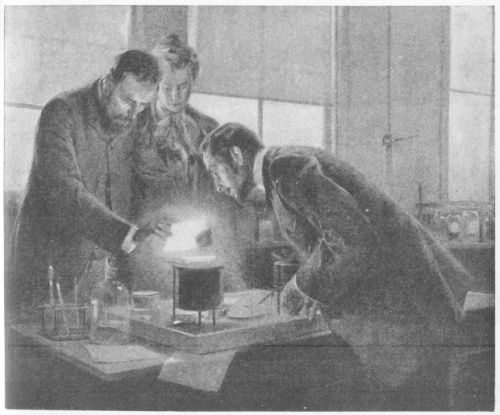
M. AND MME. CURIE FINISHING THE PREPARATION OF SOME RADIUM.
After this M. Curie took me into a darkened room, where I saw quite plainly the light from the radium tube, a clear glow sufficient to read by if the tube were held near a printed page. And, of course, this was a very small quantity of radium, about six centigrammes (nine-tenths of a grain troy).
"We estimate," said he, "that a decigramme of radium will illuminate a square décimètre (fifteen square inches) of surface sufficient for reading."
"And a kilogramme (2·2 pounds) of radium?"
"A kilogramme of radium would illuminate a room thirty feet square with a mild radiance; and the light would be much brighter if screens of sulphide of zinc were placed near the radium, for these are thrown by the metal into a brilliant phosphorescence."
"Then radium may be the light of the future?"
M. Curie shook his head. "I am afraid that we should pay rather dearly for such a light. There is first the money cost to be considered, and then the likelihood that the people illuminated by radium would be also stricken with paralysis, blindness, and various nervous disorders. Possibly protective screens might be devised against these dangers, but it is too soon to think of that. For a long time to come the radium light will be only a laboratory wonder."
After we had been in the darkness for some time M. Curie wrapped the radium tube in thick paper and put it in my hand.
"Now," said he, "shut your eyes and press this against your right eyelid."
I did as he bade me, and straightway had the sensation of a strange diffused light outside my eye. M. Curie assured me, however, that the light was not outside but inside the eye, the radium rays having the property of making the liquids of the eyeball self-luminous, a sort of internal phosphorescence being produced. He warned me that it would be dangerous to leave the radium against the eyelid very long, as a serious disturbance to the eyesight, or even blindness, might result.
Another experiment consisted in placing the radium against the bone at the side of the forehead, and even in this position, with the eyes closed, a light was perceptible, although fainter. Here the radium rays had acted upon the eyeball through the bones of the head.
"It is possible," said M. Curie, "that this property of radium may be utilized in certain diseases of the eye. Dr. Emile Javal, one of our distinguished physicians, who is blind himself, has given this matter particular attention, and he thinks that radium may offer a precious means of diagnosis in cases of cataract, by showing whether the retina is or is not intact, and whether an operation will succeed. If a person blind from cataract can see the radium light as you have just seen it, then the eyesight of that person may be restored by removing the cataract. Otherwise it cannot be restored."
As we returned to the laboratory I remarked that the quantity of radium in the various tubes I had seen was very small.
"Of course it is small," he sighed; "there is very little radium in the world. I mean very little that has been taken from the earth and purified."
"How much is there?"
He thought a moment. "We have about one gramme (one-third of an ounce) in France, Germany may have one gramme, America has less than one gramme, and the rest of the world may perhaps have half a gramme. Four grammes in all would be an outside estimate; you could heap it all in a tablespoon."
I suggested to M. Curie the possibility that some philanthropist might be inspired on reading his words to help the new cause. And I remarked that great things could doubtless be accomplished with some substantial quantity of radium, say a pound or two.
He gave me an amused look and asked if I had any idea what a pound or two of radium, say a kilogramme (two and one-fifth pounds), would cost.
"Why, no," said I, "no exact idea; but——"
"A kilogramme of radium would cost"—he figured rapidly on a sheet of paper—"with the very cheapest methods that we have of purifying the crude material it would cost about ten million francs (£400,000). Under existing conditions radium is worth about three thousand times its weight in pure gold."
"And yet there may be tons of it in the earth?"
M. Curie was not so sure of this. "It is doubtful," said he, "if there is very much radium in the earth, and what there is is so thinly scattered in the surrounding ore—mere traces of radium for tons of worthless rock—that the cost of extracting it is almost prohibitive. You will realize this when you visit our works at Ivry."
These works I visited the next day, and found myself outside the walls of Paris, near the old Ivry Cemetery, where some unpretentious sheds serve for this important business of radium extraction. One of the head men met me and explained, step by step, how they obtain this strange and elusive metal. First he showed me a lumpy reddish powder, sacks of it, brought from Bohemia by the ton, and constituting the raw material from which the radium is extracted. This powder is the refuse from uranium mines at Jachimsthal; that is, what remains of the original uranite ore, pitchblende, after the uranium has been removed. For years this refuse was regarded as worthless, and was left to accumulate in heaps, tons of it, quite at the disposal of whoever chose to cart it away. Now that it is known to contain the rarest, and most precious substance in the world, it goes without saying that the owners have begun to put a price on it.
My informant referred with proper pride to the difficulties that had confronted them when they started these radium works in 1901. It was a new problem in practical chemistry to bring together infinitesimal traces of a metal lost in tons of débris. It was like searching for specks of dust hidden in a sand heap, or for drops of perfume scattered in a river. Still, they went at it with good heart, for the end justified the effort. If it took a ton of uranite dust to yield as much radium as would half fill a doll's thimble, then the thing to do was to have many tons of this dust sent on from Bohemia, and patiently to accumulate, after months of handling, various pinches of radium, a few centigrammes, then a few decigrammes, and finally some day—who could tell?—they might get as much as a gramme. This was a distant prospect, to be sure, yet with infinite pains and all the resources of chemistry it might be attained. Well, now they had attained it, and at this time, he said, some eight tons of uranite detritus had passed through the caldrons and great glass jars and muddy barrels of the Ivry establishment, had been boiled and filtered and decanted and crystallized, with much fuming of acids and the steady glow of furnaces; and out of it all, for the twenty-four months' effort, there had come just about a gramme of practically pure chloride of radium—enough white powder to fill a salt-spoon.
When next I saw M. Curie he had just returned from London, where he had lectured before the Royal Institution. His hands were much peeled, and very sore from too much contact with radium, and for several days he had been unable to dress himself; but he took it good-naturedly, and proceeded to describe some of the experiments he had made before British scientists.
Larger Image
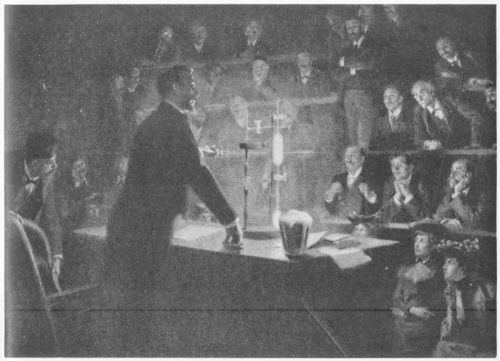
M. CURIE EXPLAINING THE WONDERS OF RADIUM AT THE SORBONNE. THIS EXPERIMENT WITH THE RADIUM LIGHT IS DESCRIBED IN THE ARTICLE.
In order to demonstrate that radium throws off heat continually he took two glass vessels, one containing a thermometer and a tube of radium, the other containing a thermometer and no radium. Both vessels were closed with cotton, and it was presently seen that the thermometer in the vessel containing the radium registered constantly 5·4 degrees F. higher than the thermometer which was not so influenced.
The most striking experiment presented by M. Curie in his London lecture was one devised by him to prove the existence of radium emanations, a kind of gaseous product (quite different from the rays) which this extraordinary metal seems to throw off constantly as it throws off heat and light. These emanations may be regarded as an invisible vapour of radium, like water vapour, only infinitely more subtle, which settles upon all objects that it approaches and confers upon them, for a time at least, the mysterious properties of radium itself. Thus the yellow powder sulphide of zinc bursts into a brilliant glow under the stimulus of radium emanations, and to make it clear that this effect is due to the emanations and not to the rays M. Curie constructed an apparatus in which a glass tube, R, containing a solution of radium is connected with two glass bulbs, A and B, containing sulphide of zinc.
The experiment is begun by exhausting the air from the two bulbs A and B, by means of air-pump connections through the tube E. The air is not exhausted, however, from the tube R, over which the stop-cock F is closed, and within which the emanations have been allowed to accumulate. The room is now darkened, and it is seen that so long as the stop-cock F remains closed there is no glow in the bulbs A and B, but as soon as the stop-cock F is opened both bulbs shine brilliantly, so that the light is plainly visible at a distance of several hundred yards. Now, obviously, if this effect were due to the radium rays, it would be produced whether the stop-cock F were open or closed, since the radium rays pass freely through glass and need not follow the tube S in order to reach the bulbs A and B. It is therefore clear that the sudden light in the bulbs is due to the passage of something out of the tube R, and through the tube S, that something being kept back by the glass of the bulb R until the stop-cock F is opened. So we conclude that the emanations of radium cannot pass through glass, and are a manifestation quite distinct from the rays of radium, which can pass through but do not influence the sulphide of zinc.
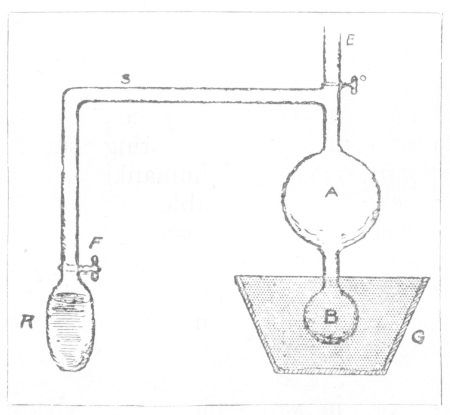
This point having been established, M. Curie proceeded to the most sensational part of his demonstration, by closing the stop-cock F and then placing the lower bulb B, still radiant, in a vessel G containing liquid air, the result being that the light in the bulb B gradually grew stronger while the light in the bulb A diminished, until, presently, all the light seemed concentrated in B and gone from A, the conclusion being that the intense cold of liquid air had produced some change in the emanations, had possibly reduced them from a gas to a liquid, thus withdrawing them from A to B and checking the one glow while increasing the other.
In talking with Sir William Crookes, M. Curie was interested to learn that the English scientist had just devised a curious little instrument which he has named the spinthariscope, and which allows one to actually see the emanations from radium and to realize as never before the extraordinary atomic disintegration that is going on ceaselessly in this strange metal. The spinthariscope is a small microscope that allows one to look at a tiny fragment of radium, about one-twentieth of a milligramme, supported on a little wire over a screen spread with sulphide of zinc.
The experiment must be made in a darkened room after the eye has gradually acquired its greatest sensitiveness to light. To the eye thus sensitive and looking intently through the lenses the screen appears like a heaven of flashing meteors, among which stars shine forth suddenly and die away. Near the central radium speck the fire shower is most brilliant, while towards the rim of the circle it grows fainter. And this goes on continuously as the metal throws off its emanations; these myriad bursting blazing stars are the emanations—at least, we may assume it—and become visible as the scattered radium dust or radium vapour impinges speck by speck upon the screen, which, for each tiny fragment, flashes back a responsive phosphorescence. M. Curie spoke of this vision, that was really contained within the area of a two-cent piece, as one of the most beautiful and impressive he had ever witnessed; it was as if he had been allowed to assist at the birth of a universe or at the death of a molecule.
Dwelling upon the extreme attenuation of these radium emanations, M. Curie mentioned a recent experiment, in which he had used a platinum box pierced by two holes so extremely small that the box would retain a vacuum, yet not small enough to resist the passage of radium emanations.
In view of the extreme rarity and costliness of radium, it is evident that its emanations may be put to many important uses in and out of the laboratory, since they bestow upon indifferent objects—a plate, a piece of iron, an old shoe, anything—the very properties of radium itself. Thus a scientist or a doctor unable to procure the metal radium may easily experiment with a bit of wood or glass rendered radio-active—that is, charged by radium emanations, and capable of replacing the original metal as long as the charge keeps its potency. This period has been determined by the Curies after observations extending over weeks and months, and applied to all sorts of substances, copper, aluminium, lead, rubber, wax, celluloid, paraffin, no fewer than fifty in all, the resulting conclusions being formulated in a precise law as follows:—
(1) All substances may be rendered radio-active through the influence of radium emanations.
(2) Substances thus influenced retain their induced radio-activity very much longer when guarded in a small enclosure through which the emanations cannot pass (say a sealed glass tube) than when not so guarded. In the former case their radio-activity diminishes one-half every four days. In the latter case it diminishes one-half every twenty-eight minutes.
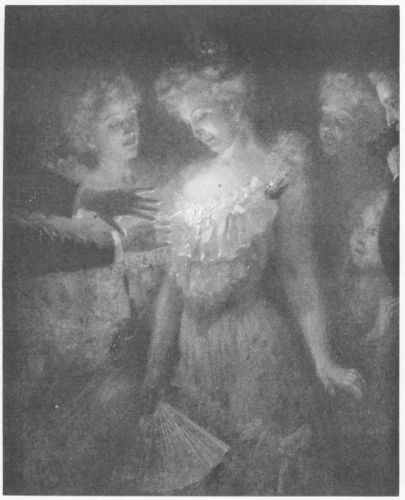
I must pass rapidly over various other wonders of radium that M. Curie laid before me. New matter is accumulating every week as the outcome of new investigations. Even in the chemistry of radium, which is practically an unexplored field, owing to the scarcity and costliness of the metal, there are various facts to be noted, as these: that radium changes the colour of phosphorus from yellow to red; that radium rays increase the production of ozone in certain cases; that a small quantity of radium dissolved in water throws off hydrogen constantly by causing a disintegration of the water, the oxygen released being absorbed in some unknown molecular combination. Also that a solution of radium gives a violet or brownish tint to a glass vessel containing it, this tint being permanent, unless the glass be heated red hot. Here, by the way, is an application of importance in the arts, for radium may thus be used to modify the colours of glass and crystals, possibly of gems. It is furthermore established that radium offers a ready means of distinguishing real from imitation diamonds, since it causes the real stones to burst into a brilliant phosphorescence when brought near them in a darkened room, while it has scarcely any such effect upon false stones. M. Curie made this experiment recently at a reception in Lille, to the great delight of the guests.
Coming now to what may be the most important properties of radium—that is, those which influence animal life—we may follow M. Curie's advice and visit the Pasteur Institute, where for some months now a remarkable series of radium tests has been in progress.
M. Danysz is convinced that all animals, probably all forms of life, would succumb to the destructive force of radium if employed in sufficient quantities.
"I have no doubt," said he, "that a kilogramme of radium would be sufficient to destroy the population of Paris, granting that they came within its influence. Men and women would be killed just as easily as mice. They would feel nothing during their exposure to the radium, nor realize that they were in any danger. And weeks would pass after their exposure before anything would happen. Then gradually the skin would begin to peel off and their bodies would become one great sore. Then they would become blind. Then they would die from paralysis and congestion of the spinal cord."
Despite this rather gloomy prospect, certain experiments at the Pasteur Institute may encourage us to believe that, for all its menace of destruction, radium is destined to bring substantial benefits to suffering humankind. The substance of these favourable experiments is that, while animal life may undoubtedly suffer great harm from radium when used in excess or wrongly used (the same is true of strychnine), it may also derive immense good from radium when used within proper bounds, these to be set when we have gained a fuller knowledge of the subject. Meantime it is worthy of note that some of M. Danysz's animals, when exposed to the radium for a short time, or to radium of lower intensity, or to radium at a greater distance, have not perished, but have seemed to thrive under the treatment.
But the most startling experiment performed thus far at the Pasteur Institute is one undertaken by M. Danysz, February 3rd, 1903, when he placed three or four dozen little worms that live in flour, the larvæ Ephestia kuehniella, in a glass flask, where they were exposed for a few hours to the rays of radium. He placed a like number of larvæ in a control flask where there was no radium, and he left enough flour in each flask for the larvæ to live upon. After several weeks it was found that most of the larvæ in the radium flask had been killed, but that a few of them had escaped the destructive action of the rays by crawling away to distant corners of the flask, where they were still living. But they were living as larvæ, not as moths, whereas in the natural course they should have become moths long before, as was seen by the control flask, where the larvæ had all changed into moths, and these had hatched their eggs into other larvæ, and these had produced other moths. All of which made it clear that the radium rays had arrested the development of these little worms.
Larger Image
M. CURIE TESTING DIAMONDS AT A RECEPTION AT LILLE.
More weeks passed and still three or four of the larvæ lived, and four full months after the original exposure I saw a larva alive and wriggling while its contemporary larvæ in the other jar had long since passed away as aged moths, leaving generations of moths' eggs and larvæ to witness this miracle, for here was a larva, venerable among his kind, a patriarch Ephestia kuehniella, that had actually lived through three times the span of life accorded to his fellows, and that still showed no sign of changing into a moth. It was very much as if a young man of twenty-one should keep the appearance of twenty-one for two hundred and fifty years!
Not less remarkable than these are some recent experiments made by M. Bohn at the biological laboratories of the Sorbonne, his conclusions being that radium may so far modify various lower forms of life as to actually produce "monsters," abnormal deviations from the original type of the species. Thus tadpole monsters have been formed from tadpoles exposed four days after birth to radium rays. Some of these monsters lived for twenty-three days, and would doubtless have lived longer had they been exposed to the rays for a shorter time. No changes occur in the tadpoles treated except at the transition points of growth, as on the eighth day, when the breathing tentacles are covered by gills in the normal tadpole, but are not so covered in the monsters formed after radium treatment. These monsters take on a new form, with an increasing atrophy of the tail and a curious wrinkling of the tissues at the back of the head; in fact, they may be said to develop a new breathing apparatus, quite different from that of ordinary tadpoles.
M. Bohn has obtained similar results with eggs of the toad and eggs of the sea-urchin, monsters resulting in both cases and continuing to live for a number of days or weeks after exposure to the radium. Furthermore, he has been able to accomplish with radium what Professor Loeb did with saline solutions—that is, to cause the growth of unfecundated eggs of the sea-urchin, and to advance these through several stages of their development. In other words, he has used radium to create life where there would have been no life but for this strange stimulation.
M. Bohn assured me of his conviction that we may in the future be able to produce new species of insects, moths, butterflies, perhaps birds and fishes, by simply treating the eggs with radium rays, the result being that interesting changes will be effected in the colouring and adornment. He also believes that, with greater quantities of radium at our disposal and a fuller understanding of its properties, it may be possible to produce new species among larger creatures, mice, rabbits, guinea-pigs, etc. It is merely a question of degree, for if new types can be produced in one species why may they not be produced in another?
It remains to mention certain important services that radium may render in the cure of bodily ills, notably of lupus and other skin diseases. Here is a great new field full of promise, yet one that must be considered with guarded affirmation, lest false hopes be aroused. It is too soon as yet to say more than this, that distinguished doctors speak with confidence of excellent results that may be looked for from the radium treatment. Dr. Danlos, for instance, has used the radium rays on lupus patients at the St. Louis Hospital in Paris for over a year, and in several cases has accomplished apparent cures. The radium used is enclosed between two small discs of copper and aluminium, the whole being about the size of a silver dollar. The aluminium disc, which is very thin, is pressed against the affected part and left there for fifteen minutes; that is all there is in the treatment, except cleansing, bandaging, etc. Day after day, for weeks or months, this contact with the disc is continued, and after a period of irritation the sores heal, leaving healthy white scars. Some patients thus treated have gone for months without a relapse, but it is too soon to declare the cures absolute. They look like absolute cures, that is all Dr. Danlos will say, and if time proves that they are absolute cures, then radium will do for lupus patients all that Finsen's lamps do, and will do it more quickly, more simply, and with no cumbersome and costly apparatus. It may be objected that radium also is costly, but the answer is that radium will probably become cheaper as the supply increases and as the processes of extracting it are perfected. Furthermore, the effects of radium may be obtained, as already stated, by the use of indifferent bodies rendered radio-active, so that lupus patients may be treated with a piece of wood or a piece of glass possessed for the moment of the virtues of radium. And certain kinds of cancer may be similarly treated; indeed, a London physician has already reported a case of cancer cured by radium.
These are possibilities, not certainties, and there are others. It appears that radium has a bactericidal action in certain cases, and it would therefore seem reasonable that air rendered radio-active may benefit sufferers from lung troubles if breathed into the lungs, or that water rendered radio-active may benefit sufferers from stomach troubles if taken into the stomach. It goes without saying that in all these cases the use of radium must be attended with extreme precautions, so that harmful effects may be avoided.
Just as I was leaving Paris I learned of an interesting and significant new fact about radium, one that greatly impressed M. Curie—namely, that the air from deep borings in the earth is found to be radio-active, and that the waters from mineral springs are radio-active. This would seem to indicate the presence of radium in the earth in considerable quantities, and that would mean more abundant and cheaper radium in the not distant future. One of the things to be hoped for now is the discovery of a single simple reaction by which radium may be easily separated from the dross that contains it, and any day the chemists may put their hands on such a reaction.
And then—well, it is best to avoid sweeping statements, but there is certainly reason to believe that we are entering upon a domain of new, strange knowledge and drawing near to some of Nature's most hallowed secrets.