"Happy Evenings."
Reading edition
Ordinarily the High Street fairly stewed with juvenile humanity. But to-night, for a wonder, the High Street, Plimsoll Lane, Byles's Rents, and all the adjacent squalid courts and avenues were deserted. Something more than a mild fog was needed to effect such a transformation out of school hours. Neither was there evidence, ocular or auricular, of any hand-organ, or a trained bear, or a free fight enlivening the neighbourhood. How was it possible to account for the peaceful condition of the streets? Surely the ordinary denizens of the gutter couldn't be at school? Well, not exactly at school, but at the school-house. A ragged little urchin of seven volunteered to be our pilot.
"'Appy evenin'? Yessir, I'm goin' there myself. I'll show you."
"What's your name, my boy?"
"Saunders, sir; but they allers calls me 'Magsie,' all along o' my twin-sister wot uz named Marguerite."
"And why isn't your little sister with you to-night?"
"'Cos she got scarlet fever."
"Scarlet fever? Good gracious, boy!"
"An' she died—more'n a year ago."
"Oh, I see."
"The lidy wot we calls the Countess 's goin' to be at the 'Appy Evenin' to-night. Look! That's 'er—see—with the 'at an' the little black fevvers."
We proved to be just in time. Several ladies and gentlemen had doffed their furs and overcoats, and stood smiling at one end of a large school-room, whilst in the middle some two or three hundred meanly-clad, but clean and happy-looking, children of all ages under twelve or thirteen trooped along merrily to the notes of a piano in the corner.
"This is our overture," explained the gentle-eyed lady with the "fevvers." "We always begin this way and they seem to enjoy it." She raised her jewelled finger and the music stopped. So did the promenaders. There was a silence, punctuated by giggles, as the Countess observed, "And now for our games this evening. What girls for the quiet room?"
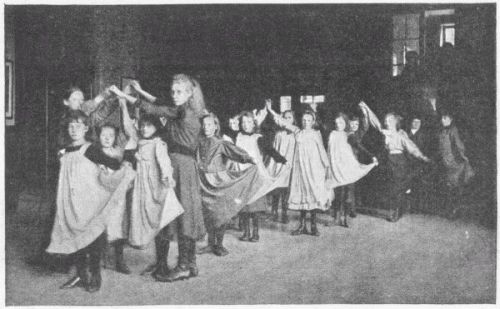
Larger Image
A PRELIMINARY SIR ROGER DE COVERLEY.
From a Photo. by George Newnes, Ltd.
Twenty hands went up instantly.
"What boys?"
Half-a-dozen—not more—two of whom were cripples.
"And the noisy room? And the fairy-tale room? And the toy room? And the painting room? And the dolls' room?"
Thus were these denizens of the gutter in one of the most notorious slums of London granted their hearts' wishes for this evening. As they made a choice, so they were marched off under the wing of a lady or gentleman to a separate room, and the music struck up again for a Sir Roger de Coverley.
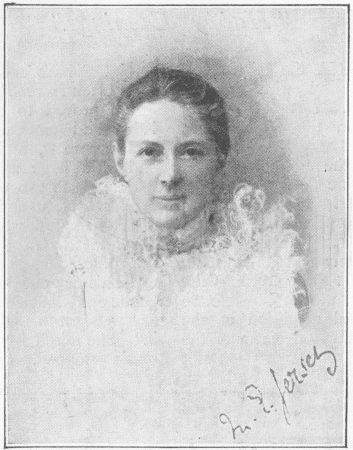
THE COUNTESS OF JERSEY—PRESIDENT OF THE COUNCIL.
From a Photo. by Gillman, Oxford.
"There is no use," explains one of the ladies, "forcing a child to romp if it doesn't want to romp. Perhaps its tastes are in quite another direction—indeed, we know that there are thousands of wretched little mites in London who pine for quiet and seclusion. Then there are kiddies who are passionately fond of fairy stories. They could listen to them by the hour—perhaps by the day—yet possibly outside of a Happy Evening they never hear one that really interests them. Our girls' fairy-teller here, I may tell you, has a wonderful gift. She really mesmerizes the children. Would you like to be mesmerized, too?"
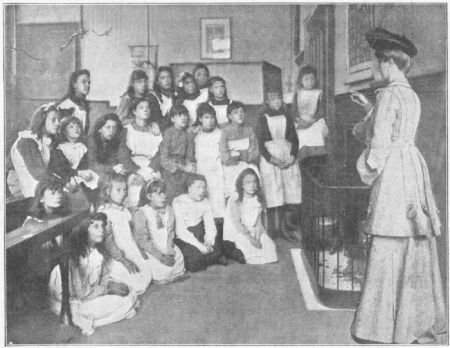
Larger Image
A FAIRY TALE.
From a Photo. by][George Newnes, Ltd.
"With all the pleasure in life," we reply, and the handle of the fairy-tale room is slowly turned. We may mention it for a fact, and as a tribute to the lady's powers, that the noise of our entrance is absolutely without effect on this little audience. Oh, what would not a pulpit orator, a politician, a lecturer—yes, even a great actor—give to hold his auditors' minds thus in the hollow of his hand? They see nothing, hear nothing but the speaker.
"'So, so,' cried the Genie, in an angry voice; 'if that is the case then you must quickly step upon this strip of carpet.' And he laid a piece of red and yellow carpet on the ground.
"'What for?' asked the young Prince. You see, he didn't know about the magic in the carpet—nobody had ever told him.
Larger Image
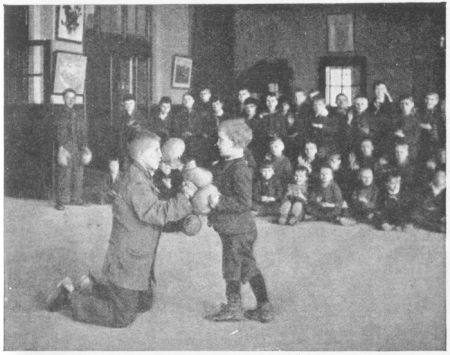
"'IT 'IM ON THE NOB, MAGSIE."
From a Photo. by][George Newnes, Ltd.
"'What for?' replied the Genie. 'Why, because——' and he told him then and there. And he put on his hat and stepped upon the carpet, and like a flash——"
We stole out at this juncture, leaving the children open-mouthed and open-eyed, oblivious of our presence and retreat, and ascending a flight of steps found ourselves ushered into a totally different scene. The uproar was terrific, which was not surprising considering that a hundred and fifty boys were yelling at the top of their lungs.
"Punch 'im, 'Magsie'; 'it 'im on the nob!"
And "Magsie," suiting the action to the word, actually landed his opponent one on the "nob." It was a boxing match—presided over by a peer's son. Physically the combatants were most unequally matched, one lad being nearly thirteen and the other—my original cicerone of the evening—only seven. But they equalize these matters at the Happy Evenings, and "Pokey" was on his knees, while Billy was the possessor of much pugilistic science. With each fairly-planted blow the yelling was terrific, but nobody objected; they encouraged it, if anything. What's the good of being happy if you can't yell? And so the hundred and fifty yelled. They have a proper contempt for girls. Girls only giggle and scream.
Larger Image
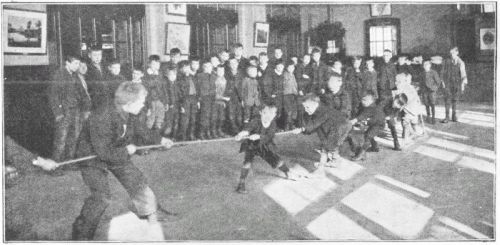
THE GREAT CONTEST: THORPE'S MEWS v. BYLES'S RENTS.
From a Photo. by][George Newnes, Ltd.
But the chief event of the evening among the juvenile male section was the tug-of-war—the denizens of Thorpe's Mews versus Byles's Rents, a truly Homeric contest, as it would have appeared to Liliput. Powerfully-built tatterdemalions boasting fully three feet of stature were matched against a lesser number of giants of four feet six. The rope swayed now this side—now that—of the chalked line. Was ever so much sinew built up of stale bread-crusts and fried fish before? But the Byles's Rents men—pale, perspiring, and panting—ultimately pulled their rivals across the line and on to their knees pell-mell, and the ceiling threatened to splinter and send down pounds of plaster upon the heads of the spectators at shouts over this triumph. It was thrice repeated, and then, lo! a few steps and the scene had changed and we were in the dolls' room.
Larger Image
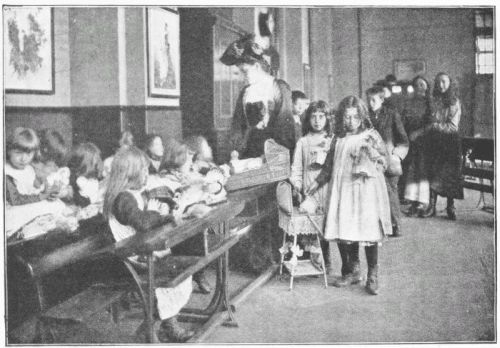
"PLEASE, LADY, MAY I 'AVE THE FAIRY DOLL NEXT TIME?"
From a Photo. by][George Newnes, Ltd.
Every year in November there is a brave show of dolls dressed for the Happy Evenings children at Bath House, Piccadilly, and some of these dolls were here now, tended, oh, so gently, almost worshipped, as they are taken out of their cupboard resting-places and dressed and undressed.
"Please, lady, may I 'ave the fairy doll next time?" pleaded a golden-haired little child, with an earnest, wistful look.
Larger Image
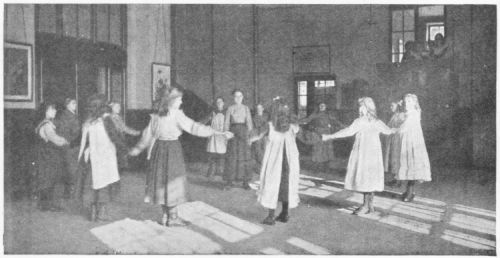
A PEEP INTO THE NOISY ROOM.
From a Photo. by][George Newnes, Ltd.
"Yes, if your hands are the cleanest. The little girl with the very cleanest hands shall dress the fairy doll."
There is a buzz of pleased anticipation, and then a small voice is heard:—
"Oh, Kitie Jimes, will your mother lend my mother your kike o' smellin' soap next Tuesday evenin', an' you can 'ave our fryin'-pan?"
Larger Image
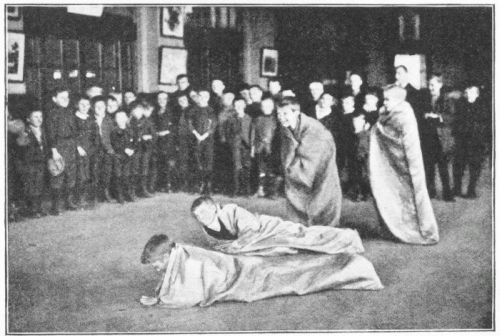
THE SACK RACE.
From a Photo. by][George Newnes, Ltd.
In the girls' noisy room they were playing "London Bridge" and "Kiss-in-the-Ring," but it was tame work in comparison with the uproarious diversions of the stern sex below. When the boys' boxing contest was over they had a sack race, but a small group of youngsters were observed making for the door.
"W'ere you goin', 'Arry?" asked a friend.
"Me? Oh. I'm goin' with Johnson."
"W'ere's Johnson goin'?"
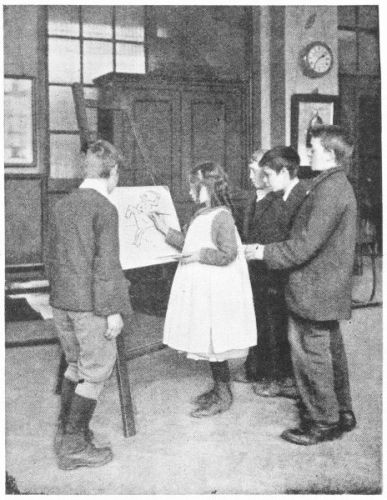
"Darnstairs. Johnson's father's a 'ouse-painter, and 'e knows something, Johnson does. We promised to go an' see Millie White paint in the paintin' room. You orter see 'er dror a 'orse. I promised to 'old her cup an' Johnson's 'oldin' her paints. P'r'aps, if you come, she'll let you 'ave a brush to 'old."
Larger Image
A GROUP OF ADMIRERS.
From a Photo. by George Newnes, Ltd.
This is gallantry and this is appreciation of art. Five minutes later, after seeing the champion of Byles's Rents again victorious in the sack race, we descend to the painting room to find Miss Millie White (ætat eight), the celebrated animal painter, daughter of Larry White; the well-known Shoreditch navvy, surrounded by her admirers. In another part of the same room we come upon quite an animated group of talented colourists. Some of the designs done by these children of the slums are most creditable, and at least their faces are radiant with happiness, which is the chief thing after all. The articles produced in the toy-making room are vastly ingenious. Out of the most unpromising materials—such as reels of cotton and match-boxes, fortified by cardboard and coloured paper—the most delectable toys are produced.
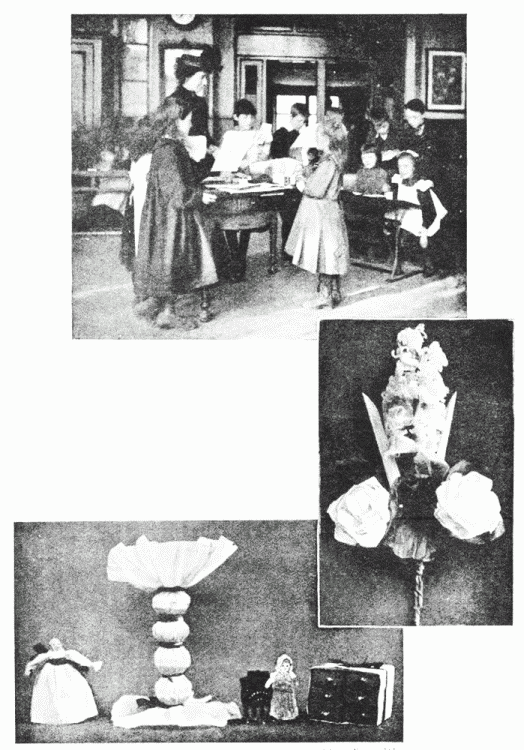
THE PAINTING ROOM. From a Photo. by George Newnes, Ltd.
ARTIFICIAL FLOWERS MADE BY THE CHILDREN. From a Photo. by George Newnes, Ltd.
ARTICLES MADE BY THE CHILDREN. From a Photo. by] [George Newnes, Ltd.
As the famous chef, Brillat-Savarin, could create an exquisite soup out of a kid glove and a pint of boiling water, so these tiny artisans manage to manufacture butchers' shops, chests of drawers, tables, sofas, Christmas crackers, and luxuriant flowers out of the meanest ingredients. One of the favourite diversions of the smaller children is cutting out and colouring fashion-plates, decapitating the heads and fitting on instead portraits of their favourite "great ladies" of the Happy Evenings Association which they have found in the newspapers. These are afterwards stiffened with cardboard and made to stand up in a group, which at a distance gives a very good idea of a swell reception amongst the "hupper suckles"—if it did not more nearly suggest a wax-work gathering at Madame Tussaud's. Two of these figures we photographed for The Strand—Lady Northcote and Lady Margaret Rice—both indefatigable workers of the Children's Happy Evenings Association.
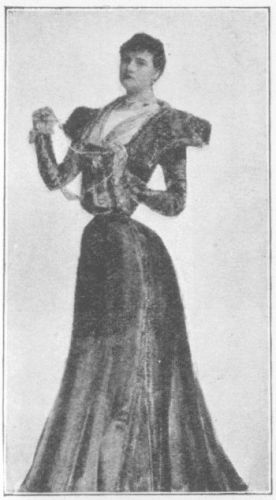
LADY NORTHCOTE.
As constructed by the children.
And what—the reader may ask at this stage—what is the Happy Evenings Association? Well, it is a body of kind-hearted ladies and gentlemen—numbering some of the highest and noblest names that you will find in "Burke" or "Debrett"—who take a pleasure in going down amongst the slums of London and teaching the slum waifs how to play. For the London guttersnipe doesn't know how to play. As a rule, he or she can maunder about and fight and scream and exchange badinage and throw stones in the gutter, but of true games the gamin is as ignorant as his parents are of entrées or Euclid. Before the association was started in 1891 there was no one to teach them the mysteries of battledore and shuttlecock, sack races, kiss-in-the-ring, picture-books, dolls, and doll dressmaking. As their motto expressed it, the association, whose first efforts began at the Waterloo Road Schools, was "to put a thought beneath their rags to ennoble the heart's struggle."
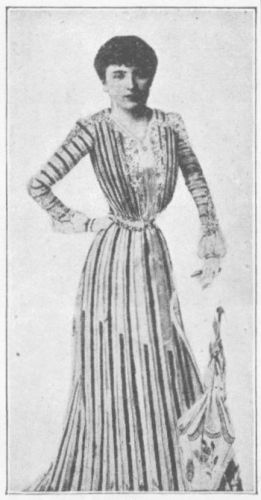
LADY MARGARET RICE.
As constructed by the children.
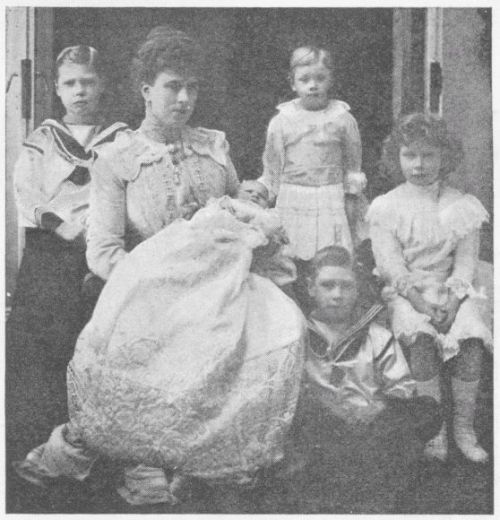
THE PRINCESS OF WALES AND HER FAMILY—THE PRINCESS IS THE PRESIDENT OF THE ASSOCIATION.
From a Photo. by Wilkinson & Co., Norwich. Published by the London Stereoscopic Co.
The gutters were full—the Board schools after school-hours were empty. Why not get permission to use these empty Board schools for the little ones to play in? And so in a modest fashion the first of the Happy Evenings was carried out by Miss Heather Bigg at Waterloo Road Schools in January, 1891. The association grew and workers came forward until now it is one of the most influential, as it is the "smartest," charity in London. It has for its president that mother of so many little children—the Princess of Wales; its chief of council is the Countess of Jersey, and among its helpers are the Marchioness of Zetland, Lady Ludlow, Lady Cadogan, Lady Iddesleigh, Mrs. Bland-Sutton, etc. Moreover, the children of the rich are brought to serve the children of the poor, the example being set by children no less highly placed than the little Princes and the little Princess at Marlborough House, whose dolls and toys find their way into the Happy Evenings gatherings. When little Prince Edward first heard of the Happy Evenings he turned to his Royal mamma and said:—
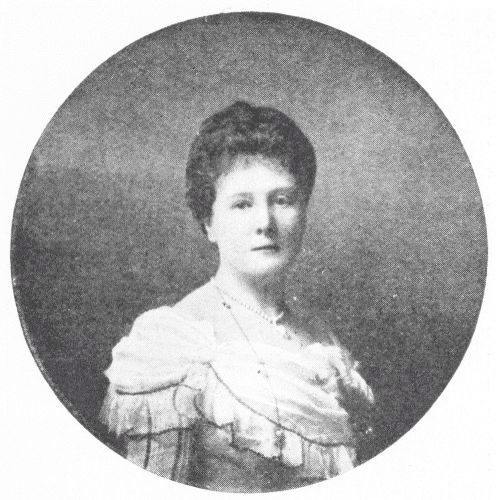
MRS. BLAND-SUTTON—HON. SECRETARY OF THE ASSOCIATION.
From a Photo. by E. W. Evans.
"Mayn't I give my helmet and breast-plate? It's such good fun to dress up as a soldier. I'm sure those little boys would like it." And so a little gamin was pointed out to us at a Happy Evening, prancing about in the martial and metallic raiment which had lately enclosed the person of another boy—the future King of England.
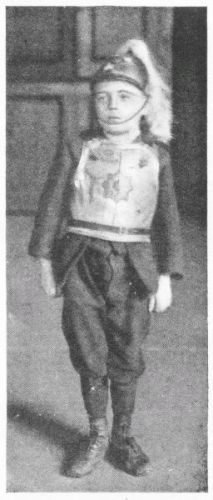
PRINCE EDWARD'S ARMOUR.
From a Photo. by George Newnes, Ltd.
Some wag has called these gatherings "Juvenile Parties for Guttersnipes," and although the secretary naturally resents the terms of such description, yet perhaps, on the whole, it gives a fair idea to the average observer of what these gatherings really mean. "We do not, however, aim at making our Happy Evenings a juvenile party. We try and make the pastimes of the children approximate closely to those of a well-ordered nursery or school-room, and the children are encouraged to vary their amusements on their own initiative, and to choose by preference those games which involve co-operation."
Larger Image
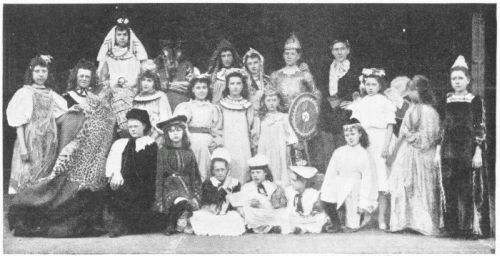
EAST-END CHILDREN IN LADY JERSEY'S CHILD-DRAMA
"ST. GEORGE."
From a Photo. by W. S. Bradshaw & Sons.
Occasionally the elder children get together and arrange rough-and-ready presentments of historic incidents, such as the Battle of Cressy, the Execution of Mary Queen of Scots, the Indian Mutiny, Alfred and the Cakes, the Landing of the Pilgrim Fathers, etc. The Mayflower, in this last tableau, was represented by a large newspaper boat capable of holding the two feet of one child comfortably. The other Pilgrim Fathers apparently preferred to wade.
The picture on page 22 shows a party of East London children in Lady Jersey's play, "St. George of England," and in their brave costumes they certainly compare very favourably with any equal body of children from more fashionable regions.
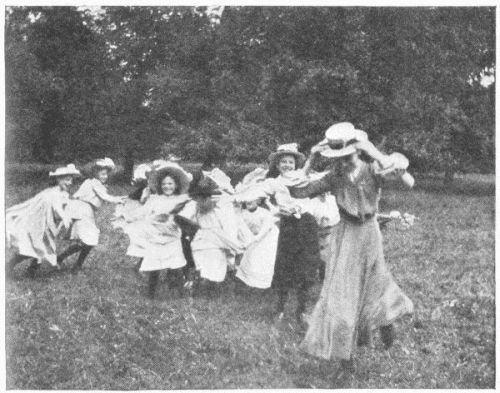
A DAY IN THE COUNTRY.
From a Photo. by[Lady Margaret Rice.]
But perhaps the greatest event of the whole year for the children of the Happy Evenings occurs in summer, when each branch president invites them for a merry day in the country. Somehow or other the girls manage to rake up cheap cotton frocks for the occasion of various tints and degrees of wear—and the boys are carefully washed, brushed, and patched; and then off to one of the stately homes of England, where they may romp in the grass or in the woods and pick wild flowers to their hearts' content. You would scarcely recognise these half-fed, prematurely old London children in the laughing faces and buoyant forms of this picture taken at Osterley Park.
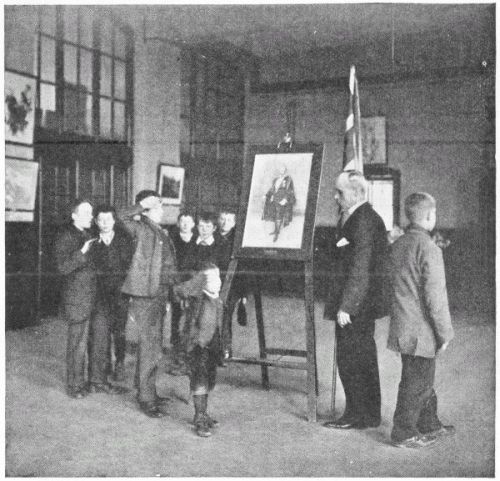
A HAPPY EVENING CONCLUDED—SALUTING HIS MAJESTY.
From a Photo. by George Newnes, Ltd.
One other picture taken has a special interest as showing that lessons of loyalty are inculcated at the Happy Evenings. It represents the conclusion of the sports and games; the boys are seen filing before a portrait of His Majesty and the Union Jack and saluting as they pass, while the piano plays "God Save the King."