Sadi the Fiddler. AN INCIDENT IN THE SIEGE OF STRASBURG.
Reading edition
By Max Pemberton.

Sadi the fiddler, carrying the little black case under his arm, locked the door of his garret as carefully as though it had contained the wealth of the Cæsars. It was the night of Monday, the twenty-first day of September, in the year 1870. Sadi had not tasted food for twenty hours, and, though he well understood that there was very little to eat in the town of Strasburg, he went forth bravely in quest of it. After all, someone might throw him a bone, even though he were nothing more than a poor, crazy fiddler.
"Heaven knows they have music enough here," he said to himself, as he descended the narrow staircase and came out beneath the eaves of the old houses. This was the thirty-second night since the hated Prussians had come swarming down from Wörth and had invested the city like an army of human locusts. There was scarcely a minute by day or night when the great guns ceased to thunder, or the shots to play havoc with the ancient streets of gallant Strasburg. Even as the fiddler walked away from his own house that night a great shell, thrown from one of the batteries to the north-west, came singing and sighing above him, and then fell with a mighty crash upon the roof next to his own. It was an incendiary shell, Sadi hazarded, and presently a tongue of flame leaping up from the doomed building told him that he had guessed aright. He knew that his worldly possessions, such as they were, would soon be engulfed in that raging furnace of smoke and fire; and he reflected with a sigh, odd fellow that he was, on a picture which he would have given much to save. Sadi wondered now that he had not brought the picture with him. Standing there upon the narrow pavement, while the flames licked about the window of his attic, he remembered the day when Lucy, the daughter of Ludenmayer, the artist from Bad Nauheim, had given the portrait to him and had written the words "In grateful remembrance" upon one corner of it. "We shall never return to Strasburg—never meet again, dear friend," she had said. He knew that it was true, admitted that she could be nothing to him—and yet his eyes were dim when he turned from the burning house and set off to wander aimlessly through the terrible streets.
He had never been a rich man, but the outbreak of the war between France and Prussia robbed him in a day of his employment and left him a beggar. Nero had fiddled while Rome was burning, but no one in Strasburg desired to emulate that incomparable artist; and while there had been days when Sadi might have earned a good dinner by playing the Marseillaise to patriotic hosts, his pride forbade him and his violin was silent. The same sense of the dignity of his art kept him from the public distribution of food ordered by the Mayor and the brave General Uhrich. He, Sadi Descourcelles, had the blood of kings in his veins. A philosophic observer might have remarked that it ran thin and sluggish upon that twenty-first day of September, for he, Sadi, was famishing, ravenous, desperate with the gnawing hunger as of youth and strenuous life. He felt that he could commit any crime for bread. He searched the very gutters with his eyes for any scrap of food that fortune might have cast there. Such lighted windows as showed to him the tables spread for dinner or supper moved him to frenzies of desire. Why should some eat when others were starving? And the Prussians killed all indiscriminately, he said, rich or poor, old and young, mothers and children. What folly resisted the right of Bismarck and the Red Prince? Sadi prayed that the city might fall and bread be given to him; but with the next breath he was cursing the blue-coats and hoping in his heart that Strasburg might never surrender. For he was a patriot in spite of his poverty.
It was a warm night of September, with a starry sky to be seen here and there between the clouds of sulphurous smoke which floated above the ramparts. Few walked abroad, for there was danger in the streets, and scarcely any cessation of the flying shells which the Prussians hurled upon the doomed city. Sadi was accustomed to the awful sounds and sights which accompanied the siege, and they were powerless any longer to affright him. Even the dead in the gutters—the children who had not made the war but paid the price of it with their young blood—found him callous and without sympathy. As these had died, so he would die and be at rest. He envied them as they lay there—the flare of the burning houses showed him the white faces and they seemed to sleep. Sadi believed that when next he slept it would be as these—eternally and without pain.
Larger Image
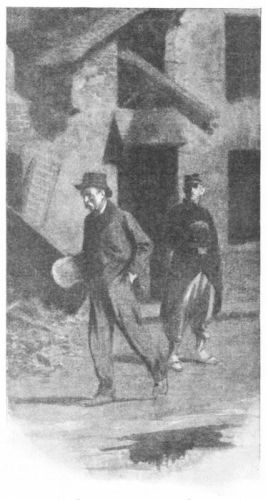
"THE TWO PARTED SURLILY."
He was indifferent to the danger; nevertheless some little measure of prudence remained to him, and he walked in the centre of the street to avoid the flying fragments and the falling timbers. Doleful cries from stricken houses fell upon deaf ears so far as Sadi the fiddler was concerned. The warnings of a friendly soldier, who told him that he was drawing perilously near the zone of fire, he received with a curt word of thanks. Had the man given him a crust he would have kissed him on both cheeks; but the fellow was hungry himself, and the two parted surlily—the one to a beer-shop, the other toward the ramparts.
"You can play them a tune, old fellow," the soldier said.
Sadi answered, "Why so, friend, since the houses dance already?"
Yes; the houses danced indeed, and the mad music of the guns waxed more terrible as Sadi approached the ramparts and could see the cannon for himself. It was just like a display of fireworks in the gardens of the Tuileries, he said. From minute to minute the dark background of the sky would be cleaved by a line of fire, which marked the path of an incendiary shell as it soared above the quivering city and fell in a shower of flame upon house, or church, or citadel. The hither ground was a mighty waste of rubble, a desert of rubbish, where a few weeks ago houses had stood up proudly, and churches had invited worshippers, and children had found their homes. And all this misery, this untold and savage destruction, was the work of the hated Prussians over yonder, where the night was red and the darkness behind it shielded the assassins. Sadi, in the presence of those who were doing something for France, asked himself what he had done. The answer was, "Nothing." He reflected upon it a little bitterly and turned away toward the west, walking from the ramparts of that unhappy quarter of the city which the Prussians had destroyed ten days ago and now forgotten.
The path was desolate—none trod it but Sadi the fiddler, and he stumbled often as he went. So completely had the Prussians demolished the quarter that the very contour of the streets was lost and a dismal plain presented itself—an open field of rubbish, broken here and there by great abysses which once had been the cellars of the houses. Sadi did not know why he walked in such a place or what hope of bread it could give him; but when he stumbled upon an open cellar he reflected that, after all, the house had been quitted in haste, and that some provision might have been left in its larders. The bare possibility appealing to his ravenous hunger sent him climbing down into the cellar like a schoolboy upon a forbidden venture. Impatiently, and with a strength he did not know that he possessed, he delved among the rubble, thrust at the great beams, and wormed his way toward the vault. None would interfere with him, he argued; there was no law, military or civil, which forbade a man to share a bone with the dogs. Sadi was like a miser seeking for his gold; and when at length he stood upright in that which undoubtedly had been the larder of a house, he felt all the joy of an explorer who has discovered an unknown city. Unhappily, such a transport endured for the briefest of moments. Sadi was just telling himself that he was a very lucky fellow when a great hand, thrust out of the darkness, clutched at his throat, and the rays of a lantern shining full in his face blinded him to any other sights.
"Well, my body-snatcher," cried a voice in guttural French, "and what may you be doing here?"
A German spoke; there was no doubt of it at all. Moreover, he was a huge fellow, probably a Prussian from the North; and although he wore the uniform of a French regiment of chasseurs, it was ridiculously small for him and showed its deficiencies when his cloak fell aside. Quick-witted and mentally alert, Sadi guessed the fellow's business there at the first hazard. He could be no one else than one of the many Prussian spies who then found their way in and out of Strasburg so readily. This desert waste of the city would harbour him surely—perchance he waited an opportunity to recross the lines, and was hiding meanwhile in this labyrinth like a fox that has gone to earth. All this passed through Sadi's mind in a moment, but it was accompanied by a cold shiver as though icy water were running down his back. For he perceived at once that the Prussian carried a revolver in his right hand and that the finger itched upon the trigger. A word, a step, might cost him his life. Sadi stood rigid as a statue, while the sweat gathered in heavy drops upon his brow.
"Come, no nonsense!" the Prussian repeated, menacingly. "You had better be honest with me. What is your business here? I will give you the half of a minute to tell me."
Sadi breathed heavily, but he spoke apparently without emotion.
"I have had nothing to eat for twenty hours," he said; "naturally I came here for food."
The Prussian interrupted him with a brutal laugh.
"Then you certainly live on vermin, my bag of bones," he retorted, with a jeer. "Come, your time is nearly up, and my fingers are impatient. You will really be very foolish if you are not candid with me."
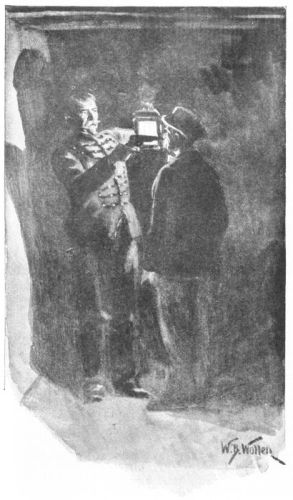
He raised the pistol slowly, and deliberately touched Sadi's forehead with the cold barrel. The lantern's light showed a hard face and small eyes set above puffy cheeks. He wore a moustache in the French fashion and an uncouth imperial, which added to his grotesque appearance. Sadi knew that such a man would think it no greater crime to shoot a Frenchman than to drown a dog. Heroically as he had philosophized about death ten minutes ago, the nearer presence of it was very dreadful to him. He could imagine the sting of the bullet as it crashed through his forehead, the sudden giddiness, the voice which said, "Never again shall you speak, or breathe, or look up to the sun." A desperate desire of life came to him. He trembled violently, pressed his hand to his heart, but could not utter a single word. The Prussian watched him without compassion. He began to count ironically, "One, two, three," he said; "I will count ten, canaille," and he started off from the beginning again. He was at the number "five" when a second voice in the cellar caused him to turn sharply upon his heel and then to salute in the rigid German fashion.
"Ah, Herr Lieutenant, here is a job for you," he exclaimed, as though glad to be quit of the responsibility. "I found this rat in the hole here. Look at him for yourself and see what kind of a rogue he is."
The new-comer was quite a youth, a fair, freckled German lad, in little more than his twentieth year. He, too, wore a French uniform, but it was that of the artillery, and Sadi observed that it was a better fit than the loose clothes of the rough customer who had just been threatening him. Such trifling facts occupied the fiddler's mind to the exclusion of all else. He believed that he was about to die, and yet could count the buttons on the lieutenant's tunic, guess at the State he came from, and hazard the colour of his eyes. The lad was a Bavarian, he said, a merry, laughing youngster. Impossible to believe that he would sanction a brutal murder. Sadi breathed quickly—he appealed to the lad's sympathy in an earnest, manly voice.
Larger Image
"HE RAISED THE PISTOL SLOWLY."
"Herr Lieutenant, it is nothing of the kind," he protested; "I am a poor wretch of a fiddler, whose garret your people have just burned."
It was not a wise thing to have said, and the young soldier's interruption told Sadi as much.
"My people, sir!" he cried, sharply, and with feigned astonishment. "What people do you mean, then?"
"It is as I say," interrupted the trooper; "he is a spy who has tracked us to our hole, Herr Lieutenant. Better make an end of him while there is time."
"But not with a pistol, trooper," retorted the boy, with a little laugh. "At least, let us sup first."
Sadi breathed again, while the two Prussians discussed the pros and cons in a low voice. "If these men would but quarrel!" was his idea. They, however, had no intention of doing anything of the kind, for presently they ceased to wrangle, and the young soldier exclaimed, with some severity:—
"You say that you are a fiddler. What proofs of that can you give us?"
"My fiddle," answered Sadi, almost joyously; "you will find it on the stones upstairs, sir."
The answer surprised the men very much.
"Go and look for it, trooper," said the officer, quietly; "there is plenty of time before daylight to settle this fellow's affair. Besides, the captain is fond of a little music."
The trooper clambered up out of the cellar at the word of command, while the lieutenant calmly lighted a cigar and surveyed Sadi with an ironical glance.
"Poor business, yours, just now, is it not?" he asked.
"So poor that I am starving," said Sadi, with dignified simplicity.
"Ah! And you look for your supper on the dust-heaps. Just like a fiddler."
"I have walked to the ramparts and back every evening for three years," rejoined Sadi, whose self-possession remained to him. "The habit clings to me; besides, what is the harm?" he asked.
"The captain will teach you that; don't let me deceive you at all; he will certainly shoot you, old fellow. For myself, I am sensitive; it is my weakness to prefer live bodies to dead ones. I could not—no, I could not harm a fly, my Stradivarius. That is why you are now allowed to say your prayers."
His own humour amused him, and presently he continued:—
"But perhaps you do not want to say your prayers, my Amati. Other people generally do that when Frenchmen are fiddling. Here is your violin, I see. Let us play it together."
The trooper returned while he spoke, carrying the frayed black leather case which stood for all that life could give to Sadi Descourcelles. When the lieutenant seized upon it with rough hands it was as though someone had struck Sadi a blow.
"Gently, for Heaven's sake, sir," he cried. "Do you know that my fiddle is worth five thousand francs?"
"To us possibly a good deal more," retorted the lieutenant, uncompassionately. "The captain shall read your music, my little Paganini. This way, if you please, and mind your precious neck if you prefer pistols."
It was the lieutenant's evident idea that the violin-case contained the private papers of a common spy, who had fallen by some lucky chance into the hands of the very men he would have betrayed to the French. Proud at the capture, and confident of applause from his superior officers, he now pushed Sadi across the cellar in which they stood to a door upon the far side of it, whence a flight of steps led downward to a second cellar, more spacious and less encumbered. Here candles burned upon a rude table, a fire flickered upon a tiled hearth, and burly figures moved about a copper, whence a fragrant smell diffused itself. Sadi perceived at once that he had been conducted into a very nest of Prussians. He had no doubt whatever that these were the men who had been carrying news of Strasburg to the Red Prince since the siege began; their startled exclamations when the door opened, the quick exchange of sign and counter-sign, left no other conclusion possible. And he understood what he had to hope from them—he, who knew their secret and could, by a word, bring a rabble there which would tear them limb from limb.
The trooper thrust Sadi forward toward the fire, while coarse, stubbly faces peered into his own, and more than one hand reached out for a candle to examine him more closely. To the hurried questions: "Whom have you here; what cattle is this?" the lieutenant answered, simply: "I must see the captain; please to wake him." In a tense interval, during which someone entered a lunette of the cellar and touched a sleeping figure upon the shoulder, the ruffian by the copper asked Sadi if he were hungry, and, being answered "Yes," he took a ladleful of the boiling soup and poured it over the prisoner's fingers. Sadi cried out sharply; but before the act could be repeated a burly man strode out of the alcove and gave the fellow a box on the ear which sounded like a pistol-shot.
"What do you mean by that, sergeant?" the new-comer asked.
"A spy from the ramparts. I was keeping him warm, Herr Captain," was the answer.
"But this is no spy; this is Sadi the fiddler."
Sadi turned with a cry of joy.
"Ludenmayer! You, my friend!" he exclaimed.
"Sadi! Old Sadi the fiddler! Impossible!"
"Indeed, it is possible. Old Sadi, as you say, and so hungry that he could eat the bones off your dishes."
"Then he shall sup with us. A hungry man makes friends with strange company, and we are that, as you guess, Maître Sadi. Come, sergeant, fill our friend a bowl of soup. Let him spy out that to begin with. Eh, Sadi, you will not refuse a bowl of soup even from the Prussians? Then let us see you fall to. We can talk of old friends afterwards."
There were some murmurs at this from the men about the table, but the sergeant obeyed the order sullenly, and a bowl of the hot soup was set before the astonished Sadi almost before he had realized that a lucky accident had saved his life—for the moment, at any rate. Ludenmayer, honestly glad to see an old acquaintance, even under such circumstances, began to assure the rest that they had nothing to fear from Sadi; but at this the fiddler put down his spoon and flatly contradicted his friend.
"Not so," he said, blandly; "if it were in my power I would hang the lot of you!"
They laughed at him now—laughed at him for a foolish crank, airing his absurd patriotism even at the pistol's mouth. While some of them said that he would soon have Prussians enough for his neighbours in Strasburg, others promised the city twenty, thirty, forty hours of her freedom.
"And we shall have you for our guest, friend Sadi," Ludenmayer said, affably. "We like you so much that we cannot part with you. No, we must certainly keep you until the Red Prince comes in; after that we will send you to Munich to fiddle at the opera. Eh, my boy, there's a career—to scrape this new Wagner stuff and hear the madmen say that you are a genius. Will you come to Munich and see little Lucy again? I know that you will, Sadi."
Sadi sighed, but did not answer his friend. If the name of Lucy were a sweet remembrance to him, this promise of Strasburg's surrender and of the humiliation it must put upon France cut him to the quick. These men about him, jesting in the face of death, defiant of all risks—how much, perchance, they had done in the terrible weeks of the siege to bring about this inevitable cataclysm and the ruin and death which attended it! Their reward would be promotion and applause from those who had contrived France's misfortunes. None would punish them, none bring them to account, Sadi reflected bitterly; and, reflecting, he asked himself of a sudden if he were not the appointed agent—he, the humble fiddler, sent there by the chances of the night to discover and, it might be, to betray them.
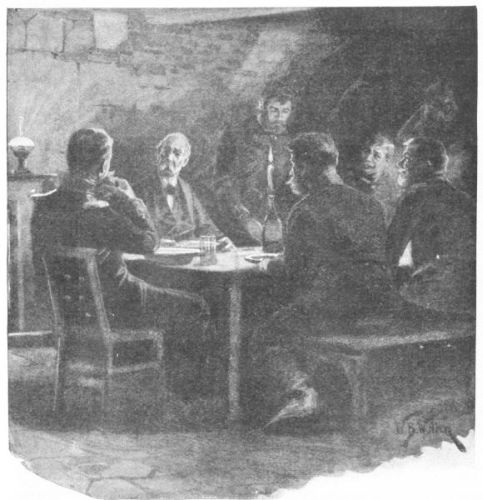
"IF IT WERE IN MY POWER I WOULD HANG THE LOT OF YOU."
The idea came to him quite unexpectedly while the Prussians were at their supper. In another he would have scoffed at it, but Sadi had long been fretting upon his own uselessness and the poor part he had played at the time of his country's need; and now it came to him as in a flash that this was the appointed hour. That he would lose his own life in the endeavour to give these men up to France he was quite convinced; but this contemplation of sacrifice pleased him, and there was but one regret—that he could do nothing which would not wound the father of her he had so greatly loved. Yes, if he could call Frenchmen to this hiding-place they would spare none, and Ludenmayer would perish with the others. Sadi said that many a daughter mourned a father in Strasburg that day—why should little Lucy be spared? And yet he could not bring himself to harm his old friend. Did he not owe his life to him?
It was a strange scene—the big cellar lighted by guttering candles, the red fire flickering upon the hearth, and the sombre figures of the burly Prussians lolling over their dishes or their pipes. From time to time one or other would quit the place stealthily, returning anon with news from the ramparts or the streets. The young lieutenant disappeared altogether toward midnight, and Sadi knew that he had re-crossed the lines while his friends were pledging him in giant bumpers of champagne. As the hours went on the hilarity became reckless and, as it seemed to Sadi, even dangerous. Ludenmayer called for silence more than once, but the men, warmed with the wine, obeyed him reluctantly, and were soon talking and laughing again. It was at the height of such an outburst that Sadi touched his friend upon the shoulder and bethought him of the very first lie he had told in all his life.
"Did you say good-bye to the Herr Lieutenant?" he asked, in a low voice; and then continued, "I hope so, for you will never see him again, friend Ludenmayer."
The captain, who had been squatting upon a heap of straw by Sadi's side, laughed a little incredulously, but his nervousness was evident when he asked:—
"And why should we not see him again, Sadi?"
"Because they know where he will recross to-night."
"They know! Who knows, then?"
Larger Image
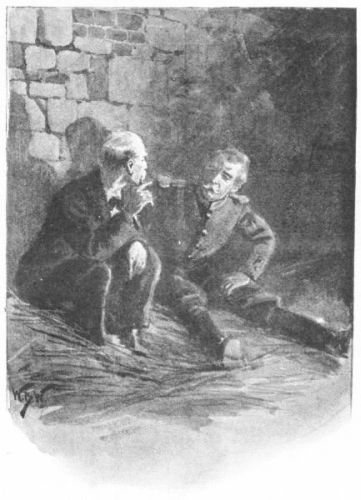
"I CAME HERE TO WARN YOU."
"Levoire and the staff. It is rumoured that you are hiding in the ruins. I came here to warn you—you alone, mind, not the others."
He raised a finger as much as to say, "This is the compact between us." The Prussians round about were playing cards and dominoes, and quarrelling over their games. Ludenmayer, fallen serious in a moment, seemed to be turning over Sadi's words in his mind. Presently he said:—
"Levoire was a friend of yours, I think?"
"I had the honour to be instructor to his wife."
"Then she was your informant?"
He had put the idea into Sadi's head, and the fiddler seized upon it with avidity.
"We need not go into that. If you doubt her information, prove it for yourself. Your friends here are scarcely capable."
"That is true, the cattle. They think that their work is over. I must certainly go, Sadi—and take you with me."
"Not so, Ludenmayer; I must have nothing to do with it. Besides, I am very comfortable here."
"For the time being, yes. But if anything should happen to me, they would assuredly hang you, friend Sadi."
"I will take my chances, Ludenmayer. Remember, it is you alone that I wish to serve. They will at least respect your orders."
"Give them your word to be silent, and they will let you go away at once. There is nothing easier, Sadi."
"For a Prussian, perhaps—for me, no. We have been comrades—let that suffice, Ludenmayer. A wise man would go at once."
The eyes of the two met, and the Prussian seemed to read something of this odd fellow's purpose in his dilated pupils and the stern, set expression of his mouth. It came to Ludenmayer that he and the gregarious dozen of spies with him were already in a trap from which haste alone would save them. This simple old fiddler knew much more than he would tell. Ludenmayer, trained to selfishness by his occupation, cared nothing for that which happened to the others if he could save his own skin. He was grateful to Sadi, and he wrung his hand.
"Well," he said, in a louder voice, for all to hear, "I must certainly be off, but I shall not be away long. Do not spare the bottle, Sadi. And mind you treat him well," he added, turning to the company, "for he is my guest."
The men stood to the salute mechanically, and the sentry in the passage whispering that the road was clear, Ludenmayer left the cellar with a last word in Sadi's ear.
"Take care of yourself," he said; "they are in an ugly mood."
Sadi nodded his head confidently, but his heart beat quicker when the door was shut, and he looked a little eagerly into the faces of the crew as though he would learn their purpose now that the captain was gone. It could not be very long, he argued, before Ludenmayer discovered the trick which had been played upon him and returned to charge him with it. As to the Prussians about him, some were already steeped with wine, and they lay sprawling like animals in the straw; others, and the cook was among the number of these, eyed their captain's guest suspiciously and discussed him in low voices. Sadi knew that his life hung upon a thread; but when a great ruffian drew a revolver and loaded it deliberately the fiddler was not afraid. "They will not shoot me," he said to himself; "they would be afraid of the noise." What he feared was the rope and the hook in the beam above, but he did not confess it by his looks; and turning from them with a laugh he buried his head in the straw and pretended to sleep. Soon the others imitated him, and the heavy breathing of tired men echoed through the cellar.
Sadi lay for a long while without any other idea than that of his own danger and the fate which awaited him if Ludenmayer did not come back. He had caught up the precious fiddle which the captain returned to him, and he hugged it to him as the one possession left to him in the world. Silent as the place was, the broken roof admitted sounds of the later night, the blare of bugles, and the booming of the shells. Sadi wondered what those distant troops would say if a man should go to them and cry, "The cellars by the old church of St. Gervais are full of Prussian spies; you will find them sleeping there." Could he but send that message, at least one of the wrongs of those bitter days would be avenged. And yet how impotent he was! The desert waste of land above would be without one living soul at such an hour; and he knew that any attempt to quit the cellar would bring instant death upon him. Sadi, convinced of the hopelessness of his idea, lay very still and counted the dreary hours. For a time he slept; and when he awoke it was the sentry's voice which aroused him. The man had come down to warn his comrades. A regiment of the line marched out to the assistance of the gunners at Lunette 53—you could hear their heavy tramping as they crossed the old road, now lumbered over with stones and the rubble of the tumbled houses. There would be many, very many of them, the ear said. Sadi alone amongst those who listened to the footsteps did not tremble or turn pale. He was unloosing his fiddle in its case. None saw him or thought of him in that tragic moment. "For France!" he said, and he believed it was the last word he would ever utter.
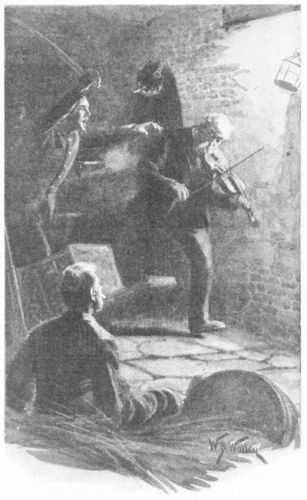
The alarm cried softly in the cellar found stupid ears and men but half-awakened from a drunken sleep. Some of the Prussians sat up with hush words upon their lips; others simply lay and listened—a regiment was marching past certainly, but what of that? They had but to lie close and to douse the lights (which they were quick to do) and their safety was assured. This they believed when sudden music, loud and distinct, sent them leaping to their feet and crying for their swords. Someone played the "Wacht am Rhein" at their very elbows—a voice roared "Shoot the fiddler down"—another voice cried out for a light. It was the supreme moment in the life of Sadi the fiddler. Never had he played so wildly or with such delight of his notes. And the darkness, he said, might yet save him. Dodging here, ducking there, he plunged into the passage and went on headlong toward the light. But he never ceased to play the "Wacht am Rhein" when he could stand a moment to breathe, and the bullets singing by him, the sword-thrusts aimed at him, did but make him play the louder.
Larger Image
"HE NEVER CEASED TO PLAY THE 'WACHT AM RHEIN.'"
Sadi gained the ruins above with a great gash upon his cheek and his precious fiddle cleaved in half by a cut from a Prussian sword. Up in the open his eyes beheld a glad sight. A regiment of infantry stood at the halt not twenty paces from him. Its officers were moving about as though in quest of some mystery, and when they perceived him they advanced a little curiously and bade the fiddler halt. He answered them in words which were almost incoherent. "The ruins are full of Prussians," he said, and pointed downwards to the cellars he had left. No other word was spoken or needed. Savagely, silently, as beasts of prey that have found quarry, the soldiers fixed their bayonets and began to go down. And Sadi stood entranced, listening to the cries of men in their death agony, to their prayers for mercy; and he said, "This wrong at least is avenged."
And so he turned from the scene, with his poor broken fiddle, and the long day of loneliness before him.
"I shall not play in Munich; I shall never see little Lucy again," he said. But he knew that he had done his duty, and his step was firmer when he set out again for the terrible streets of a city about to open its gates to the enemy.