How a Chromo-Lithograph is Printed.
Reading edition
By L. Gray-Gower.

Many readers have no doubt wondered how the vivid and faithful reproductions of celebrated pictures, with which the public has latterly become so familiar, are reproduced. There is a vague idea that it is the result of some occult colour-process that involves several distinct printings, but exactly what that process is remains commonly a sealed book. But there must be many readers who know nothing whatever of lithographic stones and colour-printing. Let us briefly, then, explain the principle.
About a hundred years ago a struggling Bavarian printer, Alois Senefelder by name, having no paper at hand with which to indite his washing bill, used for the purpose a flat slab of peculiarly soft stone which he had in his workshop. The ink he used was a rude and greasy mixture. The appearance of the writing on the stone suggested to him the possibility of reproducing the writing. His experiments were crowned with success, and lithography naturally took its place amongst the great industrial arts of the world.
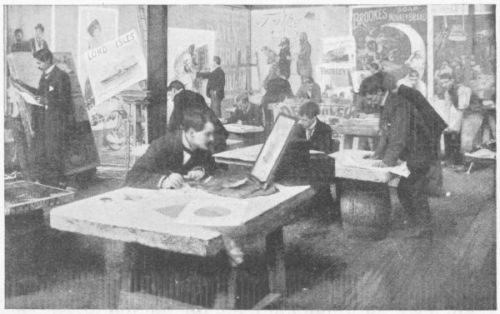
If you enter any great lithographer's workshop to-day, like that of the Dangerfield Company at St. Albans, you will notice huge slabs of stone, two or three inches thick, ranging in size from that of a large bedstead to that of a small book. All these stones may be said to come from one place—Solenhofen, in the district of Monheim.
At the Dangerfield Company's works the writer seemed to be passing through a miniature quarry, or through a tombstone warehouse. The stones arrive at the works in their rough condition. They are prepared for use by being ground face to face with sand and water.
The broad principles of lithography consist, of course, in the strong adhesion of greasy substances to calcareous stone, the affinity of one greasy body for another, and the antipathy of such bodies to water. When water is applied to the surface of the stone it remains only on such portions as are not covered with grease, so that, if a roller charged with greasy ink be passed over the stone, the ink will only adhere to the greasy portions, while the moist parts will resist the ink and remain clean. In consequence, when a sheet of paper is pressed upon the stone, it only receives an impression in ink from the greasy line. This is the whole theory of lithography.
And now comes in the task of the expert colour-master. There has been growing up of late years a class of experts in colour for whom the entire National Gallery is only a collection of tints on canvas more or less adroitly combined. These men are master-lithographers. For them the most divine creations of Raphael, Titian, Claude, and Turner are workmanlike colour-combinations, which it is their business to analyze and resolve into their separate constituents. To-day the dead walls and hoardings of the kingdom are covered with wonderful posters and the shop windows lined with gorgeous lithographs evolved by men whose chromatic perception is so acute that they can tell you at a glance what the great Turner himself did not know: how many colours go to the making of one of Turner's pictures.
Larger Image
THE ARTISTS' ROOM AT THE DANGERFIELD COMPANY'S WORKS, SHOWING THE LITHOGRAPHIC STONES.
From a Photo. by] [the Dangerfield Co.
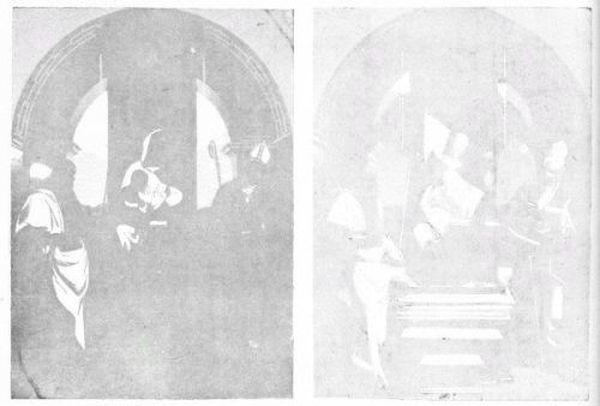
FIRST STONE—LIGHT YELLOW. THIRD STONE—LIGHTEST BLUE.
There are very few artists who can say exactly how their colour-effects were produced, or precisely what pigments were employed to attain certain tones. They work away, slowly painting and repainting until the end desired is reached.
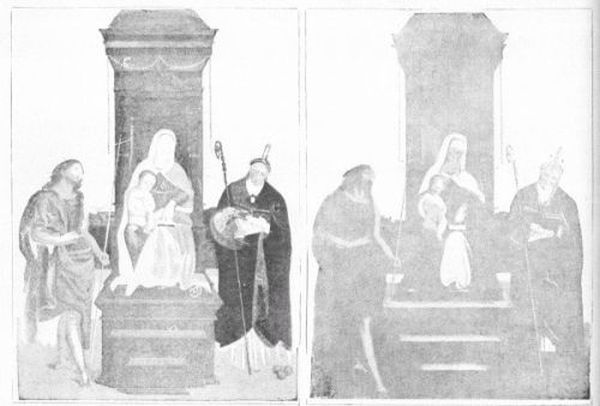
SECOND STONE—DARK YELLOW. FOURTH STONE—LIGHT FLESH TINT.
"We have master-lithographers in our employ," said Mr. Adolphe Tuck to the writer, "who can tell almost at a glance how many colours and shades go to the making of any given picture, no matter how complex."
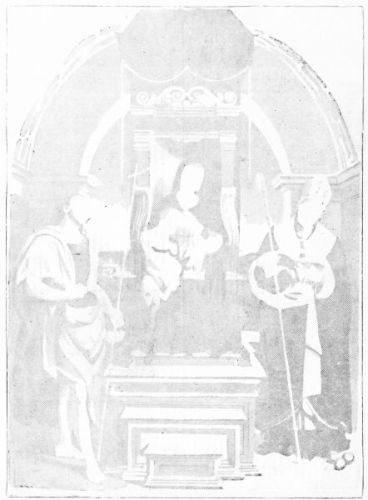
FIFTH STONE—DARK BROWN.
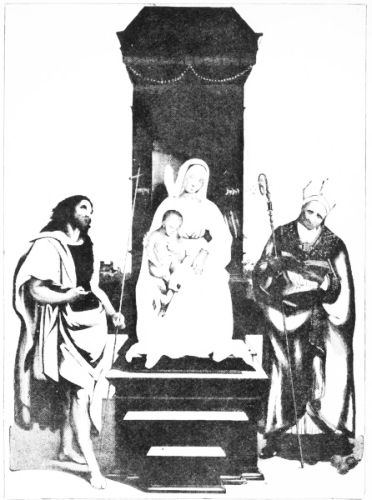
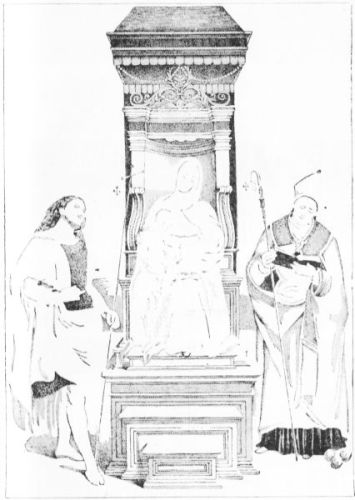
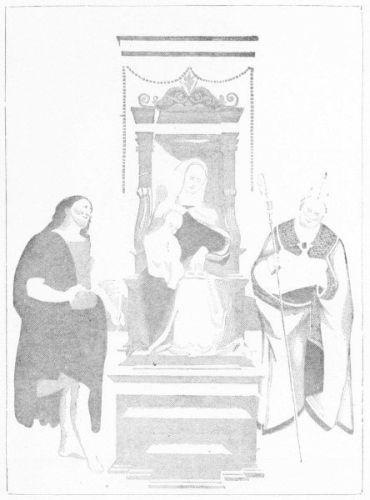
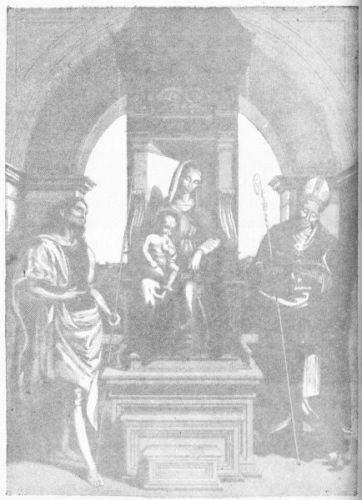
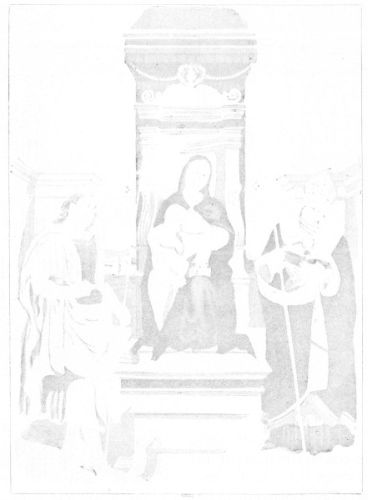
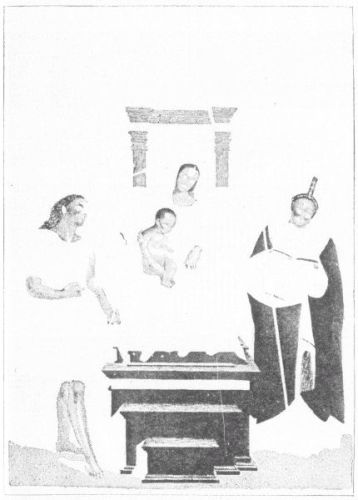
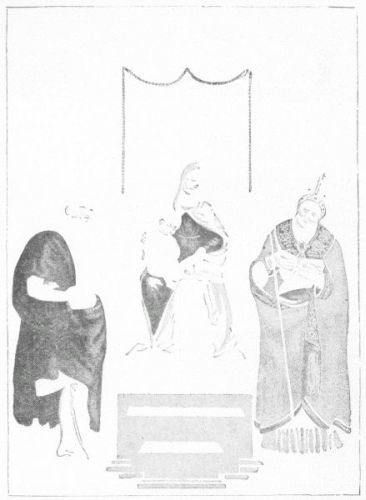
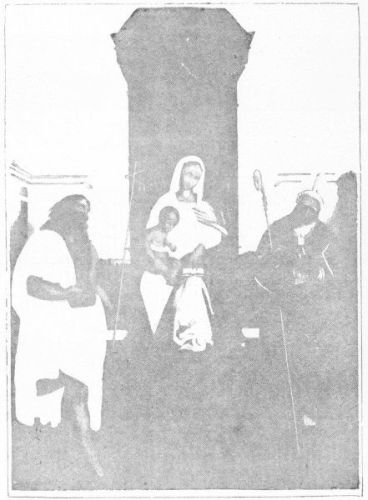
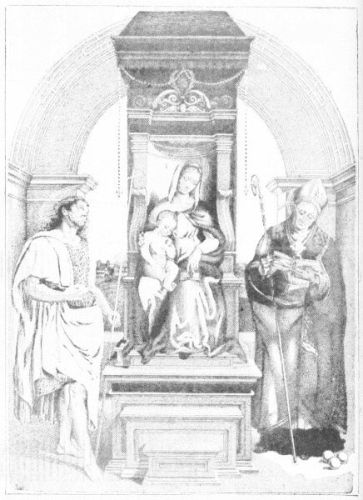
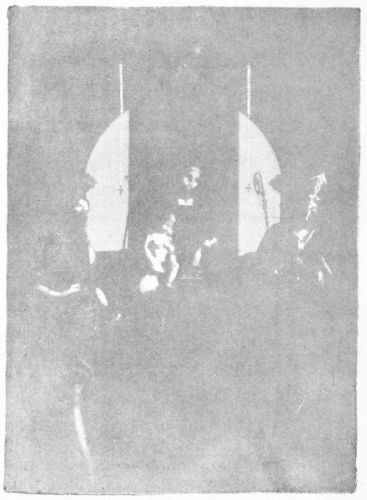
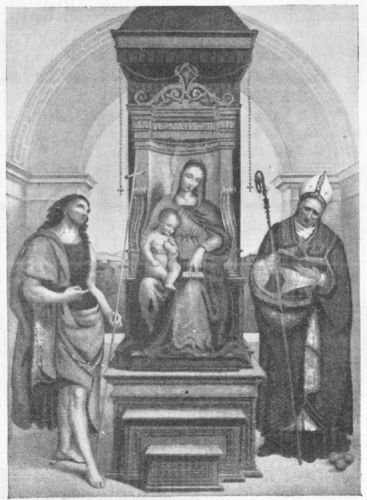
Take the case of one of the most successful reproductions of one of the old masters, "The Madonna Ansidei," which hangs in the National Gallery. The colour-master of whom we have spoken quickly resolved this picture into eighteen colours, involving the use of eighteen lithographic stones, each printing a separate tint and being of itself almost a separate picture, until by repeated printings the whole masterpiece was gradually built up. This is the example of which we present illustrations in this article, and is the work of Mr. Adolphe Tuck.
SIXTH STONE—LIGHT BROWN.
But what an eye for colour! What a gift for the realities and essentials of tone to be able, without any mixings of paint or other analytic experiments, to divine straight away just what colours are needed, and prepare stone after stone with the absolute certainty that the combination would produce such a result!
SEVENTH STONE—LIGHT BLUE.
To illustrate the almost marvellous capability of the colour-expert in analyzing the colours of a picture submitted to him, one may mention that the late Sir Charles Eastlake, P.R.A., once ventured to assert that there were sixteen colours or shades visible in a picture by Van Dyck. The lithographic colour-expert declared there were only eleven. Accordingly an accurate copy was painted at the National Gallery of the picture, so accurate that it was difficult to discern a difference between the copy and the original. This was duly analyzed and placed on the stones, eleven in number, and the eleventh printing disclosed an exact facsimile of the copy, and therefore of the original.
EIGHTH STONE—PINK.
NINTH STONE—MEDIUM GREY.
Sir Charles Eastlake acknowledged himself beaten, and readily paid tribute to the wonderful analytic powers of an artist, or, rather, of a scientist, who could not paint a picture but could tell just what a picture was made of.
TENTH STONE—MEDIUM BLUE.
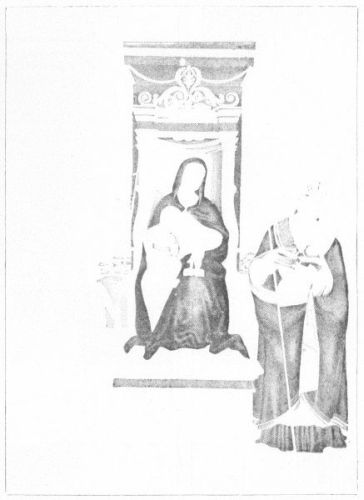
In the case of the Ansidei Madonna, the canvas was copied at the National Gallery under the eye of the Director. The first stage of reproduction was to transfer upon the stone a sort of yellowish-grey base or silhouette of the whole picture (No. 1). It will be noticed that the high lights are upon portions of St. John's and Mary's garments and the mitre of St. Nicholas.
The picture on the next stone, which is to overlay the first, gives more detail.
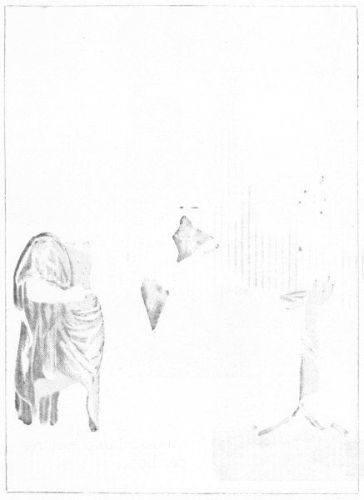
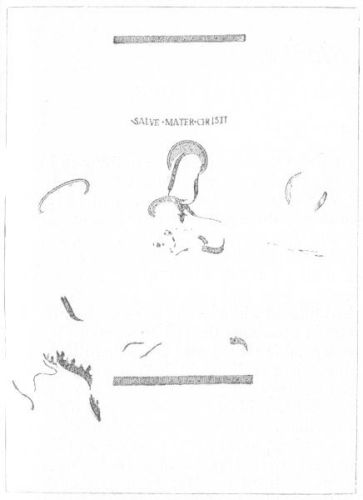
Gradually these pictures, each done by a separate artist, under the eyes of the colour expert or master-lithographer, assume greater perfection, as colour by colour is added, one from every stone, until in No. 9 one would fain think, as the artist himself may have thought, that the picture was finished, or at least approaching completion. But, as a matter of fact, it is only half completed. It is still lacking many necessary qualities; the reds and the greens and the greys and the gold have yet to be added. What a quaint enigma is presented by Nos. 11, 12, 14, and 15! Taken by themselves they seem meaningless, but combined with their forerunners and successors they are seen to be essential to the finished picture.
ELEVENTH STONE—MEDIUM YELLOW.
In the very final stages the stones are devoted to greys, which by overlaying one another impart a roundness and solidity to the design which it would otherwise lack. It may be mentioned that this reproduction is, according to Mr. Tuck, the most successful, as it is the most elaborate, colour-lithograph ever attempted.
TWELFTH STONE—DARK RED.
THIRTEENTH STONE—DARK FLESH TINT.
In the case of an ordinary colour-drawing the usual method is to prepare a keystone—that is to say, an outline of the picture, together with the black or grey portions. It is then marked off into colours, each colour requiring, as has been said, a separate stone. Of the uncoloured outline as many copies are printed as there are to be colours in the finished picture, and each of these serves as a key or guide in determining in what position on each stone the separate colour shall be. Each artist then sets to work on his own part of the picture, which is very often, as will be seen by our illustrations, a picture by itself. The master-lithographer knows just how many of these pictures will be necessary to achieve a facsimile. It may be that one colour will frequently have to be printed over another in order to produce the precise effect.
FOURTEENTH STONE—DARK BLUE.
For colour-printing the stone is polished. Naturally the order in which the colours succeed each other is very important, and must be carefully considered. But perhaps the great object of the maker of pictures from stones, after the picture in its various phases has been prepared, is to see that each colour falls accurately into its proper place on the paper. Nothing is more common, in a badly done lithograph, than to find in the face of the human subject, say an attractive young lady, the flesh colour overlapping the collar or the hat, or even extruding itself out into space beyond the ear. All this implies bad "registering." The drawing on each stone must be made to fit in, or register, with the preceding one, so that, as the paper is passed through the printing machine, the picture is built up colour on colour, each, however, being allowed to dry before the next is applied.
In preparing the stone to take the picture extreme care has to be exercised, for so great is its affinity for grease that even a finger-mark will become perpetuated. After a drawing on the stone is finished it is a precaution to coat it with a solution of gum-arabic and nitric acid, which fills up the pores of the stone in the unfilled parts and prevents the drawing from spreading.
FIFTEENTH STONE—LIGHT RED.
SIXTEENTH STONE—DARK GREY.
Having described the manner in which the picture on stone is prepared, we now come to the printing of it. To begin with, there is the "proving-press," which is employed in preparing the stones for the machine. The gummy solution is first washed off, but sufficient remains in the pores of the stones to offer a resisting influence to the ink when the time for printing comes. At this stage the stone is damped and a roller charged with printing ink is passed over its surface, every part of the design being brought in contact with the ink. Accidental grease spots are removed by scraping, polishing, or the application of acid, otherwise they would develop and spoil the result.
SEVENTEENTH STONE—GOLD.
EIGHTEENTH STONE—LIGHT GREY.
When the stone is thus rectified it is subjected to what is technically termed etching; that is, a weak solution of gum and nitric acid is applied, which causes the surface of the bare part of the stones to be gently eroded, and gives a stronger "tooth" to the design. Although the ink of the design itself may now be washed away and the picture be invisible, yet it is there, ready to receive any desired colour which forms the part of the picture. The stones have to be damped and inked before each impression is taken, but nevertheless the printing proceeds with great rapidity, ranging from six hundred to one thousand impressions per hour.
Larger Image
THE FINISHED CHROMO-LITHOGRAPH: "THE MADONNA ANSIDEI" (AFTER RAPHAEL).