The Coils of Fate.
Reading edition
By L. J. Beeston.
I.

"If you ever kill a man, my friends—ah! but you may—take care to dispossess the mind of haunting fancies. Murder is a wrong against society, certainly. So is borrowing a sovereign which you do not intend to return. Both may be forgotten."
Vassilitch spoke across the dinner-table. His unconventional philosophy was meant for every ear there, though he addressed himself to his host—George Etheridge, of Hollowfield Court.
Gabrielle Rupinsky, the speaker's countrywoman, who was seated at his right side, turned her head to flash into his face one look from her calm eyes.
A silence followed the remark; not an uncomfortable period, but rather one of that satisfaction which we feel when a good talker ventures out from the ruts of conversation and trite opinion. Then Tweed, a round-faced, optimistic schoolboy of a man, said, cheerfully:—
"How comforting! Let us go and exterminate our enemies before they get wind of so pleasing an assurance and exterminate us. Alas, though, we have not altogether done with Leviticus yet; still the hangman takes care of our consciences."
In the first place they had been speaking about echoes. Several of the company had heard wonderful echoes in different parts of the world. George Etheridge had told of an echo in Bavaria which had startled him—as it startles all to whom it speaks. He said: "You row out to the middle of the lake. There is an immense rugged cliff on one hand, and on the other a dense wood of pines. You fire a pistol. The sound rolls from between precipice and forest, tossed from one to the other, gathering in intensity and power, until it breaks like a clap of thunder overhead. The effect is certainly terrifying. Shall I tell you of what it made me think? Of one of those imprudent acts, one of those small sins that we commit in an unconsidered moment, which is the trifling cause of growing and overwhelming effects that end in cataclysm."
The conversation having been given this serious turn, first one and then another of Etheridge's guests recalled stories of sins that had worked in lives as worms through a ship's planks. Tweed mocked. He was rarely grave, but his easy heart was valued by all who knew him. He said, "You will all give yourselves a nightmare at bedtime. Come, let us have a murder yarn to wind up with."
And so Vassilitch, who was no stranger to the fatalism of the Slav, and who on that account had listened with considerable interest to the dialogue, had suddenly roused himself to utter his views expressed above.
"I will repeat my advice," said he. "If you ever kill a man do not think about it afterwards. Ah! the fantasies that we invent to torment ourselves with!"
Gabrielle was compelled to look at the speaker once more. As the guests of Etheridge they had seen much of one another during the past three days. She liked to have him by her side because he was her countryman; also, to her eyes, he appeared to be the strongest man in the company. And he? Whenever Mademoiselle Rupinsky came in late he was silent to taciturnity; and when she took her place he thawed.
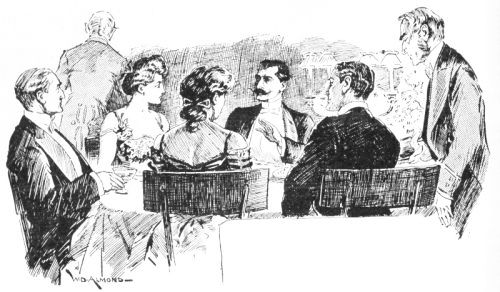
"You are not—you cannot be—in earnest?" said Gabrielle.
"Never more so, mademoiselle."
"It is your profession that has killed your sentiment," explained Etheridge.
"As you will."
Clearly they were all waiting for him to continue. He perceived that he was the centre of observation, of interest—Ivan Féodor Vassilitch, sometime captain of a Cossack regiment that had made a reputation for hardihood and valour unique even amongst those northern soldiers whose nerves have the iron coldness of their ice-plains. He raised his glass, emptied it, and went on:—
"I tell you, my friends, that if circumstance compels you to such an act as I have spoken of, then any future terrors must be entirely the product of a superstitious imagination. No spirit will haunt you save that which you yourself conjure by bending the mind continually to that idea. No worm of remorse will tear your peace unless you believe liars who tell you it exists."
Larger Image
"'YOU ARE NOT—YOU CANNOT BE—IN EARNEST?' SAID GABRIELLE."
That was all. None cared to argue the point. He was so quietly certain of his philosophy; so terribly sure.
An hour later Vassilitch was addressed by Gabrielle. "I should like five minutes' talk with you," she said.
He expressed both readiness and pleasure, and he spoke the truth. They passed out into the garden, after he had insisted that she should cover her shoulders with a wrap, for the dews of late autumn were condensing and falling imperceptibly on the still trees and flowers.
"Will you sit down?"
"I should prefer to walk slowly." He saw her bosom rise and fall in agitation, and he wondered what was coming.
"Monsieur, I have a story to tell you. Of all the men I know, you can best appreciate it. It may be that you will care to help me—ah! do not be too ready; my request, if I prefer it, is altogether an unusual one, and such as only you might understand, and I. These Englishmen have cold hearts; passion with them is slow to catch fire and easy to be extinguished."
"You speak of love, mademoiselle?" said Vassilitch, uneasily.
"No."
"Then it must be revenge. I am all attention."
"You have heard of that society that call themselves 'The Scourge'? Of their political opinions I know nothing. Three years ago the police broke into a Moscow cellar and captured fifteen of this confraternity. Of the ultimate fate of those fifteen I also know nothing, but the end that came to one has been told me. He, at any rate, was a man, and a true Russian."
Gabrielle caught her breath with a gasp, paused a moment, then continued:—
"He was deprived of civil rights, his property confiscated, and he himself sent into exile. He escaped from a convict station in the Trans-Baikal. He gained the woods, but it was winter, and you know what that means."
"Ah!" muttered Vassilitch, twisting his black moustache and watching the pale face of his beautiful companion.
"I have not seen those dreary forests, but I have heard and read of them; how packs of hungry wolves seek food and cannot find it; and how the varnaks—those wretches who have committed real crimes—infest the lonely pathways at evening to rob and murder. They say that the police kill them as dogs."
"Pardon, mademoiselle; you must not credit these wild tales."
"But I do believe them. Listen. This poor exile, after he had wandered for days in that dead land, was discovered by a band of Cossacks riding along a forest path. He was seized. Their officer cried out that he was a varnak, a bradyaga, and ordered that he should be shot. You start; perhaps this story has reached your ears?"
"No, no," said the other, quickly. "Pray go on."
"The exile protested that he was an escaped political prisoner. He was not believed. The officer again repeated his order. A soldier was about to obey, but the other threw the man from his horse. Instantly a dozen carbines were levelled, but the officer, convulsed with passion, cried out, 'You will tie this scoundrel to a tree, eight feet above the ground, and leave him to the wolves.' Ah! why do you recoil from me? Do you not believe this story? I tell you that it is absolutely true in every detail."
Gabrielle was trembling with emotion.
"It is quite cold out here; you will catch your death. Let us go indoors," said Vassilitch, harshly.
She continued unheedingly. "The command of that monster was obeyed by his men. The victim was lashed to the trunk of a pine tree, high above the ground. The Cossacks rode away, laughing, and left him there until the wolves should come to surround the tree, to bite it through with their sharp teeth, and then—and then——"
A gleam of lightning passed over the sky, and the rumble of thunder followed.
"Do you recollect the talk at the table?" said Gabrielle; "about echoes? This act is one of those that return to break in thunder upon the perpetrator."
The ex-captain of Cossacks shrugged his shoulders. "What is your request?" he demanded.
Gabrielle stopped in the garden path and faced him. A faint light from the windows of the mansion fell upon her form with its perfect lines, its loveliness. She was conscious of her beauty then, and she knew that he was conscious of it.
"Find the man who did this thing."
He was silent.
"You think me revengeful? I acknowledge it. Right or wrong, for three years I have prayed for this."
"Mademoiselle, I must ask you two questions: The name of your informant?"
"I am pledged not to give it. He was a trooper in the band who obeyed the orders of their officer."
"That is unfortunate, for I should much like to know his name. Let that pass. Question number two: What was this prisoner to you that his fate should awake these feelings of deep sorrow and revenge?"
For an instant Gabrielle hesitated, while his eyes appeared to be reading her inmost thoughts. Then she said, "He was a brother."
"Ah!"
Vassilitch was clearly relieved by the answer. He said, "This will, of course, necessitate a journey to Russia. Well, I will find this man."
"And you will challenge him?"
"I will challenge him."
"And you will kill him?"
"If by that time you still wish it—yes, I will kill him."
They looked into one another's eyes, adding no further word. A heavy clap of thunder broke and rolled overhead.
"You had better go in now," said Vassilitch.
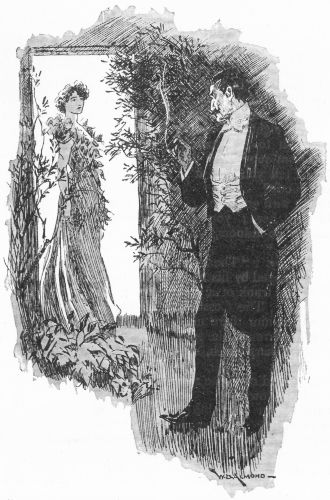
He left her at the doors of the French windows, while he lighted a cigar and went again into the garden. Suddenly he turned. He perceived that she was yet standing, gazing after him. He could see her in the aureole of light, though she could not see him in the outer gloom.
"How beautiful she is!" muttered Vassilitch.
He flung down his cigar, put his foot upon it, and ground it into the earth.
II.
"Expensive? Rather. You cannot get diggings in Regent Street for a song." Tweed rose, threw up the window, sat down again, and added, "Especially over a jeweller's shop. They are so careful. There is nothing but a plank, my dear Boris, between us and thousands of pounds' worth of glittering things."
"It is very nice here," said Boris Stefanovitch, looking across to the Quadrant with wistful, melancholy eyes.
"'Twill serve. They are not bad for bachelors' quarters. My only fear is that one day I may get my head into the matrimonial noose. Do not laugh; it is too serious. There are many who feel in the same way. We are determined not to marry. We build a hedge, and dig a trench, and raise a tower; but—but——" Tweed shrugged his shoulders. "Halloa, it is beginning to snow," he added, abruptly. "Do you feel cold? I will close the window."
"Pray do not. I had an idea that it never snowed in England. This wind is most refreshing."
"I am glad you think so," said Tweed, pushing back his chair as a rush of raw air swept into the apartment. "No doubt a cutting blast like this is a summer breeze to you after your——" He pulled himself up suddenly. That was a subject that he never cared to be the first to open.
There was the rattle of descending iron shutters. They were closing the shop on the ground floor. The white flakes were driving by in dizzying confusion. Almost every cab had an occupant. A hushed roar told of the traffic at Piccadilly Circus.
Stefanovitch said, quietly, "Well, I shall return to Russia."
"You will do nothing of the sort," was the equally quiet reply.
"There is a difference in our cases. You wish to live without love; and I—to me love is life. This silence is not to be endured. Why no response to my letters? I shall wait one more month, and then I shall go to Moscow."
"You dare not! Haven't you seen enough of Russian prisons?"
"More than three years since I set eyes on her," muttered the other; and his face, which bore the marks of much suffering, became all at once haggard with perplexity.
"Three years is a long time and a hard test," argued Tweed.
The other caught his meaning. He smiled as he said, simply, "My friend, you do not know this woman."
"But I know the Trans-Baikal, and the frozen horror of your northern swamps. And I have seen a gang of exiles, in their long, earth-coloured coats, women and men, chained together, living statues of despair, tramping, tramping, and the soldiers with their bayonets fixed——"
"Don't!" said Stefanovitch. But the other went on unheedingly.
"And I have seen your northern forests in winter, shrouded in snow, with an Arctic wind rattling down the pine needles, bending the cedars, and the fir trees making a sound that gives you the shivers. And I have seen the wolves there. They appear to rise out of the ground. Once they chased me for three leagues. We were in a tarantass, and were nearly caught, by Jove! What brutes! Every tooth looked like a dagger. And frequently a poor wretch will escape from a convict station and try to hide himself in these forests——"
Larger Image
"HE PERCEIVED THAT SHE WAS YET STANDING, GAZING AFTER HIM."
"Will you stop?" cried Stefanovitch, covering his eyes.
"——will endeavour to conceal himself in one of these forests; but either he starves to death or the wolves get him, or perhaps a party of soldiers, say Cossacks, come upon him and take him for a varnak. And I have known one instance in which the man, having resisted authority, was lashed to a tree to wait for the wolves. He succeeded in releasing himself, it is true; and ultimately he escaped from the country, but——"
"Enough, enough!" implored Stefanovitch, as if appalled by some memory that had seared heart and brain.
"——but next time he will not meet with such fortune." Tweed rose and smashed down the window.
"Why do you recall these things to me?" said the other, huskily.
"Why will you make a fool of yourself?" was the heated retort. "I tell you that you shall not go back to Moscow if I can prevent it. There's not a woman on this earth who is worth running so great a risk for. If she will not answer your letters, you must forget her, that is all."
"You suggest an impossibility."
"And you suggest a madness. What are you gazing at? Do you recognise anybody?"
The other was looking across the roadway to where a tall, broad figure, in a massive fur-trimmed coat, was leisurely pacing the thronged pavement. Tweed repeated his question.
"I—I don't know," replied Stefanovitch, indecisively. "The face of that tall fellow—I thought it was familiar—the light is so bad—and a cab came between——"
"What, that fellow in the coat? How strange! I seem to know him, too. Even his back is familiar. Let me think. Where on earth did I meet—ah!—no, it's slipped me again. Yet I'm sure—almost sure—that I—got it, by thunder! The man's Vassilitch—Ivan Féodor Vassilitch, a countryman of yours; not a bad sort, but cold and hard—hard as sheet-iron. You have met him, perhaps?"
"The name is not familiar to me."
"I met him at Etheridge's place in Cumberland. It was four months back." Tweed spoke cheerily, feeling glad that the subject was changed. "There were some nice people down there," he continued. "I should like you to know Etheridge. Ah, yes—there was also a countrywoman of yours staying at the place. She and Vassilitch were rather thick, we thought. A singularly beautiful creature. Her name was Gabrielle Rupinsky. She——What on earth is the matter?"
"Gabrielle Rupinsky!" echoed Stefanovitch, springing so suddenly to his feet that his chair went flying.
"The same. Do——"
"The daughter of old Otto Rupinsky, General of Hussars?" The speaker was trembling with excitement.
"That is she," said the other, astonished.
Stefanovitch caught at his collar as if emotion were choking him. "Do you know what you are saying?" he cried. "Fool that I was not to have mentioned her name! This is the woman who is all—all the beauty of the world to me. Gabrielle in England! Now it is clear why my letters were not answered. Heaven bless you for this news. Her address—quick!"
Tweed, overjoyed and immensely relieved, was wringing the other's hands in his delight. "I'm afraid I can't give it you straight away," said he. "You see, she isn't in Cumberland now. But I will write at once to Etheridge, and you should have it within forty-eight hours. 'Pon my word, old fellow, this is great news. Are you going?"
"If you do not mind. A thousand thanks. I hope it is not a dream; it seems too good to be true," he added, with pathos. "What! I shall see Gabrielle within forty-eight hours? Shall hold her in my arms? Pardon me; these things may not appeal to you. But if you had waited and suffered——"
"I know, I know," said Tweed, sympathetically. They had descended the stairway and were at the open door. "Look here," he added, in parting, "we have supper together at my club to-morrow night; that engagement holds good, of course?"
"As you will; most certainly."
Stefanovitch pressed his friend's hand and was gone. At that moment Tweed perceived the tall form of Ivan Vassilitch repassing. He murmured, "I should like to renew my acquaintance with this man; he fascinated me, rather. I'll go out and meet him." And he bounded upstairs for his coat and hat.
III.
An electric bell hummed through the cottage.
Gabrielle put down her book in surprise. She had scarcely expected a visitor at that late hour. Yet it was not really late, but in this sleepy Hertfordshire village nine o'clock was considered an unusual time for anyone to be out.
She drew back the blind. A black night pressed against the window. The country-side, unillumined by moon or stars, was just a wall of darkness, as if reclaimed by "chaos and old night."
A servant entered with a card. Gabrielle glanced at the slip of pasteboard, and the observant maid noticed that a sudden rush of colour swept into her mistress's face.
"I will see him," said Gabrielle.
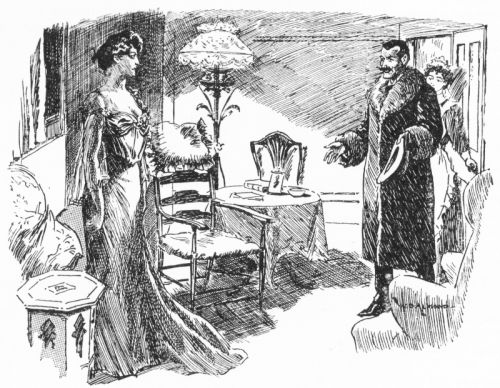
There entered Ivan Féodor Vassilitch. The lines of his face relaxed at sight of her, and a smile almost of sweetness raised his black moustache. "Why do you not light your English country roads?" he demanded, laughing. "I had only the light of your window to guide me for a mile."
"Pardon; they are not my roads," she answered, in the same bright spirit of banter. "I am not yet naturalized. Where have you been?"
Larger Image
"THERE ENTERED IVAN FÉODOR VASSILITCH."
"To Russia." He spoke the truth.
"Ah!" Instantly she became serious. "And you returned——?"
"Yesterday."
"Will you sit down, monsieur?" She spoke with a palpable effort. Some emotion had robbed her of breath.
"Shall we go straight to our subject?" asked Vassilitch, perfectly controlled, as he always was.
"For what else are you here?"
"My first thought was that I should see you; my second was that I had a more definite errand."
He bore her sudden coldness so steadily that she was compelled to relent. "Well," she said, "I am very pleased to see you, monsieur."
"You are exceedingly kind. On the day following the evening on which I received your instructions I set about the business, and I was not long in finding the man who worked you and yours so great a wrong."
"Not long? Impossible that he was in England?"
"On the contrary, mademoiselle, he was in this country. Do not ask me how I discovered him. As an ex-officer of Cossacks you will understand that my inquiries were respected. The task was not difficult; in fact, it was ridiculously easy."
"Why do you laugh like that? You found this monster; what then?"
"He went to Russia. I went also."
"And you challenged him there?" cried Gabrielle, and the womanly softness fled from her eyes.
"I did not."
"Monsieur! monsieur!"
"Listen. He returned to England; and I, too, followed."
"What! You permitted him to escape? You lost this chance?"
"Mademoiselle, there is one thing which both of us overlooked—or, rather, of which we were in ignorance."
"That you were afraid?" said Gabrielle, rising to her feet, with a world of scorn and anger in her beautiful face.
Vassilitch regarded her with steadiness; he took the word as he would have taken a pistol ball, and again she relented. "Forgive me," she said. "I was hasty; I wronged you."
"Mademoiselle, the Queen can do no wrong." He took the hand she gave him, made as if he would have raised it to his lips, then released it with infinite gentleness. "The one important point that we overlooked," he continued, "is that this man—I wonder if you can guess?"
"No, no. Go on."
"——is that this man loves you, mademoiselle."
"Loves—me?"
"So I discovered. You are his guiding star. To you his life points; round you it revolves. Parted from you by an infinite distance, he is yet bound to you by the strongest of laws, and can no more escape your sway than the earth the pole-star to which it looks, about which it rolls. And knowing this, I could not kill him—just yet."
"Why, what folly is this that you are talking?" exclaimed Gabrielle, a trifle awed in spite of herself. "You are not serious, monsieur? You cannot be."
Vassilitch did not answer.
"His name? Tell me his name," was the impatient command.
"I will tell you, but not now."
"You are very mysterious," said Gabrielle, watching him closely. "You must be aware that you are keeping me in suspense."
Vassilitch rose. "It is merely a fancy of mine," said he. "I ask you to believe that I have spoken the simple truth. I am still prepared to carry out your instructions; but I should like you to consider the assurance that I have given you. In a short time I hope to see you again. Perhaps—anyhow, you know that I am your servant; you have but to command me. I will wish you good-night, mademoiselle."
Gabrielle extended her hand. She was troubled by the bitterness of his smile. Certainly this man was mysterious to-night. "Where are you staying?" she asked, suddenly, willing to prolong the conversation.
"At the L—— Hotel."
"You will dine with me one night? This place is quiet, but it has its charm."
"Nothing would delight me more."
"To-morrow?"
"You are very good, but I have an engagement. Do you recollect the Englishman—I have his card here—George Tweed? That is it. He was in Cumberland when——"
"I remember him perfectly."
"Well, we met this evening in London. He extracted from me a promise to take supper with him to-morrow night. He wants me to meet a great friend of his, and a countryman of ours, whose conversation he vowed would interest me."
"Indeed? Did he mention the name?"
"Yes. It was—it was—no, it has slipped my memory. It scarcely matters."
A servant came at a touch of the bell. The visitor descended the stairs and left the cottage. Impelled by a sudden impulse Gabrielle ran to the window and pulled up the blind. He would see her standing there. What of that? The crunch of his heavy footfall sounded upon the gravel, and his voice came clearly—"Good-night!" She replied and felt glad.
Gabrielle drew down the blind again and retreated into the well-lighted room. She paused by the table and put to herself, aloud, a direct question: "Why did I tell him that—that he was my brother?" And she replied, in as direct a fashion: "I imagined that he—cared for me a little. If he had known the truth should I have been able so to command him? I cannot think so."
The recollection of the time when she had met Ivan Vassilitch brought to her certain details of the occasion; and suddenly she remembered that conversation in which famous echoes that appear to gather sound and reverberate had been likened to actions that will not leave a life. She had compared that cruel wrong which had destroyed her peace with one of these deeds that come back to break in thunder. She recalled the reminiscence with a sense of uneasiness.
IV.
There were half-a-dozen men in the coffee-room at the club.
"What I like about this place," said Tweed, across the table, to Stefanovitch, "is that they feed you well. The big restaurants have spoilt most clubs in that respect. If ever——" he stopped, and took his arms off the table as a uniformed waiter approached with a bottle of champagne. The man held the dusty neck with a serviette, drew the cork, and filled two glasses. Stefanovitch, lost in thought, did not observe the act. When he looked down he flushed slightly as he said, "Thank you, I do not care to drink before eating."
The other was visibly annoyed as he glanced at the clock. "Our man is behind time," said he. "A bad thing in a soldier. By the way, I wonder if you do know him? I should say that he is a man of iron—one of those fellows whom you couldn't drive nails into, to quote a picturesque expression, and the last man on earth of whom I should care to make an enemy."
"You said that, when you were all together in Cumberland," answered the other, speaking with apparent effort, "this Ivan Vassilitch, whom I am to meet to-night, appeared rather fond of Gabrielle. Of course——"
Tweed laughed outright. "Don't worry," said he. "Mademoiselle Rupinsky was to him as to most of us—a beautiful statue. Her cold reserve is now fully explained; she believes that you are either dead or yet an exile. You will make her a happy woman to-morrow, Boris. Ah! an idea. Vassilitch may be wiser than I. He may have her address, in which case you will not have to wait for this letter from Etheridge. And that is a point which will soon be settled, for here comes our man."
The tall figure of Ivan Vassilitch appeared at the door of the spacious coffee-room. His hat and coat had been taken from him. He at once perceived Tweed, and dismissed with a nod the servant who had conducted him thither. Tweed gripped his hand with almost boyish fervour.
"So pleased to see you," said he. "Come along, I will introduce you to a fellow-countryman who——Halloa! you know one anoth——" He broke off on the unfinished word.
Stefanovitch had risen to his feet. He faced Vassilitch. Into his eyes a wild expression leaped, a look of haunting fear, of cowering terror. Tweed, with astonishment, observed that piteous gaze, and thought instinctively of a half-tamed animal that turns upon its master. Stefanovitch recoiled a step, one hand grasping a chair-back, the other clutching the table-cloth, and with all the strength of his spirit he strove to beat down the straight look of this man who, by an hour of horror, had well-nigh broken that spirit.
Vassilitch was the first to break the silence. He said, unflinchingly, "Monsieur Stefanovitch appears to recognise me. He has a good memory for faces. Yes; we have met before."
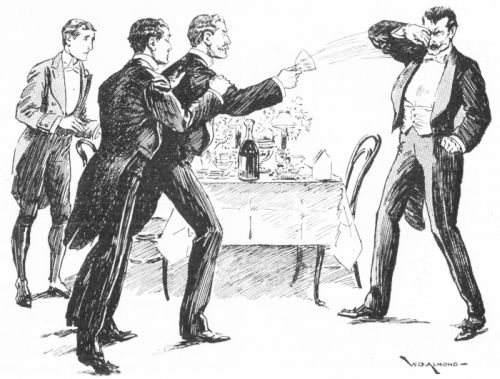
At the words, or the callous tone in which they were spoken, a sudden frenzy of passion convulsed Stefanovitch. Uttering a stifled cry of "Scoundrel!" he snatched up his untasted glass of wine and flung the contents in the face of Vassilitch.
Larger Image
"HE SNATCHED UP HIS UNTASTED GLASS OF WINE AND FLUNG THE CONTENTS IN THE FACE OF VASSILITCH."
"Are you mad?" exclaimed Tweed, grasping the outstretched arm.
A waiter who had observed the action took a step forward, then hesitated, ready for developments.
The ex-officer of Cossacks wiped the liquid from his face and coat. He was very pale. He turned to Tweed.
"I compliment you on the manners of your friends," said he; "they are delightful. I have the honour to wish you good evening." He bowed slightly, twice—the second time to Stefanovitch, who had sunk into a chair; then he quitted the room.
V.
The fatalistic idea that he was being carried onward in spite of himself would occur insistently; he felt that he was no longer master of circumstance.
It was hardly to be wondered at, since it was largely a matter of nerves. Vassilitch had returned to his hotel after the scene at the club, and spent half the night writing a letter to Gabrielle; slept badly, breakfasted on four cups of black coffee, spent the best part of the day in pacing the narrow dimensions of his sitting-room, and was now—as the afternoon waned—as undecided as ever.
He told himself that the only clear part of the business was that he could not do without her—no, nor would he; that he was guiltless of the crime that had awakened her abhorrence and fierce desire for justice. For her brother had escaped death, it appeared, and had come back. But that brother would denounce him, would have to be reckoned with. It was certainly awkward. The difference in their names did not puzzle him. Doubtless the name of Stefanovitch had been assumed from political reasons of prudence.
But, then, he told himself, brother and sister must have met in England, perhaps weeks, even months past. In that case Gabrielle must have learned the truth, and so might very well be playing with him. This thought was terrible. Yet when he called to mind the obvious surprise and discomfiture of Stefanovitch he felt relieved. Then another suspicion arose: what if that meeting had been a prearranged thing? It was a little unusual that the Englishman, George Tweed, should accost him—a mere acquaintance—in Regent Street, and invite him to supper. Yes, it really did appear as if he were the dupe of Gabrielle and Stefanovitch, that they were indeed amusing themselves at his expense. If not, how strange that she should have said to him, of all men on earth, "Kill the man who killed my brother."
This frightful suspicion was not to be endured. He combated it, since it was for his life. He strove to remember one soft look that she might have given him. He had imagined at times that she trusted a little in him.
A firm resolve to act came at last to him. He tore into small pieces the letter that he had written. He would see Gabrielle—would end this torment.
He examined a time-table and started to leave the hotel. Half-way down the stairs he paused, returned quickly, and slipped into his pocket a Derringer pistol, which he took, without exactly knowing why, from a drawer. A minute later he was bowling towards King's Cross Station.
On the platform he saw Stefanovitch, and guessed rightly that the latter was bound for the same destination as himself. If Vassilitch had been sure of this he would have abandoned his intention; as it was he resolved to go on without losing sight of the other.
The train sped from the Metropolis, rushing with piercing cries through the winter-laden country. The short day was passing from fields and sky; already the tops of the leafless trees mingled with the grey of evening.
When Ivan Vassilitch alighted at his station he perceived that Stefanovitch was before him, that he was just quitting the platform, moving with sharp strides, as if he were in a hurry. Vassilitch had half a mind to turn back, but, not caring to wait for perhaps a long time till an up train came in, he almost mechanically followed the other at a safe distance.
Stefanovitch stopped once or twice, and appeared to make inquiries as to his way. This mystified Vassilitch. Was it possible, he asked himself, that Gabrielle had not met her brother; that the latter had but just set foot in England? The consideration was comforting.
Stefanovitch walked on with great strides, not looking behind, or scarcely to right and left. Gabrielle's cottage was isolated from other habitations. It was built on an eminence that was sheltered on three sides by poplar trees, while the gravelled drive that led to the front of the house was bordered by elms, whose branches met overhead and formed an avenue.
Stefanovitch was approaching the head of this avenue when he perceived, coming toward him, the figure of a woman. His heart almost stopped beating, then continued with great thumps of excitement. The waning, pallid twilight obscured the form, but something in the poise of that figure, in the walk, brought back to him a flood of dear remembrance. With fingers that shook he lifted the latch of the gate and continued down the avenue, that was covered with dead leaves of autumn. And then he saw that it was indeed she.
He cried out in stifled tones:—
"Gabrielle! Gabrielle!"
She stopped; the quick panting of her breath reached his ears.
"It is I—Boris! I have come back to you, Gabrielle—come back, after all these years! My heart! Why do you look at me like that? No word of welcome, Gabrielle? Ah! you thought that I was dead? My selfishness has made me too abrupt." Stefanovitch had caught the white hands and was drawing her towards him.
"Yes, I—I—thought that you were—dead," answered Gabrielle. The sound of his voice, its infinite tenderness, the joy that glowed in his eyes, moved her so that she broke out into sobs—sobs that startled him.
"My love! my dear love! I have frightened you. Oh, you must not cry like that. Look at me, Gabrielle! How I have lived for you! Not one hour in which I have not thought of you. And this, God's mercy, is greater than His trial." Stefanovitch raised the drooping head and covered her face with his passionate kisses. "My love! My love!" he said.
And Gabrielle at that moment seemed to wake from a dream. Here was the heart that she could rest upon. What other thoughts were those which she had permitted to linger for awhile? They were fading already, were passing with her tears.
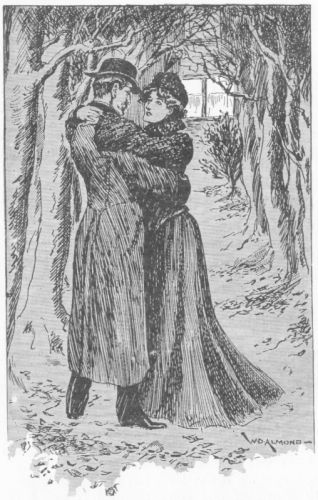
Larger Image
"SHE PUT HER ARMS ABOUT HIS NECK."
She put her arms about his neck; and so they were silent for a time, standing motionless beneath the trees. Stefanovitch said at last:—
"Who told you that I was dead, little one? Who caused you such pain?"
"It is so terrible a story. I heard that you escaped—"
"And so I did."
"That in the forest you were caught by a regiment of Cossacks, and that—"
Stefanovitch interrupted her. "What!" he cried out, "you heard of that? Yes, it was true; but, Gabrielle, at a moment like this, when my cup is overflowing, I can forgive even Ivan Vassilitch—"
Gabrielle sprang from him as if he had struck her. In an instant she saw the whole truth. The cry she would have uttered died on her parted lips. She remained mute, bewildered, paralyzed with astonishment.
"Ah, you know the man," said Stefanovitch. "I had forgotten that. Well, let him pass, Gabrielle. Come, you are shivering. It is so cold out here. May I come indoors for an hour?"
The ex-captain of Cossacks closed the gate as he left the avenue. He had heard every word. And he had let them go. Why, he might have pistolled Stefanovitch as he stood there!
He remained in the snow-covered road, staring at the darkened fields, pallid with grief and rage.
Suddenly he snatched the Derringer from his pocket. The barrel into which he looked was but a tiny orifice, yet wide and deep as the pit of death. He lifted his arm. A pressure of the finger, that was all that was needed—
"Bah! for a woman? She is not worth it!"
Vassilitch fired into the air. The report echoed and re-echoed—a note of thunder in the quiet night!