THE STORY OF THE UNIVERSE
Reading edition
OMNIPRESENCE OF LIFE —George Henry Lewes
Come with me, and lovingly study Nature, as she breathes, palpitates, and works under myriad forms of Life-forms unseen, unsuspected, or unheeded by the mass of ordinary men. Our course may be through park and meadow, garden and lane, over the swelling hills and spacious heaths, beside the running and sequestered streams along the tawny coast, out on the dark and dangerous reefs, or under dripping caves and slippery edges. It matters little where we go: everywhere—in the air above, the earth beneath, and waters under the earth—we are surrounded with Life. Avert your eyes a while from our human world, with its ceaseless anxieties, its noble sorrow, poignant, yet sublime, of conscious imperfection aspiring to higher states, and contemplate the calmer activities of that other world with which we are so mysteriously related. I hear you exclaim,
“The proper study of mankind is man;”
nor will I pretend, as some enthusiastic students seem to think, that
“The proper study of mankind is cells;”
but agreeing with you, that man is the noblest study, I would suggest that under the noblest there are other problems which we must not neglect. Man himself is imperfectly known, because the laws of universal Life are imperfectly known. His life forms but one grand illustration of Biology—the science of Life—as he forms but the apex of the animal world.
Our studies here will be of Life, and chiefly of those minuter or obscurer forms which seldom attract attention. In the air we breathe, in the water we drink, in the earth we tread on, Life is everywhere. Nature lives: every pore is bursting with Life; every death is only a new birth, every grave a cradle. And of this we know so little, think so little! Around us, above us, beneath us, that great mystic drama of creation is being enacted, and we will not even consent to be spectators! Unless animals are obviously useful or obviously hurtful to us, we disregard them. Yet they are not alien, but akin. The Life that stirs within us stirs within them. We are all “parts of one transcendent whole.” The scales fall from our eyes when we think of this; it is as if a new sense had been vouchsafed to us, and we learn to look at Nature with a more intimate and personal love.
Life everywhere! The air is crowded with birds—beautiful, tender, intelligent birds—to whom life is a song and a thrilling anxiety, the anxiety of love. The air is swarming with insects—those little animated miracles. The waters are peopled with innumerable forms, from the animalcule, so small that one hundred and fifty millions of them would not weigh a grain, to the whale, so large that it seems an island as it sleeps upon the waves. The bed of the seas is alive with polypes, crabs, star-fishes, and with sand-numerous shell-animalcules. The rugged face of rocks is scarred by the silent boring of soft creatures, and blackened with countless mussels, barnacles, and limpets.
Life everywhere! on the earth, in the earth, crawling, creeping, burrowing, boring, leaping, running. If the sequestered coolness of the wood tempt us to saunter into its checkered shade, we are saluted by the murmurous din of insects, the twitter of birds, the scrambling of squirrels, the startled rush of unseen beasts, all telling how populous is this seeming solitude. If we pause before a tree, or shrub, or plant, our cursory and half-abstracted glance detects a colony of various inhabitants. We pluck a flower, and in its bosom we see many a charming insect busy at its appointed labor. We pick up a fallen leaf, and if nothing is visible on it, there is probably the trace of an insect larva hidden in its tissue, and awaiting there development. The drop of dew upon this leaf will probably contain its animals, visible under the microscope. This same microscope reveals that the blood-rain suddenly appearing on bread, and awakening superstitious terrors, is nothing but a collection of minute animals (Monas prodigiosa); and that the vast tracts of snow which are reddened in a single night owe their color to the marvelous rapidity in reproduction of a minute plant (Protococcus nivalis). The very mould which covers our cheese, our bread, our jam, or our ink, and disfigures our damp walls, is nothing but a collection of plants. The many-colored fire which sparkles on the surface of a summer sea at night, as the vessel plows her way, or which drips from the oars in lines of jeweled light, is produced by millions of minute animals.
Nor does the vast procession end here. Our very mother-earth is formed of the débris of life. Plants and animals which have been built up its solid fabric. We dig downward thousands of feet below the surface, and discover with surprise the skeletons of strange, uncouth animals, which roamed the fens and struggled through the woods before man was. Our surprise is heightened when we learn that the very quarry itself is mainly composed of the skeletons of microscopic animals; the flints which grate beneath our carriage wheels are but the remains of countless skeletons. The Apennines and Cordilleras, the chalk cliffs so dear to homeward-nearing eyes—these are the pyramids of bygone generations of atomies. Ages ago these tiny architects secreted the tiny shells which were their palaces; from the ruins of these palaces we build our Parthenons, our St. Peters, and our Louvres. So revolves the luminous orb of Life! Generations follow generations; and the Present becomes the matrix of the Future, as the Past was of the Present—the Life of one epoch forming the prelude to a higher Life.
When we have thus ranged air, earth, and water, finding everywhere a prodigality of living forms, visible and invisible, it might seem as if the survey were complete. And yet it is not so. Life cradles within Life. The bodies of animals are little worlds, having their own animals and plants. A celebrated Frenchman has published a thick octavo volume devoted to the classification and description of The Plants which Grow on Men and Animals;[1] and many Germans have described the immense variety of animals which grow on and in men and animals; so that science can boast of a parasitic Flora and Fauna. In the fluids and tissues, in the eye, in the liver, in the stomach, in the brain, in the muscles, parasites are found, and these parasites have often their living parasites in them!
We have thus taken a bird’s-eye view of the field in which we may labor. It is truly inexhaustible. We may begin where we please, we shall never come to an end; our curiosity will never slacken.
“And whosoe’er in youth Has through ambition of his soul given way To such desires, and grasp’d at such delights, Shall feel congenial stirrings late and long.”
As a beginning, get a microscope. If you can not borrow, boldly buy one. Few purchases will yield you so much pleasure; and, while you are about it, do, if possible, get a good one. Spend as little money as you can on accessory apparatus and expensive fittings, but get a good stand and good glasses. Having got your instrument, bear in mind these two important trifles—work by daylight, seldom or never by lamplight; and keep the unoccupied eye open. With these precautions you may work daily for hours without serious fatigue to the eye.
Now where shall we begin? Anywhere will do. This dead frog, for example, that has already been made the subject of experiments, and is now awaiting the removal of its spinal cord, will serve us as a text from which profitable lessons may be drawn. We snip out a portion of its digestive tube, which, from its emptiness, seems to promise little; but a drop of the liquid we find in it is placed on a glass slide, covered with a small piece of very thin glass, and brought under the microscope. Now look. There are several things which might occupy your attention, but disregard them now to watch that animalcule which you observe swimming about. What is it? It is one of the largest of the Infusoria, and is named Opalina. When I call this an Infusorium I am using the language of text-books; but there seems to be a growing belief among zoologists that the Opalina is not an Infusorium, but the infantile condition of some worm (Distoma?). However, it will not grow into a mature worm as long as it inhabits the frog; it waits till some pike or bird has devoured the frog, and then, in the stomach of its new captor, it will develop into its mature form—then, and not till then. This surprises you. And well it may; but thereby hangs a tale, which to unfold—for the present, however, it must be postponed, because the Opalina itself needs all our notice.
Observe how transparent it is, and with what easy, undulating grace it swims about; yet this swimmer has no arms, no legs, no tail, no backbone to serve as a fulcrum to moving muscles—nay, it has no muscles to move with. ’Tis a creature of the most absolute abnegations—sans eyes, sans teeth, sans everything; no, not sans everything, for, as we look attentively, we see certain currents produced in the liquid, and, on applying a higher magnifying power, we detect how these currents are produced. All over the surface of the Opalina there are delicate hairs in incessant vibration; these are the cilia.[2] They lash the water, and the animal is propelled by their strokes, as a galley by its hundred oars. This is your first sight of that ciliary action of which you have so often read, and which you will henceforth find performing some important service in almost every animal you examine. Sometimes the cilia act as instruments of locomotion; sometimes as instruments of respiration, by continually renewing the current of water; sometimes as the means of drawing in food, for which purpose they surround the mouth, and by their incessant action produce a small whirlpool into which the food is sucked. An example of this is seen in the Vorticella.
Having studied the action of these cilia in microscopic animals, you will be prepared to understand their office in your own organism.
It is an interesting fact, that while the direction in which the cilia propel fluids and particles is generally toward the interior of the organism, it is sometimes reversed, and, instead of beating the particles inward, the cilia energetically beat them back if they attempt to enter. Fatal results would ensue if this were not so. Our air-passages would no longer protect the lungs from particles of sand, coal-dust, and filings flying about the atmosphere; on the contrary, the lashing hairs which cover the surface of these passages would catch up every particle and drive it onward into the lungs. Fortunately for us, the direction of the cilia is reversed, and they act as vigilant janitors, driving back all vagrant particles with a stern “No admittance, even on business!” In vain does the whirlwind dash a column of dust in our faces—in vain does the air, darkened with coal-dust, impetuously rush up the nostrils; the air is allowed to pass on, but the dust is inexorably driven back.
The swimming apparatus of the Opalina has led us far away from the little animal who has been feeding while we have been lecturing. At the mention of feeding you naturally look for the food that is eaten, the mouth and stomach that eat. But I hinted just now that this ethereal creature dispenses with a stomach, as too gross for its nature, and, of course, by a similar refinement, dispenses with a mouth. Indeed, it has no organs whatever except the cilia just spoken of.
And this leads us to consider what biologists mean by an organ: it is a particular portion of the body set apart for the performance of some particular function. The whole process of development is this setting apart for special purposes. The starting-point of Life is a single cell—that is to say, a microscopic sac, filled with liquid and granules, and having within it a nucleus, or smaller sac. Paley has somewhere remarked that in the early stages there is no difference discernible between a frog and a philosopher. It is very true—truer than he conceived. In the earliest stage of all, both the Batrachian and the Philosopher are nothing but single cells, although the one cell will develop into an Aristotle or a Newton, and the other will get no higher than the cold, damp, croaking animal which boys will pelt, anatomists dissect, and Frenchmen eat. From the starting-point of a single cell this is the course taken: the cell divides itself into two, the two become four, the four eight, and so on, till a mass of cells is formed not unlike the shape of a mulberry. This mulberry-mass then becomes a sac, with double envelopes or walls; the inner wall, turned toward the yelk, or food, becomes the assimilating surface for the whole; the outer wall, turned toward the surrounding medium, becomes the surface which is to bring frog and philosopher into contact and relation with the external world—the Non-Ego, as the philosopher in after life will call it. Here we perceive the first grand “setting apart,” or differentiation, has taken place; the embryo having an assimilating surface, which has little to do with the external world, and a sensitive, contractile surface, which has little to do with the preparation and transport of food. The embryo is no longer a mass of similar cells; it is already become dissimilar, different, as respects its inner and outer envelope. But these envelopes are at present uniform; one part of each is exactly like the rest. Let us, therefore, follow the history of Development, and we shall find that the inner wall gradually becomes unlike itself in various parts, and that certain organs, constituting a very complex apparatus of Digestion, Secretion, and Excretion, are all one by one wrought out of it by a series of metamorphoses or differentiations. The inner wall thus passes from a simple assimilating surface to a complex apparatus serving the functions of vegetative life.
Now glance at the outer wall: from it also various organs have gradually been wrought; it has developed into muscles, nerves, bones, organs of sense, and brain—all these from a simple homogeneous membrane!
With this bird’s-eye view of the course of development you will be able to appreciate the grand law first clearly enunciated by Goethe and Von Baer as the law of animal life, namely, that development is always from the general to the special, from the simple to the complex, from the homogeneous to the heterogeneous, and this by a gradual series of differentiations.
Here is our Opalina, for example, without mouth, or stomach, or any other organ. It is an assimilating surface in every part; in every part a breathing, sensitive surface. Living on liquid food, it does not need a mouth to seize or a stomach to digest such food. The liquid, or gas, passes through the Opalina’s delicate skin by a process which is called endosmosis; it there serves as food; and the refuse passes out again by a similar process, called exosmosis. This is the way in which many animals and all plants are nourished. The cell at the end of a rootlet, which the plant sends burrowing through the earth, has no mouth to seize, no open pores to admit the liquid that it needs; nevertheless, the liquid passes into the cell through its delicate cell-wall, and passes from this cell to other cells upward from the rootlet to the bud. It is in this way, also, that the Opalina feeds: it is all-mouth, no-mouth; all-stomach, no-stomach. Every part of its body performs the functions which in more complex animals are performed by organs specially set apart. It feeds without mouth, breathes without lungs, and moves without muscles. The Opalina, as I have said, is a parasite. It may be found in various animals, and almost always in the frog.
Nature is economic as well as prodigal of space. She fills the illimitable heavens with planetary and starry grandeurs, and the tiny atoms moving over the crust of earth she makes the homes of the infinitely little. Far as the mightiest telescope can reach, it detects worlds in clusters, like pebbles on the shore of infinitude; deep as the microscope can penetrate, it detects life within life, generation within generation, as if the very universe itself were not vast enough for the energies of life!
THE ANIMAL KINGDOM —Thomas H. Huxley
As soon as the labors of anatomists had extended over a sufficiently great variety of animals, it was found that they could be grouped into separate assemblages, the members of each of which, while varying more or less in minor respects, had certain structural features in common, and these common morphological characters became the definition of the group thus formed. The smallest group thus constituted is a Morphological Species. A certain number of species having characters in common, by which they resemble one another and differ from all other species, constitutes a Genus; a group of genera, similarly associated, constitutes a Family; a group of families, an Order; a group of orders, a Class; a group of classes, a Sub-kingdom; while the latter, agreeing with one another only in the characters in which all animals agree, and in which they differ from all plants, make up the Animal Kingdom.
Linnæus, living at a time when neither comparative anatomy nor embryology can be said to have existed, based his classification of animals upon such broad resemblances of adult structure and habit as his remarkable sagacity and wide knowledge enabled him to detect. Cuvier and his school devoted themselves to the working out of adult structure, and the Leçons d’Anatomie Comparée and the Règne Animal are wonderful embodiments of the results of such investigations. But the Cuvierian system ignores development; and it was reserved for Von Baer to show the importance of developmental studies, and to inaugurate the marvelous series of researches which, in the course of the last fifty years, have made us acquainted with the manner of development of every important group of animals. The splendid researches of Cuvier gave birth to scientific palæontology, and demonstrated that, in some cases, at any rate, extinct forms of life present characters intermediate between those of groups which are at present widely different. The investigations of Agassiz upon fossil fishes tended in the same direction, and further showed that, in some cases, the older forms preserve, as permanent features, structural characters which are embryonic and transitory in their living congeners. Moreover, Darwin, Owen, and Wallace proved that, in any great area of geographical distribution, the later tertiary extinct forms are clearly related to those which now exist in the area. As Taxonomic investigations increased in accuracy and in extent, the careful examination of large suites of specimens revealed an unexpected amount of variability in species; and Darwin’s investigation of the phenomena presented by animals under domestication proved that forms, morphologically as distinct as admitted natural genera, could be produced by selective breeding from a common stock.
The only genus of animals of which we possess a satisfactory, though still not quite complete, ancestral history, is the genus Equus, the development of which in the course of the Tertiary epoch from an Anchitherioid ancestor, through the form of Hipparion, appears to admit of no doubt. And all the facts of geology and palæontology not only tend to show that the knowledge of ancestral development is likely long to remain fragmentary, but lead us to doubt whether even such fragments as may be vouchsafed to us by the extension of geological inquiry will ever be sufficiently old, in relation to the whole duration of life on the earth, to give us positive evidence of the nature of the earliest forms of animals.
In the case of an existing animal, it is possible to determine its adult structure and its development, and therefore to assign its place relatively to other animals, the structure and development of which are also known; and, in the case of an extinct animal, it is possible to ascertain certain facts of its structure, and sometimes certain facts of its development, which will justify a more or less positive assignment of its place relatively to existing animals. So far, Taxonomy is objective, capable of proof and disproof, and it should leave speculation aside, until speculation has converted itself into demonstration.
In the present rapidly shifting condition of our knowledge of the facts of animal structure and development, however, it is no easy matter to group these facts into general propositions which shall express neither more nor less than is contained in the facts; and no one can be more conscious of the manifold imperfections of the following attempt at such a classification than the author of it.
In certain of the lower animals, the substance of the body is not differentiated into histogenetic elements; that is, into cells[3] which, by their metamorphoses, give rise to tissues. In all other animals, on the other hand, the protoplasmic mass, which constitutes the primitive body, is converted into a multitude of cells, which become metamorphosed into the tissues of the body.
For the first of these divisions the old name of Protozoa may be retained; for the second, the title of Metazoa, recently proposed by Haeckel, may be conveniently employed.
The subjoined synopsis indicates the general relations of the different groups of the animal kingdom.
Those who are familiar with the existing condition of our knowledge of animal morphology will be aware that any such scheme must needs, at present, be tentative and subject to extensive revision, in correspondence with the advance of knowledge. Nor will they regard it as any objection to the scheme of classification proposed, that the divisions sketched out may be incapable of sharp definition—the constant tendency of modern investigations being to break through all boundaries of groups, and to fill up the gaps between them by the discovery of transitional forms. In the place of assemblages of distinctly definable groups, which it has hitherto been the object of the taxonomist to define and co-ordinate in precise logical categories, we are gradually learning to substitute series, in which all the modifications by which a fundamental form passes from lower to higher degrees of organic complication are summed up.
ANIMALIA
I.—PROTOZOA
i. MONERA
Protamœbidæ. Protomonadidæ. Myxastridæ, etc.
ii. ENDOPLASTICA
Amœbidæ. Flagellata. Gregarinidæ. Acinetida. Ciliata. Radiolaria
II.—METAZOA
A. Gastrææ
i. POLYSTOMATA
Porifera (or Spongida)
ii. MONOSTOMATA
1. Archæostomata
α. Scolecimorpha β. Cœlenterata
|
Rotifera Nematoidea Hirudinea Hydrozoa
Turbellaria Oligochæta Actinozoa
Trematoda
2. Deuterostomata
a. Schizocœla b. Enterocœla
| |
Annelida (Polychæta) Gephyrea Brachiopoda (?) Enteropneusta Chætognatha Echinodermata
Arthropoda Mollusca Polyzoa (?)
c. Epicœla
|
Tunicata Vertebrata
B. Agastrææ (provisional)
Acanthocephala. Cestoidea
THE FOUR CLASSES —Baron Cuvier
If we consider only the organization and nature of animals, without regard to their size, utility, the greater or less knowledge we have of them, and other accessory circumstances, we shall find there are four principal forms, four general plans, if it may be so expressed, on which all animals seem to have been modeled, and whose ulterior divisions, whatever be the titles with which naturalists have decorated them, are merely slight modifications, founded on the development or addition of certain parts, which produce no essential change in the plan itself.
In the first of these forms, which is that of man and of the animals most nearly resembling him, the brain and principal trunk of the nervous system are inclosed in a bony envelope, formed by the cranium and vertebræ; to the sides of this intermedial column are attached the ribs and bones of the limbs, which form the framework of the body; the muscles generally cover the bones, whose motions they occasion, while the viscera are contained within the head and trunk. Animals of this form we shall denominate Animalia Vertebrata. They have, all, red blood, a muscular heart, a mouth furnished with two jaws situated either above or before each other, distinct organs of sight, hearing, smell, and taste placed in the cavities of the face, never more than four limbs, the sexes always separated, and a very similar distribution of the medullary masses and the principal branches of the nervous system.
By a closer examination of each of the parts of this great series of animals, we always discover some analogy, even in species the most remote from each other; and may trace the gradations of one same plan from man to the last of the fishes.
In the second form there is no skeleton; the muscles are merely attached to the skin, which constitutes a soft contractile envelope, in which, in many species, are formed stony plates, called shells, whose position and production are analogous to those of the mucous body. The nervous system is contained within this general envelope along with the viscera, and is composed of several scattered masses connected by nervous filaments; the chief of these masses is placed on the æsophagus and is called the brain. Of the four senses, the organs of two only are observable, those of taste and sight, the latter of which are even frequently wanting. One single family alone presents organs of hearing. There is always, however, a complete system of circulation, and particular organs for respiration. Those of digestion and secretion are nearly as complex as in the vertebrata. We will distinguish the animals of this second form by the appellation of Animalia Mollusca.
Although, as respects the external configuration of the parts, the general plan of their organization is not as uniform as that of the vertebrata, there is always an equal degree of resemblance between them in the structure and the functions.
The third form is that remarked in worms, insects, etc. Their nervous system consists of two long cords, running longitudinally through the abdomen, with which they communicate by filaments that encircle the æsophagus like a necklace. The covering or envelope of the body is divided by transverse folds into a certain number of rings whose teguments are sometimes soft, and sometimes hard; the muscles, however, being always situated internally. Articulated limbs are frequently attached to the trunk; but very often there are none. We will call these animals Animalia Articulata, or articulated animals, in which is observed the transition from the circulation in closed vessels to nutrition by imbibition, and the corresponding one of respiration in circumscribed organs, to that effected by tracheæ or air-vessels distributed throughout the body. In them the organs of taste and sight are the most distinct; one single family alone presenting that of hearing. Their jaws, when they have any, are always lateral.
The fourth form, which embraces all those animals known by the name of zoophytes, may also be properly denominated Animalia Radiata, or radiated animals. We have seen that the organs of sense and motion in all the preceding ones are symmetrically arranged on the two sides of an axis. There is a posterior and anterior dissimilar face. In this last division they are disposed by rays round a centre; and this is the case even when they consist of but two series, for then the two faces are similar. They approximate to the homogeneity of plants, having no very distinct nervous system or particular organs of sense; in some of them it is even difficult to discover a vestige of circulation; their respiratory organs are almost universally seated on the surface of the body, the intestine in the greater number is a mere sac without issue, and the lowest of the series are nothing but a sort of homogeneous pulp, endowed with motion and sensibility.
DEEP SEA FAUNA —Lord Kelvin
Nearly all the animals at extreme depths—practically all the animals, for the small number of higher forms feed upon these—belong to one sub-kingdom, the Protozoa; whose distinctive character is that they have no special organs of nutrition, but absorb nourishment through the whole surface of their jelly-like bodies. Most of these animals secrete exquisitely formed skeletons, some of silica, some of carbonate of lime. There is no doubt that they extract both these substances from the sea-water; and it seems more than probable that the organic matter which forms their soft parts is derived from the same source. It is thus quite intelligible that a world of animals may live in these dark abysses, but it is a necessary condition that they must chiefly belong to a class capable of being supported by absorption through the surface of their bodies of matter in solution, developing but little heat, and incurring a very small amount of waste by any manifestation of vital activity. According to this view it seems probable that at all periods of the earth’s history, some form of the Protozoa—rhizopods, sponges, or both—predominated greatly over all other forms of animal life in the depths of the warmer regions of the sea. The rhizopods, like the corals of a shallower zone, form huge accumulations of carbonate of lime, and it is probably to their agency that we must refer most of those great bands of limestone which have resisted time and change, and come in here and there with their rich imbedded lettering to mark like milestones the progress of the passing ages.
We find the first and simplest of the invertebrate sub-kingdoms, the Protozoa, represented by three of its classes—the monera, the rhizopoda, and the sponges. The monera have been defined as a distinct class by Professor Ernst Haeckel, of a vast assemblage of almost formless beings apparently absolutely devoid of internal structure, and consisting simply of living and moving expansions of jelly-like protoplasm. The monera pass into the rhizopoda, which give a slight indication of advance in the definite form of the graceful, calcareous, shell-like structures which most of them secrete, and the two groups may be taken together.
The dredging at 2,435 fathoms at the mouth of the Bay of Biscay gave a very fair idea of the condition of the bottom of the sea over an enormous area, as we know from many observations which have now been made with the various sounding instruments contrived to bring up a sample of the bottom. Under the microscope the surface-layer was found to consist chiefly of entire shells of Globigerina bulloides, large and small, and fragments of such shells mixed with a quantity of amorphous calcareous matter in fine particles, a little fine sand, and many spicules, portions of spicules, and shells of Radiolaria, a few spicules of sponges, and a few frustules of diatoms.
In this dredging, as in most others in the bed of the Atlantic, there was evidence of a considerable quantity of soft gelatinous organic matter, enough to give a slight viscosity to the mud of the surface-layer. This gelatinous matter is capable of a certain amount of movement, and there can be no doubt that it manifests the phenomena of a very simple form of life.
To this organism, if a being can be so called which shows no trace of differentiation of organs, consisting apparently of an amorphous sheet of a protein compound, irritable to a low degree and capable of assimilating food, Professor Huxley has given the name of Bathybius haeckelii. The circumstance which gives its special interest to Bathybius is its enormous extent: whether it be continuous in one vast sheet, or broken up into circumscribed individual particles, it appears to extend over a large part of the bed of the ocean; and as no living thing, however slowly it may live, is ever perfectly at rest, but is continually acting and reacting with its surroundings, the bottom of the sea becomes like the surface of the sea and of the land—a theatre of change, performing its part in maintaining the “balance of organic nature.”
Living upon and among this Bathybius, we find a multitude of other protozoa—foraminifera and other rhizopods, radiolarians, and sponges; and we as yet know very little of the life-history of these groups.
Many foraminifera of different groups inhabit the deep water, lying upon or mixed in the upper layer of the globigerina ooze, or fixed to some foreign body, such as a sponge, coral, or stone; and all of these are remarkable for their large size.
The few hauls of the dredge which we have already had in deep water have been enough to teach us that our knowledge of sponges is in its infancy—that those which we have collected from shallow water along our shores, and even those few which have been brought up from deep water on fishing lines, and have surprised us by the beauty of their forms and the delicacy of their lustre, are the mere margin and remnant of a wonderfully diversified sponge-fauna which appears to extend in endless variety over the whole of the bottom of the sea.
The most remarkable new forms are referable to the group which seems to be in a sense special to deep water, the Hexactinellidæ. One of the most abundant and singular forms belonging to this order, Holtenia carpenteri, is an oval or sphere 90 to 100 mm. in height, with one large oscular opening at the top about 30 mm. in diameter, whence a simple cylindrical cavity cupped at the bottom passes down vertically into the substance of the sponge to the depth of 55 mm. The outer wall of the sponge consists of a complicated network of the cross-like heads of five-rayed spicules. One ray of each spicule dips directly into the body of the sponge, and the other four, which are at right angles to it, form a cross on the surface, giving it a beautiful stellate appearance. The silicious rays of one star curve toward and meet the rays of the neighboring stars, and run parallel with them. All the rays of all the spicules are thickly invested with consistent semi-transparent gelatinous matter, which binds their concurrent branches together by an elastic union, and fills up the angles of the meshes with softly curved viscous masses. This arrangement of the spicules, free and yet adhering together by long elastic connections, produces a strong, flexible, and very extensible tissue. The cylindrical oscular cavity within the sponge is lined with nearly the same kind of network.
When the sponge is living, the interstices of the silicious network are filled up both outside and in with a delicate fenestrated membrane formed of a glairy substance like white of egg, which is constantly moving, extending or contracting the fenestræ, and gliding over the surface of the spicules. This “sarcode,” which is the living flesh of the sponge, contains distributed through it an infinite number of very minute spicules, presenting the most singular and elegant forms very characteristic of each species of sponge. A constant current of water carried along by the action of cilia passes in by apertures in the outer wall, courses through the passages in the loose texture of the intermediate sponge-substance carrying organic matter in solution and particles of nourishment into all its interstices, and finally passes out by the large “osculum” at the top. Over the upper third of the sponge a multitude of radiating rigid silicious spicules form a kind of ornamental frill, and from the lower third a perfect maze of delicate glassy filaments, like fine white hair, spread out in all directions, penetrating the semi-fluid mud, and supporting the sponge in its precarious bed by increasing its surface indefinitely while adding but little to its weight.
This is only one of the ways by which sponges anchor themselves in the ooze of the deep sea. Hyalonema sends right down through the soft mud a coiled wisp of strong spicules, each as thick as a knitting needle, which open out into a brush as the bed gets firmer, and fix the sponge in its place somewhat on the principle of a screw pile. A very singular sponge from deep water off the Lofoten Islands spreads into a thin circular cake, and adds to its surface by sending out a flat border of silky spicules, like a fringe of white floss round a little yellow mat; and the lovely Euplectella, whose beauty is imbedded up to its fretted lid in the gray mud of the seas of the Philippines, is supported by a frill of spicules standing up round it like Queen Elizabeth’s ruff.
The sponges of the deep-water ooze are by no means confined to one group. The Hexactinellidæ are perhaps the most abundant, but corticate sponges even, closely allied to those which look so rigid when fixed to stones in shallow water, send out long anchoring spicules and balance themselves in the soft mud; and off the coast of Portugal Mr. Gwyn Jeffreys dredged in 1870 several small forms of the Halichondridæ, with long supporting fibrous beards.
From its appearance when brought up Holtenia evidently lives buried in the mud to its upper fringe of spicules. When freshly dredged, it is loaded with pale gray semi-fluid sarcode, full of Globigerinæ, Triloculinæ, and other rhizopods, and covered in our northern localities with the little ophiurid Amphiura abyssicola, Sars, and the exquisitely delicate transparent clam, Pecten viterus Chemnitz. Holtenia extends from the Butt of Lewis to Gibraltar, in from 500 to 1,000 fathoms.
In the Hexactinellidæ all the spicules, so far as we know, are formed on the hexradiate plan; that is to say, there is a primary axis, which may be long or short, and at one point four secondary rays cross this central shaft at right angles. In many of the Hexactinellidæ the spicules are all distinct, and combined, as in Holtenia, by a small quantity of nearly transparent sarcode; but in others, as in “Venus’s flower-basket,” and the nearly equally beautiful genera Iphiteon, Aphrocallistes, and Farrea, the spicules run together and make a continuous silicious network. When this is the case the sponge may be boiled in nitric acid, and all the organic matter and other impurities thus removed, when the skeleton comes out a lovely lacy structure of the clearest glass. The six-rayed form of the spicules gives the network which is the result of their fusion great flexibility of design, with a characteristic tendency, however, to square meshes.
Off the Butt of Lewis, in water of 450 to 500 fathoms, we met on two occasions with full-grown specimens of a species of the remarkable genus Hyalonema, with the coils in the larger examples upward of 40 centimetres in length.
A bundle of from 200 to 300 threads of transparent silica, glistening with a silky lustre, like the most brilliant spun-glass—each thread from 30 to 40 centimetres long, in the middle the thickness of a knitting-needle, and gradually tapering toward either end to a fine point; the whole bundle coiled like a strand of rope into a lengthened spiral, the threads of the middle and upper portions remaining compactly coiled by a permanent twist of the individual threads; the lower part of the coil, which, when the sponge is living, is imbedded in the mud, frayed out so that the glassy threads stand separate from one another, like the bristles of a glittering brush; the upper portion of the coil close and compact, imbedded perpendicularly in a conical or cylindrical sponge; and usually part of the upper portion of the silicious coil, and part of the sponge-substance, covered with a brownish leathery coating, whose surface is studded with the polypes of an alcyonarian zoophyte—such is the general effect of a complete specimen of Hyalonema.
The genus was first known in Europe by specimens brought from Japan by the celebrated naturalist and traveler, Von Siebold; and Japanese examples of Hyalonema sieboldi, Gray, may now be found more or less perfect in most of the European museums. When the first specimen of Hyalonema was brought home, the other vitreous sponges which approach it so closely in all essential points of structure were unknown.
In essential structure Hyalonema very closely resembles Holtenia, and the more characteristic forms of the Hexactinellidæ. On one of the Holteniæ from the Butt of Lewis, there was a little accumulation of greenish granular matter among the fibres. On placing this under the microscope it turned out to be a number of very young sponges, scarcely out of their germ state. They were all at first sight very much alike, minute pear-shaped bodies, with a long delicate pencil of silky spicules taking the place of the pear-stalk. On closer examination, however, these little germs proved to belong to different species, each showing unmistakably the characteristic forms of its special spicules. Most of them were the young of Tisiphonia, but among them were several Holteniæ, and one or two were at once referred to Hyalonema. In two or three hauls in the same locality we got them in every subsequent stage—beautiful little pear-shaped things, a centimetre long, with a single osculum at the top, and the wisp like a small brush. At this stage the Palythoa is usually absent, but when the body of the sponge has attained 15 mm. or so in length very generally a little pink tubercle may be detected at the point of junction between the sponge body and the coil, the germ of the first polype.
During Mr. Gwyn Jeffreys’s cruise in 1870, two specimens of a wonderful sponge belonging also to the Hexactinellidæ were dredged in 374 fathoms in rocky ground off Cape St. Vincent. The larger of these forms a complete vase of a very elegant form, nearly ninety centimetres in diameter at the top and about sixty in height. The sponge came up folded together, and had much the appearance of a piece of coarse, grayish-colored blanket.
Near the mouth of the Strait of Gibraltar a number of species were taken in considerable quantity, belonging to a group which were at first confused with the Hexactinellidæ, on account of their frequently forming a similar and equally beautiful continuous network of silica, so as to assume the same resemblance to delicate lace when boiled in nitric acid. The Corallio-spongiæ differ, however, from the Hexactinellidæ in one very fundamental character. While in the latter the spicule is hexradiate, in the former it consists of a shaft with three diverging rays at one end.
This group of sponges are as yet imperfectly known. They seem to pass into such forms as Geodia and Tethya; and the typical example with which we are most familiar is the genus Dactylocalyx, represented by the cup-shaped pumice-like masses which are thrown ashore from time to time on the West Indian Islands.
Twelve species of stony corals were dredged in 1869.
From their considerable size, the length and rigidity of their straggling rays, and their habit of clinging to fixed objects, the Echinodermata are not very readily taken by the dredge, but they fall an easy prey to the “hempen tangles.” It is possible that this circumstance may to a certain extent exaggerate their apparent abundance at great depths, but we have direct evidence in the actual numbers which are brought up that in some places they must be wonderfully numerous; and we frequently dredge sponges and corals actually covered with them in the attitudes in which they lived, nestling among their fibres and in the angles of their branches. I have counted seventy-three examples of Amphiura abyssicola, small and large, sticking to one Holtenia.
Both on account of their beauty and extreme rarity, and of the important part they have borne in the fauna of some of the past periods of the earth’s history, the first order of the Echinoderms, the Crinoidea, has always had a special interest to naturalists; and, on the watch as we were for missing links which might connect the present with the past, we eagerly welcomed any indication of their presence. Crinoids were very abundant in the seas of the Silurian period. But during the lapse of ages the whole order seems to have been worsted in the “struggle for life.” They become scarce in the newer Mesozoic beds, still scarcer in the Tertiaries, and up to within the last few years only two living stalked crinoids were known in the seas of the present period, and these appeared to be confined to deep water in the seas of the Antilles, whence fishermen from time to time bring up mutilated specimens on their lines. Their existence has been known for more than a century; but although many eyes have been watching for them, until very lately not more than twenty specimens had reached Europe, and of these only two showed all the joints and plates of the skeleton, and the soft parts were lost in all.
These two species belong to the genus Pentacrinus, which is well represented in the beds of the lias and oolite, and sparingly in the white chalk; and are named respectively Pentacrinus asteria, L., and P. mülleri, Oersted. The first of these has been known in Europe since the year 1755, when a specimen was brought to Paris from the island of Martinique, and described by Guettard in the Memoirs of the Royal Academy of Sciences. For the next hundred years an example turned up now and then from the Antilles.
Pentacrinus asteria may be taken as the type of its order; I will therefore describe it briefly. The animal consists of two well-marked portions, a stem and a head. The stem, which is often from 40 to 60 centimetres in length, consists of a series of flattened calcareous joints; it may be snapped over at the point of junction between any two of these joints, and by slipping the point of a penknife into the next suture a single joint may be removed entire. The joint has a hole in the centre, through which one might pass a fine needle. This hole forms part of a canal filled during life with a gelatinous nutrient matter which runs through the whole length of the stem, branches in a complicated way through the plates of the cup, and finally passes through the axis of each of the joints of the arms, and of the ultimate pinnules which fringe them. On the upper and lower surfaces of the stem-joint there is a very graceful and characteristic figure of five radiating oval leaf-like spaces, each space surrounded by a border of minute alternate ridges and grooves. The ridges of the upper surface of a joint fit into the grooves of the lower surface of the joint above it; so that, though from being made up of many joints the stem admits of a certain amount of motion, that motion is very limited.
As the border of each star-like figure exactly fits the border of the star above and below, the five leaflets within the border are likewise placed directly one above the other. Within these leaflets the limy matter which makes up the great bulk of the joint is more loosely arranged than it is outside, and five oval bands of strong fibres pass in the interspaces right through the joints, from joint to joint, from one end of the stem to the other. These fibrous bands give the column great strength. It is by no means easily broken even when dead and dry. They also, by their elasticity, admit a certain amount of passive motion. There are no muscles between the joints of the stem, so that the animal does not appear to be able to move its stalk at will. It is probably only gently waved by the tides and currents, and by the movements of its own arms.
In Pentacrinus asteria about every seventeenth joint of the lower mature part of the stem is a little deeper or thicker than the others, and bears a whorl of five long tendrils or cirri. These tendrils have no true muscles; they have, however, some power of contracting round resisting objects which they touch, and there are often star-fishes and other sea animals entangled among them.
Near the head the cirri become shorter and smaller, and their whorls closer. At the top of the stem five little calcareous lumps like buttons stand out from the projecting ridges, and upon these and upon the upper part of the stem the cup which holds the viscera of the animal is placed.
All the ordinary joints of the arms are provided with muscles producing various motions, and binding the joints firmly together. If one of the arms get entangled, or fall into the jaws or claws of an enemy, by a jerk the star-fish can at once get rid of the embarrassed arm; and as all this group have a wonderful power of reproducing lost parts, the arm is soon restored.
Unfortunately, most of the examples of Pentacrinus asteria hitherto procured have had the soft parts destroyed and the disk more or less injured. One specimen, however, in my possession is quite perfect. The body is covered above by a membrane closely tessellated with irregularly formed flat plates. The mouth is a rounded opening of considerable size in the centre of the disk, and opens into a stomach passing into a short curved intestine which ends in a long excretory tube—the so-called “proboscis” of the fossil crinoids—which rises from the surface of the disk near the mouth. From the mouth five deep grooves, bordered on either side by small square plates, run out to the edge of the disk, and are continuous with the grooves on the upper surface of the arms and pinnules, while in the angles between them five thickened masses of the mailing of the disk surround the mouth like valves. These were at first supposed to answer the purpose of teeth. The crinoids, however, are not predatory animals. Their nutrition is effected in a very gentle manner. The grooves of the pinnules and arms are richly ciliated. The crinoid expands its arms like the petals of a full-blown flower, and a current of sea-water bearing organic matter in solution and suspension is carried by the cilia along the brachial and radial grooves to the mouth. In the stomach and intestine the water is exhausted of assimilable matter, and the length and direction of the excretory proboscis prevent the exhausted water from returning at once into the ciliated passages.
Two other fixed crinoids were dredged from the Porcupine, and these must be referred to the Apiocrinidæ, which differ from all other sections of the order in the structure of the upper part of the stem.
The Apiocrinidæ attained their maximum during the Jurassic period, when they were represented by many fine species of the genera Apiocrinus and Millericrinus. The chalk genus Bourguetticrinus shows many symptoms of degeneracy. Rhizocrinus loffotensis, M. Sars, was discovered in the year 1864, at a depth of about 300 fathoms, off the Lofoten Islands, by G. O. Sars, a son of the celebrated Professor of Natural History in the University of Christiania, by whom it was described in the year 1868. It is obviously a form of the Apiocrinidæ still more degraded than Bourguetticrinus, which it closely resembles.
The genus Bathycrinus must also be referred to the Apiocrinidæ, since the lower portion of the head consists of a gradually expanding funnel-shaped piece, which seems to be composed of coalesced upper stem-joints. The stem of Bathycrinus gracilis is long and delicate; in one example of a stem alone, which came up in the same haul with the one nearly perfect specimen which was procured, it was 90 mm. in length.
The general distribution of the deep-sea Asteridea has already been referred to. Perhaps the most obvious peculiarity which they present is the great preponderance of the genera Astrogonium, Archaster, Astropecten, and their allies. Genera belonging to other groups do not apparently become less numerous, for species of Asteracanthion, Cribrella, Asteriscus, and Ophidiaster are as abundant as they are at lesser depths; but as we go down new species with tessellated mailing on the disk and massive marginal plates seem to be perpetually added.
Of the twenty-six Echinoderms dredged from the Porcupine, seven—Porocidaris purpurata, Phormosoma placenta, Calveria hystrix, C. fenestrata, Neolampas rostellatus, Pourtalesia jeffreysi, and P. phiale—are forms which have been for the first time brought to light during deep-sea dredging operations, whether on this or on the other side of the Atlantic. There seems little doubt that these must be referred to the abyssal fauna, upon whose confines we are now only beginning to encroach. Three of the most remarkable generic forms—Calveria, Neolampas, and Pourtalesia—have been found by Alexander Agassiz among the results of the deep dredging operations of Count Pourtales in the Strait of Florida, showing a wide lateral distribution, while even a deeper interest attaches to the fact that while one family type, the Echinothuridæ, has been hitherto only known in a fossil state, the entire group finds nearer allies in the extinct faunæ of the chalk or of the earlier Tertiaries than in that of the present period.
Many of the mollusca from the deep water have hitherto been found only in the northern portions of the area examined, and are generally allied to northern forms.
The abyssal mollusca are by no means devoid of color, though, as a rule, they are paler than those from shallow water. Neither are the abyssal mollusca universally destitute of eyes. A new species of Pleurotoma from 2,090 fathoms had a pair of well-developed eyes on short foot-stalks; and a Fusus from 1,207 fathoms was similarly provided. The presence of organs of sight at these great depths leaves little room to doubt that light must reach even these abysses from some source. From many considerations it can scarcely be sunlight. The whole of the light beyond a certain depth might be due to phosphorescence, which is certainly very general, particularly among the larvæ and young of deep-sea animals.
“THE MIMIC FIRES OF OCEAN” —G. Clarke Nuttall
Nature dazzles the eye of man with many wonderful phenomena, but perhaps never more so than when she turns the gloomy night waters of the sea into a sheet of silvery fire. At these times every movement of the wave, every cleavage of the water by oar or prow, reveals in its dark depths a hidden fire which scintillates and sparkles with weird and mysterious light. The spectacle is one of absolute fascination, for the Spirit of Enchantment rests upon the waters and reality becomes fairyland.
The ancients, keenly alive to a sense of the supernatural, saw in this luminosity a manifestation of some unknown power, and wondered; the ignorant read in it a portent of judgment and terror; while in all ages the curious and the searchers after knowledge have speculated as to its cause. But just as Nature has invested its appearance with a halo of mystery, so she has also wrapped in much obscurity its immediate cause; and thus, though in the course of centuries varying suggestions have been put forward, nothing with any finality about it has been arrived at. It was asserted truly that certain fishes were luminous; sharks have glowed and shone, shoals of herrings, pilchards, or mackerel have been moving masses of light, and the fish drawn out of the water have lain in great shining heaps, the glow of which vanished as they dried and died.
Many writers have described the passages of ships through such shoals—the sheet of moving flames—the beautiful pale greenish elf-light that the fish exhibited; while poets have apostrophized the “mimic fires of ocean” and the “lightnings of the wave,” and scientists and naturalists have in turn tried to account for their power of luminosity. Some have attributed it to the presence of certain substances of a fatty nature excreted by the fish and adhering to the surface of their bodies; others have declared that it is due to a subtle power of the fish itself—a form in which the energy of life shows itself under certain conditions, just as this energy may be exhibited in heat, or motion, or electricity; others, again, have ascribed it to direct absorption and transmission of the light of the sun, and so on. Many theories have been elaborated, but none convincingly.
But now, it is asserted, the secret is laid bare.
It is wonderful how many secrets the searching light of the Nineteenth Century is claiming to reveal.
It is only lately that any very serious effort has been made to study this phenomenon, but the research has been abundantly rewarded, for it is now pretty certain that the luminosity is due to the presence in the water of various kinds of bacteria.
Now, bacteria are the very smallest living organisms of which we have cognizance. Millions of them can lie on a penny; therefore, to produce the gleaming appearance recognized by us as phosphorescence, they must be present in numbers too enormous even to contemplate with our finite minds. It would be immeasurably easier to reckon with the stars for multitude than with these phosphorescent bacteria. They are colorless, rod-like bodies, only known to us in the land revealed by the highest powers of the microscope, and careful comparison shows minor differences among them. For instance, some of them are capable of independent motion—we can hardly call it swimming—others are non-motile, some are inclosed in a jelly-like covering, others are without this sheath. Their power of motion is probably due to excessively fine hairs at their extremities, which, moving to and fro in the water, act the part of oars. These cilia have not been found in all forms of bacteria which move, but their presence is inferred, since every advance in the study of motile forms increases the number of bacteria which are seen to possess them.
These light-producing bacteria are known as photo-bacteria, and so far some half-dozen varieties have been distinguished and named. The names in such cases are usually either given from the locality of their appearance (thus, photo-bacterium Balticum, found in the Baltic), from their discoverer (for example, photo-bacterium Fischeri, after Professor Fischer), or from some striking attribute (to wit, photo-bacterium phosphorescens, the commonest light-giving species).
A Dutchman named Beyerinck has made a special study of these photo-bacteria, and has experimented with them in a great number of ways to determine, if possible, why they should thus become illuminated, and if the light plays any notable part in their life-history; but his results are, seemingly, all more or less of a negative nature. He can not find that it has any very important function. The breathing of these tiny organisms is not, apparently, in any way bound up with it; their nutrition, growth, and development go on quite well even if they are placed under such conditions that their luminosity is arrested; in no way, indeed, is it a vital process. It only seems to depend on the food which the bacteria feed upon and the presence of oxygen. Given suitable food and plenty of fresh air, and they exhibit their characteristic light; deprive them of one or the other and they no longer shine.
This knowledge helps us to understand, then, the phenomenon of phosphorescence. It is visible only at night because in the full glare of day the greater light overpowers the lesser; it is visible at certain times and seasons because the conditions are such as to evoke it. And what is favorable for the lighting up of a single bacterium is favorable for all; hence the myriad multitudes of infinitesimal units, each set glowing with its tiny light, are sufficient in the sum total to put a whole ocean aflame.
It would, of course, be presumptuous, and doubtless erroneous, to say that all the phosphorescence of the sea is due solely to photo-bacteria; it can only be asserted in the present state of our knowledge that they are certainly responsible for a great share of it. But this wonder of nature must now be regarded as yet another instance of the mighty results accomplished through the agency of the smallest of living things.
THE JELLY-FISH AND OTHER HYDROZOA —P. Martin Duncan
If anybody were asked to name the commonest objects on a sandy or pebbly seashore, the reply would be—sea-weed, crabs, limpets, a stranded jelly-fish, looking like so much blubber, and a sea-gull flying overhead. The first three things really belong to the shore; the bird is a visitor that is looking after food, and the large, turned-upside-down, basin-shaped, jelly-looking mass is a waif from the ocean. If one of these stranded jelly-fish is looked at, as it lies on the sand, its shape appears to be something like that of an umbrella without the stick. It is thick, however, and has some curious markings about its surface and inside. Even something like a fringe of thick hairs may be detected around the edge. On trying to take it up or turn it over, the fingers go into it, so readily does the animal tear; but on getting the umbrella on its back, the underneath part is seen to be made up, in the middle, of some projections slightly more solid than the rest of the body; and if put between them, the finger passes through a sort of tube into a cavity in the body, which is the stomach.
Some of these jelly-fish, or Medusæ, as they are called, are pounds in weight; but after a while only a shred of membrane-looking stuff remains, the water which makes up nearly all the animal having drained away. It is evident that the large Medusæ grow from small ones, and that there are many kinds of them, some of which are always small. A great jelly-fish, two feet across, was once a little one, leading exactly the same life. They grow, and to grow they must have nourishment; they are never still, and their muscles, transparent as they may be, have to be nourished, or their strength would soon give way. They require not only food, but also air in the water, so that they consume it, and make its oxygen gas of use to them. They seek the light in a remarkable manner, and get out of the way of things very gracefully, and their motions are rhythmical, like the ticks of a clock, in succession. Have they nerves and eyes? Science answers in the affirmative. These creatures, consisting of a vast proportion of sea-water, breathe, digest, and feed. More than this, they produce young; and if they are pale in color, bluish, or roseate in hue during the day, they are the glory of the deep during the night; and each one is a globe of light, the luminousness being the result of the action of the mysterious energy of life upon matter.
Many of the jelly-fish found on the shores dead and injured are eighteen inches across, and it is not uncommon to see one swimming freely whose body is larger than that. Yet in spite of this size, and of the gifts of the creature, it has one of the shortest of lives, and it is born, grown, and dead between the spring and the winter.
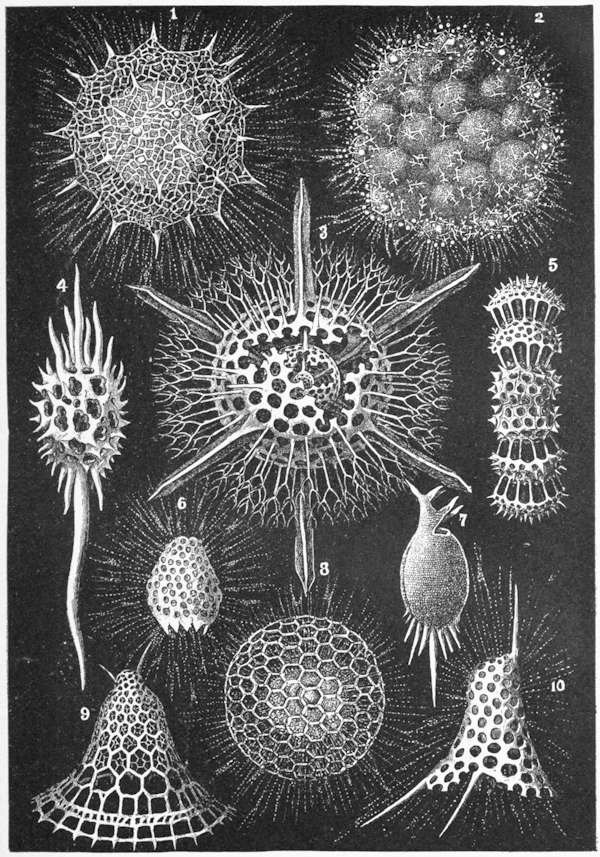
Typical Radiolaria
1, Rhizosphæra; 2, Sphærozoum; 3, Actinomma; 4, Lithomespilus; 5, Ommatocampe; 6, Carpocaium; 7, Challengeron; 8, Heliosphæra; 9, Clathrocyclas; 10, Dictyophimus
On examining a large jelly-fish, it will be noticed to have not only four round bodies on the top, round the centre, and the four lobes hanging down beneath, but that the edges of the body are not quite round, but are notched, so as to make eight lobes to it. And if a little care be taken, marks can be seen on the under part of the body, from the round centre spots to each of the eight splits in the disk; and a magnifying-glass shows a little substance there which feels gritty, and is sometimes colored. Other branching tube-marks pass from the midst of the body to the edge of the umbrella, and a tube runs all round the edge. The tubes communicate in the midst of the body with a cavity, into which the finger can pass between the four under lobes—the stomach—and the digested matters pass into them to nourish the creature. Around the disk or umbrella, and outside the circular tube, is the fringe of hairs which have, to a certain extent, to do with the capture of prey. Each consists of a filmy substance, in which are fixed thread-cells, not very unlike those of the sea-anemone, but they have longer barbs and sharper thorns stretching out from them. Any violence or irritation causes the thread to shoot forth and to injure. The rest of the body of the Medusa is covered with an excessively thin skin, which has movable cilia upon it. It is supposed, and with some reason—for nervous threads and bodies have been found on the disk, close to the gritty bodies especially—that these last are eyes, or ears, or both. The nerves supply the muscles that move the umbrella, and cause it to expand and contract, and the muscles are remarkable, for some are not simple contracting fibres all made of one piece, as in the Anemone tribe.
The jelly-fish, when in full vigor and weighing many pounds, must catch and eat much, and the manner in which this is done is by no means perfectly understood. The food is digested, and the results are taken from the stomach into the numerous tubes in the body, where they nourish the tissues. The movements of the animal and its extremely delicate membranes enable much water to come in contact with it, and it breathes by that means, for there are no special gills or lungs.
The four round spots on the top of the body, sometimes white and sometimes red in color, are spaces in the body, and they open into the central stomach. The circles of these chambers are lined with ciliate membrane, and in some places it is arranged in folds, and in them the eggs or ova form. Little oval or roundish things, like pins’ heads are they: they burst forth and pass out of the stomach, and then through the canal into the four lobes hanging down like pouting lips. Here they rest a while until a little grown, and they start out on their journey of life in the autumn time as little oval or long things made up of cells, the outside ones having movable hairs also on them. Totally unlike the parent, the tiny offspring floats off with the tide and does a little work in moving itself with its hairy covering. Sooner or later this minute thing, which is called a planula, settles on a stone or piece of sea-weed, and begins to grow. First of all its outer skin is formed into a hollow on the top, a kind of basin-shaped cavity being produced. This is the future stomach. Then some little projections grow around the hollow, and stick out in the water like so many rays, and they increase in number and length very rapidly. Under this shape the creature has been described as a hydra or a polype, and it really resembles a small sea-anemone with very long and slender tentacles. But the internal anatomy differs. The creature is all stomach and tentacles, and it grows by catching small prey. All the elaborate tissues of the jelly-fish are absent and the creature can not move. It is this curious condition of life that brings the jelly-fish tribe within notice of a seashore observer, for those little hydras live in some places at low-water mark. The knowledge that the hydra was the child of the jelly-fish was obtained many years ago by a Scotch and by a Scandinavian naturalist. It was known that some small kinds of jelly-fish which were kept in sea-water in an aquarium disappeared altogether in the late autumn. Then it was noticed that there were many very small things with tentacles, on the sides of the glass, which had not been noticed before. And at last the curious discovery was made that these hydras or planulas reproduced jelly-fish the next year. This is a very strange story, and the course of nature’s proceeding is, that when food has become scarce and the boisterous waves would become fatal to the delicate Medusa, it shall lay eggs which produce creatures that can settle down out of the way of the rush of water, and that require but little food. Then in the next year when food is in plenty, the progeny separate into jelly-fish like the parent. The hydras or progeny have no power of laying eggs; they digest and produce the creature that shall lay eggs. The Scandinavian naturalists and Germans called this “alternate generation,” and named the hydra the nurse of the jelly-fishes. This is the method by which most of the jelly-fish, which may be occasionally seen stranded on the coast, were produced; but there are some whose planulas do not settle down, but are always free swimmers, and they divide into Medusæ in the sea.
This intensely interesting course of life is modified in all the hundreds of kinds of creatures which are connected with the jelly-fish in classification, by their having many structures in common. The creatures thus classified with the jelly-fish are called Hydrozoa, or Water Animals, and they pass two lives, one of which is commonly observed on the seashore everywhere. One life is a fixed one, and the other is a free swimming one; in one stage it is eating and drinking, and in the other, these functions are not always or often carried out. The egg-laying and perpetuation of the animal are the duty of the greater part of the beautiful branched and hair-like things which are arranged by visitors to the seaside in patterns, and retained as memorials of pleasant days, and which are popularly called sea-weeds. They are not such things, but are the delicate stems, branches, and bud-like homes of the parents of tiny jelly-fish, which are only to be caught in the open sea. These horny stems and branches end in creatures with tentacles or feelers, and they live between tides, in rock pools, and at low water.
Sometimes these fragile, plant-looking things are fixed on to stones or sea-weed, and some get a ride by growing on shells, inhabited, since the death of their original possessor, by the Hermit Crab.
One very numerous tribe of these feathery-looking weeds, but which are truly animals, is common everywhere on the shore, between tide-marks into deep water. Their stems are branching, and the little bud-like things on them, when watched in still water, may be seen to put forth pretty colored bodies with tentacles around a centre; and as there may be hundreds of them on the branches and stem, the creature resembles a bunch of rayed flowers. Hence the name Sertularia, from sertula, a small garland.
These Sertularians were noticed and drawn many years ago, and were called Corallines. This is a great mistake, because the Coralline is a plant covered with carbonate of lime. The correct name would be the Garland polypes. When we get a bunch of these creatures from the seaside they are dead, and the hard and preservable outside parts alone are left, all the beauty of color and the wonderful inside structure are gone. But even then it can be noticed that the stems of the creature arise from a network of tubes fixed on to stones, sea-weeds, and shells. This resembles a root, but it does not absorb nourishment like the root of a plant. The stems, often not bigger than hairs, are hollow, and the branches also. The surface of the branches is covered on one, or often on both sides, by minute cups. These give almost a saw-edge look to it, in some of the creatures; and among these cups, which are open at their free end, are some larger ones, which are closed where free, and often ribbed and ornamented on their outside. It is noticed that the hollow of the stem and branches is continued into the cups, but not into the closed ones, and that these are shut off from it by a very delicate layer of tissue. This is the minute structure of these things when dead; but when alive, the inside of the stem and branches is filled with a soft substance, which reaches up to the part where each of the cups is attached to the outside. The cups, hundreds in number, on each stem and branch, contain a most beautiful flower-like polype. Variously colored, according to the kind, it has a bell shape, and has a spot for the mouth, which leads to a stomach, whose floor is connected with the pith of the whole branch. Around the mouth are numerous tentacles excessively irritable, capable of stinging and paralyzing prey; and the spectacle of hosts of these, all working for the common good of the branching animal, is very beautiful. Sometimes there is much red in the color, at other times green, yellow, or a dull tint; and in order to relieve the sameness of outline presented by thousands of cups, their horny margin is spined or toothed. In full vigor during the summer, and living through the winter and probably for several years, these cups with their tentacled polypes contribute to the growth and nutrition of the whole. They all work for a common end, and that is for the persistence of the life of the colony. They live on microscopic things in the water, such as minute ova, or the young of things like unto themselves, and on animalcules, and probably on the moving spores of sea-weeds. As the spring advances, the larger and closed cups begin to grow by budding from the stem, and they become filled with a gummy substance with a few granules in it, and somewhat resembling the pith of the stem. As the closed cup grows, it often becomes marked on the outside with rings or belts, and it becomes a very prominent object on the horny-looking Garland polype. These closed cups are concerned in the reproduction of the creature, for after a few weeks the substance inside them is seen to collect into bunches of round or oval bodies, often yellow in color, or of other tints. By and by the cup bursts, or a sort of trap-door opens at the top, and these things escape. They are small, covered with cilia, or moving hairs, and resemble the planulas of the jelly-fish in shape, and they swim freely, and finally settle down on a stone or weed. They become environed by a horny coat, the stomach having been formed first by simple bending in of the outside of the creature, and tentacles grow. The planula thus founds a new colony. But there are other phases in this curious life-story; for instead of the little round balls in the closed cups getting free as planulas, some in certain kinds grow there, and resemble excessively minute jelly-fish stuck fast by the back, and exposing the mouth, feet, and the fringed umbrella. These Medusæ, as they may be called, die on the parent, and never wander.
There is one kind of these Garland polypes called Lafœa in which the round bodies produced in the closed cups burst forth, and not in the shape of planulas. They come forth like tiny bells, furnished with minute eye-spots on the edge, and they have an umbrella shape, and long tentacles arising from the edge near the eye-spots. They are jelly-fish, to all intents and purposes, and swim freely about, and in time produce planulas which develop into a parent Garland polype again.
There is a very interesting kind of these allies of the sea-jellies which, from its feathery shape, has been called Plumularia. Specimens are common, and there is a stem, and it has branches, and the cups are in one row on the branchlets. Moreover, there are openings in the horny envelope of the soft pith of the branches, which do not give exit to a polype-looking thing with its mouth surrounded with tentacles, but to a simple pith with many threads or stinging cells in it. It is more or less like a long tongue, and is placed among the cups with polypes, and it is evidently an instrument for capturing minute creatures. The Sickle-beard is one of them.
But one of the most singular of these delicate creatures lives in very numerous colonies, on such an unexpected place as the outside of the shell tenanted within by a wandering hermit-crab. It is called Hydractinia. The Hydractinia has a kind of crust for its formation, with tubes in it, and out from them comes a white film, which, under a magnifying-glass, presents a number of stems and polypes. Each one has at its free part a club-shaped end, which has several rows of tentacles around it. These, often twenty-five in number, are, like the stem, very irritable, flexible, and are covered with a sticky matter. The club is hollow within, for the stomach, and food gets in by the top, where the horny skin appears to be absent.
The tentacles are rather sharp, and when they are half-contracted they often appear to have a knob at the end, otherwise they are stuck out and are like so many thick threads. The stalk which supports the conical-shaped head has a thin and wrinkled skin with sharp, dot-like points on it, and probably they secrete a sticky substance. The polypes thus formed cluster together like so much moss on the shell, and it would appear, if not in the English species, certainly in one which frequents the American coasts, that some groups are male and others female. But there is no doubt, from the researches of Mr. Moseley, F.R.S., of the Challenger, that some of the polypes act as catchers of food, and feed those which pay especial attention to increasing and multiplying. These last have minute little knobs growing on the stalk beneath the head, and which develop round bodies inside. After a while motion is noticed in them, and there is every reason to believe that they burst forth and swim off as small jelly-fish. Some, however, give out little planulas, which settle down and grow like the parent.
It will have been noticed from this description that these polypes are different in shape from the Garland polypes and that instead of being bell-shaped, with tentacles around the mouth, they are club-shaped, and have more than one row of tentacles half way down. This last shape gives a characteristic to many little polypes which lead, like the others, two lives—one fixed on the seashore on plants and stones, and the other, freely swimming, as a pretty little jelly-fish.
Another kind lives fixed on sea-weeds in shallow water, and its stem consists of a single tube, which is creeping and threadlike. The cups for the polype are on long stalks, with markings like rings on them, and are bell-shaped with a toothed edge. The mouth is surrounded by tentacles, as in the Garland polype, and, in fact, there is not much outside distinction between them and this Campanularia, or Bell polype.
There is a stomach in the polype bud which leads to a canal that goes down the stalk, and even into the creeping stem or root. The buds, on stalks of their own, are very remarkable. They contain, soon after they are formed, numerous little jelly-fish attached to stalks. There may be twenty or thirty of these in each bud, and the day will come when they will burst forth, be cast loose from their stems, and swim off. They resemble hand-bells of a very flat kind, and the mouth is prolonged into a four-parted projection, which protrudes through a structure not seen in the great jelly-fish, but peculiar to these smaller ones, which fills up the disk underneath, from the mouth to the edge, with a layer of muscular fibres. They have four long tentacles, and when they have lived for some time they begin to play some very curious tricks. Thus a foreign naturalist, M. Van Beneden, was examining some creatures in his aquarium, and found hundreds of these very small jelly-fish, and he caught some in order to examine them with his microscope. He began to draw some of them carefully in order to write a description of them. About an hour afterward, on again looking at his specimen, he was amazed to find its shape changed, and the animal apparently turned inside out. The tentacles on the edge seemed to be reversed in their position; the umbrella-like dome, from being convex was the reverse, and the curled lip-like proboscis seemed converted into the stem of a solitary polype. One of these Campanularians, called erroneously the Wrinkled-thread Coralline, grows on sea-weeds near low-water mark, and especially on the great Riband Tangle. It is a small thing, about an inch in height, and its stem is of a pink or rose-red color; it is sparingly branched in a zigzag manner, and its stem is ringed. The buds develop jelly-fish, but they never escape, and hang on by stalks for the rest of their lives.
FISHES —Andrew Wilson
This division every one must know as that of the Vertebrata, a word which may be used in a popular sense, as corresponding to the expression “backboned” animals. At the head of this group man and quadrupeds are found, while the fishes form the lowest class in the division.
There are few groups of the animal world more interesting to the ordinary observer than that of the fishes. To survey the various forms and shapes presented by these animals as displayed in a great museum should prove a sufficient incentive to gain a more intimate acquaintance with the class; and when, even in a popular sense, we investigate the structure and habits of fishes, the study increases in its fascination and interest. While if we reflect that on a knowledge of the habits of fishes, of their distribution in our oceans and seas, and of the special products which many of them offer for our use and luxury, the commercial success of our fisheries depends, it can need no further argument to convince us that, after all, there is something of great practical benefit to be derived from the study of zoological science.
It is not our intention at present to say anything regarding the commercial or economic aspects of fishes, and even their general habits must be very briefly touched upon. We rather aim at giving some account of the structure of the fishes, and at noting such peculiarities in their habits and life as may prove most interesting to our readers. Primarily, then, we find that fishes may be recognized by having the body usually, but not always, covered with scales, of various forms and kinds. Then, secondly, we have the limbs represented by certain fins; and, thirdly, we find almost all fishes to breathe by gills during the whole of life. These three points are, in the main, sufficient to distinguish fishes from their higher as well as their lower neighbors. The scales which cover the bodies of fishes present great diversities in shape, size, and appearance. Some fishes thus exhibit an utter want of scales; while others, like knights of old, are incased in a veritable suit of scaly armor. The lampreys, and their curious neighbors the hag-fishes, are destitute of scales; and in our familiar eels, the scales are very small and insignificant. Such fishes, however, are amply compensated for the want of scales by the power they possess of throwing out from the skin a vast quantity of glutinous or oily matter, technically named mucus. The presence of this secretion, which has given origin to the phrase “as slippery as an eel,” serves to protect the surface of the body, and no doubt also assists in the easy progress of these fishes through the water. So large is the quantity of this oily matter which the hag-fishes can emit from their body, that one form has received the specific name of glutinosa; the fish being able in this way to literally convert the water of the vessel in which it is contained into a jelly-like mass. The familiar blennies, found in rock-pools after the tide has receded, are also able to emit a large amount of this glutinous fluid.
Illustrating the opposite extreme of the development of scales, we find such fishes as the bony pikes of North American lakes and rivers, the bodies of which are covered with an armor of closely fitting and overlapping scales or plates, named ganoid, from their shining appearance (Greek ganos, splendor). The scales of this fish are said to be employed in the manufacture of the little “mother-of-pearl” buttons, so commonly used. Many fossil fishes were also abundantly provided with these hard, bony plates; and our living sturgeons possess scales of similar nature, although in the latter fishes they do not completely cover the body. The bright silvery scales of the herring and its neighbors are thin structures, and are very easily detached from the skin; and a curious form of scale is seen in the perches; the hinder edge of each scale in the latter case being cut into comb-like teeth. In the sharks, skates, and rays, the scales are small and horny, and are often provided with little spines. If we draw our hand along the back of a dog-fish from tail to head, as when we stroke a cat’s back the wrong way, we feel numerous small projecting points, borne on the scales. The rough skin surface thus produced is frequently used under the name of “shagreen” in the manufacture of spectacle-cases and like articles, and is also employed for polishing the surface of wood.
In their general shape the bodies of fishes exhibit a great compression from side to side, a rounding of the sides, and a pointing of either extremity, adapting the animals for easy progression through the water. Some fishes, such as the soles, flounders, plaice, etc., are named “flat fishes” from the great flattening exhibited by their bodies; although, at the same time, it is important to observe that these fishes are simply more compressed from side to side than their neighbors. Most persons, on looking at a sole or flounder, are apt to think that one of the flat surfaces must represent the back, and the other the under surface of the body. This idea is strengthened by the fact that the so-called back surface is dark, and the apparent under surface light in color, and because both eyes exist on the dark-colored surface. That, however, the flat surfaces are really the sides of the fish may be seen by noting that on each surface a breast-fin is developed; these fins being placed invariably one on each side of the body. And while the eyes in early life are disposed one on each side of the head, in the position in which eyes are naturally situated, they are gradually brought round to one side by the bones of the head becoming curiously twisted in the course of development. Thus these fishes lie and swim on one side—that which is light-colored—and present a most singular combination of curious and abnormal features.
The fins of fishes constitute interesting features in their structure. Almost all fishes have two sets of fins—those which exist in pairs and those which are unpaired, and which are developed in the middle line of the body. To the former class belong the two pectoral or “breast-fins” and the two ventral or “belly-fins.” The “breast-fins” correspond to the forelegs of other animals or to the arms of man; while the ventral fins correspond to the hindlegs or to man’s lower limbs; and these latter fins may be placed, as hind-limbs should be, to the rear of the body (as in sturgeons); or they may be found (as in the cod) placed beneath the breast-fins on the throat.
It may be asked, How do we know that these two pairs of fins represent the limbs of other animals? We reply, because when we investigate their structure we find them to be supported by a bony skeleton, the various portions of which correspond to those existing in the skeleton of the limbs of man or other vertebrates. And it is only through this important principle of tracing out what are known as the homologies or resemblances between parts, and by looking at and comparing their structure, that we are enabled to find out the real nature of many organs in animals; similar organs frequently existing under very different and varied guises.
The other fins of fishes do not exist in pairs, but are placed in the middle line of the body. Hence they are named the median or unpaired fins. Thus we find the back or dorsal fins to represent the unpaired fins, as also do the tail and anal fins; the latter being placed on the lower surface of the body. These unpaired fins, if they correspond to any other structures in the fishes, are simply to be regarded as special developments of the skin, and therefore bear no true relationship to the limbs of other animals. We may find one or more dorsal and one or more anal fins; but the tail-fin, by the action of which, as every one knows, the fish chiefly swims, is always single, but may be divided into halves. Most of our common fishes have the halves of the tail-fin of equal size; others, such as the sharks, sturgeons, etc., having the upper half greatly exceeding the lower half of the tail-fin in size. In one species of shark, named the Thresher or Fox-shark, the upper half of the tail-fin appears enormously developed as compared with the lower half; and the names of this species have been derived from the use the fish makes of its tail in lashing the water, and from the long-tailed appearance suggesting a resemblance to the familiar Reynard of the land. In fishes the tail-fin is always placed vertically, or in the same line as the body, and moves from side to side; while in the whales—which are not fishes, but Mammalia or quadrupeds possessing fish-like bodies—the tail-fin is placed across the body. Some fishes may want arms or legs—that is, the pectoral or ventral fins; the eels, for example, possessing no ventral fins. The flying-fishes, on the contrary, possess a very large development of the pectoral or breast fins, and support themselves temporarily in the air by their aid.
Fishes are usually very well provided in the matter of teeth. What would be thought of a quadruped which had teeth not only in its jaws, but had its tongue, its palate, the sides and floor of its mouth, and other parts, also bearing rows of these structures? Yet such is the case with many fishes. Then, also, where the teeth of one set in fishes are lost, or destroyed through the natural wear and tear to which they are subjected, new teeth are developed to supply the place of the lost members. Any one may gain a good idea of the formidable array of teeth in fishes, and of the manner in which one set succeeds another, by inspecting the jaws of a shark in a museum. In fishes the teeth are not implanted in sockets, but are fastened by ligaments to the surface of the bones which bear them. Sometimes one tooth only is developed in fishes. This is the case in the curious, eel-like hag-fishes already mentioned; these fishes possessing but a single large tooth, borne on the palate; and by means of this formidable weapon, which possesses saw-like edges, they bore their way into the bodies of other fishes, and there take up their abode as unwelcome guests. A cod or large haddock may sometimes be found with five or six hags contained in its interior. The parrot-fishes, or Scari, of tropical seas, are so named from their possessing jaws shaped like the beaks of those familiar birds, and these jaws are rendered all the more extraordinary from their being covered or incrusted by numerous small teeth, which are as closely packed on the jaw as paving-stones are in a street, and which serve these fishes as useful instruments when they feed upon the living parts of the hard and limy coral-animals. In the jaws and floor of the mouth of the Port Jackson shark, or in the Eagle rays, or skates, the teeth may be seen to be flat and broad. Such teeth form a regular pavement arranged like a mosaic pattern, and are admirably adapted for crushing whatever substances enter the mouth.
Fishes are well provided in the way of digestive apparatus. A throat or gullet, stomach, intestines, liver, and other glands, serve for the digestion of the food, and a heart and blood-vessels exist for the circulation of the blood thus manufactured from the food. The blood is purified in the gills. Each gill—consisting in common fishes of a supporting “arch” bearing a great number of delicate filaments arranged like the teeth of a comb—may be viewed as simply a network of blood-vessels. The blood, pumped into this network by the heart, is purified by the action of the oxygen gas contained in the pure water which the fish is constantly taking into its gill-chamber by its mouth; while the pure blood is recirculated through the body, and the water used in breathing is got rid of by being ejected behind the “gill-cover” at the neck, so as to allow a fresh inflow to be drawn in by the mouth. The gills of some fishes may be very differently constructed from those of the common members of the class. Thus the lampreys breathe by pouch-like gills which open each by a separate aperture. Seven gill-apertures may be seen on each side of the neck of the common lamprey; and the sharks, skates, and their neighbors also breathe by sac-like gills. Certain curious facts regarding the breathing of fishes will be afterward alluded to. Fishes illustrate plainly what is meant by aquatic or water-breathing. They possess gills or organs, adapted for separating the atmospheric air which is entangled or contained in the water; land animals breathing the same air directly from the atmosphere.
That fishes are wary and active, and possess senses of acute nature, are facts well known to all. The lowest fish, the little clear-bodied lancelet, possesses no brain whatever, and no organ of hearing is developed, while the eyes are at the best of very simple and rudimentary structure. In other fishes, again, the brain and nervous system not only acquire a typical development, but the senses also advance in perfection. The sense of sight is of perfect kind, the eyes of fishes being adapted for seeing in the dense medium in which they live; while the sense of smell is also developed, although, curiously enough, the nostrils, in all except two kinds of fishes—the hag-fishes and the curious Lepidosiren or mud-fish—are pocket-like in nature, and do not open backward, as in higher animals, into the mouth. The sense of taste is not exercised in a high degree by fishes, and it is interesting to observe that the sense of touch appears to reside especially in the sides of the body, on which surfaces a well-marked line—the “lateral line”—may be observed in most fishes. This lateral line is connected with a series of canals or sacs abundantly supplied with nerves. The function of these organs is believed to be that of exercising the sense of touch; and from the manner in which many fishes swim against objects, and bring the sides of their bodies in gentle contact with foreign objects, there would seem to exist strong reasons for supporting the above idea. That fishes “hear” is a well-known fact. No outer ear is developed, but an internal ear—the essential part of the organ of hearing—is found in all fishes except the little lancelet.