THE STORY OF THE UNIVERSE (continued 3)
Reading edition
The species belonging to the order Hymenoptera are among the most interesting of insects. To this order belong the gallflies, the sawflies, the ichneumons, and, above all, the ants and bees. We are accustomed to class the Anthropoid apes next to man in the scale of creation, but if we were to judge animals by their works, the chimpanzee and the gorilla must certainly give place to the bee and the ant. The larvæ of the sawflies, which live on leaves, and of the Siricidæ or long-tailed wasps, which feed on wood, are very much like caterpillars, having three pairs of legs, and in the former case abdominal prolegs as well: but in the great majority of Hymenoptera the larvæ are legless, fleshy grubs; and the various modes by which the females provide for, or secure to, them a sufficient supply of appropriate nourishment constitutes one of the most interesting pages of Natural History.
The species of Hymenoptera are very numerous; in England alone there are about 3,000 kinds, most of which are very small. In the pupa state they are inactive, and show distinctly all the limbs of the perfect insect, incased in distinct sheaths, and folded on the breast. In the perfect state they are highly organized and very active. The working ants and some few species are wingless, but the great majority have four strong membraneous wings, a character distinguishing them at once from the true flies, which have only one pair of wings.
The sawflies are so called because they possess at the end of the body a curious organ, corresponding to the sting of a wasp, but which is in the form of a fine-toothed saw. With this instrument the female sawfly cuts a slit in the stem or leaf of a plant, into which she introduces her egg. The larva much resembles a caterpillar, both in form and habits. To this group belongs the nigger, or black caterpillar of the turnip, which is often in sufficient numbers to do much mischief. Some species make galls, but the greater number of galls are formed by insects of another family, the Cynipidæ.
In the Cynipidæ the female is provided with an organ corresponding to the saw of the sawfly, but resembling a needle. With this she stings or punctures the surface of leaves, buds, stalks, or even roots of various plants. In the wound thus produced she lays one or more eggs. The effects of this proceeding, and particularly of the irritating fluid which she injects into the wound, is to produce a tumor or gall, within which the egg hatches, and on which the larva, a thick fleshy grub, feeds. In some species each gall contains a single larva; in others, many live together.
The oak supports several kinds of gallflies: one produces the well-known oak-apple, one a small swelling on the leaf resembling a currant, another a gall somewhat like an acorn, another attacks the root; the species making the bullet-like galls, which are now so common, has only existed for a few years in England; the beautiful little spangles so common in autumn on the under side of oak leaves are the work of another species, the Cynips longipennis. One curious point about this group is, that in some of the commonest species the females alone are known, no one yet having ever succeeded in finding a male.
Another great family of the Hymenoptera is that of the ichneumons; the females lay their eggs either in or on other insects, within the bodies of which the larvæ live. These larvæ are thick, fleshy, legless grubs, and feed on the fatty tissues of their hosts, but do not attack the vital organs. When full-grown, the grubs eat their way through the skin of the insect, and turn into chrysalides. Almost every kind of insect is subject to the attacks of these little creatures, which are no doubt useful in preventing the too great multiplication of insects, and especially of caterpillars. Some species are so minute that they actually lay their eggs within those of other insects. These parasites assume very curious forms in their larval state.
But of all the Hymenoptera, the group containing the ant, the bee, and the wasp is the most interesting. This is especially the case with the social species, though the solitary ones also are extremely remarkable. The solitary bee or wasp, for instance, forms a cell generally in the ground, places in it a sufficient amount of food, lays an egg, and closes the cell. In the case of bees, the food consists of honey; in that of wasps, the larva requires animal food, and the mother therefore places a certain number of insects in the cell, each species having its own special prey, some selecting small caterpillars, some beetles, some spiders. Cerceris bupresticida, as its name denotes, attacks beetles belonging to the genus Buprestis. Now if the Cerceris were to kill the beetle before placing it in the cell, it would decay, and the young larva, when hatched, would find only a mass of corruption. On the other hand, if the beetle were buried uninjured, in its struggles to escape it would be almost certain to destroy the egg. The wasp has, however, the instinct of stinging its prey in the centre of the nervous system, thus depriving it of motion, and let us hope of suffering, but not of life; consequently, when the young larva leaves the egg, it finds ready a sufficient store of wholesome food.
Other wasps are social, and, like the bees and ants, dwell together in communities. They live for one season, dying in autumn, except some of the females, which hibernate, awake in the spring, and form new colonies. These, however, do not, under ordinary circumstances, live through a second winter. One specimen which I kept tame through one spring and summer lived until the end of February, but then died. The larvæ of wasps are fat, fleshy, legless grubs. When full-grown they spin for themselves a silken covering, within which they turn into chrysalides. The oval bodies which are so numerous in ants’ nests, and which are generally called ants’ eggs, are really not eggs, but cocoons. Ants are very fond of the honey-dew which is formed by the Aphides, and have been seen to tap the Aphides with their antennæ, as if to induce them to emit some of the sweet secretion. There is a species of Aphis which lives on the roots of grass, and some ants collect these into their nests, keeping them, in fact, just as we do cows. Moreover, they collect the eggs in the autumn and tend them through the winter (when they are of no use) with the same care as their own, so as to have a supply of young Aphides in the spring. This is one of the most remarkable facts I know in the whole history of animal life. One species of red ant does no work for itself, but makes slaves of a black kind, which then do everything for their masters. The slave makers will not even put food into their own mouths, but would starve in the midst of plenty if they had not a slave to feed them. I found, however, that I could keep them in life and health for months if I gave them a slave for an hour or two in a week to clean and feed them.
Ants also keep a variety of beetles and other insects in their nests. Some of these produce a secretion which is licked by the ants as they do the honey-dew; there are others, however, which have not yet been shown to be of any use to the ants, and yet are rarely, if ever, found, excepting in ants’ nests. That the ants have some reason for tolerating their presence seems clear, because they readily attack any unwelcome intruder; but what that reason is, we do not yet know. If these insects are to be regarded as the domestic animals of the ants, then we must admit that the ants possess more domestic animals than we do.
M. Lespès, who regards these insects as true domestic animals, has recorded some interesting observations on the relations between one of them (Claviger Duvalii) and the ants (Lasius niger) with which it lives. This species of Claviger is never met with except in ants’ nests, though, on the other hand, there are many communities of Lasius which possess none of these beetles; and M. Lespès found that when he placed Clavigers in a nest of ants which had none of their own, the beetles were immediately killed and eaten, the ants themselves being, on the other hand, kindly received by other communities of the same species. He concludes from these observations that some communities of ants are more advanced in civilization than others; the suggestion is no doubt ingenious, and the fact curiously resembles the experience of navigators who have endeavored to introduce domestic animals among barbarous tribes.
The order Strepsiptera are a small but very remarkable group of insects, parasitic on bees and wasps. The larva is minute, six-legged, and very active; it passes through its transformations within the body of the bee or wasp. The male and female are very dissimilar. The males are minute, very active, short-lived, and excitable, with one pair of large membraneous wings. The females, on the contrary, are almost motionless, and shaped very much like a bottle; they never quit the body of the bee, but only thrust out the top of the bottle between the abdominal rings of the bee.
In the order Coleoptera, the larvæ differ very much in form. The majority are elongated, active, hexapod, and more or less depressed; but those of the Weevils, of Scolytus, etc., which are vegetable feeders, and live surrounded by their food—as, for instance, in grain, nuts, etc.—are apod, white, fleshy grubs, not unlike those of bees and ants. The larvæ of the Longicorns, which live inside trees, are long, soft, and fleshy, with six short legs. The Geodephaga, corresponding with the Linnæan genera Cicindela and Carabus, have six-legged, slender, carnivorous larvæ; those of Cicindela, which waylay their prey, being less active than the hunting larvæ of the Carabidæ. The Hydradephaga, or water-beetles, have long and narrow larvæ, with strong sickle-shaped jaws, short antennæ, four palpi, and six small eyes on each side of the head; they are very voracious. The larvæ of the Staphylinidæ are by no means unlike the perfect insect, and are found in similar situations; their jaws are powerful, and their legs moderately strong. The larvæ of the Lamellicorn beetles—cock-chafers, stag-beetles, etc.—feed on vegetable substances or on dead animal matter. They are long, soft, fleshy grubs, with the abdomen somewhat curved, and generally lie on their side. The larvæ of the Elateridæ, known as wireworms, are long and slender, with short legs. That of the glowworm (Lampyridæ) is not unlike the apterous female. The male glowworm, on the contrary, is very different. It has long, thin, brown wing-cases, and often flies into rooms at night, attracted by the light which it probably mistakes for that of its mate.
The metamorphoses of the Cantharidæ are very remarkable. The larvæ are at first active and hexapod. The Phytophaga are vegetable feeders, both as larvæ and in the perfect state. The larvæ are furnished with legs, and are not unlike the caterpillars of certain Lepidoptera.
The larva of Coccinella (the ladybird) is somewhat depressed, of an elongated ovate form, with a small head, and moderately strong legs. It feeds on Aphides.
Thus, then, we see that there are among the Coleoptera many different forms of larvæ. Macleay considered that there were five principal types.
The pupa of the Coleoptera is quiescent, and “the parts of the future beetle are plainly perceivable, being incased in distinct sheaths; the head is applied against the breast; the antennæ lie along the sides of the thorax; the elytra and wings are short and folded at the sides of the body, meeting on the under side of the abdomen; the two anterior pairs of legs are entirely exposed, but the hind pair are covered by wing-cases, the extremity of the thigh only appearing beyond the sides of the body.”[8]
In the next three orders—namely, the Orthoptera (grasshoppers, locusts, crickets, walking-stick insects, cockroaches, etc.), Euplexoptera (earwigs), and Thysanoptera, a small group of insects well known to gardeners under the name of Thrips—the larvæ when they quit the egg already much resemble the mature form, differing, in fact, principally in the absence of wings, which are more or less gradually acquired, as the insect increases in size. They are active throughout life. Those specimens which have rudimentary wings are, however, usually called pupæ.
The Neuroptera present, perhaps, more differences in the character of their metamorphoses than any other order of insects. Their larvæ are generally active, hexapod little creatures, and do not vary from one another in appearance so much, for instance, as those of the Coleoptera, but their pupæ differ essentially; some groups remaining active throughout life, like the Orthoptera; while a second division have quiescent pupæ, which, however, in some cases, acquire more or less power of locomotion shortly before they assume the mature state; thus that of Raphidia, though motionless at first, at length acquires strength enough to walk, even while still inclosed in the pupa skin, which is very thin.
One of the most remarkable families belonging to this order is that of the Termites, or so-called white ants. They abound in the tropics, where they are a perfect pest, and a serious impediment to human development. Their colonies are extremely numerous, and they attack woodwork and furniture of all kinds, generally working from within, so that their presence is often unsuspected until it is suddenly found that they have completely eaten away the interior of some post or table, leaving nothing but a thin outer shell. Their nests, which are made of earth, are sometimes ten or twelve feet high, and strong enough to bear a man. One species, Termes lucifugus, is found in the south of France, where it has been carefully studied by Latreille. He found in these communities five kinds of individuals—(1) males; (2) females, which grow to a very large size, their bodies being distended with eggs, of which they sometimes lay as many as 80,000 in a day; (3) a form described by some observers as pupæ, but by others as neuters. These differ very much from the others, having a long, soft body without wings, but with an immense head, and very large, strong jaws. These individuals act as soldiers, doing apparently no work, but keeping watch over the nest and attacking intruders with great boldness. (4) Apterous eyeless individuals, somewhat resembling the winged ones, but with a larger and more rounded head; these constitute the greater part of the community, and, like the workers of ants and bees, perform all the labor, building the nest and collecting food. (5) Latreille mentions another kind of individual which he regards as the pupa, and which resembles the workers, but has four white tubercles on the back, where the wings afterward make their appearance. There is still, however, much difference of opinion among entomologists with reference to the true nature of these different classes of individuals. M. Lespès, who has studied the same species, describes a second kind of male and a second kind of female, and the subject, indeed, is one which offers a most promising field for future study.
Another interesting family of Neuroptera is that of the Ephemeræ, or Mayflies, so well known to fishermen. The larvæ are semi-transparent, active, six-legged little creatures, which live in water; having at first no gills, they respire through the general surface of the body. They grow rapidly and change their skin every few days. After one or two moults they acquire seven pairs of branchiæ, or gills, which are generally in the form of leaves, one pair to the segment. When the larvæ are about half grown, the posterior angles of the two posterior thoracic segments begin to elongate. These elongations become more and more marked with every change of skin. One morning, in the month of June, some years ago, I observed a full-grown larva, which had a glistening appearance, owing to the presence of a film of air under the skin. I put it under the microscope, and, having added a drop of water with a pipette, looked through the glass. To my astonishment, the insect was gone, and an empty skin only remained. I then caught a second specimen in a similar condition, and put it under the microscope, hoping to see it come out. Nor was I disappointed. Very few moments had elapsed, when I had the satisfaction of seeing the thorax open along the middle of the back; the two sides turned over; the insect literally walked out of itself, unfolded its wings, and in an instant flew up to the window. Several times since, I have had the pleasure of witnessing this marvelous change, and it is really wonderful how rapidly it takes place: from the moment when the skin first cracks, not ten seconds are over before the insect has flown away.
Another family of Neuroptera, the dragon-flies, or horse-stingers, as they are sometimes called, from a mistaken idea that they sting severely enough to hurt a horse, though in fact they are quite harmless, also spend their early days in the water. The larvæ are brown, sluggish, ugly creatures, with six legs. They feed on small water-animals, for which they wait very patiently, either at the bottom of the water or on some aquatic plant. The lower jaws are attached to a long folding rod; and when any unwary little creature approaches too near the larva, this apparatus is shot out with such velocity that the prey which comes within its reach seldom escapes. In their perfect condition, also, dragon-flies feed on other insects, and may often be seen hawking round ponds. The so-called ant-lions in many respects resemble the dragon-flies, but the habits of the larvæ are very dissimilar. They do not live in the water, but prefer dry places, where they bury themselves in the loose sand, and seize with their long jaws any small insect which may pass. The true ant-lion makes itself a round, shallow pit in loose ground or sand, and buries itself at the bottom. Any inattentive little insect which steps over the edge of this pit immediately falls to the bottom, and is instantaneously seized by the ant-lion. Should the insect escape, and attempt to climb up the side of the pit, the ant-lion is said to throw sand at it, knocking it down again.
One other family of Neuroptera which I must mention is the Hemerobiidæ. The perfect insect is a beautiful, lace-winged, very delicate, green creature, something like a tender dragon-fly, and with bright, green, touching eyes. The female deposits her eggs on leaves, not directly on the plant itself, but attached to it by a long white slender footstalk. The larva has six legs and powerful jaws, and makes itself very useful in destroying the hop-fly.
The insects forming the order Trichoptera are well known in their larval condition under the name of caddis worms. These larvæ are not altogether unlike caterpillars in form, but they live in water—which is the case with very few lepidopterous larvæ—and form for themselves cylindrical cases or tubes, built up of sand, little stones, bits of stick, leaves, or even shells. They generally feed on vegetable substances, but will also attack minute fresh-water animals. When full grown, the larva fastens its case to a stone, the stem of a plant, or some other fixed substance, and closes the two ends with an open grating of silken threads, so as to admit the free access of water, while excluding enemies. It then turns into a pupa which bears some resemblance to the perfect insect, “except that the antennæ, palpi, wings, and legs are shorter, inclosed in separate sheaths, and arranged upon the breast.” The pupa remains quiet in the tube until nearly ready to emerge, when it comes to the surface, and in some cases creeps out of the water. It is not therefore so completely motionless as the pupæ of Lepidoptera.
The Diptera, or flies, comprise insects with two wings only, the hinder pair being represented by minute club-shaped organs called “haltères.” Flies quit the egg generally in the form of fat, fleshy, legless grubs. They feed principally on decaying animal or vegetable matter, and are no doubt useful as scavengers. Other species, as the gadflies, deposit their eggs on the bodies of animals, within which the grubs feed, when hatched. The mouth is generally furnished with two hooks which serve instead of jaws. The pupæ of Diptera are of two kinds. In the true flies, the outer skin of the full-grown larva is not shed, but contracts and hardens, thus assuming the appearance of an oval brownish shell or case, within which the insect changes into a chrysalis. The pupæ of the gnats, on the contrary, have the limbs distinct and inclosed in sheaths. They are generally inactive, but some of the aquatic species continue to swim about.
One group of flies, which is parasitic on horses, sheep, bats, and other animals, has been called the Pupipara, because it was supposed that they were not born until they had arrived at the condition of pupæ. They come into the world in the form of smooth, ovate bodies, much resembling ordinary dipterous pupæ, but as Leuckart has shown, they are true, though abnormal, larvæ.
The next order, that of the Aphaniptera, is very small in number, containing only the different species of flea. The larva is long, cylindrical, and legless; the chrysalis is motionless, and the perfect insect is too well known, at least as regards its habits, to need any description.
The Heteroptera, unlike the preceding orders of insects, quit the egg in a form differing from that of the perfect insect principally in the absence of wings, which are gradually acquired. In their metamorphoses they resemble the Orthoptera, and are active through life. The majority are dull in color, though some few are very beautiful. The species constituting this group, though very numerous, are generally small, and not so familiarly known to us as those of the other large orders, with indeed one exception, the well-known bug. This is not, apparently, an indigenous insect, but seems to have been introduced. The word is indeed used by old writers, but either as meaning a bugbear, or in a general sense, and not with reference to this particular insect. In Britain it never acquires wings, but is stated to do so sometimes in warmer climates. The Heteroptera can not exactly be said either to sting or bite. The jaws, of which, as usual among insects, there are two pairs, are like needles, which are driven into the flesh, and the blood is then sucked up by the lower lip, which has the form of a tube. This peculiar structure of the mouth prevails throughout the whole order; consequently their nutriment consists almost entirely of the juices of animals or plants. The Homoptera agree with the Heteroptera in the structure of the mouth, and in the metamorphoses. They differ principally in the front wings, which in Homoptera are membraneous throughout, while in the Heteroptera, the front part is thickened and leathery. As in the Heteroptera, however, so also in the Homoptera, some species do not acquire wings. The Cicada, celebrated for its chirp, and the lanthorn fly, belong to this group. So also does the so-called cuckoo-spit, so common in English gardens, which has the curious faculty of secreting round itself a quantity of frothy fluid which serves to protect it from its enemies. But the best known insects of this group are the Aphides or plant-lice; while the most useful belong to the Coccidæ, or scale insects, from one species of which we obtain the substance called lac, so extensively used in the manufacture of sealing-wax and varnish. Several species also have been used in dyeing, especially the cochineal insect of Mexico, a species which lives on the cactus. The male coccus is a minute, active insect, with four large wings; while the female, on the contrary, never acquires wings, but is very sluggish, broad, more or less flattened, and in fact, when full grown, looks like a small brown, red, or white scale.
The larvæ of the order Lepidoptera are familiar to us all under the name of caterpillars. The insects of this order in their larval condition are almost all phytophagous, and are very uniform both in structure and in habits. The body is long and cylindrical, consisting of thirteen segments; the head is armed with powerful jaws; the three following segments, the future prothorax, mesothorax, and metathorax, each bears a pair of simple articulated legs. Of the posterior segments, five also bear false or prolegs, which are short, unjointed, and provided with a number of hooklets. A caterpillar leads a dull and uneventful life; it eats ravenously and grows rapidly, casting its skin several times during the process, which generally lasts only a few weeks; though in some cases, as, for instance, that of the goat-moth, it extends over a period of two or three years, after which the larva changes into a quiescent pupa or chrysalis.
Fossil insects are, unfortunately, rare, there being but few strata in which the remains of this group are well preserved. Moreover, well-characterized Orthoptera and Neuroptera occur as early as the Devonian strata; Coleoptera and Hemiptera in the Coal-measures; Hymenoptera and Diptera in the Jurassic; Lepidoptera, on the contrary, not until the Tertiary. But although it appears from these facts that, as far as our present information goes, the Orthoptera and Neuroptera are the most ancient orders, it is not, I think, conceivable that the latter should have been derived from any known species of the former; on the other hand, the earliest known Neuroptera and Orthoptera, though in some respects less specialized than existing forms, are as truly and as well characterized insects as any now existing; nor are we acquainted with any earlier forms which in any way tend to bridge over the gap between them and lower groups, though, as we shall see, there are types yet existing which throw much light on the subject.
The stag-beetle, the dragon-fly, the moth, the bee, the ant, the gnat, the grasshopper—these and other less familiar types seem at first to have little in common. They differ in size, in form, in color, in habits, and modes of life. Yet the researches of entomologists, following the clew supplied by the illustrious Savigny, have proved not only that while differing greatly in details they are constructed on one common plan, but also that other groups, as, for instance, Crustacea (lobsters, crabs, etc.) and Arachnida (spiders and mites), can be shown to be fundamentally similar.
Thus, then, although it can be demonstrated that perfect insects, however much they differ in appearance, are yet reducible to one type, the fact becomes much more evident if we compare the larvæ. M. Brauer and I have pointed out that two types of larvæ, which I have proposed to call Campodea-form and Lindia-form, and which Packard has named Leptiform and Eruciform, run through the principal groups of insects.
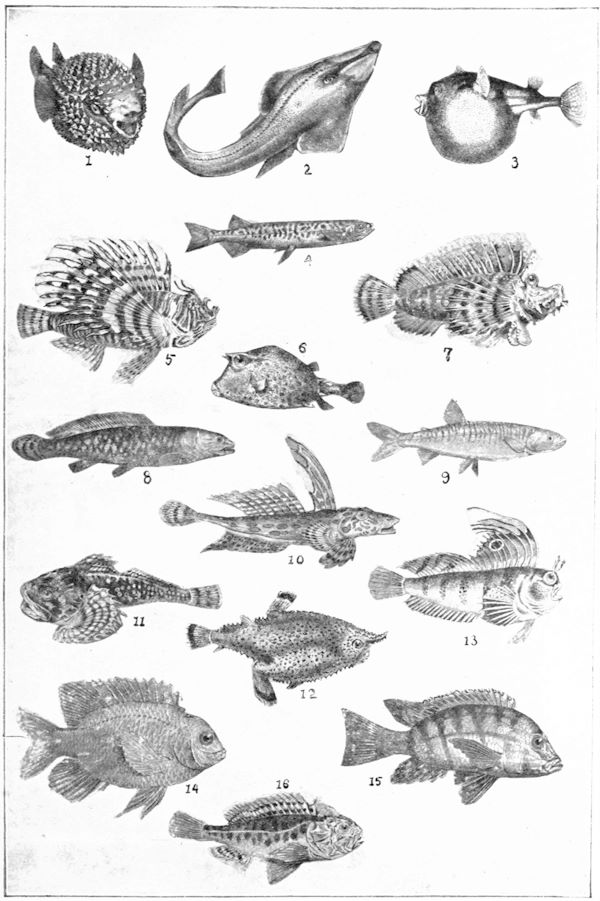
Strange and Rare Fishes
1, Diodon; 2, Rhinobatus; 3, Tetrodon; 4, Galaxias; 5, Pterois; 6, Ostracion; 7, Pelor; 8, Amia; 9, Haplochiton; 10, Callionymus; 11, Cottus; 12, Malthe; 13, Blennius; 14, Pomacentrus; 15, Chromis; 16, Scorpæna
Let me say a word as to the general insect type. It may be described shortly as consisting of animals possessing a head, with mouth-parts, eyes, and antennæ; a many-segmented body, with three pairs of legs on the segments immediately following the head; with, when mature, either one or two pairs of wings, generally with caudal appendages.
Thus, then, we find in many of the principal groups of insects that, greatly as they differ from one another in their mature condition, when they leave the egg they more nearly resemble the typical insect type, consisting of a head, a three-segmented thorax, with three pairs of legs, and a many-jointed abdomen, often with anal appendages. Now, is there any mature animal which answers to this description? We need not have been surprised if this type, through which it would appear that insects must have passed so many ages since (for winged Neuroptera have been found in the carboniferous strata), had long ago become extinct. Yet it is not so. The interesting genus Campodea still lives; it inhabits damp earth, and closely resembles the larva of Chloëon, constituting, indeed, a type which occurs in many orders of insects. It is true that the mouth-parts of Campodea do not resemble either the strongly mandibulate form which prevails among the larvæ of Coleoptera, Orthoptera, Neuroptera, Hymenoptera, Lepidoptera; or the suctorial type of the Homoptera and Heteroptera. It is, however, not the less interesting or significant on that account, since its mouth-parts are intermediate between the mandibulate and haustellate types; a fact which seems to me most suggestive.
It appears, then, that there are good grounds for considering that the various types of insects are descended from ancestors more or less resembling the genus Campodea, with a body divided into head, thorax, and abdomen; the head provided with mouth-parts, eyes, and one pair of antennæ; the thorax with three pairs of legs; and the abdomen, in all probability, with caudal appendages.
If these views are correct, the genus Campodea must be regarded as a form of remarkable interest, since it is the living representative of a primeval type, from which not only the Collembola and Thysanura, but the other great orders of insects have derived their origin.
Since, then, individual insects are certainly in many cases developed from larvæ closely resembling the genus Campodea, why should it be regarded as incredible that insects as a group have gone through similar stages? That the ancestors of beetles under the influence of varying external conditions, and in the lapse of geological ages, should have undergone changes which the individual beetle passes through under our own eyes and in the space of a few days, is surely no wild or extravagant hypothesis. Again, other insects come from vermiform larvæ much resembling the genus Lindia, and it has been also repeatedly shown that in many particulars the embryo of the more specialized forms resembles the full-grown representatives of lower types. I conclude, therefore, that the Insecta generally are descended from ancestors resembling the existing genus Campodea, and that these again have arisen from others belonging to a type represented more or less closely by the existing genus Lindia.
Of course it may be argued that these facts have not really the significance which they seem to me to possess. It may be said that when Divine power created insects, they were created with these remarkable developmental processes. By such arguments the conclusions of geologists were long disputed. When God made the rocks, it was tersely said, He made the fossils in them. No one, I suppose, would now be found to maintain such a theory; and I believe the time will come when it will be generally admitted that the structure of the embryo, and its developmental changes, indicate as truly the course of organic development in ancient times as the contents of rocks and their sequence teach us the past history of the earth itself.
INSECTS: THEIR WINGS, STINGS, EARS, AND EYES —Philip Henry Gosse
The most perfect fliers in existence are insects. The swallow and the humming-bird are powerful on the wing, and rapid; but neither these nor any other “winged fowl” can be compared with many of the filmy-winged insects. The common house-fly, for example, will remain for hours together floating in the air beneath the ceilings of our dwelling-rooms, hovering and dancing from side to side, without effort and without fatigue. It has been calculated that in its ordinary flight the house-fly makes about 600 strokes with its wings every second, and that it is carried through the air a distance of five feet during that brief period. But, if alarmed, the velocity can be increased six or sevenfold, as every one must have observed, so as to carry the insect thirty or five-and-thirty feet in the second. In the same space of time, observes Mr. Kirby, a race-horse could clear only ninety feet, which is at the rate of more than a mile a minute. Our little fly, in her swiftest flight, will in the same space of time go more than the third of a mile. Now compare the infinite difference of the size of the two animals (ten millions of the fly would hardly counterpoise one racer), and how wonderful will the velocity of this minute creature appear! Did the fly equal the race-horse in size, and retain its present powers in the ratio of its magnitude, it would traverse the globe with the rapidity of lightning.
Bees, again, are accomplished masters of aerial motion. The humblebees, notwithstanding their heavy bodies, are the most powerful fliers of this class. The same excellent entomologist tells us that they “traverse the air in segments of a circle, the arc of which is alternately to right and left. The rapidity of their flight is so great that, could it be calculated, it would be found, the size of the creature considered, far to exceed that of any bird, as has been proved by the observations of a traveler in a railway carriage proceeding at the rate of twenty miles an hour, which was accompanied, though the wind was against them, for a considerable distance by a humblebee (Bombus subinterruptus), not merely with the same rapidity, but even greater, as it not infrequently flew to and fro about the carriage, or described zigzag lines in its flight. The aerial movements of the hive-bee are more distinct and leisurely.”
You have doubtless often admired the noble dragon-fly, with its four ample and widespread wings of gauze, hawking in a green lane, or over a pool in the noon of summer. It sails, or rather shoots with arrowy fleetness hither and thither, now forward, now backward, now to the right, now to the left, without turning its body, but simply by the action of its powerful and elegant wings. Leeuwenhoek once saw an insect of this tribe chased by a swallow in a menagerie a hundred feet long. The dragon-fly shot along with such astonishing power of wing, to the right, to the left, and in all directions, that this bird of rapid flight and ready evolution was unable to overtake and capture it, the insect eluding every attempt, and being in general fully six feet in advance of the bird. A dragon-fly has been known to fly on board a ship at sea, the nearest land being the coast of Africa, five hundred miles distant, a fact highly illustrative of its power of wing.
It is a point of interest to know the structure of the organs by which such results are accomplished. Let us begin with the common fly. Well, we will borrow one of his wings for the lesson, and, putting it into the stage-forceps, we shall be able to turn it in any direction for observation beneath the microscope.
At first it seems a very thin, transparent membrane, of a shape between triangular and oval, with a few fine black lines running through it, and along one edge. But on bringing a greater magnifying power to bear on it, we see that the clear surface is covered with minute short stiff hairs, each of which has an expanded base. And still further, by delicate focusing, we find that there are two sets of these hairs, which come into view alternately, those of one row projecting upward toward our eye, those of the other downward. They are placed on both the upper and under surface, and are in fact appendages of two distinct membranes, applied to each other. There is some reason to believe that these hairs are delicate organs of touch communicating impressions through the skin to a sensitive layer beneath; at least such seems their function on the body, and we may judge from analogy that it is not different here.
The black lines are elastic, horny tubes, over which the membranes are spread and stretched, like the silk of an umbrella by its ribs. The upper membrane is firmly attached to the tubes (which are called nervures); the lower has but a slight adhesion, and is easily stripped from them. The nervures originate in the body, and diverge like a fan to various points of the tip, and to the upper and lower edges; some of them, however, terminate in the substance of the wing without reaching the edge, and some send off cross branches by which two are connected together. They generally maintain the same thickness throughout, but there are enlargements where the branches join the main trunks. These nervures are hollow, and are, during life, filled with a subtile fluid, which is supplied from the vessels of the body. They contain also ramifications of the exquisite spiral air-vessels.
In this wing of the bee all of these structures may be seen to greater advantage. Unlike the fly, which has but a single pair of wings, the bee has two pairs, of which the fore pair is the larger and more horny, the hinder pair seeming to be, as it were, cut out of the hinder and inner side of the fore ones. The two edges—the hinder edge of the fore pair and the front edge of the hind pair—then correspond, but it is necessary that, during flight, when the wings are expanded, the two wings on each side should maintain this relative position, neither overlapping the other, but together presenting one broad surface, wherewith to beat the air. There must be, therefore, some contrivance for locking together the two edges in question, which yet shall be capable of being unlocked at the pleasure of the animal; for the wings during repose slide over one another. This contrivance is furnished by a series of hairs or spines running along the front edge of the hindwing; they are bent up into strong semicircular hooks, arching outward, looking, under a high power, like the hooks on a butcher’s stall. On the other hand, the margin of the forewing is strengthened, and is turned over with a shallow doubling, so as to make a groove into which the hooks catch; and thus, while the forewings are expanded, the hooks of the other pair are firmly locked in their doubled edge, while, as soon as flight ceases, and the wings are relaxed, there is no hindrance to the sliding of the front over the hind pair.
The wings of many insects are interesting on account of the organs with which they are clothed. A familiar example is furnished by the common gnat. There is the same general structure as before—two clear elastic membranes stretched over slender horny tubular nervures, and studded on both surfaces with short spine-like hairs, which in this case, however, are excessively numerous and minute. But along the nervures, and along other lines which run (generally) parallel with the front margin, and also along the whole margin, there are set long leaf-like scales of very curious appearance and structure.
There are, however, other insects which display these or similar appendages in far greater profusion, and in much variety of form and appearance. In the fissures of cliffs that border the seashore may often be found some wingless but active insects, which are endowed with the power of leaping in great perfection. From their hinder extremity being furnished with long projecting bristles, they are sometimes called bristle-tails, but naturalists designate the genus Machilis. If you can get one sufficiently still to examine it, you will be delighted with the lustre of its clothing, which appears dusted all over with a metallic powder of rich colors—red, brown, orange, and yellow, foiled by dull lead-gray in places.
If you touch one of these nimble leapers, though ever so slightly, you will see the result on your finger-ends, for they will be found covered with a thin stratum of the finest dust, which displays the colored metallic reflection seen on the insect. By touching one with a plate of glass, instead of your finger, you will get the same dust to adhere to this transparent medium, by applying which to the microscope you may at once discern the marvelous nature of the raiment with which the little creature is bedecked.
The dust is now seen to be composed of myriads of thin scales, mostly regular and symmetrical in their forms, though varying exceedingly among themselves in this respect. Some are heart-shaped, some shovel-shaped, some round, oval, elliptical, half round, half elliptical, long and narrow, sometimes irregular and unequal, and of various other indescribable outlines.
The beautiful and extensive order called Lepidoptera or scale-winged, par excellence, including the gay tribes of butterflies and moths, presents us with many exceedingly interesting varieties in these singular coverings.
Here are specimens from the pretty little white five-plume moth (Pterophorus), so common in meadows in summer. The general shape of the scales from the body and wings is that of a willow-leaf, some singly pointed, but more cut at the tip into two, three, or four notches. Those from the legs are longer and slenderer in proportion; and among the others from the wings there are some which take the form of hairs, which send forth one or more branches from one side, that form a very acute angle with the main stem. The scales proper are all marked with longitudinal lines, very minute and close, but they mostly bear a central band, and sometimes a marginal one on each side, of spots set in sinuous lines like the bands on a mackerel’s back; these are probably composed of pigment-granules.
The hairs with which the bodies of moths are invested are essentially of the same character as the scales which clothe their wings. Here are examples from the glowing sides of the abdomen of that richly colored insect, the cream-spot tiger-moth (Arctia villica). You see they are simple scales, drawn out to an inordinate length and great tenuity; each has its quill-like footstalk, and we may trace on some of them the ribs and transverse dotting, while here we see all intermediate stages between the slenderest hair and the broadly ovate, bluntly pointed scales from the wings.
You are familiar, of course, with the brilliant little blue butterfly (Polyommatus Alexis) which dances and glitters in the sunshine on waste places in June. Among the scales of ordinary form which clothe the lovely little wings will occur one here and there of a different shape from the rest. Here you may see one; it is much smaller than the average; the footstalk is very long, and the shape of the entire scale is that of a battledoor. The ribs are rather few and coarse, and they have this peculiarity, that each rib swells at intervals into rounded dilatations, each of which has a minute black point in its centre. In some of these battledoor scales there is, near the lower part of the expansion, a crescent of minute pigment-grains.
Scales taken from the brilliant changeable blue-green patch in the hindwing of Papilio Paris, a fine Indian butterfly, have an interesting appearance. They are simply pear-shaped in outline, with few longitudinal ribs set far apart, and numerous strongly marked corrugations running across between them. That these are really elevations of the surface is well seen in some scales, even with transmitted light, and a high power; for the slopes of the wrinkles that face the light display the lustrous emerald reflection proper to the wing, while the transmitted color of the whole scale is a rich transparent red.
The dimensions of the scales do not bear any certain proportion to the size of the insect which is clothed with them; those from the broad wings of the noble Saturnia Atlas, for example, eight or nine inches in expanse, being exceeded in size by some from those of the little British muslin moth, an inch wide.
The little beetles which we are familiar with under the name of weevils, characterized by their long slender snouts, at the end of which they carry curiously folding antennæ, and which constitute the family Curculionidæ, are in many cases clothed with scales, to which they owe their colors and patterns. Several of British species display a green or silvery lustre, which under the microscope is seen to be produced by oval scales. But these are eclipsed by the splendor of many tropical species, especially that well-known one from South America which is called the diamond beetle, and scientifically Entimus imperialis, from its unparalleled magnificence.
A piece of one of the wing-cases of this beetle is gummed to the slide now upon the stage. We look at it by reflected light with a magnifying power of 130 diameters. We see a black ground, on which are strewn a profusion of what look like precious stones blazing in the most gorgeous lustre. Topazes, sapphires, amethysts, rubies, emeralds seem here sown broadcast; and yet not wholly without regularity, for there are broad bands of the deep black surface, where there are no gems, and, though at considerable diversity of angle, they do all point with more or less precision in one direction, viz., that of the bands. These gems are flat transparent scales, very regularly oval in form, for one end is rather more pointed than the other; there is no appearance of a footstalk, and by what means they adhere I know not; they are evidently attached in some manner by the smaller extremity to the velvety black surface of the wing-case. The gorgeous colors seem dependent in some measure on the reflection of light from their polished surface, and to vary according to the angle at which it is reflected. Green, yellow, and orange hues predominate; crimson, violet, and blue are rare, except upon the long and narrow scales that border the suture of the wing-cases, where these colors are the chief reflected.
If you have ever thought on the subject, you have probably taken for granted that the various sounds produced by insects are voices uttered by their mouths. But it is not so. No insect has anything approaching to a voice. Vocal sounds are produced by the emission of air from the lungs variously modified by the organs of the mouth. But no insect breathes through its mouth; no air is expelled thence in a single species; it is a biting, or piercing, or sucking organ; an organ for the taking of food, or an organ for offence or defence; but never an organ of sound. The wings are in most cases the immediate causes of insect sounds.
There is a pretty little beetle (Clytus), not uncommon in summer in gardens, remarkable for the brilliant gamboge-yellow lines across its dark wing-cases, which makes a curious squeaking sound when you take it in your hand. You think it is crying; but if you carefully examine it with a lens while the noise is uttered, you will perceive that the cause is the grating of the thorax against the front part of the two wing-cases. Several other beetles produce similar sounds when alarmed, by rubbing the other end of the wing-sheaths with the tip of the abdomen. Many of those genera which feed on ordure and carrion do this.
But the noisiest of all insects are those of the classes Orthoptera and Homoptera, the crickets and grasshoppers, and the treehoppers. The locusts and grasshoppers, it appears, make use of their hindlegs in producing their crink. If you look at the grasshopper’s leg, you will see that the thigh is marked with a number of transverse overlapping angular plates, and that the shank carries a series of short horny points along each side. The insect when it crinks brings the shank up to its thigh, and rubs both to and fro against the wing-sheaths, doing this by turns with the right and left legs, which causes the regular breaks in the sound.
In this case we may without hesitation conclude that the friction of the thigh-plates and shank-points on the rough edges of the wing-cases produces the musical vibration of the tense membrane, as rubbing a wet glass with the finger will yield a loud musical note.
The most elaborate contrivance for the production of sounds among the insect races, however, is found among the Cicadæ, celebrated in classical poetry as the very impersonations of song and eloquence.
Probably at some period of your life you have been stung by a bee or wasp. I shall take it for granted that you have, and that having tested the potency of these warlike insects’ weapons with one sense, you have a curiosity to examine them with another. The microscope shall aid your vision to investigate the morbific implement.
This is the sting of the honey-bee. It consists of a dark brown horny sheath, bulbous at the base, but suddenly diminishing, and then tapering to a fine point. This sheath is split entirely along the inferior edge, and by pressure with a needle I have been enabled to project the two lancets, which commonly lie within the sheath. These are two slender filaments of the like brown horny substance, of which the centre is tubular, and carries a fluid, in which bubbles are visible. The extremity of each displays a beautiful mechanism, for it is thinned away into two thin blade-edges, of which one remains keen and knife-like, while the opposite edge is cut into several saw teeth pointing backward.
The lancets do not appear to be united with the sheath in any part, but simply to lie in its groove; their basal portions pass out into the body behind the sheath, where you see a number of muscle-bands crowded around them: these, acting in various directions, and being inserted into the lancets at various points, exercise a complete control over their movements, projecting or retracting them at their will. But each lancet has a singular projection from its back, which appears to act in some way as a guide to its motion, probably preventing it from slipping aside when darted forth, for the bulbous part of the sheath, in which these projections work, seems formed expressly to receive them.
Thus we see an apparatus beautifully contrived to enter the flesh of an enemy: the two spears finely pointed, sharp-edged, and saw-toothed, adapted for piercing, cutting, and tearing; the reversed direction of the teeth gives the weapon a hold in the flesh, and prevents it from being readily drawn out. Here is an elaborate store of power for the jactation of the javelins, in the numerous muscle-bands; here is a provision made for the precision of the impulse; and finally, here is a polished sheath for the reception of the weapons and their preservation when not in actual use. All this is perfect; but something still was wanting to render the weapons effective, and that something your experience has proved to be supplied.
The mere intromission of these points, incomparably finer and sharper than the finest needle that was ever polished in a Sheffield workshop, would produce no result appreciable to our feelings; and most surely would not be followed by the distressing agony attendant on the sting of a bee. We must look for something more than we have seen.
We need not be long in finding it. For here, at the base of the sheath, into which it enters by a narrow neck, lies a transparent pear-shaped bag, its surface covered all over, but especially toward the neck, with small glands set transversely. It is rounded behind, where it is entered by a very long and slender membraneous tube, which, after many turns and windings, gradually thickening and becoming more evidently glandular, terminates in a blind end.
This is the apparatus for preparing and ejecting a powerful poison. The glandular end of the slender tube is the secreting organ: here the venom is prepared; the remainder of the tube is a duct for conveying it to the bag, a reservoir in which it is stored for the moment of use. By means of the neck it is thrown into the groove at the moment the sting is projected, the same muscles, probably, that dart forward the weapon compressing the poison-bag and causing it to pour forth its contents into the groove, whence it passes on between the two spears into the wound which they have made.
A modification of this apparatus is found throughout a very extensive order of insects—the Hymenoptera; but in the majority of cases it is not connected with purposes of warfare. Wherever it occurs it is always confined to the female sex, or (as in the case of some social insects) to the neuters, which are undeveloped females. When it is not accompanied by a poison-reservoir it is ancillary to the deposition of the eggs, and is hence called an ovipositor, though in many cases it performs a part much more extensive than the mere placing of the ova.
A very wide field of observation, and one easily cultivated, is presented by the organs of sense in the insect races, and in particular by those curious jointed threads which proceed from the front or sides of the head, and which are technically called antennæ. These may sometimes be confounded with the palpi; for in a carnivorous beetle, for instance, both palpi and antennæ are formed of a number of oblong, polished hard joints, set end to end, like beads on a necklace. And it is probable there may be as much community in the function as in the form of these two sets of appendages; that both are the seats of some very delicate perceptive faculty allied to touch, but of which we can not, from ignorance, speak very definitely. It is likely, indeed, that sensations of a very variable character are perceived by them, according to their form, the degree of their development, and the habits of the species. It is not impossible, judging from the very great diversity which we find in the form and structure of these and similar organs in this immense class of beings, compared with the uniformity that prevails in the organs of sense bestowed on ourselves and other vertebrate animals, that a far wider sphere of perception is open to them than to us. Perhaps conditions that are appreciable to us only by the aid of the most delicate instruments of modern science may be appreciable to their acute faculties, and may govern their instincts and actions. Among such we may mention, conjecturally, the comparative moisture or dryness of the atmosphere, delicate changes in its temperature, in its density, the presence of gaseous exhalations, the proximity of solid bodies indicated by subtile vibrations of the air, the height above the earth at which flight is performed, measured barometrically, the various electrical conditions of the atmosphere; and perhaps many other physical diversities which can not be classed under sight, sound smell, taste, or touch, and which may be altogether unappreciable, and therefore altogether inconceivable, by us. It is probable, however, that the antennæ are the organs in which the sense of hearing is specially seated.
The forms which are assumed by the antennæ of insects are very diverse; and I can bring before you only a very small selection out of the mass. One of the most simple forms is that found in many beetles, as in this Carabus, for example. Here each antennæ is composed of eleven joints, almost exactly alike and symmetrical, each joint a horny body of apparently a long oval shape, polished on the surface, but not smooth, because covered with minute depressed lines, and clothed with shaggy hair. There is, however, a slight illusion in the appearance: it seems as if the dividing point of the joints were, as I have just said, at the termination of the oval, but when we look closely we see that the summit of each oval is, as it were, cut off by a line, and by comparing the basal joints with the others, we see that this line is the real division, that the summit of the oval really forms the bottom of the succeeding joint, and that the constricted part is no articulation at all. The first, or basal joint (called the scapus), and the second (called the pedicella), differ in form from the rest, here but slightly, but often considerably. The whole of the remaining joints are together termed the clavola.
There is a very extensive family of beetles known as Lamellicornes, because the antennal joints are singularly flattened and applied one over the other like the leaves of a book (lamella, a leaf).
But this structure is seen to still greater advantage in the much larger cockchafer, so abundant in May in some seasons. The insect widely expands them, evidently to receive impressions from the atmosphere; when alarmed, they are closed and withdrawn beneath the shield of the head, but on the first essay toward escape, or any kind of forward movement, the leaves are widely opened, and then, after an instant’s pause to test the perceptions on the sensorium, away it travels.
But much more curious and beautiful are the antennæ of many moths, which often resemble feathers, particularly in the group Bombycina, of which the silkworm is an example; and in the male sex, which displays this structure more than the female.
This is the antenna of a large and handsome and not at all uncommon moth—the oak egger (Lasiocampa quercus). It consists of about seventy joints, so nearly alike in size and outline that the whole forms an almost straight rod, slightly tapering to the tip. Each joint, however, sends forth two long straight branches, so disposed that the pair make a very acute angle, and the whole double series of seventy on each side form a deep narrow groove. These two series of branches, being perfectly regular and symmetrical, impart to the antennæ the aspect of exquisite feathers.
It is, however, when we examine the elements of this structure in detail, using moderately high powers of enlargement, that we are struck with the elaborateness of the workmanship bestowed upon them. Each of the lateral branches is a straight rod, thick at its origin, whence it tapers to a little beyond its middle, and then thickens again to its tip. Here two horny spines project from it obliquely, one much stouter than the other, at such an angle as nearly to touch the tip of the succeeding branch.
Besides this, each branch is surrounded throughout its length with a series of short stiff bristles, very close-set, projecting horizontally (to the plane of the axis of the branch), and bent upward at the end candelabrum-fashion. The mode in which they are arranged is in a short spiral, which makes about forty-five whorls or turns about the axis; at least in the branches which are situated about the middle of the antennæ; for these diminish in length toward the extremity, bringing the feather to a rather abrupt point.
The entire surface of the branch gleams under reflected light with metallic hues, chiefly yellows and bronzy greens; which appear to depend on very minute and closely applied scales that overlap each other. The main stem of the feather—that is, the primary rod or axis—is somewhat sparsely clothed with scales of another kind, thin, oblong, flat plates, notched at the end, and very slightly attached by means of a minute stem at the base—the common clothing scales of the Lepidoptera.
We may acquire some glimpse of a notion why this remarkable development of antennæ is bestowed upon the male sex of this moth by an acquaintance with its habits. It has been long a practice with entomologists, when they have reared a female moth from the chrysalis, to avail themselves of the instincts of the species to capture the male. This sex has an extraordinary power of discovering the female at immense distances, and though perfectly concealed; and will crowd toward her from all quarters, entering into houses, beating at windows, and even descending chimneys, to come at the dear object of their solicitude. Collectors call this mode of procuring the male “sembling,” that is “assembling,” because the insects of the sex assemble at one point. It can not be practiced with all insects, nor even with all moths; those of this family, Bombycidæ, are in general available; and of these, none is more celebrated for the habit than the oak egger. The very individual whose antenna has furnished us with this observation was taken in this way; for having bred a female of this species, one evening I put her into a basket in my parlor. One male, the same evening, came dashing into the kitchen; but the next day, soon after noon, in the hot sunshine of August, no fewer than four more males came rapidly in succession to the parlor window, which was a little open, and, after beating about the panes a few minutes, found their way in, and made straightway for the basket, totally regardless of their own liberty.
It must be manifest to you that some extraordinary sense is bestowed upon these moths, or else some ordinary and well-known sense in extraordinary development. It may be smell; it may be hearing; but neither odor nor sound, perceptible by our dull faculties, is given forth by the females; the emanation is far too subtile to produce any vibrations on our sensorium, and yet sufficiently potent, and widely diffused, to call these males from their distant retreats in the hedges and woods.
The male gnat presents in its antennæ a pair of plumes of equal beauty, but of a totally different character. The pattern here is one of exceeding lightness and grace.
In the tribe of two-winged insects, which we term, par excellence, flies (Muscadæ), the antennæ are of peculiar structure. The common house-fly shall give us a good example. Here, in front of the head, is a shell-like concavity, divided into two by a central ridge. Just at the summit of this projection are the two antennæ, originating close together, and diverging as they proceed. Each antenna consists of three joints, of which the first is very minute, the second is a reversed cone, and the third, which is large, thick, and ovate, is bent abruptly downward immediately in front of the concavity. From the upper part of this third joint projects obliquely a stiff bristle or style, which tapers to a fine point. It is densely hairy throughout; and is more beset with longer hairs on two opposite sides, which decrease regularly in length from the base, making a wide and pointed plume.
Such are a few examples of what are presumed to be the ears of insects; let us now turn our attention to their eyes. And we can scarcely select a more brilliant, or a larger example, than is presented by this fine dragon-fly (Æshna), which I just now caught as it was hawking to and fro in my garden. How gorgeously beautiful are these two great hemispheres that almost compose the head, each shining with a soft satiny lustre of azure hue, surrounded by olive-green, and marked with undefined black spots, which change their place as you move the insect round!
Each of these hemispheres is a compound eye. I put the insect in the stage-forceps, and bring a low power to bear upon it with reflected light. You see an infinite number of hexagons, of the most accurate symmetry and regularity of arrangement. Into those which are in the centre of the field of view, the eye can penetrate far down, and you perceive that they are tubes; of those which recede from the centre, you discern more and more of the sides; while, by delicate adjustment of the focus, you can see that each tube is not open, but is covered with a convex arch of some glassy medium polished and transparent as crystal. There are, according to the computations of accurate naturalists, not fewer than 24,000 of these convex lenses in the two eyes of such a large species of dragon-fly as this. Every one of these 24,000 bodies represents a perfect eye; every one is furnished with all the apparatus and combinations requisite for distinct vision; and there is no doubt that the dragon-fly looks through them all. In order to explain this, I must enter into a little technical explanation of the anatomy of the organs, as they have been demonstrated by careful dissection.
The glassy convex plate or facet in front of each hexagon is a cornea, or corneule, as it has been called. Behind each cornea, instead of a crystalline lens, there descends a slender transparent pyramid, whose base is the cornea, and whose apex points toward the interior, where it is received and embraced by a translucent cup, answering to the vitreous humor. This, in its turn, is surrounded by another cup, formed by the expansion of a nervous filament arising from the ganglion on the extremity of the optic nerve, a short distance from the brain. Each lens-like pyramid, with its vitreous cup and nervous filament, is completely surrounded and isolated by a coat (the choroid) of dark pigment, except that there is a minute orifice or pupil behind the cornea, where the rays of light enter the pyramid, and one at the apex of the latter, where they reach the fibres of the optic nerve.
Each cornea is a lens with a perfect magnifying power. The focus of each cornea has been ascertained by similar experiments to be exactly equal to the length of the pyramid behind it, so that the image produced by the rays of light proceeding from any external object, and refracted by the convex cornea, will fall accurately upon the sensitive termination of the optic nerve-filament placed there to receive it.
The rays which pass through the several pyramids are prevented from mingling with each other by the isolating sheath of dark pigment; and no rays except those which pass along the axis of each pyramid can reach the optic nerve; all the rest being absorbed in the pigment of the sides. Hence it is evident that as no two corneæ on the rounded surface of the compound eye can have the same axis, no two can transmit a ray of light from the very same point of any object looked at; while, as each of the composite eyes is immovable, except as the whole head moves, the combined action of the whole 24,000 lenses can present to the sensorium but the idea of a single, undistorted, unconfused object, probably on somewhat of the same principle by which the convergence of the rays of light entering our two eyes gives us but a single stereoscopic picture.
The soft blue color of this dragon-fly’s eyes—as also the rich golden reflections seen on the eyes of other insects, as the whameflies, and many other Diptera—is not produced by the pigment which I have alluded to, but is a prismatic reflection from the corneæ.
You would suppose that, having 24,000 eyes, the dragon-fly was pretty well furnished with organs of vision and surely would need no more; but you would be mistaken. It has three other eyes of quite another character.
If you look at the commissure or line of junction of the two compound eyes on the summit of the head, you will see just in front of the point where they separate and their front outlines diverge a minute crescent-shaped cushion of a pale-green color, at each angle of which is a minute antenna. Close to the base of each antenna there is set, in the black skin of the head that divides the green crescent from the compound eyes, a globose polished knob of crystal-like substance, much like the “bull’s-eyes” or hemispheres of solid glass that are set in a ship’s deck to enlighten the side-cabins. On the front side of the crescentic cushion there is a third similar glassy sphere, but much larger than the two lateral ones. What are these three spherules?
They are eyes, in no important respect differing from the individuals which compose the compound masses except that they are isolated. The shining glassy hemisphere is a cornea of hard transparent substance, behind which is situated a spherical lens, lodged in a kind of cup formed by an expansion of the optic nerve, and which is surrounded by a colored pigment-layer. You may study these simple eyes, or stemmata, as they are called, in many other insects, though they are not so universally present as the compound eyes. On the forehead of the honey-bee they are well seen, as three black shining globules, placed, as in the dragon-fly, in a triangle.
FAIRY FLIES —Fred. Enock
If it were possible to obtain a reply from all living naturalists as to what first attracted their attention to insect life, I venture to think that seventy-five per cent or more of the replies would be: “The first sight of a living butterfly.” How many of us (no matter what our specialty may now be) can look back to that time when, perhaps, a tortoise-shell flaunted its beauty before our youthful eyes, and we were drawn to it and fascinated by its gorgeous color, as it delicately sipped the nectar from a dandelion or thistle, gently opening and shutting its wings, spreading them as wide as possible so that every part should be seen! The colors and markings flashed before our enraptured gaze, and while we were held captive by its beauty, another still more beautiful butterfly—the peacock—sailed past and alighted close to the first, riveting our attention by the marvelously lovely “eyes” on its wings; and again another—this time a red admiral—in full sail bore down upon us, opened fire, and we surrendered, swearing allegiance for evermore to Atalanta and all her crew. Few boys could stand still and not be affected or influenced by such beauty. Such then has been, and will be, the foundation of our naturalists—“butterfly hunters” first, specialists later on.
As we are briefly running through the Hymenoptera our difficulties seem to increase, for with the next division, the Chalcididæ, we hardly know what to do, or to whom we can turn for assistance in naming these brilliantly spangled green and gold colored flies, whose “name is legion.” The laborers in this field are indeed few, so much so that there is not a “specialist” even at the Natural History Museum, South Kensington.
Let us go back to one of those “neglected families” which have received but small attention. One reason for this want of attention is, no doubt, because of the extreme smallness of the members of this family, the largest being not more than one-twentieth of an inch long, whereas the smallest is less than one-eighty-fifth of an inch from head to tail. These insect atoms have been classed among the Chalcididæ by Haliday—the originator of the Mymaridæ—who first noticed them in 1833. Since that date Westwood has placed them among the Proctotrupidæ; and now Ashmead—author of American Proctotripidæ—has decided in favor of Haliday’s arrangement, and in this I fully concur.
The fairy flies are, without doubt, among the many wonderful parasitic Hymenoptera, the most admirable in their exquisite structure, as well as in their habits and economy. All the species are egg parasites, and each species has its peculiar taste, selecting with unerring instinct the right kind of egg—generally that of an injurious insect—in which the female lays one of its own eggs, which in due time hatches or develops into an active maggot. This maggot feeds upon the contained fluids, and finds sufficient nutriment to bring it to full size, when it assumes the pupal stage. The fly, being matured, bites out a round piece of the eggshell large enough to allow it to escape. The most noticeable character in the fairy flies is the transverse line across the face a little above the insertion of the antennæ. The wings are devoid of all wing nerves, for the sub-costal is so short and stumpy that the wing looks perfectly free. Both the upper and under surfaces of the wings are covered with minute hairs, and the margins of both wings are surrounded by long hair-like ciliæ.
Owing to the kindness of the authorities of Dublin Museum, I have been permitted to make a most exhaustive and critical examination of Haliday’s type collection of British Mymaridæ, and though the hand of time and those of others have materially interfered with their original arrangement, the result has been most satisfactory to me. Although one or two of the most interesting types are absent, I have been enabled to re-establish Haliday’s genus Panthus, which certain compilers had, for no apparent reason, ignored. I found two specimens still bearing the old labels, and after long and critical microscopic examination I saw that both were distinct from any others. I applied for and obtained permission to remove the carded specimens, and remount them in Canada balsam. This was successfully done, and on making a photo-micrograph the peculiar generic characters were brought out most distinctly. Some naturalists appear to imagine that a pocket lens will be sufficient to identify these species, but in an insect which is but a fiftieth or an eightieth of an inch long it is of absolute importance that every joint and detail should be examined under the microscope, and the relative proportion of each joint of the antennæ be compared with closely allied species—just as they are with all large Hymenoptera. The curve, too, of the delicate wings is a most important feature which must not be hurried over. This point leads me to speak of the immense superiority of photo-micrographs over drawings of these fairy flies. No matter how exact an enthusiastic naturalist may be in his endeavors, it is a physical impossibility for any one to follow out and reproduce the exact curve of these microscopic wings; and as the flies when properly prepared and “set” in Canada balsam lend themselves peculiarly to photo-micrography, it is wise to take advantage of this. The details can afterward be drawn to a much larger scale. It is my intention to do this with every species which I have collected during the past twenty-five years, and of which I have a very large number, far exceeding those known to science. The illustrations accompanying this short article will, I think, show what exceedingly good subjects the fairy flies are for photo-micrographs.
Since Haliday’s arrangement of the British Mymaridæ, elucidated by Francis Walker, no new species have been recorded, the genera numbering eleven, the species, thirty-five, as follows, viz.:
Ooctonus, four species Mymar, one species
Gonatocerus, five species Cosmocoma, eight species
Alaptus, two species Caraphractus, one species
Litus, one species Anaphes, seven species
Eustochus, one species Anagrus, four species
Camptoptera, one species
Of these I have found representatives of all, and a few notes may not be uninteresting to those who desire to search for these fairy flies.
Ooctonus. Of this genus I have not found very many specimens. It is thick-set, and least like a fairy. Unfortunately, Haliday did not publish any detailed account of his captures, but from the fact of his naming one (plentifully represented in his collection) Ooctonus hemipterus, it is just possible it may be parasitic in eggs of bugs.
Gonatocerus is, perhaps, as plentiful as any in the London district. It is a constant visitor to my garden, though I have failed to discover its nidus.
Alaptus minimus and fusculus have long been known to me. The first-named is not more than one-seventy-second of an inch long, with a sessile abdomen. Its wings are somewhat hatchet shaped, with peculiar enlargements at the base of the inner margin. The lower wings have a crimped appearance, arising from the mackerel marking. This, and in fact all the family, are to be found running up the glass in a greenhouse, especially on the window facing east. Alaptus fusculus is one of the first to appear in spring—its peculiar jerky gait will at once reveal its identity. Of this species I have bred hundreds from the eggs of a psocid (Stenopscocus cruciatus), an insect much like a common aphis, but very active and shy, having a decided objection to being watched. But “all good things come to those who know how to wait,” and wait he must for hours, days, months, and years before the life history of a single species is made out. Haliday mentions that Polynema (Cosmocoma) destroys the eggs of the cabbage butterfly. I read this twenty-five years ago, but I have never yet found one egg “struck.” Stenopscocus lays its eggs on the leaves of various shrubs and trees. I have found them on lime, oak, sycamore, hawthorn, and ivy. They are laid in patches of ten to twenty, the female psocid carefully weaving a silken covering in an endeavor to protect them from the attacks of enemies; but, alas! who would imagine a fairy fly to be an enemy? Yet its microscopic size enables it to pass unnoticed, and also permits its passing beneath the silken screen, and, once there, woe betide the psocid’s eggs! for the busy fairy taps one with her clubbed antennæ, mounts to the summit, and then lets down the ovipositor until the barbed tip touches the surface of the fresh-laid egg (it must be fresh). Now by carefully focusing a good magnifier, we can observe the fairy taking a firm hold of the surface of the egg with the two curved tips of each of her exquisitely formed toes! Next we note that pressure is being put upon the barbed ovipositor. The antennæ are pressed firmly to the surface, and impress the observer with the fact that some very serious business is in hand. Eleven minutes have passed without any sign of a move, when just after eleven and a quarter the ovipositor positively bumps through the shell. There is another serious pause, and then up go the clubbed antennæ, and very carefully the ovipositor is withdrawn until it slips back between the sheaths. The fairy turns round, and with saliva from her mouth seals up the incision. Another egg is ascended, bored, and stored with an egg—and so on until the whole batch of twenty has been struck, and all chance of any psocid emerging utterly ruined. I kept the first batch of eggs which I had seen struck in October until the following year, when, as the warm days of April arrived, I carefully examined them, until one eventful day I observed one of the eggs had a tiny hole in it. On placing it under the microscope I saw a pair of mandibles busily at work nibbling away the eggshell, until at last the hole was large enough to admit of the head being thrust through. After many efforts the antennæ were freed, followed by the first pair of legs; then, with this additional leverage at command, the thorax was lifted out, the second pair of legs and part of the wings following, and after much apparently painful effort the third and last pair of legs was withdrawn, enabling the fairy to walk out, and to free those most exquisitely delicate wings without a hitch. Now, taking a firm grip on the empty eggshell, the fairy went through her toilet. Not a hair or spine escaped attention—each and every part of this microscopic marvel received the utmost attention; every hair forming the lovely marginal fringe was brushed out and arranged in exact order. The wings were raised several times to try them, and then away this atom of perfection flew. Since my first seeing the ovipositor of a fairy fly I have dissected many struck eggs, and in less than a minute had the germ (laid by the fairy fly) under my microscope, and watched it grow, and the cells divide again and again in such a marvelous manner that I have been lost in wonderment or simply overcome. Flesh and blood is not strong enough to carry on such watchings too long, but the fascination is so great that time after time have I watched the mysterious changes taking place—various organs being formed under my eyes—the active larva gradually losing all its activity until it appears in pupal form, and then new limbs and organs seem to be evolved from nothing at all.
The next genus, Litus, is a peculiar one. Its one representative, Litus cynipseus, much resembles a flea in color and form. It is the only fairy fly that takes its time in walking. I have never seen it in a hurry, neither have I ever seen the male—and the female is not a plentiful species.
Eustochus is distinguished by having a deeply marked suture across the club of the antennæ, and though Haliday mentions but one species, I have found over a dozen; in fact, of this genus I can always find specimens anywhere—on windows, in greenhouses, in railway carriages, besides sweeping them up from grass and all kinds of herbage. I have also seen and caught them flying, and have obtained many specimens from spiders’ webs.
Mymar pulchellus is, without doubt, the most extraordinary of the whole family. My first specimen I caught in a spider’s web when living near Finsbury Park. It was very much held by viscid globules, but after many hours’ work appeared in Canada balsam a splendid mount. No insect has exercised my power of thought more than this one; but its life history remains a mystery still, though I imagine I am within measurable distance of discovering its nidus. The posterior wings are abnormal—mere bristles—and yet they are of immense service when hooked into the anterior ones, the black specks just before the tips of these bristle-like wings being the three hooklets.
The next representative, Cosmocoma, is Haliday’s Polynema, which, he states, affects the eggs of the cabbage butterfly. C. fumipennis is of the most strikingly beautiful character. I once saw the male of this, but it was on the glass outside the greenhouse, while I was inside and the door was locked. My feelings at that moment can be better imagined than described.
Caraphractus cinctus has received a good deal of attention and notoriety from the fact that in 1862 Sir John Lubbock discovered that it was aquatic in its habits, using its wings for swimming under water. It was christened Polynema natans by the worthy discoverer of its natatorial habits; but in 1896 it fell to my lot to prove it to be identical with Haliday’s Caraphractus.
Anaphes is found in almost any garden, and is frequently confounded with Eustochus, but the solid club is an unfailing character. It is also somewhat larger than Eustochus.
Anagrus contains many species of very delicate yellow fairy flies, always present in gardens and about ponds—in fact, almost everywhere. I have been again fortunate in discovering the life history of several species belonging to this genus. One is parasitic in eggs of dragon-flies, and three others in different kinds of eggs of frog-hoppers, which have for over thirty years eluded my search.
One more genus remains to be noticed, and it is the most fairy-like of all the Mymaridæ, viz., Camptoptera papaveris. It is the smallest of the family, the female being but one-eighty-fifth of an inch long. Mystery surrounds this gem, and yet it is most plentiful in certain localities. The male, of which I have only taken two specimens, measures just one-ninety-second of an inch from head to tail, and yet is absolutely perfect in every part.
INSECT TRANSFORMATIONS —Andrew Wilson
Most people are aware, as a piece of commonplace knowledge, that many animals, before arriving at their mature or adult state, undergo a series of changes in form, of a more or less complete character. To such a series of changes the naturalist applies the term “metamorphosis”; and the study of the disguises which an animal may in this way successively assume forms one of the most interesting and fascinating subjects that can attract the notice of the observer.
The great insect-class presents us with the most familiar examples of these changes, and the butterflies and moths exemplify metamorphosis in its most typical aspect. Thus we know that from the egg of the butterfly, deposited by the short-lived parent upon the leaves of plants, a crawling grub-like creature is first developed. This form we name the “larva” or “caterpillar”; and if we might fail to recognize its relationship to the bright denizen of the air as far as outward appearance is concerned, we might also be at a loss to reconcile its internal structure with that of the perfect butterfly. Thus the latter is winged; possesses a mouth and digestive system, adapted for the reception and assimilation of flower-juices; and wholly differs in structure and habits from its worm-like progeny. The caterpillar is provided with a mouth furnished with jaws, and adapted for biting or mastication; its digestive system presents a type differing widely from that of the perfect form; and its crawling, terrestrial habits appear in strong contrast to the light and ethereal movements of its parent.
The life of this larva may be accurately described as one devoted solely to its nourishment. Its entire existence, while in the caterpillar state, is one long process of continuous eating and devouring. By means of its jaws it nips and destroys the young leaves of plants, much to the gardener’s annoyance; and so rapidly does its body increase in size, that the first skin with which its body is provided soon cracks and bursts like a tight-fitting coat, and a process of moulting ensues. As the result of this process the larva emerges, clad in a new skin, adapted to the increased size of its body. This second skin may similarly become inadequate to accommodate its ever-increasing growth, and a second process of moulting produces in turn a new investment. In this way the caterpillar may change its coat many times—twenty-one moultings have been counted in the development of the Mayflies—and on arriving at the close of its larval stage of existence, may present a very great increase in size, as compared with the dimensions it presented at the beginning of its life.
But, sooner or later, the caterpillar appears to sicken, and to become quiescent. Its former state of activity is exchanged for one of lethargy, from which it awakes to begin an operation of a novel and different nature from that in which it has been previously engaged. It begins to spin a delicate silky thread by means of a special apparatus, situated in the head, and which consists of silk-glands and of an organ named the “spinneret.” Within the silken case or “cocoon” which it thus constructs with the thread of the spinneret, the caterpillar-body is soon inclosed; the first stage of its existence comes to an end; and the second or cocoon stage, marked by outward quiescence and apparent rest, becomes known to us as that of the “pupa,” “chrysalis,” or “nymph.”
Although outwardly still, and although all the former activity appears to have been exchanged for a state of dull repose, changes of active kind, and of marvelous extent, are meanwhile proceeding within the cocoon or pupa-case. The elements of the caterpillar’s form are being gradually disintegrated or broken down, and built up anew in the form and image of the adult butterfly. Old textures and garments are being exchanged for new ones; particle by particle the outward and inward structures of the larva are being replaced by others proper to the mature being; and in due course, and after a longer or shorter period, the cocoon is ruptured, and the perfect form emerges—a bright and beautiful creature, furnished with wings and active senses, and rejoicing in the exercise of its new-born functions amid the sunlight and the flowers.
Such is an outline of the familiar process by which the larva or caterpillar of the butterfly becomes transformed or developed, to form the “imago” or perfect and adult form. And if we review the stages exemplified in the process, we shall be able to detect in each an obvious harmony and correspondence both with the preceding and with the succeeding stage. Thus we find that the life of the perfect and mature insect is at the best of a comparatively short and transient nature, and its energies are directed chiefly to reproduction—to the deposition of eggs, from which new individuals will, in due course, be reproduced. The larval stage, on the contrary, is devoted to nutrition; to the laying up, as it were, of a store of nourishment, sufficient to last throughout the lifetime of the being, and to sustain it while its adult functions are being performed.
Indeed, the entire lifetime of the higher insect may be divided into, or comprised within, two distinct periods. The first of these latter is the nutritive period, represented by the caterpillar-state, when the nutrition of the body is mainly provided for; and the second period, no less defined than the first, is included in the life of the perfect form, which is devoted to reproducing the species. This last we might therefore term the reproductive period of insect-life.
All insects, however, do not exemplify “metamorphosis” in so perfect a manner as does the butterfly. The beetles, flies, bees, etc., and many other insects, undergo a process of metamorphosis essentially resembling that of the butterfly; the characteristic feature of this form of development being that while the caterpillar stage is passed in activity, the pupa or chrysalis is quiescent; and from this resting-pupa the active, winged insect comes forth. The dragon-flies, crickets, grasshoppers, and their allies, undergo, on the other hand, a less perfect series of changes than the foregoing insects. The young grasshopper, on leaving the egg, bears first a close resemblance to the perfect insect. It is, further, not of worm-like conformation, and in these two points differs from the larva of the other forms. Then, thirdly, it does not inclose itself in a cocoon-case, but passes its chrysalis stage in a free and active condition. In this respect it again differs from the butterfly chrysalis; and its perfect form is attained simply by the development of the wings. So that, in reality, the chief difference between the young and the perfect form of the grasshopper consists in the non-development in the former of the wings, which are thus characteristic of the adult form.
The dragon-flies illustrate an essentially similar kind of metamorphosis, but also exemplify differences in the details of their development. The young of the dragon-fly are active creatures, inhabiting the water of pools; the eggs from which they are produced having been deposited by the parent in bunches on the leaves of water-plants. The larvæ are of brownish color, and possess six legs, and a peculiar apparatus of jaws, consisting of a pair of nippers attached to a movable, rod-like stem. This apparatus can be folded upon the head, when it gives to the larva the appearance of being masked, and hence the name of “mask” which has been applied to this structure. But on the approach of some unwary insect, the jaws can be rapidly extended to seize the unfortunate victim, and convey it to the mouth of its captor. The dragon-fly’s young are thus purely aquatic in habits, and propel themselves along by ejecting water, which has been used in breathing, from the posterior extremity of the body.
Having arrived at the close of its chrysalis-stage of development—the chrysalis differing from the larva simply in its greater size, and in the development of the wings and perfect body within the pupa-skin—the insect at length fixes its body to some water-plant. The pupa-skin next splits along the back, and the mature, winged insect slowly emerges therefrom. The crumpled wings soon dry, and acquire their normal consistence; and the dragon-fly, freed from the trammels of a mundane existence, mounts into the air, and “revels in the freedom of luxury and light.” Tennyson has aptly described this change in his lines:
To-day I saw the dragon-fly Come from the wells where he did lie. An inner impulse rent the veil Of his old husk: from head to tail Came out clear plates of sapphire mail. He dried his wings: like gauze they grew: Thro’ crofts and pastures wet with dew A living flash of light he flew.
In these latter instances, as in the case of the butterfly, the nutrition of the insects has been proceeding during the earlier stages of life, and has been fitting them for entering upon the final part of their existence, which may extend for a longer or shorter period, but which is mainly devoted to the continuation of the species. The time occupied in the development of insects varies greatly in different groups. Cold and damp appear to delay this process. The chrysalis of a butterfly has been kept for two years in an icehouse, without undergoing development; while on removal to a warm place it became transformed into the winged insect. The cockchafer occupies three years in its development, the duration of life in its perfect state being probably only a single year.
STRUGGLE FOR EXISTENCE —Charles Darwin
Among organic beings in a state of nature there is some individual variability: indeed I am not aware that this has ever been disputed. It is immaterial for us whether a multitude of doubtful forms be called species or sub-species or varieties; what rank, for instance, the two or three hundred doubtful forms of British plants are entitled to hold, if the existence of any well-marked varieties be admitted. But the mere existence of individual variability and of some few well-marked varieties, though necessary as the foundation for the work, helps us but little in understanding how species arise in nature. How have all those exquisite adaptations of one part of the organization to another part, and to the conditions of life, and of one organic being to another being, been perfected? We see these beautiful co-adaptations most plainly in the woodpecker and the mistletoe; and only a little less plainly in the humblest parasite which clings to the hairs of a quadruped or feathers of a bird; in the structure of the beetle which dives through the water; in the plumed seed which is wafted by the gentlest breeze; in short, we see beautiful adaptations everywhere and in every part of the organic world.
Again, it may be asked, how is it that varieties, which I have called incipient species, become ultimately converted into good and distinct species, which in most cases obviously differ from each other far more than do the varieties of the same species? How do those groups of species which constitute what are called distinct genera, and which differ from each other more than do the species of the same genus, arise? All these results follow from the struggle for life. Owing to this struggle, variations, however slight and from whatever cause proceeding, if they be in any degree profitable to the individuals of a species, in their infinitely complex relations to other organic beings and to their physical conditions of life, will tend to the preservation of such individuals, and will generally be inherited by the offspring. The offspring, also, will thus have a better chance of surviving, for, of the many individuals of any species which are periodically born, but a small number can survive. I have called this principle, by which each slight variation, if useful, is preserved, by the term Natural Selection, in order to mark its relation to man’s power of selection. But the expression often used by Mr. Herbert Spencer of the Survival of the Fittest is more accurate, and is sometimes equally convenient.