THE STORY OF THE UNIVERSE (continued 4)
Reading edition
The elder De Candolle and Lyell have largely and philosophically shown that all organic beings are exposed to severe competition. In regard to plants, no one has treated this subject with more spirit and ability than W. Herbert, Dean of Manchester, evidently the result of his great horticultural knowledge. Nothing is easier than to admit in words the truth of the universal struggle for life, or more difficult—at least I have found it so—than constantly to bear this conclusion in mind. Yet unless it be thoroughly ingrained in the mind, the whole economy of nature, with every fact on distribution, rarity, abundance, extinction, and variation, will be dimly seen or quite misunderstood. We behold the face of nature bright with gladness, we often see superabundance of food; we do not see or we forget that the birds which are idly singing round us mostly live on insects or seeds, and are thus constantly destroying life; or we forget how largely these songsters, or their eggs, or their nestlings, are destroyed by birds and beasts of prey; we do not always bear in mind that, though food may be now superabundant, it is not so at all seasons of each recurring year.
I should premise that I use this term Struggle for Existence in a large and metaphorical sense, including dependence of one being on another, and including (which is more important) not only the life of the individual, but success in leaving progeny. Two canine animals, in a time of dearth, may be truly said to struggle with each other which shall get food and live. But a plant on the edge of a desert is said to struggle for life against the drought, though more properly it should be said to be dependent on the moisture. A plant which annually produces a thousand seeds, of which only one on an average comes to maturity, may be more truly said to struggle with the plants of the same and other kinds which already clothe the ground. The mistletoe is dependent on the apple and a few other trees, but can only in a far-fetched sense be said to struggle with these trees, for, if too many of these parasites grow on the same tree, it languishes and dies. But several seedling mistletoes, growing close together on the same branch, may more truly be said to struggle with each other. As the mistletoe is disseminated by birds, its existence depends on them; and it may metaphorically be said to struggle with other fruit-bearing plants, in tempting the birds to devour and thus disseminate its seeds. In these several senses, which pass into each other, I use for convenience’ sake the general term of Struggle for Existence.
A struggle for existence inevitably follows from the high rate at which all organic beings tend to increase. Every being, which during its natural lifetime produces several eggs or seeds, must suffer destruction during some period of its life, and during some season or occasional year, otherwise, on the principle of geometrical increase, its numbers would quickly become so inordinately great that no country could support the product. Hence, as more individuals are produced than can possibly survive, there must in every case be a struggle for existence, either one individual with another of the same species, or with the individuals of distinct species.
There is no exception to the rule that every organic being naturally increases at so high a rate that, if not destroyed, the earth would soon be covered by the progeny of a single pair. Even slow-breeding man has doubled in twenty-five years, and at this rate, in less than a thousand years, there would literally not be standing-room for his progeny. Linnæus has calculated that if an annual plant produced only two seeds—and there is no plant so unproductive as this—and their seedlings next year produced two, and so on, then in twenty years there would be a million plants. The elephant is reckoned the slowest breeder of all known animals, and I have taken some pains to estimate its probable minimum rate of natural increase; it will be safest to assume that it begins breeding when thirty years old, and goes on breeding till ninety years old, bringing forth six young in the interval, and surviving till one hundred years old; if this be so, after a period of from 740 to 750 years there would be nearly nineteen million elephants alive, descended from the first pair.
But we have better evidence on this subject than mere theoretical calculations; namely, the numerous recorded cases of the astonishingly rapid increase of various animals in a state of nature, when circumstances have been favorable to them during two or three following seasons. Still more striking is the evidence from our domestic animals of many kinds which have run wild in several parts of the world; if the statements of the rate of increase of slow-breeding cattle and horses in South America, and latterly in Australia, had not been well authenticated, they would have been incredible. So it is with plants; cases could be given of introduced plants which have become common throughout whole islands in a period of less than ten years. In such cases, and endless others could be given, no one supposes that the fertility of the animals or plants has been suddenly and temporarily increased in any sensible degree. The obvious explanation is that the conditions of life have been highly favorable, and that there has consequently been less destruction of the old and young, and that nearly all the young have been enabled to breed. Their geometrical ratio of increase, the result of which never fails to be surprising, simply explains their extraordinarily rapid increase and wide diffusion in their new homes.
In a state of nature almost every full-grown plant annually produces seed, and among animals there are very few which do not annually pair. Hence we may confidently assert that all plants and animals are tending to increase at a geometrical ratio—that all would rapidly stock every station in which they could anyhow exist—and that this geometrical tendency to increase must be checked by destruction at some period of life. Our familiarity with the larger domestic animals tends, I think, to mislead us: we see no great destruction falling on them, but we do not keep in mind that thousands are annually slaughtered for food, and that in a state of nature an equal number would have somehow to be disposed of.
The only difference between organisms which annually produce eggs or seeds by the thousand, and those which produce extremely few, is, that the slow-breeders would require a few more years to people, under favorable conditions, a whole district, let it be ever so large. The condor lays a couple of eggs and the ostrich a score, and yet in the same country the condor may be the more numerous of the two; the Fulmar petrel lays but one egg, yet it is believed to be the most numerous bird in the world. One fly deposits hundreds of eggs, and another, like the hippobosca, a single one; but this difference does not determine how many individuals of the two species can be supported in a district. A large number of eggs is of some importance to those species which depend on a fluctuating amount of food, for it allows them rapidly to increase in number. But the real importance of a large number of eggs or seeds is to make up for much destruction at some period of life; and this period in the great majority of cases is an early one. If an animal can in any way protect its own eggs or young, a small number may be produced, and yet the average stock be fully kept up; but if many eggs or young are destroyed, many must be produced, or the species will become extinct. It would suffice to keep up the full number of a tree, which lived on an average for a thousand years, if a single seed were produced once in a thousand years, supposing that this seed were never destroyed, and could be insured to germinate in a fitting place. So that, in all cases, the average number of any animal or plant depends only indirectly on the number of its eggs or seeds.
In looking at Nature, it is most necessary to keep the foregoing considerations always in mind—never to forget that every single organic being may be said to be striving to the utmost to increase in numbers; that each lives by a struggle at some period of its life; that heavy destruction inevitably falls either on the young or old, during each generation or at recurrent intervals. Lighten any check, mitigate the destruction ever so little, and the number of the species will almost instantaneously increase to any amount.
The causes which check the natural tendency of each species to increase are most obscure. Look at the most vigorous species; by as much as it swarms in numbers, by so much will it tend to increase still further. We know not exactly what the checks are even in a single instance. Nor will this surprise any one who reflects how ignorant we are on this head, even in regard to mankind, although so incomparably better known than any other animal. Eggs or very young animals seem generally to suffer most, but this is not invariably the case. With plants there is a vast destruction of seeds, but, from some observations which I have made, it appears that the seedlings suffer most from germinating in ground already thickly stocked with other plants. Seedlings, also, are destroyed in vast numbers by various enemies; for instance, on a piece of ground three feet long and two wide, dug and cleared, and where there could be no choking from other plants, I marked all the seedlings of our native weeds as they came up, and out of 357 no less than 295 were destroyed, chiefly by slugs and insects. If turf which has long been mown, and the case would be the same with turf closely browsed by quadrupeds, be let grow, the more vigorous plants gradually kill the less vigorous, though fully grown plants; thus out of twenty species growing on a little plot of mown turf (three feet by four) nine species perished, from the other species being allowed to grow up freely.
The amount of food for each species of course gives the extreme limit to which each can increase; but very frequently it is not the obtaining food; but the serving as prey to other animals, which determines the average numbers of species. Thus, there seems to be little doubt that the stock of partridges, grouse, and hares on any large estate depends chiefly on the destruction of vermin. If not one head of game were shot during the next twenty years in England, and, at the same time, if no vermin were destroyed, there would, in all probability, be less game than at present, although hundreds of thousands of game animals are now annually shot. On the other hand, in some cases, as with the elephant, none is destroyed by beasts of prey; for even the tiger in India most rarely dares to attack a young elephant protected by its dam.
Climate plays an important part in determining the average numbers of a species, and periodical seasons of extreme cold or drought seem to be the most effective of all checks. I estimated (chiefly from the greatly reduced numbers of nests in the spring) that the winter of 1854-55 destroyed four-fifths of the birds in my own grounds; and this is a tremendous destruction, when we remember that ten per cent is an extraordinarily severe mortality from epidemics with man. The action of climate seems at first sight to be quite independent of the struggle for existence; but in so far as climate chiefly acts in reducing food, it brings on the most severe struggle between the individuals, whether of the same or of distinct species, which subsist on the same kind of food. Even when climate, for instance extreme cold, acts directly, it will be the least vigorous individuals, or those which have got least food through the advancing winter, which will suffer most. When we travel from south to north, or from a damp region to a dry, we invariably see some species gradually getting rarer and rarer, and finally disappearing; and the change of climate being conspicuous, we are tempted to attribute the whole effect to its direct action. But this is a false view; we forget that each species, even where it most abounds, is constantly suffering enormous destruction at some period of its life, from enemies or from competitors for the same place and food; and if these enemies or competitors be in the least degree favored by any slight change of climate, they will increase in numbers; and as each area is already fully stocked with inhabitants, the other species must decrease. When we travel southward and see a species decreasing in numbers, we may feel sure that the cause lies quite as much in other species being favored as in this one being hurt. So it is when we travel northward, but in a somewhat lesser degree, for the number of species of all kinds, and therefore of competitors, decreases northward; hence in going northward, or in ascending a mountain, we far oftener meet with stunted forms, due to the directly injurious action of climate, than we do in proceeding southward or in descending a mountain. When we reach the Arctic regions or snow-capped summits, or absolute deserts, the struggle for life is almost exclusively with the elements.
That climate acts in main part indirectly by favoring other species, we clearly see in the prodigious number of plants which in our gardens can perfectly well endure our climate, but which never become naturalized, for they can not compete with our native plants nor resist destruction by our native animals.
When a species, owing to highly favorable circumstances, increases inordinately in numbers in a small tract, epidemics—at least, this seems generally to occur with our game animals—often ensue; and here we have a limiting check independent of the struggle for life. But even some of these so-called epidemics appear to be due to parasitic worms, which have from some cause, possibly in part through facility of diffusion among the crowded animals, been disproportionally favored: and here comes in a sort of struggle between the parasite and its prey.
On the other hand, in many cases, a large stock of individuals of the same species, relatively to the numbers of its enemies, is absolutely necessary for its preservation. Thus we can easily raise plenty of corn and rape-seed, etc., in our fields, because the seeds are in great excess compared with the number of birds which feed on them; nor can the birds, though having a superabundance of food at this one season, increase in number proportionally to the supply of seed, as their numbers are checked during winter; but any one who has tried knows how troublesome it is to get seed from a few wheat or other such plants in a garden: I have in this case lost every single seed. This view of the necessity of a large stock of the same species for its preservation explains, I believe, some singular facts in nature, such as that of very rare plants being sometimes extremely abundant, in the few spots where they do exist; and that of some social plants being social, that is abounding in individuals, even on the extreme verge of their range. For in such cases we may believe that a plant could exist only where the conditions of its life were so favorable that many could exist together, and thus save the species from utter destruction. I should add that the good effects of intercrossing, and the ill effects of close interbreeding, no doubt come into play in many of these cases.
Many cases are on record showing how complex and unexpected are the checks and relations between organic beings which have to struggle together in the same country. I will give only a single instance, which, though a simple one, interested me. In Staffordshire, on the estate of a relation, where I had ample means of investigation, there was a large and extremely barren heath, which had never been touched by the hand of man; but several hundred acres of exactly the same nature had been inclosed twenty-five years previously and planted with Scotch fir. The change in the native vegetation of the planted part of the heath was most remarkable, more than is generally seen in passing from one quite different soil to another: not only the proportional numbers of the heath-plants were wholly changed, but twelve species of plants (not counting grasses and carices) flourished in the plantations, which could not be found on the heath. The effect on the insects must have been still greater, for six insectivorous birds were very common in the plantations, which were not to be seen on the heath; and the heath was frequented by two or three distinct insectivorous birds. Here we see how potent has been the effect of the introduction of a single tree, nothing whatever else having been done, with the exception of the land having been inclosed, so that cattle could not enter. But how important an element inclosure is I plainly saw near Farnham, in Surrey. Here there are extensive heaths, with a few clumps of old Scotch firs on the distant hilltops: within the last ten years large spaces have been inclosed, and self-sown firs are now springing up in multitudes, so close together that all can not live. When I ascertained that these young trees had not been sown or planted, I was so much surprised at their numbers that I went to several points of view, whence I could examine hundreds of acres of the uninclosed heath, and literally I could not see a single Scotch fir except the old planted clumps. But on looking closely between the stems of the heath, I found a multitude of seedlings and little trees which had been perpetually browsed down by the cattle. In one square yard, at a point some hundred yards distant from one of the old clumps, I counted thirty-two little trees; and one of them, with twenty-six rings of growth, had, during many years, tried to raise its head above the stems of the heath, and had failed. No wonder that, as soon as the land was inclosed, it became thickly clothed with vigorously growing young firs. Yet the heath was so extremely barren and so extensive that no one would ever have imagined that cattle would have so closely and effectually searched it for food.
Here we see that cattle absolutely determine the existence of the Scotch fir; but in several parts of the world insects determine the existence of cattle. Perhaps Paraguay offers the most curious instance of this; for here neither cattle nor horses nor dogs have ever run wild, though they swarm southward and northward in a feral state; and Azara and Rengger have shown that this is caused by the greater number in Paraguay of a certain fly, which lays its eggs in the navels of these animals when first born. The increase of these flies, numerous as they are, must be habitually checked by some means, probably by other parasitic insects. Hence, if certain insectivorous birds were to decrease in Paraguay, the parasitic insects would probably increase; and this would lessen the number of the navel-frequenting flies—then cattle and horses would become feral, and this would certainly greatly alter (as indeed I have observed in parts of South America) the vegetation: this again would largely affect the insects; and this, as we have just seen in Staffordshire, the insectivorous birds, and so onward in ever-increasing circles of complexity. Not that under nature the relations will ever be as simple as this. Battle within battle must be continually recurring with varying success; and yet in the long run the forces are so nicely balanced that the face of nature remains for long periods of time uniform, though assuredly the merest trifle would give the victory to one organic being over another. Nevertheless, so profound is our ignorance, and so high our presumption, that we marvel when we hear of the extinction of an organic being; and as we do not see the cause, we invoke cataclysms to desolate the world, or invent laws on the duration of the forms of life!
I am tempted to give one more instance showing how plants and animals, remote in the scale of nature, are bound together by a web of complex relations. I shall hereafter have occasion to show that the exotic Lobelia fulgens is never visited in my garden by insects, and consequently, from its peculiar structure, never sets a seed. Nearly all our orchidaceous plants absolutely require the visits of insects to remove their pollen-masses and thus to fertilize them. I find from experiments that humblebees are almost indispensable to the fertilization of the heart’s-ease (Violo tricolor), for other bees do not visit this flower. I have also found that the visits of bees are necessary for the fertilization of some kinds of clover; for instance, 20 heads of Dutch clover (Trifolium repens) yielded 2,290 seeds, but 20 other heads protected from bees produced not one. Again, 100 heads of red clover (T. pratense) produced 2,700 seeds, but the same number of protected heads produced not a single seed. Humblebees alone visit red clover, as other bees can not reach the nectar. It has been suggested that moths may fertilize the clovers; but I doubt whether they could do so in the case of the red clover, from their weight not being sufficient to depress the wing petals. Hence we may infer as highly probable that, if the whole genus of humblebees became extinct or very rare in England, the heart’s-ease and red clover would become very rare, or wholly disappear. The number of humblebees in any district depends in a great measure upon the number of field-mice, which destroy their combs and nests; and Colonel Newman, who has long attended to the habits of humblebees, believes that “more than two-thirds of them are thus destroyed all over England.” Now the number of mice is largely dependent, as every one knows, on the number of cats; and Colonel Newman says, “Near villages and small towns I have found the nests of humblebees more numerous than elsewhere, which I attribute to the number of cats that destroy the mice.” Hence it is quite credible that the presence of a feline animal in large numbers in a district might determine, through the intervention first of mice and then of bees, the frequency of certain flowers in that district!
The dependency of one organic being on another, as of a parasite on its prey, lies generally between beings remote in the scale of nature. This is likewise sometimes the case with those which may be strictly said to struggle with each other for existence, as in the case of locusts and grassfeeding quadrupeds. But the struggle will almost invariably be most severe between the individuals of the same species, for they frequent the same districts, require the same food, and are exposed to the same dangers. In the case of varieties of the same species, the struggle will generally be almost equally severe, and we sometimes see the contest soon decided: for instance, if several varieties of wheat be sown together, and the mixed seed be resown, some of the varieties which best suit the soil or climate, or are naturally the most fertile, will beat the others and so yield more seed, and will consequently in a few years supplant the other varieties. To keep up a mixed stock of even such extremely close varieties as the variously colored sweet peas, they must be each year harvested separately, and the seed then mixed in due proportion, otherwise the weaker kinds will steadily decrease in number and disappear. So again with the varieties of sheep; it has been asserted that certain mountain varieties will starve out other mountain varieties, so that they can not be kept together. The same result has followed from keeping together different varieties of the medicinal leech. It may even be doubted whether the varieties of any of our domestic plants or animals have so exactly the same strength, habits, and constitution, that the original proportions of a mixed stock (crossing being prevented) could be kept up for half a dozen generations, if they were allowed to struggle together, in the same manner as beings in a state of nature, and if the seed or young were not annually preserved in due proportion.
As the species of the same genus usually have, though by no means invariably, much similarity in habits and constitution, and always in structure, the struggle will generally be more severe between them, if they come into competition with each other, than between the species of distinct genera. We see this in the extension over parts of the United States of one species of swallow having caused the decrease of another species. The increase of the missel-thrush in parts of Scotland has caused the decrease of the song-thrush. How frequently we hear of one species of rat taking the place of another species under the most different climates! In Russia the small Asiatic cockroach has everywhere driven before it its great congener. In Australia the imported hive-bee is rapidly exterminating the small, stingless native bee. One species of charlock has been known to supplant another species; and so in other cases.
A corollary of the highest importance may be deduced from the foregoing remarks; namely, that the structure of every organic being is related, in the most essential yet often hidden manner, to that of all the other organic beings, with which it comes into competition for food or residence, or from which it has to escape, or on which it preys. This is obvious in the structure of the teeth and talons of the tiger; and in that of the legs and claws of the parasite which clings to the hair on the tiger’s body. But in the beautifully plumed seed of the dandelion, and in the flattened and fringed legs of the water-beetle, the relation seems at first confined to the elements of air and water. Yet the advantage of plumed seeds no doubt stands in the closest relation to the land being already thickly clothed with other plants; so that the seeds may be widely distributed and fall on unoccupied ground. In the water-beetle, the structure of its legs, so well adapted for diving, allows it to compete with other aquatic insects, to hunt for its own prey, and to escape serving as prey to other animals.
All that we can do is to keep steadily in mind that each organic being is striving to increase in a geometrical ratio; that each at some period of its life, during some season of the year, during each generation, or at intervals, has to struggle for life and to suffer great destruction. When we reflect on this struggle, we may console ourselves with the full belief that the war of nature is not incessant, that no fear is felt, that death is generally prompt, and that the vigorous, the healthy, and the happy survive and multiply.
NATURAL SELECTION —Charles Darwin
How will the struggle for existence, briefly discussed in the last chapter, act in regard to variation? Can the principle of selection, which we have seen is so potent in the hands of man, apply under nature? I think we shall see that it can act most efficiently. Let the endless number of slight variations and individual differences occurring in our domestic productions, and, in a lesser degree, in those under nature, be borne in mind; as well as the strength of the hereditary tendency. Under domestication, it may be truly said that the whole organization becomes in some degree plastic. But the variability, which we almost universally meet with in our domestic productions, is not directly produced, as Hooker and Asa Gray have well remarked, by man; he can neither originate varieties, nor prevent their occurrence; he can only preserve and accumulate such as do occur. Unintentionally he exposes organic beings to new and changing conditions of life, and variability ensues; but similar changes of conditions might and do occur under nature. Let it also be borne in mind how infinitely complex and close-fitting are the mutual relations of all organic beings to each other and to their physical conditions of life; and consequently what infinitely varied diversities of structure might be of use to each being under changing conditions of life. Can it, then, be thought improbable, seeing that variations useful to man have undoubtedly occurred, that other variations useful in some way to each being in the great and complex battle of life, should occur in the course of many successive generations? If such do occur, can we doubt (remembering that many more individuals are born than can possibly survive) that individuals having any advantage, however slight, over others, would have the best chance of surviving and of procreating their kind? On the other hand, we may feel sure that any variation in the least degree injurious would be rigidly destroyed. This preservation of favorable individual differences and variations, and the destruction of those which are injurious, I have called Natural Selection, or the Survival of the Fittest.
We shall best understand the probable course of natural selection by taking the case of a country undergoing some slight physical change, for instance, of climate. The proportional numbers of its inhabitants will almost immediately undergo a change, and some species will probably become extinct. We may conclude, from what we have seen of the intimate and complex manner in which the inhabitants of each country are bound together, that any change in the numerical proportions of the inhabitants, independently of the change of climate itself, would seriously affect the others. If the country were open on its borders, new forms would certainly immigrate, and this would likewise seriously disturb the relations of some of the former inhabitants. Let it be remembered how powerful the influence of a single introduced tree or mammal has been shown to be. But in the case of an island, or of a country partly surrounded by barriers, into which new and better adapted forms could not freely enter, we should then have places in the economy of nature which would assuredly be better filled up, if some of the original inhabitants were in some manner modified; for, had the area been open to immigration, these same places would have been seized on by intruders. In such cases, slight modifications, which in any way favored the individuals of any species, by better adapting them to their altered conditions, would tend to be preserved; and natural selection would have free scope for the work of improvement.
We have good reason to believe that changes in the conditions of life give a tendency to increased variability; and in the foregoing cases the conditions have changed, and this would manifestly be favorable to natural selection, by affording a better chance of the occurrence of profitable variations. Unless such occur, natural selection can do nothing. Under the term of “variations,” it must never be forgotten that mere individual differences are included. As man can produce a great result with his domestic animals and plants by adding up in any given direction individual differences, so could natural selection, but far more easily from having incomparably longer time for action. Nor do I believe that any great physical change, as of climate, or any unusual degree of isolation to check immigration, is necessary in order that new and unoccupied places should be left for natural selection to fill up by improving some of the varying inhabitants. For as all the inhabitants of each country are struggling together with nicely balanced forces, extremely slight modifications in the structure or habits of one species would often give it an advantage over others; and still further modifications of the same kind would often still further increase the advantage, as long as the species continued under the same conditions of life and profited by similar means of subsistence and defence. No country can be named in which all the native inhabitants are now so perfectly adapted to each other and to the physical conditions under which they live, that none of them could be still better adapted or improved; for in all countries the natives have been so far conquered by naturalized productions that they have allowed some foreigners to take firm possession of the land. And as foreigners have thus in every country beaten some of the natives, we may safely conclude that the natives might have been modified with advantage, so as to have better resisted the intruders.
As man can produce, and certainly has produced, a great result by his methodical and unconscious means of selection, what may not natural selection effect? Man can act only on external and visible characters: Nature, if I may be allowed to personify the natural preservation or survival of the fittest, cares nothing for appearances, except in so far as they are useful to any being. She can act on every internal organ, on every shade of constitutional difference, on the whole machinery of life. Man selects only for his own good: Nature only for that of the being which she tends. Every selected character is fully exercised by her, as is implied by the fact of their selection. Man keeps the natives of many climates in the same country; he seldom exercises each selected character in some peculiar and fitting manner; he feeds a long and a short-beaked pigeon on the same food; he does not exercise a long-backed or long-legged quadruped in any peculiar manner; he exposes sheep with long and short wool to the same climate. He does not allow the most vigorous males to struggle for the females. He does not rigidly destroy all inferior animals, but protects during each varying season, as far as lies in his power, all his productions. He often begins his selection by some half-monstrous form; or at least by some modification prominent enough to catch the eye or to be plainly useful to him. Under Nature, the slightest differences of structure or constitution may well turn the nicely balanced scale in the struggle for life, and so be preserved. How fleeting are the wishes and efforts of man! how short his time! and consequently how poor will be his results, compared with those accumulated by Nature during whole geological periods! Can we wonder, then, that Nature’s productions should be far “truer” in character than man’s productions; that they should be infinitely better adapted to the most complex conditions of life, and should plainly bear the stamp of far higher workmanship?
It may metaphorically be said that natural selection is daily and hourly scrutinizing, throughout the world, the slightest variations; rejecting those that are bad, preserving and adding up all that are good; silently and insensibly working, whenever and wherever opportunity offers, at the improvement of each organic being in relation to its organic and inorganic conditions of life. We see nothing of these slow changes in progress, until the hand of time has marked the lapse of ages, and then so imperfect is our view into long-past geological ages, that we see only that the forms of life are now different from what they formerly were.
In order that any great amount of modification should be effected in a species, a variety when once formed must again, perhaps after a long interval of time, vary or present individual differences of the same favorable nature as before; and these must be again preserved, and so onward step by step. Seeing that individual differences of the same kind perpetually recur, this can hardly be considered as an unwarrantable assumption. But whether it is true, we can judge only by seeing how far the hypothesis accords with and explains the general phenomena of nature. On the other hand, the ordinary belief that the amount of possible variation is a strictly limited quantity is likewise a simple assumption.
Although natural selection can act only through and for the good of each being, yet characters and structures, which we are apt to consider as of very trifling importance, may thus be acted on. When we see leaf-eating insects green, and bark-feeders mottled-gray; the Alpine ptarmigan white in winter, the red grouse the color of heather, we must believe that these tints are of service to these birds and insects in preserving them from danger. Grouse, if not destroyed at some period of their lives, would increase in countless numbers; they are known to suffer largely from birds of prey; and hawks are guided by eyesight to their prey—so much so, that on parts of the Continent persons are warned not to keep white pigeons, as being the most liable to destruction. Hence natural selection might be effective in giving the proper color to each kind of grouse, and in keeping that color, when once acquired, true and constant. Nor ought we to think that the occasional destruction of an animal of any particular color would produce little effect: we should remember how essential it is in a flock of white sheep to destroy a lamb with the faintest trace of black. In plants, the down on the fruit and the color of the flesh are considered by botanists as characters of the most trifling importance: yet we hear from an excellent horticulturist, Downing, that in the United States smooth-skinned fruits suffer far more from a beetle, a Curculio, than those with down; that purple plums suffer far more from a certain disease than yellow plums; whereas another disease attacks yellow-fleshed peaches far more than those with other colored flesh. If, with all the aids of art, these slight differences make a great difference in cultivating the several varieties, assuredly, in a state of nature, where the trees would have to struggle with other trees and with a host of enemies, such differences would effectually settle which variety, whether a smooth or downy, a yellow or purple fleshed fruit, should succeed.
In looking at many small points of difference between species, which, as far as our ignorance permits us to judge, seem quite unimportant, we must not forget that climate, food, etc., have no doubt produced some direct effect. It is also necessary to bear in mind that, owing to the law of correlation, when one part varies, and the variations are accumulated through natural selection, other modifications, often of the most unexpected nature, will ensue.
Natural selection will modify the structure of the young in relation to the parent, and of the parent in relation to the young. In social animals it will adapt the structure of each individual for the benefit of the whole community; if the community profits by the selected change. What natural selection can not do is to modify the structure of one species, without giving it any advantage, for the good of another species; and though statements to this effect may be found in works of natural history, I can not find one case which will bear investigation. A structure used only once in an animal’s life, if of high importance to it, might be modified to any extent by natural selection; for instance, the great jaws possessed by certain insects, used exclusively for opening the cocoon—or the hard tip to the beak of unhatched birds, used for breaking the egg. It has been asserted that of the best short-beaked tumbler-pigeons a greater number perish in the egg than are able to get out of it; so that fanciers assist in the act of hatching. Now if nature had to make the beak of a full-grown pigeon short for the bird’s own advantage, the process of modification would be very slow and there would be simultaneously the most rigorous selection of all the young birds within the egg, which had the most powerful and hardest beaks, for all with weak beaks would inevitably perish; or, more delicate and more easily broken shells might be selected, the thickness of the shell being known to vary like every other structure.
Inasmuch as peculiarities often appear under domestication in one sex and become hereditarily attached to that sex, so no doubt it will be under nature. Thus it is rendered possible for the two sexes to be modified through natural selection in relation to different habits of life, as is sometimes the case; or for one sex to be modified in relation to the other sex, as commonly occurs. This leads me to say a few words on what I have called Sexual Selection. This form of selection depends, not on a struggle for existence in relation to other organic beings or to external conditions, but on a struggle between the individuals of one sex, generally the males, for the possession of the other sex. The result is not death to the unsuccessful competitor, but few or no offspring. Sexual selection is, therefore, less rigorous than natural selection. Generally, the most vigorous males, those which are best fitted for their places in nature, will leave most progeny. But in many cases, victory depends not so much on general vigor as on having special weapons, confined to the male sex. A hornless stag or spurless cock would have a poor chance of leaving numerous offspring. Sexual selection, by always allowing the victor to breed, might surely give indomitable courage, length to the spur, and strength to the wing to strike in the spurred leg, in nearly the same manner as does the brutal cockfighter by the careful selection of his best cocks. How low in the scale of nature the law of battle descends I know not; male alligators have been described as fighting, bellowing, and whirling round, like Indians in a war-dance, for the possession of the females; male salmon have been observed fighting all day long; male stag-beetles sometimes bear wounds from the huge mandibles of other males; the males of certain hymenopterous insects have been frequently seen by that inimitable observer, M. Fabre, fighting for a particular female who sits by, an apparently unconcerned beholder of the struggle, and then retires with the conqueror. The war is, perhaps, severest between the males of polygamous animals, and these seem oftenest provided with special weapons. The males of carnivorous animals are already well armed; though to them and to others special means of defence may be given through means of sexual selection, as the mane of the lion and the hooked jaw to the male salmon; for the shield may be as important for victory as the sword or spear.
Among birds, the contest is often of a more peaceful character. All those who have attended to the subject believe that there is the severest rivalry between the males of many species to attract, by singing, the females. The rock-thrush of Guiana, birds of paradise, and some others, congregate; and successive males display with the most elaborate care, and show off in the best manner, their gorgeous plumage; they likewise perform strange antics before the females, which, standing by as spectators, at last choose the most attractive partner. Those who have closely attended to birds in confinement well know that they often take individual preferences and dislikes: thus Sir R. Heron has described how a pied peacock was eminently attractive to all his hen birds. I can not here enter on the necessary details; but if man can in a short time give beauty and an elegant carriage to his bantams, according to his standard of beauty, I can see no good reason to doubt that female birds, by selecting, during thousands of generations, the most melodious or beautiful males, according to their standard of beauty, might produce a marked effect. Some well-known laws, with respect to the plumage of male and female birds, in comparison with the plumage of the young, can partly be explained through the action of sexual selection on variations occurring at different ages, and transmitted to the males alone or to both sexes at corresponding ages.
Thus it is, as I believe, that when the males and females of any animal have the same general habits of life, but differ in structure, color, or ornament, such differences have been mainly caused by sexual selection: that is, by individual males having had, in successive generations, some slight advantage over other males, in their weapons, means of defence, or charms, which they have transmitted to their male offspring alone. Yet, I would not wish to attribute all sexual differences to this agency: for we see in our domestic animals peculiarities arising and becoming attached to the male sex, which apparently have not been augmented through selection by man. The tuft of hair on the breast of the wild turkey-cock can not be of any use, and it is doubtful whether it can be ornamental in the eyes of the female bird;—indeed, had the tuft appeared under domestication, it would have been called a monstrosity.
In order to make it clear how, as I believe, natural selection acts, I must beg permission to give one or two imaginary illustrations. Let us take the case of a wolf, which preys on various animals, securing some by craft, some by strength, and some by fleetness; and let us suppose that the fleetest prey, a deer, for instance, had from any change in the country increased in numbers, or that other prey had decreased in numbers, during that season of the year when the wolf was hardest pressed for food. Under such circumstances the swiftest and slimmest wolves would have the best chance of surviving and so be preserved or selected—provided always that they retained strength to master their prey at this or some other period of the year, when they were compelled to prey on other animals. I can see no more reason to doubt that this would be the result than that man should be able to improve the fleetness of his greyhounds by careful and methodical selection, or by that kind of unconscious selection which follows from each man trying to keep the best dogs without any thought of modifying the breed. I may add, that, according to Mr. Pierce, there are two varieties of the wolf inhabiting the Catskill Mountains, in the United States, one with a light greyhound-like form, which pursues deer, and the other more bulky, with shorter legs, which more frequently attacks the shepherd’s flocks.
To the effects of intercrossing in eliminating variations of all kinds, I shall have to recur; but it may be here remarked that most animals and plants keep to their proper homes, and do not needlessly wander about; we see this even with migratory birds, which almost always return to the same spot. Consequently each newly formed variety would generally be at first local, as seems to be the common rule with varieties in a state of nature; so that similarly modified individuals would soon exist in a small body together, and would often breed together. If the new variety were successful in its battle for life, it would slowly spread from a central district, competing with and conquering the unchanged individuals on the margins of an ever-increasing circle.
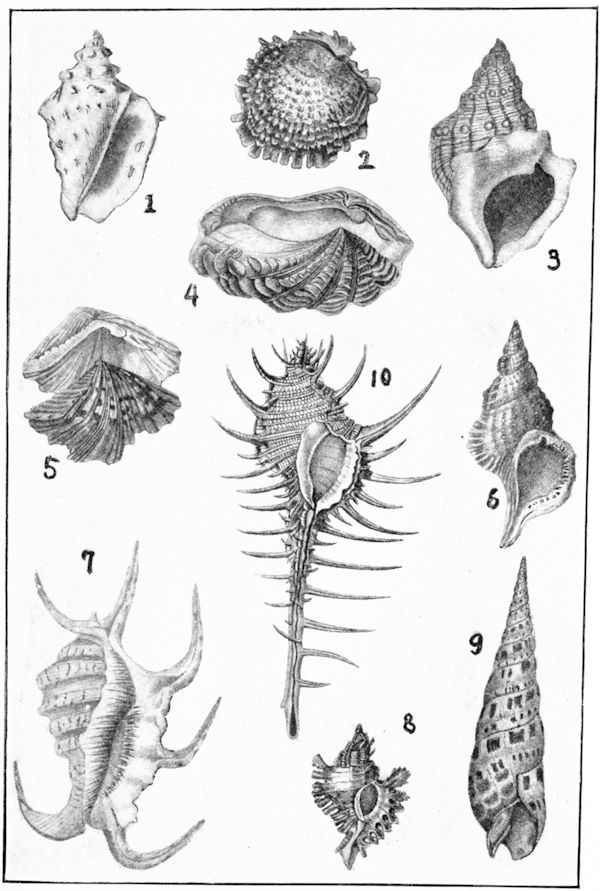
Beautiful and Curious Shells
1, Strombus; 2, Chama; 3, Struthiolaria; 4, Tridacna; 5, Hippopus; 6, Ranella; 7, Pteroceras; 8, 10, Murex; 9, Terebra
It may be worth while to give another and more complex illustration of the action of natural selection. Certain plants excrete sweet juice, apparently for the sake of eliminating something injurious from the sap: this is effected, for instance, by glands at the base of the stipules in some Leguminosæ, and at the backs of the leaves of the common laurel. This juice, though small in quantity, is greedily sought by insects; but their visits do not in any way benefit the plant Now, let us suppose that the juice or nectar was excreted from the inside of the flowers of a certain number of plants of any species. Insects in seeking the nectar would get dusted with pollen, and would often transport it from one flower to another. The flowers of two distinct individuals of the same species would thus get crossed; and the act of crossing, as can be fully proved, gives rise to vigorous seedlings, which consequently would have the best chance of flourishing and surviving. The plants which produced flowers with the largest glands or nectaries, excreting most nectar, would oftenest be visited by insects, and would oftenest be crossed; and so in the long run would gain the upper hand and form a local variety. The flowers, also, which had their stamens and pistils placed, in relation to the size and habits of the particular insect which visited them, so as to favor in any degree the transportal of the pollen, would likewise be favored. We might have taken the case of insects visiting flowers for the sake of collecting pollen instead of nectar; and as pollen is formed for the sole purpose of fertilization, its destruction appears to be a simple loss to the plant; yet if a little pollen were carried, at first occasionally and then habitually, by the pollen-devouring insects from flower to flower, and a cross thus effected, although nine-tenths of the pollen were destroyed it might still be a great gain to the plant to be thus robbed; and the individuals which produced more and more pollen, and had larger anthers, would be selected.
When our plant, by the above process long continued, had been rendered highly attractive to insects, they would, unintentionally on their part, regularly carry pollen from flower to flower; and that they do this effectually, I could easily show by many striking facts.
Let us now turn to the nectar-feeding insects; we may suppose the plant, of which we have been slowly increasing the nectar by continued selection, to be a common plant; and that certain insects depended in main part on its nectar for food. I could give many facts showing how anxious bees are to save time: for instance, their habit of cutting holes and sucking the nectar at the bases of certain flowers, which with a very little more trouble they can enter by the mouth. Bearing such facts in mind, it may be believed that under certain circumstances individual differences in the curvature or length of the proboscis, etc., too slight to be appreciated by us, might profit a bee or other insect, so that certain individuals would be able to obtain their food more quickly than others; and thus the communities to which they belonged would flourish and throw off many swarms inheriting the same peculiarities. The tubes of the corolla of the common red and incarnate clovers (Trifolium pratense and incarnatum) do not on a hasty glance appear to differ in length; yet the hive-bee can easily suck the nectar out of the incarnate clover, but not out of the common red clover, which is visited by humblebees alone; so that whole fields of the red clover offer in vain an abundant supply of precious nectar to the hive-bee. That this nectar is much liked by the hive-bee is certain; for I have repeatedly seen, but only in the autumn, many hive-bees sucking the flowers through holes bitten in the base of the tube by humblebees. The difference in the length of the corolla in the two kinds of clover, which determines the visits of the hive-bee, must be very trifling; for I have been assured that when red clover has been mown, the flowers of the second crop are somewhat smaller, and that these are visited by many hive-bees. I do not know whether this statement is accurate; nor whether another published statement can be trusted, namely, that the Ligurian bee, which is generally considered a mere variety of the common hive-bee, and which freely crosses with it, is able to reach and suck the nectar of the red clover. Thus, in a country where this kind of clover abounded, it might be a great advantage to the hive-bee to have a slightly longer or differently constructed proboscis. On the other hand, as the fertility of this clover absolutely depends on bees visiting the flowers, if humblebees were to become rare in any country, it might be a great advantage to the plant to have a shorter or more deeply divided corolla, so that the hive-bees should be enabled to suck its flowers. Thus I can understand how a flower and a bee might slowly become, either simultaneously or one after the other, modified and adapted to each other in the most perfect manner, by the continued preservation of all the individuals which presented slight deviations of structure mutually favorable to each other.
I must here introduce a short digression. In the case of animals and plants with separated sexes, it is of course obvious that two individuals must always (with the exception of the curious and not well understood cases of parthenogenesis) unite for each birth; but in the case of hermaphrodites this is far from obvious. Nevertheless there is reason to believe that with all hermaphrodites two individuals, either occasionally or habitually, concur for the reproduction of their kind. This view was long ago doubtfully suggested by Sprengel, Knight, and Kölreuter. We shall presently see its importance; but I must here treat the subject with extreme brevity, though I have the materials prepared for an ample discussion. All vertebrate animals, all insects, and some other large groups of animals, pair for each birth. Modern research has much diminished the number of supposed hermaphrodites; and of real hermaphrodites a large number pair; that is, two individuals regularly unite for reproduction, which is all that concerns us. But still there are many hermaphrodite animals which certainly do not habitually pair, and a vast majority of plants are hermaphrodites. What reason, it may be asked, is there for supposing in these cases that two individuals ever concur in reproduction? As it is impossible here to enter on details, I must trust to some general considerations alone.
In the first place, I have collected so large a body of facts, and made so many experiments, showing, in accordance with the almost universal belief of breeders, that with animals and plants a cross between different varieties, or between individuals of the same variety but of another strain, gives vigor and fertility to the offspring; and, on the other hand, that close interbreeding diminishes vigor and fertility; that these facts alone incline me to believe that it is a general law of nature that no organic being fertilizes itself for a perpetuity of generations; but that a cross with another individual is occasionally—perhaps at long intervals of time—indispensable.
Turning for a brief space to animals; various terrestrial species are hermaphrodites, such as the land-mollusca and earthworms; but these all pair. As yet I have not found a single terrestrial animal which can fertilize itself. This remarkable fact, which offers so strong a contrast with terrestrial plants, is intelligible on the view of an occasional cross being indispensable; for owing to the nature of the fertilizing element there are no means, analogous to the action of insects and of the wind with plants, by which an occasional cross could be effected with terrestrial animals without the concurrence of two individuals. Of aquatic animals, there are many self-fertilizing hermaphrodites; but here the currents of water offer an obvious means for an occasional cross. As in the case of flowers, I have as yet failed, after consultation with one of the highest authorities, namely, Professor Huxley, to discover a single hermaphrodite animal with the organs of reproduction so perfectly inclosed that access from without, and the occasional influence of a distinct individual, can be shown to be physically impossible. Cirripeds long appeared to me to present, under this point of view, a case of great difficulty; but I have been enabled, by a fortunate chance, to prove that two individuals, though both are self-fertilizing hermaphrodites, do sometimes cross.
It must have struck most naturalists as a strange anomaly that, both with animals and plants, some species of the same family and even of the same genus, though agreeing closely with each other in their whole organization, are hermaphrodites, and some unisexual. But if, in fact, all hermaphrodites do occasionally intercross, the difference between them and unisexual species is, as far as function is concerned, very small.
From these several considerations and from the many special facts which I have collected, but which I am unable here to give, it appears that with animals and plants an occasional intercross between distinct individuals is a very general, if not universal, law of nature.
To sum up, as far as the extreme intricacy of the subject permits, the circumstances favorable and unfavorable for the production of new species through natural selection. I conclude that for terrestrial productions a large continental area, which has undergone many oscillations of level, will have been the most favorable for the production of any new forms of life, fitted to endure for a long time and to spread widely. While the area existed as a continent, the inhabitants will have been numerous in individuals and kinds, and will have been subjected to severe competition. When converted by subsidence into large separate islands, there will still have existed many individuals of the same species on each island: intercrossing on the confines of the range of each new species will have been checked: after physical changes of any kind, immigration will have been prevented, so that new places in the polity of each island will have had to be filled up by the modification of the old inhabitants; and time will have been allowed for the varieties in each to become well modified and perfected. When, by renewed elevation, the islands were reconverted into a continental area, there will again have been very severe competition: the most favored or improved varieties will have been enabled to spread: there will have been much extinction of the less improved forms, and the relative proportional numbers of the various inhabitants of the reunited continent will again have been changed; and again there will have been a fair field for natural selection to improve still further the inhabitants, and thus to produce new species.
That natural selection generally acts with extreme slowness I fully admit. It can act only when there are places in the natural polity of a district which can be better occupied by the modification of some of its existing inhabitants. The occurrence of such places will often depend on physical changes, which generally take place very slowly, and on the immigration of better adapted forms being prevented. As some few of the old inhabitants become modified, the mutual relations of others will often be disturbed; and this will create new places, ready to be filled up by better adapted forms; but all this will take place very slowly. Although all the individuals of the same species differ in some slight degree from each other, it would often be long before differences of the right nature in various parts of the organization might occur. The result would often be greatly retarded by free intercrossing. Many will exclaim that these several causes are amply sufficient to neutralize the power of natural selection. I do not believe so. But I do believe that natural selection will generally act very slowly, only at long intervals of time, and only on a few of the inhabitants of the same region. I further believe that these slow, intermittent results accord well with what geology tells us of the rate and manner at which the inhabitants of the world have changed.
Slow though the process of selection may be, if feeble man can do much by artificial selection, I can see no limit to the amount of change, to the beauty and complexity of the co-adaptations between all organic beings, one with another and with their physical conditions of life, which may have been effected in the long course of time through nature’s power of selection, that is, by the survival of the fittest.
Natural selection acts solely through the preservation of variations in some way advantageous, which consequently endure. Owing to the high geometrical rate of increase of all organic beings, each area is already fully stocked with inhabitants; and it follows from this, that as the favored forms increase in number, so, generally, will the less favored decrease and become rare. Rarity, as geology tells us, is the precursor to extinction. We can see that any form which is represented by few individuals will run a good chance of utter extinction, during great fluctuations in the nature of the seasons, or from a temporary increase in the number of its enemies. But we may go further than this; for, as new forms are produced, unless we admit that specific forms can go on indefinitely increasing in number, many old forms must become extinct. That the number of specific forms has not indefinitely increased, geology plainly tells us; and we shall attempt to show why it is that the number of species throughout the world has not become immeasurably great.
We have seen that the species which are most numerous in individuals have the best chance of producing favorable variations within any given period. It is the common and diffused or dominant species which offer the greatest number of recorded varieties. Hence, rare species will be less quickly modified or improved within any given period; they will consequently be beaten in the race for life by the modified and improved descendants of the commoner species.
From these several considerations I think it inevitably follows that as new species in the course of time are formed through natural selection, others will become rarer and rarer, and finally extinct. The forms which stand in closest competition with those undergoing modification and improvement will naturally suffer most. And we have seen in the chapter on the Struggle for Existence that it is the most closely allied forms—varieties of the same species, and species of the same genus or of related genera—which, from having nearly the same structure, constitution, and habits, generally come into the severest competition with each other; consequently, each new variety or species, during the progress of its formation, will generally press hardest on its nearest kindred, and tend to exterminate them. We see the same process of extermination among our domesticated productions, through the selection of improved forms by man. Many curious instances could be given showing how quickly new breeds of cattle, sheep, and other animals, and varieties of flowers, take the place of older and inferior kinds. In Yorkshire, it is historically known that the ancient black cattle were displaced by the long-horns, and that these “were swept away by the short-horns” (I quote the words of an agricultural writer) “as if by some murderous pestilence.”
Divergence of character is of high importance, and explains, as I believe, several important facts. In the first place, varieties, even strongly marked ones, though having somewhat of the character of species—as is shown by the hopeless doubts in many cases of how to rank them—yet certainly differ far less from each other than do good and distinct species. Nevertheless, according to my view, varieties are species in the process of formation, or are, as I have called them, incipient species. How, then, does the lesser difference between varieties become augmented into the greater difference between species? That this does habitually happen, we must infer from most of the innumerable species throughout nature presenting well-marked differences, whereas varieties, the supposed prototypes and parents of future well-marked species, present slight and ill-defined differences. Mere chance, as we may call it, might cause one variety to differ in some character from its parents, and the offspring of this variety again to differ from its parent in the very same character and in a greater degree; but this alone would never account for so habitual and large a degree of difference as that between the species of the same genus.
As has always been my practice, I have sought light on this head from our domestic productions. We shall here find something analogous. It will be admitted that the production of races so different as short-horn and Hereford cattle, race and cart-horses, the several breeds of pigeons, etc., could never have been effected by the mere chance accumulation of similar variations during many successive generations. In practice, a fancier is, for instance, struck by a pigeon having a slightly shorter beak; another fancier is struck by a pigeon having a rather longer beak; and on the acknowledged principle that “fanciers do not and will not admire a medium standard, but like extremes,” they both go on (as has actually occurred with the sub-breeds of the tumbler-pigeon) choosing and breeding from birds with longer and longer beaks, or with shorter and shorter beaks. Again, we may suppose that at an early period of history, the men of one nation or district required swifter horses, while those of another required stronger and bulkier horses. The early differences would be very slight, but, in the course of time, from the continued selection of swifter horses in the one case, and of stronger ones in the other, the differences would become greater, and would be noted as forming two sub-breeds. Ultimately, after the lapse of centuries, these sub-breeds would become converted into two well-established and distinct breeds. As the differences became greater, the inferior animals with intermediate characters, being neither very swift nor very strong, would not have been used for breeding, and will thus have tended to disappear. Here, then, we see in man’s productions the action of what may be called the principle of divergence, causing differences, at first barely appreciable, steadily to increase, and the breeds to diverge in character, both from each other and from their common parent.
But how, it may be asked, can any analogous principle apply in nature? I believe it can and does apply most efficiently (though it was a long time before I saw how), from the simple circumstance that the more diversified the descendants from any one species become in structure, constitution, and habits, by so much will they be better enabled to seize on many and widely diversified places in the polity of nature, and so be enabled to increase in numbers.
We can clearly discern this in the case of animals with simple habits. Take the case of a carnivorous quadruped, of which the number that can be supported in any country has long ago arrived at its full average. If its natural power of increase be allowed to act, it can succeed in increasing (the country not undergoing any change in conditions) only by its varying descendants seizing on places at present occupied by other animals: some of them, for instance, being enabled to feed on new kinds of prey, either dead or alive; some inhabiting new stations, climbing trees, frequenting water, and some perhaps becoming less carnivorous. The more diversified in habits and structure the descendants of our carnivorous animals become, the more places they will be enabled to occupy. What applies to one animal will apply throughout all time to all animals—that is, if they vary—for otherwise natural selection can effect nothing.
By considering the nature of the plants or animals which have in any country struggled successfully with the indigenes, and have there become naturalized, we may gain some crude idea in what manner some of the natives would have to be modified in order to gain an advantage over their compatriots; and we may at least infer that diversification of structure, amounting to new generic differences, would be profitable to them.
The advantage of diversification of structure in the inhabitants of the same region is, in fact, the same as that of the physiological division of labor in the organs of the same individual body—a subject so well elucidated by Milne Edwards. No physiologist doubts that a stomach adapted to digest vegetable matter alone, or flesh alone, draws most nutriment from these substances. So in the general economy of any land, the more widely and perfectly the animals and plants are diversified for different habits of life, so will a greater number of individuals be capable of there supporting themselves. A set of animals, with their organization but little diversified, could hardly compete with a set more perfectly diversified in structure. It may be doubted, for instance, whether the Australian marsupials, which are divided into groups differing but little from each other, and feebly representing, as Mr. Waterhouse and others have remarked, our carnivorous, ruminant, and rodent mammals, could successfully compete with these well-developed orders. In the Australian mammals, we see the process of diversification in an early and incomplete stage of development.
If under changing conditions of life organic beings present individual differences in almost every part of their structure, and this can not be disputed; if there be, owing to their geometrical rate of increase, a severe struggle for life at some age, season, or year, and this certainly can not be disputed; then, considering the infinite complexity of the relations of all organic beings to each other and to their conditions of life, causing an infinite diversity in structure, constitution, and habits, to be advantageous to them, it would be a most extraordinary fact if no variations had ever occurred useful to each being’s own welfare, in the same manner as so many variations have occurred useful to man. But if variations useful to any organic being ever do occur, assuredly individuals thus characterized will have the best chance of being preserved in the struggle for life; and from the strong principle of inheritance, these will tend to produce offspring similarly characterized. This principle of preservation, or the survival of the fittest, I have called Natural Selection. It leads to the improvement of each creature in relation to its organic and inorganic conditions of life; and consequently, in most cases, to what must be regarded as an advance in organization. Nevertheless, low and simple forms will long endure if well fitted for their simple conditions of life.
Natural selection, on the principle of qualities being inherited at corresponding ages, can modify the egg, seed, or young, as easily as the adult. Among many animals, sexual selection will have given its aid to ordinary selection, by assuring to the most vigorous and best adapted males the greatest number of offspring. Sexual selection will also give characters useful to the males alone, in their struggles or rivalry with other males; and these characters will be transmitted to one sex or to both sexes, according to the form of inheritance which prevails.
Whether natural selection has really thus acted, in adapting the various forms of life to their several conditions and stations, must be judged by the general tenor and balance of evidence. But we have already seen how it entails extinction; and how largely extinction has acted in the world’s history, geology plainly declares. Natural selection, also, leads to divergence of character; for the more organic beings diverge in structure, habits, and constitution, by so much the more can a large number be supported on the area—of which we see proof by looking to the inhabitants of any small spot, and to the productions naturalized in foreign lands. Therefore, during the modification of the descendants of any one species, and during the incessant struggle of all species to increase in numbers, the more diversified the descendants become, the better will be their chance of success in the battle for life. Thus the small differences distinguishing varieties of the same species steadily tend to increase, till they equal the greater differences between species of the same genus, or even of distinct genera.
We have seen that it is the common, the widely diffused and widely ranging species, belonging to the larger genera within each class, which vary most; and these tend to transmit to their modified offspring that superiority which now makes them dominant in their own countries. Natural selection, as has just been remarked, leads to divergence of character and to much extinction of the less improved and intermediate forms of life. On these principles, the nature of the affinities, and the generally well-defined distinctions between the innumerable organic beings in each class throughout the world, may be explained. It is a truly wonderful fact—the wonder of which we are apt to overlook from familiarity—that all animals and all plants throughout all time and space should be related to each other in groups, subordinate to groups, in the manner which we everywhere behold; namely, varieties of the same species most closely related, species of the same genus less closely and unequally related, forming sections and sub-genera, species of distinct genera much less closely related, and genera related in different degrees, forming sub-families, families, orders, sub-classes and classes. The several subordinate groups in any class can not be ranked in a single file, but seem clustered round points, and these round other points, and so on in almost endless cycles. If species had been independently created, no explanation would have been possible of this kind of classification; but it is explained through inheritance and the complex action of natural selection, entailing extinction and divergence of character.
The affinities of all the beings of the same class have sometimes been represented by a great tree. I believe this simile largely speaks the truth. The green and budding twigs may represent existing species; and those produced during former years may represent the long succession of extinct species. At each period of growth all the growing twigs have tried to branch out on all sides, and to overtop and kill the surrounding twigs and branches, in the same manner as species and groups of species have at all times overmastered other species in the great battle for life. The limbs divided into great branches, and these into lesser and lesser branches, were themselves once, when the tree was young, budding twigs; and this connection of the former and present buds by ramifying branches may well represent the classification of all extinct and living species in groups subordinate to groups. Of the many twigs which flourished when the tree was a mere bush, only two or three, now grown into great branches, yet survive and bear the other branches; so with the species which lived during long-past geological periods, very few have left living and modified descendants. From the first growth of the tree, many a limb and branch has decayed and dropped off; and these fallen branches of various sizes may represent those whole orders, families, and genera which have now no living representatives, and which are known to us only in a fossil state. As we here and there see a thin straggling branch springing from a fork low down in a tree, and which by some chance has been favored and is still alive on its summit, so we occasionally see an animal like the Ornithorhynchus or Lepidosiren, which in some small degree connects by its affinities two large branches of life, and which has apparently been saved from fatal competition by having inhabited a protected station. As buds give rise by growth to fresh buds, and these, if vigorous, branch out and overtop on all sides many a feebler branch, so by generation I believe it has been with the great Tree of Life, which fills with its dead and broken branches the crust of the earth, and covers the surface with its ever-branching and beautiful ramifications.
MAMMALIA —Baron Cuvier
The mammalia are placed at the head of the animal kingdom not only because it is the class to which man himself belongs, but also because it is that which enjoys the most numerous faculties, the most delicate sensations, the most varied powers of motion, and in which all the different qualities seem combined in order to produce a most perfect degree of intelligence, the one most fertile in resources, most susceptible of perfection, and least the slave of instinct.
As their quantity of respiration is moderate, they are designed in general for walking on the earth, but with vigorous and continued steps. The forms of the articulations of their skeleton are, consequently, strictly defined, which determines all their motions with the most rigorous precision.
Some of them, however, by means of limbs considerably elongated and extended membranes, raise themselves in the air; others have them so shortened that they can move with facility in water only, though this does not deprive them of the general character of the class.
The upper jaw in all of these animals is fixed to the cranium; the lower jaw is formed of two pieces only, articulated by a projecting condyle to a fixed temporal bone; the neck consists of seven vertebræ; one single species excepted, which has nine; the anterior ribs are attached before, by cartilage to a sternum consisting of several vertical pieces; their anterior extremity commences in a shoulder-blade, that is not articulated, but simply suspended in the flesh, often resting on the sternum by means of an intermediate bone, called a clavicle. This extremity is continued by an arm, a forearm, and a hand, the latter being composed of two ranges of small bones called the carpus, of another range called the metacarpus, and of the fingers, each of which consists of two or three bones, termed phalanges.
With the exception of the cetacea, the first part of the posterior extremity in all animals of this class is fixed to the spine, forming a girdle or pelvis, which, in youth, consists of three pairs of bones, the ilium which is attached to the spine, the pubis which forms the anterior part of the girdle, and the ischium, the posterior. At the point of union of these three bones is situated the cavity with which the thigh is articulated, to which, in its turn, is attached the leg, formed of two bones, the tibia and fibula; this extremity is terminated by parts similar to those of the hand, i. e., by a tarsus, metatarsus, and toes.
The head of the mammalia is always, articulated by two condyles, with the atlas, the first vertebra of the neck.
The brain is always composed of two hemispheres, united by a medullary layer, called the corpus callosum, containing the ventricles, and enveloping four pairs of tubercles, named the corpora striata, or striated bodies, the thalami nervorum opticorum, or beds of the optic nerves, and the nates and testes. Between the optic beds is a third ventricle, which communicates with a fourth under the cerebellum, the crura of which always form a transverse prominence under the medulla oblongata, called the pons Varolii, or bridge of Varolius.
The eye, invariably lodged in its orbit, is protected by two lids and a vestige of a third, and has its crystalline fixed by the ciliary processes—its sclerotic is simply cellular.
The ear always contains a cavity called the tympanum, or drum, which communicates with the mouth by the Eustachian tube; the cavity itself is closed externally by a membrane called the membrana tympani, and contains a chain of four little bones, named the incus or anvil, malleus or hammer, the os orbiculare or circular bone, and the stapes or stirrup; a vestibule, on the entrance of which rests the stapes, and which communicates with three semicircular canals; and finally a cochlea, which terminates by one canal in the vestibule and by the other in the tympanum.
Their cranium is subdivided into three portions; the anterior is formed by the two frontal and ethmoidal bones, the middle by the two ossa parietalia and the os ethmoides, and the posterior by the os occipitis. Between the ossa parietalia, the sphenoidalis, and the os occipitis are interposed the two temporal bones, part of which belong properly to the face.
Their face consists of two maxillary bones, between which pass the nostrils; the two intermaxillaries are situated before and the two ossa palati behind them; between these descends the vomer, a bony process of the os ethmoides; at the entrance of the nasal canal are placed the ossa nasi; to its external parietes adhere the inferior turbinated bones, the superior ones which occupy its upper and posterior portion belonging to the os ethmoides. The jugal or cheek bone unites the maxillary to the temporal bone on each side, and frequently to the os frontis; finally the os unguis and pars plana of the ethmoid bone occupy the internal angle of the orbit, and sometimes a part of the cheek. In the embryo state these bones also are much more subdivided.
Their tongue is always fleshy, connected with a bone called the hyoides, which is composed of several pieces, and suspended from the cranium by ligaments.
Their lungs, two in number, divided into lobes and composed of an infinite number of cells, are always inclosed, without any adhesion, in a cavity formed by the ribs and diaphragm and lined by the pleura; the organ of voice is always at the upper extremity of the trachea; a fleshy curtain, called the velum palati, establishes a direct communication between their larynx and nasal canal.
Their residence on the surface of the earth rendering them less exposed to the alternations of cold and heat, their tegument, the hair, is but moderately thick, and in such as inhabit warm climates even that is rare.
The Cetacea, which live exclusively in water, are the only ones that are altogether deprived of it.
The young are nourished for some time after birth by a fluid (milk) peculiar to animals of this class, which is produced by the mammæ at the time of parturition, and continues to be so long as is necessary. It is from the mammæ that this class derives its name, and being a character peculiar to it, they distinguish it better than any other that is external.
The variable characters which form essential differences among the mammalia are taken from the organs of touch, on which depends their degree of ability or address, and from the organs of manducation, which determine the nature of their ailment, and are all closely connected, not only with everything relative to the function of digestion, but also with a multitude of other differences relating to their intelligence.
The degree of perfection of the organs of touch is estimated by the number and the pliability of the fingers, and from the greater or less extent to which their extremities are enveloped by the nail or the hoof.
A hoof which completely envelops the end of the toe blunts its sensibility, and renders the foot incapable of seizing.
The opposite extreme is when a nail, formed of one single lamina, covers only one of the faces of the extremity of the finger, leaving the other possessed of all its delicacy.
The nature of the food is known by the grinders, to the form of which the articulation of the jaws universally corresponds.
To cut flesh, grinders are required as trenchant as a saw and jaws fitted like scissors, having no other motion than a vertical one.
For bruising roots or grains flat-crowned grinders are necessary, and jaws that have a lateral motion; in order that inequalities may always exist on the crown of these teeth, it is also requisite that their substance be composed of parts of unequal hardness, so that one may wear away faster than others.
Hoofed animals are necessarily herbivorous, and have flat-crowned grinders, inasmuch as their feet preclude the possibility of their seizing a living prey.
Animals with unguiculated fingers were susceptible of more variety; their food is of all kinds, and independently of the form of their grinders, they differ greatly from each other in the pliability and delicacy of their fingers. There is one character with respect to this which has immense influence on their dexterity and greatly multiplies its powers; it is the faculty of opposing the thumb to the finger for the purpose of seizing minute objects, constituting what is properly called a hand, a faculty which is carried to its highest perfection in man, in whom the whole anterior extremity is free and capable of prehension.
These various combinations which strictly determine the nature of the different mammalia have given rise to the following orders:
Among the unguiculated animals, the first is Man, who, in addition to privileges of other descriptions, possesses hands at the anterior extremities only, the posterior being designed to support him in an erect position.
In the order next to man, that of the Quadrumana, we find hands at the four extremities.
In another order, that of the Carnivora, the thumb is not free, and can not be opposed to the anterior extremities.
Each of these orders has the three sorts of teeth, grinders, canini, and incisors, or cutting teeth.
In the fourth order, that of the Rodentia, the toes differ but little from those of the Carnivora, but there are no canine teeth, and the incisors are placed in front of the mouth, and adapted to a very peculiar sort of manducation.
Then come those animals whose toes are much cramped and deeply sunk in large nails, which are generally curved; they have no incisors, and in some the canines disappear, while others have none of any description. We comprise them all under the title of Edentata.
This distribution of the unguiculated animals would be perfect and form a very regular series were it not that New Holland has lately furnished us with a little collateral one, consisting of animals with pouches, the different genera of which are connected by a general similarity of organization; some of them, however, in the teeth and nature of their diet corresponding to the Carnivora and others to the Rodentia, and a third to the Edentata.
The hoofed animals are less numerous, and have likewise fewer irregularities.
The Ruminantia, by their cloven foot, the absence of true incisors in their upper jaw, and their four stomachs, form an order that is very distinct.
The remaining hoofed animals may all be united in a single order, which I shall call Pachydermata or Jumenta, the elephant excepted, which might constitute a separate one, and which is remotely connected with that of the Rodentia.
In the last place we find those of the mammalia which have no posterior extremities, whose piscatory form and aquatic mode of life would induce us to form them into a particular class, were it not that in everything else their economy is similar to that in which we have them. These are the hot-blooded fishes of the ancients, or the Cetacea, which, uniting to the vigor of the other mammalia the advantage of being sustained by the watery element, present to our wondering sight the most gigantic of animals.
ZOOLOGICAL ZONES —Sir Richard Owen
Organic life in its animal form is much more developed, and more variously, in the sea than in its vegetable form.
Observations of marine animals have led to attempts at generalizing the results; and the modes of enunciating these generalizations or laws of geographical distribution are very analogous to those which have been applied to the vegetable kingdom, which is as diversely developed on land as is the animal kingdom in the sea. Certain horizontal areas, or provinces, have been characterized by the entire assemblage of animals and plants constituting their population, of which a considerable proportion is peculiar to each province, and the majority of the species have their areas of maximum development within it.
Of such provinces of marine life, that much-lamented, far-seeing, and genial philosopher, Edward Forbes, has provisionally defined twenty-five.
The same physical conditions are associated with a certain similarity between the animals of different provinces. Where those provinces are proximate, such likeness is due to the identity or close affinity of the species; but where the provinces are remote the resemblance is one of analogy, and species of different genera or families represent each other.
A second mode of expressing the ascertained facts of the geographical distribution of marine animals is by tracts called Homoiozoic Belts, bounded by climatal lines; which are not, however, parallel with lines of latitude, but undulate in subordination to climatal influences of warm or cold oceanic currents, relations of land to water, etc. Of these belts Professor E. Forbes has defined nine: one equatorial, with four to the north and four to the south, which are mutually representative.
But the most interesting form of expression of the distribution of marine life is that which parallels the perpendicular distribution of plants. Edward Forbes, availing himself of the valuable results of a systematic use of the dredge, first showed that marine animals and plants varied according to the depth at which they lived in a manner very analogous to the changes in the forms and species of vegetation observed in the ascent of a tropical mountain. He has expressed these facts by defining five bathymetrical zones, or belts of depth, which he calls: 1. Littoral; 2. Circumlittoral; 3. Median; 4. Infra-median; 5. Abyssal.
The life-forms of these zones vary, of course, according to the nature of the sea bottom; and are modified by those primitive or creative laws that have caused representative species in distant localities under like physical conditions—species related by analogy.
Very much remains to be observed and studied by naturalists in different parts of the globe, under the guidance of the generalizations thus sketched out, to the completion of a perfect theory. But in the progress to this, the results can not fail to be practically most valuable. A shell or a sea-weed, whose relations to depth are thus understood, may afford important information or warning to the navigator. To the geologist the distribution of marine life according to the zones of depth has given the clew to the determination of the depth of the seas in which certain formations have been deposited.
By the light of these laws of geographical distribution we view with quite a new interest the shells, corals, and sea-weeds of our own shores. We trace the regions whence they have been invaded by races not aboriginally belonging to our seas; we obtain indications of irruptions of sea-currents of dates anterior to the present arrangements of land and water. Thus, part of our marine fauna has been traced back to the old Pliocene period, part to the somewhat newer period of the red-crag, part to the still more recent glacial period—all these being anterior to the constitution of the Celtic Province, as it is now displayed.
The class of animals to which the restrictive laws of geographical distribution might seem least applicable is that of birds: their peculiar power of locomotion, associated in numerous species with migratory habits, might seem to render them independent of every influence, save those of climate and of food, which directly affects the conditions of their existence. Yet the long-winged albatross is never met with north of the equator; nor does the condor soar above other mountains than the Andes. The geographical range of its European representative, the strong-winged lammergeyer, is similarly restricted. The Asiatic Phasianidæ and Pavonidæ are represented by turkeys (Meleagris) in America; by the guinea-fowl (Numida Agelastus, Phasidus) in Africa, and by the Megapodiæ or mound birds in Australia. Several genera of finches are peculiar to the Galapagos Islands; the richly and fantastically ornate birds of paradise are restricted to New Guinea and some neighboring isles. Mr. Sclater, who has contributed the latest summary of facts on the distribution of birds, reckons seventeen families as peculiar to America and sixteen families as peculiar to Europe, Asia, and Africa. Some species have a singularly restricted locality, as the red-grouse (Tetrao scoticus) to the British Isles; the owl-parrot (Nestor productus) to Philip Island, a small spot near New Zealand.
When birds have wings too short for flight, we marvel less at their restricted range; and particular genera of brevipennate birds have their peculiar continents and islands. The long and strong-limbed ostrich courses over the whole continent of Africa and conterminous Arabia. The genus of three-toed ostriches (rhea) is similarly restricted to South America. The emeu (Dromaius) has Australia assigned to it. The continent of the cassowary (Casaurius) has been broken up into Sumatra, Java, Banda, and other islands, extending from the southeastern peninsula of Asia to New Guinea. A second species of cassowary has recently been imported to our zoological gardens from the more southern island of New Britain. The singular nocturnal wingless kivi (apteryx) is peculiar to the island of New Zealand.
Other species and genera which seem to be like the apteryx, as it were mocked with feathers and rudiments of wings, have wholly ceased to exist within the memory of man in the islands to which they were respectively restricted. The dodo (Didus ineptus) of the Mauritius, and the solitaire (Pezophops solitaria) are instances.
In New Zealand also there existed, within the memory of the Maori ancestry, huge birds having their nearest affinities to the still existing apteryx of that island, but generically distinct from that and all other known birds. I have proposed the name of Dinornis for this now extinct genus, of which more than a dozen well-defined species have come to my knowledge, all peculiar to New Zealand, and the last discovered the strangest, by reason of the elephantine proportions of its feet. A tridactyle wingless bird of another genus, Æpyornis, second only to the gigantic Dinornis in size, appears to have only recently become extinct—if it be extinct—in the island of Madagascar. The egg of this bird, which may have suggested to the Arabian voyagers, attaining Madagascar from the Red Sea, the idea of the Roc of their romances, would hold the contents of six eggs of the ostrich, sixteen eggs of the cassowary, and one hundred and forty-eight eggs of the common fowl.
Had all the terrestrial animals that now exist diverged from one common centre within the limited period of a few thousand years, it might have been expected that the remoteness of their actual localities from such ideal centre would bear a certain ratio with their respective powers of locomotion. With regard to the class of birds, one might have expected to find that those which were deprived of the power of flight, and were adapted to subsist on the vegetation of a warm or temperate latitude, would still be met with more or less associated together, and least distant from the original centre of dispersion situated in such a latitude. But what is the fact? The species of no one order of birds is more widely dispersed over the earth than the wingless or struthious kind. Assuming that the original centre has been somewhere in the southwestern mountain range of Asia, there is but one of the species of flightless birds whose habitat can be reconciled with the hypothesis. By the neck of land still uniting Asia with Africa, the progeny of the primary pair created or liberated at the hypothetical centre might have traveled to the latter continent, and there have propagated and dispersed themselves southward to the Cape of Good Hope. It is remarkable, however, that the ostrich should not have migrated eastward over the vast plains or steppes which extend along the warmer temperate zone of Asia, or have reached the southern tropical regions; it is in fact scarcely known in the Asiatic continent, being restricted to the Arabian deserts, and being rare even in those parts which are most contiguous to what I have called its proper continent, Africa. If we next consider the locality of the cassowary, we find great difficulty in conceiving how such a bird could have migrated to the islands of Java, the Moluccas, or New Guinea, from the continent of Asia. The cassowary is not web-footed like the swimming birds; for wings it has only a few short and strong quills. How could it have overcome the obstacles which some hundreds of miles of ocean would present to its passage from the continent of Asia to those islands? If the difficulty already be felt to be great in regard to the insular position of the cassowary, it is still greater when we come to apply the hypothesis of dispersion from a single centre to the dodo of the island of Mauritius, or the solitaire of the island of Rodriguez. How, again, could the emeu have overcome the natural obstacles to the migration of a wingless terrestrial bird from Asia to Australia? and why should not the great continent of Asia have offered in its fertile plains a locality suited to its existence, if it ever at any period had existed on that continent? A bird of the nature of the emeu was hardly less likely to have escaped the notice of scientific travelers than the ostrich itself; but, save in the Arabian deserts, the ostrich has not been found in any part of Asia, and no other species of wingless birds has ever been met with on that continent; the evidence in regard to such large and conspicuous birds is conclusive to that fact. Again, in order that the rhea, or three-toed ostrich, should reach South America by traveling along that element on which alone it is organized and adapted to make progress, it must, on the hypothesis of dispersion from a single Asiatic centre, have traveled northward into the inhospitable wilds of Siberia; it must have braved and overcome the severer regions of the Arctic zone; it must have maintained its life with strength adequate to the extraordinary power of walking and running more than a thousand miles of land or frozen ocean utterly devoid of the vegetables that now constitute its food before it could gain the northern division of America, to the southern division of which it is at present and seems ever to have been confined. The migration in this case could not have been gradual and accomplished by successive generations. No individual of the large vegetable-feeding wingless bird that now subsists in South America could have maintained its existence, much less hatched its eggs, in Arctic latitudes, where the food of the species is wholly absent. If we are still to apply the current hypothesis to this problem in natural history, we must suppose that the pair or pairs of the rhea that started from the highest temperate zone in Asia capable of maintaining their life must have also been the same individuals which began to propagate their kind when they reached the corresponding temperate latitude of America. But no individuals of the rhea have remained in the prairies or in any part of North America—they are limited to the middle and southern division of the South American continent. And now, finally, consider the abode of the little apteryx at the Antipodes, in the comparatively small insulated patch of dry land formed by New Zealand. Let us call to mind its very restricted means of migration—the wings reduced to the minutest rudiments, the feet webless like the common fowls, its power of swimming as feeble! How could it ever have traversed six hundred miles of sea that separate it from the nearest land intervening between New Zealand and Asia? How pass from the southern extremity of that continent to the nearest island of the Indian Archipelago, and so from member to member of that group to Australia—and yet leave no trace behind of such migration by the arrest of any descendants of the migratory generations in Asia itself, or in any island between Asia and New Zealand?