THE STORY OF THE UNIVERSE (continued 6)
Reading edition
It is a well-known fact that comparatively few birds (at any rate outside of the tropics) remain in the same place all the year round. They do not hibernate, but migrate on the approach of cold. Some we know as winter visitors, returning north again in spring, most we know only in summer, for in autumn they fly to the warmer south; a third set we call “birds of passage”; for these we only know somewhat incidentally as they pass through on their way elsewhere.
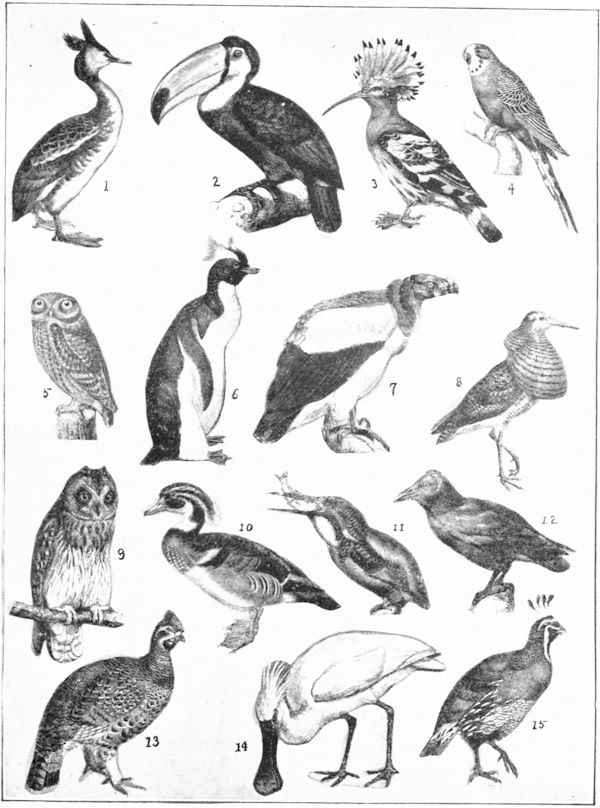
Birds of all Climes
1, Crested Grebe (Podiceps); 2, Toucan; 3, Hoopoe; 4, Parrot (Melopsittacus); 5, Barn Owl; 6, Crested Penguin; 7, King Vulture; 8, Ruff (Pavoucella); 9, Horned Owl; 10, Wood Duck; 11, Kingfisher; 12, Capuchin Bird; 13, Grouse; 14, Spoonbill; 15, California Quail
Thus the swallow, the cuckoo, the nightingale, etc., come to Britain in summer and breed there, being winter residents further south; the fieldfare, jacksnipe, bean-goose, redwing, and some others, reach Great Britain in winter, being summer residents and breeders further north; while the little sandpipers are familiar examples of the true birds of passage which we know only for a short time as they rest on our shores in the journey south in autumn, and north again in spring. These three classes are obviously only different cases of one fact of migration. Almost all birds are in some degree migratory. Those which breed in the equatorial regions are the chief exceptions, and even they pass from hill to valley and back again. Forms, too, which seem to be constant residents of a non-tropical country are in many cases known to exhibit a partial or a very local migration. This is true, for instance, of the common wren and the red grouse in the north of Scotland. All birds breed in the colder regions of their migration. Changes in food supply and the temperature are the most important conditions impelling them to shift their habitats. The general trend of migration is always, as indicated, toward the equator in autumn, from the equator in spring; but the investigations of the British Migration Committee have clearly shown that the courses often come to be circular. The flight is the more universal in a country the more marked the contrast between summer and winter. The annual migration from breeding areas too cold for winter residence and food supply to warmer subsistence areas can not be understood apart from the history of climates. When the European climate was more equable, it was virtually indifferent to the birds where they went. As it grew colder the birds had to fly further and further south every few winters. Migration has become an inherited habit, for they set about it before the impelling conditions are directly present. According to Wallace, natural selection has played an important part in confirming this habit. Many facts about migration are still utterly obscure. The power birds have of flying straight and of returning to the same locality is very marvelous. It must be remembered that a continuous tradition is sustained; those who have made the journey before guide the others. Doubtless they have memory for great landmarks. They fly across the shallower parts of the Mediterranean, where a chain of islands in this submerged tract long remained to guide them. The smaller birds usually keep nearer the ground; but it must not be forgotten that the flight is usually mostly accomplished by night. Birds generally meet in concourses, and migrate in flocks. Only a few fly alone. Sometimes the old males remain, while the others “flit.” The return northward is more rapid, without young ones or weaklings. The males often return first.
As birds have a full active life, with considerable variety of function, in usually complex environment, since, as we have already noticed, their sense-organs and nervous systems are highly developed, considerable exhibition of intelligence is to be expected. They seem to have great vividness of sense impressions, to judge from their power of recalling old haunts and old friends. Birds often return to the same place season after season, and they have been known to recognize an owner after the lapse of years. Their quickness of ear and power of retention are evidenced by the power some possess of learning to repeat sounds, both words and tunes. Some have exhibited marked fondness for music, and the æsthetic tastes of the bower-bird excite deserved admiration. Much more is known in regard to their marvelous hereditary, general, and largely automatic reasonable habits or “instincts” than in regard to their power of individually adapting their conduct to novel circumstances. Their beautiful and adroit contrivances of nest-building are very familiar instances of the former, but many instances of the latter have been recorded.
As to feelings, it is hardly necessary to refer to their unexampled exhibition of sexual emotion in song and dance, parade, and display, or to the marvelous parental love and sacrifice expressed in their nest-building labors, in their prolonged incubation, and in their care for and courage in defending their brood. Subtler emotions of jealousy, both in connection with and altogether apart from sex, of affection for owners or associations, of sympathy for wounded or enfeebled fellows, are also not rarely exhibited. That a bird singing continuously for hours does not represent a rare height of emotion is not to be believed. It may be fairly said that the joyous song of the lark “at heaven’s gate” is an eloquent expression of emotion only surpassed perhaps by human music.
MIMICRY —David Robertson
In ordinary language a person who can imitate the accent, manner of talking, and acting of another is said to be a good mimic. In biology, however, the term mimicry is used in a metaphorical sense, being applied to the resemblance which one species of animal or plant frequently shows to another. This resemblance is usually of a protective character. It is evident that if the resemblance which a defenceless species of animal often has to a species well furnished with natural offensive and defensive weapons were a mere freak of nature, no satisfactory and philosophical explanation of the phenomenon could be given.
Scientific investigators have to lay aside their wonder, and laboriously set about finding a solution to the most intricate and puzzling phenomena both in natural and physical science.
Mimicry was first used by Mr. W. H. Bates to denote the advantageous and generally protective resemblance assumed by one species of animal or plant to another.
It will be seen further on that the resemblance is not confined to one species of animal to another species of animal, and one species of plant to a plant of quite a distinct species, but that it also exists between animals and plants.
Mr. A. R. Wallace, who, by his most patient and skilful researches in the domain of animal life, has clearly defined and limited the term mimicry as applied in biology, says: “A certain species of plant or animal possesses some special means of defence from its enemies, such as a sting, a powerful and disagreeable odor, a nauseous taste, or a hard integument or covering. Some other species, inhabiting the same district or part of it, and not itself provided with the same means of defence, closely resembles the first species in all external points of form and color, though often very different in structure and unrelated in the biological order.”
In South America there are certain butterflies, the Heliconidæ, which are remarkable for the variety and beauty of their colors; but they are incapable of rapid and sustained flight, and would for this reason fall an easy prey to insect-eating birds. Their wings, however, are never found among those rejected by insectivorous birds—in places where the remains of other butterflies frequently cover the ground. The Heliconidæ possess a powerfully disagreeable and pungent odor, which is so little volatile as to cling to the fingers for several days after handling one of these insects. Mr. Wallace inferred from this that they have a disagreeable taste, and would not on that account be eaten by birds. This was subsequently found by Mr. Belt to be the case.
Belonging to the family of the Pieridæ, which is quite distinct from the family of the Heliconidæ, and the greater number of which are white, there is a genus of small butterfly named Leptalis, which is eaten by birds. Some species of the genus Leptalis are white, like their allies among the Pieridæ, but the majority of the Leptales have an exact resemblance to some species of the Heliconidæ as far as regards the peculiar shape and color of their wings.
The structure of the two families is completely different; in spite of this the resemblance is so strikingly close that both the experienced entomologists Mr. Bates and Mr. Wallace often at the time of capture mistook the one for the other, and only discovered their mistake by a closer examination. This has been looked upon as the most typical example of true mimicry, and is interesting from the fact that it is the first instance to which the term mimicry was applied.
It is necessary to distinguish carefully between true mimicry and several similar though superficial modes of resemblance which occur among organic beings. Several orchids resemble flies or spiders, but this is merely a case of accidental resemblance.
Among animals of a higher order than insects mimicry very seldom occurs.
Among mammals, all of which belong to the vertebrates, mimicry is seldom found, and it is supposed that only one genuine case has been observed.
Cladobates, an insect-eating genus found in the Malayan region, includes many species closely resembling squirrels both in size and color, as well in regard to the bushiness and position of the tail.
It is supposed by Mr. Wallace that Cladobates, owing to its resemblance to the harmless fruit-eating squirrel, may be enabled to approach insects and birds upon which it lives.
Cuckoos bear a considerable resemblance to hawks; the cuckoo tribe being weak and defenceless will in this way be enabled to elude the voracious hawks.
There is a genus of dull-colored birds in Australia and the Moluccas named Tropidorhynchus. These birds are large, active, and strong, with powerful claws and sharp beaks. They congregate in flocks, and are remarkably aggressive, driving away crows and even hawks.
In these same countries a genus of the group orioles lives, named Mimeta. These are much weaker than their allies the golden orioles, and besides are devoid of their brilliant colors, being usually olive-green or brown. It is a very common thing to find species of the Mimeta resembling Tropidorhynchi living on the same island.
The Tropidorhynchus bouruensis and Mimeta bouruensis are both found in the island of Bouru, the latter of which mimics the former as described by Mr. Wallace:
“The upper and under surfaces of the two birds are exactly of the same tints of dark and light brown. The Tropidorhynchus has a large, bare, black patch round the eyes; this is copied in the Mimeta by a patch of black feathers. The top of the head of the Tropidorhynchus has a scaly appearance from the narrow scaly-formed feathers, which are imitated by the broader feathers of the Mimeta, having a dusky line down each. The Tropidorhynchus has a pale ruff, formed of curious recurved feathers on the nape (which has given the whole genus the name of friar birds); this is represented in the Mimeta by a pale band in the same position. Lastly, the bill of the Tropidorhynchus is raised into a protuberant keel at the base, and that of the Mimeta has the same character, although it is not a common one in the genus.” The result is that when superficially examined the birds seem to be identical, though possessed of important structural differences, and placed wide apart in any natural arrangement.
Mr. Wallace mentions some curious cases of mimicry among reptiles, where a venomous tropical genus of snakes, Elaps, belonging to America, is closely mimicked by several genera of harmless snakes.
It is in a special degree among insects that cases of mimicry are most frequently found.
Genuine cases of mimicry are not so easily shown to exist among plants. The resemblance between white dead nettle (Lamium album) and the stinging nettle, as well as between other labiates and the stinging nettle, may be considered to be a case of real mimicry as defined above.
The true stinging nettles are avoided by animals, owing to their possession of stinging hairs, which contain an acid fluid capable of causing pain and producing blisters.
It would be clearly of advantage to another plant to resemble one possessing such defensive armor as the stinging nettle.
There is another labiate, Ajuga ophrydis of South Africa, mentioned by Mr. Mansel Weale. This labiate closely resembles an orchid, and for this reason insects may be induced to visit the flower and thus fertilize it.
Mr. Worthington Smith, the eminent fungologist, has found three rare British fungi, each accompanying common species, which they closely resembled; and one of the common species has a bitter nauseous taste. In this case we have an example of genuine mimicry.
Dr. Hans Meyer has given in his valuable work, Across East African Glaciers, some very striking instances of mimicry. He says:
“The similarity for the purpose of protection of the majority of the great mammals, i. e., the likeness of the color of their coats, and partly also of their external appearance, to the features and colors of the regions which they inhabit, must strike every traveler with astonishment.
“At a small distance the hartbeest (antelope), when stationary, is really not distinguishable from red ant-heaps which everywhere abound; the long-legged and long-necked giraffe can not be distinguished from the dead trunk of a mimosa, the zebra from a gray-brown clump of grass and thorn-scrub, the rhinoceros from a fallen trunk of a tree. It is only when they move that they can be distinguished. Nature has also extended this protective mimicry (Schutzspiel) to the small insects; and perhaps for this reason they often escape the eye specially in search of them; for butterflies and grasshoppers look like dry twigs, the cicadæ like leaf-stalks, the spiders like thorns, the phasmodæ like bare twigs, beetles like small lumps of earth and small stones, moths like mosses and lichens.
“This protective mimicry is manifested not only in regard to the colors and forms of the animals, but also as regards their movements, or their manner of standing still, and in their preference for certain localities appropriate to their disguise. There is protection everywhere; protection against climatic extremes and against animal foes; such varied and abundant protection as could only be developed by natural selection in a primeval continent like Africa.”
In spite of the voluminous literature of “animal mimicry” since Bates first published his classical memoir on the subject, the exact nature of the process whereby insects and other creatures “mimic” (though that is not the appropriate word) the appearance of other species is still far from being understood. All we know is that this power, this resemblance of a beetle or a butterfly to the ground upon which it sits, the sticks among which it creeps, or the leaves among which it flutters, helps to save it from destruction, while it is a decided advantage to it to “mimic” another insect which is sedulously avoided by birds. The observations in this byway of zoology are as curious as any yet made. It is found, for instance, that an American spider (Cyrlarachne) takes the semblance of a little land shell very abundant in the localities which it frequents; and that another species (Thomisus alcatorius), remarkable for the length of its forelegs, so fastens itself on the stems of grasses as to be nearly indistinguishable from the spikelets.
Some observations, for which we are indebted to M. Heckel of Marseilles, throw a good deal of light on the origin of mimicry, at least so far as the assumption of protective coloration is concerned. There is a spider (Thomisus onustus) very common in the south of France which conceals itself in the flower of a species of wild convolvulus for the purpose of trapping two kinds of fly on which it feeds. This convolvulus is found in three principal varieties: white, pink with deeper spots of the same hue, and light pink forms with a slight greenishness on the external wall of the flower. Each of these three varieties is visited by the spider. But the varieties of spider conform in hue to the varieties of the flower, and each confines itself to the one which is most protective to it. If, however, the animal is confined to a Dahlia versicolor, it conforms to the hue of its new abode—that is, the pink one turns to red, and, in like manner, if transferred to the yellow snapdragon, it takes the color of this flower. They change in shade as the shade of their host changes, and when pink, white, green, and yellow varieties are confined together in a box they all become nearly white.
The question of protective coloration in fishes has of late received some light which compels a revision of our former theories on the subject. It has usually been held that the color of fishes is of the mimicry order—that is, it has been acquired for the purpose of deceiving their enemies. Trout will very commonly take the hue of the river bottom over which they swim, and, as every one knows, it is difficult to detect a flounder or other flat fish at rest, though when it turns over the white under surface of its body instantly reveals the creature’s presence. The hue of the upper surface is due to the action of light. For when a sole was kept in a raised glass case, with light directed upward from below, pigment formed on the white side, and began to be absorbed on the one hitherto exposed to the same agent.
DWELLINGS —Frédéric Houssay
Animals construct dwellings either to protect themselves from the cold, heat, rain, and other chances of the weather, or to retire to at moments when the search for food does not compel them to be outside and exposed to the attacks of enemies. Some inhabit these refuges permanently; others only remain there during the winter; others, again, who live during the rest of the year in the open air, set up dwellings to bring forth their young, or to lay their eggs and rear the offspring.
We shall find every stage, from that of beings provided for by nature, and endowed with a special organ which secretes for them a shelter, up to those who are constrained by necessity to seek in their own intelligence an expedient to repair the forgetfulness of nature.
Nearly all the Mollusca are enveloped by a very hard calcareous case, secreted by their mantle: this shell, which is a movable house, they bear about with them and retire into at the slightest warning.
Caterpillars which are about to be transformed into chrysalides weave a cocoon, a very close dwelling in which they can go through their metamorphosis far from exterior troubles. It is an organic form of dwelling, or produced by an organ. It is not necessary to multiply examples of this kind; they are extremely numerous. In the same category must be ranged the cells issuing from the wax-glands which supply bees with materials for their combs in which they inclose the eggs of the queen with a provision of honey.
I do not wish to insist on creations of this kind which are independent of the animal’s will and reflection. Near these facts must be placed those in which animals, still using a natural secretion, yet endeavor to obtain ingenious advantages from it unknown by related species.
There is, for example, the Macropus viridiauratus, or paradise-fish, which blows air bubbles in the mucus produced from its mouth. This mucus becomes fairly resistant, and all the bubbles imprisoned and sticking side by side at last form a floor. It is beneath this floating shelter that the fish suspends its eggs for its little ones to undergo their early development.
Certain tubicolar annelids, whose skin furnishes abundant mucus which does not become sufficiently hard to form an efficacious protection, utilize it to weld together and unite around them neighboring substances, grains of sand, fragments of shell, etc. They thus construct a case which both resembles formations by special organs and manufacture by the aid of foreign materials. The larvæ of Phryganea, who lead an aquatic life, use this method to separate themselves from the world and prepare tubes in which to dwell. All the fragments carried down by the stream are good for their labors on condition only that they are denser than the water. They take possession of fragments of aquatic leaves, and little fragments of wood which have been sufficiently long in the water to have thoroughly imbibed it, and so become heavy enough to keep themselves at the bottom, or at least to prevent them from floating to the surface. It is the larva of Phryganea striata which has been best studied; those of neighboring species evidently act much in the same way, with differences only in detail. The little carpenter stops a fragment rather longer than his own body, lies on it and brings it in contact with other pieces along his own sides. He thus obtains the skeleton of a cylinder. The largest holes are filled up with detritus of all kinds. Then these materials are agglutinated by a special secretion. The larva overlays the interior of its tube with a covering of soft silk which renders the cylinder water-tight and consolidates the earlier labors. The insect is thus in possession of a safe retreat. Resembling some piece of rubbish, it completes its metamorphosis in peace, undisturbed by the carnivora of the stream.
Between the beings whom nature has endowed with a shelter and those who construct it by their own industry, we may intercept those who, deprived of a natural asylum and not having the inclination or the power to make one, utilize the dwellings of others, either when the latter still inhabit them, or when they are empty on account of the death or departure of the owner. In the interior of the branchial chamber of many bivalvular mollusca, and especially the mussel, there lives a little crustaceous commensal called the pea-crab (Pinnoteres pisum). He goes, comes, hunts, and retires at the least alarm within his host’s shell. The mussel, as the price of its hospitality, no doubt profits by the prizes which fall to the little crab’s claws. It is even said that the crab in recognition of the benefits bestowed by his indolent friend keeps him acquainted with what is passing on around, and as he is much more active and alert than his companion he sees danger much further away, and gives notice of it, asking for the door to be shut by lightly pinching the mussel’s gill.
For birds like the cuckoo and the Molothrus it is not possible to plead extenuating circumstances. They occupy a place in an inhabited house without paying any sort of rent. Every one knows the cuckoo’s audacity. The female lays her eggs in different nests and troubles herself no further about their fate. She seeks for her offspring a shelter which she does not take the trouble to construct, and moreover at the same time assures for them the care of a stranger in place of her own.
In North America a kind of starling, the Molothrus pecoris, commonly called the cowbird, acts in the same careless fashion. It lives in the midst of herds, and owes its specific name to this custom; it feeds on the parasites on the skin of cattle. This bird constructs no nest. At the moment of laying the female seeks out an inhabited dwelling, and when the owner is absent she furtively lays an egg there. The young intruder breaks his shell after four days’ incubation, that is to say, usually much before the legitimate children; and the parents, in order to silence the beak of the stranger who, without shame, claims his share with loud cries, neglect their own brood which have not yet appeared, and which they abandon.
The habits of the Molothrus bovariensis, a closely allied Argentine cowbird, have been carefully studied by Mr. W. H. Hudson, who has also some interesting remarks as to the vestiges of the nesting instinct in this interesting parasitical bird, which is constantly dropping eggs in all sorts of places, even on the ground, most of them being lost. Mr. Hudson suggests that this bird lost the nest-making instinct by acquiring the semi-parasitical habit, common to many South American birds, of breeding in the large covered nests of the Dendrocolaptidæ, although, owing to increased severity in the struggle for the possession of such nests, this habit was defeated.
The Rhodius anarus, a fish of European rivers, also ensures a quiet retreat for his offspring by a method which is not less indiscreet. At the period of spawning, a male chooses a female companion and with great vigilance keeps off all those who wish to approach her. When the laying becomes imminent, the Rhodius, swimming up and down at the bottom of the stream, at length discovers a Unio. The bivalve is asleep with his shell ajar, not suspecting the plot which is being formed against him. It is a question of nothing less than of transforming him into furnished lodgings. The female fish bears underneath her tail a prolongation of the oviduct; she introduces it delicately between the mollusk’s valves and allows an egg to fall between his branchial folds. In his turn the male approaches, shakes himself over it, and fertilizes it. Then the couple depart in search of another Unio, to whom to confide another representative of the race. The egg, well sheltered against dangers from without, undergoes development, and one fine day the little fish emerges and frisks away from his peaceful retreat.
The hermit-crab perhaps knows best how to take advantage of old clothes. He collects shells of Gasteropods, abandoned flotsam, the first inhabitant of which has died. The hermit-crab (Pagurus Bernhardus) is a Decapod Crustacean—that is to say, he resembles a very small crab. But his inveterate habit during so many generations of sheltering his abdomen in a shell prevents this part from being incrusted with lime and becoming hard. The legs and the head remain in the ordinary condition outside the house, and the animal moves bearing it everywhere with him; on the least warning he retires into it entirely. But the crustacean grows. When young he had chosen a small shell. A mollusk, in growing, makes his house grow with him. The hermit-crab can not do this, and when his dwelling has become too narrow he abandons it for one that is more comfortable. At first inclosed in the remains of a Trochus, he changes into that of a Purpura; a little later he seeks asylum in a whelk. Besides the shelter which these shells assure to the crustacean, they serve to mask his ferocity, and the prey, which approaches confidently what it takes to be an inoffensive mollusk, becomes his victim.
The great horned owl likewise does not construct a nest, but takes possession of the dwellings abandoned by others. These birds utilize for laying their eggs sometimes the nest of a crow or a dove, sometimes the lair which a squirrel had considered too dilapidated. The female, without troubling about the bad state of these ruins, or taking pains to repair them, lays her eggs here and sits on them.
It is time to turn to animals who have more regard for comfort, and who erect dwellings for themselves or their offspring. These dwellings may be divided into three groups: (1) Those which are hollowed in earth or in wood; (2) those which in the simplest form result from the division of material of any kind; then, as a complication, of materials bound together; then, as a last refinement, of delicate materials, such as blades of grass or threads of wool woven together; such are the nests of certain birds and the tents of nomads; (3) those which are built of moist earth which becomes hard on drying; the perfection of this method consists of piling up hard fragments, pieces of wood or ashlar, the moist earth being only a mortar which unites the hard parts together. Animals exercise with varying success these different methods, all of which man still practices.
We will first occupy ourselves with the dwelling hollowed in the earth. It is the least complicated form. The number of creatures who purely and simply bury themselves thus to obtain shelter is incalculable; I will only mention a few examples, and pass on from simple combinations to the more perfected industries, of which they present the first sketch.
Speaking generally, birds are accomplished architects. Certain of them are, however, content with a rudimentary cavern. There is no question here of those who retire to clefts in the rock or in trunks of trees, for in these cases the cavity is only the support of the true house, and it is in the construction of this that the artist reveals his talent. I wish to speak of animals which remain in a burrow without making a nest there. A paroquet of New Zealand called the kakapo (Strigops habroptilus) thus dwells in natural or hollowed excavations. It is only found in a restricted portion of the island and leads a miserable life there, habitually staying in the earth and pursued by numerous enemies, especially half-wild dogs. It tries to hold its own, but its wings and beak do not suffice to protect it, and the race would have completely disappeared if these birds were not able to resist, owing to the prudence with which they stay within their dwellings. They profit by a natural retreat, or one constructed in rocks or beneath roots of trees; they only come out when impelled by hunger, and return as soon as they can in case of danger.
A large number of animals also hollow out shelters for their eggs, with the double object of maintaining them at a constant temperature and of concealing them. Most reptiles act in this manner.
It is not only land animals which adopt this custom of living in the earth, and there sheltering their offspring. Fish also make retreats on the bank or at the bottom. To mention only one case, the bullhead (Cottus gobio) of English rivers, which spawns in the Seine in May, June, and July, acts in this manner. Beneath a rock in the sand it prepares a cavity; then seeks females and brings them to lay eggs in its little lodging. During the four or five weeks before they come out it watches the eggs, keeping away as far as possible every danger which threatens them. It only leaves its position when pressed by hunger, and as soon as the hunt is concluded, returns to the post of duty.
Other animals when digging have a double object: they wish to shelter themselves, and at the same time to find the water which they need for themselves or for the development of their young.
It is well known that frogs and toads generally go in the spring to lay their eggs in streams and ponds. A batrachian of Brazil and the hot regions of South America, the Cystignathus ocellatus, no doubt fearing too many dangers for the spawn if deposited in the open water, employs the artifice of hollowing, not far from the bank, a hole the bottom of which is filled by infiltration. It there places its eggs, and the little ones on their birth can lead an aquatic life while being guaranteed against its risks.
Many beings live permanently in a burrow; reptiles—snakes or lizards—are to be placed among these. Among others, the Lacerta stirpium arranges a narrow and deep hole, well hidden beneath a thicket, and retires into it for the winter, when cold renders it incapable of movement and at the mercy of its enemies. Before giving itself up to its hibernal sleep, it is careful to close hermetically the opening of the dwelling with a little earth and dried leaves. When spring returns and the heat awakens the reptile, it comes out to warm itself and to hunt, but never abandons its dwelling, always retiring into it in case of alarm and to pass there cold days and nights.
Darwin has observed and described how a little lacertilian, the Conlophus subcristatus, conducts its work of mining and digging. It establishes its burrow in a soft tufa, and directs it almost horizontally, hollowing it out in such a way that the axis of the hole makes a very small angle with the soil. This reptile does not foolishly expend its strength in this troublesome labor. It only works with one side of its body at a time, allowing the other side to rest. For instance, the right anterior leg sets to work digging, while the posterior leg on the same side throws out the earth. When fatigued, the left legs come into play, allowing the others to repose.
Other animals, without building their cavern with remarkable skill, show much sagacity in the choice of a site calculated to obtain certain determined advantages. In Egypt there are dogs which have become wild. Having shaken off the yoke of man, which in the East affords them little or no support, they lead an independent life. During the day they remain quiescent in desert spots or ruins, and at night they prowl about like jackals, hunting living prey or feeding on abandoned carcasses. There are hills which have in a manner become the property of these animals. They have founded villages there, and allow no one to approach. These hills have an orientation from north to south, so that one slope is exposed to the sun from morning to midday and the other from midday to evening. Now, dogs have a great horror of heat. They fear the torrid heat of the south as much as in our climate they like to lie warmed by gentle rays; there is no shadow too deep for their siesta. Therefore, on these Egyptian hills every dog hollows out a lair on both slopes. In the morning, when he returns from his nocturnal expeditions, the animal takes refuge in the second, and remains there until midday, sunk in refreshing sleep. At that hour the sun begins to reach him, and to escape it he passes over to the opposite slope; it is a curious sight to see them all, with pendent heads and sleepy air, advance with trailing steps to their eastern retreat, settle down in it, and continue their dream and their digestion till evening, when they again set forth to prowl.
The trap-door spiders of the south of Europe construct burrows which have been studied with great care and in much detail by Moggridge. He found that there were four chief types of burrow. The whole burrow as well as the door are lined with silk, which also forms the hinge. The great art of the trap-door spider lies in her skilful forming of the door, which fits tightly, although it opens widely when she emerges, and which she frequently holds down when an intruder strives to enter, and in the manner with which the presence of the door is concealed, so as to harmonize with surrounding objects. Perhaps in no case is the concealment more complete than when dead leaves are employed to cover the door. In some cases a single withered olive leaf is selected, and it serves to cover the entrance; in other cases several are woven together with bits of wood or roots.
The trap-door spider (Mybale henzii, Girard), which is widely diffused in California, forms a simple shaft-like burrow, but, like the European trap-door spider, it is very skilful in forming an entrance and in concealing its presence. Its habits have lately been described by D. Cleveland of San Diego. In the adobe land hillocks are numerous; they are about a foot in height, and some three or four feet in diameter. These hillocks are selected by the spiders—apparently because they afford excellent drainage, and can not be washed away by the winter rains—and their stony summits are often full of spiders’ nests. These subterranean dwellings are shafts sunk vertically in the earth, except where some stony obstruction compels the miner to deflect from a downward course. The shafts are from five to twelve inches in depth, and from one-half to one and a half inches in diameter, depending largely upon the age and size of the spider.
When the spider has decided upon a location, which is always in clay, adobe or stiff soil, he excavates the shaft by means of the sharp horns at the end of his mandibles, which are his pick and shovel and mining tools. The earth is held between the mandibles and carried to the surface. When the shaft is of the required size, the spider smoothes and glazes the wall with a fluid which is secreted by itself. Then the whole shaft is covered with a silken paper lining, spun from the animal’s spinnerets.
The door at the top of the shaft is made of several alternate layers of silk and earth, and is supplied with an elastic and ingenious hinge, and fits closely in a groove around the rim of the tube. This door simulates the surface on which it lies, and is distinguishable from it only by a careful scrutiny. The clever spider even glues earth and bits of small plants on the upper side of his trap-door, thus making it closely resemble the surrounding surface.
The spider generally stations itself at the bottom of the tube. When, by tapping on the door, or by other means, a gentle vibration is caused, the spider runs to the top of his nest, raises the lid, looks out and reconnoitres. If a small creature is seen, it is seized and devoured. If the invader is more formidable, the door is quickly closed, seized and held down by the spider, so that much force is required to lever it open. Then, with the intruder looking down upon him, the spider drops to the bottom of his shaft.
It has been found by many experiments that when the door of his nest is removed, the spider can renew it five times—never more than that. Within these limitations, the door torn off in the evening was found replaced by a new one in the morning. Each successive renewal showed, however, a greater proportion of earth, and a smaller proportion of silk, until finally the fifth door had barely enough silk to hold the earth together. The sixth attempt, if made, was a failure, because the spinnerets had exhausted their supply of the web fluid. When the poor persecuted spider finds his domicile thus open and defenceless, he is compelled to leave it, and wait until his stock of web fluid is renewed.
Skilful diggers prepare burrows with several entrances; some even arrange several rooms, each for a special object. The otter seeks its food in the water, and actively hunts fish in ponds and rivers. But when fishing is over, it likes to keep dry and at the same time sheltered from terrestrial enemies. Its dwelling must also present an easy opening into the water. In order to fulfil all the conditions, its house consists first of a large room hollowed in the bank at a level sufficiently high to be beyond reach of floods. From the bottom of this keep a passage starts which sinks and opens about fifty centimetres beneath the surface of the water. It is through here that the otter noiselessly glides to find himself in the midst of his hunting domain without having been seen or been obliged to make a noisy plunge which would put the game to flight. If this were all, the hermetically closed dwelling would soon become uninhabitable, as there would be no provision for renewing the air, so the otter proceeds to form a second passage from the ceiling of the room to the ground, thus forming a ventilation tube. In order that this may not prove a cause of danger, it is always made to open up in the midst of brushwood or in a tuft of rushes and reeds.
Marmots also are not afraid of the work which will assure them a warm and safe refuge in the regions they inhabit, where the climate is rough. In summer they ascend the Alps to a height of 2,500 to 3,000 metres and rapidly hollow a burrow like that for winter time, which I am about to describe, but smaller and less comfortable. They retire into it during bad weather or to pass the night. When the snow chases them away and causes them to descend to a lower zone, they think about constructing a genuine house in which to shut themselves during the winter and to sleep. Twelve or fifteen of these little animals unite their efforts to make first a horizontal passage, which may reach the length of three or four metres. They enlarge the extremity of it into a vaulted and circular room more than two metres in diameter. They make there a good pile of very dry hay on which they all install themselves, after having carefully protected themselves against the external cold by closing up the passage with stones and calking the interstices with grass and moss.
In solitary woods or roads the badger (Meles), who does not like noise, prepares for himself a peaceful retreat, clean and well ventilated, composed of a vast chamber situated about a metre and a half beneath the surface. He spares no pains over it, and makes it communicate with the external world by seven or eight very long passages, so that the points where they open are about thirty paces distant from one another. In this way, if an enemy discovers one of them and introduces himself into the badger’s home, the badger can still take flight through one of the other passages. In ordinary times they serve for the aeration of the central room. The animal attaches considerable importance to this. He is also very clean in his habits, and every day may be seen coming out for little walks, having an object of an opposite nature to the search for food. This praiseworthy habit is, as we shall see, exploited by the fox in an unworthy manner.
The fox has many misdeeds on his conscience, but his conduct toward the badger is peculiarly indelicate. The fox is a skilful digger, and when he can not avoid it, he can hollow out a house with several rooms. The dwelling has numerous openings, both as a measure of prudence and of hygiene, for this arrangement enables the air to be renewed. He prepares several chambers side by side, one of which he uses for observation and to take his siesta in; a second as a sort of larder in which he piles up what he can not devour at once; a third in which the female brings forth and rears her young. But he does not hesitate to avoid this labor when possible. If he finds a rabbit warren he tries first to eat the inhabitants, and then, his mind cleared from this anxiety, arranges their domicile to his own taste, and comfortably installs himself in it. In South America, again, the Argentine fox frequently takes up permanent residence in a vizcachera, ejecting the rightful owners; he is so quiet and unassuming in his manners that the vizcachas become indifferent to his presence, but in spring the female fox will seize on the young vizcachas to feed her own young, and if she has eight or nine, the young of the whole village of vizcachas may be exterminated.
The badger’s dwelling appears to the fox particularly enviable. In order to dislodge the proprietor he adopts the following plan: Knowing that the latter can tolerate no ordure near his home, he chooses as a place of retirement one of the passages which lead to the chamber of the peaceful recluse. He insists repeatedly, until at last the badger, insulted by this grossness, and suffocated by the odor, decides to move elsewhere and hollow a fresh palace. The fox is only waiting for this, and installs himself.
The vizcacha (Lagostomus trichodactylus) is a large rodent inhabiting a vast extent of country in the pampas of La Plata, Patagonia, etc. Unlike most other burrowing species, the vizcacha prefers to work on open level spots. On the great grassy plains it is even able to make its own conditions, like the beaver, and is in this respect, and in its highly developed social instinct, among the two or three mammals which approach man, although only a rodent, and even in this order, according to Waterhouse, coming very low down by reason of its marsupial affinities.
The vizcacha lives in small communities of from twenty to thirty members, in a village of deep-chambered burrows, some twelve or fifteen in number, with large pit-like entrances closely grouped together, and as the vizcachera, as this village is called, endures for an indefinitely long period, the earth which is constantly brought up forms an irregular mound thirty or forty feet in diameter, and from fifteen to thirty inches above the level of the road; this mound serves to protect the dwelling from floods on low ground. A clearing is made all round the abode and all rubbish thrown on the mound; the vizcachas thus have a smooth turf on which to disport themselves, and are freed from the danger of lurking enemies.
The entire village occupies an area of one hundred to two hundred square feet of ground. The burrows vary greatly in extent; usually in a vizcachera there are several that, at a distance of from four to six feet from the entrance, open into large circular chambers. From these chambers other burrows diverge in all directions, some running horizontally, others obliquely downward to a maximum depth of six feet from the surface; some of these galleries communicate with those of other burrows.
On viewing a vizcachera closely, the first thing that strikes the observer is the enormous size of the entrances to the central burrows in the mound; there are usually several smaller outside burrows. The entrance to some of the principal burrows is sometimes four to six feet across the mouth, and sometimes it is deep enough for a tall man to stand in up to the waist.
Certain rodents have carried hollow dwellings to great perfection. Among these the hamster of Germany (Cricteus frumentarius) is not the least ingenious. To his dwelling-room he adds three or four storehouses for amassed provisions. The burrow possesses two openings: one, which the animal prefers to use, which sinks vertically into the soil; the other, the passage of exit, with a gentle and very winding slope. The bottom of the central room is carpeted with moss and straw, which make it a warm and pleasant home. A third tunnel starts from this sleeping chamber, soon forking and leading to the wheat barns. Thus during the winter the hamster has no pressing need to go out except on fine days for a little fresh air. He has everything within his reach, and can remain shut up with nothing to fear from the severity of the season.
It is not only the soil which may serve for retreat; wood serves as an asylum for numerous animals, who bore it, and find in it both food and shelter. In this class must be placed a large number of worms, insects, and crustaceans. One of these last, the Chelura terebrans, a little amphipod, constitutes a great danger for the works of man. It attacks piles sunken to support structures, and undermines them to such a degree that they eventually fall.
An insect, the Xylocopa violacea, related to the humblebee, from which it differs in several anatomical characters, and by the dark violet tint of its wings, brings an improvement to the formation of the shelter which it makes in wood for its larvæ. Instead of hollowing a mere retreat to place there all its eggs indiscriminately, it divides them into compartments, separated by horizontal partitions. It is the female alone who accomplishes this task, connected with the function of perpetuating the race. She chooses an old tree-trunk, a pole, or the post of a fence, exposed to the sun and already worm-eaten, so that her labor may be lightened. She first attacks the wood perpendicularly to the surface, then suddenly turns and directs downward the passage, the diameter of which is about equal to the size of the insect’s body. The Xylocopa thus forms a tube about thirty centimetres in length. Quite at the bottom she places the first egg, leaving beside it a provision of honey necessary to nourish the larva during its evolution; she then closes it with a partition. This partition is made with fragments of the powder of wood glued together with saliva. A first horizontal ring is applied round the circumference of the tube; then in the interior of this first ring a second is formed, and so on continuously, until the central opening, more and more reduced, is at last entirely closed up. This ceiling forms the floor for the next chamber, in which the female deposits a new egg, provided, like the other, with abundant provisions. The same acts are repeated until the retreat becomes transformed into a series of isolated cells in which the larvæ can effect their development, and from which they will emerge either by themselves perforating a thin wall which separates them from daylight, or by an opening which the careful mother has left to allow them to attain liberty without trouble.
The second class of habitation, which I have called the woven dwelling, proceeds at first from the parceling up of substances, then of objects capable of being entangled like wisps of wood or straw, then of fine and supple materials which the artisan can work together in a regular manner, that is to say, by felting or weaving.
There are, first, cases in which the will of the animal does not intervene, or at least is very slightly manifested. The creature is found covered and protected by foreign bodies which are often living beings. Spider-crabs (Maïa), for example, have their carapaces covered with algæ and hydroids of all sorts. Thus garnished, the Crustaceans have the advantage of not being recognized from afar when they go hunting, since beneath this fleece they resemble some rock. H. Fol has observed at Villefranche-sur-Mer a Maïa so buried beneath this vegetation that it was impossible at first sight to distinguish it from the stones around. Under these conditions the animal submits to a shelter rather than creates it. Yet it is not so passive as one might at first be led to suppose. When the algæ which flourish on its back become too long and impede or delay its progress, it tears them off with its claws and thoroughly cleans itself. The carapace being quite clean, the animal finds itself too smooth and too easy to distinguish from surrounding objects; it therefore takes up again fragments of algæ and replaces them where they do not delay to take root like cuttings and to flourish anew.
The sponge-crab (Dromia vulgaris) also practices this method of shelter. It seizes a large sponge and maintains it firmly over its carapace with the help of the posterior pair of limbs. The sponge continues to prosper and to spread over the Crustacean who has adopted it. The two beings do not seem to be definitely fixed to each other; the contact of a sudden wave will separate them. When the divorce is effected, the Dromia immediately throws itself on its cherished covering and replaces it. M. Künckel d’Herculais tells of one of these curious Crustaceans which delighted the workers in the laboratory of Concarneau. The need for covering themselves experienced by these crabs is so strong that in aquariums when their sponge is taken away they will apply to the back a fragment of wrack or of anything which comes to hand. A little white cloak with the arms of Brittany was manufactured for one of these captives, and it was very amusing to see him put on his overcoat when he had nothing else wherewith to cover himself.
An Australian bird, the Catheturus Lathami, as described by Gould, is still in the rudiments, and limits itself to preparing an enormous pile of leaves. It begins its work some weeks before laying its eggs; with its claws it pushes behind it all the dead leaves which fall on the earth and brings them into a heap. The bird throws new material on the summit until the whole is of suitable height. This detritus ferments when left to itself, and a gentle heat is developed in the centre of the edifice. The Catheturus returns to lay near this coarse shelter; it then takes each egg and buries it in the heap, the larger end uppermost. It places a new layer above, and quits its labor for good. Incubation takes place favored by the uniform heat of this decomposing mass, hatching is produced, and the young emerge from their primitive nest.
Birds are not alone in constructing temporary dwellings in which to lay their eggs; some fish are equally artistic in this kind of industry, and even certain reptiles. The alligator of the Mississippi would not perhaps at first be regarded as a model of maternal foresight. Yet the female constructs a genuine nest. She seeks a very inaccessible spot in the midst of brushwood and thickets of reeds. With her jaw she carries thither boughs which she arranges on the soil and covers with leaves. She lays her eggs and conceals them with care beneath vegetable remains. Not yet considering her work completed, she stays in the neighborhood watching with jealous eye the thicket which shelters the dear deposit, and never ceases to mount guard threateningly until the day when her young ones can follow her into the stream.
A hymenopterous relative of the bees, the Megachile, cuts out in rose-leaves fragments of appropriate form which it bears away to a small hole in a tree, an abandoned mouse nest or some similar cavity. There it rolls them, works them up, and arranges them with much art, so as to manufacture what resemble thimbles, which it fills with honey and in which it lays.
The Anthocopa acts in a similar manner, carpeting the holes of which it takes possession with the delicate petals of the corn poppy.
The retreats of nocturnal birds of prey do not differ in method of construction from these two kinds of nests. They are holes in trees, in ruins, in old walls, and are lined with soft and warm material. These dwellings are related, not to the type of the hollowed cave, but to that of the habitation manufactured from mingled materials. They constitute an inferior form in which the pieces are not firmly bound together, but need support throughout. The cavity is the support which sustains the real house.
Diurnal birds of prey are the first animals who practice skilfully the twining of materials. Their nests, which have received the name of eyries, are not yet masterpieces of architecture, and reveal the beginning of the industry which is pushed so far by other birds. Usually situated in wild and inaccessible spots, the young are there in safety when their parents are away on distant expeditions. The abrupt summits of cliffs and the tops of the highest forest trees are the favorite spots chosen by the great birds of prey. The eyrie generally consists of a mass of dry branches which cross and mutually support one another, constituting a whole which is fairly resistant.
The abodes of squirrels, though exhibiting more art, are constructions of the same nature; that is to say, they are formed of interlaced sticks. This animal builds its home to shelter itself there in the bad season, to pass the night in, and to rear its young. Very agile, and not afraid of climbing, it places its domicile near the tops of our highest forest trees. Rather capricious also, and desiring change of residence from time to time, it builds several of them; at least three or four, sometimes more. The materials which it needs are collected on the earth among fallen dead branches, or are torn away from the old abandoned nest of a crow or some other bird. The squirrel first builds a rather hollow floor by intermingling the fragments of wood which it has brought. In this state its dwelling resembles a magpie’s nest. But the fastidious little animal wishes to be better protected and not thus to sleep in the open air. Over this foundation he raises a conical roof; the sticks which form it are very skilfully disposed, and so well interlaced that the whole is impenetrable to rain. The house must still be furnished, and this is done with Oriental luxury; that is to say, the entire furniture consists of a carpet, a carpet of very dry moss, which the squirrel tears from the trunks of trees, and which it piles up so as to have a soft and warm couch. An entrance situated at the lower part gives access to the aerial castle; it is usually directed toward the east. On the opposite side there is another orifice by which the animal can escape if an enemy should invade the principal entrance. In ordinary times also it serves to ventilate the chamber by setting up a slight current of air. The squirrel greatly fears storms and rain, and during bad weather hastens to take refuge in his dwelling. If the wind blows in the direction of the openings, the little beast at once closes them with two stoppers of moss, and keeps well shut in as long as the storm rages.
The great Anthropoid apes have found nothing better for shelter than the squirrels’ method. It must, however, be taken into account that they have much more difficulty in arranging and maintaining much heavier rooms, and in building up a shelter with larger surface.
The orang-outang, which lives in the virgin forests of the Sunda Archipelago, does not feel the need of constructing a roof against the rain. He is content with a floor established in the midst of a tree, and made of broken and interlaced branches. He piles up on this support a considerable mass of leaves and moss; for the orang does not sleep seated like the other great apes, but lies down in the manner of man, as has often been observed when he is in captivity. When he feels the cold he is ingenious enough to cover himself with the leaves of his couch.
In Upper and Lower Guinea the chimpanzee (Troglodytes niger) also establishes his dwelling on trees. He first makes choice of a large horizontal branch, which constitutes a sufficient floor for the agile animal. Above this branch he bends the neighboring boughs, crosses them, and interlaces them so as to obtain a sort of framework. When this preliminary labor is accomplished, he collects dead wood or breaks up branches and adds them to the first. Before commencing he had taken care when choosing the site that the whole was so arranged that a fork was within reach to sustain the roof. He thus constructs a very sufficient shelter.
The Troglodytes calvus, a relative of the preceding, inhabiting the same regions, as described by Du Chaillu, shows still more skill in raising his roof. A tree is always chosen for support. He breaks off boughs and fastens them by one end to the trunk, by the other to a large branch. To fix all these pieces he employs very strong creepers, which grow in abundance in his forests. Above this framework, which indicates remarkable ingenuity, the animal piles up large leaves, forming in layers well pressed down and quite impenetrable to the rain. The whole has the appearance of an open parasol. The ape sits on a branch beneath his handiwork, supporting himself against the trunk with one arm. He has thus an excellent shelter against the midday sun as well as against tropical showers.
There exists in Australia a bird with very curious customs. This is the satin bower-bird. The art displayed in this bird’s constructions is not less interesting than the sociability he gives evidence of, and his desire to have for his hours of leisure a shelter adorned to his taste. The bowers which he constructs, and which present on a small scale the appearance of the arbors in our old gardens, are places for reunion and for warbling and courtship, in which the birds stay during the day, when no anxiety leads them to disperse. They are not, properly speaking, nests built for the purpose of rearing young; for at the epoch of love each couple separates and constructs a special retreat in the neighborhood of the bower. These shelters are always situated in the most retired parts of the forest, and are placed on the earth at the foot of trees. Several couples work together to raise the edifice, the males performing the chief part of the work. At first they establish a slightly convex floor, made with interlaced sticks, intended to keep the place sheltered from the moisture of the soil. The arbor rises in the centre of this first platform. Boughs vertically arranged are interlaced at the base with those of the floor. The birds arrange them in two rows facing each other; they then curve together the upper extremities of these sticks, and fix them so as to obtain a vault. All the prominences in the materials employed are turned toward the outside, so that the interior of the room may be smooth and the birds may not catch their plumage in it. This done, the little architects, to embellish their retreat, transport to it a number of conspicuous objects, such as very white stones from a neighboring stream, shells, the bright feathers of the paroquet, whatever comes to their beak. All these treasures are arranged on the earth, before the two entries to the bower, so as to form on each side a carpet, which is not smooth, but the varied colors of which rejoice the eye. The prettiest treasures are fixed into the wall of the hut. These objects are intended solely for the delight of these feathered artists. They are very careful also only to collect pieces which have been whitened and dried by the sun.
Certain humming-birds also, according to Gould, decorate their dwellings with great taste. “They instinctively fasten thereon,” he stated, “beautiful pieces of flat lichen, the larger pieces in the middle, and the smaller on the part attached to the branch. Now and then a pretty feather is intertwined or fastened to the outer sides, the stem being always so placed that the feather stands out beyond the surface.”
In spite of their lack of skill and the inadequacy of their organs, fish are not the most awkward architects. The species which construct nests for laying in are fairly numerous; the classical case of the stickleback is always quoted, but this is not the only animal of its class to possess the secret of the manufacture of a shelter for its eggs.
A fish of Java, the gourami (Osphronemus olfax), establishes an ovoid nest with the leaves of aquatic plants woven together. It makes its work about the size of a fist, takes no rest until it is completed, and is able to finish it in five or six days. It is the male alone who weaves this dwelling; when it is ready a female comes to lay there, and generally fills it; it may contain from six hundred to a thousand eggs.
Without doubt the class of birds furnishes the most expert artisans in the industry of the woven dwelling. In our own country we may see them seeking every day to right and left, carrying a morsel of straw, a pinch of moss, a hair from a horse’s tail, or a tuft of wool caught in a bush. They intermingle these materials, making the framework of the construction with the coarser pieces, keeping those that are warmer and more delicate for the interior. These nests, attached to a fork in a branch or in a shrub, hidden in the depth of a thicket, are little masterpieces of skill and patience. To describe every form and every method would fill a volume. But I can not pass in silence those which reveal a science sure of itself, and which are not very inferior to what man can do in this line. The Lithuanian titmouse (Ægithalus pendulinus), whose works have been well described by Baldamus, lives in the marshes in the midst of reeds and willows in Poland, Galicia, and Hungary. Its nest, which resembles none met with in England, is always suspended above the water, two or three metres above the surface, fixed to a willow branch. All individuals do not exhibit the same skill in fabricating their dwelling; some are more careful and clever than others who are less experienced. Some also are obliged by circumstances to hasten their work. It frequently happens that magpies spoil or even altogether destroy with blows of their beaks one of these pretty nests. The unfortunate couple are obliged to recommence their task, and if this accident happens two or three times to the same household, it can easily be imagined that, discouraged and depressed by the advancing season, they hasten to build a shelter anyhow, only doing what is indispensable, and neglecting perfection. However this may be, the nests which are properly finished have the form of a purse, twenty centimetres high and twelve broad. At the side an opening, prolonged by a passage which is generally horizontal, gives access to the interior. Sometimes another opening is found without any passage. Every nest in the course of construction possesses this second entry, but it is usually filled up when the work is completed. When the bird has resolved to establish its retreat, it first chooses a hanging branch presenting bifurcations which can be utilized as a rigid frame on which to weave the lateral walls of the habitation. It intercrosses wool and goats’ hair so as to form two courses which are afterward united to each other below, and constitute the first sketch of the nest, at this moment like a flat-bottomed basket. This is only the beginning. The whole wall is reinforced by the addition of new material. The architect piles up down from the poplar and the willow, and binds it all together with filaments torn from the bark of trees, so as to make a whole which is very resistant. Then a couch is formed by heaping up wool and down at the bottom of the nest.
The American Baltimore oriole, also called the Baltimore bird, is a distinguished weaver. With strong stalks and hemp or flax, fastened round two forked twigs corresponding to the proposed width of nest, it makes a very delicate sort of mat, weaving into it quantities of loose tow. The form of the nest might be compared to that of a ham; it is attached by the narrow portion to a small branch, the large part being below. An opening exists at the lower end of the dwelling, and the interior is carefully lined with soft substances, well interwoven with the outward netting, and it is finished with an external layer of horse-hair, while the whole is protected from sun and rain by a natural canopy of leaves.
The rufous-necked weaver bird, as described by Brehm, shows itself equally clever. Its nest is woven with extreme delicacy, and resembles a long-necked decanter hung up with the opening below. From the bottom of the decanter a strong band attaches the whole to the branch of a tree. The yellow weaver bird of Java, as described by Forbes, constructs very similar retort-shaped nests.
These birds have no monopoly of these careful dwellings; a considerable number of genera have carried this industry to the same degree of perfection.
When animals apply themselves in association to any work, they nearly always exhibit in it a marked superiority over neighboring species among whom the individuals work in isolation. The construction of dwellings is no exception, and the nests of the sociable weaver birds of South Africa are the best constructed that can be found. These birds live together in considerable colonies; the members of an association are at least two hundred in number, and sometimes rise to five hundred. The city which they construct is a marvel of industry. They first make with grass a sloping roof, giving it the form of a mushroom or an open umbrella, and they place it in such a way that it is supported by the trunk of a tree and one or two of the branches. This thatch is prepared with so much care that it is absolutely impenetrable to water. Beneath this protecting shelter each couple constructs its private dwelling. All the individual nests have their openings below, and they are so closely pressed against one another that, on looking at the construction from beneath, the divisions can not be seen. One only perceives a surface riddled with holes like a skimmer; each of these holes is the door of a nest. The work may endure for several years; as long as there is room beneath the roof the young form pairs near their cradle; but at last, as the colony continues to increase, a portion emigrate to found a new town on another tree in the forest.
The industry of the woven dwelling does not flourish among mammals; but there is one which excels in it. This is the dwarf mouse (Mus minutus), certainly one of the smallest rodents. It generally lives amid reeds and rushes, and it is perhaps this circumstance which has impelled it to construct an aerial dwelling for its young, not being able to deposit them on the damp and often flooded soil. This retreat is not used in every season; its sole object is for bringing forth the young. It is therefore a genuine nest, not only by the manner in which it is made, but by the object it is intended to serve. The nest is made with as much delicacy as that of any bird, and no other mammal except man is capable of executing such weaver’s work.
There are birds which have succeeded in solving a remarkable difficulty. Sewing seems so ingenious an art that it must be reserved for the human species alone. Yet the tailor-bird, the Orthotomus longicauda, and other species possess the elements of it. They place their nests in a large leaf which they prepare to this end. With their beaks they pierce two rows of holes along the two edges of the leaf; they then pass a stout thread from one side to the other alternately. With this leaf, at first flat, they form a horn in which they weave their nest with cotton or hair. These labors of weaving and sewing are preceded by the spinning of the thread. The bird makes it itself by twisting in its beak spiders’ webs, bits of cotton, and little ends of wool. Sykes found that the threads used for sewing were knotted at the ends. It is impossible not to admire animals who have skilfully triumphed over all the obstacles met with in the course of these complicated operations.
Certain spiders, while they do not actually sew in the sense that they perforate the leaves they use to build their nest, and draw the thread through them, yet subject the leaves to an operation which can not well be called anything else but sewing it.
Certain wasps, by the material of their dwellings, approach the Japanese; they build with paper. This paper or cardboard is very strong and supplies a solid support; moreover, being a bad conductor of heat, it contributes to maintain an equable temperature within the nest. The constructions of these insects, though they do not exhibit the geometric arrangement of those of bees, are not less interesting. The paper which they employ is manufactured on the spot, as the walls of the cells develop. Detritus of every kind enters into its preparation: small fragments of wood, sawdust, etc.; anything is good. These Hymenoptera possess no organ specially adapted to aid them; it is with their saliva that they glue this dust together and make of it a substance very suitable for its purpose. The dwellings often reach considerable size, yet they are always begun by a single female, who does all the work without help until the moment when the first eggs come out; she is thus furnished with workers capable of taking a share in her task. The Vespa sylvestris builds a paper nest of this kind, hanging to the branch of a tree, like a great gray sphere prolonged to a blunt neck. The hornet’s nest is similar in construction.
Gelatine nests are made by certain swallows who nest in grottoes or cliffs on the edge of the sea. After having collected from the water a gelatinous substance formed either of the spawn of fish or the eggs of mollusca, they carry this substance on to a perpendicular wall, and apply it to form an arc of a circle. This first deposit being dry, they increase it by sticking on to its edge a new deposit. Gradually the dwelling takes on the appearance of a cup and receives the workers’ eggs. These dwellings are the famous swallows’ nests, so appreciated by the epicures of the extreme East, which are edible in the same way as, for example, caviare.
Certain animals, whose dwelling participates in the nature of a hollow cavern, make additions to it which claim a place among the constructions with which we are now occupied.
The Anthophora parietina is in this group; it is a small bee which lives in liberty in our climate. As its name indicates, it prefers to frequent the walls of old buildings and finds a refuge in the interstices, hollowing out the mortar half disintegrated by time. The entrance to the dwelling is protected by a tube curved toward the bottom, and making an external prominence. The owner comes and goes by this passage, and as it is curved toward the earth the interior is protected against a flow of rain, while at the same time the entry is rendered more difficult for Melectes and Anthrax. These insects, in fact, watch the departure of the Anthophora to endeavor to penetrate into their nests and lay their eggs there. The gallery of entry and exit has been built with grains of sand, the débris produced by the insect in working. These grains of sand glued together form, on drying, a very resistant wall.
The other animals of which I have to speak are genuine masons, who prepare their mortar by tempering moistened earth. Every one has seen the swallow in spring working at its nest in the corner of a window. It usually establishes its dwelling in an angle, so that the three existing walls can be utilized, and to have an inclosed space there is need only to add the face. It usually gives to this the form of a quarter of a sphere, and begins it by applying earth more or less mixed with chopped hay against the walls which are to support the edifice. At the summit of the construction a hole is left for entry and exit. During the whole of its sojourn in our country the swallow uses this dwelling, and even returns to it for many years in succession, as long as its work will support the attacks of time. The faithful return of these birds to their old nest has been many times proved by attaching ribbons to their claws; they have always returned with the distinctive mark.
Besides the swallows, birds offer us several types of skilful construction with tempered earth.
The flamingo, which lives in marshes, can not place its eggs on the earth nor in the trunks of trees, which are often absent from its domain. It builds a cone of mud, which dries and becomes very resistant, and it prepares at the summit an excavation open to the air; this is the nest. The female broods by sitting with her legs hanging over the sides of the hillock on which her little family prospers above the waters and the damp soil.
A perch in the Danube makes a dwelling of dried earth in the form of an elliptic cupola, and prepares a semicircular opening for entry and exit.
The bird which shows itself the most skilful mason is probably the oven-bird (Furnarius rufus) of Brazil and La Plata. Its name is owing to the form of the nest which it constructs for brooding, and which has the appearance of an oven. It is very skilful and knows how to build a dome of clay without scaffolding, which is not altogether easy. Having chosen for the site of its labors a large horizontal branch, it brings to it a number of little clay balls more or less combined with vegetable débris, works them all together, and makes a very uniform floor, which is to serve as a platform for the rest of the work. When this is done, and while the foundation is drying, the bird arranges on it a circular border of mortar slightly inclined outward. This becomes hard; it raises it by a new application, this time inclined inward. All the other layers which will be placed above this will also be inclined toward the interior of the chamber. As the structure rises, the circle which terminates it above becomes more and more narrow. Soon it is quite small, and the animal, closing it with a little ball of clay, finds itself in possession of a well-made dome. Naturally it prepares an entrance; the form of this is semicircular. But this is not all. In the interior it arranges two partitions: one vertical, the other horizontal, separating off a small chamber. The vertical partition begins at one of the edges of the door, so that the air from without can not penetrate directly into the dwelling, which is thus protected against extreme variations of temperature. It is in the compartment thus formed that the female lays her eggs and broods, after having taken care to carpet it with a thick layer of small herbs.
The muskrats of Canada live in colonies on the banks of streams or deep lakes, and construct dwellings which are very well arranged. In their methods we find combined the woven shelter with the house of built earth. Their cabins are established over the highest level of the water and look like little domes. In building them the animals begin by placing reeds in the earth; these they interlace and weave so as to form a sort of vertical mat. They plaster it externally with a layer of mud, which is mixed by means of the paws and smoothed by the tail. At the upper part of the hut the reeds are not pressed together or covered with earth, so that the air may be renewed in the interior. A dwelling of this kind, intended to house six or eight individuals who have combined to build it, may measure up to sixty-five centimetres in diameter. There is no door directly opening on to the ground. A subterranean gallery starts from the floor and opens out beneath the water. It presents secondary branches, some horizontal, through which the animal goes in search of roots for food, while others descend vertically to pits specially reserved for the disposal of ordure.
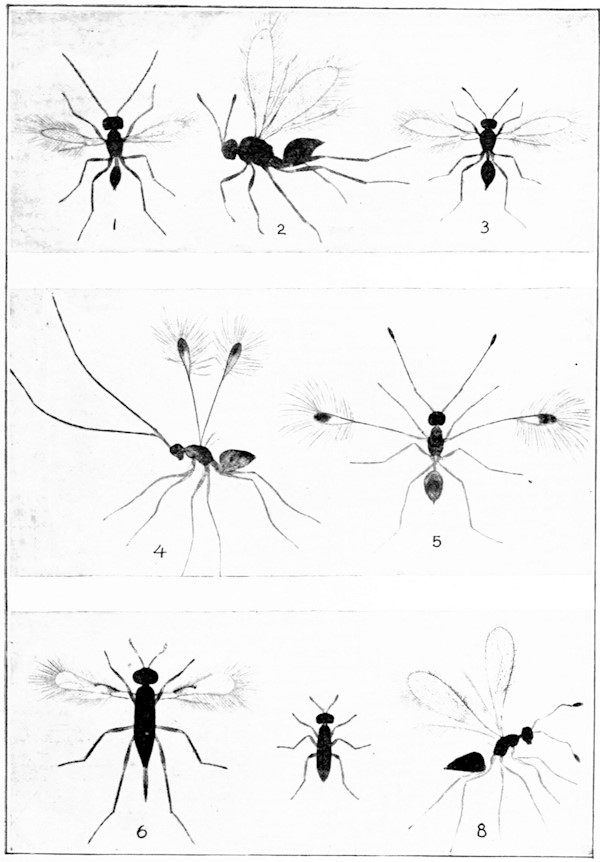
Fairy Flies (magnified 30 diameters)
1, Caraphractus Cinctus, Male; 2, 3, same, Female; 4, 5, Mymar Pulchellus, Male and Female; 6, 7, Prestwichia Aquatica, Female and Male; 8, Cosmocomo Fumipennis, Female
But it is, above all, the beaver (Castor fibre) who exhibits the highest qualities as an engineer and mason. This industrious and sagacious rodent is well adapted to inconvenience the partisans of instinct as an entity, apart from intelligence, which renders animals similar to machines and impels them to effect associated acts, without themselves being able to understand them, and with a fatality and determination from which they can under no circumstance escape.
The civilization of the beaver has perished in the presence of man’s civilization, or rather of his persecution. In regions where it is tracked and disturbed by man the beaver lives in couples, and is content to hollow out a burrow like the otter’s, instead of showing its consummate art. It merely vegetates, fleeing from enemies who are too strong for it, and depriving itself of a dangerous comfort. But when the security of solitude permits these animals to unite in societies, and to possess, without too much fear, a pond or a stream, they then exhibit all their industry.
They build very well arranged dwellings, although at first sight they look like mere piles of twigs, branches, and logs heaped in disorder on a small dome of mud. At the edge of a pond each raises his own lodge, and there is no work by the colony in common. If, however, there is a question of inhabiting the bank of a shallow stream, certain preliminary works become necessary. The rodents establish a dam, so that they may possess a large sheet of water which may be of fair depth, and above all constant, not at the mercy of the rise and fall of the stream. A sudden and excessive flood is the one danger likely to prove fatal to these dikes; but even our own constructions are threatened under such circumstances.
When the beavers, tempted by abundance of willows and poplars, of which they eat the bark and utilize the wood in construction, have chosen a site, and have decided to establish a village on the edge of the water, there are several labors to be successively accomplished. Their first desire is to be in possession of a large number of felled trunks of trees. To obtain them they scatter themselves in the forest bordering the stream and attack saplings of from twenty to thirty centimetres in diameter. They are equipped for this purpose. With their powerful incisors, worked by strong jaws, they can soon gnaw through a tree of this size. But they are capable of attacking trees even more than 100 cm. in diameter and some forty metres in height with great skill and adaptability; “no better work could be accomplished by a most highly finished steel cutting tool, wielded by a muscular human arm” (Martin). They operate seated on their hindquarters, and they make their incision in the wood with a feather edge. It was once supposed that they always take care so to direct their wood-cutting task that the tree may fall on the water-side, but this is by no means the case, and appears to be simply due, as Martin points out, to the fact that trees by the water-side usually slope toward the water. The austerity of labor alternates, it may be added, with the pleasures of the table. From time to time the beavers remove the bark of the fallen trees and feed on it.
Mr. Lewis H. Morgan studied the American beaver with great care and thoroughness, more especially on the southwest shore of Lake Superior; he devotes fifty pages to the dams, and it is worth while to quote his preliminary remarks regarding them: “The dam is the principal structure of the beaver. It is also the most important of his erections, as it is the most extensive, and because its production and preservation could only be accomplished by patient and long-continued labor. In point of time, also, it precedes the lodge, since the floor of the latter and the entrances to its chamber are constructed with reference to the level of the water in the pond. The object of the dam is the formation of an artificial pond, the principal use of which is the refuge it affords to them when assailed, and the water-connection it gives to their lodges and to their burrows in the banks. Hence, as the level of the pond must, in all cases, rise from one to two feet above these entrances for the protection of the animal from pursuit and capture, the surface-level of the pond must, to a greater or less extent, be subject to their immediate control. As the dam is not an absolute necessity to the beaver for the maintenance of his life, his normal habitation being rather natural ponds and rivers, and burrows in their banks, it is in itself considered a remarkable fact that he should have voluntarily transferred himself, by means of dams and ponds of his own construction, from a natural to an artificial mode of life.
“Some of these dams are so extensive as to forbid the supposition that they were the exclusive work of a single pair or of a single family of beavers; but it does not follow, as has very generally been supposed, that several families, or a colony, unite for the joint construction of a dam. After careful examination of some hundreds of these structures, and of the lodges and burrows attached to many of them, I am altogether satisfied that the larger dams were not the joint product of the labor of large numbers of beavers working together, and brought thus to immediate completion; but, on the contrary, that they arose from small beginnings, and were built upon year after year, until they finally reached that size which exhausted the capabilities of the location; after which they were maintained for centuries, at the ascertained standard, by constant repairs. So far as my observations have enabled me to form an opinion, I think they were usually, if not invariably, commenced by a single pair, or a single family of beavers; and that when, in the course of time, by the gradual increase of the dam, the pond had become sufficiently enlarged to accommodate more families than one, other families took up their residence upon it, and afterward contributed by their labor to its maintenance. There is no satisfactory evidence that the American beavers either live or work in colonies; and if some such cases have been observed, it will either be found to be an exception to the general rule, or in consequence of the sudden destruction of a work upon the maintenance of which a number of families were at the time depending.
“The great age of the larger dams is shown by their size, by the large amount of solid materials they contain, and by the destruction of the primitive forest within the area of the ponds; and also by the extent of the beaver-meadows along the margins of the streams where dams are maintained, and by the hummocks formed upon them by and through the annual growth and decay of vegetation in separate hills. These meadows were undoubtedly covered with trees adapted to a wet soil when the dams were constructed. It must have required long periods of time to destroy every vestige of the ancient forest by the increased saturation of the earth, accompanied with occasional overflows from the streams. The evidence from these and other sources tends to show that these dams have existed in the same places for hundreds and thousands of years, and that they have been maintained by a system of continuous repairs.
“At the place selected for the construction of a dam, the ground is usually firm and often stony, and when across the channel of a flowing stream, a hard rather than a soft bottom is preferred. Such places are necessarily unfavorable for the insertion of stakes in the ground, if such were, in fact, their practice in building dams. The theory upon which beaver-dams are constructed is perfectly simple, and involves no such necessity. Soft earth, intermixed with vegetable fibre, is used to form an embankment, with sticks, brush, and poles imbedded within these materials to bind them together, and to impart to them the requisite solidity to resist the effects both of pressure and of saturation. Small sticks and brush are used, in the first instance, with mud and earth and stones for down-weight. Consequently these dams are extremely rude at their commencement, and they do not attain their remarkably artistic appearance until after they have been raised to a considerable height, and have been maintained, by a system of annual repairs, for a number of years.”[12]
There are two different kinds of beaver-dams, although they are both constructed on the same principle. One, the stick-dam, consists of interlaced stick and pole work below, with an embankment of earth raised with the same material upon the upper or water face. This is usually found in brooks or large streams with ill-defined banks. The other, the solid-bank dam, is not so common nor so interesting, and is usually found on those parts of the same stream where the banks are well defined, the channel deep, and the current uniform. In this kind the earth and mud entirely buries the sticks and poles, giving the whole a solid appearance. In the first kind the surplus water percolates through the dam along its entire length, while in the second it is discharged through a single opening in the crest formed for that purpose.
The materials being prepared in the manner I have previously described, the animals make ready to establish their dike. They intermix their materials—driftwood, green willows, birch, poplars, etc.—in the bed of the river, with mud and stones, so making a solid bank, capable of resisting a great force of water; sometimes the trees will shoot up forming a hedge. The dam has a thickness of from three to four metres at the base, and about sixty centimetres at the upper part. The wall facing up-stream is sloping, that directed down-stream is vertical; this is the best arrangement for supporting the pressure of the mass of water which is thus expended on an inclined surface. In certain cases beavers carry hydraulic science still further. If the course of the water is not very rapid, they generally make an almost straight dike, perpendicular to the two banks, as this is then sufficient; but if the current is strong, they curve it so that the convexity is turned up-stream. In this way it is much better fitted to resist. Thus they do not always act in the same way, but arrange their actions so as to adapt them to the conditions of the environment.
The embankment being completed, the animals construct their lodges. Fragments of wood, deprived of the bark, are arranged and united by clay or mud which the beavers take from the river-side, transport, mix, and work with their forepaws. During a single night they can collect as much mud at their houses as amounts to some thousands of their small handfuls. They thus plaster their houses with mud every autumn; in the winter this freezes as hard as a stone and protects them from enemies. These cabins form domes from three to four metres in diameter at the base, and from two to two and a half metres in height. The floor is on a level with the surface of the artificial pond. A passage sinks in the earth and opens about one and a half metres below the level of the water, so that it can not be closed up by ice during the severe winters of these regions.
Within, near the entry, the beavers form, with the aid of a partition, a special compartment to serve as a storehouse, and they there pile up enormous heaps of nenuphar roots as provisions for the days when ice and snow will prevent them from barking the young trunks.
A dwelling of this kind may last for three or four years, and the animal here tranquilly enjoys the fruits of its industry as long as man fails to discover the retreat; for the beaver can escape by swimming from all carnivorous animals excepting, perhaps, the otter. During the floods the level of the water nearly reaches the hut; if the inundation is prolonged and the animal runs the risk of being asphyxiated beneath his dome, it breaks through the upper part with its teeth and escapes. When the water returns to its bed the beaver comes back, makes the necessary repairs, and resumes the usual peaceful course of its life.
We have thus seen, from a shapeless hole to these complex dwellings, every possible stage; we have found among animals the rudiments of the different human habitations, certain animals, indeed, having arrived at a degree of civilization which man himself in some countries has not yet surpassed, or even indeed yet attained.
MAN’S FIRST APPEARANCE —Boyd Dawkins
The characteristics of the evolution of living forms may be summed up as follows:
I. Eocene—in which the placental mammals now on earth were represented by allied forms belonging to existing orders and families. Living orders and families appear; lemurs (Lemuridæ) in Europe and North America. Evidence found in fresh-water and marine strata; lignites.
II. Miocene—in which the alliance between living and placental mammals is more close than before. Living genera appear; apes (Simiadæ) in Europe and North America. Evidence—fresh-water and marine strata; volcanic débris (Auvergne); lignites.
III. Pliocene—in which living species of placental mammals appear. Living species appear; apes (Simiadæ) in Southern Europe. Evidence found in fresh-water and marine strata; volcanic débris (Auvergne).
IV. Pleistocene—in which living species of placental mammals are more abundant than the extinct. Man appears; Anthropidæ; the palæolithic hunter; living species abundant. Evidence—refuse-heaps, contents of caves, river deposits, submarine forests, bowlder clay, moraines, marine sands, and shingle.
V. Prehistoric—in which domestic animals and cultured fruits appear. Man abundant, domestic animals, cultivated fruits, spinning, weaving, pottery-making, mining, commerce; the neolithic, bronze, and iron stages of culture. Evidence—camps, habitations, tombs, refuse-heaps, surface accumulation, caves, alluvia, peat bogs, submarine forests, raised beaches.
VI. Historic—in which the events are recorded in history. Evidence—documents, refuse-heaps, caves, tombs.
The orders, families, genera, and species in the above summary, when traced forward in time, fall into the shape of a genealogical tree, with its trunk hidden in the secondary period, and its branchlets (the living species) passing upward from the Pliocene, a tree of life with living Mammalia for its fruits and foliage. Were the extinct species taken into account, it would be seen that they fill up the intervals separating one living form from another, and that they too grow more and more like the living forms as they approach nearer to the present day. It must be remembered that in the above definitions the fossil marsupials are purposely ignored, because they began their specialization in the secondary period, and had arrived in the Eocene at the stage which is marked by the presence of living genus—the opossum (Didelphys).
It will be seen that our inquiry into the antiquity of man is limited to the last four of the divisions. The most specialized of all animals can not be looked for until the higher Mammalia by which he is surrounded were alive. We can not imagine him in the Eocene age, at a time when animal life was not sufficiently differentiated to present us with any living genera of placental mammals. Nor is there any probability of his having appeared on the earth in the Miocene, because of the absence of higher placental mammals belonging to living species. It is most unlikely that man should have belonged to a fauna in which no other living species of mammal was present. He belongs to a more advanced stage of evolution than the mid-Miocene of Thenay. Up to this time the evolution of the animal kingdom had advanced no further than the Simiadæ in the direction of man; and the apes then haunting the forests of Italy, France, and Germany represent the highest type of those on earth.