THE STORY OF THE UNIVERSE (continued 5)
Reading edition
If these facts are inexplicable on the hypothesis of the dispersion of the species of the air-breathing animals from a single Asiatic centre, we must next endeavor to collect analogous facts and classify them, and so try to explain intelligibly, that is agreeably with the facts, the true law or cause of the actual geographical distribution of animals.
The laws of geographical distribution, as affecting mammalian life, have been reduced to great exactness by observations continued since the time of Buffon, who first began to generalize about a century ago in that way, noting the peculiarities of the species of South American animals. The most important extension of this branch of zoology has been due to recent researches and discoveries of extinct species of the class Mammalia; and it is chiefly in relation to the modifications of zoological ideas produced by palæontology that a few brief remarks will here be made.
The Quadrumana, or order of apes, monkeys, and lemurs, consist of three chief divisions—Catarhines, Platyrhines, and Strepsirhines. The first family is peculiar to the Old World; the second to South America; the third has the majority of its species and its chief genus (Lemur) exclusively in Madagascar. Out of twenty-six known species of Lemuridæ, only six are Asiatic and three are African.
The Catarhine monkeys include the Macaques, most of which are Asiatic, a few are African and one European; the Cercopitheques, most of which are African and a few Asiatic; and other genera which characterize one or other continent exclusively. Thus the true baboons (Papio) are African, as are the thumbless monkeys (Colobus) and the chimpanzees (Troglodytes). The Semnopithecus, gibbons, and orangs are peculiarly Asiatic. Palæontology has shown that a macaque, a gibbon, and an orang existed during the older Tertiary times in Europe, and that Semnopithecus existed in Miocene times in India. But all the fossil remains of Quadrumana in the Old World belong to the family Catarhina, which is still exclusively confined to that great division of dry land. The tailless macaque (Innus silvanus) of Gibraltar may have existed in that part of the Old World before Europe was separated by the Straits of Gibraltar from Africa. Fossil remains of Quadrumana have been discovered in South America; they indicate Platyrhine forms: a species, for example, allied to the howlers (Mycetes), but larger than any now known to exist, has left its remains in Brazil.
While adverting to the geographical distribution of Quadrumana, I would contrast the peculiarly limited range of the orangs and chimpanzees with the cosmopolitan powers of mankind. The two species of orang (Pithecus) are confined to Borneo and Sumatra; the two species of chimpanzee (Troglodytes) are limited to an intertropical tract of the western part of Africa. They appear to be inexorably bound by climatal influences regulating the assemblage of certain trees and the production of certain fruits. With all our care, in regard to choice of food, clothing, and contrivances for artificially maintaining the chief physical conditions of their existence, the healthiest specimens of orang or chimpanzee, brought over in the vigor of youth, perish within a period never exceeding three years, and usually much shorter in England. By what metamorphoses, may we ask, has the alleged humanized chimpanzee or orang been brought to endure all climates? The advocates of transmutation have failed to explain them. Certain it is that those physical differences in cerebral, dental, and osteological structure which place, in my estimate of them, the genus Homo in a distinct group of the mammalian class, zoologically of higher value than the order, are associated with equally contrasted powers of endurance of different climates, whereby man has become a denizen of every part of the globe from the Torrid to the Arctic zones.
Climate rigidly limits the range of the Quadrumana latitudinally; creational and geographical causes limit their range in longitude. Distinct genera represent each other in the same latitudes of the New and Old Worlds; and also, in a great degree, in Africa and Asia. But the development of an orang out of a chimpanzee, or reciprocally, is physiologically inconceivable.
The order Ruminantia is principally represented by Old World species, of which 162 have been defined, while only 24 species have been discovered in the New World, and none in Australia, New Guinea, New Zealand, or the Polynesian Isles.
The camelopard is now peculiar to Africa; the musk-deer to Africa and Asia; out of fifty defined species of antelope, only one is known in America, and none in the central and southern divisions of the New World. The bison of North America is distinct from the bison of Europe. The musk-ox alone, peculiar for its limitation, to high northern latitudes, roams over the Arctic coasts of both Asia and America. The deer tribe are more widely distributed. The camels and dromedaries of the Old World are represented by the llamas and vicunas of the New. As, in regard to a former (Tertiary) zoological period, the fossil Camilidæ of Asia are of the genus Camilus, so those of America are of the genus Auchenia. This geographical restriction ruled prior to any evidence of man’s existence.
Palæontology has expanded our knowledge of the range of the giraffe: during Miocene or old Pliocene periods, species of Camelopardalis roamed in Asia and Europe. Passing to the non-ruminant Artiodactyles, geology has also taught us that the hippopotamus was not always confined, as now, to African rivers, but bathed, during Pliocene times, in those of Asia and Europe. But no evidence has yet been had that the giraffe or hippopotamus were ever other than Old World forms of Ungulata.
With respect to the hog tribe, we find that the true swine (Sus) of the Old World are represented by peccaries (Dicotyles) in the New; and geology has recently shown that Tertiary species of Dicotyles existed in North as well as South America. But no true Sus has been found fossil in either division of the New World, nor have the Dicotyles been found fossil in the Old World of the geographer. One of the earliest forms of the European rhinoceros was devoid of the nasal weapon.
Geology gives a wider range to the horse and elephant kinds than was cognizant to the student of living species only. The existing Equidæ and Elephantidæ properly belong, or are limited, to the Old World; and the elephants to Asia and Africa, the species of the two continents being quite distinct. The horse, as Buffon remarked, carried terror to the eye of the indigenous Americans, viewing the animal for the first time, as it proudly bore their Spanish conqueror. But a species of Equus coexisted with the Megatherium and Megalonyx in both South and North America, and perished apparently with them, before the human period. Elephants are dependent chiefly upon trees for food. One species now finds conditions of existence in the rich forests of tropical Asia; and a second species in those of tropical Africa. Why, we may ask, should not a third be living at the expense of the still more luxuriant vegetation watered by the Orinoco, the Essequibo, the Amazon, and La Plata, in tropical America? Geology tells us that at least two kinds of elephant (Mastodon Andium and Mastodon Humboldtii) formerly did derive their subsistence, along with the great Megatheroid beasts, from that abundant source. Nay, more; at least two kinds of elephant (Mastodon ohioticus and Elephas texianus) existed in the warm and temperate latitudes of North America. Twice as many species of mastodon and elephant, distinct from all the others, roamed in Pliocene times in the same latitude of Europe. At a later or Pleistocene period, a huge elephant, clothed with wool and hair, obtained its food from hardy trees, such as now grow in the 65th degree of north latitude; and abundant remains of this Elephas primigenius (as it has been prematurely called, since it was the last of the British elephants) have been found in temperate and high northern latitudes in Europe, Asia, and America. This, like other Arctic animals, was peculiar in its family for its longitudinal range. The musk buffalo was its contemporary in England and Europe, and still lingers in the northernmost parts of America.
I have received evidences of elephantine species from China and Australia, proving the proboscidian pachyderms to have been the most cosmopolitan of hoofed herbivorous quadrupeds. Geology extends the geographical range of the sloths and armadillos from South to North America; but the deductions from recent rich discoveries of huge terrestrial forms of sloth, of gigantic armadillos, and large anteaters go to establish the fact that these peculiar features of the order Bruta have ever been, as they are now, peculiar to America; that several genera, including the larger species, have perished; and that the range of their still existing diminutive representatives has been reduced to the southern division of the New World.
Australia, which in extent of dry land merits to be regarded as a fifth continent, has a more restricted and peculiar character of aboriginal mammalian population than South America. It is emphatically the “province” of those quadrupeds the females of which are provided with a pouch for the transport and protection of their prematurely formed young.
One genus of Marsupialia (Didelphys or opossums, properly so called) is peculiar to America, and is there the sole representative of the order. A small kangaroo, and a few phalangers, exist in islands that link the Malayan Archipelago with the Australian world. All the other marsupial genera are found in Australasia, comprising New Guinea, Australia, and Tasmania. The largest and most destructive of carnivorous marsupials are peculiar to Tasmania.
The sum of all the evidence from the fossil world in Australia proves its mammalian population to have been essentially the same in Pleistocene, if not Pliocene, times as now; only represented, as the Edentate mammals in South America were then represented, by more numerous genera, and much more gigantic species than now exist.
In the Miocene and Eocene tertiary deposits, marsupial fossils of the American genus Didelphys have been found, both in France and England; and they are associated with tapirs like that of America. In a more ancient geological period, remains of marsupials, some insectivorous, others with teeth, have been found in the upper Oolite.
Thus it would seem that the deeper we penetrate the earth, or, in other words, the further we recede in time, the more completely we are absolved from the present laws of geographical distribution.
GEOGRAPHICAL DISTRIBUTION OF ANIMALS —William Hughes
The great division of the animal kingdom recognized by naturalists is that into vertebrate and invertebrate animals. Vertebrated animals are those which possess a spinal bone, to which are attached ribs, constituting the framework of the entire body. All animals of this division have red blood. The vertebrate animals comprehend fishes, reptiles, birds, and mammalia. This last term is inclusive of all animals that suckle their young, man among the number.
The class mammalia comprehends the following orders: 1. Carnivora (flesh-eating, as the lion, tiger, etc.); 2. Ruminantia (animals that chew the cud, as the camel, ox, sheep, and others); 3. Pachydermata (thick-skinned, as the elephant, horse, etc.); 4. Rodentia (gnawing, as the beaver, squirrel, mice, etc.); 5. Edentata (toothless, as the ant-eater and armadillo); 6. Quadrumma (four-handed, as the ape and monkey tribe); 7. Cherioptera (having winged arms, as bats); 8. Marsupialia (pouched, as the kangaroo and opossum); 9. Cetaceæ (whales, dolphins, and the various seals). The last-mentioned of these divisions includes members (and those the largest) of a tribe assigned in popular language to a distinct division of the animal world—fishes. But the whale and other creatures of its order possess the distinguishing attribute of the mammalia—that is, they afford their nutriment from the breast.
The animals belonging to the ruminating and pachydermatous orders are further distinguished as ungulata, or hoofed, from the well-known characteristic of their extremities. The domesticated animals that are used as food by man are almost exclusively derived from this class. The animals included within the other orders of mammalia are designated as unguiculata, from their extremities terminating in claws, or nails.
The invertebrate animals, or those which have no spinal bone, all have white blood. They are scientifically divided into molluscous animals, in which the muscles are attached to the skin, with or without the protection of a shell—such as snails and slugs; articulated animals, in which the covering of the body is divided into rings or segments, to the interior of which the muscles are attached—comprehending all insects and worms; and radiated animals, in which the organs of motion or sensation radiate from a common centre—such as star-fish.
The opposite sides of a hill-range, even in cases where the climate is nearly identical, and the passage from one slope to the other easy, will often exhibit different conditions of animal life. Isothermal lines mark—with hardly less precision in the case of animals than of plants—the range of particular families and species, in the direction of latitude and elevation alike. The fact that such is the case testifies strongly to the force of those instincts with which all animals are endowed, and by which their habits are regulated. The powers of locomotion possessed by animals might at first sight seem calculated to favor a wider extension of geographical range than belongs to vegetables, and in the well-known instances of migratory species (of which the swallow and other birds are familiar examples) such is undoubtedly the case. But even these migrations are confined within a well-defined range, determined by conditions of climate, and facility of obtaining the necessary food. Birds in general are separated, as markedly as quadrupeds, in respect of their habitat, or geographical range. This is equally true, indeed, in regard to every one of the great classes into which the animal world is divided. Each zone of the ocean, both in latitude and in the direction of depth, has its proper forms of life.
To take an instance from land animals, the elephant is confined by natural instinct within the belt of the warm latitudes, and not more so by the high temperature which such latitudes alone enjoy than by the limitation of its necessary food to the regions which are its proper home. Nowhere else but within or near the tropics is there found the luxuriant abundance of forest vegetation which the elephant requires to make sustenance upon. The reindeer, on the other hand, is as characteristically an inhabitant of polar latitudes, and perishes if brought within the continued influence of a warmer temperature than that of his native region. The ibex and the chamois, with some other animals of the goat tribe, frequent only the highest and least accessible portions of the mountain region, while various members of the deer kind range over the lower elevations and the plains below. Of birds, the condor, or great vulture of the Andes, confines his range within the region of the highest peaks of the mountain region, as his European congener—the lammergeyer, or vulture of the Alps—does in another part of the globe. In the mountainous portions of Great Britain, the eagles which (notwithstanding the keen pursuit of the sportsman) frequent the scarcely accessible crags that surround Loch Maree and other secluded localities of the Highlands, furnish a similar instance. Again, the shark is the well-known scourge of the warmer belt of ocean, while the same zone of sea constitutes—from its high temperature—a region through which the whale never passes.
It is, besides, equally true of the animal as of the vegetable kingdom, that every region of the globe has its own proper inhabitants, different in species, for the most part, from those of other regions. The animal life of the Old World is markedly different from that of the New World in correspondent parallels, and under conditions of climate which are in all important regards analogous. Even when the genera, or families, are the same, the species are in nearly all cases distinct. In yet higher measure, the animal life of Australia differs from that of other divisions of the globe. Whole orders of the animal world are wanting in Australian zoology, while the vast majority of its animals belong to a division which is altogether unrepresented in the continents of the Old World—that is, the marsupial tribe. The difference is less strongly marked in the case of the adjacent continents of the Northern Hemisphere than in the instances of the lands lying south of the equator.
The natural distribution of animals has been importantly modified by human agency. This is especially the case in regard to those divisions of the mammalia which comprehend the domestic quadrupeds—the horse, dog, ox, sheep, and others. Man has carried these animals with him in his migrations from one region to another, and has thus introduced new species (and even genera) into lands where they were previously unknown. The horse, the ox, and the common sheep, were unknown in the New World prior to the Spanish discoveries of the Fifteenth and Sixteenth Centuries, but speedily became naturalized there, and, in the case of the two first-named, have long since reverted to a condition of nature. Wild horses roam by thousands over the savannas and pampas of the western world. Within a much more recent period, the domestic cattle of Europe have been introduced into the Australian continent, and have multiplied there to an extraordinary degree. Efforts are now making to introduce into Australia both the camel of the Old World and the llama of South America. The hare and the rabbit of Britain have become naturalized in the more southwardly of the Australian colonies. Similar efforts are at the present time directed to the naturalization in the Australian rivers of the salmon and other fish that belong to the streams and estuaries of Europe. What has been accomplished, in these and many similar cases, by the direct efforts of man, has resulted, in the case of many of the smaller animals, from his involuntary agency, or from accidental causes. The vessel which conveys a cargo of native produce from one region to a foreign shore has often carried with it the germs of life (vegetable as well as animal), besides, in numerous instances, the smaller members themselves of the animal world. The insects that were originally confined to one region have thus become distributed over wide areas of the globe.
A few other of the more obvious differences between the native zoology of the Old and New Worlds may be adverted to with advantage. Among carnivorous quadrupeds, the lion, tiger, leopard, panther, and hyena are confined to the eastern half of the globe. In the New World, the puma and the jaguar take respectively the places of the lion and tiger of the Asiatic continent. Of the ruminants, the camel, the giraffe, and the numerous antelopes are only found within the Old World. Of the pachydermata, the elephant, the rhinoceros, the hippopotamus, the horse, the zebra, and the ass are unknown to the native zoology of the lands lying west of the Atlantic. The elephant, and also the rhinoceros, belong to Asia and Africa (the species being different in the case of either continent), the hippopotamus is African only: the zebra (with its kindred species, the quagga) is also peculiar to Africa. Both the horse and the ass probably came originally from Asia. Of the Quadrumana, which are numerously represented in the zoology of either hemisphere, the species (and, in most cases, the genera) are distinct. Again, the opossums of the New World belong to an order (the marsupial) which is altogether unrepresented in the three continents of the Old World, but which exhibits its fullest development in the Australian division of the globe. Numerous other instances might be adduced, but these will suffice. They serve to show that, in the case of animals as of plants, particular regions constitute centres of particular forms of life, which thence spread, within certain limits, around, still leaving to each such region its strongly marked and typical characteristics in such regards.
Europe exhibits, in its indigenous zoology, a character less marked and distinctive than belongs to other divisions of the globe. This is in some degree the result of its dense population, and the consequent diminution in the number of wild species, but in a more special manner results from its conditions of geographical form and position. Europe is less a continent in itself than an outlying portion of the vast and unbroken mass of the Asiatic continent. No strongly marked feature intervenes between the plains of eastern Europe and those of northern Asia, and within the continuous range of land that extends, under the same parallels, from the Baltic Sea eastward to the waters of the Pacific Ocean, the animal life exhibits for the most part identity of species and genera. The differences between them, in a vast number of instances, are merely varieties. Many of the fur-bearing animals are common to all the lands that lie within the Arctic circle, as many as twenty-seven species being native to Europe, Asia, and North America alike.
The vast population of Europe has necessitated the rearing of the domestic quadrupeds in vast numbers, and has been accompanied, in numerous instances, by the extermination of the wild denizens of the forest. It would seem from a passage in Herodotus (book vii, 125) that the lion once frequented the woods of Macedonia. The wild boar, bear, and the wolf were formerly natives of the British Islands, and the last named animal has only been exterminated from within their limits during the last hundred and fifty years. The beaver, long since banished, was once common on the banks of the Welsh streams. The fox is only preserved by artificial means, and for the purposes of the chase. The wildcat, now rarely seen, and that only in the remoter portions of the Scotch Highlands, was formerly common within the English forests. The bustard, a bird now rarely seen, was once met with in huge flights on the plains of Norfolk and Suffolk, while huge fen-eagles frequented the marshy flats of the adjacent country.
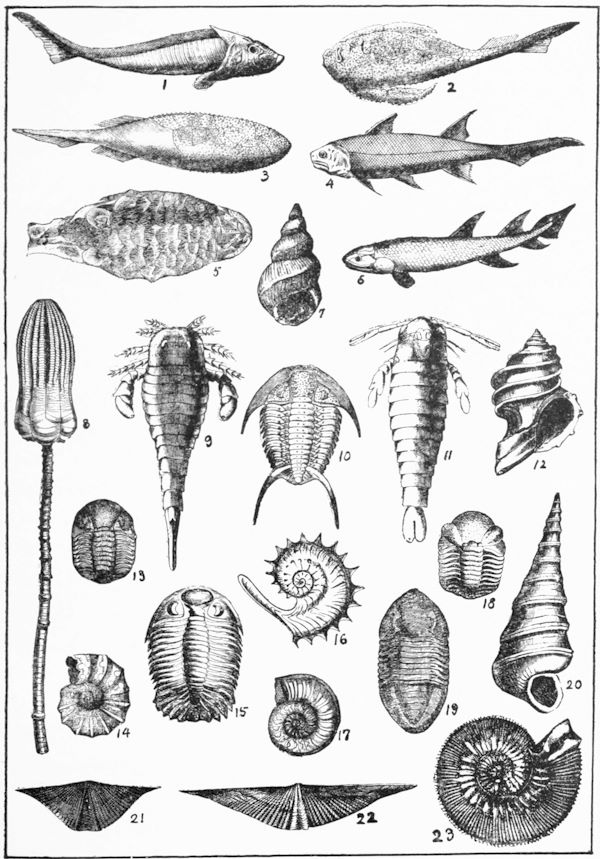
Extinct Fishes, Mollusca, and Crustacea
1, Cephalaspis; 2, Pterichthys; 3, Coccocosteus; 4, Diplacanthus; 5, Holoptychius; 6. Osteolepis; 7, 12, 20, Gasteropods; 8, Crinoid; 9, Eurypterus; 10, 13, 15, 18, 19, Trilobites; 14, 16, 17, 23, Cephalopods (Ammonites); 21, 22, Spirifers
These are but few instances of the way in which human agency modifies the distribution of animal life. On the continent, the extermination of a particular species is of course more difficult; in numerous cases is perhaps altogether impossible. The wolf inhabits the forests of continental Europe, from the high tracts that adjoin the Alps and the Pyrenees northward to the shores of the Baltic and White Seas. The wild boar and the bear (three species of the latter—the brown and the black in the wooded regions of the south, the white polar bear in the extreme north) are still met with. The urus or wild ox of the Lithuanian forests, regarded by naturalists as the progenitor of our common domestic cattle, is even yet found to the eastward of the Baltic.
Europe, however, has no one of the great families of mammalia that can be looked on as peculiarly its own, or, in other words, as giving it a distinctive zoology—like the antelopes of Southern and Western Asia, the numerous pachyderms of the African continent, the llama tribe of the New World, or the marsupials of Australia. Of the total number of European mammalia, not exceeding a hundred and eighty, only fifty-eight are peculiar to this continent, and none of the larger quadrupeds is included among them.
The domesticated animals that are so numerously reared in every part of Europe have probably been, in most cases, derived from indigenous species. The urus or wild ox has been the parent of the common ox, and the wild boar of the domestic pig; the goat, and, in the extreme north, the reindeer, are also native to the European soil. The moufflon of Sardinia was perhaps the ancestor of at least some of our breeds of sheep.
The birds of Europe display a greater number and variety of species than its land animals. This is especially the case in regard to the family of aquatic birds—always most numerous in the higher latitudes. More than thirty species of the duck tribe alone belong to Northern Europe, some of them being common to the corresponding latitudes of Asia and the New World. The stork and the crane (both of migratory habits) belong to the maritime regions of Western Europe; the pelican, the spoonbill, and the scarlet flamingo, to the shores of the Mediterranean.
Europe has fewer species (as well as fewer individuals) of the reptile kind than either of the other divisions of the globe—a happy exemption, which is due to its temperate climate. The only venomous serpents found in Europe are three species of viper, all of them confined to its southern shores: the common viper of middle and Northern Europe is innocuous. Lizards are common in the south, as many as sixty-three species being enumerated.
The waters of Europe exhibit a rich variety of fish, a vast number of them useful as to the food of man. Each of its inland seas has its own peculiar tribes, the Mediterranean basin displaying the richest diversity. Among the inhabitants of the Mediterranean are several sharks, swordfish, dolphins, and six species of tunny—the last-mentioned the largest of edible fish. The anchovy is peculiar to the Mediterranean. The seas that lie around the British Islands abound in the gregarious tribes of edible fish, as the cod, turbot, mackerel, herring, pilchard, and many others. The stromming of the Baltic is of like utility. The salmon frequents the estuaries and river-mouths throughout the coast-line of Western Europe to the northward of the Bay of Biscay, becoming more numerous as higher latitudes are reached.
The generally temperate climate of Europe secures it, for the most part, an exemption from the dense swarms of insect-life that belong to warmer latitudes. Yet between eight or nine thousand species are enumerated as native to the British Islands alone. The common honey-bee is distributed all over southern and Central Europe, and is probably indigenous. The locust is only an occasional visitor to its shores, and belongs to the other side of the Mediterranean. The silkworm was introduced from China toward the close of the Fifth Century of our era.
Asia is rich in variety of animal life, and especially so as regards the class mammalia, all the orders of which but two (the marsupials and the edentata) are represented in its zoology. Of domesticated quadrupeds, the camel, ox, goat, and sheep, among the ruminants, with the horse, the ass, and the elephant, among pachyderms, are natives of Asia. The camel, of which there are several species, all natives of this continent, ranges from the shores of the Indian Ocean and Red Sea as far north as Lake Baikal. The reindeer and elk frequent the Siberian and Mongolian plains, migrating from the former locality southward with the approach of winter. Numerous varieties of the ox tribe (including the common ox, aurochs, buffalo, and yak) are reared by the Tartar nations who inhabit the upland plains of the interior. The antelope and deer tribe, of which there are a vast number of species, belong to the western and southwestern regions of the continent. The plains of Turkestan, to the eastward of the Caspian, are perhaps the original country of the horse. The wild ass is indigenous to Western Asia. The elephant is not found to the west of India, nor to the north of the Himalaya Mountains; it belongs only to the two Indian peninsulas, with Ceylon, and some of the smaller islands of the Malay archipelago.
Among Asiatic carnivora are the lion, tiger, leopard, panther, and ounce, of the cat genus: the wolf, hyena, and jackal, of the dog tribe. Two species of bear are native to the Himalaya region (the snow-bear, and the black-bear) and the polar bear belongs to the Arctic coasts of the continent. The lion of Asia is now restricted to the region which extends from the banks of the Euphrates and Tigris to the western coasts of the Indian peninsula, including the deserts of Mesopotamia, Persia, and Hindostan. The tiger has a more extensive range, and inhabits all the middle and southeastern divisions of the continent. The hyena, and also the jackal, belong to the western half of Southern Asia; the wolf frequents the northern and western plains, and is found in a range of country extending from Siberia, through Turkestan, to the shores of the Mediterranean. The dog and the fox are common all over the continent, and present numerous varieties; in Kamtchatka and some parts of Siberia, the former animal is used as a beast of burden, and is trained to draw the sledges over the vast plains of ice and snow.
Numerous fur-bearing animals occur in Siberia, including the bear, glutton, badger, wolf, fox, lynx, pole-cat, weasel, ermine, marten, otter, sable, squirrel, beaver, hare, and the reindeer: many of these belong also to the northern regions of Europe. The quadrumana are found in the south and southeast of the continent and the islands of the Malay archipelago; the largest and most remarkable among them—the orang-outang—is restricted to the Malayan peninsula and the islands of Borneo and Sumatra. The gibbons (or long-armed apes) belong exclusively to Asia, and abound in its southeastern parts. Bats are more numerous in the islands of the Asiatic archipelago than on the continent.
Asia is less rich in variety of birds than in quadrupeds, but (with the exception of the turkey, which is a native of the New World, and of the guinea-fowl, which is African) all our domestic poultry came originally from this division of the globe. Among its birds of prey are eagles, vultures, falcons, owls, and hawks; but although individually abundant, the species of these are not numerous. Song-birds are numerous in western Asia, but are comparatively scarce in the eastern division of the continent, where, however (especially among the islands of the Malay archipelago and in China), birds of beautiful plumage abound. The peacock is a native of India, the golden pheasants belong to China, and the birds of paradise to New Guinea and the adjacent islands.
Reptiles are less numerous in Asia than in some other parts of the globe, but are sufficiently common in the southeastern parts of the continent and the adjacent islands. The python (analogous to the boa-constrictor of the New World) lurks in the morasses and swamps of the East Indian islands; the cobras, with several other kinds of venomous serpents, are found in the peninsulas of Eastern and Western India. Both sea and fresh-water snakes are numerous. Among insects, the locust is abundant in Western Asia, and commits the most dreadful ravages among the crops in Syria, Persia, and Arabia.
Africa is yet richer than Asia in regard to the animal kingdom. Of the total number of mammalia, more than a fourth occur in this division of the Old World, and fewer than a sixth of the number are common to Africa with either of the other continents. It is in the carnivora, ruminants, pachyderms, and quadrumana, that African zoology is more especially rich. Only one order, the marsupial, is unrepresented in it. Nor is the varied abundance of animal life in this region of the globe confined to species; the development of individual life within its vast and almost boundless solitudes is yet more characteristic.
Among African beasts of prey are the lion, panther, leopard, wolf, fox, hyena, and jackal. Three varieties of the lion occur—that of Northern Africa, of the countries on the Senegal, and of the extreme south, toward the Orange River. There are two hyenas—one, the spotted hyena, a native of Southern Africa; the other, the striped hyena, indigenous to the more northerly parts of the continent, and extending its range from Abyssinia and Barbary into Western Asia. The wolf and the jackal belong to Northern Africa.
Of ruminants, there are no less than sixty species of the antelope kind, which is especially abundant in Southern Africa. The camelopard or giraffe is peculiar to this continent, and ranges from the banks of the Gariep to the southern borders of the Sahara, but is not found upon the western coasts. Several species of buffalo occur in a wild state, and are most abundant within the outlying districts of the Cape Colony. Sheep and goats abound in most parts of Africa, but are probably not indigenous; both in Barbary and near the Cape of Good Hope—at the opposite extremities of the continent—are found sheep with broad, fat tails, so large as sometimes to weigh from ten to thirty pounds. The camel of Africa is found all over its northern and central regions.
Of the Pachydermata, or thick-skinned animals, the most characteristic are the elephant, rhinoceros, and hippopotamus. The elephant is found dispersed, in immense herds of from one to three hundred, all over the wooded regions of Central and Southern Africa, and the rhinoceros frequents principally the same localities. The ivory supplied by the tusks of the former is one of the most valuable native products of this quarter of the globe. The rhinoceros is valued chiefly for its hide, which is made into shields and harness. The hippopotamus is found in the upper part of the Nile valley, and in all the lakes and rivers to the southward of the Great Desert—including the Senegal, the Gambia, the Congo, and the Gariep. This animal is peculiar to Africa; its teeth consist of the finest ivory, for the sake of which it is hunted by the settlers of the Cape. All three of these animals are used as food by the native races of the South African interior.
The wild boar is found in some parts of Africa: the zebra, dow, and quagga (all peculiar to this continent) abound in its central and southern regions, particularly in the arid plains in the neighborhood of the Orange River. Of the African Quadrumana, monkeys, baboons, apes, and lemurs abound in the forests throughout every part of the continent.
The chimpanzee of the western coasts (from the neighborhood of Sierra Leone to the 10th parallel of S. latitude) makes nearer approach to the human form than the orang-outang of Southeastern Asia, but is surpassed in this respect by the gorilla, one of the largest of the ape tribe, which inhabits the forests in the neighborhood of the Gaboon River (0° 30′ N. lat.).
Bats are numerous in Africa, and most of the species inhabiting this continent are peculiar to it. The Rodentia are also for the most part of peculiar species; among them are hares, rabbits, jerboas, squirrels, rats, and mice.
Among birds, the ostrich is confined to Africa, but ranges from its southern extremity to the northern borders of the Great Desert. Its feathers form a highly valued article of traffic, and the bird is domesticated in many parts of Africa for the sake of procuring these free from injury. The vulture (of which two species occur—one in Northern Africa and the other in the neighborhood of the Cape) serves here, as elsewhere, to preserve the air from impurity, by feeding on the carcasses of animals, and divides with the hyena the office of scavenger. The owl, falcon, and eagle are also enumerated among the African birds of prey. Of gallinaceous birds Africa possesses only the guinea-fowl; but the domestic poultry are numerously reared, though not indigenous. The woods of tropical Africa abound in numberless varieties of parrots and paroquets, besides many other birds of bright and gaudy plumage—as the beautiful sun-birds (which inhabit the western coasts, and are scarcely larger than the humming-birds of America), together with the golden-colored orioles, crested hoopoes, bee-eaters, and others. The honey-suckers, which abound in the neighborhood of the Cape of Good Hope, feed entirely upon the nectar or saccharine juice of the proteas and similar plants. The sun-birds also occur in Southern Africa, and rival those of India and the Gambia in the brilliancy of their colors.
Lizards, serpents, and reptiles of every description abound in various parts of the African continent, though its general aridity, throughout extensive regions, is less favorable to the development of reptile life than in the case of correspondent latitudes elsewhere. The crocodile inhabits all the large rivers of tropical Africa, and is abundant in the lower portion of the Nile. The huge python, sometimes twenty-two feet in length (though inferior in size to the boa of the New World), is found in the swamps and morasses of the western coast, and some species of the cobra (or hooded snake) occur—chiefly in Southern Africa and on the shores of Guinea. Insects abound, both in species and as individuals; among them is the locust, which at intervals ravages all the northern parts of the continent. But the termites, or white ants, of Western Africa are the most celebrated members of the insect family, and effect the most extraordinary destruction of furniture, books, clothes, food, and everything that comes in their way. They build pyramidal or conical nests, firmly cemented together, and divided into several apartments—so large that at first sight they appear in the distance like the villages of the natives. Both the bee and the wasp are numerously distributed, but the bee has not been domesticated by any of the native people of this continent; it is, however, reared by the Arabs in Northern Africa.
The New World exhibits, through its vast prolongation in the direction of latitude, a development of animal life which is almost infinitely varied, and which differs in many essential regards from that belonging to either of the continents of the Eastern Hemisphere. Each of the nine orders of Mammalia is represented within its limits, but many of the most attractive and valuable members of the animal life of Asia and Africa are nevertheless wanting. America has neither the elephant nor the camel; and neither the horse, the ox, the sheep, nor the hog is indigenous to it.
The Carnivora of the New World are inferior in size, strength, and ferocity to those of Asia and Africa. In place of the lion, America has only the puma—a smaller and less powerful creature. The tiger of Southern Asia is represented by the jaguar, a somewhat smaller animal, but the most powerful of the American carnivora. In North America, however, the numerous bears are distinguished by their size and power, particularly the grizzly bear of the countries which border upon the Rocky Mountains. The great white bear of the polar regions is common to the high latitudes of either hemisphere. North America, which is more strictly continental in extent than the southern half of the New World, possesses, indeed, other types of animal life which rival those of the Eastern Hemisphere. Among these are the majestic bison, or American buffalo, together with the elk or moose-deer, occupying a place similar to the reindeer of Northern Europe and Asia. Several varieties of the deer-kind occur in the northern half of the continent, together with the musk-ox, the big-horned sheep, and the Rocky Mountain goat, which are peculiar to this region.
The tapir and the peccary (an animal of the hog kind) range all over the plains of South America, and the former is also found on the coast of Central America. The puma (or cougar) occurs on the Mexican Isthmus, and even as far northward as the 45th parallel, though found most numerously in the southern half of the continent, where its range extends to within a few degrees of the Strait of Magellan. The jaguar is found in the coast regions of the Mexican Isthmus, as well as the forests of Brazil and the adjoining regions of South America. The lynx and the wolf belong to the colder tracts of North America.
The opossums are numerous in South America, and one species is met with in the United States (Virginia); this family (Marsupialia) is altogether absent from the eastern continent, but is fully developed in the Australian division of the globe. The beaver abounds in the colder latitudes of North America, together with a vast number of other fur-bearing animals; as raccoons, martens, squirrels, sea-otters, minks, muskrats, ermines, foxes, wolverines, and hares.
The llama tribe (comprehending, besides the llama, the alpaca, vicuna, and others), is peculiar to South America. Its members are found throughout the prolonged cordilleras of the western side of that continent, from Chili to New Granada, dwelling always at considerable heights above the level of the sea. The llama belongs to the same order (Ruminantia) as the camel of the Old World, and supplies some of the uses of that animal as a beast of burden. Prior to the Spanish conquest, the llama was, indeed, the only beast of burden which the natives of South America possessed. The tapir of the same continent (an animal about the size of a small cow, and readily distinguished by the downward bend of its snout) belongs to the order of pachyderms. Two species of tapir, both of them peculiar to that region, inhabit South America: a third species is native to the island of Sumatra, and the adjacent Malay peninsula, in Southeastern Asia.
The paca and cutia (or agouti) both of a family which is peculiar to South America, take the place of the hare and rabbit of the Old World, and belong, like those animals, to the order of rodents. Both are used as food. The capybara and the common guinea-pig belong to the same order. The chinchilla, another of the South American rodents, valued for its delicate fur, is confined to the southern portions of the Andes.
The sloth, ant-eater, and armadillo (all belonging to the order of Edentata), are natives of South America.
Monkeys are exceedingly numerous all over that continent, especially in the forests of Brazil. These, however, are different in species from the monkeys of the Eastern Hemisphere; they are of smaller size, and (with the exception of one nearly tailless species, found within the forests of the Upper Amazons, within a very limited area) all possess tails, mostly prehensile. None of the apes of the New World makes the same approach to the human form which is found either in the chimpanzee and gorilla of Western Africa or the orang of Southeastern Asia. Toward the close of the day the howling monkeys of Brazil make the woods resound with the most frightful cries; but they are neither of large size nor of formidable powers. The family of lemurs, so abundant in the eastern half of the globe, has not a single representative in the New World. The marmosets, a family confined to America, are numerous within the regions of the lower Amazons.
Bats are very numerous in South America—more so than in any other part of the world: among them is the large vampire-bat, to which popular rumor has assigned the most bloodthirsty propensities, though it is in reality perfectly harmless, feeding chiefly upon fruits, with a few insects. All the American bats differ in species from those of the eastern continent.
The ornithology of tropical America exceeds in splendor that of any other region of the globe. Among the principal birds of prey are several species of eagle, including the large white-headed eagle of the United States, with vultures, hawks, kites, and owls. South America, however, possesses the largest of the vulture tribe—the gigantic condor of the Andes, which is confined to the higher peaks of those mountains, bordering on the limits of the snowy region. This is one of the most powerful and rapacious of birds, and commits numerous ravages among the cattle, deer, and other animals. The American ostrich, or emu, which dwells in the pampas of that region, is also distinguished by its size. The turkey is American, and is the only one of the domestic poultry that has been derived from the New World.[9] The toucans, distinguished by their enormous bills, are peculiar to America.
The humming-birds are peculiar to the western continent, and in the tropical regions of America various birds of the most glittering plumage, together with numberless fire-flies, lend an almost magical charm to the aspect of nature. The range of the humming-birds extends over the whole continent to the southward of the 42d parallel (north lat.) and stretches upon the western side of North America as high as the parallel of 60°—an evidence of the superior warmth which distinguishes that side of the American continent.
Both reptiles and insects are abundant in the New World, which, owing to its excessive moisture and dense vegetation, is peculiarly suited to the development of these departments of the natural kingdom. Venomous serpents are more numerous in tropical America than in any other part of the globe. The rattlesnake occurs in both divisions of the continent, within the parallels of 44° to the northward and of 30° to the south of the equator; the huge boa-constrictor, the largest of the serpent tribe, and the terror even of the natives, dwells in the marshes and swamps of South America. Huge caymans, iguanas, and other lizards, with numberless alligators and water-snakes, abound in the rivers and temporary lagoons of the same region.
Australia possesses a zoology which is more distinctive than that of any other part of the world. Its native insects, reptiles, birds, and land animals are all strikingly different from those of other regions. The difference is greatest (or, at any rate, most obvious to ordinary observation) in the case of its land animals. Two-thirds of the Australian Mammalia belong to the marsupial order, and the kangaroo, the largest member of that family, surpasses in size any other of its indigenous quadrupeds. The Quadrumana, pachyderms, and ruminants are altogether unrepresented, nor are there any of the larger carnivora, the native dog (already verging on extinction) being the chief among them. In the present day large numbers of the Australian population are employed in rearing the domestic cattle of Europe.
Australia forms in all regards a distinct zoological province, and its insulated position has tended, in greater measure than is the case with any other part of the world, to confine the distinguishing features of its fauna within its own proper limits. The kangaroo family includes numerous distinct species, from the full-sized kangaroo down to the kangaroo-rat. But not a single one of the tribe is found beyond the limits of Australia and the neighboring island of Tasmania. The opossums, which belong to the same order, are only found elsewhere in the New World. The most remarkable, however, among the members of the Australian animal world is that popularly known as the duck-bill (platypus, or ornithorynchus), which constitutes a puzzle to the naturalist. This is a semi-aquatic creature, about twelve or thirteen inches in length, with the body of an otter, a bill like that of the duck, and which lays eggs. As one of the tribe of Mammalia (to which, by its habits, it belongs), the platypus must be classed under the head of Edentata; while, on the other hand, as being oviparous, it may be regarded as belonging to a totally distinct division of the animal world. The platypus frequents the margins of creeks and pools, but remains mostly in the water, and is only approached with difficulty, on account of its extreme shyness. It has a coating of soft fur, variously shaded from black to silver-gray.
Australia is distinguished by an extreme paucity of animal life (in so far as land animals are concerned), in even a higher degree than by the limited number of its native species. This is readily explained by the generally arid character of its interior, the scantiness of the native vegetation, and the consequent difficulty of finding food. The traveler may frequently pass over many hundred miles of country without meeting with a single quadruped, and almost without finding the traces of a single land animal. Its characteristics in the latter regard are undergoing, however, a rapid change: the horse and the ox, introduced by the European settlers, have in some cases reverted to a state of nature, and a herd of wild cattle is now not infrequently met with beyond the ordinary limits of the settlers’ range.
The ornithology of Australia is richer and more varied than other branches of its animal life. Its chief distinction consists in the vast proportion of suctorial birds—that is, such birds as derive their principal support from sucking the nectar of flowers. This peculiar organization, restricted in Africa, India, and America to the smallest birds in creation, is here developed very generally, and belongs to species that are as large as an English thrush. The melliphagidæ, or honey-suckers, take the place of the humming-birds of the New World: like all the family to which they belong, they have the tongue terminating in a brush-like bundle of very slender filaments, with which they suck the nectar of flowers.
Among the native Australian birds are a vast number of the parrot tribe, comprehending paroquets, cockatoos, and others, many of them distinguished by the most beautiful plumage. Of birds of prey, eagles, falcons, and hawks are numerous, as well as several owls. The largest among the feathered tribes of Australia is the emu, or cassowary—a bird of the ostrich kind, though of rather inferior size to the African ostrich. It is found chiefly in the southern portions of the continent, but is yearly becoming scarcer under the advance of the settlers.[10]
The scattered islands of the Pacific which, under the name of Polynesia, constitute, in modern geography, one of the divisions of the globe, can hardly be regarded as a distinct zoological region, so obviously has their animal life been derived from other lands. When first visited by European navigators, little more than a century since, the largest quadruped found in the Polynesian groups was the hog, which had probably accompanied the tribes of mankind by whom they were peopled. The only other land animals were the dog, mouse, and lizard, with a few rats. There were but few reptiles, or insects; fleas, scorpions, cockroaches, and other vermin have since been introduced.
The native fauna of New Zealand is hardly less scanty than that of the smaller groups of the Pacific. The largest animal found there by the first European settlers was the pig, which is probably not indigenous, though it has reverted to a state of nature. Dogs are the only beasts of prey: a few rats and mice complete the list of its Mammalia. There are no marsupials, though New Zealand is nearer by many thousand miles to Australia than to any of the other continents. The feathered tribes are equally few in number, but they include at least one species—now fast approaching extinction—the apteryx (wingless bird), which has no representative elsewhere. The moa, a bird of the ostrich kind, appears to have become extinct within the Nineteenth Century.
CETACEA —Peter Mark Roget
Remarkable exemplifications of the law of uniformity of organic structure are furnished by the family of the Cetacea, which includes the whale, the cachalot, the dolphin, and the porpoise, and exhibits the most elementary forms of the type of the Mammalia, of which they represent the early or rudimental stage of development. Here, as before, we have to seek these first elements among the inhabitants of the water: for whenever, in our progress through the animal kingdom, we enter upon a new division, aquatic tribes are always found to compose the lowest links of the ascending chain. Here, also, we observe organic development proceeding with more rapidity, and raising structures of greater dimensions in aquatic than in terrestrial animals. The order Cetacea comprises by far the largest animals which inhabit the globe. Whatever may have been the magnitude of those huge monsters which once moved in the bosom of the primeval ocean, or stalked with gigantic strides across antediluvian plains, and whose scattered remains bear fearful testimony of the convulsions of a former world, certain it is that, at the present day, the whales of the northern seas are the most colossal of the living animal structures existing on the surface of this planet.
A cursory survey of the organization of the tribes belonging to this semi-amphibious family will impress us with the resemblance they bear to fishes; for they present the same oval outline of the body, the same compact form of the trunk, which is united with the head without an intervening neck; the same fin-like shape of the external instruments of motion and the same enormous expansion and prolongation of the tail, which is here also, as in fishes, the chief agent in progression. With all this agreement in external characters, their internal economy is conducted upon a totally different plan; for although constantly inhabiting the ocean, their vital organs are so constructed as to admit of their breathing only the air of the atmosphere, and the consequences which flow from this difference are of great importance. The necessity of aerial respiration compels them to rise, at short intervals, to the surface of the water; and this air, with which they fill their lungs in respiration, gives their bodies the buoyant force that is required to facilitate their ascent, and supersedes the necessity of a swimming bladder, an organ which is so useful to the fish.
With the intent of diminishing still further their specific gravity, Nature has provided that a large quantity of oily fluid shall be collected under the skin, a provision which answers, also, the purpose of preserving the vital warmth of the body. A great accumulation of this lighter substance is formed on the upper part of the head, apparently with a view to facilitate the elevation to the surface of the blowing hole, or orifice of the nostrils, which is placed there.[11]
Another peculiarity of conformation, in which the Cetacea differ from fishes, and which has also an obvious relation to their peculiar mode of breathing, is in the form of the tail, which, instead of being compressed laterally and inflected from side to side, as in fishes, is flattened horizontally, and strikes the water in a vertical direction, thereby giving the body a powerful impulsion, either toward the surface, when the animal is constrained to rise, or downward, when, by diving, it hastens to escape from danger.
All the essential and permanent parts of the skeleton of vertebrated animals, that is, the spinal column, and its immediate dependencies, the skull, the caudal prolongation, and the ribs are found in that of the Cetacea. The thorax is carried very much forward, especially in the whale, and the neck is so short as to be scarcely recognizable: for the object of the conformation is here, as in that of the fish, to allow free scope for the movements of the tail and ample space for the lodgment of its muscles. For the purpose of giving greater power and more extensive attachment to these muscles, the transverse processes of the dorsal and lumbar vertebræ are expanded both in length and breadth, and, being situated horizontally, offer no impediment to the vertical flexure of the spine. For the same reason the ribs are continued in a line with the transverse processes, and articulated with their extremities, thus giving still further breadth to the trunk.
As there is a total absence of hinder extremities, so there is no enlargement of any of the vertebræ corresponding to a sacrum, and the caudal vertebræ are uninterrupted continuations of those of the trunk. They develop, however, parts which are met with only among fishes and reptiles, namely, arches composed of inferior leaves and spinous processes, inclosing and giving protection to a large artery. Although the bones of the legs do not exist, yet there are found, in the hinder and lower part of the trunk, concealed in the flesh, and quite detached from the spine, two small bones, apparently corresponding to pelvic bones, for the presence of which no more probable reason can be assigned than the tendency to preserve an analogy with the more developed structures of the same type.
A similar adherence to the law of uniformity in the plan of construction of all the animals belonging to the same class, is strikingly shown in the conformation of the bones of the anterior extremities of the Cetacea; for, although they present, externally, no resemblance to the leg and foot of a quadruped, being fashioned into fin-like members, with a flat, oval surface for striking the water, yet, when the bones are stripped of the thick integument which covers them and conceals their real form, we find them exhibiting the same divisions into carpal and metacarpal bones, and phalanges of fingers, as exist in the most highly developed organization, not merely of a quadruped, but also of a monkey, and even of man.
HUNTING AND FISHING OF ANIMALS —Frédéric Houssay
The search for food has necessarily been the cause of the earliest industries among animals. It is easy to understand that the herbivora need little ingenuity in seeking nourishment; they are so superior to their prey that they can obtain it and feed on it by the sole fact of an organization adapted to its assimilation. They are, it is true, at the mercy of circumstances over which they have no control, and which lead to famine. The carnivora also may have to suffer from the absence of prey, but even in the most favorable seasons, and in the regions where the animals on which they live abound, it is necessary for them to develop a special activity to obtain possession of beings who are suspicious, prompt in flight, and as fleet as themselves. Thus it is among these that we expect to find the art of hunting most cultivated; especially if we put aside the more grossly carnivorous of them, whose whole organization is adapted for rapid and effective results.
The most rudimentary method of hunting in ambush is simply to take advantage of some favorable external circumstance to obtain concealment, and then to await the approach of the prey. Some animals place themselves behind a tuft of grass, others thrust themselves into a thicket, or hang on to the branch of a tree in order to fall suddenly on the victim who innocently approaches the perfidious ambush. The crocodile, as described by Sir Samuel Baker, conceals himself by his skill in plunging noiselessly. On the bank a group of birds have alighted. They search the mud for insects or worms, or simply approach the stream to drink or bathe. In spite of his great size and robust appetite the crocodile does not disdain this slight dish; but the least noise, the least wrinkle on the surface of the water would cause the future repast to vanish. The reptile plunges, the birds continue without suspicion to come and go. Suddenly there emerges before them the huge open jaw armed with formidable teeth. In the moment of stupor and immobility which this unforeseen apparition produces a few imprudent birds have disappeared within the reptile’s mouth, while the others fly away. In the same sly and brutal manner he snaps up dogs, horses, oxen, and even men who come to the river to drink.
One of the most dangerous ambushes which can be met on the road by animals who resort to a spring is that prepared by the python. This gigantic snake hangs by his tail to the branch of a tree and lets himself droop down like a long creeper. The victim who comes within his reach is seized, enrolled, pounded in the knots which the snake forms around him. It is not necessary to multiply examples of this simple and widespread method of hunting.
Not content with utilizing the natural arrangements they meet with, there are animals which construct genuine ambushes, acting thus like man, who builds in the middle or on the edge of ponds, cabins in which to await wild ducks, or who digs in the path of a lion a hole covered with trunks of trees, at the bottom of which he may kill the beast without danger. Certain insects practice this method of hunting. The fox, for instance, so skilful a hunter in many respects, constructs an ambush when hunting hares.
The larva of the tiger beetle (Cicindela campestris) constructs a hole about the size of a feather quill, disposed vertically, and of a depth, enormous for its size, of forty centimetres. It maintains itself in this tube by arching its supple body along the walls at a height sufficient for the top of its head to be level with the surface of the soil, and to close the opening of the hole. A little insect—an ant, a young beetle, or something similar—passes. As soon as it begins to walk on the head of the larva, the latter letting go its hold of the wall allows itself to fall to the bottom of the trap, dragging its victim with it. In this narrow prison it is easily able to obtain the mastery over its prey, and to suck out the liquid parts.
The Staphilinus Cæsareus acts with still greater shrewdness; not only is his pit more perfect, but he takes care to remove all traces of preceding repasts which might render the place obviously one of carnage. He chooses a stone, beneath which he hollows a cylindro-conical hole with extremely smooth walls. This hole is not to serve as a trap, that is to say that the proprietor has no intention of causing any pedestrian to roll to the bottom. It is simply a place of concealment in which he awaits the propitious moment. No creature is more patient than this insect, and no delay discourages him. As soon as some small animal approaches his hiding-place he throws himself on it impetuously, kills it, and devours it. Near his ditch he has hollowed a second of a much coarser character, the walls of which have not been smoothed with the same care. One here sees elytra and claws piled up; they are the hard and horny parts which he has not been able to eat. The heap in this ditch is not then an alimentary store. It is the oubliette in which the Staphilinus buries the remains of his victims. If he allowed them to accumulate around his hole all pedestrians would come to fear this spot and to avoid it. It would be like the dwelling of a polypus, which is marked by the numerous carapaces of crabs and shells which strew the neighborhood.
The ambuscade of the ant-lion is classic; it does not differ greatly from the others. He excavates a conical pitfall, in which he conceals himself, and seizes the unfortunate ants and other insects whom ill-chance causes to roll into it.
A variety of ambush which brings the baited ambush method of hunting to considerable perfection lies in inciting the prey to approach the hiding-place instead of trusting to chance to bring it there. In such circumstances man places some allurement in the neighborhood—that is to say, one of the foods preferred by the desired victim, or at least some object which recalls the form of that food, as, for example, an artificial fly to obtain possession of certain fishes.
It is curious to find that fish themselves utilize this system; it is the method adopted by the angler and the Uranoscopus. The Uranoscopus scaber lives in the Mediterranean. At the end of his lower jaw there is developed a mobile and supple filament which he is able to use with the greatest dexterity. Concealed in the mud, without moving and only allowing the end of his head to emerge, he agitates and vibrates his filament. The little fishes who prowl in the neighborhood, delighted with the sight of this apparent worm, regarding it as a destined prey, throw themselves on to it, but before they are able to bite and recognize their error they have disappeared in the mouth of the proprietor of the bait.
The angler (Lophius piscatorius) has not usurped his rather paradoxical name. He retires to the midst of the sea-weed and algæ. On his body and all round his head he bears fringed appendages which, by their resemblance to the leaves of marine plants, aid the animal to conceal himself. The color of his body also does not contrast with neighboring objects. From his head arise three movable filaments formed by three spines detached from the upper fin. He makes use of the anterior one, which is the longest and most supple. Working in the same way as the Uranoscopus, the angler agitates his three filaments, giving them as much as possible the appearance of worms, and thus attracting the little fish on which he feeds.
All these methods of hunting or of fishing by surprises are for the most part practiced by the less agile species which can not obtain their prey by superior fleetness. Midway between these two methods may be placed that which consists in surprising game when some circumstance has rendered it motionless. Sometimes it is sleep which places it at the mercy of the hunter, whose art in this case consists in seeking out its dwelling. Sometimes he profits by the youth of the victim, like all bird-nesters, whose aim is to eat the eggs or to devour the young while still incapable of flying. The animals who eat birds’ eggs are numerous both among mammals and reptiles, as well as among birds themselves.
The alligator of Florida and of Louisiana delights in this chase. He seeks in particular the great boat-tail (Quiscalus major) which nests in the reeds at the edge of marshes and ponds. When the young have come out and are expecting from their parents the food which the chances of the hunt may delay, they do not cease chirping and calling by their cries. But the parents are not alone in hearing these appeals. They may also strike the ears of the alligator, who furtively approaches the imprudent singers. With a sudden stroke of his tail he strikes the reeds and throws into the water one or more of the hungry young ones, who are then at his mercy.
The animals who feed on species living in societies either seize on their prey when isolated or when all the members of the colony are united in their city. A search for the nest is necessary in the case of creatures who are very small in comparison with the hunter, as in the case of ants and the ant-eater. But the ant-eater possesses a very long and sticky tongue, which renders the capture of these insects extremely easy; when he finds a frequented passage it is enough to stretch out his tongue; all the ants come of their own accord and place themselves on it, and when it is sufficiently charged he withdraws it and devours them. The African Orycteropus, who is also a great eater of ants and especially of termites, is equally aided by a very developed tongue; but he has less patience than the ant-eater, and he adds to this resource other proceedings which render the hunt more fruitful and enable him to obtain a very large number of insects at one time. Thanks to his keenness of scent he soon discovers an ant-path bearing the special and characteristic odor which these Hymenoptera leave behind them, and he follows the track which leads to their nest. On arriving there, without troubling himself about the scattered insects that prowl in the neighborhood, he sets himself to penetrate into the midst of the dwelling, and with his strong claws hollows out a passage which enables him to gain access. On the way he pierces walls, breaks down floors, gathering here and there some fugitives, and arrives at last at the centre, in which millions of animals swarm. He then swallows them in large mouthfuls and retires, leaving behind him a desert and a ruin in the spot before occupied by a veritable palace, full of prodigious activity.
The colonies are not only exposed to the devastations of those who feed on their members; they have other enemies in the animals who covet their stores of food. The most inveterate robber of bees is the nocturnal Death’s Head moth. When he has succeeded in penetrating the hive the stings of the proprietors who throw themselves on him do not trouble him, thanks to his thick fleece of long hairs which the sting can not penetrate; he makes his way to the cells, rips them open, gorges himself with honey, and causes such havoc that in Switzerland, in certain years when these butterflies were abundant, numbers of hives have been found absolutely empty. Many other marauders and of larger size, such as the bear, also spread terror among these laborious insects and empty their barns. No animal is more crafty than the raven, and the fabulist who wished to make him a dupe was obliged to oppose to him the very cunning fox in order to render the tale fairly life-like. A great number of stories are told concerning the raven’s cleverness, and many of them are undoubtedly true. There is no bolder robber of nests. He swallows the eggs and eats the little ones of the species who can not defend themselves against him; he even seeks the eggs of sea-gulls on the coast; but in this case he must use cunning, for if he is discovered it means a serious battle. On the coast also the raven seeks to obtain possession of the hermit-crab. This crustacean dwells in the empty shells of gasteropods. At the least alarm he retires within this shell and becomes invisible, but the bird advances with so much precaution that he is often able to seize the crab before he has time to hide himself. If the raven fails he turns the shell over and over until the impatient crustacean allows a claw to emerge; he is then seized and immediately devoured.
If there is a question of hunting larger game like a hare, the raven prefers to take an ally. They start him at his burrow and pursue him flying. In spite of his proverbial rapidity the hare is scarcely able to flee more than two hundred yards. He succumbs beneath vigorous blows on his skull from the beaks of his assailants. During winter, in the high regions of the Alps, when the soil is covered with snow, this chase is particularly fruitful for ravens. The story is told of that unfortunate hare who had hollowed out in the snow a burrow with two entrances. Two of these birds having recognized his presence, one entered one hole in order to dislodge the hare, the other awaited him at the other opening to batter his head with blows from his beak and kill him before he had time to gain presence of mind.
Rooks sometimes hunt in burrows by ingeniously concerted operations. Mr. Bernard has described the interesting way in which the rook hunts voles or field-mice in Thuringia. His curiosity was excited by the way in which numerous rooks stood about a field cawing loudly. In a few days this was explained: the field was covered with rooks; the original assemblage had been calling together a mouse-hunt, which could only be successfully carried out by a large number of birds acting in conjunction. By diligently probing the ground and blocking up the network of runs, the voles, one or more at a time, were gradually driven into a corner. The hunt was very successful, and no more voles were seen in that field during the winter.
Other animals are not easily discouraged by the swiftness of their prey; they count on their own resistance in order to tire the game; some of them also manage their pursuit in the most intelligent way, so as to preserve their own strength while the tracked animal’s strength goes on diminishing until exhaustion and fatigue place him at their mercy.
Mammals especially, such as dogs, wolves, and foxes, exercise this kind of chase; it is, exactly, the coursing which man has merely had to direct for his own benefit. Wild dogs pursue their prey united in immense packs. They excite each other by barking while they frighten the game and half paralyze his efforts. No animal is agile and strong enough to be sure of escaping. They surround him and cut off his retreat in a most skilful manner; gazelles and antelopes, in spite of their extreme nimbleness and speed, are caught at last; boars are rapidly driven into a corner; their vigorous defence may cost the life of some of the assailants, but they nevertheless become the prey of the band who rush on to the quarry. In Asia wild dogs do not fear even to attack the tiger.
Wolves hunt also in considerable bands. Their audacity, especially when pressed by hunger in the bad season, is well known. In time of war they follow armies, to attack stragglers and to devour the dead. In Siberia they pursue sledges on the snow with terrible perseverance, and the pack is not delayed by the massacre of those who are shot. A few stop to devour at once their fallen comrades, while the others continue the pursuit.
Besides these brutal chases wolves seem able to exercise a genuine feint. Sometimes it is a couple who hunt in concert. If they meet a flock, as they are well aware that the dog will bravely defend the animals intrusted to him, that he is vigilant, and that his keen scent will bring him on them much sooner than the shepherd, it is with him that they first occupy themselves. The two wolves approach secretly; then suddenly one of them unmasks and attracts the attention of the dog, who rushes after him with such ardor that he fails to perceive that in the meantime the second thief has seized the sheep and dragged it into the wood. The dog finally renounces his pursuit of the fugitive and returns to his flock. Then the two confederates join each other and share the prey. In other circumstances it is a wolf who hunts with his female. When they wish to obtain possession of a deer, whose robust flight may last a long time, one of the couple, the male, for example, pursues him and directs his chase in such a way that the game must pass by a place where the female wolf is concealed. She then takes up the chase while the male reposes. It is an organized system of relays. The strength of the deer becomes necessarily exhausted; he can not resist the animation shown by his active foe, and is seized and killed. Then the other wolf calmly approaches the place of the feast to share his part of the booty.
The fox also successfully uses this method of coursing with relays.
It has often been repeated that man is the only creature sufficiently intelligent to utilize as weapons exterior objects like a stone or a brick; in a much greater degree, therefore, it was said, was he the only creature capable of striking from afar with a projectile. Nevertheless creatures so inferior as fish exhibit extreme skill in the art of reaching their prey at a distance. Several act in this way. There is first the Toxotes jaculator, who lives in the rivers of India. His principal food is formed by the insects who wander over the leaves of aquatic plants. To wait until they fell into the water would naturally result in but meagre fare. To leap at them with one bound is difficult, not to mention that the noise would cause them to flee. The Toxotes knows a better trick than that. He draws in some drops of water, and, contracting his mouth, projects them with so much force and certainty that they rarely fail to reach the chosen aim, and to bring into the water all the insects he desires. Other animals also squirt various liquids, sometimes in attack, but more especially in defence. The Cephalopods, for example, emit their ink, which darkens the water and allows them to flee. Certain insects exude bitter or fœtid liquids; but in all these cases, and in others that are similar, the animal finds in his own organism a secretion which happens to be more or less useful to his conservation. The method of the Toxotes is different. It is a foreign body which he takes up, and it is an intended victim at which he takes aim and which he strikes; his movements are admirably co-ordinated to obtain a precise effect.
Another fish, the Chelinous of Java, also acts in this manner. He generally lives in estuaries. It is, therefore, a brackish water which he takes up and projects by closing his gills and contracting his mouth; he can thus strike a fly at a distance of several feet. Usually he aims sufficiently well to strike it at the first blow, but sometimes he fails. Then he begins again until he has succeeded, which shows that his movements are not those of a machine. He knows what he is doing, what effect ought to be produced, and whether this desired result has happened, and he perseveres until the insect has fallen. These facts are unquestioned; the Chinese preserve these curious fish in jars, and amuse themselves by making them carry on this little exercise. Many observers have witnessed and described it.
THE DEATH-FEIGNING INSTINCT —W. H. Hudson
Most people are familiar with the phenomenon of “death-feigning,” commonly seen in coleopterous insects and in many spiders. This highly curious instinct is also possessed by some vertebrates. In insects, it is probably due to temporary paralysis occasioned by sudden concussion, for when beetles alight abruptly, though voluntarily, they assume that appearance of death which lasts for a few moments. Some species, indeed, are so highly sensitive that the slightest touch, or even a sudden menace, will instantly throw them into this motionless, death-simulating condition. Curiously enough, the same causes which produce this trance in slow-moving species, like those of Scarabæus, for example, have a precisely contrary effect on species endowed with great activity. Rapacious beetles, when disturbed, scuttle quickly out of sight, and some water-beetles spin about the surface, in circles or zigzag lines, so rapidly as to confuse the eye. The common long-legged spiders (Pholcus) when approached draw their feet together in the middle of the web, and spin the body round with such velocity as to resemble a whirligig.
Certain mammals and birds also possess the death-simulating instinct, though it is hardly possible to believe that the action springs from the same immediate cause in vertebrates and in insects. In the latter, it appears to be a purely physical instinct, the direct result of an extraneous cause, and resembling the motions of a plant. In mammals and birds, it is evident that violent emotion, and not the rough handling experienced, is the final cause of the swoon.
Passing over venomous snakes, skunks, and a few other species in which the presence of danger excites only anger, fear has a powerful, and in some cases a disabling, effect on animals; and it is this paralyzing effect of fear on which the death-feigning instinct, found only in a few widely separated species, has probably been built up by the slow cumulative process of natural selection.
I have met with some curious instances of the paralyzing effect of fear. I was told by some hunters in an outlying district of the pampas of its effect on a jaguar they startled, and which took refuge in a dense clump of dry reeds. Though they could see it, it was impossible to throw the lasso over its head, and after vainly trying to dislodge it, they at length set fire to the reeds. Still it refused to stir, but lay with head erect, fiercely glaring at them through the flames. Finally, it disappeared from sight in the black smoke; and when the fire had burned itself out, it was found, dead and charred, in the same spot.
On the pampas, the Gauchos frequently take the black-necked swan by frightening it. When the birds are feeding or resting on the grass, two or three men or boys on horseback go quietly to leeward of the flock, and, when opposite to it, suddenly wheel and charge it at full speed, uttering loud shouts, by which the birds are thrown into such terror that they are incapable of flying, and are quickly despatched.
I have also seen Gaucho boys catch the silver-bill (Lichenops perspicillata) by hurling a stick or stone at the bird, then rushing at it, when it sits perfectly still, disabled by fear, and allows itself to be taken. I myself once succeeded in taking a small bird of another species in the same way.
Among mammals, our common fox (Canis azaræ), and one of the opossums (Didelphys azaræ), are strangely subject to the death-simulating swoon. For it does indeed seem strange that animals so powerful, fierce and able to inflict such terrible injury with their teeth should also possess this safeguard, apparently more suited to weak inactive creatures that can not resist or escape from an enemy and to animals very low down in the scale of being. When a fox is caught in a trap or run down by dogs, he fights savagely at first, but by and by relaxes his efforts, drops on the ground and apparently yields up the ghost. The deception is so well carried out that dogs are constantly taken in by it, and no one, not well acquainted with this clever trickery of nature, but would at once pronounce the creature dead, and worthy of some praise for having perished in so brave a spirit.
Now, when in this condition of feigning death, I am sure that the animal does not altogether lose consciousness. It is exceedingly difficult to discover any evidence of life in the opossum; but when one withdraws a little way from the feigning fox, and watches him very attentively, a slight opening of the eye may be detected; and finally, when left to himself, he does not recover and start up like an animal that has been stunned, but slowly and cautiously raises his head first, and only gets up when his foes are at a safe distance. Yet I have seen Gauchos, who are very cruel to animals, practice the most barbarous experiments on a captive fox without being able to rouse it into exhibiting any sign of life. This has greatly puzzled me, since if death-feigning is simply a cunning habit, the animal could not suffer itself to be mutilated without wincing. I can only believe that the fox, though not insensible, as its behavior on being left to itself seems to prove, yet has its body thrown by extreme terror into that benumbed condition which simulates death, and during which it is unable to feel the tortures practiced upon it.
The swoon sometimes actually takes place before the animal has been touched, and even when the exciting cause is at a considerable distance. I was once riding with a Gaucho, when we saw, on the open level ground before us, a fox, not yet fully grown, standing still and watching our approach. All at once it dropped, and when we came up to the spot it was lying stretched out, with eyes closed, and apparently dead. Before passing on, my companion, who said it was not the first time he had seen such a thing, lashed it vigorously with his whip for some moments, but without producing the slightest effect.
The death-feigning instinct is possessed in a very marked degree by the spotted tinamou or common partridge of the pampas (Nothura maculosa). When captured, after a few violent struggles to escape, it drops its head, gasps two or three times, and, to all appearances, dies. If, when you have seen this, you release your hold, the eyes open instantly, and, with startling suddenness and a noise of wings, it is up and away and beyond your reach forever. Possibly, while your grasp is on the bird, it does actually become insensible, though its recovery from that condition is almost instantaneous. Birds when captured do sometimes die in the hand, purely from terror. The tinamou is excessively timid, and sometimes when birds of this species are chased—for Gaucho boys frequently run them down on horseback—and when they find no burrows or thickets to escape into, they actually drop dead on the plain. Probably, when they feign death in their captor’s hand, they are in reality very near to death.
BIRDS —J. Arthur Thomson
Birds are in some ways the highest of the vertebrate animals. They represent the climax of that passage from water to land which the backboned series illustrates. Their skeleton is more modified from the general type than that of mammals; their arrangements for locomotion, breathing, and nutrition are certainly not less perfect; their body temperature, higher than that of any other animals, is an index to the intense activity of their general life; their habitual and adaptive intelligence is familiarly great, while in range of emotion and sense impressions they must be allowed the palm. It is, in fact, only when we emphasize the development of the nervous system, and the closeness of connection between mother and offspring, that the mammals are seen to have a right to their pre-eminence over birds. Birds and mammals represent two divergent lines of progress, and stand in no close connection, but the affinities between birds and reptiles are sufficiently marked to warrant their being included in a common class (Sauropsida), in contrast to the amphibians and fishes (Ichthyopsida) on the one hand, and Mammalia on the other. Among the numerous points of difference which separate birds from their nearest relations, the reptiles, and from mammals, the following may be noticed:
REPTILES BIRDS MAMMALS
Covering Scales or scutes Feathers Hair
Number of fingers Always more than three At most three Five or fewer
” ” skull condyles One One Two
Number of aortic arches At least two One, right One, left
Diaphragm Only incipient Only incipient Complete
Blood Cold Hottest Warm
Position of optic lobes On top of brain At sides of brain Covered up
Parturition Ovi- or viviparous Oviparous Except two viviparous
But those contrasts are only a few of the less technical selected from Professor Huxley’s masterly comparison of the three classes. To appreciate the full extent of the resemblances and differences between birds and reptiles, and the contrast between both and mammals, the reader must consult Huxley’s Anatomy of Vertebrate Animals.
Most birds use their wings in flight, the feather-covered arms being raised and depressed with great rapidity by means of the breast muscles. Every one who has watched birds is familiar with the marked differences in rapidity and mode of flight. It has been calculated that a common average of rapidity is about 40 to 60 feet per second, but records of the feats of carrier-pigeons, etc., certainly greatly surpass this. It seems probable that strong-winged birds, like eagles, can cover about 80 feet in a second. Buffon noted that they disappeared from sight in about three minutes. Strong birds, like the albatross and birds of prey, can not fly very rapidly, but can sustain their exertions for long periods, while many other birds rarely take prolonged flights, except during migration. The ostrich uses its wings to help it along in its rapid race; some aquatic birds, like the steamer-duck, use them as paddles, auxiliary to their legs. On the ground, birds vary greatly in rate and manner of progression: the swift strides of the ostrich, the rapid run of the partridge, the hopping of the sparrow are well-known illustrations of different gaits. That many birds are expert divers and climbers is also a familiar fact.
The great activity of birds is associated with very efficient respiration. Expiration, or the expulsion of used air, is managed by the contraction of breast and abdominal muscles, which compress the inclosed cavities and force the air from the sacs and lungs. When these muscles are relaxed the cavities again elastically expand, and fresh air rushes in by the windpipe to lungs and air sacs.
With few exceptions, birds have a vocal organ, and are able to produce more or less variable sounds. The organ is, however, wanting in the running birds, such as the ostrich and the American vultures. The sounds produced are almost as varied as the different kinds of birds, and an expert ornithologist has little difficulty in identifying a great number of forms by their distinctive noises. That some chirp and others scream, that chattering describes the language of many and croaking that of others, that some boom and others bark, that the crows caw, and the laughing jackass laughs, that the mocking-bird imitates, and the parrot becomes able to articulate, and above all that the lark trills and the nightingale truly sings, are well-known illustrations of the variety of bird language. The weird cry of the curlew or whaup, the melancholy voice of the sea-mew, the gabble of ducks, the crowing of the cock, the soft cooing of the dove, the hoarse voice of the corncrake, the ecstatic melody of the bobolink, the cheerful notes of the blackbird, the educated music of the canary, are again a random selection of instances from an almost infinite medley. It is among the so-called perchers, songsters, or Insessores that we find song really developed, and that for most part in the males, and in highest degree at breeding time. Though the notes are not musically pure, many songs of birds have been expressed in musical notation, and every one is familiar with imitations in word form. Singing is an unbidden expression of emotional energy. It is most marked at the high tide of sexual emotion during the breeding season. It is best, sometimes solely, developed in the males, who use their powers to attract the females, and often vie with one another in so doing. In other cases the note is obviously used as language, expressing alarm and the like, for that some birds are able by voice to convey impressions to one another is indubitable. In so far as the song is an instrument and expression of sexual attraction, it fails to be included among those powers which have been strengthened and developed by sexual selection.
After the strain of the reproductive period, or sometimes at the low ebb of mid-winter, the old feathers drop off, and birds undergo annual moult. The use of this in replacing breakage, and in furnishing a complete machinery for the flight of migration, is very evident; the cause is not yet sufficiently investigated. Moulting obviously presents some analogies with skin-casting and hair-shedding in other animals, and must be associated with some deep-seated constitutional change, such as its connection with the end of the breeding season suggests. Besides this annual growth of new feathers, many birds exhibit double and some triple moulting. The ptarmigan, for instance, changes its suit three times in the year, moulting after breeding into gray, changing this for white as the winter sets in, and acquiring in spring a third and most attractive set of feathers. In association with sexual attraction many male birds seem to undergo a partial moult, as the result of which they acquire those special decorations which are the index of a reproductive climax.
Birds usually pair in springtime, but to this rule there are many exceptions. Fertilization is internal, and all birds are oviparous. The number of eggs is often in inverse proportion to the size of the bird. Several, such as the apteryx, lay only one; the doves and birds of prey lay two or three, but the majority of birds many more.
It is important to notice that the higher development of birds, as compared with reptiles, is associated with the production of fewer offspring, but at the same time with the enormous increase of parental care and sacrifice. If the young are to be developed within the eggs, the latter must be kept at an approximately constant warmth. In almost all cases this is effected by brooding, the frequent helplessness of the young, the very common arboreal habit, the not infrequent enemies, have necessitated a most varied series of nest-building contrivances. The nest is built before the eggs are ready to be laid, and in most cases the female takes the prominent part in its construction. But both in the building and in the subsequent brooding the male may do his share, or in some cases much more. Each species usually has its own peculiar style and material of construction, though this may be adapted to varying conditions. The nests are usually solitary, more rarely grouped, and very exceptionally (as among cassowaries and ostriches) common property. Rooks, sea-fowl, herons, are familiar examples of breeding communities, while the sociable grosbeak, the republican swallows, and a few others, form even closer associations. The cuckoo and the cowbird have managed by a sort of parasitism to shirk their task, and quite a number of birds lay their eggs in an exceptional manner in the nests of neighbors. The beak is the organ most used in construction, but the pressure of the body may round off the forming nest, and the feet may also be used. How comfortable a nest may be made inside every one knows; how adroitly hidden it may be by external decorations of moss and lichen is familiar to every nest-hunter. The smaller birds usually build the more beautiful nests, and every variety occurs, from the comparatively careless hole in the sand made by the ostrich to the skilfully suspended and neatly fashioned nest of the tailor-bird. It must be noticed that habits vary considerably, as the very diverse nests built in different circumstances by falcon, eagle, heron, etc., well illustrate. Nests are shifted to suit food-supply, and vary in structure according to the available material. And again, since nest-building is obviously an acquired habit, which gradually rewarded the species in the greater success of both parent and offspring during breeding time, it is natural to find it dispensed with in many cases where the nature of the situation rendered no actual nest necessary, or where the birds for some other reason have never learned the habit. Some sea-birds, like the auk, simply lay on the rocky ledges of their haunts; some ground-birds simply deposit their eggs on the bare soil.
Burrowed holes are made by sand-martins, bee-eaters, penguins, kingfishers, and many others. The prairie-owl, living in the burrows of the prairie-dog and of the armadillo, is a well-known example of peculiar habit, and in the first case of curious partnership. Ground nests, generally of the simplest character, with rough and scanty accumulation of nest material, are made by swans, ducks, geese, fowls, gulls, waterhens, corncrakes, etc. Mud nests, constructed from damp earth, are well illustrated by the house-swallows, blue-creeper, flamingo, etc. The common singing thrush is well known to make a firm nest of clay and cow-dung mixed with moss. Carpenter-nests, formed with more or less preparation in the holes of trees, are used by woodpeckers and a few other arboreal birds. Platform nests, simply consisting of flat seats, are formed by the ring and turtle doves, by eagles, storks, and cranes. In some parts of the Continent the flat nests formed by the storks on the tops of buildings are familiar enough objects. Basket nests are such loosely interwoven constructions of grass, stems, twigs, etc., as are made by the crows, missel-thrushes, and most singing birds. The green weaving birds (Ploceus pensilis) hang their loosely woven nests, with downward directed opening, on the Madagascar trees. The South African republican birds (Philitærus socius) form hundreds of hanging nests on the branches, under the shelter of a common thatch. Woven nests are the more delicately constructed and really woven constructions of wool, hair, bark, grass, etc., which are made by such birds as the goldfinch, the Baltimore bird, and very many others. Sewed nests, composed of leaves sewed together by the beak as needle, are well illustrated by various species of Icterus, and by the Indian tailor-bird (Orthotomus bennetii). Felt-work nests are woven from the wool of plants or animals, sometimes with other material in addition; the humming-birds and the bullfinch form beautiful nests of this fashion. Cement nests are bound together by a viscid and very adhesive secretion, which is mixed with saliva, and used to glue the materials of the nest together. The nests of the American swallow, the edible birds’ nests of the Salangani, sought after as luxuries by Chinese and others, are of this cemented type. Dome or moss nests are roofed in above and have an entrance on the side. The common wren, the water-wagtail, and the tits build on this principle. The beautiful bottle-shaped nest of the titmouse is one of the best examples. The parasite habit is well known among cuckoos and cowbirds. The nest of another bird is utilized to the future loss of the rightful inmates, and with obvious economy of labor on the part of the intruders. Thus sparrows usurp the nests of swallows, and starlings those of woodpeckers. Pheasant and partridge eggs are sometimes found in the same nest, and the same has been observed in many cases—e. g., gull and eider-duck. When artificial nests are forthcoming, birds are glad to be relieved of the labor of construction, and different birds thus sometimes share a common box. The resorts of birds, when convenient nooks are available, are often extremely curious.