THE STORY OF THE UNIVERSE (continued 2)
Reading edition
While the intelligence or instinct of fishes is not, generally speaking, of a high order, there are not wanting instances to prove that these animals may exhibit traits of character sometimes wanting in higher groups of animals. Any one who has kept gold-fishes must have noted that in time they become more and more familiar with the hand that feeds them, and the experience of aquarium keepers goes to prove that some fishes may even show signs of recognizing friends.
Like the human race, the class of fishes evinces many illustrations of individuals and groups which differ more or less widely from their more commonplace neighbors. To some of the more curious of these “odd fishes” we may next direct attention.
A very singular little group of fishes, for example, is that known to the naturalist by the name Lophobranchii; this term meaning literally “tuft-gilled.” Included in this division are two curious families, of one of which the sea-horses or Hippocampi are the representatives; while to the other family belong their allies, the pipe-fishes. No more interesting forms than these two groups can well be selected from the great class of which they are little-known members. And the interest with which they are regarded by zoologists extends beyond the mere investigation of their outside form or appearance; since they present, in many points of their economy and habits, very marked deviations from what one may call the ordinary course of fish-life.
Imagine a little body from four to six inches in length, topped by a head which in outline exactly resembles that of a horse, and which tapers off below, or rather behind, into a lithe, flexible, and pointed tail, and we may form a rough idea of the general appearance of one of the sea-horses. This little body we shall find to be covered with ganoid plates or scales of hard horny or bony material, exhibiting ridges and angles all over its surface. Two large brilliant eyes, each of which may be moved independently of the other, add to the curious appearance of the head; while to the body itself may be attached long streamers of sea-weed, serving to conceal the little beings as they nestle amid their marine bowers, each looking like some veritable creation of heraldic or mythological kind.
The flexible tail which terminates the body has the important office of mooring or attaching the fishes to any fixed object. As we see them in the aquarium, they are generally poised, as it were, on the tail; the latter being coiled around a bit of sea-weed, while the erect body and head look warily through the waters of their miniature sea. When they detach themselves, they swim about in the erect position by means of the two pectoral or breast fins, which being placed close to the sides of the neck, project like veritable ears, and assist in rendering the equine appearance of the head of still more realistic nature. These fins move with a quick twittering motion, and propel their possessor swiftly through the water; while the back-fin, placed toward the hinder extremity of the body, also assists them in swimming.
Some curious points in the internal structure of the sea-horses warrant a brief notice. As already stated, the gills of an ordinary fish are shaped each like a comb; the teeth of the comb being represented by the delicate processes, each consisting in reality of a network of blood-vessels, in which the blood is exposed to the oxygen of the water, and is thus purified. In the sea-horses, however, the gills do not present this comb-like appearance, but exist in the form of separated tufts or bunches of delicate filaments, which spring from the gill-supports or arches. From this peculiarity the name “tuft-gilled,” already alluded to, is derived, and the pipe-fishes agree in the structure of the gills with the sea-horses. Then, also, as most readers are aware, the gills of ordinary fishes are covered by a horny plate, appropriately named the gill-cover, and it is by sharply compressing the gills with this cover that the water used in breathing is ejected from the gills, so as to make room for a fresh supply. In the sea-horses, however, the gill-cover is not open or free at its under and hinder edges, but is firmly attached all round to the neighboring tissues, and so rendered immovable. At one point in its circumference, however, a small aperture is left, through which the breathing-water escapes from the gills.
The sea-horses are found abundantly in the English Channel, around the coasts of France and Spain, in the Mediterranean Sea, and in the tropical oceans. Several distinct species are known to zoologists, but they closely resemble one another in the essential features just noted. They are lively and intelligent little creatures, and become familiar in time with their possessors. Fixed by their tails, they may be seen actively to dart the head at any passing object adapted for food; while, when they wish to free their bodies from the attached position, they appear to manœuvre with the chin and head in order to effect their purpose. Their food appears to consist of small crustaceans, worms, etc.; and they are known to be especially fond of such delicate titbits as are afforded by the eggs of other fishes.
Perhaps the most curious part of the history of the sea-horses relates to their care of the young. Fishes generally take little or no care of their offspring, and it is therefore the more surprising to encounter in these little beings a singular example of parental fidelity and attachment. Nor, as might be expected, is it the mother-fish who is charged with the task of attending the young. Contrary to the general rule, the male fish assumes the part of nurse, and well and faithfully does he appear to discharge his duties. At the root of the tail in the male sea-horse a curious little pouch is seen. In this pouch the eggs laid by the females—which want the pouch—are deposited, and are therein duly hatched. Nor does the parental duty end here; for after the young are hatched and swim about by themselves, they seek refuge in the pouch during the early or infantile period of their life whenever danger threatens them. This procedure forcibly reminds one of the analogous habits of the kangaroos and their young; but the occurrence is the more remarkable in the lower and presumably less intelligent fish.
Some experiments made on the sea-horses seem to demonstrate the existence of a more than ordinary degree of attachment to the young. Thus when a parent-fish was taken out of the water, the young escaped from the pouch; but on the parent being held over the side of the boat, the young at once swam toward him, and re-entered the pouch without hesitation. Some authorities have not hesitated to express an opinion that the young are nourished within the pouch by some fluid or secretion of its lining membrane. But further observation is certainly necessary before this latter opinion can be relied upon.
The pipe-fishes are very near neighbors of the sea-horses, and derive their name from the thin elongated shape of their bodies, together with the fact that the jaws are prolonged to form a long pipe-like snout, at the extremity of which the mouth opens. These fishes are very lively in all their movements, and dart through the water so quickly that in many cases the eye is unable to follow them. Like the sea-horses, the male pipe-fishes protect and tend their progeny, and exhibit an equal attachment to their young.
These latter features are also well exemplified by the familiar sticklebacks of our ponds and streams. The latter fishes actually build nests for the reception and care of their eggs, the nests being made chiefly or solely by the males; while on the latter, during the process of hatching and in the upbringing of the young, devolves the chief care of protecting and looking after the welfare of the progeny. These instances of the care and duties which devolve on the males, instead of on the mother-parents, appear to reverse the more natural order which almost universally obtains in the case of both lower and higher animals.
Of the oddities which fish-life presents, probably none are more remarkable than the archer or shooter fishes (Toxotes), which inhabit the seas of Japan and of the Eastern Archipelago. When kept in confinement, these fishes may be seen to shoot drops of water from their elongated jaws at flies and other insects which attract their attention. They have been observed to strike their prey with unerring aim at distances of three or four feet. Another notable species of shooting-fishes is the Chætodon. This latter form possesses a prominent beak or muzzle, consisting of the elongated jaws; and from this beak, as from the barrel of a rifle, the fish shoots its watery missiles at the insects which alight on the vegetation fringing its native waters.
The old saying which compares great helplessness to the state of a “fish out of water” does not always find a corroborative re-echo in natural history science. As every one knows, different fishes exhibit very varying degrees of tenacity to life when removed from their native element. Thus a herring dies almost immediately on being taken out of water; while, on the other hand, the slippery eels will bear removal from their habitat for twenty-four hours or longer; and we have known of blennies—such as the shanny (Blennius pholis)—surviving a long journey by post of some forty-eight hours’ duration, when packed amid some damp sea-weed in a box.
But certain fishes are known not merely to live when taken out of water, but actually of themselves, and as part of their life and habits, to voluntarily leave the water and disport themselves on land. Of such abnormal fishes, the most famous is the climbing perch or Anabas scandens of India, which inhabits the Ganges, and is also found in other Asiatic ponds and rivers. These fishes may be seen to leave the water and to make their way overland, supporting themselves in their jerking gait by means of their strong spiny fins. They appear to migrate from one pool to another in search of “pastures new,” especially in the dry season, and when the water of their habitats becomes shallow.
The Hindu name applied to these fishes means “climbers of trees”; and although statements have been made both by travelers and natives that the climbing perch has been found scaling the stems of trees, these accounts, we fear, must be regarded as of equal value with the native belief that the fishes fall in showers on the land from the skies. Of the power of the fishes to live for five or six days out of water, however, no doubt can be entertained; and their ability to support life under these unwonted conditions is explained by the fact that certain bones of the head are curiously contorted so as to form a labyrinth, amid the delicate recesses of which a supply of water is retained, for the purpose of keeping the gills moist.
Another group of fishes, also inhabiting India, and possessing powers of existing “out of water,” is the Ophiocephalidæ (“snake-headed”); a family allied to the Mullet group. It would appear, from some observations on these fishes, that they are enabled not only to live, like the climbing perch, out of water, but that they die if kept below the surface of the water even for a comparatively short time. Thus when an Ophiocephalus and a carp were placed together in a vessel of water, a net being placed about two inches from the surface, the carp swam, as might be expected, freely and continuously below the surface, while the Ophiocephalus made vigorous efforts to attain the surface, for the purpose of inhaling air directly from the atmosphere. When not allowed to reach the surface, the Ophiocephali died, suffocated, in periods varying from twenty minutes to two hours. The explanation of the power possessed by the latter fish, of being able to live out of water, resides in the fact that these fishes possess two cavities in the throat, in which blood is purified by the inhalation of atmospheric air. Thus the Ophiocephalus not only can exist out of water, but escape from that medium must, in fact, be viewed as an absolute necessity for the normal life of the animal. The climbing perch appears also to exhibit this latter peculiarity of requiring to escape periodically from the water, for this fish, like the Ophiocephalus, may be actually drowned, if kept from obtaining a supply of atmospheric air.
The curious Lepidosirens or mud-fishes, which occur in the Gambia of Africa and the Amazon of South America, exhibit a greater peculiarity of structure, which still more completely fits them for living out of water. In the great majority of fishes, a curious sac or bag known as the swimming or air bladder is found. The use of this structure in ordinary fishes is to alter the specific gravity of the animals; and, by the compression or expansion of the air or gases it contains, to enable them to sink or rise in the water at will; but it would also appear that indirectly it may aid in the breathing of all fishes which possess the organ. In the mud-fishes, however, the air-bladder becomes divided externally into two sacs, while internally each sac exhibits a cellular structure resembling that seen in the lungs of higher animals, with which structures, in fact, the swimming-bladder of fishes actually corresponds. Then also this elaborate air-bladder of the mud-fish communicates with the mouth and throat by a tube, which corresponds to a windpipe. The nostrils of the mud-fishes further open backward into the mouth; while, as already mentioned, in all other fishes, save one genus, the nostrils are simple, closed, pocket-like cavities. And it may lastly be noted that the Lepidosirens are in addition provided with true gills, like their ordinary and more commonplace neighbors.
These remarks serve to explain the “reason why” these fishes can exist for months out of water. Thus, on the approach of the hot season, the mud-fishes leave their watery homes and wriggle into the soft mud of their native rivers. Here they burrow out a kind of nest, coiling head and tail together; and as the mud dries and hardens, the fishes remain in this temporary tomb; breathing throughout the warm season like true land-dwellers, by means of the lung-like air-bladder. When the wet season once more returns, the fishes are aroused from their semi-torpid state by the early rains moistening the surrounding clay; and when the pools and rivers once more attain their wonted depth, the Lepidosirens emerge from their nests, seek the water, breathe by means of their gills, and otherwise lead a true aquatic existence. Another fish, the Ceratodus or “Barramunda” of Australian rivers, possesses a similarly modified air-bladder, and is thus enabled to breathe independently of its gills.
With such a combination of the characters of land and water animals, it is little to be wondered at that the true position of the mud-fishes and their neighbors in the zoological scale should have formed a subject for much discussion. They appear, however, to be true fishes, and not amphibians (or frog-like animals); and they therefore may legally occupy a prominent position among the oddities of their class.
Other curious beings included among the fishes are the so-called globe-fishes (Diodon, etc.), which derive their name from their power of distending their bodies with air at will; and their bodies being usually provided with spines, they may be judged to present a rather formidable front to any ordinary adversary in their expanded condition. Then also we have the curious trigger-fishes (Balistes), so named from the prominent pointed spine in front of the first back-fin; this spine firmly holding its erect position until the second spine or fin-ray be depressed, when the first spine is released by mechanism resembling that of the trigger of a gun. The obvious use of such an apparatus is clearly of a defensive kind; and it is remarkable to find that man has imitated and reproduced, in one of his common mechanical contrivances, a structure existing in all its natural perfection in the fish.
Oddities in the way of curious fishes can receive no better illustration than that afforded by the very curious “telescope-fishes” of China. These beautiful little fishes are kept alive in many of our large aquaria. At first sight the telescope-fishes might be mistaken for the familiar gold-fishes, but a cursory inspection of their appearance at once shows the peculiarities of structure which have earned for these creatures their distinctive name. The eyes are seen to be singularly prominent, and protrude from the head to a marked extent, while they also present certain alterations in intimate structure. The fins, moreover, are double, this conformation being well exemplified in the large and prominent tail-fin. The exact nature of these fishes has been discussed by the French Academy of Sciences, in the records of which it is stated that the Chinese have cultivated these fishes from an ordinary species of the carp race, and that the peculiar conformation of the eyes results from a diseased state, which, by being transmitted from one generation to another, has become at last a stable and definite character of the animals. This very probable explanation of the origin of these peculiar eyes is supported by the fact that certain carps inhabiting the canal Saint Martin at Paris were found to possess prominent eyes; and a like appearance has been observed in carps living in rivers into which the water of drains had been allowed to flow.
WONDERS OF THE SHORE —Charles Kingsley
See, on the shore, a shell bed, quite large, but comely enough to please any eye. What a variety of colors and forms are there, amid the purple and olive wreaths of wrack, and bladder-weed, and tangle (ore-weed they call it in the south), and the delicate green ribbons of the Zostera (the only English flowering plant which grows beneath the sea). What are they all? What are the long, white razors? What are the delicate green-gray cimeters? What are the tapering brown spires? What the tufts of delicate yellow plants like squirrels’ tails and lobsters’ horns, and tamarisks, and fir-trees, and all other finely cut animal and vegetable forms? What are the groups of gray bladders, with something like a little bud at the tip? What are the hundreds of little pink-striped pears? What those tiny babies’ heads covered with gray prickles instead of hair? The great red star-fish, which the Ulster children call “the bad man’s hands”; and the great whelks, which the youth of Musselburgh know as roaring buckies, these we have seen before; but what, oh what, are the red capsicums?
Yes, what are the red capsicums? and why are they poking, snapping, starting, crawling, tumbling wildly over each other, rattling about the huge mahogany cockles, as big as a child’s two fists, out of which they are protruded? Mark them well, for you will perhaps never see them again.
That red capsicum is the foot of the animal contained in the cockle-shell. By its aid it crawls, leaps, and burrows in the sand, where it lies drinking in the salt water through one of its siphons and discharging it again through the other. Put the shell into a rock pool, or a basin of water, and you will see the siphons clearly. But I suppose your eyes will be rather attracted by that scarlet and orange foot which is being drawn in and thrust out to a length of nearly four inches, striking with its point against any opposing object, and sending the whole shell backward with a jerk. The point, you see, is sharp and tongue-like, only flattened, not horizontally, like a tongue, but perpendicularly, so as to form, as it was intended, a perfect sand-plow, by which the animal can move at will either above or below the surface of the sand.
Enough of Cardium tuberculatum. Now for the other animals of the heap; and first, for those long, white razors. They, as well as the gray cimeters, are solens, razor-fish (Solen siliqua and S. ensis), burrowers in the sand by that foot which protrudes from one end, nimble in escaping from the Torquay boys, whom you will see boring for them with a long iron screw on the sands at low tide. They are very good to eat, these razor-fish; at least for those who so think them; and abound in millions upon all our sandy shores.
Now for the tapering brown spires. They are Turritellæ, snail-like animals (though the form of the shell is different), who crawl and browze by thousands on the beds of Zostera, or grass wrack, which you see thrown about on the beach, and which grows naturally in two or three fathoms of water. Stay: here is one which is “more than itself.” On its back is mounted a cluster of barnacles (Balanus Porcatus), of the same family as those which stud the tide-rocks in millions, scratching the legs of hapless bathers. Look at the mouth of the shell; a long gray worm protrudes from it, which is not the rightful inhabitant. He is dead long since, and his place has been occupied by one Sipunculus Bernhardi, a wight of low degree who connects “radiate” with annulate forms—in plain English, sea-cucumbers with sea-worms. But however low in the scale of comparative anatomy, he has wit enough to take care of himself; mean, ugly, little worm as he seems. For, finding the mouth of the Turritella too big for him, he has plastered it up with sand and mud (Heaven alone knows how), just as a wry-neck plasters up a hole in an apple tree when she intends to build therein, and has left only a round hole, out of which he can poke his proboscis. A curious thing is this proboscis, when seen through the magnifier. You perceive a ring of tentacles round the mouth, for picking up I know not what; and you will perceive, too, if you watch it, that when he draws it in, he turns mouth, tentacles, and all inward, and so down into his stomach, just as if you were to turn the finger of a glove inward from the tip till it passed into the hand; and so performs, every time he eats, the clown’s as yet ideal feat of jumping down his own throat.
So much have we seen on one little shell. But there is more to see close to it. Those yellow plants which I likened to squirrels’ tails and lobsters’ horns, and what not, are zoophytes of different kinds. Here is Sertularia argentea (true squirrel’s tail); here S. filicula, as delicate as tangled threads of glass; here abietina; here rosacea. The lobsters’ horns are Antennaria antennina; and mingled with them are Plumulariæ, always to be distinguished from Sertulariæ by polypes growing on one side of the branch, and not on both. Here is falcata, with its roots twisted round a sea-weed. Here is cristata, on the same weed; and here is a piece of the beautiful myriophyllum, which has been battered in its long journey out of the deep water about the ore rock. Here are Flustræ, or sea-mats. This, which smells very like Verbena, is Flustra coriacea. That scurf on the frond of ore-weed is F. lineata. The glass bells twined about this Sertularia are Campanularia syringa; and here is a tiny plant of Cellularia ciliata. Look at it through the field-glass; for it is truly wonderful. Each polype cell is edged with whip-like spines, and on the back of some of them is—what is it but a live vulture’s head, snapping and snapping—what for?
Next, what are the striped pears? They are sea-anemones, Sagartia viduata, the snake-locked anemone. They have been washed off the loose stones to which they usually adhere by the pitiless roll of the ground-swell; however, they are not so far gone but that if you take one of them home and put it in a jar of water, it will expand into a delicate compound flower, which can neither be described nor painted, of long pellucid tentacles, hanging like a thin, bluish cloud over a disk of mottled brown and gray. Here, adhering to this large whelk, is another, but far larger and coarser. It is Sagartia parasitica, one of our largest British species; and most singular in this, that it is almost always (in Torbay at least) found adhering to a whelk: but never to a live one; and for this reason. The live whelk (as you may see for yourself when the tide is out) burrows in the sand in chase of hapless bivalve shells, which he bores through with his sharp tongue (always, cunning fellow, close to the hinge where the fish is), and then sucks out their life. Now, if the anemone stuck to him, it would be carried under the sand daily, to its own disgust. It prefers, therefore, the dead whelk, inhabited by a soldier crab, Pagurus Bernhardi, of which you may find a dozen anywhere as the tide goes out; and travels about at the crab’s expense, sharing with him the offal which is his food. Note, moreover, that the soldier crab is the most hasty and blundering of marine animals, as active as a monkey, and as subject to panics as a horse; wherefore the poor anemone on his back must have a hard life of it; being knocked about against rocks and shells, without warning, from morn to night and night to morn. Against which danger, kind Nature, ever maximus in minimis, has provided by fitting him with a stout leather coat, which she has given, I believe, to no other of his family.
Next for the babies’ heads, covered with prickles instead of hair. They are sea urchins, Amphidotus cordatus, which burrow by thousands in the sand. They are of that Spatangoid form which you will often find fossil in the chalk, and which shepherd boys call snakes’ heads. We shall soon find another sort, an Echinus, and have time to talk over these most strange (in my eyes) of all living animals.
I must mention Synapta; or, as Montague called it, Chirodota—a much better name, and, I think, very uselessly changed; for Chirodota expresses the peculiarity of the beast, which consists in—start not, reader—twelve hands, like human hands, while Synapta expresses merely its power of clinging to the fingers, which it possesses in common with many other animals. It is, at least, a beast worth talking about; as for finding one, I fear that we have no chance of such good fortune.
But what is it like? Conceive a very fat, short earth-worm; not ringed, though, like the earth-worm, but smooth and glossy, dappled with darker spots, especially on one side, which may be the upper one. Put round its mouth twelve little arms, on each a hand with four ragged fingers, and on the back of the hand a stump of a thumb, and you have Synapta Digitata. These hands it puts down to its mouth, generally in alternate pairs, but how it obtains its food by them is yet a mystery, for its intestines are filled, like an earth-worm’s, with the mud in which it lives, and from which it probably extracts (as does the earth-worm) all organic matters.
You will find it stick to your fingers by the whole skin, causing, if your hand be delicate, a tingling sensation; and if you will examine the skin under the microscope, you will find the cause. The whole skin is studded with minute glass anchors, some hanging freely from the surface, but most imbedded in the skin. Each of these anchors is joined at its root into one end of a curious cribriform plate—in plain English one pierced like a sieve, which lies under the skin and reminds one of the similar plates in the skin of the White Cucumaria, which I will show you presently; and both of these we must regard as the first rudiments of an Echinoderm’s outside skeleton, such as in the sea-urchins covers the whole body of the animal. The animal, when caught, has a strange habit of self-destruction, contracting its skin at two or three different points, and writhing till it snaps itself into “junks,” as the sailors would say, and then dies.
Every ledge of these flat New Red Sandstone rocks, if torn up with the crowbar, discloses in its cracks and crannies nests of strange forms which shun the light of day; beautiful Actiniæ fill the tiny caverns with living flowers; great Pholades bore by hundreds in the softer strata; and wherever a thin layer of muddy sand intervenes between two slabs, long Annelid worms of quaintest forms and colors have their horizontal burrows, among those of that curious and rare radiate animal, the Spoonworm, an eyeless bag about an inch long, half bluish gray, half pink, with a strange scalloped and wrinkled proboscis of saffron color, which serves in some mysterious way, soft as it is, to collect food and clear its dark passage through the rock. See, at the extreme low-water mark, where the broad olive fronds of the Laminariæ, like fan-palms, droop and wave gracefully in the retiring ripples, a great bowlder which will serve our purpose. Its upper side is a whole forest of sea-weeds, large and small; and that forest, if you examined it closely, as full of inhabitants as those of the Amazon or the Gambia. To “beat” that dense cover would be an endless task; but on the under side, where no sea-weeds grow, we shall find full in view enough to occupy us till the tide returns.
Now the crowbar is well under it; heave, and with a will; and so, after five minutes’ tugging, propping, slipping, and splashing, the bowlder gradually tips over, and we rush greedily upon the spoil.
The first object which strikes the eye is probably a group of milk-white slugs, from two to six inches long, cuddling snugly together. You try to pull them off, and find that they give you some trouble, such a firm hold have the delicate white sucking arms, which fringe each of their five edges. You see at the head nothing but a yellow dimple; for eating and breathing are suspended till the return of tide; but once settled in a jar of salt water, each will protrude a large chocolate-colored head, tipped with a ring of ten feathery gills, looking very much like a head of “curled kale,” but of the loveliest white and primrose; in the centre whereof lies perdu a mouth with sturdy teeth—if, indeed, they, as well as the whole inside of the beast, have not been lately got rid of, and what you see be not a mere bag, without intestine or other organ: but only for the time being. For hear it, worn-out epicures and old Indians who bemoan your livers, this little Holothuria knows a secret which, if he could tell it, you would be glad to buy of him for thousands sterling. To him blue pill and muriatic acid are superfluous and travels to Brunnen a waste of time. Happy Holothuria! who possesses really the secret of everlasting youth, which ancient fable bestowed on the serpent and the eagle. For when his teeth ache, or his digestive organs trouble him, all he has to do is just to cast up forthwith his entire inside, and faisant maigre for a month or so, grow a fresh set, and then eat away as merrily as ever. His name, if you wish to consult so triumphant a hygeist, is Cucumaria Pentactes.
Now what are those bright little buds, like salmon-colored Banksia roses half-expanded, sitting closely on the stone? Touch them; the soft part is retracted, and the orange flower of flesh transformed into a pale pink flower of stone. That is the Madrepore (Caryophyllia Smithii); one of our south coast varieties: and see, on the lip of the last one, which we have carefully scooped off with the chisel, two little pink towers of stone, delicately striated; drop them into this small bottle of sea-water, and from the top of each tower issues every half second—what shall we call it?—a hand or a net of finest hairs, clutching at something invisible to our grosser sense.
“Doubtless you are familiar with the stony skeleton of our Madrepore, as it appears in museums. It consists of a number of thin calcareous plates standing up edgewise, and arranged in a radiating manner round a low centre.... This is but the skeleton; and though it is a very pretty object, those who are acquainted with it alone can form but a very poor idea of the beauty of the living animal.... Let it, after being torn from the rock, recover its equanimity; then you will see a pellucid gelatinous flesh emerging from between the plates, and little exquisitely formed and colored tentacula, with white clubbed tips fringing the sides of the cup-shaped cavity in the centre, across which stretches the oval disk marked with a star of some rich and brilliant color, surrounding the central mouth, a slit with white crenated lips, like the orifice of one of those elegant cowry shells which we put upon our mantel-pieces. The mouth is always more or less prominent, and can be protruded and expanded to an astonishing extent. The space surrounding the lips is commonly fawn color, or rich chestnut-brown, the star or vandyked circle rich red, pale vermilion, and sometimes the most brilliant emerald green, as brilliant as the gorget of a humming-bird.”[4]
And what does this exquisitely delicate creature do with its pretty mouth? Alas for fact! It sips no honey-dew, or fruits from paradise. “I put a minute spider, as large as a pin’s head, into the water, pushing it down to the coral. The instant it touched the tip of a tentacle it adhered, and was drawn in with the surrounding tentacles between the plates. With a lens I saw the small mouth slowly open and move over to that side, the lips gaping unsymmetrically; while, with a movement as imperceptible as that of the hour hand of a watch, the tiny prey was carried along between the plates to the corner of the mouth. The mouth, however, moved most, and at length reached the edges of the plates, gradually closed upon the insect, and then returned to its usual place in the centre.” (Gosse.) The fact is, that the Madrepore, like those glorious sea-anemones whose living flowers stud every pool, is by profession a scavenger and a feeder on carrion; and being as useful as he is beautiful, really comes under the rule which he seems at first to break, that handsome is who handsome does.
Look now at these tiny saucers of the thinnest ivory, the largest not bigger than a silver threepence, which contain in their centres a milk-white crust of stone, pierced, as you see under the magnifier, into a thousand cells, each with its living architect within. Here are two kinds: in one the tabular cells radiate from the centre, giving it the appearance of a tiny compound flower, daisy or groundsel; in the other they are crossed with waving grooves, giving the whole a peculiar fretted look, even more beautiful than that of the former species. They are Tubulipora patina and Tubulipora hispida; and stay—break off that tiny rough red wart, and look at its cells also under the magnifier: it is Cellepora pumicosa; and now, with the Madrepore, you hold in your hand the principal, at least the commonest, British types of those famed coral insects which in the tropics are the architects of continents and the conquerors of the ocean surge.
There are a few other true cellepore corals round the coast. The largest of all, Cervicornis, may be dredged a few miles outside on the Exmouth bank, with a few more Tubulipores: but all tiny things, the lingering and, as it were, expiring remnants of that great coral-world which, through the abysmal depths of past ages, formed here in Britain our limestone hills, storing up for generations yet unborn the materials of agriculture and architecture. Inexpressibly interesting, even solemn, to those who will think, is the sight of those puny parasites which, as it were, connect the ages and the eons: yet not so solemn and full of meaning as that tiny relic of an older world, the little pear-shaped Turbinolia (cousin of the Madrepores and Sea-anemones), found fossil in the Suffolk crag, and yet still lingering here and there alive in the deep water of Scilly and the west coast of Ireland, possessor of a pedigree which dates, perhaps, from ages before the day in which it was said: “Let us make man in our image, after our likeness.”
But we must make haste; for the tide is rising fast, and our stone will be restored to its eleven hours’ bath long before we have talked over half the wonders which it holds. Look, though, ere you retreat, at one or two more.
What is that little brown thing whom you have just taken off the rock to which he adhered so stoutly by his sucking-foot? A limpet? Not at all: he is of quite a different family and structure; but on the whole, a limpet-like shell would suit him well enough, so he had one given him: nevertheless, owing to certain anatomical peculiarities, he needed one aperture more than a limpet; so one, if you will examine, has been given him at the top of his shell (Fissurella græca). This is one instance among a thousand of the way in which a scientific knowledge of objects must not obey, but run counter to, the impressions of sense; and of a custom in nature which makes this caution so necessary, namely, the repetition of the same form, slightly modified, in totally different animals, sometimes as if to avoid waste (for why should not the same conception be used in two different cases, if it will suit in both?) and sometimes (more marvelous by far) when an organ, fully developed and useful in one species, appears in a cognate species but feeble, useless, and, as it were, abortive; and gradually, in species still further removed, dies out altogether; placed there it would seem at first sight merely to keep up the family likeness. I am half jesting; that can not be the only reason, perhaps not the reason at all; but the fact is one of the most curious, and notorious also, in comparative anatomy.
Look, again, at those sea-slugs. One, some three inches long, of a bright lemon-yellow, clouded with purple; another of a dingy gray (Doris tuberculata and bilineata); another exquisite little creature of a pearly French white, furred all over the back with what seem arms, but are really gills, of ringed white and gray and black (Eolis papilosa). Put that yellow one into water, and from his head, above the eyes, arise two serrated horns, while from the after part of his back springs a circular Prince-of-Wales’s-feather of gills—they are exactly like those which we saw just now in the white Cucumaria. Yes; here is another instance of the same custom of repetition. The Cucumaria is a low radiate animal—the sea-slug a far higher mollusk; and every organ within him is formed on a different type; as, indeed, are those seemingly identical gills, if you come to examine them under the microscope, having to oxygenate fluids of a very different and complicated kind; and, moreover, the Cucumaria’s gills were put round his mouth, the Doris’s feathers round the other extremity; that gray Eolis’s again, are simple clubs, scattered over his whole back, and in each of his nudibranch congeners these same gills take some new and fantastic form; in Melibæa those clubs are covered with warts; in Scyllæa, with tufted bouquets; in the beautiful Antiopa they are transparent bags; and in many other English species they take every conceivable form of leaf, tree, flower, and branch, bedecked with every color of the rainbow, as you may see them depicted in Messrs. Alder and Hancock’s unrivaled Monograph on the Nudibranch Mollusca.
One sight more, and we have done. I had something to say, had time permitted, on the ludicrous element which appears here and there in nature. There are animals, like monkeys and crabs, which seem made to be laughed at; by those at least who possess that most indefinable of faculties, the sense of the ridiculous. But, in the meanwhile, there are animals in which results so strange, fantastic, even seemingly horrible, are produced, that fallen man may be pardoned if he shrinks from them in disgust. At all events, whether we were intruding or not, in turning this stone, we must pay a fine for having done so; for there lies an animal as foul and monstrous to the eye as “hydra, gorgon, or chimæra dire,” and yet so wondrously fitted to its work that we must needs endure for our own instruction to handle and to look at it. Its name, if you wish for it, is Nemertes; probably N. Borlasii, a worm of very “low” organization, though well fitted enough for its own work. You see it? That black, shiny, knotted lump among the gravel, small enough to be taken up in a dessert spoon. Look now, as it is raised and its coils drawn out. Three feet—six—nine, at least: with a capability of seemingly endless expansion; a slimy tape of living caoutchouc, some eighth of an inch in diameter, a dark, chocolate black, with paler longitudinal lines. Is it alive? It hangs, helpless and motionless, a mere velvet string across the hand. Ask the neighboring Annelids and the fry of the rock-fishes, or put it into a vase at home, and see. It lies motionless, trailing itself among the gravel; you can not tell where it begins or ends; it may be a dead strip of sea-weed, Himanthalia lorea, perhaps, or Chorda filum, or even a tarred string. So thinks the little fish who plays over and over it, till he touches at last what is too surely a head. In an instant a bell-shaped sucker mouth has fastened to his side. In another instant, from one lip, a concave double proboscis, just like a tapir’s (another instance of the repetition of forms), has clasped him like a finger; and now begins the struggle: but in vain. He is being “played” with such a fishing-line as the skill of a Wilson or a Stoddart never could invent; a living line, with elasticity beyond that of the most delicate fly rod, which follows every lunge, shortening and lengthening, slipping and twining round every piece of gravel and stem of sea-weed, with a tiring drag such as no Highland wrist or step could ever bring to bear on salmon or on trout. The victim is tired now; and slowly, and yet dexterously, his blind assailant is feeling and shifting along his side, till he reaches one end of him; and then the black lips expand, and slowly and surely the curved finger begins packing him end foremost into the gullet, where he sinks, inch by inch, till the swelling which marks his place is lost among the coils, and he is probably mascerated to a pulp long before he has reached the opposite extremity of his cave of doom. Once safe down, the black murderer slowly contracts again into a knotted heap, and lies, like a boa with a stag inside him, motionless and blessed.
There; we must come away now, for the tide is over our ankles; but touch, before you go, one of those little red mouths which peep out of the stone. A tiny jet of water shoots up almost into your face. The bivalve (Saxicava rugosa), who has burrowed into the limestone knot (the softest part of the stone to his jaws, though the hardest to your chisel), is scandalized at having the soft mouths of his siphons so rudely touched, and taking your finger for some bothering Annelid, who wants to nibble him, is defending himself; shooting you, as naturalists do humming-birds, with water. Let him rest in peace; it will cost you ten minutes’ hard work and much dirt to extract him; but if you are fond of shells, secure one or two of those beautiful pink and straw-colored scallops (Hinnites pusio) who have gradually incorporated the layers of their lower valve with the roughness of the stone, destroying thereby the beautiful form which belongs to their race, but not their delicate color. There are a few more bivalves, too, adhering to the stone, and those rare ones, and two or three delicate Mangeliæ and Nassæ are trailing their graceful spires up and down in search of food. That little bright red and yellow pea, too, touch it—the brilliant colored cloak is withdrawn, and, instead, you have a beautiful ribbed pink cowry (Cypræa Europæa), the only European representative of that grand tropical family. Cast one wondering glance, too, at the forest of zoophytes and corals, Lepraliæ and Flustræ, and those quaint blue stars, set in brown jelly, which are no zoophytes, but respectable mollusks, each with his well-formed mouth and intestines (Botrylli), but combined in a peculiar form of communism, of which all one can say is that one hopes they like it.
From the bare rocks above high-water mark, down to abysses deeper than ever plummet sounded, is life, everywhere life; fauna after fauna, and flora after flora, arranged in zones, according to the amount of light and warmth which each species requires, and to the amount of pressure which they are able to endure. The crevices of the highest rocks, only sprinkled with salt-spray in spring-tides and high gales, have their peculiar little univalves, their crisp lichen-like sea-weed, in myriads; lower down, the region of the Fuci (bladder-weeds) has its own tribes of periwinkles and limpets; below again, about the neap-tide mark, the region of the Corallines and Algæ furnishes food for yet other species who graze on its watery meadows; and beneath all, only uncovered at low spring-tide, the zone of the Laminariæ (the great tangles and ore-weeds) is most full of all of every imaginable form of life.
CRABS, PRAWNS, AND LOBSTERS —Philip Henry Gosse
If you look at the head of a crab, a lobster, or a prawn, you will see that it is furnished with jointed antennæ, like that of insects; but whereas in insects there is never more than a single pair, in the creatures of which I am speaking there are two pairs. In the prawn you may suppose, at first sight, that there are four pairs; but that is because the internal antennæ terminate each in three many-jointed bristles, in structure and appearance exactly like the bristles of the outer pair, two of the three being nearly as long as the outer, while the third is short. In the lobster, the internal are two-bristled, both bristles rather short, while the external are very long. In the flat-crabs each pair is simple, the inner minute, the outer long. In the great eatable crab each pair is very small, and they are dissimilar.
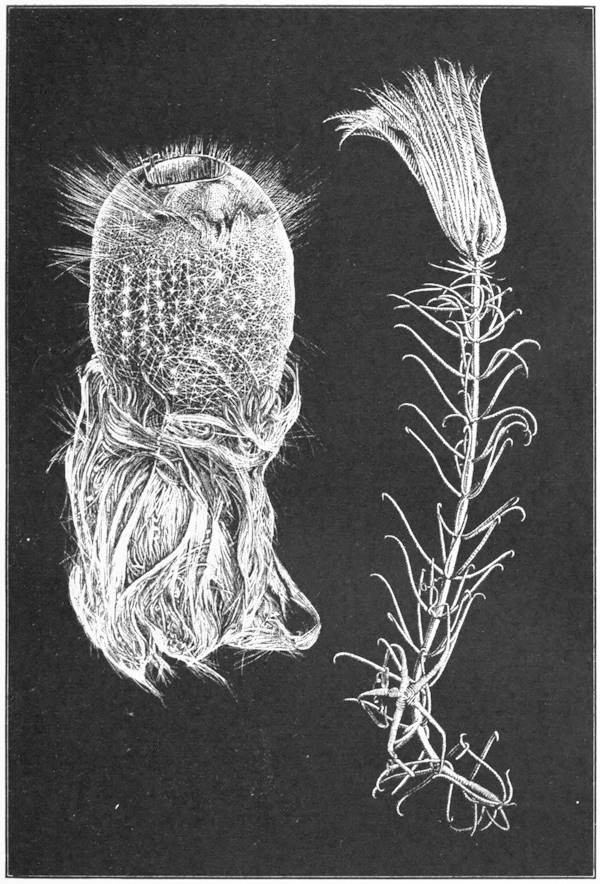
Two Strange Zoophytes
1, Holtenia Carpenteri, a species of glass sponge; 2, Pentacrinus Asteria, the only survivor of the Crinoid family
Now taking the last-named animal as the representative of his class, let us examine one of his inner antennæ first. It consists of a jointed stem and a terminating bristle; the latter furnished with small hairs common to the general surface of the body, and with long, delicate, membraneous filaments (setæ), often improperly called cilia, which are larger and much more delicate in structure than the ordinary hairs.
The basal joint is greatly enlarged: if it be carefully removed from its connection with the head, and broken open, it will be found to inclose in its cavity a still smaller chamber, with calcareous walls of a much more delicate character than the outer walls. This internal shell is considered by Mr. Spence Bate to be a cochlea, from its analogy, both in structure and supposed use, to the organ so named in the internal ear of man and other vertebrate animals. It is situated, as has been said, in the cavity of the basal joint of the internal antennæ, and is attached to the interior surface of its wall furthest from the median line of the crab. It has a tendency to a spiral form, but does not pass beyond the limits of a single convolution.
If this interior cell does indeed represent the cochlea of more highly constructed ears—to which it bears some resemblance, both in form and structure—then it seems to identify, beyond dispute, these inner or upper antennæ as the organs of hearing.
Now with this conclusion agrees well the manner in which the living animal makes use of the organs in question. The crab always carries them erect and elevated; and is incessantly striking the water with them, with a very peculiar jerking action, now and then vibrating, and, as it has been called, “twiddling” them. These antennæ, therefore, appear to be always on the watch: let the animal be at rest, let it be feeding, no matter, the superior antennæ are ever elevated and on constant guard.
The lengthened and delicate setæ with which they are furnished are, moreover, peculiarly adapted to receive and convey the most minute vibratory sensations from the medium in which they are suspended; and, on the whole, it seems to be satisfactorily settled by Mr. Spence Bate (to whose excellent memoir I am indebted for these explanatory details) that the inner antennæ are real ears.
Having thus taken our crab by the ears, we will endeavor next to tweak his nose. But stay, we must find it first. We turn our horny gentleman up, and in his flat ancient face we certainly discern little sign of a nasal organ. Our friend Mr. Bate must assist us again. He will tell us to look at the outer or lower antennæ. We will look accordingly, magnifier in hand, while he makes it clear to us that these are a pair of noses.
Each of these organs is formed of a stem consisting in general of five joints, and a filament of many minute joints. In the prawn and the lobster all the five joints of the stem are distinct; but in the crab the whole are, as it were, soldered together into a compact mass, with difficulty distinguishable into their constituent articulations; while in some species their position can be indicated only by the presence of the olfactory operculum.
This important little organ varies in its construction in the different families of Crustacea. In the crab it is a small movable appendage, situated at the point of junction between the second and third joints; it is attached to a long, calcareous, lever-like tendon, at the extreme limit of which is placed a set of muscles, by which it is opened and closed; to assist in which operation, at the angle of the operculum most distant from the central line of the animal are fixed two small hinges. When the operculum is raised, the internal surface is found to be perforated by a circular opening protected by a thin membrane.
In the prawn, shrimp, and lobster, there is no operculum, but only the orifice covered by a membrane, which is placed at the extremity of a small protuberance, and it is not capable of being withdrawn into the cavity of the antennæ, as in the crab.
In the latter animal, the little door, when it is raised, exposes the orifice in a direction pointing to the mouth; and where there is no door, still the direction of the opening is the same, inward and forward, answering to the position of the nostrils in the higher animals. In each case it is so situated that it is impossible for any food to be conveyed into the mouth without passing under this organ; and there most conveniently the animal is enabled to judge of the suitability of any substance for food, by raising the little door, and applying to the matter to be tested the sensitive membrane of the internal orifice.
Thus it is concluded that this lower or outer pair of antennæ are the proper organs of smell, as the upper and inner are of hearing.
The eyes, though constructed on the same general principles as those of insects, yet present some particulars worthy of your notice. In the crabs and lobsters they consist of numerous facets, behind each of which is a conical or prismatic lens, the round extremity of which is fitted into a transparent conical pit, corresponding to a vitreous body, while the conical extremity of these lenses is received into a kind of cup, formed by the filaments of the optic nerve. Each of these filaments, together with its cup, is surrounded by pigment matter in a sheath-like manner. To see this structure would require anatomical skill; but you may here examine with a low power portions of the cornea, or glassy exterior, of the eye of a crab and of a lobster. In the former, you see that the facets into which the cornea is divided are hexagonal, like those of most insects, but in the latter they are square.
But Crustacea have a far greater faculty of circumspection than insects have; for besides the extensive convexity and numerous facets of their eyes, these organs are placed at the extremity of shelly foot-stalks, which are themselves movable on hinges, capable of being projected at pleasure, of being moved in different directions, and of being packed snugly away, when not in active use, in certain grooves hollowed out expressly for them in the front margin of the shell.
REPTILES —Peter Mark Roget
The order of Batrachia, or Amphibious Reptiles, constitutes the first step in the transition from aquatic to terrestrial vertebrata. It is more particularly the function of respiration that requires to be modified, in consequence of the change of element in which the animal is to reside; and as if it had been necessary, conformably to the laws of animal creation, that this change should not be abruptly made, we find that Batrachian reptiles, with which this series commences, are constructed, at first, on the model of fishes; breathing the atmospheric air contained in the water by means of gills, and moving through the fluid by the same instruments of progression as fishes, which, indeed, they exactly resemble in every part of their mechanical conformation. The tadpole, which is the young of the frog, is, at first, not distinguishable in any circumstance of its internal skeleton, or in the disposition of its vital organs, from the class of fishes. The head, indeed, is enlarged, but the body immediately tapers to form a lengthened tail, by the prolongation of the spinal column, which presents a numerous series of coccygeal vertebræ, furnished with a vertical expansion of membrane to serve as a caudal fin, and with appropriate muscles for executing all the motions required in swimming.
Yet, with all this apparent conformity to the structure of a strictly aquatic animal, the tadpole contains within its organization the germs of a higher development. Preparations are silently making for a change of habitation, for the animal’s emerging from the waters, for the reception of atmospheric air into new cavities, for the acquisition of limbs suited to new modes of progression; in a word, for a terrestrial life, and for all the attributes and powers which belong to quadrupeds. The succession of forms, which these metamorphoses present, are in themselves exceedingly curious, and bear a remarkable analogy with the progress of the transformations of those insects, which in the first stages of their existence are aquatic. To this philosophic inquirer into the marvelous plans of creation, the series of changes which mark these singular transitions can not fail to be deeply interesting; and occurring, as we here find them, among a tribe of animals allied to the more perfect forms of organization, they afford us a better opportunity of exploring the secrets of their development by tracing them from the earlier stages of this complicated process, so full of mystery and of wonder.
The egg of the frog is a round mass of transparent nutritive jelly, in the centre of which appears a small black globule. By degrees this shapeless globule exhibits the appearance of a head and tail, and in this form it emerges from its prison, and moves briskly in the water. From the sides of the neck there grow out feathery tufts, which float loosely, and without protection, in the surrounding fluid. These, however, are mere temporary organs, for they serve the purposes of respiration only until the proper gills are formed, and they then shrink and become obliterated. The true gills, or branchiæ, are contained within the body, and are four in number on each side, constructed on a plan very similar to those of fishes. Retaining this aquatic constitution, the tadpole rapidly increases in size and in activity for several weeks. In the meantime the legs, of which no trace was at first apparent, have commenced their growth. The hindlegs are the first to make their appearance, showing their embryo forms within the transparent coverings of the hinder part of the trunk, just at the origin of the tail. These are soon succeeded by the forelegs, which exactly follow the hindlegs in all the stages of their development, until they have acquired their due proportion to the size of the trunk. The animal at this period wears a very ambiguous appearance, partaking of the forms both of the frog and of the lizard, and swimming both by the inflexions of the tail and the irregular impulses given by the feet. This interval is also employed by this amphibious being in acquiring the faculty of respiring atmospheric air. We observe it rising every now and then to the surface, and cultivating its acquaintance with that element, into which it is soon to be raised; occasionally taking in a mouthful of air, which is received into its newly developed lungs, and afterward discharging it in the form of a small bubble. When the necessary internal changes are at length completed, preparations are made for getting rid of the tail, which is now a useless member, and which, ceasing to be nourished, diminishes by degrees, leaving only a short stump, which is soon removed. The gills are by this time shrunk, and rapidly disappear, their function being superseded by the lungs, which have been called into play; and the animal now emerges from the water and begins a new mode of existence, having become a perfect frog. It still, however, retains its aquatic habits, and swims with great ease in the water by means of its hindfeet, which are very long and muscular, and of which the toes are furnished with a broad web, derived from a thin extension of the integuments.
No less curious are the changes which take place in all the other organs for the purpose of effecting the transformations rendered necessary by this entire alteration in all the external circumstances of that animal—this total reversal of its wants, of its habits, of its functions, and of its very constitution.
There are five toes in the foot, with sometimes the rudiment of a sixth: the anterior extremity has only four toes, which are without claws.
The necessity of employing the same instruments for progression in the water and on land is probably the cause which prevents their having the form best adapted for either function. The hindfeet of the frog, being well constructed for striking the water backward in swimming, are, in consequence, less capable of exerting a force sufficient to raise and support the weight of the body in walking: and this animal accordingly is exceedingly awkward in its attempt to walk. On a short level plane it can proceed only by leaps; an action which the length and great muscularity of the hindlegs particularly fit them for performing. The toad, on the other hand, whose hindlegs are short and feeble, walks better, but does not jump or swim so well as the frog.[5] The Hyla, or tree-frog, has the extremities of each of its toes expanded into a fleshy tubercle, approaching in the form of its concave surface to that of a sucker, and by the aid of which it fastens itself readily to the branches of trees, which it chiefly inhabits, and along which it runs with great agility.
The salamander is an animal of the same class as the frog, undergoing the same metamorphoses from the tadpole state. It differs much, however, in respect to the development of particular parts of the skeleton. The anterior extremities of the salamander make their appearance earlier than the hindlegs, and the tail remains as a permanent part of the structure. The land salamanders have a rounded tail, but the aquatic species, or Tritons, have it compressed vertically; thus retaining the fish-like form of the tadpole, and the same radiated disposition of the muscles.
In the class of serpents we see exemplified the greatest possible state of simplicity to which a vertebrated skeleton can be reduced; for it consists merely of a lengthened spinal column, with a head but little developed, and a series of ribs; but apparently destitute of limbs, and of the bones which usually connect those limbs with the trunk. In the conformation of the skull and bones of the face, they present strong analogies with Batrachian reptiles, and also with fishes, one tribe of which, namely, the apodous or anguilliform fishes, they greatly resemble by the length and flexibility of the spine. These peculiarities of conformation may be in a great measure traced to the mode of life for which they are destined. The food assigned to them is living prey, which they must attack and vanquish before they can convert it into nourishment. The usual mode in which the boa seizes and destroys its victims is by coiling the hinder part of its body round the trunk or branch of a tree, keeping the head and anterior half of the body disengaged; and then, by a sudden spring, fasten upon the defenceless object of its attack, and twining round its body so as to compress its chest and put a stop to its respiration. Venomous serpents, on the other hand, coil themselves into the smallest possible space, and suddenly darting upon the unsuspecting or fascinated straggler, inflict the quickly fatal wound.[6]
It is evident, from these considerations, that, in the absence of all external instruments of prehension and of progressive motion, it is necessary that the spine should be rendered extremely flexible, so as to adapt itself to a great variety of movements. This extraordinary flexibility is given, first, by the sub-division of the spinal column into a great number of small pieces; secondly, by the great freedom of their articulations; and thirdly, by the peculiar mobility and connections of the ribs.
Numerous as are the vertebræ of the eel, the spine of which consists of above a hundred, that of serpents is in general formed of a still greater number. In the rattlesnake (Crotalus horridus) there are about two hundred; and above three hundred have been counted in the spine of the Coluber natrix. These vertebræ are all united by ball and socket joints, as in the adult batrachia; the posterior rounded eminence of each vertebra being received into the anterior surface of the next.
While provision has thus been made for extent of motion, extraordinary care has at the same time been bestowed upon the security of the joints. Thus, we find them effectually protected from dislocation by the locking in, above and below, of the articular processes, and by the close investment of the capsular ligaments. The direction of the surfaces of these processes, and the shape and length of the spinous processes, are such as to allow of free lateral flexion, but to limit the vertical and longitudinal motions: and whatever degree of freedom of motion may exist between the adjoining vertebræ, that motion being multiplied along the column, the flexibility of the whole becomes very great, and admits of its assuming every degree and variety of curvature.
The mode in which the boa exerts a powerful pressure on the bodies of the animals it has seized, and which it has encircled within its folds, required the ribs to be movable laterally, as well as backward, in order to elude the force thus exerted. The broad convex surfaces on which they play give them, in this respect, an advantage which the ordinary mode of articulation would not have afforded. The spinous processes in this tribe of serpents are short and widely separated, so as to allow of flexion in every direction. In the rattlesnake, on the other hand, their length and oblique position are such as to limit the upward bending of the spinal column, although, in other respects, its motion is not restricted. The vertebræ at the end of the tail are furnished with broad transverse processes for the attachment of the first joints of the rattle.
But of whatever variety of flexions we may suppose the lengthened body of a serpent to be capable, it will, at first view, be difficult to conceive how these simple actions can be rendered subservient to the purposes of progression on land: and yet experience teaches us that few animals advance with more celerity on the surface of the ground, or dart upon their prey with greater promptitude and precision. They raise themselves without difficulty to the tops of the highest trees, and escape to their hiding-places with a quickness which eludes observation and baffles the efforts of their pursuers.
The solution of this enigma is to be sought for partly in the structure of the skin, which, in almost every species, is covered with numerous scales: and partly in the peculiar conformation of the ribs. The edges of the scales form rough projections, which are directed backward, so as to catch the surfaces of the bodies to which they are applied, and to prevent any retrograde motion. In some species, the integument is formed into annular plates, reminding us of the structures so prevalent among worms and myriapode animals. Each scale is connected with a particular set of muscular fibres, capable of raising or depressing it, so that, in this way, it is converted into a kind of toe; and thus the body rests upon the ground by numerous fixed points of support.
This support is further strengthened by the connection of the ribs with the abdominal scuta, or the scales on the under side of the body. The mode in which the ribs become auxiliary instruments of progressive motion was first noticed by Sir Joseph Banks. While he was watching the movements of a Coluber of unusual size which was exhibited in London, and was moving briskly along the carpet, he thought he saw the ribs come forward in succession, like the feet of a caterpillar. Sir Everard Home, to whom Sir Joseph Banks pointed out this circumstance, verified the fact by applying his hand below the serpent, and he then distinctly felt the ends of the ribs moving upon the palm, as the animal passed over it. The mode in which the ribs are articulated with the spine is peculiar, and has evidently been employed with reference to this particular function of the ribs, which here stand in place of the anterior and posterior extremities, possessed by most vertebrated animals, and characterizing the type of their osseous fabric. In the ordinary structure, the head of each rib has a convex surface, that plays either on the body of a single vertebra with which it is connected, or upon the two bodies of adjacent vertebræ: but in serpents the extremity of the head of the rib has two slightly concave articular surfaces, which play on a convex protuberance of the vertebra. This structure is attended with the advantage of preventing the ribs from interfering with the motions of the vertebræ upon one another. At their lower ends the ribs of one side have no connection with those of the other, nor are they joined to any bone analogous to a sternum: for, except in the Ophiosaurus and the blind-worm (Anguis fragilis), there is no vestige either of a sternum or scapula, in any animal of this class. Each rib terminates in a slender cartilage, tapering to a point, which rests, for its whole length, upon the upper surface of one of the scuta, or broad scales on the lower side of the body. These scuta, which are thus connected with the ends of the ribs, and which are moved by means of short muscles, may be compared to hoofs, while the ribs themselves may be considered as performing the office of legs. The ribs move in pairs; and the scutum under each pair, being carried along with it in all its motions, and laying hold of the ground by its projecting edge, becomes a fixed point for the advance of the body. This motion, Sir E. Home observes, is beautifully seen when a snake is climbing over an angle to get upon a flat surface. When the animal is moving on a plane, it alters its shape from a circular or oval form, to one that approaches to a triangle, of which the surface applied to the ground forms the base. Five sets of muscles are provided for the purpose of giving to the ribs the motions backward and forward, by which, as levers, they effect this species of progression. These muscles are disposed in regular layers; some passing over one or two ribs to be attached to the succeeding rib. In all snakes the ribs are continued backward much beyond the region occupied by the lungs; and although the anterior set are subservient to respiration, as well as to progressive motion, it is evident that all those posterior to the lungs must be employed solely for the latter of these purposes.
It is easy to understand how the serpent can slowly advance, by this creeping, or vermicular motion, consisting in reality of a succession of very short steps. But its progress is accelerated by the curvatures into which it throws its body; the fore part being fixed, and the hind part brought near to it; then, by a reverse process, the hind part is fixed, and the head projected forward. By an alternation of these movements, assisted by the actions of the ribs, the serpent is enabled to glide onward with considerable rapidity, and without attracting observation. But where greater expedition is necessary, they employ a more hurried kind of pace, although one which exposes them more to immediate view. The body, instead of being bent from side to side, is raised in one great arch, of which the two extremities alone touch the ground; and these being alternately employed as points of support, are made successively to approach and to separate from each other, the body being propelled by bringing it from a curved to a straight line.
There is yet a third kind of motion, which serpents occasionally resort to, when springing upon their prey, or when desirous of making a sudden escape from danger. They coil themselves into a spiral, by contracting all the muscles on one side of the body, and then, suddenly throwing into violent action all the muscles on the opposite side, the whole body is propelled, as if by the release and unwinding of a powerful spring, with an impulse which raises it to some height from the ground, and projects it to a considerable distance.
Thus these animals, to which nature has denied all external members, are yet capable, by the substitution of a different kind of mechanism, still constructed from the elements belonging to the primitive type of vertebrated animals, of silently gliding along the surface of the earth, of creeping up trees, of striding rapidly across the plain, and of executing leaps with a vigor and agility which astonish the beholder, and which, in ages of ignorance and superstition, were easily ascribed to supernatural agency.
The conformation of those parts of the frame which are subservient to progressive motion becomes more perfect in the class of Saurian reptiles, which includes all the lizard tribes. Several links of connection with the preceding class may still be noticed, marking the progress of development, as we follow the ascending series of animals. Rudiments of the bones of the extremities, and, also, of the sternum, make their appearance very visibly in the Ophiosaurus, and in the blind-worm (Anguis fragilis). The Siren lacertina has two diminutive forefeet, placed close to the head. The Lacerta lumbricoides of Linnæus, or the Bipes canaliculatus of Lacépède, which is found in Mexico, and of which a specimen is preserved in the collection at Paris, has a pair of very short feet, also placed near the head, and divided into four toes, with the rudiment of a fifth. The Lacerta bipes (Linn.), or Sheltopusic of Pallas, has, on the other hand, a pair of hindfeet only, but extremely small, together with rudiments of a scapula and clavicle concealed under the skin. Next in order must be placed the Chalcides, or snake-lizard, and the Lacerta seps, animals frequently met with in the south of France, and which have four minute feet, totally inefficient for the support of the body, and only remotely useful in contributing to its progressive undulations.
Ascending from these, we may form a series of reptiles, in which the development of the limbs becomes more and more extended, till we arrive at crocodiles, in which they attain a considerable degree of perfection. As a consequence of this greater development of the skeleton, we find the trunk divisible into separate regions. We now, for the first time, meet with a distinct neck, separating the head from the thorax, which is itself distinguishable from the abdomen; and a distinct sacrum is interposed between the lumbar and the caudal vertebræ.
The number of ribs differs in different species of Sauria: they are always articulated to the extremities of the transverse processes of the vertebræ, of which they appear to be continuations. Processes of this description also occur in the neck, attached to the transverse processes of the cervical vertebræ; and these have been regarded as cervical ribs. Their presence are impediments to the flexions of the neck; whence arises the difficulty which the crocodile appears to have in bending the neck, while turning round upon the animal he is pursuing. In the thorax, the ribs are connected with a broad sternum; but there are other ribs, both before and behind, which have no such termination, and therefore bear the name of false ribs.
The toes are usually provided with membranes spread between them, to assist in swimming. The form of the tail, which is generally compressed vertically, like that of fishes, though perhaps not to an equal degree, is another indication of their being formed for an aquatic life: for where the tail has this shape, we always find that the chief muscular power is bestowed upon it as an instrument of aquatic progression, producing, by its lateral flexions, a horizontal movement of the body. Crocodiles and alligators, for instance, which have this conformation, are comparatively weak when on land, and as soon as they have seized their prey their efforts are always directed to drag it with them into the water; knowing that when in their own element they can readily master its struggles, and dispose of it as they please.
In the Gecko tribe we find a particular mechanism provided for effecting the adhesion of the feet to the objects to which they are applied. It is somewhat analogous to that employed in the case of the house-fly, already mentioned. Each foot has five toes; all, except the thumb, terminated by a sharp curved claw. On the under surface of each toe there are as many as sixteen transverse slits, leading to the same number of cavities, or sacs; these open forward, and their external edge is serrated, appearing like the teeth of a small-toothed comb. All these parts, together with the cavities, are covered or lined with cuticle. Below them are large muscles which draw down the claw; and from the tendons of these muscles arise two sets of smaller muscles, situated so as to be put upon the stretch, when the former are in action. By the contractions of these muscles the orifices of the cavities, or sacs to which they belong, are opened, and the serrated edges applied accurately to the surfaces with which the feet are in contact. Sir Everard Home, in his account of this structure, compares it to the sucking disk of the Remora. By its means the animal is enabled to walk securely upon the smoothest surfaces, even in opposition to the tendency of gravity. It can run very quickly along the walls or ceiling of a building, in situations where it can not be supported by the feet, but must depend altogether upon the suspension derived from a succession of rapid and momentary adhesions.
Although the Sauria are better formed for progressive motion than any of the other orders of reptiles, yet the greater shortness and oblique position of their limbs, compared with those of mammiferous quadrupeds, obliges them in general to rest the weight of the trunk of the body on the ground, when they are not actually moving. None of these reptiles has any other kind of pace than that of walking or jumping; being incapable of performing either a trot or a gallop, in consequence of the obliquity of the plane in which their limbs move. The chameleon walks with great slowness and apparent difficulty; and we have seen that, in consequence of the structure of the bones of its neck, the crocodile, though capable of swift motion in a straight line, is unable to turn itself round quickly. The general type of these reptiles, having reference to an amphibious life, has not attained that exclusive adaptation to a terrestrial existence which we find in the higher orders of the Mammalia.
The order of Chelonian Reptiles, which comprises all the tribes of tortoises and turtles, appears to constitute an exception to the general laws of conformation which prevail among vertebrated animals: for instead of presenting a skeleton wholly internal, the trunk of the body is found to be inclosed on every side in a bony case, which leaves openings only for the head, the tail, and the fore and hind extremities. That portion of this osseous expansion which covers the back is termed the Carapace; and the flat plate which defends the lower part of the body is termed the Plastron. It is a form of structure that reminds us of the defence provided for animals very low in the scale of organization, such as the echinus, the crustacea, and the bivalve mollusca. Yet the substance which forms these strong bucklers, both above and below, is a real osseous structure, developed in the same manner as other bones, subject to all the changes and having all the properties of these structures. The great purpose which Nature seems to have had in view in the formation of the Chelonia is security; and for the attainment of this object she has constructed a vaulted and impenetrable roof, capable of resisting enormous pressures from without, and proof against any ordinary measures of assault. It is to the animal a strong castle, into which he can retire on the least alarm, and defy the efforts of his enemies to dislodge or annoy him.
These considerations supply us with a key to many of those apparent anomalies which can not fail to strike us in viewing the dispositions of the parts of the skeleton and the remarkable inversion they appear to have undergone, when compared with the usual arrangement. We find, however, on a more attentive examination, that all the bones composing the skeleton in other vertebrated animals exist also in the tortoise; and that the bony case which envelops all the other parts is really formed by an extension of the spinous processes of the vertebræ and ribs on the one side and of the usual pieces which compose the sternum on the other. The upper and lower plates thus formed are united at their edges by expansions of the sternocostal appendices, which become ossified. Thus, no new element has been created; but advantage has been taken of those already existing in the general type of the vertebrata, to modify their forms by giving them different degrees of relative development, and converting them, by these transformations, into a mechanism of a very different kind, and subservient to other objects than those to which they are usually applied. It is scarcely possible to have stronger proofs, if such were wanting, of the unity of plan which has regulated the formation of all animal structures than those afforded by the skeleton of the tortoise.
The first step taken to secure the relative immobility of the trunk is to unite in one rigid, bony column all its vertebræ, and to allow of motion only in those of the neck and of the tail. The former, accordingly, are all anchylosed together, leaving, indeed, traces of their original forms as separate vertebræ, but exhibiting no sutures at the place of junction. The canal for the spinal marrow is preserved, as usual, above the bodies of these coalesced vertebræ, and is formed by their united leaves; the arches being completed by the spinous processes. But these processes do not terminate in a crest as usual; they are further expanded in a lateral direction, forming flat pieces along the back, which are united to one another by sutures, and which are also joined to the expanded ribs, so as to form the continuous plane surface of the carapace. The transverse processes of the vertebræ are well marked, but, though firmly united to the ribs, do not give rise to them; for the ribs, which are flattened and expanded, so as to touch one another along their whole length, are inserted below, between the bodies of every two adjoining vertebræ; while above they are united by suture with the plates of the spinous processes. This change in the situation of the ribs is the consequence of the change in their office. When designed to be very movable, we find them attached either to the extremities of the transverse processes or to the articular surfaces of a single vertebra; but where solidity and security are aimed at, they are always inserted between the bodies of two vertebræ. It is remarkable, indeed, that a great number of the peculiarities which distinguish the conformation of the chelonia from that of other reptiles indicate an approach to the structure of birds; as if Nature had intended this small group of animals to be an intermediate link of gradation to that new and important type of animals destined for a very different mode of existence.
It is to be noticed, also, that as the plates, which form this investing case, are bony structures, they could not with any safety have been exposed to the action of the atmosphere. Hence we find them covered throughout with a thin, horny plate, originally a production of the integument. This substance is commonly known by the name of tortoise-shell.
The immobility of the trunk is compensated, as far as regards the safety of the head, by the great flexibility of the neck; which is composed of seven vertebræ, unencumbered by processes, and capable of taking a double curvature like the letter S, when the head is to be retracted within the carapace. These vertebræ are joined by the ball and socket articulation common to all the existing species of reptiles.[7] The articulation of the head with the neck is effected in the same manner; but it is interesting to remark that the occipital condyle, which is situated at the lower margin of the great aperture, though presenting a single convex surface, yet has that surface evidently divided into three parts; the two upper portions being lateral and the lower portion in the middle.
The singular conformation of the bones of the head, in the turtle, affords fresh evidence in support of the theory that these bones were originally vertebræ. The brain of the tortoise is exceedingly small; and yet the skull, when viewed from above, presents an appearance of great breadth, as if it inclosed a cavity of large dimensions. This great breadth of the head in the turtle gives the animal an aspect of superior intelligence, to which character, from the really diminutive size of its brain, it is in no respect entitled. As the turtle is unable to withdraw its head within the carapace, such extraordinary protection appears to have been necessary: for it is not met with in the tortoise, which has a carapace sufficiently capacious to give shelter to the head whenever occasion may require.
All the feet are joined obliquely to the limbs which support them, giving the animal an apparent awkwardness of gait, as if it were obliged to walk upon club feet. The impulse which they give being lateral and oblique, renders them more efficacious for progression in the water than on land: this circumstance, in conjunction with the constitutional torpor of the animal, sufficiently accounts for the excessive and, indeed, proverbial tardiness of its movements.
Security appears still to be the object aimed at in the mechanism of all other parts of the skeleton. After the head has been drawn in by the double or serpentine flexion of the neck, the knees are brought together and the whole limb withdrawn within the shell, the forelegs folding completely over the head, so as to cover and protect it most effectually.
Considerable differences may be noticed in the structure of the several species of Chelonia, according to the diversity of their habits. Tortoises which live on land require more complete protection by means of their shell than turtles, or Emydes, which dwell only in the water: hence the convexity of their carapace, the solidity of its ossification, its immovable connection with the plastron, and the complete shelter it affords to the head and limbs. Turtles, on the other hand, receiving support from the element in which they reside, require less provision to be made for these objects. Previously to the retraction of the head and limbs within the shell, the air is expelled from the large cavities of the lungs by the vigorous actions of the abdominal muscles, which exist in these animals as well as in all the vertebrata, although here they are covered by the bones, and compress the lungs by pushing the abdominal viscera against them. This sudden expulsion of air is the cause of the long-continued hissing sound which the tortoise emits while preparing to retreat into its stronghold.
The ribs, though they first assume the form of broad plates immovably united to the spine, when they have proceeded a certain distance separate from each other and resume their usual form; the intervening spaces between two adjacent ribs being here filled up by membrane. The plastron is united with the carapace by membrane likewise; and the sternum, instead of forming one broad plate of bone, has the intervals between its imperfectly developed elements also membraneous. All this renders the whole shell less compact, more flexible, and more feeble: but the movements of the animal are quicker and more energetic.
These characteristic differences between the aquatic Chelonia and those that live on land are still more strongly marked in the genus Trionyx, or soft tortoise, which is destitute of scales, and in which many of the pieces that are bony in the tortoise are replaced by simple cartilage or membrane.
The enormous weight of the shell of the turtle would be a serious impediment to the motion of this animal in the water, were there not some provision made for diminishing the specific gravity in the body. This purpose is answered by the great capacity of the lungs, which, when inflated with air, nearly fill the thorax, and give great buoyancy to the whole mass. Thus, wherever there exists a supposed inconvenience, dependent on the fulfilment of one condition, we are certain to meet with a compensation in the structure of some other part and in the mode of executing some other function. An express provision for giving buoyancy has been made in the construction of the shell of a species of tortoise inhabiting the coasts of the Seychelle Islands. The under surface of the shell, instead of being gently concave, as in land tortoises, has a deep circular concavity in the centre, above four inches in depth, which, when the animal goes into the water, retains a large volume of air, buoying up the whole mass while it remains in that element. The greater size of turtles, when compared with tortoises, is a further instance of the superior facility with which organic growth proceeds in aquatic than in land animals formed on the same model of construction.
THE CLASSIFICATION AND ORIGIN OF INSECTS —Lord Avebury
About sixty years ago the civil and ecclesiastical authorities of St. Fernando in Chili arrested a certain M. Renous on a charge of witchcraft because he kept some caterpillars which turned into butterflies. This was no doubt an extreme case of ignorance; it is now almost universally known that the great majority of insects quit the egg in a state very different from that which they ultimately assume; and the general statement in works on entomology has been that the life of an insect may be divided into four periods.
Thus, according to Kirby and Spence, “the states through which the insects pass are four: the egg, the larva, the pupa, and the imago.” Burmeister, also, says that, excluding certain very rare anomalies, “we may observe four distinct periods of existence in every insect—namely, those of the egg, the larva, the pupa, and the imago, or perfect insect.” In fact, however, the various groups of insects differ widely from one another in the metamorphoses they pass through: in some, as in the grasshoppers and crickets, the changes consist principally in a gradual increase of size, and in the acquisition of wings; while others, as, for instance, the common fly, acquire their full bulk in a form very different from that which they ultimately assume, and pass through a period of inaction in which not only is the whole form of the body altered, not only are legs and wings acquired, but even the internal organs themselves are almost entirely disintegrated and re-formed.
The following list gives the orders or principal groups into which the Class Insecta may be divided. I will not, indeed, here enter upon my own views, but will adopt the system given by Mr. Westwood in his excellent Introduction to the Modern Classification of Insects. He divides insects into thirteen groups, and with reference to eight of them it may be said that there is little difference of opinion among entomologists. These orders are by far the most numerous, and I have placed them in capital letters. As regards the other five there is still much difference of opinion. It must also be observed that Prof. Westwood omits the parasitic Anoplura, as well as the Thysanura and Collembola.
ORDERS OF INSECTS ACCORDING TO WESTWOOD
1. Hymenoptera Bees, Wasps, Ants, etc.
2. Strepsiptera Stylops, Zenos, etc.
3. Coleoptera Beetles.
4. Euplexoptera Earwigs.
5. Orthoptera Grasshoppers, Crickets, Cockroaches, etc.
6. Thysanoptera Thrips.
7. Neuroptera Ephemeras, etc.
8. Trichoptera Phryganea.
9. Diptera Flies and Gnats.
10. Aphaniptera Fleas.
11. Heteroptera Bugs.
12. Homoptera Aphis, Coccus, etc.
13. Lepidoptera Butterflies and Moths.
Of these thirteen orders, the eight which I have placed in capital letters—namely, the first, third, fifth, seventh, ninth, eleventh, twelfth, and thirteenth—are much the most important in the number and variety of their species; the other five form comparatively small groups. The Strepsiptera are minute insects, parasitic on Hymenoptera: Rossi, by whom they were discovered, regarded them as Hymenopterous; Lamarck placed them among the Diptera; by others they have been considered to be most closely allied to the Coleoptera, but they are now generally treated as an independent order.
The Euplexoptera or Earwigs are only too familiar to most of us. Linnæus classed them among the Coleoptera, from which, however, they differ in their transformations. Fabricius, Olivier, and Latreille regarded them as Orthoptera; but Dr. Leach, on account of the structure of their wings, considered them as forming the type of a distinct order, in which view he has been followed by Westwood, Kirby, and many other entomologists.
The Thysanoptera, consisting of the Linnæan genus Thrips, are minute insects well known to gardeners, differing from the Coleoptera in the nature of their metamorphoses, in which they resemble the Orthoptera and Hemiptera.
The Trichoptera, or Caddis worms, offer many points of resemblance to the Neuroptera, while in others they approach more nearly to the Lepidoptera. According to Westwood, the genus Phryganea “forms the connecting link between the Neuroptera and Lepidoptera.”
The last of these small aberrant orders is that of the Aphaniptera, constituted for the family Pulicidæ. In their transformations, as in many other respects, they closely resemble the Diptera. Strauss Durckheim indeed said that “la puce est un diptère sans ailes.” Westwood, however, regards it as constituting a separate order.
As indicated by the names of these orders, the structure of the wings affords extremely natural and convenient characters by which the various groups may be distinguished from one another. The mouth-parts also are very important; and, regarded from this point of view, the Insecta have been divided into two series—the Mandibulata and Haustellata, or mandibulate and suctorial groups, between which the Collembola occupy an intermediate position. These two series are:
Mandibulata. Haustellata.
Hymenoptera. Lepidoptera.
Strepsiptera. Diptera.
Coleoptera. Aphaniptera.
Euplexoptera. Hemiptera.
Orthoptera. Homoptera.
Trichoptera?
Thysanoptera?
Again—and this is the most important from my present point of view—insects have sometimes been divided into two other series, according to the nature of their metamorphoses: “Heteromorpha,” to use the terminology of Prof. Westwood, “or those in which there is no resemblance between the parent and the offspring; and Homomorpha, or those in which the larva resembles the imago, except in the absence of wings. In the former the larva is generally worm-like, of a soft and fleshy consistence, and furnished with a mouth, and often with six short legs attached in pairs to the three segments succeeding the head. In the Homomorpha, including the Orthoptera, Hemiptera, Homoptera, and certain Neuroptera, the body, legs, and antennæ are nearly similar in their form to those of the perfect insect, but the wings are wanting.”
Heteromorpha. Homomorpha.
Hymenoptera. Euplexoptera.
Strepsiptera. Orthoptera.
Coleoptera. Hemiptera.
Trichoptera. Homoptera.
Diptera. Thysanoptera.
Aphaniptera.
Lepidoptera.
Neuroptera.
But though the Homomorphic insects do not pass through such striking changes of form as the Heteromorphic, and are active throughout life, still it was until within the last few years generally (though erroneously) considered, that in them, as in the Heteromorpha, the life fell into four distinct periods; those of (1) the egg, (2) the larva, characterized by the absence of wings, (3) the pupa with imperfect wings, and (4) the imago, or perfect insect.