THE WILDERNESS-TRAINING (continued 3)
Reading edition
The forms of Moses and Eleazar were at last discerned, slowly descending the mountain-side; but Aaron was not with them. Upon Eleazar were the sacerdotal garments, showing that he had succeeded his father in the sacred office. As the people with heavy hearts gathered about their leader, Moses told them that Aaron had died in his arms upon Mount Hor, and that they there buried him. The congregation broke forth in mourning and lamentation, for they all loved Aaron, though they had so often caused him sorrow. “They mourned for Aaron thirty days, even all the house of Israel.”[743]
Concerning the burial of Israel’s high priest the Scriptures give only the simple record, “There Aaron died, and there he was buried.”[744] In what striking contrast to the customs of the present day was this burial, conducted according to the express command of God. In modern times the funeral services of a man of high position are often made the occasion of ostentatious and extravagant display. When Aaron died, one of the most illustrious men that ever lived, there were only two of his nearest friends to witness his death and to attend his burial. And that lonely grave upon Mount Hor was forever hidden from the sight of Israel. God is not honored in the great display so often made over the dead, and the extravagant expense incurred in returning their bodies to the dust.
The whole congregation sorrowed for Aaron, yet they could not feel the loss so keenly as did Moses. The death of Aaron forcibly reminded Moses that his own end was near; but short as the time of his stay on earth must be, he deeply felt the loss of his constant companion,—the one who had shared his joys and sorrows, his hopes and fears, for so many long years. Moses must now continue the work alone; but he knew that God was his friend, and upon him he leaned more heavily.
Soon after leaving Mount Hor, the Israelites suffered defeat in an engagement with Arad, one of the Canaanite kings. But as they earnestly sought help from God, divine aid was granted them, and their enemies were routed. This victory, instead of inspiring gratitude, and leading the people to feel their dependence upon God, made them boastful and self-confident. Soon they fell into the old habit of murmuring. They were now dissatisfied because the armies of Israel had not been permitted to advance upon Canaan immediately after their rebellion at the report of the spies nearly forty years before. They pronounced their long sojourn in the wilderness an unnecessary delay, reasoning that they might have conquered their enemies as easily heretofore as now.
As they continued their journey toward the south, their route lay through a hot, sandy valley, destitute of shade or vegetation. The way seemed long and difficult, and they suffered from weariness and thirst. Again they failed to endure the test of their faith and patience. By continually dwelling on the dark side of their experiences, they separated themselves farther and farther from God. They lost sight of the fact that but for their murmuring when the water ceased at Kadesh, they would have been spared the journey around Edom. God had purposed better things for them. Their hearts should have been filled with gratitude to him that he had punished their sin so lightly. But instead of this, they flattered themselves that if God and Moses had not interfered, they might now have been in possession of the promised land. After bringing trouble upon themselves, making their lot altogether harder than God designed, they charged all their misfortunes upon him. Thus they cherished bitter thoughts concerning his dealings with them, and finally they became discontented with everything. Egypt looked brighter and more desirable than liberty and the land to which God was leading them.
As the Israelites indulged the spirit of discontent, they were disposed to find fault even with their blessings. “And the people spake against God, and against Moses, Wherefore have ye brought us up out of Egypt to die in the wilderness? for there is no bread, neither is there any water; and our soul loatheth this light bread.”[745]
Moses faithfully set before the people their great sin. It was God’s power alone that had preserved them in “that great and terrible wilderness, wherein were fiery serpents, and scorpions, and drought, where there was no water.”[746] Every day of their travels they had been kept by a miracle of divine mercy. In all the way of God’s leading, they had found water to refresh the thirsty, bread from heaven to satisfy their hunger, and peace and safety under the shadowy cloud by day and the pillar of fire by night. Angels had ministered to them as they climbed the rocky heights or threaded the rugged paths of the wilderness. Notwithstanding the hardships they had endured, there was not a feeble one in all their ranks. Their feet had not swollen in their long journeys, neither had their clothes grown old. God had subdued before them the fierce beasts of prey and the venomous reptiles of the forest and the desert. If with all these tokens of his love the people still continued to complain, the Lord would withdraw his protection until they should be led to appreciate his merciful care, and return to him with repentance and humiliation.
Because they had been shielded by divine power, they had not realized the countless dangers by which they were continually surrounded. In their ingratitude and unbelief they had anticipated death, and now the Lord permitted death to come upon them. The poisonous serpents that infested the wilderness were called fiery serpents, on account of the terrible effects produced by their sting, it causing violent inflammation and speedy death. As the protecting hand of God was removed from Israel, great numbers of the people were attacked by these venomous creatures.
Now there was terror and confusion throughout the encampment. In almost every tent were the dying or the dead. None were secure. Often the silence of night was broken by piercing cries that told of fresh victims. All were busy in ministering to the sufferers, or with agonizing care endeavoring to protect those who were not yet stricken. No murmuring now escaped their lips. When compared with the present suffering, their former difficulties and trials seemed unworthy of a thought.
The people now humbled themselves before God. They came to Moses with their confessions and entreaties. “We have sinned,” they said, “for we have spoken against the Lord, and against thee.”[747] Only a little before, they had accused him of being their worst enemy, the cause of all their distress and afflictions. But even when the words were upon their lips, they knew that the charge was false; and as soon as real trouble came, they fled to him as the only one who could intercede with God for them. “Pray unto the Lord,” was their cry, “that he take away the serpents from us.”
Moses was divinely commanded to make a serpent of brass resembling the living ones, and to elevate it among the people. To this, all who had been bitten were to look, and they would find relief. He did so, and the joyful news was sounded throughout the encampment, that all who had been bitten might look upon the brazen serpent and live. Many had already died, and when Moses raised the serpent upon the pole, some would not believe that merely gazing upon that metallic image would heal them; these perished in their unbelief. Yet there were many who had faith in the provision which God had made. Fathers, mothers, brothers, and sisters were anxiously engaged in helping their suffering, dying friends to fix their languid eyes upon the serpent. If these, though faint and dying, could only once look, they were perfectly restored.
The people well knew that there was no power in the serpent of brass to cause such a change in those who looked upon it. The healing virtue was from God alone. In his wisdom he chose this way of displaying his power. By this simple means the people were made to realize that this affliction had been brought upon them by their sins. They were also assured that while obeying God they had no reason to fear; for he would preserve them.
The lifting up of the brazen serpent was to teach Israel an important lesson. They could not save themselves from the fatal effect of the poison in their wounds. God alone was able to heal them. Yet they were required to show their faith in the provision which he had made. They must look, in order to live. It was their faith that was acceptable with God, and by looking upon the serpent their faith was shown. They knew that there was no virtue in the serpent itself, but it was a symbol of Christ; and the necessity of faith in his merits was thus presented to their minds. Heretofore many had brought their offerings to God, and had felt that in so doing they made ample atonement for their sins. They did not rely upon the Redeemer to come, of whom these offerings were only a type. The Lord would now teach them that their sacrifices, in themselves, had no more power or virtue than the serpent of brass, but were, like that, to lead their minds to Christ, the great sin-offering.
“As Moses lifted up the serpent in the wilderness,” even so was “the Son of man lifted up, that whosoever believeth in him should not perish, but have eternal life.”[748] All who have ever lived upon the earth have felt the deadly sting of “that old serpent, called the devil, and Satan.”[749] The fatal effects of sin can be removed only by the provision that God has made. The Israelites saved their lives by looking upon the uplifted serpent. That look implied faith. They lived because they believed God’s word, and trusted in the means provided for their recovery. So the sinner may look to Christ, and live. He receives pardon through faith in the atoning sacrifice. Unlike the inert and lifeless symbol, Christ has power and virtue in himself to heal the repenting sinner.
While the sinner cannot save himself, he still has something to do to secure salvation. “Him that cometh to me,” says Christ, “I will in no wise cast out.”[750] But we must come to him; and when we repent of our sins, we must believe that he accepts and pardons us. Faith is the gift of God, but the power to exercise it is ours. Faith is the hand by which the soul takes hold upon the divine offers of grace and mercy.
Nothing but the righteousness of Christ can entitle us to one of the blessings of the covenant of grace. There are many who have long desired and tried to obtain these blessings, but have not received them, because they have cherished the idea that they could do something to make themselves worthy of them. They have not looked away from self, believing that Jesus is an all-sufficient Saviour. We must not think that our own merits will save us; Christ is our only hope of salvation. “For there is none other name under heaven given among men, whereby we must be saved.”[751]
When we trust God fully, when we rely upon the merits of Jesus as a sin-pardoning Saviour, we shall receive all the help that we can desire. Let none look to self, as though they had power to save themselves. Jesus died for us because we were helpless to do this. In him is our hope, our justification, our righteousness. When we see our sinfulness, we should not despond, and fear that we have no Saviour, or that he has no thoughts of mercy toward us. At this very time he is inviting us to come to him in our helplessness, and be saved.
Many of the Israelites saw no help in the remedy which Heaven had appointed. The dead and dying were all around them, and they knew that, without divine aid, their own fate was certain; but they continued to lament their wounds, their pains, their sure death, until their strength was gone, and their eyes were glazed, when they might have had instant healing. If we are conscious of our needs, we should not devote all our powers to mourning over them. While we realize our helpless condition without Christ, we are not to yield to discouragement, but rely upon the merits of a crucified and risen Saviour. Look and live. Jesus has pledged his word; he will save all who come unto him. Though millions who need to be healed will reject his offered mercy, not one who trusts in his merits will be left to perish.
Many are unwilling to accept of Christ until the whole mystery of the plan of salvation shall be made plain to them. They refuse the look of faith, although they see that thousands have looked, and have felt the efficacy of looking, to the cross of Christ. Many wander in the mazes of philosophy, in search of reasons and evidence which they will never find, while they reject the evidence which God has been pleased to give. They refuse to walk in the light of the Sun of Righteousness, until the reason of its shining shall be explained. All who persist in this course will fail to come to a knowledge of the truth. God will never remove every occasion for doubt. He gives sufficient evidence on which to base faith, and if this is not accepted, the mind is left in darkness. If those who were bitten by the serpents had stopped to doubt and question before they would consent to look, they would have perished. It is our duty, first, to look; and the look of faith will give us life.

THE CONQUEST OF BASHAN—39

After passing to the south of Edom, the Israelites turned northward, and again set their faces toward the promised land. Their route now lay over a vast, elevated plain, swept by cool, fresh breezes from the hills. It was a welcome change from the parched valley through which they had been traveling, and they pressed forward, buoyant and hopeful. Having crossed the brook Zered, they passed to the east of the land of Moab; for the command had been given, “Distress not the Moabites, neither contend with them in battle; for I will not give thee of their land for a possession; because I have given Ar unto the children of Lot.”[760] And the same direction was repeated concerning the Ammonites, who were also descendants of Lot.
Still pushing northward, the hosts of Israel soon reached the country of the Amorites. This strong and warlike people originally occupied the southern part of the land of Canaan; but increasing in numbers, they crossed the Jordan, made war upon the Moabites, and gained possession of a portion of their territory. Here they had settled, holding undisputed sway over all the land from the Arnon as far north as the Jabbok. The route to the Jordan which the Israelites desired to pursue, lay directly through this territory, and Moses sent a friendly message to Sihon, the Amorite king, at his capital: “Let me pass through thy land; I will go along by the highway, I will neither turn unto the right hand nor to the left. Thou shalt sell me meat for money, that I may eat; and give me water for money, that I may drink; only I will pass through on my feet.” The answer was a decided refusal; and all the hosts of the Amorites were summoned to oppose the progress of the invaders. This formidable army struck terror to the Israelites, who were poorly prepared for an encounter with well-armed and well-disciplined forces. So far as skill in warfare was concerned, their enemies had the advantage. To all human appearance, a speedy end would be made of Israel.
But Moses kept his gaze fixed upon the cloudy pillar, and encouraged the people with the thought that the token of God’s presence was still with them. At the same time he directed them to do all that human power could do in preparing for war. Their enemies were eager for battle, and confident that they would blot out the unprepared Israelites from the land. But from the Possessor of all lands the mandate had gone forth to the leader of Israel: “Rise ye up, take your journey, and pass over the river Arnon. Behold, I have given into thine hand Sihon the Amorite, king of Heshbon, and his land; begin to possess it, and contend with him in battle. This day will I begin to put the dread of thee and the fear of thee upon the nations that are under the whole heaven, who shall hear report of thee, and shall tremble, and be in anguish because of thee.”
These nations on the borders of Canaan would have been spared, had they not stood, in defiance of God’s word, to oppose the progress of Israel. The Lord had shown himself to be long-suffering, of great kindness and tender pity, even to these heathen peoples. When Abraham was shown in vision that his seed, the children of Israel, should be strangers in a strange land four hundred years, the Lord gave him the promise, “In the fourth generation they shall come hither again; for the iniquity of the Amorites is not yet full.”[761] Although the Amorites were idolaters, whose life was justly forfeited by their great wickedness, God spared them four hundred years to give them unmistakable evidence that he was the only true God, the Maker of heaven and earth. All his wonders in bringing Israel from Egypt were known to them. Sufficient evidence was given; they might have known the truth, had they been willing to turn from their idolatry and licentiousness. But they rejected the light, and clung to their idols.
When the Lord brought his people a second time to the borders of Canaan, additional evidence of his power was granted to those heathen nations. They saw that God was with Israel in the victory gained over King Arad and the Canaanites, and in the miracle wrought to save those who were perishing from the sting of the serpents. Although the Israelites had been refused a passage through the land of Edom, thus being compelled to take the long and difficult route by the Red Sea, yet in all their journeyings and encampments, past the land of Edom, of Moab and Ammon, they had shown no hostility, and had done no injury to the people or their possessions. On reaching the border of the Amorites, Israel had asked permission only to travel directly through the country, promising to observe the same rules that had governed their intercourse with other nations. When the Amorite king refused this courteous solicitation, and defiantly gathered his hosts for battle, their cup of iniquity was full, and God would now exercise his power for their overthrow.
The Israelites crossed the river Arnon, and advanced upon the foe. An engagement took place, in which the armies of Israel were victorious; and following up the advantage gained, they were soon in possession of the country of the Amorites. It was the Captain of the Lord’s host who vanquished the enemies of his people; and he would have done the same thirty-eight years before, had Israel trusted in him.
Filled with hope and courage, the army of Israel eagerly pressed forward, and, still journeying northward, they soon reached a country that might well test their courage and their faith in God. Before them lay the powerful and populous kingdom of Bashan, crowded with great stone cities that to this day excite the wonder of the world,—“threescore cities ... with high walls, gates, and bars, besides unwalled towns a great many.”[762] The houses were constructed of huge black stones, of such stupendous size as to make the buildings absolutely impregnable to any force that in those times could have been brought against them. It was a country filled with wild caverns, lofty precipices, yawning gulfs, and rocky strongholds. The inhabitants of this land, descendants from a giant race, were themselves of marvelous size and strength, and so distinguished for violence and cruelty as to be the terror of all surrounding nations; while Og, the king of the country, was remarkable for size and prowess, even in a nation of giants.
But the cloudy pillar moved forward, and following its guidance the Hebrew hosts advanced to Edrei, where the giant king, with his forces, awaited their approach. Og had skillfully chosen the place of battle. The city of Edrei was situated upon the border of a table-land rising abruptly from the plain, and covered with jagged, volcanic rocks. It could be approached only by narrow pathways, steep, and difficult of ascent. In case of defeat, his forces could find refuge in that wilderness of rocks where it would be impossible for strangers to follow them.
Confident of success, the king came forth with an immense army upon the open plain; while shouts of defiance were heard from the table-land above, where might be seen the spears of thousands, eager for the fray. When the Hebrews looked upon the lofty form of that giant of giants towering above the soldiers of his army; when they saw the hosts that surrounded him, and beheld the seemingly impregnable fortress, behind which unseen thousands were entrenched, the hearts of many in Israel quaked with fear. But Moses was calm and firm; the Lord had said concerning the king of Bashan, “Fear him not; for I will deliver him, and all his people, and his land, into thy hand; and thou shalt do unto him as thou didst unto Sihon king of the Amorites, which dwelt at Heshbon.”[763]
The calm faith of their leader inspired the people with confidence in God. They trusted all to his omnipotent arm, and he did not fail them. Not mighty giants nor walled cities, armed hosts nor rocky fortresses, could stand before the Captain of the Lord’s host. The Lord led the army; the Lord discomfited the enemy; the Lord conquered in behalf of Israel. The giant king and his army were destroyed; and the Israelites soon took possession of the whole country. Thus was blotted from the earth that strange people, who had given themselves up to iniquity and abominable idolatry.
In the conquest of Gilead and Bashan there were many who recalled the events which nearly forty years before, had, in Kadesh, doomed Israel to the long desert wandering. They saw that the report of the spies concerning the promised land was in many respects correct. The cities were walled and very great, and were inhabited by giants, in comparison with whom the Hebrews were mere pigmies. But they could now see that the fatal mistake of their fathers had been in distrusting the power of God. This alone had prevented them from at once entering the goodly land.
When they were at the first preparing to enter Canaan, the undertaking was attended with far less difficulty than now. God had promised his people that if they would obey his voice he would go before them and fight for them; and he would also send hornets to drive out the inhabitants of the land. The fears of the nations had not been generally aroused, and little preparation had been made to oppose their progress. But when the Lord now bade Israel go forward, they must advance against alert and powerful foes, and must contend with large and well-trained armies that had been preparing to resist their approach.
In their contests with Og and Sihon the people were brought to the same test beneath which their fathers had so signally failed. But the trial was now far more severe then when God had commanded Israel to go forward. The difficulties in their way had greatly increased since they refused to advance when bidden to do so in the name of the Lord. It is thus that God still tests his people. And if they fail to endure the trial, he brings them again to the same point, and the second time the trial will come closer, and be more severe than the preceding. This is continued until they bear the test, or, if they are still rebellious, God withdraws his light from them, and leaves them in darkness.
The Hebrews now remembered how once before, when their forces had gone to battle, they had been routed, and thousands slain. But they had then gone in direct opposition to the command of God. They had gone out without Moses, God’s appointed leader, without the cloudy pillar, the symbol of the divine presence, and without the ark. But now Moses was with them, strengthening their hearts with words of hope and faith; the Son of God, enshrined in the cloudy pillar, led the way; and the sacred ark accompanied the host. This experience has a lesson for us. The mighty God of Israel is our God. In him we may trust, and if we obey his requirements he will work for us in as signal a manner as he did for his ancient people. Every one who seeks to follow the path of duty will at times be assailed by doubt and unbelief. The way will sometimes be so barred by obstacles, apparently insurmountable, as to dishearten those who will yield to discouragement; but God is saying to such, Go forward. Do your duty at any cost. The difficulties that seem so formidable, that fill your soul with dread, will vanish as you move forward in the path of obedience, humbly trusting in God.
BALAAM—40
Returning to the Jordan from the conquest of Bashan, the Israelites, in preparation for the immediate invasion of Canaan encamped beside the river, above its entrance into the Dead Sea, and just opposite the plain of Jericho. They were upon the very borders of Moab, and the Moabites were filled with terror at the close proximity of the invaders.
The people of Moab had not been molested by Israel, yet they had watched with troubled forebodings all that had taken place in the surrounding countries. The Amorites, before whom they had been forced to retreat, had been conquered by the Hebrews, and the territory which the Amorites had wrested from Moab was now in the possession of Israel. The hosts of Bashan had yielded before the mysterious power enshrouded in the cloudy pillar, and the giant strongholds were occupied by the Hebrews. The Moabites dared not risk an attack upon them; an appeal to arms was hopeless in face of the supernatural agencies that wrought in their behalf. But they determined, as Pharaoh had done, to enlist the power of sorcery to counteract the work of God. They would bring a curse upon Israel.
The people of Moab were closely connected with the Midianites, both by the ties of nationality and religion. And Balak, the king of Moab, aroused the fears of the kindred people, and secured their co-operation in his designs against Israel, by the message, “Now shall this company lick up all that are round about us, as the ox licketh up the grass of the field.”[770] Balaam, an inhabitant of Mesopotamia, was reported to possess supernatural powers, and his fame had reached to the land of Moab. It was determined to call him to their aid. Accordingly, messengers of “the elders of Moab and of the elders of Midian,” were sent to secure his divinations and enchantments against Israel.
The ambassadors at once set out on their long journey over the mountains and across the deserts, to Mesopotamia; and upon finding Balaam, they delivered to him the message of their king: “Behold, there is a people come out from Egypt; behold, they cover the face of the earth, and they abide over against me. Come now therefore, I pray thee, curse me this people; for they are too mighty for me. Peradventure I shall prevail, that we may smite them, and that I may drive them out of the land; for I wot that he whom thou blessest is blessed, and he whom thou cursest is cursed.”
Balaam was once a good man and a prophet of God; but he had apostatized, and had given himself up to covetousness; yet he still professed to be a servant of the Most High. He was not ignorant of God’s work in behalf of Israel; and when the messengers announced their errand, he well knew that it was his duty to refuse the rewards of Balak, and to dismiss the ambassadors. But he ventured to dally with temptation, and urged the messengers to tarry with him that night, declaring that he could give no decided answer till he had asked counsel of the Lord. Balaam knew that his curse could not harm Israel. God was on their side; and so long as they were true to him, no adverse power of earth or hell could prevail against them. But his pride was flattered by the words of the ambassadors, “He whom thou blessest is blessed, and he whom thou cursest is cursed.” The bribe of costly gifts and prospective exaltation excited his covetousness. He greedily accepted the offered treasures, and then, while professing strict obedience to the will of God, he tried to comply with the desires of Balak.
In the night season the angel of God came to Balaam, with the message, “Thou shalt not go with them; thou shalt not curse the people; for they are blessed.”
In the morning, Balaam reluctantly dismissed the messengers; but he did not tell them what the Lord had said. Angry that his visions of gain and honor had been suddenly dispelled, he petulantly exclaimed, “Get you into your land; for the Lord refuseth to give me leave to go with you.”
Balaam “loved the wages of unrighteousness.”[771] The sin of covetousness, which God declares to be idolatry, had made him a time-server, and through this one fault, Satan gained entire control of him. It was this that caused his ruin. The tempter is ever presenting worldly gain and honor to entice men from the service of God. He tells them it is their over-conscientiousness that keeps them from prosperity. Thus many are induced to venture out of the path of strict integrity. One wrong step makes the next easier, and they become more and more presumptuous. They will do and dare most terrible things when once they have given themselves to the control of avarice and a desire for power. Many flatter themselves that they can depart from strict integrity for a time, for the sake of some worldly advantage, and that having gained their object, they can change their course when they please. Such are entangling themselves in the snare of Satan, and it is seldom that they escape.
When the messengers reported to Balak the prophet’s refusal to accompany them, they did not intimate that God had forbidden him. Supposing that Balaam’s delay was merely to secure a richer reward, the king sent princes more in number and more honorable than the first, with promises of higher honors, and with authority to concede to any terms that Balaam might demand. Balak’s urgent message to the prophet was, “Let nothing, I pray thee, hinder thee from coming unto me; for I will promote thee unto very great honor, and I will do whatsoever thou sayest unto me. Come therefore, I pray thee, curse me this people.”
A second time Balaam was tested. In response to the solicitations of the ambassadors, he professed great conscientiousness and integrity, assuring them that no amount of gold and silver could induce him to go contrary to the will of God. But he longed to comply with the king’s request; and although the will of God had already been definitely made known to him, he urged the messengers to tarry, that he might further inquire of God; as though the Infinite One were a man, to be persuaded.
In the night season, the Lord appeared to Balaam, and said, “If the men come to call thee, rise up, and go with them; but yet the word which I shall say unto thee, that shalt thou do.” Thus far the Lord would permit Balaam to follow his own will, because he was determined upon it. He did not seek to do the will of God, but chose his own course, and then endeavored to secure the sanction of the Lord.
There are thousands at the present day who are pursuing a similar course. They would have no difficulty in understanding their duty if it were in harmony with their inclinations. It is plainly set before them in the Bible, or is clearly indicated by circumstances and reason. But because these evidences are contrary to their desires and inclinations, they frequently set them aside, and presume to go to God to learn their duty. With great apparent conscientiousness, they pray long and earnestly for light. But God will not be trifled with. He often permits such persons to follow their own desires, and to suffer the result. “My people would not hearken to my voice.... So I gave them up unto their own hearts’ lust; and they walked in their own counsels.”[772] When one clearly sees a duty, let him not presume to go to God with the prayer that he may be excused from performing it. He should rather, with a humble, submissive spirit, ask for divine strength and wisdom to meet its claims.
The Moabites were a degraded, idolatrous people; yet according to the light which they had received, their guilt was not so great in the sight of Heaven as was that of Balaam. As he professed to be God’s prophet, however, all he should say would be supposed to be uttered by divine authority. Hence he was not to be permitted to speak as he chose, but must deliver the message which God should give him. “The word which I shall say unto thee, that shalt thou do,” was the divine command.
Balaam had received permission to go with the messengers from Moab, if they came in the morning to call him. But annoyed at his delay, and expecting another refusal, they set out on their homeward journey without further consultation with him. Every excuse for complying with the request of Balak had now been removed. But Balaam was determined to secure the reward; and taking the beast upon which he was accustomed to ride, he set out on the journey. He feared that even now the divine permission might be withdrawn, and he pressed eagerly forward, impatient lest he should by some means fail to gain the coveted reward.
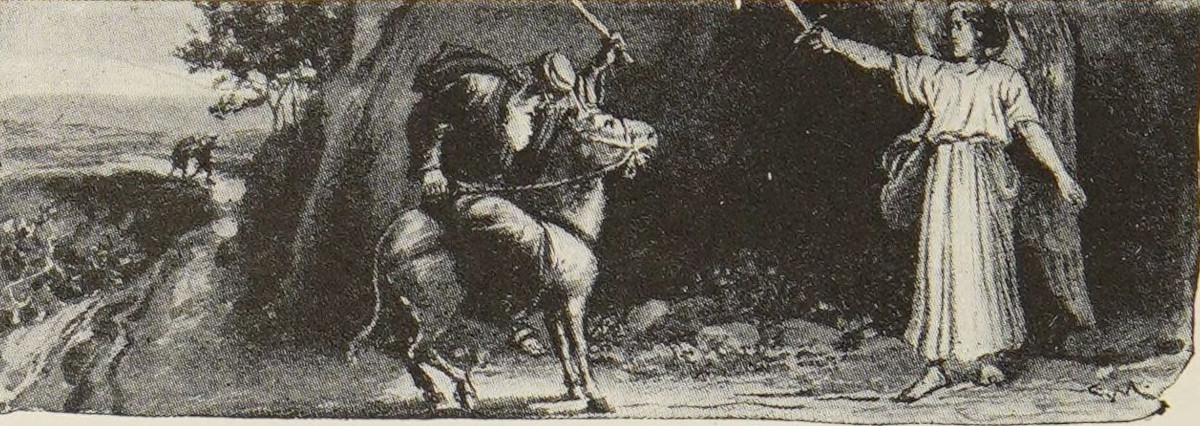
But “the angel of the Lord stood in the way for an adversary against him.” The animal saw the divine messenger, who was unperceived by the man, and turned aside from the highway into a field. With cruel blows, Balaam brought the beast back into the path; but again, in a narrow place shut in by walls, the angel appeared, and the animal, trying to avoid the menacing figure, crushed her master’s foot against the wall. Balaam was blinded to the heavenly interposition, and knew not that God was obstructing his path. The man became exasperated, and beating the ass unmercifully, forced it to proceed.
Again, “in a narrow place, where there was no way to turn either to the right hand or to the left,” the angel appeared, as before, in a threatening attitude; and the poor beast, trembling with terror, made a full stop, and fell to the earth under its rider. Balaam’s rage was unbounded, and with his staff he smote the animal more cruelly than before. God now opened its mouth, and by “the dumb ass speaking with man’s voice,” he “forbade the madness of the prophet.”[773] “What have I done unto thee,” it said, “that thou hast smitten me these three times?”
Furious at being thus hindered in his journey, Balaam answered the beast as he would have addressed an intelligent being,—“Because thou has mocked me. I would there were a sword in mine hand, for now would I kill thee.” Here was a professed magician, on his way to pronounce a curse upon a whole people with the intent to paralyze their strength, while he had not power even to slay the animal upon which he rode!
The eyes of Balaam were now opened, and he beheld the angel of God standing with drawn sword ready to slay him. In terror “he bowed down his head, and fell flat on his face.” The angel said to him, “Wherefore hast thou smitten thine ass these three times? Behold, I went out to withstand thee, because thy way is perverse before me. And the ass saw me, and turned from me these three times. Unless she had turned from me, surely now also I had slain thee, and saved her alive.”
Balaam owed the preservation of his life to the poor animal that he had treated so cruelly. The man who claimed to be a prophet of the Lord, who declared that his “eyes were open,” and he saw the “vision of the Almighty,” was so blinded by covetousness and ambition, that he could not discern the angel of God visible to his beast. “The god of this world hath blinded the minds of them which believe not.”[774] How many are thus blinded! They rush on in forbidden paths, transgressing the divine law, and cannot discern that God and his angels are against them. Like Balaam they are angry at those who would prevent their ruin.
Balaam had given evidence of the spirit that controlled him, by his treatment of his beast. “A righteous man regardeth the life of his beast; but the tender mercies of the wicked are cruel.”[775] Few realize as they should the sinfulness of abusing animals or leaving them to suffer from neglect. He who created man made the lower animals also, and “his tender mercies are over all his works.”[776] The animals were created to serve man, but he has no right to cause them pain by harsh treatment or cruel exaction.
It is because of man’s sin that “the whole creation groaneth and travaileth in pain together.”[777] Suffering and death were thus entailed, not only upon the human race, but upon the animals. Surely, then, it becomes man to seek to lighten, instead of increasing, the weight of suffering which his transgression has brought upon God’s creatures. He who will abuse animals because he has them in his power, is both a coward and a tyrant. A disposition to cause pain, whether to our fellow-men or to the brute creation, is satanic. Many do not realize that their cruelty will ever be known, because the poor dumb animals cannot reveal it. But could the eyes of these men be opened, as were those of Balaam, they would see an angel of God standing as a witness, to testify against them in the courts above. A record goes up to heaven, and a day is coming when judgment will be pronounced against those who abuse God’s creatures.
When he beheld the messenger of God, Balaam exclaimed in terror, “I have sinned; for I knew not that thou stoodest in the way against me. Now therefore, if it displease thee, I will get me back again.” The Lord suffered him to proceed on his journey, but gave him to understand that his words should be controlled by divine power. God would give evidence to Moab that the Hebrews were under the guardianship of Heaven; and this he did effectually when he showed them how powerless Balaam was even to utter a curse against them without divine permission.
The king of Moab, being informed of the approach of Balaam, went out with a large retinue to the borders of his kingdom, to receive him. When he expressed his astonishment at Balaam’s delay, in view of the rich rewards awaiting him, the prophet’s answer was, “Lo, I am come unto thee; have I now any power at all to say anything? The word that God putteth in my mouth, that shall I speak.” Balaam greatly regretted this restriction; he feared that his purpose could not be carried out, because the Lord’s controlling power was upon him.
With great pomp, the king, with the chief dignitaries of his kingdom, escorted Balaam to “the high places of Baal,” from which he could survey the Hebrew host. Behold the prophet as he stands upon the lofty height, looking down over the encampment of God’s chosen people. How little do the Israelites know of what is taking place so near them! How little do they know of the care of God, extended over them by day and by night! How dull are the perceptions of God’s people! How slow are they, in every age, to comprehend his great love and mercy! If they could discern the wonderful power of God constantly exerted in their behalf, would not their hearts be filled with gratitude for his love, and with awe at the thought of his majesty and power?
Balaam had some knowledge of the sacrificial offerings of the Hebrews, and he hoped that by surpassing them in costly gifts, he might secure the blessing of God, and insure the accomplishment of his sinful projects. Thus the sentiments of the idolatrous Moabites were gaining control of his mind. His wisdom had become foolishness; his spiritual vision was beclouded; he had brought blindness upon himself by yielding to the power of Satan.
By Balaam’s direction, seven altars were erected, and he offered a sacrifice upon each. He then withdrew to a “high place,” to meet with God, promising to make known to Balak whatever the Lord should reveal.
With the nobles and princes of Moab, the king stood beside the sacrifice, while around them gathered the eager multitude, watching for the return of the prophet. He came at last, and the people waited for the words that should paralyze forever that strange power exerted in behalf of the hated Israelites. Balaam said:—
“The king of Moab hath brought me from Aram,
Out of the mountains of the East,
Saying, Come, curse me Jacob,
And come, defy Israel.
How shall I curse, whom God hath not cursed?
Or how shall I defy, whom the Lord hath not defied?
For from the top of the rocks I see him,
And from the hills I behold him.
Lo, the people shall dwell alone,
And shall not be reckoned among the nations.
Who can count the dust of Jacob,
And the number of the fourth part of Israel?
Let me die the death of the righteous,
And let my last end be like his!”
Balaam confessed that he came with the purpose of cursing Israel; but the words he uttered were directly contrary to the sentiments of his heart. He was constrained to pronounce blessings, while his soul was filled with curses.
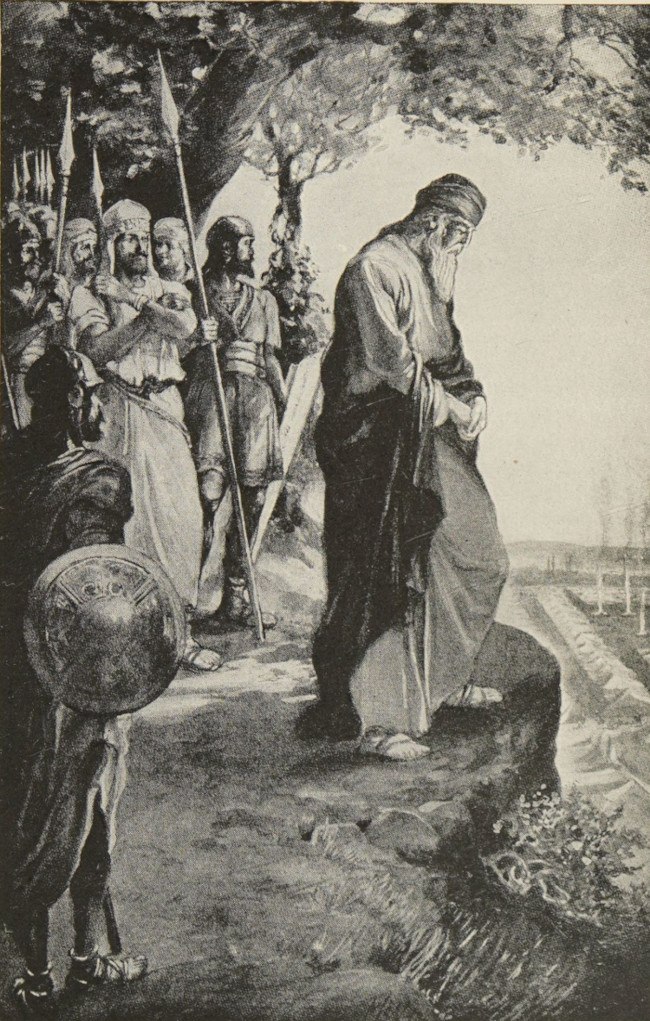
BALAAM BLESSING ISRAEL “From the top of the rocks I see him, And from the hills I behold him. Lo, the people shall dwell alone, And shall not be reckoned among the nations.”
As Balaam looked upon the encampment of Israel, he beheld with astonishment the evidence of their prosperity. They had been represented to him as a rude, disorganized multitude, infesting the country in roving bands that were a pest and terror to the surrounding nations; but their appearance was the reverse of all this. He saw the vast extent and perfect arrangement of their camp, everything bearing the marks of thorough discipline and order. He was shown the favor with which God regarded Israel, and their distinctive character as his chosen people. They were not to stand upon a level with other nations, but to be exalted above them all. “The people shall dwell alone, and shall not be reckoned among the nations.” At the time when these words were spoken, the Israelites had no permanent settlement, and their peculiar character, their manners and customs, were not familiar to Balaam. But how strikingly was this prophecy fulfilled in the after-history of Israel! Through all the years of their captivity, through all the ages since they were dispersed among the nations, they have remained a distinct people. So the people of God,—the true Israel,—though scattered throughout all nations, are on earth but sojourners, whose citizenship is in heaven.
Not only was Balaam shown the history of the Hebrew people as a nation, but he beheld the increase and prosperity of the true Israel of God to the close of time. He saw the special favor of the Most High attending those who love and fear him. He saw them supported by his arm as they enter the dark valley of the shadow of death. And he beheld them coming forth from their graves, crowned with glory, honor, and immortality. He saw the redeemed rejoicing in the unfading glories of the earth made new. Gazing upon the scene, he exclaimed, “Who can count the dust of Jacob, and the number of the fourth part of Israel?” And as he saw the crown of glory on every brow, the joy beaming from every countenance, and looked forward to that endless life of unalloyed happiness, he uttered the solemn prayer, “Let me die the death of the righteous, and let my last end be like his!”
If Balaam had had a disposition to accept the light that God had given, he would now have made true his words; he would at once have severed all connection with Moab. He would no longer have presumed upon the mercy of God, but would have returned to him with deep repentance. But Balaam loved the wages of unrighteousness, and these he was determined to secure.
Balak had confidently expected a curse that would fall like a withering blight upon Israel; and at the words of the prophet he passionately exclaimed, “What hast thou done unto me? I took thee to curse mine enemies, and, behold, thou hast blessed them altogether.” Balaam, seeking to make a virtue of necessity, professed to have spoken from a conscientious regard for the will of God the words that had been forced from his lips by divine power. His answer was, “Must I not take heed to speak that which the Lord hath put in my mouth?”
Balak could not even now relinquish his purpose. He decided that the imposing spectacle presented by the vast encampment of the Hebrews, had so intimidated Balaam that he dared not practice his divinations against them. The king determined to take the prophet to some point where only a small part of the host might be seen. If Balaam could be induced to curse them in detached parties, the whole camp would soon be devoted to destruction. On the top of an elevation called Pisgah, another trial was made. Again seven altars were erected, whereon were placed the same offerings as at the first. The king and his princes remained by the sacrifices, while Balaam retired to meet with God. Again the prophet was intrusted with a divine message, which he was powerless to alter or withhold.
When he appeared to the anxious, expectant company, the question was put to him, “What hath the Lord spoken?” the answer, as before, struck terror to the heart of king and princes:—
“God is not a man, that he should lie;
Neither the son of man, that he should repent.
Hath he said, and shall he not do it?
Or hath he spoken, and shall he not make it good?
Behold, I have received commandment to bless;
And he hath blessed; and I cannot reverse it.
He hath not beheld iniquity in Jacob,
Neither hath he seen perverseness in Israel;
The Lord his God is with him,
And the shout of a King is among them.”
Awed by these revelations, Balaam exclaimed, “Surely there is no enchantment against Jacob, neither is there any divination against Israel.” The great magician had tried his power of enchantment, in accordance with the desire of the Moabites; but concerning this very occasion it should be said of Israel, “What hath God wrought!” While they were under the divine protection, no people or nation, though aided by all the power of Satan, should be able to prevail against them. All the world should wonder at the marvelous work of God in behalf of his people,—that a man determined to pursue a sinful course, should be so controlled by divine power as to utter, instead of imprecations, the richest and most precious promises, in the language of sublime and impassioned poetry. And the favor of God at this time manifested toward Israel, was to be an assurance of his protecting care for his obedient, faithful children in all ages. When Satan should inspire evil men to misrepresent, harass, and destroy God’s people, this very occurrence would be brought to their remembrance, and would strengthen their courage and their faith in God.
The king of Moab, disheartened and distressed, exclaimed, “Neither curse them at all, nor bless them at all.” Yet a faint hope still lingered in his heart, and he determined to make another trial. He now conducted Balaam to Mount Peor, where was a temple devoted to the licentious worship of Baal, their god. Here the same number of altars were erected as before, and the same number of sacrifices were offered; but Balaam went not alone, as at other times, to learn God’s will. He made no pretense of sorcery, but standing beside the altars, he looked abroad upon the tents of Israel. Again the Spirit of God rested upon him, and the divine message came from his lips:—
“How goodly are thy tents, O Jacob,
And thy tabernacles, O Israel!
As the valleys are they spread forth, as gardens by the river’s side,
As the trees of lign-aloes which the Lord hath planted, and as cedar-trees beside the waters.
He shall pour the water out of his buckets, and his seed shall be in many waters,
And his King shall be higher than Agag, and his kingdom shall be exalted.
He couched, he lay down as a lion, and as a great lion. Who shall stir him up?
Blessed is he that blesseth thee, and cursed is he that curseth thee.”
The prosperity of God’s people is here represented by some of the most beautiful figures to be found in nature. The prophet likens Israel to fertile valleys covered with abundant harvests; to flourishing gardens watered by never-failing springs; to the fragrant sandal-tree and the stately cedar. The figure last mentioned is one of the most strikingly beautiful and appropriate to be found in the inspired word. The cedar of Lebanon was honored by all the people of the East. The class of trees to which it belongs is found wherever man has gone, throughout the earth. From the arctic regions to the tropic zone they flourish, rejoicing in the heat, yet braving the cold; springing in rich luxuriance by the river-side, yet towering aloft upon the parched and thirsty waste. They plant their roots deep among the rocks of the mountains, and boldly stand in defiance of the tempest. Their leaves are fresh and green when all else has perished at the breath of winter. Above all other trees, the cedar of Lebanon is distinguished for its strength, its firmness, its undecaying vigor; and this is used as a symbol of those whose life is “hid with Christ in God.”[778] Says the Scripture, “The righteous ... shall grow like a cedar.”[779] The divine hand has exalted the cedar as king over the forest. “The fir-trees were not like his boughs, and the chestnut trees were not like his branches, nor any tree in the garden of God.”[780] The cedar is repeatedly employed as an emblem of royalty; and its use in Scripture to represent the righteous, shows how Heaven regards those who do the will of God.
Balaam prophesied that Israel’s king would be greater and more powerful than Agag. This was the name given to the kings of the Amalekites, who were at this time a very powerful nation; but Israel, if true to God, would subdue all her enemies. The King of Israel was the Son of God; and his throne was one day to be established in the earth, and his power to be exalted above all earthly kingdoms.
As he listened to the prophet’s words, Balak was overwhelmed with disappointed hope, with fear and rage. He was indignant that Balaam could have given him the least encouragement of a favorable response, when everything was determined against him. He regarded with scorn the prophet’s compromising, deceptive course. The king exclaimed fiercely, “Therefore now flee thou to thy place. I thought to promote thee unto great honor; but, lo, the Lord hath kept thee back from honor.” The answer was that the king had been forewarned that Balaam could speak only the message given him from God.
Before returning to his people, Balaam uttered a most beautiful and sublime prophecy of the world’s Redeemer, and the final destruction of the enemies of God:—
“I shall see Him, but not now. I shall behold him, but not nigh.
There shall come a Star out of Jacob, and a Scepter shall rise out of Israel,
And shall smite the corners of Moab, and destroy all the children of Sheth.”
And he closed by predicting the complete destruction of Moab and Edom, of Amalek and the Kenites, thus leaving to the Moabitish king no ray of hope.
Disappointed in his hopes of wealth and promotion, in disfavor with the king, and conscious that he had incurred the displeasure of God, Balaam returned from his self-chosen mission. After he had reached his home, the controlling power of the Spirit of God left him, and his covetousness, which had been merely held in check, prevailed. He was ready to resort to any means to gain the reward promised by Balak. Balaam knew that the prosperity of Israel depended upon their obedience to God, and that there was no way to cause their overthrow but by seducing them into sin. He now decided to secure Balak’s favor by advising the Moabites of the course to be pursued to bring a curse upon Israel.
He immediately returned to the land of Moab, and laid his plans before the king. The Moabites themselves were convinced that so long as Israel remained true to God, he would be their shield. The plan proposed by Balaam was to separate them from God by enticing them into idolatry. If they could be led to engage in the licentious worship of Baal and Ashtaroth, their omnipotent Protector would become their enemy, and they would soon fall a prey to the fierce, warlike nations around them. This plan was readily accepted by the king, and Balaam himself remained to assist in carrying it into effect.
Balaam witnessed the success of his diabolical scheme. He saw the curse of God visited upon his people, and thousands falling under his judgments; but the divine justice that punished sin in Israel, did not permit the tempters to escape. In the war of Israel against the Midianites, Balaam was slain. He had felt a presentiment that his own end was near when he exclaimed, “Let me die the death of the righteous, and let my last end be like his.” But he had not chosen to live the life of the righteous, and his destiny was fixed with the enemies of God.
The fate of Balaam was similar to that of Judas, and their characters bear a marked resemblance to each other. Both these men tried to unite the service of God and mammon, and met with signal failure. Balaam acknowledged the true God, and professed to serve him; Judas believed in Jesus as the Messiah, and united with his followers. But Balaam hoped to make the service of Jehovah the stepping-stone to the acquirement of riches and worldly honor; and failing in this he stumbled, and fell, and was broken. Judas expected by his connection with Christ to secure wealth and promotion in that worldly kingdom which, as he believed, the Messiah was about to set up. The failure of his hopes drove him to apostasy and ruin. Both Balaam and Judas had received great light and enjoyed special privileges; but a single cherished sin poisoned the entire character, and caused their destruction.
It is a perilous thing to allow an unchristian trait to live in the heart. One cherished sin will, little by little, debase the character, bringing all its nobler powers into subjection to the evil desire. The removal of one safe-guard from the conscience, the indulgence of one evil habit, one neglect of the high claims of duty, breaks down the defenses of the soul, and opens the way for Satan to come in and lead us astray. The only safe course is to let our prayers go forth daily from a sincere heart, as did David, “Hold up my goings in Thy paths, that my footsteps slip not.”[781]
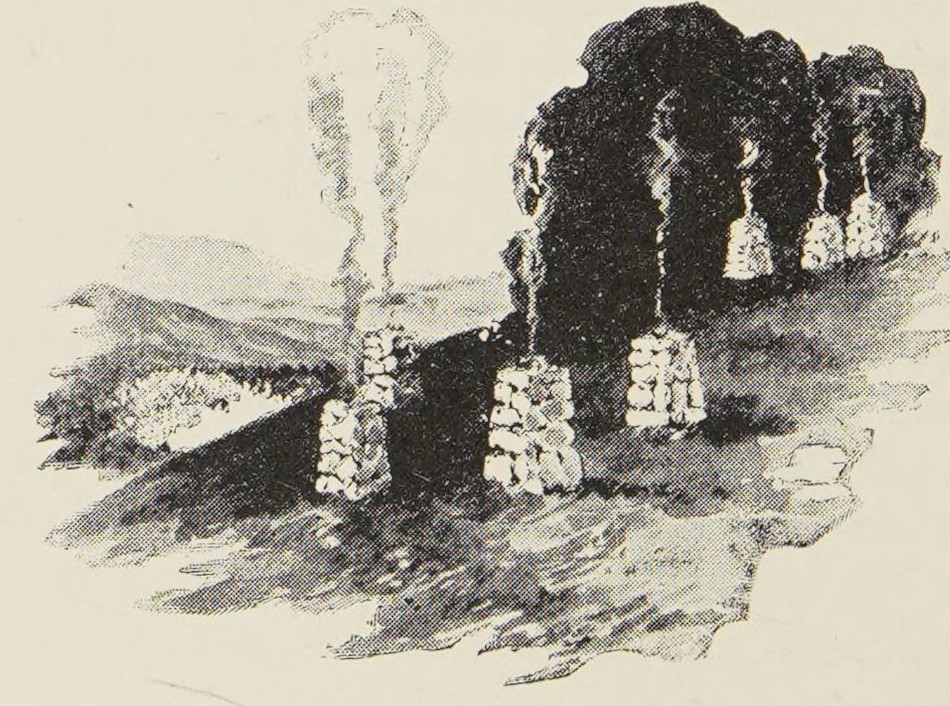
“The Seven Altars of Balaam.”
APOSTASY AT THE JORDAN—41
With joyful hearts and renewed faith in God, the victorious armies of Israel had returned from Bashan. They had already gained possession of a valuable territory, and they were confident of the immediate conquest of Canaan. Only the river Jordan lay between them and the promised land. Just across the river was a rich plain, covered with verdure, watered with streams from copious fountains, and shaded by luxuriant palm-trees. On the western border of the plain rose the towers and palaces of Jericho, so embosomed in its palm-tree groves that it was called “the city of palm-trees.”
On the eastern side of Jordan, between the river and the high table-land which they had been traversing, was also a plain, several miles in width, and extending some distance along the river. This sheltered valley had the climate of the tropics; here flourished the shittim, or acacia tree, giving to the plain the name, “Vale of Shittim.” It was here that the Israelites encamped, and in the acacia groves by the river-side they found an agreeable retreat.
But amid these attractive surroundings they were to encounter an evil more deadly than mighty hosts of armed men or the wild beasts of the wilderness. That country, so rich in natural advantages, had been defiled by the inhabitants. In the public worship of Baal, the leading deity, the most degrading and iniquitous scenes were constantly enacted. On every side were places noted for idolatry and licentiousness, the very names being suggestive of the vileness and corruption of the people.
These surroundings exerted a polluting influence upon the Israelites. Their minds became familiar with the vile thoughts constantly suggested; their life of ease and inaction produced its demoralizing effect; and almost unconsciously to themselves, they were departing from God, and coming into a condition where they would fall an easy prey to temptation.
During the time of their encampment beside Jordan, Moses was preparing for the occupation of Canaan. In this work the great leader was fully employed; but to the people this time of suspense and expectation was most trying, and before many weeks had elapsed, their history was marred by the most frightful departures from virtue and integrity.
At first there was little intercourse between the Israelites and their heathen neighbors; but after a time Midianitish women began to steal into the camp. Their appearance excited no alarm, and so quietly were their plans conducted that the attention of Moses was not called to the matter. It was the object of these women, in their association with the Hebrews, to seduce them into transgression of the law of God, to draw their attention to heathen rites and customs, and lead them into idolatry. These motives were studiously concealed under the garb of friendship, so that they were not suspected, even by the guardians of the people.
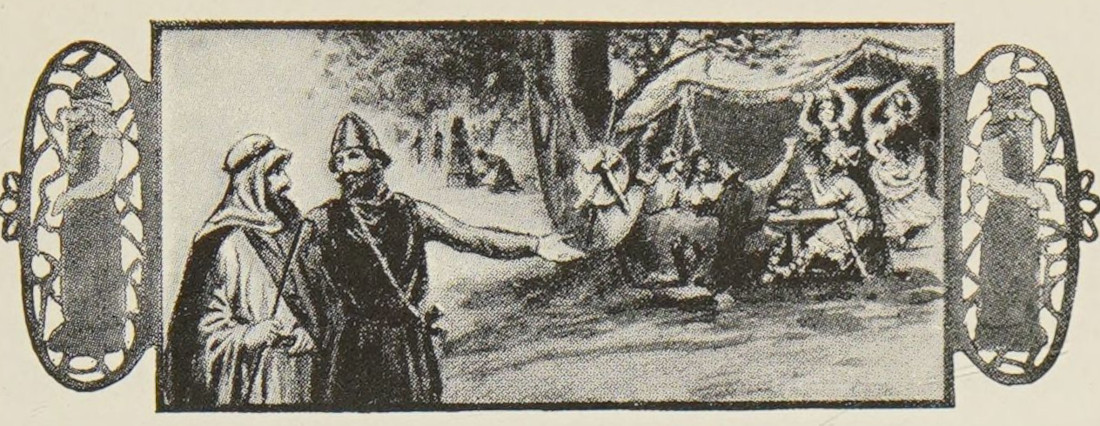
At Balaam’s suggestion, a grand festival in honor of their gods was appointed by the king of Moab, and it was secretly arranged that Balaam should induce the Israelites to attend. He was regarded by them as a prophet of God, and hence had little difficulty in accomplishing his purpose. Great numbers of the people joined him in witnessing the festivities. They ventured upon the forbidden ground, and were entangled in the snare of Satan. Beguiled with music and dancing, and allured by the beauty of heathen vestals, they cast off their fealty to Jehovah. As they united in mirth and feasting, indulgence in wine beclouded their senses, and broke down the barriers of self-control. Passion had full sway; and having defiled their consciences by lewdness, they were persuaded to bow down to idols. They offered sacrifice upon heathen altars, and participated in the most degrading rites.
It was not long before the poison had spread, like a deadly infection, through the camp of Israel. Those who would have conquered their enemies in battle, were overcome by the wiles of heathen women. The people seemed to be infatuated. The rulers and the leading men were among the first to transgress, and so many of the people were guilty that the apostasy became national. “Israel joined himself unto Baal-peor.”[790] When Moses was aroused to perceive the evil, the plots of their enemies had been so successful that not only were the Israelites participating in the licentious worship at Mount Peor, but the heathen rites were coming to be observed in the camp of Israel. The aged leader was filled with indignation, and the wrath of God was kindled.
Their iniquitous practices did that for Israel which all the enchantments of Balaam could not do—they separated them from God. By swift-coming judgments the people were awakened to the enormity of their sin. A terrible pestilence broke out in the camp, to which tens of thousands speedily fell a prey. God commanded that the leaders in this apostasy be put to death by the magistrates. This order was promptly obeyed. The offenders were slain, then their bodies were hung up in sight of all Israel, that the congregation, seeing the leaders so severely dealt with, might have a deep sense of God’s abhorrence of their sin, and the terror of his wrath against them.
All felt that the punishment was just, and the people hastened to the tabernacle, and with tears and deep humiliation confessed their sin. While they were thus weeping before God, at the door of the tabernacle, while the plague was still doing its work of death, and the magistrates were executing their terrible commission, Zimri, one of the nobles of Israel, came boldly into the camp, accompanied by a Midianitish harlot, a princess “of a chief house in Midian,” whom he escorted to his tent. Never was vice bolder or more stubborn. Inflamed with wine, Zimri “declared his sin as Sodom,” and gloried in his shame. The priests and leaders had prostrated themselves in grief and humiliation, weeping “between the porch and the altar,” and entreating the Lord to spare his people, and give not his heritage to reproach, when this prince in Israel flaunted his sin in the sight of the congregation, as if to defy the vengeance of God and mock the judges of the nation. Phinehas, the son of Eleazar the high priest, rose up from among the congregation, and seizing a javelin, “he went after the man of Israel into the tent,” and slew them both. Thus the plague was stayed, while the priest who had executed the divine judgment was honored before all Israel, and the priesthood was confirmed to him and to his house forever.
Phinehas “hath turned my wrath away from the children of Israel,” was the divine message; “wherefore say, Behold, I give unto him my covenant of peace. And he shall have it, and his seed after him, even the covenant of an everlasting priesthood; because he was zealous for his God, and made an atonement for the children of Israel.”
The judgments visited upon Israel for their sin at Shittim, destroyed the survivors of that vast company, who, nearly forty years before, had incurred the sentence, “They shall surely die in the wilderness.” The numbering of the people by divine direction, during their encampment on the plains of Jordan, showed that “of them whom Moses and Aaron the priest numbered, when they numbered the children of Israel in the wilderness of Sinai, ... there was not left a man of them, save Caleb the son of Jephunneh, and Joshua the son of Nun.”[791]
God had sent judgments upon Israel for yielding to the enticements of the Midianites; but the tempters were not to escape the wrath of divine justice. The Amalekites, who had attacked Israel at Rephidim, falling upon those who were faint and weary behind the host, were not punished till long after; but the Midianites, who seduced them into sin, were speedily made to feel God’s judgments, as being the more dangerous enemies. “Avenge the children of Israel of the Midianites,”[792] was the command of God to Moses; “afterward shalt thou be gathered unto thy people.” This mandate was immediately obeyed. One thousand men were chosen from each of the tribes, and sent out under the leadership of Phinehas. “And they warred against the Midianites, as the Lord commanded Moses.... And they slew the kings of Midian, beside the rest of them that were slain; ... five kings of Midian; Balaam also the son of Beor they slew with the sword.” The women also, who had been made captives by the attacking army, were put to death at the command of Moses, as the most guilty and most dangerous of the foes of Israel.
Such was the end of them that devised mischief against God’s people. Says the psalmist: “The heathen are sunk down in the pit that they made; in the net which they hid is their own foot taken.”[793] “For the Lord will not cast off his people, neither will he forsake his inheritance. But judgment shall return unto righteousness.” When men “gather themselves together against the soul of the righteous,” the Lord “shall bring upon them their own iniquity, and shall cut them off in their own wickedness.”[794]
When Balaam was called to curse the Hebrews, he could not, by all his enchantments, bring evil upon them; for the Lord “had not beheld iniquity in Jacob, neither had he seen perverseness in Israel.”[795] But when through yielding to temptation they transgressed God’s law, their defense departed from them. When the people of God are faithful to his commandments, “there is no enchantment against Jacob, neither is there any divination against Israel.” Hence all the power and wily arts of Satan are exerted to seduce them into sin. If those who profess to be the depositaries of God’s law, become transgressors of its precepts, they separate themselves from God, and they will be unable to stand before their enemies.
The Israelites, who could not be overcome by the arms or by the enchantments of Midian, fell a prey to her harlots. Such is the power that woman, enlisted in the service of Satan, has exerted to entrap and destroy souls. “She hath cast down many wounded; yea, many strong men have been slain by her.”[796] It was thus that the children of Seth were seduced from their integrity, and the holy seed became corrupt. It was thus that Joseph was tempted. Thus Samson betrayed his strength, the defense of Israel, into the hands of the Philistines. Here David stumbled. And Solomon, the wisest of kings, who had thrice been called the beloved of his God, became a slave of passion, and sacrificed his integrity to the same bewitching power.
“Now all these things happened unto them for ensamples; and they are written for our admonition upon whom the ends of the world are come. Wherefore let him that thinketh he standeth, take heed lest he fall.”[797] Satan well knows the material with which he has to deal in the human heart. He knows—for he has studied with fiendish intensity for thousands of years—the points most easily assailed in every character; and through successive generations he has wrought to overthrow the strongest men, princes in Israel, by the same temptations that were so successful at Baal-peor. All along through the ages there are strewn wrecks of character that have been stranded upon the rocks of sensual indulgence. As we approach the close of time, as the people of God stand upon the borders of the heavenly Canaan, Satan will, as of old, redouble his efforts to prevent them from entering the goodly land. He lays his snares for every soul. It is not the ignorant and uncultured merely that need to be guarded; he will prepare his temptations for those in the highest positions, in the most holy office; if he can lead them to pollute their souls, he can through them destroy many. And he employs the same agents now as he employed three thousand years ago. By worldly friendships, by the charms of beauty, by pleasure-seeking, mirth, feasting, or the wine-cup, he tempts to the violation of the seventh commandment.
Satan seduced Israel into licentiousness before leading them to idolatry. Those who will dishonor God’s image and defile his temple in their own persons will not scruple at any dishonor to God that will gratify the desire of their depraved hearts. Sensual indulgence weakens the mind and debases the soul. The moral and intellectual powers are benumbed and paralyzed by the gratification of the animal propensities; and it is impossible for the slave of passion to realize the sacred obligation of the law of God, to appreciate the atonement, or to place a right value upon the soul. Goodness, purity, and truth, reverence for God, and love for sacred things,—all those holy affections and noble desires that link men with the heavenly world,—are consumed in the fires of lust. The soul becomes a blackened and desolate waste, the habitation of evil spirits, and “the cage of every unclean and hateful bird.” Beings formed in the image of God are dragged down to a level with the brutes.
It was by associating with idolaters and joining in their festivities that the Hebrews were led to transgress God’s law, and bring his judgments upon the nation. So now it is by leading the followers of Christ to associate with the ungodly and unite in their amusements, that Satan is most successful in alluring them into sin. “Come out from among them, and be ye separate, saith the Lord, and touch not the unclean.”[798] God requires of his people now as great a distinction from the world, in customs, habits, and principles, as he required of Israel anciently. If they faithfully follow the teachings of his word, this distinction will exist; it cannot be otherwise. The warnings given to the Hebrews against assimilating with the heathen were not more direct or explicit than are those forbidding Christians to conform to the spirit and customs of the ungodly. Christ speaks to us, “Love not the world, neither the things that are in the world. If any man love the world, the love of the Father is not in him.” “The friendship of the world is enmity with God; whosoever therefore will be a friend of the world is the enemy of God.”[799] The followers of Christ are to separate themselves from sinners, choosing their society only when there is opportunity to do them good. We cannot be too decided in shunning the company of those who exert an influence to draw us away from God. While we pray, “Lead us not into temptation,” we are to shun temptation, so far as possible.
It was when the Israelites were in a condition of outward ease and security that they were led into sin. They failed to keep God ever before them, they neglected prayer, and cherished a spirit of self-confidence. Ease and self-indulgence left the citadel of the soul unguarded, and debasing thoughts found entrance. It was the traitors within the walls that overthrew the strongholds of principle and betrayed Israel into the power of Satan. It is thus that Satan still seeks to compass the ruin of the soul. A long preparatory process, unknown to the world, goes on in the heart before the Christian commits open sin. The mind does not come down at once from purity and holiness to depravity, corruption, and crime. It takes time to degrade those formed in the image of God to the brutal or the satanic. By beholding, we become changed. By the indulgence of impure thoughts, man can so educate his mind that sin which he once loathed will become pleasant to him.
Satan is using every means to make crime and debasing vice popular. We cannot walk the streets of our cities without encountering flaring notices of crime presented in some novel, or to be acted at some theater. The mind is educated to familiarity with sin. The course pursued by the base and vile is kept before the people in the periodicals of the day, and everything that can excite passion is brought before them in exciting stories. They hear and read so much of debasing crime, that the once tender conscience, which would have recoiled with horror from such scenes, becomes hardened, and they dwell upon these things with greedy interest.
Many of the amusements popular in the world to-day, even with those who claim to be Christians, tend to the same end as did those of the heathen. There are indeed few among them that Satan does not turn to account in destroying souls. Through the drama he has worked for ages to excite passion and glorify vice. The opera, with its fascinating display and bewildering music, the masquerade, the dance, the card-table, Satan employs to break down the barriers of principle, and open the door to sensual indulgence. In every gathering for pleasure where pride is fostered or appetite indulged, where one is led to forget God and lose sight of eternal interests, there Satan is binding his chains about the soul.
“Keep thy heart with all diligence,” is the counsel of the wise man; “for out of it are the issues of life.” As man “thinketh in his heart, so is he.”[800] The heart must be renewed by divine grace, or it will be in vain to seek for purity of life. He who attempts to build up a noble, virtuous character independent of the grace of Christ, is building his house upon the shifting sand. In the fierce storms of temptation it will surely be overthrown. David’s prayer should be the petition of every soul: “Create in me a clean heart, O God; and renew a right spirit within me.”[801] And having become partakers of the heavenly gift, we are to go on unto perfection, being “kept by the power of God, through faith.”[802]
Yet we have a work to do to resist temptation. Those who would not fall a prey to Satan’s devices must guard well the avenues of the soul; they must avoid reading, seeing, or hearing that which will suggest impure thoughts. The mind should not be left to wander at random upon every subject that the adversary of souls may suggest. “Girding up the loins of your mind,” says the apostle Peter, “be sober, ... not fashioning yourselves according to your former lusts in your ignorance; but like as He which called you is holy, be ye yourselves also holy in all manner of living.”[803] Says Paul, “Whatsoever things are true, whatsoever things are honest, whatsoever things are just, whatsoever things are pure, whatsoever things are lovely, whatsoever things are of good report; if there be any virtue, and if there be any praise, think on these things.”[804] This will require earnest prayer and unceasing watchfulness. We must be aided by the abiding influence of the Holy Spirit, which will attract the mind upward, and habituate it to dwell on pure and holy things. And we must give diligent study to the word of God. “Wherewithal shall a young man cleanse his way? By taking heed thereto according to thy word.” “Thy word,” says the psalmist, “have I hid in mine heart, that I might not sin against thee.”[805]
Israel’s sin at Beth-peor brought the judgments of God upon the nation, and though the same sins may not now be punished as speedily, they will as surely meet retribution. “If any man defile the temple of God, him shall God destroy.”[806] Nature has affixed terrible penalties to these crimes,—penalties which, sooner or later, will be inflicted upon every transgressor. It is these sins more than any other that have caused the fearful degeneracy of our race, and the weight of disease and misery with which the world is cursed. Men may succeed in concealing their transgression from their fellow-men, but they will no less surely reap the result, in suffering, disease, imbecility, or death. And beyond this life stands the tribunal of the Judgment, with its award of eternal penalties. “They which do such things shall not inherit the kingdom of God,” but with Satan and evil angels shall have their part in that “lake of fire” which “is the second death.”[807]
“The lips of a strange woman drop as a honey-comb, and her mouth is smoother than oil; but her end is bitter as wormwood, sharp as a two-edged sword.” “Remove thy way far from her, and come not nigh the door of her house; lest thou give thine honor unto others, and thy years unto the cruel: lest strangers be filled with thy wealth; and thy labors be in the house of a stranger; and thou mourn at the last, when thy flesh and thy body are consumed.” “Her house inclineth unto death.” “None that go unto her return again.” “Her guests are in the depths of hell.”[808]
THE LAW REPEATED—42
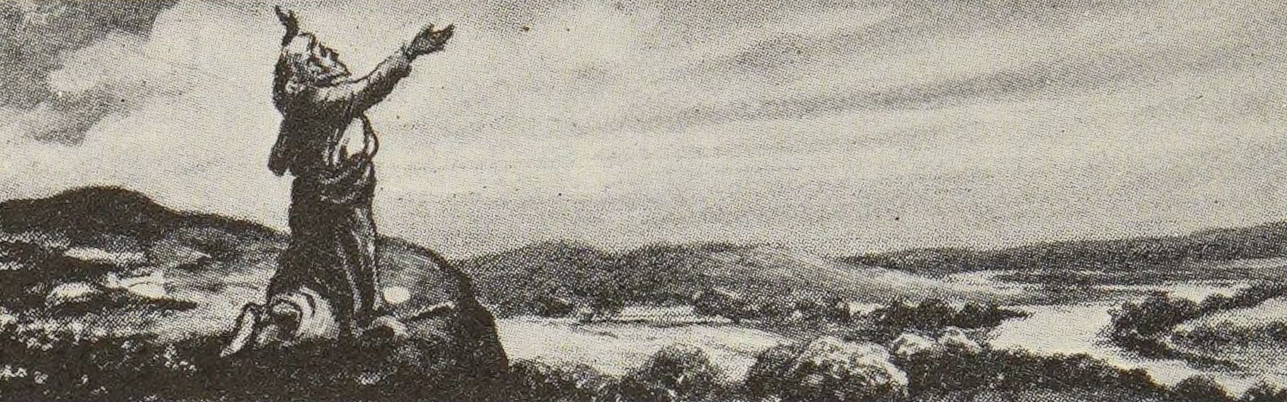
The Lord announced to Moses that the appointed time for the possession of Canaan was at hand; and as the aged prophet stood upon the heights overlooking the river Jordan and the promised land, he gazed with deep interest upon the inheritance of his people. Would it be possible that the sentence pronounced against him for his sin at Kadesh might be revoked? With deep earnestness he pleaded, “O Lord God, thou hast begun to show thy servant thy greatness, and thy mighty hand; for what god is there in heaven or in earth, that can do according to thy works, and according to thy might? I pray thee, let me go over, and see the good land that is beyond Jordan, that goodly mountain, and Lebanon.”[810]
The answer was, “Let it suffice thee; speak no more unto me of this matter. Get thee up into the top of Pisgah, and lift up thine eyes westward, and northward, and southward, and eastward, and behold it with thine eyes; for thou shalt not go over this Jordan.”
Without a murmur, Moses submitted to the decree of God. And now his great anxiety was for Israel. Who would feel the interest for their welfare that he had felt? From a full heart he poured forth the prayer, “Let the Lord, the God of the spirits of all flesh, set a man over the congregation, which may go out before them, and which may go in before them, and which may lead them out, and which may bring them in; that the congregation of the Lord be not as sheep which have no shepherd.”[811]
The Lord hearkened to the prayer of his servant; and the answer came, “Take thee Joshua, the son of Nun, a man in whom is the Spirit, and lay thine hand upon him; and set him before Eleazar the priest, and before all the congregation; and give him a charge in their sight. And thou shalt put some of thine honor upon him, that all the congregation of the people of Israel may be obedient.” Joshua had long attended Moses; and being a man of wisdom, ability, and faith, he was chosen to succeed him.
Through the laying on of hands by Moses, accompanied by a most impressive charge, Joshua was solemnly set apart as the leader of Israel. He was also admitted to a present share in the government. The words of the Lord concerning Joshua came through Moses to the congregation, “He shall stand before Eleazar the priest, who shall ask counsel for him, after the judgment of Urim before the Lord. At his word shall they go out, and at his word they shall come in, both he, and all the children of Israel with him, even all the congregation.”
Before relinquishing his position as the visible leader of Israel, Moses was directed to rehearse to them the history of their deliverance from Egypt and their journeyings in the wilderness, and also to recapitulate the law spoken from Sinai. When the law was given, but few of the present congregation were old enough to comprehend the awful solemnity of the occasion. As they were soon to pass over Jordan and take possession of the promised land, God would present before them the claims of his law, and enjoin upon them obedience as the condition of prosperity.
Moses stood before the people to repeat his last warnings and admonitions. His face was illumined with a holy light. His hair was white with age; but his form was erect, his countenance expressed the unabated vigor of health, and his eye was clear and undimmed. It was an important occasion, and with deep feeling he portrayed the love and mercy of their Almighty Protector:—
“Ask now of the days that are past, which were before thee, since the day that God created man upon the earth, and ask from the one side of heaven unto the other, whether there hath been any such thing as this great thing is, or hath been heard like it? Did ever people hear the voice of God speaking out of the midst of the fire, as thou hast heard, and live? or hath God assayed to go and take him a nation from the midst of another nation, by temptations, by signs, and by wonders, and by war, and by a mighty hand, and by a stretched-out arm, and by great terrors, according to all that the Lord your God did for you in Egypt before your eyes? Unto thee it was showed, that thou mightest know that the Lord he is God; there is none else beside him.”[812]
“The Lord did not set his love upon you, nor choose you, because ye were more in number than any people; for ye were the fewest of all people: but because the Lord loved you, and because he would keep the oath which he had sworn unto your fathers, hath the Lord brought you out with a mighty hand, and redeemed you out of the house of bondmen, from the hand of Pharaoh king of Egypt. Know therefore that Jehovah thy God he is God, the faithful God, which keepeth covenant and mercy with them that love him and keep his commandments to a thousand generations.”[813]
The people of Israel had been ready to ascribe their troubles to Moses; but now their suspicions that he was controlled by pride, ambition, or selfishness, were removed, and they listened with confidence to his words. Moses faithfully set before them their errors, and the transgressions of their fathers. They had often felt impatient and rebellious because of their long wandering in the wilderness; but the Lord had not been chargeable with this delay in possessing Canaan; he was more grieved than they because he could not bring them into immediate possession of the promised land, and thus display before all nations his mighty power in the deliverance of his people. With their distrust of God, with their pride and unbelief, they had not been prepared to enter Canaan. They would in no way represent that people whose God is the Lord; for they did not bear his character of purity, goodness, and benevolence. Had their fathers yielded in faith to the direction of God, being governed by his judgments, and walking in his ordinances, they would long before have been settled in Canaan, a prosperous, holy, happy people. Their delay to enter the goodly land dishonored God, and detracted from his glory in the sight of surrounding nations.
Moses, who understood the character and value of the law of God, assured the people that no other nation had such wise, righteous, and merciful rules as had been given to the Hebrews. “Behold,” he said, “I have taught you statutes and judgments, even as the Lord my God commanded me, that ye should do so in the land whither ye go to possess it. Keep therefore and do them; for this is your wisdom and your understanding in the sight of the nations, which shall hear all these statutes, and say, Surely this great nation is a wise and understanding people.”[814]
Moses called their attention to the “day that thou stoodest before the Lord thy God in Horeb.” And he challenged the Hebrew host: “What nation is there so great, who hath God so nigh unto them, as the Lord our God is in all things that we call upon him for? And what nation is there so great, that hath statutes and judgments so righteous as all this law which I set before you this day?” To-day the challenge to Israel might be repeated. The laws which God gave his ancient people were wiser, better, and more humane than those of the most civilized nations of the earth. The laws of the nations bear marks of the infirmities and passions of the unrenewed heart; but God’s law bears the stamp of the divine.
“The Lord hath taken you, and brought you forth out of the iron furnace,” declared Moses, “to be unto him a people of inheritance.”[815] The land which they were soon to enter, and which was to be theirs on condition of obedience to the law of God, was thus described to them,—and how must these words have moved the hearts of Israel, as they remembered that he who so glowingly pictured the blessings of the goodly land, had been, through their sin, shut out from sharing the inheritance of his people:—
“The Lord thy God bringeth thee into a good land,” “not as the land of Egypt, from whence ye came out, where thou sowedst thy seed, and wateredst it with thy foot, as a garden of herbs. But the land, whither ye go to possess it, is a land of hills and valleys, and drinketh water of the rain of heaven;” “a land of brooks of water, of fountains and depths that spring out of valleys and hills; a land of wheat, and barley, and vines and fig-trees, and pomegranates; a land of oil olive and honey; a land where thou shalt eat bread without scarceness, thou shalt not lack anything in it; a land whose stones are iron, and out of whose hills thou mayest dig brass;” “a land which the Lord thy God careth for; the eyes of the Lord thy God are always upon it, from the beginning of the year even unto the end of the year.”[816]
“And it shall be, when the Lord thy God shall have brought thee into the land which he sware unto thy fathers, to Abraham, to Isaac, and to Jacob, to give thee great and goodly cities, which thou buildedst not, and houses full of all good things, which thou filledst not, and wells digged, which thou diggedst not, vineyards and olive-trees, which thou plantedst not; when thou shalt have eaten and be full; then beware lest thou forget the Lord.” “Take heed unto yourselves, lest ye forget the covenant of the Lord your God; ... for the Lord thy God is a consuming fire, even a jealous God.”[817] If they should do evil in the sight of the Lord, then, said Moses, “Ye shall soon utterly perish from off the land whereunto ye go over Jordan to possess it.”[817]
After the public rehearsal of the law, Moses completed the work of writing all the laws, the statutes, and the judgments which God had given him, and all the regulations concerning the sacrificial system. The book containing these was placed in charge of the proper officers, and was for safe-keeping deposited in the side of the ark. Still the great leader was filled with fear that the people would depart from God. In a most sublime and thrilling address he set before them the blessings that would be theirs on condition of obedience, and the curses that would follow upon transgression:—
“If thou shalt hearken diligently unto the voice of the Lord thy God, to observe and to do all his commandments which I command thee this day,” “blessed shalt thou be in the city, and blessed shalt thou be in the field,” in “the fruit of thy body, and the fruit of thy ground, and the fruit of thy cattle; ... blessed shall be thy basket and thy store; blessed shalt thou be when thou comest in, and blessed shalt thou be when thou goest out. The Lord shall cause thine enemies that rise up against thee to be smitten before thy face.... The Lord shall command the blessing upon thee in thy storehouses, and in all that thou settest thine hand unto.”[818]
“But it shall come to pass, if thou wilt not hearken unto the voice of the Lord thy God, to observe to do all his commandments and his statutes which I command thee this day; that all these curses shall come upon thee,” “and thou shalt become an astonishment, a proverb, and a by-word, among all nations whither the Lord shall lead thee.” “And the Lord shall scatter thee among all people, from the one end of the earth even unto the other; and there thou shalt serve other gods, which neither thou nor thy fathers have known, even wood and stone. And among these nations shalt thou find no ease, neither shall the sole of thy foot have rest; but the Lord shall give thee there a trembling heart, and failing of eyes, and sorrow of mind. And thy life shall hang in doubt before thee; and thou shalt fear day and night, and shalt have none assurance of thy life. In the morning thou shalt say, Would God it were even! And at even thou shalt say, Would God it were morning! For the fear of thine heart wherewith thou shalt fear, and for the sight of thine eyes which thou shalt see.”
By the Spirit of inspiration, looking far down the ages, Moses pictured the terrible scenes of Israel’s final overthrow as a nation, and the destruction of Jerusalem by the armies of Rome: “The Lord shall bring a nation against thee from far, from the end of the earth, as swift as the eagle flieth; a nation whose tongue thou shalt not understand; a nation of fierce countenance, which shall not regard the person of the old, nor show favor to the young.”
The utter wasting of the land, and the horrible suffering of the people during the siege of Jerusalem under Titus, centuries later, were vividly portrayed: “He shall eat the fruit of thy cattle, and the fruit of thy land, until thou be destroyed; ... and he shall besiege thee in all thy gates, until thy high and fenced walls come down, wherein thou trustedst, throughout all thy land.... Thou shalt eat the fruit of thine own body, the flesh of thy sons and of thy daughters, which the Lord thy God hath given thee, in the siege, and in the straitness, wherewith thine enemies shall distress thee.” “The tender and delicate woman among you, which would not adventure to set the sole of her foot upon the ground for delicateness and tenderness, her eye shall be evil toward the husband of her bosom, ... and toward her children which she shall bear; for she shall eat them for want of all things secretly in the siege and straitness, wherewith thine enemy shall distress thee in thy gates.”
Moses closed with these impressive words: “I call heaven and earth to record this day against you, that I have set before you life and death, blessing and cursing; therefore choose life, that both thou and thy seed may live; that thou mayest love the Lord thy God, and that thou mayest obey his voice, and that thou mayest cleave unto him; for he is thy life, and the length of thy days; that thou mayest dwell in the land which the Lord sware unto thy fathers, to Abraham, to Isaac, and to Jacob, to give them.”[819]
The more deeply to impress these truths upon all minds, the great leader embodied them in sacred verse. This song was not only historical, but prophetic. While it recounted the wonderful dealings of God with his people in the past, it also foreshadowed the great events of the future, the final victory of the faithful when Christ shall come the second time in power and glory. The people were directed to commit to memory this poetic history, and to teach it to their children and children’s children. It was to be chanted by the congregation when they assembled for worship, and to be repeated by the people as they went about their daily labors. It was the duty of parents to so impress these words upon the susceptible minds of their children that they might never be forgotten.
Since the Israelites were to be, in a special sense, the guardians and keepers of God’s law, the significance of its precepts and the importance of obedience were especially to be impressed upon them, and through them, upon their children and children’s children. The Lord commanded concerning his statutes: “Thou shalt teach them diligently unto thy children, and shalt talk of them when thou sittest in thine house, and when thou walkest by the way, and when thou liest down, and when thou risest up.... And thou shalt write them upon the posts of thy house, and on thy gates.”[820]
When their children should ask in time to come, “What mean the testimonies, and the statutes, and the judgments which the Lord our God hath commanded you?” then the parents were to repeat the history of God’s gracious dealings with them—how the Lord had wrought for their deliverance that they might obey his law,—and to declare to them, “The Lord commanded us to do all these statutes, to fear the Lord our God, for our good always, that he might preserve us alive, as it is at this day. And it shall be our righteousness, if we observe to do all these commandments before the Lord our God, as he hath commanded us.”[820]

THE DEATH OF MOSES—43
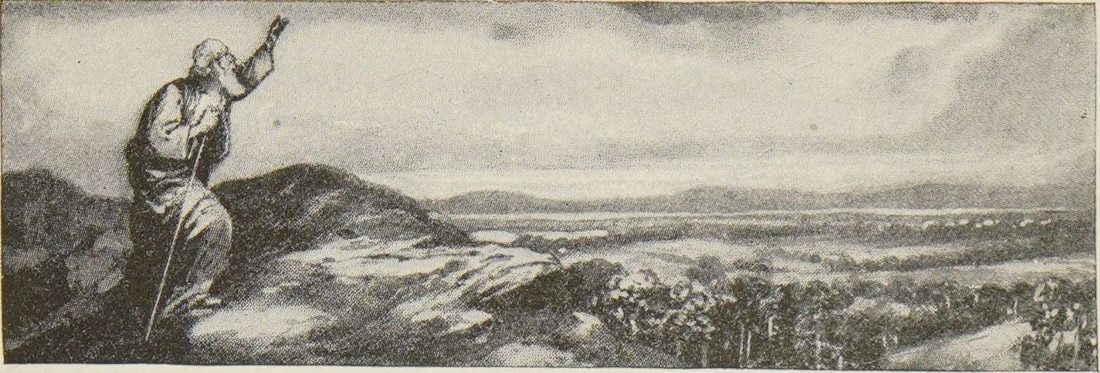
In all the dealings of God with his people, there is, mingled with his love and mercy, the most striking evidence of his strict and impartial justice. This is exemplified in the history of the Hebrew people. God had bestowed great blessings upon Israel. His loving-kindness toward them is touchingly portrayed: “As an eagle stirreth up her nest, fluttereth over her young, spreadeth abroad her wings, taketh them, beareth them on her wings; so the Lord alone did lead him.”[830] And yet what swift and severe retribution was visited upon them for their transgressions!