THE WILDERNESS-TRAINING (continued 2)
Reading edition
God had chosen Moses, and had put his Spirit upon him; and Miriam and Aaron, by their murmurings, were guilty of disloyalty, not only to their appointed leader, but to God himself. The seditious whisperers were summoned to the tabernacle, and brought face to face with Moses. “And Jehovah came down in the pillar of the cloud, and stood in the door of the tabernacle, and called Aaron and Miriam.” Their claim to the prophetic gift was not denied; God might have spoken to them in visions and dreams. But to Moses, whom the Lord himself declared “faithful in all mine house,” a nearer communion had been granted. With him God spake mouth to mouth. “Wherefore then were ye not afraid to speak against my servant Moses? And the anger of the Lord was kindled against them, and he departed.” The cloud disappeared from the tabernacle in token of God’s displeasure, and Miriam was smitten. She “became leprous, white as snow.” Aaron was spared, but he was severely rebuked in Miriam’s punishment. Now, their pride humbled in the dust, Aaron confessed their sin, and entreated that his sister might not be left to perish by that loathsome and deadly scourge. In answer to the prayers of Moses, the leprosy was cleansed. Miriam was, however, shut out of the camp for seven days. Not until she was banished from the encampment did the symbol of God’s favor again rest upon the tabernacle. In respect for her high position, and in grief at the blow that had fallen upon her, the whole company abode in Hazeroth, awaiting her return.
This manifestation of the Lord’s displeasure was designed to be a warning to all Israel, to check the growing spirit of discontent and insubordination. If Miriam’s envy and dissatisfaction had not been signally rebuked, it would have resulted in great evil. Envy is one of the most satanic traits that can exist in the human heart, and it is one of the most baleful in its effects. Says the wise man, “Wrath is cruel, and anger is outrageous; but who is able to stand before envy?”[656] It was envy that first caused discord in heaven, and its indulgence has wrought untold evil among men. “Where envying and strife is, there is confusion and every evil work.”[657]
It should not be regarded as a light thing to speak evil of others, or to make ourselves judges of their motives or actions. “He that speaketh evil of his brother, and judgeth his brother, speaketh evil of the law, and judgeth the law; but if thou judge the law, thou art not a doer of the law, but a judge.” There is but one judge,—He “who both will bring to light the hidden things of darkness, and will make manifest the counsels of the hearts.”[658] And whoever takes it upon himself to judge and condemn his fellow-men is usurping the prerogative of the Creator.
The Bible specially teaches us to beware of lightly bringing accusation against those whom God has called to act as his ambassadors. The apostle Peter, describing a class who are abandoned sinners, says, “Presumptuous are they, self-willed, they are not afraid to speak evil of dignities. Whereas angels, which are greater in power and might, bring not railing accusation against them before the Lord.”[659] And Paul, in his instruction for those who are placed over the church, says, “Against an elder receive not an accusation, but before two or three witnesses.”[660] He who has placed upon men the heavy responsibility of leaders and teachers of his people, will hold the people accountable for the manner in which they treat his servants. We are to honor those whom God has honored. The judgment visited upon Miriam should be a rebuke to all who yield to jealousy, and murmur against those upon whom God lays the burden of his work.
THE TWELVE SPIES—34
Eleven days after leaving Mount Horeb, the Hebrew host encamped at Kadesh, in the wilderness of Paran, which was not far from the borders of the promised land. Here it was proposed by the people that spies be sent up to survey the country. The matter was presented before the Lord by Moses, and permission was granted, with the direction that one of the rulers of each tribe should be selected for this purpose. The men were chosen as had been directed, and Moses bade them go and see the country, what it was, its situation and natural advantages; and the people that dwelt therein, whether they were strong or weak, few or many; also to observe the nature of the soil and its productiveness, and to bring of the fruit of the land.
They went, and surveyed the whole land, entering at the southern border, and proceeding to the northern extremity. They returned after an absence of forty days. The people of Israel were cherishing high hopes, and were waiting in eager expectancy.
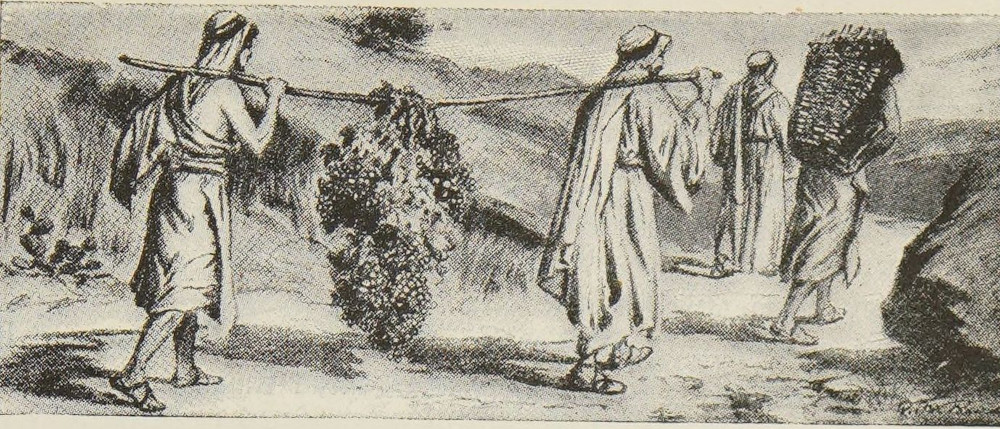
The news of the spies’ return was carried from tribe to tribe, and was hailed with rejoicing. The people rushed out to meet the messengers, who had safely escaped the dangers of their perilous undertaking. The spies brought specimens of the fruit, showing the fertility of the soil. It was in the time of ripe grapes, and they brought a cluster of grapes so large that it was carried between two men. They also brought of the figs and pomegranates which grew there in abundance.
The people rejoiced that they were to come into possession of so goodly a land, and they listened intently as the report was brought to Moses, that not a word should escape them. “We came unto the land whither thou sentest us,” the spies began, “and surely it floweth with milk and honey; and this is the fruit of it.”[670] The people were enthusiastic; they would eagerly obey the voice of the Lord, and go up at once to possess the land. But after describing the beauty and fertility of the land, all but two of the spies enlarged upon the difficulties and dangers that lay before the Israelites should they undertake the conquest of Canaan. They enumerated the powerful nations located in various parts of the country, and said that the cities were walled and very great, and the people who dwelt therein were strong, and it would be impossible to conquer them. They also stated that they had seen giants, the sons of Anak, there, and it was useless to think of possessing the land.
Now the scene changed. Hope and courage gave place to cowardly despair, as the spies uttered the sentiments of their unbelieving hearts, which were filled with discouragement prompted by Satan. Their unbelief cast a gloomy shadow over the congregation, and the mighty power of God, so often manifested in behalf of the chosen nation, was forgotten. The people did not wait to reflect; they did not reason that He who had brought them thus far would certainly give them the land; they did not call to mind how wonderfully God had delivered them from their oppressors, cutting a path through the sea, and destroying the pursuing hosts of Pharaoh. They left God out of the question, and acted as though they must depend solely on the power of arms.
In their unbelief they limited the power of God, and distrusted the hand that had hitherto safely guided them. And they repeated their former error of murmuring against Moses and Aaron. “This, then, is the end of all our high hopes,” they said. “This is the land we have traveled all the way from Egypt to possess.” They accused their leaders of deceiving the people and bringing trouble upon Israel.
The people were desperate in their disappointment and despair. A wail of agony arose, and mingled with the confused murmur of voices. Caleb comprehended the situation, and bold to stand in defense of the word of God, he did all in his power to counteract the evil influence of his unfaithful associates. For an instant the people were stilled to listen to his words of hope and courage respecting the goodly land. He did not contradict what had already been said; the walls were high, and the Canaanites strong. But God had promised the land to Israel. “Let us go up at once, and possess it,” urged Caleb; “for we are well able to overcome it.”
But the ten, interrupting him, pictured the obstacles in darker colors than at first. “We be not able to go up against the people,” they declared; “for they are stronger than we.... All the people that we saw in it are men of a great stature. And there we saw the giants, the sons of Anak, which come of the giants; and we were in our own sight as grasshoppers, and so we were in their sight.”
These men, having entered upon a wrong course, stubbornly set themselves against Caleb and Joshua, against Moses, and against God. Every advance step rendered them the more determined. They were resolved to discourage all effort to gain possession of Canaan. They distorted the truth in order to sustain their baleful influence. “It is a land that eateth up the inhabitants thereof,” they said. This was not only an evil report, but it was also a lying one. It was inconsistent with itself. The spies had declared the country to be fruitful and prosperous, and the people of giant stature, all of which would be impossible if the climate were so unhealthful that the land could be said to “eat up the inhabitants.” But when men yield their hearts to unbelief, they place themselves under the control of Satan, and none can tell to what lengths he will lead them.
“And all the congregation lifted up their voice, and cried; and the people wept that night.” Revolt and open mutiny quickly followed; for Satan had full sway, and the people seemed bereft of reason. They cursed Moses and Aaron, forgetting that God hearkened to their wicked speeches, and that, enshrouded in the cloudy pillar, the Angel of his presence was witnessing their terrible outburst of wrath. In bitterness they cried out, “Would God that we had died in the land of Egypt! or would God we had died in this wilderness!” Then their feelings rose against God: “Wherefore hath the Lord brought us unto this land, to fall by the sword, that our wives and our children should be a prey? Were it not better for us to return into Egypt? And they said one to another, Let us make a captain, and let us return into Egypt.” Thus they accused not only Moses, but God himself, of deception, in promising them a land which they were not able to possess. And they went so far as to appoint a captain to lead them back to the land of their suffering and bondage, from which they had been delivered by the strong arm of Omnipotence.
In humiliation and distress, “Moses and Aaron fell on their faces before all the assembly of the congregation of the children of Israel,” not knowing what to do to turn them from their rash and passionate purpose. Caleb and Joshua attempted to quiet the tumult. With their garments rent in token of grief and indignation, they rushed in among the people, and their ringing voices were heard above the tempest of lamentation and rebellious grief: “The land, which we passed through to search it, is an exceeding good land. If the Lord delight in us, then he will bring us into this land, and give it us; a land which floweth with milk and honey; only rebel not ye against the Lord, neither fear ye the people of the land; for they are bread for us. Their defense is departed from them, and the Lord is with us. Fear them not.”
The Canaanites had filled up the measure of their iniquity, and the Lord would no longer bear with them. His protection being removed, they would be an easy prey. By the covenant of God, the land was insured to Israel. But the false report of the unfaithful spies was accepted, and through it the whole congregation were deluded. The traitors had done their work. If only the two men had brought the evil report, and all the ten had encouraged them to possess the land in the name of the Lord, they would still have taken the advice of the two in preference to the ten, because of their wicked unbelief. But there were only two advocating the right, while ten were on the side of rebellion.
The unfaithful spies were loud in denunciation of Caleb and Joshua, and the cry was raised to stone them. The insane mob seized missiles with which to slay those faithful men. They rushed forward with yells of madness, when suddenly the stones dropped from their hands, a hush fell upon them, and they shook with fear. God had interposed to check their murderous design. The glory of his presence, like a flaming light, illuminated the tabernacle. All the people beheld the signal of the Lord. A mightier one than they had revealed himself, and none dared continue their resistance. The spies who brought the evil report, crouched terror-stricken, and with bated breath sought their tents.
Moses now arose, and entered the tabernacle. The Lord declared to him, “I will smite them with the pestilence, and disinherit them, and will make of thee a greater nation.” But again Moses pleaded for his people. He could not consent to have them destroyed, and himself made a mightier nation. Appealing to the mercy of God, he said: “I beseech thee, let the power of my Lord be great, according as thou hast spoken, saying, The Lord is long-suffering, and of great mercy.... Pardon, I beseech thee, the iniquity of this people according unto the greatness of thy mercy, and as thou hast forgiven this people, from Egypt even until now.”
The Lord promised to spare Israel from immediate destruction; but because of their unbelief and cowardice he could not manifest his power to subdue their enemies. Therefore in his mercy he bade them, as the only safe course, to turn back toward the Red Sea.
In their rebellion the people had exclaimed, “Would God we had died in this wilderness!” Now this prayer was to be granted. The Lord declared: “As ye have spoken in mine ears, so will I do to you: your carcasses shall fall in this wilderness; and all that were numbered of you, according to your whole number, from twenty years old and upward.... But your little ones, which ye said should be a prey, them will I bring in, and they shall know the land which ye have despised.” And of Caleb he said, “My servant Caleb, because he had another spirit with him, and hath followed me fully, him will I bring into the land whereinto he went; and his seed shall possess it.” As the spies had spent forty days in their journey, so the hosts of Israel were to wander in the wilderness forty years.
When Moses made known to the people the divine decision, their rage was changed to mourning. They knew that their punishment was just. The ten unfaithful spies, divinely smitten by the plague, perished before the eyes of all Israel; and in their fate the people read their own doom.
Now they seemed sincerely to repent of their sinful conduct; but they sorrowed because of the result of their evil course, rather than from a sense of their ingratitude and disobedience. When they found that the Lord did not relent in his decree, their self-will again arose, and they declared that they would not return into the wilderness. In commanding them to retire from the land of their enemies, God tested their apparent submission, and proved that it was not real. They knew that they had deeply sinned in allowing their rash feelings to control them, and in seeking to slay the spies who had urged them to obey God; but they were only terrified to find that they had made a fearful mistake, the consequences of which would prove disastrous to themselves. Their hearts were unchanged, and they only needed an excuse to occasion a similar outbreak. This presented itself when Moses, by the authority of God, commanded them to go back into the wilderness.
The decree that Israel was not to enter Canaan for forty years was a bitter disappointment to Moses and Aaron, Caleb and Joshua; yet without a murmur they accepted the divine decision. But those who had been complaining of God’s dealings with them, and declaring that they would return to Egypt, wept and mourned greatly when the blessings which they had despised were taken from them. They had complained at nothing, and now God gave them cause to weep. Had they mourned for their sin when it was faithfully laid before them, this sentence would not have been pronounced; but they mourned for the judgment; their sorrow was not repentance, and could not secure a reversing of their sentence.
The night was spent in lamentation; but with the morning came a hope. They resolved to redeem their cowardice. When God had bidden them go up and take the land, they had refused; and now when he directed them to retreat, they were equally rebellious. They determined to seize upon the land and possess it; it might be that God would accept their work, and change his purpose toward them.
God had made it their privilege and their duty to enter the land at the time of his appointment; but through their willful neglect that permission had been withdrawn. Satan had gained his object in preventing them from entering Canaan; and now he urged them on to do the very thing, in the face of the divine prohibition, which they had refused to do when God required it. Thus the great deceiver gained the victory by leading them to rebellion the second time. They had distrusted the power of God to work with their efforts in gaining possession of Canaan; yet now they presumed upon their own strength to accomplish the work independent of divine aid. “We have sinned against the Lord,” they cried; “we will go up and fight, according to all that the Lord our God commanded us.”[671] So terribly blinded had they become by transgression. The Lord had never commanded them to “go up and fight.” It was not his purpose that they should gain the land by warfare, but by strict obedience to his commands.
Though their hearts were unchanged, the people had been brought to confess the sinfulness and folly of their rebellion at the report of the spies. They now saw the value of the blessing which they had so rashly cast away. They confessed that it was their own unbelief which had shut them out from Canaan. “We have sinned,” they said, acknowledging that the fault was in themselves, and not in God, whom they had so wickedly charged with failing to fulfill his promises to them. Though their confession did not spring from true repentance, it served to vindicate the justice of God in his dealings with them.
The Lord still works in a similar manner to glorify his name by bringing men to acknowledge his justice. When those who profess to love him complain of his providence, despise his promises, and, yielding to temptation, unite with evil angels to defeat the purposes of God, the Lord often so overrules circumstances as to bring these persons where, though they may have no real repentance, they will be convinced of their sin, and will be constrained to acknowledge the wickedness of their course, and the justice and goodness of God in his dealings with them. It is thus that God sets counter-agencies at work to make manifest the works of darkness. And though the spirit which prompted to the evil course is not radically changed, confessions are made that vindicate the honor of God, and justify his faithful reprovers, who have been opposed and misrepresented. Thus it will be when the wrath of God shall be finally poured out. When “the Lord cometh with ten thousands of his saints to execute judgment upon all,” he will also “convince all that are ungodly among them of all their ungodly deeds.”[672] Every sinner will be brought to see and acknowledge the justice of his condemnation.
Regardless of the divine sentence, the Israelites prepared to undertake the conquest of Canaan. Equipped with armor and weapons of war, they were, in their own estimation, fully prepared for conflict; but they were sadly deficient in the sight of God and his sorrowful servants. When, nearly forty years later, the Lord directed Israel to go up and take Jericho, he promised to go with them. The ark containing his law was borne before their armies. His appointed leaders were to direct their movements, under the divine supervision. With such guidance, no harm could come to them. But now, contrary to the command of God and the solemn prohibition of their leaders, without the ark, and without Moses, they went out to meet the armies of the enemy.
The trumpet sounded an alarm, and Moses hastened after them with the warning, “Wherefore now do ye transgress the commandment of the Lord? But it shall not prosper. Go not up, for the Lord is not among you; that ye be not smitten before your enemies. For the Amalekites and the Canaanites are there before you, and ye shall fall by the sword.”[673]
The Canaanites had heard of the mysterious power that seemed to be guarding this people, and of the wonders wrought in their behalf; and they now summoned a strong force to repel the invaders. The attacking army had no leader. No prayer was offered that God would give them the victory. They set forth with the desperate purpose to reverse their fate or to die in battle. Though untrained in war, they were a vast multitude of armed men, and they hoped by a sudden and fierce assault to bear down all opposition. They presumptuously challenged the foe that had not dared to attack them.
The Canaanites had stationed themselves upon a rocky table-land reached only by difficult passes and a steep and dangerous ascent. The immense numbers of the Hebrews could only render their defeat more terrible. They slowly threaded the mountain paths, exposed to the deadly missiles of their enemies above. Massive rocks came thundering down, marking their path with the blood of the slain. Those who reached the summit, exhausted with their ascent, were fiercely repulsed, and driven back with great loss. The field of carnage was strewn with the bodies of the dead. The army of Israel was utterly defeated. Destruction and death was the result of that rebellious experiment.
Forced to submission at last, the survivors “returned, and wept before the Lord;” but “the Lord would not hearken to their voice.”[674] By their signal victory, the enemies of Israel, who had before awaited with trembling the approach of that mighty host, were inspired with confidence to resist them. All the reports they had heard concerning the marvelous things that God had wrought for his people, they now regarded as false, and they felt that there was no cause for fear. That first defeat of Israel, by inspiring the Canaanites with courage and resolution, had greatly increased the difficulties of the conquest. Nothing remained for Israel but to fall back from the face of their victorious foes, into the wilderness, knowing that here must be the grave of a whole generation.
THE REBELLION OF KORAH—35
The judgments visited upon the Israelites served for a time to restrain their murmuring and insubordination, but the spirit of rebellion was still in the heart, and eventually brought forth the bitterest fruits. The former rebellions had been mere popular tumults, arising from the sudden impulse of the excited multitude; but now a deep-laid conspiracy was formed, the result of a determined purpose to overthrow the authority of the leaders appointed by God himself.
Korah, the leading spirit in this movement, was a Levite, of the family of Kohath, and a cousin of Moses; he was a man of ability and influence. Though appointed to the service of the tabernacle, he had become dissatisfied with his position, and aspired to the dignity of the priesthood. The bestowal upon Aaron and his house of the priestly office, which had formerly devolved upon the first-born son of every family, had given rise to jealousy and dissatisfaction, and for some time Korah had been secretly opposing the authority of Moses and Aaron, though he had not ventured upon any open act of rebellion. He finally conceived the bold design of overthrowing both the civil and the religious authority. He did not fail to find sympathizers. Close to the tents of Korah and the Kohathites, on the south side of the tabernacle, was the encampment of the tribe of Reuben, the tents of Dathan and Abiram, two princes of this tribe, being near that of Korah. These princes readily joined in his ambitious schemes. Being descendants from the eldest son of Jacob, they claimed that the civil authority belonged to them, and they determined to divide with Korah the honors of the priesthood.
The state of feeling among the people favored the designs of Korah. In the bitterness of their disappointment, their former doubts, jealousy, and hatred had returned, and again their complaints were directed against their patient leader. The Israelites were continually losing sight of the fact that they were under divine guidance. They forgot that the Angel of the covenant was their invisible leader, that, vailed by the cloudy pillar, the presence of Christ went before them, and that from him Moses received all his directions.
They were unwilling to submit to the terrible sentence that they must all die in the wilderness, and hence they were ready to seize upon every pretext for believing that it was not God but Moses who was leading them, and who had pronounced their doom. The best efforts of the meekest man upon the earth could not quell the insubordination of this people; and although the marks of God’s displeasure at their former perverseness were still before them in their broken ranks and missing numbers, they did not take the lesson to heart. Again they were overcome by temptation.
The humble shepherd’s life of Moses had been far more peaceful and happy than his present position as leader of that vast assembly of turbulent spirits. Yet Moses dared not choose. In place of a shepherd’s crook a rod of power had been given him, which he could not lay down until God should release him.
He who reads the secrets of all hearts had marked the purposes of Korah and his companions, and had given his people such warning and instruction as might have enabled them to escape the deception of these designing men. They had seen the judgment of God fall upon Miriam because of her jealousy and complaints against Moses. The Lord had declared that Moses was greater than a prophet. “With him will I speak mouth to mouth.” “Wherefore, then,” he added, “were ye not afraid to speak against my servant Moses?”[680] These instructions were not intended for Aaron and Miriam alone, but for all Israel.
Korah and his fellow-conspirators were men who had been favored with special manifestations of God’s power and greatness. They were of the number who went up with Moses into the mount and beheld the divine glory. But since that time a change had come. A temptation, slight at first, had been harbored, and had strengthened as it was encouraged, until their minds were controlled by Satan, and they ventured upon their work of disaffection. Professing great interest in the prosperity of the people, they first whispered their discontent to one another, and then to leading men of Israel. Their insinuations were so readily received that they ventured still further, and at last they really believed themselves to be actuated by zeal for God.
They were successful in alienating two hundred and fifty princes, men of renown in the congregation. With these strong and influential supporters they felt confident of making a radical change in the government, and greatly improving upon the administration of Moses and Aaron.
Jealousy had given rise to envy, and envy to rebellion. They had discussed the question of the right of Moses to so great authority and honor, until they had come to regard him as occupying a very enviable position, which any of them could fill as well as he. And they deceived themselves and one another into thinking that Moses and Aaron had themselves assumed the positions they held. The discontented ones said that these leaders had exalted themselves above the congregation of the Lord, in taking upon them the priesthood and government, but their house was not entitled to distinction above others in Israel; they were no more holy than the people, and it should be enough for them to be on a level with their brethren, who were equally favored with God’s special presence and protection.
The next work of the conspirators was with the people. To those who are in the wrong, and deserving of reproof, there is nothing more pleasing than to receive sympathy and praise. And thus Korah and his associates gained the attention and enlisted the support of the congregation. The charge that the murmurings of the people had brought upon them the wrath of God, was declared to be a mistake. They said that the congregation were not at fault, since they desired nothing more than their rights; but that Moses was an overbearing ruler; that he had reproved the people as sinners, when they were a holy people, and the Lord was among them.
Korah reviewed the history of their travels through the wilderness, where they had been brought into strait places, and many had perished because of their murmuring and disobedience. His hearers thought they saw clearly that their troubles might have been prevented if Moses had pursued a different course. They decided that all their disasters were chargeable to him, and that their exclusion from Canaan was in consequence of the mismanagement of Moses and Aaron; that if Korah would be their leader, and would encourage them by dwelling upon their good deeds instead of reproving their sins, they would have a very peaceful, prosperous journey; instead of wandering to and fro in the wilderness, they would proceed directly to the promised land.
In this work of disaffection there was greater union and harmony among the discordant elements of the congregation than had ever before existed. Korah’s success with the people increased his confidence, and confirmed him in his belief that the usurpation of authority by Moses, if unchecked, would be fatal to the liberties of Israel; he also claimed that God had opened the matter to him, and had authorized him to make a change in the government before it should be too late. But many were not ready to accept Korah’s accusations against Moses. The memory of his patient, self-sacrificing labors came up before them, and conscience was disturbed. It was therefore necessary to assign some selfish motive for his deep interest for Israel; and the old charge was reiterated, that he had led them out to perish in the wilderness, that he might seize upon their possessions.
For a time this work was carried on secretly. As soon, however, as the movement had gained sufficient strength to warrant an open rupture, Korah appeared at the head of the faction, and publicly accused Moses and Aaron of usurping authority which Korah and his associates were equally entitled to share. It was charged, further, that the people had been deprived of their liberty and independence. “Ye take too much upon you,” said the conspirators, “seeing all the congregation are holy, every one of them, and the Lord is among them; wherefore then lift ye up yourselves above the congregation of the Lord?”[681]
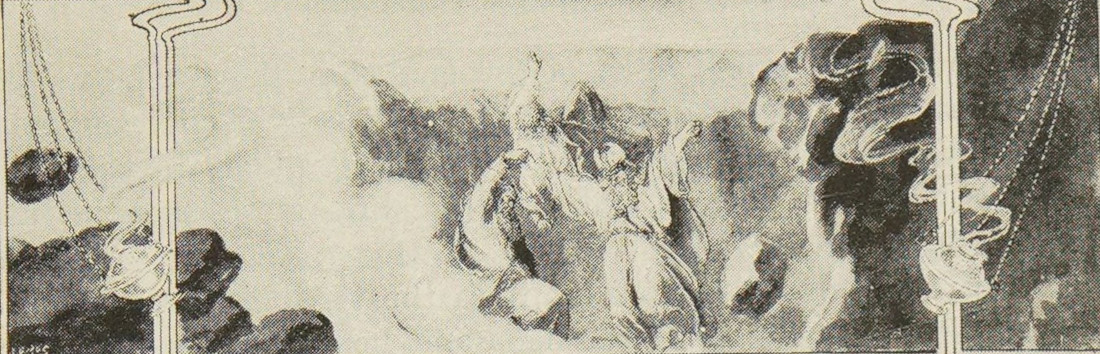
Moses had not suspected this deep-laid plot, and when its terrible significance burst upon him, he fell upon his face in silent appeal to God. He arose sorrowful indeed, but calm and strong. Divine guidance had been granted him. “Even to-morrow,” he said, “the Lord will show who are his, and who is holy; and will cause him to come near unto him: even him whom he hath chosen will he cause to come near unto him.” The test was to be deferred until the morrow, that all might have time for reflection. Then those who aspired to the priesthood were to come each with a censer, and offer incense at the tabernacle in the presence of the congregation. The law was very explicit that only those who had been ordained to the sacred office should minister in the sanctuary. And even the priests, Nadab and Abihu, had been destroyed for venturing to offer “strange fire,” in disregard of a divine command. Yet Moses challenged his accusers, if they dared enter upon so perilous an appeal, to refer the matter to God.
Singling out Korah and his fellow-Levites, Moses said, “Seemeth it but a small thing unto you, that the God of Israel hath separated you from the congregation of Israel, to bring you near to himself to do the service of the tabernacle of the Lord, and to stand before the congregation to minister unto them? And he hath brought thee near to him, and all thy brethren the sons of Levi with thee; and seek ye the priesthood also? for which cause both thou and all thy company are gathered together against the Lord. And what is Aaron, that ye murmur against him?”
Dathan and Abiram had not taken so bold a stand as had Korah; and Moses, hoping that they might have been drawn into the conspiracy without having become wholly corrupted, summoned them to appear before him, that he might hear their charges against him. But they would not come, and they insolently refused to acknowledge his authority. Their reply, uttered in the hearing of the congregation, was, “Is it a small thing that thou hast brought us up out of a land that floweth with milk and honey, to kill us in the wilderness, except thou make thyself altogether a prince over us? Moreover thou hast not brought us into a land that floweth with milk and honey, or given us inheritance of fields and vineyards; wilt thou put out the eyes of these men? We will not come up.”
Thus they applied to the scene of their bondage the very language in which the Lord had described the promised inheritance. They accused Moses of pretending to act under divine guidance, as a means of establishing his authority; and they declared that they would no longer submit to be led about like blind men, now toward Canaan, and now toward the wilderness, as best suited his ambitious designs. Thus he who had been as a tender father, a patient shepherd, was represented in the blackest character of a tyrant and usurper. The exclusion from Canaan, in punishment of their own sins, was charged upon him.
It was evident that the sympathies of the people were with the disaffected party; but Moses made no effort at self-vindication. He solemnly appealed to God, in the presence of the congregation, as a witness to the purity of his motives and the uprightness of his conduct, and implored him to be his judge.
On the morrow, the two hundred and fifty princes, with Korah at their head, presented themselves, with their censers. They were brought into the court of the tabernacle, while the people gathered without, to await the result. It was not Moses who assembled the congregation to behold the defeat of Korah and his company, but the rebels, in their blind presumption, had called them together to witness their victory. A large part of the congregation openly sided with Korah, whose hopes were high of carrying his point against Aaron.
As they were thus assembled before God, “the glory of the Lord appeared unto all the congregation.” The divine warning was communicated to Moses and Aaron, “Separate yourselves from among this congregation, that I may consume them in a moment.” But they fell upon their faces, with the prayer, “O God, the God of the spirits of all flesh, shall one man sin, and wilt thou be wroth with all the congregation?”
Korah had withdrawn from the assembly, to join Dathan and Abiram, when Moses, accompanied by the seventy elders, went down with a last warning to the men who had refused to come to him. The multitudes followed, and before delivering his message, Moses, by divine direction, bade the people, “Depart, I pray you, from the tents of these wicked men, and touch nothing of theirs, lest ye be consumed in all their sins.” The warning was obeyed, for an apprehension of impending judgment rested upon all. The chief rebels saw themselves abandoned by those whom they had deceived, but their hardihood was unshaken. They stood with their families in the door of their tents, as if in defiance of the divine warning.
In the name of the God of Israel, Moses now declared, in the hearing of the congregation: “Hereby ye shall know that the Lord hath sent me to do all these works; for I have not done them of mine own mind. If these men die the common death of all men, or if they be visited after the visitation of all men, then the Lord hath not sent me. But if the Lord make a new thing, and the earth open her mouth, and swallow them up, with all that appertain unto them, and they go down quick into the pit, then ye shall understand that these men have provoked the Lord.”
The eyes of all Israel were fixed upon Moses, as they stood, in terror and expectation, awaiting the event. As he ceased speaking, the solid earth parted, and the rebels went down alive into the pit, with all that pertained to them, and “they perished from among the congregation.” The people fled, self-condemned as partakers in the sin.
But the judgments were not ended. Fire flashing from the cloud consumed the two hundred and fifty princes who had offered incense. These men, not being the first in rebellion, were not destroyed with the chief conspirators. They were permitted to see their end, and to have an opportunity for repentance; but their sympathies were with the rebels, and they shared their fate.
When Moses was entreating Israel to flee from the coming destruction, the divine judgment might even then have been stayed, if Korah and his company had repented and sought forgiveness. But their stubborn persistence sealed their doom. The entire congregation were sharers in their guilt, for all had, to a greater or less degree, sympathized with them. Yet God in his great mercy made a distinction between the leaders in rebellion and those whom they had led. The people who had permitted themselves to be deceived were still granted space for repentance. Overwhelming evidence had been given that they were wrong, and that Moses was right. The signal manifestation of God’s power had removed all uncertainty.
Jesus, the Angel who went before the Hebrews, sought to save them from destruction. Forgiveness was lingering for them. The judgment of God had come very near, and appealed to them to repent. A special, irresistible interference from heaven had arrested their rebellion. Now, if they would respond to the interposition of God’s providence, they might be saved. But while they fled from the judgments, through fear of destruction, their rebellion was not cured. They returned to their tents that night terrified, but not repentant.
They had been flattered by Korah and his company until they really believed themselves to be a very good people, and that they had been wronged and abused by Moses. Should they admit that Korah and his company were wrong, and Moses right, then they would be compelled to receive as the word of God the sentence that they must die in the wilderness. They were not willing to submit to this, and they tried to believe that Moses had deceived them. They had fondly cherished the hope that a new order of things was about to be established, in which praise would be substituted for reproof, and ease for anxiety and conflict. The men who had perished had spoken flattering words, and had professed great interest and love for them, and the people concluded that Korah and his companions must have been good men, and that Moses had by some means been the cause of their destruction.
It is hardly possible for men to offer greater insult to God than to despise and reject the instrumentalities he would use for their salvation. The Israelites had not only done this, but had purposed to put both Moses and Aaron to death. Yet they did not realize the necessity of seeking pardon of God for their grievous sin. That night of probation was not passed in repentance and confession, but in devising some way to resist the evidences which showed them to be the greatest of sinners. They still cherished hatred of the men of God’s appointment, and braced themselves to resist their authority. Satan was at hand to pervert their judgment, and lead them blindfold to destruction.
All Israel had fled in alarm at the cry of the doomed sinners who went down into the pit, for they said, “Lest the earth swallow us up also.” “But on the morrow all the congregation of the children of Israel murmured against Moses and against Aaron, saying, Ye have killed the people of the Lord.” And they were about to proceed to violence against their faithful, self-sacrificing leaders.
A manifestation of the divine glory was seen in the cloud above the tabernacle, and a voice from the cloud spoke to Moses and Aaron, “Get you up from among this congregation, that I may consume them as in a moment.”
The guilt of sin did not rest upon Moses, and hence he did not fear, and did not hasten away and leave the congregation to perish. Moses lingered, in this fearful crisis manifesting the true shepherd’s interest for the flock of his care. He pleaded that the wrath of God might not utterly destroy the people of his choice. By his intercession he stayed the arm of vengeance, that a full end might not be made of disobedient, rebellious Israel.
But the minister of wrath had gone forth; the plague was doing its work of death. By his brother’s direction, Aaron took a censer, and hastened into the midst of the congregation to “make an atonement for them.” “And he stood between the dead and the living.” As the smoke of the incense ascended, the prayers of Moses in the tabernacle went up to God; and the plague was stayed; but not until fourteen thousand of Israel lay dead, an evidence of the guilt of murmuring and rebellion.
But further evidence was given that the priesthood had been established in the family of Aaron. By divine direction each tribe prepared a rod, and wrote upon it the name of the tribe. The name of Aaron was upon that of Levi. The rods were laid up in the tabernacle, “before the testimony.” The blossoming of any rod was to be a token that the Lord had chosen that tribe for the priesthood. On the morrow, “behold, the rod of Aaron for the house of Levi was budded, and brought forth buds, and bloomed blossoms, and yielded almonds.”[682] It was shown to the people, and afterward laid up in the tabernacle as a witness to succeeding generations. This miracle effectually settled the question of the priesthood.
It was now fully established that Moses and Aaron had spoken by divine authority; and the people were compelled to believe the unwelcome truth that they were to die in the wilderness. “Behold,” they exclaimed, “we die, we perish, we all perish.” They confessed that they had sinned in rebelling against their leaders, and that Korah and his company had suffered from the just judgment of God.
In the rebellion of Korah is seen the working out, upon a narrower stage, of the same spirit that led to the rebellion of Satan in heaven. It was pride and ambition that prompted Lucifer to complain of the government of God, and to seek the overthrow of the order which had been established in heaven. Since his fall it has been his object to infuse the same spirit of envy and discontent, the same ambition for position and honor, into the minds of men. He thus worked upon the minds of Korah, Dathan, and Abiram, to arouse the desire for self-exaltation, and excite envy, distrust, and rebellion. Satan caused them to reject God as their leader, by rejecting the men of God’s appointment. Yet while in their murmuring against Moses and Aaron they blasphemed God, they were so deluded as to think themselves righteous, and to regard those who had faithfully reproved their sins as actuated by Satan.
Do not the same evils still exist that lay at the foundation of Korah’s ruin? Pride and ambition are wide-spread; and when these are cherished, they open the door to envy, and a striving for supremacy; the soul is alienated from God, and unconsciously drawn into the ranks of Satan. Like Korah and his companions, many, even of the professed followers of Christ, are thinking, planning, and working so eagerly for self-exaltation, that in order to gain the sympathy and support of the people, they are ready to pervert the truth, falsifying and misrepresenting the Lord’s servants, and even charging them with the base and selfish motives that inspire their own hearts. By persistently reiterating falsehood, and that against all evidence, they at last come to believe it to be truth. While endeavoring to destroy the confidence of the people in the men of God’s appointment, they really believe that they are engaged in a good work, verily doing God service.
The Hebrews were not willing to submit to the directions and restrictions of the Lord. They were restless under restraint, and unwilling to receive reproof. This was the secret of their murmuring against Moses. Had they been left free to do as they pleased, there would have been fewer complaints against their leader. All through the history of the church, God’s servants have had the same spirit to meet.
It is by sinful indulgence that men give Satan access to their minds, and they go from one stage of wickedness to another. The rejection of light darkens the mind and hardens the heart, so that it is easier for them to take the next step in sin, and to reject still clearer light, until at last their habits of wrong-doing become fixed. Sin ceases to appear sinful to them. He who faithfully preaches God’s word, thereby condemning their sins, too often incurs their hatred. Unwilling to endure the pain and sacrifice necessary to reform, they turn upon the Lord’s servant, and denounce his reproofs as uncalled for and severe. Like Korah, they declare that the people are not at fault; it is the reprover that causes all the trouble. And soothing their consciences with this deception, the jealous and disaffected combine to sow discord in the church, and weaken the hands of those who would build it up.
Every advance made by those whom God has called to lead in his work, has excited suspicion; every act has been misrepresented by the jealous and fault-finding. Thus it was in the time of Luther, of the Wesleys and other reformers. Thus it is to-day.
Korah would not have taken the course he did, had he known that all the directions and reproofs communicated to Israel were from God. But he might have known this. God had given overwhelming evidence that he was leading Israel. But Korah and his companions rejected light until they became so blinded that the most striking manifestations of his power were not sufficient to convince them; they attributed them all to human or satanic agency. The same thing was done by the people, who the day after the destruction of Korah and his company came to Moses and Aaron, saying, “Ye have killed the people of the Lord.” Notwithstanding they had had the most convincing evidence of God’s displeasure at their course, in the destruction of the men who had deceived them, they dared to attribute his judgments to Satan, declaring that through the power of the evil one, Moses and Aaron had caused the death of good and holy men. It was this act that sealed their doom. They had committed the sin against the Holy Spirit, a sin by which man’s heart is effectually hardened against the influence of divine grace. “Whosoever speaketh a word against the Son of man,” said Christ, “it shall be forgiven him; but whosoever speaketh against the Holy Ghost, it shall not be forgiven him.”[683] These words were spoken by our Saviour when the gracious works which he had performed through the power of God were attributed by the Jews to Beelzebub. It is through the agency of the Holy Spirit that God communicates with man; and those who deliberately reject this agency as satanic, have cut off the channel of communication between the soul and Heaven.
God works by the manifestation of his Spirit to reprove and convict the sinner; and if the Spirit’s work is finally rejected, there is no more that God can do for the soul. The last resource of divine mercy has been employed. The transgressor has cut himself off from God; and sin has no remedy to cure itself. There is no reserved power by which God can work to convict and convert the sinner. “Let him alone,”[684] is the divine command. Then “there remaineth no more sacrifice for sins, but a certain fearful looking for of judgment and fiery indignation, which shall devour the adversaries.”[684]
IN THE WILDERNESS—36
For nearly forty years the children of Israel are lost to view in the obscurity of the desert. “The space,” says Moses, “in which we came from Kadesh-barnea, until we were come over the brook Zered, was thirty and eight years; until all the generation of the men of war were wasted out from among the host, as the Lord sware unto them. For indeed the hand of the Lord was against them, to destroy them from among the host, until they were consumed.”[690]
During these years the people were constantly reminded that they were under the divine rebuke. In the rebellion at Kadesh they had rejected God; and God had, for the time, rejected them. Since they had proved unfaithful to his covenant, they were not to receive the sign of the covenant, the rite of circumcision. Their desire to return to the land of slavery had shown them to be unworthy of freedom, and the ordinance of the Passover, instituted to commemorate the deliverance from bondage, was not to be observed.
Yet the continuance of the tabernacle service testified that God had not utterly forsaken his people. And his providence still supplied their wants. “The Lord thy God hath blessed thee in all the works of thy hand,” said Moses, in rehearsing the history of their wanderings. “He knoweth thy walking through this great wilderness; these forty years the Lord thy God hath been with thee; thou hast lacked nothing.”[691] And the Levites’ hymn, recorded by Nehemiah, vividly pictures God’s care for Israel, even during these years of rejection and banishment: “Thou in thy manifold mercies forsookest them not in the wilderness; the pillar of the cloud departed not from them by day, to lead them in the way; neither the pillar of fire by night, to show them light, and the way wherein they should go. Thou gavest also thy good Spirit to instruct them, and withheldest not thy manna from their mouth, and gavest them water for their thirst. Yea, forty years didst thou sustain them in the wilderness.... Their clothes waxed not old, and their feet swelled not.”[692]
The wilderness wandering was not only ordained as a judgment upon the rebels and murmurers, but it was to serve as a discipline for the rising generation, preparatory to their entrance into the promised land. Moses declared to them, “As a man chasteneth his son, so the Lord thy God chasteneth thee,” “to humble thee, and to prove thee, to know what was in thine heart, whether thou wouldst keep his commandments, or no. And he ... suffered thee to hunger, and fed thee with manna, which thou knewest not, neither did thy fathers know; that he might make thee know that man doth not live by bread only, but by every word that proceedeth out of the mouth of the Lord doth man live.”[693]
“He found him in a desert land, and in the waste, howling wilderness; he led him about, he instructed him, he kept him as the apple of his eye.” “In all their affliction he was afflicted, and the Angel of his presence saved them; in his love and in his pity he redeemed them; and he bare them, and carried them all the days of old.”[694]
Yet the only records of their wilderness life are instances of rebellion against the Lord. The revolt of Korah had resulted in the destruction of fourteen thousand of Israel. And there were isolated cases that showed the same spirit of contempt for the divine authority.
On one occasion the son of an Israelitish woman and of an Egyptian, one of the mixed multitude that had come up with Israel from Egypt, left his own part of the camp, and entering that of the Israelites, claimed the right to pitch his tent there. This the divine law forbade him to do, the descendants of an Egyptian being excluded from the congregation until the third generation. A dispute arose between him and an Israelite, and the matter being referred to the judges was decided against the offender.
Enraged at this decision, he cursed the judge, and in the heat of passion blasphemed the name of God. He was immediately brought before Moses. The command had been given, “He that curseth his father, or his mother, shall surely be put to death;”[695] but no provision had been made to meet this case. So terrible was the crime that there was felt to be a necessity for special direction from God. The man was placed in ward until the will of the Lord could be ascertained. God himself pronounced the sentence; by the divine direction the blasphemer was conducted outside the camp, and stoned to death. Those who had been witnesses to the sin placed their hands upon his head, thus solemnly testifying to the truth of the charge against him. Then they threw the first stones, and the people who stood by afterward joined in executing the sentence.
This was followed by the announcement of a law to meet similar offenses: “Thou shalt speak unto the children of Israel, saying, Whosoever curseth his God shall bear his sin. And he that blasphemeth the name of the Lord, he shall surely be put to death, and all the congregation shall certainly stone him. As well the stranger, as he that is born in the land, when he blasphemeth the name of the Lord, shall be put to death.”[696]
There are those who will question God’s love and his justice in visiting so severe punishment for words spoken in the heat of passion. But both love and justice require it to be shown that utterances prompted by malice against God are a great sin. The retribution visited upon the first offender would be a warning to others, that God’s name is to be held in reverence. But had this man’s sin been permitted to pass unpunished, others would have been demoralized; and as the result, many lives must eventually have been sacrificed.
The mixed multitude that came up with the Israelites from Egypt were a source of continual temptation and trouble. They professed to have renounced idolatry, and to worship the true God; but their early education and training had moulded their habits and character, and they were more or less corrupted with idolatry and with irreverence for God. They were oftenest the ones to stir up strife, and were the first to complain, and they leavened the camp with their idolatrous practices and their murmurings against God.
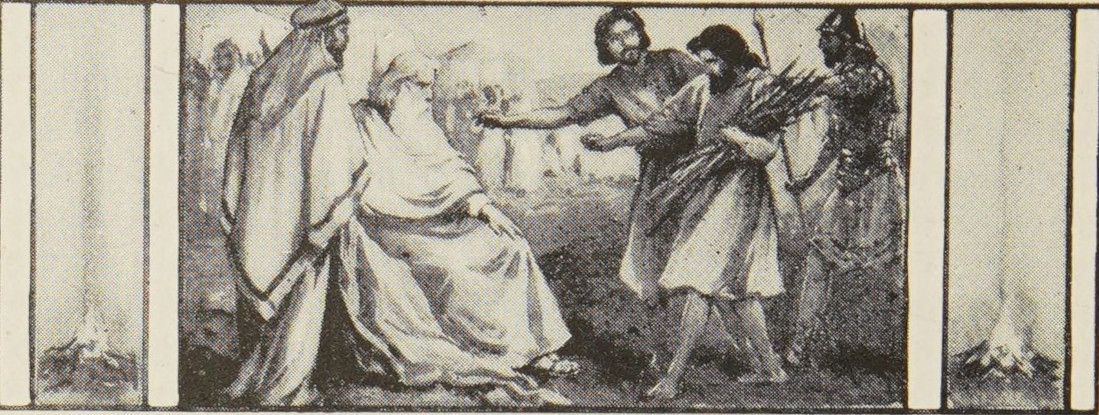
Soon after the return into the wilderness, an instance of Sabbath violation occurred, under circumstances that rendered it a case of peculiar guilt. The Lord’s announcement that he would disinherit Israel, had roused a spirit of rebellion. One of the people, angry at being excluded from Canaan, and determined to show his defiance of God’s law, ventured upon the open transgression of the fourth commandment, by going out to gather sticks upon the Sabbath. During the sojourn in the wilderness, the kindling of fires upon the seventh day had been strictly prohibited. The prohibition was not to extend to the land of Canaan, where the severity of the climate would often render fires a necessity; but in the wilderness, fire was not needed for warmth. The act of this man was a willful and deliberate violation of the fourth commandment,—a sin, not of thoughtlessness or ignorance, but of presumption.
He was taken in the act, and brought before Moses. It had already been declared that Sabbath-breaking should be punished with death; but it had not yet been revealed how the penalty was to be inflicted. The case was brought by Moses before the Lord, and the direction was given, “The man shall be surely put to death; all the congregation shall stone him with stones without the camp.”[697] The sins of blasphemy and willful Sabbath-breaking received the same punishment, being equally an expression of contempt for the authority of God.
In our day there are many who reject the creation Sabbath as a Jewish institution, and urge that if it is to be kept, the penalty of death must be inflicted for its violation; but we see that blasphemy received the same punishment as did Sabbath-breaking. Shall we therefore conclude that the third commandment also is to be set aside as applicable only to the Jews? Yet the argument drawn from the death penalty applies to the third, the fifth, and indeed to nearly all the ten precepts, equally with the fourth. Though God may not now punish the transgression of his law with temporal penalties, yet his word declares that the wages of sin is death; and in the final execution of the judgment it will be found that death is the portion of those who violate his sacred precepts.
During the entire forty years in the wilderness, the people were every week reminded of the sacred obligation of the Sabbath, by the miracle of the manna. Yet even this did not lead them to obedience. Though they did not venture upon so open and bold transgression as had received such signal punishment, yet there was great laxness in the observance of the fourth commandment. God declares through his prophet, “My Sabbaths they greatly polluted.”[698] And this is enumerated among the reasons for the exclusion of the first generation from the promised land. Yet their children did not learn the lesson. Such was their neglect of the Sabbath during the forty years’ wandering, that though God did not prevent them from entering Canaan, he declared that they should be scattered among the heathen after the settlement in the land of promise.
From Kadesh the children of Israel had turned back into the wilderness; and the period of their desert sojourn being ended, they came, “even the whole congregation, into the desert of Zin in the first month; and the people abode in Kadesh.”[699]
Here Miriam died and was buried. From that scene of rejoicing on the shores of the Red Sea, when Israel went forth with song and dance to celebrate Jehovah’s triumph, to the wilderness grave which ended a life-long wandering,—such had been the fate of millions who with high hopes had come forth from Egypt. Sin had dashed from their lips the cup of blessing. Would the next generation learn the lesson?
“For all this they sinned still, and believed not for his wondrous works.... When he slew them, then they sought him; and they returned and inquired early after God. And they remembered that God was their Rock, and the high God their Redeemer.”[700] Yet they did not turn to God with a sincere purpose. Though when afflicted by their enemies they sought help from Him who alone could deliver, yet “their heart was not right with him, neither were they steadfast in his covenant. But he, being full of compassion, forgave their iniquity, and destroyed them not; yea, many a time turned he his anger away.... For he remembered that they were but flesh, a wind that passeth away, and cometh not again.”[700]
THE SMITTEN ROCK—37
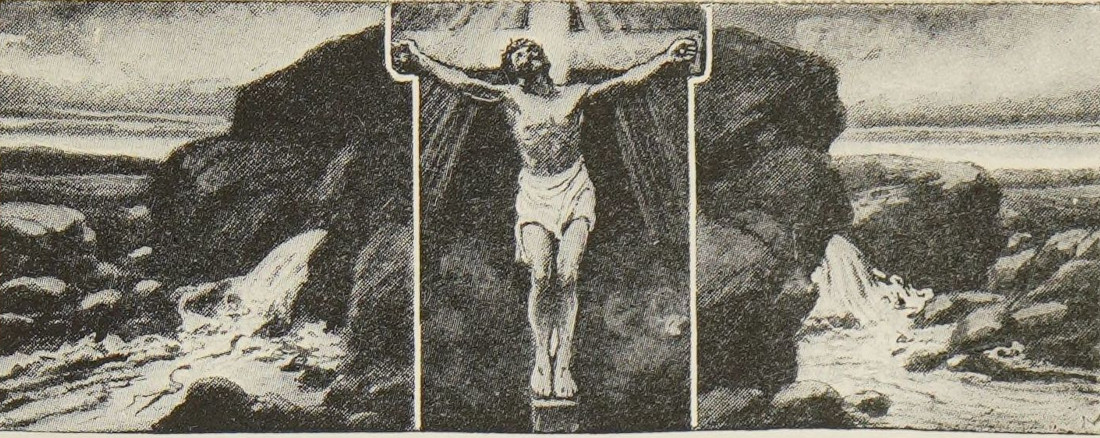
From the smitten rock in Horeb first flowed the living stream that refreshed Israel in the desert. During all their wanderings, wherever the need existed, they were supplied with water by a miracle of God’s mercy. The water did not, however, continue to flow from Horeb. Wherever in their journeyings they wanted water, there from the clefts of the rock it gushed out beside their encampment.
It was Christ, by the power of his word, that caused the refreshing stream to flow for Israel. “They drank of that spiritual Rock that followed them; and that Rock was Christ.”[710] He was the source of all temporal as well as spiritual blessings. Christ, the true Rock, was with them in all their wanderings. “They thirsted not when he led them through the deserts; he caused the waters to flow out of the rock for them; he clave the rock also, and the waters gushed out.” “They ran in the dry places like a river.”[711]
The smitten rock was a figure of Christ, and through this symbol the most precious spiritual truths are taught. As the life-giving waters flowed from the smitten rock, so from Christ, “smitten of God,” “wounded for our transgressions,” “bruised for our iniquities,”[712] the stream of salvation flows for a lost race. As the rock had been once smitten, so Christ was to be “once offered to bear the sins of many.”[713] Our Saviour was not to be sacrificed a second time; and it is only necessary for those who seek the blessings of his grace to ask in the name of Jesus, pouring forth the heart’s desire in penitential prayer. Such prayer will bring before the Lord of hosts the wounds of Jesus, and then will flow forth afresh the life-giving blood, symbolized by the flowing of the living water for Israel.
The flowing of the water from the rock in the desert was celebrated by the Israelites, after their establishment in Canaan, with demonstrations of great rejoicing. In the time of Christ this celebration had become a most impressive ceremony. It took place on the occasion of the Feast of Tabernacles, when the people from all the land were assembled at Jerusalem. On each of the seven days of the feast the priests went out with music and the choir of Levites to draw water in a golden vessel from the spring of Siloam. They were followed by multitudes of the worshipers, as many as could get near the stream drinking of it, while the jubilant strains arose, “With joy shall ye draw water out of the wells of salvation.”[714] Then the water drawn by the priests was borne to the temple amid the sounding of trumpets and the solemn chant, “Our feet shall stand within thy gates, O Jerusalem.” The water was poured out upon the altar of burnt-offering, while songs of praise rung out, the multitudes joining in triumphant chorus with musical instruments and deep-toned trumpets.
The Saviour made use of this symbolic service to direct the minds of the people to the blessings that he had come to bring them. “In the last day, that great day of the feast,” his voice was heard in tones that rang through the temple courts, “If any man thirst, let him come unto me, and drink. He that believeth on me, as the scripture hath said, out of his belly shall flow rivers of living water.” “This,” said John, “spake he of the Spirit, which they that believe on him should receive.”[715] The refreshing water, welling up in a parched and barren land, causing the desert place to blossom, and flowing out to give life to the perishing, is an emblem of the divine grace which Christ alone can bestow, and which is as the living water, purifying, refreshing, and invigorating the soul. He in whom Christ is abiding has within him a never-failing fountain of grace and strength. Jesus cheers the life and brightens the path of all who truly seek him. His love, received into the heart, will spring up in good works unto eternal life. And not only does it bless the soul in which it springs, but the living stream will flow out in words and deeds of righteousness, to refresh the thirsting around him.
The same figure Christ had employed in his conversation with the woman of Samaria at Jacob’s well: “Whosoever drinketh of the water that I shall give him shall never thirst; but the water that I shall give him shall be in him a well of water springing up into everlasting life.”[716] Christ combines the two types. He is the rock, he is the living water.
The same beautiful and expressive figures are carried throughout the Bible. Centuries before the advent of Christ, Moses pointed to him as the rock of Israel’s salvation;[717] the psalmist sung of him as “my Redeemer,” “the rock of my strength,” “the rock that is higher than I,” “a rock of habitation,” “rock of my heart,” “rock of my refuge.” In David’s song his grace is pictured also as the cool, “still waters,” amid green pastures, beside which the heavenly Shepherd leads his flock. Again, “Thou shalt make them,” he says, “drink of the river of thy pleasures. For with thee is the fountain of life.”[718] And the wise man declares, “The wellspring of wisdom is as a flowing brook.”[719] To Jeremiah, Christ is “the fountain of living waters;” to Zechariah, “a fountain opened ... for sin and for uncleanness.”[720]
Isaiah describes him as the “rock of ages,” and “the shadow of a great rock in a weary land.”[721] And he records the precious promise, bringing vividly to mind the living stream that flowed for Israel: “When the poor and needy seek water, and there is none, and their tongue faileth for thirst, I the Lord will hear them, I the God of Israel will not forsake them.” “I will pour water upon him that is thirsty, and floods upon the dry ground;” “in the wilderness shall waters break out, and streams in the desert.” The invitation is given, “Ho, every one that thirsteth, come ye to the waters.”[722] And in the closing pages of the sacred word this invitation is echoed. The river of the water of life, “clear as crystal,” proceeds from the throne of God and the Lamb; and the gracious call is ringing down through the ages, “Whosoever will, let him take the water of life freely.”[723]
Just before the Hebrew host reached Kadesh, the living stream ceased that for so many years had gushed out beside their encampment. It was the Lord’s purpose again to test his people. He would prove whether they would trust his providence or imitate the unbelief of their fathers.
They were now in sight of the hills of Canaan. A few days’ march would bring them to the borders of the promised land. They were but a little distance from Edom, which belonged to the descendants of Esau, and through which lay the appointed route to Canaan. The direction had been given to Moses, “Turn you northward. And command thou the people, saying, Ye are to pass through the coast of your brethren, the children of Esau, which dwell in Seir; and they shall be afraid of you.... Ye shall buy meat of them for money, that ye may eat; and ye shall also buy water of them for money, that ye may drink.”[724] These directions should have been sufficient to explain why their supply of water had been cut off; they were about to pass through a well-watered, fertile country, in a direct course to the land of Canaan. God had promised them an unmolested passage through Edom, and an opportunity to purchase food, and also water sufficient to supply the host. The cessation of the miraculous flow of water should therefore have been a cause of rejoicing, a token that the wilderness wandering was ended. Had they not been blinded by their unbelief, they would have understood this. But that which should have been an evidence of the fulfillment of God’s promise, was made the occasion of doubt and murmuring. The people seemed to have given up all hope that God would bring them into possession of Canaan, and they clamored for the blessings of the wilderness.
Before God permitted them to enter Canaan, they must show that they believed his promise. The water ceased before they had reached Edom. Here was an opportunity for them, for a little time, to walk by faith instead of sight. But the first trial developed the same turbulent, unthankful spirit that had been manifested by their fathers. No sooner was the cry for water heard in the encampment than they forgot the hand that had for so many years supplied their wants, and instead of turning to God for help, they murmured against him, in their desperation exclaiming, “Would God that we had died when our brethren died before the Lord;”[725] that is, they wished they had been of the number who were destroyed in the rebellion of Korah.
Their cries were directed against Moses and Aaron: “Why have ye brought up the congregation of the Lord into this wilderness, that we and our cattle should die there? And wherefore have ye made us to come up out of Egypt, to bring us in unto this evil place? It is no place of seed, or of figs, or of vines, or of pomegranates; neither is there any water to drink.”
The leaders went to the door of the tabernacle, and fell upon their faces. Again “the glory of the Lord appeared,” and Moses was directed, “Take the rod, and gather thou the assembly together, thou and Aaron thy brother, and speak ye unto the rock before their eyes; and it shall give forth his water, and thou shalt bring forth to them water out of the rock.”
The two brothers went on before the multitude, Moses with the rod of God in his hand. They were now aged men. Long had they borne with the rebellion and obstinacy of Israel; but now, at last, even the patience of Moses gave way. “Hear now, ye rebels,” he cried; “must we fetch you water out of this rock?” and instead of speaking to the rock, as God had commanded him, he smote it twice with the rod.
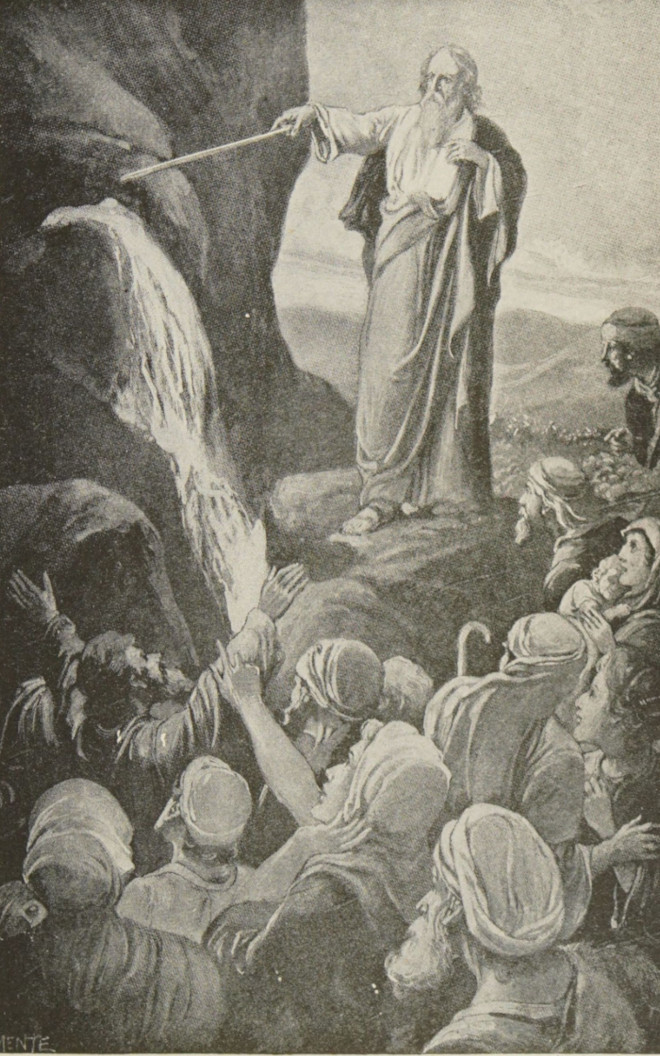
THE SMITTEN ROCK. “The water gushed forth in abundance to satisfy the host.”
The water gushed forth in abundance to satisfy the host. But a great wrong had been done. Moses had spoken from irritated feeling; his words were an expression of human passion rather than of holy indignation because God had been dishonored. “Hear now, ye rebels,” he said. This accusation was true, but even truth is not to be spoken in passion or impatience. When God had bidden Moses to charge upon Israel their rebellion, the words had been painful to himself, and hard for them to bear, yet God had sustained him in delivering the message. But when he took it upon himself to accuse them, he grieved the Spirit of God, and wrought only harm to the people. His lack of patience and self-control was evident. Thus the people were given occasion to question whether his past course had been under the direction of God, and to excuse their own sins. Moses, as well as they, had offended God. His course, they said, had from the first been open to criticism and censure. They had now found the pretext which they desired for rejecting all the reproofs that God had sent them through his servant.
Moses manifested distrust of God. “Shall we bring water?” he questioned, as if the Lord would not do what he promised. “Ye believed me not,” the Lord declared to the two brothers, “to sanctify me in the eyes of the children of Israel.” At the time when the water failed, their own faith in the fulfillment of God’s promise had been shaken by the murmuring and rebellion of the people. The first generation had been condemned to perish in the wilderness because of their unbelief, yet the same spirit appeared in their children. Would these also fail of receiving the promise? Wearied and disheartened, Moses and Aaron had made no effort to stem the current of popular feeling. Had they themselves manifested unwavering faith in God, they might have set the matter before the people in such a light as would have enabled them to bear this test. By prompt, decisive exercise of the authority vested in them as magistrates, they might have quelled the murmuring. It was their duty to put forth every effort in their power to bring about a better state of things before asking God to do the work for them. Had the murmuring at Kadesh been promptly checked, what a train of evil might have been prevented!
By his rash act, Moses took away the force of the lesson that God purposed to teach. The rock, being a symbol of Christ, had been once smitten, as Christ was to be once offered. The second time, it was needful only to speak to the rock, as we have only to ask for blessings in the name of Jesus. By the second smiting of the rock, the significance of this beautiful figure of Christ was destroyed.
More than this, Moses and Aaron had assumed power that belongs only to God. The necessity for divine interposition made the occasion one of great solemnity, and the leaders of Israel should have improved it to impress the people with reverence for God and to strengthen their faith in his power and goodness. When they angrily cried, “Must we fetch you water out of this rock?” they put themselves in God’s place, as though the power lay with themselves, men possessing human frailties and passions. Wearied with the continual murmuring and rebellion of the people, Moses had lost sight of his Almighty Helper, and without the divine strength he had been left to mar his record by an exhibition of human weakness. The man who might have stood pure, firm, and unselfish to the close of his work, had been overcome at last. God had been dishonored before the congregation of Israel, when he should have been magnified and exalted.
God did not on this occasion pronounce judgments upon those whose wicked course had so provoked Moses and Aaron. All the reproof fell upon the leaders. Those who stood as God’s representatives had not honored him. Moses and Aaron had felt themselves aggrieved, losing sight of the fact that the murmuring of the people was not against them but against God. It was by looking to themselves, appealing to their own sympathies, that they unconsciously fell into sin, and failed to set before the people their great guilt before God.
Bitter and deeply humiliating was the judgment immediately pronounced. “The Lord spake unto Moses and Aaron, Because ye believed me not, to sanctify me in the eyes of the children of Israel, therefore ye shall not bring this congregation into the land which I have given them.” With rebellious Israel they must die before crossing the Jordan. Had Moses and Aaron been cherishing self-esteem, or indulging a passionate spirit, in the face of divine warning and reproof, their guilt would have been far greater. But they were not chargeable with willful or deliberate sin; they had been overcome by a sudden temptation, and their contrition was immediate and heartfelt. The Lord accepted their repentance, though because of the harm their sin might do among the people, he could not remit its punishment.
Moses did not conceal his sentence, but told the people that since he had failed to ascribe glory to God, he could not lead them into the promised land. He bade them mark the severe punishment visited upon him, and then consider how God must regard their murmurings in charging upon a mere man the judgments which they had by their sins brought upon themselves. He told them how he had pleaded with God for a remission of the sentence, and had been refused. “The Lord was wroth with me for your sakes,” he said, “and would not hear me.”[726]
On every occasion of difficulty or trial, the Israelites had been ready to charge Moses with having led them from Egypt, as though God had had no agency in the matter. Throughout their journeyings, as they had complained of the difficulties in the way, and murmured against their leaders, Moses had told them, “Your murmurings are against God. It is not I, but God, who has wrought in your deliverance.” But his hasty words before the rock, “Shall we bring water?” were a virtual admission of their charge, and would thus confirm them in their unbelief, and justify their murmurings. The Lord would remove this impression forever from their minds, by forbidding Moses to enter the promised land. Here was unmistakable evidence that their leader was not Moses, but the mighty Angel of whom the Lord had said, “Behold, I send an Angel before thee, to keep thee in the way, and to bring thee into the place which I have prepared. Beware of him, and obey his voice; ... for my name is in him.”[727]
“The Lord was wroth with me for your sakes,” said Moses. The eyes of all Israel were upon Moses, and his sin cast a reflection upon God, who had chosen him as the leader of his people. The transgression was known to the whole congregation; and had it been passed by lightly, the impression would have been given that unbelief and impatience under great provocation might be excused in those in responsible positions. But when it was declared that because of that one sin Moses and Aaron were not to enter Canaan, the people knew that God is no respecter of persons, and that he will surely punish the transgressor.
The history of Israel was to be placed on record for the instruction and warning of coming generations. Men of all future time must see the God of heaven as an impartial ruler, in no case justifying sin. But few realize the exceeding sinfulness of sin. Men flatter themselves that God is too good to punish the transgressor. But in the light of Bible history it is evident that God’s goodness and his love engage him to deal with sin as an evil fatal to the peace and happiness of the universe.
Not even the integrity and faithfulness of Moses could avert the retribution of his fault. God had forgiven the people greater transgressions, but he could not deal with sin in the leaders as in those who were led. He had honored Moses above every other man upon the earth. He had revealed to him his glory, and through him he had communicated his statutes to Israel. The fact that Moses had enjoyed so great light and knowledge, made his sin more grievous. Past faithfulness will not atone for one wrong act. The greater the light and privileges granted to man, the greater is his responsibility, the more aggravated his failure, and the heavier his punishment.
Moses was not guilty of a great crime, as men would view the matter; his sin was one of common occurrence. The psalmist says that “he spake unadvisedly with his lips.”[728] To human judgment this may seem a light thing; but if God dealt so severely with this sin in his most faithful and honored servant, he will not excuse it in others. The spirit of self-exaltation, the disposition to censure our brethren, is displeasing to God. Those who indulge in these evils cast doubt upon the work of God, and give the skeptical an excuse for their unbelief. The more important one’s position, and the greater his influence, the greater is the necessity that he should cultivate patience and humility.
If the children of God, especially those who stand in positions of responsibility, can be led to take to themselves the glory that is due to God, Satan exults. He has gained a victory. It was thus that he fell. Thus he is most successful in tempting others to ruin. It is to place us on our guard against his devices that God has given in his word so many lessons teaching the danger of self-exaltation. There is not an impulse of our nature, not a faculty of the mind or an inclination of the heart, but needs to be, moment by moment, under the control of the Spirit of God. There is not a blessing which God bestows upon man, nor a trial which he permits to befall him, but Satan both can and will seize upon it to tempt, to harass and destroy the soul, if we give him the least advantage. Therefore however great one’s spiritual light, however much he may enjoy of the divine favor and blessing, he should ever walk humbly before the Lord, pleading in faith that God will direct every thought and control every impulse.
All who profess godliness are under the most sacred obligation to guard the spirit, and to exercise self-control under the greatest provocation. The burdens placed upon Moses were very great; few men will ever be so severely tried as he was; yet this was not allowed to excuse his sin. God has made ample provision for his people; and if they rely upon his strength, they will never become the sport of circumstances. The strongest temptation cannot excuse sin. However great the pressure brought to bear upon the soul, transgression is our own act. It is not in the power of earth or hell to compel any one to do evil. Satan attacks us at our weak points, but we need not be overcome. However severe or unexpected the assault, God has provided help for us, and in his strength we may conquer.
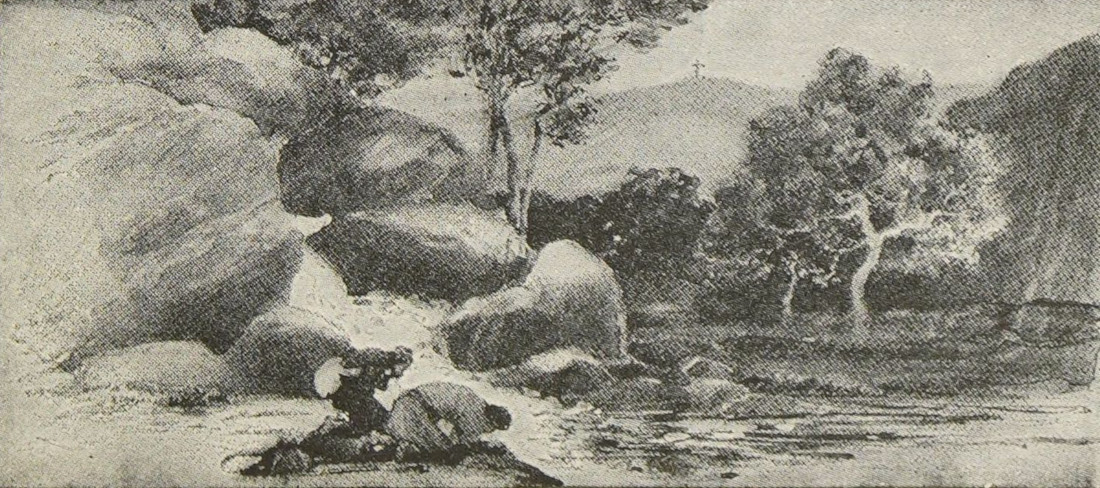
THE JOURNEY AROUND EDOM—38

The encampment of Israel at Kadesh was but a short distance from the borders of Edom, and both Moses and the people greatly desired to follow the route through this country to the promised land; accordingly they sent a message, as God had directed them, to the Edomite king,—
“Thus saith thy brother Israel, Thou knowest all the travail that hath befallen us; how our fathers went down into Egypt, and we have dwelt in Egypt a long time; and the Egyptians vexed us, and our fathers. And when we cried unto the Lord, he heard our voice, and sent an angel, and hath brought us forth out of Egypt. And, behold, we are in Kadesh, a city in the uttermost of thy border. Let us pass, I pray thee, through thy country. We will not pass through the fields, or through the vineyards, neither will we drink of the water of the wells. We will go by the king’s highway, we will not turn to the right hand nor to the left, until we have passed thy borders.”[740]
To this courteous request, a threatening refusal was returned: “Thou shalt not pass by me, lest I come out against thee with the sword.”
Surprised at this repulse, the leaders of Israel sent a second appeal to the king, with the promise, “We will go by the highway; and if I and my cattle drink of thy water, then I will pay for it; I will only, without doing anything else, go through on my feet.”
“Thou shalt not go through,” was the answer. Armed bands of Edomites were already posted at the difficult passes, so that any peaceful advance in that direction was impossible, and the Hebrews were forbidden to resort to force. They must make the long journey around the land of Edom.
Had the people, when brought into trial, trusted in God, the Captain of the Lord’s host would have led them through Edom, and the fear of them would have rested upon the inhabitants of the land, so that, instead of manifesting hostility, they would have shown them favor. But the Israelites did not act promptly upon God’s word, and while they were complaining and murmuring, the golden opportunity passed. When they were at last ready to present their request to the king, it was refused. Ever since they left Egypt, Satan had been steadily at work to throw hindrances and temptations in their way, that they might not inherit Canaan. And by their own unbelief they had repeatedly opened the door for him to resist the purpose of God.
It is important to believe God’s word and act upon it promptly, while his angels are waiting to work for us. Evil angels are ready to contest every step of advance. And when God’s providence bids his children go forward, when he is ready to do great things for them, Satan tempts them to displease the Lord by hesitation and delay; he seeks to kindle a spirit of strife or to arouse murmuring or unbelief, and thus deprive them of the blessings that God desired to bestow. God’s servants should be minute men, ever ready to move as fast as his providence opens the way. Any delay on their part gives time for Satan to work to defeat them.
In the directions first given to Moses concerning their passage through Edom, after declaring that the Edomites should be afraid of Israel, the Lord had forbidden his people to make use of this advantage against them. Because the power of God was engaged for Israel, and the fears of the Edomites would make them an easy prey, the Hebrews were not therefore to prey upon them. The command given them was, “Take ye good heed unto yourselves therefore; meddle not with them; for I will not give you of their land, no, not so much as a foot breadth; because I have given Mount Seir unto Esau for a possession.”[741] The Edomites were descendants of Abraham and Isaac, and for the sake of these his servants, God had shown favor to the children of Esau. He had given them Mount Seir for a possession, and they were not to be disturbed unless by their sins they should place themselves beyond the reach of his mercy. The Hebrews were to dispossess and utterly destroy the inhabitants of Canaan, who had filled up the measure of their iniquity; but the Edomites were still probationers, and as such were to be mercifully dealt with. God delights in mercy, and he manifests his compassion before he inflicts his judgments. He teaches Israel to spare the people of Edom, before requiring them to destroy the inhabitants of Canaan.
The ancestors of Edom and Israel were brothers, and brotherly kindness and courtesy should exist between them. The Israelites were forbidden, either then or at any future time, to revenge the affront given them in the refusal of passage through the land. They must not expect to possess any part of the land of Edom. While the Israelites were the chosen and favored people of God, they must heed the restrictions which he placed upon them. God had promised them a goodly inheritance; but they were not to feel that they alone had any rights in the earth, and seek to crowd out all others. They were directed, in all their intercourse with the Edomites, to beware of doing them injustice. They were to trade with them, buying such supplies as were needed, and promptly paying for all they received. As an encouragement to Israel to trust in God and obey his word, they were reminded, “The Lord thy God hath blessed thee; ... thou hast lacked nothing.” They were not dependent upon the Edomites; for they had a God rich in resources. They must not by force or fraud seek to obtain anything pertaining to them; but in all their intercourse they should exemplify the principle of the divine law, “Thou shalt love thy neighbor as thyself.”
Had they in this manner passed through Edom, as God had purposed, the passage would have proved a blessing, not only to themselves, but to the inhabitants of the land; for it would have given them an opportunity to become acquainted with God’s people and his worship, and to witness how the God of Jacob prospered those who loved and feared him. But all this the unbelief of Israel had prevented. God had given the people water in answer to their clamors, but he permitted their unbelief to work out its punishment. Again they must traverse the desert and quench their thirst from the miraculous spring, which, had they but trusted in him, they would no longer have needed.
Accordingly the hosts of Israel again turned toward the south, and made their way over sterile wastes, that seemed even more dreary after a glimpse of the green spots among the hills and valleys of Edom. From the mountain range overlooking this gloomy desert, rises Mount Hor, whose summit was to be the place of Aaron’s death and burial. When the Israelites came to this mountain, the divine command was addressed to Moses,—
“Take Aaron and Eleazar his son, and bring them up unto Mount Hor; and strip Aaron of his garments, and put them upon Eleazar his son; and Aaron shall be gathered unto his people, and shall die there.”[742]
Together these two aged men and the younger one toiled up the mountain height. The heads of Moses and Aaron were white with the snows of sixscore winters. Their long and eventful lives had been marked with the deepest trials and the greatest honors that had ever fallen to the lot of man. They were men of great natural ability, and all their powers had been developed, exalted, and dignified, by communion with the Infinite One. Their life had been spent in unselfish labor for God and their fellow-men; their countenances gave evidence of great intellectual power, firmness and nobility of purpose, and strong affections.
Many years, Moses and Aaron had stood side by side in their cares and labors. Together they had breasted unnumbered dangers, and had shared together the signal blessing of God; but the time was at hand when they must be separated. They moved on very slowly, for every moment in each other’s society was precious. The ascent was steep and toilsome; and as they often paused to rest, they communed together of the past and the future. Before them, as far as the eye could reach, was spread out the scene of their desert wanderings. In the plain below were encamped the vast hosts of Israel, for whom these chosen men had spent the best portion of their lives; for whose welfare they had felt so deep an interest, and made so great sacrifices. Somewhere beyond the mountains of Edom was the path leading to the promised land,—that land whose blessings Moses and Aaron were not to enjoy. No rebellious feelings found a place in their hearts, no expression of murmuring escaped their lips; yet a solemn sadness rested upon their countenances as they remembered what had debarred them from the inheritance of their fathers.
Aaron’s work for Israel was done. Forty years before, at the age of eighty-three, God had called him to unite with Moses in his great and important mission. He had co-operated with his brother in leading the children of Israel from Egypt. He had held up the great leader’s hands when the Hebrew hosts gave battle to Amalek. He had been permitted to ascend Mount Sinai, to approach into the presence of God, and to behold the divine glory. The Lord had conferred upon the family of Aaron the office of the priesthood, and had honored him with the sacred consecration of high priest. He had sustained him in the holy office by the terrible manifestations of divine judgment in the destruction of Korah and his company. It was through Aaron’s intercession that the plague was stayed. When his two sons were slain for disregarding God’s express command, he did not rebel nor even murmur. Yet the record of his noble life had been marred. Aaron committed a grievous sin when he yielded to the clamors of the people and made the golden calf at Sinai; and again, when he united with Miriam in envy and murmuring against Moses. And he, with Moses, offended the Lord at Kadesh by disobeying the command to speak to the rock that it might give forth its water.
God intended that these great leaders of his people should be representatives of Christ. Aaron bore the names of Israel upon his breast. He communicated to the people the will of God. He entered the most holy place on the day of atonement, “not without blood,” as a mediator for all Israel. He came forth from that work to bless the congregation, as Christ will come forth to bless his waiting people when his work of atonement in their behalf shall be ended. It was the exalted character of that sacred office as representative of our great High Priest, that made Aaron’s sin at Kadesh of so great magnitude.
With deep sorrow, Moses removed from Aaron the holy vestments, and placed them upon Eleazar, who thus became his successor by divine appointment. For his sin at Kadesh, Aaron was denied the privilege of officiating as God’s high priest in Canaan,—of offering the first sacrifice in the goodly land, and thus consecrating the inheritance of Israel. Moses was to continue to bear his burden in leading the people to the very borders of Canaan. He was to come within sight of the promised land, but was not to enter it. Had these servants of God, when they stood before the rock at Kadesh, borne unmurmuringly the test there brought upon them, how different would have been their future! A wrong act can never be undone. It may be that the work of a life-time will not recover what has been lost in a single moment of temptation or even thoughtlessness.
The absence from the camp of the two great leaders, and the fact that they had been accompanied by Eleazar, who, it was well known, was to be Aaron’s successor in holy office, awakened a feeling of apprehension, and their return was anxiously awaited. As the people looked about them, upon their vast congregation, they saw that nearly all the adults who left Egypt had perished in the wilderness. All felt a foreboding of evil as they remembered the sentence pronounced against Moses and Aaron. Some were aware of the object of that mysterious journey to the summit of Mount Hor, and their solicitude for their leaders was heightened by bitter memories and self-accusings.