ESTABLISHMENT IN CANAAN (continued 2)
Reading edition
TITHES AND OFFERINGS—50

In the Hebrew economy, one tenth of the income of the people was set apart to support the public worship of God. Thus Moses declared to Israel: “All the tithe of the land, whether of the seed of the land, or of the fruit of the tree, is the Lord’s; it is holy unto the Lord.” “And concerning the tithe of the herd, or of the flock, ... the tenth shall be holy unto the Lord.”[920]
But the tithing system did not originate with the Hebrews. From the earliest times the Lord claimed a tithe as his; and this claim was recognized and honored. Abraham paid tithes to Melchizedek, the priest of the most high God.[921] Jacob, when at Bethel, an exile and a wanderer, promised the Lord, “Of all that thou shalt give me I will surely give the tenth unto thee.”[921] As the Israelites were about to be established as a nation, the law of tithing was re-affirmed, as one of the divinely ordained statutes upon obedience to which their prosperity depended.
The system of tithes and offerings was intended to impress the minds of men with a great truth,—that God is the source of every blessing to his creatures, and that to him man’s gratitude is due for the good gifts of his providence.
“He giveth to all life, and breath, and all things.”[922] The Lord declares, “Every beast of the forest is mine, and the cattle upon a thousand hills.” “The silver is mine, and the gold is mine.” And it is God who gives men power to get wealth.[922] As an acknowledgment that all things came from him, the Lord directed that a portion of his bounty should be returned to him in gifts and offerings to sustain his worship.
“The tithe ... is the Lord’s.” Here the same form of expression is employed as in the law of the Sabbath. “The seventh day is the Sabbath of the Lord thy God.”[923] God reserved to himself a specified portion of man’s time and of his means, and no man could, without guilt, appropriate either for his own interests.
The tithe was to be exclusively devoted to the use of the Levites, the tribe that had been set apart for the service of the sanctuary. But this was by no means the limit of the contributions for religious purposes. The tabernacle, as afterward the temple, was erected wholly by free-will offerings; and to provide for necessary repairs, and other expenses, Moses directed that as often as the people were numbered, each should contribute a half shekel for “the service of the tabernacle.” In the time of Nehemiah a contribution was made yearly for this purpose.[924] From time to time, sin-offerings and thank-offerings were brought to God. These were presented in great numbers at the annual feasts. And the most liberal provision was made for the poor.
Even before the tithe could be reserved, there had been an acknowledgment of the claims of God. The first that ripened of every product of the land, was consecrated to him. The first of the wool when the sheep were shorn, of the grain when the wheat was threshed, the first of the oil and the wine, was set apart for God. So also were the first-born of all animals; and a redemption price was paid for the first-born son. The first-fruits were to be presented before the Lord at the sanctuary, and were then devoted to the use of the priests.
Thus the people were constantly reminded that God was the true proprietor of their fields, their flocks, and their herds; that he sent them sunshine and rain for their seed-time and harvest, and that everything they possessed was of his creation, and he had made them stewards of his goods.
As the men of Israel, laden with the first-fruits of field and orchard and vineyard, gathered at the tabernacle, there was made a public acknowledgment of God’s goodness. When the priest accepted the gift, the offerer, speaking as in the presence of Jehovah, said, “A Syrian ready to perish was my father;” and he described the sojourn in Egypt, and the affliction from which God had delivered Israel “with an outstretched arm, and with great terribleness, and with signs, and with wonders.” And he said, “He hath brought us into this place, and hath given us this land, even a land that floweth with milk and honey. And now, behold, I have brought the first-fruits of the land, which thou, Jehovah, hast given me.”[925]
The contributions required of the Hebrews for religious and charitable purposes amounted to fully one-fourth of their income. So heavy a tax upon the resources of the people might be expected to reduce them to poverty; but, on the contrary, the faithful observance of these regulations was one of the conditions of their prosperity. On condition of their obedience, God made them this promise: “I will rebuke the devourer for your sakes, and he shall not destroy the fruits of your ground; neither shall your vine cast her fruit before the time in the field.... And all nations shall call you blessed; for ye shall be a delightsome land, saith the Lord of hosts.”[926]
A striking illustration of the results of selfishly withholding even free-will offerings from the cause of God, was given in the days of the prophet Haggai. After their return from the captivity in Babylon, the Jews undertook to rebuild the temple of the Lord; but meeting determined opposition from their enemies, they discontinued the work; and a severe drought, by which they were reduced to actual want, convinced them that it was impossible to complete the building of the temple. “The time is not come,” they said, “the time that the Lord’s house should be built.” But a message was sent them by the Lord’s prophet: “Is it time for you, O ye, to dwell in your ceiled houses, and this house lie waste? Now therefore, thus saith the Lord of hosts: Consider your ways. Ye have sown much, and bring in little; ye eat, but ye have not enough; ye drink, but ye are not filled with drink; ye clothe you, but there is none warm; and he that earneth wages, earneth wages to put it into a bag with holes.”[927] And then the reason is given: “Ye looked for much, and, lo, it came to little; and when ye brought it home, I did blow upon it. Why? saith the Lord of hosts. Because of mine house that is waste, and ye run every man unto his own house. Therefore the heaven over you is stayed from dew, and the earth is stayed from her fruit. And I called for a drought upon the land, and upon the mountains, and upon the corn, and upon the new wine, and upon the oil, and upon that which the ground bringeth forth, and upon men, and upon cattle, and upon all the labor of the hands.” “When one came to a heap of twenty measures, there were but ten; when one came to the press-fat for to draw out fifty vessels out of the press, there were but twenty. I smote you with blasting, and with mildew, and with hail in all the labors of your hands.”[928]
Roused by these warnings, the people set themselves to build the house of God. Then the word of the Lord came to them: “Consider now from this day and upward, from the four and twentieth day of the ninth month, even from the day that the foundation of the Lord’s temple was laid, ... from this day will I bless you.”[928]
Says the wise man, “There is that scattereth, and yet increaseth; and there is that withholdeth more than is meet, but it tendeth to poverty.”[929] And the same lesson is taught in the New Testament by the apostle Paul: “He which soweth sparingly, shall reap also sparingly; and he which soweth bountifully, shall reap also bountifully.” “God is able to make all grace abound toward you; that ye, always having all sufficiency in all things, may abound to every good work.”[930]
God intended that his people Israel should be light-bearers to all the inhabitants of the earth. In maintaining his public worship they were bearing a testimony to the existence and sovereignty of the living God. And this worship it was their privilege to sustain, as an expression of their loyalty and their love to him. The Lord has ordained that the diffusion of light and truth in the earth shall be dependent upon the efforts and offerings of those who are partakers of the heavenly gift. He might have made angels the ambassadors of his truth; he might have made known his will, as he proclaimed the law from Sinai, with his own voice; but in his infinite love and wisdom he called men to become co-laborers with himself, by choosing them to do this work.
In the days of Israel the tithe and free-will offerings were needed to maintain the ordinances of divine service. Should the people of God give less in this age? The principle laid down by Christ is that our offerings to God should be in proportion to the light and privileges enjoyed. “Unto whomsoever much is given, of him shall be much required.”[931] Said the Saviour to his disciples, as he sent them forth, “Freely ye have received, freely give.”[932] As our blessings and privileges are increased,—above all, as we have before us the unparalleled sacrifice of the glorious Son of God,—should not our gratitude find expression in more abundant gifts to extend to others the message of salvation? The work of the gospel, as it widens, requires greater provision to sustain it than was called for anciently; and this makes the law of tithes and offerings of even more urgent necessity now than under the Hebrew economy. If his people were liberally to sustain his cause by their voluntary gifts, instead of resorting to unchristian and unhallowed methods to fill the treasury, God would be honored, and many more souls would be won to Christ.
The plan of Moses to raise means for the building of the tabernacle was highly successful. No urging was necessary. Nor did he employ any of the devices to which churches in our day so often resort. Ho made no grand feast. He did not invite the people to scenes of gayety, dancing, and general amusement; neither did he institute lotteries, nor anything of this profane order, to obtain means to erect the tabernacle for God. The Lord directed Moses to invite the children of Israel to bring their offerings. He was to accept gifts from every one that gave willingly, from his heart. And the offerings came in so great abundance that Moses bade the people cease bringing, for they had supplied more than could be used.
God has made men his stewards. The property which he has placed in their hands is the means that he has provided for the spread of the gospel. To those who prove themselves faithful stewards he will commit greater trusts. Saith the Lord, “Them that honor me, I will honor.”[933] “God loveth a cheerful giver,”[934] and when his people, with grateful hearts, bring their gifts and offerings to him, “not grudgingly, or of necessity,” his blessing will attend them, as he has promised. “Bring ye all the tithes into the store-house, that there may be meat in mine house, and prove me now herewith, saith the Lord of hosts, if I will not open you the windows of heaven, and pour you out a blessing, that there shall not be room enough to receive it.”[935]
GOD’S CARE FOR THE POOR—51
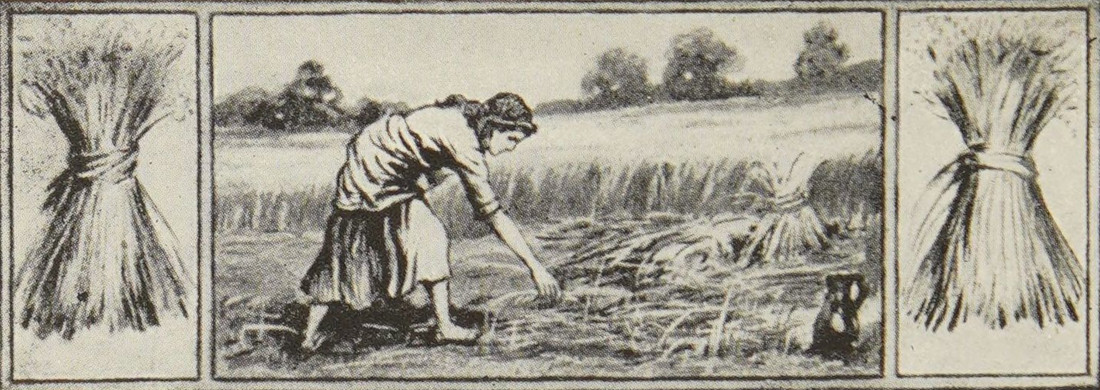
To promote the assembling of the people for religious service, as well as to provide for the poor, a second tithe of all the increase was required. Concerning the first tithe, the Lord had declared, “I have given the children of Levi all the tenth in Israel.”[940] But in regard to the second he commanded, “Thou shalt eat before the Lord thy God, in the place which he shall choose to place his name there, the tithe of thy corn, of thy wine, and of thine oil, and the firstlings of thy herds and of thy flocks; that thou mayest learn to fear the Lord thy God always.”[941] This tithe, or its equivalent in money, they were for two years to bring to the place where the sanctuary was established. After presenting a thank-offering to God, and a specified portion to the priest, the offerers were to use the remainder for a religious feast, in which the Levite, the stranger, the fatherless, and the widow should participate. Thus provision was made for the thank-offerings and feasts at the yearly festivals, and the people were drawn to the society of the priests and Levites, that they might receive instruction and encouragement in the service of God.
Every third year, however, this second tithe was to be used at home, in entertaining the Levite and the poor, as Moses said, “That they may eat within thy gates, and be filled.”[942] This tithe would provide a fund for the uses of charity and hospitality.
And further provision was made for the poor. There is nothing, after their recognition of the claims of God, that more distinguishes the laws given by Moses than the liberal, tender, and hospitable spirit enjoined toward the poor. Although God had promised greatly to bless his people, it was not his design that poverty should be wholly unknown among them. He declared that the poor should never cease out of the land. There would ever be those among his people who would call into exercise their sympathy, tenderness, and benevolence. Then, as now, persons were subject to misfortune, sickness, and loss of property; yet so long as they followed the instruction given by God, there were no beggars among them, neither any who suffered for food.
The law of God gave the poor a right to a certain portion of the produce of the soil. When hungry, a man was at liberty to go to his neighbor’s field or orchard or vineyard, and eat of the grain or fruit to satisfy his hunger. It was in accordance with this permission that the disciples of Jesus plucked and ate of the standing grain as they passed through a field upon the Sabbath day.
All the gleanings of harvest-field, orchard, and vineyard, belonged to the poor. “When thou cuttest down thine harvest in thy field,” said Moses, “and hast forgot a sheaf in the field, thou shalt not go again to fetch it.... When thou beatest thine olive-tree, thou shalt not go over the boughs again.... When thou gatherest the grapes of thy vineyard, thou shalt not glean it afterward. It shall be for the stranger, for the fatherless, and for the widow. And thou shalt remember that thou wast a bondman in the land of Egypt.”[943]
Every seventh year, special provision was made for the poor. The sabbatical year, as it was called, began at the end of the harvest. At the seed-time, which followed the ingathering, the people were not to sow; they should not dress the vineyard in the spring; and they must expect neither harvest nor vintage. Of that which the land produced spontaneously, they might eat while fresh, but they were not to lay up any portion of it in their store-houses. The yield of this year was to be free for the stranger, the fatherless, and the widow, and even for the creatures of the field.[944]
But if the land ordinarily produced only enough to supply the wants of the people, how were they to subsist during the year when no crops were gathered?—For this the promise of God made ample provision. “I will command my blessing upon you in the sixth year,” he said, “and it shall bring forth fruit for three years. And ye shall sow the eighth year, and eat yet of old fruit until the ninth year; until her fruits come in ye shall eat of the old store.”[945]
The observance of the sabbatical year was to be a benefit to both the land and the people. The soil, lying untilled for one season, would afterward produce more plentifully. The people were released from the pressing labors of the field; and while there were various branches of work that could be followed during this time, all enjoyed greater leisure, which afforded opportunity for the restoration of their physical powers for the exertions of the following years. They had more time for meditation and prayer, for acquainting themselves with the teachings and requirements of the Lord, and for the instruction of their households.
In the sabbatical year the Hebrew slaves were to be set at liberty, and they were not to be sent away portionless. The Lord’s direction was: “When thou sendest him out free from thee, thou shalt not let him go away empty. Thou shalt furnish him liberally out of thy flock, and out of thy floor, and out of thy wine-press. Of that wherewith the Lord thy God hath blessed thee, thou shalt give unto him.”[946]
The hire of a laborer was to be promptly paid: “Thou shalt not oppress a hired servant that is poor and needy, whether he be of thy brethren, or of thy strangers that are in thy land.... At his day thou shalt give him his hire, neither shall the sun go down upon it; for he is poor, and setteth his heart upon it.”[947]
Special directions were also given concerning the treatment of fugitives from service: “Thou shalt not deliver unto his master the servant which is escaped from his master unto thee. He shall dwell with thee, even among you, in that place which he shall choose in one of thy gates, where it liketh him best; thou shalt not oppress him.”[948]
To the poor, the seventh year was a year of release from debt. The Hebrews were enjoined at all times to assist their needy brethren by lending them money without interest. To take usury from a poor man was expressly forbidden: “If thy brother be waxen poor, and fallen in decay with thee, then thou shalt relieve him; yea, though he be a stranger, or a sojourner; that he may live with thee. Take thou no usury of him, or increase; but fear thy God; that thy brother may live with thee. Thou shalt not give him thy money upon usury, nor lend him thy victuals for increase.”[949] If the debt remained unpaid until the year of release, the principal itself could not be recovered. The people were expressly warned against withholding from their brethren needed assistance on account of this: “If there be among you a poor man of one of thy brethren, ... thou shalt not harden thine heart, nor shut thine hand from thy poor brother.... Beware that there be not a thought in thy wicked heart, saying, The seventh year, the year of release, is at hand; and thine eye be evil against thy poor brother, and thou givest him naught; and he cry unto the Lord against thee, and it be sin unto thee.” “The poor shall never cease out of the land; therefore I command thee, saying, Thou shalt open thine hand wide unto thy brother, to thy poor, and to thy needy, in thy land,” “and shalt surely lend him sufficient for his need, in that which he wanteth.”[950]
None need fear that their liberality would bring them to want. Obedience to God’s commandments would surely result in prosperity. “Thou shalt lend unto many nations,” he said, “but thou shalt not borrow; and thou shalt reign over many nations, but they shall not reign over thee.”[951]
After “seven sabbaths of years,” “seven times seven years,” came the great year of release,—the jubilee. “Then shalt thou cause the trumpet of the jubilee to sound ... throughout all your land. And ye shall hallow the fiftieth year, and proclaim liberty throughout all the land unto all the inhabitants thereof; it shall be a jubilee unto you; and ye shall return every man unto his possession, and ye shall return every man unto his family.”[952]
“On the tenth day of the seventh month, in the day of atonement,” the trumpet of the jubilee was sounded. Throughout the land, wherever the Jewish people dwelt, the sound was heard, calling upon all the children of Jacob to welcome the year of release. On the great day of atonement, satisfaction was made for the sins of Israel, and with gladness of heart the people would welcome the jubilee.
As in the sabbatical year, the land was not to be sown or reaped, and all that it produced was to be regarded as the rightful property of the poor. Certain classes of Hebrew slaves—all who did not receive their liberty in the sabbatical year—were now set free. But that which especially distinguished the year of jubilee was the reversion of all landed property to the family of the original possessor. By the special direction of God, the land had been divided by lot. After the division was made, no one was at liberty to trade his estate. Neither was he to sell his land unless poverty compelled him to do so, and then, whenever he or any of his kindred might desire to redeem it, the purchaser must not refuse to sell it; and if unredeemed, it would revert to its first possessor or his heirs in the year of jubilee.
The Lord declared to Israel: “The land shall not be sold forever; for the land is mine; for ye are strangers and sojourners with me.”[953] The people were to be impressed with the fact that it was God’s land which they were permitted to possess for a time; that he was the rightful owner, the original proprietor, and that he would have special consideration made for the poor and unfortunate. It was to be impressed upon the minds of all that the poor have as much right to a place in God’s world as have the more wealthy.
Such were the provisions made by our merciful Creator, to lessen suffering, to bring some ray of hope, to flash some gleam of sunshine, into the life of the destitute and distressed.
The Lord would place a check upon the inordinate love of property and power. Great evils would result from the continued accumulation of wealth by one class, and the poverty and degradation of another. Without some restraint, the power of the wealthy would become a monopoly, and the poor, though in every respect fully as worthy in God’s sight, would be regarded and treated as inferior to their more prosperous brethren. The sense of this oppression would arouse the passions of the poorer class. There would be a feeling of despair and desperation which would tend to demoralize society, and open the door to crimes of every description. The regulations that God established, were designed to promote social equality. The provisions of the sabbatical year and the jubilee would, in a great measure, set right that which during the interval had gone wrong in the social and political economy of the nation.
These regulations were designed to bless the rich no less than the poor. They would restrain avarice and a disposition for self-exaltation, and would cultivate a noble spirit of benevolence; and by fostering good-will and confidence between all classes, they would promote social order, the stability of government. We are all woven together in the great web of humanity, and whatever we can do to benefit and uplift others, will reflect in blessing upon ourselves. The law of mutual dependence runs through all classes of society. The poor are not more dependent upon the rich than are the rich upon the poor. While the one class ask a share in the blessings which God has bestowed upon their wealthier neighbors, the other need the faithful service, the strength of brain and bone and muscle, that are the capital of the poor.
Great blessings were promised to Israel on condition of obedience to the Lord’s directions. “I will give you rain in due season,” he declared, “and the land shall yield her increase, and the trees of the field shall yield their fruit. And your threshing shall reach unto the vintage, and the vintage shall reach unto the sowing time; and ye shall eat your bread to the full, and dwell in your land safely. And I will give peace in the land, and ye shall lie down, and none shall make you afraid; and I will rid evil beasts out of the land, neither shall the sword go through your land.... I will walk among you, and will be your God, and ye shall be my people.... But if ye will not hearken unto me, and will not do all these commandments; and ... ye break my covenant, ... ye shall sow your seed in vain, for your enemies shall eat it. And I will set my face against you, and ye shall be slain before your enemies; they that hate you shall reign over you, and ye shall flee when none pursueth you.”[954]
There are many who urge with great enthusiasm that all men should have an equal share in the temporal blessings of God. But this was not the purpose of the Creator. A diversity of condition is one of the means by which God designs to prove and develop character. Yet he intends that those who have worldly possessions shall regard themselves merely as stewards of his goods, as intrusted with means to be employed for the benefit of the suffering and the needy.
Christ has said that we shall have the poor always with us; and he unites his interest with that of his suffering people. The heart of our Redeemer sympathizes with the poorest and lowliest of his earthly children. He tells us that they are his representatives on earth. He has placed them among us to awaken in our hearts the love that he feels toward the suffering and oppressed. Pity and benevolence shown to them are accepted by Christ as if shown to himself. An act of cruelty or neglect toward them is regarded as though done to him.
If the law given by God for the benefit of the poor had continued to be carried out, how different would be the present condition of the world, morally, spiritually, and temporally! Selfishness and self-importance would not be manifested as now, but each would cherish a kind regard for the happiness and welfare of others; and such wide-spread destitution as is now seen in many lands, would not exist.
The principles which God has enjoined, would prevent the terrible evils that in all ages have resulted from the oppression of the rich toward the poor, and the suspicion and hatred of the poor toward the rich. While they might hinder the amassing of great wealth, and the indulgence of unbounded luxury, they would prevent the consequent ignorance and degradation of tens of thousands whose ill-paid servitude is required to build up these colossal fortunes. They would bring a peaceful solution of those problems that now threaten to fill the world with anarchy and bloodshed.

“The yield of this year was to be free for the stranger, the fatherless, and the widow, and even for the creatures of the field.”
THE ANNUAL FEASTS—52

There were three annual assemblies of all Israel for worship at the sanctuary.[955] Shiloh was for a time the place of these gatherings; but Jerusalem afterward became the center of the nation’s worship, and here the tribes convened for the solemn feasts.
The people were surrounded by fierce, warlike tribes, that were eager to seize upon their lands; yet three times every year all the able-bodied men, and all the people who could make the journey, were directed to leave their homes, and repair to the place of assembly, near the center of the land. What was to hinder their enemies from sweeping down upon those unprotected households, to lay them waste with fire and sword? What was to prevent an invasion of the land, that would bring Israel into captivity to some foreign foe?—God had promised to be the protector of his people. “The angel of Jehovah encampeth round about them that fear him, and delivereth them.”[956] While the Israelites went up to worship, divine power would place a restraint upon their enemies. God’s promise was, “I will cast out the nations before thee, and enlarge thy borders; neither shall any man desire thy land, when thou shalt go up to appear before the Lord thy God thrice in the year.”[957]
The first of these festivals, the Passover, the feast of unleavened bread, occurred in Abib, the first month of the Jewish year, corresponding to the last of March and the beginning of April. The cold of winter was past, the latter rain had ended, and all nature rejoiced in the freshness and beauty of the springtime. The grass was green on the hills and valleys, and wild-flowers everywhere brightened the fields. The moon, now approaching the full, made the evenings delightful. It was the season so beautifully pictured by the sacred singer:—
“The winter is past,
The rain is over and gone;
The flowers appear on the earth;
The time of the singing of birds is come,
And the voice of the turtle is heard in our land;
The fig-tree ripeneth her green figs,
And the vines are in blossom,
They give forth their fragrance.”[958]
Throughout the land, bands of pilgrims were making their way toward Jerusalem. The shepherds from their flocks, the herdsmen from the mountains, fishers from the Sea of Galilee, the husbandmen from their fields, and sons of the prophets from the sacred schools,—all turned their steps toward the place where God’s presence was revealed. They journeyed by short stages, for many went on foot. The caravans were constantly receiving accessions, and often became very large before reaching the holy city.
Nature’s gladness awakened joy in the hearts of Israel, and gratitude to the Giver of all good. The grand Hebrew psalms were chanted, exalting the glory and majesty of Jehovah. At the sound of the signal trumpet, with the music of cymbals, the chorus of thanksgiving arose, swelled by hundreds of voices:—
“I was glad when they said unto me,
Let us go unto the house of the Lord.
Our feet shall stand
Within thy gates, O Jerusalem....
Whither the tribes go up, even the tribes of the Lord, ...
To give thanks unto the name of Jehovah....
Pray for the peace of Jerusalem,
They shall prosper that love thee.”[959]
As they saw around them the hills where the heathen had been wont to kindle their altar fires, the children of Israel sang:—
“Shall I lift up mine eyes to the hills?
Whence should my help come?
My help cometh from Jehovah,
Which made heaven and earth.”[959]
“They that trust in the Lord
Are as Mount Zion, which can not be moved, but abideth forever.
As the mountains are round about Jerusalem,
So the Lord is round about his people,
From this time forth and forevermore.”[959]
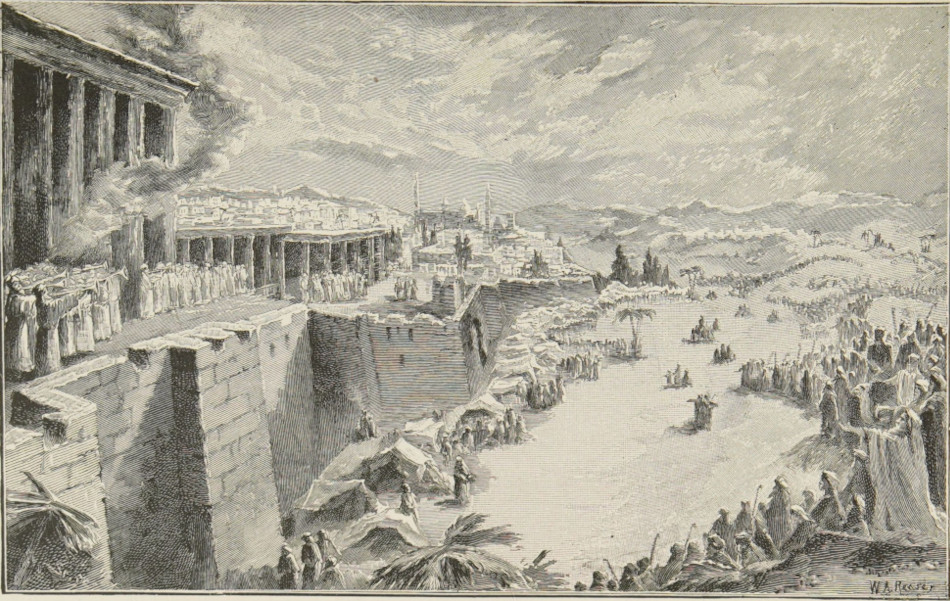
THE FEAST OF TABERNACLES. “I was glad when they said unto me, Let us go unto the house of the Lord.”
Surmounting the hills in view of the holy city, they looked with reverent awe upon the throngs of worshipers wending their way to the temple. They saw the smoke of the incense ascending, and as they heard the trumpets of the Levites heralding the sacred service, they caught the inspiration of the hour, and sung:—
“Great is the Lord, and greatly to be praised,
In the city of our God, in the mountain of his holiness.
Beautiful for situation, the joy of the whole earth,
Is Mount Zion, on the sides of the north,
The city of the great King.”[960]
“Peace be within thy walls,
And prosperity within thy palaces.”
“Open to me the gates of righteousness;
I will go into them, and I will praise the Lord.”
“I will pay my vows unto the Lord
Now in the presence of all his people,
In the courts of the Lord’s house,
In the midst of thee, O Jerusalem.
Praise ye the Lord.”[961]
All the houses in Jerusalem were thrown open to the pilgrims, and rooms were furnished free; but this was not sufficient for the vast assembly, and tents were pitched in every available space in the city and upon the surrounding hills.
On the fourteenth day of the month, at even, the Passover was celebrated, its solemn, impressive ceremonies commemorating the deliverance from bondage in Egypt, and pointing forward to the sacrifice that should deliver from the bondage of sin. When the Saviour yielded up his life on Calvary, the significance of the Passover ceased, and the ordinance of the Lord’s Supper was instituted as a memorial of the same event of which the Passover had been a type.
The Passover was followed by the seven days’ feast of unleavened bread. The first and the seventh day were days of holy convocation, when no servile work was to be performed. On the second day of the feast, the first-fruits of the year’s harvest were presented before God. Barley was the earliest grain in Palestine, and at the opening of the feast it was beginning to ripen. A sheaf of this grain was waved by the priest before the altar of God, as an acknowledgment that all was his. Not until this ceremony had been performed was the harvest to be gathered.
Fifty days from the offering of first-fruits, came the Pentecost, called also the feast of harvest and the feast of weeks. As an expression of gratitude for the grain prepared as food, two loaves baked with leaven were presented before God. The Pentecost occupied but one day, which was devoted to religious service.
In the seventh month came the Feast of Tabernacles, or of ingathering. This feast acknowledged God’s bounty in the products of the orchard, the olive grove, and the vineyard. It was the crowning festal gathering of the year. The land had yielded its increase, the harvests had been gathered into the granaries, the fruits, the oil, and the wine had been stored, the first-fruits had been reserved, and now the people came with their tributes of thanksgiving to God, who had thus richly blessed them.
This feast was to be pre-eminently an occasion of rejoicing. It occurred just after the great day of atonement, when the assurance had been given that their iniquity should be remembered no more. At peace with God, they now came before him to acknowledge his goodness, and to praise him for his mercy. The labors of the harvest being ended, and the toils of the new year not yet begun, the people were free from care, and could give themselves up to the sacred, joyous influences of the hour. Though only the fathers and sons were commanded to appear at the feasts, yet, so far as possible, all the household were to attend them, and to their hospitality the servants, the Levites, the stranger, and the poor were made welcome.
Like the Passover, the Feast of Tabernacles was commemorative. In memory of their pilgrim life in the wilderness, the people were now to leave their houses, and dwell in booths, or arbors, formed from the green branches “of goodly trees, branches of palm-trees, and the boughs of thick trees, and willows of the brook.”[962]
The first day was a holy convocation, and to the seven days of the feast an eighth day was added, which was observed in like manner.
At these yearly assemblies the hearts of old and young would be encouraged in the service of God, while the association of the people from the different quarters of the land would strengthen the ties that bound them to God and to one another. Well would it be for the people of God at the present time to have a Feast of Tabernacles,—a joyous commemoration of the blessings of God to them. As the children of Israel celebrated the deliverance that God had wrought for their fathers, and his miraculous preservation of them during their journeyings from Egypt, so should we gratefully call to mind the various ways he has devised for bringing us out from the world, and from the darkness of error, into the precious light of his grace and truth.
With those who lived at a distance from the tabernacle, more than a month of every year must have been occupied in attendance upon the annual feasts. This example of devotion to God should emphasize the importance of religious worship, and the necessity of subordinating our selfish, worldly interests to those that are spiritual and eternal. We sustain a loss when we neglect the privilege of associating together to strengthen and encourage one another in the service of God. The truths of his word lose their vividness and importance in our minds. Our hearts cease to be enlightened and aroused by the sanctifying influence, and we decline in spirituality. In our intercourse as Christians we lose much by lack of sympathy with one another. He who shuts himself up to himself, is not filling the position that God designed he should. We are all children of one Father, dependent upon one another for happiness. The claims of God and of humanity are upon us. It is the proper cultivation of the social elements of our nature that brings us into sympathy with our brethren, and affords us happiness in our efforts to bless others.
The Feast of Tabernacles was not only commemorative, but typical. It not only pointed back to the wilderness sojourn, but, as the feast of harvest, it celebrated the ingathering of the fruits of the earth, and pointed forward to the great day of final ingathering, when the Lord of the harvest shall send forth his reapers to gather the tares together in bundles for the fire, and to gather the wheat into his garner. At that time the wicked will all be destroyed. They will become “as though they had not been.”[963] And every voice in the whole universe will unite in joyful praise to God. Says the Revelator, “Every creature which is in heaven, and on the earth, and under the earth, and such as are in the sea, and all that are in them, heard I saying, Blessing, and honor, and glory, and power, be unto Him that sitteth upon the throne, and unto the Lamb forever and ever.”[964]
The people of Israel praised God at the Feast of Tabernacles, as they called to mind his mercy in their deliverance from the bondage of Egypt and his tender care for them during their pilgrim life in the wilderness. They rejoiced also in the consciousness of pardon and acceptance, through the service of the day of atonement, just ended. But when the ransomed of the Lord shall have been safely gathered into the heavenly Canaan,—forever delivered from the bondage of the curse, under which “the whole creation groaneth and travaileth in pain together until now,”[965]—they will rejoice with joy unspeakable and full of glory. Christ’s great work of atonement for men will then have been completed, and their sins will have been forever blotted out.
“The wilderness and the solitary place shall be glad for them;
And the desert shall rejoice, and blossom as the rose.
It shall blossom abundantly, and rejoice even with joy and singing:
The glory of Lebanon shall be given unto it,
The excellency of Carmel and Sharon,
They shall see the glory of the Lord, and the excellency of our God.
“Then the eyes of the blind shall be opened,
And the ears of the deaf shall be unstopped.
Then shall the lame man leap as an hart,
And the tongue of the dumb sing:
“For in the wilderness shall waters break out,
And streams in the desert.
And the parched ground shall become a pool,
And the thirsty land springs of water:...
“And an highway shall be there, and a way,
And it shall be called The way of holiness;
The unclean shall not pass over it;
But it shall be for those:
The wayfaring men, though fools, shall not err therein.
“No lion shall be there,
Nor any ravenous beast shall go up thereon,
It shall not be found there;
But the redeemed shall walk there.
“And the ransomed of the Lord shall return,
And come to Zion with songs
And everlasting joy upon their heads:
They shall obtain joy and gladness,
And sorrow and sighing shall flee away.”[966]