THE CHOSEN NATION
Reading edition
“The Lord’s portion is his people; Jacob is the lot of his inheritance.”
“He remembered his holy promise, and Abraham his servant. And he brought forth his people with joy, and his chosen with gladness; ... that they might observe his statutes, and keep his laws.”
MOSES—22
The people of Egypt, in order to supply themselves with food during the famine, had sold to the crown their cattle and lands, and had finally bound themselves to perpetual serfdom. Joseph wisely provided for their release; he permitted them to become royal tenants, holding their lands of the king, and paying an annual tribute of one-fifth of the products of their labor.
But the children of Jacob were not under the necessity of making such conditions. On account of the service that Joseph had rendered the Egyptian nation, they were not only granted a part of the country as a home, but were exempted from taxation, and liberally supplied with food during the continuance of the famine. The king publicly acknowledged that it was through the merciful interposition of the God of Joseph that Egypt enjoyed plenty while other nations were perishing from famine. He saw, too, that Joseph’s management had greatly enriched the kingdom, and his gratitude surrounded the family of Jacob with royal favor.
But as time rolled on, the great man to whom Egypt owed so much, and the generation blessed by his labors, passed to the grave. And “there arose up a new king over Egypt, which knew not Joseph.”[350] Not that he was ignorant of Joseph’s services to the nation, but he wished to make no recognition of them, and, so far as possible, to bury them in oblivion. “And he said unto his people, Behold, the people of the children of Israel are more and mightier than we. Come on, let us deal wisely with them; lest they multiply, and it come to pass, that, when there falleth out any war, they join also unto our enemies, and fight against us, and so get them up out of the land.”
The Israelites had already become very numerous; “they were fruitful, and increased abundantly, and multiplied, and waxed exceeding mighty; and the land was filled with them.” Under Joseph’s fostering care, and the favor of the king who was then ruling, they had spread rapidly over the land. But they had kept themselves a distinct race, having nothing in common with the Egyptians in customs or religion; and their increasing numbers now excited the fears of the king and his people, lest in case of war they should join themselves with the enemies of Egypt. Yet policy forbade their banishment from the country. Many of them were able and understanding workmen, and they added greatly to the wealth of the nation; the king needed such laborers for the erection of his magnificent palaces and temples. Accordingly he ranked them with the Egyptians who had sold themselves with their possessions to the kingdom. Soon taskmasters were set over them, and their slavery became complete. “And the Egyptians made the children of Israel to serve with rigor, and they made their lives bitter with hard bondage, in mortar, and in brick, and in all manner of service in the field; all their service, wherein they made them serve, was with rigor.” “But the more they afflicted them, the more they multiplied and grew.”
The king and his counselors had hoped to subdue the Israelites with hard labor, and thus decrease their numbers and crush out their independent spirit. Failing to accomplish their purpose, they proceeded to more cruel measures. Orders were issued to the women whose employment gave them opportunity for executing the command, to destroy the Hebrew male children at their birth. Satan was the mover in this matter. He knew that a deliverer was to be raised up among the Israelites; and by leading the king to destroy their children he hoped to defeat the divine purpose. But the women feared God, and dared not execute the cruel mandate. The Lord approved their course, and prospered them. The king, angry at the failure of his design, made the command more urgent and extensive. The whole nation was called upon to hunt out and slaughter his helpless victims. “And Pharaoh charged all his people, saying, Every son that is born ye shall cast into the river, and every daughter ye shall save alive.”
While this decree was in full force, a son was born to Amram and Jochebed, devout Israelites of the tribe of Levi. The babe was “a goodly child;” and the parents, believing that the time of Israel’s release was drawing near, and that God would raise up a deliverer for his people, determined that their little one should not be sacrificed. Faith in God strengthened their hearts, “and they were not afraid of the king’s commandment.”[351]
The mother succeeded in concealing the child for three months. Then, finding that she could no longer keep him safely, she prepared a little ark of rushes, making it water-tight by means of slime and pitch; and laying the babe therein, she placed it among the flags at the river’s brink. She dared not remain to guard it, lest the child’s life and her own should be forfeited; but his sister, Miriam, lingered near, apparently indifferent, but anxiously watching to see what would become of her little brother. And there were other watchers. The mother’s earnest prayers had committed her child to the care of God; and angels, unseen, hovered above his lowly resting-place. Angels directed Pharaoh’s daughter thither. Her curiosity was excited by the little basket, and as she looked upon the beautiful child within, she read the story at a glance. The tears of the babe awakened her compassion, and her sympathies went out to the unknown mother who had resorted to this means to preserve the life of her precious little one. She determined that he should be saved; she would adopt him as her own.
Miriam had been secretly noting every movement; perceiving that the child was tenderly regarded, she ventured nearer, and at last said, “Shall I go and call to thee a nurse of the Hebrew women, that she may nurse the child for thee?” And permission was given.
The sister hastened to her mother with the happy news, and without delay returned with her to the presence of Pharaoh’s daughter. “Take this child away, and nurse it for me, and I will give thee thy wages,” said the princess.
God had heard the mother’s prayers; her faith had been rewarded. It was with deep gratitude that she entered upon her now safe and happy task. She faithfully improved her opportunity to educate her child for God. She felt confident that he had been preserved for some great work, and she knew that he must soon be given up to his royal mother, to be surrounded with influences that would tend to lead him away from God. All this rendered her more diligent and careful in his instruction than in that of her other children. She endeavored to imbue his mind with the fear of God and the love of truth and justice, and earnestly prayed that he might be preserved from every corrupting influence. She showed him the folly and sin of idolatry, and early taught him to bow down and pray to the living God, who alone could hear him and help him in every emergency.
She kept the boy as long as she could, but was obliged to give him up when he was about twelve years old. From his humble cabin home he was taken to the royal palace, to the daughter of Pharaoh, “and he became her son.” Yet even here he did not lose the impressions received in childhood. The lessons learned at his mother’s side could not be forgotten. They were a shield from the pride, the infidelity, and the vice that flourished amid the splendor of the court.
How far-reaching in its results was the influence of that one Hebrew woman, and she an exile and a slave! The whole future life of Moses, the great mission which he fulfilled as the leader of Israel, testifies to the importance of the work of the Christian mother. There is no other work that can equal this. To a very great extent, the mother holds in her own hands the destiny of her children. She is dealing with developing minds and characters, working not alone for time, but for eternity. She is sowing seed that will spring up and bear fruit, either for good or for evil. She has not to paint a form of beauty upon canvas or to chisel it from marble, but to impress upon a human soul the image of the divine. Especially during their early years the responsibility rests upon her of forming the character of her children. The impressions now made upon their developing minds will remain with them all through life. Parents should direct the instruction and training of their children while very young, to the end that they may be Christians. They are placed in our care to be trained, not as heirs to the throne of an earthly empire, but as kings unto God, to reign through unending ages.
Let every mother feel that her moments are priceless; her work will be tested in the solemn day of accounts. Then it will be found that many of the failures and crimes of men and women have resulted from the ignorance and neglect of those whose duty it was to guide their childish feet in the right way. Then it will be found that many who have blessed the world with the light of genius and truth and holiness, owe the principles that were the mainspring of their influence and success to a praying, Christian mother.
At the court of Pharaoh, Moses received the highest civil and military training. The monarch had determined to make his adopted grandson his successor on the throne, and the youth was educated for his high station. “And Moses was learned in all the wisdom of the Egyptians, and was mighty in words and in deeds.”[352] His ability as a military leader made him a favorite with the armies of Egypt, and he was generally regarded as a remarkable character. Satan had been defeated in his purpose. The very decree condemning the Hebrew children to death had been overruled by God for the training and education of the future leader of his people.
The elders of Israel were taught by angels that the time for their deliverance was near, and that Moses was the man whom God would employ to accomplish this work. Angels instructed Moses also that Jehovah had chosen him to break the bondage of his people. He, supposing that they were to obtain their freedom by force of arms, expected to lead the Hebrew host against the armies of Egypt, and having this in view, he guarded his affections, lest in his attachment to his foster mother or to Pharaoh he would not be free to do the will of God.
By the laws of Egypt, all who occupied the throne of the Pharaohs must become members of the priestly caste; and Moses, as the heir apparent, was to be initiated into the mysteries of the national religion. This duty was committed to the priests. But while he was an ardent and untiring student, he could not be induced to participate in the worship of the gods. He was threatened with the loss of the crown, and warned that he would be disowned by the princess should he persist in his adherence to the Hebrew faith. But he was unshaken in his determination to render homage to none save the one God, the Maker of heaven and earth. He reasoned with priests and worshipers, showing the folly of their superstitious veneration of senseless objects. None could refute his arguments or change his purpose, yet for the time his firmness was tolerated, on account of his high position, and the favor with which he was regarded by both the king and the people.
“By faith Moses, when he was come to years, refused to be called the son of Pharaoh’s daughter; choosing rather to suffer affliction with the people of God, than to enjoy the pleasures of sin for a season; esteeming the reproach of Christ greater riches than the treasures in Egypt: for he had respect unto the recompense of the reward.”[353] Moses was fitted to take pre-eminence among the great of the earth, to shine in the courts of its most glorious kingdom, and to sway the scepter of its power. His intellectual greatness distinguishes him above the great men of all ages. As historian, poet, philosopher, general of armies, and legislator, he stands without a peer. Yet with the world before him, he had the moral strength to refuse the flattering prospects of wealth and greatness and fame, “choosing rather to suffer affliction with the people of God, than to enjoy the pleasures of sin for a season.”
Moses had been instructed in regard to the final reward to be given to the humble and obedient servants of God, and worldly gain sank to its proper insignificance in comparison. The magnificent palace of Pharaoh and the monarch’s throne were held out as an inducement to Moses; but he knew that the sinful pleasures that make men forget God were in its lordly courts. He looked beyond the gorgeous palace, beyond a monarch’s crown, to the high honors that will be bestowed on the saints of the Most High in a kingdom untainted by sin. He saw by faith an imperishable crown that the King of heaven would place on the brow of the overcomer. This faith led him to turn away from the lordly ones of earth, and join the humble, poor, despised nation that had chosen to obey God rather than to serve sin.
Moses remained at court until he was forty years of age. His thoughts often turned upon the abject condition of his people, and he visited his brethren in their servitude, and encouraged them with the assurance that God would work for their deliverance. Often, stung to resentment by the sight of injustice and oppression he burned to avenge their wrongs. One day while thus abroad seeing an Egyptian smiting an Israelite, he sprung forward, and slew the Egyptian. Except the Israelite, there had been no witness to the deed, and Moses immediately buried the body in the sand. He had now shown himself ready to maintain the cause of his people, and he hoped to see them rise to recover their liberty. “He supposed his brethren would have understood how that God by his hand would deliver them; but they understood not.”[354] They were not yet prepared for freedom. On the following day, Moses saw two Hebrews striving together, one of them evidently at fault. Moses reproved the offender, who at once retaliated upon the reprover, denying his right to interfere, and basely accusing him of crime: “Who made thee a prince and a judge over us?” he said. “Intendest thou to kill me, as thou killedst the Egyptian?”[355]
The whole matter was quickly made known to the Egyptians, and, greatly exaggerated, soon reached the ears of Pharaoh. It was represented to the king that this act meant much; that Moses designed to lead his people against the Egyptians, to overthrow the government, and to seat himself upon the throne; and that there could be no security for the kingdom while he lived. It was at once determined by the monarch that he should die; but becoming aware of his danger, he made his escape, and fled toward Arabia.
The Lord directed his course, and he found a home with Jethro, the priest and prince of Midian, who was also a worshiper of God. After a time, Moses married one of the daughters of Jethro; and here, in the service of his father-in-law, as keeper of his flocks, he remained forty years.
In slaying the Egyptian, Moses had fallen into the same error so often committed by his fathers, of taking into their own hands the work that God had promised to do. It was not God’s will to deliver his people by warfare, as Moses thought, but by his own mighty power, that the glory might be ascribed to him alone. Yet even this rash act was overruled by God to accomplish his purposes. Moses was not prepared for his great work. He had yet to learn the same lesson of faith that Abraham and Jacob had been taught,—not to rely upon human strength or wisdom, but upon the power of God for the fulfillment of his promises. And there were other lessons that, amid the solitude of the mountains, Moses was to receive. In the school of self-denial and hardship he was to learn patience, to temper his passions. Before he could govern wisely, he must be trained to obey. His own heart must be fully in harmony with God before he could teach the knowledge of his will to Israel. By his own experience he must be prepared to exercise a fatherly care over all who needed his help.
Man would have dispensed with that long period of toil and obscurity, deeming it a great loss of time. But Infinite Wisdom called him who was to become the leader of his people, to spend forty years in the humble work of a shepherd. The habits of care-taking, of self-forgetfulness and tender solicitude for his flock, thus developed, would prepare him to become the compassionate, long-suffering shepherd of Israel. No advantage that human training or culture could bestow, could be a substitute for this experience.
Moses had been learning much that he must unlearn. The influences that had surrounded him in Egypt,—the love of his foster mother, his own high position as the king’s grandson, the dissipation on every hand, the refinement, the subtlety, and the mysticism of a false religion, the splendor of idolatrous worship, the solemn grandeur of architecture and sculpture,—all had left deep impressions upon his developing mind, and had moulded, to some extent, his habits and character. Time, change of surroundings, and communion with God, could remove these impressions. It would require on the part of Moses himself a struggle as for life to renounce error and accept truth; but God would be his helper when the conflict should be too severe for human strength.
In all who have been chosen to accomplish a work for God the human element is seen. Yet they have not been men of stereotyped habits and character, who were satisfied to remain in that condition. They earnestly desired to obtain wisdom from God, and to learn to work for him. Says the apostle, “If any of you lack wisdom, let him ask of God, that giveth to all men liberally, and upbraideth not; and it shall be given him.”[356] But God will not impart to men divine light, while they are content to remain in darkness. In order to receive God’s help, man must realize his weakness and deficiency; he must apply his own mind to the great change to be wrought in himself; he must be aroused to earnest and persevering prayer and effort. Wrong habits and customs must be shaken off; and it is only by determined endeavor to correct these errors, and to conform to right principles, that the victory can be gained. Many never attain to the position that they might occupy, because they wait for God to do for them that which he has given them power to do for themselves. All who are fitted for usefulness must be trained by the severest mental and moral discipline; and God will assist them by uniting divine power with human effort.
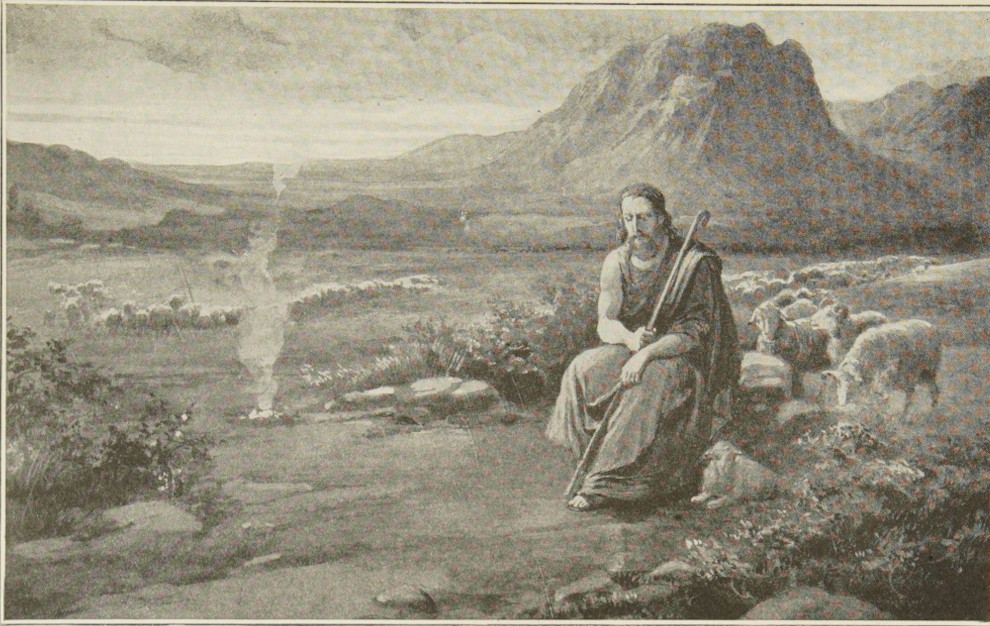
MOSES A SHEPHERD. “Shut in by the bulwarks of the mountains, Moses was alone with God.”
Shut in by the bulwarks of the mountains, Moses was alone with God. The magnificent temples of Egypt no longer impressed his mind with their superstition and falsehood. In the solemn grandeur of the everlasting hills he beheld the majesty of the Most High, and in contrast realized how powerless and insignificant were the gods of Egypt. Everywhere the Creator’s name was written. Moses seemed to stand in his presence, and to be overshadowed by his power. Here his pride and self-sufficiency were swept away. In the stern simplicity of his wilderness life, the results of the ease and luxury of Egypt disappeared. Moses became patient, reverent, and humble, “very meek, above all the men which were upon the face of the earth,”[357] yet strong in faith in the mighty God of Jacob.
As the years rolled on, and he wandered with his flocks in solitary places, pondering upon the oppressed condition of his people, he recounted the dealings of God with his fathers, and the promises that were the heritage of the chosen nation, and his prayers for Israel ascended by day and by night. Heavenly angels shed their light around him. Here, under the inspiration of the Holy Spirit, he wrote the book of Genesis. The long years spent amid the desert solitudes were rich in blessing, not alone to Moses and his people, but to the world in all succeeding ages.
“And it came to pass in process of time, that the king of Egypt died; and the children of Israel sighed by reason of the bondage, and they cried, and their cry came up unto God by reason of the bondage. And God heard their groaning, and God remembered his covenant with Abraham, with Isaac, and with Jacob. And God looked upon the children of Israel, and God had respect unto them.”[358] The time for Israel’s deliverance had come. But God’s purpose was to be accomplished in a manner to pour contempt on human pride. The deliverer was to go forth as a humble shepherd, with only a rod in his hand; but God would make that rod the symbol of his power. Leading his flocks one day near Horeb, “the mountain of God,” Moses saw a bush in flames, branches, foliage, and trunk, all burning, yet seeming not to be consumed. He drew near to view the wonderful sight, when a voice from out of the flame called him by name. With trembling lips he answered, “Here am I.” He was warned not to approach irreverently: “Put off thy shoes from off thy feet; for the place whereon thou standest is holy ground.... I am the God of thy father, the God of Abraham, the God of Isaac, and the God of Jacob.”[359] It was He who, as the Angel of the covenant, had revealed himself to the fathers in ages past. “And Moses hid his face; for he was afraid to look upon God.”
Humility and reverence should characterize the deportment of all who come into the presence of God. In the name of Jesus we may come before him with confidence, but we must not approach him with the boldness of presumption, as though he were on a level with ourselves. There are those who address the great and all-powerful and holy God, who dwelleth in light unapproachable, as they would address an equal, or even an inferior. There are those who conduct themselves in his house as they would not presume to do in the audience-chamber of an earthly ruler. These should remember that they are in His sight whom seraphim adore, before whom angels vail their faces. God is greatly to be reverenced; all who truly realize his presence will bow in humility before him, and, like Jacob beholding the vision of God, they will cry out, “How dreadful is this place! This is none other but the house of God, and this is the gate of heaven.”
As Moses waited in reverent awe before God, the words continued: “I have surely seen the affliction of my people which are in Egypt, and have heard their cry by reason of their taskmasters; for I know their sorrows; and I am come down to deliver them out of the hand of the Egyptians, and to bring them up out of that land unto a good land and a large, unto a land flowing with milk and honey.... Come now, therefore, and I will send thee unto Pharaoh, that thou mayest bring forth my people, the children of Israel, out of Egypt.”
Amazed and terrified at the command, Moses drew back, saying, “Who am I, that I should go unto Pharaoh, and that I should bring forth the children of Israel out of Egypt?” The reply was, “Certainly I will be with thee; and this shall be a token unto thee, that I have sent thee: When thou hast brought forth the people out of Egypt, ye shall serve God upon this mountain.”
Moses thought of the difficulties to be encountered, of the blindness, ignorance, and unbelief of his people, many of whom were almost destitute of a knowledge of God. “Behold,” he said, “when I come unto the children of Israel, and shall say unto them, The God of your fathers hath sent me unto you, and they shall say to me, What is his name? what shall I say unto them?” The answer was,—
“I AM THAT I AM.” “Thus shalt thou say unto the children of Israel, I AM hath sent me unto you.”
Moses was commanded first to assemble the elders of Israel, the most noble and righteous among them, who had long grieved because of their bondage, and to declare to them a message from God, with a promise of deliverance. Then he was to go with the elders before the king, and say to him,—
“The Lord God of the Hebrews hath met with us; and now let us go, we beseech thee, three days’ journey into the wilderness, that we may sacrifice to the Lord our God.”
Moses was forewarned that Pharaoh would resist the appeal to let Israel go. Yet the courage of God’s servant must not fail; for the Lord would make this the occasion to manifest his power before the Egyptians and before his people. “And I will stretch out my hand, and smite Egypt with all my wonders which I will do in the midst thereof; and after that he will let you go.”
Direction was also given concerning the provision they were to make for the journey. The Lord declared, “It shall come to pass that, when ye go, ye shall not go empty; but every woman shall borrow of her neighbor, and of her that sojourneth in her house, jewels of silver, and jewels of gold, and raiment.” The Egyptians had been enriched by the labor unjustly exacted from the Israelites, and as the latter were to start on the journey to their new home, it was right for them to claim the reward of their years of toil. They were to ask for articles of value, such as could be easily transported, and God would give them favor in the sight of the Egyptians. The mighty miracles wrought for their deliverance would strike terror to the oppressors, so that the requests of the bondmen would be granted.
Moses saw before him difficulties that seemed insurmountable. What proof could he give his people that God had indeed sent him? “Behold,” he said, “they will not believe me, nor hearken unto my voice; for they will say, The Lord hath not appeared unto thee.” Evidence that appealed to his own senses was now given. He was told to cast his rod upon the ground. As he did so, “it became a serpent;[360] and Moses fled from before it.” He was commanded to seize it, and in his hand it became a rod. He was bidden to put his hand into his bosom. He obeyed, and “when he took it out, behold, his hand was leprous as snow.” Being told to put it again into his bosom, he found on withdrawing it, that it had become like the other. By these signs the Lord assured Moses that his own people, as well as Pharaoh, should be convinced that one mightier than the king of Egypt was manifest among them.
But the servant of God was still overwhelmed by the thought of the strange and wonderful work before him. In his distress and fear he now pleaded as an excuse a lack of ready speech: “O my Lord, I am not eloquent, neither heretofore, nor since thou hast spoken unto thy servant; but I am slow of speech, and of a slow tongue.” He had been so long away from the Egyptians that he had not so clear knowledge and ready use of their language as when he was among them.
The Lord said unto him, “Who hath made man’s mouth? or who maketh the dumb, or deaf, or the seeing, or the blind? Have not I the Lord?” To this was added another assurance of divine aid: “Now therefore go, and I will be with thy mouth, and teach thee what thou shalt say.” But Moses still entreated that a more competent person be selected. These excuses at first proceeded from humility and diffidence; but after the Lord had promised to remove all difficulties, and to give him final success, then any further shrinking back and complaining of his unfitness showed distrust of God. It implied a fear that God was unable to qualify him for the great work to which he had called him, or that he had made a mistake in the selection of the man.
Moses was now directed to Aaron, his elder brother, who, having been in daily use of the language of the Egyptians, was able to speak it perfectly. He was told that Aaron was coming to meet him. The next words from the Lord were an unqualified command:—
“Thou shalt speak unto him, and put words in his mouth; and I will be with thy mouth, and with his mouth, and will teach you what ye shall do. And he shall be thy spokesman unto the people; and he shall be, even he shall be to thee instead of a mouth, and thou shalt be to him instead of God. And thou shalt take this rod in thine hand, wherewith thou shalt do signs.” He could make no further resistance; for all ground for excuse was removed.
The divine command given to Moses found him self-distrustful, slow of speech, and timid. He was overwhelmed with a sense of his incapacity to be a mouth-piece for God to Israel. But having once accepted the work, he entered upon it with his whole heart, putting all his trust in the Lord. The greatness of his mission called into exercise the best powers of his mind. God blessed his ready obedience, and he became eloquent, hopeful, self-possessed, and well fitted for the greatest work ever given to man. This is an example of what God does to strengthen the character of those who trust him fully, and give themselves unreservedly to his commands.
A man will gain power and efficiency as he accepts the responsibilities that God places upon him, and with his whole soul seeks to qualify himself to bear them aright. However humble his position or limited his ability, that man will attain true greatness who, trusting to divine strength, seeks to perform his work with fidelity. Had Moses relied upon his own strength and wisdom, and eagerly accepted the great charge, he would have evinced his entire unfitness for such a work. The fact that a man feels his weakness, is at least some evidence that he realizes the magnitude of the work appointed him, and that he will make God his counselor and his strength.
Moses returned to his father-in-law, and expressed his desire to visit his brethren in Egypt. Jethro’s consent was given, with his blessing, “Go in peace.” With his wife and children, Moses set forth on the journey. He had not dared to make known the object of his mission, lest they should not be allowed to accompany him. Before reaching Egypt, however, he himself thought it best, for their own safety, to send them back to the home in Midian.
A secret dread of Pharaoh and the Egyptians whose anger had been kindled against him forty years before, had rendered Moses still more reluctant to return to Egypt; but after he had set out to obey the divine command, the Lord revealed to him that his enemies were dead.
On the way from Midian, Moses received a startling and terrible warning of the Lord’s displeasure. An angel appeared to him in a threatening manner, as if he would immediately destroy him. No explanation was given; but Moses remembered that he had disregarded one of God’s requirements; yielding to the persuasion of his wife, he had neglected to perform the rite of circumcision upon their youngest son. He had failed to comply with the condition by which his child could be entitled to the blessings of God’s covenant with Israel; and such a neglect on the part of their chosen leader could not but lessen the force of the divine precepts upon the people. Zipporah, fearing that her husband would be slain, performed the rite herself, and the angel then permitted Moses to pursue his journey. In his mission to Pharaoh, Moses was to be placed in a position of great peril; his life could be preserved only through the protection of holy angels. But while living in neglect of a known duty, he would not be secure; for he could not be shielded by the angels of God.
In the time of trouble just before the coming of Christ, the righteous will be preserved through the ministration of heavenly angels; but there will be no security for the transgressor of God’s law. Angels cannot then protect those who are disregarding one of the divine precepts.
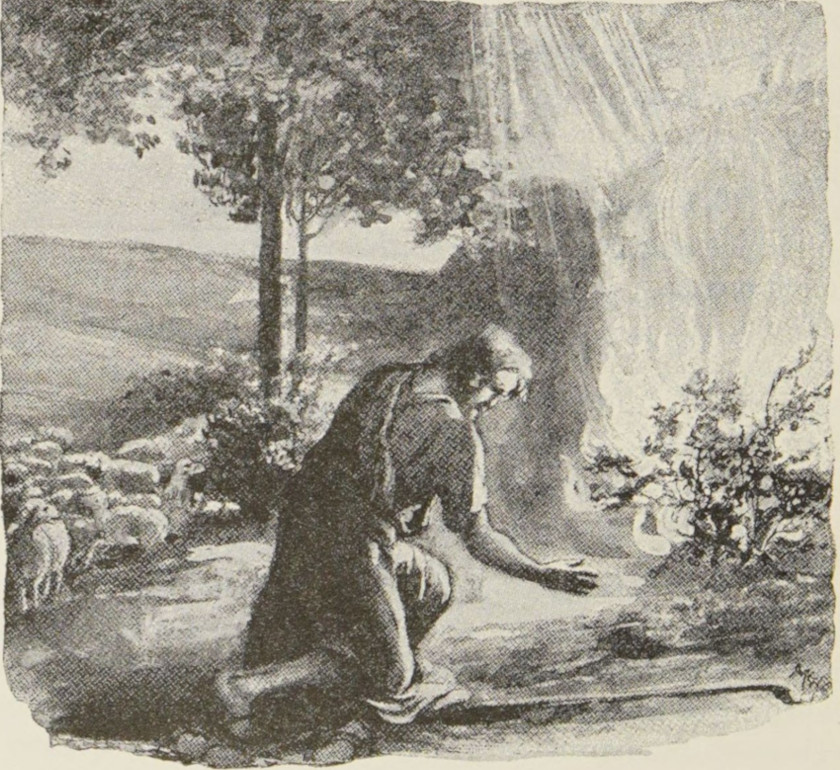
“He was warned not to approach irreverently.”
THE PLAGUES OF EGYPT—23
Aaron, being instructed by angels, went forth to meet his brother, from whom he had been so long separated; and they met amid the desert solitudes, near Horeb. Here they communed together, and Moses told Aaron “all the words of the Lord who had sent him, and all the signs which he had commanded him.”[370] Together they journeyed to Egypt; and having reached the land of Goshen, they proceeded to assemble the elders of Israel. Aaron repeated to them all the dealings of God with Moses, and then the signs which God had given Moses were shown before the people. “The people believed; and when they heard that the Lord had visited the children of Israel, and that he had looked upon their affliction, then they bowed their heads and worshiped.”[370]
Moses had been charged also with a message for the king. The two brothers entered the palace of the Pharaohs as ambassadors from the King of kings, and they spoke in his name: “Thus saith Jehovah, God of Israel, Let my people go, that they may hold a feast unto me in the wilderness.”
“Who is Jehovah, that I should obey his voice to let Israel go?” demanded the monarch; “I know not Jehovah, neither will I let Israel go.”
Their answer was, “The God of the Hebrews hath met with us; let us go, we pray thee, three days’ journey into the desert, and sacrifice unto the Lord our God, lest he fall upon us with pestilence, or with the sword.”
Tidings of them and of the interest they were exciting among the people had already reached the king. His anger was kindled. “Wherefore do ye, Moses and Aaron, let [hinder] the people from their works?” he said. “Get you unto your burdens.” Already the kingdom had suffered loss by the interference of these strangers. At thought of this he added, “Behold, the people of the land now are many, and ye make them rest from their burdens.”
In their bondage the Israelites had to some extent lost the knowledge of God’s law, and they had departed from its precepts. The Sabbath had been generally disregarded, and the exactions of their taskmasters made its observance apparently impossible. But Moses had shown his people that obedience to God was the first condition of deliverance; and the efforts made to restore the observance of the Sabbath had come to the notice of their oppressors.[371]
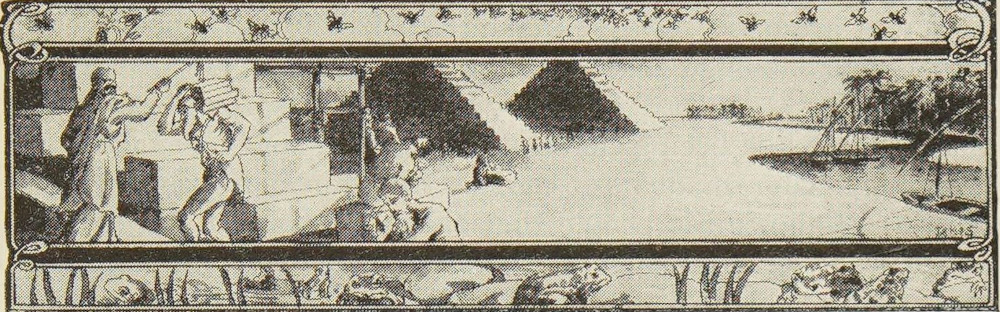
The king, thoroughly roused, suspected the Israelites of a design to revolt from his service. Disaffection was the result of idleness; he would see that no time was left them for dangerous scheming. And he at once adopted measures to tighten their bonds and crush out their independent spirit. The same day, orders were issued that rendered their labor still more cruel and oppressive. The most common building material of that country was sun-dried brick; the walls of the finest edifices were made of this, and then faced with stone; and the manufacture of brick employed great numbers of the bondmen. Cut straw being intermixed with the clay, to hold it together, large quantities of straw were required for the work; the king now directed that no more straw be furnished; the laborers must find it for themselves, while the same amount of brick should be exacted.
This order produced great distress among the Israelites throughout the land. The Egyptian taskmasters had appointed Hebrew officers to oversee the work of the people, and these officers were responsible for the labor performed by those under their charge. When the requirement of the king was put in force, the people scattered themselves throughout the land, to gather stubble instead of straw; but they found it impossible to accomplish the usual amount of labor. For this failure the Hebrew officers were cruelly beaten.
These officers supposed that their oppression came from their taskmasters, and not from the king himself; and they went to him with their grievances. Their remonstrance was met by Pharaoh with a taunt: “Ye are idle, ye are idle; therefore ye say, Let us go and do sacrifice to the Lord.” They were ordered back to their work, with the declaration that their burdens were in no case to be lightened. Returning, they met Moses and Aaron, and cried out to them, “The Lord look upon you, and judge; because ye have made our savor to be abhorred in the eyes of Pharaoh, and in the eyes of his servants, to put a sword in their hand to slay us.”
As Moses listened to these reproaches, he was greatly distressed. The sufferings of the people had been much increased. All over the land a cry of despair went up from old and young, and all united in charging upon him the disastrous change in their condition. In bitterness of soul he went before God, with the cry, “Lord, wherefore hast thou so evil entreated this people? Why is it that thou hast sent me? For since I came to Pharaoh to speak in thy name, he hath done evil to this people; neither hast thou delivered thy people at all.” The answer was, “Now shalt thou see what I will do to Pharaoh; for with a strong hand shall he let them go, and with a strong hand shall he drive them out of his land.” Again he was pointed back to the covenant which God had made with the fathers, and was assured that it would be fulfilled.
During all the years of servitude in Egypt, there had been among the Israelites some who adhered to the worship of Jehovah. These were sorely troubled as they saw their children daily witnessing the abominations of the heathen, and even bowing down to their false gods. In their distress they cried unto the Lord for deliverance from the Egyptian yoke, that they might be freed from the corrupting influence of idolatry. They did not conceal their faith, but declared to the Egyptians that the object of their worship was the Maker of heaven and earth, the only true and living God. They rehearsed the evidences of his existence and power, from creation down to the days of Jacob. The Egyptians thus had an opportunity to become acquainted with the religion of the Hebrews; but disdaining to be instructed by their slaves, they tried to seduce the worshipers of God by promises of reward, and, this failing, by threats and cruelty.
The elders of Israel endeavored to sustain the sinking faith of their brethren by repeating the promises made to their fathers, and the prophetic words of Joseph before his death, foretelling their deliverance from Egypt. Some would listen and believe. Others, looking at the circumstances that surrounded them, refused to hope. The Egyptians, being informed of what was reported among their bondmen, derided their expectations, and scornfully denied the power of their God. They pointed to their situation as a nation of slaves, and tauntingly said, “If your God is just and merciful, and possesses power above that of the Egyptian gods, why does he not make you a free people?” They called attention to their own condition. They worshiped deities termed by the Israelites false gods, yet they were a rich and powerful nation. They declared that their gods had blessed them with prosperity, and had given them the Israelites as servants, and they gloried in their power to oppress and destroy the worshipers of Jehovah. Pharaoh himself boasted that the God of the Hebrews could not deliver them from his hand.
Words like these destroyed the hopes of many of the Israelites. The case appeared to them very much as the Egyptians had represented. It was true that they were slaves, and must endure whatever their cruel taskmasters might choose to inflict. Their children had been hunted and slain, and their own lives were a burden. Yet they were worshiping the God of heaven. If Jehovah were indeed above all gods, surely he would not thus leave them in bondage to idolaters. But those who were true to God understood that it was because of Israel’s departure from him,—because of their disposition to marry with heathen nations, thus being led into idolatry,—that the Lord had permitted them to become bondmen; and they confidently assured their brethren that he would soon break the yoke of the oppressor.
The Hebrews had expected to obtain their freedom without any special trial of their faith, or any real suffering or hardship. But they were not yet prepared for deliverance. They had little faith in God, and were unwilling patiently to endure their afflictions until he should see fit to work for them. Many were content to remain in bondage, rather than meet the difficulties attending removal to a strange land; and the habits of some had become so much like those of the Egyptians that they preferred to dwell in Egypt. Therefore the Lord did not deliver them by the first manifestation of his power before Pharaoh. He overruled events more fully to develop the tyrannical spirit of the Egyptian king, and also to reveal himself to his people. Beholding his justice, his power, and his love, they would choose to leave Egypt and give themselves to his service. The task of Moses would have been much less difficult, had not many of the Israelites become so corrupted that they were unwilling to leave Egypt.
The Lord directed Moses to go again to the people, and repeat the promise of deliverance, with a fresh assurance of divine favor. He went as he was commanded; but they would not listen. Says the Scripture, “They hearkened not ... for anguish of spirit, and for cruel bondage.” Again the divine message came to Moses, “Go in, speak unto Pharaoh king of Egypt, that he let the children of Israel go out of his land.” In discouragement he replied, “Behold, the children of Israel have not hearkened unto me; how then shall Pharaoh hear me?” He was told to take Aaron with him, and go before Pharaoh, and again demand “that he send the children of Israel out of his land.”
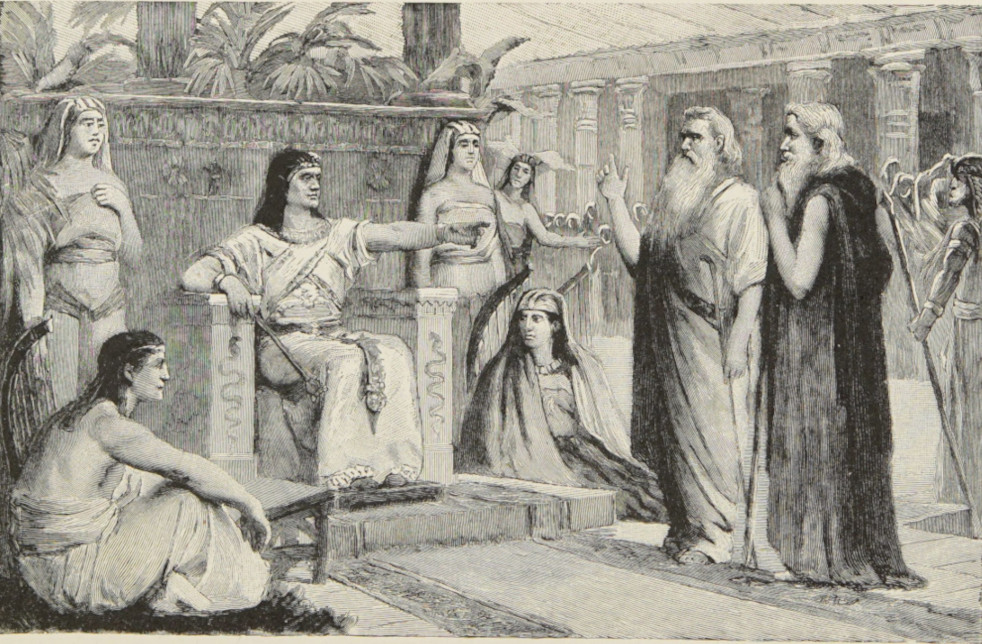
MOSES AND AARON BEFORE PHARAOH. “Wherefore do ye, Moses and Aaron, let the people from their work? Get you unto your burdens.”
He was informed that the monarch would not yield until God should visit judgments upon Egypt, and bring out Israel by the signal manifestation of his power. Before the infliction of each plague, Moses was to describe its nature and effects, that the king might save himself from it if he chose. Every punishment rejected would be followed by one more severe, until his proud heart would be humbled, and he would acknowledge the Maker of heaven and earth as the true and living God. The Lord would give the Egyptians an opportunity to see how vain was the wisdom of their mighty men, how feeble the power of their gods, when opposed to the commands of Jehovah. He would punish the people of Egypt for their idolatry, and silence their boasting of the blessings received from their senseless deities. God would glorify his own name, that other nations might hear of his power and tremble at his mighty acts, and that his people might be led to turn from their idolatry and render him pure worship.
Again Moses and Aaron entered the lordly halls of the king of Egypt. There, surrounded by lofty columns and glittering adornments, by the rich paintings and sculptured images of heathen gods, before the monarch of the most powerful kingdom then in existence, stood the two representatives of the enslaved race, to repeat the command from God for Israel’s release. The king demanded a miracle, in evidence of their divine commission. Moses and Aaron had been directed how to act in case such a demand should be made, and Aaron now took the rod, and cast it down before Pharaoh. It became a serpent. The monarch sent for his “wise men and the sorcerers,” who “cast down every man his rod, and they became serpents; but Aaron’s rod swallowed up their rods.” Then the king, more determined than before, declared his magicians equal in power with Moses and Aaron; he denounced the servants of the Lord as impostors, and felt himself secure in resisting their demands. Yet while he despised their message, he was restrained by divine power from doing them harm.
It was the hand of God, and no human influence or power possessed by Moses and Aaron, that wrought the miracles which they showed before Pharaoh. Those signs and wonders were designed to convince Pharaoh that the great “I AM” had sent Moses, and that it was the duty of the king to let Israel go, that they might serve the living God. The magicians also showed signs and wonders; for they wrought not by their own skill alone, but by the power of their god, Satan, who assisted them in counterfeiting the work of Jehovah.
The magicians did not really cause their rods to become serpents; but by magic, aided by the great deceiver, they were able to produce this appearance. It was beyond the power of Satan to change the rods to living serpents. The prince of evil, though possessing all the wisdom and might of an angel fallen, has not power to create, or to give life; this is the prerogative of God alone. But all that was in Satan’s power to do, he did; he produced a counterfeit. To human sight the rods were changed to serpents. Such they were believed to be by Pharaoh and his court. There was nothing in their appearance to distinguish them from the serpent produced by Moses. Though the Lord caused the real serpent to swallow up the spurious ones, yet even this was regarded by Pharaoh, not as a work of God’s power, but as the result of a kind of magic superior to that of his servants.
Pharaoh desired to justify his stubbornness in resisting the divine command, and hence he was seeking some pretext for disregarding the miracles that God had wrought through Moses. Satan gave him just what he wanted. By the work that he wrought through the magicians, he made it appear to the Egyptians that Moses and Aaron were only magicians and sorcerers, and that the message they brought could not claim respect as coming from a superior being. Thus Satan’s counterfeit accomplished its purpose, of emboldening the Egyptians in their rebellion, and causing Pharaoh to harden his heart against conviction. Satan hoped also to shake the faith of Moses and Aaron in the divine origin of their mission, that his instruments might prevail. He was unwilling that the children of Israel should be released from bondage, to serve the living God.
But the prince of evil had a still deeper object in manifesting his wonders through the magicians. He well knew that Moses, in breaking the yoke of bondage from off the children of Israel, prefigured Christ, who was to break the reign of sin over the human family. He knew that when Christ should appear, mighty miracles would be wrought as an evidence to the world that God had sent him. Satan trembled for his power. By counterfeiting the work of God through Moses, he hoped not only to prevent the deliverance of Israel, but to exert an influence through future ages to destroy faith in the miracles of Christ. Satan is constantly seeking to counterfeit the work of Christ, and to establish his own power and claims. He leads men to account for the miracles of Christ by making them appear to be the result of human skill and power. In many minds he thus destroys faith in Christ as the Son of God, and leads them to reject the gracious offers of mercy through the plan of redemption.
Moses and Aaron were directed to visit the river-side next morning, where the king was accustomed to repair. The overflowing of the Nile being the source of food and wealth for all Egypt, the river was worshiped as a god, and the monarch came thither daily to pay his devotions. Here the two brothers again repeated the message to him, and then they stretched out the rod and smote upon the water. The sacred stream ran blood, the fish died, and the river became offensive to the smell. The water in the houses, the supply preserved in cisterns, was likewise changed to blood. But “the magicians of Egypt did so with their enchantments,” and “Pharaoh turned and went into his house, neither did he set his heart to this also.” For seven days the plague continued, but without effect.
Again the rod was stretched out over the waters, and frogs came up from the river, and spread over the land. They overran the houses, took possession of the bed-chambers, and even the ovens and kneading-troughs. The frog was regarded as sacred by the Egyptians, and they would not destroy it; but the slimy pests had now become intolerable. They swarmed even in the palace of the Pharaohs, and the king was impatient to have them removed. The magicians had appeared to produce frogs, but they could not remove them. Upon seeing this, Pharaoh was somewhat humbled. He sent for Moses and Aaron, and said, “Entreat the Lord, that he may take away the frogs from me, and from my people; and I will let the people go, that they may do sacrifice unto the Lord.” After reminding the king of his former boasting, they requested him to appoint a time when they should pray for the removal of the plague. He set the next day, secretly hoping that in the interval the frogs might disappear of themselves, and thus save him from the bitter humiliation of submitting to the God of Israel. The plague, however, continued till the time specified, when throughout all Egypt the frogs died, but their putrid bodies, which remained, polluted the atmosphere.
The Lord could have caused them to return to dust in a moment; but he did not do this, lest after their removal, the king and his people should pronounce it the result of sorcery or enchantment, like the work of the magicians. The frogs died, and were then gathered together in heaps. Here the king and all Egypt had evidence which their vain philosophy could not gainsay, that this work was not accomplished by magic, but was a judgment from the God of heaven.
“When Pharaoh saw that there was respite, he hardened his heart.” At the command of God, Aaron stretched out his hand, and the dust of the earth became lice throughout all the land of Egypt. Pharaoh called upon the magicians to do the same, but they could not. The work of God was thus shown to be superior to that of Satan. The magicians themselves acknowledged, “This is the finger of God.” But the king was still unmoved.
Appeal and warning were ineffectual, and another judgment was inflicted. The time of its occurrence was foretold, that it might not be said to have come by chance. Flies filled the houses and swarmed upon the ground, so that “the land was corrupted by reason of the swarm of flies.” These flies were large and venomous; and their bite was extremely painful to man and beast. As had been foretold, this visitation did not extend to the land of Goshen.
Pharaoh now offered the Israelites permission to sacrifice in Egypt; but they refused to accept such conditions. “It is not meet,” said Moses; “lo, shall we sacrifice the abomination of the Egyptians before their eyes, and will they not stone us?” The animals which the Hebrews would be required to sacrifice were among those regarded as sacred by the Egyptians; and such was the reverence in which these creatures were held, that to slay one, even accidentally, was a crime punishable with death. It would be impossible for the Hebrews to worship in Egypt without giving offense to their masters. Moses again proposed to go three days’ journey into the wilderness. The monarch consented, and begged the servants of God to entreat that the plague might be removed. They promised to do this, but warned him against dealing deceitfully with them. The plague was stayed, but the king’s heart had become hardened by persistent rebellion, and he still refused to yield.
A more terrible stroke followed,—murrain upon all the Egyptian cattle that were in the field. Both the sacred animals and the beasts of burden—kine and oxen and sheep, horses and camels and asses—were destroyed. It had been distinctly stated that the Hebrews were to be exempt; and Pharaoh, on sending messengers to the home of the Israelites, proved the truth of this declaration of Moses. “Of the cattle of the children of Israel died not one.” Still the king was obstinate.
Moses was next directed to take ashes of the furnace, and “sprinkle it toward the heaven in the sight of Pharaoh.” This act was deeply significant. Four hundred years before, God had shown to Abraham the future oppression of his people, under the figure of a smoking furnace and a burning lamp. He had declared that he would visit judgments upon their oppressors, and would bring forth the captives with great substance. In Egypt, Israel had long languished in the furnace of affliction. This act of Moses was an assurance to them that God was mindful of his covenant, and that the time for their deliverance had come.
As the ashes were sprinkled toward heaven, the fine particles spread over all the land of Egypt, and wherever they settled, produced boils “breaking forth with blains upon man and upon beast.” The priests and magicians had hitherto encouraged Pharaoh in his stubbornness, but now a judgment had come that reached even them. Smitten with a loathsome and painful disease, their vaunted power only making them contemptible, they were no longer able to contend against the God of Israel. The whole nation was made to see the folly of trusting in the magicians, when they were not able to protect even their own persons.
Still the heart of Pharaoh grew harder. And now the Lord sent a message to him, declaring, “I will at this time send all my plagues upon thine heart, and upon thy servants, and upon thy people; that thou mayest know that there is none like me in all the earth.... And in very deed for this cause have I raised thee up, for to show in thee my power.” Not that God had given him an existence for this purpose; but his providence had overruled events to place him upon the throne at the very time appointed for Israel’s deliverance. Though this haughty tyrant had by his crimes forfeited the mercy of God, yet his life had been preserved that through his stubbornness the Lord might manifest his wonders in the land of Egypt. The disposing of events is of God’s providence. He could have placed upon the throne a more merciful king, who would not have dared to withstand the mighty manifestations of divine power. But in that case the Lord’s purposes would not have been accomplished. His people, were permitted to experience the grinding cruelty of the Egyptians, that they might not be deceived concerning the debasing influence of idolatry. In his dealing with Pharaoh, the Lord manifested his hatred of idolatry, and his determination to punish cruelty and oppression.
God had declared concerning Pharaoh, “I will harden his heart, that he shall not let the people go.”[372] There was no exercise of supernatural power to harden the heart of the king. God gave to Pharaoh the most striking evidence of divine power; but the monarch stubbornly refused to heed the light. Every display of infinite power, rejected by him, rendered him the more determined in his rebellion. The seeds of rebellion that he sowed when he rejected the first miracle, produced their harvest. As he continued to venture on in his own course, going from one degree of stubbornness to another, his heart became more and more hardened, until he was called to look upon the cold, dead faces of the first-born.
God speaks to men through his servants, giving cautions and warnings, and rebuking sin. He gives to each an opportunity to correct his errors before they become fixed in the character; but if one refuses to be corrected, divine power does not interpose to counteract the tendency of his own action. He finds it more easy to repeat the same course. He is hardening the heart against the influence of the Holy Spirit. A further rejection of light places him where a far stronger influence will be ineffectual to make an abiding impression.
He who has once yielded to temptation will yield more readily the second time. Every repetition of the sin lessens his power of resistance, blinds his eyes, and stifles conviction. Every seed of indulgence sown will bear fruit. God works no miracle to prevent the harvest. “Whatsoever a man soweth, that shall he also reap.”[373] He who manifests an infidel hardihood, a stolid indifference to divine truth, is but reaping the harvest of that which he has himself sown. It is thus that multitudes come to listen with stoical indifference to the truths that once stirred their very souls. They sowed neglect, and resistance to the truth, and such is the harvest which they reap.
Those who are quieting a guilty conscience with the thought that they can change a course of evil when they choose, that they can trifle with the invitations of mercy, and yet be again and again impressed, take this course at their peril. They think that after casting all their influence on the side of the great rebel, in a moment of utmost extremity, when danger compasses them about, they will change leaders. But this is not so easily done. The experience, the education, the discipline of a life of sinful indulgence, has so thoroughly moulded the character that they cannot then receive the image of Jesus. Had no light shown upon their pathway, the case would have been different. Mercy might interpose, and give them an opportunity to accept her overtures; but after light has been long rejected and despised, it will be finally withdrawn.
A plague of hail was next threatened upon Pharaoh, with the warning, “Send therefore now, and gather thy cattle, and all that thou hast in the field; for upon every man and beast which shall be found in the field, and shall not be brought home, the hail shall come down upon them, and they shall die.” Rain or hail was unusual in Egypt, and such a storm as was foretold had never been witnessed. The report spread rapidly, and all who believed the word of the Lord gathered in their cattle, while those who despised the warning left them in the field. Thus in the midst of judgment the mercy of God was displayed, the people were tested, and it was shown how many had been led to fear God by the manifestation of his power.
The storm came as predicted,—thunder and hail, and fire mingled with it, “very grievous, such as there was none like it in all the land of Egypt since it became a nation. And the hail smote throughout all the land of Egypt, all that was in the field, both man and beast; and the hail smote every herb of the field, and brake every tree of the field.” Ruin and desolation marked the path of the destroying angel. The land of Goshen alone was spared. It was demonstrated to the Egyptians that the earth is under the control of the living God, that the elements obey his voice, and that the only safety is in obedience to him.
All Egypt trembled before the awful outpouring of divine judgment. Pharaoh hastily sent for the two brothers, and cried out, “I have sinned this time; the Lord is righteous, and I and my people are wicked. Entreat the Lord (for it is enough) that there be no more mighty thunderings and hail; and I will let you go, and ye shall stay no longer.” The answer was, “As soon as I am gone out of the city, I will spread abroad my hands unto the Lord; and the thunder shall cease, neither shall there be any more hail; that thou mayest know how that the earth is the Lord’s. But as for thee and thy servants, I know that ye will not yet fear the Lord God.”
Moses knew that the contest was not ended. Pharaoh’s confessions and promises were not the effect of any radical change in his mind or heart, but were wrung from him by terror and anguish. Moses promised, however, to grant his request; for he would give him no occasion for further stubbornness. The prophet went forth, unheeding the fury of the tempest, and Pharaoh and all his host were witnesses to the power of Jehovah to preserve his messenger. Having passed without the city, Moses “spread abroad his hands unto the Lord; and the thunders and hail ceased, and the rain was not poured upon the earth.” But no sooner had the king recovered from his fears, than his heart returned to its perversity.
Then the Lord said unto Moses, “Go in unto Pharaoh; for I have hardened his heart, and the heart of his servants, that I might show these my signs before him; and that thou mayest tell in the ears of thy son, and of thy son’s son, what things I have wrought in Egypt, and my signs which I have done among them; that ye may know how that I am Jehovah.” The Lord was manifesting his power, to confirm the faith of Israel in him as the only true and living God. He would give unmistakable evidence of the difference he placed between them and the Egyptians, and would cause all nations to know that the Hebrews, whom they had despised and oppressed, were under the protection of the God of heaven.
Moses warned the monarch that if he still remained obstinate, a plague of locusts would be sent, which would cover the face of the earth, and eat up every green thing that remained; they would fill the houses, even the palace itself; such a scourge, he said, as “neither thy fathers, nor thy fathers’ fathers have seen, since the day that they were upon the earth unto this day.”
The counselors of Pharaoh stood aghast. The nation had sustained great loss in the death of their cattle. Many of the people had been killed by the hail. The forests were broken down, and the crops destroyed. They were fast losing all that had been gained by the labor of the Hebrews. The whole land was threatened with starvation. Princes and courtiers pressed about the king, and angrily demanded, “How long shall this man be a snare unto us? Let the men go, that they may serve the Lord their God. Knowest thou not yet that Egypt is destroyed?”
Moses and Aaron were again summoned, and the monarch said to them, “Go, serve the Lord your God; but who are they that shall go?”
The answer was, “We will go with our young and with our old, with our sons and with our daughters, with our flocks and with our herds will we go; for we must hold a feast unto the Lord.”
The king was filled with rage. “Let the Lord be so with you,” he cried, “as I will let you go, and your little ones. Look to it; for evil is before you. Not so: go now ye that are men, and serve the Lord; for that ye did desire. And they were driven out from Pharaoh’s presence.” Pharaoh had endeavored to destroy the Israelites by hard labor, but he now pretended to have a deep interest in their welfare and a tender care for their little ones. His real object was to keep the women and children as surety for the return of the men.
Moses now stretched forth his rod over the land, and an east wind blew, and brought locusts. “Very grievous were they; before them there were no such locusts as they, neither after them shall be such.” They filled the sky till the land was darkened, and devoured every green thing remaining. Pharaoh sent for the prophets in haste, and said, “I have sinned against the Lord your God, and against you. Now therefore forgive, I pray thee, my sin only this once, and entreat the Lord your God, that he may take away from me this death only.” They did so, and a strong west wind carried away the locusts toward the Red Sea. Still the king persisted in his stubborn resolution.
The people of Egypt were ready to despair. The scourges that had already fallen upon them seemed almost beyond endurance, and they were filled with fear for the future. The nation had worshiped Pharaoh as a representative of their god; but many were now convinced that he was opposing himself to One who made all the powers of nature the ministers of his will. The Hebrew slaves, so miraculously favored, were becoming confident of deliverance. Their taskmasters dared not oppress them as heretofore. Throughout Egypt there was a secret fear that the enslaved race would rise and avenge their wrongs. Everywhere men were asking with bated breath, What will come next?
Suddenly a darkness settled upon the land, so thick and black that it seemed a “darkness which might be felt.” Not only were the people deprived of light, but the atmosphere was very oppressive, so that breathing was difficult. “They saw not one another, neither rose any from his place for three days; but all the children of Israel had light in their dwellings.” The sun and moon were objects of worship to the Egyptians; in this mysterious darkness the people and their gods alike were smitten by the power that had undertaken the cause of the bondmen.[374] Yet fearful as it was, this judgment is an evidence of God’s compassion and his unwillingness to destroy. He would give the people time for reflection and repentance before bringing upon them the last and most terrible of the plagues.
Fear at last wrung from Pharaoh a further concession. At the end of the third day of darkness he summoned Moses, and consented to the departure of the people, provided the flocks and herds were permitted to remain. “There shall not a hoof be left behind,” replied the resolute Hebrew. “We know not with what we must serve the Lord until we come thither.” The king’s anger burst forth beyond control. “Get thee from me,” he cried, “take heed to thyself, see my face no more; for in that day thou seest my face thou shalt die.”
The answer was, “Thou hast spoken well; I will see thy face again no more.”
“The man Moses was very great in the land of Egypt, in the sight of Pharaoh’s servants, and in the sight of the people.” Moses was regarded with awe by the Egyptians. The king dared not harm him, for the people looked upon him as alone possessing power to remove the plagues. They desired that the Israelites might be permitted to leave Egypt. It was the king and the priests that opposed to the last the demands of Moses.
THE PASSOVER—24
When the demand for Israel’s release had been first presented to the king of Egypt, the warning of the most terrible of the plagues had been given. Moses was directed to say to Pharaoh, “Thus saith the Lord, Israel is my son, even my first-born; and I say unto thee, Let my son go, that he may serve me. And if thou refuse to let him go, behold, I will slay thy son, even thy first-born.”[380] Though despised by the Egyptians, the Israelites had been honored by God, in that they were singled out to be the depositaries of his law. In the special blessings and privileges accorded them, they had pre-eminence among the nations, as the first-born son had among brothers.
The judgment of which Egypt had first been warned, was to be the last visited. God is long-suffering, and plenteous in mercy. He has a tender care for the beings formed in his image. If the loss of their harvests and their flocks and herds had brought Egypt to repentance, the children would not have been smitten; but the nation had stubbornly resisted the divine command, and now the final blow was about to fall.
Moses had been forbidden, on pain of death, to appear again in Pharaoh’s presence; but a last message from God was to be delivered to the rebellious monarch, and again Moses came before him, with the terrible announcement: “Thus saith the Lord, About midnight will I go out into the midst of Egypt; and all the first-born in the land of Egypt shall die, from the first-born of Pharaoh that sitteth upon his throne, even unto the first-born of the maidservant that is behind the mill, and all the first-born of beasts. And there shall be a great cry throughout all the land of Egypt, such as there was none like it, nor shall be like it any more. But against any of the children of Israel shall not a dog move his tongue, against man or beast: that ye may know how that the Lord doth put a difference between the Egyptians and Israel. And all these thy servants shall come down unto me, and bow down themselves unto me, saying, Get thee out, and all the people that follow thee; and after that I will go out.”[381]
Before the execution of this sentence, the Lord through Moses gave direction to the children of Israel concerning their departure from Egypt, and especially for their preservation from the coming judgment. Each family, alone or in connection with others, was to slay a lamb or a kid “without blemish,” and with a bunch of hyssop sprinkle its blood on “the two side-posts and on the upper door-post”[382] of the house, that the destroying angel, coming at midnight, might not enter that dwelling. They were to eat the flesh roasted, with unleavened bread and bitter herbs, at night, as Moses said, “with your loins girded, your shoes on your feet, and your staff in your hand; and ye shall eat it in haste; it is the Lord’s passover.”[382]
The Lord declared: “I will pass through the land of Egypt this night, and will smite all the first-born in the land of Egypt, both man and beast; and against all the gods of Egypt I will execute judgment.... And the blood shall be to you for a token upon the houses where ye are; and when I see the blood, I will pass over you, and the plague shall not be upon you to destroy you, when I smite the land of Egypt.”
In commemoration of this great deliverance, a feast was to be observed yearly by the people of Israel in all future generations. “This day shall be unto you for a memorial; and ye shall keep it a feast to the Lord throughout your generations; ye shall keep it a feast by an ordinance forever.” As they should keep the feast in future years, they were to repeat to their children the story of this great deliverance, as Moses bade them: “Ye shall say, It is the sacrifice of the Lord’s passover, who passed over the houses of the children of Israel in Egypt, when he smote the Egyptians, and delivered our houses.”
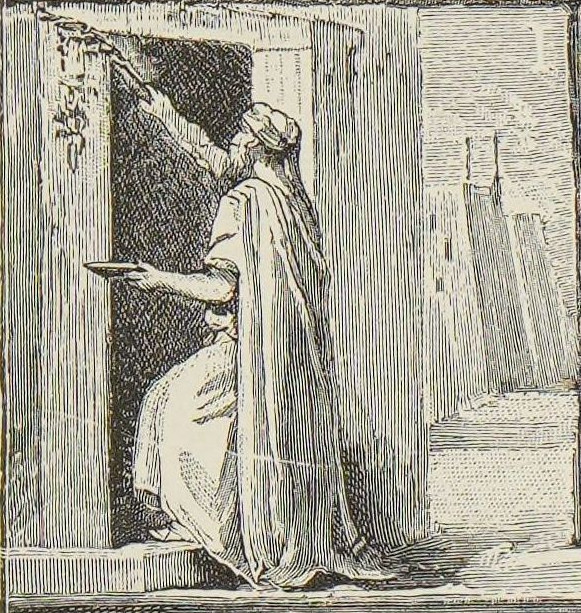
The Passover: I. Sprinkling the Blood
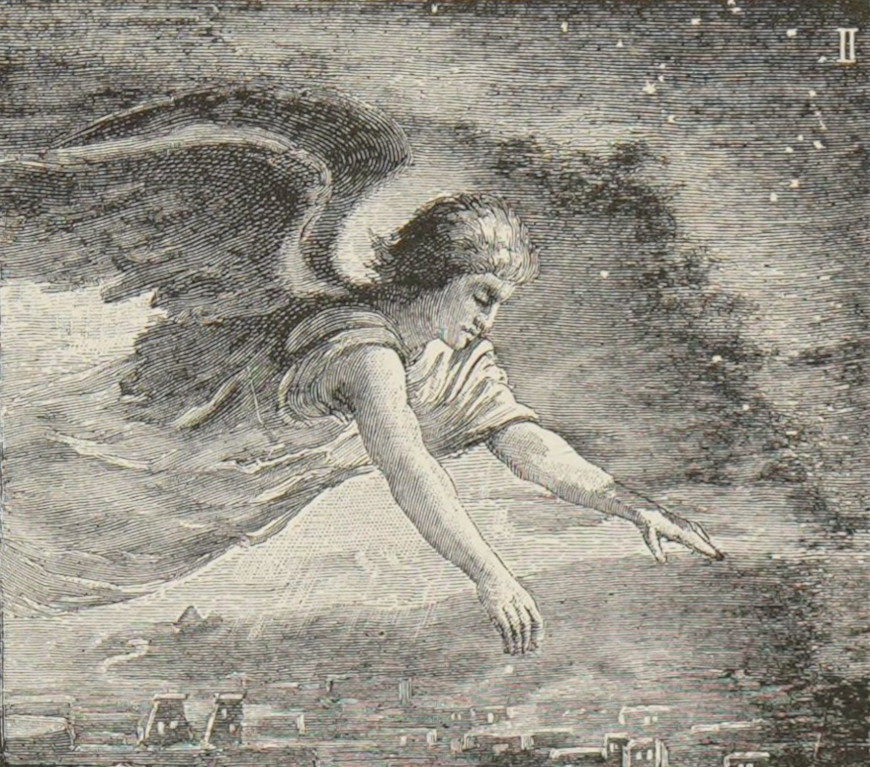
II. The Destroying Angel
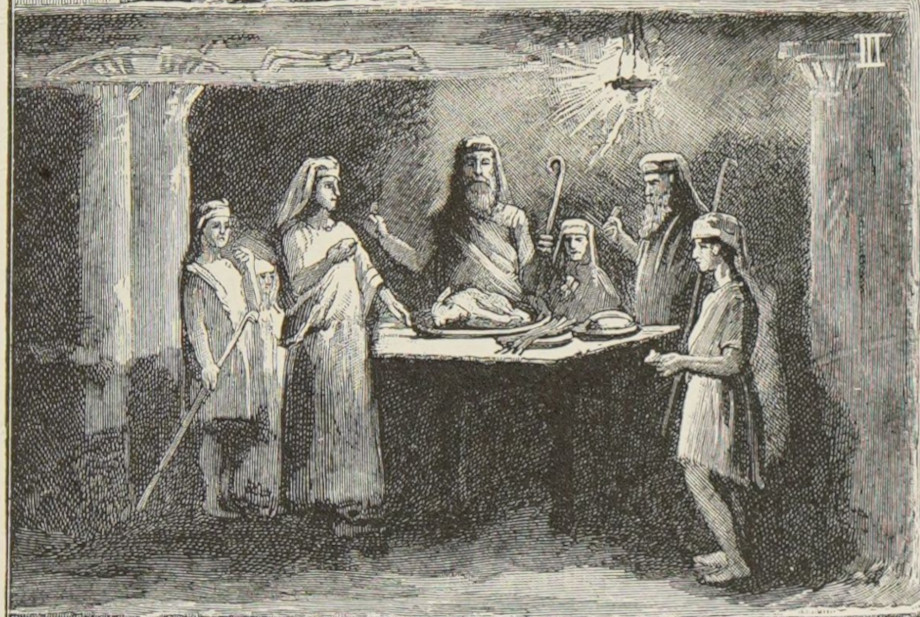
III. The Passover Supper
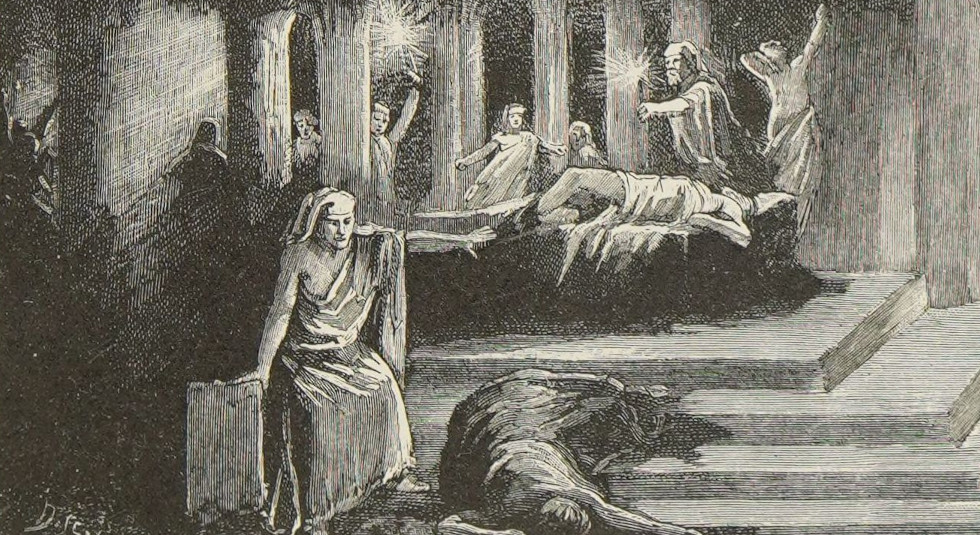
IV. The First-born Slain
Furthermore, the first-born of both man and beast were to be the Lord’s, to be brought back only by a ransom, in acknowledgment that when the first-born of Egypt perished, that of Israel, though graciously preserved, had been justly exposed to the same doom but for the atoning sacrifice. “All the first-born are mine,” the Lord declared; “for on the day that I smote all the first-born in the land of Egypt, I hallowed unto me all the first-born in Israel, both man and beast: mine they shall be.”[383] After the institution of the tabernacle service, the Lord chose unto himself the tribe of Levi for the work of the sanctuary, instead of the first-born of the people. “They are wholly given unto me from among the children of Israel,” he said. “Instead of the first-born of all the children of Israel, have I taken them unto me.”[384] All the people were, however, still required, in acknowledgment of God’s mercy, to pay a redemption-price for the first-born son.[385]
The Passover was to be both commemorative and typical, not only pointing back to the deliverance from Egypt, but forward to the greater deliverance which Christ was to accomplish in freeing his people from the bondage of sin. The sacrificial lamb represents “the Lamb of God,” in whom is our only hope of salvation. Says the apostle, “Christ our passover is sacrificed for us.”[386] It was not enough that the paschal lamb be slain; its blood must be sprinkled upon the door-posts; so the merits of Christ’s blood must be applied to the soul. We must believe, not only that he died for the world, but that he died for us individually. We must appropriate to ourselves the virtue of the atoning sacrifice.
The hyssop used in sprinkling the blood was the symbol of purification, being thus employed in the cleansing of the leper and of those defiled by contact with the dead. In the psalmist’s prayer also its significance is seen: “Purge me with hyssop, and I shall be clean; wash me, and I shall be whiter than snow.”[387]
The lamb was to be prepared whole, not a bone of it being broken; so not a bone was to be broken of the Lamb of God, who was to die for us.[388] Thus was also represented the completeness of Christ’s sacrifice.
The flesh was to be eaten. It is not enough even that we believe on Christ for the forgiveness of sin; we must by faith be constantly receiving spiritual strength and nourishment from him through his word. Said Christ, “Except ye eat the flesh of the Son of man, and drink his blood, ye have no life in you. Whoso eateth my flesh and drinketh my blood, hath eternal life.” And to explain his meaning he said, “The words that I speak unto you, they are spirit, and they are life.”[389] Jesus accepted his Father’s law, wrought out its principles in his life, manifested its spirit, and showed its beneficent power in the heart. Says John, “The Word was made flesh, and dwelt among us (and we beheld his glory, the glory as of the only begotten of the Father), full of grace and truth.”[390] The followers of Christ must be partakers of his experience. They must receive and assimilate the word of God so that it shall become the motive power of life and action. By the power of Christ they must be changed into his likeness, and reflect the divine attributes. They must eat the flesh and drink the blood of the Son of God, or there is no life in them. The spirit and work of Christ must become the spirit and work of his disciples.
The lamb was to be eaten with bitter herbs, as pointing back to the bitterness of the bondage in Egypt. So when we feed upon Christ, it should be with contrition of heart, because of our sins. The use of unleavened bread also was significant. It was expressly enjoined in the law of the Passover, and as strictly observed by the Jews in their practice, that no leaven should be found in their houses during the feast. In like manner the leaven of sin must be put away from all who would receive life and nourishment from Christ. So Paul writes to the Corinthian church, “Purge out therefore the old leaven, that ye may be a new lump.... For even Christ our passover is sacrificed for us; therefore let us keep the feast, not with old leaven, neither with the leaven of malice and wickedness, but with the unleavened bread of sincerity and truth.”[391]
Before obtaining freedom, the bondmen must show their faith in the great deliverance about to be accomplished. The token of blood must be placed upon their houses, and they must separate themselves and their families from the Egyptians, and gather within their own dwellings. Had the Israelites disregarded in any particular the directions given them, had they neglected to separate their children from the Egyptians, had they slain the lamb, but failed to strike the door-post with blood, or had any gone out of their houses, they would not have been secure. They might have honestly believed that they had done all that was necessary, but their sincerity would not have saved them. All who failed to heed the Lord’s directions, would lose their first-born by the hand of the destroyer.
By obedience the people were to give evidence of their faith. So all who hope to be saved by the merits of the blood of Christ should realize that they themselves have something to do in securing their salvation. While it is Christ only that can redeem us from the penalty of transgression, we are to turn from sin to obedience. Man is to be saved by faith, not by works; yet his faith must be shown by his works. God has given his Son to die as a propitiation for sin, he has manifested the light of truth, the way of life, he has given facilities, ordinances, and privileges; and now man must co-operate with these saving agencies; he must appreciate and use the helps that God has provided,—believe and obey all the divine requirements.
As Moses rehearsed to Israel the provisions of God for their deliverance, “the people bowed the head and worshiped.”[392] The glad hope of freedom, the awful knowledge of the impending judgment upon their oppressors, the cares and labors incident to their speedy departure,—all were for the time swallowed up in gratitude to their gracious Deliverer. Many of the Egyptians had been led to acknowledge the God of the Hebrews as the only true God, and these now begged to be permitted to find shelter in the homes of Israel when the destroying angel should pass through the land. They were gladly welcomed, and they pledged themselves henceforth to serve the God of Jacob, and to go forth from Egypt with his people.
The Israelites obeyed the directions that God had given. Swiftly and secretly they made their preparations for departure. Their families were gathered, the paschal lamb slain, the flesh roasted with fire, the unleavened bread and bitter herbs prepared. The father and priest of the household sprinkled the blood upon the door-post, and joined his family within the dwelling. In haste and silence the paschal lamb was eaten. In awe the people prayed and watched, the heart of the eldest-born, from the strong man down to the little child, throbbing with indefinable dread. Fathers and mothers clasped in their arms their loved first-born, as they thought of the fearful stroke that was to fall that night. But no dwelling of Israel was visited by the death-dealing angel. The sign of blood—the sign of a Saviour’s protection—was on their doors, and the destroyer entered not.
At midnight “there was a great cry in Egypt; for there was not a house where there was not one dead.” All the first-born in the land, “from the first-born of Pharaoh that sat on his throne unto the first-born of the captive that was in the dungeon; and all the first-born of cattle,”[393] had been smitten by the destroyer. Throughout the vast realm of Egypt the pride of every household had been laid low. The shrieks and wails of the mourners filled the air. King and courtiers, with blanched faces and trembling limbs, stood aghast at the overmastering horror. Pharaoh remembered how he had once exclaimed, “Who is Jehovah, that I should obey his voice to let Israel go? I know not Jehovah, neither will I let Israel go.” Now, his heaven-daring pride humbled in the dust, he “called for Moses and Aaron by night, and said, Rise up, and get you forth from among my people, both ye and the children of Israel; and go, serve the Lord, as ye have said. Also take your flocks and your herds, as ye have said, and be gone; and bless me also.” The royal counselors also and the people entreated the Israelites to depart “out of the land in haste; for they said, We be all dead men.”

“The hyssop used in sprinkling the blood was the symbol of purification.”
THE EXODUS—25
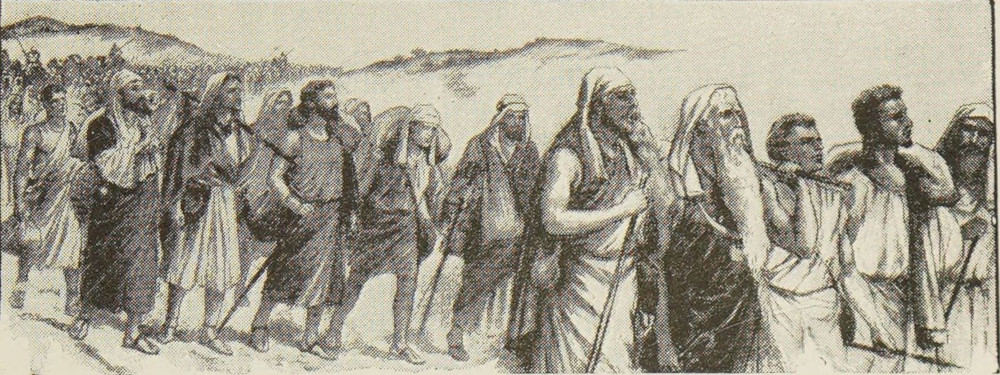
With their loins girt, with sandaled feet, and staff in hand, the people of Israel had stood, hushed, awed, yet expectant, awaiting the royal mandate that should bid them go forth. Before the morning broke, they were on their way. During the plagues, as the manifestation of God’s power had kindled faith in the hearts of the bondmen and had struck terror to their oppressors, the Israelites had gradually assembled themselves in Goshen; and notwithstanding the suddenness of their flight, some provision had already been made for the necessary organization and control of the moving multitudes, they being divided into companies, under appointed leaders.
And they went out, “about six hundred thousand on foot that were men, beside children. And a mixed multitude went up also with them.”[400] In this multitude were not only those who were actuated by faith in the God of Israel, but also a far greater number who desired only to escape from the plagues, or who followed in the wake of the moving multitudes, merely from excitement and curiosity. This class were ever a hindrance and a snare to Israel.
The people took also with them “flocks and herds, even very much cattle.” These were the property of the Israelites, who had never sold their possessions to the king, as had the Egyptians. Jacob and his sons had brought their flocks and herds with them to Egypt, where they had greatly increased. Before leaving Egypt, the people, by the direction of Moses, claimed a recompense for their unpaid labor; and the Egyptians were too eager to be freed from their presence to refuse them. The bondmen went forth laden with the spoil of their oppressors.
That day completed the history revealed to Abraham in prophetic vision centuries before: “Thy seed shall be a stranger in a land that is not theirs, and shall serve them; and they shall afflict them four hundred years; and also that nation, whom they shall serve, will I judge; and afterward shall they come out with great substance.”[401] The four hundred years had been fulfilled. “And it came to pass the selfsame day, that the Lord did bring the children of Israel out of the land of Egypt by their armies.”[402] In their departure from Egypt the Israelites bore with them a precious legacy, in the bones of Joseph, which had so long awaited the fulfillment of God’s promise, and which, during the dark years of bondage, had been a reminder of Israel’s deliverance.
Instead of pursuing the direct route to Canaan, which lay through the country of the Philistines, the Lord directed their course southward, toward the shores of the Red Sea. “For God said, Lest peradventure the people repent when they see war, and they return to Egypt.”[403] Had they attempted to pass through Philistia, their progress would have been opposed; for the Philistines, regarding them as slaves escaping from their masters, would not have hesitated to make war upon them. The Israelites were poorly prepared for an encounter with that powerful and warlike people. They had little knowledge of God and little faith in him, and they would have become terrified and disheartened. They were unarmed, and unaccustomed to war, their spirits were depressed by long bondage, and they were encumbered with women and children, flocks and herds. In leading them by the way of the Red Sea, the Lord revealed himself as a God of compassion as well as of judgment.
“And they took their journey from Succoth, and encamped in Etham, in the edge of the wilderness. And the Lord went before them by day in a pillar of a cloud, to lead them the way; and by night in a pillar of fire, to give them light; to go by day and night. He took not away the pillar of the cloud by day, nor the pillar of fire by night, from before the people.” Says the psalmist, “He spread a cloud for a covering; and fire to give light in the night.”[404] The standard of their invisible Leader was ever with them. By day the cloud directed their journeyings, or spread as a canopy above the host. It served as a protection from the burning heat, and by its coolness and moisture afforded grateful refreshment in the parched, thirsty desert. By night it became a pillar of fire, illuminating their encampment, and constantly assuring them of the divine presence.
In one of the most beautiful and comforting passages of Isaiah’s prophecy, reference is made to the pillar of cloud and of fire to represent God’s care for his people in the great final struggle with the powers of evil: “The Lord will create upon every dwelling-place of Mount Zion, and upon her assemblies, a cloud and smoke by day, and the shining of a flaming fire by night; for above all the glory shall be a covering. And there shall be a tabernacle for a shadow in the daytime from the heat, and for a place of refuge, and for a covert from storm and from rain.”[405]
Across a dreary, desert-like expanse they journeyed. Already they began to wonder whither their course would lead; they were becoming weary with the toilsome way, and in some hearts began to arise a fear of pursuit by the Egyptians. But the cloud went forward, and they followed. And now the Lord directed Moses to turn aside into a rocky defile, and encamp beside the sea. It was revealed to him that Pharaoh would pursue them, but that God would be honored in their deliverance.
In Egypt the report was spread that the children of Israel, instead of tarrying to worship in the desert, were pressing on toward the Red Sea. Pharaoh’s counselors declared to the king that their bondmen had fled, never to return. The people deplored their folly in attributing the death of the first-born to the power of God. Their great men, recovering from their fears, accounted for the plagues as the result of natural causes. “Why have we done this, that we have let Israel go from serving us?”[406] was the bitter cry.
Pharaoh collected his forces, “six hundred chosen chariots, and all the chariots of Egypt,” horsemen, captains, and foot soldiers. The king himself, attended by the great men of his realm, headed the attacking army. To secure the favor of the gods, and thus insure the success of their undertaking, the priests also accompanied them. The king was resolved to intimidate the Israelites by a grand display of his power. The Egyptians feared lest their forced submission to the God of Israel should subject them to the derision of other nations; but if they should now go forth with a great show of power and bring back the fugitives, they would redeem their glory, as well as recover the services of their bondmen.
The Hebrews were encamped beside the sea, whose waters presented a seemingly impassable barrier before them, while on the south a rugged mountain obstructed their further progress. Suddenly they beheld in the distance the flashing armor and moving chariots betokening the advance guard of a great army. As the force drew nearer, the hosts of Egypt were seen in full pursuit. Terror filled the hearts of Israel. Some cried unto the Lord, but far the greater part hastened to Moses with their complaints: “Because there were no graves in Egypt, hast thou taken us away to die in the wilderness? Wherefore hast thou dealt thus with us, to carry us forth out of Egypt? Is not this the word that we did tell thee in Egypt, saying, Let us alone, that we may serve the Egyptians? For it had been better for us to serve the Egyptians, than that we should die in the wilderness.”[407]
Moses was greatly troubled that his people should manifest so little faith in God, notwithstanding they had repeatedly witnessed the manifestation of his power in their behalf. How could they charge upon him the dangers and difficulties of their situation, when he had followed the express command of God? True, there was no possibility of deliverance unless God himself should interpose for their release; but having been brought into this position in obedience to the divine direction, Moses felt no fear of the consequences. His calm and assuring reply to the people was, “Fear ye not, stand still, and see the salvation of the Lord, which he will show to you to-day; for the Egyptians whom ye have seen to-day, ye shall see them again no more forever. The Lord shall fight for you, and ye shall hold your peace.”
It was not an easy thing to hold the hosts of Israel in waiting before the Lord. Lacking discipline and self-control, they became violent and unreasonable. They expected speedily to fall into the hands of their oppressors, and their wailings and lamentations were loud and deep. The wonderful pillar of cloud had been followed as the signal of God to go forward; but now they questioned among themselves if it might not foreshadow some great calamity; for had it not led them on the wrong side of the mountain, into an impassable way? Thus the angel of God appeared to their deluded minds as the harbinger of disaster.
But now, as the Egyptian host approached them, expecting to make them an easy prey, the cloudy column rose majestically into the heavens, passed over the Israelites, and descended between them and the armies of Egypt. A wall of darkness interposed between the pursued and their pursuers. The Egyptians could no longer discern the camp of the Hebrews, and were forced to halt. But as the darkness of night deepened, the wall of cloud became a great light to the Hebrews, flooding the entire encampment with the radiance of day.
Then hope returned to the hearts of Israel. And Moses lifted up his voice unto the Lord. “And the Lord said unto Moses, Wherefore criest thou unto me? Speak unto the children of Israel, that they go forward. But lift thou up thy rod, and stretch out thine hand over the sea, and divide it; and the children of Israel shall go on dry ground through the midst of the sea.”
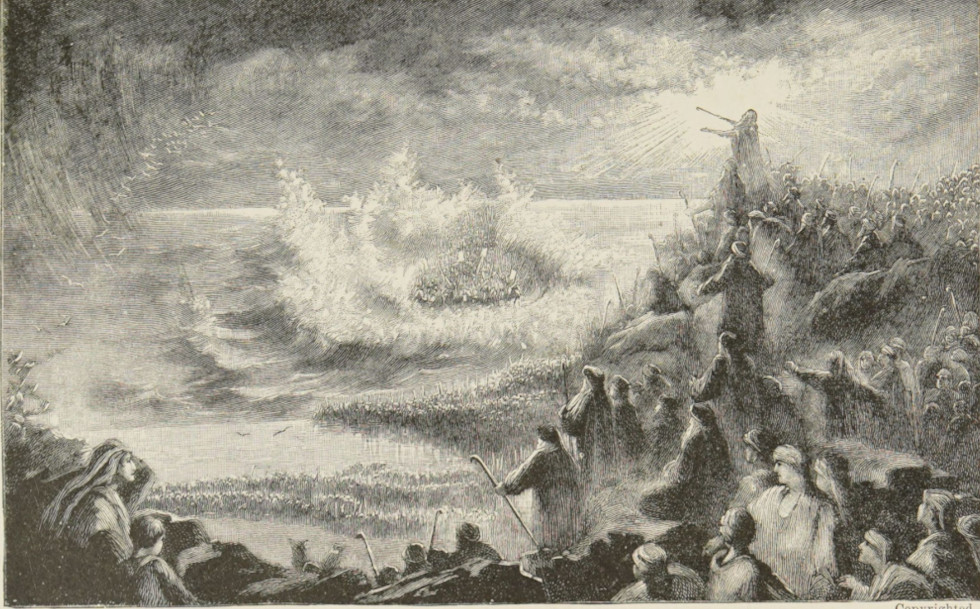
DELIVERANCE OF ISRAEL AT THE RED SEA. “The path where God leads the way may be through the desert or the sea, but it is a safe path.”
The psalmist, describing the passage of the sea by Israel, sung, “Thy way was in the sea, and thy paths in the great waters, and thy footsteps were not known. Thou leddest thy people like a flock, by the hand of Moses and Aaron.”[408] As Moses stretched out his rod, the waters parted, and Israel went into the midst of the sea, upon dry ground, while the waters stood like a wall upon each side. The light from God’s pillar of fire shone upon the foam-capped billows, and lighted the road that was cut like a mighty furrow through the waters of the sea, and was lost in the obscurity of the farther shore.
“The Egyptians pursued, and went in after them to the midst of the sea, even all Pharaoh’s horses, his chariots, and his horsemen. And it came to pass, that in the morning watch the Lord looked unto the host of the Egyptians through the pillar of fire and of the cloud, and troubled the host of the Egyptians.”[409] The mysterious cloud changed to a pillar of fire before their astonished eyes. The thunders pealed, and the lightnings flashed. “The clouds poured out water; the skies sent out a sound; thine arrows also went abroad. The voice of thy thunder was in the whirlwind; the lightning lightened the world; the earth trembled and shook.”[410]
The Egyptians were seized with confusion and dismay. Amid the wrath of the elements, in which they heard the voice of an angry God, they endeavored to retrace their steps, and flee to the shore they had quitted. But Moses stretched out his rod, and the piled-up waters, hissing, roaring, and eager for their prey, rushed together, and swallowed the Egyptian army in their black depths.
As morning broke, it revealed to the multitudes of Israel all that remained of their mighty foes,—the mail-clad bodies cast upon the shore. From the most terrible peril, one night had brought complete deliverance. That vast, helpless throng—bondmen unused to battle, women, children, and cattle, with the sea before them, and the mighty armies of Egypt pressing behind—had seen their path opened through the waters, and their enemies overwhelmed in the moment of expected triumph. Jehovah alone had brought them deliverance, and to him their hearts were turned in gratitude and faith. Their emotion found utterance in songs of praise. The Spirit of God rested upon Moses, and he led the people in a triumphant anthem of thanksgiving, the earliest and one of the most sublime that are known to man.