THE EARLIER KINGS (continued 3)
Reading edition
The word of the Lord to ancient Israel is addressed also to his people in this age: “Regard not them that have familiar spirits, neither seek after wizards, to be defiled by them;” “for all that do these things are an abomination unto the Lord.”[1104]
Caravan Crossing the Desert.
DAVID AT ZIKLAG—68
David and his men had not taken part in the battle between Saul and the Philistines, though they had marched with the Philistines to the field of conflict. As the two armies prepared to join battle, the son of Jesse found himself in a situation of great perplexity. It was expected that he would fight for the Philistines. Should he in the engagement quit the post assigned him, and retire from the field, he would not only brand himself with cowardice, but with ingratitude and treachery to Achish, who had protected him and confided in him. Such an act would cover his name with infamy, and would expose him to the wrath of enemies more to be feared than Saul. Yet he could not for a moment consent to fight against Israel. Should he do this, he would become a traitor to his country,—the enemy of God and of his people. It would forever bar his way to the throne of Israel; and should Saul be slain in the engagement, his death would be charged upon David.
David was caused to feel that he had missed his path. Far better would it have been for him to find refuge in God’s strong fortresses of the mountains than with the avowed enemies of Jehovah and his people. But the Lord, in his great mercy, did not punish this error of his servant by leaving him to himself in his distress and perplexity; for though David, losing his grasp on divine power, had faltered, and turned aside from the path of strict integrity, it was still the purpose of his heart to be true to God. While Satan and his host were busy, helping the adversaries of God and of Israel to plan against a king who had forsaken God, the angels of the Lord were working to deliver David from the peril into which he had fallen. Heavenly messengers moved upon the Philistine princes to protest against the presence of David and his force with the army in the approaching conflict.
“What do these Hebrews here?”[1110] cried the Philistine lords, pressing about Achish. The latter, unwilling to part with so important an ally, answered, “Is not this David the servant of Saul the king of Israel, which hath been with me these days, or these years, and I have found no fault in him since he fell unto me unto this day?”
But the princes angrily persisted in their demand: “Make this fellow return, that he may go again to his place which thou hast appointed him, and let him not go down with us to battle, lest in the battle he be an adversary to us; for wherewith should he reconcile himself unto his master? should it not be with the heads of these men? Is not this David, of whom they sang one to another in dances, saying, Saul slew his thousands, and David his ten thousands?” The slaughter of their famed champion and the triumph of Israel upon that occasion were still fresh in the memory of the Philistine lords. They did not believe that David would fight against his own people; and should he, in the heat of battle, take sides with them, he could inflict greater harm on the Philistines than would the whole of Saul’s army.
Thus Achish was forced to yield, and calling David, said unto him, “Surely as Jehovah liveth, thou hast been upright, and thy going out and thy coming in with me in the host is good in my sight; for I have not found evil in thee since the day of thy coming unto me unto this day. Nevertheless the lords favor thee not. Wherefore now return, and go in peace, that thou displease not the lords of the Philistines.”
David, fearing to betray his real feelings, answered, “But what have I done? and what hast thou found in thy servant so long as I have been with thee unto this day, that I may not go fight against the enemies of my lord the king?”
The reply of Achish must have sent a thrill of shame and remorse through David’s heart, as he thought how unworthy of a servant of Jehovah were the deceptions to which he had stooped. “I know that thou art good in my sight, as an angel of God,” said the king; “notwithstanding the princes of the Philistines have said, He shall not go up with us to the battle. Wherefore now rise up early in the morning with thy master’s servants that are come with thee; and as soon as ye be up early in the morning, and have light, depart.” Thus the snare in which David had become entangled was broken, and he was set free.
After three days’ travel, David and his band of six hundred men reached Ziklag, their Philistine home. But a scene of desolation met their view. The Amalekites, taking advantage of David’s absence, with his force, had avenged themselves for his incursions into their territory. They had surprised the city while it was left unguarded, and having sacked and burned it, had departed, taking all the women and children as captives, with much spoil.
Dumb with horror and amazement, David and his men for a little time gazed in silence upon the blackened and smouldering ruins. Then as a sense of their terrible desolation burst upon them, those battle-scarred warriors “lifted up their voice and wept, until they had no more power to weep.”
Here, again, David was chastened for the lack of faith that had led him to place himself among the Philistines. He had opportunity to see how much safety could be found among the foes of God and his people. David’s followers turned upon him as the cause of their calamities. He had provoked the vengeance of the Amalekites by his attack upon them; yet, too confident of security in the midst of his enemies, he had left the city unguarded. Maddened with grief and rage, his soldiers were now ready for any desperate measures, and they threatened even to stone their leader.
David seemed to be cut off from every human support. All that he held dear on earth had been swept from him. Saul had driven him from his country; the Philistines had driven him from the camp; the Amalekites had plundered his city; his wives and children had been made prisoners; and his own familiar friends had banded against him, and threatened him even with death. In this hour of utmost extremity, David, instead of permitting his mind to dwell upon these painful circumstances, looked earnestly to God for help. He “encouraged himself in the Lord.” He reviewed his past eventful life. Wherein had the Lord ever forsaken him? His soul was refreshed in recalling the many evidences of God’s favor. The followers of David, by their discontent and impatience, made their affliction doubly grievous; but the man of God, having even greater cause for grief, bore himself with fortitude. “What time I am afraid, I will trust in Thee,”[1111] was the language of his heart. Though he himself could not discern a way out of the difficulty, God could see it, and would teach him what to do.
Sending for Abiathar the priest, the son of Ahimelech, “David inquired of the Lord, saying, If I pursue after this troop, shall I overtake them?” The answer was, “Pursue; for thou shalt surely overtake them, and shalt without fail recover all.”[1112]
At these words the tumult of grief and passion ceased. David and his soldiers at once set out in pursuit of their fleeing foe. So rapid was their march, that upon reaching the brook Besor, which empties, near Gaza, into the Mediterranean Sea, two hundred of the band were compelled by exhaustion to remain behind. But David with the remaining four hundred pressed forward, nothing daunted.
Advancing, they came upon an Egyptian slave, apparently about to perish from weariness and hunger. Upon receiving food and drink, however, he revived, and they learned that he had been left to die, by his cruel master, an Amalekite belonging to the invading force. He told the story of the raid and pillage; and then, having exacted a promise that he should not be slain or delivered to his master, he consented to lead David’s company to the camp of their enemies.
As they came in sight of the encampment, a scene of revelry met their gaze. The victorious host were holding high festival. “They were spread abroad upon all the earth, eating, and drinking, and dancing, because of all the great spoil that they had taken out of the land of the Philistines, and out of the land of Judah.” An immediate attack was ordered, and the pursuers rushed fiercely upon their prey. The Amalekites were surprised and thrown into confusion. The battle was continued all that night and the following day, until nearly the entire host was slain. Only a band of four hundred men, mounted upon camels, succeeded in making their escape. The word of the Lord was fulfilled. “David recovered all that the Amalekites had carried away; and David rescued his two wives. And there was nothing lacking to them, neither small nor great, neither sons nor daughters, neither spoil, nor anything that they had taken to them; David recovered all.”
When David had invaded the territory of the Amalekites, he had put to the sword all the inhabitants that fell into his hands. But for the restraining power of God, the Amalekites would have retaliated by destroying the people of Ziklag. They decided to spare the captives, desiring to heighten the honor of the triumph by leading home a large number of prisoners, and intending afterward to sell them as slaves. Thus, unwittingly, they fulfilled God’s purpose, keeping the prisoners unharmed, to be restored to their husbands and fathers.
All earthly powers are under the control of the Infinite One. To the mightiest ruler, to the most cruel oppressor, he says, “Hitherto shalt thou come, but no further.”[1113] God’s power is constantly exercised to counteract the agencies of evil: he is ever at work among men, not for their destruction, but for their correction and preservation.
With great rejoicing, the victors took up their homeward march. Upon reaching their companions who had remained behind, the more selfish and unruly of the four hundred urged that those who had had no part in the battle should not share the spoils; that it was enough for them to recover each his wife and children. But David would permit no such arrangement. “Ye shall not do so, my brethren,” he said, “with that which the Lord hath given us, ... as his part is that goeth down to the battle, so shall his part be that tarrieth by the stuff; they shall part alike.” Thus the matter was settled, and it afterward became a statute in Israel that all who were honorably connected with a military campaign should share the spoils equally with those who engaged in actual combat.
Besides recovering all the spoil that had been taken from Ziklag, David and his band had captured extensive flocks and herds belonging to the Amalekites. These were called “David’s spoil;” and upon returning to Ziklag, he sent from this spoil presents to the elders of his own tribe of Judah. In this distribution, all those were remembered who had befriended him and his followers in the mountain fastnesses, when he had been forced to flee from place to place for his life. Their kindness and sympathy, so precious to the hunted fugitive, were thus gratefully acknowledged.
It was the third day since David and his warriors returned to Ziklag. As they labored to restore their ruined homes, they watched with anxious hearts for tidings of the battle which they knew must have been fought between Israel and the Philistines. Suddenly a messenger entered the town, “with his clothes rent, and earth upon his head.”[1114] He was at once brought to David, before whom he bowed with reverence, expressing recognition of him as a powerful prince, whose favor he desired. David eagerly inquired how the battle had gone. The fugitive reported Saul’s defeat and death, and the death of Jonathan. But he went beyond a simple statement of facts. Evidently supposing that David must cherish enmity toward his relentless persecutor, the stranger hoped to secure honor to himself as the slayer of the king. With an air of boasting, the man went on to relate that during the battle he found the monarch of Israel wounded, and sore pressed by his foes, and that at his own request the messenger had slain him. The crown from his head and the golden bracelets from his arm he had brought to David. He confidently expected that these tidings would be hailed with joy, and that a rich reward would be his for the part that he had acted.
But “David took hold on his clothes, and rent them; and likewise all the men that were with him. And they mourned, and wept, and fasted, until even, for Saul, and for Jonathan his son, and for the people of the Lord, and for the house of Israel; because they were fallen by the sword.”
The first shock of the fearful tidings past, David’s thoughts returned to the stranger herald, and the crime of which, according to his own statement, he was guilty. The chief demanded of the young man, “Whence art thou?” And he answered, “I am the son of a stranger, an Amalekite. And David said unto him, How wast thou not afraid to stretch forth thine hand to destroy the Lord’s anointed?” Twice, David had had Saul in his power; but when urged to slay him, he had refused to lift his hand against him who had been consecrated by the command of God to rule over Israel. Yet the Amalekite feared not to boast that he had slain the king of Israel. He had accused himself of a crime worthy of death, and the penalty was inflicted at once. David said, “Thy blood be upon thy head; for thy mouth hath testified against thee, saying, I have slain the Lord’s anointed.”
David’s grief at the death of Saul was sincere and deep, evincing the generosity of a noble nature. He did not exult in the fall of his enemy. The obstacle that had barred his access to the throne of Israel was removed, but at this he did not rejoice. Death had obliterated the remembrance of Saul’s distrust and cruelty, and now nothing in his history was thought of but that which was noble and kingly. The name of Saul was linked with that of Jonathan, whose friendship had been so true and so unselfish.
The song in which David gave utterance to the feelings of his heart, became a treasure to his nation, and to the people of God in all subsequent ages:—
“Thy glory, O Israel, is slain upon thy high places!
How are the mighty fallen!
Tell it not in Gath,
Publish it not in the streets of Askelon;
Lest the daughters of the Philistines rejoice,
Lest the daughters of the uncircumcised triumph.
Ye mountains of Gilboa,
Let there be no dew nor rain upon you, neither fields of offerings:
For there the shield of the mighty was vilely cast away,
The shield of Saul as of one not anointed with oil....
Saul and Jonathan were lovely and pleasant in their lives,
And in their death they were not divided;
They were swifter than eagles.
They were stronger than lions.
Ye daughters of Israel, weep over Saul,
Who clothed you in scarlet delicately,
Who put ornaments of gold upon your apparel.
How are the mighty fallen in the midst of the battle!
Jonathan is slain upon thy high places.
I am distressed for thee, my brother Jonathan;
Very pleasant hast thou been unto me;
Thy love to me was wonderful,
Passing the love of women.
How are the mighty fallen,
And the weapons of war perished!”[1115]
DAVID CALLED TO THE THRONE—69
The death of Saul removed the dangers that had made David an exile. The way was now open for him to return to his own land. When the days of mourning for Saul and Jonathan were ended, “David inquired of the Lord, saying, Shall I go up into any of the cities of Judah? And the Lord said unto him, Go up. And David said, Whither shall I go up? And he said, Unto Hebron.”[1120]
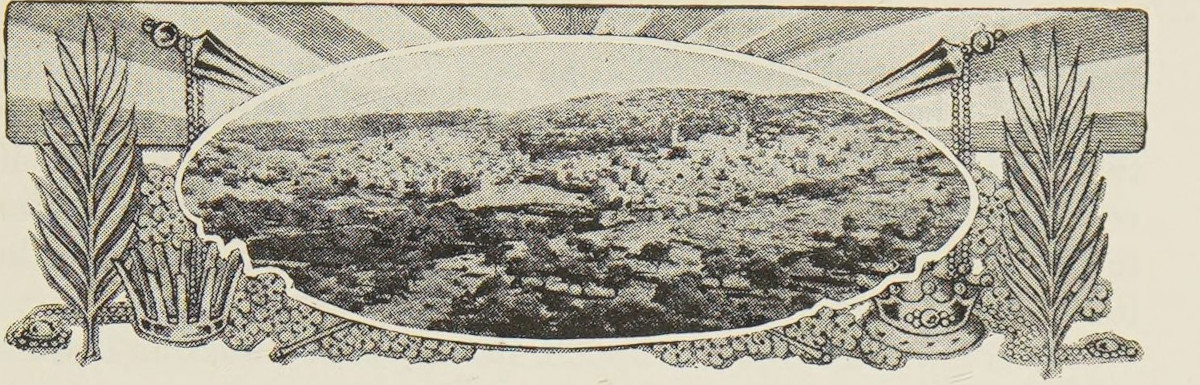
Hebron was twenty miles north from Beersheba, and about midway between that city and the future site of Jerusalem. It was originally called Kirjath-arba, the city of Arba, the father of Anak. Later it was called Mamre, and here was the burial-place of the patriarchs, “the cave of Machpelah.” Hebron had been the possession of Caleb, and was now the chief city of Judah. It lies in a valley surrounded by fertile hill country and fruitful lands. The most beautiful vineyards of Palestine were on its borders, together with numerous plantations of olive and other fruit trees.
David and his followers immediately prepared to obey the instruction which they had received from God. The six hundred armed men, with their wives and children, their flocks and herds, were soon on the way to Hebron. As the caravan entered the city, the men of Judah were waiting to welcome David as the future king of Israel. Arrangements were at once made for his coronation. “And there they anointed David king over the house of Judah.” But no effort was made to establish his authority, by force, over the other tribes.
One of the first acts of the new-crowned monarch was to express his tender regard for the memory of Saul and Jonathan. Upon learning of the brave deed of the men of Jabesh-gilead in rescuing the bodies of the fallen leaders, and giving them honorable burial. David sent an embassy to Jabesh with the message, “Blessed be ye of the Lord, that ye have showed this kindness unto your lord, even unto Saul, and have buried him. And now the Lord show kindness and truth unto you; and I also will requite you this kindness.” And he announced his own accession to the throne of Judah, and invited the allegiance of those who had proved themselves so true-hearted.
The Philistines did not oppose the action of Judah in making David king. They had befriended him in his exile, in order to harass and weaken the kingdom of Saul, and now they hoped that because of their former kindness to David the extension of his power would, in the end, work to their advantage. But David’s reign was not to be free from trouble. With his coronation began the dark record of conspiracy and rebellion. David did not sit upon a traitor’s throne; God had chosen him to be king of Israel, and there had been no occasion for distrust or opposition. Yet hardly had his authority been acknowledged by the men of Judah, when through the influence of Abner, Ishbosheth, the son of Saul, was proclaimed king, and set upon a rival throne in Israel.
Ishbosheth was but a weak and incompetent representative of the house of Saul, while David was pre-eminently qualified to bear the responsibilities of the kingdom. Abner, the chief agent in raising Ishbosheth to kingly power, had been commander-in-chief of Saul’s army, and was the most distinguished man in Israel. Abner knew that David had been appointed by the Lord to the throne of Israel, but having so long hunted and pursued him, he was not now willing that the son of Jesse should succeed to the kingdom over which Saul had reigned.
The circumstances under which Abner was placed, served to develop his real character, and showed him to be ambitious and unprincipled. He had been intimately associated with Saul, and had been influenced by the spirit of the king to despise the man whom God had chosen to reign over Israel. His hatred had been increased by the cutting rebuke that David had given him at the time when the cruse of water and the spear of the king had been taken from the side of Saul, as he slept in the camp. He remembered how David had cried in the hearing of the king and the people of Israel, “Art not thou a valiant man? And who is like to thee in Israel? Wherefore then hast thou not kept thy lord the king?... This thing is not good that thou hast done. As the Lord liveth, ye are worthy to die, because ye have not kept your master, the Lord’s anointed.”[1121] This reproof had rankled in his breast, and he determined to carry out his revengeful purpose, and create division in Israel, whereby he himself might be exalted. He employed the representative of departed royalty to advance his own selfish ambitions and purposes. He knew that the people loved Jonathan. His memory was cherished, and Saul’s first successful campaigns had not been forgotten by the army. With determination worthy a better cause, this rebellious leader went forward to carry out his plans.
Mahanaim, on the farther side of Jordan, was chosen as the royal residence, since it offered the greatest security against attack, either from David or from the Philistines. Here the coronation of Ishbosheth took place. His reign was first accepted by the tribes east of Jordan, and was finally extended over all Israel except Judah. For two years the son of Saul enjoyed his honors in his secluded capital. But Abner, intent upon extending his power over all Israel, prepared for aggressive warfare. And “there was long war between the house of Saul and the house of David; but David waxed stronger and stronger, and the house of Saul waxed weaker and weaker.”
At last, treachery overthrew the throne that malice and ambition had established. Abner, becoming incensed against the weak and incompetent Ishbosheth, deserted to David, with the offer to bring over to him all the tribes of Israel. His proposals were accepted by the king, and he was dismissed with honor, to accomplish his purpose. But the favorable reception of so valiant and famed a warrior excited the jealousy of Joab, the commander-in-chief of David’s army. There was a blood-feud between Abner and Joab, the former having slain Asahel, Joab’s brother, during the war between Israel and Judah. Now Joab, seeing an opportunity to avenge his brother’s death, and rid himself of a prospective rival, basely took occasion to waylay and murder Abner.
David, upon hearing of this treacherous assault, exclaimed, “I and my kingdom are guiltless before the Lord forever from the blood of Abner the son of Ner; let it rest on the head of Joab, and on all his father’s house.” In view of the unsettled state of the kingdom, and the power and position of the murderers,—for Joab’s brother Abishai had been united with him,—David could not visit the crime with just retribution, yet he publicly manifested his abhorrence of the bloody deed. The burial of Abner was attended with public honors. The army, with Joab at their head, were required to take part in the services of mourning, with rent garments and clothed in sackcloth. The king manifested his grief by keeping a fast upon the day of burial; he followed the bier as chief mourner; and at the grave he pronounced an elegy which was a cutting rebuke of the murderers. “The king lamented over Abner, and said:—
“Died Abner as a fool dieth?
Thy hands were not bound.
Nor thy feet put into fetters;
As a man falleth before wicked men,
So fellest thou.”
David’s magnanimous recognition of one who had been his bitter enemy, won the confidence and admiration of all Israel. “All the people took notice of it, and it pleased them, as whatsoever the king did pleased all the people. For all the people and all Israel understood that day that it was not of the king to slay Abner the son of Ner.” In the private circle of his trusted counselors and attendants, the king spoke of the crime, and recognizing his own inability to punish the murderers as he desired, he left them to the justice of God: “Know ye not that there is a prince and a great man fallen this day in Israel? And I am this day weak, though anointed king; and these men, the sons of Zeruiah, be too hard for me. The Lord shall reward the doer of evil according to his wickedness.”
Abner had been sincere in his offers and representations to David, yet his motives were base and selfish. He had persistently opposed the king of God’s appointment, in the expectation of securing honor to himself. It was resentment, wounded pride, and passion, that led him to forsake the cause he had so long served; and in deserting to David he hoped to receive the highest position of honor in his service. Had he succeeded in his purpose, his talents and ambition, his great influence and want of godliness, would have endangered the throne of David and the peace and prosperity of the nation.
“When Saul’s son heard that Abner was dead in Hebron, his hands were feeble, and all the Israelites were troubled.” It was evident that the kingdom could not long be maintained. Soon another act of treachery completed the downfall of the waning power. Ishbosheth was foully murdered by two of his captains, who, cutting off his head, hastened with it to the king of Judah, hoping thus to ingratiate themselves in his favor.
They appeared before David with the gory witness to their crime, saying, “Behold the head of Ishbosheth the son of Saul thine enemy, which sought thy life; and the Lord hath avenged my lord the king this day of Saul, and of his seed.” But David, whose throne God himself had established, and whom God had delivered from his adversaries, did not desire the aid of treachery to establish his power. He told these murderers of the doom visited upon him who boasted of slaying Saul. “How much more,” he added, “when wicked men have slain a righteous person in his own house upon his bed? Shall I not therefore now require his blood of your hand, and take you away from the earth? And David commanded his young men, and they slew them.... But they took the head of Ishbosheth and buried it in the sepulcher of Abner in Hebron.”
After the death of Ishbosheth, there was a general desire among the leading men of Israel that David should become king of all the tribes. “Then came all the tribes of Israel to David unto Hebron, and spake, saying, Behold, we are thy bone and thy flesh.” They declared, “Thou wast he that leddest out and broughtest in Israel; and the Lord said to thee, Thou shalt feed my people Israel, and thou shalt be a captain over Israel. So all the elders of Israel came to the king to Hebron; and King David made a league with them in Hebron before the Lord.” Thus through the providence of God the way had been opened for him to come to the throne. He had no personal ambition to gratify, for he had not sought the honor to which he had been brought.
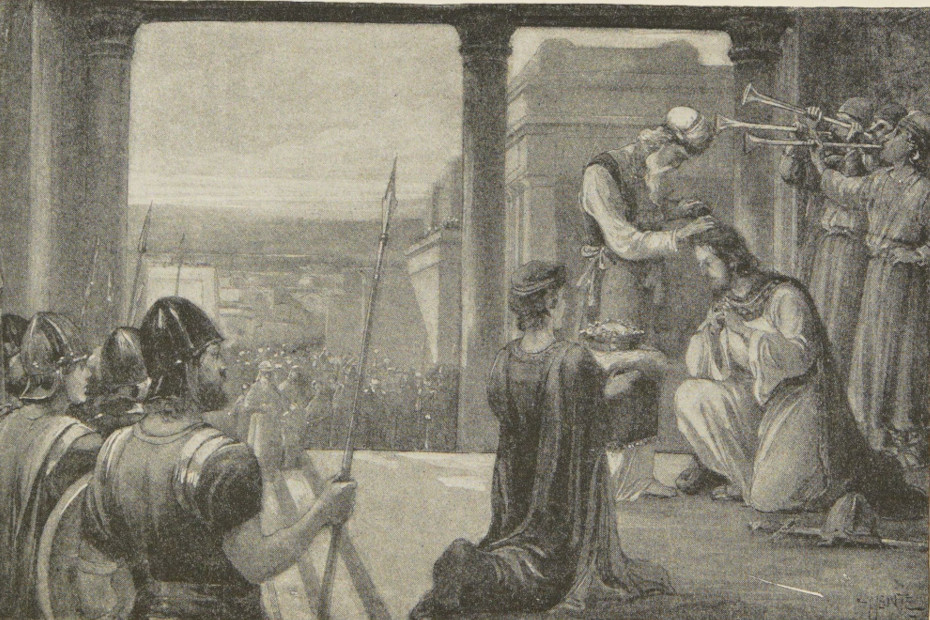
THE CORONATION OF DAVID. “The time had come, and David by solemn rite, was consecrated to his office as God’s vicegerent.”
More than eight thousand of the descendants of Aaron, and of the Levites, waited upon David. The change in the sentiments of the people was marked and decisive. The revolution was quiet and dignified, befitting the great work they were doing. Nearly half a million souls, the former subjects of Saul, thronged Hebron and its environs. The very hills and valleys were alive with the multitudes. The hour for the coronation was appointed; the man who had been expelled from the court of Saul, who had fled to the mountains and hills and to the caves of the earth to preserve his life, was about to receive the highest honor that can be conferred upon man by his fellow-man. Priests and elders clothed in the garments of their sacred office, officers and soldiers with glittering spear and helmet, and strangers from long distances, stood to witness the coronation of the chosen king. David was arrayed in the royal robe. The sacred oil was put upon his brow by the high priest; for the anointing by Samuel had been prophetic of what would take place at the inauguration of the king. The time had come, and David, by solemn rite, was consecrated to his office as God’s vicegerent. The scepter was placed in his hands. The covenant of his righteous sovereignty was written, and the people gave their pledges of loyalty. The diadem was placed upon his brow, and the coronation ceremony was over. Israel had a king by divine appointment. He who had waited patiently for the Lord, beheld the promise of God fulfilled. “And David went on, and grew great, and the Lord God of hosts was with him.”[1122]
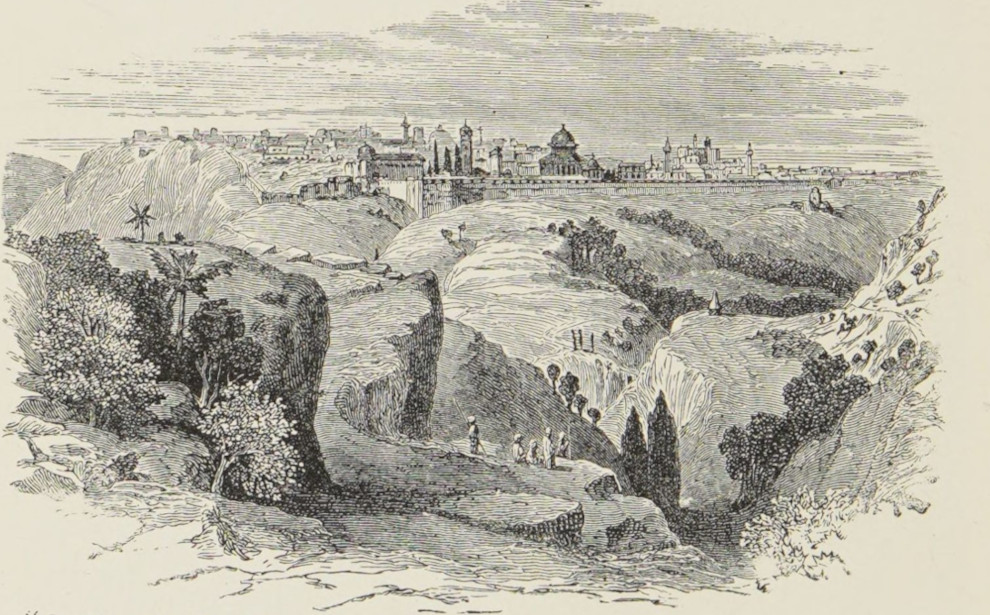
Jerusalem. “As the mountains are round about Jerusalem, so the Lord is round about his people.”
THE REIGN OF DAVID—70

As soon as David was established on the throne of Israel, he began to seek a more appropriate location for the capital of his realm. Twenty miles from Hebron, a place was selected as the future metropolis of the kingdom. Before Joshua had led the armies of Israel over Jordan, it had been called Salem. Near this place, Abraham had proved his loyalty to God. Eight hundred years before the coronation of David, it had been the home of Melchizedek, the priest of the most high God. It held a central and elevated position in the country, and was protected by an environment of hills. Being on the border between Benjamin and Judah, it was in close proximity to Ephraim, and was easy of access to the other tribes.
In order to secure this location, the Hebrews must dispossess a remnant of the Canaanites, who held a fortified position on the mountains of Zion and Moriah. This stronghold was called Jebus, and its inhabitants were known as Jebusites. For centuries, Jebus had been looked upon as impregnable; but it was besieged and taken by the Hebrews under the command of Joab, who, as the reward of his valor, was made commander-in-chief of the armies of Israel. Jebus now became the national capital, and its heathen name was changed to Jerusalem.
Hiram, king of the wealthy city of Tyre, on the Mediterranean Sea, now sought an alliance with the king of Israel, and lent his aid to David in the work of erecting a palace at Jerusalem. Ambassadors were sent from Tyre, accompanied by architects and workmen, and long trains laden with costly wood, cedar-trees, and other valuable material.
The increasing strength of Israel in its union under David, the acquisition of the stronghold of Jebus, and the alliance with Hiram, king of Tyre, excited the hostility of the Philistines, and they again invaded the country with a strong force, taking up their position in the valley of Rephaim, but a short distance from Jerusalem. David with his men of war retired to the stronghold of Zion, to await divine direction. “And David inquired of the Lord, saying, Shall I go up to the Philistines? wilt thou deliver them into mine hand? And the Lord said unto David, Go up; for I will doubtless deliver the Philistines into thine hand.”[1125]
David advanced upon the enemy at once, defeated and destroyed them, and took from them the gods which they had brought with them to insure their victory. Exasperated by the humiliation of their defeat, the Philistines gathered a still larger force, and returned to the conflict. And again they “spread themselves in the valley of Rephaim.” Again David sought the Lord, and the great I AM took the direction of the armies of Israel.
God instructed David, saying, “Thou shalt not go up; but fetch a compass behind them, and come upon them over against the mulberry trees. And let it be, when thou hearest the sound of a going in the tops of the mulberry trees, that then thou shalt bestir thyself; for then shall the Lord go out before thee, to smite the host of the Philistines.” If David, like Saul, had chosen his own way, success would not have attended him. But he did as the Lord had commanded, and he “smote the host of the Philistines from Gibeon even to Gazer. And the fame of David went out into all lands; and the Lord brought the fear of him upon all nations.”[1126]
Now that David was firmly established upon the throne, and free from the invasions of foreign foes, he turned to the accomplishment of a cherished purpose,—to bring up the ark of God to Jerusalem. For many years the ark had remained at Kirjath-jearim, nine miles distant; but it was fitting that the capital of the nation should be honored with the token of the divine presence.
David summoned thirty thousand of the leading men of Israel; for it was his purpose to make the occasion a scene of great rejoicing and imposing display. The people responded gladly to the call. The high priest, with his brethren in sacred office, and the princes and leading men of the tribes, assembled at Kirjath-jearim. David was aglow with holy zeal. The ark was brought out from the house of Abinadab, and placed upon a new cart drawn by oxen, while two of the sons of Abinadab attended it.
The men of Israel followed, with exultant shouts, and songs of rejoicing, a multitude of voices joining in melody with the sound of musical instruments; “David and all the house of Israel played before the Lord ... on harps, and on psalteries, and on timbrels, and on cornets, and on cymbals.”[1127] It had been long since Israel had witnessed such a scene of triumph. With solemn gladness the vast procession wound its way along the hills and valleys toward the holy city.
But “when they came to Nachon’s threshing-floor, Uzzah put forth his hand to the ark of God, and took hold of it; for the oxen shook it. And the anger of the Lord was kindled against Uzzah; and God smote him there for his rashness;[1128] and there he died by the ark of God.” A sudden terror fell upon the rejoicing throng. David was astonished and greatly alarmed, and in his heart he questioned the justice of God. He had been seeking to honor the ark as the symbol of the divine presence. Why, then, had that fearful judgment been sent to turn the season of gladness into an occasion of grief and mourning? Feeling that it would be unsafe to have the ark near him, David determined to let it remain where it was. A place was found for it near by, at the house of Obed-edom the Gittite.
The fate of Uzzah was a divine judgment upon the violation of a most explicit command. Through Moses the Lord had given special instruction concerning the transportation of the ark. None but the priests, the descendants of Aaron, were to touch it, or even to look upon it uncovered. The divine direction was, “The sons of Kohath shall come to bear it; but they shall not touch any holy thing, lest they die.”[1129] The priests were to cover the ark, and then the Kohathites must lift it by the staves, which were placed in rings upon each side the ark, and were never removed. To the Gershonites and Merarites, who had in charge the curtains and boards and pillars of the tabernacle, Moses gave carts and oxen for the transportation of that which was committed to them. “But unto the sons of Kohath he gave none; because the service of the sanctuary belonging unto them was that they should bear upon their shoulders.”[1130] Thus in the bringing of the ark from Kirjath-jearim, there had been a direct and inexcusable disregard of the Lord’s directions.
David and his people had assembled to perform a sacred work, and they had engaged in it with glad and willing hearts; but the Lord could not accept the service, because it was not performed in accordance with his directions. The Philistines, who had not a knowledge of God’s law, had placed the ark upon a cart when they returned it to Israel, and the Lord accepted the effort which they made. But the Israelites had in their hands a plain statement of the will of God in all these matters, and their neglect of these instructions was dishonoring to God. Upon Uzzah rested the greater guilt of presumption. Transgression of God’s law had lessened his sense of its sacredness, and with unconfessed sins upon him, he had, in face of the divine prohibition, presumed to touch the symbol of God’s presence. God can accept no partial obedience, no lax way of treating his commandments. By the judgment upon Uzzah, he designed to impress upon all Israel the importance of giving strict heed to his requirements. Thus the death of that one man, by leading the people to repentance, might prevent the necessity of inflicting judgments upon thousands.
Feeling that his own heart was not wholly right with God, David, seeing the stroke upon Uzzah, had feared the ark, lest some sin on his part should bring judgments upon him. But Obed-edom, though he rejoiced with trembling, welcomed the sacred symbol as the pledge of God’s favor to the obedient. The attention of all Israel was now directed to the Gittite and his household; all watched to see how it would fare with them. “And the Lord blessed Obed-edom, and all his household.”
Upon David the divine rebuke accomplished its work. He was led to realize, as he had never realized before, the sacredness of the law of God, and the necessity of strict obedience. The favor shown to the house of Obed-edom led David again to hope that the ark might bring a blessing to him and to his people.
At the end of three months, he resolved to make another attempt to remove the ark, and he now gave earnest heed to carry out in every particular the directions of the Lord. Again the chief men of the nation were summoned; and a vast assemblage gathered about the dwelling-place of the Gittite. With reverent care the ark was now placed upon the shoulders of men of divine appointment, the multitude fell into line, and with trembling hearts the vast procession again set forth. After advancing six paces, the trumpet sounded a halt. By David’s direction, sacrifices of “oxen and fatlings” were to be offered. Rejoicing now took the place of trembling and terror. The king had laid aside his royal robes, and had attired himself in a plain linen ephod, such as was worn by the priests. He did not by this act signify that he assumed priestly functions, for the ephod was sometimes worn by others besides the priests. But in this holy service he would take his place as, before God, on an equality with his subjects. Upon that day, Jehovah was to be adored. He was to be the sole object of reverence.
Again the long train was in motion, and the music of harp and cornet, trumpet and cymbal, floated heavenward, blended with the melody of many voices. “And David danced before the Lord,” in his gladness keeping time to the measure of the song.
David’s dancing in reverent joy before God has been cited by pleasure-lovers in justification of the fashionable modern dance; but there is no ground for such an argument. In our day, dancing is associated with folly and midnight reveling. Health and morals are sacrificed to pleasure. By the frequenters of the ballroom, God is not an object of thought and reverence; prayer or the song of praise would be felt to be out of place in their assemblies. This test should be decisive. Amusements that have a tendency to weaken the love for sacred things and lessen our joy in the service of God, are not to be sought by Christians. The music and dancing in joyful praise to God at the removal of the ark had not the faintest resemblance to the dissipation of modern dancing. The one tended to the remembrance of God, and exalted his holy name. The other is a device of Satan to cause men to forget God and to dishonor him.
The triumphal procession approached the capital, following the sacred symbol of their invisible King. Then a burst of song demanded of the watchers upon the walls that the gates of the holy city should be thrown open:—
“Lift up your heads, O ye gates;
And be ye lifted up, ye everlasting doors;
And the King of glory shall come in.”
A band of singers and players answered,—
“Who is this King of glory?”
From another company came the response,—
“The Lord strong and mighty,
The Lord mighty in battle.”
Then hundreds of voices, uniting, swelled the triumphal chorus,—
“Lift up your heads, O ye gates;
Even lift them up, ye everlasting doors;
And the King of glory shall come in.”
Again the joyful interrogation was heard, “Who is this King of glory?” And the voice of the great multitude, “like the sound of many waters,” was heard in the rapturous reply,—
“The Lord of hosts,
He is the King of glory.”[1131]
Then the gates were opened wide, the procession entered, and with reverent awe the ark was deposited in the tent that had been prepared for its reception. Before the sacred inclosure, altars for sacrifice were erected; the smoke of peace-offerings and burnt-offerings, and the clouds of incense, with the praises and supplications of Israel, ascended to heaven. The service ended, the king himself pronounced a benediction upon his people. Then with regal bounty he caused gifts of food and wine to be distributed for their refreshment.
All the tribes had been represented in this service, the celebration of the most sacred event that had yet marked the reign of David. The Spirit of divine inspiration had rested upon the king, and now as the last beams of the setting sun bathed the tabernacle in a hallowed light, his heart was uplifted in gratitude to God that the blessed symbol of his presence was now so near the throne of Israel.
Thus musing, David turned toward his palace, “to bless his household.” But there was one who had witnessed the scene of rejoicing, with a spirit widely different from that which moved the heart of David. “As the ark of the Lord came into the city of David, Michal, Saul’s daughter, looked through a window, and saw King David leaping and dancing before the Lord; and she despised him in her heart.” In the bitterness of her passion, she could not await David’s return to the palace, but went out to meet him, and to his kindly greeting poured forth a torrent of bitter words. Keen and cutting was the irony of her speech:—
“How glorious was the king of Israel to-day, who uncovered himself to-day in the eyes of the handmaids of his servants, as one of the vain fellows shamelessly uncovereth himself!”
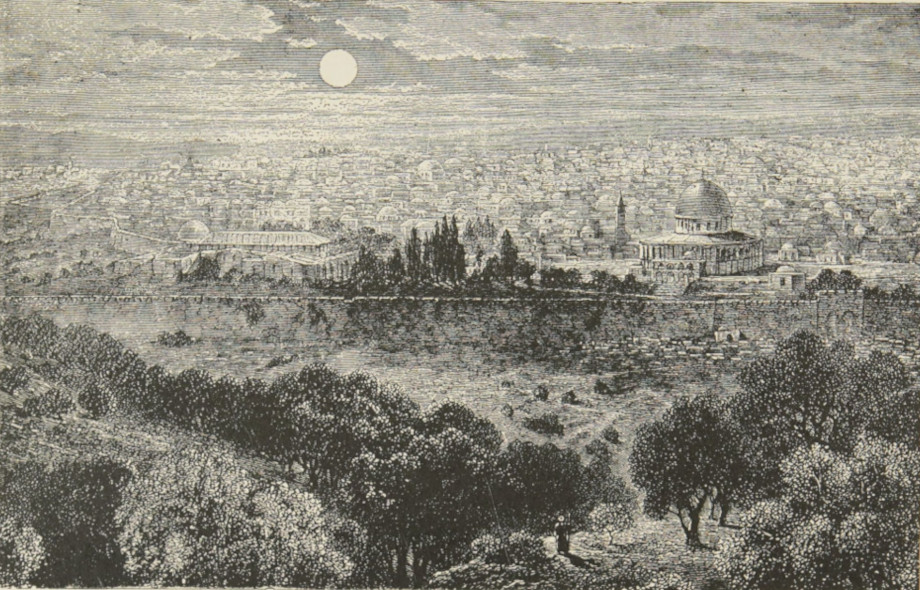
MODERN JERUSALEM BY MOONLIGHT.
David felt that it was the service of God which Michal had despised and dishonored, and he sternly answered: “It was before the Lord, which chose me before thy father, and before all his house, to appoint me ruler over the people of the Lord, over Israel; therefore will I play before the Lord. And I will yet be more vile than thus, and will be base in mine own sight; and of the maid-servants which thou hast spoken of, of them shall I be had in honor.” To David’s rebuke was added that of the Lord: because of her pride and arrogance, Michal “had no child unto the day of her death.”
The solemn ceremonies attending the removal of the ark had made a lasting impression upon the people of Israel, arousing a deeper interest in the sanctuary service, and kindling anew their zeal for Jehovah. David endeavored, by every means in his power, to deepen these impressions. The service of song was made a regular part of religious worship, and David composed psalms, not only for the use of the priests in the sanctuary service, but also to be sung by the people in their journeys to the national altar at the annual feasts. The influence thus exerted was far-reaching, and it resulted in freeing the nation from idolatry. Many of the surrounding peoples, beholding the prosperity of Israel, were led to think favorably of Israel’s God, who had done such great things for his people.
The tabernacle built by Moses, with all that appertained to the sanctuary service, except the ark, was still at Gibeah. It was David’s purpose to make Jerusalem the religious center of the nation. He had erected a palace for himself, and he felt that it was not fitting for the ark of God to rest within a tent. He determined to build for it a temple of such magnificence as should express Israel’s appreciation of the honor granted the nation in the abiding presence of Jehovah their King. Communicating his purpose to the prophet Nathan, he received the encouraging response, “Do all that is in thine heart; for the Lord is with thee.”[1132]
But that same night the word of the Lord came to Nathan, giving him a message for the king. David was to be deprived of the privilege of building a house for God, but he was granted an assurance of the divine favor to him, to his posterity, and to the kingdom of Israel: “Thus saith Jehovah of hosts; I took thee from the sheepcote, from following the sheep, to be ruler over my people, over Israel; and I was with thee whithersoever thou wentest, and have cut off all thine enemies out of thy sight, and have made thee a great name, like unto the name of the great men that are in the earth. Moreover I will appoint a place for my people Israel, and will plant them, that they may dwell in a place of their own, and move no more; neither shall the children of wickedness afflict them any more, as beforetime.”
As David had desired to build a house for God, the promise was given, “The Lord telleth thee that he will make thee a house.... I will set up thy seed after thee.... He shall build a house for my name, and I will stablish the throne of his kingdom forever.”
The reason why David was not to build the temple, was declared: “Thou hast shed blood abundantly, and hast made great wars; thou shalt not build a house unto my name.... Behold, a son shall be born to thee, who shall be a man of rest; and I will give him rest from all his enemies;... his name shall be Solomon [peaceable], and I will give peace and quietness unto Israel in his days. He shall build a house for my name.”[1133]
Though the cherished purpose of his heart had been denied, David received the message with gratitude. “Who am I, O Lord God?” he exclaimed, “and what is my house, that thou hast brought me hitherto? And this was yet a small thing in thy sight, O Lord God; but thou hast spoken also of thy servant’s house for a great while to come;” and he then renewed his covenant with God.
David knew that it would be an honor to his name, and would bring glory to his government, to perform the work that he had purposed in his heart to do; but he was ready to submit his will to the will of God. The grateful resignation thus manifested is rarely seen, even among Christians. How often do those who have passed the strength of manhood, cling to the hope of accomplishing some great work upon which their hearts are set, but which they are unfitted to perform! God’s providence may speak to them, as did his prophet to David, declaring that the work which they so much desire is not committed to them. It is theirs to prepare the way for another to accomplish it. But instead of gratefully submitting to the divine direction, many fall back as if slighted and rejected, feeling that if they cannot do the one thing which they desire to do, they will do nothing. Many cling, with desperate energy, to responsibilities which they are incapable of bearing, and vainly endeavor to accomplish a work for which they are insufficient, while that which they might do, lies neglected. And because of this lack of co-operation on their part, the greater work is hindered or frustrated.
David, in his covenant with Jonathan, had promised that when he should have rest from his enemies, he would show kindness to the house of Saul. In his prosperity, mindful of this covenant, the king made inquiry, “Is there yet any that is left of the house of Saul, that I may show him kindness for Jonathan’s sake?”[1134] He was told of a son of Jonathan, Mephibosheth, who had been lame from childhood. At the time of Saul’s defeat by the Philistines at Jezreel, the nurse of this child, attempting to flee with him, had let him fall, thus making him a life-long cripple. David now summoned the young man to court, and received him with great kindness. The private possessions of Saul were restored to him, for the support of his household; but the son of Jonathan was himself to be the constant guest of the king, sitting daily at the royal table. Through reports from the enemies of David, Mephibosheth had been led to cherish a strong prejudice against him as a usurper; but the monarch’s generous and courteous reception of him, and his continued kindness, won the heart of the young man; he became strongly attached to David, and like his father Jonathan, he felt that his interest was one with that of the king whom God had chosen.
After David’s establishment upon the throne of Israel, the nation enjoyed a long interval of peace. The surrounding peoples, seeing the strength and unity of the kingdom, soon thought it prudent to desist from open hostilities; and David, occupied with the organization and upbuilding of his kingdom, refrained from aggressive war. At last, however, he made war upon Israel’s old enemies, the Philistines, and upon the Moabites, and succeeded in overcoming both, and making them tributary.
Then there was formed against the kingdom of David a vast coalition of the surrounding nations, out of which grew the greatest wars and victories of his reign, and the most extensive accessions to his power. This hostile alliance, which really sprung from jealousy of David’s increasing power, had been wholly unprovoked by him. The circumstances that led to its rise were these:—
Tidings were received at Jerusalem announcing the death of Nahash, king of the Ammonites,—a monarch who had shown kindness to David when he was a fugitive from the rage of Saul. Now, desiring to express his grateful appreciation of the favor shown him in his distress, David sent ambassadors with a message of sympathy to Hanun, the son and successor of the Ammonite king. “Said David, I will show kindness unto Hanun the son of Nahash, as his father showed kindness unto me.”[1135]
But his courteous act was misinterpreted. The Ammonites hated the true God, and were the bitter enemies of Israel. The apparent kindness of Nahash to David had been prompted wholly by hostility to Saul as king of Israel. The message of David was misconstrued by Hanun’s counselors. They “said unto Hanun their lord, Thinkest thou that David doth honor thy father, that he hath sent comforters unto thee? hath not David rather sent his servants unto thee, to search the city, and to spy it out, and to overthrow it?” It was by the advice of his counselors that Nahash, half a century before, had been led to make the cruel condition required of the people of Jabesh-gilead, when, besieged by the Ammonites, they sued for a covenant of peace. Nahash had demanded the privilege of thrusting out all their right eyes. The Ammonites still vividly remembered how the king of Israel had foiled their cruel design, and had rescued the people whom they would have humbled and mutilated. The same hatred of Israel still prompted them. They could have no conception of the generous spirit that had inspired David’s message. When Satan controls the minds of men, he will excite envy and suspicion which will misconstrue the very best intentions. Listening to his counselors, Hanun regarded David’s messengers as spies, and loaded them with scorn and insult.
The Ammonites had been permitted to carry out the evil purposes of their hearts without restraint, that their real character might be revealed to David. It was not God’s will that Israel should enter into a league with this treacherous heathen people.
In ancient times, as now, the office of ambassador was held sacred. By the universal law of nations it insured protection from personal violence or insult. The ambassador standing as a representative of his sovereign, any indignity offered to him demanded prompt retaliation. The Ammonites, knowing that the insult offered to Israel would surely be avenged, made preparation for war. “When the children of Ammon saw that they had made themselves odious to David, Hanun and the children of Ammon sent a thousand talents of silver to hire them chariots and horsemen out of Mesopotamia, and out of Syria-maachah, and out of Zobah. So they hired thirty and two thousand chariots.... And the children of Ammon gathered themselves together from their cities, and came to battle.”[1136]
It was indeed a formidable alliance. The inhabitants of the region lying between the river Euphrates and the Mediterranean Sea had leagued with the Ammonites. The north and east of Canaan was encircled with armed foes, banded together to crush the kingdom of Israel.
The Hebrews did not wait for the invasion of their country. Their forces, under Joab, crossed the Jordan, and advanced toward the Ammonite capital. As the Hebrew captain led his army to the field, he sought to inspire them for the conflict, saying, “Be of good courage, and let us behave ourselves valiantly for our people, and for the cities of our God; and let the Lord do that which is good in his sight.”[1136] The united forces of the allies were overcome in the first engagement. But they were not yet willing to give over the contest, and the next year, renewed the war. The king of Syria gathered his forces, threatening Israel with an immense army. David, realizing how much depended upon the result of this contest, took the field in person, and by the blessing of God inflicted upon the allies a defeat so disastrous that the Syrians, from Lebanon to the Euphrates, not only gave up the war, but became tributary to Israel. Against the Ammonites, David pushed the war with vigor, until their strongholds fell, and the whole region came under the dominion of Israel.
The dangers which had threatened the nation with utter destruction, proved, through the providence of God, to be the very means by which it rose to unprecedented greatness. In commemorating his remarkable deliverances, David sings:—
“The Lord liveth; and blessed be my rock; and exalted be the God of my salvation;
Even the God that executeth vengeance for me, and subdueth peoples under me.
He rescueth me from mine enemies;
Yea, thou liftest me up above them that rise up against me;
Thou deliverest me from the violent man.
Therefore I will give thanks unto thee, O Lord, among the nations.
And will sing praises unto thy name.
Great deliverance giveth he to his king;
And showeth loving-kindness to his anointed,
To David and to his seed, forevermore.”[1137]
And throughout the songs of David, the thought was impressed on his people that Jehovah was their strength and deliverer:—
“There is no king saved by the multitude of a host;
A mighty man is not delivered by much strength.
A horse is a vain thing for safety;
Neither shall he deliver any by his great strength.”
“Thou art my king, O God;
Command deliverances for Jacob.
Through thee, will we push down our enemies;
Through thy name will we tread them under that rise up against us.
For I will not trust in my bow,
Neither shall my sword save me.
But thou hast saved us from our enemies,
And hast put them to shame that hated us.”
“Some trust in chariots, and some in horses;
But we will remember the name of Jehovah our God.”[1138]
The kingdom of Israel had now reached in extent the fulfillment of the promise given to Abraham, and afterward repeated to Moses: “Unto thy seed have I given this land, from the river of Egypt unto the great river, the river Euphrates.”[1139] Israel had become a mighty nation, respected and feared by surrounding peoples. In his own realm, David’s power had become very great. He commanded, as few sovereigns in any age have been able to command, the affections and allegiance of his people. He had honored God, and God was now honoring him.
But in the midst of prosperity lurked danger. In the time of his greatest outward triumph, David was in the greatest peril, and met his most humiliating defeat.
DAVID’S SIN AND REPENTANCE—71

The Bible has little to say in praise of men. Little space is given to recounting the virtues of even the best men who have ever lived. This silence is not without purpose; it is not without a lesson. All the good qualities that men possess are the gift of God; their good deeds are performed by the grace of God through Christ. Since they owe all to God, the glory of whatever they are or do, belongs to him alone; they are but instruments in his hands. More than this—as all the lessons of Bible history teach—it is a perilous thing to praise or exalt men; for if one comes to lose sight of his entire dependence on God, and to trust to his own strength, he is sure to fall. Man is contending with foes who are stronger than he. “We wrestle not against flesh and blood, but against principalities, against powers, against the rulers of the darkness of this world, against wicked spirits in high places.”[1140] It is impossible for us, in our own strength, to maintain the conflict; and whatever diverts the mind from God, whatever leads to self-exaltation or to self-dependence, is surely preparing the way for our overthrow. The tenor of the Bible is to inculcate distrust of human power and to encourage trust in divine power.
It was the spirit of self-confidence and self-exaltation that prepared the way for David’s fall. Flattery, and the subtle allurements of power and luxury, were not without effect upon him. Intercourse with surrounding nations also exerted an influence for evil. According to the customs prevailing among Eastern rulers, crimes not to be tolerated in subjects were uncondemned in the king; the monarch was not under obligation to exercise the same self-restraint as the subject. All this tended to lessen David’s sense of the exceeding sinfulness of sin. And instead of relying in humility upon the power of Jehovah, he began to trust to his own wisdom and might. As soon as Satan can separate the soul from God, the only source of strength, he will seek to arouse the unholy desires of man’s carnal nature. The work of the enemy is not abrupt; it is not, at the outset, sudden and startling; it is a secret undermining of the strongholds of principle. It begins in apparently small things,—the neglect to be true to God and to rely upon him wholly, the disposition to follow the customs and practices of the world.
Before the conclusion of the war with the Ammonites, David, leaving the conduct of the army to Joab, returned to Jerusalem. The Syrians had already submitted to Israel, and the complete overthrow of the Ammonites appeared certain. David was surrounded by the fruits of victory and the honors of his wise and able rule. It was now, while he was at ease and unguarded, that the tempter seized the opportunity to occupy his mind. The fact that God had taken David into so close connection with himself, and had manifested so great favor toward him, should have been to him the strongest of incentives to preserve his character unblemished. But when, in ease and self-security, he let go his hold upon God, David yielded to Satan, and brought upon his soul the stain of guilt. He, the Heaven-appointed leader of the nation, chosen by God to execute his law, himself trampled upon its precepts. He who should have been a terror to evil-doers, by his own act strengthened their hands.
Amid the perils of his earlier life, David, in conscious integrity, could trust his case with God. The Lord’s hand had guided him safely past the unnumbered snares that had been laid for his feet. But now, guilty and unrepentant, he did not ask help and guidance from Heaven, but sought to extricate himself from the dangers in which sin had involved him. Bathsheba, whose fatal beauty had proved a snare to the king, was the wife of Uriah the Hittite, one of David’s bravest and most faithful officers. None could foresee what would be the result should the crime become known. The law of God pronounced the adulterer guilty of death, and the proud-spirited soldier, so shamefully wronged, might avenge himself by taking the life of the king, or by exciting the nation to revolt.
Every effort which David made to conceal his guilt proved unavailing. He had betrayed himself into the power of Satan; danger surrounded him, dishonor more bitter than death was before him. There appeared but one way of escape, and in his desperation he was hurried on to add murder to adultery. He who had compassed the destruction of Saul, was seeking to lead David also to ruin. Though the temptations were different, they were alike in leading to transgression of God’s law. David reasoned that if Uriah were slain by the hand of enemies in battle, the guilt of his death could not be traced home to the king, Bathsheba would be free to become David’s wife, suspicion could be averted, and the royal honor would be maintained.
Uriah was made the bearer of his own death-warrant. A letter sent by his hand to Joab from the king commanded, “Set ye Uriah in the forefront of the hottest battle, and retire ye from him, that he may be smitten, and die.”[1141] Joab, already stained with the guilt of one wanton murder, did not hesitate to obey the king’s instructions, and Uriah fell by the sword of the children of Ammon.
Heretofore David’s record as a ruler had been such as few monarchs have ever equaled. It is written of him that he “executed judgment and justice unto all his people.”[1142] His integrity had won the confidence and fealty of the nation. But as he departed from God, and yielded himself to the wicked one, he became, for the time, the agent of Satan; yet he still held the position and authority that God had given him, and because of this, claimed obedience that would imperil the soul of him who should yield it. And Joab, whose allegiance had been given to the king rather than to God, transgressed God’s law because the king had commanded it.
David’s power had been given him by God, but to be exercised only in harmony with the divine law. When he commanded that which was contrary to God’s law, it became sin to obey. “The powers that be are ordained of God,”[1143] but we are not to obey them contrary to God’s law. The apostle Paul, writing to the Corinthians, sets forth the principle by which we should be governed. He says, “Be ye followers of me, even as I also am of Christ.”[1144]
An account of the execution of his order was sent to David, but so carefully worded as not to implicate either Joab or the king. Joab “charged the messenger, saying, When thou hast made an end of telling the matters of the war unto the king, and if so be that the king’s wrath arise, ... then say thou, Thy servant Uriah the Hittite is dead also. So the messenger went, and came and showed David all that Joab had sent him for.”
The king’s answer was, “Thus shalt thou say unto Joab: Let not this thing displease thee, for the sword devoureth one as well as another. Make thy battle more strong against the city, and overthrow it; and encourage thou him.”
Bathsheba observed the customary days of mourning for her husband; and at their close, “David sent and fetched her to his house, and she became his wife.” He whose tender conscience and high sense of honor would not permit him, even when in peril of his life, to put forth his hand against the Lord’s anointed, had so fallen that he could wrong and murder one of his most faithful and most valiant soldiers, and hope to enjoy undisturbed the reward of his sin. Alas! how had the fine gold become dim! how had the most fine gold changed!
From the beginning, Satan has portrayed to men the gains to be won by transgression. Thus he seduced angels. Thus he tempted Adam and Eve to sin. And thus he is still leading multitudes away from obedience to God. The path of transgression is made to appear desirable; “but the end thereof are the ways of death.”[1145] Happy they who, having ventured in this way, learn how bitter are the fruits of sin, and turn from it betimes. God, in his mercy, did not leave David to be lured to utter ruin by the deceitful rewards of sin.
For the sake of Israel also, there was a necessity for God to interpose. As time passed on, David’s sin toward Bathsheba became known, and suspicion was excited that he had planned the death of Uriah. The Lord was dishonored. He had favored and exalted David, and David’s sin misrepresented the character of God, and cast reproach upon his name. It tended to lower the standard of godliness in Israel, to lessen in many minds the abhorrence of sin; while those who did not love and fear God were by it emboldened in transgression.
Nathan the prophet was bidden to bear a message of reproof to David. It was a message terrible in its severity. To few sovereigns could such a reproof be given but at the price of certain death to the reprover. Nathan delivered the divine sentence unflinchingly, yet with such heaven-born wisdom as to engage the sympathies of the king, to arouse his conscience, and to call from his lips the sentence of death upon himself. Appealing to David as the divinely appointed guardian of his people’s rights, the prophet repeated a story of wrong and oppression that demanded redress.
“There were two men in one city,” he said, “the one rich, and the other poor. The rich man had exceeding many flocks and herds; but the poor man had nothing, save one little ewe lamb, which he had brought and nourished up; and it grew up together with him, and with his children; it did eat of his own meat, and drank of his own cup, and lay in his bosom, and was unto him as a daughter. And there came a traveler unto the rich man, and he spared to take of his own flock and of his own herd, to dress for the wayfaring man that was come unto him; but took the poor man’s lamb, and dressed it for the man that was come to him.”
The anger of the king was roused, and he exclaimed, “As the Lord liveth, the man that hath done this thing is worthy to die. And he shall restore the lamb fourfold, because he did this thing, and because he had no pity.”[1146]
Nathan fixed his eyes upon the king; then lifting his right hand to heaven, he solemnly declared, “Thou art the man.” “Wherefore,” he continued, “hast thou despised the commandment of the Lord, to do evil in his sight?” The guilty may attempt, as David had done, to conceal their crime from men; they may seek to bury the evil deed forever from human sight or knowledge: but “all things are naked and opened unto the eyes of Him with whom we have to do.”[1147] “There is nothing covered, that shall not be revealed; and hid, that shall not be known.”[1148]
Nathan declared: “Thus saith the Lord God of Israel: I anointed thee king over Israel, and I delivered thee out of the hand of Saul.... Wherefore hast thou despised the commandment of the Lord, to do evil in his sight? Thou hast killed Uriah the Hittite with the sword, and hast taken his wife to be thy wife, and hast slain him with the sword of the children of Ammon. Now therefore the sword shall never depart from thine house.... Behold, I will raise up evil against thee out of thine own house, and I will take thy wives before thine eyes, and give them unto thy neighbor.... For thou didst it secretly; but I will do this thing before all Israel, and before the sun.”
The prophet’s rebuke touched the heart of David; conscience was aroused; his guilt appeared in all its enormity. His soul was bowed in penitence before God. With trembling lips he said, “I have sinned against the Lord.” All wrong done to others reaches back from the injured one to God. David had committed a grievous sin, toward both Uriah and Bathsheba, and he keenly felt this. But infinitely greater was his sin against God.
Though there would be found none in Israel to execute the sentence of death upon the anointed of the Lord, David trembled, lest, guilty and unforgiven, he should be cut down by the swift judgment of God. But the message was sent him by the prophet, “The Lord also hath put away thy sin; thou shalt not die.” Yet justice must be maintained. The sentence of death was transferred from David to the child of his sin. Thus the king was given opportunity for repentance; while to him the suffering and death of the child, as a part of his punishment, was far more bitter than his own death could have been. The prophet said, “Because by this deed thou hast given great occasion to the enemies of the Lord to blaspheme, the child also that is born unto thee shall surely die.”
When his child was stricken, David, with fasting and deep humiliation, pleaded for its life. He put off his royal robes, he laid aside his crown, and night after night he lay upon the earth, in heart-broken grief interceding for the innocent one suffering for his guilt. “The elders of his house arose, and went to him, to raise him up from the earth; but he would not.” Often when judgments had been pronounced upon persons or cities, humiliation and repentance had turned aside the blow, and the Ever-Merciful, swift to pardon, had sent messengers of peace. Encouraged by this thought, David persevered in his supplication so long as the child was spared. Upon learning that it was dead, he quietly submitted to the decree of God. The first stroke had fallen of that retribution which he himself had declared just; but David, trusting in God’s mercy, was not without comfort.
Very many, reading the history of David’s fall, have inquired, “Why has this record been made public? Why did God see fit to throw open to the world this dark passage in the life of one so highly honored of Heaven?” The prophet, in his reproof to David, had declared concerning his sin, “By this deed thou hast given great occasion to the enemies of the Lord to blaspheme.” Through successive generations, infidels have pointed to the character of David, bearing this dark stain, and have exclaimed in triumph and derision, “This is the man after God’s own heart!” Thus a reproach has been brought upon religion, God and his word have been blasphemed, souls have been hardened in unbelief, and many, under a cloak of piety, have become bold in sin.
But the history of David furnishes no countenance to sin. It was when he was walking in the counsel of God, that he was called a man after God’s own heart. When he sinned, this ceased to be true of him until by repentance he had returned to the Lord. The word of God plainly declares, “The thing that David had done was evil in the eyes of Jehovah.”[1149] And the Lord said to David by the prophet, “Wherefore hast thou despised the commandment of the Lord, to do evil in his sight?... Now therefore the sword shall never depart from thine house; because thou hast despised me.” Though David repented of his sin, and was forgiven and accepted by the Lord, he reaped the baleful harvest of the seed he himself had sown. The judgments upon him and upon his house testify to God’s abhorrence of the sin.
Heretofore God’s providence had preserved David against all the plottings of his enemies, and had been directly exercised to restrain Saul. But David’s transgression had changed his relation to God. The Lord could not in any wise sanction iniquity. He could not exercise his power to protect David from the results of his sin as he had protected him from the enmity of Saul.
There was a great change in David himself. He was broken in spirit by the consciousness of his sin and its far-reaching results. He felt humbled in the eyes of his subjects. His influence was weakened. Hitherto his prosperity had been attributed to his conscientious obedience to the commandments of the Lord. But now his subjects, having a knowledge of his sin, would be led to sin more freely. His authority in his own household, his claim to respect and obedience from his sons, was weakened. A sense of his guilt kept him silent when he should have condemned sin; it made his arm feeble to execute justice in his house. His evil example exerted its influence upon his sons, and God would not interpose to prevent the result. He would permit things to take their natural course, and thus David was severely chastised.
For a whole year after his fall, David lived in apparent security; there was no outward evidence of God’s displeasure. But the divine sentence was hanging over him. Swiftly and surely a day of judgment and retribution was approaching, which no repentance could avert, agony and shame that would darken his whole earthly life. Those who, by pointing to the example of David, try to lessen the guilt of their own sins, should learn from the Bible record that the way of transgression is hard. Though like David they should turn from their evil course, the results of sin, even in this life, will be found bitter and hard to bear.
God intended the history of David’s fall to serve as a warning that even those whom he has greatly blessed and favored are not to feel secure, and neglect watchfulness and prayer. And thus it has proved to those who in humility have sought to learn the lesson that God designed to teach. From generation to generation, thousands have thus been led to realize their own danger from the tempter’s power. The fall of David, one so greatly honored by the Lord, has awakened in them distrust of self. They have felt that God alone could keep them by his power through faith. Knowing that in him was their strength and safety, they have feared to take the first step on Satan’s ground.
Even before the divine sentence was pronounced against David, he had begun to reap the fruit of transgression. His conscience was not at rest. The agony of spirit which he then endured is brought to view in the thirty-second psalm. He says:—
“Blessed is he whose transgression is forgiven, whose sin is covered.
Blessed is the man unto whom the Lord imputeth not iniquity,
And in whose spirit there is no guile.
When I kept silence, my bones waxed old,
Through my roaring all the day long.
For day and night thy hand was heavy upon me;
My moisture was changed as with the drought of summer.”[1150]
And the fifty-first psalm is an expression of David’s repentance, when the message of reproof came to him from God:—
“Have mercy upon me, O God, according to thy loving-kindness;
According unto the multitude of thy tender mercies blot out my transgressions.
Wash me thoroughly from mine iniquity, and cleanse me from my sin.
For I acknowledge my transgressions; and my sin is ever before me....
Purge me with hyssop, and I shall be clean; wash me, and I shall be whiter than snow.
Make me to hear joy and gladness,
That the bones which thou hast broken may rejoice.
Hide thy face from my sins,
And blot out all mine iniquities.
Create in me a clean heart, O God;
And renew a right spirit within me.
Cast me not away from thy presence;
And take not thy Holy Spirit from me.
Restore unto me the joy of thy salvation,
And uphold me with thy free Spirit.
Then will I teach transgressors thy ways;
And sinners shall be converted unto thee.
Deliver me from blood-guiltiness, O God, thou God of my salvation,
And my tongue shall sing aloud of thy righteousness.”[1151]
Thus in a sacred song to be sung in the public assemblies of his people, in the presence of the court,—priests and judges, princes and men of war,—and which would preserve to the latest generation the knowledge of his fall, the king of Israel recounted his sin, his repentance, and his hope of pardon through the mercy of God. Instead of endeavoring to conceal his guilt, he desired that others might be instructed by the sad history of his fall.
David’s repentance was sincere and deep. There was no effort to palliate his crime. No desire to escape the judgments threatened, inspired his prayer. But he saw the enormity of his transgression against God; he saw the defilement of his soul; he loathed his sin. It was not for pardon only that he prayed, but for purity of heart. David did not in despair give over the struggle. In the promises of God to repentant sinners, he saw the evidence of his pardon and acceptance.
“For thou desirest not sacrifice; else would I give it;
Thou delightest not in burnt-offering.
The sacrifices of God are a broken spirit;
A broken and a contrite heart, O God, thou wilt not despise.”[1151]
Though David had fallen, the Lord lifted him up. He was now more fully in harmony with God and in sympathy with his fellow-men than before he fell. In the joy of his release he sang,—
“I acknowledged my sin unto thee, and mine iniquity have I not hid.
I said, I will confess my transgressions unto the Lord,
And thou forgavest the iniquity of my sin....
Thou art my hiding-place; thou shalt preserve me from trouble;
Thou shalt compass me about with songs of deliverance.”[1152]
Many have murmured at what they called God’s injustice in sparing David, whose guilt was so great, after having rejected Saul for what appear to them to be far less flagrant sins. But David humbled himself and confessed his sin, while Saul despised reproof, and hardened his heart in impenitence.
This passage in David’s history is full of significance to the repenting sinner. It is one of the most forcible illustrations given us of the struggles and temptations of humanity, and of genuine repentance toward God and faith in our Lord Jesus Christ. Through all the ages, it has proved a source of encouragement to souls that, having fallen into sin, were struggling under the burden of their guilt. Thousands of the children of God, who have been betrayed into sin, when ready to give up to despair have remembered how David’s sincere repentance and confession were accepted by God, notwithstanding he suffered for his transgression; and they also have taken courage to repent, and try again to walk in the way of God’s commandments.
Whoever under the reproof of God will humble the soul with confession and repentance, as did David, may be sure that there is hope for him. Whoever will in faith accept God’s promises, will find pardon. The Lord will never cast away one truly repentant soul. He has given this promise: “Let him take hold of my strength, that he may make peace with me, and he shall make peace with me.”[1153] “Let the wicked forsake his way, and the unrighteous man his thoughts; and let him return unto the Lord, and he will have mercy upon him; and to our God, for he will abundantly pardon.”[1154]

THE REBELLION OF ABSALOM—72
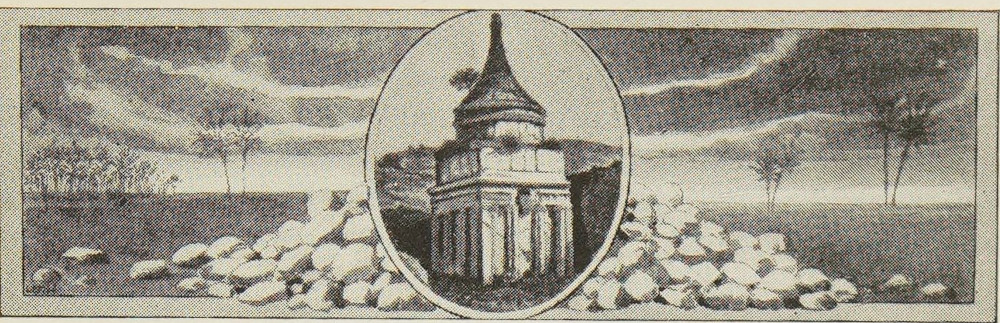
“He shall restore fourfold,” had been David’s unwitting sentence upon himself, on listening to the prophet Nathan’s parable; and according to his own sentence he was to be judged. Four of his sons must fall, and the loss of each would be a result of the father’s sin.
The shameful crime of Amnon, the first-born, was permitted by David to pass unpunished and unrebuked. The law pronounced death upon the adulterer, and the unnatural crime of Amnon made him doubly guilty. But David, self-condemned for his own sin, failed to bring the offender to justice. For two full years, Absalom, the natural protector of the sister so foully wronged, concealed his purpose of revenge, but only to strike more surely at the last. At a feast of the king’s sons, the drunken, incestuous Amnon was slain, by his brother’s command.
Twofold judgment had been meted out to David. The terrible message was carried to him, “Absalom hath slain all the king’s sons, and there is not one of them left. Then the king arose, and tare his garments, and lay on the earth; and all his servants stood by with their clothes rent.”[1160] The king’s sons, returning in alarm to Jerusalem, revealed to their father the truth; Amnon alone had been slain; and they “lifted up their voice and wept; and the king also and all his servants wept very sore.” But Absalom fled to Talmai, the king of Geshur, his mother’s father.
Like other sons of David, Amnon had been left to selfish indulgence. He had sought to gratify every thought of his heart, regardless of the requirements of God. Notwithstanding his great sin, God had borne long with him. For two years he had been granted opportunity for repentance; but he continued in sin, and with his guilt upon him, he was cut down by death, to await the awful tribunal of the Judgment.
David had neglected the duty of punishing the crime of Amnon, and because of the unfaithfulness of the king and father, and the impenitence of the son, the Lord permitted events to take their natural course, and did not restrain Absalom. When parents or rulers neglect the duty of punishing iniquity, God himself will take the case in hand. His restraining power will be in a measure removed from the agencies of evil, so that a train of circumstances will arise which will punish sin with sin.
The evil results of David’s unjust indulgence toward Amnon were not ended; for it was here that Absalom’s alienation from his father began. After he fled to Geshur, David, feeling that the crime of his son demanded some punishment, refused him permission to return. And this had a tendency to increase rather than to lessen the inextricable evils in which the king had come to be involved. Absalom, energetic, ambitious, and unprincipled, shut out by his exile from participation in the affairs of the kingdom, soon gave himself up to dangerous scheming.
At the close of two years, Joab determined to effect a reconciliation between the father and his son. And with this object in view he secured the services of a woman of Tekoah, reputed for wisdom. Instructed by Joab, the woman represented herself to David as a widow whose two sons had been her only comfort and support. In a quarrel, one of these had slain the other, and now all the relatives of the family demanded that the survivor should be given up to the avenger of blood. “And so,” said the mother, “they shall quench my coal which is left, and shall not leave to my husband neither name nor remainder upon the earth.” The king’s feelings were touched by this appeal, and he assured the woman of the royal protection for her son.
After drawing from him repeated promises for the young man’s safety, she entreated the king’s forbearance, declaring that he had spoken as one at fault, in that he did not fetch home again his banished. “For,” she said, “we must needs die, and are as water spilt on the ground, which cannot be gathered up again; neither doth God respect any person; yet doth he devise means, that his banished be not expelled from him.” This tender and touching portrayal of the love of God toward the sinner,—coming as it did from Joab, the rude soldier,—is a striking evidence of the familiarity of the Israelites with the great truths of redemption. The king, feeling his own need of God’s mercy, could not resist this appeal. To Joab the command was given, “Go, therefore, bring the young man Absalom again.”
Absalom was permitted to return to Jerusalem, but not to appear at court, or to meet his father. David had begun to see the evil effects of his indulgence toward his children; and tenderly as he loved this beautiful and gifted son, he felt it necessary, as a lesson both to Absalom and to the people, that abhorrence for such a crime should be manifested. Absalom lived two years in his own house, but banished from the court. His sister dwelt with him, and her presence kept alive the memory of the irreparable wrong she had suffered. In the popular estimation, the prince was a hero rather than an offender. And having this advantage, he set himself to gain the hearts of the people. His personal appearance was such as to win the admiration of all beholders. “In all Israel there was none to be so much praised as Absalom for his beauty; from the sole of his foot even to the crown of his head there was no blemish in him.” It was not wise for the king to leave a man of Absalom’s character—ambitious, impulsive, and passionate—to brood for two years over supposed grievances. And David’s action, in permitting him to return to Jerusalem, and yet refusing to admit him to his presence, enlisted in his behalf the sympathies of the people.
With the memory ever before him of his own transgression of the law of God, David seemed morally paralyzed; he was weak and irresolute, when before his sin he had been courageous and decided. His influence with the people had been weakened. And all this favored the designs of his unnatural son.
Through the influence of Joab, Absalom was again admitted to his father’s presence; but though there was an outward reconciliation, he continued his ambitious scheming. He now assumed an almost royal state, having chariots and horses, and fifty men to run before him. And while the king was more and more inclined to desire retirement and solitude, Absalom sedulously courted the popular favor.
The influence of David’s listlessness and irresolution extended to his subordinates; negligence and delay characterized the administration of justice. Absalom artfully turned every cause of dissatisfaction to his own advantage. Day by day this man of noble mien might be seen at the gate of the city, where a crowd of suppliants waited to present their wrongs for redress. Absalom mingled with them, and listened to their grievances, expressing sympathy with their sufferings, and regret at the inefficiency of the government. Having thus listened to the story of a man of Israel, the prince would reply, “Thy matters are good and right; but there is no man deputed of the king to hear thee;” adding, “O that I were made judge in the land, that every man which hath any suit or cause might come unto me, and I would do him justice! And it was so, that when any man came nigh to do him obeisance, he put forth his hand, and took him, and kissed him.”
Fomented by the artful insinuations of the prince, discontent with the government was fast spreading. The praise of Absalom was on the lips of all. He was generally regarded as heir to the kingdom; the people looked upon him with pride as worthy of this high station, and a desire was kindled that he might occupy the throne. “So Absalom stole the hearts of the men of Israel.” Yet the king, blinded by affection for his son, suspected nothing. The princely state which Absalom had assumed, was regarded by David as intended to do honor to his court,—as an expression of joy at the reconciliation.
The minds of the people being prepared for what was to follow, Absalom secretly sent picked men throughout the tribes, to concert measures for a revolt. And now the cloak of religious devotion was assumed to conceal his traitorous designs. A vow made long before while he was in exile must be paid in Hebron. Absalom said to the king, “I pray thee, let me go and pay my vow, which I have vowed unto the Lord, in Hebron. For thy servant vowed a vow while I abode at Geshur, in Syria, saying, If the Lord shall bring me again indeed to Jerusalem, then I will serve the Lord.” The fond father, comforted with this evidence of piety in his son, dismissed him with his blessing. The conspiracy was now fully matured. Absalom’s crowning act of hypocrisy was designed not only to blind the king, but to establish the confidence of the people, and thus to lead them on to rebellion against the king whom God had chosen.
Absalom set forth for Hebron, and there went with him “two hundred men out of Jerusalem, that were called; and they went in their simplicity, and they knew not anything.” These men went with Absalom, little thinking that their love for the son was leading them into rebellion against the father. Upon arriving at Hebron, Absalom immediately summoned Ahithophel, one of the chief counselors of David, a man in high repute for wisdom, whose opinion was thought to be as safe and wise as that of an oracle. Ahithophel joined the conspirators, and his support made the cause of Absalom appear certain of success, attracting to his standard many influential men from all parts of the land. As the trumpet of revolt was sounded, the prince’s spies throughout the country spread the tidings that Absalom was king, and many of the people gathered to him.
Meanwhile the alarm was carried to Jerusalem, to the king. David was suddenly aroused, to see rebellion breaking out close beside his throne. His own son—the son whom he had loved and trusted—had been plotting to seize his crown, and doubtless to take his life. In his great peril, David shook off the depression that had so long nested upon him, and with the spirit of his earlier years he prepared to meet this terrible emergency. Absalom was mustering his forces at Hebron, only twenty miles away. The rebels would soon be at the gates of Jerusalem.
From his palace, David looked out upon his capital—“beautiful for situation, the joy of the whole earth, ... the city of the great King.”[1161] He shuddered at the thought of exposing it to carnage and devastation. Should he call to his help the subjects still loyal to his throne, and make a stand to hold his capital? Should he permit Jerusalem to be deluged with blood? His decision was taken. The horrors of war should not fall upon the chosen city. He would leave Jerusalem, and then test the fidelity of his people, giving them an opportunity to rally to his support. In this great crisis it was his duty to God and to his people to maintain the authority with which Heaven had invested him. The issue of the conflict he would trust with God.
In humility and sorrow, David passed out of the gate of Jerusalem,—driven from his throne, from his palace, from the ark of God, by the insurrection of his cherished son. The people followed in long, sad procession, like a funeral train. David’s body-guard of Cherethites, Pelethites, and six hundred Gittites from Gath, under the command of Ittai, accompanied the king. But David, with characteristic unselfishness, could not consent that these strangers who had sought his protection should be involved in his calamity. He expressed surprise that they should be ready to make this sacrifice for him. Then said the king to Ittai the Gittite, “Wherefore goest thou also with us? Return to thy place, and abide with the king; for thou art a stranger, and also an exile. Whereas thou earnest but yesterday, should I this day make thee go up and down with us? Seeing I go whither I may, return thou, and take back thy brethren; mercy and truth be with thee.”
Ittai answered, “As the Lord liveth, and as my lord the king liveth, surely in what place my lord the king shall be, whether in death or life, even there also will thy servant be.” These men had been converted from paganism to the worship of Jehovah, and nobly they now proved their fidelity to their God and their king. David, with grateful heart, accepted their devotion to his apparently sinking cause, and all passed over the brook Kedron, on the way toward the wilderness.
Again the procession halted. A company clad in holy vestments was approaching. “And lo Zadok also, and all the Levites were with him, bearing the ark of the covenant of God.” The followers of David looked upon this as a happy omen. The presence of that sacred symbol was to them a pledge of their deliverance and ultimate victory. It would inspire the people with courage to rally to the king. Its absence from Jerusalem would bring terror to the adherents of Absalom.