THE EARLIER KINGS (continued 4)
Reading edition
At sight of the ark, joy and hope for a brief moment thrilled the heart of David. But soon other thoughts came to him. As the appointed ruler of God’s heritage, he was under solemn responsibility. Not personal interests, but the glory of God and the good of his people, were to be uppermost in the mind of Israel’s king. God, who dwelt between the cherubim, had said of Jerusalem, “This is my rest;”[1162] and without divine authority, neither priest nor king had a right to remove therefrom the symbol of his presence. And David knew that his heart and life must be in harmony with the divine precepts, else the ark would be the means of disaster rather than of success. His great sin was ever before him. He recognized in this conspiracy the just judgment of God. The sword that was not to depart from his house had been unsheathed. He knew not what the result of the struggle might be. It was not for him to remove from the capital of the nation the sacred statutes which embodied the will of their divine Sovereign, which were the constitution of the realm and the foundation of its prosperity.
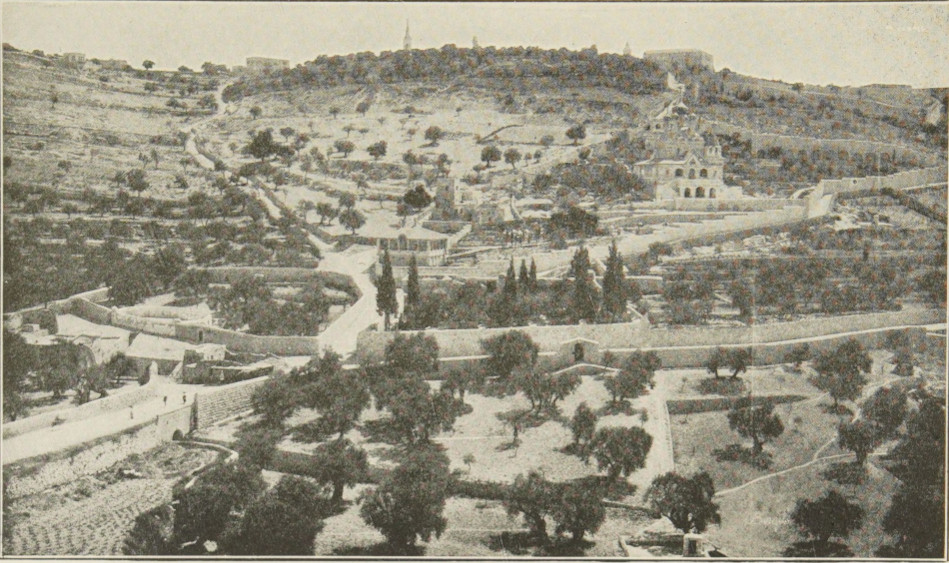
THE MOUNT OF OLIVES. “David went up by the ascent of Olivet, and wept as he went up.”
He commanded Zadok, “Carry back the ark of God into the city. If I shall find favor in the eyes of the Lord, he will bring me again, and show me both it and his habitation; but if he thus say, I have no delight in thee; behold, here am I, let him do to me as seemeth good unto him.”
David added, “Art not thou a seer?”—a man appointed of God to instruct the people? “Return into the city in peace, and your two sons with you, Ahimaaz thy son, and Jonathan the son of Abiathar. See, I will tarry in the plain of the wilderness, until there come word from you to certify me.” In the city the priests might do him good service by learning the movements and purposes of the rebels, and secretly communicating them to the king by their sons, Ahimaaz and Jonathan.
As the priests turned back toward Jerusalem, a deeper shadow fell upon the departing throng. Their king a fugitive, themselves outcasts, forsaken even by the ark of God;—the future was dark with terror and foreboding. “And David went up by the ascent of Olivet, and wept as he went up, and had his head covered, and he went barefoot; and all the people that was with him covered every man his head, and they went up, weeping as they went up. And one told David, saying, Ahithophel is among the conspirators with Absalom.” Again David was forced to recognize in his calamities the results of his own sin. The defection of Ahithophel, the ablest and most wily of political leaders, was prompted by revenge for the family disgrace involved in the wrong to Bathsheba, who was his granddaughter.
“And David said, O Lord, I pray thee, turn the counsel of Ahithophel into foolishness.” Upon reaching the top of the mount, the king bowed in prayer, casting upon God the burden of his soul, and humbly supplicating divine mercy. His prayer seemed to be at once answered. Hushai the Archite, a wise and able counselor, who had proved himself a faithful friend to David, now came to him with his robes rent, and with earth upon his head, to cast in his fortunes with the dethroned and fugitive king. David saw, as by a divine enlightenment, that this man, faithful and true-hearted, was the one needed to serve the interests of the king in the councils at the capital. At David’s request, Hushai returned to Jerusalem, to offer his services to Absalom, and defeat the crafty counsel of Ahithophel.
With this gleam of light in the darkness, the king and his followers pursued their way down the eastern slope of Olivet, through a rocky and desolate waste, through wild ravines, and along stony and precipitous paths, toward the Jordan. “And when King David came to Bahurim, behold, thence came out a man of the family of the house of Saul, whose name was Shimei, the son of Gera; he came forth, and cursed still as he came. And he cast stones at David, and at all the servants of King David; and all the people and all the mighty men were on his right hand and on his left. And thus said Shimei when he cursed: Come out, come out, thou bloody man, and thou man of Belial. The Lord hath returned upon thee all the blood of the house of Saul, in whose stead thou hast reigned; and the Lord hath delivered the kingdom unto the hand of Absalom thy son; and, behold, thou art taken in thy mischief, because thou art a bloody man.”
In David’s prosperity, Shimei had not shown by word or act that he was not a loyal subject. But in the affliction of the king, this Benjamite revealed his true character. He had honored David upon his throne, but he cursed him in his humiliation. Base and selfish, he looked upon others as of the same character as himself, and, inspired by Satan, he wreaked his hatred upon him whom God had chastened. The spirit that leads man to triumph over, to revile or distress, one who is in affliction, is the spirit of Satan.
Shimei’s accusations against David were utterly false,—a baseless and malignant slander. David had not been guilty of wrong toward Saul or his house. When Saul was wholly in his power, and he could have slain him, he merely cut the skirt of his robe, and he reproached himself for showing even this disrespect for the Lord’s anointed.
Of David’s sacred regard for human life, striking evidence had been given, even while he himself was hunted like a beast of prey. One day while he was hidden in the cave of Adullam, his thoughts turning back to the untroubled freedom of his boyhood life, the fugitive exclaimed, “O that one would give me drink of the water of the well of Bethlehem, which is by the gate!”[1163] Bethlehem was at that time in the hands of the Philistines; but three mighty men of David’s band broke through the guard, and brought of the water of Bethlehem to their master. David could not drink it. “Be it far from me,” he cried; “is not this the blood of the men that went in jeopardy of their lives?” And he reverently poured out the water as an offering to God. David had been a man of war, much of his life had been spent amid scenes of violence; but of all who have passed through such an ordeal, few indeed have been so little affected by its hardening, demoralizing influence as was David.
David’s nephew, Abishai, one of the bravest of his captains, could not listen patiently to Shimei’s insulting words. “Why,” he exclaimed, “should this dead dog curse my lord the king? Let me go over, I pray thee, and take off his head.” But the king forbade him. “Behold,” he said, “my son seeketh my life; how much more now may this Benjamite do it? Let him alone, and let him curse; for the Lord hath bidden him. It may be that the Lord will look on mine affliction, and that the Lord will requite me good for his cursing this day.”
Conscience was uttering bitter and humiliating truths to David. While his faithful subjects wondered at his sudden reverse of fortune, it was no mystery to the king. He had often had forebodings of an hour like this. He had wondered that God had so long borne with his sins, and had delayed the merited retribution. And now in his hurried and sorrowful flight, his feet bare, his royal robes changed for sackcloth, the lamentations of his followers awaking the echoes of the hills, he thought of his loved capital,—of the place which had been the scene of his sin,—and as he remembered the goodness and long-suffering of God, he was not altogether without hope. He felt that the Lord would still deal with him in mercy.
Many a wrong-doer has excused his own sin by pointing to David’s fall; but how few there are who manifest David’s penitence and humility. How few would bear reproof and retribution with the patience and fortitude that he manifested. He had confessed his sin, and for years had sought to do his duty as a faithful servant of God; he had labored for the upbuilding of his kingdom, and under his rule it had attained to strength and prosperity never reached before. He had gathered rich stores of material for the building of the house of God; and now was all the labor of his life to be swept away? Must the results of years of consecrated toil, the work of genius and devotion and statesmanship, pass into the hands of his reckless and traitorous son, who regarded not the honor of God nor the prosperity of Israel? How natural it would have seemed for David to murmur against God in this great affliction!
But he saw in his own sin the cause of his trouble. The words of the prophet Micah breathe the spirit that inspired David’s heart. “When I sit in darkness, the Lord shall be a light unto me. I will bear the indignation of the Lord, because I have sinned against him, until he plead my cause, and execute judgment for me.”[1164] And the Lord did not forsake David. This chapter in his experience, when, under cruelest wrong and insult, he shows himself to be humble, unselfish, generous, and submissive, is one of the noblest in his whole experience. Never was the ruler of Israel more truly great in the sight of heaven than at this hour of his deepest outward humiliation.
Had God permitted David to go on unrebuked in sin, and while transgressing the divine precepts, to remain in peace and prosperity upon his throne, the skeptic and infidel might have had some excuse for citing the history of David as a reproach to the religion of the Bible. But in the experience through which he caused David to pass, the Lord shows that he cannot tolerate or excuse sin. And David’s history enables us to see also the great ends which God has in view in his dealings with sin; it enables us to trace, even through darkest judgments, the working out of his purposes of mercy and beneficence. He caused David to pass under the rod, but he did not destroy him; the furnace is to purify, but not to consume. The Lord says, “If they break my statutes, and keep not my commandments, then will I visit their transgression with the rod, and their iniquity with stripes. Nevertheless my loving-kindness will I not utterly take from him, nor suffer my faithfulness to fail.”[1165]
Soon after David left Jerusalem, Absalom and his army entered, and without a struggle took possession of the stronghold of Israel. Hushai was among the first to greet the new-crowned monarch, and the prince was surprised and gratified at the accession of his father’s old friend and counselor. Absalom was confident of success. Thus far his schemes had prospered, and eager to strengthen his throne and secure the confidence of the nation, he welcomed Hushai to his court.
Absalom was now surrounded by a large force, but it was mostly composed of men untrained for war. As yet they had not been brought into conflict. Ahithophel well knew that David’s situation was far from hopeless. A large part of the nation were still true to him; he was surrounded by tried warriors, who were faithful to their king, and his army was commanded by able and experienced generals. Ahithophel knew that after the first burst of enthusiasm in favor of the new king, a reaction would come. Should the rebellion fail, Absalom might be able to secure a reconciliation with his father; then Ahithophel, as his chief counselor, would be held most guilty for the rebellion; upon him the heaviest punishment would fall. To prevent Absalom from retracing his steps, Ahithophel counseled him to an act that in the eyes of the whole nation would make reconciliation impossible. With hellish cunning, this wily and unprincipled statesman urged Absalom to add the crime of incest to that of rebellion. In the sight of all Israel he was to take to himself his father’s concubines, according to the custom of oriental nations, thus declaring that he succeeded to his father’s throne. And Absalom carried out the vile suggestion. Thus was fulfilled the word of God to David by the prophet, “Behold. I will raise up evil against thee out of thine own house, and I will take thy wives before thine eyes, and give them unto thy neighbor.... For thou didst it secretly, but I will do this thing before all Israel, and before the sun.”[1166] Not that God prompted these acts of wickedness; but because of David’s sin he did not exercise his power to prevent them.
Ahithophel had been held in high esteem for his wisdom, but he was destitute of the enlightenment which comes from God. “The fear of the Lord is the beginning of wisdom;”[1167] and this, Ahithophel did not possess, or he could hardly have based the success of treason upon the crime of incest. Men of corrupt hearts plot wickedness, as if there were no overruling Providence to cross their designs; but “He that sitteth in the heavens shall laugh; the Lord shall have them in derision.”[1168] The Lord declares: “They would none of my counsel; they despised all my reproof. Therefore shall they eat of the fruit of their own way, and be filled with their own devices. For the turning away of the simple shall slay them, and the prosperity of fools shall destroy them.”[1169]
Having succeeded in the plot for securing his own safety, Ahithophel urged upon Absalom the necessity of immediate action against David. “Let me now choose out twelve thousand men,” he said, “and I will arise and pursue after David this night; and I will come upon him while he is weary and weak-handed, and will make him afraid; and all the people that are with him shall flee; and I will smite the king only; and I will bring back all the people unto thee.” This plan was approved by the king’s counselors. Had it been followed, David would surely have been slain, unless the Lord had directly interposed to save him. But a wisdom higher than that of the renowned Ahithophel was directing events. “The Lord had appointed to defeat the good counsel of Ahithophel, to the intent that the Lord might bring evil upon Absalom.”
Hushai had not been called to the council, and he would not intrude himself unasked, lest suspicion should be drawn upon him as a spy; but after the assembly had dispersed, Absalom, who had a high regard for the judgment of his father’s counselor, submitted to him the plan of Ahithophel. Hushai saw that if the proposed plan were followed, David would be lost. And he said, “The counsel that Ahithophel hath given is not good at this time. For,” said Hushai, “thou knowest thy father, and his men, that they be mighty men, and they be chafed in their minds, as a bear robbed of her whelps in the field; and thy father is a man of war, and will not lodge with the people. Behold, he is hid now in some pit, or in some other place;” he argued that, if Absalom’s forces should pursue David, they would not capture the king; and should they suffer a reverse, it would tend to dishearten them, and work great harm to Absalom’s cause. “For,” he said, “all Israel knoweth that thy father is a mighty man, and they which be with him are valiant men.” And he suggested a plan attractive to a vain and selfish nature, fond of the show of power: “I counsel that all Israel be generally gathered together unto thee, from Dan even to Beersheba, as the sand that is by the sea for multitude; and that thou go to battle in thine own person. So shall we come upon him in some place where he shall be found, and we will light upon him as the dew falleth on the ground; and of him and of all the men that are with him there shall not be left so much as one. Moreover, if he be gotten into a city, then shall all Israel bring ropes to that city, and we will draw it into the river, until there be not one small stone found there.
“And Absalom and all the men of Israel said, The counsel of Hushai the Archite is better than the counsel of Ahithophel.” But there was one who was not deceived,—one who clearly foresaw the result of this fatal mistake of Absalom’s. Ahithophel knew that the cause of the rebels was lost. And he knew that whatever might be the fate of the prince, there was no hope for the counselor who had instigated his greatest crimes. Ahithophel had encouraged Absalom in rebellion; he had counseled him to the most abominable wickedness, to the dishonor of his father; he had advised the slaying of David, and had planned its accomplishment; he had cut off the last possibility of his own reconciliation with the king; and now another was preferred before him, even by Absalom. Jealous, angry, and desperate, Ahithophel “gat him home to his house, to his city, and put his household in order, and hanged himself, and died.” Such was the result of the wisdom of one, who, with all his high endowments, did not make God his counselor. Satan allures men with flattering promises, but in the end it will be found by every soul, that the “wages of sin is death.”[1170]
Hushai, not certain that his counsel would be followed by the fickle king, lost no time in warning David to escape beyond Jordan without delay. To the priests, who were to forward it by their sons, Hushai sent the message: “Thus and thus did Ahithophel counsel Absalom and the elders of Israel; and thus and thus have I counseled. Now therefore ... lodge not this night in the plains of the wilderness, but speedily pass over; lest the king be swallowed up, and all the people that are with him.”
The young men were suspected and pursued, yet they succeeded in performing their perilous mission. David, spent with toil and grief after that first day of flight, received the message that he must cross the Jordan that night, for his son was seeking his life.
What were the feelings of the father and king, so cruelly wronged, in this terrible peril? “A mighty valiant man,” a man of war, a king, whose word was law, betrayed by his son whom he had loved and indulged and unwisely trusted, wronged and deserted by subjects bound to him by the strongest ties of honor and fealty,—in what words did David pour out the feelings of his soul? In the hour of his darkest trial, David’s heart was stayed upon God, and he sang:—
“Lord, how are they increased that trouble me!
Many are they that rise up against me.
Many there be which say of my soul,
There is no help for him in God.
But thou, O Lord, art a shield for me;
My glory, and the lifter up of mine head.
I cried unto the Lord with my voice,
And he heard me out of his holy hill.
I laid me down and slept;
I awaked; for the Lord sustained me.
I will not be afraid of ten thousands of people,
That have set themselves against me round about....
Salvation belongeth unto the Lord;
Thy blessing is upon thy people.”[1171]
David and all his company,—warriors and statesmen, old men and youth, the women and the little children,—in the darkness of night crossed the deep and swift-flowing river. “By the morning light there lacked not one of them that was not gone over Jordan.”
David and his forces fell back to Mahanaim, which had been the royal seat of Ishbosheth. This was a strongly fortified city, surrounded by a mountainous district favorable for retreat in case of war. The country was well-provisioned, and the people were friendly to the cause of David. Here many adherents joined him, while wealthy tribesmen brought abundant gifts of provision, and other needed supplies.
Hushai’s counsel had achieved its object, gaining for David opportunity for escape; but the rash and impetuous prince could not be long restrained, and he soon set out in pursuit of his father. “And Absalom passed over Jordan, he and all the men of Israel with him.” Absalom made Amasa, the son of David’s sister Abigail, commander-in-chief of his forces. His army was large, but it was undisciplined, and poorly prepared to cope with the tried soldiers of his father.
David divided his forces into three battalions under the command of Joab, Abishai, and Ittai the Gittite. It had been his purpose himself to lead his army in the field; but against this the officers of the army, the counselors, and the people vehemently protested. “Thou shalt not go forth,” they said; “for if we flee away, they will not care for us; neither if half of us die, will they care for us; but thou art worth ten thousand of us; therefore now it is better that thou be ready to succor us out of the city. And the king said unto them, What seemeth you best I will do.”[1172]
From the walls of the city, the long lines of the rebel army were in full view. The usurper was accompanied by a vast host, in comparison with which David’s force seemed but a handful. But as the king looked upon the opposing forces, the thought uppermost in his mind was not of the crown and the kingdom, nor of his own life, that depended upon the wage of battle. The father’s heart was filled with love and pity for his rebellious son. As the army filed out from the city gates, David encouraged his faithful soldiers, bidding them go forth trusting that the God of Israel would give them the victory. But even here he could not repress his love for Absalom. As Joab, leading the first column, passed his king, the conqueror of a hundred battle-fields stooped his proud head to hear the monarch’s last message, as with trembling voice he said, “Deal gently for my sake with the young man, even with Absalom.” And Abishai and Ittai received the same charge,—“Deal gently for my sake with the young man, even with Absalom.” But the king’s solicitude, seeming to declare that Absalom was dearer to him than his kingdom, dearer even than the subjects faithful to his throne, only increased the indignation of the soldiers against the unnatural son.
The place of battle was a wood near the Jordan, in which the great numbers of Absalom’s army were only a disadvantage to him. Among the thickets and marshes of the forest, these undisciplined troops became confused and unmanageable. And “the people of Israel were slain before the servants of David, and there was there a great slaughter that day of twenty thousand men.” Absalom, seeing that the day was lost, had turned to flee, when his head was caught between the branches of a wide-spreading tree, and his mule going out from under him, he was left helplessly suspended, a prey to his enemies. In this condition he was found by a soldier, who, for fear of displeasing the king, spared Absalom, but reported to Joab what he had seen. Joab was restrained by no scruples. He had befriended Absalom, having twice secured his reconciliation with David, and the trust had been shamelessly betrayed. But for the advantages gained by Absalom through Joab’s intercession, this rebellion, with all its horrors, could never have occurred. Now it was in Joab’s power at one blow to destroy the instigator of all this evil. “And he took three darts in his hand, and thrust them through the heart of Absalom.... And they took Absalom, and cast him into a great pit in the wood, and laid a very great heap of stones upon him.”
Thus perished the instigators of rebellion in Israel. Ahithophel had died by his own hand. The princely Absalom, whose glorious beauty had been the pride of Israel, had been cut down in the vigor of his youth, his dead body thrust into a pit, and covered with a heap of stones, in token of everlasting reproach. During his lifetime, Absalom had reared for himself a costly monument in the king’s dale, but the only memorial which marked his grave was that heap of stones in the wilderness.
The leader of the rebellion being slain, Joab by the sound of the trumpet recalled his army from the pursuit of the fleeing host, and messengers were at once dispatched to bear the tidings to the king.
The watchman upon the city wall, looking out toward the battle-field, discovered a man running alone. Soon a second came in sight. As the first drew nearer, the watchman said to the king, who was waiting beside the gate, “Methinketh the running of the foremost is like the running of Ahimaaz the son of Zadok. And the king said, He is a good man, and cometh with good tidings. And Ahimaaz called, and said unto the king, All is well. And he fell down to the earth upon his face before the king, and said, Blessed be the Lord thy God, which hath delivered up the men that lifted up their hand against my lord the king.” To the king’s eager inquiry, “Is the young man Absalom safe?” Ahimaaz returned an evasive answer.
The second messenger came, crying, “Tidings, my lord the king; for the Lord hath avenged thee this day of all them that rose up against thee.” Again from the father’s lips came the absorbing question, “Is the young man Absalom safe?” Unable to conceal the heavy tidings, the herald answered, “The enemies of my lord the king, and all that rise up against thee to do thee hurt, be as that young man is.” It was enough. David questioned no further, but with bowed head he “went up to the chamber over the gate, and wept; and as he went, thus he said, O my son Absalom, my son, my son Absalom! would God I had died for thee, O Absalom, my son, my son!”
The victorious army, returning from the field, approached the city, their shouts of triumph awaking the echoes of the hills. But as they entered the city gate, the shout died away, their banners drooped in their hands, and with downcast gaze they advanced more like those who had suffered defeat than like conquerors. For the king was not waiting to bid them welcome, but from the chamber above the gate his wailing cry was heard, “O my son Absalom, my son, my son Absalom! would God I had died for thee, O Absalom, my son, my son!”
“The victory that day was turned into mourning unto all the people; for the people heard say that day how the king was grieved for his son. And the people gat them by stealth that day into the city, as people being ashamed steal away when they flee in battle.”
Joab was filled with indignation. God had given them reason for triumph and gladness; the greatest rebellion that had ever been known in Israel had been crushed; and yet this great victory was turned to mourning for him whose crime had cost the blood of thousands of brave men. The rude, blunt captain pushed his way into the presence of the king, and boldly said, “Thou hast shamed this day the faces of all thy servants, which this day have saved thy life, and the lives of thy sons and of thy daughters; ... in that thou lovest thine enemies, and hatest thy friends. For thou hast declared this day, that thou regardest neither princes nor servants; for this day I perceive, that if Absalom had lived, and all we had died this day, then it had pleased thee well. Now therefore arise, go forth, and speak comfortably unto thy servants; for I swear by the Lord, if thou go not forth, there will not tarry one with thee this night; and that will be worse unto thee than all the evil that befell thee from thy youth until now.”
Harsh and even cruel as was the reproof to the heart-stricken king, David did not resent it. Seeing that his general was right, he went down to the gate, and with words of courage and commendation greeted his brave soldiers as they marched past him.
THE LAST YEARS OF DAVID—73

The overthrow of Absalom did not at once bring peace to the kingdom. So large a part of the nation had joined in revolt, that David would not return to his capital and resume his authority without an invitation from the tribes. In the confusion that followed Absalom’s defeat, there was no prompt and decided action to recall the king, and when at last Judah undertook to bring back David, the jealousy of the other tribes was roused, and a counter-revolution followed. This, however, was speedily quelled, and peace returned to Israel.
The history of David affords one of the most impressive testimonies ever given, to the dangers that threaten the soul from power and riches and worldly honor,—those things that are most eagerly desired among men. Few have ever passed through an experience better adapted to prepare them for enduring such a test. David’s early life as a shepherd, with its lessons of humility, of patient toil, and of tender care for his flocks; the communion with nature in the solitude of the hills, developing his genius for music and poetry, and directing his thoughts to the Creator; the long discipline of his wilderness life, calling into exercise courage, fortitude, patience, and faith in God, had been appointed by the Lord as a preparation for the throne of Israel. David had enjoyed precious experiences of the love of God, and had been richly endowed with his Spirit; in the history of Saul he had seen the utter worthlessness of mere human wisdom. And yet worldly success and honor so weakened the character of David that he was repeatedly overcome by the tempter.
Intercourse with heathen peoples led to a desire to follow their national customs, and kindled ambition for worldly greatness. As the people of Jehovah, Israel was to be honored; but as pride and self-confidence increased, the Israelites were not content with this pre-eminence. They cared rather for their standing among other nations. This spirit could not fail to invite temptation. With a view to extending his conquests among foreign nations, David determined to increase his army by requiring military service from all who were of proper age. To effect this, it became necessary to take a census of the population. It was pride and ambition that prompted this action of the king. The numbering of the people would show the contrast between the weakness of the kingdom when David ascended the throne, and its strength and prosperity under his rule. This would tend still further to foster the already too great self-confidence of both king and people. The Scripture says, “Satan stood up against Israel, and provoked David to number Israel.”[1180] The prosperity of Israel under David had been due to the blessing of God rather than to the ability of her king or the strength of her armies. But the increasing of the military resources of the kingdom would give the impression to surrounding nations that Israel’s trust was in her armies, and not in the power of Jehovah.
Though the people of Israel were proud of their national greatness, they did not look with favor upon David’s plan for so greatly extending the military service. The proposed enrollment caused much dissatisfaction; consequently it was thought necessary to employ the military officers in place of the priests and magistrates, who had formerly taken the census. The object of the undertaking was directly contrary to the principles of a theocracy. Even Joab remonstrated, unscrupulous as he had heretofore shown himself. He said, “The Lord make his people a hundred times so many more as they be; but, my lord the king, are they not all my lord’s servants? why then doth my lord require this thing? why will he be a cause of trespass to Israel? Nevertheless the king’s word prevailed against Joab. Wherefore Joab departed, and went throughout all Israel, and came to Jerusalem.” The numbering was not finished, when David was convicted of his sin. Self-condemned, he “said unto God, I have sinned greatly, because I have done this thing; but now, I beseech thee, do away the iniquity of thy servant; for I have done very foolishly.” The next morning a message was brought to David by the prophet Gad: “Thus saith the Lord: Choose thee either three years’ famine; or three months to be destroyed before thy foes, while that the sword of thine enemies overtake thee; or else three days the sword of the Lord, even the pestilence, in the land, and the angel of the Lord destroying throughout all the coasts of Israel. Now therefore,” said the prophet, “advise thyself what word I shall bring again to Him that sent me.”
The king’s answer was, “I am in a great strait: let us fall now into the hand of the Lord; for his mercies are great: and let me not fall into the hand of man.”[1181]
The land was smitten with pestilence, which destroyed seventy thousand in Israel. The scourge had not yet entered the capital, when “David lifted up his eyes, and saw the angel of the Lord stand between the earth and the heaven, having a drawn sword in his hand stretched out over Jerusalem. Then David and the elders of Israel, who were clothed in sackcloth, fell upon their faces.” The king pleaded with God in behalf of Israel: “Is it not I that commanded the people to be numbered? even I it is that have sinned, and done evil indeed; but as for these sheep, what have they done? let thine hand, I pray thee, O Lord my God, be on me, and on my father’s house; but not on thy people, that they should be plagued.”
The taking of the census had caused disaffection among the people; yet they had themselves cherished the same sins that prompted David’s action. As the Lord through Absalom’s sin visited judgment upon David, so through David’s error he punished the sins of Israel.
The destroying angel had stayed his course outside Jerusalem. He stood upon Mount Moriah, “in the threshing-floor of Ornan the Jebusite.” Directed by the prophet, David went to the mountain, and there built an altar to the Lord, “and offered burnt-offerings and peace-offerings, and called upon the Lord; and he answered him from heaven by fire upon the altar of burnt-offering.” “So the Lord was entreated for the land, and the plague was stayed from Israel.”[1182]
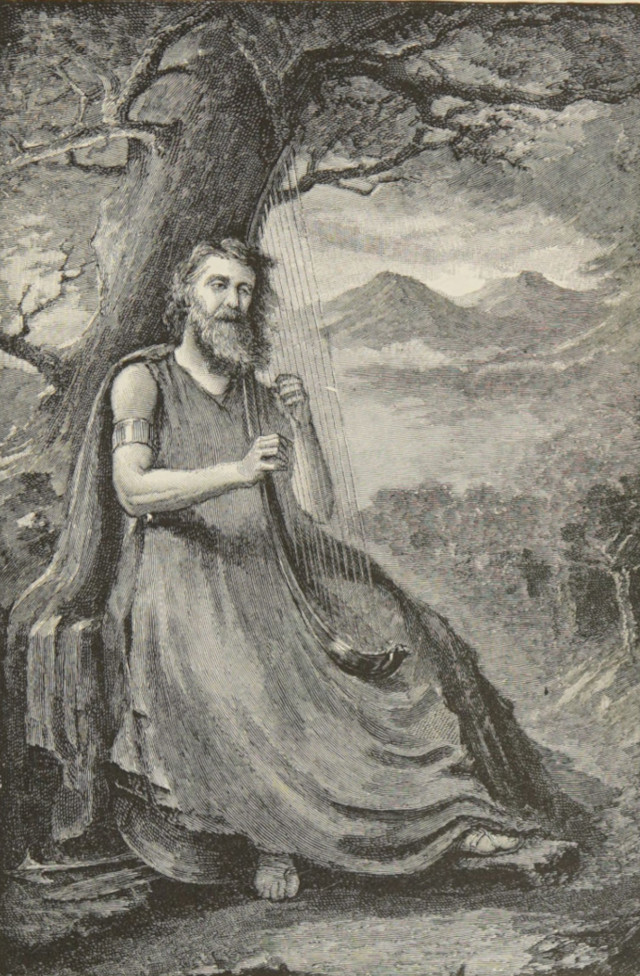
THE SWEET SINGER OF ISRAEL. “He shall be as the light of the morning, ... even a morning without clouds.”
The spot upon which the altar was erected, henceforth ever to be regarded as holy ground, was tendered to the king by Ornan as a gift. But the king declined thus to receive it. “I will verily buy it for the full price,” he said; “for I will not take that which is thine for the Lord, nor offer burnt-offerings without cost. So David gave to Ornan for the place six hundred shekels of gold by weight.” This spot, memorable as the place where Abraham had built the altar to offer up his son, and now hallowed by this great deliverance, was afterward chosen as the site of the temple erected by Solomon.
Still another shadow was to gather over the last years of David. He had reached the age of threescore and ten. The hardships and exposures of his early wanderings, his many wars, the cares and afflictions of his later years, had sapped the fountain of life. Though his mind retained its clearness and strength, feebleness and age, with their desire for seclusion, prevented a quick apprehension of what was passing in the kingdom, and again rebellion sprung up in the very shadow of the throne. Again the fruit of David’s parental indulgence was manifest. The one who now aspired to the throne was Adonijah, “a very goodly man” in person and bearing, but unprincipled and reckless. In his youth he had been subjected to but little restraint; for “his father had not displeased him at any time in saying, Why hast thou done so?”[1183] He now rebelled against the authority of God, who had appointed Solomon to the throne. Both by natural endowments and religious character, Solomon was better qualified than his elder brother to become ruler of Israel; yet although the choice of God had been clearly indicated, Adonijah did not fail to find sympathizers. Joab, though guilty of many crimes, had heretofore been loyal to the throne; but he now joined the conspiracy against Solomon, as did also Abiathar the priest.
The rebellion was ripe; the conspirators had assembled at a great feast just without the city to proclaim Adonijah king, when their plans were thwarted by the prompt action of a few faithful persons, chief among whom were Zadok the priest, Nathan the prophet, and Bathsheba the mother of Solomon. They represented the state of affairs to the king, reminding him of the divine direction that Solomon should succeed to the throne. David at once abdicated in favor of Solomon, who was immediately anointed and proclaimed king. The conspiracy was crushed. Its chief actors had incurred the penalty of death. Abiathar’s life was spared, out of respect to his office and his former fidelity to David; but he was degraded from the office of high priest, which passed to the line of Zadok. Joab and Adonijah were spared for the time, but after the death of David they suffered the penalty of their crime. The execution of the sentence upon the son of David completed the fourfold judgment that testified to God’s abhorrence of the father’s sin.
From the very opening of David’s reign, one of his most cherished plans had been that of erecting a temple to the Lord. Though he had not been permitted to execute this design, he had manifested no less zeal and earnestness in its behalf. He had provided an abundance of the most costly material,—gold, silver, onyx stones, and stones of divers colors; marble, and the most precious woods. And now these valuable treasures that he had collected must be committed to others; for other hands must build the house for the ark, the symbol of God’s presence.
Seeing that his end was near, the king summoned the princes of Israel, with representative men from all parts of the kingdom, to receive this legacy in trust. He desired to commit to them his dying charge, and secure their concurrence and support in the great work to be accomplished. Because of his physical weakness, it had not been expected that he would attend to this transfer in person; but the inspiration of God came upon him, and with more than his wonted fervor and power, he was able, for the last time, to address his people. He told them of his own desire to build the temple, and of the Lord’s command that the work should be committed to Solomon his son. The divine assurance was, “Solomon thy son, he shall build my house and my courts; for I have chosen him to be my son, and I will be his father. Moreover I will establish his kingdom forever, if he be constant to do my commandments and my judgments, as at this day.” “Now therefore,” David said, “in the sight of all Israel the congregation of the Lord, and in the audience of our God, keep and seek for all the commandments of the Lord your God; that ye may possess this good land, and leave it for an inheritance for your children after you forever.”[1184]
David had learned by his own experience how hard is the path of him who departs from God. He had felt the condemnation of the broken law, and had reaped the fruits of transgression; and his whole soul was moved with solicitude that the leaders of Israel should be true to God, and that Solomon should obey God’s law, shunning the sins that had weakened his father’s authority, imbittered his life, and dishonored God. David knew that it would require humility of heart, a constant trust in God, and unceasing watchfulness, to withstand the temptations that would surely beset Solomon in his exalted station; for such prominent characters are a special mark for the shafts of Satan. Turning to his son, already acknowledged as his successor on the throne, David said: “And thou, Solomon my son, know thou the God of thy father, and serve him with a perfect heart and with a willing mind; for the Lord searcheth all hearts, and understandeth all the imaginations of the thoughts: if thou seek him, he will be found of thee; but if thou forsake him, he will cast thee off forever. Take heed now; for the Lord hath chosen thee to build a house for the sanctuary: be strong, and do it.”
David gave Solomon minute directions for building the temple, with patterns of every part, and of all its instruments of service, as had been revealed to him by divine inspiration. Solomon was still young, and shrank from the weighty responsibilities that would devolve upon him in the erection of the temple and in the government of God’s people. David said to his son, “Be strong and of good courage, and do it; fear not, nor be dismayed; for the Lord God, even my God, will be with thee; he will not fail thee, nor forsake thee.”
Again David appealed to the congregation: “Solomon my son, whom alone God hath chosen, is yet young and tender, and the work is great; for the palace is not for man, but for the Lord God.” He said, “I have prepared with all my might for the house of my God,” and he went on to enumerate the materials he had gathered. More than this, he said, “I have set my affection to the house of my God, I have of mine own proper good, of gold and silver, which I have given to the house of my God, over and above all that I have prepared for the holy house, even three thousand talents of gold, of the gold of Ophir, and seven thousand talents of refined silver, to overlay the walls of the houses withal.” “Who then,” he asked of the assembled multitude that had brought their liberal gifts,—“who then is willing to consecrate his service this day unto the Lord?”
There was a ready response from the assembly. “The chief of the fathers and princes of the tribes of Israel, and the captains of thousands and of hundreds, with the rulers of the king’s work, offered willingly, and gave for the service of the house of God, of gold five thousand talents and ten thousand drams, and of silver ten thousand talents, and of brass eighteen thousand talents, and one hundred thousand talents of iron. And they with whom precious stones were found gave them to the treasure of the house of the Lord.... Then the people rejoiced, for that they offered willingly, because with perfect heart they offered willingly to the Lord; and David the king also rejoiced with great joy.
“Wherefore David blessed the Lord before all the congregation; and David said, Blessed be thou, Lord God of Israel our father, forever and ever. Thine, O Lord, is the greatness, and the power, and the glory, and the victory, and the majesty; for all that is in the heaven and in the earth is thine; thine is the kingdom, O Lord, and thou art exalted as head above all. Both riches and honor come of thee, and thou reignest over all; and in thine hand is power and might; and in thine hand it is to make great, and to give strength unto all. Now therefore, our God, we thank thee, and praise thy glorious name. But who am I, and what is my people, that we should be able to offer so willingly after this sort? for all things come of thee, and of thine own have we given thee. For we are strangers before thee, and sojourners, as were all our fathers; our days on the earth are as a shadow, and there is none abiding. O Lord our God, all this store that we have prepared to build thee an house for thine holy name cometh of thine hand, and is all thine own. I know also, my God, that thou triest the heart, and hast pleasure in uprightness.
“As for me, in the uprightness of mine heart I have willingly offered all these things; and now have I seen with joy thy people, which are present here, to offer willingly unto thee. O Lord God of Abraham, Isaac, and of Israel, our fathers, keep this forever in the imagination of the thoughts of the heart of thy people, and prepare their heart unto thee; and give unto Solomon my son a perfect heart, to keep thy commandments, thy testimonies, and thy statutes, and to do all these things, and to build the palace, for the which I have made provision. And David said to all the congregation, Now bless the Lord your God. And all the congregation blessed the Lord God of their fathers, and bowed down their heads, and worshiped the Lord.”
With deepest interest the king had gathered the rich material for building and beautifying the temple. He had composed the glorious anthems that in after-years should echo through its courts. Now his heart was made glad in God, as the chief of the fathers and the princes of Israel so nobly responded to his appeal, and offered themselves to the important work before them. And as they gave their service, they were disposed to do more. They swelled the offerings, giving of their own possessions into the treasury. David had felt deeply his own unworthiness in gathering the material for the house of God, and the expression of loyalty in the ready response of the nobles of his kingdom, as with willing hearts they dedicated their treasures to Jehovah, and devoted themselves to his service, filled him with joy. But it was God alone who had imparted this disposition to his people. He, not man, must be glorified. It was he who had provided the people with the riches of earth, and his Spirit had made them willing to bring their precious things for the temple. It was all of the Lord; if his love had not moved upon the hearts of the people, the king’s efforts would have been vain, and the temple would never have been erected.
All that man receives of God’s bounty still belongs to God. Whatever God has bestowed in the valuable and beautiful things of earth, is placed in the hands of men to test them,—to sound the depths of their love for him and their appreciation of his favors. Whether it be the treasures of wealth or of intellect, they are to be laid, a willing offering, at the feet of Jesus; the giver saying, meanwhile, with David, “All things come of thee, and of thine own have we given thee.”
When he felt that death was approaching, the burden of David’s heart was still for Solomon and for the kingdom of Israel, whose prosperity must so largely depend upon the fidelity of her king. “And he charged Solomon his son, saying, I go the way of all the earth; be thou strong therefore, and show thyself a man; and keep the charge of the Lord thy God, to walk in his ways, to keep his statutes, and his commandments, and his judgments, and his testimonies, ... that thou mayest prosper in all that thou doest, and whithersoever thou turnest thyself; that the Lord may continue his word which he spake concerning me, saying, If thy children take heed to their way, to walk before me in truth with all their heart and with all their soul, there shall not fail thee (said he) a man on the throne of Israel.”[1185]
David’s “last words,” as recorded, are a song,—a song of trust, of loftiest principle, and undying faith:—
“David the son of Jesse saith,
And the man who was raised on high saith,
The anointed of the God of Jacob,
And the sweet psalmist of Israel:
The Spirit of Jehovah spake by me:...
One that ruleth over men righteously,
That ruleth in the fear of God,
He shall be as the light of the morning, when the sun riseth,
A morning without clouds,
When the tender grass springeth out of the earth,
Through clear shining after rain.
Verily my house is not so with God,
Yet he hath made me an everlasting covenant,
Ordered in all things, and sure;
For it is all my salvation, and all my desire.”[1186]
Great had been David’s fall, but deep was his repentance, ardent was his love, and strong his faith. He had been forgiven much, and therefore he loved much.[1187]
The psalms of David pass through the whole range of experience, from the depths of conscious guilt and self-condemnation to the loftiest faith and the most exalted communing with God. His life record declares that sin can bring only shame and war, but that God’s love and mercy can reach to the deepest depths, that faith will lift up the repenting soul to share the adoption or the sons of God. Of all the assurances which his word contains, it is one of the strongest testimonies to the faithfulness, the justice, and the covenant mercy of God.
Man “fleeth as a shadow, and continueth not,” “but the word of our God shall stand forever.” “The mercy of Jehovah is from everlasting to everlasting upon them that fear him, and his righteousness unto children’s children; to such as keep his covenant, and to those that remember his commandments to do them.”[1188]
“Whatsoever God doeth, it shall be forever.”[1189]
Glorious are the promises made to David and his house, promises that look forward to the eternal ages, and find their complete fulfillment in Christ. The Lord declared:—
“I have sworn unto David my servant, ... with whom my hand shall be established: mine arm also shall strengthen him.... My faithfulness and my mercy shall be with him: and in my name shall his horn be exalted. I will set his hand also in the sea, and his right hand in the rivers. He shall cry unto me, Thou art my Father, my God, and the rock of my salvation. Also I will make him my firstborn, higher than the kings of the earth. My mercy will I keep for him forevermore, and my covenant shall stand fast with him.”[1190]
“His seed also will I make to endure forever,
And his throne as the days of heaven.”[1191]
“He shall judge the poor of the people,
He shall save the children of the needy,
And shall break in pieces the oppressor.
They shall fear thee while the sun endureth,
And so long as the moon, throughout all generations....
In his days shall the righteous flourish;
And abundance of peace, till the moon be no more.
He shall have dominion also from sea to sea,
And from the river unto the ends of the earth.”
“His name shall endure forever;
His name shall be continued as long as the sun:
And men shall be blessed in him;
All nations shall call him blessed.”[1192]
“For unto us a child is born, and unto us a Son is given; and the government shall be upon his shoulder; and his name shall be called Wonderful, Counselor, The Mighty God, The everlasting Father, The Prince of Peace.” “He shall be great, and shall be called the Son of the Highest: and the Lord God shall give unto him the throne of his father David: and he shall reign over the house of Jacob forever, and of his kingdom there shall be no end.”[1193]