Front matter
Reading edition
Transcriber's Note:
Obvious typographical errors have been corrected. Inconsistent spelling and hyphenation in the original document have been preserved.
The illustration on page 310, labeled "East Front of San Francesco" is titled "Church of Sta. Maria Maggiore" in the List of Illustrations.
The picture listed as "Umbrian Oxen" in the List of Illustrations does not appear in the book. (Several copies of this and surrounding editions were checked.)
The Story of Assisi
"Between Tupino, and the wave that falls From blest Ubaldo's chosen hill, there hangs Rich slope of mountain high, whence heat and cold Are wafted through Perugia's eastern gate: And Nocera with Gualdo, in its rear, Mourn for their heavy yoke. Upon that side, Where it doth break its steepness most, arose A sun upon the world, as duly this From Ganges doth: therefore let none who speak Of that place, say Ascesi; for its name Were lamely so deliver'd; but the East, To call things rightly, be it henceforth styled." Dante, Paradiso, xi. (Cary's translation).
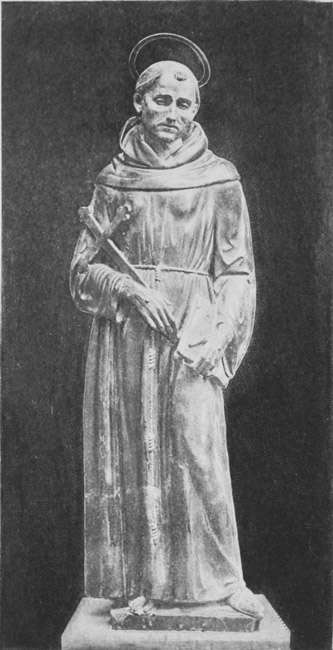
P. Lunghi. Photo.
Statue of St. Francis. by Andrea della Robbia in Sta. Maria degli Angeli.

The Story of Assisi
by Lina Duff Gordon
Illustrated by Nelly Erichsen and M. Helen James
London: J. M. Dent & Co. Aldine House, 29 and 30 Bedford Street Covent Garden W.C. * * 1901
First Edition, December 1900 Second Edition, October 1901
All rights reserved
To Margaret Vaughan this small book is affectionately dedicated in remembrance of days spent together in the Umbrian country
NOTE
My sincerest thanks are due to my aunt Mrs Ross, to Mrs Vaughan, Dr E. Percival Wright, M. Paul Sabatier, Mr Sidney Colvin, Sir William Markby and Mr Pearsall Smith, for the help rendered me in various ways during the writing of this book. I wish further to acknowledge the kindness of Mr Roger Fry who allowed me to quote from his lectures on Art delivered this year in London, before they were published in the New Monthly Review; and also the generous permission of Mr Anderson (Rome), and Signor Lunghi (Assisi), for allowing me to use their photographs. For the loan of old Italian books I am indebted to Cav. Bruschi, Librarian of the Marucelliana at Florence, to Professor Bellucci, Professor of the University of Perugia, and to Signor Rossi, proprietor of the Hotel Subasio at Assisi, whose intimate knowledge of his native town has been of great service to me.
L. D. G.
Poggio Gherardo, Florence, October 1900.
CONTENTS
CHAPTER I
PAGE
War and Strife 1
CHAPTER II
The Umbrian Prophet 39
CHAPTER III
The Carceri, Rivo-Torto and Life at the Portiuncula 81
CHAPTER IV
The building of the Basilica and Convent of San Francesco. The Story of Brother Elias 117
CHAPTER V
Cimabue and his School at San Francesco 149
CHAPTER VI
The Paintings of Giotto and his School in the Lower Church 168
CHAPTER VII
The Sienese Masters in the Lower Church. The Convent 198
CHAPTER VIII
Giotto's Legend of St. Francis in the Upper Church 228
CHAPTER IX
St. Clare at San Damiano. The Church of Santa Chiara 258
CHAPTER X
Other Buildings in the Town 289
CHAPTER XI
The Church of Santa Maria degli Angeli. The Feast of the Pardon of St. Francis or the "Perdono d'Assisi" 335
ILLUSTRATIONS
Statue of St. Francis by Andrea della Robbia in Sta. Maria degli Angeli (P. Lunghi—photo) Photogravure-Frontispiece
PAGE
The Temple of Minerva 3
The Eastern Slope of Assisi with the Castle, from the Porta Cappucini 10
The Guelph Lion of Assisi 22
The Arms of Assisi 37
Assisi in the time of St. Francis 38
Via di S. Maria delle Rose 58
The Arms of the Franciscans 80
Hermitage of the Carceri 82
The Carceri with a View of the Bridge 89
Side Door of the Portiuncula built by St. Benedict 99
The Portiuncula in the time of St. Francis, from the "Collis Paradisi" 107
Assisi from the Plain 113
Church and Convent of San Francesco 127
San Francesco from the Plain 147
The Lower Church 150
Looking through the doors of the Upper Church towards the Porta S. Giacomo and the Castle 157
Plan of the Lower Church and Monastery of San Francesco at Assisi (facing) 168
Choir and Transepts of the Lower Church 172
The Marriage of St. Francis with Poverty (D. Anderson—photo) 179
The Old Cemetery of San Francesco 194
The Knighthood of St. Martin by Simone Martini (D. Anderson—photo) 201
Bird's Eye View of the Basilica and Convent of San Francesco, from a drawing made in 1820 213
San Francesco from the Tescio 217
Staircase leading from the Upper to the Lower Piazza of San Francesco 220
San Francesco from the Ponte S. Vittorino 222
A Friar of the Minor Conventual Order of St. Francis 225
St. Francis Renounces the World (D. Anderson—photo) 233
Death of the Knight of Celano (D. Anderson—photo) 247
Arms of the Franciscans from the Intarsia of the Stalls 257
Door through which St. Clare left the Palazzo Scifi 262
San Damiano, showing the Window with the Ledge whence St. Claire routed the Saracens 268
Santa Chiara 282
Santa Chiara from near the Porta Mojano 287
Campanile of San Rufino 290
Door of San Rufino 295
The Dome and Apse of San Rufino from the Canon's Garden 298
Campanile of Sta. Maria Maggiore 309
Church of Sta. Maria Maggiore 310
Church of S. Pietro 313
Confraternity of San Francescuccio in Via Garibaldi 315
Monte Frumentorio in the Via Principe di Napoli 320
House of the Comacine Builders in the Via Principe di Napole 322
Looking across the Assisan roofs towards the East 325
View of San Francesco from beneath the Castle Walls 332
The Garden of the Roses at Sta. Maria degli Angeli 339
The Fonte Marcella by Galeazzo Alessi 346
An Assisan Garden in Via Garibaldi 347
Umbrian Oxen 349
Women from the Basilicata 351
San Francesco 356
Plan of Assisi 372
The Story of Assisi
CHAPTER I
War and Strife
"C'était le temps des guerres sans pitié et des inimitiés mortelles." H. Taine. Voyage en Italie. Perouse et Assise.
All who ascend the hill of the Seraphic City must feel its indescribable charm—intangible, mysterious, and quite distinct from the beauty of the Umbrian valley. "Why," we ask ourselves, "this stillness and sense of marvellous peace in every church and every street?" And, as though conscious of our thoughts, a young Assisan, with a gesture of infinite sadness towards the large, desolate palaces and broad deserted streets, said, as we lingered on our way: "Ah! Signore mie, our city is a city of the dead—of memories only." As he spoke a long procession of a grey-clothed confraternity, bearing on their breasts the franciscan badge, preceded by a priest who walked beneath a baldachino, streamed out of a small church. Slowly they passed down the road, and then the priest turned into a wayside cottage where lay a dying woman, while the others waited outside under the olive trees. But the sound of their chanting and the tinkling of the small bell came to us as we leaned over the city walls. Of a truth we felt the religious life of the town was not dead: perchance, down those streets, now so still, men had passed along to battle during the sad turmoil of the middle ages, had hated and loved as well as prayed, with all the fervour of their southern nature. We must turn to the early chroniclers to find in their fascinating pages that Assisi has had her passionate past and her hours of deepest trial.
Her origin goes back to the days when the Umbrians, one of the most ancient people of Italy, inhabited the country north and south of the Tiber, and lived a wild life in caves. But the past is very dim; some Umbrian inscriptions, a few flint arrow heads, and some hatchets made of jade found on the shore of lake Thrasymene are the only records we possess of these early settlers.
If written history of their ways and origin is lacking, the later chroniclers of Assisi endeavour to supply with their gossip, what is missing. Rambling and strange as their legends often seem to us, nevertheless they contain a germ of truth, an image, faint but partly true of a time so infinitely far away. Most of the local Umbrian historians have awarded the honour of the foundation of their own particular town to the earliest heroes whom they happen to know of, and these are invariably Noah and his family. It is, therefore, curious to note that the Assisan chroniclers have departed from this custom and have woven for themselves a legend so different from the usual friar's tale: "Various are the opinions," says one of them, "concerning the first building of our city; but the most probable, and the most universally accepted by serious writers, is the one which gives Dardanus as her founder. In the year 713 after the Deluge, and 865 years before the foundation of Rome, the first civil war in Italy broke out between the brothers Jasius and Dardanus, both sons of Electra; but the father of Jasius was Jupiter, while Dardanus was the son of Corythus, King of Cortona." The people of Umbria took sides, as some would have it that Jasius ought to be king in the place of the dead prince Corythus. Now it happened that Dardanus had pitched his tent on the slope of Mount Subasio, when a dream came to him that Jupiter and Minerva were preparing to assail the enemy, and that Jasius would be vanquished. On waking he determined, should his dream be true, to raise a temple to the goddess on the spot where he had slept. He went forth to battle, and with the help of the goddess drove the enemy back with great slaughter; Jasius was killed and they buried him on the field of battle. "Full well did Dardanus keep his vow, for in a few months there arose a wonderful building, now known as the sacred temple, dedicated to the true Minerva of Heaven, under the name of Santa Maria Sopra Minerva. Thus it is that the country round Assisi has been called Palladios agros, the fields of Pallas."[1]
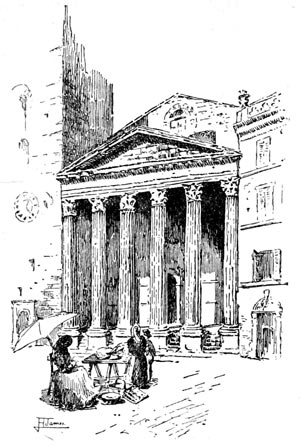
THE TEMPLE OF MINERVA
And thus the monk dreams on about the Seraphic Province of Umbria; and we dream with him of the Umbrians who forsook the chase and their shepherd huts on the heights about Subasio, to gather round the marvellous temple built by the hero ere he went forth to found the city of Troy. People came from afar to look at the six-fluted columns, and while marvelling at a thing so fair, they resolved to build their homes within sight and under the shadow of the sacred walls. Here was the nucleus of a future town. The simple shelters of cane and brushwood were soon replaced by huts of a neater pattern made of wattle and clay, with earthen floors, rounded porches and pent roofs. The dwellers by the temple throve and prospered, and all was peace for a while, until the van-guard of that mysterious people, the Etruscans, appeared on the Umbrian horizon. We are told how Dardanus, while visiting the King of Lydia on his way to Troy, drew such a highly-coloured picture of the loveliness of Tuscany, the fruitful qualities of the soil, and the lightness of the air, that Tyrrhenus, the king's son, was immediately sent with a large army to take possession of so rich a province. Then came a struggle, and the Umbrian tribes were driven back south of the Tiber, which henceforth strictly defined the boundary between Umbria and Etruria.
Immediately to the west of Assisi, and on the longest spur of hills which juts out into the valley of the Tiber, stood the now Etruscan city of Perugia, to which a band of Etruscans had lately immigrated. The huge, grim walls which grew up round it after the advent of the new settlers, the narrow pointed gateways, some guarded by heads of stern and unknown deities, the general menacing and ferocious aspect of its buildings, soon warned the smaller Umbrian cities of what they might in coming ages expect from her inhabitants. It is probable that skirmishes were frequent between the neighbouring towns of Assisi and Perugia, and to judge from the subterranean passages which still exist beneath the streets of the former place, we may gather that she was open to constant attacks, and that her inhabitants found it more prudent to disappear underground at the approach of enemies than to meet them in open battle. These subterranean galleries, cut in the soft tufa, extend for miles under the present city: branching out in all directions they form a veritable labyrinth of secret passages. Here swiftly and silently as the foe advanced, men and women with their children would disappear into the bowels of the earth, some being occasionally buried beneath masses of soil shaken down by the tramp of many feet above them. Repeated dangers of this sort at last decided the Assisans to meet their enemies in more war-like fashion, and to surround themselves—as Perugia had done—with stones and mortar. Soon the town bristled with towers and turreted gateways, and the houses, no longer built of wattle and mud, began to foreshadow the strongly fortified palaces of a later date. None too soon did Assisi prepare for war. In the year 309 b.c. the shrill sound of the Roman clarion echoed through the Cimminian forest. It roused Etruria to arms, proclaiming the fact that the Romans had dared to penetrate beyond this dangerous barrier which hitherto had been deemed impassable. The Etruscans and Umbrians, forgetting all their former strifes, now joined against the new power which threatened to crush their liberties. The battles which followed beneath the walls of Perugia, and by Bevagna in the plain of the Clitumnus, brought all Umbria, in the space of a single year, under the yoke of Rome.
And now, although we leave the fields of legend and enter those of history, we find but little mention of Assisi: this is, however, easily accounted for. Built upon the unfrequented slopes of Mount Subasio, like a flower gradually opening to the sun's rays, she was far more secure than her neighbour Perugia who, commanding and commanded by the road from Rome to Ravenna, along which an army passed, stood in haughty and uncompromising pre-eminence. The comparatively obscure position of Assisi therefore gave her long periods of peace, and these she employed in building innumerable temples, a theatre, and a circus. It is impossible to excavate in any part of Assisi without coming upon relics of that time. Statues and busts of the Cæsars, of gods and of consuls, are lying in dark corners of the communal palace, and broken fragments of delicately-wrought friezes and heads of goddesses, half buried in bushes of oleander, adorn the Assisan gardens. Beneath the foundations of the more modern houses, mosaic floors and frescoed walls have been found, showing that Assisi had her years of early splendour. But full of life and action as this Roman period was, it is as completely hidden from us as are the temples now buried beneath the present town. It passed rapidly away, and yet is of some importance in the history of the world as having witnessed the birth of Sex. Aurelius Propertius, great among the poets even at a time when Virgil, Horace, and a host of others were filling Italy with their song.
Many an Umbrian town prides itself on being the birthplace of Propertius. The people of Spello have even placed a tablet in their walls to claim him as her son; but the Assisans, ignoring the rivalry of others, very quietly point to the many inscriptions of the Propertius' family collected beneath the portico of the Temple of Minerva. One may be noticed referring to C. Passennus Sergius Paullus Propertius Blaesus, said to be a lineal descendant of the poet, who is supposed to have married after the death of the fair Cynthia, and returned to his native valley to pass his last days in domestic tranquillity. Angelo Poliziano, on the margin of an early edition of the poet's works now in the Laurentian Library of Florence, has made a note to the effect that Propertius, as well as St. Francis, was born at Assisi; and certainly modern writers assign the honour to Assisi.
The somewhat vague utterances of Propertius as to his native town seem to show that the position of Assisi, with regard to Perugia and the plain, more nearly coincides with his description than that of any other city in the valley or on the hills. To one inquisitive friend he answers: "Tullus, thou art ever entreating me in the name of our friendship to tell thee my country and my descent. If thou knowest Perusia, which gave a field of death and a sepulchre to our father and in Italy's hour of affliction, when domestic discord drove Rome's own citizens one against the other—(Ah! hills of Etruria, to me beyond measure have ye given sorrow, for ye suffered the limbs of my kinsman to be cast aside unburied, and denied the handful of dust to cover his bones)—there it was that, close above the margin of her plain spread below, Umbria, rich in fertile domains, gave me birth."[2] The kinsman spoken of here is a certain Gallus, who lost his life in b.c. 41, when Lucius Antonius was besieged in Perugia by Augustus. The horrors of the general massacre which followed the fall of the city left sad memories in the mind of Propertius, then a mere child. In the general confiscation of property after the battle of Philippi his family lost their estates. But poor as they were, Propertius was sent to Rome to study, where, recognised as the leader of a new school of poetry, he remained until shortly before his death, at the age of thirty-five. His paternal estates having been restored to him, he forsook the splendour of the Augustan court, the patronage of Maecenas, the friendship of Virgil, and returned to the Umbrian country where his first inspirations had been awakened. The contrast between a house and garden on the Palatine hill, in the midst of the stir of Roman life, and a farm by the silent stream flowing through the stillest of valleys, must have been great. But, judging from his description of the country, he seems to have fallen readily into rural ways, and loved to watch the herds of white oxen, dedicated to the service of the goddesses, grazing close to the banks of the Clitumnus. We may infer that he hunted the "timorous hare and birds" in the thick oak forest of the Spoletan valley, but, as he playfully tells us, he left "the hazardous boar alone," for physical courage was not one of his characteristics.
From the plain his eyes were often raised in the direction of Assisi, and to his familiarity with her towers we owe this exquisite description of his birthplace, which, perhaps out of modesty, as he alludes to his own fame, he places in the mouth of a soothsayer: "Ancient Umbria gave thee birth from a noted household. Do I mistake, or do I touch rightly the region of your home, where misty Mevania stands among the dews of the hill-girt plain, and the waters of the Umbrian lake grow warm the summer through, and where on the summit of mounting Asis rise the walls to which your genius has added glory."[3]
Nothing happens, or at least nothing is mentioned in Assisan chronicles until Christianity stealthily worked its way up from Rome about the third century. Then bloodshed followed during a period of darkness when Christians and pagans divided the town into factions by their bitter fights for religion. At first the Christians suffered, and many were martyred in the Umbrian rivers, but only to triumph later when Roman Assisi soon vanished and Christian basilicas were built on the site of pagan temples. Although, after the Roman period, we find Assisi more nearly linked with the general history of Italy, she appears uninfluenced by outside events, and her atmosphere of remoteness remains unimpaired. Thus we may say that Huns, Franks, and Lombards merely passed by and left no lasting mark upon the city. For a moment she was suddenly aroused by the tempestuous arrival of one or other of their leaders, but once the danger was past she returned to her calm sleep upon the mountain side.
In 545 Totila, on his march to Rome, arrived before the walls of Assisi which were gallantly defended for the Emperor Justinian by Siegfried the Goth, but unfortunately he being killed in a skirmish with the Huns, the disheartened citizens reluctantly opened their gates to the enemy. For the first time in her annals (the Roman occupation had been peaceful enough) a foreigner—a tyrant set foot in her streets as master. But the restless Totila soon began to scan the country round for other cities to attack. Becoming aware of the large and wealthy city of Perugia perched upon the western hill, he sallied forth to capture a bigger prey, and Assisi enjoyed a further spell of peace.
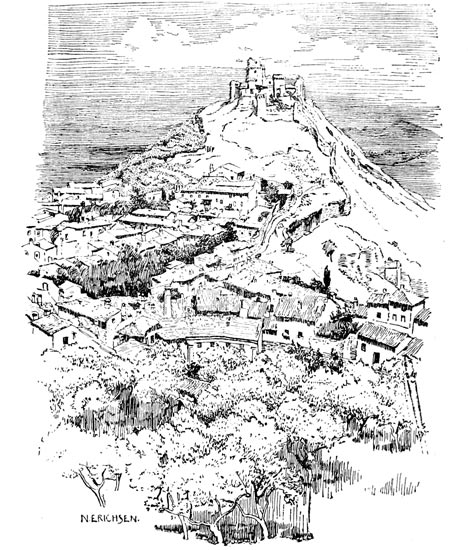
THE EASTERN SLOPE OF ASSISI WITH THE CASTLE, FROM THE PORTA CAPPUCCINI
In reading the long-winded chronicles it is often difficult to gather to which power the various small towns at this time belonged. One point is, however, clear, that during endless contentions between the Popes and the Greek, and later the German Emperors, the Umbrian cities were often left to manage their own affairs, and because of the periods of rest which they thus enjoyed and used in their individual ways, we are inclined to speak of them as republics. For a long time Assisi remained annexed to the Duchy of Spoleto, then under the rule of the Lombard Dukes whose advent had filled the different cities in the valley with Arian Christians, unfriendly to the Papacy. Assisi, together with other towns swerved from her allegiance to the Pope, and it is perhaps on this account that Charlemagne in 773 with his "terrible and fierce followers" came to besiege her. They laid the country waste, and made many attacks upon Assisi which met with stout resistance; but while prowling round the walls one night they found the main drain, and stealing through it they were able to discover the weakest part of the town. Next night they returned well armed, slew the guards who were keeping watch by the midnight fires, and before the citizens could rush to arms, the gates were opened to Charlemagne. The army passed in, her citizens were put to the sword, and the town razed to the ground.
"Thus," says a chronicler, "Assisi bereft of her inhabitants, found herself an unhappy widow. Then was the most clement emperor grieved, and ordering that the city should be rebuilt, he placed therein a new colony of Christians of the Roman faith, and the city was restored, and in it the Divine Worship."[4]
A small arched doorway ornamented with a delicate frieze of foliage still remains as a record of the rebuilding of the city by Charlemagne's Lombard workmen. The stone is blackened, the tracery worn away. Few find this dark corner in the Piazza delle Rose, and the people wonder at those who stop to look, for "it is ugly and very old," they say.
It was probably at this time, towards the end of the eighth century, that the Rocca d'Assisi was built. This made her a more important factor in Umbrian politics; and leaders of armies, who hitherto had paid her but a hurried visit, now vied with each other to possess a city with so fair a crown. The citizens had chosen for the site of the castle the part where the hill rises in a sudden peak above the town, looking to the north across a deep ravine towards the mountains of Gualdo and Nocera. Above the main building and the four crenelated towers soared the castle keep; from the ramparts started two lines of walls which, going east and west, gathered the town as it were within a nest. At intervals rose forts connected by a covered passage, and tall towers guarded the walls where they joined the city gates. The Rocca d'Assisi with this chain of walls bristling with iron spikes and towers, complete in strength and perfect in architecture, looked down upon the town like some guarding deity, and was the pride of every citizen. It was no gloomy stronghold such as the French kings erected in the woods of Tourraine, but built of the yellow Subasian stone it seemed more like a mighty palace with windows large and square, whence many a condottiere and many a noble prisoner leant out to look upon the splendid sweep of country from Perugia to Spoleto.
Proud as the citizens were of their new-born importance they soon regretted the calmer days of their obscurity. By the twelfth century they were torn between the Pope, the Emperor, and their own turbulent factions, for even in the smaller towns the cries of Guelph and Ghibelline were beginning to be heard. Whenever German potentates—"the abhorred Germans" as the chroniclers call them—had their hands well clenched upon an Umbrian town, the citizens turned imploring eyes towards Rome. The promise of municipal liberty was the bait which every pontiff knew well how to use for his own profit. The German, on the other hand, troubled not to use diplomacy as a means to gain his ends, but brought an army to storm the town, and took up his residence in the castle, whence he could hear the murmurings of the citizens below planning to drive him out of their gates. The first distinguished but unwelcome guest in the Rocca d'Assisi was Frederick Barbarossa. He was, however, too much occupied in his career of conquest to waste more than a few weeks in Umbria, and in 1195 we find Conrad of Suabia, who in the annals of the time is known by the nickname of "the whimsical one," in charge of the castle, with the title of Count of Assisi. Conrad was also Duke of Spoleto, but he preferred the fortress of Assisi as a residence and spent some two years there to the annoyance of the citizens, who were constrained to be more or less on their good behaviour. With him in those days was a small but important person, who, at the age of two, had been elected King of Germany and Italy. This was Frederick II, and the legend recounts how he was born in the Piazza Minerva beneath a tent hastily erected for the occasion, and in his third year was baptised in the Cathedral of San Rufino, amidst a throng of cardinals, bishops, Assisan priors and nobles. It would, indeed, be strange that he, who later was to prove a thorn in the side of many a Pope, should have been born and nurtured in the Seraphic City.
The Assisans soon wearied of the German yoke, but unaided they could not throw it off and it needed the timely intervention of Innocent III, to rid them of Conrad's presence. The Pope, who had been quietly waiting an opportunity to regain his lost Umbrian towns, felt himself powerful enough now that the Emperor Henry VI, was dead, to send haughty commands to Conrad. He was bidden to meet Innocent at Narni where he solemnly made over his possessions to the Church. Thus left to themselves, the Assisans, with cries of "Liberty and the Pope," rushed on the castle to tear it down. Built to be their safeguard, it proved their greatest danger, and they determined that no other tyrant should find shelter within its walls. While the Assisans were rejoicing in their freedom, and endeavouring to guard against the constant attacks of the Perugians, the big world outside was being torn and rent by a medley of events which was carrying men's thoughts forward in the swift current of a fresh era. Everywhere a new spirit was spreading—"the fraternising spirit" it has been called. In the cities men were joining together in guilds, heralding the commonwealths; while, in the country, bands of people, under the names of Patarins, Albergenses, Poor Men of Lyons, etc., raised the standard of revolt yet higher against their feudal and spiritual lords. A contemporary writer speaks of thirty-two heresies as being rampant in Italy at this time. Men were eager and full of energy, finding relief through many channels that set all Italy in a ferment. But amidst the confusion of wars and heresies the Papal power grew ever stronger, until, with the accession of Innocent III, the claims of a temporal ruler were blended with spiritual rights. The Marches of Ancona, Umbria, and the seven hills of Rome belonged alike to him, while he was powerful enough to excommunicate cities, kingdoms, and emperors at his pleasure, and rule all with a rod of iron. The magnificent designs planned by Hildebrand seemed to triumph under Innocent, and yet the papal horizon was not without its clouds.
"Ah Constantine! of how much ill was cause, Not thy conversion, but those rich domains That the first wealthy Pope received of thee,"[5]
groans Dante, in writing of the condition of the Church, and his cry reaches back to the time of which we write. Jacques de Vitry, who was often at the court of Innocent, also speaks with bitterness of the depravity of the priests. They were, he tells us, "deceiving as foxes, proud as bulls, avaricious and insatiable as the minotaur."
Innocent III, though scheming and ambitious, was a man of lofty character, and no one watched with so much anguish the rising storms which threatened to shake the mighty fabric of the Papacy. In a moment of discouragement he is said to have exclaimed that fire and sword were needed to heal the wounds made by the simoniacal priests, and for a long time he in vain sought a remedy for those ills. But salvation was at hand, and it came from the Umbrian mountains, as the fresh breeze comes which suddenly breaks upon the budding trees in springtime.
Within the narrow circuit of the Assisan walls arose a figure of magical power who drew men to him by the charm of his mysticism and the spell of his ardent nature. It is the sweet-souled saint of mediæval Italy—St. Francis of Assisi—who now illuminates this quiet corner of the world.
Francis Bernardone was born in the year 1182, when, as we have seen, the Church was harrowed by a hundred ills. He passed a gay youth, free from every care, and tested all the pleasures that riches could procure. Though the son of a merchant he consorted with the noblest of the Assisan youths, who, partly on account of his father's wealth, partly because of his gaiety and love of splendour, were glad to accept him as an equal. All looked to the high-spirited, gifted Francis as the leader at every feast, the organiser of every entertainment, and when Perugia blew her war-trumpet he rode out to battle side by side with the Assisan cavaliers. Such, in a few words, was his position in Assisi when in his twenty-second year, after a severe illness which brought him to the brink of the grave, he resolved to follow to the letter the precept of the Gospel and lead the life of the first apostles. So complete was his conversion that he, the rich merchant's son, was to be seen walking through the streets with bricks on his back for the repair of the ruined churches of Assisi, while his former companions drew back and laughed as he passed them. But their derision was of short duration, for the charm they had felt in former days had by no means passed away. Holiness could never make him sad, and in the human tenderness and joyousness of his nature lay the secret of that power which was strong enough, the Assisans soon discovered, to lead them where he would—though it was now by a new road he travelled.
The great movement, which began at Assisi and spread throughout Europe in a very few years, can only be likened to that witnessed by the lake of Galilee. Rich citizens gave all to the poor; the peasants left the vintage and sold their oxen, to join the ever-swelling crowd of bare-footed disciples who wandered through cities and into distant lands bringing comfort and words of peace to all they met. Like a ray of brilliant sunshine St. Francis dispersed the gloom of the middle ages, teaching men that the qualities of mercy and love were to be looked for from God instead of the inflexible justice that had overshadowed a religion intended to be all light. He walked the earth with joyous steps, inviting all to come with him and see how beautiful was the world; he looked upwards, praising God in bursts of eloquent song for the rain that fed the flowers, the birds that sang to him in the woods, and the blueness of his Umbrian sky. How different from the stern, orthodox saints who passed through the loveliest valleys with downcast eyes for fear of some hidden temptation or of some interruption to their prayers! With such a founder it is hardly surprising that the order of St. Francis spread and multiplied, becoming a great world force, as great and perhaps greater than that of St. Dominic. We get an interesting picture of the change he wrought throughout Italy and of the enthusiasm he kindled among his followers in a letter of Jacques de Vitry; from this we quote at length, for, being written by a contemporary of the saint, its value is very great.
"While I was at the pontifical court I saw many things which grieved me to the heart. Everyone is so preoccupied with secular and temporal things, with matters concerning kings and kingdoms, litigations and lawsuits, that it is almost impossible to talk on religious matters.
"Yet I found one subject for consolation in those lands: in that many persons of either sex, rich, and living in the great world, leave all for the love of Christ and renounce the world. They are called the Friars Minor, and are held in great respect by the Pope and the Cardinals. They, on their part, care nought for things temporal, and strive hard every day to tear perishing souls from the vanities of this world and to entice them into their ranks. Thanks be to God, their labour has already borne fruit, and they have gained many souls: inasmuch as he who listens to them brings others, and thus one audience creates another.
"They live according to the rule of the primitive church, of which it is written: 'The multitude of believers were as one heart and one soul.' In the day they go into the cities and the villages to gain over souls and to work; in the night they betake themselves to hermitages and solitary places and give themselves up to contemplation.
"The women live together near to cities in divers convents; they accept nought, but live by the labour of their hands. They are much disturbed to find themselves held in greater esteem, both by the clergy and the laity, than they themselves desire.
"The men of this order meet once a year in some pre-arranged place, to their great profit, and rejoice together in the Lord and eat in company; and then, with the help of good and honest men, they adopt and promulgate holy institutions, approved by the Pope. After this they disperse, going about in Lombardy, Tuscany, and even in Apulia and Sicily, for the rest of the year.... I think it is to put the prelates to shame, who are like dogs unable to bark, that the Lord wills to save many souls before the end of the world, by means of these poor simple friars."[6]
Certainly one of the most remarkable events in mediæval history was the result of the teaching of St. Francis upon his own and future generations. In his native city the strength of his personal influence and the love and veneration which he excited was extraordinary. But we notice even a stranger fact; with his death this holy influence apparently vanished, and it is possible that the memory of the saint is dearer to the hearts of the Assisans in what we are inclined to call the prosaic tedium of our trafficking nineteenth century, than it was in the years immediately following his death. Later centuries have shown us that his teaching and his presence there were not in vain. Assisi, down to our own times, has continued to be the Mecca of thousands of pilgrims. Her churches bear the record of infinite early piety, for when art was in its early prime the most famous masters from Tuscany were called upon to decorate the Franciscan Basilica and leave their choicest treasures there as tributes to the immortal glory of the saint. But the note of war rings louder than the song of praise and love for many years to come in all the Assisan chronicles, and grass and weeds grow up to choke, though not to kill, the blessed seed that Francis sowed and did not live to tend. No sooner did the gates of death close upon that sweet and genial spirit, than war, lust, strife and pestilence burst upon the very people he had so tenderly loved. The story of Assisi becomes, as it had never been before, a list of murders—of struggles to the death for individual power, and of wars which made the fair Umbrian country a desolate and cruel waste for months and even years.
Each town looked with hatred upon its powerful rival, and the communal armies were for ever meeting in the plain by the Tiber to match their strength and see if some small portion at least of a city's domains could not be wrested from her. The bitterest and most pronounced enemies in the valley were undoubtedly Assisi and Perugia. Their feuds date back to the twelfth century; but even before the Christian era these two cities of the hills had marked each other as a foe for the one was Umbrian, the other Etruscan, and they merely continued the rivalry of their founders. It is often difficult to discover the cause of each separate war, but it may, as a general rule, be traced to Perugia's inborn love of fighting, and to her restless spirit which led her to storm each town in turn. From her eyrie she looked straight down upon half the Umbrian country, and gazing daily on so fair a land the desire for possession grew ever stronger. Many towns were forced to submit to her sway, and by the thirteenth century she was the acknowledged mistress of Umbria. It is, therefore, with surprise and admiration that we watch the undaunted struggle of Assisi against a tyrant whom she hated with a hatred quite Dantesque in its bitterness and strength. Many menacing towers were built on either side of the valley, and heralds were continually sent between the two towns with insulting messages to goad the citizens forward into battle. When Perugia was known to be preparing for an attack upon Assisi, the castles and villages around hastened to break their allegiance to the weaker city and ally themselves with the Perugian griffin. Assisi was thus often obliged to defend herself unaided against the Umbrian tyrant. When, in 1321 Perugia declared war against "this most wicked city of Assisi" whose crime consisted in having fallen under the rule of the Ghibelline party of her citizens,[7] both communes were in need of money as their bellicose habits had proved expensive. Busily, therefore, they set to work about procuring it, and in a highly characteristic manner Perugia sold her right of fishing in Thrasymene for five years, while the citizens of the Seraphic City entered by force into the sacristy of San Francesco and carried off a quantity of sacred spoils. Gold ornaments, censers, chalices, crucifixes of rare workmanship and precious stuffs, were divided into lots and sold, partly to Arezzo for 14,000 golden florins, and partly to Florence for a larger sum. Now these things did not even belong to the Franciscans, but had been carefully stored in the sacristy by the Pope and his cardinals during their last visit to the town. Great, therefore, was the wrath at the Papal Court when news came of the sacrilegious robbery, and without a moment's delay a bull of excommunication was fulminated from Avignon. For thirty-eight years Assisi lay under the heavy sentence of an interdict, and, except for the feast of the "Pardon of St. Francis," the church doors were closed and the church bells were silent. But not a whit did the people care for the anger of a distant Pope, and it is related that when the two friars brought the bull of excommunication to Ser Muzio di Francesco, the leader of the robbers, they were flogged within an inch of their lives, and further, they were made to swallow the seals of lead which hung from the Papal document.
The Assisans, having obtained the necessary funds, set to work to defend themselves against the enemy who were to be seen rolling their heavy catapults along the dusty roads. A proud historian says, "they saw without flinching 500 horsemen galloping round their walls," and with a heroism worthy of so good a cause, determined to be buried in the ruins of their city sooner than cede one step to their abhorred enemies the Perugians. They closed the shops, barred the houses and threw the chains across the streets to stop advancing cavalry; every artisan turned soldier, every noble watched from the tower of his palace. Not only were they guarding their own liberties, but they feared for the safety of the body of St. Francis, which the Perugians, ever prowling day and night about the walls, were anxious to carry off. The siege, it is said, lasted a year, when the Assisans were forced to give way and open their gates to the enemy, who sacked the town, "killing more than one hundred of the most wicked citizens, to wit, all those who fought against the city of Perugia." Then came a perilous moment, for many, not content with a barbarous pillage, wished to destroy Assisi altogether. Fortunately a wily Perugian, Massiolo di Buonante, stood up in her defence, arguing that "Assisi being now in their power, it were better to possess her fortified, and well provided against any new attack of the Ghibelline party."[8] His words had due effect, but still the town suffered horribly, and her walls only lately built were in greater part razed to the ground. The chains that guarded the streets together with the bars and keys of the gates were taken back to Perugia, where, until a century ago, they hung "as glorious trophies" from the claws of the bronze griffon outside the Palazzo Pubblico. Before leaving, the Perugians gave their orders to the now submissive city. The Guelphs were to live within the ancient circle of walls in the upper and more fortified part of the town, while the Ghibellines were left in the undefended suburbs.
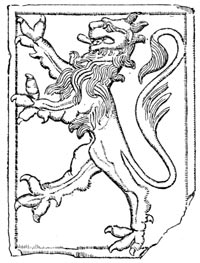
THE GUELPH LION OF ASSISI
They further commanded that each year, on the feast of St. Ercolano, the Assisans should bring them a banner "worth at least 25 golden florins, in signum subjectionis." This was the greatest ignominy of all, and rankled even more deeply in the hearts of the citizens of Assisi than the fact of their being governed by Perugian officials. The delivery of the yearly tribute was performed in a manner highly characteristic of the times and of the love of petty tyranny and display peculiar to the mediæval towns. An Assisan horseman mounted on a splendidly caparisoned charger brought the hated emblem to lay before the Priors of Perugia, who robed in crimson, with heavy golden chains about their necks, waited at the foot of the campanile of San Lorenzo. Close to them stood four mace bearers and trumpeters with white griffins painted on the red satin streamers which hung from the silver trumpets. Nothing was neglected that would impress her subjects with the dignity of her hill-set city. All the Perugians were assembled, and in their name the Priors promised to defend Assisi against her enemies and to preserve her from the yoke of tyrants. Having uttered this solemn mockery, they gave the Podestà of Assisi a sealed book wherein were written the laws to be observed in return for the inestimable favours granted; the book was not to be opened until he and his retinue had returned to their own city. The spirit of the Assisans was by no means crushed by their misfortunes, and shortly after the events we have just narrated they issued an edict with a pomp worthy of Perugia herself which fairly puzzled the Priors of that city. All Perugians holding land in Assisi were herein ordered to pay the taxes usually demanded of "strangers" possessing property in the territory; further, the Assisans proclaimed their firm determination no longer to observe any orders given to them by the Commune of Perugia. This audacity was, however, soon checked. Perugia issued an order to the effect that these statutes, and these alone, which were decreed by herself were to be valid in Assisi, all others were worthless. Assisi therefore remained subject to Perugia till 1367, when Cardinal Albornoz who was engaged in recovering the allegiance of the Papal States, entered her gates. He was received with wild enthusiasm by the citizens, for they hailed him as their deliverer from the hated yoke of the Perugians. The Assisans had every reason to rejoice in this change of masters, as the Cardinal allowed them to govern their town like a free republic; he rebuilt the walls destroyed during the last siege, and the castle which had also suffered much from the Perugian soldiery. The people were delighted, and their artists were soon busily employed in painting the gilded arms of the church on gateways and on palaces.
During his brief sojourn in Assisi the war-like Cardinal had found such peace as he had probably not often known before, and such was his love for the church of San Francesco that he added to it several chapels and chose a place for his tomb within its walls. He died at Viterbo; and only five months after the Assisans had welcomed him with such rejoicing, they went with torches and candles, to bear his dead body back to San Francesco, the Priors, says a chronicler, spending 145 florins upon the crimson gowns they bought for this occasion.
Days of peace and liberty were short, and the Assisans were soon groaning beneath the enormous taxes laid upon them by the zealous ministers of the Pope. In 1376 their indignation rose to such a pitch that they broke into open rebellion, and joined in the war-cry against the Church, which was to be heard in other towns of Tuscany and Umbria. The citizens besieged the Legates in their palaces and ordered them with haughty words to depart; so seeing it was safer to obey, they returned to Rome without a word. "Because of their love for the holy Pontiff, whose servants they were, the Assisans used no violence towards them," but having got their way with polite bows accompanied them safely beyond the city gates. But at this time, when all was war and conspiracy, there seemed no chance of a free life again for the people. No sooner had one tyrant been disposed of than another rose to take his place. When news of these events reached the Perugians they thought it a good opportunity to try and again get possession of the town, accordingly envoys were sent "just to put things in order" as they expressed it; but the Assisans shut the gates of the city in their faces and informed them that in future they intended to manage their own affairs. We cannot say that their endeavours were crowned with success, the nobles fought among themselves, while the mob was ever ready for any kind of novelty. It is related how in the year 1398 the Assisans changed their mind three times in one day as to who should be their lord. "Evviva the Church" was the first cry; the second, "Evviva the people of Perugia"; and lastly, "Evviva Messer Imbroglia," a roving adventurer who alternately fought for the Duke of Milan and the Pope, and finally entered Assisi at the head of a large cavalcade as Captain and Gonfalonier of the city.
In the early centuries Assisi had bravely fought for her independence and held her own fairly well; but in the fourteenth century a sudden whirlwind swept across the country threatening to destroy the last remnant of her freedom. At this time the condottieri were busy carving out principalities for themselves, and one after another they marched through the land forcing the towns to bear their yoke. Assisi, not without a sharp struggle, fell a prey to Biordo Michelotti and Braccio Fortebraccio, successive despots of Perugia; and the citizens found themselves for the next twenty years in turn the vassals of Guidantonio of Montefeltro, of Sforza, and of the Pope. In 1442 Perugia was governed, in the name of the Pope, by Niccolò Piccinino, successor to Fortebraccio as the leader of the Bracceschi troops, and consequently a successor to the rivalry with Francesco Sforza, Duke of Milan. Assisi, therefore, who had spontaneously given herself to Sforza, preferring the tyranny of strangers to the yoke of Perugia, was not likely to be favourably looked on by Piccinino, and sooner or later he determined to besiege her. But just at this time Perugia had made peace with all the world, and, delighted with this novel state of things, she rang the great bell of the Commune, lit beacon fires on the hills, and sent a special messenger to Assisi to proclaim the fact. The Assisans, with more courage than discretion, cursed the messenger and those who sent him, saying they had half a mind to kill him. "Return with this message," they cried, "say unto those who sent thee, that they try to wipe us from the face of the earth and then send words of peace. But we will have war and only war." This insulting message was duly delivered to the astonished priors, and that night the beacon fires were extinguished. When news reached Assisi of the vast preparations in Perugia for war, these hasty words were regretted. Luckily Francesco Sforza sent the Assisans a good supply of troops, and every day they hoped for the arrival of his brother Alessandro.
The month that followed was disastrous to Assisi, and the account of the war given us by the Perugian chronicler Graziani who took part in the siege, brings before us vividly the many stages she had to pass through before arriving at the calm, seraphic days of later years.
By the end of October 1442, Niccolò Piccinino, alluded to always as el Capitano, arrived in the plain below Assisi with some 20,000 men, and took up his quarters in the Franciscan monastery of San Damiano. His first intention was to take the town by assault, but on surveying the fortifications and walls and the impregnable castle, he deemed it wiser to wait quietly until hunger should have damped the valour of the citizens. Help, however, came to him from another quarter. It is believed that a Franciscan friar, perhaps one of those with whom he lodged at San Damiano, betrayed to him a way into the town by means of an unused drain.
"On Wednesday, being the 28th day of November, the Captain's people entered Assisi by an underground drain, which, beginning below the smaller fortress towards the Carceri, enters Assisi near the market-place below the castle. There Pazaglia, Riccio da Castello, and Nicolo Brunoro, with more than 300 men-at-arms, had seen to clearing the said sewer and cutting through some iron bars at the exit placed by the Assisans so that none might enter; and Pazaglia and his companions worked so well that they entered with all their people one by one. And when they had entered they emerged inside the walls, and advanced without any noise, holding close to the side of the said walls so as not to be seen, although the darkness of the night was great and drizzling rain was falling. But it happened that one of those within passed by with a lighted torch in his hand, and, hearing and seeing people, said several times: 'Who goes there.' At last answer was made to him: 'Friends, friends.' The bearer of the torch went but a little farther before he began to cry out: 'To arms, to arms. Awake, awake, for the enemy is within.' So a great tumult arose throughout the town. Then Pazaglia and his companions, finding they were discovered, mounted the walls and shouted to those outside: 'Ladders, ladders. Enter, enter.'"[9]
With cries of "Braccio, Braccio," the captain led his men rapidly through the town, burning the gate, killing the citizens, and pillaging every palace as they passed along. When Alessandro Sforza who had stolen into Assisi the night before, "to comfort and encourage the citizens," found that the enemy was within he hurried with a few Assisan notables to take refuge in the castle. From the tower-girt hill he looked down upon the scene of carnage—and what a sight it was as pictured by Graziani!
"The anguish, the noise, and the screams of women and children! God alone knows how fearful a thing it was to see them all dishevelled; some tearing their faces, some beating their breasts, one weeping for a father, one for a son, another for a brother, as, crying with loud voices, they prayed to God for death.... But, in truth, these same Assisans did themselves much injury, greatly adding to their own trouble. They might have saved many more of their chattels had they trusted the Perugians, but rather did they trust the strangers, and this to their undoing, for the said strangers deceived them. Thus was proved the truth of that proverb which says: 'The offender never pardons.' Often aforetime had they offended the Commune of Perugia as we have seen. Even at this moment, when its forces were encamped outside Assisi, they constantly stood on their walls and hurled insulting and menacing words at the Perugians, defying and threatening them, whom for this reason peradventure they did not trust.... Also on the same day, while the city was being sacked, a multitude of women with their children and goods, took sanctuary in Santa Chiara; and when the captain passed and saw so many women and children sheltered there, he said to the women, especially to the nuns of Santa Chiara, that it was no longer a safe refuge for them, and if they would choose where they wished to go he would send them thither in safety. Then, naming to them all the neighbouring towns, he lastly offered to place them in safety in the city of Perugia. But when they heard the name of Perugia, first the nuns and then the other women replied, 'May Perugia be destroyed by fire.' And when the captain heard this answer, he immediately cried, 'Pillage, pillage!' Thus was everything plundered and ruined—the convent with the nuns, the women and the children, and much booty was there...."[10]
Assisi, now the shell of her former self, seemed indeed a city of the dead. Through her deserted streets, running with the blood of the slain, echoed the sound of falling rafters and crumbling palaces, while bon-fires flamed on the piazza fed with the public archives by the destroying Perugians. Across the Tiber were to be seen the unhappy citizens being driven like droves of cattle by their captors up the hill to the city they hated. There the women, with their children clinging round their necks, were sold in the market-place as slaves, and exposed to the cruellest treatment by their masters. Even tiny children of four and five years old were sold; a maiden, we are told, fetched fifteen ducats, and many were bought, sometimes for the love of God, and sometimes as maidservants. Every day fresh booty was brought in, and the Perugians fought over the gold chalices, missals, and other treasures robbed from churches and convents; but these brought lower prices, for even Perugian consciences seem to have been troubled with scruples, and superstitious fear kept them from buying stolen church property. While the slave market was proceeding amidst the clanging of bells proclaiming the victory, the Priors of Perugia sat in their council hall of the great Palazzo Pubblico discussing how they could bring about the total annihilation of Assisi. The following curious letter was finally written, sealed, and sent to Niccolò Piccinino by five ambassadors who were to tempt him to do the deed with a bribe of 15,000 ducats:
"Your illustrious Signory being well aware how that city has ever been the scandal of this one, and that now the time has come to take this beam from out of our eyes, we pray and supplicate your illustrious Signory, in the name of this city and of the State, that it may please you to act in such wise that this your city shall never again have reason to fear her; and so, as appears good to all the community, it will be well to raze her to the ground, saving only the churches. And this will be the most singular among other favours that your illustrious Signory has ever done to us."[11]
"Trust in my words and trust in my deeds," replied Piccinino to the bearers of this truly mediæval letter; but, adds the chronicler, he refused his consent to their cowardly scheme for the destruction of the town. It is believed that he was acting upon orders received from Eugenius IV, who appears as the benevolent genius of Assisi, until, as the local historians tell us with rage, the Pope offered to sell them to the Commune of Perugia, when his clemency seems due solely to the fact that the papal coffers were sadly empty. Luckily the Perugians, somewhat in debt owing to the late war, were unable to pay the price, and Assisi thus escaped being given "like a lamb to the butcher," while her enemy missed the chance "of removing that beam from out of her eye."
From this time onward Assisi remained in the possession of the Church, and many of the Popes, touched by the miserable condition of the town, supplied money to rebuild its ruined walls and palaces, and thus induce the citizens to return and inhabit the desolate city. But hardly had the Assisans succeeded in getting back some kind of order and prosperity than new wars appeared to ruffle the onward flow of things. This time the danger came from within, and in Assisi, as in so many of the cities of Italy, it was the feud between the nobles themselves that drenched the streets with blood and crushed the struggles of a people whose cries for liberty were now only faintly heard. All sank beneath the heavy hand of the despot. The Perugian citizens were being tyrannised over by the powerful family of the Baglioni, whose name brings up a picture of crime and bloodshed that has hardly been equalled in any town in Italy.[12] In Assisi the balance of power lay between the two families of Fiumi and Nepis, who, in the irregular fashion of the time, alternately ruled the city in opposition to the legal sovereignty of the Papacy. The city was sharply divided into the Upper town, where the Nepis had their palaces near the castle and San Rufino, and the Lower town, inhabited entirely by the Fiumi and their adherents, which clustered round the church of Santa Chiara and down to San Francesco. These two families sought perpetually to outshine each other, and such was the reputation they gained among the people in the country round that even the Perugian chroniclers speak of them as "most cultured and splendid citizens," praising their horsemanship and the magnificence of their dress. So great was the rivalry between the members of the two families Fiumi and Nepis that, when they met in the piazza of Assisi where the nobles often walked in the evening, they would provoke each other with scornful looks and words, and often this was a signal for a skirmish. The bravi would gather round them, and in an instant the whole town be roused to arms. After a sharp fight one party was driven to retire to its strongholds in the open country, while the victorious nobles seized the reins of government, and the weary citizens sank beneath the rule of the despots. Assisi presented a most melancholy spectacle at the end of one of these encounters. Most of the dwellings of the exiled nobles lay in ruins, the churches were shut in consequence of the perpetual bloodshed, and the palaces, barred and chained, with the gratings drawn up before the entrance, seemed to be inhabited by no living being. Franciscan friars stole along the streets on their errands of mercy among the distressed citizens, who, besides the horrors of the city feuds, suffered from the pestilence and famine which decimated nearly all the towns of Italy at this period. But this death-like silence within the town was never of long duration. The exiled party, ever on the alert to regain possession of their homes, would creep into the town at some unguarded moment and once more stir a people to fight who were beginning to chafe beneath the irksome rule of the rival despots.
A climax of evils came when, in addition to a hundred other ills, the Baglioni of Perugia took upon themselves to interfere.
In 1494 we find the Fiumi and the Nepis living peaceably in their palaces, dividing the power in Assisi, until at last the hot-headed Fiumi grew weary of the even balance of things, and determined at one stroke to rid themselves of every foe. In open combat they had attempted this and failed, so a treacherous plot was hatched. Jacopo Fiumi, head of the house, and his brother Alessandro, persuaded their friends, the Priors of the city, to prepare a great banquet in the Communal Palace and invite all the members of the rival family to be present. Unarmed, and not dreaming of danger, the Nepis entered the big hall. No sooner had they thrown off their cloaks than the Fiumi rushed upon them with drawn swords and knives. Angered by such wanton treachery, the citizens drove the murderers from the city; and the Priors, protected by the darkness of the night, fled into the open country to seek a refuge in some neighbouring town.
Now this event, like many others, might have subsided and been followed by a period of peace, only it happened that the Baglioni were allies of the Nepis and ready to avenge them in Assisi. They had, moreover, old scores to settle with Jacopo Fiumi, who, Matarazzo tells us, in pained surprise, "was a most cruel enemy of the house of Baglioni and of every Perugian, and studied day and night how he might injure those of Perugia, so that he was the cause of much trouble to the magnificent house of Baglioni."[13] This was therefore a good opportunity for the Baglioni to lay siege to Assisi, and perpetual skirmishes took place in the plain, which sapped the life-blood of the citizens and laid waste the Umbrian country for many miles around. The peasants, whose grain had been trampled down by the Baglioni, were driven half-naked into the woods, and watched the high roads from the heights above Assisi like birds of prey, swooping down to rob or kill travellers passing by. Badgers, wolves, and foxes roamed unmolested in the plain, and fed upon the unburied bodies of the murdered travellers and of those who fell in battle; while, in the dead of night, the friars of the Portiuncula stole out to bury what bones the wild beasts had left. Things had come to such a pass that the Assisans, as we are told, knew not what to say or do, so many of their number were dead or taken captive and the enemy was ever at their gates. Giovan Paolo, mounted on his black charger, "which did not run but flew," led the Perugians to storm the town and draw the citizens out to battle. He was one of the fiercest of the Baglioni brood and a famous soldier, and yet it was in vain he sought to inspire the Assisans with fear. "Indeed," says Matarazzo, "each one proved himself valiant on either side; for the Assisans had become warlike and inured to arms, and they were all iniquitous and desperate."[14] The foes were of equal strength and courage, and the war, which had already lasted three years, seemed likely to have no end. But one day the Assisans, watching from their ramparts, saw a large squadron of soldiers hurrying from Perugia to the aid of the Baglioni, and they began to ring the city bells as a signal that the moment had come for the final stand. Those who were skirmishing in the plain against Giovan Paolo began to lose heart when they heard the clanging of the bells, and the Perugians, perceiving their advantage, took new courage, so that "each one became as a lion." More than sixty Assisans were slain that day, while the prisoners suffered cruelly under the vengeance of those who took this opportunity of remembering offences of past years. "And thus did his lordship, the magnificent Giovan Paolo, return victorious and joyful from this great and dangerous battle."[15]
Once the gates of Assisi were forced open, the Baglioni and their bravi scoured the streets from end to end, killing all they encountered, and dragging from the churches the poor women who sought shelter and protection. The blood-thirsty brood did not even respect the Church of San Francesco; and the friars, in a letter to their patron Guidobaldo, Duke of Urbino, complain most bitterly of the crimes committed within the sacred edifice, even on the very steps of the altar. "The poor city of Assisi," the letter says, "has known only sorrow through the perpetual raids of the Baglioni, whose many crimes would be condemned even by the infidel Turks. They rebel against the holy Pontiff, and such is their ferocity that they have set fire to the gates of the city—even unto that of the Basilica of San Francesco. They do not shudder to murder men, cook their flesh, and give it to the relations of the slain to eat in their prison dungeons."[16] Matarazzo also dwells on the sad conditions of Assisi during her final struggle for independence. "So great was the pestilence and the famine within the walls that human tongue could not describe it, for great woe there was, and such scarcity and penury in Assisi as had never been known. I myself have talked to men who were in Assisi at that time, and who, on remembering those days of famine, pestilence, and war were bathed in tears; and, if the subject had come up a thousand times in a day, a thousand times would they have wept bitterly, so dark was the memory thereof. Not only did they weep, but those also who listened to them, for they would recount how they wandered by the walls of the town, and down to the hamlets, and in every place searching for herbs to eat; and how, forced by hunger, they ate all manner of cooked herbs, and many people sustained themselves with three or four cooked nuts dipped in wine, and with this they made good cheer."[17]
In reading the terrible chronicle of these years, one asks, "How did any life survive in the face of such ghastly suffering?" The strange fact remains that life not only survived, but that the Assisans even flourished during the period, and, like half-drowned birds, who, rising to the surface, bask for a while in the sunshine and then spread their wings for a fresh flight, they too arose and prospered. But the time was drawing near when these continual efforts were no longer needed. The rival factions had reached the summit of their savage strength, and the city despots were soon to be swept from the land by the whirlwind they themselves had raised.
In the year 1500, during one awful night of carnage at Perugia, the Baglioni were nearly all murdered through the treachery of some of their own family. The manner in which the clansmen sought out their victims and stabbed them in their sleep, driving their teeth into their hearts in savage fury, sent a thrill of horror throughout Italy. The downfall of this powerful house affected the destiny of Assisi, for Perugia was brought under the immediate dominion of the church, and with the advent of Paul III, she lost her independence, which she never again recovered. A mighty fortress was erected on the site of the Baglioni palaces, and the significant words "Ad coercendam Perusinorum audacam" were inscribed upon its walls. The Farnese Pope meant to warn, not only the citizens of that proud city which he had brought so successfully within his net, but also the Assisans and the other Umbrians who, with anxious eyes, were watching the storms that wrecked Perugia.
With this new order of things the last flicker of mediæval liberty was being extinguished, and when Paul III, ordered the cannons from the castle of Assisi to be transferred to his new fortress at Perugia, the Assisans felt that a crisis had been reached and that henceforth they must be guided by the menacing finger of an indomitable pontiff. One last effort she did indeed make to save her dignity: she begged to be governed independently of her old rival Perugia. To this the Pope agreed, and a Papal Legate came with great pomp and was met outside the gates by the Priors, nobles, and citizens of Assisi. With that great Farnese fortress looming in the distance they were forced to make some show of gladness as they followed him in solemn procession through the town and up the steep hill to the Rocca Maggiore. Here the Legate walked round the ramparts and through the spacious halls of the castle, taking possession of all in the name of the Church of Rome. Then the Castellano knelt down before him, and as he handed the keys over to his keeping, the history of war and strife in Assisi abruptly closed.

THE ARMS OF ASSISI
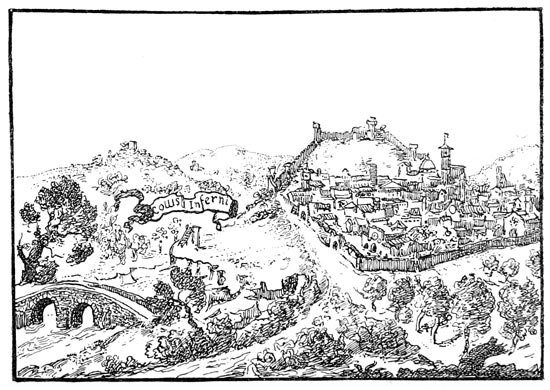
ASSISI IN THE TIME OF ST. FRANCIS


CHAPTER II
The Umbrian Prophet
"Fra santi il pui santo, e tra i peccatori quasi uno di loro."—Celano. Vita I. cap. xxix.
ften while reading the Italian chroniclers we forget that a life of chivalry, song, tournament, and pagan pleasure-making was passed in a mediæval town even while war, pestilence, and famine cast a settled gloom on every home. Lazar-houses stood at the gates of the city while sumptuous feasts were spread in the banqueting halls of palaces. Men rebelled against the ugliness and squalor produced by a hundred ills that swept over Italy during the twelfth century,[18] and so it came about that in the darkest hours of a city's history, scenes of maddest revelry were enacted. At this period were founded the Brigate Amorose, or Companies of young nobles, whose one aim in life was amusement. There were few towns in Italy, however small, in which these gay youths did not organise magnificent sports and tournaments[19] to which the ladies came in gowns of rich brocades or "fair velvet," their tresses garlanded with precious jewels and flowers. Or knights, ladies, and other folk would meet in the piazzas and pass the summer evenings with
"Provençal songs and dances that surpass; And quaint French mummings: and through hollow brass A sound of German music in the air."[20]
Late at night after a splendid banquet, the nobles wandered through the streets singing as they followed the lead of one chosen by themselves, whom they called the Lord of Love. Sometimes their ranks were swelled by passing troubadours from Provence who sang of the feats of Charlemagne and of King Arthur and his knights. For it was the time when Bernard de Ventadour was singing some of his sweetest love lyrics, and people were alternately laughing at the whimsicalities of Pierre Vidal and weeping at the tender pathos of his poems.[21] Those who listened to these songsters were, for the moment, deceived into thinking life was full of love and mirth, and sorrow only touched them when their lady frowned. The music of Provence found a way across the Alps to the feudal courts of Este and Ferrara, to Verona, and later, southwards to Sicily, where Frederick the Great was king. It came even to the towns which lay hidden in the folds of the Umbrian mountains, and some of its sweetest strains were echoed back again from Assisi. Her troubadour was Francis Bernardone, the rich merchant's son, leader of the young nobles who, in their carousals, named him Lord of Love, and placed the kingly sceptre in his hand as he walked at their head through the streets at night, rousing the sleepy Assisan burghers with wild bursts of song.
Francis had learned the Provençal language from his mother, Madonna Pica, whom Pietro Bernardone[22] is said to have met while journeying from castle to castle in Provence, tempting the ladies to buy his merchandise as he told them news of Italy. The early writers do not mention her nationality, they only allude to her as Madonna, which might imply that she was of noble birth; the later legend, which says that she was of the family of the counts of Bourlemont, is without foundation. We know she was a good and tender mother to Francis, who was left mostly in her charge, as Pietro Bernardone was so often absent in France. She taught him to love the world of romance and chivalry peopled by the heroes of the troubadours, and there he found an escape from the gloom that enveloped Assisi during those early days of warfare which were enough to sadden that joyous nature rarely found among saints. Celano gives a graphic picture of the temptations to which the youths of the middle ages were exposed, even in infancy in their own homes. This danger Francis escaped, but the companions with whom he spent the first twenty years of his life in gay living had not been so well guarded, and Francis was not slow to feel the influence of his time. We must remember that the accounts we have of him were written under the papal eye, and it is patent that both as sinner and as saint he took a leading part.
"He was always first among his equals in all vanities," says Celano, "the first instigator of evil, and behind none in foolishness, so that he drew upon himself the attention of the public by vain-glorious extravagance, in which he stood foremost. He was not chary of jokes, ridicule, light sayings, evil-speaking, singing, and in the wearing of soft and fine clothes; being very rich he spent freely, being less desirous of accumulating wealth than of dissipating his substance; clever at trafficking, but too vain to prevent others from spending what was his: withal a man of pleasant manners, facile and courteous even to his own disadvantage; for this reason, therefore, many, through his fault, became evil-doers and promoters of scandal. Thus, surrounded by many worthless companions, triumphantly and scornfully he went upon his way."[23]
His early years passed away in feasting and singing with an occasional journey to a neighbouring town to sell the Bernardone wares, until 1202 when war broke out between Perugia and Assisi, and the big bell of the cathedral called the citizens to arms in the Piazza della Minerva. Men gathered round their captain, while from the windows of every house women gesticulated wildly, almost drowning the clank of armour and the tramp of horses by their shrill screams. Francis, on a magnificent charger, rode out of the city gates abreast with the nobles of Assisi, filling the bourgeois heart of Pietro with delight, that a son of his should be thus honoured. It was a beautiful sight to see the communal armies winding down to the plain, one coming from the western hill, the other from the southern, to match their strength by the Tiber. They were "troops of knights, noble in face and form, dazzling in crest and shield; horse and man one labyrinth of quaint colour and gleaming light—the purple, and silver, and scarlet fringes flowing over the strong limbs and clashing mail like sea waves over rocks at sunset."[24]
The Assisans were vanquished: no details of the fight have come down to us, but we know that the nobles lay in a Perugian prison for a year and that it was Francis who cheered them, often astonishing them with his wild spirits. They told him he was mad to dance so gaily in a prison, but nothing saddened him in those days.
When peace was at last made, with hard terms for Assisi, the prisoners returned home and threw themselves with renewed vigour into their former pursuit of pleasure, and soon afterwards Francis fell ill of a fever which brought him near the grave. Face to face with death he stood a while, and the result of the danger he had passed through worked an extraordinary change in his nature. His recovery was in reality a return to a new life, both of body and soul. Celano tells us that Francis "being somewhat stronger and able to walk about the house leaning on a stick, in order to complete his restoration to health one day went forth and with unusual eagerness gazed at the vast extent of country which lay before him; yet neither the charm of the vineyards or of aught that is pleasant to look on, were of any consolation to him."[25]
It was probably from the Porta Nuova, close to where the church of Santa Chiara now stands, that he looked out on the Umbrian country he loved so well. Here Mount Subasio rises grey and bleak above the olive groves which slope gradually down to the valley where a white road leads past Spello to Foligno in the plain and on to Spoleto high up in the mountain gorge which brings the valley to a close. All these towns were dear and familiar to Francis. He had watched them in spring time when the young corn was ripening near their walls and the children came out to look for the sweet scented narcissi. While wandering on the hill sides at dawn he had seen the brown roofs warmed by the first rays of the sun and each window twinkle like so many eyes across the plain in answer to the light. But as he looked now upon the same scene a great sadness came over him, and we are told he wondered at the sudden inward change. That hour in the smiling Umbrian landscape was the most solitary he ever experienced; ill and weak he awoke to the emptiness of the life he had hitherto led, and in the bitterness of his soul he did not know where to turn for comfort.[26]
It is a remarkable fact that Celano does not from this moment picture Francis as an aureoled saint, but allows us to realise the many difficulties he had to overcome before he stands once more among the vineyards with a song of praise upon his lips, and a look of victory in his eyes.
Although Francis began to "despise those things he had formerly held dear," he was not altogether freed from the bonds of vanity, nor had he "thrown off the yoke of servitude"; for when restored to health he was full of ambitious projects to make a great career for himself in the world. The realisation of his dreams seemed indeed near, as it happened at this time that a noble knight of Assisi was preparing to join the army of Gauthier de Brienne, then fighting the battles of Pope Innocent III, in Apulia. Francis, "greedy of glory," determined to accompany the knight to the wars, and began to prepare for the journey with more than usual magnificence. He was all impatience to start, and his mind was full of the expedition when he had a dream which filled him with hope. In lieu of the bales of silk in his father's warehouse, stood saddles, shields, and lances, all marked with the red cross, and as he marvelled at the sight a voice told him those arms were intended for himself and his soldiers. Rising next morning full of ambitious plans after such an omen of good fortune, he mounted his charger and rode through the town bidding farewell to his friends. He smiled on all and seemed so light of heart that they pressed round asking what made him so merry. "I shall yet be a great prince," he answered, and he passed out of the Porta Nuova, where but a short while before he had stood looking down so sadly on the valley he was now to traverse as an armoured knight. At Spoleto he had a return of intermittent fever, and while chafing at the delay a voice called to him: "Francis, who can do the most good, the master or the servant?"
"The master," answered Francis, not in the least astonished by the mysterious question.
"Why then dost thou leave the master for the servant, and the prince for the follower? Return to thy country, there shalt thou be told what to do; for thou hast mistaken the meaning and wrongly interpreted the vision sent thee by God."
Next morning, leaving the knight to continue the journey alone, he mounted his horse and returned to Assisi, where he was doubtless received with disappointment by his parents, and with gibes by the citizens who had listened to his boasts of future greatness. Once again he went back to work in his father's shop, but now when the young nobles called to him to join in their revels he went listlessly, often escaping from their midst to wander alone in the fields or pass long hours praying in a grotto near the city. One day his friends, in despair at his frequent absences, gave a grand banquet, making him "King of the feast." He delighted them all with fitful bursts of merry wit, but at last when the revellers rushed out into the night to roam about the town till dawn, Francis fell back from the gay throng, and stood gazing up at the calm Umbrian sky decked in all its splendour of myriad stars. When the others returned in search of their leader, they, wondering at the change that had come over the wildest spirit of Assisi, assailed him with questions. "Are you thinking of marrying, Francis," cried one jester, and amidst the laughter of all came his quiet answer: "Yes, a wife more noble and more beautiful than ye have ever seen; she will outshine all others in beauty and in wisdom." Already the image of the Lady Poverty had visited him, and enamoured like a very troubadour he composed songs in her honour as he walked in the woods near Assisi.
The kind heart of Francis had always been touched at the sight of the poor lepers, who, exiled from the companionship of their fellow creatures, lived in a lazar-house on the plain, about a mile from the town. But his compassion for their misery was mingled with a strong feeling of repugnance, so that he had always shunned these wretched outcasts. "When I was in the bondage of sin," he tells us in his will, "it was bitter to me, and loathsome to see, and loke uppon persouny enfect with leopre; but that blessed Lord broughte me amonge them, and I did mercy with them, and departing from them, what before semyd bittre and lothesomme was turned and changed to me in great sweetnesse and comfort both of body and of soule, and afterwards in this state I stode and abode a lytle while, and then I lefte and forsooke the worldly lyf."[27]
Pietro Bernardone now saw his son, clothed in rags, his face pinched and white from long vigils spent in prayer, going forth on errands of mercy, jeered at by the citizens, pelted with stones and filth by the children. There were many storms in the Bernardone household which the gentle Pica was unable to quell; and when finally Francis began to throw his father's money among the poor in the same regal manner in which he had once spent it among his boon companions, Bernardone could bear it no longer, and drove his son from the house. When they met he cursed him, and the family bonds thus severed were never again renewed.
Francis was still like a pilgrim uncertain of his goal, or like a man standing before a heavy burden which he feels unable to lift. What was he to do with his life—how could he help the poor and suffering—were questions he asked himself over and over again as he vainly sought for an anchor in the troubled seas. The answer came to him one day as he was attending mass at the chapel of the Portiuncula on the feast of St. Matthew the apostle, in the year 1209.
"And as ye go, preach, saying, The kingdom of heaven is at hand. Heal the sick, cleanse the lepers, raise the dead, cast out devils: freely ye have received, freely give. Provide neither gold, nor silver, nor brass in your purses, nor scrip for your journey, neither two coats, neither shoes, nor yet staves" ... read the priest from the gospel of the day. Those simple words were a revelation to Francis, who, when mass was over, ran out into the woods, and, with only the birds in the oak trees to witness his strange interpretation of the gospel, threw away his shoes, wallet, staff and well-filled purse. "This is what I desired; behold, here is what I searched for and am burning to perform," he cried, in the delirium of his new-found joy.
If the Assisans had been astonished at his former eccentricities, as they termed his deeds of charity, they were yet more amazed to see him now, clothed in a coarse habit, with a knotted cord round his waist, and with bare feet, begging his bread from door to door. After a little while they grew accustomed to the hurrying figure of the young mendicant as he passed rapidly down the street greeting all he met with the salutation of "Our Lord give thee His peace." The words brought something new and strange into men's hearts, and those who had scoffed at him most drew near to learn the secret of their charm. The first to be touched by the simplicity and joyous saintliness of Francis was Bernardo di Quintevalle, a wealthy noble of Assisi, who had known him as King among the young Assisan revellers, and watched with astonishment his complete renouncement of the world. He determined to join Francis in ministering to the lepers, and began his new mode of life by selling all his possessions for the benefit of the poor. His conversion created a considerable stir in the town; and people had not ceased to gossip on the subject when another well-known citizen, Pietro de Catanio, a canon of the cathedral, also offered his services at the lazar-house. A few days later a labourer named Egidio "beholding how those noble knights of Assisi despised the world, so that the whole country stood amazed," came in search of Francis to beg him to take him as one of his companions. Francis met him at the entrance of the wood by the lazar hospital, and gazing on the devout aspect of Egidio, answered and said: "Brother most dear, God has shown Himself exceeding gracious unto thee. If the Emperor were to come to Assisi and desire to make a certain citizen his knight or private chamberlain, ought not such a one to be exceeding glad? How much more oughtest thou not to rejoice that God hath chosen thee out to be His knight and well-beloved servant, to observe the perfection of the Holy Gospel"?[28] and, taking him by the hand, he brought him to the hut which was their home. Here a merchant's son, a learned churchman, and a rich nobleman, welcomed an Assisan labourer in their midst with the simple brotherly love which was to be the keynote of the franciscan order. After the reception of Egidio we are told that Francis went with him to the Marches of Ancona, "singing glorious praises of the Lord of heaven and earth" as they travelled along the dusty roads. Albeit Francis did not preach publicly to the people, yet as he went by the way he admonished and corrected the men-folk and the women-folk, saying lovingly to them these simple words: "Love and fear God, and do fit penance for your sins." And Egidio would say: "Do what this my spiritual Father saith unto you, for he speaketh right well."
It was not long before the fame of Francis drew quite a little community of brethren to the tiny hut in the plain, and the question naturally occurs—Did Francis plan out the creation of an order when he gathered men around him? It was so natural a thing for disciples to follow him that his biographers simply note it as a fact, and, not being given to speculation in those days, pass on to other events. We may be allowed to conjecture that the same ambition which some years before had stirred his longing to be a great prince was not dead, only his dreams were to be realised in another sphere of action. The qualities which made him the brilliant leader among the gay nobles of Assisi were now turned into another channel—he became a prince among saints, a controller of men's destinies.
Varied indeed was the band of Francis' disciples, and it is interesting to see how each one was allowed to follow the bent of his nature. In this complete sympathy with character lay one of the secrets of his power. Egidio, who in the world had been a labourer, was encouraged by his master to continue his life in the open country. He gathered in the olives for the peasants, helped them with their vintage, and when the corn was being cut would glean the ears; but if anyone offered him a handful of grain, he remarked: "My brother, I have no granary wherein to store it." Usually he gave away what he had gleaned to the poor, so that he brought little food back to the convent. Always ready to turn his hand to every job, one day we find Egidio beating a walnut tree for a proprietor who could find none to do the work because the tree was so tall. But he set himself gaily to the task, and having made the sign of the Cross, "with great fear climbed up the walnut tree and beat it. The share that fell to him was so large that he could not carry it in his tunic, so taking off his habit he tied the sleeves and the hood together and made a sack of it."[29] With this load on his back he returned towards the convent, but on the way distributed all the nuts to the poor. Egidio remains the ideal type of the franciscan friar. "He is a Knight of my Round Table," said Francis one day as he recounted some new adventure which had befallen the intrepid brother, who was always journeying to some southern town, and is said even to have visited the Holy Land.[30]
A very different man, drawn by the magic influence of Francis into the Order at the beginning of its fame in 1211, was Elias Buonbarone, the son of a Bolognese mattress-maker who had for some time been settled in Assisi. He is always represented by the biographers as haughty, overbearing, and fond of controlling the actions of others; in fact a strong contrast to the meek brother Leo whom Francis lovingly named the little lamb of God. But if lacking in saintly qualities, Elias possessed a remarkable mind and determination of character which enabled him afterwards to play a considerable part in the history of his times. He embodies the later franciscan spirit which grew up after the saint's death, and of which we shall treat in another chapter.
When Francis found himself surrounded by some dozen followers, all anxious to obey his wishes to the very letter and waiting only to be sent hither and thither as he commanded, it became necessary to write down some rule of life. In simple words he enjoined all to live according to the precepts of the Gospel, "and they that came to reseyve this forme or manner of lyvynge departyd and distributed that they had and myght haue too powre people. And we were content with oone coote pesyd bothe within forthe and without forthe with oone corde and a femorall, and we wolde not haue ony more. Our dyvyne servyse the clerkis saide as other clerkis, and the lay bretherne said ther Pater noster. And we fulle gladly dwelt and taried in pour deserte and desolat churchys, and we were contente to be taken as ideotis and foolys of every man, and I did exercyse my self in bodily laboure. And I wille laboure, and yt ys my wille surely and steadfastely that alle the bretherne occupie and exercyse themself in laboure, and in such occupation and laboure as belongeth to honeste. And those that have no occupation to exercyse themself with alle, shall lerne not for covetis to resceyve the price or hier for their laboure, but for to give good example and eschewe and put away idlenesse. When we wer not satisfied nor recompensied for our laboure, we went and had recourse to the lord of oure Lorde, askynge almes from dore to dore. Our Lorde by reualation tawghte me to say this maner of salutation, 'Our Lorde give to thee His peace.'"[31]
The first rule which Francis and his companions took in the summer of 1210 to be confirmed by Innocent III, has not come down to us. In Rome they fortunately met the bishop of Assisi, who promised to obtain for them, through one of the Cardinals, an interview with the Pope. A legend tells us how Innocent, wrapt in deep meditation, was pacing with solemn step the terrace of the Lateran, when this strange company of ragged, bare-footed, dusty men was ushered into his presence. He looked at them in surprise, his lip curling in disdain as Francis stepped forward to make his request. From an Umbrian pilgrim he heard for the first time that power was not the greatest good in life while in poverty lay both peace and joy, and the great pope stood amazed at the new doctrine. "Who can live without temporal possessions," sarcastically asked the Cardinals who had been trained in the spirit of Innocent, and the "Penitents of Assisi" bowed their heads, and drawing their hoods forward, went sorrowfully out of the pope's presence amid the jeers of his court. That night Innocent had a dream in which he saw the church of St John Lateran about to fall, and its tottering walls were supported on the shoulders of a man whom he recognised as the spokesman of the band of Umbrians he had so hastily dismissed. Full of strange visions the pope sent for Francis, who repeated his desire to have his rule confirmed. "My son," said Innocent, "your rule of life seems to us most hard and bitter, but although we do not doubt your fervour we must consider whether the road is not too hard a one for those who are to follow thee." Francis, with ready wit, answered these objections by a tale he invented for the purpose. "A beautiful but poor girl lived in a desert, and a great king, seeing her beauty, wished to take her to wife, thinking by her to have fine children. The marriage having taken place, many sons were born, and when they were grown up their mother thus spoke to them: 'My sons be not ashamed, for you are sons of the king; go therefore to his court and he will cause all that is needful to be given to you.' And when they came, the king, observing their beauty and seeing in them his own likeness and image, said: 'Whose sons are you?' And they answered; 'sons of a poor woman who lived in the desert.' So with great joy the king embraced them, saying: 'Be not afraid, for you are my sons, and when strangers eat at my table how much more right have you to eat who are my legitimate sons?' The king then ordered the said woman to send all sons born of her to be nourished at his court." "Oh, Messer," cried Francis, "I am that poor woman, beloved of God, and made beautiful through His mercy, by whom he was pleased to generate legitimate sons. And the King said to me that he will feed all the sons born of me, for as He feeds strangers so He may well feed His own."