Front matter (continued 4)
Reading edition
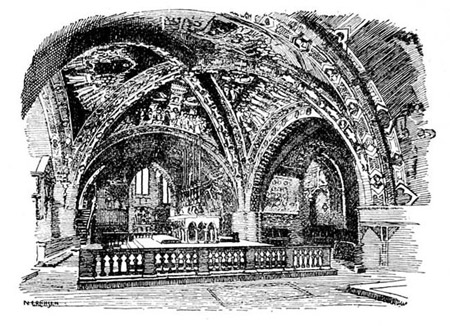
CHOIR AND TRANSEPTS OF THE LOWER CHURCH
The Visitation (on the same wall as Cimabue's Madonna) is one of those frescoes that we remember like a scene we have witnessed, so naturally does the Virgin move forward, followed by a group of handmaidens, and hold out her arms to greet Elizabeth who is bending with such reverence to salute her cousin. They stand at the entrance of a dainty house inlaid with mosaic which is set among the bare rocks with only a stunted tree here and there. But Giotto does not forget to place a flowering plant in the balcony just as the peasants have always done in his mountain home.
It is interesting to compare the next fresco of the Nativity with the same subject in the Upper Church, treated by a follower of Cimabue where the same idea is depicted, but with what a difference. Though two episodes are placed in one picture, Giotto succeeds in giving a harmonious composition, which, if a little stiff and over symmetrical, is full of charm and beauty. The angels singing to the new-born Infant and those apprising the shepherds of the news hover like a flight of birds above the barn. They are in truth the winged spirits of the air, "birds of God" Dante calls them, and thus Giotto paints them. As though to accentuate the sadness and poverty of Christ's birthplace, the barn, all open and exposed to the night breezes, is laid in a lonely landscape with a high rock rising behind it. Beyond in the valley, a leafless tree grows upon the bank of a calm stream where the heavenly light from the angels is seen to play like moonbeams in its waters.
Messrs. Crowe and Cavalcaselle hold that the Visit of the Magi was "never painted with more feeling, more naturally or beautifully composed than here"; and Giotto must have felt he could add little to the perfection of the scene when in later years he painted the same subject at Padua. All interest is centred on the Child, who, bending forward from the Virgin's arms, lays a tiny hand in blessing upon the head of the aged king. Curiously enough St. Joseph has been forgotten, and instead an angel stands upon either side to receive the offerings of the Magi.
But to us the Purification seems even more beautiful in sentiment, composition and the perfection of religious feeling. Giotto was the first to conceive the idea of the Infant Jesus turning from Simeon towards the Virgin Mary as if anxious to come back to her, while she holds out her arms to invite him with a naïve attitude of gentle motherhood.
From charming frescoes like these we come to the grand and powerful scene of the Crucifixion. Every figure tells a different tale of sorrow; of tender pity, as in the group of women round the fainting Virgin; of wonder that Christ should be allowed to suffer, as in the gesture of the woman with arms thrown back and St. John who wrings his hands almost fiercely; of sympathy expressed by the Magdalene, as she kisses the pierced feet; and of hope and prayer, in the kneeling figures of St. Francis and his brethren. Even more vehement in their grief are the angels, who rending their garments fly away with arms stretched out as if unable to bear the sight of so much pain. How rapidly they turn and circle in the air; they are not borne along by the winds, but trusting to their wings they rise with the swift, sure flight of a swallow.[74]
Upon the opposite wall the early life of the Virgin is continued with the Flight into Egypt, which bears a strong resemblance to the fresco at Padua. There is the same sense that St. Joseph, his bundle slung on a stick over his shoulder like a pilgrim, is really walking along and in a moment must disappear from sight; a palm tree bends sideways to the breeze, and above two angels seem to cleave the air as they hurriedly lead on the travellers to exile and safety. Only the Virgin sits calm and unruffled. In the Massacre of the Innocents Giotto has happily not painted the full horror of the scene, but has aimed rather at suggesting the tragedy than at giving its actual representation. Very beautiful are the women to the left mourning for their dead children. One rocks her child in her arms and tries to awaken him with her kisses, whilst another raises her hands in despair as she gazes upon the dead child upon her knees.
The Return of the Holy Family from Egypt, though only showing a group of houses within surrounding walls and a gateway and a group of people, suggests better than a more complicated composition would have done the scene of a home-coming after long absence.
The Preaching of the Child in the Temple completes the series, and like the one at Padua, it is the least interesting of Giotto's paintings.
There are three other frescoes in the Transept which most people, with reason, attribute to Giotto, representing miracles of St. Francis. The first refers to a child of the Spini family of Florence who fell from a tower of the Palazzo Spini (now Feroni), and was being carried to the grave, when the intercession of St. Francis was invoked and he appeared among them to restore the child to life. Part of the fresco has been lost owing to the ruthless way in which the walls were cut into for the purpose of erecting an organ—a barbarous act difficult to understand. But the principal group of people are seen outside an exquisite basilica of marble and mosaic, and each figure can be studied with pleasure as they have not been mutilated by the "restorer's" usual layers of thick paint. Seldom has Giotto painted lovelier women than those kneeling in the foreground, their profiles of delicate and pure outline recalling a border of white flowers. Near them is a figure bearing so strong a resemblance to Dante, that we would fain believe that Giotto meant to represent the type of a true Florentine in a portrait of the poet. Above the staircase is a fine picture of St. Francis resting his hand upon the shoulder of a crowned skeleton "in which," says Messrs. Crowe and Cavalcaselle, "a much deeper study of anatomy is revealed than has ever been conceded to Giotto." The oval face of the saint, with clear brown colouring, is very beautiful, strongly resembling the St. Francis in glory in the fresco above the high altar. By him also is the half-length figure of Christ in the vaulting of the window.
Although the two remaining frescoes deal with the death and resurrection of a child, they probably have nothing to do with the Spini miracle; the one where the dead child is lying in the arms of two men has unfortunately been so repainted as to take all character away from the faces, and we can only admire the general grouping, the fine gestures of the weeping women, and the grand modelling of the figures. Only a great artist could make one feel, by such simple means, the strain of the dead weight upon the men's arms. The man to the left (the second from the one holding his finger to his chin) is believed to be the portrait of Giotto; if it is, the painter has not flattered himself, and we can believe Dante's tale that he was remarkably ugly, and had six hideous children. On the other side of the arch the legend continues; a procession of white-robed monks and sorrowing friends approach the house to which the child has been taken, but in the meantime St. Francis has called him back to life, and a man, evidently in great excitement over the miracle, is hurrying down the steps to announce what has occurred. The story is so well and simply told that, although we have failed to find any account of it, it is easy to understand the sequence of the two frescoes, and the events they relate.
Allegories by Giotto in the ceiling over the High Altar.—The task was now given to Giotto to depict by the medium of allegory the three virtues of the franciscan order and St. Francis in glory. These virtues, the rocks upon which the franciscan order was so securely founded, had been preached by St. Francis to the people of Italy with the extraordinary results we have seen, and now Giotto came to take up the theme and, by means of his immortal art, perpetuate it as long as the great basilica lasts, and pilgrims come to pray and read upon the walls, in a language even the unlettered can understand, the lessons taught by the Umbrian preacher seven centuries ago. Apart from the fact of his genius, it was a fortunate thing that he should have been chosen for the task. A man of weaker and more impressionable temperament might have been led into such exaggerations of feeling and sentiment as we find in the Lorenzetti frescoes of the transept. Giotto came not many years after the Flagellants, roaming in hordes through the land calling for mercy and beating their half-naked bodies with leathern thongs, had spread a spirit of fanaticism which threatened to destroy the healthy influence of the teaching of St. Francis. But the mountain-born painter, impervious to such influences, kept his faith pure amidst the turmoil and unrest; and much as he admired the saint (it is said he belonged to the Third order), he looked upon his teaching from the practical point of view and was by no means carried away by the poetical manner in which it had been presented to the people. Nothing shows the mind and character of Giotto so plainly as some lines he wrote on poverty, most likely after painting his famous Allegories when he had an opportunity to observe how little the manners and customs of mediæval monks corresponded with the spirit of their founder. Every line of the poem is full of common sense and knowledge of human frailty. Many, Giotto remarks somewhat sarcastically, praise poverty; but he does not himself recommend it as virtue is seldom co-existent with extremes; and voluntary poverty, upon which he touches in a few caustic lines, is the cause of many ills, and rarely brings peace to those who have chosen her as a mate and who too often study how to avoid her company; thus it happens that under the false mantle of the gentlest of lambs appears the fiercest wolf, and by such hypocrisy is the world corrupted.[75]
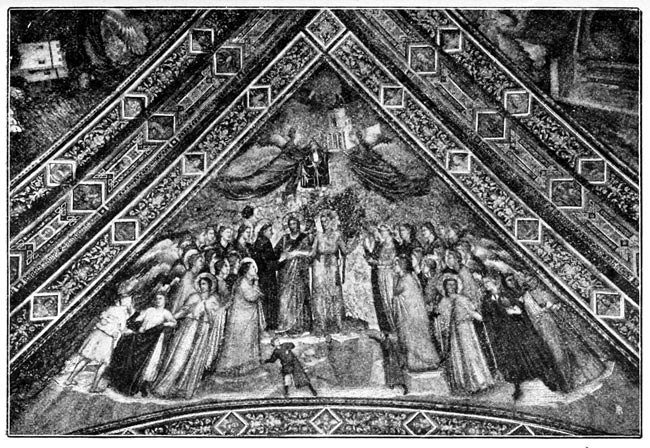
THE MARRIAGE OF ST. FRANCIS WITH POVERTY
(D. Anderson—photo)]
Giotto, an artist before he was a moralist, undertook to carry out the wishes of his patrons, and thought only how he could best fill the triangular spaces of the ceiling with the figures of saints and angels. It was by no means an easy task, but Giotto succeeded so well that these four frescoes are reckoned among his masterpieces and the wonders of the thirteenth century. They certainly show a marked advance upon the earlier works in the Transept, but they lack the power and assurance of those in the Upper Church, where the youthful painter all but reached the zenith of his fame.
The Marriage of St. Francis and Poverty.[76]—In this fresco Giotto has represented three incidents, but just as they all refer to one subject, so do the figures form a perfect harmony, faultless as decoration and beautiful as a picture. A youth, imitating the charity of St. Francis to whom his guardian angel is pointing, is seen on the left giving his cloak to a beggar, while upon the other side, a miser clutching his money-bag and a youth with a falcon on his gloved hand refuse to listen to the good suggestions of an angel and of the friar who stands between them. The lines of decoration are further carried out by the two angels who fly up carrying a temple with an enclosed garden, perhaps symbolising Charity, and a franciscan habit, which may be the symbol of Obedience. But these are details and the eye does not rest upon them, but rather is carried straight into the midst of a court of attendant angels where Christ, standing upon a rock, gives the hand of St. Francis to the Lady Poverty, who slightly draws away as if in warning of the hardships and disillusions in store for him who links his life with hers. Cold and white, her garments torn by a network of accacia thorns, she is indeed the true widow of Christ, who, after His death as Dante says,
". . . . . . slighted and obscure Thousand and hundred years and more, remain'd Without a single suitor, till he came."[77]
The bridesmaids, Hope pointing to the sky, and Charity holding a heart and crowned with flowers that start into tiny flames, come floating out of the choir of angels towards the pale bride whose veil is bounded only by her hair. Heedless of the children of earth, who encouraged by the barking of a dog, press the thorns still deeper into her flesh, she gazes at St. Francis, and shows him the pink and white roses of paradise and the Madonna lilies which are flowering behind her wings.
Chastity.—The different stages of perfection in the religious life are portrayed in this allegory. To the left St. Francis welcomes three aspirants to the order—Bernard of Quintavalle—typifying the franciscans; St. Clare—the Second Order; and one, who is said to be the poet Dante, in the near foreground in a florentine dress of the period—the Third Order. Two angels in the central group impose hands and pour the purifying water upon the head of a youth standing naked in a font, and two other angels bend forward with the franciscan habits in their hands, while leaning over the wall of the fortress are two figures, one presenting the banner of purity the other the shield of fortitude to the novice. On either side stands a grey-bearded, mail-clad warrior, lash and shield in hand to denote the perpetual warfare and self-mortification of those who follow St. Francis. To the right three youthful warrior-monks, beautiful of feature, bearing the signs of the Passion in their hands, aided by one in the garb of a Penitent with angels' wings, are chasing away the tempting spirits of the flesh from the rocks about the fortress into the abyss below. The winged boar falls backwards, followed by a demon and a winged skeleton emblematic of the perpetual death of the wicked, while poor blindfolded Love writhes beneath the lash of Penitence. But just as he is about to spring down with the rest, his string of human hearts still slung across his shoulders, he snatches up a sprig of roses from the rocks.
Above, out of a walled enclosure guarded at each end by towers like every mediæval castle on the hills about Italian towns, rises a crenulated fortress. At the open window of the magnificent central tower is seen Chastity, veiled and in prayer as if unconscious of the scene below, her vigilance typified by the bell o'erhead. She appears to be reading, by the light of a taper, from the open book held before her by an angel, while another is bringing her the palm of sanctity. They are no longer Giotto's bird-like creations, but stately messengers with splendid human forms uplifted by outstretched wings their garments brought into long curved lines by the rapidity of their flight.
Obedience.—Under an open loggia sits the winged figure of Obedience in the habit of a franciscan, holding his finger to his lips as he places a wooden yoke (symbol of obedience) upon the neck of a kneeling friar. Prudence, with double face, holding a glass mirror and a compass, and Humility, with her lighted taper to illumine the path to paradise, are seated on either side, perhaps to show that he who imposes obedience upon others must be prudent and humble himself. An angel upon the right is pointing these virtues out to a centaur (symbolizing pride, envy and avarice), who, thrown back upon his haunches by a ray of light from the mirror of Prudence, is thus stopped from tempting away the young novice kneeling on the opposite side, encouraged in his act of renunciation by the angel who holds him firmly by the wrist. Two divine hands appear from the clouds above and are holding St. Francis by his yoke, while two angels unroll the rules of his order.
The Glory of St. Francis.—The throng of fair-haired angels, seem, as they move towards the throne of the saint and press around it, to be intoning a hymn of perpetual praise and jubilation. Their figures, against the dull gold background, are seen white and strong, with here and there a touch of mauve or pale blue in their garments bringing out more distinctly the feeling of light and joyousness. The perpetual movement of the heavenly choir, some blowing long trumpets, others playing on flutes and tambourines, while many gaze upwards in silent prayer as they float upon the clouds, contrasts strangely with the stiff and silent figure of St. Francis, who in his robe of gold and black brocade, a brilliant light behind him, looks like some marvellous eastern deity, recalling Dante's words of how he
"... arose A sun upon the world, as duly this From Ganges doth: ..."
In the dimness of the cave-like church built to serve the purpose of a tomb and keep men's ideas familiar with the thought of death, these frescoes are glimpses into the heaven of the blest. Watch them at all hours of the day and there will be some new wonder to be noted, a face among the crowd which seems fairer than the rest, or, as the sunshine moves across, a flash of colours in an angel's wing like the sudden coming of a rainbow in a cloudy sky. And who shall forget the strange play of fancy as the candle light, during an afternoon service, mingles with the strong sunshine upon the white figures of saints and the whiter figure of the Lady Poverty, who appear to move towards us from amidst a blaze of golden clouds, until gradually as the evening closes in and the candles go out one by one, they are set once more in the shadow of their backgrounds like so many images of snow.
La Capella del Sacramento, or the Chapel of St. Nicholas.—Giotto left one scholar at Assisi whose work it is easy to discover, but who, as far as name and personality are concerned, is unknown, and shares in the general mystery which surrounds both the builders and painters of San Francesco. All we know is that he followed his master's style and great laws of composition even more closely than Taddeo Gaddi, and that he possessed much charm and originality. By the kind help of Mr Bernhard Berenson we have been able to group together some of the works of this interesting artist, who was evidently working at Assisi between 1300 and 1310 when he executed the last nine frescoes of the Upper Church illustrating the death and the miracles of St. Francis, decorated the Capella del Sacramento in the Lower Church with the legend of St. Nicholas, and painted a fine Crucifixion in the Confraternity of San Rufinuccio (see chap. x). There is a very delightful panel picture also by him in the corridor of the Uffizzi (No. 20 in the corridor), with eight small scenes from the life of St. Cecilia.
In a fresco over the arch on the inside of the Capella del Sacramento are portraits of the donors of the chapel, Cardinal Napoleone Orsini, who is being presented to Christ by St. Francis, and his younger brother Giovanni (below him is written Dñs Joñs Gaetanus frater ejus), presented by St. Nicholas. It helps to date the decoration of the chapel, for we know that Giovanni Orsini received the cardinal's hat in 1316, while here he is represented in the white dress of a deacon confirming the general opinion that these frescoes must have been painted before that date.[78]
St. Nicholas of Myra, generally known as St. Nicholas of Bari, both during his life and after his death was forever coming to the assistance of the oppressed; he did not even object to be the patron saint of drunkards and thieves, as well as of maiden virtue. He can easily be recognised in art by the three purses or golden balls which are always placed at his feet, in reference to the first kind action he performed when a wealthy young noble. This incident is charmingly recorded in the chapel upon the right wall near the entrance. Three sleeping maidens are lying by their father's side, and St. Nicholas, who has heard of their poverty, throws in three bags of gold as he passes by the open window. This charitable deed has made him a famous saint; when Dante is in Purgatory he hears the spirit of Hugh Capet recounting various acts of virtuous poverty and generosity, among which
"... it spake the gift Of Nicholas, which on the maidens he Bounteous bestow'd, to save their youthful prime Unblemish'd...."
Below (the picture immediately beneath is entirely obliterated) is a very beautiful composition, recalling the same artist's treatment of St. Clare and her nuns in the Upper Church. In front of a Gothic chapel of white and black marble stands St. Nicholas, between two placid and portly friars, listening to the petition of a despairing father who implores his protection for his three sons, unjustly condemned to death by a wicked consul. The figures of the prisoners, with halters round their necks, followed by sympathising friends, are full of movement and life; St. Nicholas is particularly charming, dressed in his episcopal robes, slightly bending forward and listening attentively to the doleful tale.[79]
The legend is continued upon the opposite side, where he arrives just in time to save the youths. The figure of the kneeling victim expecting the blow every moment to fall upon his neck and the majestic attitude of the saint in the act of seizing the sword, are finely rendered, but Giotto would hardly have approved of the complicated building decked with much superfluous decoration which is supposed to represent the city gate.
The fresco below relates a vision of the Emperor Constantine who had ordered his three generals, unjustly accused of treason, to be put to death. St. Nicholas appears and commands him to release the prisoners, who are in a wooden cage by the bed.
High up in the lunette of this wall is an interesting fresco referring to a humorous incident of one of the saint's miracles. It appears that a Jew, hearing that St. Nicholas gave special protection to property, placed a statue of him in his house; but it must be remembered that St. Nicholas was also the patron of thieves, and one day all the Jew's possessions disappeared. Enraged by the failure of his plan he administered a sound thrashing to the statue, which stands in a beautiful niche with spiral columns, behaving much in the same way as the childish sons of faith in Southern Italy who turn the Madonna's picture to the wall when their prayers have not been effectual. In this case St. Nicholas was so deeply offended that he appeared in a vision to the thieves, who kindly restored the goods of the irate Jew. There are dim remains of frescoes on this wall, but it is impossible to make out what they represent. Other wonderful miracles are related upon the opposite side, beginning high up in the lunette, where, with some difficulty, we distinguished St. Nicholas restoring a child to life who has been taken from his parents and killed by evil spirits. Below is a scene in a banqueting hall, where a king, seated at table, takes a goblet of wine from the hand of a slave boy. St. Nicholas, in full episcopals, performs one of his many ærial flights, lays his hand upon the boy's head and carries him back to his parents. In the scene beneath St. Nicholas is restoring to his people another youth, who, it seems, was nearly drowned while filling a goblet with water for the altar of St. Nicholas; or it may be the continuation of the preceding legend, and show the home-coming of the captive boy from the king's palace. It is one of the most charmingly rendered of the series; the impetuous action of the mother rising with outstretched arms to welcome her son, and the calm dignity of the father's embrace, are almost worthy of Giotto himself. A small dog bounds forward to add his welcome to the others, while St. Nicholas surveys the scene with great gravity, every line of his figure denoting dignity, power and repose.
On one side of the arched entrance to the chapel is a fresco of St. Mary Magdalen, on the opposite side is St. John the Baptist, and in the vaulting of the arch, on the right, are St. Anthony of Padua with St. Francis; St. Albino with St. George; St. Agnes holding a lamb, perhaps the most graceful of the figures, with St. Cecilia crowned with roses. Opposite are St. Rufino and St. Nicholas holding a book; St. Sabino and St. Vittorino, both Assisan martyrs; and St. Claire with St. Catherine of Alexandria. But the quality of this artist will be only half realised if the single figures of the apostles on the walls below the scenes from the life of Nicholas are overlooked. Very grave and reposeful they lend an air of great solemnity to the chapel, and as Messrs. Crowe and Cavalcaselle remark, they are "after those of Giotto in the Ciborium of Rome, the most admirable that were produced in the early times of the revival...."
It is as difficult to explain why the Chapel of St. Nicholas possesses so much charm, as it is to understand why people seldom spend more than sufficient time to read the few lines in their guide-book about it and verify for themselves that the frescoes are there; but perhaps when some fifty frescoes by Giotto have to be realised in about an hour, which is the time usually devoted to them by the visitor to Assisi, it is not surprising that Giotto's follower, the closest and the best he ever had, should be neglected.
The stained glass windows, remarkable rather for their harmony than for their depth of tone, belong also to the early part of the fourteenth century, and are decorated with the Orsini arms. On the left side of the central window is a charming design of St. Francis in a rose-coloured mantle, recommending to Christ the young Giovanni Gaetano Orsini, who is said to be buried in the chapel. His monument behind the altar, erected soon after his death in 1347, is, according to Vasari, the work of Agostino da Siena, a pupil of Giovanni Pisano. Very calm and youthful-looking the Cardinal lies at full length in long folded robes while two angels guard his slumbers.
There is yet another treasure in St. Nicholas' Chapel; a lovely picture on panel of the Virgin and saints (rather difficult to see as it is against the light over the altar), by a Sienese artist who possesses some of Simone Martini's talent of depicting ethereal and serene Madonnas.
The Chapel of St. Maria Maddalena.—According to a legend given by Padre Angeli the chapel was built and consecrated by St. Bonaventure while General of the franciscan order towards the end of the thirteenth century. The three frescoes on the left wall certainly belong to Giotto's time, and if not actually painted by him they appear to be from his designs, and not merely copies of the Paduan frescoes which they resemble. Above the frescoes of the Raising of Lazarus and the Anointing of Christ's feet is the Communion of the Magdalen, rendered with such simplicity yet with so much religious feeling and solemnity that we realise it is indeed the last communion of the saint on earth. The attitude of the priest, the splendid drapery of the man in orange-coloured garments, and the way in which the figure of the saint being carried by angels to heaven completes the composition, bear unmistakably the impress of Giotto's style before the Paduan period (1206).
The "Noli mi Tangere" upon the opposite wall may also have been designed by him, but the type of the faces are heavier than his, and the angels are no longer swift spirits of the heavens ending in flame and cloud.
The painter, as if wishing to remind the faithful of the new life symbolised in the resurrection of Christ, has covered the rocks and ground with flowering rosebushes and exquisitely designed tufts of ferns and leaves.
The story of the Prince and Princess of Marseilles is a favourite subject with the Giottesque school. The legend tells that when Mary Magdalen arrived at Marseilles with Lazarus and Martha, she met a prince and his wife who were praying to the gods for a son, and she persuaded them to pray instead to the God of the Christians. Their desire was granted, and they were converted, but evidently being of a cautious turn of mind, they resolved to sail at once for Jerusalem and find out if St. Peter's teaching agreed with that of the Magdalen. On the way a terrible storm arose, and during the tempest the princess gave birth to a son, and died. The sailors insisted that her body must be thrown overboard or the storm, they said, would not abate; at last the prince was forced to lay the body of his wife upon a rocky island in the midst of the ocean, and calling upon Mary Magdalen for help, he left the child wrapt in the cloak of its dead mother by her side and continued the journey to the Holy Land. His visit to St. Peter ended in his complete conversion, and upon his return to France he stopped at the rocky island where he found his wife and son alive and well, thanks to the prayers of St. Mary Magdalen. They returned to Marseilles, the vessel being guided by angels, and the whole town became Christian.
Above the arch facing the altar is a very charming fresco of the Magdalen standing at the entrance of a cave, her hair falling like a mantle of cloth of gold about her, to receive the gift of a garment from a charitable hermit who had heard of her life of austerity and privation among the mountains of Provence.
The single figures of St. Clare, St. Mary Magdalen and St. Rufino, as well as the saints in the vaulting opposite the altar, no longer follow Giotto's designs and are far inferior to the other frescoes. Teobaldo Pontano, Bishop of Assisi between 1314 and 1329, is supposed to be the kneeling figure at the feet of St. Rufino as donor of the chapel. It is so unlikely Giotto should have repeated his later Paduan designs in a feebler manner, as seen here, or that a pupil should have slavishly copied them, that it seems more probable the chapel dates from the time of St. Bonaventure, when its decoration may have been begun by Giotto and completed by some later Florentine follower called in by the bishop who desired to be buried here. The Pontano arms decorate the beautiful stained glass windows, which certainly date from the first half of the fourteenth century, and are the finest in the Lower Church with the exception of those in St. Martin's chapel. Each figure has a claim on our admiration, but especially lovely is the figure of the Magdalen whose hair falls to her feet in heavy waves of deepest gold. In the last division of the right window is the death of the saint, with the lions at her feet which are supposed to have dug her grave.
The Chapel of St. Antonio di Padova.—Built by the Assisan family of Lelli in the fourteenth century, it was once ornamented by Florentine frescoes of the same date which were destroyed when the roof fell in, and it has now nothing of interest save the windows. These contain some naïve scenes from the life of St. Anthony; among them may be noticed his preaching to the fish which raise their heads above the water to listen.
Chapel of San Stefano.—This like the last, has only very decadent frescoes by Adone Doni and is solely interesting for its windows (second half of fourteenth century), where below the symbols of the Evangelists are single figures of saints, among them King Louis and the royal Bishop of Toulouse. Cardinal Gentile di Montefiore, founder of the chapel of S. Martino, was also the donor of this one and is represented in the right window with his crest, a tree growing out of a blue mound against an orange background.
The Chapel of St. Catherine, or Capella del Crocifisso.—This chapel was built by order of Cardinal Albornoz towards the end of the fourteenth century when on his passage through Umbria to reconquer the rebellious cities for the Roman Pontiff. He conceived at Assisi so great a love for the memory of St. Francis that he desired to be buried there; but though his body was brought to Assisi from Viterbo where he died in 1367, it was afterwards carried to his bishopric at Toledo "at small expense," writes an economical chronicler, "upon men's shoulders"; only a cardinal's hat, suspended from the roof of the chapel, now remains to remind us of the warlike Spanish prelate. The frescoes here have been assigned to that mythical person Buffalmaco, of whom Vasari relates such humorous tales. All we can say is that they belong to the second half of the fourteenth century and are not very pleasing scenes from the life and martyrdom of St. Catherine of Alexandria, with a fresco of Cardinal Albornoz receiving consecration from a pope under the auspices of St. Francis. The windows are the first things to shine out amidst the gloom as one enters the Lower Church. Especially attractive are the figures of St. Francis and St. Clare, their cloaks of the colour of a tea-rose, and of the other saints in green and russet-brown standing in a frame of twisted ribbons tied in bows above their heads. Unfortunately the glass has been repaired in some places by careless modern workers and we see such strange results as the large head of a bearded man upon the body of St. Catherine, high up in the left hand window.
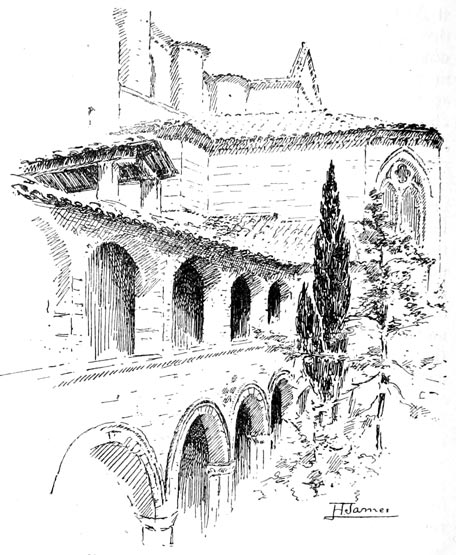
THE OLD CEMETERY OF SAN FRANCESCO
The Chapel of St. Anthony the Abbot.[80]—About 1367 two monuments were erected in this chapel over the sepulchres of two murdered princes—Messer Ferdinando Blasco, nephew of the Cardinal Albornoz, and his son Garzia. Some say they met their death at Spoleto where the father was vice-governor, others that they were killed at Assisi close to the convent of S. Appolinare by the citizens before they submitted to the kindly rule of the Cardinal. The chapel had been built by a liberal Assisan gentleman who also left money for its decoration; but if there were paintings (Vasari mentions some by Pace di Fænza) nothing now remains but a rather feeble picture by a scholar of Pinturicchio. The white stone monuments, the white-washed walls and the total absence of colour gives an uncared-for look to this out-of-the way corner of the church. A much brighter spot is the old cemetery opening out of this chapel, which was built in the fourteenth century with the intention of adorning it with frescoes in imitation of the Campo Santo at Pisa. The double cloister seen against a background of cypresses and firs, above which rises the northern side of the Basilica, form a pretty group of buildings, and can be better enjoyed now than in former days, when the bones of Assisan nobles and franciscan friars were piled in the open galleries.
The Basilica of San Francesco became the burial place, not only of some of the saint's immediate followers, but also of many distinguished personages. The large stone tomb at the end of the church is always pointed out as that of "Ecuba," Queen of Cyprus, who is said to have come to Assisi in 1229 to give thanks for having been cured of an illness by the intercession of St. Francis, when she gave the porphyry vase full of ultramarine which is still to be seen, though now empty of its precious contents. She is said to have died in 1240, and to have been buried in San Francesco. But this "Ecuba" is a mysterious person not to be found in the history of her country, which has led some writers to say that it is Iolanthe, the second wife of Frederick II, who lies here. It is one of those tombs common in the time of Giovanni Pisani, but bearing only a faint resemblance to his masterpiece in the Church of San Domenico in Perugia. "On one side," says Vasari, in surprise at the novelty of the style, "the Queen, seated upon a chair, places her right leg over the left in a singular and modern manner, which position for a lady is ungraceful, and cannot be regarded as a suitable action for a royal monument."
The tomb to the right was erected soon after 1479 in memory of Niccolò Specchi, an Assisan physician of renown attached to the persons of Eugenius IV, and Niccolò V.
Tomb of St. Francis.—Although it had always been supposed that St. Francis lay beneath the high altar, no one knew precisely the spot where Elias had hidden him. In the last centuries many attempts were made to find the tomb by driving galleries in every direction into the bed of rock on which the Basilica stands;[81] but all failed, until more energetic measures were taken in 1818. And after fifty nights of hard work, conducted with the greatest secrecy (it would seem as though the spirit of Elias still presided over the workers), below the high altar, encased in blocks of travertine taken from the Roman wall near the temple of Minerva, and fitted together neatly as those of an Etruscan wall, was found the sepulchral urn of St. Francis. It was evidently the same in which he had been laid in the Church of San Giorgio, untouched till that day. Round the skeleton were found various objects, placed, perhaps, by the Assisans, who in this seem to have followed the custom of their earliest ancestors, as offerings to the dead. There were several silver coins, amongst them some of Lucca of 1181 and 1208, and a Roman ring of the second century, with the figure of Pallas holding a Victory in her right hand engraved on a red cornelian. Five Umbrian bishops, four cardinals, numberless priests and archæologists visited the spot to verify the truth of the discovery, and finally published the tidings far and wide, which brought greater crowds than ever to Assisi, and among them no less a personage than the Emperor Francis I, of Austria. Donations poured in for building a chapel beneath the Lower Church round the saint's tomb, and in six months the work was completed by Giuseppe Brizzi of Assisi. The citizens, in their zeal, decorated it with marble altars and statues, until the tradition treasured by the people of a hidden chapel below the Basilica and rivalling it in richness was almost realised, and they flocked down the dark staircases with lighted torches to witness the accomplishment of the legends weaved by their forefathers (see p. 136). It is a most impressive sight to attend mass here with the peasants in early morning ere they go forth to their work in the fields. Silently they kneel with bowed heads near the tomb, touching it now and again through the grating with their rosaries; the acolytes move slowly about the altar and the voices of the priests are hushed, for here at least all feel the solemnity of a religious rite. The candles burn dimly with a smoky flame, the sanctuary lamps cast a flickering red light upon the marble pavement and the walls cut out of the living rock, and with the darkness which seems to press around is the damp smell, reminding us that we are indeed in the very bowels of the Assisan mountain.
CHAPTER VII
The Sienese Masters in the Lower Church. The Convent
... "Je donnerais pour ce caveau toutes les églises de Rome."—H. Taine. Voyages en Italie. Pérouse et Assisi.
The Chapel of St. Martin[82]
The best masters of Tuscany having, by the beginning of the thirteenth century, covered most of the walls of San Francesco with choice work, it now remained for Siena to send artists to complete their loveliness by effigies of calmly sweet Madonnas and saints whose gentle beauty seemed rightly fitted for their Umbrian surroundings.
The first to come, probably very few years after Giotto had left, was Simone Martini, "the most lovable," Mr Berenson calls him, "of all the artists before the Renaissance."[83] He married Giovanna Memmi, a Sienese, whose brother Lippo Memmi often helped him in minor works; this may account for the confusion between the two, and why he is so often called by his brother-in-law's surname. One of the artist's claims to immortality, the highest, according to Vasari who was not partial to the Sienese, was the praise he won from Petrarch for the portraits he painted on more than one occasion of Madonna Laura. Simone's talents were sung by the "love-devoted" Tuscan poet who calls him "mio Simon," and in one perfect sonnet tells how he must surely have been in paradise and seen the loveliness of Madonna Laura, as he has drawn her features with such fidelity that all on earth must perforce acknowledge her beauty.
The Chapel of St. Martin at Assisi is filled with such faces as Petrarch describes. It possesses, too, all the varied colour of a garden, only a garden not inhabited by earthly mortals, but by gentle knights and fairy kings wearing wonderful crowns of beaten gold, with cherubs' heads, flowers and moons upon their surface, and women who hold their lilies with caressing fingers. All gives way before his sense of the beautiful, the ornate and the charming, so that he creates a world apart of saints and angels with a feeling of remoteness about them which is one of the most striking features of his art. He loved all that was joyous; he depicted no tragic scenes; his saints have already won their crowns in heaven, his kings are conquerors, and around a death-bed the angels sing. He may sometimes fail as a story-teller, and his compositions do not always give the same sense of perfection as those of other stronger artists, but his very faults are lovable, and all can be forgiven for the exquisite finish of his paintings, which, in their brilliant colouring, are like a piece of old embroidery where design and hues have been woven in by patient fingers. "To convey his feeling for beauty and grace and splendour," says Mr Berenson, "Simone possessed means more than sufficient. He was a master of colour as few have been before him or after him. He had a feeling for line always remarkable, and once, at least, attaining to a degree of perfection not to be surpassed. He understood decorative effects as a great musician understands his instruments."[84]
It is a little difficult to find out where Simone begins his legend of St. Martin, as he seems to have fitted in the different scenes just where he could, thinking, as was only right, more of the effect of decoration than of the sequence of the story. The two frescoes on the left wall refer to the well-known act of charity, when St. Martin, a young Lombard soldier serving in the army of the Emperor Constantine in Gaul, met, on a bitter winter's day, a beggar outside the gates of Amiens, and having nothing but the clothes he wore divided his cloak with the poor man. It is not one of Simone's pleasing compositions; far better is the next where Christ appears to the saint in a dream, wearing the cloak he had given in charity and saying to the angels who surround him: "Know ye who hath thus arrayed me? My servant Martin, though yet unbaptised, hath done this." The face of the young saint is very calm and palely outlined against his golden aureole as he lies asleep, clasping his throat gently with one hand. With what patience has Simone drawn the open-work of the sheets, the pattern on the counterpane, the curtain about the bed; no detail has been passed over. And who can forget his angels, the profile of one, the thick waving hair of another, and the grand pose of the standing figure, a little behind Christ, whose head is poised so stately upon a well-moulded neck.
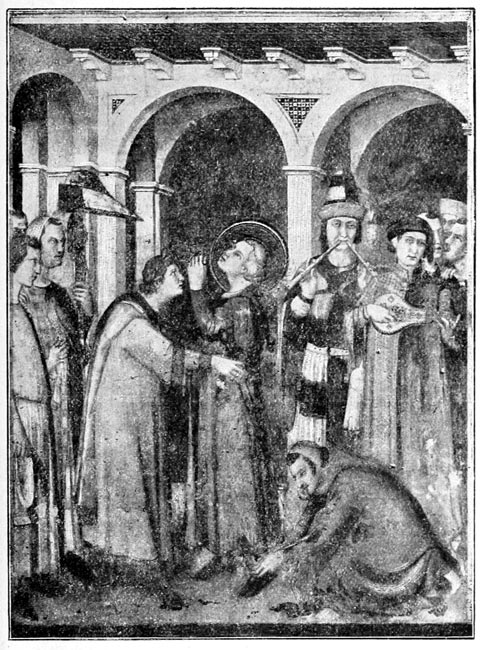
THE KNIGHTHOOD OF ST. MARTIN BY SIMONE MARTINI
(D. Anderson—photo)]
Exactly opposite are two scenes belonging to the early times of the saint's life when he was yet a soldier. In one the Emperor Constantine is giving him his sword, while an attendant buckles on the spurs of knighthood; here also, as in most of the frescoes, we pick out single figures to dwell on, such as the youth with a falcon on his wrist, whose profile is clearly outlined yet tender, with that pale red-golden tinge over the face by which Simone always charms us. Remarkable for grace and motion is the man playing on the mandoline, with a sad dreamy face, who seems to sway to the sounds of his own music; whilst almost comic is the player on the double pipes, with his curious headgear and tartan cloak.
The next scene is divided by a rocky ridge, behind which is seen the army of the Gauls, who, by the way, have Assisan lions on their shields. St. Martin, after refusing to accept his share of the donations to the soldiers, declares his intention of leaving the army to become a priest, and when accused of cowardice by the Emperor, he offers to go forth and meet the enemy without sword or shield. Simone pictures him as he steps forth upon the perilous enterprise, holding the cross and pointing to the sky, as he refuses the helmet held out to him by the Emperor. Next day, says the legend, the Gauls laid down their arms, having submitted to the word of St. Martin who was then allowed to quit the world for the religious life.
On the opposite wall, above the apparition of Christ with the cloak, we see St. Martin no longer in soldier's garb, but as the holy Bishop of Tours. The saint has fallen into a reverie whilst saying mass, and in vain a priest tries to rouse him by laying a hand upon his shoulder for his eyes remain closed, and the kneeling priest waits patiently with the book of the Gospels upon his knee. Simone never surpassed the dignity, the religious feeling, the quiet repose and ease expressed in the figure of St. Martin; while he has kept the scene as simple as one of Giotto's frescoes, thus making it the most perfect among these compositions. To the left is a much ruined picture of the restoration of a child to life through the prayers of the saint, who was preaching at Chartres. Among a crowd of people one figure, with a Florentine headgear such as Andrea del Castagno paints, stands clearly out; below a small child can be discerned stretching out little hands towards the kneeling bishop.
Above this again, almost too high to be clearly seen, is the death of St. Hilary of Poitiers, at which St. Martin assisted. One of the mourners has a mantle of turquoise blue, a beautiful piece of colour like the sky seen through the arches of the Gothic windows.
On the other wall, over the fresco where St. Martin receives knighthood, is recorded the legend of how "as he went to the church on a certain day, meeting a poor man naked, he gave him his inner robe, and covered himself as he best might with his cope. And the archdeacon, indignant, offering him a short and narrow vestment, he received it humbly, and went up to celebrate mass. And a globe of fire appeared above his head, and when he elevated the host, his arms being exposed by the shortness of the sleeves, they were miraculously covered with chains of gold and silver, suspended on them by angels."[85]
The next picture, which is very ruined, represents the visit of St. Martin to the Emperor Valentinian, who, because he had rudely kept his seat in his presence, suddenly found it to be on fire, and, as the legend says, "he burnt that part of his body upon which he sat, whereupon, being compelled to rise, contrite and ashamed, he embraced Martin, and granted all that he required of him."
Above this is the death of St. Martin, with a graceful flight of angels hovering over the bier singing as they prepare to carry his soul to heaven. Very fine is the fresco in the lunette of the entrance, where Cardinal Gentile, in his franciscan habit, is kneeling before the saint who bends forward to raise him from so humble a position. But in the single figures of saints, in the arch of this chapel, standing like guardian deities within their Gothic niches, Simone rivals greater artists in grace and strange beauty. In honour of the franciscan donor the chief franciscan saints are depicted beside two others of universal fame. St. Francis and St. Anthony of Padua, and below them St. Catherine of Alexandria and St. Mary Magdalen; on the other side, St. Louis, King of France and St. Louis, Bishop of Toulouse, and below them St. Clare and St. Elisabeth of Hungary. Nowhere has St. Clare received so true an interpretation of her gentle saintliness as in this painting by Simone, and he has surpassed his other works in the exquisite drawing of the hand which holds her habit to one side. It would seem as though in these saints he had attained the limits of his power of expressing types of pure beauty, were it not for the half figures in the embrasures of the window of such finish and subtle charm as to haunt us like some strain of long remembered music. There is a bishop in a cope of creamy white with gold embroidery, a hermit with a long brown beard, and saints who calmly pray with clasped hands. The broad white band of pale shadowed fur is low enough to show the graceful line of the neck of the young saint in the left hand window, his hair tinged with pale red and his face so fair as to seem a shadow upon the wall, coming and going in the play of light.
So enthralling is the study of the frescoes that it is possible to leave the chapel without noticing the stained-glass windows, perhaps the loveliest in the church where all are lovely. They seem to belong to the same epoch as the paintings, and in one or two instances a figure may have been inspired by them, such as the angels with sword and shield who resemble Simone's angels in the upper part of the fresco of St. Martin's death. Cardinal Gentile was in all probability the donor of these as well as of the chapel, for he is represented in the central window kneeling before St. Martin, who is in full episcopals. These windows are dazzling; there are warriors in red and green, saints standing against circles of cream-tinted leaves, St. Jerome in magenta-coloured vestments harmonising strangely with the crimson of his cardinal's hat; and St. Anthony of Padua in violet shaded with paler lights as on the petals of a Florentine iris. A saint in white is placed against a scarlet background, another in pale china blue against a sky of deep Madonna blue, and all these colours lie side by side like masses of jewels of every shade.
On leaving we find to the left of the papal throne a small chapel ornamented only by a window which has an apostle standing in a plain Gothic niche, the ruby red and tawny yellow of his mantle making a brilliant patch of colour in this dark corner of the church. The head is modern, but the figure, the circular pattern beneath, and the right half of the window with five medallions, are, according to Herr Thode, the oldest pieces of coloured glass in the lower church.
Just above the papal throne is a handsomely worked ambo in red marble and mosaic, forming a kind of pulpit from which many illustrious people have preached, among them St. Bonaventure and St. Bernardine of Siena. In the recess a Florentine artist of the fourteenth century has painted the Coronation of the Virgin, a fresco worthy of its beautiful setting; and there is a crucifixion and scenes from the martyrdom of St. Stanislaus of Poland by a follower of Pietro Lorenzetti, pupil of Simone Martini. St. Stanislaus was canonised in 1253 when Innocent IV, came to consecrate the Basilica, and upon this occasion a miracle took place which redounds to the honour of the saint. While Cardinal de Conti (afterwards Alexander IV,) was preaching, one of the capitals of a pillar above the pulpit fell upon the head of a woman in the congregation, and thinking she was dead, as she had sunk down without a groan, her neighbours covered her over with a cloak "so as not to disturb the solemnity of the occasion." But to their amazement when the sermon ended the woman rose up and gave thanks to St. Stanislaus, for the blow, far from doing her harm, had cured her of headaches to which she had been subject. The legend would long since have been forgotten, were it not that the capital which fell on that memorable day is still suspended by chains in the opposite corner of the nave, and often puzzles the visitor who does not know its history.
Below the pulpit is a slab of red marble let into the wall with these simple words inscribed: "Hic jacet Jacoba sancta nobilisque romana," by which the Assisans commemorated the burial place of Madonna Giacoma da Settesoli the friend of St. Francis, who after his death lived at Assisi and followed the rule of the Third order until she died in 1239 (see p. 114).
Left Transept.—To Pietro Lorenzetti was given the work of decorating these walls with scenes from the Passion, and so far as completing the rich colour of the church be succeeded. But when studied as separate compositions they betray the weakness of an artist who, as Mr. Berenson remarks, "carries Duccio's themes to the utmost pitch of frantic feeling." Great prominence is given to the subject of the crucifixion where the vehement actions of the figures rather than the nobility of the types are pre-eminent. It may be of interest to some that the man on the white horse is said to be Gualtieri, Duke of Athens, the tyrant of Florence, whose arms Vasari says he discovered in the fresco which he describes as the work of Pietro Cavallini.
A curious composition is that on the opposite wall where the disciples sit in awkward attitudes and the servants in the kitchen are seen cleaning the dishes while a dog hastily licks up the scraps. It would be difficult to know this represented a religious scene were it not for the large aureoles of the apostles. Nor has Pietro succeeded in giving solemnity to the scene of the Stigmata, where the strained position of St. Francis and the agitated movement of the Seraph partake of the general characteristics of these frescoes. But in his Madonna, St. Francis and St. John the Evangelist, below the crucifixion, Pietro Lorenzetti gives his very best and their faces we remember together with the saints of Simone Martini. Referring to this fresco M. Berenson says: "At Assisi, in a fresco by Pietro, of such relief and such enamel as to seem contrived of ivory and gold rather than painted, the Madonna holds back heart-broken tears as she looks fixedly at her child, who, Babe though he is, addresses her earnestly; but she remains unconsoled."[86]
Chapel of S. Giovanni Battista.[87]—Another lovely work by Pietro Lorenzetti is the triptych over the altar, the Madonna, St. Francis and St. John the Baptist, but here the action of the child leaning towards the Virgin and holding the end of her veil, is more caressing and suggestive of babyhood. Above are small heads of angels like those Pietro places in medallions round the frescoes in the south transept. This, and the panel picture over the altar in the opposite chapel, complete the works of the Sienese school in Assisi. The Umbrian school is represented by a large and unsympathetic picture by Lo Spagna (dated 1526), which is however considered by local admirers of the painter to be his masterpiece. It is a relief to turn from his yellow-eyed saints and hard colouring to the windows of this chapel which are remarkable for their harmony and depth of tone.[88] The figures of the central window date from the second half of the thirteenth century, those of the left window are at least two centuries later.
The Sacristies.—These open out of St. Giovanni's Chapel. Both are ornamented with handsomely carved cupboards of the sixteenth century where the friars store their vestments and costly lace, and which once were full of gold and silver vessels amassed during many centuries. But often during mediæval times of warfare the friars had to stand aside and see the sacristies sacked by the Perugians, or even the Assisans, when they must have envied the peace of mind of the first franciscans who, possessing nothing, could have no fear of robbers.[89]
Devoted as the citizens were to the memory of St. Francis they do not seem to have hesitated, when in want of money, to help themselves liberally to the things in his church. At one time when the Baglioni were besieging Assisi, her despot Jacopo Fiumi gathered the citizens about him, and in an eloquent harangue called upon them to rob the church at once before the enemy had entered the gates, lest the treasure should fall into the hands of the Perugians. So the sacristies were rifled, and with the proceeds Jacopo Fiumi rebuilt the walls and the palaces which had fallen to ruin during the incessant fighting of past years. The next plunderers were the soldiers of Napoleon, and it is a marvel that so many things still remain. A cupboard in the inner sacristy contains a beautiful cross of rock-crystal ornamented with miniatures in blue enamel brought by St. Bonaventure as a gift from St. Louis of France; there is also the second rule of St. Francis which was sanctioned by Honorius III. Even more precious is a small and crumpled piece of parchment, with a blessing written in the big child-like writing of St. Francis, which he gave to Brother Leo at La Vernia after he had received the Stigmata. On one side he wrote part of the Laudes Creatoris, upon the other the biblical blessing:
"Benedicat tibi Dominus et custodiat te: Ostendat faciem suam tibi et misereatur tui: Convertat vultum suam ad te et de tibi pacem":
and then below:
"Dominus benedicat te, Frate Leo."
Instead of the Latin, the saint signs with the Thau cross, which is of the shape of the mediæval gallows, and may have been yet another way of showing his humility by humbling himself even to the level of malefactors. Many pages have been written about this relic; the line by Brother Leo in explanation below the signature of St. Francis:
"Simili modo fecit istud signum Thau cum capite manu sua,"
has puzzled many people, but in a pamphlet by Mr Montgomery Carmichael[90] it has received a plausible translation. He thinks that cum capite refers to the small knob at the top of the Thau, by which St. Francis meant to represent a malefactor's head; the line would read thus: "in like manner with his own hand he made a cross with a head," and not "with his own head," as some believe. Mr Carmichael thinks the curious mound out of which the cross rises is a rough drawing of La Vernia. Above the benediction, in neatly formed letters, Brother Leo has written a short account of the sojourn at the Sacred Mount and of the Vision of the Seraph. This relic has been mentioned in the archives of the convent since 1348, and is always carried in procession at the commencement of the feast of the "Perdono" on July 31st.
Almost more honoured by the faithful is the "Sacred Veil of the most Holy Virgin," which can only be exposed to the public in the presence of the Bishop of Assisi, and is shown in times of pilgrimage when the sacristy and church are full of men and women waiting for their turn to kiss the holy relic.
The picture over the door, painted by Giunta Pisano (?) is always pointed out as a portrait of St. Francis, but as the painter's first visit to Assisi was in 1230 he can only have seen the body of the saint borne to its last resting-place in the Basilica, and even that is doubtful when we remember with what secrecy the burial was performed. Here the face is pointed and emaciated, with a curious look in the eyes as though Giunta had desired to record his blindness. The figure is surrounded by small scenes from the miracles of St. Francis, performed during his lifetime and at his tomb in San Giorgio. But though in the so-called portraits of the saint, the artists think more of representing him as the symbol of asceticism and sanctity than of aiming at giving a true likeness, both this picture and a fresco painted in 1216 at Subiaco when the saint stayed there on his way to Spain, are not very dissimilar from the graphic description left us by Celano. He tells us that St. Francis "was rather below the middle stature with a small round head and a long pinched face, a full but narrow forehead and candid black eyes of medium size, his hair likewise was black; the brows were straight, the nose well-proportioned, thin and straight, the ears erect but small, and the temples flat; his speech was kindly, yet ardent and incisive; his voice powerful, sweet, clear and sonorous; his teeth were regular, white and set close; his lips thin and mobile, his beard was black and scant, his neck thin, his shoulders square; the arms were short, the hands small with long fingers and almond-shaped nails, his legs were thin, his feet small, his skin delicate, and he was very thin...."
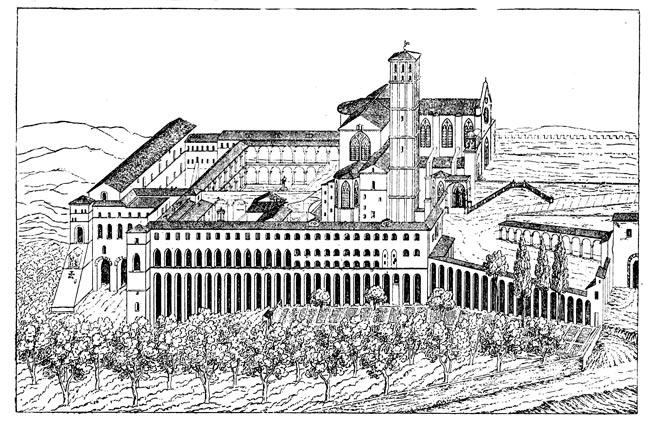
BIRD'S EYE VIEW OF THE BASILICA AND CONVENT OF SAN FRANCESCO, FROM A DRAWING MADE IN 1820
Right Transept.[91]—On the walls between the Chapels of the Sacramento and of St. Maria Maddalena, Simone Martini has left some of his loveliest work in the half figures of franciscan saints he places near the Madonna. These are St. Francis, St. Louis of Toulouse, St. Elizabeth of Hungary, St. Clare clothed in the habit of her order, always to be recognised when painted by Simone by her heavy plaits of hair, St. Anthony of Padua with the lily, St. Louis of France with a crown of fleur-de-lis, and upon the right of the Virgin, a noble saint who may be Helen the mother of King Louis, as she too holds a sceptre with the lily of France on the top. Never had saints so majestic a queen as Simone's Madonna. The subdued greens and tawny reds of their mantles and their auburn hair look most beautiful against the gold ground which shines with dull light about them. Each of their aureoles bears a different pattern in raised gesso; a garland of flowers, a circle of human heads, suns, a tracery of roses and ivy, or yet again another of oak leaves. After Giotto's Allegories and the frescoes in San Martino, these saints are by far the loveliest things in San Francesco, and as they look towards us, ethereal, like a faint moon on a misty night, they seem the very incarnation of mediæval faith. Dante created women such as Matilda, who sings to him in Purgatory as she is picking flowers on a woodland river's edge, and Simone paints them and conveys their spirit in the faces of St. Clare and St. Elizabeth.
The Convent
It is natural to think that the Basilica and Convent built under the guidance of Elias was as we see it now in its full magnificence of chapels, porch, colonnades and cloisters. Certainly the essential form of the building has not been altered, but in the early days it stood isolated from the town, surrounded by such rocks as jut out among the grass in the ravine outside Porta S. Pietro, and approached by a drawbridge which made it resemble, even more than it does now, a feudal stronghold guarding the Umbrian valley. Later on, as the life of the place centred ever more round the church of the saint, the citizens no longer built their houses near San Rufino or below the castle, but close to San Francesco, until a second town sprang up where once were only rough mountain pastures. It is still possible to form an idea of how it looked by following round the base of the hill by the Tescio, whence a wonderful and unique view of the northern side of church and convent is obtained (see Appendix). Assisi lies hidden, and standing high above us, shutting out the view of the valley, is San Francesco; not the building with great arches we are familiar with, rising high above the vineyards, but a castle, seen clearly defined and strong against the sky, whose bastions clasp the hill top as powerfully as a good rider bestrides his horse. Oak copses cover the slopes from the convent wall straight down to the banks of the Tescio, where little mills are set above deep pools of emerald green water and narrow canals fringed by poplar trees. The minute detail of the landscape in this deep ravine gives a curious feeling that we are walking in the background of one of Pier della Francesca's pictures—even to the distant view of low-lying hills where the torrent makes the sudden bend round the mountain edge; and the contrast is strange between it and the fortress-church upon the dark hill, where deep shadows lie across it and lurk within the crannies of its traceries in the bay windows of the chapels and in the depths of jutting stones. Such was the massive building "Jacopo" planned to stand upon the mountain ridge, as much a part of the rocks and the red earth as the cypresses which crown the summit. And in the midst, but on the southern side, he placed, as if to balance the rest, a square and boldly conceived bell-tower rising high above the church.[92] At the time it was the wonder of the Assisans, who boasted that for beauty as well as for solidity it could be counted among the first, not in Italy only, but in Europe. Bartolomeo of Pisa, came to cast one of the big bells, and together with his own name he inscribed those of Elias, Gregory IX, and Frederick II. On another bell, which has been recast, was graven a delightful couplet informing the faithful of the many services which consecrated bronze could render to the country round.
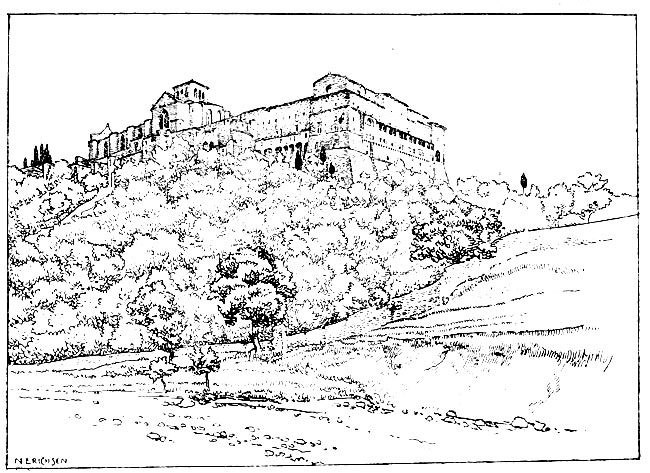
SAN FRANCESCO FROM THE TESCIO
"Sabbatha pango, funera plango, fulgura frango: Excito lentos, domo cruentos, dissipo ventos." ("I ring in Sunday, I lament for the dead, the lightning I break, I hurry the sluggards, I vanquish the wicked, the winds I disperse.")
To the time of Elias also belongs the fine entrance to the Upper Church, where the Guelph lion and the eagle of Frederick II, record the liberality of both parties towards the building of the church, while the four animals round the wheel window seem to show that "Jacopo," notwithstanding his marked love for pure Gothic architecture, could not quite forget the strange but fascinating beasts of Lombard façades.
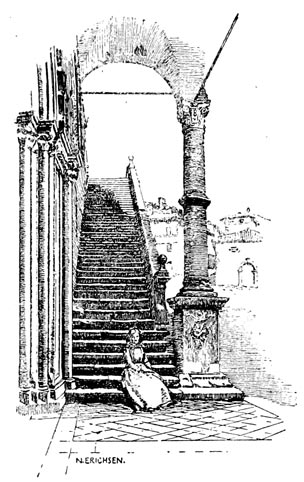
STAIRCASE LEADING FROM THE UPPER TO THE LOWER PIAZZA OF SAN FRANCESCO
One friar in the fifteenth century inherited some of the enthusiasm of Elias for the basilica; this was Francesco Nani, the General of the franciscans, known as Francesco Sansone because his patron, Sixtus IV, is said to have addressed him with these words in allusion to his energy and strength of character, "Tu es fortissimus Samson." His name is found upon the beautiful stalls of the Upper Church, and it was he who superintended the laying out of the upper piazza, connected with the lower one by a long flight of stairs. It may also have been at this time that the loggie of San Francesco were built for the purpose of erecting booths during the festival of the "Pardon of St. Francis." Certainly it was chiefly at his expense that Baccio Pintelli (1478) built the handsome entrance door and porch to the Lower Church, which in olden times was entered by a small door close to the campanile. The architect fitted his work admirably into a corner of the building, completing with clustered columns of pink marble, wheel window, trefoiled arches and stone traceries, the scheme of colour and the perfect proportions for which San Francesco is so remarkable. The doors of carved wood, darkened now and of such massive workmanship as to resemble bronze, were made in 1546 by Niccolò da Gubbio, who has carefully commemorated the legend of St. Francis and the wolf of Gubbio in one of the panels to the left. Sansone also commissioned the doorway of what is now the entrance to the friars' convent a year after the porch was finished, then it was only a small chapel, built by the members of the Third order when St. Bernardine of Siena revived the religious enthusiasm of the people. The Assisan artist placed a bas-relief of the saint in the arch above the door, and it is still called "la porta di San Bernardino."
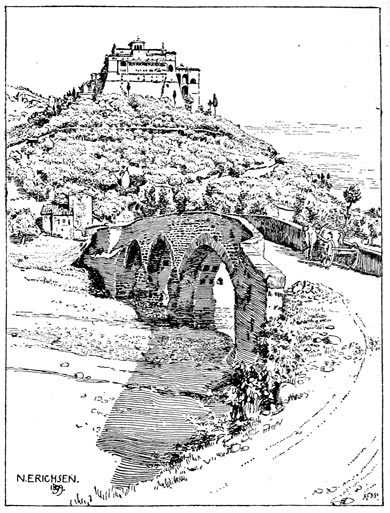
SAN FRANCESCO FROM THE PONTE S. VITTORINO
None should leave Assisi, not even those who only hurry over for the day, without visiting the convent, which recalls an eastern building from the whiteness of its great vaulted rooms, long corridors and arcaded courtyards when seen against the bluest of summer skies.[93] Then from the cool and spacious convent, a place to linger in upon a hot day in August, we step out into the open colonnade which skirts the building to the south, makes a sharp turn west, and then juts out at the end, facing south again. This last portion was added by Cardinal Albornoz in 1368, and goes by the name of the Calcio. But two centuries later the foundations were found to be insecure, and Sixtus IV, strengthened it by a bastion, which looks solid enough to resist even the havoc of an earthquake. The Pope was a great benefactor of the convent, and the friars placed his statue in a niche in the bastion, where he sits, his hand raised in benediction, on a papal throne overlooking the valley. From the rounded arches of rough stone, turned by storm and sunshine to russet-red, pink and yellow, we look out upon one of the most beautiful and extensive views in Umbria. To the right is Perugia standing out almost aggressively on the hill top; opposite, on a separate spur which divides the valley of Spoleto from that of the Tiber, Bettona and Montefalco hang upon peaks like the nests of birds in trees, and beyond are Spoleto, Trevi and Narni, nearer again Spello, and the domes of Foligno in the plain, with a host of small villages near. All the Umbrian world lies before us from the convent of San Francesco.
Many weary people besides the popes came to rest here in early times, and one mediæval warrior, Count Guido of Montefeltro, the great leader of the Ghibellines, laid down his arms and left his castle at Urbino in the year 1296, to pass his last days as a friar doing penance within the peaceful shelter of San Francesco for a long life of intrigue and bloodshed. He prayed by day, for at night they say he stood gazing out of his window, one of those we see above the walled orchard of the monks, watching the stars and attempting to divine the mysteries and destinies he read there, exceeding even the superstition of the age by his faith in the laws of astrology. But his meditations and careful preparation for a holy death were suddenly disturbed, and he found himself once more plunged into the whirl of Italian politics and intrigue. War raged between Pope Boniface VIII, a Gaetani, and the powerful family of the Colonna who braved his excommunications, and, when their Roman palaces were burnt, fled to their strongholds in the country. Many of these fell into the hands of the papal troops, but Penestrino, their principal fief, resisted all attacks and the Pope was nearly defeated when, remembering the old soldier Count Guido known to be "more cunning than any Italian of his time, masterly alike in war and in diplomacy," he hastened to ask his counsel. The story is recounted by Dante, who could not forgive the Ghibelline chieftain for coming to the assistance of the Pope.
Boniface, seeking to silence the scruples of the friar, promised to absolve him from all sin, even before committal, if only he would tell him how to act so "that Penestrino cumber earth no more." Guido, whose subtlety had not deserted him in the cloister, gave an answer which, while it ensured success to the papal arms, stamped him as a man of such deceit and treachery that Dante placed him in the eighth gulf of hell, among the evil counsellors eternally surrounded by flaming tongues of fire.
"Then, yielding to the forced arguments, Of silence as more perilous I deem'd, And answer'd: 'Father! since thou washest me 'Clear of that guilt wherein I now must fall, 'Large promise with performance scant, be sure 'Shall make thee triumph in thy lofty seat.'"[94]
Besides Count Guido and the popes who, finding the large and airy rooms of the convent a convenient summer resort, were constant visitors at Assisi, it can show a fine list of royal visitors. Among them is the Queen of Sweden who, in 1655, came escorted by Papal Nuncios, foreign ambassadors and cavalry, to pray at the tomb of St. Francis. The Assisans sent out their best carriages with horses ridden by postillions to meet her, adorned their palaces with flags and damask hangings, and rang all the bells as she approached the Basilica. "The Queen is called Christina," a chronicler tells us; "she is aged twenty-nine, is very learned, being able to write in eleven languages; she is small but very comely.... One hundred and fifty beds were prepared in the convent and beautiful it was to see the numerous suite and the pages of the nobles."
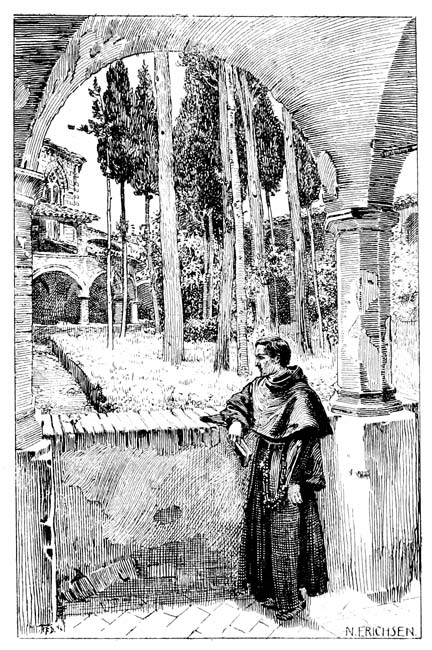
A FRIAR OF THE MINOR CONVENTUAL ORDER OF ST. FRANCIS
It strikes the visitor to Assisi as strange that the black-robed friars in charge of the Basilica are so unlike the franciscans with whom everyone is familiar, and it may be well to give a few facts relating to the many divisions in the Order which, as we have seen, began already to change in the time of Elias. In 1517 a portion of the brethren, desiring a mitigation of their rule, obtained from Leo X, a dispensation and received the title of Friars Minor Conventuals with the permission to choose their own Minister General. Their dress is shown in the illustration. Those who kept to the rule more nearly approaching to that of St. Francis, like those of Sta. Maria degli Angeli, the Carceri and San Damiano, were called Friars Minor of the Observance, or Observants, and take precedence over the others, enjoying the privilege of electing the "Minister General of the whole order of the Friars Minor and successor of St. Francis." In 1528, Matteo Baschi, an observant, instituted a new branch called the Capucins, because of their long pointed capuce, whom he inspired with the desire to lead a hermit's life in solitary places, preaching to the people but once in the year. They have deserted their hermitages and are a very popular order in Italy, devoting themselves especially to preaching and hearing confessions, and form quite a distinct family from the rest. The Basilica at Assisi no longer belongs to the Conventuals, as after the union of Italy it was declared to be a national monument. The Government also took possession of the convent as a school for boys, leaving only a small portion for the reduced number of friars to inhabit. They went to law, and the judge pronounced the convent to be the property of the Holy See which had never ceased to exercise jurisdiction over it; but a proviso was made that the school was to remain in its present quarters until the Pope or the franciscans should erect a suitable building for it in another part of the town. As much money is required for so large an edifice and sites are not so easily procured, it seems probable that for many years the sound of boys at play will be heard in the convent walls instead of the slow footsteps of silent friars.
CHAPTER VIII
Giotto's Legend of St. Francis in the Upper Church
"What, therefore, Giotto gave to art was, before all things, vitality."—J. A. Symonds. Renaissance in Italy.
Giotto in the Lower Church had felt his way towards the full expression of his genius; succeeding so well in the four Allegories that he was chosen to illustrate the life of St. Francis, withheld, as we have seen, from all former artists, while Cimabue was to hear the poet's praise of his pupil, "Ora ha Giotto il grido." The task undertaken by the young painter, already a master at twenty-five, was almost superhuman, and certainly unique in the career of any artist; for whereas the pictorial treatment of the New Testament had been attempted by many during several centuries, Giotto was destined to invent forms for the whole franciscan cycle with such perfection that no succeeding artist has varied his formula. It remains a wonderful achievement, and the noble manner of its accomplishment proved him to be, as Mr Roger Fry expresses it, "the supreme epic painter of the world."
If St. Francis was fortunate in having his life related by so admirable a story-teller, Giotto also owed something to the early chroniclers who seeing, perhaps unconsciously, the extraordinary poetry and the dramatic incidents in the saint's career, had faithfully recorded them in simple and beautiful language. So far the work was ready for Giotto, even the exact scenes were chosen for him to illustrate, but the problem how to unfold and make them familiar to the faithful by simple means, and yet not to lose the dignity and charm of the theme, remained for him to solve; and the representation, by a few figures, of a whole dramatic incident in so vivid a manner could only have succeeded in the hands of a great master of the fourteenth century. It is nearly certain that Giotto used St. Bonaventure's Life of St. Francis, finished in 1263 and founded, with but few additions, upon The Three Companions and Celano's first and second Life of St. Francis. Though written with a certain charm of style and though it lacks the ring of those early pages, in which St. Francis becomes known to us in such a way that we forget he lived seven hundred years ago; and although the various incidents of his life are presented like so many beautiful pictures, there is the feeling always that St. Bonaventure was writing about a saint already honoured upon earth and in heaven, and not of the man whom all loved as the "Poverello d'Assisi." But this legend served Giotto's purpose; and a knowledge of the words he followed being necessary in order to see where he simply kept to the franciscan legend, and where he penetrated the true spirit of the saint's life and its dramatic interest, we quote from it at some length, although many of the main facts have already been treated of in a preceding chapter.[95]
1. St. Francis honoured by the Simpleton.—(We begin on the right wall by the High Altar, and follow straight on to the opposite side, the legend unfolding as in the pages of a book.)
"A certain man of great simplicity dwelt in those days in Assisi, who, by virtue of knowledge divinely infused, whenever he met Francis in the street, would take off his mantle, and spread it upon the ground before him, declaring that he did so because he was a man worthy of all honour and reverence, who should shortly perform great works and marvellous deeds...."[96]
The bare facts are here narrated which Giotto does not alter, but he puts such life into the scene that we feel he might have been present when the simpleton cast himself at Francis' feet and astonished the Assisans by his words. Attention is fixed upon the six people in the foreground. Two worthy citizens have just arrived in time to see the cloak being spread on the ground before Francis, and to hear the prophetic words; and as they turn to each other, one pointing to the scene, the other raising his hand with a movement of surprise, we seem to hear their carping criticisms upon the brilliant youth who, although he spent his time in singing and carousals, was one day to bring renown to their city. The young Francis, ever heedless of worldly comment, is stepping lightly on to the cloak, with a movement of surprise that he should receive such honour. All have the Florentine headgear, but the head of St. Francis is covered by a small white cap fitting close behind the ears, just showing his hair in front, and we feel that Giotto would have left him so, but the franciscans, ever to and fro in the church to see that the story was painted as they liked, insisted upon an aureole being added. As much glory for St. Francis they cried, as gold and money can give him. So Giotto, who disliked unnecessary decorations, was made to put an aureole above the white cap, larger than any we have ever seen. But take away the halo and we should yet know which of the figures is the saint, for he stands a little apart from his two noble friends with ermine lined cloaks who talk with hands clasped together, and is perhaps already wondering about the destiny which awaits him and of which he was unaware, "for as yet he understood not the great purposes of God towards him."
Besides the human interest of the frescoes it is a delightful task to study the architecture in each scene, for here, in the Upper Church, Giotto has built a whole city of little pink houses with balconies, towers and turrets, of exquisite Gothic basilicas, of temples and gabled thrones. His priests sit within palaces full of lancet windows and pointed arches, the groined roofs, as in the Assisan Church, ablaze with myriads of stars. What love he had for dainty ornaments, simple, nay almost severe in outline, but perfectly finished; and he always likes to show the blue sky overhead, or at least peeping through one of the windows, making the marble seem more lustrous and creamy white. Would that all Florence had been built by him.
2. St. Francis giving his cloak to a poor Knight.
"Going forth one day, as was his wont, in apparel suited to his state, he met a certain soldier of honour and courage, but poor and vilely clad; of whose poverty, feeling a tender and sorrowful compassion, he took off his new clothes and gave them to the poor man-at-arms."
None are there to witness the kind action of the young saint who, like another St. Martin, has dismounted to give his mantle to the poor man in a ravine near a little town enclosed by walls, a church spire rising upon the opposite hill. Giotto must have been thinking of the small rock-set towns, with stunted trees growing outside their walls, in his Tuscan home in the Mugello when he painted this, instead of the Umbrian town, standing amid vineyards and cornfields above an open valley with winding rivers, whose church he was decorating. It is the only one of the series in which the landscape is an important part of the picture, in the others it is a mere accessory.
3. The Vision of St. Francis.
"On the following night, when he was asleep, the divine mercy showed him a spacious and beautiful palace filled with arms and military ensigns, all marked with the Cross of Christ to make known to him that his charitable deed done to the poor soldier for the love of the great King of heaven should receive an unspeakable reward."
It will be remembered that after this dream St. Francis started to join the army of Walter de Brienne, having wrongly interpreted the vision, which in reality symbolised the army he was eventually to lead in the service of the Pope (see p. 44). This is, perhaps, the least successful of the frescoes; probably the subject did not appeal strongly to the painter (he only seems to have enjoyed inventing the colonnaded palace with its trefoil windows) and also, as Mr Ruskin explains: "Giotto never succeeded, to the end of his days, in representing a figure lying down, and at ease. It is one of the most curious points in all his character. Just the thing which he could study from nature without the smallest hindrance, is the thing he never can paint; while subtleties of form and gesture, which depend absolutely on their momentariness, and actions in which no model can stay an instant, he seizes with infallible accuracy."[97]
4. St. Francis praying before the Crucifix in San Damiano.
"As he lay prostrate before a crucifix he was filled with great spiritual consolation, and gazing with tearful eyes upon the holy cross of the Lord, he heard with his bodily ears a voice from the crucifix, which said thrice to him: 'Francis, go and build up My house, which as thou seest, is falling into ruin.'"
Unfortunately this fresco is much faded and in parts peeled off; this, combined with the representation of a ruined church, gives a curious effect of total destruction, as if an earthquake had passed over the land. The figure of the saint, just visible, and his attitude of earnest prayer is very charming.
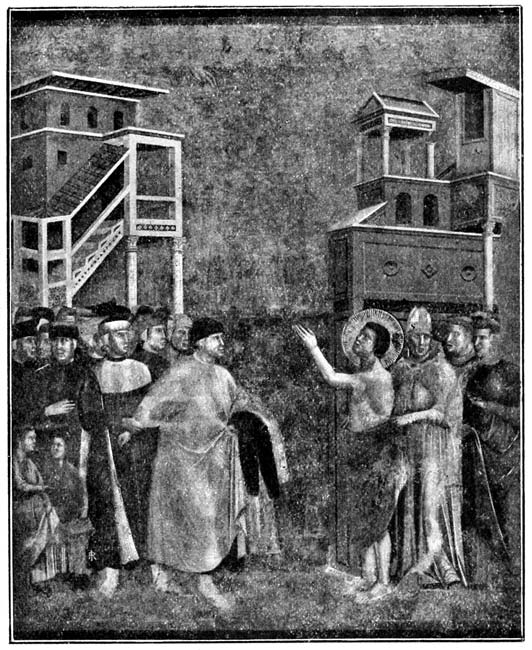
ST. FRANCIS RENOUNCES THE WORLD
(D. Anderson—photo)
5. St. Francis renounces the world.
"And now his father, ... brought this son, ... before the Bishop of Assisi to compel him to renounce in his hands all his inheritance.... As soon, therefore, as he came into the Bishop's presence, without a moment's delay, neither waiting for his father's demand nor uttering a word himself, he laid aside all his clothes, and gave them back to his father.... With marvellous fervour he then turned to his father, and spoke thus to him in the presence of all: 'Until this hour I have called thee my father on earth; from henceforth, I may say confidently, my Father Who art in heaven.'"
This, perhaps the most interesting of Giotto's frescoes, can be compared with the one in Sta. Croce at Florence on the same subject, painted when time and labour had given greater strength to his genius. The Assisan scene is treated with more simplicity, and, if less perfect as a decorative scheme, possesses quite as much dramatic interest and vitality. A little block of pink houses on either side reminds us that we are outside the Bishop's palace in the Piazza S. Maria Maggiore, where the scene is said to have occurred. Of course all the Assisans have turned out to see how the quarrel between Bernardone and his son will end. They stand behind the irate father like a Greek chorus, while one, evidently a citizen of distinction from his ermine lined cloak and tippet, restrains Messer Pietro, who is throwing back his arm with the evident intention of striking his son. Francis' passion for repairing Assisan churches and ministering to the wants of the poor had proved a costly business to the thrifty merchant, who loved his money and had little sympathy with Assisan beggars (sojourners in Assisi may agree with him). Delightful are the two tiny children who with one hand clutch up their garments, full of stones to throw at St. Francis. The bishop is the calmest person there, turning to his priests he seems to say: "All is well, there is God the Father's hand in the sky (with a little patience it can be distinguished in the fresco), and we are sure to gain the day, spite of Pietro's angry words." And so he quietly folds his episcopal mantle around St. Francis, who from this moment becomes indeed the Child of heaven. It may seem strange, as Mr Ruskin truly observes, that St. Francis, one of whose virtues was obedience, should begin life by disobeying his father, but Giotto means to show that the young saint was casting off all worldly restraint in order to obey the Supreme Power, and the scene is a counterpart to Dante's lines referring to his marriage with the Lady Poverty.
"A dame, to whom none openeth pleasure's gate More than to death, was, 'gainst his father's will, His stripling choice: and he did make her his, Before the spiritual court, by nuptial bonds, And in his father's sight: from day to day, Then loved her more devoutly."[98]
6. The dream of Innocent III.
"He saw in a dream the Lateran Basilica, now falling into ruin, supported by the shoulders of a poor, despised, and feeble man. 'Truly,' said he, 'this is he who by his works and his teaching shall sustain the Church of Christ.'"
In the representations of this vision painted for Dominican churches, the Lateran is always supported by the two great founders, Francis and Dominic, who, in their different ways, helped Innocent in his difficult task of reforming the Church. Giotto shows his power and the advance art is making under his hand, in the figure of St. Francis, who with body slightly bent back and one hand on his hip, seems to support the great weight, while his feet are so firmly planted that there is no uncomfortable feeling of strain and only a sense of strength and security. Two men are seated by the bedside of the Pope, one is asleep while the other keeps watch, and in his slightly wearied attitude and the reposeful figure of the sleeper, Giotto's keen observation of the ordinary incidents of every day life is very apparent.
7. Innocent III, sanctions the Rule of St. Francis.
"He was filled with a great and special devotion and love for the servant of God. He granted all his petitions, and promised to grant him still greater things. He approved the Rule, gave him a mission to preach penance, and granted to all the lay brothers in the company of the servant of God to wear a tonsure smaller than that worn by priests, and freely to preach the Word of God."
Giotto, in his fresco, has to represent the most important event in the life of the saint—his arrival at the papal court when he comes face to face with one of the greatest of the Roman Pontiffs; and by the simplest possible means the scene is brought before us. Here are no crimson-robed cardinals, no gilded papal throne; the bishops grouped behind Innocent are hardly noticed, or even the brethren who, with hands clasped as though in prayer, press closely to their leader like a flock of sheep round their shepherd. The eye is so fixed upon the two central figures, that all else fades away. Giotto has seized the supreme moment when the Pope, having overcome his fear lest St. Francis should falter in a life of poverty and prove to be only another heretical leader of which Italy had already too many, is, with kingly gesture, giving the Umbrian penitent authority to preach throughout the land. St. Francis, holding out his hand to receive his simple Rule, now bearing the papal seals, looks up with steady gaze; he is the most humble among men kneeling at the feet of Rome's sovereign, but strong in love, in faith and in knowledge of the righteousness of his mission. M. Paul Sabatier has beautifully illustrated the meaning of Giotto when he writes: "On pourrait croire que le peintre avait trempé ses lèvres dans la coupe du Voyant Calabrais [Joachim de Flore] et qu'il a voulu symboliser dans l'attitude de ces deux hommes la rencontre des représentants de deux âges de l'humanité, celui de la Loi et celui de l'Amour."
8. Vision of the Friars at Rivo-Torto.
"Now while the brethren abode in the place aforesaid, the holy man went on a certain Saturday into the city of Assisi, for he was to preach on the Sunday morning in the Cathedral Church. And being thus absent in body from his children, and engaged in devout prayer to God (as was his custom throughout the night), in a certain hut in the canon's garden, about midnight, whilst some of the brethren were asleep and others watching in prayer, a chariot of fire, of marvellous splendour, was seen to enter the door, and thrice to pass hither and thither through the house; ..."
Giotto's was not a nature to find much enjoyment in the portrayal of such events as saints being carried aloft in fiery chariots, and in dealing with this miracle he dedicated all his power to representing the astonishment of the brethren who witness the vision at Rivo-Torto. Two talk together and point to St. Francis being borne across the heavens by crimson horses, one hastens to awaken his companions who are huddled together in their hut like tired dogs asleep, and another starts from his slumbers to hear the wondrous news.