Front matter (continued 3)
Reading edition
Things went smoothly enough when left to the management of such friars as Leo, Masseo or Rufino, but when one day the office of cook fell to Juniper, that dear jester of the brotherhood, we get a humorous picture of what his companions sometimes had to endure, and of the kindness with which they pardoned all shortcomings. The brethren had gone out, and Juniper being left alone devised an excellent plan whereby the convent might be supplied with food for a fortnight, and thus the cook have more time for prayer. "With all diligence," it is related in the Fioretti, "he went into the village and begged for several large cooking-pots, obtained fresh meat and bacon, fowls, eggs and herbs, also he begged a quantity of firewood, and placed all these upon the fire, to wit, the fowls with their feathers on, the eggs in their shells, and the rest in like fashion." When the brethren came home, one that was well acquainted with the simplicity of Brother Juniper went into the kitchen, and seeing so many and such large pots on a great fire, sat down amazed without saying a word, and watched with what anxious care Brother Juniper did this cooking. Because of the fierceness of the fire he could not well get near to skim the pots, so he took a plank and tied it with a rope tight to his body and sprang from one pot to the other, so that it was a joy to see him. Contemplating all with great delight, this brother went forth from the kitchen and finding the other brothers, said: "In sooth I tell you, Brother Juniper is making a marriage feast."
Then in hurried Juniper, all red with his exertions and the heat of the fire, explaining the excellent plan he had devised; and as he set his mess upon the table he praised it, saying: "Now these fowls are nourishing to the brain, this stew will refresh the body, it is so good"; but the stew remained untasted, for, says the Fioretti, "there is no pig in the land of Rome so famished that he would eat of it."
At the end of any foolish adventure Brother Juniper would always ask pardon with such humility that he edified his companions and all the people he came in contact with, instead of annoying them with his childish pranks. His goodness was manifest, and St. Francis was often heard to say to those who wished to reprove him after one of his wildest frolics, "would that I had a whole forest of these junipers."
Between the men who lived at the Portiuncula with the saint, and those who in later times ruled large convents in the cities, the contrast is so great that we would wish to draw still further from these inexhaustible chronicles which reveal so charmingly the life of these Umbrian friars. But to tell of all the events connected with the Portiuncula would mean recounting the history of the whole franciscan brotherhood, and we must now pass over many years to that saddest year of all, when St. Francis was brought to die in the place he had so carefully tended.
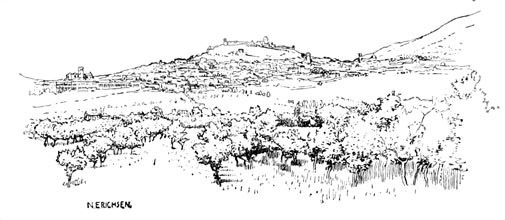
ASSISI FROM THE PLAIN
Knowing that he had but a few more weeks of life, he begged the brethren to find some means to carry him away from the Bishop's Palace at Assisi where he had been staying some time. "Verily," he told them pathetically, "because of my very infirmity I cannot go afoot"; so they carried him in their arms down the hill to the plain, and when they came to the hospital of San Salvatore dei Crociferi they laid him gently down upon the ground with his face towards Assisi, because he desired to bless the town for the last time before he died.
The blind saint, lifting his hand in blessing, pronounced these words dear to the hearts of the Assisans to this day: "Blessed be thou of the Lord, O city, faithful to God, because through thee many souls shall be saved. The servants of the Most High shall dwell in great numbers within thy walls, and many of thy sons shall be chosen for the realms of heaven."
Then they carried him to the hut nearest the Portiuncula which was the infirmary, and here his last days were passed.[58] Although he suffered acutely, they were days of marvellous peace and joy. It is beautiful to read how, with his usual tenderness, he thought of the brethren he was leaving to carry on the work without him, encouraging them all as they stood weeping round his bed. Like Isaac of old, the Umbrian patriarch blessed his first born, Bernard of Quintavalle, saying: "Come my little son that my soul may bless thee before I die," while he enjoined upon all to love and honour Bernard, who had been the first to listen to his words now so many years ago. With all his sons near him St. Francis dictated his will, wherein he describes the way of life they were to lead, and which, coming from him at this solemn moment, must always remain as a precious message from the saint, in many ways of more importance than the Rule approved in his life-time by Pope Honorius. When this was done he commended once again to their special care the chapel of the Portiuncula. "I will," he said to them, "that for all times it be the mirror and good example of all religion, and as it were a lamp ever burning and resplendent before the throne of God and before the Blessed Virgin."
The farewells to those of his immediate circle had been made and a letter written to St. Clare, and now he wished to bid "the most noble Roman matron, Madonna Giacoma dei Settesoli," one of his most devoted followers, to come and take leave of him at Assisi. The letter had only just been written when knocking at the door and the sound of horses trampling was heard outside, and the brethren going out to discover the cause of such unwonted noise found that Madonna Giacoma, accompanied by her sons, two Roman senators, had been inspired to come and visit the dying saint.
The brethren, somewhat averse to allow a woman, even one so renowned for holiness as Madonna Giacoma, to enter their sacred precincts, called to St. Francis in their doubt: "Father, what shall be done? Shall we let her enter and come unto thee?" And the Blessed Francis said: "The regulation is to be set aside in respect to this lady whose great faith and devotion hath brought her hither from such far-off parts." So Madonna Giacoma came into the presence of the Blessed Francis weeping bitterly, and she brought with her the shroud-cloth, incense, and a great quantity of wax for the candles which were to burn before his body after death. She had even thought of some cakes made of almonds and sugar, known in Rome by the name of mostaccioli, which she had often made for him when he visited her. But the saint was fast failing, and could eat but little of the cakes.
As the end came nearer his thoughts were drawn away from earth, and true to the last to his Lady Poverty, he caused himself to be laid naked on the ground as a token of his complete renouncement of the world. His face radiant with happiness, he kept asking his companions to recite the Canticle of the Sun, often joining in it himself or breaking forth into his favourite psalm Voce mea ad Dominum Clamavi.
With words of praise and gladness the Blessed Francis of Assisi, the spouse of Poverty, died in a mud hut close to the shrine he loved, on the 3rd of October of 1226 in the forty-fifth year of his age.
His soul was seen to ascend to heaven under the semblance of a star, but brilliant as the sun, upon clouds as white as snow. It was sunset, the hour when in Umbria after the stillness of a warm autumn day an unusual tremor passes through the land and all things in the valley and upon the hill-sides are stirred by it, when a flight of larks circled above the roof of the hut where the saint lay at rest. And these birds of light and gladness "seemed by their sweet singing to be in company with Francis praising the Lord God."
CHAPTER IV
The building of the Basilica and Convent of San Francesco. The Story of Brother Elias
"O brother mine, O beautiful brother, O brother of love, build me a castle which shall have neither stone nor iron. O beautiful brother, build me a city which shall have neither wood nor stone."—Beato Egidio.



ne of the strangest characteristics of mediæval Italy was the rivalry between different towns to gain possession of the bodies of holy people. They did not even wait for the bull of canonisation to arrive from Rome, but often of their own accord placed the favoured being in the Calendar of Saints, and papal decrees merely ratified the choice of popular devotion. We have an example of this with the Perugians. Ever on the alert to increase the glory of their city, they hovered near the road St. Francis was to follow during his last illness when borne from Cortona to Assisi, meaning to carry him off by force so that he might die in Perugia.[59] Never at a loss for a way out of any difficulty Elias hastily changed the itinerary for the journey, and instead of the short way by lake Thrasymene he took the much longer and more difficult road by Gualdo and Nocera, far back in the mountains to the north of Assisi. He warned the Assisans of the peril run by the little company of friars with their sick father, and soldiers were immediately sent to escort them safely to the Bishop's Palace where St. Francis stayed until carried to the Portiuncula when he knew that he was dying.
They were sad days at Assisi when St. Francis was borne through the city blind and ill; and as he stretched out his hands to bless the people they bowed their heads and wept at the sight of so much suffering. Now that the end had come and they knew he lay safely in the little shrine of the Portiuncula, their mourning was changed into rejoicing, and as though they were preparing for a great festival, strange sounds of busy talk, of laughter and of singing were heard in the streets. Had a stranger found himself at Assisi that Sunday morning he might well have asked: "What victory have you gained to merit all this show of gladness, or what emperor are you going forth to greet?" And the answer would have been: "Francis, our saint, the son of Bernardone, returned to us when he was nigh to death, and now that he is dead we possess his body which will bring great honour and fame to our city by reason of the many miracles to be wrought at his tomb."
The sun had not yet risen when the Assisans left their houses and thronged down the hill to the Portiuncula to bring the precious burden to rest within the more certain refuge of their walled town. "Blessed and praised be the Lord our God who has entrusted to us, though unworthy, so great a gift. Praise and glory to the ineffable Trinity," they sang as they hurried along in the cold dawn. Trumpeters blew loud and discordant notes, nearly drowning the voices of the priests who vainly in the din tried to intone the canticles and psalms. The nobles came from their castles with lighted torches to join the procession, the peasants from the hills brought sprigs of olive, and those from the forests stripped the oaks of their finest branches which they waved above their heads, while children strewed the ground with flowers.
Amidst all this stirring show of joy a kindly thought had been taken of St. Clare and her nuns, so that when the body of St. Francis had been laid in a coffin, and the long line of friars, priests and townsmen turned to climb the hill, they took a path skirting just below the town, through the vineyards and olive groves, to the convent of San Damiano. The sound of chanting must have warned the watchers of their approach long before they came in sight. An artist has pictured the nuns like a flock of timid sheep in his fresco, trooping out of an exquisitely marbled chapel, with St. Clare endeavouring to suppress her grief as she bends over the dead Francis, while the sisters press close behind her. This is how it ought to have been; but, alas, only an iron lattice, through which the nuns were wont to receive the Holy Communion, was opened for them, and the friars lifting the body of St. Francis from the coffin, held it in their arms at the opening as one by one the nuns came to kiss the pierced hands. "Madonna Chiara's" tears fell fast as she gazed on him who had brought such joy into her cloistered solitude. "Oh father, father," she murmured, "what are we to do now that thou hast abandoned us unhappy ones? With thee departs all consolation, for buried here away from the world there is none to console us." Restraining the lamentations which filled her heart she passed like a shadow out of sight to her cell, and when all the sisters had bidden farewell to St. Francis, the small window was closed "never again to open upon so sad a scene."
The people, who until now had wept bitterly, began to sing again as the procession went on its way up the hill towards the Porta Mojano. The trumpets sounded louder than ever, and "with jubilation and great exultation" the sacred body was brought to the church of San Giorgio, where it was carefully laid in a marble urn covered with an iron grating, and guarded day and night from the prying eyes of the Perugians. If Francis had worked miracles during his life, those chronicled at his tomb are even more marvellous; in recounting some which read like fairy tales, a biographer recounts with pride that, "even from heaven, the Saint showed his courtesy to all."
Devotion to St. Francis was not confined to Umbria or even to Italy, for we read how his fame spread throughout France, and how the King and Queen with all the barons of the land, came to Paris to kiss one of his relics. "People journeyed from the east and from the west," enthusiastically exclaims Celano with a total disregard of detail, "they came from the north and from the south, even the learned and the lettered who abounded in Paris at that time."
But while France was being stirred by the news of perpetual miracles and prodigies wrought through the intercession of the saint, and Assisi in consequence was fast growing into a place of great importance in the world, Pope Gregory IX, who had been lately elected upon the death of Honorius III, spent many hours in the Cannonica at Perugia wrestling with his doubts concerning the truth of the greatest miracle of all, the miracle of the Stigmata. While in this state of uncertainty and perplexity St. Francis, the Fioretti relates, appeared to him one night, and showed him the five wounds inflicted by the Seraph upon his hands, feet and side. The vision, it seems, dispelled all doubt from the mind of Pope Gregory, for in conclave with the cardinals he proclaimed the sanctity of his friend, the Poverello d'Assisi, and determined to set the final seal of the church upon his miracles and fame.
This vision was the prelude of a great ceremony held a few days later in San Giorgio for the canonisation of Francis, at which all Umbria seems to have been present. Pope Gregory, clothed in vestments of cloth of gold embroidered with precious stones, his tiara "almost as an aureole of sanctity about his head," sat stiffly on his pontifical throne like some carved image, surrounded by cardinals in crimson garments and bishops in white stoles. All eyes were fixed upon this splendid group, and it is not improbable that among the spectators stood Pietro Bernardone and Madonna Pica, and many who had reviled Francis in his early days of sanctity, and now, within two years of his death, witnessed him placed among the greatest of the saints. Gregory had prepared an eloquent address, which he delivered in a sonorous voice occasionally broken by sobs of emotion. Becoming more and more enthusiastic as he proceeded, he compared Francis to a full moon, a refulgent sun, a star rising above the morning mists, and when he had finished the pious homily, a sub-deacon read out a list of the saint's miracles, and a learned cardinal, "not without copious weeping," discoursed thereon, while the Pope listened, shedding "rivers of tears," and breaking forth every now and then into deep-drawn sighs. The prelates wept so devoutly that their vestments were in great part wet, and the ground was drenched with their tears. The ceremony ended when the Pope rose to bless the people, and intoned the Te Deum, in which all joined with such good will that the "earth resounded in great jubilee."
Had St. Francis foreseen how his humility would be rewarded? This we know, that he in part had realised how his order would slip away from his ideal, and there is a deep note of sadness in many pages of his life, showing us how fully he realised the pitfalls his disciples were likely to fall into when he was no longer there to watch over them with tender care. Often while he was absent for only a little time the brethren forgot his simple rule, building cells and houses too spacious and pretentious for the home of the Lady Poverty. This had been one of the signs to him that his earnest prayers to God, his example and admonitions to his followers, which come to us through his letters and the pages of Brother Leo like the cry of one who bravely fought against the inevitable, were all to be in vain. It is a tragic story, and rendered still more so by the fact that the Saint's last years should have been saddened by this knowledge of coming events.
Only a little while and the teaching of poverty and obscurity which he had so deeply implanted in the hearts of his followers was to be completely swept away; upon the ruins of that first franciscan order, guarded jealously for a time by a faithful few, arose the new franciscan spirit which Elias Buonbarone, inspired by the will of Gregory IX, brought into being almost before the echo of his master's words had died away. It is not for us in this small space to trace the many changes that crept into the young community, but we simply note as a fact, what to some may appear exaggerated, that the order St. Francis founded, and prayed would continue as he left it, ceased at his death, while the order that grew up afterwards bore the unmistakable stamp of Elias and the Vatican.
The extraordinary humility of St. Francis gave rise to the myth that when he lay dying at the Portiuncula he expressed a strong desire to be buried in the most despised spot near Assisi, which, because criminals were said to have been executed there, bore the name of Colle del Inferno. It seems unlike him to have been concerned with what might become of "brother body" after death, and it was probably not until Gregory IX conceived the idea of building a church in honour of his friend, that a suitable burial-place was searched for near the walls of the town, if not actually within them, where the citizens could safely guard the precious relics. Everything favoured the designs of Gregory, for not only was he fortunate in finding a man like Elias, capable, prompt and energetic, but the one place suited for the erection of a great church, happened to be in the possession of a generous citizen of Assisi. No sooner were the wishes of the Pontiff made known than Simon Puzzarelli offered his land on the Collis Inferni, which from this time forward Gregory ordered to be called Collis Paradisi, the Hill of Paradise.[60]
A document, duly sealed and signed, is still in the Assisan archives, in which we read how the site for the building of "an oratory or church for the most holy body of St. Francis" was given over, in words that admitted of no withdrawal, to Elias as representative of the Lord Pope Gregory IX—"dedit, tradedit, cesset, delegavit et donavit simpliciter et irrevocabiliter." Now the use of the word oratory is a remarkable fact as suggesting that at the beginning the Assisans little dreamed of the erection of a great basilica which would cast their cathedral entirely into the shade.
A few days after the ceremony of the canonisation of St. Francis, Pope Gregory, amid the usual crowd of Umbrian spectators, laid the foundation-stone of the franciscan basilica. Then being recalled by his Roman subjects, whom Assisan chroniclers describe as "a race of men most seditious and fierce," he was obliged to hurry south, leaving Elias to carry out his wishes as he thought best.
So far the task left to Elias was easy enough, for money was not lacking, and countless workmen were ready to begin the great enterprise; but the question of who should design a church upon the site chosen was a more difficult matter to settle, as Vasari tells us: "There was a great scarcity of good architects at this time, and the church, having to be built upon a very high hill, at the base of which flows a torrent called the Tescio, an excellent artist was required for the work. After much deliberation a certain Maestro Jacopo Tedesco was called to Assisi as being the best architect then to be found, and having examined the site, and consulted the wishes of the fathers, who were holding a Chapter in Assisi to discuss the matter, he designed the plan of a very beautiful church and convent."[61]
"Jacopo" is said to have come to Italy in the retinue of the Emperor Frederick II. Vasari recounts that the fame he gained all over Italy by his work at Assisi was so great that the Florentines summoned him to build them bridges and palaces, and "Jacopo," charmed with the Tuscan city, married and dwelt there. The citizens, following a custom which still continues in every Italian town, changed his name to Lapo, and he is revealed to us as father of the famous Arnolfo di Lapo, architect of the Florentine cathedral and of the Palazzo della Signoria. In the seductive pages of Vasari the account reads so pleasantly that it seems a pity later writers should have discovered that the story rests upon uncertain dates and legends. Vasari's endeavour to amalgamate three artists into one person, have forced many to the opposite extreme, until even the existence of "Jacopo Tedesco" is denied, and they are reduced to speak of an architect who designed the church and convent of San Francesco.[62]
Such is the irony of fate, that while numerous documents remain giving the names of contractors and minor masons employed in the building there is absolutely no evidence or clue of any kind as to the architect employed by Elias. We can only suppose that the document relating to this and other interesting points in connection with the decoration of the church, must have been destroyed by the Perugians when they sacked Assisi under Jacopo Piccinino and burnt so many treasures in the archives. We are consequently at the mercy of local legends, which were no doubt recounted to Vasari by the Assisans themselves when he visited the town in the middle of the sixteenth century. But there is still the evidence of our own eye to help us to know something of the builder of San Francesco, the builder of the first Gothic church in Italy. We are told he was a German; but then we know from Mr Fergusson's Handbook of Architecture that Germans were only just awakening to the Gothic influences at the time of St. Francis's death, and, when they wished to build churches in the new style they called in French masons to help them. Was it therefore likely that Germany should have given the mysterious architect to Assisi? A church recalling the Assisan Basilica may be vainly searched for in Germany or in Lombardy and this further fact inclines us to believe in the theory of M. Edouard Corroyer.
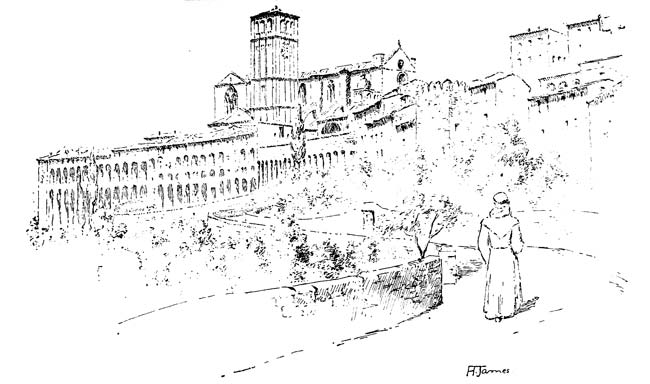
CHURCH AND CONVENT OF SAN FRANCESCO
Whether the man who conceived the original idea of raising one church above another flanked by a colonnaded convent on the spur of a great mountain was called Philip or James, or whether he came from a Lombard or a German province seems of small importance compared with the country where he learned his art. Even supposing "Jacopo" to have been a northern Italian from the home of the Comacine Guild of master masons, which is extremely likely, everything goes to prove that he must have drawn his inspiration for the Assisan Basilica straight from the south of France. What establishes the French parentage of San Francesco is the mode of construction, especially visible in the Upper Church, and which, as M. Corroyer says, "possesses all the characteristics peculiar to the French architecture in the south of France at the close of the thirteenth and the beginning of the fourteenth century, of which the Cathedral of Albi [in Aquitaine] is the most perfect type. The single nave, its buttresses projecting externally in the form of half turrets, add to the likeness of the Italian church of Assisi with that of Albi in France."[63] A glance at the illustrations of the two churches will bear this theory out better than many words; and it will be seen at once that had the half turrets between the bay windows of San Francesco been completed with pointed roofs and small lancet windows, as no doubt was the intention, the likeness would be even more striking.
Although "Jacopo" left a very substantial mark of his genius upon the Umbrian hill-side, he came and went like a shadow, leaving his designs and plans to be carried on by his young disciple Fra Filippo Campello, whom we shall meet with again in the chapter on Santa Chiara. Little, therefore, as we know of this earlier portion of its history, San Francesco at least remains to us in all its first prime and glory to tell its own tale, and endless should be the hymn of praise sung by the Assisans for the chance which brought so beautiful a creation within their walls.
It seems indeed strange that a style so new and so admired, was not more faithfully adhered to at a time when cathedrals and churches were being erected in every Italian city. Perhaps the Romanesque and Byzantine influences from the south so tempered the Gothic tendencies of Lombard architects, that they were unable to attain the true ideal, and succeeded only in creating a style of their own, to be found at Florence, Siena and Orvieto, known as Italian Gothic. Thus it happens that the Assisans are the proud possessors, not only of the first Gothic church built in Italy during the dawn of the new era, but of a church which is unique, as recalling less dimly than those of other cities the splendour of the northern cathedrals.
The rapidity with which the Assisan Basilica progressed is one of the most wonderful results of the love inspired by St. Francis among mediæval Christians. The generosity of the Catholic world was so stirred that donations poured in without ceasing from Germany and France, and even from Jerusalem and Morocco. "Cardinals, bishops, dukes, princes, counts and barons," write the chroniclers, helped Elias in his work, while the people of Umbria, too poor to give money, came in numbers, out of the reverence they bore the Saint, to work for small and often for no wages. It was a busy time; and Assisi awoke to a sense of her importance. Under the vigilant eye of Elias, armies of masons and labourers worked as unremittingly as ants at a nest, while processions of carts drawn by white oxen, went ever to and fro upon the road leading to the quarries, bringing creamy-white, rose and golden-coloured blocks of Subasian stone.
This universal enthusiasm enabled Elias to complete the Lower Church in twenty-two months, while the Upper Church was roofed in six years later, and finished in all essential details by 1253. But while Elias was applauded by most people, a few of the franciscans, headed by Fra Leo, still clung to the letter of the franciscan rule, and bitterly disapproved of these innovations. They sorrowfully looked on at the army of workers, raising, as if by magic, walls and colonnades upon the hill-side and towers ever higher against the sky. They watched blocks of marble and stone being chiselled into cornices, friezes and capitals ornamented with foliage and flowers, until, with despair in their hearts, they slowly returned to their mud huts in the plain. The dreams of Francis were vanishing fast as the allegiance to the Lady Poverty diminished. Now her shrine existed only in the Carceri, in San Damiano and in the Portiuncula, where few sought her company, for all eyes were turned towards the new Basilica. The words of the Master, recorded faithfully in Leo's biography, were ever ringing in his ears: "Set a good hedge round in lieu of a wall, as a sign of holy poverty and humility ... build poor little cells of mud and wood, and other cells where at times the brethren may pray and work to the gain of virtue and the avoidance of sloth. Also cause small churches to be built; they ought not to raise great churches for the sake of preaching to the people, or for any other reason, for they will show greater humility and give a better example by going to preach in other churches. And if by chance prelates, clerics, religious or seculars should come to these abodes, the poor houses, the little cells and small churches will be better sermons and cause greater edification to them than many words."[64]
No wonder that Leo and his friends watched Elias at his work with no friendly eye, for between the mud huts which Francis had planned with so much simplicity, and the massive Basilica and palatial convent, stretched an infinite chasm, separating the old order from the new.
They were still more unhappy and scandalised when Elias, who had the full permission of Gregory IX. for this innovation, placed a marble vase outside San Francesco to receive the contributions of those anxious to see the church quickly finished. A curious account is given by a latin chronicler of the warfare which ensued between the standard-bearers of the new and the old franciscan spirit: "Some brothers of marvellous sanctity and purity went to Perugia to consult Brother Egidio, a good and pious man, concerning the erection of so large a building and the manner of collecting money, which seemed to be expressly against the rule. And Brother Egidio answered them: "If that building were to reach from Assisi to here [to Perugia] a little corner would suffice for me to dwell in." And they having asked him what he thought about the vase, he said, turning to Brother Leo: "If thou considerest thyself already dead [to the world and its persecutions] go and break it. But if thou livest, stay thy hand, for perchance thou mayest not be able to bear the persecution of that Brother Elias."[65] Hearing this, Brother Leo went with his companions and broke the vase to pieces. Then Brother Elias, hearing this, had them severely beaten by his servants, and drove them from Assisi in great confusion. For this reason a great tumult arose among the brethren. Because of these aforesaid excesses, and because Brother Elias threatened the complete destruction of the rule, when the brethren met in general Chapter they deprived him of the office of Vicar General, and unanimously elected Brother John of Florence [Giovanni Parenti].[66]
But these murmurs were drowned in the din of public applause which enabled Elias to work in his own way, unscrupulously dispersing every difficulty without any reference to the rule of St. Francis.
He continued to be the presiding spirit at Assisi, and such was the success of his untiring energy that by the month of May 1230, the Lower Church of the Basilica was ready to receive the "most sacred body" of the Saint, while the magnificent quarters in the adjoining convent were ready for those friars who belonged to the moderate party, and approved of the new order of things.
Pope Gregory was unable to visit Assisi at this time owing to difficulties with his unruly Roman subjects, but he sent innumerable indulgences, golden crosses studded with precious stones containing relics of the true cross, vases of silver and gold, and a large sum of money for the further advancement of the building. These generous gifts were followed by a Brief, which in calmer moments the monks might have viewed with irritation, declaring both Basilica and convent to be immediately subject to the Holy See. The franciscan order was fast becoming a Papal institution, to be patronised and ruled by succeeding Pontiffs.
While Giovanni Parenti was preparing for the Conclave to be held in the spacious rooms of the new convent, the wily Elias was holding secret councils with the magistrates of the town as to ensuring the safe conduct of the body of St. Francis to the Basilica. The number of people continually arriving in anticipation of the coming ceremony made them somewhat uneasy, and their doubts were carefully discussed in the Communal Palace. They came to the conclusion that if the exact place of the saint's sepulchre was known, there would always be the danger of its being rifled by the citizens of neighbouring towns, especially by the Perugians, whose partiality for relics was well known. So a stratagem, most likely invented by the fertile brain of Elias, was decided upon and succeeded admirably.
The friars and citizens, unconscious of the plot hatched in their midst, were all eager for the day of the Translation. The Umbrians left their towns empty to assist at the great spectacle, and their number was so great, that, failing to find room within the walls of Assisi, they wandered like droves of cattle on the hills above trying to obtain a sight of the procession. It was a great day in the annals of Assisi; outside the little church of San Giorgio a triumphal car, drawn by a pair of magnificent oxen, their whiteness almost hidden beneath purple draperies and their horns wreathed and garlanded with flowers, stood waiting for the holy burden. Three Papal Legates and Elias placed the heavy sarcophagus with their own hands upon the car, covering it over with a piece of rich brocaded silk sent for the occasion by the mother of King Louis of France. They kept close to the car all the time, while the brethren, holding palms and torches, formed a long procession followed by the bishops and their clergy, and the Podestà with his retinue of crimson-robed priors. It was the month of May, and from every garden and terrace the nobles and their ladies showered flowers over the "sacred ark" as it was borne slowly up the street amidst the deafening sound of trumpets and the cheers of the populace. All that could be done to honour St. Francis had been thought of; Gregory IX. had even composed a hymn to be sung on that day in which the "Poverello" was compared to Christ. They were in the midst of the hymn of praise and quite close to the new Basilica when the heavy tramp of numerous armed men was suddenly heard; swiftly a passage was made through the crowd, who for the moment fell back amazed and powerless, while the soldiers hurried with the sarcophagus into the church, closely followed by Elias, who promptly shut and barred the door. After the first moment of surprise, a wild burst of indignation arose from the thousands who were thus deprived of a spectacle which they had come miles to see. They howled like wild beasts baulked of their prey, banging at the doors of the church in their fury; but silence reigned within, for Elias and his accomplices were stealthily engaged in hiding the body of St. Francis in the very bowels of the mountain, where for five centuries it remained unseen and undisturbed.
Till far into the night the people continued to murmur; the bewildered friars asked each other what this strange behaviour of Elias meant, and the only people who preserved any appearance of calmness were Messer il Podestà of Assisi and his priors, who smiled to see how well the plot had worked. It was not long before the scandal reached the ears of Pope Gregory. The enemies of Elias painted the story in glowing colours, and the Pope expressed himself greatly shocked at sacrilegious hands having been laid upon the holy body of the saint. He blamed the magistrates for allowing such a tumult to arise, and called upon them to give due explanation of their conduct within a fortnight at the court of Rome under pain of their city being laid under an interdict. The Pope's Brief caused consternation, and his accusations of their ingratitude for past favour rankled deeply. We are not told how the anger of the Pope was pacified, but no doubt both Elias and the Podestà explained satisfactorily the reasons for so strange a burial, as Assisi continued to enjoy the patronage of the Holy See. The efforts of Elias to ensure the safety of the body of St. Francis had been eminently successful, and Gregory could hardly fail to pardon the unusual manner in which this had been obtained.
Out of the mysterious events of that day of tumult grew a legend which lasted until the body of St. Francis was finally discovered five centuries later. It was believed that a church far surpassing the other two in grandeur and beauty had been built beneath them by Elias, and that St. Francis risen from his tomb stood in the midst, his hands crossed upon his breast, his head thrown back, gazing eternally towards the sky. The Umbrians, refusing to believe that their saint could suffer the common lot of mortals, loved to think of him as "almost alive," waiting for the last call, surrounded by the glorious beauty of a hidden church which they had never seen and only dimly pictured to themselves. Vasari refers to this "invisible church" described to him by the awe-struck citizens, when he mentions that "the tomb containing the body of the glorious saint is in the lowest church where no one enters, and whose doors are walled up"; and in the beginning of his description of the Basilica, he speaks of three ranges of buildings placed one above the other, the lowest of all being subterranean, which is curious as showing how closely he followed tradition regarding the Assisan church. Padre Angeli so unhesitatingly accepted the story that in his "Collis Paradisi" he drew from imagination a plan, together with a picture of the "invisible church." It represents a long vaulted hall somewhat recalling the architecture of the Upper Church, at the end of which is St. Francis standing upon his tomb in a recess corresponding to a kind of choir; the vaulted roof is supported by slender columns with chiselled capitals, and the walls and floor are ornamented with marbles and mosaic of different colours.
To close this chapter without touching upon the career of Elias, who is at once the black sheep of the franciscan order and one of the greatest citizens of Assisi, would be impossible. Few have written calmly about him, trying either to exculpate him or blaming his actions too severely, so that it is difficult to obtain any just idea of the real motives which guided him in an ill-starred life. Elias was neither devil nor saint, though he possessed the energy of both and his marked and domineering character would have fitted him better for the world than for the cloister. Ambition seems to have been his chief fault, together with a certain proud reserve which kept him aloof from his companions. From the various references to him in the early biographies of St. Francis we feel the writers failed ever to come quite in touch with one so outside their lives, and whom they considered as a kind of Judas—for did he not betray the interests of the Master?
"Elias is an altogether different type of man from the simple-minded Francis," writes Mrs Oliphant, echoing the general opinion. "He is an ambitious and ascetic churchman, of the class which has pushed Rome into much power and many abuses—an almost conventional development of the intellectual monk, making up for compulsory humbleness in external matters by the highest strain of ecclesiastical ambition and spiritual pride."
But while all abused him, none doubted his very exceptional talents, and even in the Fioretti he was accounted "one of the most learned men in the world," and St. Francis showed the great confidence he had in him by naming him Vicar-General after the death of Peter Cataneo. It was at a Chapter held in the wood by the Portiuncula that the saint expressed his desire to again resign the government of the order to another, and while Elias discoursed to the assembled friars St. Francis sat at his feet listening attentively to every word.[67] On the other hand, the saint was quite aware of his faults, and from the Fioretti, where Elias is pictured for artistic effect in strong colours as the wicked friar, we seem to realize the strain that often must have come between these two very different men. Thus we read that it being revealed to St. Francis that Elias was destined to lose his soul and bring dishonour on the order, he conceived such an antipathy towards him that he would even avoid meeting him, although at the time they were living in the same convent. The scene when Elias, discovering the reason of his displeasure, threw himself at the feet of the saint to implore his intercession with heaven reveals in the most touching way the great belief and reverence inspired by St. Francis in the heart of the least docile of his followers. "I have so great a faith in thy prayers," said Elias, "that were I in the midst of hell, and thou wert to pray to God for me, I should feel some relief; therefore again I pray thee to commend me, a sinner, unto God who came to save sinners that He may receive me into His mercy." And this did Brother Elias say with much devotion and many tears, so that St. Francis, like a pitying father, promised to pray to God for him. It will be seen how far the revelation of St. Francis came true, and the manner in which his prayer was answered.
So long as Elias remained under the influence of Francis his pride was tempered, and his ambition curbed, but when cast upon his own resources he gave full rein to the ideas which had no doubt been forming in his mind for some years past. Elias thought the franciscan order, if faithful to the Lady Poverty, would prove of small importance; and he therefore willingly leagued with Gregory IX. to mould it so that it should become a visible power upon the earth. The vision he conjured up with the sceptre in his own hand was very fair; and he failed to see why religion should not be served quite as well within the massive convent walls he had helped to rear, as when dwelling in a mud hut. He had too broad a mind to look closely to the detail of his rule; he only saw the broad outline of his master's teaching; and who can say whether after all he was not right? This we know, the mud huts have long since vanished, while thousands come each year to pray at the tomb of Francis within sight of Giotto's master-pieces. They sing aloud his praises, and as they pray and sing throw coppers and silver in heaps upon the altar steps, and pass out of the church into the sunlight again, knowing little of the lessons St. Francis spent his life in teaching.
But we must return again to Elias and his many troubles with the franciscan world. While patronized by Pope Gregory, he also seems to have had a strong party of monks on his side, probably those who had joined the Order during the last few years. Their names have not come down to us, and their personalities have merged in that of Elias who thus led them forward on a somewhat perilous way. They began by attempting to depose Giovanni Parenti while he was holding a Chapter in the new convent, a few days after the ceremony of the Translation of the body of St. Francis to the Basilica. His friars were gathered round him discussing the various missions to be undertaken, and the work that had been done during the past year, when the door was thrown open and a crowd of excited friars with Elias at their head appeared upon the threshold. Before anyone could realize what this strange apparition meant, Elias was borne rapidly along by his companions and installed in the seat of Giovanni Parenti, while a scene of indescribable tumult arose among those whose indignation had not yet cooled down after the events of the past week. It is said that St. Anthony of Padua was present at this conclave, and vainly tried to calm the excitement, but his voice was drowned in the clamour. At last, driven to despair, Giovanni Parenti began to cry aloud and tear his garments as one distraught; he could not have hit upon a better plan, for where words had failed this piece of dramatic acting produced an instantaneous effect. His friars formed a vanguard round him, acclaiming him Vicar-General as they beat back the intruders with hard blows and angry scowls. Elias, seeing the game was lost, threw himself on the ground, and with expressions of deep contrition implored forgiveness. He was pardoned, but banished to a distant hermitage, where humbled and sad he pondered for many months upon his next move. He allowed his hair and beard to grow to such a length that even his enemies began to believe his repentance was sincere, and only two years after his misconduct we find him elected Vicar-General in the place of his former rival, and, under the title of Guardian and Master of the Basilica and Convent, in full command of the works at San Francesco.
He now enjoyed a season of peace and plenty in the comfortable quarters of the franciscan convent, and is said to have gathered a household about him surpassing the splendour of a cardinal's court. Fra Illuminato di Rieti (afterwards Bishop of Assisi) acted as his secretary, writing numberless letters to "the Pope and the Princes of the World," for Elias was in correspondence with more than one crowned head and paid many visits to distant courts in quest of money for the Assisan Church. On these journeys he always went on horseback, and even when going from one church to another in Umbria, he was well mounted on a "fat and stout palfrey," to the intense scandal of some of the friars. "He also had secular servants," writes an indignant chronicler, "all dressed in divers colours like to those of bishops, who ministered to him in all things." His food was always good, and he had the reputation of keeping an excellent cook.
This peaceful and successful period of his life was of short duration, for he soon fell into dire trouble and disgrace. It was his misfortune to be sent by Pope Gregory, who trusted implicitly in his discretion and ability, on a mission to Frederic II, in the hopes of bringing the Emperor to a sense of his misdoings. A disciple of St. Francis seemed to be the right person to send as an emissary of peace; but instead of the orthodox humble and barefooted friar, we read of him as a very haughty personage, quite at his ease in the political world, then ringing with the angry cries of Guelph and Ghibelline.
No sooner had Elias reached the franciscan convent at Parma than the magnates of the city, aware of the errand he had come upon, assembled to do him honour. Fra Salimbene, who was present at the interview, describes how Elias waited for his visitors, his head swathed in an Armenian turban, and comfortably seated upon a soft chair drawn close to a huge fire. When Gherardo da Correggio, known as "Messer il Podestà of the big teeth," entered the room, Elias remained seated, and to the astonishment of all in no way disturbed himself for his illustrious guest. The Podestà very sensibly took no offence, but passed the matter over by expressing his wonder that the Vicar-General should have chosen so cold a season for his visit to Lombardy—a glance at the fire had told him that this franciscan friar liked comfort as much as most people.
There is no detailed account of the interview of Elias with the Emperor to inform us whether he behaved at it with the same easy familiarity; all we know is that Frederic, "the wonder of the world," and Elias, the Assisan friar, formed a friendship which lasted during the remainder of their lives, linking them together in a common fate. Whether Elias was won over from the first by the charm of so fascinating a personality, or simply baffled by a mind more subtle than his own, it is difficult to say, as the chroniclers have drawn too thick a veil over this unfortunate meeting for anyone to judge with fairness. His failure certainly gave a good opportunity to his many enemies to commence a very satisfactory scheme of blackening his character with the Pope; and the rumour flew to Rome that he was a traitor to his church. Branded with the abhorred name of Ghibelline there was now little hope for Elias, whose friendship with the arch-enemy of Holy Church grew always stronger. The Lombards becoming uneasy, accused Gregory of favouring the Emperor, while the latter bitterly complained that the Pope listened too much to the cause of the Lombards, and thought too little of the imperial dignity. At last a Chapter was called to enquire into the conduct of the Vicar-General, and as he was not present, his misdeeds lost nothing by the telling. Although Elias was deposed, and his place filled by a Pisan, he still held the title of Guardian and Master of the Assisan Basilica, but in a city of such strong Guelph sympathies as Assisi, it was unlikely he would be left in peace, especially as the Pope no longer favoured him. Life soon became impossible there, and of his own free will he retired to a hermitage in the woods of Cortona, followed by some dozen faithful friars, "not excepting," adds a spiteful chronicler, "Fra Bartolomeo da Padova, his most excellent cook." Thence he wrote to the Pope explaining his conduct, and humbly entreating to be pardoned, but the letter was found years afterwards in the pocket of the Pisan Vicar-General, who had promised to deliver it safely at Rome. Whether the letter was wilfully laid aside or only forgotten, none have been able to decide, but the incident had disastrous effects upon Elias. He waited anxiously for the pardon which never came, until embittered by finding himself deserted by nearly everyone, he openly joined the party of Frederic II. He went a step further, and abused Pope Gregory in caustic language, taunting him with injustice and avarice, and with being a simonist, which of course ended in his excommunication "to the great scandal of the Church." The news of his disgrace spread quickly through Italy, and the children sang a couplet, invented on the spur of the moment, under the windows of franciscan convents:
"Or'e attorno Frat'Elia Che pres'ha la mala via."
It was the cry which met the friars in every street they passed, so that the name of their former Vicar-General became hateful to them. And yet even now Elias must have had some friends in the Order, as at a council held at Genoa in 1244 there were a few who wished to reinstate him. The Pope commanded him to appear, but as the papal brief never arrived he was thus again debarred from clearing his much damaged character. The consequence of these efforts in his behalf only ended in his falling still deeper into disgrace; and for the second time he was excommunicated. We next hear of him roaming about the country with Frederic II, who found him useful on more than one occasion as a diplomatic agent. Elias was sent with strong letters of recommendation from Pier delle Vigne to Baldwin II, Emperor of Constantinople, and to Hugo I, King of Cyprus, and he was even charged to arrange a marriage for a daughter of Frederic. Among his various talents Elias seems to have been able to accommodate himself to a military life. We hear of him, both at the siege of Faenza and of Ravenna, riding out to battle on a magnificent charger. At other times he found a peaceful asylum at the Emperor's court, presenting a strange contrast to the "strolling minstrels, troubadours, poets, warriors, jugglers and artists of every grade" who frequented it. Upon the Emperor's death Elias returned to Cortona where the citizens received him kindly as he had obtained privileges for them at various times from his patron. Here, at the small hermitage in the ilex wood, he passed the last few years of his life in building a Franciscan church and convent, aided by the citizens who gave the ground for the site.
While the last touch was being put to the building of the great Assisan Basilica and it was about to be consecrated by Innocent IV, in 1253, Elias lay dying in his little cell at Cortona. His loneliness touched the heart of a lay brother, who with gentle words expressed his sorrow at seeing him an outcast from the Order and offered him help. Elias, no longer the proud ambitious churchman, answered very gently: "My brother, I see no other way save that thou shouldst go to the Pope and beg him for the love of God and of St. Francis His servant, through whose teaching I quitted the world, to absolve me from his excommunication and to give me back again the habit of religion." The lay brother hastened to Rome and pleaded so humbly that Innocent "permitted him to go back, and if he found Brother Elias alive he was to absolve him in his name from the excommunication and restore unto him the habit; so full of joy the friar departed and returned in hot haste to Brother Elias, and finding him yet alive but nigh unto death he absolved him from the excommunication and put on him again the habit, and Brother Elias quitted this life and his soul was saved by the merits of St. Francis and by his prayers in which Brother Elias had reposed such great faith."
Some say that even at the last fate pursued Elias, for the city of Cortona being at that time under an interdict no blessed oil could be found for the sacrament of extreme unction. Certainly his body was not allowed to rest in the church he had built for the brethren. A zealous friar dug it up and flung it on a dunghill, saying that no Ghibelline should be permitted to lie in consecrated ground.
Thus it was that Elias left a name hated among the franciscans as bitterly as the Emperor Frederic's always has been by Guelph historians. But while the war against the latter still rages as fiercely as ever, Elias, save for the gratitude felt by the citizens of Assisi, rests almost forgotten and his story hidden in the pages of old chronicles. Few even remember that owing to the untiring energy of this man Assisi owns one of the most beautiful monuments of mediæval art. It is possible that had Fra Leo, Bernard of Quintavalle and his companions succeeded in those first days of struggle, the Basilica of San Francesco might never have attained its present magnificence or the art of Giotto been born in this Umbrian corner of Italy. Chi lo sa? It is a question one hardly even likes to think of. But the danger passed away, and who cares now whether the franciscans grumbled at the time, or said the church and convent with its buttresses and towers looked more like the feudal fortress of some mighty baron than the tomb of the Preacher of Poverty? The San Francesco we love rises golden and rose-tinted above the olive groves and the vineyards, above the plain with its young corn and the white villages lying among the fruit-trees, above a rushing torrent which circles round the base of the Subasian mountain on its way to the Tiber; and all day the varied group of church, arcaded convent and terraced gardens, is showing its beauty to the sun.
In every light it is beautiful, in every mood we recall it, together with the choicest things we have seen in travel, haunting us like the charm of a living person. When the winter mists at early morning wrap round it like a mantle, or the stars form crowns above its roof and bell tower, there is always some new loveliness which thrills us, some fresh note of colour we have not noticed there before, making us again and again feel grateful that Elias forgot or ignored the teaching of his master.
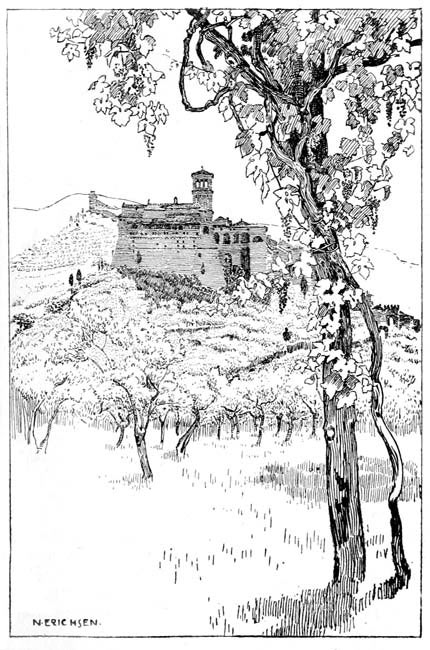
SAN FRANCESCO FROM THE PLAIN
CHAPTER V
Cimabue and his School at San Francesco
"Il semble au premier coup d'œil que le rève de François d'Assise a dû amener la fin de tout l'art et de toute noble vie. Chose étrange! ce sordide mendiant fut le père de l'art italien."—E. Renan. Nouvelles Études d'Histoire Religieuse.
The Lower Church
So rarely in Italy is a church perfect both within and without that it is with amazement we find at Assisi not one but two churches, choir and nave piled above each other, and covered from roof to floor with frescoes, as perfect of their kind as the buildings which they decorate. Wars in every town, trouble, dissension and jealousies among men, raged like a storm over the land, but all this turmoil of a fevered age was unable to check the steady, rapid progress of at least this monument to a dead saint's memory; and we perceive yet another proof of the extraordinary influence of St. Francis, who was able by the devotion and admiration he excited, to inspire all with some of his own love of the beautiful, which has lasted in Italy, from the days of his ministry, through centuries of both faith and unbelief down to modern times. But from this arose a strange event; this lover of solitude, who during his life sought only for humiliation and obscurity and loved best the poor and deserted way-side sanctuaries, was laid to rest in one of the most beautiful Italian churches of that time.
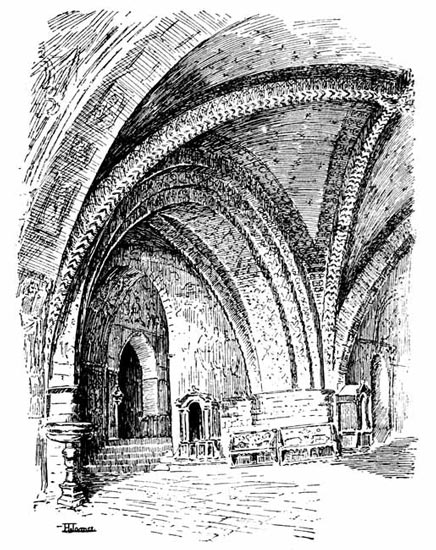
THE LOWER CHURCH
While wandering through the Lower Church, marvelling at the delicate friezes of tiny heads, flowers and winged horses, which frame every fresco; at the great spreading arches—built for strength; the vaulted roof of deep azure blue with dull golden stars upon its surface, looming above the paintings and dimming their brilliancy by the shadows which lurk in its depth, we feel that within the shelter of its perpetual twilight this is a place to pray in. It is truly the home of St. Francis, and notwithstanding its richness and vast splendour his spirit is here, the certainty that he once had dwelt upon the earth is felt.
Few ever stop to look at the walls of the nave, and indeed, upon coming out of the sunlight, the darkness and gloom for some minutes is oppressive and but little can be distinguished in the gloom. It was almost by chance that we one day noticed some frescoes, ruined and faded, just outside the Chapel of St. Martin. They are of no beauty as works of art, indeed they are rather ugly, but their interest lies in showing us that from the very beginning artists had endeavoured, however feebly, to depict the legend of St. Francis.[68] On the left wall of the nave, outside the Chapel of St. Martin, is a fresco representing the Sermon to the Birds with the same idea of composition which was adopted later by Giotto; the saint slightly bends towards the birds upon the ground, his companion stands behind, while the single tree adds a certain solemnity to the scene. The figures are large and ungainly, with feet terrible to behold, the lines are hard, and there is little feeling of movement or life; yet we look at it with reverence and hope, for we know that, with all the ugliness and stiffness of workmanship, the artist was vehemently striving in this dark church to shake off the hampering chains of worn-out traditions, and find for himself something nearer to the truth. And as we look at this one and at the next, representing St. Francis receiving the Stigmata, our thoughts are carried to other renderings of these scenes, and we say with light hearts: "After this poor craftsman comes Giotto, King of Tuscan painters."
These are the only two frescoes illustrating the life of the saint, though there may have been others which were destroyed when the walls of the nave were broken down in order to form entrances to the chapels, added to the main building about 1300. But on the right side, beginning outside the Chapel of San Stefano, are parts of several scenes from the New Testament; a crowd of women and men standing round the cross, a group of women, the Descent from the Cross, a Pietà, a landscape with houses and a decoration of circular ornaments outside the Capella di Sta. Maria Maddalena, generally attributed to Giunta Pisano, thus giving them too early a date.[69]
To us their interest seems rather to lie in that they plainly show how the earliest masters, whilst endeavouring to illustrate the franciscan legend, failed so completely to satisfy their employers that they were bidden to stay their hand and continue to paint the well-worn theme of the history of the world's redemption, which required less invention than the legend of St. Francis, where a new out-look on life had to be acquired. So the franciscans, failing to find a painter who could illustrate their founder's life to their satisfaction, contented themselves with other things, perhaps hoping that in course of time one might arise who could do justice to the theme. Well it was that they waited.
Shortly after these frescoes had been completed in the Lower Church, art received a new impulse (one likes to think that the struggles of the first artist towards something better and more true to life had to do with this); others came, with Giotto at their head, and painted over some of these early efforts, leaving us only Cimabue's great Madonna, a few ruined frescoes, a Byzantine pattern, and stray touches of colour in dark corners of the church to remind us of these first decorators of San Francesco.
We get a melancholy picture from Vasari of the depths to which art had sunk, and of the degenerate artists still following a worn-out tradition until it became as a dead thing in their hands deprived of all inspiration, when "in the year 1240, by the will of God, Giovanni Cimabue ... was born in the city of Florence to give the first light to the art of painting."
Cimabue is rightly called the Father of Italian art, as he represented a new era among Italian masters who were awakening to their country's needs; when men, filled with strange restless energy, grew tired of the Byzantine Madonna with her court of stiff, lifeless saints, and looked for something in closer touch with their mood and aspirations.
Round the name of Cimabue are grouped many charming legends belonging to a time when the people, anxious to possess the new thing their hearts craved for, looked eagerly and critically at an artist's work. There is the story of how when he had finished the picture of the Virgin Mary, the Florentines came to his workshop, and, expecting much from him, yet were amazed at the wonderful beauty of the grand Madonna, and carried the picture with rejoicing, to the sound of music, to the Church of Sta. Maria Novella, where it still hangs in the dark chapel of the Ruccellai; a street in Florence down which the picture passed being called Borgo Allegri, because of the gladness of that day. It is only a legend, and one that has been oft repeated, and as often doubted. Now the existence of Cimabue is even questioned by some, but whoever invented the story understood the great change which had come among the people and into art. It was only right that in the church of the saint who personified the feeling of the age, caught its spirit, and sent the impulse of the people even further, should centre all the first efforts towards this awakening and revival, until, step by step, the masterpieces of Giotto were reached. When we remember this, the large fresco of Cimabue in the right transept of the Lower Church becomes more full of beauty and meaning.[70] The great spirit of her presence fills the church, her majesty and nobility is that of the ideal Madonna, grave to sadness, thinking, as her eyes look steadily out upon the world, what future years would bring to the Child seated on her lap, who stretches out a baby hand to clasp her veil. All the angels round the throne sway towards her; in their heavy plaits of hair shines a dull red light, and in their wings and on the Madonna's gown are mauve and russet shades like the colours of autumnal oaks.... "To this day," says Mr Ruskin, "among all the Mater Dolorosas of Christianity, Cimabue's at Assisi is the noblest; nor did any painter after him add one link to the chain of thought with which he summed the creation of the earth, and preached its redemption."
St. Francis has not been forgotten in this fresco, but Cimabue having given all his art to make the Virgin and her choir of angels beautiful, his figure is not quite one's idea of the ethereal Umbrian preacher, and his being there at all spoils the symmetry of the grouping. It is not improbable that the figure of St. Clare stood on the other side, and was erased when the Chapel of Sta. Maria Maddalena was built, and the ornamental border painted round this fresco, which cut off part of the wings of the two angels on the left of the Virgin.
Vasari vaguely tells us of some frescoes from the lives of Jesus Christ and of St. Francis, painted by Cimabue in the Lower Church, and later writers have thought these must have been destroyed to make room for Giotto's work. If paintings were there at all they were more likely to have been the work of inferior artists, for it seems improbable that Giotto, coming to Assisi for the first time when he was quite a youth, should destroy any work of his master, who was still alive, in order to substitute his own early efforts.
The Upper Church
Not only was the Upper Church essentially fitted for fresco painting, but it required an elaborate scheme of decoration, just as a setting, however perfect, needs a gem to complete it; and it almost seems as though "Jacopo" had stayed his hand, with the intention that here, at least, architecture should be subservient to wall decoration, and had foreseen the need of large spaces to be covered with paintings, as brightly coloured, as clear, and as closely set together as are the colours upon a butterfly's wings.
"It was here, in the Upper Church of Assisi," says Mr Roger Fry, "that the Italian genius first attained to self-expression in the language of monumental painting, a language which no other European nation, except the Greeks, has ever mastered." But the question as to who were the predecessors of Giotto, and when exactly they came, can never, we think, be answered; for the time is not far off when these splendid ruins of early art will have totally faded away, or, what is infinitely worse, be covered with still thicker layers of paint than the "restorer" has already laid upon them.
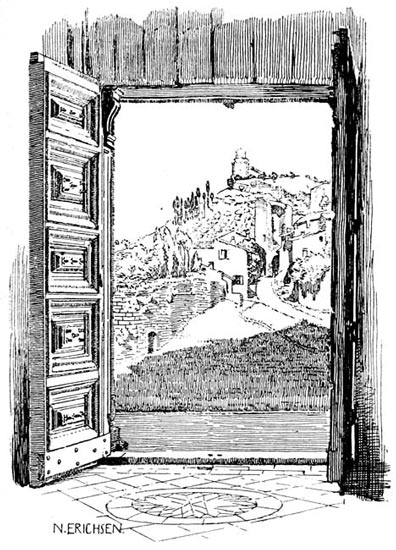
LOOKING THROUGH THE DOORS OF THE UPPER CHURCH TOWARDS THE PORTA S. GIACOMO AND THE CASTLE
Vasari finds no difficulty about the matter, declaring, to his own satisfaction and for the instruction of future generations, that every fresco in the apse and transepts, together with the series relating to the history of the Jews and the life of Christ, are by Cimabue. But then Cimabue was a Tuscan, and Vasari, the painter of Tuscan Arezzo, was determined to give as much glory to his fatherland as he could. We too would give all possible honour to Cimabue, but are bound to follow the opinion of later critics, who less prejudiced and hasty in their criticisms than Vasari, see the work of many hands in all these frescoes; so we have gathered together a few notes concerning them from various authorities to help the traveller to form his own ideas upon the subject. The theme is too endless to attempt in a small space to give more than a very brief summary of the chief facts.
Frescoes of the Choir and Transepts.—These may be divided into two distinct classes, those of the north transept, which are older and inferior to those of the south transept and choir. Herr Thode attributes their difference to the fact that while all are the work of Cimabue, the frescoes in the north transept were painted when he was quite young, while the rest belong to a later period, when he had attained his full powers. The Crucifixion of the north transept, one of the most ruined, reminds us somewhat of works by Margaritone which may be studied, without much pleasure, in most Italian galleries. The figures standing round the Cross are short, with small heads and large hands, and not even in the fainting Madonna is there the slightest charm. In the Martyrdom of St. Peter, on the next wall, it is curious to note the similarity of treatment to Giotto's fresco at Rome of the same subject. The Saint, head downwards upon the Cross without any group of people would have made but a dull composition; so both artists added an obelisk on either side to relieve the monotony of line.
Then follows the scene of Simon Magus being borne upwards by demons with bat-like wings; and upon the next wall, beneath the triforium, is represented the death of Ananias and Sapphira, and St. Peter curing the lame before the Temple, where the figures are certainly more majestic and, according to Herr Thode, distinctly show the hand of Cimabue.
Behind the papal throne are medallions of the friend and patron of St. Francis, Gregory IX, and of Innocent IV, who consecrated the Basilica. The frescoes represent the life of the Virgin, but they are all too faded to be enjoyed, save that of the Coronation on the right wall, just above the choir stalls; the Virgin is seated upon a wooden throne with Christ by her side and a group of apostles and spectators beneath. There is a striking resemblance in the drawing and form of the standing figures to those in the Crucifixion of the south transept. This, though very ruined and blackened in parts, showing no other trace of colour than a faint film of golden yellow, has still the power to make us feel that once, long ago, it was a fine work, worthy of a great master. Weeping angels fly above the Cross, some with outstretched hands, while others veil their eyes from the sight of the suffering Saviour; the Magdalen, her arms thrown up above her head, is seen in strong relief against the sky, and contrasting with this dramatic gesture, is the figure of the Virgin, erect and still, her hand clasped in that of St. John. The whole conception is dignified, replete with dramatic feeling of the nobler kind, and has been thought worthy, by Herr Thode, to be put down as the finest of Cimabue's creations.
The remaining frescoes deal with scenes from the Apocalypse, but they are so ruined that it is a thankless task for any, except the student, to try and distinguish each separately. Indeed after a minute examination of so many ruined works of art, a certain sadness and weariness is felt, but if the pilgrim has time to rest awhile in a quiet corner of the stalls and look at choir and transepts solely for their colour, he will gain for himself many beautiful memories not easily forgotten. It is a vision of youthful saints, of men with lances hurrying down a rocky mountain side, of angels trumpeting to the four ends of the earth, and out of this medley of shadowy forms in fading frescoes, like sunlight breaking through a mist with golden light, loom the mighty angels of Cimabue. Their heads are crowned by a heavy mass of auburn hair, their wings slightly lifted, as though they were on earth but for a short space, and they seem as remote from mortals as the Sphynx herself in their dignity and calm repose. To Cimabue belongs the conception of such grave and strangely beautiful creations, winged messengers of strength, who come midway between the stiff Byzantine figures, and the swift-moving angels of Giotto and the cherub children forms of later Umbrian and Venetian schools.
The Nave.—All writers upon the subject agree that here the frescoes show no trace of Cimabue's style, but are from the hand of his contemporaries and pupils, who worked together in unfolding the history of the Jews and the world's redemption. If it is impossible to hint even at the names of these artists, the most hurried traveller must notice the different character which marks the legend of the New Testament from that of the Old, where the work of talented copyists of classical works of art differ from that of others who kept nearer to the style of Cimabue, instilling into it more or less life, as their individual powers permitted. Herein lies much of the history of early Italian art, but the few remaining frescoes, especially on the left wall, have been so terribly over-painted that the work of the critic is rendered well-nigh hopeless.
Beginning at the right wall by the High Altar we have probably the work of a fine Byzantine master, or at least of one who must have copied a Greek masterpiece. In the Creation of the World, God, represented as a young man seated on a globe of fire, is, with a gesture of his hand, casting upon the earth his last creation—man—who, still suffused with celestial colour, is borne across the sea towards the land. A ram, a bull and a lion besport themselves upon the shore, enormous birds sit on the bushes, and the sea is already full of every kind of fish; slender pink clouds are in the sky, and the distant hills on the horizon have faded into shades of blue-green, like the landscape of an Umbrian picture.
The nude figures of Adam and Eve in the Expulsion from Paradise are wonderfully good for the time, and the manner in which the angels are kicking them out of the garden of Eden is somewhat unusual.
Beginning again at the first bay window but on the lower row of frescoes, in the Building of the Ark Noah is seated, an obelisk-shaped rock rising behind him, and gives his directions with a majestic air to his sons as to the sawing and placing of the great beams. A man, standing by his side, completes the composition, which has much dignity and finish.
The fresco of the Sacrifice of Isaac, with Abraham raising his sword above him his body slightly thrown back, is perhaps one of the most striking of the series. The wind has caught his yellow robe, which unfurls itself against a landscape of sandy hills.
All that remains of the next are three angels, whose grandeur can only be compared to those of Cimabue in the south transept. The remaining subjects on this side are by a different master, who followed closely the best classical traditions, and succeeds in giving extraordinary repose to his compositions as well as meaning to the various figures.
In Jacob before Isaac, Isaac is waiting for his dish of venison, and Jacob's attitude denotes uncertainty as to the reception he is likely to receive, while his mother, lifting the curtain of her husband's bed, seems to encourage her son.
The next fresco is similar in composition, but better preserved. Here we feel the blindness of Isaac, the perplexity of Esau, who cannot understand why his father refuses to bless him, and the fear of Rebecca, who has stepped back, knowing that her fraud must now be discovered. In this composition the artist has strictly kept to rules laid down by his predecessors, and the result, if a little stiff and wanting in originality, is yet pleasing and restful to look at, presenting a great contrast to the somewhat exaggerated movements expressed in the preceding ones.
The last of the series is the steward finding the cup in Benjamin's sack, though greatly ruined it still shows much beauty of composition.
Upon the opposite wall, by the altar, is depicted the life of Christ by followers of Cimabue, but the few frescoes that remain are so mutilated and repainted, that it is impossible to say much about them, or even to imagine what they may once have been.
"In the Capture," writes Messrs Crowe and Cavacaselle, "the Saviour is of a superior size to the rest of those around him, and of a stern but serene bearing. Trivial conception marks the scene of the Saviour carrying the Cross."
The Pietà, one of the last, is evidently by a finer scholar of Cimabue, and the woman coming round the rocks resembles slightly the figure of Rebecca in the two frescoes on the opposite side. "The composition," write the same authors, "is more like that which Giotto afterwards conceived than any other before or since"; but the colossal figure of Christ destroys the harmony of the scene.
The arch at the end of the nave is painted to represent a series of niches, in each of which stands the figure of a saint, all are much repainted, as are the medallions of St. Peter and St. Paul by the door. The Descent of the Holy Spirit is greatly ruined, and in the Ascension the intonaco has peeled off, showing the bricks, so that the apostles have the appearance of looking over a wall.
The ceiling is frescoed in three different places by other masters, whose names have not come down to us. Between the transepts and nave the four Evangelists, seated outside the gates of towns, are so utterly ruined and blackened by time and damp that it is barely worth craning one's neck to look at them.[71] But the four medallions of Christ, the Madonna, St. John the Baptist and St. Francis, which ornament the centre of the nave, are among the most beautiful things in the church, and quite perfect as decoration. At each corner of the spandrels stands an angel upon a globe, with wings uplifted, delicate in outline and brilliantly coloured, while the whole is bordered by the most exquisite design of blossoms and green foliage rising out of slender vases, which mingle with cupids, angels, winged horses and rabbits on a dull red ground. It must have been painted by one who had learned his art from the same source whence the decorative painters of Pompeii drew their inspiration.
It is not an easy thing to fit entire figures seated on large marble thrones into triangular spaces, and so the artist found, who in the groined ceiling nearest the door had to paint the Doctors of the Church, Sts. Jerome, Gregory, Ambrose and Augustin, dictating their epistles to busy clerks. But there is much that is charming in them, though as decoration they partly fail, and a resemblance may be found to the frescoes of Isaac and his sons, which seem to have influenced Giotto in his paintings of old men.
Vasari's enthusiasm was roused when he looked upon these endless paintings, and he tells us that: "This work, truly grand and rich, and admirably well executed, must, I conceive, in those times have astonished the world, the more so that painting had for so long been sunk in such obscurity: and to me, who saw it once more in 1563, it appeared most beautiful, as I thought how Cimabue, in such darkness could have discovered so much light."
It would be well, before leaving, to look at the windows of the Upper Church, which are among the oldest in Italy, and, according to Herr Burckhardt, the most beautiful. As of most things connected with San Francesco, little is known about them; Vasari says they were designed by the painters of the frescoes; an opinion partly held by Herr Thode, who sees a great resemblance to the style of Cimabue in the right-hand window of the choir (the centre one is modern) with scenes from the lives of Abraham, David and Christ, of most beautiful colour and design. The left window, belonging to the same period, contains naïve scenes from the Old Testament, amongst which (the sixth from the top of the left half) is Jonah emerging from a blue-green whale the colour of the waves, and possessed of large white eyes.
Those of the transepts of the same date are even finer and more beautifully coloured. Medallions of geometrical patterns of exquisite design and hue ornament the left-hand window of the north transept, while that on the right contains scenes from the Old Testament and the life of Christ; in both of these, according to Herr Thode, the influence of Cimabue is apparent.
The left window of the south transept contains seven scenes from the Creation and seven from the lives of Adam and Eve, who (in the last two divisions of the right half) are being driven out of Eden, and, spade in hand, are working at the foot of a tree. The eight saints of the right window, seated majestically on gothic thrones ornamented with spires, and dressed in rose-coloured, red and green garments, have certainly the appearance of being, as Herr Thode suggests, of a style even anterior to Cimabue.
Half of the bay window on the left, looking towards the altar, is the work of the Umbrian school of the time of Fiorenzo di Lorenzo (there is a Madonna in a blue mantle, and St. Onofrio clothed in vine-leaves), while the left half, with medallions composed of very small pieces of glass representing scenes from the early life of Christ, are perhaps the most beautiful, and certainly the oldest, in the church, and can even be compared to the stained glass of French cathedrals. The third window (the second has suffered considerably, and what is left of the original belongs to the fifteenth century) has been a good deal restored, but the large angels with blue and purple wings standing in an arch, behind which a little town is seen, are very fine, and below them is a curious small figure of St. Francis floating in front of a colossal Christ, belonging also to the fifteenth century.
Very beautiful are the two saints beneath gothic arches in the last window, and the priests in their rose-coloured stoles, the bishops in crimson and gold, and the other figures of warriors and saints.
The right half of the bay window near the door upon the opposite side, belonging also to the Umbrian school, contains some charming scenes from the life of St. Anthony, while on the left are incidents of the life of St. Francis. The whole is remarkable for delicate rose colours, greens and pale blues, and a total absence of the strong deep tones of the older and finer windows; but they are very beautiful of their kind, like patches of pale sunshine in the church.
The next two windows betray a more ancient style in the fine figures of the apostles (their heads, alas, are modern), and in the scenes from their lives, which are of a deeper tone than the former one; but even more beautiful is the last window, which does not seem to have been restored within the last three centuries, and where the colours standing out from a creamy background are very lovely. The two large and grand figures of two apostles are believed by Herr Thode to be from drawings by Cimabue.
Both Francesco di Terranuova and Valentino da Udine were employed to repair all the windows about 1476, large sums being expended, principally by the Popes who never ceased to patronise the franciscan Basilica. A most comical appearance is given by the distressing additions made in our own time of modern heads upon bodies of the thirteenth or fourteenth century. Until very lately an exquisite rose window was to be seen over the eastern door, now replaced by white glass; one would like to know how it so mysteriously disappeared and where it now is.
No pains had been spared to make San Francesco as lovely in every detail as the brain of man could devise, and it is most remarkable how the frescoes belong to the general idea of the building as though every artist had thought as much of this unity as of the individual perfection of his work. The beautiful papal throne in the choir, of white marble encrusted in mosaic with its frieze of strange animals in low relief, its arms supported by red marble lions, is almost a replica of the Soldan's throne in Giotto's fresco, and was designed by Fuccio Fiorentino in 1347, when the architecture that Giotto delighted in was still the recognised style in Italy.[72] The marble and mosaic altar is of the same date, and the octagonal pulpit of sculptured stone, with saints in small tabernacles, spiral columns and designs of leaves slightly tinted, supposed also to be by Fuccio, is placed at the corner of the wall of the nave looking as if it had grown there. The columns supporting the arched gallery round the church have each been painted to represent mauve and rose-coloured marbles, and there is not a single space in all the building which has not been decorated to harmonise with the frescoes, giving a perfect sense of infinite completeness and beauty, to which time has added by mellowing everything into a pale orange colour—the colour of Assisi.
CHAPTER VI
The Paintings of Giotto and his School in the Lower Church
"... Cimabue thought To lord it over painting's field; and now The cry is Giotto's, and his name eclipsed." Dante, Purgatory, xi., Cary's translation.
The work of Cimabue, grand and noble as it is, yet gives the impression of belonging to remote times, between which and that of Giotto, his pupil, a great gulf is set. In both churches at Assisi we pass from the early efforts of an awakening age to the work of one, who, if not the first to see the light, was the first to discover the true principles of art, to give it life, and to found a school whence a long series of painters came to carry on for generations the lessons he had taught. Cimabue did wonders for the century in which he lived; of Giotto, even granting that his drawing was sometimes faulty, and the types of faces he painted were not always beautiful, it would be an insult to express such condescending praise; and even a hasty study of his frescoes in San Francesco must soon explain the everlasting sway he holds, now, as in those first years when his work seemed little short of miraculous to the wondering Florentines.
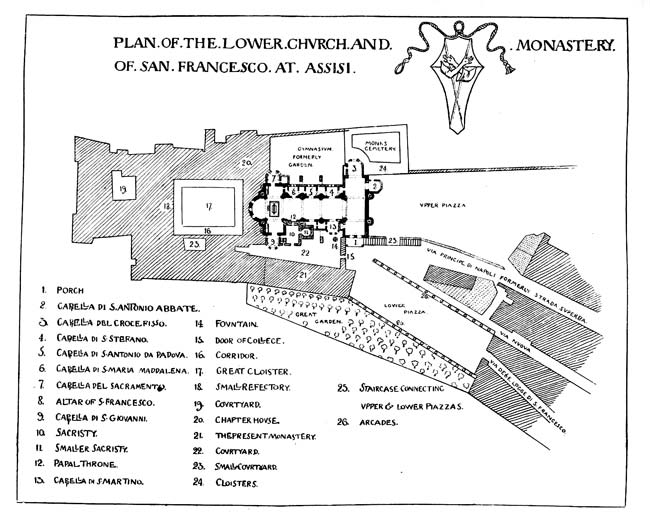
PLAN OF THE LOWER CHURCH AND MONASTERY OF SAN FRANCESCO AT ASSISI
View larger image
Some fourteen miles to the north of Florence, among the hills of the Mugello, lies the scattered hamlet of Vespignano where Giotto Bondone was born of a poor peasant family in the year 1265. Even at an early age, Vasari says, the boy was remarkable for the vivacity and quick intelligence which endeared him not only to his parents, but to all who knew him in the village and country round. He passed his childhood among them, knowing nothing of the city just across the hills, but learning much, during the long days while he wandered forth to tend his father's sheep, which was helpful to him in after years to preserve his straightforward outlook upon life and the strength and freshness of a nature that loved the sunburnt valleys and the freedom of the shepherd's existence.
When Giotto was ten years old it happened that Cimabue, on his way from Florence to Vespignano upon a matter of business, found him seated by the roadside, his flock gathered near, busily employed in drawing the outline of a sheep from life upon a smooth piece of rock. Struck by the boy's industry in the pursuit of art and his evident cleverness, Cimabue hastened to obtain the father's consent to adopt and make an artist of him. Leaving the old life in the peasant's cottage for ever, Giotto now turned south along new roads, and with Cimabue by his side, saw for the first time the city of Florence, beautiful as she lay upon the banks of the Arno in a setting of wooded hills.
The progress he made under Cimabue's guidance, who taught him all he knew, was marvellous indeed. At ten years of age a shepherd tracing idle fancies on the stones, then for a few years an apprentice in a Florentine workshop grinding colours with the others for his master's big Madonnas; while ten years later he had already gained the title of Master and was a famous painter, courted by popes and kings, and leaving masterpieces upon the walls of churches throughout Italy, that people of all times and countries have come and paused awhile to see.
Let us suppose it was the air of Florence, which, according to Vasari, "generates a desire for glory and honour and gives a natural quickness to the perceptions of men," that made Giotto a perfect Florentine, alert, witty, and ever ready with a caustic repartee to anyone who bandied words with him. But though other influences were at work around him, and new images crowded upon his active brain, he kept undimmed the vision of his mountain valley, of the fields, of the days spent in his native village, and, with the eyes of a shepherd he continued to look on all the incidents of human life; he saw the grandeur, the tragedy, the weaknesses, aye, and the humour too, in everything that surrounded him, setting it all down in his frescoes in his own simple and original way. In a few words Mr Ruskin has touched upon the keynotes of Giotto's character when he says: ... "his mind was one of the most healthy, kind and active that ever informed a human frame. His love of beauty was entirely free from weakness; his love of truth untinged by severity; his industry constant without impatience; his workmanship accurate without formalism; his temper serene and yet playful; his imagination exhaustive without extravagance; and his faith firm without superstition. I do not know, in the annals of art, such another example of happy, practical, unerring, and benevolent power."
Such was the man who came to Assisi to take up the work left uncompleted by Cimabue and his contemporaries. Giotto was then almost unknown, not having executed any of those great works upon which his fame now rests, and it is not unlikely that the recommendation by Cimabue of his promising pupil to the friars of San Francesco led to his being called there when barely twenty years of age.[73] Opinions differ as to which were his first works and whether he began in the Lower or in the Upper Church, and as there are absolutely no documents relating to the subject, and Vasari is of no help in the matter of dates or precise details, the only way to come to any conclusion is to group these frescoes according to their style. We do not wish to force any arbitrary opinions on this matter, and have simply placed Giotto's work in the order that it seems to us more likely to have been executed. Those who disagree have only to transpose the chapters as they think fit. The chief thing is to enjoy the frescoes and speculate as little as possible on all the contradictory volumes written about them.
Right Transept.—According to Messrs. Crowe and Cavalcaselle these frescoes are by Giotto, and Mr Bernhard Berenson is of the opinion that they belong to his early period, and were executed by him before the franciscans knew what his powers were, and whether they could entrust to him the more difficult task of illustrating the legend of St. Francis. The subjects are taken from the early life of Christ which had been depicted many times in preceding centuries, but although Giotto attempted no very elaborate or original manner of treatment, his style was rapidly developing, and we have in some of the scenes little traits of nature which only belong to him. On the outside of the Chapel del Sacramento, over the arch, he painted the Annunciation with such charm, dignity and harmony of outline that it would be difficult to find a more perfect conception of religious feeling even among the pictures of Angelico. Unfortunately it can only be seen in the early afternoon when the light comes in through the windows of S. Giovanni; the Madonna rising with queenly grace and the angel hastening forward with his message then stand out from their dark background like living people, and show how, from the first, Giotto attained the power of giving vitality to his figures. His Madonna is not like a graven image to be worshipped from afar; she is essentially the earthly mother of the Saviour, and Giotto, while treating her story with dignity and a certain sense of remoteness, tells it by the simplest means, endowing her with the maternal tenderness of a young peasant girl whom we meet upon the roads carrying her child to lay beneath the shadow of a tree while she goes to her work in the fields close by.