Front matter (continued 6)
Reading edition
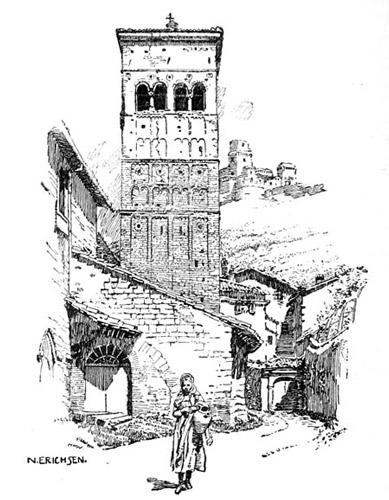
CAMPANILE OF SAN RUFINO
A few years ago the late Canon Elisei who has written many interesting pamphlets on the cathedral, obtained permission from the government to clear away the rubble beneath the present church; masses of Roman inscriptions and pieces of sculpture were brought to light, together with part of the primitive church of Bishop Basileo, and the whole of what is known as the Chiesa Ugonia, from the Bishop of that name who built it in 1028. With lighted torches the visitor can descend to the primitive basilica and realise what a peaceful spot had been chosen for this early place of worship, while picturing the Christians as they knelt round the body of their Bishop, the light falling dimly upon them through the narrow Lombard windows. The six columns, with their varied capitals rising straight from the ground without the support of bases, give a somewhat funereal aspect, recalling a crypt rather than a church. The few vestiges of frescoes in the apse—St. Mark and his lion, and St. Costanso, Bishop of Perugia—are said to be, with the paintings in S. Celso at Verona, the oldest in Italy after those in the catacombs at Rome. Ruins of other frescoes, perhaps of the same date, can be traced above the door of the first basilica, together with some stone-work in low relief of vine leaves and grapes, but it is difficult to see them without going behind a column built in total disregard of this lower building. The Roman sarcophagus is still in the apse where the altar once stood, but open and neglected, for the body of St. Rufino now lies beneath the altar of the present cathedral. It is ornamented in rough high relief with the story of Endymion; Diana steps from her chariot towards the sleeping shepherd, Pomona has her arms full of fruit and flowers, and there are nymphs and little gods of love and sleep. "It appeared to us," remarks one prudish chronicler of the church, "the first time we beheld it, that it was indecent to have present before the eyes of the faithful so unseemly a fable; our scruples we however laid aside in remembering that Holy Church is endowed with the power of purging from temples, altars and urns, all pagan abominations, and from superstition to turn them to the true service of God." No such scruples existed during the early times, and there is an amusing story of how the people wishing to place the marble sarcophagus, which had been left at Costano five centuries before, in the Chiesa Ugonia, were prevented by the Bishop who admired it, and had given orders that it should be brought to his palace at Sta. Maria Maggiore. A great tumult arose in the town, but although the people came to blows and the fight was serious on both sides, no blood was shed. A further miracle took place when the Bishop, determined to have his way, sent sixty men down to Costano who were unable to move the sarcophagus which remained as though rooted in the earth; and the event was the more remarkable as seven men afterwards brought it at a run up the hill to the church of San Rufino, where it remains to this day.
Already two basilicas had been built in honour of the saint, but the Assisans dissatisfied with their size and magnificence, in the year 1134 called in the most famous architect of the day, Maestro Giovanni of Gubbio, who before his death in 1210 had all but completed the present cathedral and campanile. It is a great surprise when, emerging from the narrow street leading from the Piazza Minerva thinking to have seen all that is loveliest in Assisi, we suddenly catch sight of the cathedral and its bell-tower. The rough brown stone which Maestro Giovanni has so beautifully worked into delicately rounded columns, cornices, rose-windows and doors with fantastic beasts, sometimes looks as dark as a capucin's habit, but there are moments in the late afternoon when all the warmth of the sun's rays sinks into it, radiating hues of golden orange which as suddenly deepen to dark brown again as the light dies away behind the Perugian hills.
All three doors are fine with their quaint ornaments of birds and beasts and flowers, but upon the central one Giovanni expended all his art. It is framed in by a double pattern of water-lilies and leaves, of human faces, beasts, penguins and other birds with a colour in their wings like tarnished gold. The red marble lions which guard the entrance, with long arched necks and symmetrical curls, a human figure between their paws, may belong to an even earlier period, and perhaps were taken by Giovanni da Gubbio from the Chiesa Ugonia to decorate his façade, together with the etruscan-looking figures of God the Father, the Virgin and St. Rufino in the lunette above. Just below the windows a long row of animals, such pre-historic beasts as may have walked upon Subasio when no man was there to interrupt their passage, seem to move in endless procession, and look down with faces one has seen in dreams.
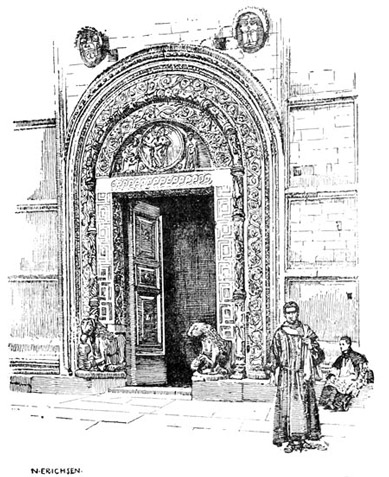
DOOR OF SAN RUFINO
The interior of the cathedral is a disappointment; at first we accuse the great Maestro Giovanni for this painful collection of truncated lines and inharmonious shapes, until we find how utterly his work was ruined in the sixteenth century by Galeazzo Alessi of Perugia. To understand what the church was five centuries before Alessi came, it is necessary to climb the campanile (only those who are attracted by ricketty ladders and dizzy heights are advised to make the trial), and when nearly half way up step out on to Alessi's roof, whence we can view the havoc he has made. But he could not spoil Giovanni's rose-windows, and through one of them we see the castle on its green hill and the town below, cut into sections as though we were looking at the Umbrian world through a kaleidoscope.
The outside of San Rufino is so lovely that we should be inclined to advise none to enter, and thus spoil the impression it makes, were it not for the triptych by Niccolò da Foligno, "the first painter in whom the emotional, now passionate and violent, now mystic and estatic, temperament of St. Francis' countrymen was revealed."[103] Here we find a dreamy Madonna with flaxen hair, surrounded by tiny angels even fairer than herself in crimson and golden garments folded about their hips. The lunettes above are studded with patches of jewel-colour, angels spreading their pointed wings upwards as they seem to be wafted to and fro by a breeze. Four tall and serious saints stand round the Virgin like columns; to the right St. Peter Damian busily writing in a book, and St. Marcello, an Assisan martyr of the fourth century who might pass for a typical Italian priest of the present day. On the left is St. Rufino in the act of giving his pastoral blessing, and St. Esuberanzio, another of Assisi's early martyrs, holding a missal. They stand in a meadow thickly overgrown with flowers drawn with all Niccolò's firm outline and love of detail. Fine as the picture is, it cannot compare with the charming predella where the artist has worked with the delicacy of a miniature painter. It represents the martyrdom of St. Rufino; in the first small compartment the Roman soldiers on horseback, their lances held high in the air, followed by a group of prying boys, watch the Bishop's tortures as the flames shoot up around him; and in the distance are two small hill-towns with the towers of Costano in the plain. Then follows the scene where two young Assisan Christians have come down to the Chiaggio to rescue the body of their saint from the river. He lies stiffly in their arms, attired in his episcopal vestments, and the water has sucked the long folds of his cope below its surface. The last represents the procession of citizens led by Bishop Basileo bringing St. Rufino's body from Costano, and is one of the most exquisite bits of Umbrian painting. Niccolò has placed the scene in early morning, the air is keen among the mountains, the sun has just reached Assisi, seen against the white slopes of Subasio, and turns its houses to a rosy hue, while the tiny wood in the plain is still in deepest shadow. The white-robed acolytes mount the hill in the sunlight followed by the people and the heifers which ought, Niccolò has forgotten, according to the legend, to have led the way. The picture is signed Opus Nicholai De Fuligneo MCCCCLX.
The only other fine things in the cathedral are the stalls of intarsia work of carved wood, by Giovanni di Pier Giacomo da San Severino (1520), a pupil of the man who executed the far finer stalls in San Francesco. In the chapel of the Madonna del Pianto is a curious wooden statue of the Pietà, how old and whether of the Italian or French school it is difficult to say. A tablet records that in 1494 because of the great dissensions in the town this Madonna was seen to weep, for which she has been much honoured, as is shown by the innumerable ex-votos hung by the faithful round her altar.
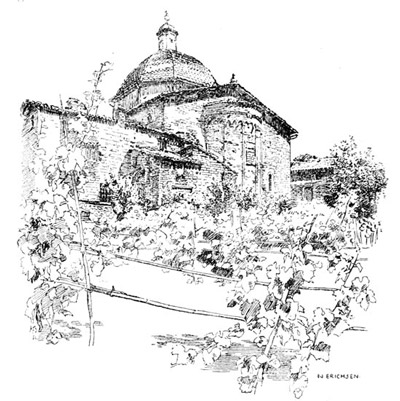
THE DOME AND APSE OF SAN RUFINO FROM THE CANON'S GARDEN
The marble statue of St. Francis is by the French artist, M. Dupré (a replica in bronze stands in the Piazza), while that of St. Clare is by his daughter, who both generously gave their work to Assisi in 1882. The statue of St. Rufino is by another Frenchman, M. Lemoyne.
The proudest possession of San Rufino is the font in which St. Francis, St. Clare, St. Agnes and Frederick II, were baptised, and the stone is shown upon which the angel knelt, who in the disguise of a pilgrim assisted at the baptism of Assisi's saint. Often did Francis come to San Rufino to preach when the small church of S. Giorgio could no longer hold the crowds who flocked to hear him, and the hut where the saint spent his nights in prayer and meditation before he preached in the cathedral is now a chapel. This was the place of the miracle when his companions at Rivo-Torto saw him descend towards them in a chariot of fire (see p. 238). In the time of the saint it was the cottage of a market-gardener and still stands amidst a vineyard, one of the prettiest and sunniest spots in the town, where vines, onions, wild flowers and cherry trees grow in happy confusion, and birds and peasants sing all day long.
The charm of the Cathedral is best realised after witnessing one of its many ceremonies, when the canons in crimson and purple, processions of scarlet clothed boys swinging censers, and the Bishop seated beneath a canopy of yellow damask his cope drawn stiffly to the ground by a fussing acolyte, recall some of the magnificence of the middle ages. The young priests bow low before the Bishop on their way to the altar, return to their seats and bow again; incense fills the church; the organ peals half drown the tenor's song, and through it all, from the stalls, drone the voices of the canons reciting their office. It is a gorgeous service but without a congregation, for even the beggars have not stolen in; and Niccolò's Madonna looks out upon the scene with big soft eyes which seem to follow us into the darkest corners of the aisles.
Roman Assisi.
Assisi is so much a place of one idea—of one interest—around which everything has grown, that it is difficult to remember that a fairly important town existed in Roman times, and that the Roman buildings, still to be seen are, in the opinion of Mr Freeman, worth a visit even if the church of San Francesco had never arisen. Some pleasant hours may be passed finding the sites of pagan monuments, the remains of ancient walls, and tracing the outline of the original town. In every case we see how Roman Assisi has, in a very marked way, become part of Mediæval Assisi, palaces having been erected upon the foundations of Roman houses and Christian churches upon the sites of ancient temples. The Temple of Hercules stood at the bend of Via S. Quirico (now Via Garibaldi) where it turns up to the ancient palace of the Scifi; while the Porta Mojano, near which old walls and part of an aqueduct can be seen, took its name from a temple of Janus which stood between it and the Vescovado. Standing a little off the Piazza Nuova, in a part of the town known as the "Gorga," are the remains of the amphitheatre. It would be difficult to find much of the original edifice, but houses having been built exactly on the ancient site its shape has been preserved, and this strange medley of old and new was thought worthy of a doric entrance gate by Galeazzo Alessi. Much the same thing has happened with many of the castles in the country near Assisi, where the peasant houses are grouped round them in such a way that only by penetrating into the midst of a tangled mass of dwellings can the vestige of a tower be here and there discerned to remind us of its former state. Assisi, though of no military importance at that time, aspired to become a little Roman town even more perfect than her neighbours on the hills. The broad and strongly built drain which extends from near the Porta Perlici beneath the Piazza Nuova to the garden behind San Rufino, is said to have been used to carry off the water from the amphitheatre after the mimic sea-fights which in Roman times were so popular. A use was found for all things, and in time of war a Roman drain proved a most efficient means of escape, especially when the Baglioni were raiding the town and putting to death all they met upon their road.
Some small remains of a Roman theatre are to be seen near the cathedral but so buried amidst a wild garden that it is difficult to form any just idea of its extent. The most splendid piece of masonry, a Roman cistern, lies beneath the campanile of the cathedral and can be easily looked into by the light of a torch, the sacristan even suggests a descent into its dark depths by means of a rickety ladder. An inscription recording the proud fact that Assisi possessed an amphitheatre has been removed to the cathedral where it is placed above the side entrance to the left. Other large portions of Roman walls are to be found at the back of a shop in the Via Portica and also in the Via San Paolo; both are marked upon the map. In those days the town seems to have been identical with what we now call old Assisi, namely the quarter round San Rufino extending to the portion round San Francescuccio where are noticed the arched Lombard windows.
But by far the most interesting record of this early age is the Temple of Minerva, which in spite of the damage done when it was turned into a church, and the way in which the mediæval buildings are crowded round it, yet remains one of the most beautiful of ancient monuments. The raising of the Piazza makes it difficult to realise, without going below ground, how imposing the temple must have been when its steps led straight down to the Forum. This can be reached by descending from the Piazza into the "scavi," or excavations, where stands the great altar with drains for the blood of the victims; the long inscription giving the name of the donor of the Temple runs:
GAL. TETTIENVS PARDALAS ET TETTIENA GALENE TETTRASTILVM SVA PECVNIA FECERVNT, ITEM SIMVLACRA CASTORIS ET POLLVCIS. MVNICIPIBVS ASISINATIBVS DONO DEDER. ET DEDICATIONE EPVLVM DECVRIONIBVS SING. XV. SEVIR. XIII. PLEBI X. DEDERVNT. S.C.L.D.
It is well known that Goethe went to Assisi solely to see the Temple, and surprised the citizens by going straight down the hill again without stopping to visit San Francesco. He wished to keep unimpaired the impression this perfect piece of classical architecture had made upon his mind, and we cannot refrain from translating his enthusiastic description of it for these pages.
"From Palladio and Volkmann I had gathered that a beautiful temple of Minerva, of the time of Augustus, was still standing and perfectly preserved. Asking a good-looking youth where Maria della Minerva was, he led me up through the city which stands on a hill. At length we reached the oldest part of the town, and I beheld the noble building standing before me, the first complete monument of ancient days that I had seen. A modest temple as befitted so small a town, yet so perfect, so finely conceived, that its beauty would strike one anywhere. But above all its position! Since reading in Vitruvius and Palladio how cities ought to be built and temples and other public edifices situated, I have a great respect for these things.... The temple stands half way up the mountain, just where two hills meet together, on a piazza which to this day is called the Piazza.... In old times there were probably no houses opposite to prevent the view. Abolish them in imagination, and one would look towards the south over a most fertile land, whilst the sanctuary of Minerva would be visible from everywhere. Probably the plan of the streets dates from long ago as they follow the conformation and sinuosities of the mountain. The temple is not in the centre of the Piazza, but is so placed that a striking, though fore-shortened, view of it is obtained by the traveller coming from Rome. Not only should the building itself be drawn but also its fine position. I could not gaze my full of the façade; how harmonious and genial is the conception of the artist.... Unwillingly I tore myself away, and determined to draw the attention of all architects to it so that correct drawings may be made; for once again have I been convinced that tradition is untrustworthy. Palladio, on whom I relied, gives us, it is true, a picture of this temple, but he cannot have seen it, as he actually places pedestals on the level whereby the columns are thrown up too high, and we have an ugly Palmyrian monstrosity instead of what is a tranquil, charming object, satisfying to both the eye and the understanding. It is impossible to describe the deep impression I received from the contemplation of this edifice, and it will produce everlasting fruit."[104]
S. Paolo[105]
A little off the Piazza della Minerva is the old Benedictine church dedicated to St. Paolo, erected in 1074, when it probably stood alone with its monastery and not, as now, wedged in with other houses. Built in the very heart of Roman Assisi, its foundations rest upon solid walls of travertine, where a secret passage reaches to the castle. In this part of the town there are several underground passages spreading out in various directions, reminding us of the insecurity of life in the early times when Pagan consuls persecuted the weaker Christian sect. Just within the doorway of the church, now alas thickly coated with whitewash, is an ionic column belonging to some building of importance which must have stood within the Forum. Few people visit S. Paolo as it is only mentioned in local guide-books, and the passing stranger is generally told that there is nothing to see which is borne out by the modesty of its exterior; but no lover of the early Umbrian school who has the time to spare should fail to step in, if only for a moment, as on a wall to the left of the entrance is a large fresco by Matteo da Gualdo. He has signed the date in the corner—1475—though not his name, but it would be difficult to mistake so characteristic a work of this delightful painter. The Virgin, tall and stately, is accompanied by St. Lucy, who holds her eyes upon a dish and is clothed in a richly coloured orange gown falling in heavy folds about her; on the other side is St. Ansano, the patron of the Sienese, looking in his elegant green jacket, trimmed with fur, more like a courtier than a holy martyr. He holds his lungs in one hand, because he is a patron of people suffering from consumption, but why we know not, as there was nothing in the way he met his death in the river Arbia by the order of Diocletian to explain the presence of this strange symbol. He stands in Matteo's fresco very daintily by the Madonna's side, pointing her out to the small donor who is seen kneeling in a doorway. The colour is deep, perhaps a little crude, and if the figures may seem somewhat stiff and their draperies angular, all such defects are amply redeemed by the small angels on the arch above, who composedly gaze down upon the Madonna as they sing and play to her.
Palazzo Pubblico or Palazzo Communale
In the beginning of the thirteenth century the civil affairs of Assisi had assumed such large proportions that it was found impossible to transact business in unsheltered quarters of the piazza as had hitherto been done, and the citizens determined to build a Palazzo Pubblico. Other towns were rising to municipal importance, notably Perugia whose palace for her priors proved a beautiful example of a gothic building, while Assisi was directing all efforts to adorn her churches. A house was bought belonging to the same Benedictine abbot of Mount Subasio, who had given the humble dwellings to St. Francis, and on its site they erected the present municipal palace, which was enlarged in 1275 and again in the fifteenth century, but it always remained a humble building with little pretensions to fine architecture. Here the priors and the consuls ruled the citizens in the absence of a despot, while in the palace of the Capitano del Popolo (now the residence of the Carabinieri), whose tower dates from 1276, the council of the citizens met to check the tyranny of the governing faction. These municipal magnates lived upon opposite sides of the Piazza, and acted as a drag upon each other in civil matters. The many small towns, villages and castles which were beneath the yoke of Assisi in mediæval times have been represented by a modern artist in the entrance hall of the Palazzo Pubblico, and are a happy record of her days of conquest and prosperity, which are duly remembered by the citizens. There is also a picture by Sermei of St. Francis blessing Assisi from the plain which, painted in the sixteenth century, is interesting as a likeness of the town at that time. There is also a picture of Elias hung upon the wall, intended as a portrait and not as an object for popular devotion. An effort has been made to adapt one of the rooms as a gallery of Umbrian art, and a few frescoes taken from walls and convents and transferred to canvas are preserved here, giving some idea, notwithstanding their ruined condition, of the liberal way in which Umbrian artists distributed their work in every corner of the town. The gateway of S. Giacomo exposed to constant sun, wind and rain, was yet thought a fitting place for Fiorenzo di Lorenzo to paint a fresco of a beautiful Madonna. It now looks sadly out of place in this room of the Municipio with a little paper ticket on the corner of the canvas marking it as No. 17. The half figures of angels, No. 23 and No. 24, by Matteo da Gualdo, were taken from the Confraternity of S. Crispino together with No. 21. From the Chiesa dei Pellegrini came No. 5, the Madonna and Saints by Ottaviano Nelli of Gubbio; while No. 6, a Madonna, with angels holding a red damask curtain behind her, was found at the fountain of Mojano and is attributed to Tiberio d'Assisi. That mysterious painter L'Ingegno d'Assisi may be the author of No. 12. Vasari recounts how he learnt his art in the workshop of Perugino in company with Raphael, and even helped his master in the Cambio frescoes. His real name was Andrea Aloisi, the nickname of Ingegno arising from the fact that he was looked up to by his fellow citizens as a very remarkable man, for not only could he paint beautiful Madonnas but he was a distinguished Procurator, Arbitrator, Syndic and Camerlingo Apostolico. But to try and trace his work is like following a will-o'-the-wisp, for no sooner do we hear of a fresco by him than it eventually turns out to be by Fiorenzo di Lorenzo or by Adone Doni, and this fresco in the Municipio is the only one in Assisi which may be by him. If it is, Tiberio d'Assisi would seem to have been his master and not Perugino.
In the same room is a small but interesting painting in fresco (No. 87), the figure of a winged Mercury, which was excavated a few years ago in the Casa Rocchi, via Cristofani. In another room is the head of a saint which some believe to be also of Roman times, but a good authority attributes it to a late follower of Raphael. The saint's head is seen against a shadowy blue landscape, and like all Umbrian things has an indescribable charm, a feeling that the artist loved the valleys in spring-time, and tried to convey some of the soft colour of the young corn and budding trees into the picture he was painting.
The Chiesa Nuova
A little below the Piazza della Minerva is the Chiesa Nuova, built at the expense of Philip III, of Spain in 1615 by the Assisan artist Giorgetti and finished in seven years. Few people come to Assisi without visiting it, for although containing nothing of artistic value, it stands upon the site of the Casa Bernardone, and recalls many incidents of St. Francis' life. The small door is shown through which Madonna Pica passed when the angel disguised as a pilgrim told her that her son was to be born in a stable, and we see part of the cell where St. Francis endured such cruel imprisonment from his father, until his mother in the absence of Messer Pietro let him out to return to his haunts at San Damiano and the Carceri.[106] Other places preserve more of the charm of the saint than the Chiesa Nuova.
Two buildings in the town are intimately connected with St. Francis, his father's shop in the Via Portica the entrance of which the sculptor of St. Bernardino's door at the franciscan convent has adorned with a beautiful pattern of flowers, shields and cupids; and the house of Bernard of Quintavalle which is reached from this street by the Via S. Gregorio. It is now the Palazzo Sbaraglini and has no doubt been much enlarged since the thirteenth century, but the little old door above a flight of steps bears the unmistakable stamp of age; it leads into a long vaulted room, now a chapel, which there seems every reason to believe was the one where Bernard, the rich noble, invited St. Francis to stay with him at a time when he doubted his sanctity. The story is too long to quote and extracts would only spoil it, but the pilgrim to Assisi should read it as related in that franciscan testament, the Fioretti (chap. iii.). Popular devotion has happily not tampered with this corner of the town as it has with the house of the Bernardone.
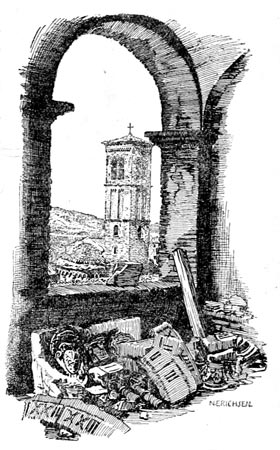
CAMPANILE OF STA. MARIA MAGGIORE
Sta. Maria Maggiore
This romanesque church stands above a Roman building whose columns and mosaic floor can easily be seen from the garden behind the apse, and for many centuries it was the cathedral of Assisi as is testified by its close proximity to the Bishop's palace. But there is now little to remind us of any pretensions to splendour which it may once have possessed, only vestiges of the frescoes destroyed by the great earthquake of 1832 can be seen on its walls, and an Annunciation in a cupboard of the sacristy—in such strange places do we find an ancient fresco in Assisi. The church was already an old building in the twelfth century, for we hear of its being restored and enlarged after a fire by Giovanni da Gubbio, and finished later by the help of St. Francis who is said to have rebuilt the apse. One gladly hurries out of it into the little piazza which, though the humblest looking in Assisi, is very famous for the scenes it has witnessed. Here St. Francis renounced the world in the presence of his angry father, and received protection from Bishop Guido; (see p. 235). Many years later the dying saint was brought to rest at the Bishop's palace near the church, and edified those who guarded the gates by singing so gaily in the midst of terrible suffering. Then again when a quarrel arose between Guido and the Podestà of Assisi, two friars came up with a message of peace from St. Francis, then on his deathbed at the Portiuncula, who had heard with grief of the dissension. The story, and it is a true one we may be sure, has been faithfully recorded by Brother Leo, who tells us how "when all were assembled together in the piazza by the Bishop's palace the two brethren rose up and said: "The blessed Francis in his illness has composed a canticle to the Lord concerning His creatures, to the praise of the Lord Himself and for the edification of the people." It was the verse beginning "Praised be my Lord for all those who pardon one another for His love's sake," which he had added to his Hymn to the Sun (see p. 79). All listened intently to the message which so touched the heart of the Podestà that he flung himself at the Bishop's feet and promised to make amends for his offence for the love of Christ and the Blessed Francis. The Bishop lifting him from the ground spoke words of forgiveness and peace, and then "with great kindness and love they embraced and kissed one another."
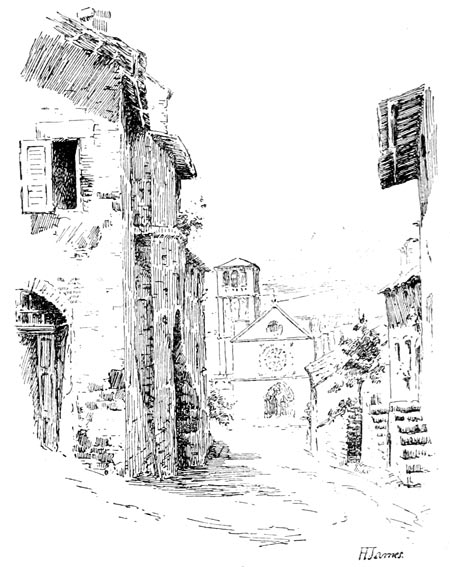
EAST FRONT OF SAN FRANCESCO
Convents of S. Quirico and S. Appolinare
Every church and convent wall in Assisi was once adorned by frescoes, and even now, when time and ill-usage have done their best to ruin them, it is still possible to come upon delightful specimens of Umbrian art. But they are so stowed away in out of the way corners that one hardly likes to pass a door, however poor and uninviting, without glancing in to see what treasure may be hidden away behind it.
Curiosity was amply rewarded one day while visiting the convent of S. Quirico which we pass on the way from Sta. Maria Maggiore to S. Pietro, attracted there by the small fresco of the Virgin and St. Anne by Matteo da Gualdo over the door. The whitewashed parlour contained nothing of interest, not even a nun peered through the iron grating, but a murmur from the attendant about frescoes drew us to a window where, above the brown-tiled roof under a rough pent ledge, exposed to rain and wind, was a fresco of Christ rising from the tomb, and four small angels. It is not perhaps one of Matteo da Gualdo's most pleasing compositions and might be passed unnoticed in a gallery, but the thought of the wealth of Umbrian art, when masters left their paintings over gateways upon city walls, and above a roof where even the nuns can scarcely see it as they walk in the cloister below, give it a peculiarly Assisan charm which we cannot easily forget. A few steps further on, down the Borgo San Pietro, is the large convent of S. Appolinare, remarkable for its pretty campanile of brick, and a wheel window above the door. It once possessed many frescoes of the fourteenth and fifteenth century, but now it is not worth while to seek admittance for they are much destroyed; some have been ruthlessly cut in two by lowering the ceiling of the rooms, and only here and there, where the whitewash has peeled off, faces of Madonnas and saints look out like ghosts imprisoned in a convent wall.
S. Pietro
The church of S. Pietro stands upon a grass piazza surrounded by mulberry trees, with a broad outlook upon the valley. The central door, supported by two lions, has a twisted design of water-plants and birds which formerly were coloured, but now only show here and there traces of green stalks on a dark red background. A finely carved inscription above it records that in the year 1218 the cistercian Abbot Rustico built the façade, but its proud historians believe the church itself to have existed in the second century, thus claiming for it the honour of being the first church erected in Assisi. The present building cannot be older than 1253 when it was rebuilt after a great fire, and consecrated by Innocent IV. The interior is finely proportioned, and the remains of ancient frescoes discovered upon the walls show the zeal of the Assisans in making all their churches, as well as San Francesco, as beautiful as they could.
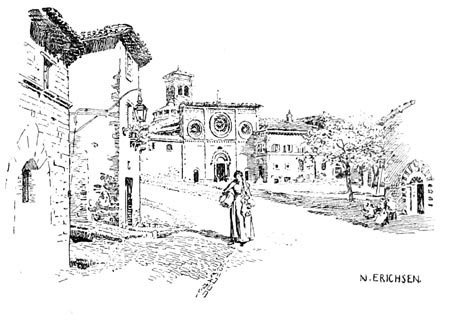
CHURCH OF S. PIETRO
In the small chapel to the left of the high altar are four stencilled medallions of a hunter with his dogs chasing a stag, besides symmetrical patterns like those of the nave of the Lower Church of San Francesco. Over the altar is a signed picture by Matteo da Gualdo (he was at Assisi in 1458, but the date here is partly effaced), of a Madonna with a choir of angels, and upon either side St. Peter and the Assisan martyr St. Vittorino. By standing on the altar steps a fresco of the Annunciation of the fifteenth century may be seen on the wall of the sacristy, discovered beneath the usual layer of whitewash some fifty years ago. The angel's profile, the hair turned back in waves from the face over the shoulders, is clearly outlined, and shows pale against the golden light of his wings. But the real treasures of this church, according to a pious author, are the bones of St. Vittorino, an Assisan Christian who was the second Bishop of Assisi, and died a martyr's death in the third century. In 1642 these relics were deposited in a more suitable marble urn than the one that had contained them before, during a grand ceremony presided over by a Baglioni, Bishop of Perugia. Other bones and ashes of some Roman martyrs were afterwards added which were taken from the cemetery at Rome by the Abbot of San Pietro "to further enrich his church."
The Confraternities
An enduring mark of St. Francis' influence is seen in the number of confraternities established in Assisi which, if they have lost many of their primitive customs, still retain a hold upon the people and are the great feature of the town. Hardly a day passes without seeing members either preparing for a service in one of their chapels, or following a church procession, or carrying the dead along the cypress walk from Porta S. Giacomo to the cemetery. Clothed in long grey hooded cloaks, holding lanterns and candles and singing their mediæval hymns, these citizens of the nineteenth century belong to Assisi of the past as much as all her frescoes and early buildings. Their origin goes back to the middle of the thirteenth century when, out of the great devotional movement due to St. Francis, arose that strange body of penitents the Flagellants, who are said to have first appeared in Perugia, and thence spread throughout Italy.[107] "The movement," says Dr Creighton, "passed away; but it left its dress as a distinctive badge to the confraternities of mercy which are familiar to the traveller in the streets of many cities of Italy." Assisi was among the first to witness the hordes of fanatics who roamed from town to town increasing as they passed like a swarm of locusts through the land, and often at night going forth into the streets clothed in white garments to dance a dance of the dead, clanging bones together as they sang. It was inevitable that their passage through Assisi should have its results, and many brotherhoods were founded; those who had no chapels of their own met in S. Pietro or S. Maria delle Rose, where they performed their penances, sometimes, as in the case of the Battuti (Flagellants), beating themselves as they sang the wild, love-inspired hymns of Jacopone da Todi, the franciscan poet of Umbria. Since those days their fervour has taken a more practical form, and very simple are their services.
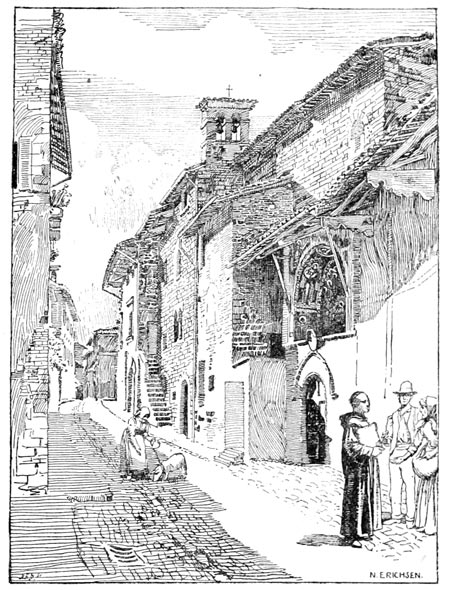
CONFRATERNITY OF SAN FRANCESCUCCIO IN VIA GARIBALDI
The members of San Francescuccio, or Delle Stimate, ever to and fro upon some errand of mercy, belong to the most important confraternity, and own one of the most picturesque chapels in the towns. When its doors are open during early Mass or Benediction the sound of prayer and chanting comes across the quiet road, and in the blaze of candle-light is seen the great Crucifixion of Ottaviano Nelli (?) in the lunette of the wall above the altar. At other times, the chapel being so sunk below the level of the road with no windows to light it, both fresco and the charming groined roof, blue as that of San Francesco, can with difficulty be seen. The pent roof outside overshadows some Umbrian frescoes by Matteo da Gualdo recording the famous miracle of the roses which flowered for St. Francis in the snow, and which he offered to the Virgin at the Altar of the Portiuncula. On the wall to the right are some ruined frescoes in terra-verde by a scholar of Matteo.
Another confraternity in this street is San Crispino, which once possessed a picture by Niccolò Alunno, but that has long since disappeared, and only faint patches of colour remain above its gateway. There are many other confraternities, but as they do not all possess pictures of interest, we only mention three others; and first of these, the Oratory of St. Anthony the Abbot, or Chiesa dei Pellegrini, which every visitor to Assisi ought to visit.[108] After the Church of San Francesco it is by far the most important sight of the town; a Lombard façade, a Roman temple, or a mediæval castle, delightful and beautiful as they are, may be seen elsewhere, but we know nothing with such individual charm as the little chapel of St. Anthony, in the Via Superba. So often a hundred vicissitudes arrested the adornment of a building during those troubled times of the middle ages, but here we find a small and perfectly proportioned oratory decorated with frescoes upon the ceiling and upon every wall, by two Umbrian masters who have sought to make it a complete and perfect sanctuary of Umbrian art.
Built in 1431 by the piety of the brotherhood of St. Anthony the Abbot, it served as a private chapel to the adjoining hospital, where pilgrims coming to pray at the shrine of St. Francis found food and shelter for three days. The liberal donations given by Guidantonio, Duke of Urbino and sometime Lord of Assisi, whose devotion to the saint was great, may have enabled the confraternity to adorn it with its many frescoes. Outside, in the arched niche above the door, are the patrons of the chapel, St. Anthony and St. James of Campostello, that great saint of pilgrims, with a frieze of small angels above them playing upon various instruments, also by Matteo da Gualdo. To him we owe the fair Madonna over the altar who gazes so dreamily before her, and sits so straight upon her throne. Angels gather round bending towards their instruments with earnest faces; Matteo's angels can never only calmly pray, they must sing or else play on tambourines, viole d'amore, cymbals and organs. Less pleasing are the large figures of St. James and St. Anthony, while in contrast to them are the slender winged figures on either side bearing tall candelabra, and moving forward with such stately step, their white garments sweeping in long folds behind them, their fair curls just ruffled by the air. Surely Matteo must have been thinking of a group of babies at play in the cornfields, or under the hedges near his own Umbrian town, when he painted that frieze of laughing children, with little caps fitting so closely round their heads, who are tossing the branches of red and white roses up into the air. Each one is different, and all are full of graceful movement. They divide the frescoes below from that of the Annunciation, which recalls the manner of Boccatis da Camerino, the master of Matteo. He paints a swallow, the bird of returning spring, perched outside the Virgin's bedroom, to symbolise the promise of redemption, and a lion cub meant to represent the lion of Judah walks leisurely towards the Madonna.
Matteo da Gualdo, as the inscription tells, worked here in 1468, and Pier Antonio da Foligno, known as Mezzastris, came in 1482 to paint the rest of the chapel, and upon the right wall he related the most famous of St. James' miracles in a naïve and delightful manner. The legends tell how in the time of Pope Calixtus II, a certain German with his wife and son on their way to the saint's Spanish shrine of Campostello lodged at Tolosa, where their host's daughter fell in love with the fair young German. But he, being a cautious youth, resisted every advance of the Spanish maiden, who sought to avenge herself by hiding a silver drinking cup belonging to her father in his wallet. The theft was discovered, and the judge of Tolosa condemned the young pilgrim to be hanged. Pier Antonio has painted the scene when the father and mother, after visiting Campostello, return to take a last look at the place where their son was executed and find him well: "O my mother! O my father!" he says, "do not lament for me, as I have never been in better cheer, the blessed Apostle James is at my side, sustaining me and filling me with celestial joy and comfort." In the fresco near the altar the story is continued; the judge, stout and imposing as one of Benozzo Gozzoli's Florentine merchants, is seated at a table in crimson and ermine robes surrounded by his friends, when the pilgrim and his wife arrive and beg him to release their son. Somewhat bored at being interrupted at his banquet he mocks them, saying: "What meanest thou, good woman? Thou art beside thyself. If thy son lives so do these fowls before me." No sooner had he spoken than, to the astonishment of all, the cock and hen stood up on the dish and the cock began to crow, as we see in Mezzastris' fresco. On the opposite wall are miracles of St. Anthony. In the fresco near the door he is sitting in the porch of the church surrounded by his companion hermits; they are watching the arrival of camels which, in answer to the saint's prayer, have brought a supply of food neatly corded on their backs. The artist has pictured the desert with sandy mountains, little flowers growing in the burning sand and thick grass in the wood by the convent. In the second fresco St. Anthony, beneath a portico of lapis lazzuli and green serpentine, is distributing the food brought by the friendly camels, to the beggars, who appear as suddenly upon the scene as the beggars do in an Assisan street.
The four figures in the ceiling, Pope Leo III, St. Bonaventure, St. Isidor of Seville and St. Augustine, and the angels with shield-shaped wings, are also by Mezzastris. A graceful piece of his work is the Christ above the door, in a glory of angels who form a wreath around Him with their wings like sheaves of yellow wheat. Delightful, but very different from Matteo's, are the cupid-angels flying across the sky on clouds, and the two seated playing with a shield upon which is painted the pilgrim's scallop-shell.
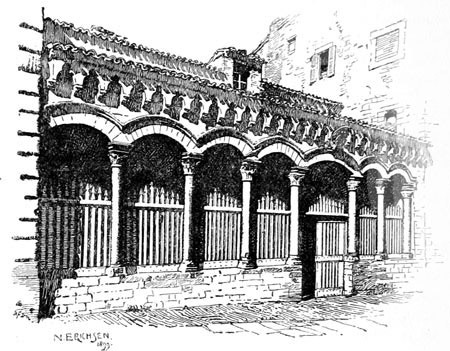
MONTE FRUMENTARIO IN THE VIA PRINCIPE DI NAPOLI
The figure of St. James near the door is of small interest, being a much restored work of a pupil of Perugino; but in the dark corner on the other side is, says Mr Berenson, a youthful work of Fiorenzo di Lorenzo. It is the young St. Ansano holding his lungs suspended daintily from one finger as in the fresco of S. Paolo, and looking so charming in his page's dress, his fair curls falling about his shoulders. He stands at the entrance of a cave with pointed rocks above, and saxifrage and ferns delicately drawn are growing in their crevices. Would that Mezzastris had given his pupil a larger space of wall to work on, so that we might have had more saints and landscapes like these. We leave the chapel with regret, giving one last look at Matteo's Madonna and his frieze of child-angels, and then go out into the long broad Via Principe di Napole. Its fine palaces, once the abode of some of the richest nobles of the town, have now been turned into schools and hospitals, and our thoughts once more revert to the past days of prosperity and magnificence as we walk along this grand but silent street where the grass grows unmolested between the stones. A little way further on to the right is the fine loggia of the Monte Frumentario which in olden times was an agricultural Monte di Pietà, where the peasants who had no other possessions than the produce of the fields would come to pawn their grain in time of need. The door is finely sculptured, and the delicate chiselling of the capitals of the pillars of the loggia mark it as a work of the fourteenth century. Not far from the Chiesa dei Pellegrini, but to the left, stands one of the oldest Assisan houses which does not seem to have suffered much alteration since it was built. It was the lodge of the Comacine guild of workers, who have left their sign of the rose between the compass over the entrance, and two pieces of sculpture, showing that those to whom the house belonged were people who worked at some trade. It does not appear to have been a dwelling-house, but only a place where the members of the guild, employed in building the different civil and religious buildings for the Assisans, could meet together to discuss their interests, draw out their plans and execute different pieces of their work. They probably did not build the house, but perhaps in the year 1485, which is the date above the door, adapted for their use one already standing.[109] It is always pointed out as the Casa di Metastasio, but his paternal dwelling is a less interesting house, standing at the angle of Via S. Giacomo and Via S. Croce, which can be reached from the Comacine Lodge by the steep by-street of S. Andrea. Metastasio, though the Trapassi were Assisans, had little to do with the town as his family were engaged in trade at Rome, where he was born in 1698. There he was found improvising songs to a crowd of wondering people by the celebrated Vincenzo Gravina, who adopted and educated him. When set to music, Metastasio's poetry brought all Rome to his feet and earned him the title of Cæsarean poet from the Emperor Charles VI; he ended his life at the court of Vienna as the favourite of Maria Theresa, honoured by all the great musicians of the day. Truly he has little to do with Assisi, yet he must be added to the list of her numerous illustrious citizens.
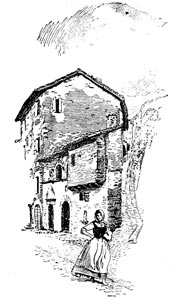
HOUSE OF THE COMACINE BUILDERS IN THE VIA PRINCIPE DI NAPOLE
Following the street by the Casa di Metastasio, we get into delightful lanes above the town and reach another little confraternity, the oldest of all, San Rufinuccio.[110] Its small chapel, built of alternate layers of pink and white Subasian stone, is a very characteristic example of an Umbrian way-side sanctuary, always open in the olden days for the peasants to come into for rest and prayer. It is worth a visit, not only because the way there is beautiful, but also for the grand Crucifixion painted above the altar by the decorator of St. Nicholas' Chapel in San Francesco. It is a strong and splendid composition, which even much repainting has been unable to destroy. Unfortunately the scenes at the sides can only just be seen. Below, the half-length Madonna and angels by another artist recall the Annunciation of S. Pietro, in the marked outline of their pale faces and the rainbow colour of clothes and wings.
Turning off from the Via Nuova to the left we mount still higher through the olive groves along a path possessing no name, but which is the nicest way to the heights above the town. We come in a few minutes to the confraternity of San Lorenzo, standing somewhat below the level of the castle. It has nothing of interest inside, but behind the wooden covering of the gateway at the side is a fresco by an unknown Umbrian artist, an Assisan perhaps, who above the Virgin's throne signs himself "Chola Pictor." He paints the faces of his saints with a smooth surface, betraying the influence of Simone Martini which he felt together with many of his fellow Umbrian artists. The Virgin's throne is full of wonderful ornaments; unfortunately the fresco has suffered from a large crack across the wall. Very quaint is a group of hooded members of the confraternity at her feet, and there is a charming figure of St. Rufino, young, with an oval face and brown eyes, but to be seen only from the top of a ladder as he is painted in a corner of the arch. It has been suggested to remove this much-ruined painting to the safer custody of the Municipio, but we hope this will not occur, for, taken away from its gateway on the hillside, where the redstarts build their nests and the evening sun lights up the colour in the Virgin's face, its interest and charm would be lost.
The Castle or "la Rocca d'Assisi"
Within her city walls Assisi possesses nothing wilder or more beautiful than the undulating slopes which rise from the city up to the Castle, where wild orchises grow among the grass, and the hedges of acacia wind around the hill. The town lies so directly below, that by stepping to the edge and looking across the white acacias, we can only see a mass of brown roofs all purple at sundown, the tops of towers and the battlements of gateways. Then there are places where the grassy hillocks stand up so high that they hide the town altogether, and we seem to be looking out upon the broad vista of the valley from an isolated peak. At all times it is beautiful; but choose a stormy day in springtime, when the clouds are driving upwards from the plain only lately covered with mist, and the nearer hills are dark their cities catching the late evening sunshine as it breaks through the storm, while wind-swept Subasio looks bleak in the white light showing here and there patches of palest green. And behind us, cresting the hill, so near the town yet seen absolutely alone and clear against the sky, rise the tower and the vast walls of the Rocca d'Assisi, looking, not like a ruin crumbling beneath the constant driving of wind and rain, but as though torn down in war-time, grand in its destruction. It stands upon the site of an ancient burial ground, where in remote times the Umbrian augurs came to watch for omens from the heights of a tower that is said to have crowned the summit. The legend of this building gave rise to the belief that a castle stood here in very early times which was taken by Totila when he besieged Assisi. But it is more probable that when Charlemagne rebuilt the town in 733 after it had been destroyed by his army, he also erected a castle to enable the Papal emissaries to keep the people in subjection; or perhaps the citizens themselves may have wished to protect themselves more securely from passing armies (see p. 16). It ended by becoming, much to the displeasure of the people the residence of whoever held Assisi for the time, and in the twelfth century they experienced the despotic rule of Conrad of Suabia, who lived here with his young charge, Frederic II. When, by the superior power of the Pope, Conrad was driven out of Umbria, the citizens did their best to destroy the walls which had harboured a tyrant, and to avoid further tyranny they obtained an edict forbidding the erection of another fortress. But promises such as these were vain indeed, for when, in 1367, escaping from the hated yoke of the Perugians Assisi welcomed Cardinal Albornoz in the Pope's name as her ruler, she lent a willing ear to his plans for rebuilding the castle. The people were well satisfied as they watched the improvements he made in the town, and two centuries had so dimmed the remembrances of Conrad's tyranny, that they gladly assisted him, little deeming that they were giving away their liberty. Albornoz, not slow to perceive what a valuable possession it would prove to the rulers of Assisi, spared neither money nor efforts to make it large and strong. By his orders the castle keep, which we see to this day, called the "maschio," and the squarely-set walls enclosing it were erected, and in a very few years the Rocca again rose proudly on its hill, warning the Umbrian people of its newly-found importance, and enticing passing condottieri to lay siege to a town that offered so fine a prize. Albornoz also rebuilt most of the city walls which had been so battered during the Perugian wars; we can trace them from gateway to gateway encircling the city, and it is curious to see how in the upper portion near San Rufino large open spaces exist, as if in those active days when the Assisans had hopes of becoming powerful, they purposely set the walls far back to provide for a large and flourishing town. The feeling of arrested growth is one of the most mournful spectacles, and we half wonder if the great castle dominating the heights was not in part the cause of it. There was war enough at the time, inevitable among the restless factions of a people groping towards freedom and power, but here above the town was placed a fresh cause of dissension and struggle against perpetual bondage through varied tyrannies.
Albornoz, in planning out the city walls, discovered that the part between Porta Cappuccini and Porta Perlici, where the hill descends towards the ravine, needed protection, so he built the strong fortress of San Antonio known as the Rocca Minore. It had a separate governor or Castellano, and though of minor importance, proved very efficient in repelling the attacks of besieging armies. The principal tower, though somewhat ruined, still looks very fine within its square enclosure of massive walls, now covered in places with heavy curtains of ivy, the home of countless birds. A pious Castellano in the fifteenth century left a fresco of the Crucifixion in the chapel with his portrait at the foot of the Cross, and as we look at it through the wooden gateway we are reminded of what otherwise from the deserted look of the place it is easy to forget, that people once lived and prayed at the Rocca as well as fought.
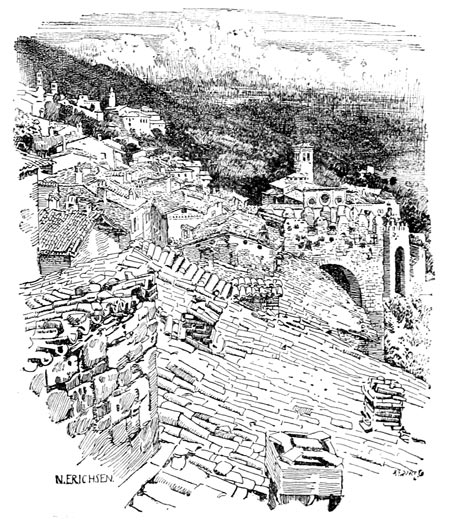
LOOKING ACROSS THE ASSISAN ROOFS TOWARDS THE EAST
Cardinal Albornoz left the castle in charge of two Assisan captains, but from 1376 an uninterrupted line of governors received their salaries from whoever was master of Assisi at the time. Always chosen from other towns their privileges were quite distinct from those of the civil governors; but in the fifteenth century, owing to the weakness of the Priors, who failed to keep order among the lawless nobles of the town, their power increased. The Papal Legate then gave into the hands of the Castellano authority to issue edicts which the Priors had to obey, and in 1515 he was invested with the title of Podestà and Pretor of Assisi. But none of these governors seems to have misused their power over the town, probably because their rule was of too short a duration to carry out any ambitious scheme. And when the despot for the time being of Assisi came to stay, he took up his quarters in the castle, ruling governors, magistrates and people alike. In the time of the despot Broglia di Trino, we hear of the Priors wearily toiling up the steep ascent to place before him the acts they had passed in the municipal palace. He received them always in the open air, holding his councils either in the first enclosure by the well, or in the second by the castle keep, where many important conclusions were arrived at, and plans for the city's dominion laid out.
So perfect is the harmony of the castle from wherever it is seen, that it is difficult to realise how many hands have formed it, how many times its walls have been battered down and rebuilt at different periods by popes, cardinals, and passing condottieri, who have nearly all left their arms upon its walls as a record of their munificence. After Albornoz had built the principal mass of fortifications little was done until 1458, when Jacopo Piccinino, the son of the great general, entered Assisi as master, and obtained immediate possession of the Rocca. His reign was short, but with the quick eye of a soldier he soon discovered the weakness of the western slope, and seeing that it might be carried by assault from Porta San Giacomo, he laid the foundations of a polygonal tower and a long wall connecting it with the main building. The Comacine builders established in Assisi were employed and left their sign, the rose between the compass and the mason's square, upon its lower walls. But long before the work was half completed Piccinino sold the city to the Pope, and it was Æneas Piccolomini, Pius II, who, when he visited Assisi in 1459, ordered it to be brought to a termination; within a year the wall was raised to its full height, the tower received its battlements and the arms of the Piccolomini were placed above those of Piccinino. The covered gallery, running along the top of the wall from the castle, still leads the visitor to the giddy heights of the tower whence he obtains truly a bird's-eye view of all the country round, from Spoleto to Perugia, across range upon range of hills towards Tuscany, and from Bettona to the wild tract of mountainous country leading to Nocera, Gualdo and Gubbio.
To recount the full history of the castle needs a book to itself, and would include not only the history of Assisi but almost of all Umbria.[111] The possession of the Rocco Maggiore entailed that of the Rocca Minore and gave undisputed sway over Assisi, so that the desperate efforts made to hold it can be understood. During the intervals when Papal authority was relaxed, we find the names of many famous people whose armies fought for this much contested prize. Biordo Michelotti, Count Guido of Montefeltro, the two Piccininos, Francesco Sforza and Gian Galeazzo Visconti, were in succession its owners. Cosmo de' Medici obtained it from Pope Eugenius IV, in payment of a bad debt, and a Florentine governor ruled over it for a year. It even, together with the town of Assisi, became the property of Lucrezia Borgia, who received it from Alexander VI, as part of her dower on her marriage with Giovanni Sforza, Lord of Pesaro. Sometimes it happened that a private citizen of Perugia conceived the ambitious scheme of making himself master of the castle, and by fraud the Castellano would be enticed outside the gates and murdered with his family. But it always ended by Perugia, fearing the wrath of the Pope, or not liking one of their own citizens to gain so much power, sending an army to dislodge the tyrant, who soon lost his head. Sometimes criminals were kept imprisoned in the castle; we can still see the room in the keep where they scratched their names upon the wall, with many references to their horror of the place, and a roughly traced heart pierced with an arrow. Ordinary malefactors were shut up in a dark cell on the stairs. When their crimes merited death they were executed on the Piazza della Minerva, or if time pressed, the Castellano hanged them from the battlements of the fortress or threw them out of a window into the ravine below. The governors had a difficult and not a very peaceful time, for they had not only to guard against outside foes, but occasionally against a faction who attempted to get possession of the castle, and great on those occasions was the fight outside its walls. It was in vain that they took every precaution for the general safety, that a night guard walked up and down the Assisan streets playing his castanets to warn off all evil-doers, or that men-at-arms watched incessantly from the castle battlements. In the sixteenth century the castle became a prey to the rival families of the Nepis and the Fiumi who divided Assisi between them. First it fell into the hands of Jacopo Fiumi and the Pope, Alexander VI, furious when he heard of this citizen's audacious act, wrote that "by love or by force" he would have his fortress back again; but Jacopo remained impervious to threats or promises and held out for another year, until the Priors fearing the anger of the Pope came to an agreement with him. Some thirty years later the Nepis obtained possession of it by treachery and violence, and it required all the astuteness of Malatesta Baglione, who was fighting for Clement VII, to dislodge them, while the Pope branded them and their adherents as "sons of iniquity" for having dared to wrest from the Papacy the castle of Assisi.
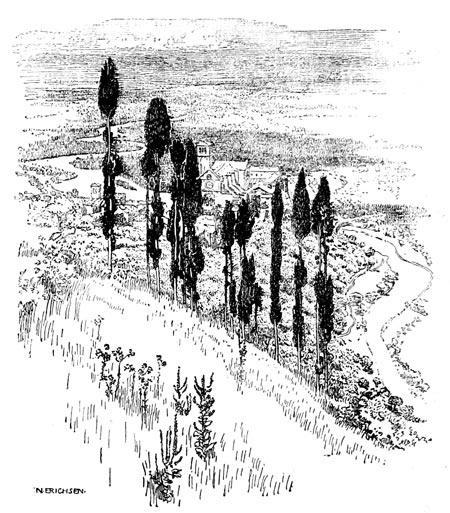
VIEW OF SAN FRANCESCO FROM BENEATH THE CASTLE WALLS
But the days of the great military importance of the Rocca were fast drawing to a close; Assisi, no longer oppressed by the nobles, harassed by the armies of Perugia, or alarmed by the coming of the despots whose power was on the wane all over Italy, lost her character of individuality as a fighting and turbulent city, and sank beneath the wise and beneficent government of the Papacy. With the arrival of Paul III, in 1535, the final blow was given to mediæval usages of war and scheming in Umbria. The great Farnese Pope was building his fortress at Perugia to finally crush that hitherto indomitable people, and fearing the Assisans might yet give trouble in the future to his legates as they had so often done in the past, he gave orders that the fortress should be repaired, and a bastion suitable for the more modern methods of warfare be built to the right of the castle keep. This is now the best preserved portion of the building. For some time a Castellano still remained in command of the castle but his title was purely a nominal one, and his chief duty seems to have consisted in guarding prisoners. Its political need having disappeared the popes thought less of their Assisan fortress, the one lately erected at Perugia being more efficient as a safeguard of their interests, and gradually its walls showed signs of decay, but no papal legates were sent to see to their repair. So terribly did it suffer during the years that followed the reign of Paul III, that in 1726 we read of the governor of the city sending an earnest supplication to the Pope that "this strong and ancient castle of Assisi, which had always been the chief fortress of Umbria, should be saved from ruin." The Pope, he tells us in another letter, had already sent Count Aureli, the military governor of Umbria, to inspect it, who declared it was "one of the strongest and most splendid fortresses of the ecclesiastical states, and as fine as any he had seen in France or in Flanders, when as head page he had accompanied Louis XIV." In the same document there is mention also of beautiful paintings in the chief rooms, and of a miraculous Crucifixion in the chapel, but these decorations, needless to say, have long since disappeared. Entreaties were vainly sent to Rome; the castle was so utterly abandoned that its gates stood open for all to roam in and out as they pleased, pulling down the ancient arms of the popes, and vying with the storms to complete its ruin and destruction. Such was its strength that it endured the ill-treatment of seasons and of men, and people now alive remember in their youth to have seen it still roofed in and possessing much of its former magnificence. A little money might have restored it to its pristine state, but during those years of struggle for the Unity of Italy the general fever of excitement invaded the quiet town, and as if remembering all the tyrants their castle walls had harboured, and the skirmishes their ancestors had fought beneath them, the citizens continued its destruction with renewed vigour. It was no uncommon thing to see cartloads of stones being taken down the hill for the construction of some modern dwelling, or boys amusing themselves by throwing down portions of the walls, and trying who could succeed in making great blocks of masonry reach the bed of the torrent below. Luckily the government gave it over to the commune of Assisi in 1883 and they did something towards its repair, though within certain limits, for a large sum would have been necessary to complete its restoration.
But it still remains a very wonderful corner of Assisi, and delightful hours may be passed sitting in the castle keep and looking out of the large windows upon a land so strangely peaceful, with little cities gathered on the hills or lying by some river in the plain. We see the battered walls around us bearing traces of ancient warfare, and wonder at the power which made the mediæval turmoil so suddenly subside. In vain we scan the valley for the coming of a warlike cardinal with glittering horsemen in his rear, or look for Gian Paolo Baglione riding hastily through the town upon his swift black charger. The communal armies met for the last time by the Tiber many centuries ago; popes, emperors, condottieri and saints have passed like pageants across Umbria, and as if touched by a magician's wand have as suddenly vanished, leaving her cities with only the memories of an active and glorious past. Thus Assisi, with the rest of the smaller towns, gradually sank as a prosperous and governing city though decidedly not as a place of pilgrimage and prayer, into that deep sleep from which she has never again awakened.
CHAPTER XI
Church of Santa Maria degli Angeli. The Feast of the Pardon of St. Francis or "il Perdono d'Assisi"
The sanctuary of the Portiuncula has, in its present surroundings, rightly been called a jewel within a casket—a casket indeed too large for so small a gem. But the great Church of Santa Maria degli Angeli was the best the Umbrians could procure for the object they loved best after their Basilica in the town, and the famous architects of the day were called in to build it.[112] A smaller shelter would have served the purpose in earlier times but the ever increasing flow of pilgrims who came in thousands for the "Perdono" rendered it necessary to think about a church large enough to contain them; and it was the dominican Pope Pius V, who enabled the work to be commenced in 1569, giving large sums to the vast enterprise. Jacopo Barozio da Vignola gave the ground-plan, leaving the execution of it, at his death in 1573, to be carried out by the well-known Perugian architect and sculptor, Giulio Danti, and his fellow-citizen Galeazzo Alessi, who designed the fine cupola and arches. The church was built in the doric style, divided into nave and aisles with numberless side chapels; and certainly they succeeded in giving it a great feeling of space and loftiness, which if less charming than the mysterious gloom of other churches yet seems to belong better to the open and sunlit Umbrian plain, where it rises as a beacon to the people for many miles round. The earthquake in 1832, which laid the villages near Ponte San Giovanni in almost total ruin, shook down the nave and choir of the Angeli creating havoc impossible to describe. By supreme good fortune, shall we say by a miracle, the cupola of Danti and Alessi remained intact above the Portiuncula, which otherwise would have been utterly destroyed. In rebuilding the church, Poletti, the Roman architect employed, deviated slightly from Vignola's original plan, and further he erected a more elaborate and far less elegant façade than the first one, but baroque as it is we may be thankful that the niches for statues of the saints have remained empty. There have been other earthquakes since that of 1832, and when they occurred a pyramid of faggots was carefully piled upon the Portiuncula for protection in case a miracle might not intervene a second time to save it from destruction.
The friars took an active part in the work, building the campanile and carving the handsome pulpit and the cupboards in the sacristy. The marble altar was given in 1782 by Mehemet Ali, the ruler of Egypt, and many noble Italian families contributed towards the erection of the chapels containing decadent paintings which it would be useless to describe or to look at. One priceless treasure ornaments the chapel of San Giuseppe (in the left transept), a work of Andrea della Robbia in terra-cotta of blue and white which is like a portion of the sky seen through the cool branches of a vine on a glaring summer's day. Andrea is truly the sculptor of the franciscans, for there are but few of his works where an incident from St. Francis' life is not introduced, and with what feeling they are realised. On one side of the beautiful Madonna who bends to receive her crown from the hands of the Saviour, is represented with great dignity and simplicity St. Francis receiving the Stigmata, on the other St. Jerome and his lion. Beneath is a predella divided into three compartments, the Annunciation, Christ in the manger, and the Adoration of the Magi; and Andrea has framed in the whole with a slightly raised garland of apples, fir-cones and Japanese medlars, which suits the delicacy of the workmanship of the small scenes better than a heavier wreath of fruit and leaves. In the Capella delle Reliquie (in the right transept) is a Crucifixion painted on panel by Giunta Pisano (?) with medallion half figures of the Virgin and St. John; below are kneeling angels by an Umbrian artist, whose work contrasts most strangely with the ancient painting belonging to the dark years before Giotto.
In a preceding chapter we lamented the efforts that have been made to decorate the Portiuncula, now alas no longer the shrine among the oak trees; not only in earlier centuries did Umbrian artists cover its rough stones in many parts with frescoes, but the German artist Overbeck has added another superfluous decoration to the façade, severely, but justly criticised by M. Taine, and a German lady has painted the Annunciation on the apse. A very small picture by Sano di Pietro of the Madonna and Child hangs above, a very charming example of the master's work. Very little remains of Pietro Perugino's Crucifixion, and what there is has been well covered over with modern paint. The choir of the monks built outside the Portiuncula having been removed in the eighteenth century half of Perugino's fresco was destroyed, leaving only the groups of people at the foot of the Cross, amongst whom we recognise St. Francis.
A naïve legend is recalled to us by the stone slab let into the wall close to the side entrance, recording the spot where Pietro Cataneo, the first vicar of the Order during the life of the saint, is buried. He was as holy as the rest of those first enthusiasts, and after death so many miracles were wrought at his tomb that the peace of the friars was disturbed. The case becoming serious they had recourse to St. Francis who, seeing the danger that their lonely abode would become a place of pilgrimage, addressed an admonition to Pietro Cataneo, saying that as he had ever been obedient in life so must he be in death and cease to perform such marvellous miracles. After this when peasants came to pray for some favour at his tomb no answer was vouchsafed, so that gradually their faith in his intercession ceased and peace again reigned at the Portiuncula.
The extent of the present church is so immense that the site of all the scattered huts of the brethren and the little orchard so carefully tended by the saint, are contained within its walls. Over what was the infirmary where St. Francis died St. Bonaventure built a chapel which Lo Spagna decorated with portraits (?) of the first franciscans, now seen very dimly like shadows on its walls by the flickering light of the tapers. Out of the half gloom stands strongly outlined in a niche above the altar, a beautiful terra-cotta statue of St. Francis by Andrea della Robbia. The hood is thrown back, the head slightly raised, and in the sad but calm expression of the exquisitely modelled face Andrea conveys a truer feeling of the suffering Poverello than all the so-called portraits. One of these, said to be painted on the lid of the saint's coffin by Giunta Pisano, hangs outside the chapel, but it looks more like a bad copy of Cimabue's St. Francis in the Lower Church, and we would fain leave with the remembrance unspoilt of Andrea's fine conception. Passing through the sacristy containing a head of Christ by an unknown follower of Perugino and a small Guido Reni (?), we reach the chapel of St. Charles Borromeo where an ancient and much restored portrait of St. Francis, said to be painted on part of his bed, hangs above the altar; it is in every way less interesting than the one in the sacristy of the Lower Church. From here an open colonnade leads past a little plot of ground, which in the days of the Little Brethren was the orchard of the convent. One day as the saint left his cell he stopped a moment to speak with the friar who attended to the land, "begging him not to cultivate only vegetables, but to leave a little portion for those plants which in due time would bring forth brother flowers, for the love of Him who is called 'flower of the field and lily of the valley.'" Accordingly a "fair little garden" was made, and often while St. Francis caressingly touched the flowers, his spirit seemed to those who watched him to be no longer upon earth but to have already reached its home. On the other side, carefully preserved within wire netting, is the famous Garden of Roses, and standing in the midst, like ruins of some temple, are the four pillars which in olden times supported a roof above the Portiuncula. In the days when St. Francis had his hut close by, this cultivated garden was only a wilderness of brambles in the forest, and the legend tells how the saint being assailed by terrible temptation as he knelt at prayer through the watches of the night, ran out into the snow and rolled naked among the brambles and thorns to quiet the fierce battle within his soul. The moonlight suddenly broke through the clouds shining upon clusters of white and red roses, their leaves stained with the saint's blood which had fallen upon the brambles and produced these thornless flowers, while celestial spirits filled the air with hymns of praise. Throwing a silken garment over him and flooding his pathway with heavenly radiance, the angel led him to the Portiuncula where the Madonna and Child appeared to him in a vision. The legend has been often illustrated, Overbeck's fresco on the façade of the chapel records it yet again where St. Francis is represented as offering to the Virgin the roses he had gathered.
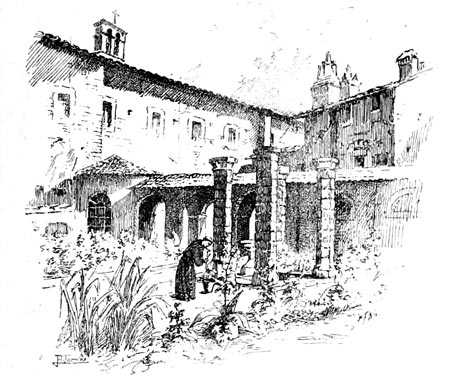
THE GARDEN OF THE ROSES AT STA. MARIA DEGLI ANGELI
A few steps beyond the Garden of the Roses lies the Chapel of the Roses built by St. Bonaventure over the hut of St. Francis, which was afterwards enlarged by St. Bernardine. The place where he spent his few moments of repose and so many hours of prayer, can be seen through the grating on a level with the chapel floor, and resembles more the lair of a wild animal than an ordinary abode of man; but such places were dear to him, and he rejoiced in having the open forest outside his cell into which he wandered at all times of the day and night, and where the brethren, ever curious to watch their beloved and holy master, could see him on moonlight nights holding sweet converse with heavenly spirits. The choir of the chapel is frescoed by Lo Spagna who repeated again the figures of the first franciscans, adding those of St. Bonaventure, St. Bernardine of Siena, St. Louis of Toulouse, and St. Anthony of Padua on the left wall, and St. Clare and St. Elisabeth of Hungary on the right wall. The fresco on the ceiling is said to be by Pinturricchio. The paintings in the nave by Tiberio d'Assisi are faintly coloured and a poor example of Umbrian art; only the last scene is interesting, where St. Francis publishes the indulgence in the presence of the seven bishops, as it gives an accurate representation of the Portiuncula in the fifteenth century with Niccolò da Foligno's fresco still upon the façade. It tells the legend of the "Perdono" which even to the present day plays so important a part in the religious life of Assisi, bringing crowds every year to the Portiuncula for whom the Angeli was finally built. Disentangling the story from the legend by no means diminishes its charm, while we get a very striking historical scene showing us St. Francis in yet another light. Once when the saint was praying at the Portiuncula, Christ and his Mother appeared to him to ask what favour he desired, for it would be granted by reason of his great faith. The salvation of souls being ever the burden of his prayers he begged for a plenary indulgence, to be earned by all who should enter the Portiuncula on a special day. "What thou askest, O Francis," replied Christ, "is very great; but thou art worthy of still greater favours. I grant thy prayer; but go and find my Vicar, the Sovereign Pontiff Honorius III, at Perugia, and ask him in my name for this indulgence." Early next morning St. Francis, accompanied by Peter Cataneo and Angelo da Rieti, started along the road to Perugia where Innocent III, had but lately died and the pious Honorius been immediately elected as his successor. It was in the early summer of 1216 that the little band of friars were led into the presence of the Pope in the old Canonica, but not for the first time did St. Francis find himself in the presence of Rome's sovereign, gaining his cause now as before through the great love that made his words and actions seem inspired. At first the Pope murmured at the immensity of the favour asked but finally, his heart being touched by the fervour of the saint, he said: "For how many years do you desire this indulgence. Perchance for one or two, or will you that I grant it to you for seven?" The Pope had still to learn the depths of love in the saint's heart who stood before him pleading so earnestly for the souls of men, not during his life only, but during centuries to come. "O Messer il Papa," cried St. Francis in accents almost of despair, "why speakest thou of years and of time? I ask thee not for years, but I ask thee for souls." "It is not the custom of the Roman Curia," answered the Pope, "to grant such an indulgence."
"Your Holiness," said the saint, "it is not I who ask for it, but He who has sent me, the Lord Jesus Christ."
The Pope conquered by these words and driven by a sudden impulse said, "We accord thee the indulgence." The Cardinals who had remained silent now began to murmur and reminded the Pope, like cautious guardians of the Papal interests, that this plenary indulgence would greatly interfere with those granted for pilgrimages to the Holy Land, and for visiting the tombs of the Blessed Apostles.
"We have given and granted it to him," answered Honorius. "What has been done we cannot undo, but we will modify it so that the indulgence will be but for one full day." And motioning the saint to approach he said: "From henceforth we grant that whoso comes to and enters this church, being sincerely repentant and having received absolution, shall be absolved from all punishment and all faults, and we will that this indulgence be valid every year in perpetuity, but for one day only from the first vesper of the one day until the first vesper of the next." Hardly had the Pope ceased speaking when St. Francis radiant with joy turned to depart.
"O semplicione quo vadis? O simple child without guile, whither goest thou? Whither goest thou without the document ratifying so great a favour?" quoth the Pope.
"If this indulgence," answered the saint, "is the work of God, I have no need of any document, let the chart be the Blessed Virgin Mary, the notary Christ and my witnesses the angels."
Round this historical interview the legend makers wove the pretty story of the roses which flowered in mid-winter among the snow, relating that after the concession of the indulgence in the summer of 1216 occurred this rose miracle, and Christ in a vision bade the saint go to Rome in order that the day might be fixed for the gaining of the indulgence, and to convince Honorius of the truth of his revelation he was to carry some of the roses with him. But having already obtained the Pope's sanction at Perugia, it was unlikely that the saint would wait another year before proclaiming the glad tidings to all the country-side, and we may be sure that no sooner had he returned to the Portiuncula from Perugia than he made speedy preparations for the arrival of a great concourse of people. On the afternoon of the first of August the plain about the Portiuncula was filled with pilgrims from far and near, and many friars hastened from distant parts to listen to their master's wonderful message. He mounted the wooden pulpit which had been erected beneath an oak tree close to the chapel, followed by the seven Umbrian bishops who were to ratify his proclamation of the indulgence. St. Francis discoursed most eloquently to the assembled multitude and then in the fullness of his joy cried out to them, "I desire to send you all to Paradise," and announced the great favour he had obtained for them from the Holy Pontiff. When the bishops heard him proclaim the indulgence as "perpetual" they murmured among themselves, and finally exclaimed that he had misunderstood the words of the Pope, and that they intended to do only what was right and ratify the indulgence for ten years. Full of righteous feeling the bishop of Assisi stepped forward to correct the error into which the saint had fallen, but to the astonishment of his companions he declared the indulgence to have been granted for all time. Then the others murmured still more, saying he had done this because he was an Assisan and wished to bring great honour to his diocese; so the bishop of Perugia, determining to set the mistake right, began to speak, but he found himself forced by a supernatural power to proclaim the indulgence in the very words of St. Francis. The same thing happened to the other five bishops, and St. Francis then saw his dearest wishes realised.
Daily the fame of the Portiuncula increased, and the year 1219 witnessed another immense gathering of people, but this time it was the meeting of the five thousand franciscan friars who came from distant parts to attend the Easter Chapter held by St. Francis in the plain. One of the most vivid and interesting chapters (the xiii) in the Fioretti, pictures for us "the camp and army of the knights of God," all busily employed in holy converse about the affairs of the Order. It relates how "in that camp were shelters, roofed with lattice and mat, arranged in separate groups according to the diverse provinces whence came the friars; therefore was this Chapter called the Chapter of the Lattices or of the Mats; their bed was the bare earth, though some had a little straw, their pillows were stones or billets of wood. For which reason the devotion of those who heard or saw them was so great, and so great was the fame of their sanctity, that from the court of the Pope who was then at Perugia, and from other towns in the vale of Spoleto, came many counts, barons and knights, and other men of gentle birth, and much people, and cardinals and bishops and abbots with many other clerics, to see so holy and great a congregation and so humble, the like had never yet been in the world of so many saintly men assembled together: and principally they came to see the head and most holy father of all these holy men...."[113]
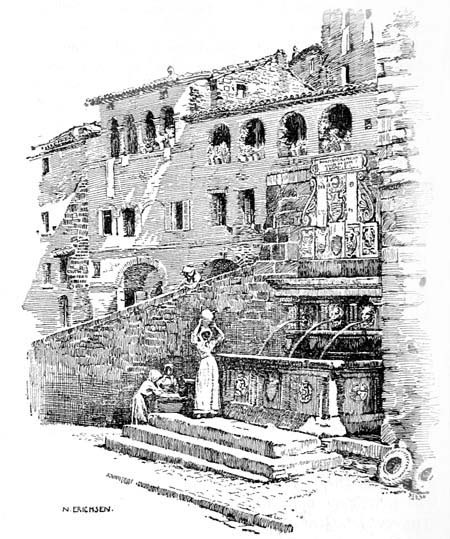
THE FONTE MARCELLA BY GALEAZZO ALESSI
The Pardon of St. Francis or "Il Perdono d'Assisi."
We cannot study the story of any Umbrian town without experiencing the feeling that it belongs to the past and was built in an age, which can only dimly be realised in the pages of old chronicles, by a people who were ever hurrying to battle, bent on glory and conquest for their cities. The character of the inhabitants has changed, and though the wonderful little cities they built upon the hills remain much as in mediæval times, they have a peaceful and quiet loveliness of their own which could not have existed in those days of fevered struggle and unrest. The word Assisi brings up, even to those who have seen the town but for a day, a host of sunlit memories; of way-side shrines with fading frescoes, whence Umbrian Madonnas smile down upon the worshippers; of ravines and forest trees; of vineyards where the peasants greeted you; of convent and Basilica glowing golden and crimson in the sudden changes from afternoon to sun-down, as they lie bathed in the last rays of light upon the hill above the darkness of the valley. All these things and many more pass through our minds, but the picture would be incomplete if we fail to recall two days in August when the undying power of St. Francis once more reaches across the centuries, arousing the people to a sudden return to mediæval times of expiation, prayer and strong belief in the power of a great saint's intercession.
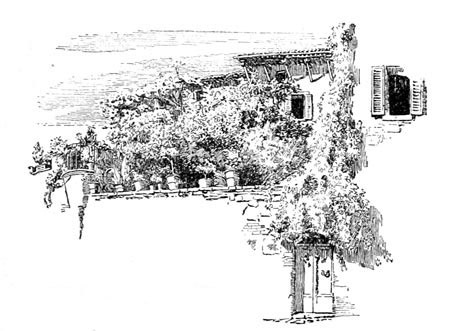
AN ASSISAN GARDEN IN VIA GARIBALDI
The very mention of a feast savours in Italy of delightful things, of songs, of crowds of happy-looking people bent on the pleasures of a holiday as well as on praying for the good of their souls, and as a feast at Assisi sounded fairer than any other, we determined to become for the moment pilgrims and seek with them for the "Pardon of St. Francis." So as the days drew near to August we stood once more on the terrace of the Hotel Subasio, and as we felt the cool air of the early morning coming from the mountains, long days of interminable heat at Florence were forgotten, and Assisi, with her gardens full of sweet-scented summer flowers, her streets resounding only with the plash of the water of many fountains, seemed to us indeed to possess more beauty, variety and brilliancy of colour than we had realised before. Never had the nights been so still as in that late July, when the peasants had gathered in their harvest and were waiting for the time of vintage; only the shrill notes of the crickets answered each other occasionally along the valley, and the frogs croaked on the margin of the rills below the town. But soon this calmness ceased as the country roused itself for the annual spell of madness; there were voices in the vineyards during the night, bonfires in the plains, and a general tremor of excitement filled men and animals, setting the thin Assisan cocks crowing at unearthly hours in the morning. A night of sounds and wakefulness preceded a day when the people of all the cities and villages near appeared to have arrived in Assisi, not for the feast—for it was only the 29th of July—but for the fair. We followed them to the Piazza della Minerva, no longer the quiet place of former visits when only a few citizens sat sipping their cups of coffee, or talked together as they walked leisurely up and down. Temples, buildings and frescoes were forgotten as we watched the peasants gather round the booths to purchase articles of apparel and household wares, bargaining in shrill voices to the delight of purchaser, seller and onlooker. All the people of the country seemed to be here, and the Umbrian sellers had decked their stalls with a dazzling mass of coloured stuffs as attractive to us as to the Umbrian women. We bought large kerchiefs with red roses on a yellow ground to wear over our heads at the feast, and enormous hats with flapping brims, which the peasants, always interested in a neighbour's purchase, helped us to choose, saying, "take this one for no rain will come through it, and you need never use an umbrella." So a sun-bonnet was bought for rain and we went away convinced that no more delightful shopping could be done than during a fair day at Assisi, when a passing farmer and his family were ready to help us to choose the goods and to bargain, and moreover comforted us in the end by the assurance that in their opinion the money had been well spent. Later we strolled up to the Piazza Nuova, where an immense fair of oxen was being held, transforming another sleepy corner of the town into a busy, bustling thoroughfare. They were quiet beasts enough and we walked in among them stroking their soft noses as we watched the groups of excited peasants performing the various rites of selling and buying. When an ox was sold the broker joined the hands of vendor and purchaser by dint of much pulling, and then shook them up and down, shouting all the while, until our joints ached at the sight of this energetic signing of a treaty. The bargaining causes enormous amusement, the discussion on either side bringing a current of eager talk through the crowd; only the oxen were thoroughly weary of the whole affair as they gazed pensively at their owners. They were large milk-white creatures, the whole place was one white shimmering mass seen against the old walls of the town and the blocks of Roman masonry, calling up idle fancies of Clitumnus down in the valley just in sight, whose fields had given pasture to the oxen of the gods.
The whole of that day Assisi was full of Umbrian men and women greatly concerned in buying and selling; but on the next the streets began to fill with people from distant parts of Italy, whose only thought was for St. Francis. At a very early hour of the 30th we were roused by the sound of many voices in the distance; going out on the terrace we saw a crowd of pilgrims coming across the plain, and others moving with slow steps up the hill. When near the Porta S. Francesco they knelt outside in the road and sang their hymn of praise before entering the Seraphic City. From dawn to evening a steady stream of pilgrims passed into the town, and the chanting, rising and falling like a fitful summer breeze, was the only sound to be heard throughout the day. Such different groups of people knelt together in the church, with nothing in common but the love for the franciscan saint whose name was for ever on their lips. They came from distant corners of Southern Italy generally in carts drawn by mules or oxen, for few could afford the luxury of coming by train. The Neapolitan women and those from the Abruzzi wore spotlessly white head-kerchiefs which fell round their shoulders like a nun's coif, a white blouse and generally a brilliant red or yellow skirt gathered thickly round the hips; the men were even more picturesque, with their waistcoats and knickerbockers of scarlet cloth, their white shirt sleeves showing, and their stockings bound round with leathern thongs. Some of the women from the Basilicata wore wonderful necklaces of old workmanship, and gold embroidered bands laid across their linen blouses, while long pins with huge knobs of beaten silver fastened their headgear of black and white cloth. There were two women from the mountains of the Basilicata who wore thick cloth turbans, and blue braid plaited in and out of their hair at one side, giving them a coquettish air; they suffered beneath the burden of their thick stuff dresses made with straight short jackets and skirts and big loose sleeves. Their felt boots were ill-fitted for Umbrian roads, and altogether they were attired for a winter climate and not for a burning August day in mid Italy. "Ah, it is cool among our mountains," they said with a sigh gazing wearily down at the plain which sent up hot vapours to mingle with the dust. Many of them had been three weeks on their journey and they look upon it as a great holiday, an event in their lives which cannot be often repeated for they are poor and depend for their livelihood upon the produce of their fields; but even the poorest brings enough to have a mass said at the Portiuncula and to drop some coppers on the altar steps. A few wandered through the Upper Church looking at Giotto's frescoes, but unable to read the story for themselves turned to us for an explanation when we happened to be there. They patted our faces, saying carina by way of thanks, but realised little or nothing about the saint they had come so far to honour, only being certain that his intercession was all powerful. Several peasants sat in turn upon the beautiful Papal throne in the choir, both as a cure and as a preventive against possible ailments, and thinking there was some legend as to its miraculous qualities we asked them to tell us about it. They looked up surprised and very simply said, "It stands in the church of San Francesco," this was enough in their eyes to explain all miracles and wonders. A favourite occupation was kneeling by the entrance door of the Lower Church and listening for mysterious sounds which are said to come from the small column fixed in the ground. "What are you doing," we asked, cruelly disturbing the devotion of an old man in our desire for information. "I am listening to the voice of St. Francis," he answered, telling us that we might hear it too, but as he was in no hurry to cede his place to others we had no chance of verifying his strange assertion. The priests had a double function to perform, for while hearing confessions they held a long rod in their hands with which they tapped the heads of the peasants passing down the church; it was a blessing, which by the ignorant might be mistaken for some mysterious kind of fishing in invisible waters. At first the northern mind was surprised at the familiar way the pilgrims used the churches as their home, many being too poor to afford a lodging in the town. Especially at the Angeli we saw the strange uses side altars were put to; a family, having heard several masses and duly performed all their spiritual duties, would settle themselves comfortably on the broad steps of an altar, unfasten their bundles and proceed to breakfast off large hunches of bread and a mug of water; what remained of the water was employed in washing their feet. One man who had tramped for many days along dusty roads and wished to change his clothes, conceived the novel idea of retiring into a confessional box for the purpose. His wife handed him in the clean things and presently he drew aside the curtain, and emerged in spotless festive apparel with his travelling suit tied up in a large red handkerchief.