Front matter (continued 5)
Reading edition
9. Vision of Brother Pacifico.
"This friar being in company with the holy man, entered with him into a certain deserted church, and there, as he was praying fervently he fell into an ecstacy, and amid many thrones in heaven he saw one more glorious than all the rest, adorned with precious stones of most glorious brightness. And marvelling at the surpassing brightness of that throne, he began anxiously to consider within himself who should be found worthy to fill it. Then he heard a voice saying to him: 'This was the throne of one of the fallen angels, and now it is reserved for the humble Francis.'"
With what devotion St. Francis, his hands crossed upon his breast, prays upon the steps of the altar, while the friar behind is intent on asking questions about the marvellous thrones he sees poised above his head. Nothing can exceed the grace of the wide-winged angel floating down to earth to record the humility of Francis, his garments slightly spread by his movement through the air.
10. St. Francis chases the Devils away from Arezzo.
"In order to disperse these seditious powers of the air, he sent as his herald Brother Sylvester, a man simple as a dove, saying to him: 'Go to the gates of the city, and there in the Name of Almighty God command the demons by virtue of holy obedience, that without delay they depart from that place....'"
The main facts of the legend are followed closely in this fresco, but St. Bonaventure does not tell us how the miracle was performed, while Giotto, understanding the soul of Francis, paints him kneeling outside the gates of Arezzo praying with intense fervour for the salvation of the city. His faith is so strong that he does not even look up like Brother Sylvester, to see the demons flee away; some springing from off the chimneys, others circling above the towers, their bat-like wings outspread. The figure of Brother Sylvester is very fine, and the way he is lifting his tunic and stepping forward, as he stretches out one arm with a gesture of command towards the demons, could not be rendered with more ease and truth.
11. St. Francis and Brother Illuminatus before the Sultan of Egypt.
"When they had gone a little further, they met with a band of Saracens, who, quickly falling upon them, like wolves upon a flock of sheep, cruelly seized and bound the servants of God ... having in many ways afflicted and oppressed them, they were ... according to the holy man's desire, brought into the presence of the Sultan. And being questioned by that prince whence and for what purpose they had come ... the servant of Christ, being enlightened from on high, answered him thus: 'If thou and thy people will be converted to Christ I will willingly abide with thee. But if thou art doubtful whether or not to forsake the law of Mohamed for the faith of Christ, command a great fire to be lighted, and I will go into it with thy priests, that it may be known which faith should be held to be the most certain and the most holy.' To whom the Sultan made answer: 'I do not believe that any of my priests would be willing to expose himself to the fire or to endure any manner of torment in defence of his faith.' Then said the holy man: 'If thou wilt promise me for thyself and thy people that thou wilt embrace the worship of Christ if I come forth unharmed, I will enter the fire alone.' ... But the Sultan answered that he dared not accept this challenge, because he feared a sedition of the people."
This subject, from its dramatic interest, appealed to Giotto, giving full scope to his powers, both as a story-teller, and as a painter with such genius for portraying dignity and nobility of character. The principal persons, the Sultan and St. Francis, are here clearly placed before us as Giotto wished us to conceive them, and how correctly he realised their characters we learn from the chronicles of the time. "We saw," writes Jacques de Vitry in one of his letters, "Brother Francis arrive, who is the founder of the Minorite Order; he was a simple man, without letters, but very lovable and dear to God as well as to men. He came while the army of the Crusaders was under Damietta, and was much respected by all." This is indeed the man depicted by Giotto in the slight figure of the preacher standing at the foot of the marble throne, so humble, yet full of that secret power which won even the Sultan's admiration. But though the story centres in St. Francis, the person Giotto wishes all to notice is the Sultan, who, far from being an ignorant heathen to be converted, conveys the idea of a most noble and kingly person, Malek Camel in short, known throughout the East as the "Perfect Prince." His mollahs had wished to kill St. Francis and his companion, and the fine answer he made was worthy of his high character. "Seigneurs," he said, addressing his visitors, "they have commanded me by Mahomet and by the law to have your heads cut off. For thus the law commands; but I will go against the order, or else I should render you bad guerdon for having risked death to save my soul."
Giotto has chosen the most dramatic moment when St. Francis offers to go through the ordeal by fire with the mahommedan priests, to prove the power of the Christian God. With one look back upon the fire the mollahs gather their robes around them and hurriedly leave the Sultan's presence; St. Francis points towards the flames as though he were assuring the Sultan that they will not hurt him, while the friar behind gazes contemptuously after the retreating figures of the mollahs.
Dante and Milton in their different ways were able to give us a vivid idea of fire, flame and heat, and so would Giotto have done had he expressed his ideas by words instead of in painting; but he was wise enough not to attempt it in his fresco, and so in lieu of a blaze of crimson flames we have only what looks like a stunted red cypress, realistic enough to make us understand the story without drawing our attention away from the main interest of the scene. In this fresco we are again reminded of the simple methods, grand and impressive by their very straightforwardness, by which he brings before us so strange a scene and accentuates the importance of an event in his own individual way.
12. Ecstasy of St. Francis.
This legend is not recounted by St. Bonaventure, Celano, or in The Three Companions, but there is a tradition of how St. Francis one day in divine communion with God, was wrapt in ecstasy and his companions saw him raised from the ground in a cloud. All that is human in the scene Giotto has done as well as possible, but he evidently found it hard to realise how St. Francis would have looked rising up in a cloud, so he has devoted himself to rendering truthfully the astonishment of the disciples who witness the miracle.
13. The Institution of the Feast at Greccio.
"... in order to excite the inhabitants of Greccio to commemorate the nativity of the Infant Jesus with great devotion, he determined to keep it with all possible solemnity; and lest he should be accused of lightness or novelty, he asked and obtained the permission of the sovereign Pontiff. Then he prepared a manger, and brought hay, an ox and an ass to the place appointed. The brethren were summoned, the people ran together, the forest resounded with their voices, and that venerable night was made glorious by many brilliant lights and sonorous psalms of praise. The man of God stood before the manger, full of devotion and piety, bathed in tears and radiant with joy; many masses were said before it, and the Holy Gospel was chanted by Francis, the Levite of Christ.... A certain valiant and veracious soldier, Master John of Greccio, who, for the love of Christ, had left the warfare of this world, and become a dear friend of the holy man, affirmed that he beheld an Infant marvellously beautiful sleeping in that manger, whom the blessed Father Francis embraced with both his arms, as if he would awake him from sleep."
Besides the wonderful way in which Giotto has succeeded, to use the words of Mr Roger Fry, "in making visible, as it were, the sudden thrill which penetrates an assembly at a moment of supreme significance," there is the further interest of knowing that the scene of the Nativity arranged by St. Francis at Greccio, was the first of the mystery plays represented in Italy which were the beginning of the Italian drama. Giotto makes not only Master John of Greccio see the miracle of the Holy Child lying in the saint's arms and smiling up into his face, but also those who accompany him and some of the friars, while the other brethren, singing with mouths wide open like young birds awaiting their food, are much too occupied to notice what passes around them. A group of women, their heads swathed in white veils, are entering at the door, and the whole scene is one of animation and festivity. The marble canopy, with tall marble columns and gabled towers, over the altar is one of Giotto's most exquisite and graceful designs. But Giotto the shepherd has not succeeded so happily in depicting an ox which lies at the saint's feet like a purring cat.
14. The Miracle of the Water.
"Another time, when the man of God wished to go to a certain desert place, that he might give himself the more freely to contemplation, being very weak, he rode upon an ass belonging to a poor man. It being a hot summer's day, the poor man, as he followed the servant of Christ, became weary with the long way and the steep ascent, and beginning to faint with fatigue and burning thirst, he called after the saint: 'Behold,' he said, 'I shall die of thirst unless I can find a little water at once to refresh me.' Then without delay the man of God got off the ass, and kneeling down with his hands stretched out to heaven, he ceased not to pray till he knew he was heard."
Giotto has here rendered the aridity of the summit of La Vernia, its pinnacles of rocks with stunted trees. Two friars, by now quite accustomed to miracles, converse together as they lead the donkey from which St. Francis has dismounted to pray that the thirsty man's wishes may be gratified. The grouping of the figures repeat the pointed lines of the landscape, and the whole is harmonious and of great charm of composition. It was justly admired by Vasari, who thought the peasant drinking was worthy of "perpetual praise." Florentine writers were continually harping on what they considered to be Giotto's claim to immortality, his genius for portraying nature so that his copy seemed as real as life, an opinion shared by Vasari when he gives his reason for admiring this particular fresco. "The eager desire," he says, "with which the man bends down to the water is portrayed with such marvellous effect, that one could almost believe him to be a living man actually drinking."
Over the door is a medallion of the Madonna and Child which once was by Giotto, but now, alas, the eyes of faith must see his handiwork through several layers of paint with which restorers have been allowed to cover it. A slightly sardonic smile has been added to the Madonna, and to appreciate what is left of her charm it is necessary to look at her from the other end of the church, where the beauty of line and composition can still be discerned notwithstanding the barbarous treatment she has undergone.
15. St. Francis Preaching to the Birds at Bevagna.
"When he drew near to Bevagna, he came to a place where a great multitude of birds of different kinds were assembled together, which, when they saw the holy man, came swiftly to the place, and saluted him as if they had the use of reason. They all turned towards him and welcomed him; those which were on the trees bowed their heads in an unaccustomed manner, and all looked earnestly at him, until he went to them and seriously admonished them to listen to the Word of the Lord.... While he spoke these and other such words to them, the birds rejoiced in a marvellous manner, swelling their throats, spreading their wings, opening their beaks, and looking at him with great attention."
This theme has been treated by another artist in the Lower Church, with little success as we have seen; it is also sometimes introduced in the predellas of big pictures of the school of Cimabue; but it remained for Giotto to give us a picture as beautiful in colour as those left by the early chroniclers in words. He never painted it again on a large scale, and the small representation in the predella of the picture in the Louvre follows the Assisan fresco in every detail. Two friars whose brown habits are tinted with mauve, one tree, a blue, uncertain landscape and some dozen birds, are all he thought necessary to explain the story, and yet the whole poetry of St. Francis' life is here, the keynote of his character, which has made him the most beloved among saints, and the man who though poor, unlettered and often reviled, was to herald the coming of a new age in religion, art and literature. With what love he bends towards his little feathered brethren as he beckons them to him, and they gather fearlessly round him while he points to the skies and tells them in simple words their duties towards their Creator.
Another Florentine, Benozzo Gozzoli, painted this subject; there across the Assisan valley at Montefalco we can see it. His birds are certainly better drawn, there are more of them too, and we can even amuse ourselves by distinguishing among them golden orioles, blackbirds, doves and wood pigeons, but no one would hesitate to say that real charm and poetry are missing. Giotto's fresco, painted 600 years ago, is somewhat faded and many of the birds are partly effaced, but we do not feel it matters much what they are—we only love the fact that St. Francis called the Umbrian birds around him and preached them a sermon with the same care as if he had been in the presence of a pope, and that Giotto believed the legend and took pains with his work, intending that we also should believe and understand something of the sweetness of this Umbrian scene.
16. Death of the Knight of Celano.
"When the holy man came into the soldier's house all the family rejoiced greatly to receive this poor one of the Lord. And before he began to eat, according to his custom, the holy man offered his usual prayers and praises to God, with his eyes raised to heaven. When he had finished his prayer, he familiarly called his kind host aside, and said to him: 'Behold, my host and brother, in compliance with thy prayers I have come to eat in thy house. But now attend to that which I say to thee, for thou shalt eat no more here, but elsewhere. Therefore, confess thy sins with truly penitent contrition; let nothing remain in thee unrevealed by true confession, for the Lord will requite thee to-day for the kindness with which thou hast received His poor servant.' The good man believed these holy words, and disclosing all his sins in confession to the companion of St. Francis, he set all his house in order, making himself ready for death, and preparing himself for it to the best of his power. They then sat down to table, and the others began to eat, but the spirit of the host immediately departed, according to the words of the man of God, which foretold his sudden death."
This is one of the most characteristic of Giotto's works, showing his power, unique at that time, of touching upon human sorrow with simplicity, truth and restraint. Here is no exaggerated gesture of grief, no feigned expression of surprise or false note to make us doubt the truth of the tragedy that has befallen the house of Celano. But the movement of the crowd of sorrowing people, the men gazing down on the dead knight, the women weeping, their fair hair falling about their shoulders, tell better than any restless movement the awful grief which fills their hearts. It has happened so suddenly that the friar still sits at table with his fork in his hand, while St. Francis hast just risen to go to the people's assistance, while a man in the Florentine dress turns to him seeming, from the gesture of his hand, to say: "See, your prophecy has been fulfilled but too soon."
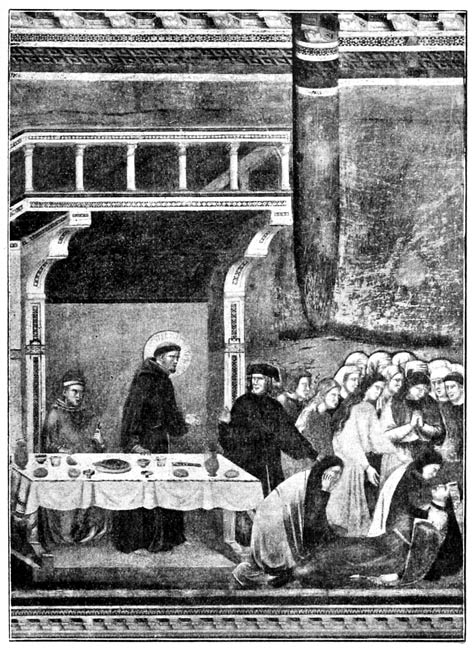
DEATH OF THE KNIGHT OF CELANO
(D. Anderson—photo)
17. St. Francis preaches before Honorius III.
"Having to preach on a certain day before the Pope and the cardinals, at the suggestion of the Cardinal of Ostia he learned a sermon by heart, which he had carefully prepared; when he was about to speak it for their edification he wholly forgot everything he had to say, so that he could not utter a word. He related with true humility what had befallen him, and then, having invoked the aid of the Holy Spirit, he began at once to move the hearts of these great men...."
In this fine fresco Giotto has represented St. Francis holding his audience as though spell-bound by the power of his eloquence, and the contrast is great between the charming figure of the saint and that of the stern and earnest Pope, who, deep in thought, is leaning his chin on his hand, perhaps wondering at the strange chance which has brought the slight brown figure, so dusty and so poorly clad, so ethereal and so eloquent, into the midst of the papal court. It is delightful to study the faces and gestures of the listeners; some are all enthusiasm and interest, like the charming young cardinal in an orange-tinted robe, whose thoughts seem to be far away following where St. Francis' burning words are leading them; but the older man gazes critically at the saint, perhaps saying within himself: "What is this I hear, we must give up all, our fat benefices, our comfortable Roman palaces, to follow Christ"; and the cardinal on the right of the Pope also seems surprised at the new doctrines of love, poverty and sacrifice. Four others lean their heads on their hands; but how varied are the gestures, from the Pope, all eagerness and keen attention, to the cardinal bowing his head sadly thinking, like the man of great possessions, how pleasant it would be to become perfect, but how impossible it is to leave the goods of this world. St. Francis' companion is seated at his master's feet as though affirming, "I follow his teaching, and all he says is right."
18. The Apparition of St. Francis.
"For when the illustrious preacher and glorious Confessor, Anthony, who is now with Christ, was preaching to the brethren in the chapel at Arles on the title upon the Cross—'Jesus of Nazareth, the King of the Jews'—a certain friar of approved virtue named Monaldus, casting his eyes by divine inspiration upon the door of the chapter-house, beheld, with his bodily eyes, the blessed Francis raised in the air, blessing the brethren, with his arms outstretched in the form of a Cross."
The friars sit in various attitudes of somewhat fatigued attention before St. Anthony who is standing, and none seem as yet to be aware of the apparition of St. Francis, who appears at the open door under a Gothic archway, the blue sky behind him. There is a strange feeling of peace about the scene.
19. The Stigmata.
"... On the hard rock, 'Twixt Arno and the Tiber, he from Christ Took the last signet, which his limbs two years Did carry...."[99]
This fresco is unhappily much ruined; enough however remains to trace a close resemblance to Giotto's predella of the same subject now in the Louvre, but where the solemnity of the scene is increased by the saint being alone with the Seraph upon La Vernia.
It may be well here to give some of the various opinions as to the authorship of these frescoes, though in this small book it is impossible to go at all deeply into the subject. Some, following Baron von Rumohr, hold that the only paintings in the Upper Church by Giotto, are the two by the door, the Miracle of the Water and the Sermon to the Birds, while Messrs. Crowe and Cavalcaselle give also the first of the series and the last five to him, but while "youthful and feeling his way," and all the rest to Gaddo Gaddi, or maybe Filippo Rusutti. Lastly, Mr Bernhard Berenson is of opinion that Giotto's style is to be clearly traced from the first fresco, St. Francis honoured by the Simpleton, to the nineteenth, The Stigmata; and they show so much affinity to the work of the great Florentine in Sta. Croce and elsewhere, that it is impossible not to agree with him. In the remaining frescoes, representing the death and miracles of St. Francis, he sees a close resemblance to the work of the artist who painted in the chapel of St. Nicholas (Lower Church), and who may have aided Giotto in the Upper Church before being chosen to continue his master's work.
20. Death of St. Francis.
"The hour of his departure being at hand, he commanded all the brethren who were in that place to be called to him, and comforted them with consoling words concerning his death, exhorting them with fatherly affection to the divine love.... When he had finished these loving admonitions, this man, most dear to God, commanded that the Book of the Gospels should be brought to him, and ... his most holy soul being set free and absorbed in the abyss of the divine glory, the blessed man slept in the Lord."
This fresco has suffered from the damp and all that clearly remains are the angels, in whom the artist's feeling for graceful movement is shown, their flight down towards the dead recalling the rush of the swallows' wings as they circle in the evening above the towers of San Francesco.
21. The Apparitions of St. Francis.
"... Brother Augustine, a holy and just man, was minister of the Friars at Lavoro: he being at the point of death, and having for a long time lost the use of speech, exclaimed suddenly, in the hearing of all who stood around: 'Wait for me, Father, wait for me; I am coming with thee....'
"At the same time the Bishop of Assisi was making a devout pilgrimage to the church of St. Michael, on Mount Gargano. To him the Blessed Francis appeared on the very night of his departure, saying: 'Behold I leave the world and go to Heaven.'"
In one fresco the artist has represented two different scenes, the greater prominence being given to the dying friar surrounded by many brethren. In neither is shown the figure of St. Francis, as the artist probably thought that it would have been difficult to introduce the apparition twice. But while the gesture of the friar stretching out his arms and the arrangement of the others explain the story, it would be difficult, without St. Bonaventure's legend, to know the feelings of the bishop who is so calmly sleeping in the background.
22. The Incredulous Knight of Assisi.
"... when the holy man had departed from this life, and his sacred spirit had entered its eternal house ... many of the citizens of Assisi were admitted to see and kiss the Sacred Stigmata. Among these was a certain soldier, a learned and prudent man, named Jerome, held in high estimation in the city, who, doubting the miracle of the Sacred Stigmata, and being incredulous like another Thomas, more boldly and eagerly than the rest moved the nails in the presence of his fellow-citizens, and touched with his own hands the hands and feet of the holy man; and while he thus touched these palpable signs of the wounds of Christ, his heart was healed and freed from every wound of doubt."
This fresco is so much ruined that it is difficult to enjoy it as a whole, but some of the figures of the young acolytes bearing lighted torches, and the priests reading the service and sprinkling the body with holy water, are very life-like.
23. The Mourning of the Nuns of San Damiano.
"Passing by the church of St. Damian, where that noble virgin, Clare, now glorious in heaven, abode with the virgins her sisters, the holy body, adorned with celestial jewels [the marks of the Stigmata], remained there awhile, till those holy virgins could see and kiss them."
This, the loveliest of the last nine frescoes, recalls the one in St. Nicholas' Chapel of the three prisoners imploring the saint's protection; even to the basilica which forms the background of both. Considering that it is the last farewell of St. Clare and her companions to St. Francis the artist might have given a more tragic touch to the scene, but all is made subservient to the rendering of graceful figures, like the charming nuns who talk together as they hasten out of San Damiano, whose humble façade of stone the artist has transformed into a building of marble and mosaic almost rivalling the glories of such cathedrals as Siena and Orvieto. St. Clare stoops to kiss the saint while priests and citizens wait to resume their hymns of praise, and a small child climbs up a tree and tears down branches to strew upon the road in front of the bier.[100]
24. The Canonisation of St. Francis.
"The Sovereign Pontiff, Gregory IX, ... determined with pious counsel and holy consideration to pay to the holy man that veneration and honour of which he knew him to be most worthy ... and coming himself in person to the city of Assisi in the year of our Lord's Incarnation, 1228, on Sunday the 6th of July, with many ceremonies and great solemnity, he inscribed the Blessed Father in the catalogue of the saints."
This fresco is so ruined that it is impossible to form any idea of its composition; about the only object clearly to be seen is the sepulchral urn of St. Francis, represented beneath an iron grating in the church of San Giorgio.
25. The Dream of Gregory IX, at Perugia.
"On a certain night, then, as the Pontiff was afterwards wont to relate with many tears, the Blessed Francis appeared to him in a dream, and with unwonted severity in his countenance, reproving him for the doubt which lurked in his heart, raised his right arm, discovered the wound, and commanded that a vessel should be brought to receive the blood which issued from his side. The Supreme Pontiff still in vision, brought him the vessel, which seemed to be filled even to the brim with the blood which flowed from his side."
We are here left with an impression that the artist was hampered by not having enough figures for his composition, and the four men seated on the ground and guarding the Pope, compare unfavourably with Giotto's fresco of the three grand watchers by Innocent III, upon the opposite wall.
16. St. Francis cures the Wounded Man.
"It happened in the city of Ilerda, in Catalonia, that a good man, named John, who was very devout to St. Francis, had to pass through a street, in which certain men were lying in wait to kill him and ... wounded him with so many dagger-strokes as to leave him without hope of life.... The poor man's cure was considered impossible by all the physicians.... And, behold, as the sufferer lay alone on his bed, frequently calling on the name of Francis ... one stood by him in the habit of a Friar Minor, who, as it seemed to him, came in by a window, and calling him by his name, said, 'Because thou hast trusted in me, behold, the Lord will deliver thee.'"
The artist having here an incident less difficult to deal with than visions and dreams, betrays a certain humour in the stout figure of the doctor, who, as he leaves the room, turns to the two women as though saying, "He has begun to pray, as if that can help him when I have failed to cure him." Meantime St. Francis, escorted by two tall and graceful angels with great wings, is laying his hands upon the wounded man. Here, as in most of these latter frescoes, a single scene is divided into more than one episode; this seems to us to be the great difference between them and the works of Giotto, where the eye is immediately attracted towards the principal figure or figures, the others only serving to complete the composition.
27. The last Confession of the Woman of Benevento.
"... a certain woman who had a special devotion to St. Francis, went the way of all flesh. Now, all the clergy being assembled round the corpse to keep the accustomed vigils, and say the usual psalms and prayers, suddenly that woman rose on her feet, in presence of them all, on the bier where she lay, and calling to her one of the priests ... 'Father,' she said, 'I wish to confess. As soon as I was dead, I was sent to a dreadful dungeon, because I had never confessed a certain sin which I will now make known to you. But St. Francis, whom I have ever devoutly served, having prayed for me, I have been suffered to return to the body, that having revealed that sin, I may be made worthy of eternal life.' ... She made her confession, therefore, trembling to the priest, and having received absolution, quietly lay down on the bier, and slept peacefully in the Lord."
The legend is dramatic and the artist has not failed to make us feel the great sadness and solemnity of the scene. A moment more, and the group of people to the left will come forward to carry the woman away for burial while the relations weep most bitterly; they stand aside with heads bowed in grief, for already the presence of death is felt. Only the sorrow of the child, who stretches out his arms, has passed away upon seeing her rise to speak with the priest. Very tall and slender are the figures of the women, bending and swaying together like flowers in a gentle breeze.
28. St. Francis releases Peter of Alesia from Prison.
"When Pope Gregory IX, was sitting in the chair of St. Peter, a certain man named Peter, of the city of Alesia, on an accusation of heresy, was carried to Rome, and, by command of the same Pontiff, was given in custody to the Bishop of Tivoli. He, having been charged to keep him in safety ... bound him with heavy chains and imprisoned him in a dark dungeon.... This man began to call with many prayers and tears upon St. Francis ... beseeching him to have mercy upon him.... About twilight on the vigil of his feast, St. Francis mercifully appeared to him in prison, and, calling him by his name, commanded him immediately to arise.... Then, by the power of the presence of the holy man, he beheld the fetters fall broken from his feet, and the doors of the prison were unlocked without anyone to open them, so that he could go forth unbound and free."
Everything here gives the impression of height; the tall slim figures, the high doorway, and the slender tower and arches. St. Francis is seen flying up to the skies with the same swift motion the artist has given to the figure of St. Nicholas in the Lower Church, and the "Greek Chorus" to the left serves to show surprise at the unusual occurrence of a prisoner suddenly emerging from his prison with broken fetters in his hands.
None should leave the church without looking at the stalls in the choir; they are by Domenico da San Severino, made in 1501, by order, as an inscription tells us, of Francesco Sansone, General of the franciscan order, and friend of Sixtus IV. The artist only took ten years to execute this really wonderful work; the intarsia figures of the stalls in pale yellow wood, most of them fancy portraits of the companions of St. Francis, are remarkable for their form and character. They betray, in the opinion of Mr Berenson, Venetian influences of Crivelli and of the school of the Vivarini.

ARMS OF THE FRANCISCANS FROM THE INTARSIA OF THE STALLS
CHAPTER IX
St. Clare at San Damiano. The Church of Santa Chiara.
"Comme les fleurs, les âmes ont leur parfum qui ne trompe jamais."—P. Sabatier. Vie de S. François d'Assise.
The days of St. Clare from the age of eighteen until her death in 1253 were passed within the convent walls of San Damiano, and though peaceful enough, for a mediæval lady, they were full of events and varied interest.
She was born on the 10th of July 1194 in Assisi of noble parents, her father being Count Favorino Scifi (spelt also Scefi) the descendant of an ancient Roman family who owned a large palace in the town, and a castle on the slope of Mount Subasio to the east of the ravine where the Carceri lie among the ilex woods. The castle gave the title of Count of Sasso Rosso to its owners, and was the cause of much skirmishing between the Scifi and the Ghislerio who were continually wresting it from each other, until in 1300, during one of these struggles, the walls were razed to the ground and no one sought afterwards to repair its ruins. Of Sasso Rosso a few stones still remain, which, as they catch the morning light, are seen from Assisi like a grey crag projecting from the mountain, high above the road to Spello. When not fighting beneath the walls of his castle Count Favorino was generally away on some skirmishing expedition, and during his absences, his wife, the Lady Ortolana of the noble family of the Fiumi, would depart upon a pilgrimage to the south of Italy or even to the Holy Land.[101] An old writer remarks that her name "Ortolana (market gardener) was very appropriate, because from her, as from a well-tended orchard, sprang most noble plants." After her return from Palestine she one night heard a voice speaking these prophetic words to which she listened with great awe. "Be not afraid Ortolana, for from thee shall arise a light so bright and clear that the darkness of the earth shall be illuminated thereby." So the daughter who was born soon after was called Chiara in memory of the divine message. With so pious a mother it is not surprising that Clare should have grown up thoughtful and fond of praying; we even hear of her seeking solitary corners in the palace where she would be found saying her rosary, using pebbles like the hermits of old instead of beads upon a chain. But her evident inclination for a religious life in no way alarmed Count Favorino, who had made up his mind that she should marry a wealthy young Assisan noble, for even at an early age she showed great promise of beauty. "Her face was oval," says a chronicler, "her forehead spacious, her complexion brilliant, and her eyebrows and hair very fair. A celestial smile played in her eyes and around her mouth; her nose was well-proportioned and slightly aquiline; of good stature she was rather inclined to stoutness, but not to excess." A little while and her fate in life would have been sealed in the ordinary way, and she would have continued to look out upon the world through the barred windows of some old Assisan palace; but great changes were being wrought in the town even when Clare had just passed into girlhood. With the rest of her fellow-citizens, rich and poor, she was destined to feel the potent influence of one who suddenly appeared in their midst like an inspired prophet of old, calling on all to repent, and picturing higher ideals in life than any had hitherto dreamed of. Although her first meeting with St. Francis has not been recorded by any early biographer, we may be sure that from the age of fourteen, and perhaps even before, the story of his doings had been familiar to her, for the stir his conversion made among the people, his quarrels with his father, and the many followers he gained, even among the nobles, were of too extraordinary a nature to pass without comment in the family of the Scifi.[102] Their palace being near the Porta Nuova it is certain that Clare and her younger sister Agnes must have often seen St. Francis pass on his way to San Damiano, carrying the bricks which he had begged from door to door to repair its crumbling walls, and heard him scoffed at by the children and cursed by his angry father. As his fame as a preacher grew the Scifi family hurried with the rest to listen to his sermons in the cathedral, or perhaps even in the market-place, where he would stand upon the steps of the old temple and gather the peasants around him on a market day. But the decisive time arrived in the year 1212, when St. Francis, by then the acknowledged founder of a new order sanctioned by the Pope, and no longer jeered at as a mad enthusiast, came to preach during Lent in the church of San Giorgio. It was the parish church of the Scifi, and the whole family attended every service. Clare was then eighteen, young enough to be carried away by the words of the franciscan and build for herself a life outside her present existence; old enough to have felt unbearable the trammels of a degraded age, and to long, during those years of warfare to which all the cities of the valley were subjected, for an escape to where peace and purity could be found. Only dimly she saw her way to a perfect love of Christ. The preacher's words were addressed to all, but she felt them as an especial call to herself, and unhesitatingly she resolved to seek out the friar at the Portiuncula and ask his help and counsel in what was no easy task. Instinctively knowing her mother could be of no aid, even if she sympathised in her cravings for a more spiritual life, she gained the confidence of her aunt, Bianca Guelfucci, who all through played her part regardless of Count Favorino's possible revenge.
Even during the first two years of his mission St. Francis was accustomed to receive many men who wished to leave home and comforts, and tramp along the country roads with him, but when the young Chiara Scifi threw herself at his feet imploring him to help her to enter upon a new way of life, his heart was troubled, and, reflecting on what wide results his preaching was taking, fear even may have formed part of his surprise. Bernard of Quintavalle he had bidden sell all that he had, distribute it to the poor, and join him at the leper houses; but before allowing Clare to take the veil he sought to prove her vocation beyond a doubt, and bade her go from door to door through the town begging her bread, clad in rough sack-cloth with a hood drawn about her face. Her piety only increased until St. Francis, believing that he was called upon to help her, resolved to act the part of the spiritual knight errant.
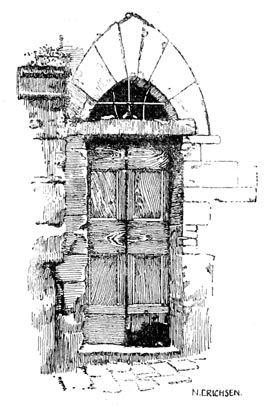
DOOR THROUGH WHICH ST. CLARE LEFT THE PALAZZO SCIFI
On Palm Sunday, arrayed in their richest clothes, the members of the Scifi and the Fiumi families attended high mass in the cathedral, and with the rest of the citizens went up to receive the branches of palms. But to the astonishment of all Clare remained kneeling as if wrapt in a dream, and in vain the bishop waited for her to follow the procession to the altar. All eyes were upon her as the bishop, with paternal tenderness, came down from the altar steps to where the young girl knelt and placed the palm in her hand. That night Clare left her father's house for ever. A small door in the Scifi palace is still shown through which she is said to have escaped. It had been walled up for some time, but the fragile girl gifted that night with superhuman strength and courage, tore down timber and stones and joined Bianca Guelfucci, who was waiting with some trembling maidservants where the arch spans the street, to accompany her to the Portiuncula (see p. 104). Great was the consternation in the family when next morning her flight was discovered, and news came that she had found shelter in the benedictine convent near Bastia. Count Favorino and his wife lost no time in following her, fully persuaded that by threats or entreaties they would be able to induce her to return home and marry the man of her father's choice; but they knew little of the strength of character which lay hidden beneath the gentle nature of the eldest and hitherto most docile of their daughters. The violent words of her father and the tears of her mother in no way shook Clare's determination; approaching the altar she placed one hand upon it while with the other she raised her veil, and facing her parents showed them the close cut hair which marked her as the bride of Jesus Christ. No earthly power, she said, should sever her from the life she had chosen of her own free will, and crest-fallen they left the convent without another word. It was hardly surprising that Agnes, the second sister, who sometimes went to see St. Clare at Bastia, should wish to take the veil. At this the fury of Count Favorino knew no bounds, and he sent his brother Monaldo with several armed followers, among whom may have been Clare's slighted lover, to force Agnes, if persuasion failed, to abandon her vocation. She was at their mercy but refused to leave the convent, so they caught her by her long fair hair and dragged her across the fields towards the town, kicking her as they went; her cries filled the air, "Clare, my sister, help, so that I may not be taken from my heavenly spouse." The prayers of Clare were heard, for suddenly the slight form of the girl became as lead in the arms of the soldiers, and in vain they tried to lift her. Monaldo, beside himself with rage, drew his sword to strike her when his arm dropt withered and useless by his side. Clare, who had by this time come upon the scene, begged them to desist from their cruel acts, and cowed by what had happened they slunk away, leaving the sisters to return to the convent.
St. Francis seeing the devotion and steady vocation of both Clare and Agnes, and doubtless foreseeing that many would follow their example, began to seek for some shelter where they could lead a life of prayer and labour. Again the Benedictines of Mount Subasio came forward with a gift, offering another humble sanctuary which the saint had repaired some years before. This was San Damiano, a chapel so old that none could tell its origin; the vague legend that it stands on the site of a pagan necropolis seems confirmed by a lofty fragment of Roman masonry which juts up on the roadside between the Porta Nuova and San Damiano. With his own hands St. Francis built a few rude cells near the chapel, resembling the cluster of huts by the Portiuncula, and here the "Poor Ladies" were to pass their days in prayer and manual labour. The little humble grey stone building among the olive trees with the pomgranates flowering against its walls, so different to a convent of the present day, must have seemed to Clare the realisation of a freer life than ever she had known before. Others felt its charm and before long several friends had joined her besides Bianca Guelfucci, while upon the death of Count Favorino, Madonna Ortolana received the habit from the hands of St. Francis together with her youngest daughter Beatrice. The fame of the order spread far and wide, gaining so many novices that several new houses were founded in Italy even during the first few years. In those early days St. Clare was given no written law to follow, but like the brethren she and her nuns learnt all the perfection of a religious life from St. Francis, who would often stop at San Damiano on his way to and from the town. He did not allow them to go beyond their boundaries, but a busy life was to be passed in their cells; owning nothing, they were to depend entirely upon what the brothers could beg for them in the town and country round, and when provisions were scarce they fasted. In return the nuns spun the grey stuff for the habits of the friars and the linen for their altars; and after St. Francis received the Stigmata, St. Clare fashioned sandals for him with space for the nails so that he might walk with more ease. Often the poor came to seek help at her hands, and many times the sick were tended in a little mud hut near her cell which she used as a hospital. Silently her life was passed, and to those who looked on from the outside perhaps it might have seemed of small avail compared with the very apparent results of St. Francis' endeavours to help his fellow creatures. But very quietly she was guiding the women of mediæval Italy towards higher aims, for even those who could not follow her into the cloister were aided in their lives at home by the thought of the pure-souled gentle nun of San Damiano. Not the least important part of her work was the womanly sympathy and help which she gave to St. Francis. He turned to her when in trouble, and it was she who encouraged him to continue preaching to the people when, at one time he thought that his vocation was to be a life of solitary prayer and not of constant contact with mankind. He counted on her prayers, and trusting in her counsel went forward once more to preach the words of redemption. From her lonely cell she watched his work with tender solicitude, and when blind and ill he came for the last time to San Damiano she tended to his wants in a little hut she erected for him not far from the convent whence, across the vineyard and olive grove which separated them, the first strains of his glorious Canticle to the Sun came to her one morning. Her gentle influence played an important part in his life, giving him a friendship which is one of the most beautiful things to dwell on in their lives. Some have sneered at its purity, and compared so ideal a connection to a commonplace mediæval tale of monk and nun; but it is degrading even to hint at such an ending to the love of these two for each other, and impossible to believe it after reading M. Sabatier's beautiful chapter on St. Clare, where he touches, in some of his most charming pages, upon a side of St. Francis' character that most biographers have but little understood.
A beautiful story in the Fioretti relates how once St. Clare, desiring greatly to eat with St. Francis, a boon he had never accorded her, was granted the request at the earnest prayer of the brethren, "and that she may be the more consoled," he said, "I will that this breaking of bread take place in St. Mary of the Angels; for she has been so long shut up in S. Damian that it will rejoice her to see again the House of Mary, where her hair was shorn off, and she became the bride of Christ." Once more St. Clare came to the plain of the Portiuncula, and the saint spoke so sweetly and eloquently of heavenly things that all remained wrapped in ecstacy, oblivious of the food which was spread before them on the floor and, as Clare dwelt in divine contemplation, a great flame sprang up and shrouded them in celestial light. The Assisans and the people of Bettona, looking down from their walls upon the plain, thought that the Portiuncula was on fire, and hurried to the assistance of their beloved saint. "But coming close to the House," says the Fioretti, "they entered within, and found St. Francis and St. Clare with all their company in contemplation wrapt in God as they sat round the humble board." Comforted by this spiritual feast St. Clare returned to San Damiano, where she was expected with great anxiety, as it had been imagined that St. Francis might have sent her to rule some other convent, "wherefore the sisters rejoiced exceedingly when they saw her face again." Those were peaceful and happy days, but sorrow came when news reached her that St. Francis was near his end; "she wept most bitterly, and refused to be comforted," for she too was ill, and feared to die before she could see his face again. This fear she signified through a brother unto the Blessed Francis, and when the saint, who loved her with a singular and paternal affection, heard it, he had pity on her; and considering that her desire to see him once more could not be fulfilled in the future, he sent her a letter with his benediction and absolving her from every fault.... "Go and tell sister Clare to lay aside all sadness and sorrow, for now she cannot see me, but of a truth before her death both she and her sisters shall see me and be greatly comforted." But the last she saw of him was through a lattice window, when they brought his dead body for the nuns to see and kiss the pierced hands and feet (see p. 119).
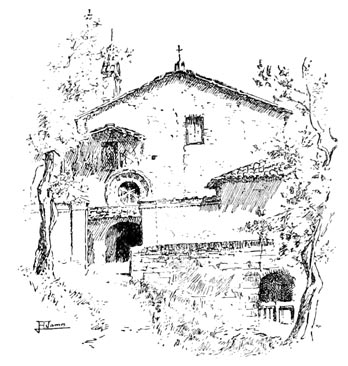
SAN DAMIANO, SHOWING THE WINDOW WITH THE LEDGE WHENCE ST. CLARE ROUTED THE SARACENS
A strange thing happened to disturb the peaceful serenity of their lives at San Damiano in the year 1234, when the army of Frederic II, was fighting in the north of Italy, and a detachment of Saracen troops under one of his generals, Vitale d'Anversa, came through Umbria, pillaging the country as they passed. Assisi was a desirable prey, as it had been to many before them, and coming to the convent of San Damiano they scaled its walls, preparatory to a final rush upon the town. The terror of the nuns may be imagined, and running to the cell where Clare lay ill in bed they cowered round her "like frightened doves when the hawk has stooped upon their dovecote." Taking the Blessed Sacrament, which she was allowed to keep in a little chapel next to her cell, she proceeded to face the whole army, trusting like St. Martin in the power of prayer and personal courage. As she walked towards the window overlooking the small courtyard a voice spoke to her from the ciborium saying, "Assisi will have much to suffer, but my arm shall defend her." Raising the Blessed Sacrament on high she stood at the open window, against which the soldiers had already placed a ladder; those who were ascending, as they looked up towards her, fell back blinded, while the others took to flight, and thus cloister and city were saved through the intercession of the gentle saint. Vitale d'Anversa, who had not been present at the prodigy, probably thinking the soldiers had failed in their enterprise through lack of valour, came with a still larger company of men, and led them in person to storm the town. St. Clare, hearing what peril encompassed Assisi, and being asked by the citizens to intercede with Heaven as the enemy had sworn to bury them beneath their city walls, gathered all her nuns about her, and knelt in prayer with them. At dawn the next morning a furious tempest arose, scattering the tents of the Saracens in every direction, and causing such a panic that they took refuge in hasty flight. The gratitude of the citizens increased their love for St. Clare, as all attributed their release to her prayers, and to this day she is regarded as the deliverer of her country.
One cannot help regretting that while so many contemporary chroniclers have left detailed and varied accounts of St. Francis, they only casually allude to St. Clare, calling her "a sweet spring blossom," or "the chief rival of the Blessed Francis in the observance of Gospel perfection," but leaving later writers to form their own pictures of the saint. And the picture they give is always of a silent and prayerful nun, beautiful of feature, sweet and gentle of disposition, coming ever to the help of those who needed it, and acting the part of a guardian angel to the Assisans. Her horizon was bounded by the mountains of the Spoletan valley; and from the outside world, on which her influence worked so surely during her life and for long centuries after her death, only faint echoes reached her when a pope or a cardinal came to see her, or a princess wrote her a letter from some distant country. Among the many royal and noble people who had entered a Poor Clare sisterhood, or like St. Elizabeth of Hungary had joined the Third Order, was the Blessed Agnes, daughter of the King of Bohemia, who, kindled with a desire for a religious life upon hearing the story of St. Clare, refused the hand of Frederick II, and passed her life in a convent. Often she wrote to the Assisan abbess getting in reply most charming letters, beginning "To her who is dearer to me than any other mortal," or "To the daughter of the King of Kings, to the Queen of Virgins, to the worthy spouse of Jesus Christ; the unworthy servant of the poor nuns of San Damiano sends greetings and rejoicings in the good fortune of living always in the extremest poverty." These two never met, but their friendship was a close one, and their correspondence, of which many letters are preserved, ceased only with their death.
St. Clare survived St. Francis twenty-seven years, and they were sad years for one, who, like her clung so devoutly to his rule and teaching. She lived to see the first divisions among the franciscans, and before she died the corner-stone of the great Basilica had been raised, filling her with dismay for the future, for in its very grandeur and beauty she saw the downfall of the franciscan ideal. Not only did she witness all these changes, but in her own convent she had many battles to fight for the preservation of the rule she loved, she even courageously opposed the commands of the Pope himself who wished to mould the nuns to his wishes as he had done the friars. Even during the lifetime of St. Francis, while he was absent on a distant pilgrimage, Gregory IX, then Cardinal Ugolino, persuaded St. Clare of the necessity of having a written rule, and gave her that of the Benedictine nuns. But when she found that, although it was strict enough, it allowed the holding of property in community, which was entirely against the spirit of her order, she refused to agree to the innovation. So upon the saint's return he composed a written rule for the sisters, so strict, it is said, that its perusal drew tears from the eyes of the Cardinal Ugolino. Still she had to fight the battle of loyalty to a dead saint's memory; for the very year that Gregory came to Assisi for the canonisation of St. Francis he paid a visit to St. Clare, and with earnest words endeavoured to persuade her to mitigate her rule. She held so firmly to her way that the Pope thought she might perhaps be thinking of the vow of poverty which she had made at the Portiuncula, and told her he could absolve her from it through the powers of his papal keys. Then Clare summoned all her courage as she faced the Pontiff, and said to him these simple words which showed him he need try no more to tempt her from duty, "Ah holy father," she cried, "I crave for the absolution of my sins, but I desire not to be absolved from following Jesus Christ."
Gregory had often been puzzled by the unique unworldliness of St. Francis; his admiration for St. Clare was even more profound, and in reading his letters after leaving the franciscan abbess one forgets that he was over eighty at the time. With him she had gained her point once and for all, but upon his death she had to oppose the wishes of Innocent IV, who did all in his power to merge the franciscan order of Poor Clares into an ordinary Benedictine community. Again it ended in the triumph of St. Clare, and the day before her death she had the joy of receiving the news that the Pope had issued a papal bull sanctioning the rule for which both St. Francis and she had fought; namely, that they were to live absolutely poor without any worldly possession of any kind. "N'est-ce pas," says M. Sabatier, "un des plus beaux tableaux de l'histoire religieuse, que celui de cette femme qui, pendant plus d'un quart de siècle, soutient contre les papes qui se succèdent sur le trône pontifical une lutte de tous les instants; qui demeure également respectueuse et inébranlable, et ne consent à mourir qu'après avoir remporté la victoire?"
St. Clare during the remaining years of her life suffered continually from ill-health, and it was from a bed of infirmity that she so ardently prayed the Pope to sanction her rule of poverty, and enjoined the sisterhood to keep its tenets faithfully. Like St. Francis, brave and cheerful to the last, she called her weeping companions around her to give them her final blessing and farewell. Among them knelt the Blessed Agnes, who had come from her nunnery in Florence to assist her sister, and the three holy brethren Leo, Angelo and Juniper. On the 11th of August 1253, the feast of St. Rufino, as she was preparing to leave the world they heard her speak, but so softly that the words were lost to them. "Mother, with whom are you conversing?" asked one of the nuns, and she answered: "Sister, I am speaking with this little soul of mine, now blessed, to whom the glory of paradise is already opening."
Then as the evening closed in and they were still watching, a great light was seen to fill the doorway leading from the oratory of St. Clare to her cell; and from out of it came a long procession of white-robed virgins led by the Queen of Heaven, whose head was crowned with a diadem of shining gold, and whose eyes sent forth such splendour as might have changed the night into the brightest day. And as each of the celestial visitors stooped to kiss St. Clare, the watching nuns knew that her soul had already reached its home.
Once the little chapel of San Damiano has been seen there can be no fear of ever forgetting the charm attached to the memory of St. Clare, for she has left there something of her own character and personality, which we feel instinctively without being able quite to explain its presence. So near the town, only just outside its walls, this little sanctuary yet remains as in the olden times, one of the most peaceful spots that could have been chosen for a nunnery; but the silence which falls upon one while resting on the stone seats before entering the courtyard, has this difference with the silence of such a piazza as that of San Rufino or of some of the Assisan streets; that there the buildings tell of an age which is dead whose memories raise no responsive echoes in our hearts, whereas San Damiano is filled with the associations of those who, living so long ago, yet have left the atmosphere of their presence as a living influence among us. As we look at the steep paths below us leading through the fields and the oak trees down to the plain, to Rivo-Torto and the Portiuncula, we think how often St. Francis went up and down it whenever he passed to see St. Clare and her sisters. And how many times did Brother Bernard come with messages when he lay dying, and news was anxiously awaited at San Damiano; then along the grass path skirting the hill from Porta Mojano were seen the crowds of nobles, townsfolk, peasants and friars bearing the dead body of the saint to San Giorgio, and pausing awhile at the convent for the love of St. Clare. A pope with all his cardinals next passes, on a visit to the young abbess; St. Bonaventure stops to ask her prayers; while the poor and the ill were ever knocking at the convent door to obtain her help or a word of kindly sympathy. In the Umbrian land it is so easy to realise these things, they are more than simply memories for those who have time to pause and dream awhile; and sometimes it has seemed, while reading the Fioretti or Brother Leo's chronicle beneath the olive trees of San Damiano, that we have slipped back through the ages, and looking up we half expect to see the hurrying figure of St. Francis moving quickly in and out among the trees. Suddenly the low sound of chanting comes through the open door of the convent reaching us like the incessant drone of a swarm of bees in the sunshine, until it dies away, and brown-clothed, sandalled brethren pass out across the courtyard, and two by two disappear down the hill on their way to the Portiuncula. They bring a whole gallery of portraits before our eyes, of brethren we read of, the companions of St. Francis; but when we look along the path they have taken and see the church of the Angeli standing high in the midst of the broad valley, its dome showing dark purple against the afternoon light, where we had thought to catch a glimpse of the Portiuncula and a circle of mud huts, the dream of the olden time fades suddenly away. As we turn to enter the little church of San Damiano with the image of the great church of the plain still in our thoughts, we feel how much we owe to the reverence of the people and the friars who have kept it so simple and unadorned, its big stones left rough and weather-beaten as when St. Francis came to prepare a dwelling-house for sister Clare. Truly says M. Sabatier, "ce petit coin de terre ombrienne sera, pour nos descendants, comme ce puits de Jacob où Jésus s'assit un instant, un des parvis préférés du culte en esprit et en vérité."
The church is very small and dim, with no frescoed walls or altar pictures to arouse the visitor's interest, and only its connection with the names of Francis and Clare bring the crowds who come to pray here. Even the crucifix which spoke to St. Francis, telling him to rebuild the ruined sanctuary, no longer hangs in the choir, but is now in the keeping of the nuns in Santa Chiara. A few relics are kept in the cupboard—a pectoral cross given by St. Bonaventure, the bell with which St. Clare called the sisters to office, her breviary written by Brother Leo in his neat, small writing, and the tabernacle of alabaster which she held up before the invading host of Saracens upon that memorable occasion. There is also a small loaf of bread which recalls the well-known story recounted in the Fioretti (cap. xxxiii.) of how Pope Innocent IV, came to see St. Clare, "to hear her speak of things celestial and divine; and as they were thus discoursing together on diverse matters, St. Clare ordered dinner to be made ready, and the bread to be laid on the table so that the Holy Father might bless it; and when their spiritual conference was finished, St. Clare, kneeling most reverently, prayed him to bless the bread which was on the table. The Holy Father replied: 'Most faithful Sister Clare, I will that thou shouldst bless this bread and make upon it the sign of the most blessed Cross of Christ, to whom thou hast so entirely given thyself.' St. Clare said: 'Holy Father, pardon me, for I should be guilty of too great a presumption if in the presence of the Vicar of Christ, I, who am but a miserable woman, should presume to give such a benediction.' And the Pope answered: 'That this should not be ascribed to presumption, but to the merit of obedience, I command thee by holy obedience to make the sign of the Holy Cross on this bread, and to bless it in the name of God.' Then St. Clare, as a true daughter of obedience, most devoutly blessed that bread with the sign of the Holy Cross. And marvellous to say, incontinently on all the loaves the sign of the Holy Cross appeared most fairly impressed; then of that bread part was eaten and part kept for the miracle's sake."
A ring belonging to St. Clare was also kept here, until in the year 1615 a Spanish franciscan vicar-general with his secretary came to visit San Damiano, and such was his devotion for anything that had belonged to the saintly abbess that when a few months later the relics were being shown to some other visitors, the precious ring was missing. A great disturbance arose in the city, and angry letters were speedily sent after the Spanish priest as suspicion had fallen upon him at once; he did not deny that he had piously stolen the ring, but as it was now well upon its way to Spain where, he assured the irate Assisans, it would be much honoured and well cared for, he refused to return it. The citizens and friars still regret the day that the Spanish dignitary and his secretary called at San Damiano.
The small chapel out of the nave was built in the middle of the seventeenth century to contain the large Crucifix which is still there, and whose story is very famous. In 1634 Brother Innocenzo of Palermo was sent to the convent to carve a crucifix for the friars, his sanctity and the talent he possessed as an artist being well known. After nine days he completed all except the head, and on returning next morning after early mass he found that mysterious hands had fashioned it during the night; not only was it of wonderful workmanship, but looking at it from three different points of view three different expressions were seen—of peace, of agony, and of death. The fame of the Crucifix spread throughout Umbria, and people flocked to San Damiano. "Now, the devil," says a chronicler, "very wrath to see such devotion in so many hearts, turned his mind to finding out some means of sowing seeds of discord. Through his doing there arose in Assisi a whisper that owing to the rapidly growing fame of this Crucifix, the ancient one of the cathedral would lose the veneration in which it had hitherto been held."
Now before placing the Crucifix of San Damiano in its place over the high altar the monks settled that it should be carried in solemn procession through Assisi. "But," writes the angry chronicler, "those who had joined this diabolical conspiracy against our Crucifix were not slow to prevent this, and had recourse to the Inquisitor of Perugia, who was induced to send his vicar to stop the procession, and bid the monks of San Damiano to keep their Crucifix hidden and allow no one to see it." There arose a terrible storm in the troubled community of Assisi, between those who took the part of the "persecuted Crucifix" and those who sided with the jealous canons of the cathedral. Finally, the case was placed before the Pope himself, and all waited anxiously the result of his investigations. A duplicate of the Crucifix of San Damiano was sent to Rome that it might be well examined by the Pope and the whole college of cardinals, and they not finding in the pious Brother Innocenzio's work anything contrary to the teaching of the gospel, it was unanimously decreed that the Crucifix of San Damiano might receive all the homage and love of the friars and citizens. So on a burning Sunday in August solemn high mass was sung at the altar of St. Clare in San Damiano and, although the friars were defrauded of their procession, such was the concourse of people who came to gain the plenary indulgence granted by His Holiness that the good friars rejoiced, and were comforted for all the persecution they had suffered on account of this marvellous Crucifix. What must have been the feelings of Brother Innocenzo as he stood by the high altar and watched the crowd of worshippers and the women lifting up their streaming eyes to the crucifix he had fashioned in his cell? The devotion to it grew as the years passed on, and we read that a century later the monks were obliged "for their greater quiet to transfer it from the choir to the chapel," where it now is, after which the monks could say their office in peace. Now we see it surrounded with votive offerings, and our guide pours forth an incessant stream of praise, and recounts at length numberless miracles.
Through the chapel of the Crucifix we reach the choir of St. Clare, left as when she used it, with the old worm-eaten stalls against the wall. It is probable that originally this was part of the house of the priest who had the keeping of San Damiano before the benedictines gave it to the Poor Clares; for here is shown the recess in the wall where St. Francis hid when his father came to seek for him, and where he is supposed to have lived in hiding for a whole month until the storm should have blown over. It was for the rebuilding of the chapel that he had taken bales of costly stuffs from the Bernardone warehouse in Assisi to sell at the fair of Foligno, and thus called forth the wrath of Messer Pietro. The good priest of San Damiano was so much astonished at this sudden conversion of Francis, that thinking he mocked him he refused to accept the purse of gold, which Francis finally threw on to a dusty window-sill. But the priest soon became his friend, allowing him to remain at San Damiano and partake of such humble fare as he could give, joining him in repairing of the poor ruined chapel.
An artist of the sixteenth century had sought to adorn the altar with a fresco of the Crucifixion which was only discovered a few months ago, but the whitewashed walls and severe simplicity of the rest seem more in keeping with the place than this crude attempt at decoration. By a rough flight of stairs we reach the small private oratory of St. Clare, which communicated with her cell and where, in her latter days of illness, she was permitted to keep the Blessed Sacrament. The rest of the convent being strict "clausura," ever since the Marquess of Ripon bought San Damiano from the Italian Government and gave it into the keeping of the franciscan friars, can only be seen by men. Within is the refectory of St. Clare where Innocent IV, dined with her and witnessed the miracle of the loaves, and Eusebio di San Giorgio (1507) has painted in the cloister two fine frescoes of the Annunciation and St. Francis receiving the Stigmata.
But anyone may step out into the small and charming garden of St. Clare which is on a level with her oratory. Walls rising on either side leave only a narrow vista of the valley where Bevagna, and Montefalco on her hill, can just be seen. Within this small enclosed space the saint is said to have taken her daily exercise and carefully attended to the flowers, and the friars to this day keep a row of flowers there in memory of her. It will be well on leaving the chapel of San Damiano to look at the open chapel in the courtyard where Tiberio d'Assisi has painted one of his most pleasing compositions. The Madonna is seated in an Umbrian valley, low lines of hills fade away in the distance, and franciscan saints, among whom St. Jerome with his lion seems curiously out of place, surround her, while at her feet is placed the kneeling figure of the nun who succeeded St. Clare as abbess. It is signed and dated 1517, while the fresco on the side-wall of St. Sebastian and St. Roch was painted five years later. In another corner of the courtyard, near the entrance, is a painting in a niche of the Madonna and saints by some Umbrian artist who felt the influence of both Giotto and Simone Martini, so that we have a curious, if pleasing result.
Santa Chiara
St. Clare was no sooner dead than the people, as they had done with St. Francis, sought to honour her memory, but in this case, Innocent IV, being in Assisi for the consecration of the Franciscan Basilica, the funeral service was conducted by the Pope and cardinals. Such a gathering of church dignitaries, Assisan nobles, priors and people had certainly never been seen in the humble convent of San Damiano; their presence, though honouring the saint, filled the hearts of the nuns with sorrow for they knew they had come to take the body of St. Clare to Assisi. With tears they consented to its being placed in safety in San Giorgio, but only on the condition that they might eventually be allowed to live near her tomb in some humble shelter. San Damiano without her, alive or dead, meant little to them, and they were ready to abandon a home of so many memories to go where they and their successors could guard her body to the end of time. Devotion to her memory and belief in her sanctity was not solely confined to them; when the friars rose to intone the service of the dead, Pope Innocent signified that there should be silence, and to the wonder of all ordered high mass to be sung and the funeral service to be changed into one of triumph, in honour of her who he believed was already with the Virgins in heaven. It was a kind of canonisation, but could not be regarded as valid without the usual preliminaries being performed, and the cardinals, more cautious and less enthusiastic than His Holiness, persuaded him to wait and in the meanwhile allow the ordinary service to proceed. To this he consented, and then amidst music and singing the Pope led the people up the hill where years before another saint had been borne to the same church of San Giorgio, and as on that day a funeral ceremony became a triumphal procession.
Innocent IV, died soon after, and it was Alexander IV, who in September 1255, two years after her death, canonized St. Clare in a Bull replete with magnificent eulogy in which there is a constant play upon her name: "Clara claris præclara meritis, magnæ in coelo claritate gloriæ, ac in terra miraculorum sublimum clare gaudet ... O admiranda Claræ beatæ claritas." Another two years were allowed to elapse before they began to erect a building to her memory; besides the readiness shown by every town to honour their saints, the Assisans had especial cause to remember St. Clare, as she had twice saved them from the Saracen army of Frederic II. Willingly the magistrates and nobles, besides many strangers who had heard of the saint's renown, contributed money for the new building, and Fra Filippo Campello the minorite was chosen as the architect. Fine as his new work proved to be it was rather the copy of a masterpiece than the inspiration of a great architect, which makes it more probable that he was only employed in completing the church of San Francesco from the designs of that first mysterious architect, and not, as some have said, its sole builder.
The canons of San Rufino offered the church and hospital of San Giorgio which belonged to them. A more fitting site for the church to be raised in honour of St. Clare could not have been chosen, for it was here that St. Francis had learnt to read and write as a child under the guidance of the parish priest; here he preached his first sermon, and later touched the heart of Clare by his words during the lenten services; and here both of them were laid in their stone urns until their last resting places were ready. So around the little old parish church with its many memories, and within sight of the Scifi palace, arose "as if by magic" the new temple with its tall and slender campanile. The hospital enlarged and improved became the convent, and the church was used by the nuns as a choir, the rest of the large building, which they could only see through iron gratings, being for the use of the congregation. With its alternate layers of pink and cream-coloured stone, wheel window and finely modelled door, the church fits well into its sunny piazza, and is a beautiful ending to the eastern side of Assisi. But in building it Fra Filippo forgot the crumbling nature of the soil, and failed to overcome the difficulty of position as had been done so admirably at San Francesco, so that in 1351 it became necessary to prop up the sides by strong flying buttresses, which, while serving as an imposing arched entrance to the side of the church, sadly detract from the feeling of solidity of the main building. A darker stone with no rosy tints was used for the convent, which makes it look very grim and old as it rises out of a soft and silvery setting of olive trees on the hillside, with orchards near of peaches and almonds. There is a great charm in the brown, weather-beaten convent, though a certain sadness when we remember, in looking at its tiny windows like holes in the wall through which only narrow vistas of the beautiful valley can be seen, how changed must be the lives of these cloistered nuns from those of the Poor Ladies of San Damiano in the time of St. Clare. They are now an order of the orthodox type, an order given to prayer and not to labour, and seeing no human face from the outside world except through an iron grating. So early as 1267 their connection with the franciscan brotherhood ceased; the brethren no longer heard their confessions or begged for them through the land as St. Francis had decreed; they lived under the patronage of the Pope, who declared their convent to be under the especial jurisdiction of the Holy See, and on the feast of St. Francis called upon the nuns to send a pound of wax candles in sign of tribute. As the Pope had often in olden times become master of Assisi so now he obtained the rule over her monastic institutions, gaining the temporal allegiance of the religious, as he had gained that of the citizens.
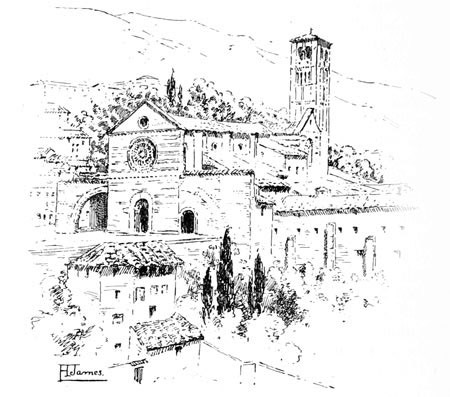
SANTA CHIARA
Upon entering the church of Santa Chiara out of the sunshine, we are struck with a sense of the coldness of its scant ornamentation, a want of colour, and a general idea that artists in first directing their steps to San Francesco had not had time to give much thought to the church of the gentle saint. Giottino is said by Vasari to have painted frescoes here, and they may be those ruined bits of colour in the right transept where it is only possible to distinguish a few heads or parts of figures here and there in what seems to be a procession, perhaps the Translation of St. Clare from San Damiano to San Giorgio. It is said that their present condition of ruin is due to the German bishop Spader who, fearing that the nuns might see too much of the world through the narrow grating because of the number of people who came to see the frescoes, had them whitewashed in the seventeenth century. The people came less, the nuns were safer, but Giottino's (?) frescoes are lost to us and we do not bless the memory of the German bishop of Assisi. The frescoes of the ceiling he did not touch, and we have in them some interesting work of an artist of the fourteenth century whose name is unknown, but who undoubtedly followed the Giottesque traditions, though not with the fidelity or the genius of the artist who painted the legend of St. Nicholas in San Francesco. In decorating the four spandrels he has been influenced by the allegories of Giotto, and the angels are grouped round the principal figures in much the same manner; they kneel, some with hands crossed upon their breasts, but they are silent worshippers with not a single instrument among them. The saints who stand in the midst of the angels in Gothic tabernacles are the Madonna with a charming Infant Jesus who grasps her mantle, and St. Clare; St. Cecilia crowned with roses, and St. Lucy; St. Agnes holding a lamb, and St. Rose of Viterbo; St. Catherine, and St. Margaret with a book in her hand. The artist has used such soft harmonious colours and bordered his frescoes with such pretty medallions of saints' heads and designs of foliage that one wishes he had been given the whole church to decorate and thus saved it from its present desolate appearance.
The large crucifix behind the altar, a characteristic work of that time, has been ascribed to Margaritone, Giunta Pisano, or Cimabue. It was painted, as the inscription says, by the order of the abbess Benedicta, who succeeded St. Clare and was the first to rule in the new convent, but the artist did not sign his name. The chapel of St. Agnes contains a Madonna which Herr Thode with far-seeing eyes recognises through all its layers of modern paint as Cimabue's work. There is also a much retouched, but rather charming picture of St. Clare, painted according to its inscription in 1283. She stands in her heavy brown dress and mantle, a thick cord round her waist, and on either side are scenes from her life. The small triptych of the Crucifixion on a gold ground is an interesting work by the artist of the four frescoes of the ceiling, and a nearer view of some of the peculiarities of his style is obtained. It is impossible to mistake the long slender necks, the curiously shaped ears with the upper part very long, the narrow eyes, straight noses and small mouths, sometimes drooping slightly at the corners, which he gives his figures. He is another of those nameless painters who came to Assisi in the wake of the great Florentine.
The visitor would leave Santa Chiara with a feeling of disappointment were it not for the chapel of San Giorgio, the original place so often mentioned in connection with St. Francis and now open to the public. The crucifix of the tenth century, so famous for having bowed its head to St. Francis in the church of San Damiano bidding him to repair the ruined churches of Assisi, is to be removed from the parlour, where it is temporarily kept, and placed behind the altar. The chapel, with a groined roof, is square, small and of perfect form, and ornamented with several frescoes. On the left wall is a delightful St. George fighting the dragon in the presence of a tall princess, her face showing very white against her red hair. There is a naïve scene of the Magi, whose sleeves are as long and whose hands are as spidery as those of the princess; and above is an Annunciation. Behind the curtain in the fresco a small child is standing who is evidently the donor, but some people believe he represents the Infant Jesus, which certainly would account for the surprised attitude of the Virgin. This wall was painted in the sixteenth century by some artist of the Gubbio school, but his name we have been unable to discover. Quite a different character marks the frescoes upon the next wall, which would seem to be the work of an Umbrian scholar of Simone Martini, or at least by one more influenced by the Sienese than the Florentine masters. There is a softness and an ivory tone in the paintings of the saints, a languid look in their eyes, a sweetness about the mouth peculiar to the Umbrian followers of Simone, who like him succeed less well with male than with female saints. Here the Madonna, seated on a Gothic throne against a crimson dais, with a broad forehead and blue eyes, her soft veil falling in graceful folds about her slender neck, is unusually charming. The St. George with his shield is perhaps less disappointing than St. Francis, but then Simone fails to quite express the nature of the Seraphic Preacher. We turn to St. Clare of the oval face and clear brown eyes, and feel that the painter had a subject which appealed to him, even to the brown habit and black veil which makes the face seem more delicate and fair. Above are the Crucifixion, Entombment and Resurrection, suggesting in the strained attitudes of the figures a follower of Pietro Lorenzetti. Some remains of frescoes upon the next wall resemble those in the nave of the Lower Church, and probably also belong to the second half of the thirteenth century. Indeed the architecture of the chapel bears a striking resemblance to San Francesco, so that although this is the original building of San Giorgio which existed long before the Franciscan Basilica, it was in all probability remodelled by Fra Campello, who may have given it the pretty groined roof.
But above all the works of art and all the views of church or convent, the pious pilgrim treasures the privilege of being able to gaze upon the body of the saint in the crypt below the high altar reached by a broad flight of marble stairs. St. Clare had been buried so far out of sight and reach that her tomb was only found in the year 1850, after much search had been made. Five bishops, with Cardinal Pecci, now Pope Leo XIII, and the magistrates of the town, were present at the opening of the sepulchre; the iron bars which bound it were filed asunder, and the body of the saint was found lying clad in her brown habit as if buried but a little while since; the wild thyme which her companions had sprinkled round her six hundred years ago, withered as it was, still sent up a sweet fragrance, while a few green and tender leaves are said to have been clinging to her veil. So great was the joy at discovering this precious relic that a procession was organised "with pomp impossible to describe."
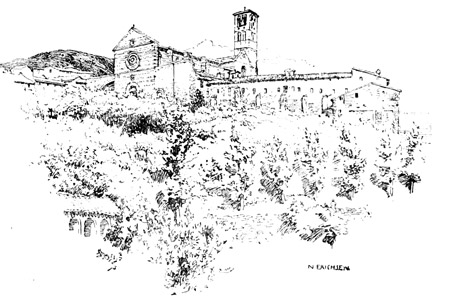
SANTA CHIARA FROM NEAR THE PORTA MOJANO
On the Sunday at dawn every bell commenced to ring calling the people to high mass, and never, says a proud chronicler, were so many bishops and such a crowd seen as upon that day. At the elevation of the Host the bells pealed forth again announcing the solemn moment to the neighbouring villages; soon after the procession was formed of lay confraternities, priests and friars, and little children dressed as angels strewed the way with flowers. The peasants, with tears raining down their cheeks, pressed near the coffin, and had to be kept back by some of the Austrian soldiers then quartered in Assisi. First they went to the Cathedral, then to San Francesco, "the body of St. Clare thus going to salute the body of her great master. Oh admirable disposition of God." It was evening before they returned to the church of Santa Chiara, where the nuns anxiously awaited them at the entrance of their cloister to place the body of their foundress in the chapel of San Giorgio until a sanctuary should be built beneath the high altar. It was soon finished, ornamented with Egyptian alabaster and Italian marbles, and the body of St. Clare was laid there to be venerated by the faithful.
As pilgrims stand before a grating in the dimly lighted crypt the gentle rustle of a nun's dress is heard; slowly invisible hands draw the curtain aside, and St. Clare is seen lying in a glass case upon a satin bed, her face clearly outlined against her black and white veils, whilst her brown habit is drawn in straight folds about her body. She clasps the book of her Rule in one hand, and in the other holds a lily with small diamonds shining on the stamens. The silence is unbroken save for the gentle clicking of the rosary beads slipping through the fingers of the invisible nun who keeps watch, and as she lets the curtain down again and blows out the lights there is a feeling that we have intruded upon the calm sleep of the "Seraphic Mother."
CHAPTER X
Other Buildings in the Town
The Cathedral of San Rufino. Roman Assisi. The Palazzo Pubblico. The Chiesa Nuova. S. Paolo. Sta. Maria Maggiore. S. Quirico. S. Appolinare. S. Pietro. The Confraternities (Chiesa dei Pellegrini, etc.). The Castle.
Assisi is the only town we know of in Italy where the interest does not centre round its cathedral and a certain sadness is felt, which perhaps is not difficult to explain; St. Francis holds all in his spell now just as he held the people long ago, so that the saints who first preached Christianity to the Assisans, were martyred and brought honour to the city, are almost forgotten and their churches deserted. The citizens, though proud of their Duomo, with its beautiful brown façade, hardly appear to love it, and we have often thought that they too feel the sense of gloom and isolation in the small piazza, which makes it a place ill-fitted to linger in for long. Men come and go so silently, women fill their pitchers at the fountain but only the splashing of water is heard, and they quickly disappear down a street; even the houses have no life, for while the windows are open no one looks out, and the total absence of flowers gives them a further look of desolation. This part of the town was already old in mediæval times, and the far away mystery of an age which has few records still lives around the cathedral and its bell tower. San Rufino stands in the very centre of Roman Assisi and its history begins very soon after the Roman era, one might say was contemporary with it, as the saint whose name it bears, was martyred in the reign of Diocletian. All the details of his death, together with the charming legend about the building of the cathedral, come down to us in a hymn by St. Peter Damian, who, although writing in 1052 of things which it is true happened long before, had very likely learnt the traditions about it from the Assisans while he lived in his mountain hermitage near Gubbio. The story goes back to the time when the Roman consul of Assisi received orders to stamp out the fast-spreading roots of Christianity, and began his work by putting to death St. Rufino, the pastor of the tiny flock. The soldiers hurried the Bishop down to the river Chiaggio and, after torturing him in horrible fashion, flung him into the water with a heavy stone round his neck. Some say that the Emperor Diocletian came in person to see his orders carried out. That night the Assisan Christians stole down to the valley to rescue the body of their Bishop and place it in safety within the castle of Costano, which still stands in the fields close to the river but almost hidden by the peasant houses built around it. Here, in a marble sarcophagus he rested, cared for and protected by each succeeding generation of Christians who had learned from tradition to love his memory, and secretly they visited the castle in the plain to pray by the tomb of the martyred saint. Their vigilance continued until the fifth century, when the Christians had already begun to burn the Pagan temples and build churches of their own. Christianity, indeed, spread so rapidly throughout Umbria that other towns cultivated a love for relics, and fearing that the body of St. Rufino might be stolen from the castle in the open country, the Assisans took the first opportunity of bringing it within the town. In the year 412 Bishop Basileo, with his clergy and congregation met at Costano, to seek through prayer some inspiration so that they might know where to take the body of their saint. As they knelt by his tomb an old man of venerable aspect suddenly appeared among them, and spoke these words in the Lord's name: "Take," he said, "two heifers which have not felt the yoke, and harness them to a car whereon you shall lay the body of St. Rufino. Follow the road taken by the heifers and where they stop, there, in his honour shall ye build a church." These words were faithfully obeyed: the heifers, knowing what they were to do, turned towards Assisi, and brought the relics, through what is now the Porta S. Pietro, to that portion of the old town known as the "Good Mother" because the goddess Ceres is said to be buried there. The heifers then turned slowly round, faced the Bishop and his people, and refused to move. For some obscure reason the place did not please the Assisans, and they began to build a church further up the hill; but every morning they found the walls, which had been erected during the preceding day, pulled down, until discouraged, they submitted to the augury, and returned to the spot chosen by the heifers. Before long, over the tomb of the Roman goddess, arose the first Christian church of Assisi, dedicated to San Rufino.