Front matter (continued 2)
Reading edition
Thus did Francis describe his Lady Poverty, and boldly hint that the crimson-robed princes of the Church and the prelates of the Papal Court had strayed from the teaching of the Gospel.
Who can say whether Innocent, watching with keen eyes the earnest face of the Umbrian teacher, began to realise the power such a man might have in restoring to the church some of its lost purity, and was planning how to yoke him to his service. This at least we know, that before Francis and his companions left Rome they received the tonsure which marked them as the Church's own, and with blessings and promises of protection Innocent sent this new and strange militia throughout the length and breadth of Italy to fight his spiritual battles. The simplicity and the love of Francis had conquered the Pope, and to the end continued to triumph over every difficulty.
Such was the desire of Francis and his companions to return to Assisi with the good news, that they forgot to eat on the way and arrived exhausted in the valley of Spoleto, though still singing aloud for the joy in their hearts. Somewhere near Orte they found an Etruscan tomb—a delightful retreat for prayer. It so pleased Francis that a strong temptation came over him to abandon all idea of preaching and lead a hermit's life. For there was that in his nature which drew him into the deep solitude of the woods, and might have kept him away from men and the work that was before him. The battle in his soul waged fiercely as he stood upon the mountain side looking up the valley towards Assisi, but his heart went out to the people who dwelt there, and the strong impulse he had to help those who suffered and needed him won the day. The die was cast; he left his Etruscan retreat to take up once more the burden, and thus it was that, in the words of Matthew Arnold: "He brought religion to the people. He founded the most popular body of ministers of religion that has ever existed in the church. He transformed monachism by uprooting the stationary monk, delivering him from the bondage of property, and sending him, as a mendicant friar, to be a stranger and sojourner; not in the wilderness, but in the most crowded haunts of men, to console them, and to do them good."
When Francis began his mission among the people of Italy it was the custom for only the bishops to preach; but as they lived in baronial splendour, enjoying the present, and amassing money which they extorted from their poor parishioners to leave to their families, they had little time to attend to spiritual duties. The people being therefore left much to their own devices, sank ever deeper into ignorance, sin, and superstition. They saw religion only from afar until Francis appeared "like a star shining in the darkness of the night" to bring to them the messages of peace and love. He came as one of themselves, poor, reviled and persecuted, and the wonder of it made the people throng in crowds to hear one who seemed indeed inspired. Those simple words from the depths of a great and noble heart filled all who listened with wonder. They were like the sharp cries of some wild bird calling to its mate—the people heard and understood them. When the citizens of an Umbrian town looked from their walls across the valley and saw the grey cloaked figure hurrying along the dusty road, they rang the bells to spread the good news, and bearing branches of olive went out singing to meet him. All turned out of their houses to run to the market-place where Francis, standing on steps, or upon a low wall, for he was short of stature, would speak to them as one friend does to another; sometimes charming them by his eloquence, often moving the whole multitude to bitter tears by his preaching on the passion of Christ. With his eyes looking up to the heavens, and his hands outstretched as though imploring them to repent, he seemed to belong to another world and "not to this century." They not only repented, but many left the world to follow him and spread the gospel of peace and love. The first woman who begged him to receive her vows of renunciation was Chiara Sciffi, of a noble Assisan house. Several members of the family, besides others from near and far, followed her into the cloister until she became the abbess of a numerous sisterhood, the foundress of the Poor Clares or Second Order of St. Francis.
The first inspired messages of Francis were brought to the Assisans, and then he left them for awhile to journey further afield into other parts of Italy, where he always met with the same marvellous success. In the following account of his visit to Bologna we get a vivid idea of his manner of appeal to the people; and of their enthusiasm and astonishment that this poor and seemingly illiterate man, the very antithesis of the pedantic clergy, should have the power to hold and sway an audience by the magic of his words. "I, Thomas, citizen of Spalato, and archdeacon of the cathedral church of the same city, studying at Bologna in the year 1220, on the day of the assumption of the Mother of God, saw St. Francis preach in the square before the little palace, where nearly the whole town was assembled. He spoke first of angels, of men, and of devils. He explained the spiritual natures with such exactness and eloquence that his hearers were astonished that such words could come from the mouth of a man so simple as he was. Nor did he follow the usual course of preachers. His discourse resembled rather one of those harangues that are made by popular orators. At the conclusion, he spoke only of the extinction of hatred, and the urgency of concluding treaties of peace, and compacts of union. His garments were soiled and torn, his person thin, his face pale, but God gave his words unheard-of power. He converted even men of rank, whose unrestrained fury and cruelty had bathed the country in blood; many who were enemies were reconciled. Love and veneration for the saint were universal; men and women thronged around him, and happy were those who could so much as touch the hem of his habit."[32]
Young knights and students stepped out of the crowd after one of these burning discourses, resolved to don the grey habit and renounce the world. The ranks of the followers of St. Francis were swelled at every town through which he passed; and he left some of his own sweetness and gentleness among those who had listened to his preaching, so that party feuds lay dormant for awhile, enemies were reconciled, and all tried to lead more Christian lives. Pax et bonum was the Franciscan war-cry which fell indeed strangely on the air in a mediæval town. Whenever Francis heard of tension and ill-will between the nobles and the people he hurried with his message of peace to quell the storm.
But at Perugia he failed. Brother Leo tells us that, "Once upon a time, when the Blessed Francis was preaching to a great multitude of people gathered together in the Piazza of Perugia, some cavaliers of the city began to joust and play on their horses in the piazza, thus interrupting his sermon; and, although rebuked by those present, they would not desist. Then the blessed Francis, in the fervour of his soul, turned towards them and said, 'Listen and understand what the Lord announces to you by me, his little servant, and refrain from jeering at him, and saying, He is an Assisan.' This he said because of the ancient hatred which still exists between the Perugians and the Assisans...."[33] Rebuking the citizens for their pride, he predicted that if they did not shortly repent civil war would break out in the city. But the Perugians, who fought ever better than they prayed, continued in their evil ways until at length the words of St. Francis were verified. A tumult arose between the people of Perugia, and the soldiers were thrust out of the city gates into the country, which they devastated, destroying trees, vineyards, and corn-fields, so that the misery in the land was great.
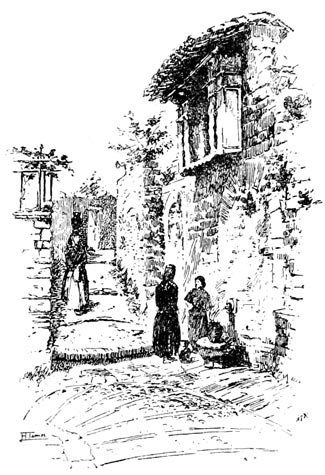
VIA DI S. MARIA DELLE ROSE
In the course of a single day Francis often preached at five different towns or villages; sometimes he went up to a feudal castle, attracted by the sound of music and laughter. "Let us go up unto this feast," he would say to his companion, "for, with the help of God, we may win some good harvest of souls." Knights and ladies left the banqueting hall when they heard of his arrival, and Francis standing on a low parapet of the courtyard preached so "devoutly and sublimely to them that all stood with their eyes and their minds turned on him as though an angel of God were speaking." And then the gay company returned to their feast and the two friars went on their way singing aloud from the joy in their hearts, and passed the night praying in some deserted church or rested under the olive trees on the hill-side. At dawn they rose and "went according to their rule, begging bread for the love of God, St. Francis going by one street and Brother Masseo by another. But St. Francis, being contemptible to look upon and small of stature, was accounted but a vile beggar by those who knew him not, and only received some mouthfuls of food and small scraps of stale bread; but to Brother Masseo, because he was tall and finely made, were given tit-bits in large pieces and in plenty and whole slices of bread. When they had done begging they met together outside the town to eat in a place where was a fair spring, and near by a fine broad stone whereon each placed the alms they had gathered, and St. Francis seeing the pieces of bread given to Brother Masseo to be more numerous, better, and far larger than his own rejoiced greatly...."[34]
Masseo on one occasion wishing to try the humility of Francis mocked him saying, "Why doth all the world come after thee, and why is it that all men long to see thee, and hear thee, and obey thee? Thou art not a comely man, thou art not possessed of much wisdom, thou art not of noble birth; whence comes it then that the whole world doth run after thee?"
It is easy to see the naive wonder of the practical Masseo in these words, a wonder doubtless shared by others who looked on from the same standpoint, at the extraordinary influence Francis obtained through his preaching. Their astonishment must have reached its height when Francis came to a little town near Bevagna (perhaps Cannara) where he preached with such fervour that the whole population wished to take the franciscan habit. Husbands, wives, nobles, labourers, young and old, rich and poor, rose up with one accord, ready to leave their homes and follow him to the end of the earth. Such an awakening by the simple words of a road-side preacher had never before been seen, and was the precursor of other popular demonstrations a few years later.[35] Francis, with extraordinary diplomacy, held the enthusiastic crowd in check without extinguishing their piety. He calmly viewed the situation and solved the difficulty where another, with less knowledge of human nature, might have been carried away by the opening of the flood-gates. It is not without amusement that one thinks of Francis coming to convert sinners, and then finding he had called into being an order of Religious who absolutely refused to separate from him. He calmed the weeping crowd, and with caution said to them: "'Be not in a hurry, neither leave your homes, and I will order that which ye are to do for the salvation of your souls:' and he then decided to create the Third Order for the universal salvation of all, and thus, leaving them much consoled and well disposed to penitence, he departed...."
At a time when war, party feuds, and the unlawful seizure of property brought misery into the land, the Tertiaries, united by solemn vows to keep the commandments of God, to be reconciled to their enemies, and to restore what was not rightfully theirs, became a power which had to be reckoned with. The rule forbidding them to fight, save in defence of the Church or of their country, dealt a severe blow at the feudal system, and therefore met with much opposition among the great barons. Persecution only increased their power, for so early as 1227 Gregory IX, protected the Brothers of Penitence by a special Bull. The enemies of the Church soon discovered that they had a powerful antagonist in an Order which comprised the faithful of every age, rank, and profession, and whose religious practices, whilst creating a great bond of union among them, were not severe enough to take them away from social life in the very heart of the great cities. They formed a second vanguard to the papacy, and Frederick II, was heard to complain that this Third Order impeded the execution of his plans against the Holy See; while his chancellor Pier delle Vigne in one of his letters exclaims that the whole of Christendom seems to have entered its ranks.[36]
Thus both from within and from without the world was being moulded as Francis willed; all Italy responded to his call, and everywhere rose songs of praise to God from a people no longer oppressed by the squalor of their evil living. His energy and desire to gain souls drew him still further afield into the wilds of Slavonia, into Spain, Syria, Morocco, and later into Egypt, for the purpose of converting the Soldan. So great was his eagerness to arrive at his destination and begin to preach that, often leaving his companions far behind, he literally ran along the roads. He was "inebriated by the excessive fervour of his spirit," and on fire with divine love, and yet he failed on these missions in foreign lands. The reason probably lay in his total ignorance of any language except Italian and Provençal, so that his words must have lost all their eloquence and power when delivered through the medium of an interpreter, and we know that Francis never made use of miracles to enforce his teaching.[37]
He returned to Assisi bitterly disappointed, and so despondent that for a while he was tempted to give up all idea of preaching. In this uncertainty he turned for council to Brother Sylvester and to St. Clare, who both urged him to continue his mission to the people; God, they said, had not elected him to work out his salvation in the solitude of a cell but for the salvation of all. He left the hermitage (perhaps the Carcere) and filled with new courage by their words, started on a fresh pilgrimage by "cities and castles," but this time among the Umbrians who knew and loved him. As he came near Bevagna in the plain a new crowd of listeners awaited him—troops of fluttering birds—bullfinches, rooks, doves, "a great company of creatures without number." Leaving his companions in a state of wonder on the road, he ran into the field saying, "I would preach to my little brothers the birds," and as he drew near, those that were on the ground did not attempt to fly away, while those perched on the trees flew down to listen to his sermon.
"My little brethren birds," he said, after saluting them as was his custom, "ye ought greatly to praise and love the Lord who created you, for He provideth all that is necessary, giving unto you feathers for raiment and wings to fly with. The Most High God has placed you among His creatures, and given you the pure air for your abode; ye do not sow neither do ye reap, but He keeps and feeds you."[38] Stretching out their necks, opening their beaks, and spreading their wings, the birds listened while they fixed their eyes upon the saint and never moved even when he walked in their midst touching them with his habit, until he made the sign of the Cross and allowed them to depart. He often related this episode which had made such a happy day in his life and had been of good augury at a time when he was sad.
The love of Francis for his "little brethren the birds," and indeed for all creatures however small, was one of the most beautiful traits in a character which stands out in such strong relief in the history of the middle ages. It was not only a poetical sentiment but the very essence of his being; a power felt by every living thing, from the brigand who left his haunts in the forests to follow him, to the half-frozen bees which crawled in winter to be fed with wine and honey from his hands. An understanding so complete with Nature was unknown until Francis stretched out his arms in yearning towards her shrines and drew the people, plunged in the gloom of Catharist doctrines, towards what was a religion in itself—the worship of the beautiful.
"Le treizième siècle était prêt pour comprendre la voix du poète de l'Ombrie; le sermon aux oiseaux clôt le règne de l'art byzantin et de la pensée dont il était l'image. C'est la fin du dogmatisme et de l'autorité; c'est l'avenement de l'individualisme et de l'inspiration,"[39] says M. Paul Sabatier. No one mocked at the sermon to the birds; no one wondered that leverets, loosed from the snare of the huntsman, should run to Francis for protection, or pheasants forsake the woods to seek a shelter in his cell; for so great an awakening had taken place in Italy that all understood the deep vein of poetry in their saint.
His biographers have transmitted these various anecdotes with a tenderness and simplicity which cannot fail to impress us with the belief that Francis, like many in our own time, possessed a marked attraction for all animals, a magnetism felt with equal strength by man and beast. Love was the Orphean lute he played upon, sending such sweet melody into the world that its strains have not yet died away.
Besides the feeling he had for the beautiful, the small, or the weak, there was another influence at work that made him walk with reverence over the stones, gather up the worms from the path to save them from being crushed, and buy the lambs that were being carried to market with their poor feet tied together. He saw in all things a symbol of some great truth which carried his thoughts straight to God. One day near Ancona he noticed a lamb following slowly and disconsolately a large herd of goats which made him think of Christ among the Pharisees. In pity he bought it from the goat-herd, and in triumph carried it to a neighbouring town where he preached a parable to an admiring crowd, even edifying the bishop by his piety.
Speaking of his favourite birds he would say, "Sister lark hath a hood like the Religious ... and her raiment—to wit her feathers—resemble the earth.... And when she soars she praises God most sweetly." Such was his desire to protect them that he once said if he could only have speech with the Emperor he would entreat him to pass a special edict for the preservation of his sisters the larks, and command the "Mayors of the cities and the Lord of the castles to throw grain on the roads by the walled towns" on the feast of the Nativity, so that all the birds should rejoice with man on that day. He found great joy in the open fields, the vineyards, the rocky ravines, and the forests which gave shelter to his feathered brethren; running water and the greenness of the orchards, earth, fire, air, and the winds so invited him to divine love that often he passed the whole day praising the marvels of creation. No wonder he turned his steps more willingly up the mountain paths to the hermitage of the Carceri than towards the crowded cities. Nature was his companion, his breviary the mirror wherein he saw reflected the face of the Creator. In the song of the nightingales, in the sound of their wings, in the petals of a tiny flower, in the ever changing glory of his own Umbrian valley he was always reminded of God, and for this he has been rightly called a "Pan-Christian."
There is not a corner in Umbria, one might almost say in Italy, which does not bear some record of the passage of the saint. The sick were brought to him and cured, those in trouble laid their sorrows before him and went away comforted. When anything went wrong, a hasty message was sent to Francis, and all with child-like simplicity trusted in him to set things right. We even hear that the people of Gubbio, being persecuted by a fierce wolf, had recourse to him, for they failed to protect themselves though the men sallied forth "as if going to battle." The saint had little difficulty in persuading Brother Wolf to lead a respectable life; and he, seeing the advantage of a peaceful existence, bowed his head and placed his paw, as a solemn seal to the compact, in the hand of Francis amid the joyful cries of the people who marvelled greatly at the "novelty of the miracle." After this he could be seen walking gently through the streets of Gubbio to receive his daily ration at every door, cared for by the citizens "and not a dog would wag even his tongue against him." When Brother Wolf died there was bitter mourning in the city, for all felt as if a friend had passed away, and there was none left to remind them of the kindly saint who had helped them in their need. "Am I expected to believe these fairy tales?" some may ask with a sneer. The exact events related—no—but the spirit of these legends is more necessary to a true conception of the saint and the times in which he lived than all the histories that can ever be written about him. The Umbrians pictured him as they saw and understood him, and tradition going from mouth to mouth found finally its perfect expression in the "Little Flowers of St. Francis." Wonders and miracles are in every page, it is true, but then the peasants will tell you all things are possible in Umbria; the taming of wild beasts, the silencing of garrulous swallows who chattered so loudly while he preached, do not seem stranger to them than the conversion of brigands and murderers, for did not the very angels obey his wishes and play and sing to him one night when he lay ill in a lonely hermitage, longing for the sound of sweet strains to break the awful stillness round him?
Francis would have been sorely troubled had he foreseen the numberless miracles his biographers were going to attribute to him, for no saint was ever humbler. Even in his lifetime, oppressed by the homage paid him, he would say to his adorers with a touch of quaint humour: "do not be in such haste to proclaim me a saint, for I may still be the father of children." He was always fearful lest people should overrate his good actions, and his horror of hypocrisy drove him to confess aloud to the people gathered round to listen to a sermon, in what manner he had given way to the desires of "Brother Body." Upon one occasion having used lard in lieu of the less wholesome oil when he was ill, he began his sermon by saying: "Ye come to me with great devoutness believing me to be a saint, but I do confess unto God and unto you that this Lent I have eaten cakes made with lard." Another time, after a severe chill, his companions sewed some fox-skin inside his habit to keep him somewhat warmer during the bitter cold, but he was not happy until a piece had been sewn also on the outside so that all might see the luxury he allowed himself.
It may at first seem strange that one so simple should have exercised such extraordinary influence on men and women of all ranks, an influence which has lasted with undiminished force for seven hundred years. But we must remember that a people, however ready to listen to the words of a reformer (especially an Italian crowd), will hardly be moved by calmness or sense; only when one like Francis stirs their imagination by a peculiar way of announcing God's word, and by acts sometimes bordering on insanity, can he completely succeed in winning them. The Assisans, at first shocked by some of the spectacles they witnessed in their sleepy town, jeered and murmured, until at last the saint literally took them by storm; and the more he risked their good opinion the louder they applauded him and wept for their sins. Astonishment was at its height when on the way to some service at the cathedral, the citizens saw Francis approaching them "naked save for his breeches," while Brother Leo carried his habit. He has gone mad through too much penance, some thought. The truth was that Francis had imposed this same penance on Brother Ruffino who was then preaching to the people in the cathedral, and his conscience smote him so that he began to chide himself, saying: "Why art thou so presumptuous, son of Bernardone, vile little man, as to command Fra Ruffino, who is one of the noblest of the Assisans, to go and preach to the people as though he were mad."... So when Ruffino's sermon was ended Francis went up into the pulpit and preached with such eloquence on his Lady Poverty and on the nakedness and shame of the Passion suffered by Our Lord Jesus Christ "that the whole church was filled with the sound of weeping and wailing such as had never before been heard in Assisi." Thus did the force of originality win the people, and all those who had jeered but a few minutes before were much "edified and comforted by this act of St. Francis and Brother Ruffino; and St. Francis having reclad Brother Ruffino and himself, returned to the Portiuncula praising and glorifying God, who had given them grace to abase themselves to the edification of Christ's little sheep."
By word and example Francis taught his disciples to be especially humble towards the clergy. "If ye be sons of peace," he often said, "ye shall win both clergy and people, and this is more acceptable to God than to win the people only and to scandalise the clergy. Cover their backslidings and supply their many defects, and when ye have done this be ye the more humble." He had to struggle against much opposition among the bishops, who looked upon him and his friars as intruders encroaching upon their rights. People had often advised him to obtain a Bull from Rome, to enable him to preach without asking permission, but it was through the power of persistent meekness that he wished to win his way to every heart, and the only weapons he used were those of love. St. Bonaventura tells us that the Bishop of Imola absolutely refused to let Francis call the citizens together and preach to them. "It suffices, friar, that I preach to the people myself," was the cross reply, and Francis, drawing his cowl over his head, humbly went his way. But after the short space of an hour he retraced his steps, and the bishop inquired with some anger why he had returned. He made answer in all humility of heart and speech: "My lord, if a father sends his son out at one door there is nothing left for him but to return by another." Then the bishop, vanquished by his humility, embraced him with a joyful countenance, saying: "Thou and all thy brethren shall have a general licence to preach throughout my diocese, as the reward of thy holy humility."[40]
This was the saint, gentle and sweet among men, who won the friendship of Ugolino, Bishop of Ostia (afterwards Pope Gregory IX). The bishop often spent quiet hours at the Portiuncula, trying perhaps to find, in the companionship of the saint and his poor friars, a peace he in vain sought amid the luxury of the Papal Court. Celano,[41] who may have been present during one of these meetings, tells us how he delighted in throwing off his rich robes and clothing himself in the Franciscan habit. In these moments of humility he would reverently bend the knee to Francis and kiss his hands. Besides his great admiration and love for the personality of the saint, he was not slow to perceive the services Francis had rendered in endeavouring to restore something of the pristine purity to Christianity, and further, the Order was fast becoming of political importance. The work of organising a community, no longer a handful of Assisan knights and yeomen following in the footsteps of their leader, was by no means an easy task; and Ugolino saw his way to bring it more closely into the service of the Church. Francis, whether willingly or not we cannot say, begged the Pope to name Ugolino Patron and Father of his Order. This was readily accorded, for it was felt in the papal circle that Francis was not so easy to drive as became a submissive child of the Church. They could not complain of actual disobedience, but he liked doing things his own way. By some at Rome it was suggested to him that he should adopt the Benedictine rule, by others that he might join his Order to that of St Dominic, but the saint smiled sweetly, and though so dove-like none succeeded in entangling him in their diplomatic nets. Indeed he puzzled Ugolino many times, and both Innocent III and Honorius III were never quite sure whether they had to do with a simpleton or a saint. The Roman prelates, completely out of sympathy with his doctrine of poverty, were only too ready to thwart him, and Ugolino knowing this advised him "not to go beyond the mountains" but remain in Italy to protect the interests of his order. He further persuaded him to come to Rome and preach before the Pope and cardinals, thinking that the personality of the saint might perchance win their favour. Anxious to do honour to his patron, Francis composed a sermon and committed it to memory with great care. When the slight, grey figure, the dust of the Umbrian roads still clinging to his sandals, stood up in the spacious hall of the Lateran before Honorius and the venerable cardinals, Ugolino watched with anxious eyes the course of events. In mortal fear "he supplicated God with all his being that the simplicity of the holy man should not become an object of ridicule," and resigning himself to Providence he waited. There was a moment of suspense, of awful silence, for Francis had completely forgotten the sermon he had so carefully learned by heart. But his humility befriended him; stepping forward a few paces with a gesture of regret he quietly confessed what had happened, and then, as if indeed inspired, he broke forth into one of his most eloquent sermons. "He preached with such fervour of spirit," says Celano, "that being unable to contain himself for joy whilst proclaiming the Word of God, he moved even his feet in the manner of one dancing, not for play, but driven thereto by the strength of the divine love that burnt within him: therefore he incited none to laughter but drew tears of sorrow from all."[42]
When Francis had been preaching for some time a certain weariness seems to have possessed him, and he would then, "leaving behind him the tumult of the multitude," retire to some secret place to dwell in constant prayer and heavenly contemplation. There were many of these refuges, but none so isolated from the world as the lofty mountain of La Vernia, which had been given to him by Count Orlando Cattani of Chiusi, whose ruined castle can still be seen on a spur of the Apennines just below. The "Sacred Mount" rises clear above the valley of the Casentino to the height of 4000 feet, between the sources of the Tiber and the Arno, and looks straight down upon one of the perfect views in Tuscany which Dante speaks of:
"The rills that glitter down the grassy slopes Of Casentino, making fresh and soft The banks whereby they glide to Arno's stream."
Range upon range of splendid hills falling away gradually to the south gather in their folds the pale-tinted mists of early summer, and seem to guard the valley from other lands, so intense is the feeling of remoteness. From the white towns gleaming like pearls on their green slopes above the young Arno cradled by poplars, is seen the sharp outline of La Vernia against the sky, always black, gloomy, and defiant above the cornfields and vineyards. Its summit, covered with fir-trees, straight and close together, appears like a great whale that has rested there since the days of the flood. Below the forest lie huge boulders of rock and yawning chasms, upheaved, says the legend, during the earthquake at the time of the Crucifixion. To this solitary place came Francis in the year 1224 to celebrate by forty days of fasting and prayer the feast of St. Michael the Archangel, accompanied by Fra Leo "the little sheep of God," Fra Angelo "the gentle knight," Fra Illuminato, and Fra Masseo. On former visits he had been content to stay in a cell beneath a "fair beech tree" built for him by Count Orlando close to where the brethren lived; but this time he chose a spot on the loneliest side of the mountain where no sound could be heard. To reach it the brethren had to throw a bridge across a "horrible and fearful cleft in a huge rock," and after they had fashioned him a rough shelter they left him in utter solitude; only once in the day and once at night Fra Leo was permitted to bring a little bread and water which he left by the bridge, stealing silently away unless called by Francis. Near this lonely retreat a falcon had built a nest and used to wake him regularly a little before matins with his cry, beating his wings at his cell until the saint rose to recite his orations. Francis, charmed with so exact a clock, obeyed the summons, and such was the sympathy between the friends that the falcon always knew when he was weary or ill, and would then "gently, and like a discreet and compassionate person, utter his cry later ... and besides this, in the day would sometimes stay quite tamely with him." The birds, which had shown joy on his arrival, filled the woods with their sweetest song while the angels visited him, sometimes playing such beautiful music on the viol that "his soul almost melted away." But Francis, honoured as he was by celestial spirits, and by man and beast, had still to receive the greatest sign of grace ever accorded to a saint, and the story has been gravely related by ancient and modern writers for seven centuries.
The moment had certainly arrived for accomplishing the high designs of Providence, for Francis through prayer, fasting, and constant contemplation on the Passion of Christ, had become like some spiritual being untrammelled by the bonds of the flesh. It was on the feast of the Exaltation of the Cross while praying on the mountain side, that the marvellous vision was vouchsafed to him. The dawn had hardly broken when "he beheld a Seraph who had six wings, which shone with such splendour that they seemed on fire, and with swift flight he came above the face of the Blessed Francis who was gazing upwards to the sky, and from the midst of the wings of the Seraph appeared suddenly the likeness of a man crucified with hands and feet stretched out in the manner of a cross, and they were marked with wounds like those of Our Lord Jesus Christ, and two wings of the said Seraph were above the head, two were spread as though flying, and two veiled the whole body."[43] Flames of fire lit up the mountains and the valley during the vision, and some muleteers seeing "the bright light shining through the windows of the inn where they slept, saddled and loaded their beasts thinking the day had broke." When Francis rose from his knees and looked up to the sky where the seraph had been and where now the sun was rising over the Casentino and her steepled towns, he bore on his body the marks of the Crucified. His hands and feet appeared as though pierced through with nails, the heads being on the inside of the hands and on the upper part of the feet, while blood flowed from the wound in his side. Thus transformed by his surpassing love for Christ, Francis returned to his four companions and recounted to them his vision, trying all the while out of his deep humility to hide from them the signs of the Stigmata. Before returning to Assisi he bade them a final farewell, for he knew this was the last time he would come with them to La Vernia. The scene is beautifully pictured in a letter of Fra Masseo, which, as far as we know, is here translated for the first time.
Jesus, Mary my Hope.
"Brother Masseo, sinner, and unworthy servant of Jesus Christ, companion of Brother Francis of Assisi, man most dear unto God, peace and greetings to all brethren and sons of the great patriarch Francis, standard-bearer of Christ.
"The great patriarch having determined to bid a last farewell to this sacred mount on the 30th of September 1224, day of the feast of St Jerome, the Count Orlando of Chiusi sent to him an ass in order that he might ride thereon, forasmuch as he could not put his feet to the ground by reason of their being sore wounded and pierced with nails. In the morning early having heard mass, according to his wont, in Sta. Maria degli Angeli,[44] he called all the brethren into the chapel, and bade them in holy obedience to live together in charity, to be diligent in prayer, always to tend the said place carefully, and to officiate therein day and night. Moreover he commended the whole of the sacred mount to all his brethren present, as well as to those to come, exhorting them to have a care that the said place should not be profaned, but always reverenced and respected, and he gave his benediction to all inhabitants thereof, and to all who bore thereunto reverence and respect. On the other hand, he said: 'Let them be confounded who are wanting in respect to the said place, and from God let them expect a well-merited chastisement.' To me he said: 'Know, Brother Masseo, that my intention is that on this mount shall live friars having the fear of God before their eyes, and chosen among the best of my order, let therefore the superiors strive to send here the worthiest friars; ah! ah! ah! Brother Masseo, I will say no more.'
"He then commanded and ordered me, Brother Masseo, and Brother Angelo, Brother Silvestro and Brother Illuminato, to have a special care of the place where that great miracle of the holy Stigmata occurred.[45] Having said that, he exclaimed 'Farewell, farewell, farewell, Brother Masseo.' Then turning to Brother Angelo, he said: 'Farewell, farewell,' and the same to Brother Silvestro and Brother Illuminato: 'Remain in peace, most dear sons, farewell, I depart from you in the body, but I leave my heart with you; I depart with Brother Lamb of God, and am going to Sta. Maria degli Angeli[46] never to return here more; I am going, farewell, farewell, farewell to all! Farewell, sacred mount. Farewell, mount Alvernia. Farewell, mount of the angels. Farewell, beloved Brother Falcon, I thank thee for the charity thou didst show me, farewell! Farewell, Sasso Spicco,[47] never more shall I come to visit thee, farewell, farewell, farewell, oh rock which didst receive me within thine entrails, the devil being cheated by thee, never more shall we behold one another![48] Farewell, Sta. Maria degli Angeli, mother of the eternal Word. I commend to thee these my sons.'
"Whilst our beloved father was speaking these words, our eyes poured forth torrents of tears, so that he also wept as he turned to go, taking with him our hearts, and we remained orphans because of the departure of such a father.
"I, Brother Masseo, have written this with tears. May God bless us."
For two years after his return from La Vernia, Francis, bearing the marks of the Seraph, continued to preach and visit the lazar houses, although he was so ill and worn by fasts and vigils that his companions marvelled how the spirit could still survive in so frail a body. Moreover he had become nearly blind, remaining sometimes sixty days and more unable to see the light of day or even the light of fire. It was to him a martyrdom that while walking in the woods led by one of the brethren, the scenes he loved so well should be hidden by this awful darkness. He could only dream of the past when he had journeyed from one walled town to another through the valley of Spoleto; sometimes rejoicing in the brilliant sunshine, often watching the storms sweeping so gloriously over the land in summer when the rocky beds of torrents were filled with rushing water and clouds cast purple shadows across the plain. Now those wanderings were over, and the spirit imprisoned within him found more than ever an outlet in music, and "the strain of divine murmurs which fell upon his ears, broke out in Gallic songs."
He went on his way singing to meet death, and the greater his sufferings the sweeter were the melodies he composed. It was during an access of his infirmities and blindness that St. Clare induced him to take some days of rest in a small wattle hut she had built in the olive grove close to her convent of San Damiano. After nights of bitter tribulation, of bodily suffering, passed in earnest prayer, he arose one morning with his heart full of new praises to the Creator. Meditating for a while he exclaimed, "Altissimo, omnipotente bono Signore," and then composed a chaunt thereon, and taught it to his companions so that they might proclaim and sing it. His soul was so comforted and full of joy that he desired to send for Brother Pacifico, who in the world had borne the title of King of Verse and had been a most renowned troubadour, and to give to him as companions some of the brethren to go about the world preaching and singing praises to the Lord ... he willed also that when the preaching was ended all together should as minstrels of God sing lauds unto Him. And at the close of the singing he ordered that the preacher should say to the people: "We are the minstrels of the Lord God wherefore we desire to be rewarded by you, to wit, that you persevere in true repentance."[49]
It was the Canticle of the Sun which Francis composed in his days of blindness, leaving it as an undying message to the world, an appeal that they should not cease to love the things he had brought to their knowledge during those earlier days of his ministry among them. He poured the teaching of a life-time into a song of passionate praise to the Creator of a world he had loved and found so beautiful; and the sustained melody of the long, rolling lines charm our fancy like the sound of waves during calm nights breaking upon the beach. The poem, though rough and unhewn, still remains one of the marvels of early literature, and to Francis belongs the honour of setting his seal on the religious poetry of his country. His was the first glow of colour proclaiming the dawn—the first notes of song which, coming from Assisi, passed along the ranks of Italian poets to be taken up by Dante in "full-throated ease." We give the Canticle of the Sun in the exquisite version of Matthew Arnold.
"O most high, almighty, good Lord God, to Thee belong praise, glory, honour, and all blessing!
"Praised be my Lord God with all His creatures; and specially our brother the sun, who brings us the day, and who brings us the light; fair is he, and shining with a very great splendour: O Lord, he signifies to us Thee!
"Praised be my Lord for our sister the moon, and for the stars, the which he has set clear and lovely in heaven.
"Praised be our Lord for our brother the wind, and for air and cloud, calms and all weather, by the which thou upholdest in life all creatures.
"Praised be my Lord for our sister water, who is very serviceable unto us, and humble, and precious, and clean.
"Praised be my Lord for our brother fire, through whom thou givest us light in the darkness; and he is bright, and pleasant, and very mighty, and strong.
"Praised be my Lord for our mother the earth, the which doth sustain us and keep us, and bringeth forth divers fruits and flowers of many colours, and grass.
"Praised be my Lord for all those who pardon one another for his love's sake, and who endure weakness and tribulation; blessed are they who peaceably shall endure, for Thou, O most Highest, shalt give them a crown![50]
"Praised be my Lord for our sister, the death of the body, from whom no man escapeth. Woe to him who dieth in mortal sin! Blessed are they who are found walking by Thy most holy will, for the second death shall have no power to do them harm.
"Praise ye and bless ye the Lord, and give thanks unto Him, and serve Him with great humility."
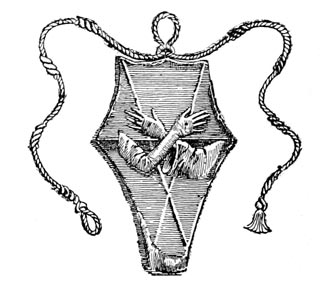
THE ARMS OF THE FRANCISCANS.
CHAPTER III
The Carceri, Rivo-Torto and Life at the Portiuncula
"O beata solitudo, O sola beatudine."
These three places near Assisi, so intimately associated with St. Francis, were in a way emblematic of the various stages in the rise and growth of his young community, and we shall see that the saint went from one to the other, not by chance, but with a settled purpose in his mind. The Carceri he kept as a something apart from, and outside his daily life; it was a hermitage in the strict sense of the word, where, far from the sound of any human voice, he could come and live a short time in isolated communion with God. As his followers increased, and the Order he had founded with but a few brethren developed even in its first years into a great army, we can easily understand the longing for solitude which at times became too strong to be resisted, for his nature was well fitted for the hermit's life, and it called him with such persistence to the woods among the flowers and the birds he loved, that had he been less tender for the sufferings of others, more blind to the ills of the Church, it is possible that the whole course of events might have been altered. Giotto would not have been called to Assisi, or if he had been, the legends told to him by the friars might not have inspired him to paint such master-pieces as he has left us in the Franciscan Basilica; and we should now be the poorer because St. Francis had chosen seven hundred years ago to live in an Etruscan tomb at Orte, or in a grotto on Mount Subasio. So much depended, not only upon what St. Francis achieved, but on the way in which he chose to work. Who therefore can tell how much we owe to the little mountain retreat of the Carceri, where, spending such hours of wondrous peace surrounded by all that he most cherished in nature, the saint could refresh himself and gain new strength for long periods of arduous labour among men.
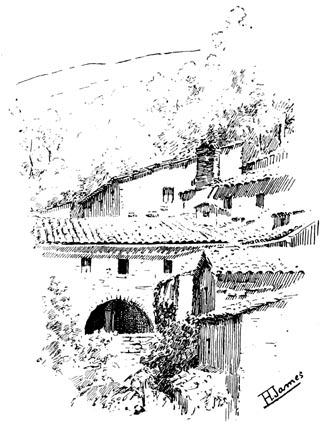
HERMITAGE OF THE CARCERI
The Carceri came into the possession of St. Francis through the generosity of the Benedictines who, until his advent, had held unlimited sway in Umbria. Many churches, and we may say, almost all the hermitages of the surrounding country belonged to them. But their principal stronghold, built in the eleventh century, stood on the higher slopes of Mount Subasio, while the Carceri, lying a little to the west, was used by them probably as a place of retreat when wearied of monastic life. Both monastery and hermitage seem to have been quiet enough, and we only occasionally hear of the Benedictine monks starting off on a visit to some hermit of renowned sanctity, or going upon some errand of mercy among the peasants in the valley, whom they often surprised by marvellous though somewhat aimless miracles wrought for their edification. Then early in the fourteenth century these hermit monks of Mount Subasio suddenly found themselves in the midst of the fighting of a mediæval populace, for the Assisans, not slow to discover the great military importance of the Benedictine Abbey, wished to possess it. When the struggle between Guelph and Ghibelline was at its height, the monks were driven to take refuge in the town, while their home was taken possession of by the exiled party who used it as a fortress whence they could sally forth and harass the eastern approach to Assisi. Perpetual skirmishes took place beneath its walls until the roving adventurer Broglia di Trino, who had made himself master of the town in 1399, in a solemn council held at the Rocca Maggiore issued an edict that the Monastery of St. Benedict was to be razed to the ground, determining thus to deprive the turbulent nobles and their party of so sure a refuge in times of civil war.
The solid walls and fine byzantine columns of what once was the most celebrated abbey in Umbria now remain much as in the mediæval days of their wreckage, and, until a few years ago when some repairs were made, the church was open for the mountain birds to nest in, and wild animals used it as their lair.
But both church and monastery stood proudly upon the mountain height above the plain when St. Francis, then the young mendicant looked upon by many as a madman, would knock at the gates, and the abbot followed by his monks, came out to listen to the humble requests he so often had to make. These prosperous religious most generously patronised St. Francis in the time of his obscurity, giving him the chapel of the Portiuncula, and later (the date is uncertain but some say in 1215) they allowed him to take possession of the still humbler chapel and huts of the Carceri. Even to call such shelters huts is giving them too grand a name, for they were but caverns excavated in the rock, scattered here and there in a deep mountain gorge. They can still be seen, unchanged since the days of St. Francis save for the tresses of ivy growing thick, like a curtain, across the entrance, for now there are none to pass in and out to pray there.
Even the attempt to describe the loneliness and discomfort of this hermitage seems to strike terror into the hearts of later franciscan writers, who no longer caring to live in caves, only saw Dantesque visions when they thought of these arid, sunburnt rocks, rushing torrents and wild wastes of mountains which even shepherds never reached. But luckily in those days there was one Umbrian who loved such isolated spots; and the charm of that silence, born of the very soul of Francis and guarded jealously by nature herself during long centuries in memory of him, now tempts us up the mountain side upon a pilgrimage to the one place where his spirit still lives in all its primitive vigour and purity.
The road leading to the Carceri[51] from the Porta Cappucini passes first through rich corn fields and olive groves, but as it skirts round Mount Subasio towards the ravine it becomes a mere mountain track. Only here and there, where peasants have patiently scraped away the stones, grows a little struggling corn, while small hill flowers nestle between the rocks unshaded even by olive trees; the colour of a stray Judas tree, or a lilac bush in bloom, only makes the landscape seem more barren and forlorn. Looking upon the road to Spello, winding down the hill through luxuriant fields of indian corn and olive groves, with the oak trees spreading their still fresher green over the vineyards of the plain, we feel that this pathway to the Carceri is something novel and unlike anything at Assisi which we have hitherto explored. Just as we are marvelling at its loveliness, a sudden turn brings Assisi once more in view, and the sight we get of it from here carries us straight back to the days of St. Francis; for the great basilica and convent are hidden by the brow of the hill, and what we now see is exactly what he looked upon so often as he hastened from Assisi to his hermitage, or left it when he was ready to take up the burden of men's lives once more. The old walls, looking now much as they did after a stormy battle with Perugia, stretch round the same rose-tinted town, which, strangely enough, time has altered but slightly—it is only a little more toned in colour, the Subasian stone streaked here and there with deeper shades of yellow and pink, while the castle is more ruined, rearing itself less proudly from its green hill-top than in earlier days of splendour. But charming as the view of the town is, we quickly leave it to watch the changes of light and colour in the valley and on the wide-bedded Tescio as it twists and turns in countless sharp zig-zags till we lose it where it joins the Tiber—there where the mist rises. We might travel far and not find so fascinating a river as the Tescio; only a trickle of water it is true, but sparkling in the sunshine like a long flash of lightning which has fallen to earth and can find no escape from a tangle of fields and vineyards.[52] Then our road turns away again from the glowing valley shimmering in the haze of a late May afternoon, and mounting ever higher we plunge into the very heart of the Assisan mountain, uncultivated, wild, colourless and yet how strangely beautiful.
Another half mile brings us round the mountain side to a narrow gorge, and the only thing in sight except the ilex trees is an arched doorway with a glimpse, caught through the half open gate, of a tiny courtyard. A step further on and we find ourselves standing amidst a cluster of cells and chapels seeming as if they hung from the bare rocks with nothing to prevent them falling straight into the depths of the ravine; and the silence around is stranger far than the mountain solitude. Surely none live here, we think, when suddenly a brown-clothed friar looks round the corner of a door, and without waste of time or asking of questions beckons us to follow, telling rapidly as he goes the story of each tree, rock, cell and shrine.
Crossing two or three chapels and passing through a trap-door and down a ladder, we reach a narrow cave-like cell where St. Francis used to sleep during those rare moments when he was not engaged in prayer. As at La Vernia this "bed" was scooped out of the rock, and a piece of wood served him as a pillow. Adjoining is an oratory where the crucifix the saint always carried with him is preserved. The doors are so narrow and so low that the smallest person must stoop and edge in sideways. From these underground caves it is a joy to emerge once more into the sunlight, and one of the delightful surprises of the place is to step straight out of the oppressive darkness of the cells into the ilex wood, with the banks above and around us glowing with sweet-scented cyclamen, yellow orchids, and long-stemmed violets. It is not surprising that St. Francis often left his cell to wander further into these woods when the birds, as though they had waited for his coming, would gather from all sides and intercept him just as he reached the bridge close to the hermitage. While they perched upon an ilex tree (which is still to be seen), he stood beneath and talked to them as only St. Francis knew how. His first sermon to the birds took place at Bevagna, but at the Carceri he was continually holding conversations with his little feathered brethren. This perhaps was also where he held his nocturnal duet with the nightingale, which was singing with especial sweetness just outside his cell. St. Francis called Brother Leo to come also and sing and see which would tire first, but the "little Lamb of God" replied that he had no voice, refusing even to try. So the saint went forth alone to the strange contest, and he and the bird sang the praises of God all through the darkest hours of the night until, quite worn out, the saint was forced to acknowledge the victory of Brother Nightingale.
Very different is the story of his encounter with the tempting devil whom he precipitated by his prayers into the ravine below; the hole through which the unwelcome visitor departed is still shown outside the saint's cell. Devils do not play a very prominent part in the story of the first franciscans, but this mountain solitude seems to have so excited the imaginations of later chroniclers that yet another story of a devil belongs to the Carceri, and is quaintly recounted in the Fioretti. This time he appeared to Brother Rufino in the form of Christ to tempt him from his life of holiness. "O Brother Rufino," said the devil, "have I not told thee that thou shouldst not believe the son of Pietro Bernardone?... And straightway Brother Rufino made answer: 'Open thy mouth that I may cast into it filth.' Whereat the devil, being exceeding wroth, forthwith departed with so furious a tempest and shaking of the rocks of Mount Subasio, which was hard by, that the noise of the falling rocks lasted a great while; and so furiously did they strike one against the other in rolling down that they flashed sparks of terrific fire in all the valley, and at the terrible noise they made St. Francis and his companions came out of the house in amazement to see what strange thing was this; and still is to be seen that exceeding great ruin of rocks."
Close to the spot rendered famous by the devil's visits a bridge crosses the gorge of a great torrent, which, threatening once to destroy the hermitage, was miraculously dried up by St. Francis, and now only fills its rocky bed when any public calamity is near. From it a good view is obtained of the hermitage, but perhaps a still better is to be had from under the avenue of trees a little beyond, on the opposite side of the deep ravine whence the groups of hovels are seen to hang like a honeycomb against the mountain side, so tightly set together that one can hardly distinguish where the buildings begin and the rock ends.
The ilex trees grow in a semicircle round this cluster of cells and caverns, and high above it all rises a peak of Mount Subasio, grey as St. Francis' habit, with a line of jagged rocks on the summit which looks more like the remains of some Umbrian temple of almost prehistoric days than the work of nature.
The sides of this mountain ravine approach so near together that only a narrow vista of the plain is obtained, blue in the summer haze, with no village or even house in sight. It would be difficult to find a place with the feeling of utter solitude so unbroken, and as we realised that these friars lived here nearly all their life, many not even going to Assisi more than once in five years, we said to one of them: "How lonely you must be," and he, as though recalling a time of struggle in the world, answered: "Doubtless there are better things in the town, but here, at the Carceri, there is peace."
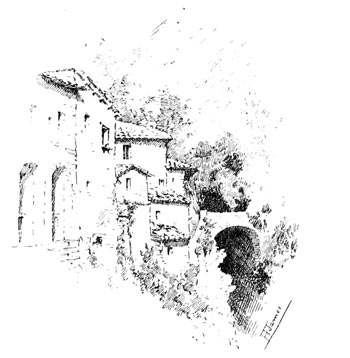
THE CARCERI WITH A VIEW OF THE BRIDGE
It is the hermit's answer; but now the need of such lives has long since passed away, and even St. Francis, living at the time when the strain of perpetual warfare, famine, pestilence and crime, created a fierce craving for solitude in the lives of many, realised that a hermitage must only be a place to rest in for a while—not to live in. His anxiety to keep his Order from becoming a contemplative one is shown in the following rule he carefully thought out for his disciples. "Those religious who desire to sojourn in a hermitage are to be at the most three or four. Two are to be like mothers having a son. Two are to follow the life of a Martha, the other the life of a Mary." Then they were to go forth again strenuously to their work abroad and give place to others in search of rest and peace.
But after the death of St. Francis the Carceri gradually lost its primitive use, and the principal person who entirely changed its character was St. Bernardine of Siena who in 1320 made many alterations and additions, building a larger chapel, adding cells and a kitchen, but so small, remarks a discontented franciscan chronicler, that it barely held the cooking utensils. Although we can no longer call it a hermitage, the Carceri became the type of an ideal franciscan convent such as Francis dreamed of for his followers when he went to live at the Portiuncula, and such it has remained to this day. For certainly the place, as left by St. Bernardine, would have been approved of by the first franciscans as a dwelling-place, but those of later years can only tell us of its discomforts. Here is a graphic description of its primeval simplicity which very nearly corresponds to its present state: "It were better called a grotto with six lairs; one sees but the naked rock untouched by the chisel, all rough and full of holes as left by nature; those who see it for the first time are seized with extraordinary fear on climbing the ladder leading to the dormitory, at each end of which are other poor buildings, added by the religious according as need arose for the use of the friars, who do not care to live as hermits did in the olden times. The refectory is small, and can contain but few friars; a brother guardian made an excavation, of sufficient height and breadth in the rock, and added thereto a table around which can sit other six religious, so that those who take their places at this new table are huddled up in the arched niche which forms a baldaquin above their heads. There is also a little common room which horrifies all beholders, wherein is lit a fire, for besides being far inside the rocky mass it is gloomy beyond description by reason of the dense smoke always enclosed therein, this is a lively cause to the religious of reflection on the hideousness and obscurity of the darkness of hell; in lieu of receiving comfort from the fire the poor friars generally come out with tears in their eyes." To somewhat atone for these discomforts they possessed a fountain, raised, as we are told, by the prayers of St. Francis, which never ran dry, "a miracle God has wished to perpetuate for the glory of His faithful servants and the continual comfort of the monks."
The crucifixion in the chapel built by St. Bernardine adjoining the choir, is said to have been painted by his orders. The artistic merits of the fresco are questionable, but connected with it is a legend possibly invented by some humorous member of the franciscan brotherhood in order to point a moral to his companions. "Here," says a chronicler, "is adored that most marvellous crucifixion, so famous in religion; it is well known to have spoken several times to the devout Sister Diomira Bini of the Third Order of St. Francis and a citizen of Assisi; and in our own times, in the last century (the seventeenth) it was seen by Brother Silvestro dello Spedalicchio to detach itself from the cross, and with most gentle slaps on the face, warn a worshipper to be reverent and vigilant while praying in this His Sacred Oratory."
In a small wooden cupboard in the chapel, according to an inventory made two hundred years ago, are preserved some relics, a few of which we have unfortunately not been able to identify. Part of the wooden pillow used by St. Francis, and a piece of the Golden Gate through which our Lord passed into Jerusalem, are still here, but the hair of the Virgin, and, strangest of all, some of the earth out of which God created Adam, are no longer to be found!
Ten or twelve friars continued to live at the Carceri for a few years after the death of St. Bernardine; some begged their daily bread from the villagers in the valley, others dug in the tiny garden at the foot of the ravine where a few vegetables grew, and two always remained at the convent to spin the wool for the habits of the religious. But soon wearying of the life they went to live at other convents, and the place passed away from the franciscans into the possession of various sects, among others to the excommunicated Fraticelli. In 1415 it was given back to the Observants, and Paolo Trinci, who had done much to reform the Order, persuaded some friars to live once more at the deserted hermitage. Again the Carceri became such an ideal franciscan convent that many came from afar to visit it, and there is a strange story of how a "woman monk" found a home and died here in the middle of the fifteenth century.
"Beata Anonima," a chronicler recounts, "being already a Cistercian nun in the convent of S. Cerbone of Lucca at the time of the siege of that city by the Florentines, when the said nuns, for valid reasons, were transferred to the convent of Sta. Christina inside the city. Now this most fervent servant of God took this opportune time and fled by stealth, disguised as a man, and went, or rather flew, to Assisi; there, fired with an ardent desire to fight under the seraphic standard, she breathlessly climbed the steep slopes of Mount Subasio, and having found the horrible cavern of Santa Maria delle Carceri fervently entreated those good Fathers to admit her amongst them and to bestow on her their sacred habit, for which her longing was extreme. At length, having overcome all resistance, believing her to be a man as appeared from her dress, and not a woman which in reality she was, they admitted her to the convent and gave her the habit of religion." She edified all by the holiness of her life and the rigid penances she performed, but her health soon suffered and only upon her death-bed, surrounded by the friars chanting the psalms for the dying, the Blessed Anonima confessed to the fraud she had practised in order to dwell in the hermitage rendered so dear because of the memory of the Poverello d'Assisi.
Rivo-Torto[53]
A straight and stony road, the old Roman one, now overgrown in many parts with grass and trails of ivy and bordered by mulberry and oak trees, leads out of the Porta Mojano to two little chapels in the plain. Set back from the main road in the midst of the fields few people find them, and the peasants know nothing of their story and can only tell of a miraculous well in which a youthful saint met his death. When his body was brought to the surface a lily had grown from his mouth and upon its petals was written in letters of gold the one word, Veritas, for he had died in the cause of truth. Since then, as the peasants recount with pride, many come from afar to drink of the waters of this well for it cures every ill. It is over-grown with ferns and close by stands an ancient sarcophagus where the children sit to eat their midday meal. A piece of old worn sculpture still ornaments the chapel of the young martyr, and the feeling of the place is very charming, but the pilgrim who comes to Assisi to visit St. Francis, has a different picture to recall with another kind of beauty belonging to it than that of holy wells and flowering banks and meadows.
It is difficult, when looking on San Rufino d'Arce, with its cluster of vine-shaded peasant houses, and then on Santa Maria Maddalena, narrow windowed, the small apse marking it as a primitive Umbrian chapel of the fields, to realise that in the Middle Ages this was a leper village separated from Assisi by a little more than a mile of open country. And yet here, without doubt, we have Rivo-Torto where, even before his famous interview with Innocent III, St. Francis had stayed with those three first Assisan companions, Bernard di Quintavalle, Peter Cataneo and Egidio. Then in the autumn of 1210, when he returned from Rome after the rule of poverty had been sanctioned by the Church, but before he was ready to begin his mission as preacher, he came to live among the lepers, forming with his disciples a little family which we may call the beginning of a first franciscan settlement.
The leper village was divided according to the social rank of the outcasts, the richer living together near the chapel of Sta. Maria Maddalena and forming quite a community with the right of freely administering their own goods. As M. Sabatier observes, it was therefore not "only a hospital, but almost a little town near the city with the same social distinctions of classes."
Those tended by St. Francis were the poorest of the lepers, whose wretched hovels lay near the chapel of San Rufino d'Arce; and Celano must be referring to this settlement when he tells us how Francis in his early days, even if he chanced to look down from Assisi upon the houses of the lepers in the plain, would hold his nostrils with his hand, because his horror of them was so great.
But as the grace of God touched his heart, making him take pity upon all things weak and suffering, he turned the force of his strong nature to overcoming this repugnance, and there is a beautiful story telling of the first victory gained shortly after his conversion. While riding one day near Assisi he met a leper, and filled with disgust and even fear at the sight, his first impulse was to turn his horse round, but, remembering his new resolutions to follow the teaching of Christ, he went forward to meet the poor man, and even kissed the hand extended to him for alms. "Then," says St. Bonaventure, "having mounted his horse, he looked around him over the wide and open plain, but the leper was nowhere to be seen. And Francis being filled with wonder and gladness, devoutly gave thanks to God, purposing within himself to proceed to still greater things than this." Certainly the event heralded a life of holiness, and was the means of rousing his latent energies and the feelings for self-sacrifice which drove him from the wild and solitary places he loved into the very midst of the world, there to work strenuously, in every part of Italy, at first among lepers and then among the wealthy, the ignorant and the sorrowful.
For the life at Rivo-Torto led by "these valiant despisers of the great and good things of this world" we cannot do better than turn to the Three Companions (Brothers Masseo, Ruffino and Leo) who knew by personal experience the hardships and roughness of the place. Feelingly they describe: "a hovel, or rather a cavern abandoned by man; the which place was so confined that they could hardly sit down to repose themselves. Many a time they had no bread, and ate nought but turnips which they begged for here and there in travail and in anguish. On the beams of the poor hut the man of God wrote the names of the brethren, so that whoso would repose or pray might know his place and not disturb, by reason of the cramped and limited space in the small hovel, the quietude of the night." Even the appearance of Otto IV, close to their hut seems in no way to have disturbed the peaceful course of their lives, but only gave St. Francis the opportunity of bestowing a timely warning upon the Emperor. Celano, ever delighting in the picturesque details of ceremonies and pageants, tells us how "there came at that time with much noise and pomp the great Emperor on his way to take the terrestrial crown of the Empire; now the most holy father with his companions being in the said house near the road where the cavalcade was passing, would neither go out to see it, nor permit his brethren to go, save one, whom he commanded fearlessly to announce to Otto that his glory would be short-lived."
Thus, if the tale be true, a German Emperor was the first to listen to Francis' message to a mediæval world sunk in the love of earthly things, and who knows whether the saint's words did not come back to Otto again in after years.
The Penitents of Assisi only remained until the spring at Rivo-Torto, for even during those few months' sojourn among the lepers their numbers had so increased that it became necessary to think of some surer abode. One day St. Francis called the brethren to tell them how he had thought of obtaining from one of his various kind friends in Assisi, a small chapel where they could peacefully say their Hours, having some poor little houses for shelter close by built of wattle and mud.
His speech was pleasing to the brethren, and so, following the master they loved and trusted, all went to dwell at the Portiuncula, where, as we shall see, a new life was to begin for them.
The Portiuncula
"Holy of Holies is this Place of Places, Meetly held worthy of surpassing honour! Happy thereof the surname, 'Of the Angels,' Happier yet the name, 'The Blessed Mary.' Now, a true omen, the third name conferreth 'The Little Portion' on the Little Brethren, Here, where by night a presence oft of Angels Singing sweet hymns illumineth the watches." (The Mirror of Perfection, translated by Sebastian Evans.)
Those who want to realise the charm of the Portiuncula and of the memories that cling about it, must try to forget the great church which shuts out from it the sunlight, and with the early chroniclers as their guides, call up the image of St. Francis with his first disciples who in an age of unrest came here to seek for peace.
Make your pilgrimage in the springtime or in the early summer, when pink hawthorn and dogroses are flowering in every hedge and the vines fill the valley with a delicate green light. Looking at cities and villages so purely Umbrian, some spread among cornfields close to a swift clear river, others set upon heights which nearly touch the sky on stormy days, we forget that beyond these hills and mountains encircling the big valley of Umbria stretch other lands as fair. We forget, because it is a little world which during long centuries has been set apart from all else, and where man has but completed the work of nature herself. During the long hours of a summer's day, when the sense of remoteness in the still plain is most intense, it brings to us, as nothing else can ever do, some feeling of that early time when four hermits came from Palestine and found a quiet retreat in the oak forests of Assisi.
It was in the year 352, as St. Cyril, Patriarch of Jerusalem, relates, when a cross had been seen stretched from Calvary to the Mount of Olives and to shine more brightly than the sun, that four holy men, impelled by a feeling that some great crisis was at hand, determined to visit the shrines of Rome. Having performed their devotions and offered many precious relics to Pope Liberius, they expressed a great desire to find some hermitage where, each in a silent cell, they could meditate upon the marvellous things they had seen in the Eternal City. The Pope gave them most excellent advice when he told them to go to the Spoletan valley. With his sanction to choose any part of it they liked, they passed over the mountains dividing Umbria from the Campagna, and by many towns until, when about a mile from Assisi, they determined to build their dwellings in the plain, thinking, as indeed they might, to find no other spot so suited for a quiet retreat. Close to four huts of rough hewn stone and brushwood they erected a tiny chapel with a pent roof and narrow window which, perhaps in memory of their native valley, they dedicated to St. Mary of Jehosaphat. But after a few years, forsaking the life of hermits, they again took up their staves and returned home to Palestine by way of the Romagna, leaving beneath the altar of the chapel they had built a relic of the Virgin's sepulchre.
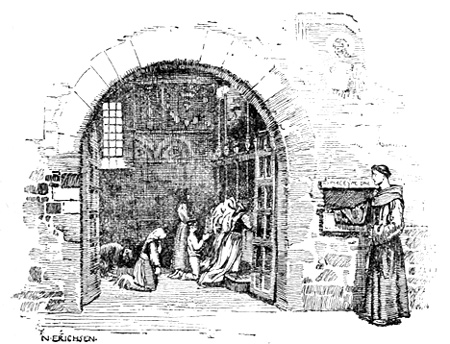
SIDE DOOR OF THE PORTIUNCULA BUILT BY ST. BENEDICT
At different times other devout hermits, charmed by the lonely chapel, took possession of it for a time, but it was often deserted for many years. Its preservation is due to St. Benedict who, passing through Umbria during the early part of the sixth century, was inspired to restore the ruined chapel and dwell near it for awhile. He not only repaired the walls, but built the two large round arched doors we see to this day, and which many declare to be quite out of proportion to the rest of the building, but their unusual size is accounted for by a charming legend. Once when St. Benedict was praying in the chapel he saw a marvellous vision as he knelt wrapt in ecstasy. A crowd of people were praying around him to St. Francis, singing hymns of praise and calling for mercy on their souls, while outside still greater multitudes waited for their turn to come and pray before the shrine. St. Benedict, understanding from this that a great saint would one day be honoured here, made the two doors in the chapel, and made them large enough for many to pass in and out at a time. Thus was the feast of the "Pardon of St. Francis" prepared for some seven hundred years too soon.
St. Benedict obtained from the Assisans the gift of a small plot of ground near the sanctuary, which suggested to him the name of St. Mary of the Little Portion—Sta. Maria della Portiuncula. When a few years later St. Benedict founded his famous order at Monte Cassino, he did not forget the Umbrian chapel he had saved from ruin, and sent some of his monks to live there and to minister among the people. Like the first hermits they lived in poor huts, saying their Hours in the little chapel, until in the eleventh century they built a large monastery and church upon the higher slopes of Mount Subasio to the east of Assisi, and the Portiuncula was again deserted. But although no one lived near, and mass was never celebrated there, it still remained in the keeping of the benedictines who occasionally must have seen to its repair, and thus preserved it for the coming of St. Francis.
It has been suggested to me that the spot selected by the four holy pilgrims in the fourth century may have been even then the site of a sacred shrine, for the custom of erecting tabernacles over the graves of distinguished persons reaches back to very early times. Originally designed as a mortuary cell such a structure might, being duly oriented, come to be used as a chapel for service.
The subject of "Sepulchral Cellæ" will be found treated of by the late Sir Samuel Fergusson[54] in a memoir in which he figures some of the burial vaults and early oratories of Ireland, some of which are in shape identical with Sta. Maria della Portiuncula, with the same pent roof, round arched door, and perfectly plain walls. A building thus erected over a grave was called Porticulus, and any who pillaged "a house made in form of a basilica over a dead person" had to pay a fine.
From an archæological point of view there is much to be desired in the published descriptions of the Portiuncula. A great part of its exterior walls is now covered with frescoes which hide all detail, but perhaps a minute examination of the interior walls might reveal portions of the foundations built upon by St. Benedict, and we sincerely hope that these few words may attract attention to so interesting a subject.
But even if the shrine said to have been built by the hermits from Palestine for Our Lady's Girdle turns out to have been an ancient tomb, the later legends are by no means destroyed. It is not unlikely that St. Benedict, attracted as much by lonely places as St. Francis, took possession of the Umbrian tomb, and perhaps little thinking what it was, rebuilt and used it as a chapel. Whatever may be the true story, it is very certain that the Portiuncula, from earliest times, has possessed a strange attraction for all who passed by, each one thinking a tiny chapel situated so charmingly in the woods, within sight, though not within sound, of the Umbrian towns, to be a perfect spot for prayer.
The country people treasure the legend that Madonna Pica often came to pray at the Portiuncula, and through the intercession of the Blessed Virgin obtained a son after seven years of waiting, and this son of prayer and patience was St. Francis of Assisi.
Half ruined and neglected as the chapel was, Francis learned, even as quite a child, to love it, and kneeling therein by his mother's side would pray with all the fervour of his childish faith. Later in life when he had turned from the mad follies of his youth to follow in the footsteps of Christ, he remembered the shrine he had loved in childhood, and would pass many nights there in prayer and bitter meditation upon the Passion. At last touched by the sight of its crumbling walls, he set himself the task of repairing them, working so busily with stones and mortar that the chapel soon regained its former simple beauty. The Benedictines of Mount Subasio, touched by his ungrudging labour and piety, arranged with an Assisan priest to celebrate mass at the Portiuncula from time to time, and this fact drew the young saint there still oftener.
Then followed his time of ministry among the lepers of San Rufino d'Arce, when day by day so many disciples came to enlist in this new army of working beggars that the little hut in the leper-village could no longer hold them, and Francis had to think of some means of housing the brethren, and obtaining, what he had often desired, a chapel wherein they could say the Hours. (The saint, we may be sure, always said his office in the woods.) But evidently he had no particular place in his mind, not even his beloved Portiuncula, for he went first to his friend Guido, Bishop of Assisi, and then to the canons of San Rufino to ask if they could help him. They only answered that they had no church to dispose of, and could offer no advice upon the subject. Then sorrowfully, like a man begging from door to door, St. Francis climbed Mount Subasio to lay his request in piteous terms before the benedictine abbot, where he met with more success. Brother Leo tells us that the abbot was "moved to pity, and after taking counsel with his monks, being inspired by divine grace and will, granted unto the Blessed Francis and his brethren the church of St. Mary of the Little Portion, as being the smallest and poorest church they possessed. And the abbot said to the Blessed Francis, 'Behold Brother, we grant what thou desirest. But should the Lord multiply thy brotherhood we will that this place shall be the mother-house of thy Order.'"[55]
With a willing heart Francis promised what the abbot asked, and further insisted upon paying rent for the Portiuncula, because he wished his followers always to bear in mind the point of his rule, which he so often dwelt upon, namely, that they owned no property whatever, but were only in this world as pilgrims. So every year two of his brethren brought to the gate of the benedictine monastery a basket full of roach caught in the Chiaggio which flows at no great distance from the Portiuncula, and the abbot, smiling at the simplicity of Francis, who had imagined yet another device for humility, gave back a vessel full of oil in exchange for the gift of fish.[56]
With great rejoicing St. Francis set to work building cells of a most simple pattern, with walls of wattle and dab, and thatched with straw, each brother inscribing his name upon a portion of the mud floor set apart for him to rest in. "And no sooner had they come to live here," writes Brother Leo, "than the Lord multiplied their number day by day, and the sweet scent of their good name spread marvellously abroad throughout all the Spoletan valley, and in many parts of the world."
It was thus that St. Mary of the Little Portion, henceforth to be the nucleus of the franciscan order, and a place familiar to pilgrims from far and near for many succeeding centuries, came into the keeping of St. Francis in the year 1211, about nine months after Innocent III had sanctioned his work among the people of Italy.
St. Francis and the brethren had been but a year in their new abode when a figure passed in among them for a moment and then was gone, leaving, as a vision to haunt them to their dying day, the memory of her beauty and soul's purity.
Never in the history of any saint has there been so touching and wondrous a scene as when the young Clare left her father's palace in Assisi to take the vows of perpetual and voluntary poverty at the altar of the Portiuncula. Followed by two trembling women, she passed swiftly through the town in the dead of night, across the fields by the slumbering village of Valecchio, and through dark woods made more sombre by the starry Umbrian sky which at intervals gleamed between the wide-spreading branches of the oak trees. The hurrying figure of the young girl, swathed in a long mantle, seemed like some spirit driven by winds towards an unknown future. One thing alone was clear to her, she was nearing the abode of Francis Bernardone whose preaching at San Giorgio only a month before had so thrilled her, inspiring her in this strange way to seek the life he had described in such fiery words. And just as she came in sight of the Portiuncula the chanting of the brethren, which had reached her in the wood, suddenly ceased, and they came out with lighted torches in expectation of her coming. Swiftly and without a word she passed in to attend the midnight mass which Francis was to serve.
The ceremony was simple, wherein lies the charm of all things franciscan. The service over and the last blessing given, St. Francis led Clare towards the altar and with his own hands cut off her long fair hair and unclasped the jewels from her neck. But a few minutes more and a daughter of the proud house of Scifi stood clothed in the brown habit of the order, the black veil of religion falling about her shoulders, lovelier far in this nun-like severity than she had been when decked out in all her former luxury of silken gowns and precious gems.
It was arranged that Clare was to go afterwards to the benedictine nuns of San Paolo near Bastia, about an hour's walk further on in the plain. So when the final vows had been taken, St. Francis took her by the hand and they passed out of the chapel together just as dawn was breaking, while the brethren returned to their cells gazing half sadly as they passed, at the coils of golden hair and the little heap of jewels which still lay upon the altar cloth.
Those early days at the Portiuncula were among the most important of Francis' life; dreams which had come to him while he spent long hours in the caves and woods near Assisi were to be fully realised, and the work he felt inspired to perform was to be carried out in the busy villages and cities of Italy and even further afield. All this was now very clear to Francis, and more than ever anxious to keep the simplicity of his order untouched, he taught his followers, in words which fell so gently yet so earnestly from his lips, that they were to toil without ceasing, and restlessly and without pause to wander from castle to castle, from city to city, in search of those who needed help. It may therefore at first seem strange that the "Penitents of Assisi" owning nothing but the peace within their hearts, desiring no better place for prayer than a cavern in some mountain gorge, should establish themselves near a chapel which, if not nominally their own, was practically regarded as the property of the Friars Minor. But in this again we feel the wisdom and tenderness of the saint for his little community. With all the fervour and fire of enthusiasm which impelled him like a living force to seek his end, he well knew that without some place in which to meet together and rest awhile, his followers, who however much imbued with his ardent spirit were but mortal men, would very likely fall away from the high ideal he had set before them.
Thus the Portiuncula became to the brethren as a nest, where like tired birds that long had been upon the wing, they could return after much wandering to peaceful thoughts, to prayer and quiet labour.
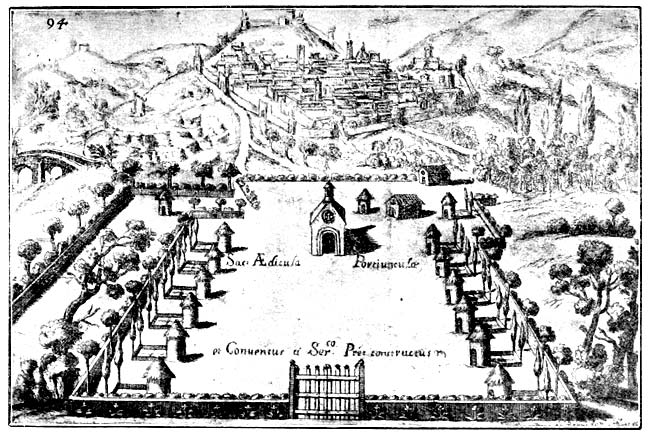
THE PORTIUNCULA IN THE TIME OF ST. FRANCIS (FROM THE "COLLIS PARADISI").
It is not very difficult, with the print from the "Collis Paradisi"[57] before us, and the remembrance of the large oaks which still mark the ancient Roman roads leading from Assisi to the plain, to call up the picture of the strange franciscan hamlet clustering round a pent-roofed chapel, and with only trees for a convent wall. What a life of peace in the mud huts! what a life of turmoil and angry strife raging in the city just in sight!
The spirit of those days, when monachism meant all that was purely ideal and beautiful, seems to live again. Then, day and night, each brother strove to fit himself for the work he had in view, drawing into his soul the peace and love he learned from nature herself as the forest leaves rustled above his cell or the nightingales accompanied the midnight office with their song. And when his turn came to take up the pilgrim's staff and follow the lead of Francis, he went with cheerfulness to bring to the people some of that child-like joy and lightness of heart which marked the Little Brethren through whatever land they wandered as the disciples of St. Francis.
Let us for a moment leave the Umbrian valley for the country near Oxford, where on a bitter Christmas Day, two friars were journeying upon their first mission to England.
"Going into a neighbouring wood they picked their way along a rugged path over the frozen mud and hard snow, whilst blood stained the track of their naked feet without their perceiving it. The younger friar said to the elder: 'Father, shall I sing and lighten our journey?' and on receiving permission he thundered forth a Salve Regina misericordiæ.... Now, when the hymn was concluded ... he who had been the consoler said, with a kind of self congratulation to his companion: 'Brother, was not that antiphonal well sung?'"
In this simple story, told us in the chronicle of Lanercost, how true rings the franciscan note struck by Francis in those early days at the Portiuncula. He was for ever telling the brethren not to show sorrowful faces to one another, saying, as recorded by Brother Leo: "Let this sadness remain between God and thyself, and pray to Him that of His mercy He may forgive thee, and restore to thy soul His healthy joyance whereof He deprived thee as a punishment for thy sins."
It is all so long ago, and yet in reading those ancient chronicles the big church of the Angeli is for a time forgotten, and only the vision of the Portiuncula and the mud huts, with the brethren ever to and fro upon the road, remains with us as a strange picture in our modern hurried life.
But although the brethren lived so quietly in this retreat of still repose, St. Francis, ever watching over the welfare of his flock, was careful that prayer and meditation should never be an excuse for idleness, which of all vices he most abhorred. Therefore he encouraged each friar who in the world had followed some trade, to continue it here; so we hear of Beato Egidio, on his return from one of his long journeys, seated at the door of his hut busily employed in making rush baskets, while Brother Juniper, in those rare moments when he was out of mischief, would pass his time in mending sandals with an awl he kept up his sleeve for the purpose. Besides these individual occupations there was much to attend to even in such humble dwellings as those round the Portiuncula. Sometimes there were sick friars to nurse, or vegetables had to be planted in the orchard and provisions to be obtained, while the office of doorkeeper, as "Angels" came perpetually to ask pertinent questions of the brethren, became quite a laborious task. When it fell to Brother Masseo to answer the door he had little peace. Upon one occasion he went in haste to see who was making such a noise and found a "fair youth clothed as though for a journey," so he spoke somewhat roughly, and the youth enquired how knocking should be done. "Give three knocks," quoth Brother Masseo, little dreaming he was instructing an angel in the art of knocking, "with a brief space between each knock, then wait until the brother has time to say a paternoster and to come unto thee; and if at the end of that time he does not come knock once again."