Chapter XXXIII
Reading edition
“Yet once I was blind, and could not see the light, And straight to Jeru-salem I then took my flight; They led me through a wilderness, with a multitude of care, You may know me by the system, or badge I wear. Twelve dazzling lights I saw, which did me surprise; I stood in amaze where I heard a great noise; A serpent came by me,—I fell unto the ground, With joy, peace, and comfort the secret I found.”[592]
The principle of all mysteries having been already elucidated, it only remains, that in this concluding chapter, I point out a few more instances of their practical application.
In the Gospel, then, according to St. Matthew, I find the words, “O generation of vipers, who hath warned you to flee from the wrath to come?”[593] And in that according to St. John, the following, “We be not born of fornication; we have one Father, even God.”[594]
The juxtaposition of these texts, one with another, and the comparison of them, mutually, with the explication of the serpent, given at p. 229, will not only confirm the truth of all the foregoing developments, but satisfy you further, what I am very certain you did not before identify, viz. that the phrases generation of vipers, and the being born of fornication, are one and the same—the viper, or serpent, being the symbol of lustfulness, making the former equivalent to ye offspring of concupiscence; that is, in other words, ye born of fornication![595] And the very stress laid upon this mode of geniture, implies not only the possibility of a different sort, but its frequency also!
“In the Purana prophecies concerning the expected Saviour,” say the Asiatic Researches, “it is said, that he was the son, or rather the incarnation, of the great serpent: and his mother was also of that tribe, and incarnate in the house of a pot-maker. She conceived, at the age of one year and a half, the great serpent gliding over her while she was asleep in the cradle: and his mother, accordingly, is represented as saying to the child, once that she brought him to a place full of serpents—‘Go and play with them, they are your relations.’”
Here it will be seen that, under the form of a serpent, is personified the Deity, or the generative power.
Nunez de la Vega, Bishop of Chiapa, in Mexico, when describing Nagualism, in his Constitutions, as observed in that country, says: “The Nagualists practise it by superstitious calendars, wherein are inserted the proper names of all the Naguals, of stars, the elements, birds, beasts, fishes, and reptiles; with observations upon the months and days; in order that the children, as soon as they are born, may be dedicated to that which, in the calendar, corresponds with the day of their birth; this is preceded by some frantic ceremonies, and the express consent of parents, which is an explicit part between the infants and the Naguals that are to be given to them. They then appoint the melpa, or place, where, after the completion of seven years, they are brought into the presence of the Nagual to ratify the engagement; for this purpose they make them renounce God and His blessed Mother, instructing them beforehand not to be alarmed, or sign themselves with the cross: they are afterwards to embrace the Nagual affectionately, which, by some diabolical art or another, appears very tame, and fondly attached to them, although it may be a beast of a ferocious nature, as a lion, a tiger, etc. They persuade the children, by their infernal cunning, that this Nagual is an angel sent by God to watch over their fortunes, to protect, assist, and accompany them; and that it must be invoked upon all occasions, business, or occurrences, in which they may require its aid!”
It is very clear, that the Nagualism above notified is but a degenerate offshoot of that serpent worship, which is coeval with the fall: yet, degenerate as it is, it is equally indisputable, that this good man’s zeal outsteps far his judgment, the exaggerations of his fancy even committing him so far, as to make him imperceptibly contradict himself!
Surely, were it a principle of action with those unfortunate beings to make their children, on their entrance upon active life, to renounce God, they would not teach them, at the same time, to reverence a brute creature, merely as being a subordinate servant of that God!
To reconcile the Bishop, therefore, to something like truth, I will suppose him to mean by the word God, where it first occurs, Christ, which is evident from the context, of “His blessed Mother”: and then the prohibition against the sign of “the cross,” must be understood exclusively as in reference to him; a conclusion which is confirmed by an additional reference to that oath, which I have before mentioned, as still prevalent amongst the Irish.
By the cross is the oath, accompanied by a transverse location of the forefinger of one hand upon that of the other: and the addition alluded to is of Christ, which is never volunteered except when equivocation is suspected; and then it is exacted as a matter of distinction between His cross and the more antecedent one!
But no further proof is requisite to prove the Bishop’s want of candour than his withholding documents from the public eye, which would appear to illustrate the subject.—“Although in these tracts and papers there are,” says he, “many other things touching primitive paganism, they are not mentioned in this epitome, lest, in being brought into notice, they should be the means of confirming more strongly an idolatrous superstition.” He should have had more confidence in his own cause, and feel that—“If anything, in consequence of this scrutiny, totter and fall, it can only be the error which has attached itself to truth, encumbering and deforming it. Truth itself will remain unshaken, unsullied, fair, immortal!”
Now, in the description of the ancient city, near Palenque, quoted before, I find some words, which prove an affinity between the worship of the ancient inhabitants of America and those of Ireland, and which rescue both from the imputations of bigotry. “I am Culebra,” says Votan, one of the early princes, I believe, of Mexico, who wrote an historical tract in the Indian idiom, “because I am Chivim.”
The man’s name, you perceive, was Votan, but his ambition was to be considered Culebra, or the snake, that is, the deity so personified: the mode whereby he sought to establish it is foreign from my inquiry.
The Gadelglas of the ancient Irish was precisely similar to this Culebra of the Americans: gad signifying a snake, or tortuosity: el, god; and glas, green—in all, the green snake-god! And conformably with this import, we are assured by a man who knew very little as to the reason why, but whose testimony is here valuable in a matter of record, not of opinion; namely, that the “Milesians, from the time they first conquered Ireland, down to the reign of Ollamh Fodhla, made use of no other arms of distinction in their banners than a serpent twisted round a rod, after the example of their Gadelian ancestors.”[596]
You have now the proof of “who puts the snakes upon our ancient crosses?” And, independently of such proof, the antiquity itself of all the traditions associating the serpent with the early memoirs of our ancestors was so great as to appal even the monks! And as they could not, in their system of transferring our history, bring down this serpent to the era of the saints, they resolved, at all events, to have him in their dispensation, and so made Moses the hero!
This they contrived by inventing the name of Gadel for one of our forefathers, and then transplanting him to the coast of the Red Sea, just as the Legislator of the Jews was conducting them out of Egypt! They then very unsacerdotally make a serpent bite him in some part of the heel, but very graciously afterwards restore him to sanity by Moses’s interposition! with a stipulation, however, that the former sore should ever appear glass or green! And thus was he called Gadelglas, or Gadel the Green!!!
In truth, it was from this green snake-god, above explained, that the island obtained the designation of Emerald; and not from the verdure of its soil, which is not greater than that of other countries.
The Arabians have a tradition, that Enoch was the first who, after Enos, son of Seth, son of Adam, wrote with a pen, in the use of which he instructed his children, saying to them additionally, “O, my sons, know that ye are Sabians!”
Although the substance of the religion, couched under this designation, has been already explained, yet the origin of the name itself remains yet to be unfolded.
Then be it known, that in the sacred, i.e. Irish language, the word Sabh,[597] has three significations—firstly, voluptuousness, or the yoni; secondly, a snake, or sinuosity; and, thirdly, death or life! And in accordance with this triple import, if you roll back the leaves as far as p. 229, you will find in the plate inserted there, and which has been transcribed from the sculptures of the ancient Palencian city before alluded to, those three symbols, viz. the yoni, the serpent, and death, all united in design, and illustrating my development of that mysterious scene wherein—
“Eve tempting Adam by a serpent was stung.”[598]
The sculpture itself is intended to pourtray the situation of those progenitors of the human species in the Garden of Eden. And yet, striking as it is, would its tendency remain ever a secret, were it not for the instrumentality of the Irish language!
“That the society of free and accepted Masons possess a grand secret among themselves is an undoubted fact. What this grand secret is, or of what unknown materials it consists, mankind in general, not dignified with the order, have made the most ridiculous suppositions. The ignorant form incoherencies, such as conferring with the devil, and many other contemptible surmises, too tedious to mention, and too dull to laugh at. While the better sort, and more polished part of mankind, puzzle themselves with reflections more refined, though equally absurd. To dispel the opinionative mist from the eye of general error is the author’s intention; and however rash the step may be thought, that he, a mere atom in the grand system, should attempt so difficult, so nice a task, yet he flatters himself that he shall not only get clear over it, but meet with the united plaudits both of the public and of his brethren. And he must beg leave to whisper to the ignorant, as well as the judicious, who thus unwarrantably give their judgment, that the truth of this grand secret is as delicately nice as the element of air; though the phenomenon continually surrounds us, yet human sensation can never feelingly touch it till constituted to the impression by the masonic art. The principal, similar to the orb of light, universally warms and enlightens the principles, the first of which, virtue, like the moon, is heavenly chaste, attended by ten thousand star-bright qualifications. The masonic system is perfectly the emblem of the astronomic; it springs from the same God, partakes of the same originality, still flourishes in immortal youth, and but with nature will expire.”[599]
The contortions of the snake were easily transferred to the revolutions of the heavenly bodies. “When the ancients,” says Boulanger, “found out the true cycle of the sun, they coined names by a jeu de mots, or words, signifying its heat, or its course, that made up the number 365, as they had done before to make up 360. The name Sabasins, that has so much perplexed antiquaries and etymologists, is no more than a numerical name, which was given to Jupiter and to Bacchus as periodical deities. When the suppliant was initiated into the mysteries of Sabasins, a serpent, the symbol of revolution, was thrown upon his breast. Το ΣΑΒΟΕ, which the Greeks repeated so often in the feasts of Bacchus without understanding the meaning of the words, meant no more than the cycle of the year, from the Chaldean Sabb circuire vertere, etc. The ancient religion, which applied entirely to the motions of the heavens and periodical return of the stars, was for that reason named Sabianism, all derived from the Chaldee Seba, a revolution”; and this, though Boulanger knew it not, from the Irish Sabh, serpent, or pith.
Sabaism, therefore, and Ophiolatreia were all one with Gadelianism; and while, apparently, purporting to be the worship of the serpent and the stars, were in reality the worship of the Sabh or Yoni—so that the dialogue in Genesis between Eve and the serpent, was, in truth, a parley between Eve and the Yoni: and the materials for the allegory were afforded by the fact of serpent and yoni being both expressed in the sacred, i.e. Irish language, by one and the same name, just as the Lingam and the Tree of Knowledge have been before identified.
The mystery, then, of our ancient escutcheon, viz. a serpent twisted round a rod, resolves itself into the Yoni embracing the Lingam.
Hence, too, it was that the portals of all the Egyptian temples were decorated with the impress of the circle and the serpent. You see also, why the seasons, at the equinoxes and solstices, should have been marked upon the circle at p. 225; and you further see the mysterious tendency of the Prophet’s injunction to his children, when he said, “Remember that ye are Sabians,” to have been equivalent with—Keep constantly in view that you are the offspring of concupiscence, and, by the suggestion of the serpent, begotten in sin, the penalty of which, as a breach of the Creator’s commandments, is inevitable death, from which you are only extricated through the promised Redeemer, emanating from the same source which was before instrumental in entailing your sorrow!
Every syllable of this is hieroglyphically expressed upon the plate inserted at p. 223, where you observe the cockatrice, or snake-god, placed at the bottom; over him the crescent, or mysterious boot, i.e. yoni, the object seduced; and, finally, the cross in triumph over both, intimating emancipation by the vicarious passion of God’s own Son.
This, then, is my answer to V. W.’s question at p. 225, where he asks, “What relation had this with the Nehustan, or brazen serpent, to which the Israelites paid divine honours in the time of Hezekiah?”
From this Sabaism, or serpent worship, Ireland obtained the name of Tibholas or Tivolas; S and T being commutable letters, Tibholas is the same as Sibholas, and this being derived from sibal, a circle, shows the name to have been equivalent with the land of circles or revolutions, otherwise, both to the serpent and the planets.
Those prophetic women of Etruria, designated Sybils, were named from the same cause, being priestesses of the serpent, i.e. the Sabh or Yoni—allegorically represented as married to Apollo, and gifted with a longevity of a thousand years. Here, again, the same conversion of letters occurred, for the place which they inhabited was called from themselves, Tivola, corresponding to our Tivolas, the S and T being, as before explained, commutable, and b or bh being equivalent to v.
Pythia is exactly synonymous with Sybil, meaning the priestess who presided over the Pith, which, like Sabhus, means as well serpent as yoni: and the oracle which she attended was called Delphi, from de, divine, and phith, yoni—it being but a cave in the shape of that symbol,[600] over the orifice of which the priestess used to take her seat upon a sacred tripod, or the religiously emblematic pyramid,[601] while the inspiring vapour issued from beneath through a tube similar to that exhibited at p. 460, and one end of which, passing through the aperture, held fast the tripod to which the priestess had been secured, so that she should not, in her delirium, relinquish the position.
The great Samian philosopher, known as Pythagoras, only assumed this name in deference to those rites: for Pyth-agoras means one who expounds the mysteries of the pith, viz. death from its weakness, and redemption from its virtue.
“Behold a virgin shall conceive and bear a Son, and shall call his name Immanuel,”[602] was the spiritual substance of those expositions: the only difference being in that Isaiah spoke prospectively towards a lately verified issue, whereas the initiated took the promise from the moment of the fall: and of its partial accomplishment prior to our era, there can be no doubt, even from the writings of this prophet.
On the opposite plate are three profile likenesses of Christ, as He appeared upon earth in human form—the first is a facsimile from a brass medal, found at Brein Owyn, in the Isle of Anglesey, and published in Rowland’s Mona Antiqua. The inscription upon it has been translated as meaning, “Jesus the Mighty, this is the Christ and the Man together.”
The second, likewise of brass, and found at Friar’s Walk, near Cork, is now in the possession of a Mr. Corlett.—Inscription upon one side, “The Lord Jesus.”—Upon the other, “Christ the King came in peace, and the light from the heaven was made life.”
You will please observe here, that he does not say the Word was made life, but the Light was made life.
The third is of silver, and the inscription means, “Jesus of Nazareth, the Christ—the Lord and the Man together.”
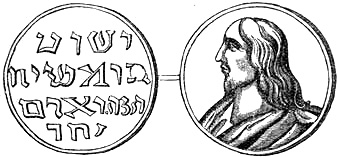
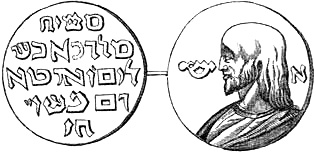
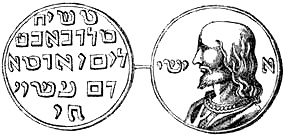
The originals of these inscriptions are all in Hebrew, and the likenesses which accompany them, although on different metals, appear almost copies one of another: whereas the cruciform figures herein already inserted, have no one feature of correspondence whatsoever with them, but prove themselves, on the contrary, in every particular, an antecedent generation.[603]
As everything else appertaining to the history of the Round Towers has already been explained, I shall now account for the difference of appropriation noticed at p. 6. Having been all erected in honour of the Budh, they all partook of the phallic form; but as several enthusiasts personified this abstract, which, in consequence of the mysteries involved in the thought and the impenetrable veil which shrouded it from the vulgar, became synonymous with wisdom or wise man, it was necessary, of course, that the Towers constructed in honour of each should portray the distinctive attributes of the individuals specified. Hence the difference of apertures towards the præputial apex, the crucifixions over the doors, and the absence or presence of internal compartments.[604]
Those venerable piles vary in their elevation from fifty to one hundred and fifty feet. At some distance from the summit there springs out a sort of covering, which—accompanied as it sometimes is with a cornice, richly sculptured in foliage, in imitation, if you must have it, præputii humani, but such also was the pattern of the “nets of checker-work and wreaths of chain-work,” which graced “the chapiters which were upon the top of the two pillars belonging to Solomon’s temple”—terminates above in a sort of sugar-loaf crown, concave on the inside and convex on the outside.
Their diameter at the base is generally about fourteen feet through, that inside measuring about eight, which decreases gradually, but imperceptibly, to the top, where it may be considered as about six feet in the interior.
The distance of the door from the level of the ground varies from four to twenty-four feet. The higher the door the more irrefragable is the evidence of the appropriation of the structure to the purposes specified. The object was two-fold, at once to keep off profane curiosity and allow the votaries the undisturbed exercise of their devotions; and to save the relics deposited underneath from the irreverent gaze of the casual itinerant.
Analogous to these would appear to have been the edifices which the Lord had in view when He said, “Neither shalt thou go up by steps unto Mine altar, that thy nakedness be not discovered thereon,”[605] which additionally proves the antiquity of the Irish philebeg; for, as with any other costume, such a prohibition would be needless, it follows that the prevailing fashion, in the eastern habiliments, must have been diffuse and open in the nether extremes.
I beg the reader will now be pleased to look back at the Tuath-de-danaan cross at p. 358, and he will at once see how it happened that the Goban Saer, who is there represented, has been imposed upon the Royal Irish Academy, or rather promulgated by them, as a woman! viz. from the peculiarity of his dress! being the distinctive badge of his sacerdotal order.
Nor is it only the character of those sculptures, but the existence of any sculptures upon those relics, as well crosses as towers, that proves them to have been Tuath-de-danaan; for the reason why Jehovah forbade the Israelites from using any tools upon the stones used in their religious edifices was, that other nations had loaded theirs with sculptured images of different gods, which made Him say, “If thou wilt make Me an altar of stone, thou shalt not build it of hewn stone, for if thou lift up thy tool upon it, thou hast polluted it.”
In their masonic construction there is nothing in the Irish Towers appertaining to any of the four orders of architecture prescribed by the moderns. It is so also with those in the East. They approach nearest, however, to the Tuscan, and the reason of that similarity may be imagined from what I have already stated as to the Etrurians.
Prepared stone is the material of which they are generally composed, and evidently, in some instances, brought from afar. Sometimes also they appear constructed of an artificial substance resembling a reddish brick, squared, and corresponding to the composition of the Round Towers of Mazunderan. Now if the monks possessed this secret, why were not the monasteries, the more important edifices, according to our would-be antiquarians, composed of the same elements? And is it not strange that all elegance and extravagance should have been lavished upon the appendages, while uncouthness, inelegance, want of durability, or other architectural recommendation are the characteristics of what they tell us were the principals? Yet neither in the monasteries, nor in any other Christian building, do we meet with those materials above described, either generally or partially, except where the ruins of a neighbouring Round Tower have made them available, which, in itself, is sufficient to overthrow for ever the anachronisms of those who would deny the existence of those temples anterior to the present era.
But Christian edifices, they say, are generally found in their vicinity. Yes, and as I have already explained the reason why,[606] I forbear now rehearsing the fact. But even this stronghold of the moderns I cut away from them, by stating that at the “Giant’s Ring,” in the county Down, the indisputable scene of primordial veneration, we have an instance of a Round Tower, without any church hard by! And while recalled by this circumstance, I must observe that the vitrification manifest within the walls of that structure arose from the burning of the dead bodies therein, and not from the indications of the sacred fire.
With three exceptions, all have a row of apertures towards the top, just under the projecting roof, made completely after the fashion of those which Solomon had built, being windows of narrow lights.[607] In general the number is four, and then they correspond to the cardinal points. In three instances there is one aperture towards the summit, in one instance there occur five, in one six, in one seven, in one eight.
Inside they are perfectly empty from the door upwards, but most of them divided, either by rests or projecting stones, into lofts or storeys, varying in number from three to eight. In the temple of Solomon we find the same, for “within, in the wall of the house, he made narrowed rests round about, that the beams should not be fastened in the walls of the house.”[608] And the images which I have shown to have been cupboarded upon these rests, were nothing more than what Solomon himself did, when “he carved all the walls of the house round about with carved figures of cherubims, and palm-trees, and open flowers, within and without.”[609]
In a future publication I intend to show a more startling correspondence between our Round Towers and some other parts of Solomon’s temple. Meanwhile I wish it to be borne in mind,—as in some degree accounting for the correspondence,—that Solomon’s architect was a Sidonian.
A striking perfection observable in their construction is the inimitable perpendicular invariably maintained. No architect of the present day, I venture to affirm, could observe such regularity. Nelson’s pillar itself has been proved to vary somewhat from the perpendicular line; but the keenest eye cannot trace a deviation, in a single instance, from amongst the whole of those Sabian monuments. Even the tower of Kilmacdugh, one of the largest in the kingdom, having from some accident, earthquake, or other cause, been forced to lean terrifically to one side; yet, miraculous to mention, retains its stability as firm as before; such was the accuracy of its original elevation.[610]
If asked how it was I conceive them to have been constructed, I should answer, by a scaffolding raised gradually from within. The expense in this case would be infinitely less, and the labour also. It would be very easy to let fall a plumb-line at various intervals of height, by which at all times the perpendicular may be ascertained, and the masonry carried on by what may be called overhanding, while the cement employed in giving solidity to the whole, and which is the direct counterpart of the Indian chunan, bids defiance to the efforts of man to dissever, except by the exertion of extraordinary power.
That this was the mode in which their erection was effected, is evident in the instance of Devenish Tower, which, from the elegance of its cut-stone exterior, would seem to negative the idea of their being built from within. But a judicious eye cannot but at once discern that near the top, where it is probable that one or two of the artists may have come out, by the help of some contrivance devised for the purpose, the execution and finish which the workmanship displays is incomparably superior to that of any of the lower parts. In other instances, where the ancient top having been removed, a modern one has been substituted, the case is very different indeed.
The cohesiveness of all these columns will be best estimated by the fact of the Round Tower at Clondalkin having firmly stood its ground when, in the year 1786-87, the powder-mill explosion, which took place within twenty-four feet of its base, shivered to annihilation every other structure within its influence; nay, extended its violence so far as to shatter the windows in some of the streets of Dublin. That at Maghera also lay unbroken after its fall, exhibiting to the spectator the almost appalling spectacle of a gigantic cannon!
That both Indians and Irish performed circular dances around them, typical of the motions of the heavenly bodies, is highly probable, as we have still the name of a particular movement, apparently that practised on the occasion, still amongst us in common use, namely, Rinke-teumpoil, or the temple dance: and that they otherwise honoured them by performing penances around them, is evident from the name of Turrish, which means a religious circuit round a tower! applied afterwards by the Catholics to any penitential round. And we have the authority of Sanchoniathon, when talking of the Creation, for stating that “the next race consecrated pillars—that they prostrated themselves before them, and made annual libations to them”![611]
These, I conceive, were the halcyon days of Ireland’s legendary and romantic greatness. In this sequestered isle, aloof from the tumults of a bustling world, this Tuath-de-danaan colony, all of a religious race, and all disposed to the pursuits of literature, united into a circle of international love, and spread the fame of their sanctity throughout the remotest regions of the universe. That its locality was familiar to the Brahmins of India I make no earthly question; that it was that sacred island which they eulogised so fondly, and spoke of with such raptures, I am sanguinely satisfied; and equally convinced am I, that it was that beautifying region, whose widespread holiness, and far-famed renown, made such an impression on the minds of Orpheus and of Pindar, when those divine bards, speaking of its Hyperborean inhabitants, thus enchantingly sung—
“On sweet and fragrant herbs they feed, amid verdant and grassy pastures, and drink ambrosial dew, divine potation: all resplendent alike in coeval youth; a placid serenity for ever smiles on their brows and lightens in their eyes; the consequence of a just temperament of mind and disposition, both in the parents and in the sons, inclining them to do what is great, and to speak what is wise. Neither disease nor wasting old age infest this holy people, but without labour, without war, they continue to live happy, and to escape the vengeance of the cruel Nemesis.”[612]
Though clothed in the cadence of measured phraseology, and decked in the charms of an imaginative style, this is scarely more beautiful than the simple summary of the Tuath-de-danaan moral code, as given you at page 112, and of which, in truth, this is but the paraphrase. For instance, they fed, it is stated, “on sweet and fragrant herbs,” because they were prevented by their first commandment from eating “anything endowed with life.”[613] They drank “ambrosial dew,” because their fifth commandment forbade their touching “any intoxicating liquor.” And the healthful aspects they exhibited were but the natural result of temperate habits and virtuous demeanour.
“The simplest flow’ret of the vale, The simplest note that swells the gale, The common air, the earth, the skies, To them were opening Paradise!”
Five hundred years after the period of their dethronement, while the influence of their example still continued to operate, we are told by the Dinn Seanchas, that “The people deemed each other’s voices sweeter than the warblings of a melodious harp, such peace and concord reigned amongst them, that no music could delight them more than the sound of each other’s voices.”
With these compare what Cambrensis, who was no friend, has said of this island, about two thousand years after. “Of all climes,” says he, “Ireland is the most temperate; neither Cancer’s violent heat is felt there in summer, nor Capricorn’s cold in winter; but in these particulars it is so blessed, that it seems as if Nature looked upon this zephyric realm with its most benignant eye. It is so temperate,” he adds, “that neither infectious fogs, nor pestilential winds, are felt there, so that the aid of doctors is seldom looked for, and sickness rarely appears except among the dying.”
The repose of this happy people being at length disturbed by the ungenial inundation of the Scythian intruders, the ritual of the temple worship was precipitated apace; and this, if I mistake not, “satisfactorily removes the uncertainty in which the origin and uses of those ancient buildings has been heretofore involved.”[614] For the Scythians being warriors[615] rather than students, and looking with distrust upon the emblematic images of their temple-serving predecessors, which they considered to be idolatry, did all in their power by legislative, as well as military enactments, to efface every trace thereof; so that in a few years the temple, or tower, worship became utterly extinct, and—more than annihilated—forgotten.
Instead thereof, they substituted the worship of fire,[616] which, though their predecessors were far from recognising as a deity, yet they always showed to it some reverential respect: and this approximation of sentiment, on both parts, contributed to what may be called a passive reconciliation; the victors assuming the mastery of the soil; and the vanquished, in deference to their high literary repute, being continued as superintendents of the national education, as well as the practical followers of all trades and professions.
It was so also at Rome, when Romulus dislodged the Pelasgi, who, we are told by Festus, had themselves some time previously, under the name of “Sacrani,” that is, the religious caste, corresponding to “Irish,” which signifies the same thing, drove the Ligures and Siculi from Septimontio, i.e. Rome.
The only use now made of those Sabian edifices, after stifling the religion for which they were designed, was, we may suppose, to promote the study of astronomical science, for which they were admirably adapted, and with which their original destination was inseparably interwoven.[617] But as the stimulus of religion was wanting for the prosecution of those researches, we cannot be surprised that this part of their purpose, too, sharing the fate of its collateral helpmate, insensibly repined under the altered aspect of the scene; for, to apply to it what has been said of the great scheme of the creation itself, viz. that—
“if each system in gradation roll Alike essential to the amazing whole, The least confusion—but in one—not all, That system only, but the whole must fall.”
The knowledge of this delightful study, however, did not yet completely die away; it formed still an essential in the education of every Irish youth; and the remnant of our language, at this very moment, shows how piously attentive were its framers to that divine precept which told them, that the “lights of the firmament of heaven were for signs and for seasons, and for days and for years.”
The profligate degeneracy of the Druids, however, tended to bring this also into disesteem.
This order of priests got so overbearing here, grasping at not only high ecclesiastical power, but also intermeddling in secular transactions, that they made themselves obnoxious to the great body of the people, and a disregard both to the literature and the religion which they inculcated was the inevitable result. To this I ascribe the plebeian war of Ireland, A.D. 47, that deplorable state of a country, when faction and rage usurp the place of counsel and discretion! when commerce stagnates! confidence decays! when lust stalks abroad to desecrate everything holy! and all is doubt, suspicion, melancholy, and death!
How beautifully and how aptly, but yet, for himself, how unwisely, did the philosophic Callisthenes apply the sentiment of Euripedes to Philip of Macedon, at Alexander’s Feast?—viz.:—
“When civil broils declining states surprise, There the worst men to highest honours rise.”
Many virtuous persons, we are told, opposed themselves to the encroachments of this degenerate hierarchy. When Conlah, in his retreat from the glitter of life, betook himself to an humble cottage, and devoted the faculties of his comprehensive mind to philosophical pursuits and the improvement of his species, the greatest praise which the analyst, in recording such worth, could bestow, was, “She do rinni an choin bhliocht-ris inna Druwdh”; that is, It is he that disputed against the Druids!
The Books, however, of their predecessors, the Boreades, still remained, and the knowledge of astronomy was kept alive by their perusal. But of these we were despoiled, very shortly after, by that mistaken piety elsewhere deplored. Some few treatises even then must have escaped, and their effect was best illustrated, as shown before, by the unprecedented success with which the gospel dispensation was hailed in this island.
I have before shown the instance of Fergil or Virgil, who, in the eighth century, maintained the rotund and true form of the earth, when the rest of Europe were ignorant on the subject. “He was,” says Sir James Ware, “the author of a Discourse on the Antipodes, which he most truly held, though against the received opinion of the ancients, who imagined the earth to be a plain.”
In this sweeping ban upon the ancients, however, Sir James must not include the ancient Irish, whose hereditary doctrine upon the subject it is evident that Fergil did here only give utterance to; and dearly did he suffer for it; his life, like that of Galileo, having been forfeited thereby, at the hands of the same enlightened tribunal. This was enough to put the last extinguisher upon the cultivation, or at least avowal, of the Irish notions of astronomy. It is astonishing, notwithstanding, what an instinctive thirst still lurked in the Irish mind for the sublimities of this pursuit.[618] Smith mentions an instance of a “poor man near Blackstones, in the county Kerry, who had a tolerable notion of calculating the epacts, golden number, dominical letter, the moon’s phases, and even eclipses, although he had never been taught to read English.” The author of this essay has known many such characters;—one in particular who, from his great proficiency in the art, had obtained for himself the honourable designation of the Kerry Star.