Chapter XXII
Reading edition
I would have my reader pause upon the substance of the terms with which the last section concluded—“Not only to live with more comfort, but to die with better hopes!”
Have you read them? Have you digested them? And are you not ashamed of your illiberality?
From what pulpit in Christendom will you hear better or more orthodox truths? Where will you find the Gospel more energetically enunciated? And, with this testimony staring you in the face—in defiance of inner light—and imperiously subjugating the allegiance of rationality—will you still persist in limiting the benevolence of your “Father?” and in withholding every symptom of paternal regard from his own handiwork, until the beginning of the last two thousand years? that is, as it were, till yesterday?
“I tell you, that if these should hold their peace, the stones would immediately cry out.”[355]
“On a bank near the shore,” says Cordiner, in his Antiquities of Scotland, “opposite to the ruins of a castellated house, called Sandwick (in Ross-shire), and about three miles east from Ferns, a very splendid obelisk is erected, surrounded at the base with large, well-cut flag stones, formed like steps. Both sides of this column are elaborately covered with various enrichments, in well-finished carved work. The one face presents a sumptuous cross, with a figure of St. Andrew on each hand, and some uncouth animals and flowerings underneath. The central division, on the reverse, renders it a piece of antiquity well worthy of preservation; there is exhibited on that such a variety of figures, birds, and animals, as seemed what might prove a curious subject of investigation; I have, therefore, given a distinct delineation of them at the foot of the column, on a larger scale, that their shapes might be distinctly ascertained, and the more probable conjectures formed of their allusion.”
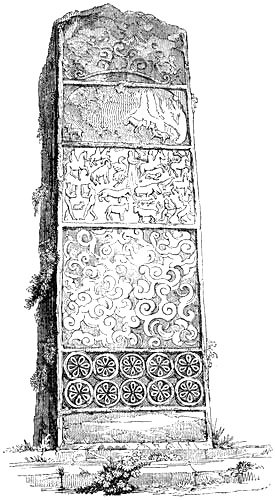
What, on earth, business would St. Andrew have in company with “uncouth animals?” What have “birds,” “figures,” and “flowerings” to do with Christianity? If this “obelisk” had not been erected here, in commemorative deification, centuries upon centuries before the era of his Saintship’s birth, why should the “cross,” which “one face presents,” be decorated with “enrichments” brought all the way from Egypt?
Look at these hieroglyphics: and where will you find anything congenial to them within the empire of the Romans? Here is the Bulbul of Iran,[356] the boar of Vishnu, the elk, the fox, the lamb, and the dancers. All the other configurations, without going through them in detail, are not only, in their nature and import, essentially eastern, but are actually the symbols of the various animal-forms under which they contemplated the properties of the Godhead. As the cross, however, is that to which we are more immediately directed, I shall confine myself, for the present, to the establishment of its antiquity.
No one will question but that Venus was antecedent to the days of St. Andrew; and she is represented with a cross and a circle![357] Jupiter also, it will be admitted, was anterior to his time; and we find him delineated with a cross and a horn! Saturn is said to have been sire to the last-mentioned god, and, by the laws of primogeniture, must have been senior to him; yet we find him also pictured with a cross and horn! The monogram of Osiris is a cross! On a medal of one of the Ptolemies is to be seen an eagle conveying a thunderbolt with the cross! In short, all through the ancient world this symbol was to be encountered, and wherever it presented itself, it was always the harbinger of sanctity and of peace.
Can we glean from their writings any confirmation to my development as to the origin of the rite? Plato asserts, that the form of the letter X was imprinted upon the universe.[358] I know how this has been interpreted as a reference to the Son of God, and the second power of the Divinity. I will not make use of it in any such light, preferring to avoid everything that may seem equivocal, yet am I well convinced that, under the philosopher’s ratiocination, may be seen the twinkling trace of a previous incarnation of the λογος, and a crucifixion, likewise, as an atonement for the sins of humanity.
“Surely He hath borne our griefs and carried our sorrows: yet we did esteem Him stricken, smitten of God, and afflicted.
“But He was wounded for our transgressions, He was bruised for our iniquities: the chastisement of our peace was upon Him; and with His stripes we are healed.”[359]
This is all in the past tense; bearing reference, irrefutably, to a former occurrence, but including also, in the sequel, the idea of a future reappearance. And if you look back at the effigy, page 296, will it not sensitively prove him to have been “a man of sorrows and acquainted with grief?”[360]
“The deity Harì,” says an inscription at Budda-gaya, in India, “the lord and possessor of all, appeared in this ocean of natural beings at the close of the Devapara and beginning of the Cali Yug. He who is omnipresent and everlastingly to be contemplated, the Supreme Being, the Eternal One, the Divinity worthy of mankind, appeared here, with a portion of His divine nature.”[361]
There is no term so vernacular in the Irish language as that of Budh-gaye. It is familiar to the ears of every smatterer in letters; and is in the mouth of every cowherd, from Cape Clear to the Giants’ Causeway. Neither class has, however, had so much as a glimpse of what it means: nor did they busy themselves much in the pursuit, but acquiesced in that example of commendable resignation once practised by Strabo—when he failed to ascertain anything about the Cabiri—by declaring that “the name was mysterious!”
A great personage, however, who was not only in his habits wise, but was in himself wisdom, has affirmed, that “there is nothing covered that shall not be revealed; nor hid that shall not be known.”[362] And as every sentence recorded as emanating from His lips has with me a value more than what could serve to illustrate a momentary topic, I flatter myself that the result of the confidence, thus humbly inspired, will be additionally verified in the instance before us.
Budh-gaye, then of the Irish, or Budha-gaya of the Hindoos, means Phallus[363] telluris, i.e. the generativeness of the earth, or the earth’s prolific principle. This I have before demonstrated to have been the object of adoration to the ancients; and have furthermore shown, that one of the individuals, in whom this idea was personified, had suffered crucifixion as a mediator for sin.
A new disclosure suggests itself from this. Budh and Phallus being synonymous, if you add Gaye to each, then Budh-gaye and Gaye-phallus will be identical. But as the character who embodied the abstract virtue of the former had been crucified, his name came to stand, not only for that abstract virtue, but also for a cross,[364] or a crucified man; and of course, Gaye-phallus, its equivalent, represented the same ideas.
Now, as well the primary as secondary meaning of those two words was liable to misconstruction; and they were sure to obtain such from ignorance and from depravity. The pure and the sublime emotions, which the religiousness of the prolific principle had comprehended, were perverted by malice into sensuality and debauchery; while the idea of a man crucified, however innocent of charge, could not be separated, by grovelling and servile dispositions, from the ordinary accompaniments of contempt and of crime.
Hence Budh-gaye and Gaye-phallus, after a succession of ages, when their proper acceptation was forgotten, were remembered only in their perverted sense. And accordingly we observe, that, when a Roman Emperor who had been brought up a priest in the East, assumed, on his being appointed to the Roman sceptre, the title of Helio-ga-balus, and thereby invested himself in all the attributes of Gaye-phallus, or Budh-gaye, that is, in other words, as the Vicegerent of the Sun, the licentiousness of his life, and the profligacy of his demeanour, having rendered him obnoxious to his subjects, they amputated the prefix of his Solar majesty, and branded him with the scorn of Ga-balus.
The disdain intended in this latter abbreviation is now, therefore, already solved. Gaye-phallus, for sound sake, having been made Ga-phallus, this latter was still further—by reason of the commutability of the letters ph and b—reduced into Ga-balus.
When the temple of Serapis, at Alexandria, was destroyed, we are told by Sozomen, that the monogram of Christ was discovered beneath the foundation. And, though neither party knew how to account for the sign, yet was it pleaded alike by the Gentiles as by the Christians, in support of the heavenliness of their respective religions.
The early Roman fathers, very pious but very illiterate men, unable to close their eyes against the proofs of the priority of the cross to the era of the advent, did not scruple to assign it to the malicious foreknowledge of the prince of the lower world.[365]
But if this gentleman had been the author of the early cross, is it likely that God would have embraced it as the signal of His protection when dealing destruction to the objects of His divine vengeance?
“And the Lord said unto him, Go through the midst of the city, through the midst of Jerusalem, and put a mark upon the foreheads of the men that sigh and that cry for all the abominations that be done in the midst thereof:
“And to the others he said in my hearing, Go ye after him through the city, and smite: let not your eye spare, neither have ye pity.
“Slay utterly old and young, both maids and little children, and women; but come not near any man upon whom is the mark; and begin at My sanctuary.”[366]
Now this “mark,” in the ancient Hebrew original, was the cross X. St. Jerome, the most learned by far of those “fathers,” has admitted the circumstance. And if this had been the device of the enemy of man, would the Author of all goodness so sanction his imposture, as to adopt it as the index of His saving love?
“Art thou a master of Israel, and knowest not these things?”[367]
But this was not the only invention which they attributed to the devil. Tertullian gravely assures us that he was the author of buskins also! And why, good reader, would you suppose?—in sooth, for no other reason than because that our Saviour said, in His sermon upon the mountain, “Which of you, by taking thought, can add one cubit unto his stature?”[368]
In him, also, did they find an adequate excuse for those apertures, which I shall by and by notice, as excavated in rocks and mounds of clay, calling them, with some compliment it must be admitted to his gallantry, by the monopolising appellation of the Devil’s Yonies.[369]
But of all the puerilities which sully their zeal, there is no one half so calculated to injure vital religion, as the low quibbles and dishonest quotations which Justin Martyr had recourse to, as apologies for the cross!
Why, Sir, the greatest persecutor with which the Christians had ever been cursed, namely, the Emperor Decius, had imprinted the cross upon some of his coins!
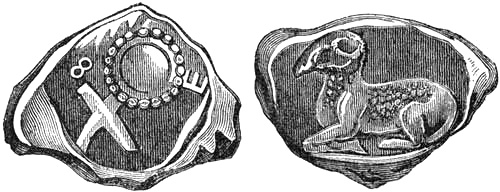
Here, again, it is upon a medal found in the ruins of Citium, and proved by Dr. Clarke in his Travels to have been Phœnician! It exhibits the lamb, the cross, and the rosary![370]
When John the Baptist first saw Jesus beyond the Jordan, in Bethabara, he exclaimed, “Behold the Lamb of God, which taketh away the sins of the world.”[371]
This he did not apply as a novel designation; but as the familiar epithet, and the recognised denomination of the Son of God, whose prescribed office it was, in all the changes of past worlds, as it was now in this present, to redress the broken-hearted by taking away sin.
He adds: “This is He of whom I said, after me cometh a man which is preferred before me; for He was before me,”[372] not only in eternity, but on this earth.
“And I knew Him not; but that He should be made manifest to Israel,”[373] as He was before to other nations,—an event which was but the fulfilment of a prophecy ushered in many years before in these remarkable words—
“Behold, the former things are come to pass”:[374] not that the predictions formerly delivered had taken place, but the things, the events, the occurrences, which had been enacted before, were now re-enacted! that a renovation of the world was at hand, which the mouthpiece of the Lord commences by saying—“New things do I declare; before they spring forth I tell you of them.”
On turning the leaf you will see another of those pillars which grace a land of heroes, “where stones were raised on high to speak to future times, with their grey heads of moss”;[375] and whose story, though “lost in the mist of years,” may yet be deciphered from off themselves.
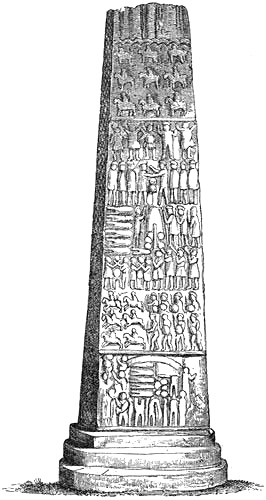
This costly relic of religion, erected solely in honour of the cross, is to be seen at Forres, in Scotland, and is thus described by Cordiner:—
“On the first division, under the Gothic ornaments at the top, are nine horses with their riders, marching in order; in the next division is a line of warriors on foot, brandishing their weapons, and appear to be shouting for the battle. The import of the attitudes in the third division very dubious, their expression indefinite.
“The figures which form a square in the middle of the column are pretty complex, but distinct; four serjeants, with their halberts, guard a canopy, under which are placed several human heads, which have belonged to the dead bodies piled up at the left of the division: one appears in the character of executioner, severing the head from another body; behind him are three trumpeters sounding their trumpets; and before him two pair of combatants fighting with sword and target.
“A troop of horse next appears, put to flight by infantry, whose first line have bows and arrows; the three following, swords and targets. In the lowermost division now visible, the horses seem to be seized by the victorious party, their riders beheaded, and the head of their chief hung in chains, or placed in a frame: the others being thrown together beside the dead bodies, under an arched cover.”
With this compare the description given by Captain Head, of the devices sculptured upon one of the Egyptian antiquities.
“It would,” says he, “far exceed the limits of this work, to attempt a description of the ornaments of sculpture in this temple. The most interesting are on the north wall, where there are battle-scenes, with innumerable figures of military combatants, using their arms, consisting of bows and arrows, spears and bucklers—of prostrate enemies, of war-chariots and horses. The fiery action and elegant shape of the steeds are remarkable. It would require a first-rate living genius to rival the variety of position, the power of effect, and fidelity of execution, in which men and horses are exhibited in the dismay of the flight, the agony of the death-struggle, and the exultation of the triumph.”
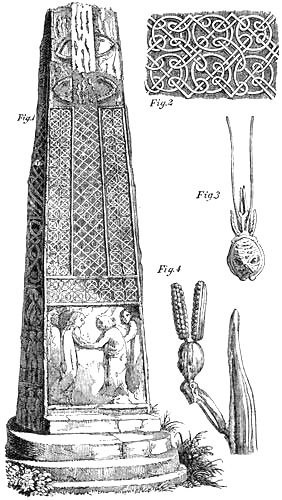
Let us take a view, now, of the other side of this obelisk. “The greatest part of it,” says Cordiner, “is occupied by a sumptuous cross, and covered over with an uniform figure, elaborately raised, and interwoven with great mathematical exactness; of this, on account of its singularity, there is given a representation at the foot of the column. Under the cross are two august personages with some attendants, much obliterated, but evidently in an attitude of reconciliation; and if the monument was erected in memory of the peace concluded between Malcolm and Canute, upon the final retreat of the Danes, these larger figures may represent the reconciled monarchs.
“On the edge, below the fretwork, are some rows of figures, joined hand-in-hand, which may also imply the new degree of confidence and security which took place, after the feuds were composed, which are characterised on the front of the pillar. But to whatever particular transaction it may allude, it can hardly be imagined, that in so early an age of the arts in Scotland as it must have been raised, so elaborate a performance would have been undertaken but in consequence of an event of the most general importance: it is, therefore, surprising, that no distincter traditions of it arrived at the era when letters were known.”
As to “the era when letters were known,” I shall bestow upon that a sentence or two by and by. For the present I confine myself to the “surprise that no distincter traditions” of this monolith temple[376] has been handed down to us.
It was erected by the Tuath-de-danaans on their expulsion from Ireland. The inscriptions upon it are the irresistible evidence of their emblematic religion. After an interval of some centuries, the Picts poured in upon their quietude; and the barbarous habits of those marauders, being averse as much to the ritual as to the avocations of the Tuath-de-danaans, they effaced every vestige of the dominion of that people, and made them fly for shelter to the Highlands.
In the days of Malcolm, therefore, and of Canute, the history of this pyramid was as difficult of solution as it was in those of Pennant and of Cordiner. And there is no question but that the two monarchs looked, with as much wonder, upon the hieroglyphics along its sides, as did the two antiquarians, who would fain associate them with them.
It is to me marvellous, how persons, in the possession of common reason could, contrary to all the evidence of observation and history, look upon the Danish invasion as the epoch of all enlightenment! and the Danes, themselves, as the heaven-sent importers of its blessings! Yet, whatever may have been the case with some hopeful scions of this order, Mr. Cordiner, at all events, appears to have been honest, and if he missed the direction of historical verity, it was less his fault than his misfortune.
Who can say so much for Ledwich?
The following extract will justify the tribute here paid to the sincerity of Mr. Cordiner’s investigations “These monuments,” says he, “are all said to have been erected in memory of defeats of the Danes, but there does not appear any reference that the hieroglyphics on them can have to such events. That they have been raised on interesting occasions there can be little doubt, perhaps in memory of the most renowned chieftains and their exploits who first embraced Christianity.”
They who first “embraced Christianity” were no “chieftains”; or such as were, had no “exploits” to record. But it was not so with the professors of the primeval “cross,” in the revelation of Budhism, the transmigrations of which were but typically pourtrayed on this enduring column. And in confirmation hereof, Mr. Gordon affirms that he has “distinguished upon it several figures of a monstrous form, resembling four-footed beasts with human heads!”
Carnac, in Upper Egypt, retains a monolith of the same symbolic character. It is eighty feet high, composed of a single block of black granite, presenting a beautifully polished surface on each of its four sides. The hieroglyphics upon it represent the lifetime of Thot, or Budda, until you at last see him enthroned in heaven, at the top.

“He seems, indeed,” says Hamilton, “to have been considered either by himself, his subjects, or his successors, as a peculiar favourite of heaven. He is frequently on his knees, receiving from Isis and Osiris, together with their blessing, the insignia of royalty, and even of divinity. The hawk is always flying about him. Two priests are performing upon him the mysterious ceremony of pouring the cruces ansatas, or crosses with rings, over his head; at which time he wears a common dress and close cap. Hermes and Osiris are pointing out to him a particular line in a graduated scale, allusive it may be to the periodical inundation of the Nile, or the administration of strict justice: or (combined with the preceding scene) to the ceremony of ‘initiation into the religious mysteries.’”[377]
The number of feet in the pillar corresponds too, if I mistake not, with that of the years of his recorded pilgrimage.
Captain Head describes, in his splendid work, the avenue which leads to the temple to which this belongs, in the following terms:—“Fragments of sphinxes line the sides of the road at intervals of ten or twelve feet, and usher the visitor to the magnificent granite propylon, or gateway, whose grandeur for a time monopolises the attention, and makes him who gazes on it at a loss to decide whether he shall remain adoring its fine proportions, or advance and examine the carvings which embellish its front. Is this ‘the land made waste by the hand of strangers, who destroy the walls, and cause the images to cease?’ The fragments of desolation that lie scattered around are identified with the predictions of the inspired historians, by whom we are enabled to estimate the ‘palmy state’ of this once mighty kingdom, whose gigantic monuments fully verify all that has been said or sung of its pristine splendour.”
After what has been said above, then, along with what may be added by and by, may I not safely proclaim that M‘Pherson’s prediction, that “the history of Caledonia, before the Roman eagles were displayed beyond the friths, must ever remain in impenetrable darkness,”[378] has now been falsified?
“What are ages and the lapse of time, Matched against truths as lasting as sublime? Can length of years on God Himself exact? Or make that fiction which was once a fact? No—marble and recording brass decay, And like the graver’s memory pass away: The works of man inherit, as is just, Their author’s frailty, and return to dust; But truth divine for ever stands secure, Its head is guarded, as its base is sure; Fixed in the rolling flood of endless years, The pillar of the eternal plan appears, The raving storm and dashing wave defies, Built by that Architect who built the skies.”[379]