Chapter XX
Reading edition
But you will say that I have ventured nothing like proof, of the paradoxical affirmation propounded a short while ago, as to the Tuath-de-danaans having been mentioned, by all Eastern writers, in connection with Persia; and yet unnoticed, the while, by themselves, not less than unheeded by their readers?
True: I but awaited the opportunity which has just arrived.
Are you not aware, then, how that all Oriental writers, when referring to Budha, who was born at Maghada, in South Bahar, state that he was the son of Suad-dha-dana? And have I not already shown you that Suadh and Tuath were but disguises of each other, and both resolvable into Budh?
Those first components, therefore, in each being the same, look at the entire compound words, Tuath-de-danaan, and Suad-dha-dana, and are not the rest, also, infallibly identical?
Admitting this, you reply, how could they, in that early age, make their way to Ireland? which, from its extreme position, must have been the very last place they would have thought of!
If the question refers to the route pursued, I decline its solution, as not necessary for my design. “A piece of sugar, or a morsel of pepper, in a neglected corner of a village inn, would be a certain proof,” says Heeren, “of the trade with either Indies, even if we possessed no other evidences of the commerce of the Dutch and English with those countries.” And when I have already made the coincidences between the two Irans and their inhabitants, their forms of worship, their language and mode of life, to be historical axioms, I surely cannot be expected to waste labour upon such a trifle, which sinks into nothing against evidences of the actual fact.[277]
But if the length of the voyage be the obstacle insinuated, then would I find some difficulty to—do what?—keep my muscles grave: as if, forsooth, the adventurous sons of man could only, slowly and imperceptibly, and like so many ants pushing a load before them, introduce themselves, inch by inch, and in measured succession, into the diversified terraqueous globe spread abroad for their enjoyment!—when we have direct demonstration that such was far from having been the case in the instance of a colony which, starting from Tyre, and leaving behind on all sides the most inviting and delicious countries, planted itself down, perhaps from the mere spirit of romance, in the circumscribed little island of Cadiz, long before Carthage or Utica had existence even in name!
No, sir; we must not be so fond of derogating from the ancients all participation in those embellishments which promote society. Asia was the cradle of the whole human race; and thence, as its population overflowed, migratory herds in different states of civilisation, and with different forms of religious culture, poured in their successive colonies with multitudinous inundation into the other continental lands; but with more zeal, and with stronger preference, into those compact little nests which have been significantly denominated the “Isles of the Gentiles.”
Vessels rode over the briny surges with as proud a canvas as now receives the gale.[278] The model of the ark would be lesson sufficient to instruct an enterprising generation in the science of naval architecture: and we may well suppose that, of all pursuits cultivated by human art, this would have occupied the very foremost regard by a people just rescued, through its salutary instrumentality, from the desolating scourge of an all-swallowing abyss.
“Well, then, at all events,”—I fancy I hear you exclaim,—“you admit the story of the deluge?”
Certainly; and that of Noah, and the ark, and the dove, and the raven. But did I not, also, concede the story of the giants, and of the serpent? of the sons of God, and of the tree of knowledge? Nay, have I not put the truth of those particulars beyond the possibility of scepticism, much more of denial? But, believe me, that the liquid which composed this “deluge” was more of the colour of claret than it was of water;—that there was no more of wood or timber in the construction of this “ark” than there was in that of the “tree of knowledge”—that those two latter were congenial and correspondent to each other,—in their configuration and intention,—and that flesh and blood were the elements of which they were both composed.
“For all that meets the bodily sense, I deem Symbolical, one mighty alphabet For infant minds———”
Could the coincidence of measure[279] between the great Egyptian pyramid at its base, and that of the Noachic ark, in ancient cubits,[280] have been accidental, do you imagine? And if not, what community of purpose, do you think, had been subserved by such numerical analogy?
The triangle, in the old world, was a sacred form. It represented the properties—capacity and dilatation—of the female symbol. Lucian, in his Auction, states the following dialogue as having occurred between Pythagoras and a purchaser, viz.:—
Pyth. How do you reckon?
Pur. One, two, three, four.
Pyth. Do you see? What you conceive four, these are ten; and a perfect triangle, and our oath.
Now, Pythagoras, though a Samian, was educated in Egypt; and the religious mysteries, with which he had been there imbued, are what is so profanely ridiculed by this infidel scoffer.
It is not my province to justify the ceremonial of the Egyptians, any further than as indicative of gratitude to the Godhead; but the reflection must suggest itself to every observant mind, that they are never called idolaters in any part of the Pentateuch; and Plutarch, in addition, positively asserts that “they had inserted nothing into their worship without a reason,—nothing merely fabulous,—nothing superstitious; but their institutions have reference either to morals or something useful in life, and bear a beautiful resemblance, many of them, to some facts in history, or some appearance in nature.”
If we investigate the secret of this Pythagorean asseveration, we shall find that the numbers 1, 2, 3, 4, thrice joined, and touching each other, as it were, in three angles, in this manner—
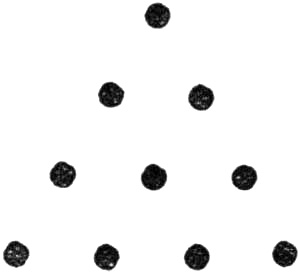
constitute an equilateral triangle, and amount also, in calculation, to ten. While the inward mystery, couched under its figure, embraced all that was solemn in religion and in thought, being, in fact, the index of male and female united—the unit, in the centre, standing for the Lingam.
Look now at the form of the great Egyptian pyramid; and is it not precisely that of the above triangle? Is there not, also, an aperture into it, about the middle as here?[281] And when to all, we add the notion of wells of water withinside, is not the demonstration complete, that the goddess of the Lotos, the soft promoter of desire, the arbitress of man, and the compeer of the angels, was the honoured object of its symbolical erection?[282]
In 1 Pet. iii. 20, it is asserted that only “eight persons” were preserved in the ark. Let us suppose them to have been Noah and his wife, with his three sons and their wives. At a comparatively short interval after the date assigned to this event,—at most but 352 years,—on Abraham’s arrival in the land of Egypt, we find a flourishing kingdom, an organised police, a systematic legislature, and comprehensive institutions, diffused over its surface. All the other parts of the world, we must be ready to presume, if not equally enlightened, were, at least, as populous; and I put it to your good sense to decide, whether eight individuals could, within that period, not only procreate so plentifully as to replenish the whole earth, but enlighten it, additionally, with such a coruscation of science, as no subsequent era has been since able to eclipse?
Indeed, the Scriptures themselves give us, elsewhere, to understand that St. Peter did not correctly interpret this history. “Come thou,” says Gen. vii. 1, “and all thy house, into the ark!” This gracious invitation, at so critical a juncture, would have been too welcome a proffer to be lost sight of by anyone who could make it available; and must not we suppose that the domestics to whom the extension was addressed, with their several dependants and collateral offspring, would have been glad and happy to grasp at it with delight?
But the name of the type itself is worth a hundred deductions from equivocal premises. The coffer of the law, the coffin of Joseph, the money chest of the temple, are all severally translated ark, and recorded in Hebrew by the word ארון aron: but the “ark of Noah”[283] and Moses’s “ark of bulrushes”[284] are peculiarly designated, תבת Thebit, or תבה tebah.[285]
What is the meaning of these mysterious terms?
“Quo spectanda modo, quo sensu credis, et ore?”
As the Tau of the Hebrews is, indifferently, in power, T and Th, Thebit has as good a right to be spelled with, as without, an h at the end of it,—and, indeed, a better right, considering the elements whereof it is compounded. Thebith, then, is the proper and true sound, and the mystery of its import I thus unravel.
Its first syllable, The, signifies sacred or consecrated;[286] and since the letters b and p are commutable—bith is the same as pith, that is, Cteis or Yoni. The words The-bith, then, together, in all the attraction of truth, intimate the consecrated Cteis; or the sacred Yoni![287]
But Pith, itself, is only a conversion of Fidh, the initial letters P and F being always interchangeable, and not more so than the penultimates t and d. And Fidh, in its abstract and original position, such as we have early seen it, is masculine, the plural of Budh, conveying variously the significations of Lingams, trees, and bulrushes. Here, however, where it is feminine, its sex reversed, and the anatomy of nature pourtrayed by the physics of language, the idea of the bulrushes alone presents itself; and the basket in which Moses was saved from the waters, and which was made of such reeds, was appropriately denominated by this mysterious symbol, as a type of the virginity in which the Messiah was to be incarnated, not less than of the redemption which was to accrue from His sufferings.
Another stage has been thus advanced; and lo! the beautiful union which subsists, as to design, between the results of our discoveries, and the consoling assurances of pure Christianity!
Let us now proceed a little farther in this course—
“Sanctos ausi recludere fontes,”[288]
and connect these truths with the Tuath-de-danaans and the Pish-de-danaans.
“Noah was a just man,” observes the scriptural historian, “and perfect in his generations; and Noah walked with God.”[289]
The name of this patriarch implies literally a boat: the character assigned him is not so well understood.
To succeed in the investigation we must have recourse to the context: and here the first thing that strikes us is the observation “that the earth was corrupt before God, and filled with violence; for all flesh had corrupted his way upon the earth.”[290]
A passage in the New Testament will be the best comment upon this subject, where the patience of God with the iniquities of mankind being at length exhausted, it is said, that He “gave them over to a reprobate mind,” “to dishonour their own bodies between themselves.”[291]
But Noah did not participate in those unhallowed abominations, and he accordingly “found grace in the eyes of the Lord.”[292]
We now, therefore, see the propriety of the name assigned to his ark;[293]—and the intimation of approval conveyed by the divine command of “Come thou and all thy house into it,” was but another form of the injunction elsewhere conveyed, to the same effect, in the words, “Be ye fruitful and multiply.”[294]
Noah, then, and Kaiomurs[295] were one and the same person, the reformer of the human species, and the first monarch of the Pish-de-danaan dynasty. Yavana was another name appropriated to him, and equivalent with Noah, excepting only that the former is literal, and the latter figurative. An advantage, however, arises from this difference, for when we know that Yavana means the yoni, and Noah a boat, and that both were equally characteristic of the same individual character, we conclude that the latter denomination was but the symbol of the former—that, in fact, it was the lunar boat,[296] or the crescent, the concha Veneris, and the type of comfort[297] that was veiled under the mystery of this ambiguous device.
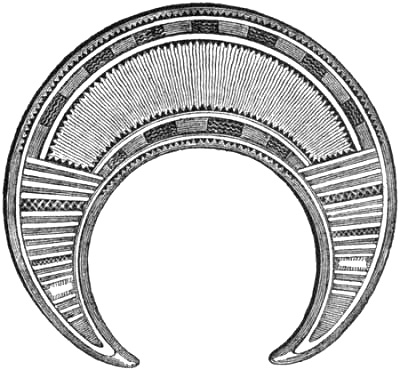
This fact once explained, you have the immediate solution of those “semicircular implements” so universal throughout this island, and which Ledwich acknowledges “have created more trouble to the antiquarians to determine their use, than all the other antiquities put together.”
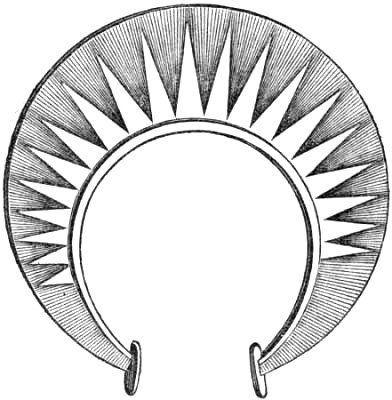
These are all made of the finest gold, and, as emblems of the yoni, which was the Raman palladium, used to have been worn as breast-plates by the priests and sovereigns. They would sometimes, also, exhibit them as ornaments to the head-dress: and when so designed the two terminating angles used to have been furnished with circular cups, whereby they would better adhere to the part: of such, likewise, we have the following specimen.[298]
Yun is the usual mode of pronouncing Yavana; and as the veneration of posterity for the virtues of this legislator, at a moment when vice had threatened a general decay,[299] led them to consider him a god, he hence obtained the prefix of Deo or Deu, which along with that of Cali, whose champion he showed himself, make up the romantic, emblematic and nominal representation of Deucaliyun.[300]
“Safe o’er the main of life the vessel rides, When passion furls her sails, and reason guides; Whilst she who has that surest rudder lost, Midst rocks and quicksands by the waves is tost; No certain road she keeps, nor port can find, Toss’d up and down by every wanton wind.”[301]
The struggles for ascendency between contending parties are not the growth of a day; still less are they unstained by the effusion of blood. Deluge was no very extravagant hyperbole to apply to such a carnage; for independently of our knowing that every visitation, whether by fire, water, or sword, was so denominated by the Easterns, we have the Scriptures themselves illustrating this use of the term in applying it to the description at a far later period of an equally severe and no less distressing catastrophe.
“Now, therefore, the Lord bringeth upon him the waters of the river, strong and many, even the King of Assyria and all his glory; and he shall come up over all his channels, and go over all his banks. And he shall pass through Judah; he shall overflow and go over, he shall reach even to the neck; and the stretching out of his wings shall fill the breadth of Thy land, O Immanuel.”[302]
But how, you ask, account for the marine strata, and other remains, found within the earth’s recesses?
I answer they were there embedded and inanimate, before ever man was placed above them as a denizen.
“It is clearly ascertained,” says Cuvier “that the oviparous quadrupeds are found considerably earlier, or in more ancient strata than those of the viviparous class. Thus the crocodiles of Harfleur and of England are found immediately beneath the chalk. The great alligators and the tortoises of Maestricht are found in the chalk formation, but these are both marine animals. This earliest appearance of fossil bones seems to indicate that dry lands and fresh waters must have existed before the formation of the chalk strata; yet neither of that early epoch, nor during the formation of the chalk strata, nor even for a long period afterwards, do we find any fossil remains of mammiferous land quadrupeds. We begin to find the bones of the mammiferous sea animals, namely, of the lamantin and of seals, in the course of shell limestone which immediately covers the chalk strata in the neighbourhood of Paris. But no bones of the mammiferous land quadrupeds are to be found in that formation; and notwithstanding the most careful investigations I have never been able to discover the slightest trace of this class excepting in the formations which lie over the coarse limestone strata: but on reaching these more recent formations, the bones of land quadrupeds are discovered in great abundance.
“As it is reasonable to believe that shells and fish did not exist at the period of the formation of the primitive rocks, we are also led to conclude that the oviparous quadrupeds began to exist along with the fishes, while the land quadrupeds did not begin to appear till long afterwards, and until the coarse shell limestone had been already deposited, which contains the greater part of our genera of shells, although of quite different species from those that are now found in a natural state. There is also a determinate order observable in the disposition of those bones with regard to each other, which indicates a very remarkable succession in the appearance of the different species.
“All the genera which are now unknown, as the Palæotheria, Anapalæotheria, and with the localities of which we are thoroughly acquainted, are found in the most ancient of the formations of which we are now treating, or those which are placed directly over the coarse limestone strata. It is chiefly they which occupy the regular strata which have been deposited from fresh waters, or certain alluvial beds of very ancient formation, generally composed of sand and rounded pebbles.
“The most celebrated of the unknown species belonging to known genera, or to genera nearly allied to those which are known, as the fossil elephant, rhinoceros, hippopotamos, and mastodon, are never found with the more ancient genera, but are only contained in alluvial formations. Lastly, the bones of species which are apparently the same with those that still exist alive, are never found except in light and alluvial dispositions.”
From all which, this philosopher draws the following just conclusion, namely:—“Thus we have a collection of facts, a series of epochs anterior to the present time, and of which the successive steps may be ascertained with perfect certainty, though the periods which intervened cannot be determined with any degree of precision. These epochs form so many fixed points, answering as rules for directing our inquiries respecting this ancient chronology of the earth.”
To return—“God said unto Noah, the end of all flesh is come before Me; for the earth is filled with violence through them; and, behold, I will destroy them with the earth.”[303]
Now, we see that the earth has not been destroyed, and this single circumstance, in itself, ought to have been enough to show us that the whole register was but figurative. The raven and the dove were indispensable auxiliaries to the structure of the allegory: the former typifies the massacre that prevailed during the period of the contest; and the latter, in its meek and its tender constancy, the invariable attendant, besides, of Venus and the boat, characteristically pourtrays the overtures made for an accommodation, until, after a second embassy, the olive-branch of peace was saluted, and the cessation of hostilities was the consequence.[304]
Behold, then, the folly of those dreamers who would make Thebith so called, as if the ark had rested upon it! Why, sir, in the entire catalogue of local names, there is no one half so common as that of Thebith and Thebæ! And surely you will not claim for your ideal man-of-war, in addition to other properties, that of ubiquity also, by making it perch upon all those places, at one and the same time!
No, these scenes have been all denominated from the form of religion which they recognised, and of which the Pith, Yoni, or sacred Boat, was the conventional sign: as the countries of Phut, that is, But, and Buotan, were so designated likewise, from their adopting the opposite symbol, namely, the Budh, Phallus, or sacred Lingam!
Perplexed in this entanglement, and tossed about in “a sea of speculation,” Mr. Jacob Bryant, in some respects a clever man, after a fatiguing cruise of somewhat more than half a century, fell at last a victim in the general shipwreck.
“Your wise men don’t know much of navigation.”
The Gentiles, says he, worshipped Noah’s ark! Yes they did; but not in the sense in which he understood it.[305]
Another axiom of his is, that the Deluge must have really happened, because that the tradition of it is universal! To this, also, I chime in my affirmative response, and proclaim, yea. But the tradition of the tree of knowledge is equally universal. And though the ground work of both occurred, and was substantively true, yet was the description of neither more than a graceful allegory; while the salutary alarm imparted under this guise, and the monitory lesson suggested by its horrors, in amusing the fancy, edified it, at the same moment, by keeping before it a picture of that spiritual desolation, which sin leaves in the citadel of the soul.[306]
“Moses,” says the apostle, “was learned in all the wisdom of the Egyptians, and was mighty in words and in deeds.”[307]
Now Strabo assures us that the Egyptians of his day were as ignorant as he was himself of the origin of their religion, of the import of their symbols, and of their national history. They pretended to retain some evanescent traces thereof in the time of Diodorus; but so scrupulously exact were they in the concealment of their tenour, that to pry into them, profanely, was morally impossible.
Herodotus himself, who neglected no channel of information, found it no easy matter to glean a few initiatory scraps from them. And even these were accompanied with such solemn denunciations, that his embarrassment is betrayed when but alluding to their tendency.
If, during Moses’s residence at Pharaoh’s Court, his opportunities of insight were greater, it is still self-evident that the accomplishments which he obtained were more of a secular character than of a religious cast—that the courtier was the first object of the young princess’s directions, and the qualifications of the statesman her next ambition for her charge. The mysteries of the priests were too awful, and too sanctified, to be debased to the routine of a schoolboy’s rehearsal; and even when ripening age did bespeak a more chastened mind, the communication of their contents was obscured by the interposition of an almost impenetrable umbrage.
Thus palliated by types, Moses did, however, imbibe from the Egyptians all the knowledge which they then possessed of the nature of their ceremonies; and the record of the Fall, the Deluge, and the Creation are the direct transcripts of the instruction so conveyed. But though it is undeniable, from their symbols, that the Egyptians must have been well apprised of the constitution of those rites, yet am I as satisfied as I am of my physical motion, that the foldings of that web, in which they were so mystically doubled, was lost to their grasp in the labyrinths of antiquity.
Moses, therefore, could not have learned from the Egyptians more than the Egyptians themselves had known. He related the allegory as he had received it from them: and it is, doubtless, to his ignorance of its ambiguous interpretation, accessible only through that language in which it was originally involved, that we are indebted for a transmission, so essentially Irish.
The Pish-de-danaan dynasty which rose upon the ruins of the Tuath-de-danaans, in Iran, was itself, in after ages, ejected from that country. Egypt was the retreat of their shattered fortunes; and there, during their abode, under the name of the Shepherd-kings, they erected the Pyramids, in honour of Pith, or Padma-devi, but at an age long anterior to what may be presumed from Manetho.[308]
Previously, however, to their arrival in Egypt, Shinaar in Mesopotamia afforded them an asylum. Here it was that Nimrod broke in:[309] and as I have before but transiently glanced at that circumstance, I shall now revert to it with more precision.
Between the tenets of the Pish-de-danaans and those of their Tuath-de-danaan predecessors, there was but a single point of dissentient belief. The language, the customs, the manners and modes of life of both were the same. To all intents and purposes they were one identical people.
But as the former had imagined that the Yoni alone was the author of procreation, while the others claimed that honour for their own symbol, the Lingam, an animosity ensued, which was not allayed even by the consciousness, that each, secretly, worshipped the type of the other’s creed.
The goddess, however, prevailed in the struggle, and her glories in Iran were great and far spread. Monarchs bowed at the nod of her omnipotence, and the earth swelled with the gestations of her praise.[310] “Sed ultima dies semper homini est expectanda.” A rude and a lawless swarm of stragglers, headed by an adventurer of commanding abilities and determined heroism, deluged, in turn, the Boatmen, or the Noachidæ,[311] and swamped them in a flood, as sanguinary and as disastrous as that which they had, themselves, before, brought upon the adversaries of their zeal.
But it was not the bloodshed of the scene that affected them half so much as the insult offered by the erection of the Tower![312] And as no clue can be so adequate for the analysis of this enigma as that which they themselves have bequeathed,—for it was from the Yavanas or Pish-de-danaans that Moses had been taught the fact,—I shall place such before your eyes, in all the eloquence of a self-interpreting dissyllable.
מנרל is the name by which the scriptural record perpetuates this structure.[313] If you put this into English letters, and read them regularly, from left to right, it will be Lidgam. But the Hebrews read in the opposite direction, from right to left; and that is the very cause of the appearance of the d in the word; for as Magnil—reading backwards—would produce a cacophony, the n of the original was left out, and d substituted, making Magdil: reinstate, therefore, the n, and enunciate the Hebrew word, as you would the Irish or the Sanscrit, and it will not only unmask the secret of this long-disputed edifice, but be, sound, and personate, in all the nicety of accentuation, Lingam, and thus prevent all further controversy about the character of the Tower of Babel.
“The waies through which my weary steps I guide, In this researche of old antiquitie, Are so exceeding riche, and long, and wyde, And sprinkled with such sweet varietie, Of all that pleasant is to eare and eye, That I, nigh ravisht with rare thought’s delight, My tedious travel quite forgot thereby; And when I gin to feel decay of might, It strength to me supplies and cheers my dulled spright.”[314]