Chapter XXXI
Reading edition
“They shall be astonished, and shall humble their countenances: and trouble shall seize them, when they shall behold the Son of Woman sitting upon the throne of his glory. Then shall the kings, the princes, and all who possess the earth glorify him who has dominion over all things—him who was concealed: for, from the beginning, the Son of Man existed in secret, whom the Most High preserved in the presence of his power, and revealed to the elect.”[543]
So speaks one of the most extraordinary productions that has ever appeared in England, in the shape of literature! And the commentary of its translator[544] is as follows:—
“In both these passages,” says he, “the pre-existence of the Messiah is asserted in language which admits not the slightest shade of ambiguity—nor is it such a pre-existence as the philosophical cabalists attributed to him, who believed the souls of all men, and, consequently, that of the Messiah, to have been originally created together, when the world itself was formed; but an existence antecedent to all creation, an existence previous to the formation of the luminaries of heaven; an existence prior to all things visible and invisible, before everything concealed.—It should likewise be remarked, that the pre-existence ascribed to him is a divine pre-existence.”[545]
As to the pre-existence of the Messiah, in the only way in which the Archbishop affirms, I did not think that the doctrine was so obscure as to require so much stress! Everybody acquiesces, who acquiesces in Christianity—that its Founder had existence and dominion with His Father before all worlds. And, therefore, when His Grace offers this as an illustration of our opening extract, he either unconsciously contradicts himself, or, else, by dealing in generalities, evades an exposition, which he was not at liberty to communicate!
I am quite ignorant as to whether or not Dr. Lawrence belongs to the order of Freemasons, but I confess that when first I glanced at the above remarks I fancied he did. The care with which the two words “secret” and “concealed” were distinguished by him in italics, led me to this conjecture. But the indefinite unsubstantiality into which he afterwards wandered, made the fact of his initiation become, itself, a secret.
Let me, however, prove the above dilemma.
His Lordship has asserted, that the uninspiration of “the author” will admit of no dispute:[546] and yet that “author,” whom the Archbishop himself acknowledges to have written, at the very lowest, antecedently to the Advent, speaks of the Messiah as the “Son of Man” and the “Son of Woman.”[547]
Either, therefore, the author was inspired, speaking prospectively of an occurrence not then consummated! or else, uninspired, he historically transmits the record of an incarnation vouchsafed before his time.
I feel perfectly indifferent as to which horn of this alternative you may patronise. They both equally make for me. Nor do I want either, otherwise than to show, that else the Archbishop is already of my way of thinking, and restrained from avowing it, or unwillingly involved in a contradictory nodus, from a partial succumbing to education!
With this I leave Enoch! I have hitherto done without him! I shall continue still to do so! But while bidding adieu, I must disburthen myself of the sentiments which his merits have inspired, and that after a very short personal familiarity.
Thou art, then, a GOODLY and a WISE book, Enoch, stored with many and recondite truths, but “few they be who find” them. Better for thee it were, however, that thou hadst slept a little longer in thy tranquil retirement, than obtrude thyself, unappreciated, upon an ungenial world—a cold, a calculating, an adamantine world—who fancy they know everything, but who, in truth, know nothing—to meet with nothing but their scorn! It is true, Enoch, that thy face hath been tarnished by many a blemish! And that the hand of time hath dealt with thee, as it doth with the other works of man! Yet, despite of the curtailments thus sustained, and the exotics incorporated, thy magnificent ruin still holds within it some gleams, which to the initiated and the sympathetic afford delight and gratification.
———“Sweet as the ecstatic bliss Of souls that by intelligence converse!”
Doubtless, reader, you are acquainted with the Gospel of St. John?—and you have a heart?—and you have emotions?—and you have sensibilities?—and you have intellect? Well, then, tell me frankly, have not these all been brought into requisition, at the metaphysical sublimity and the oriental pathos of the opening part of that production?
“He was in the world, and the world was made by Him; and the world knew Him not. He came unto His own, and His own received Him not.”[548]
You surely cannot suppose this said in reference to the late incarnation! Were it so, why should the Evangelist deliver himself in terms so pointedly allusive to distant times? The interval between Christ’s disappearance and St. John’s registration was but as yesterday, and therefore the latter, when inculcating the divinity of the former, upon the belief of his countrymen, who were all contemporaries, as well of one as of the other, need not advertise them of an addition, of which they were themselves cognisant.
But to illustrate to you as light, that it was not the recent manifestation that was meant by the above text, he tells us in the sequel, when expressly narrating this latter fact, that “the Logos was made flesh and dwelt among us”;[549] where you perceive that “dwelling among us” is made a distinct thing from, and posterior in eventuation to “coming unto His own,” as before recorded![550]
Indeed, in the delineation, it is not only the order of time, but the precision of words, that we see most rigidly characteristic. The Jews, it is certain, could not be called “His own,” except by adoption; and, I am free to allow, that from them, “as concerning the flesh, Christ came”; but by “His own”[551] are meant His real relations!—emanations from the Godhead, such as He was Himself! beings altogether separate from flesh and blood! and whose mysteriousness was perceptible most clearly to St. John, as you will perceive by the Greek words from which this is rendered, viz. τα ιδια, having been put in the neuter gender!
But suppose them, for an instant, to have been the Jews!—Then we are told that, “to as many as received Him, gave He power to become sons of God.”[552] Now, the apostles were they who did implicitly receive Him: and why does not St. John refer to those, whether living or dead, as admitted to the privilege of becoming “sons of God”? I will tell you:—it was because that they did not answer to that order of beings “which were born not of blood, nor of the will of the flesh, nor of the will of man, but of God.”[553]
These were the persons to whom Christ came before—these were “His own,” because that, like Him, they also were of God.[554] These were they, who having lapsed into sin,[555] and vitiated their nature, drew down the vengeance of heaven upon them; and to the descendants of these it was that “the elect” and “the concealed one,” in mercy was made manifest, with proposals of redemption to regain their lost state!!!
“O the depth of the riches both of the wisdom and knowledge of God! how unsearchable are His judgments, and how inscrutable His ways!”[556]
Seest thou not now, therefore, the propriety of St. John’s expression, when He says, “And I knew Him not, but that He should be made manifest to Israel”;[557] for when, before “He was in the world,” it was in secret and concealed—as still and always represented in the mysteries! The latter, he asserts, as a matter of revelation—for the former he appeals to the experience of his auditors, as a subject of history: and both epochs are confirmed by the “voice from heaven,” which replied to Christ’s own prayer, as thus, “I have both glorified it,” viz. at Thy former manifestation—“and will glorify it again,”[558] at this Thy present!!!
I was myself twelve years of age before ever I saw a Testament in any language. The first I was then introduced to was the Greek. Being in favour with my tutor, he took an interest in my progress, and the consequence was, to my gratitude and his praise, that no deviation from the exactness of grammatical technicality could possibly escape my observation. Soon as I arrived at the text wherein τα ιδια occurs, its irregularity, at once, flashed across my mind. I sought for an explanation, but it was in vain; my imagination set to work, but it was equally abortive. At length, in despair, I relinquished the pursuit, and never again troubled myself with it, or its solution, until recalled by its connection with the present inquiry.
But it was not alone the peculiarity of gender that excited my circumspection, the phraseology, when translated, sounded so familiar to my ear, as to appear an old acquaintance under a new form. For, though I could then tolerably well express myself in English, the train of my reflections always ran in Irish. From infancy I spoke that tongue: it was to me vernacular. I thought in Irish, I understood in Irish, and I compared in Irish. My sentiments and my conceptions were filtrated therein!
As to dialectal idioms or lingual peculiarities, I had not, of course, the most remote idea. Whether, therefore, the expression coming to “His own” were properly a Greek or an English elocution, I did not, then, know either sufficiently well to determine; but that it was Irish I was perfectly satisfied; my ear and my heart, at once, told me so.
I now positively affirm that the phrase is neither Hebrew, Greek, nor English! And if you are not disposed to admit the information which it conveys,[559] to be an immediate communication from the Omnipotent, I have another very adequate mode of accounting for St. John’s having acquired it, and expressed it too in a phraseology so essentially Oriental.
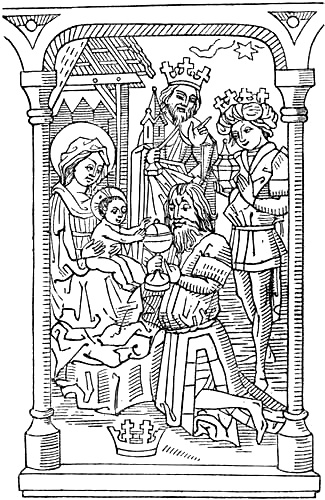
The three wise men—who came from the East to Jerusalem, saying, “Where is He that is born King of the Jews? for we have seen His star in the east, and are come to worship Him”[560]—to a mortal certainty imparted to him the intelligence!
Here you see them with crosses upon their crowns,[561] the religious counterparts of our Irish shamrocs![562] And surely, as Jesus was then but an infant, those mysterious devices were commemorative of His crucifixion, when “He came to His own,”—and not to that which occurred while He “dwelt among us,” a catastrophe which had not yet taken place!
Nor is it alone this single phrase (τα ιδια) that I claim as Oriental—the five first verses of this Gospel, as at present arranged, appertain also thereto. They speak the doctrine alike of the Budhists and of the Free-masons; but in diction, and in peculiarity, in tone, in point, and essence, they are irrefragably Irish.[563]
That St. John never wrote them is beyond all question! but having found them to his hand, existing after the circuit of centuries and ages, the composition seemed so pure, and so consonant with Christianity, nay, its very vitality and soul, he adopted it as the preface to his own production, which begins only at the sixth verse, opening with, “There was a man sent from God whose name was John”!
Having asserted that the preliminary part was inalienably Irish, I now undertake to prove a radical misconception, nay, a derogation from the majesty of the Messiah, to have crept into the text, in consequence of its having been translated by persons unacquainted with that language!
The term logos, which you render word, means to an iota the spiritual flame—log, or logh, being the original denomination. The Greeks, who had borrowed all their religion from the Irish, adopted this also from their vocabulary; but its form not being suited to the genius of their language, they fashioned it thereto by adding the termination os, as loghos; and thus did it become identified in sound with the common logos, which they had before, and which merely expresses a word or term!
But though thus confounded, their philosophers, for a long time, kept both expressions distinct. The former they ever considered a foreign importation, rendering it, as we did, by the spiritual flame; as is evident from Zeno making use of the expression, δια του παντος λογος, that is, the spiritual flame, which is diffused through, and vivifies everything.
Pythagoras is so explicit upon this spiritual flame, that you would swear he was paraphrasing the first five verses of St. John.
“God,” says he, “is neither the object of sense, nor subject to passion, but invisible, only intelligible, and supremely intelligent. In His body, He is like the light, and in His soul He resembles truth. He is the universal spirit that pervades and diffuseth itself over all nature. All beings receive their life from Him. There is but one only God, who is not, as some are apt to imagine, seated above the world, beyond the orb of the universe; but being Himself all in all, He sees all the beings that fill His immensity, the only principle, the light of Heaven, the Father of all. He produces everything, He orders and disposes everything; He is the reason, the life, and the motion of all being.”
Even the Latins having borrowed the idea from the Greeks, steered clear of the equivocation of the ridiculous word; and the immortal Maro, when describing the quickening influence of this ethereal logos through all the branches of nature, interprets it as above, literally, by the spiritual flame!
“Principio cœlum ac terras, camposque liquentes, Lucentemque globum Lunæ, Titaniaque Astra, Spiritus intus alit; totamque infusa per artus Mens agitat molem, et magno se corpore miscet. Inde hominum pecudumque genus, vitæque volantum, Et quæ marmoreo fert monstra sub æquore pontus.”[564]
Am I, therefore, presumptuous in appealing to the community to reject this word as applied to the logos? A meaning, it is true, has been trumped up for this, as the communicating vehicle between God and His creatures! No doubt the Saviour is all that: but logos does not express it; and the duration of an abuse is no reason why it should be perpetuated after its exposure.
I have said that it degraded the dignity of the Godhead to render this expression by the form of word. I do not retract the charge: on the contrary, I add that, independently altogether of the former arguments, adduced to establish its inaccuracy, it would be revolting to common sense, were it not even thus incorrect!
For example—“In Him was life,” says the text, “and the life was the light of men.”
Now, how could there be life in a word? except by the most unnatural straining of metaphor. Or, admitting that there was life, how could there be light, except by the same? Whereas, by substituting the proper term, then all is regular and easy; for what could be more natural, than that there should be life in spirit? and that this life should give light to men?
You will observe accordingly, that Jesus Himself, when describing His own character, exactly states what I here rectify, saying, “I am the light of the world”—not the word of the world—or any such nonsense. And He continues the idea by noting further, that “he that followeth Me shall not walk in darkness, but shall have the light of life.”[565] Thus keeping up an uninterrupted reference to logos, or the spiritual flame!
I do, therefore, humbly, but strenuously, implore of the legislature that they restore this epithet to its divine interpretation! I entreat of the heads, as well of Church as of State, that they cancel the error; for error I unhesitatingly pronounce it to be,—a derogation from the Godhead, and a perversion of the attributes of the Messiah!
I will myself show the way—thus: “In the beginning was the spiritual flame: and the spiritual flame was with God, and the spiritual flame was God.”[566]
How beautiful! may I hope that it will never more be extinguished!
Now, there is another text in the same chapter, which, though not incorrectly translated, yet loses half its beauty as at present understood! It will startle you when I recite it! Yet here it comes. “Behold the Lamb of God, which taketh away the sin of the world!”[567]
By lamb, no doubt, you mean a young sheep: but let me ask you, what connection can you perceive between a young sheep and the taking away of sin? That of immolation, you answer, as typifying the grand offering. Well, then, why add “of God”? Why say, the young sheep of God, if it was an ordinary animal of the mere ovine species that was intended?
No, sir; recollect the “Lamb slain from the beginning of the world,” recorded in the Revelations, as quoted before.[568]
A deep mystery is involved in this expression, which the ingenuity of man could not evolve but through the Irish. In that language lambh is a word having three significations. The first is a hand; the second a young sheep; and the third a cross.[569]
Let us now, in rendering the text, substitute this latter instead of the intermediate; and it will be, “Behold the cross of God, which taketh away the sin of the world!” By which you perceive that when John the Baptist, by inspiration, pointed out Jesus Christ as the universal Saviour of the world, his very words establish a previous crucifixion!
You now see how it happened that ten, in numerals, came to be represented by a cross X. This being the number of fingers upon each person’s hands: and a hand and a cross being both prefigured in the sacred, that is, in the Irish language,[570] by the same term, lambh, it hence occurred that in all reckoning and notation, a new score should be commenced therefrom—that its sanctity should be still further enhanced by the epithet of diag, or perfection, which characterises it as a submultiple, and that the mysteriousness of the whole should be additionally shrouded under the comprehensive symbol of a pyramid or triangle △[571]
“Our Hibernian Druids,” says Vallancey, “always wore a key, like the doctors of law of the Jews, to show they alone had the key of the sciences, that is, that they alone could communicate the knowledge of the doctrine they preached. The name of this key was kire, or cire; and eo, a peg or pin, being compounded with it, forms the modern eo-cire, the key of a lock. The figure of this key resembled a cross; those of the Lacedæmonians and Egyptians were of the same form.”
Estimable and revered Vallancey, it pains me to say anything against you! but on those subjects you were quite at bay! It was not to “show that they alone had the key of the sciences,” that “the doctors of law of the Jews always wore a key,” but because that they had seen it in the ceremonial of the Egyptians, from whom, like the Lacedæmonians, they had borrowed its use, without either of them being able to penetrate its import![572]
The origin, then, of this badge appearing amongst the habiliments of our ancient priests, is developed by the name which those priests themselves bore, viz. Luamh, which, being but a direct formative from lambh, a cross, unlocks the secret of their being its ministers.[573]
The Idæi-Dactyli, who superintended the mysteries of Ceres, obtained their designation from the very same cause, and corresponded literally with our Luamhs: for the Iod of the Chaldeans being equivalent to the lambh or hand of the Irish, the number of fingers thereon were made religiously significant of the X, or cross! And,—what cannot fail to excite astonishment, as to the immutability of a nation’s character,—to this very hour, the symbolical oath of the Irish peasant is a transverse placing of the forefinger of one hand over that of the other, and then uttering the words, “By the cross”!
Are not the opposers of my truths, then, as yet satisfied? or will they still persist in saying that it was the Pope that sent over our Tuath-de-danaan crosses?[574] in the ship Argho! some thousands of years before ever Pope was born. I wonder was it His Holiness that transported emissaries also to that ancient city in America, lately discovered in ruins, near Palenque; amongst the sculptures of which we discover a cross! And the priority of which to the times of Christianity is borne witness to by the gentleman who has published the “Description” of those ruins,[575] though glaringly ignorant as to what was commemorated thereby.
“Upon one point, however,” he says, “it is deemed essentially necessary to lay a stress, which is the representation of a Greek cross, in the largest plate illustrative of the present work, from whence the casual observer might be prompted to infer that the Palencian city flourished at a period subsequent to the Christian era; whereas it is perfectly well known to all those conversant with the mythology of the ancients, that the figure of a cross constituted the leading symbol of their religious worship: for instance, the augural staff or wand of the Romans was an exact resemblance of a cross, being borne as the ensign of authority by the community of the augurs of Rome, where they were held in such high veneration that, although guilty of flagrant crimes, they could not be deposed from their offices; and with the Egyptians the staff of Bootes or Osiris is similar to the crosier of Catholic bishops, which terminated at the top with a cross.”
But if the Pope had so great a taste for beautifying our valleys with those costly specimens of art, whereof some are at least eighteen feet in height, composed of a single stone, and chiselled into devices of the most elaborate mysteries, is it not marvellous that he has not, in the plenitude of his piety, thought proper to adorn the neighbourhood of the Holy See with any similar trophies? And why has he not preserved in the archives of the Vatican any record of the bequest, as he has taken care to do in the case of the four palls?
But, transcendently and lastly, why did he deem it necessary to depict centaurs upon those crosses, with snakes, serpents, dogs and other animals, such as this following one exhibits, which is that at Kells, and which has been alluded to, by promise, some pages backwards.[576]
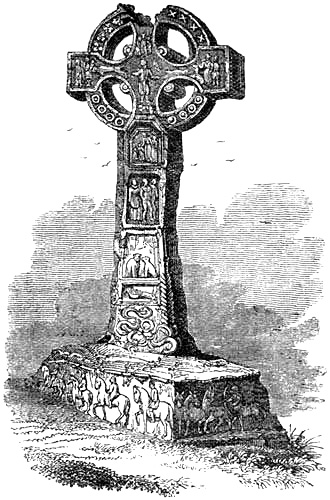
I have now done with the appropriation of those columns; and shall just whisper into my adversaries’ ears—if they have but recovered from the downcrash of their fabric—that so far from laying claim to the honour of their erection, the Pope has actually excommunicated all such as revered them! and has otherwise disowned all participation therein, by the fulminating of bulls and of anathemas![577]
Yet did the zealots of party, after the history of those crosses was forgotten, associate them individually with some favourite saint! “This notion,” says Mosheim, referring to such diversions, “rendered it necessary to multiply prodigiously their number, and to create daily new ones. The clergy set their invention at work, and peopled at discretion the invisible world with imaginary protectors; they invented the names and histories of saints that never existed; many chose their own patrons, either phantoms of their own creation or distracted fanatics whom they sainted.”
Here, however, the historian is as inaccurate as he is severe: for not only did the majority of those saints, if not all of them, exist, but the greater part also of those exploits ascribed to them have actually occurred! The imposition consisted in making them the heroes of events and legends belonging to former actors.[578]
I shall now give you, from the Book of Ballymote, my proof for the assertion before advanced as to the Goban Saer, whom they would fain appropriate, having been a member of the Tuath-de-danaans, viz.: “Ro gabsat sartain in Eirin Tuatha Dadann is deb ro badar na prem ealadhnaigh: Luchtand saer credne ceard: Dian ceachd liargh etan dan a hingeinsidhe: buime na filedh Goibneadh Gobha lug Mac Eithe Occai; ro badar na huile dana Daghadae in Righ: oghma brathair in Righ, is e ar arainic litri no Scot.” That is, The Tuath-de-danaans then ruled in Eirin. They were first in all sciences. Credne Ceard was of this people; and his daughter Dean Ceachd, who presided over physic: she nursed the poet Gohne Gobha, the Free-mason (lug is the same as Saer), son of Occai Esthne. Daghdae the king was skilled in all sciences: his brother Ogmus taught the Scythians the use of letters.
Thus you see that he could not, by possibility, be on the same theatre with St. Abham; while the popular tradition is still substantially true which connects his name with the erection of the Round Towers!
The Church festivals themselves, in our Christian calendar, are but the direct transfers from the Tuath-de-danaan ritual. Their very names in Irish are identically the same as those by which they were distinguished by that earlier race. If therefore, surprise has heretofore been excited at the conformity observable between our Church institutions and those of the East, let it in future subside at the explicit announcement that Christianity, with us, was but the revival of a religion imported amongst us, many ages before, by the Tuath-de-danaans from the East, and not from any chimerical inundation of Greek missionaries—a revival upon which their hearts were longingly riveted, and which Fiech himself, the pupil of St. Patrick, and bishop of Sletty, unconsciously registers in the following couplet, viz.:—
“Tuatha Heren, tarcaintais Dos nicfead sith laithaith nua.”[579]
That is,—
The Budhists of Irin prophesied That new times of peace would come.
What kind of peace, you ask? Is it of deliverance from their Scythian oppressors? No, but that spiritual tranquillity, such as they enjoyed before, and at which even the angels of heaven rejoiced, while announcing the tidings to man[580]—
“And sweet, and with rapture o’erflowing, Was the song from that multitude heard, Who their heav’n for a season foregoing, To second the Angel appear’d. ‘All glory,’ the anthem resounding, ‘To God in the highest,’ began; And the chant was re-echoed, responding, ‘Peace on earth, loving-kindness to man.’”[581]
You will remember that the Scriptures themselves record, how that the wise men of the East foresaw this epoch; and “Lo, the star which they saw in the east, went before them, till it came and stood over where the young child was.”[582]
Is it therefore to be wondered at that our Tuath-de-danaans, who were their brethren, should equally anticipate it?
Yes, from the commencement of time, and through all the changes of humanity, God had always witnesses to the truth in this nether world.
“And Melchizedec, King of Salem, brought forth bread and wine, and he was the priest of the most high God.
“And he blessed him, and said, Blessed be Abram of the most high God, possessor of heaven and earth:
“And blessed be the most high God, which hath delivered thine enemies into thy hand. And he gave him tithes of all.”[583]
“Now consider how great this man was, unto whom even the patriarch Abraham gave the tenth of the spoils.
“For this Melchizedec, King of Salem, priest of the most high God, who met Abraham returning from the slaughter of the kings, and blessed him:
“To whom also Abraham gave a tenth part of all: first being, by interpretation, king of righteousness, and after that also king of Salem, which is king of peace.
“Without father, without mother, without descent, having neither beginning of days nor end of life; but made like unto the Son of God—abideth a priest continually.”[584]
Thus does the apostle proceed, in a strain of the closest argumentation, to point out the superiority of this king of peace, over Abraham and his lineage: after which Mr. Brown, in his Commentary upon the Bible, expresses himself as follows, viz.:—“Who this Melchizedec was, this priest of God among the Canaanites, greater than Abraham, the friend of God, who were his parents or his successors, is on purpose concealed by the Holy Ghost. And hence he is without father or mother, predecessor or successor, in his historical account, in order that he might typify the incomprehensible dignity, the amazing pedigree and unchangeable duration of Jesus Christ, our great High Priest.”
Nobody can quarrel with the piety of this commentator: but piety is not the only requisite for a commentator upon the Scriptures: the absence of stupidity is an essential condition. It is not, however, as applied to this particular passage that I thus express myself: were this the only instance of accommodating oversight it should draw forth no critique from me. But the instances are innumerable, to verify the expression that “some persons see, but perceive not.”
Mr. Brown had no idea of an emanation! Mr. Brown did not comprehend the sons of God! Mr. Brown did not know the connection which existed between the peace of Christ and that which was represented by Melchizedec.[585]
“How beautiful upon the mountains are the feet of Him that bringeth good tidings, that publisheth peace; that bringeth good tidings of good, that publisheth salvation; that saith unto Zion, Thy God reigneth.”[586]
“These things have I spoken unto you, that in Me ye might have peace. In the world ye shall have tribulation: but be of good cheer; I have overcome the world.”[587]
“If thou hadst known, even thou, at least in this thy day the things which belong unto thy peace! but now they are hid from thine eyes.”[588]
“Peace I leave with you; My peace I give unto you: not as the world giveth, give I unto you.”[589]
“Which hope we have as an anchor of the soul, both sure and steadfast, and which entereth into that within the veil;
“Whither the forerunner is for us entered, even Jesus, made an High Priest for ever after the order of Melchisedec.”[590]
“From our fathers to us the good tidings descend, From us to our children agen; Unrestrain’d as the sun, and as lasting, they blend All the nations and ages of men. Good news of great joy to all people, they speak At once to the learn’d and the rude, To barbarian and Scythian, the Jew and the Greek, Nor country nor person exclude. From the man who goes forth to his labour by day, To the woman his help-meet at home; From the child that delights in his infantine play, To the old on the brink of the tomb; From the bridal companions, the youth and the maid, To the train on the death-pomp that wait; From the rich in fine linen and purple array’d, To the beggar that lies at his gate: To all is the ensign of blessedness shown, To the dwellers in vale or on hill, Alike to the monarch who sits on his throne, And the bond-man who toils at the mill; High and low, rich and poor, young and old, one and all, Earth’s sojourners, dead and alive, Who perish’d by Adam, our forefather’s fall, Shall in Jesus the Saviour revive. Not an ear, that those tidings of welfare can meet, But to it doth that welfare belong: Then those tidings with rapture what ear shall not greet, What tongue shall not echo the song? All hail to the Saviour! all hail to the Lord! God and Man in one person combined! The Father’s Anointed! by Angels adored! The Hope and Delight of mankind!”[591]