Chapter XIII
Reading edition
Another characteristic, to which I would fain attract the reader’s regard, is the circumstance of their being erected in the vicinity of water. At Glendalough, what a magnificent lake salutes the Tower? In Devenish and at Killmalloch, is not the same the case? In other parts of the country, also, we find them similarly located. And even where nature has not been so lavish of her inland seas, yet is water, of some shape, always to be seen contiguous to our towers.
What use, it will be asked, do I mean to make of this argument? or how seek support from the accidental propinquity of this element? Remember my remark upon the article, before, in connection with the Egyptian Pyramids. Captain Mignan, besides, tells us that a tradition, handed down from time immemorial, says that “near the foot of the ruin of El Mujellebah,” which he takes to be that of the Tower of Babel, “is a well, invisible to mortals”; and, as all Eastern heathenism, whence ours was deduced, partook in some degree of the same usages and properties, I think it very probable the correspondence will apply in this as well as in other peculiarities; and the rather as from symptoms of vaults, which have already appeared, and the hollow sounds, or echoes, which invariably accompany, the proposition does not come unwarranted, however singly put forth or without something like argument to recommend its trial.
We know that in Hieropolis, or the “Holy city,” in Syria, where a Temple, with a Tower, was erected to Astarte, there stood adjacent a lake, where sacred fishes were preserved, in the midst of which was a stone altar, which was said, and really appeared, to float; whither numbers of persons used to swim every day to perform their devotions. Under this temple they showed the cleft where it was said the waters drained off after Deucalion’s flood, and this tradition brought on the extraordinary ceremony now about to be narrated, something similar to which our ancestors must formerly have practised here.
“I have,” says Lucian,[196] “myself seen this chasm, and it is a very small one, under the temple. Whether it was formerly larger and since lessened I cannot tell, but that which I have seen is small. In commemoration of this history they act in this manner: twice in every year water is brought from the sea to the temple, and not by the priests only, but by all Syria and Arabia. Many come from the Euphrates to the sea, and all carry water, which they first pour out in the temple, and afterwards it sinks into the chasm, which though small, receives a prodigious quantity of water, and when they do so, they say, Deucalion instituted the ceremony as a memorial of the calamity above named, and of his deliverance from it.”
Twice a year a man went up to the top of the Priap, and there remained seven days. His mode of getting up was thus:—He surrounded it and himself with a chain, and ascended by the help of that and certain pegs, which, stuck out of its sides for the purpose, lifting the chain up after him at each resting interval—a method of ascent which will be readily understood by those who have seen men climb up the palm trees of Egypt and Arabia. Having reached the summit he let down the chain, and by means thereof drew up all the necessaries in the way of food, and withal prepared himself a seat, or rather nest on his aërial tabernacle.
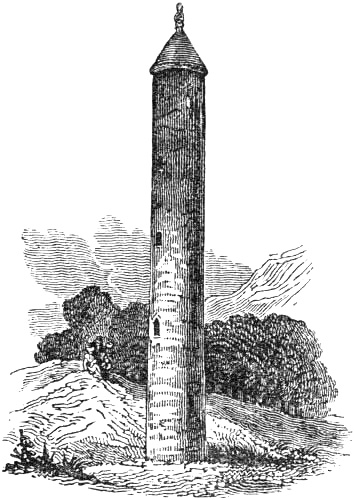
View him now mounted on his sacred tower, He looks around with conscious sense of power.
On these occasions crowds used to come with offerings, and the custom was for each to declare his name to the priests; upon which one below cried it out to him on the top, who thereupon muttered a prayer, which, in order to arrest the attention of the congregation, and enliven their devotion, he all the while accompanied by striking a bell.
One way of their sacrificing was as shocking as it would be otherwise ridiculous. They crowned victims with garlands, then drove them out of the temple-court, on one side whereof was an abrupt steep, where falling they thereby perished. Nay, some tied up their very children in sacks, and then shoved them down, reproaching them as wild beasts, miserably to perish.
This whole proceeding, only under a mythological garb, was in direct harmony with the directions given and the practice pursued by God’s own people. The man ascending to the top of the tower had a parallel in that declaration of the Lord recorded in Ex. xxiv. 1, 2, 3, viz.: “And he said unto Moses, come up unto the Lord, thou, and Aaron, Nadab, and Abihu, and seventy of the elders of Israel, and worship ye afar off. And Moses alone shall come near the Lord; but they shall not come nigh, neither shall the people go up with him. And Moses came and told the people all the words of the Lord, and all the judgments; and all the people answered with one voice, and said, ‘All the words which the Lord hath said, will we do.’”[197]
His staying there seven days corresponded with Lev. viii. 33, 34, 35: “And ye shall not go out of the door of the tabernacle of the congregation in seven days, until the days of your consecration be at an end: for seven days shall ye consecrate you. As he hath done this day, so the Lord hath commanded to do, to make an atonement for you. Therefore shall ye abide at the door of the tabernacle of the congregation day and night seven days, and keep the charge of the Lord, that ye die not; for so I am commanded.” And again, Ezek. xliii. 25: “Seven days shalt thou prepare every day a goat for a sin-offering: they shall also prepare a young bullock and a ram out of the flock, without blemish. Seven days shall they purge the altar, and purify it; and they shall consecrate themselves.”
The enrolment of their names was also sanctioned by Divine command, as Ex. xxviii. 29: “And Aaron shall bear the names of the children of Israel in the breastplate of judgment upon his heart, when he goeth in unto the holy place, for a memorial before the Lord continually.” Whilst the ringing of the bell is particularly enforced by a triple repetition, Ex. xxviii. 33, 34: “And beneath upon the hem of it thou shalt make pomegranates of blue, and of purple, and of scarlet, round about the hem thereof; and bells of gold between them round about. A golden bell and a pomegranate, a golden bell and a pomegranate, upon the hem of the robe round about.”
This last-cited text is of the most inconceivable advantage in the development of the subject which we thus pursue. The most superficial must have noticed how that, in the tracing of this analogy between the ceremonies of the Gentiles and the Hebrews, I have studiously guarded against its appearing an imitation, on the part of the former, from the ritual of the latter. The priority in point of date will certainly appear on the Gentile side. Meanwhile, ere other links of conformity crowd upon our path, it will be well to take heed to the frequency of the word pomegranate, as occurring in the Scriptures. It has already appeared that one of the names of the Syrian goddess, in whose honour the Hieropolitan Priaps were erected, was Rimmon. This epithet you have had before expounded as expressive of that fruit; and as we see that, both in the Jewish and the pagan formulæ, it occupied so prominent a position,[198] it must occasion you no surprise if, by and by, I discover it amongst the mouldings[199] of our consecrated and venerable Round Towers.
As to their devotions at the lake, and the propinquity of the lake itself to the temple, it is in direct similitude to the “molten sea,” mentioned 1 Kings vii. 23, 24, 25, 26, “the brim whereof was wrought like the brim of a cup, with flowers of lilies,” etc.;—while the cruel and shocking sacrifice with which the whole terminated, was the exact respondent of the Mosaical scapegoat.[200]
Let it not be wondered at, therefore, if on the summit of one of our Round Towers are to be found the traces of the apparatus for a bell. For independently of what Walsh and others inform us of, viz. that the Irish—enjoying tranquillity and repose after the expulsion of the Ostmen, and so recalling their attention to the cultivation of Christianity after their release from that scourge—converted those structures of exploded paganism to the only obvious use to which they could then be made subservient, namely, that of belfries, for the summoning together of the people to public worship, some remnants of which it is but natural may yet remain—independently, I say, of this, have I not here shown that bells entered essentially into the code of the pagan ceremonial, from whence it is more than probable, nay, a downright certainty, that the first Christian ecclesiastics adopted the use, as the Mohammedans, in their minarets, did so likewise.[201]
The instance to which I have referred in an early part of this volume, of astonishment created in the English minds, on their first beholding one of those implements, was that of Gildas, who, having finished his education at Armagh, and returned to Britain about the year 508, was engaged by Cadoc, abbot of the church of Mancarban, to superintend the studies of his pupils during his absence for a twelvemonth. Having done so most successfully, and without accepting of any remuneration for his labour, we find, in an ancient life of Cadoc, in the Tinmouth MS., Lambeth observes that “Cadoc, returning to his monastery, found Gildas a noble scholar, with a very beautiful little bell, which he brought with him from Ireland.”
Those bells, then, we may be sure, appertained exclusively to the service of the Round Towers.[202] Having none of these in England, of course they had no bells, and hence the surprise manifested on the above occasion. In Ireland, too, they must have been, now, comparatively obsolete.[203] And hence we find, according to Primate Usher, that their (restored) use was not general in the churches here before the latter end of the seventh century; while another writer assures us that it was not until the ninth century that large ones were invented for the purpose of suspension.[204]
The shape of the Irish pagan bells was precisely the same as of those in the present day. They were called crotals, or bell-cymbals. Oblong square ones, some of bell-metal, some of iron, from twelve inches to eighteen inches high, with a handle to sound them by, have been also dug up in our various bogs. Of these the museum of the Dublin Society possesses one; another is preserved by the Moira family. The writer of this article not having seen either of these relics, is rather diffident in the conjecture which he is now about to express; but from the account received of that in the possession of the house of Moira, he feels strongly disposed to identify its origin with the worship of the above-mentioned deity, Astarte. Lucian expressly tells us that under the veil of this goddess was really meant the moon; and that “the host of heaven,”—including sun, moon, and stars, and typifying the fulgor of that Omniscient germ whence they all had emanated,—constituted the object of the ancient Irish adoration, no one, I believe, can longer question. Now, in Hall’s Tour through Ireland, 1813, I see this bell described as having “a hole in one of its sides like a quarterly moon”; and not knowing whether this is the effect of accident or corrosion, or a symbolical property in its original shape, I trust I shall not be deemed fanciful if I ascribe it as a reference to that planet in whose vain solemnities it had been primarily exercised.
Whether this exposition prove eccentrical or otherwise, and, by inspection, it can be readily ascertained, I cannot presume to determine; nor indeed does it value much.[205] With one thing, however, I am gratified, that in Archer’s Travels in Upper India, published, as before observed, within the last few weeks, I find that distinguished soldier and shrewd observer, delineate a piece of architecture similar in all particulars to this Syrian Priap—the allusion to which has recalled me to ring this second chime upon the bells—and as the notice is of value, I shall give it in his express words: “A curious structure,” says he, “is at the bottom of the hill (Dutteah). It consists of five conical pillars, with green painted tops, in a line from east to west; the two larger ones in the centre: the pillars have tiles stuck in them resembling steps. We could not learn what was its meaning or use. The village is wholly Jain, and is named Serrowlee.”
It is not difficult to understand why no information could be obtained, from the present inhabitants, as to the object of those edifices. Their remote antiquity is a sufficient reply. But I flatter myself that the reader, who has accompanied me from the outset of this antiquarian voyage, can now supply the defect, and explain that they were a series of Round Towers, or Phalli, erected by the aboriginal Buddhists, of whom the Jaina are only the wretched remains; and that those “tiles” which are “stuck in them, resembling steps,” were for the purpose of ascending by the aid of a hoop, such as we have shown at Hieropolis. The projecting stones in our Priaps, or the cavities that appear after their removal, are thus also accounted for.