Chapter XXIV
Reading edition
The regal figures, which I promised, as belonging to the Nubian temple, and corresponding to the Knockmoy frescoes, are the following:—
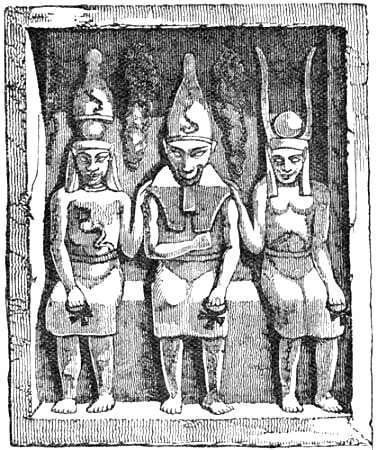
You will, furthermore, observe how that they all wear the philibeg, like our crucified effigy at p. 296, and our war-god, Phearagh, at p. 138. Each of them, also, is adorned with the cross, as the passport of their redemption: while the three divinities, delineated in the Irish scenes, have these as their counterparts in the temple of Nubia.
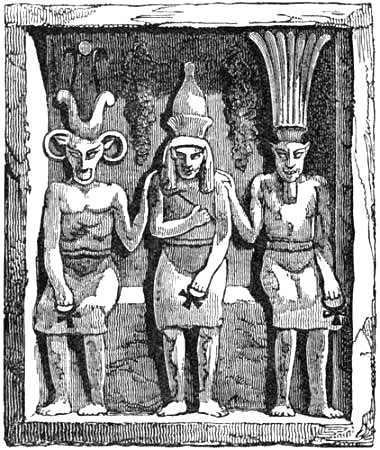
Abbe Pluché states, that “the figures of those gods brought from Egypt into Phœnicia, wore on their heads leaves and branches, wings and globes, which,” he adds, “appeared ridiculous to those who did not comprehend the signification of these symbols, as happened to Cambyses, King of Persia, but these represented Isis, Osiris, and Horus.”
“In the Gentleman’s Magazine for November, 1742, is an account,” says Vallancey, “of two silver images, found under the ruins of an old tower, which had raised various conjectures and speculations amongst the antiquaries; they were about three inches in height, representing men in armour, with very high helmets on their heads, ruffs round their necks, and standing on a pedestal of silver, holding a small golden spear in their hands. The account is taken from the Dublin papers. The writer refers to Merrick’s translation of Tryphiodorus, an Egyptian, that composed a Greek poem on the destruction of Troy, a sequel to Homer’s Iliad, to show that it was customary with the ancients, at the foundation of a fort or city, to consecrate such images to some titular guardians, and deposit them in a secret part of the building; where he also inserts a judicious exposition of a difficult text of Scripture on that subject.”
The above extract was indited long before the publication of those Nubian antiquities; and, consequently, when neither the contributor to the magazine, nor the quoter from its columns, had any knowledge of their existence. Its production, therefore, must be valuable here, as showing not only the connection of the idols with the Round Tower ceremonial, but also that the helmets of the Nubian gods had been adopted in the effigies of some of those amongst us.
I terminate my proofs of the primeval crucifixion, by the united testimonies of the Budhists and the Free-Masons.
“Though the punishment of the cross,” says the Asiatic Researches, “be unknown to the Hindus, yet the followers of Buddha have some knowledge of it, when they represent Deva Thot (that is, the god Thot) crucified upon an instrument resembling a cross, according to the accounts of some travellers to Siam.”
“Christianity,” says Oliver, “or the system of salvation through the atonement of a crucified Mediator, was the main pillar of Freemasonry ever since the fall.”
Let me point your notice now to some consequences of that mysterious fact. I begin by asking—
How happened it, that, of all places in the world, Ireland was that which gave the readiest countenance, and the most cheering support, to the Gospel of Christ, on its first promulgation?
This question you will consider of no trivial tendency. It is, in itself, worth a thousand other arguments. To solve it, I must premise that, besides the many ancient appellatives, already given you, for this country, there was one, which characterised it, as anticipating that event?
Crioch-na-Fuineadhach[393] was this name. Its meaning is, the asylum of the expectants: or, the retreat of those looking forward.
To what, you ask?—To the consummation, I reply, of that prophecy, which was imparted to Israel through another source, saying, “The sceptre shall not depart from Judah, nor a lawgiver from between his feet, until Shiloh come.”[394]
Numerous intimations have, from time to time, been conveyed to man as harbingers of an event which was to crown their species with universal blessings. In the Puranas, it was prophesied, that “after three thousand and one hundred years of the Caliyuga are elapsed, will appear King Saca, to remove wretchedness from the world.”[395]
I have given an abstract of the history of this remarkable personage at pp. 293 and 294, and shortly after, at p. 296, I presented you with the effigy of his crucifixion. As to the era of his appearance, as deducible from the Yugas, I shall confine myself to the opinion advanced by Mr. Davis, in the Asiatic Researches, vol. ix. p. 243, where he states: “It may further with confidence be inferred, that Mons. Anquetil du Perron’s conclusion, with respect to the late introduction of Yugas, which are the component parts of the Calpa, into the Hindu astronomy, is unfounded; and that the invention of those periods, and the application of them to computations by the Hindus, must be referred to an antiquity which has not yet been ascertained.”
In another age was promised another Redeemer; and of him I copy what Mr. Wilford transmits, as follows, viz.:—
“A thousand years before that event, the goddess Cali had foretold him that he would reign, or rather his posterity, according to several learned commentators in the Dokhin, as mentioned by Major Mackenzie, till a divine child, born of a virgin, should put an end both to his life and kingdom, or to his dynasty, nearly in the words of Jacob, in Genesis, chap. xlix. ver. 10. The Hindu traditions concerning this wonderful child are collected in a treatise called the Vicrama Chastra; or, History of Vicrama Ditya. This I have not been able to procure, though many learned pundits have repeated to me by heart whole pages from them. Yet I was unwilling to make use of their traditions till I found them in the large extracts made by the ingenious and indefatigable Major C. Mackenzie of the Madras establishment, and by him communicated to the Asiatic Society.”
In truth, it was to the certainty of this manifestation that the first couplet of an Arabic elegy, preserved by Mons. d’Herbelot in his account of Ibnuzaidun, a celebrated Andalusian poet, refers. In Roman letters, the lines run thus—
“Jekad heïn tenagikom dharmairna Jacdha alaïna alassa laula tassina.”
That is, “The time will soon come when you will deliver us from all our cares; the remedy is assured, provided we have a little patience.”
The learned President of the Society of Bengal, unaware of the drift of this beautiful stanza, and without ever having so much as seen the original whence it was quoted, offers to alter its import to the following, viz.: “When our bosoms impart their secrets to you, anguish would almost fix our doom, if we were not mutually to console ourselves!” And the only reason he assigns for this novel interpretation is, that two individuals, neither of whom, he himself admits, knew anything about its meaning, happened, or rather pretended, to put it for him differently into Arabic words!
On the pillar at Buddal, this emanation of the godhead is thus characterised: “He did not exult over the ignorant and ill-favoured: but spent his riches among the needy: in short, he was the wonder of all good men.”[396] Isaiah’s prophecy of the future Messiah would appear a verbatim, though more poetical transcript of this inscription, viz.: “He shall not cry, nor lift up; nor cause His voice to be heard in the street; a bruised reed shall He not break, and the smoking flax shall He not quench: He shall bring forth judgment unto truth.”[397]
At p. 110 of this volume, I have promised to explain the origin of the word Eleusinian, as applied to the celebration of certain religious rites. I have very little doubt but that, when reading the declaration, the reader looked upon its offer as, to say the least, gratuitous—satisfied that the term could have no possible other meaning, than as an adjective formed from the substantive Eleusis!
Well, the rashness of that judgment I very freely forgive; and repay it now by the verification of my contract.
Eleusis, the place, and Eleusinian, as descriptive of the mysteries therein solemnised, were both denominated in honour of that Advent, which all nations awaited; and the fulfilment of which, in the person of one of the Budhas, made him to be recognised on one occasion as the “source of the faith of the three epochs of the world.”[398]
I have already redeemed the character of those ceremonies from the sinister imputations which attached to their secrecy. An apprehension that their publication would subvert the popular belief, or a supposed indelicacy in their tenour, were the mildest constructions which the uninitiated would afford them. Though secure in the sufficiency of my former proofs, I cannot avoid taking support from an article in a very talented publication of our day, in which the writer, wholly uninstructed, while he evidently is, as to the nature of those celebrations, yet confirms the fact of their worth and their purity.
“From the whole concurrent testimony of ancient history,” says he, “we must believe that the Eleusinian mysteries were used for good purposes, for there is not an instance on record that the honour of an initiation was ever obtained by a very bad man. The hierophants—the higher priests of the order—were always exemplary in their morals, and became sanctified in the eyes of the people. The high-priesthood of this order in Greece was continued in one family, the Eumolpidæ, for ages. In this they resembled both the Egyptians and the Jews.
“The Eleusinian mysteries in Rome took another form, and were called the rites of Bona Dea; but she was the same Ceres that was worshipped in Greece. All the distinguished Roman authors speak of these rites and in terms of profound respect. Horace denounces the wretch who should attempt to reveal the secrets of these rites; Virgil mentions these mysteries with great respect; and Cicero alludes to them with a greater reverence than either of the poets we have named. Both the Greeks and Romans punished any insult offered to these mysteries with the most persevering vindictiveness. Alcibiades was charged with insulting these religious rites; and although the proof of his offence was quite doubtful, yet he suffered for it for years in exile and misery; and it must be allowed that he was the most popular man of his age.”[399]
Analogous to these were the solemnities at Carthage, designated by the name of Phiditia; and the import of which, as well in term as in substance, has been no less a riddle to antiquarians, than was the sanctified commemoration which it disguises. During the interval of their celebration, the youths received lessons from their elders of the state, as to the regulation of their conduct in after life; and the lustre of truth, and the comeliness of virtue, as they shone forth in Budha (which solves the mystery of the name), were the invariable ethics they propounded.
Public feasts were the scene for the delivery of those discourses. They found their way also to Rome, but the spirituality of Redemption not going hand-in-hand with its doctrine, or not duly comprehended, if accompanying, the joyousness of hope, was there sunk into the licentiousness of enjoyment, and the innocence of mirth and of moral hilarity was superseded by the uproar of riot and of vice! Such were the Saturnalia.
How different was their celebration in our “Sacred Ireland!” The very letters of the epithet, by which our forefathers had solemnised them, show the spirituality of purpose which actuated their zeal. Nullog was that epithet—it is compounded of nua, new; and log (for bullog), a belly, meaning regeneration, or the putting aside of the old leaven of sin, and the assumption of the new investiture of righteousness, by justification.
As everything, however, in their religious procedure was transacted by symbols, so, in this instance, they did not content themselves with the inner consciousness of a new birth,[400] but the most go through the outer form of it by typification; and for this end it was that they excavated those apertures in the bodies of rocks, which I have noticed in page 314, as calling forth, from ignorance, the animadversion of the devil’s yonies, in order that, by passing themselves through them, they might represent the condition of one issuing, through the womb, to a new scope of life.[401]
A nobler method of symbolisation, and confined solely to the initiated, was that which characterised the construction of their subterranean temples. Here the sublimity of their worship breaks out in all the grandeur and the majesty of awe.[402] The narrowness of the entrance, never larger than the girth of the ordinary human body, pourtrayed, as well the circular passage in their regenerating type,[403] as the circumvention of temptation by which the faithful are ever beset;[404] while the model of the cross, which regulates their architecture withinside, attests the mystery and the form of their master’s death.
The Mithratic temple, at New Grange, is exactly so constructed. After squeezing yourself, with much labour, through a long emblematic gallery, you arrive at a circular room, or rather an irregular polygon or octagon;[405] whence, at measured intervals, three other apartments diverge, forming, with the inleading gut, a perfect cross; and presenting, altogether, to a susceptible mind, the most solemn combination of symbolical mysteries![406]
I wonder why do not our moderns confer these subterraneous cruciform edifices upon the industry of the early Christians, as they have striven to claim for them the corresponding structures above ground! and without half the probability of success! For if it may be stated, that the crucifixions upon the towers were an interpolation, with a view to Christianise what before was devoted to Paganism, no one, at all events, would maintain that the monks had gone down into the bowels of the earth, and after ejecting the inmates of old Alma Mater, converted their tabernacles into a magical cross!
Nay, a greater difficulty would still attach to this adventure. The Pagodas[407] of Benares and Mathura, the two principal ones in all India, are cruciformly built! and, in order to make both worlds harmonise, the advocates for the monks, or rather their beliers, would have to transport their mechanics to those regions also, and turn upside down, and sideways, and every way, whatever was the shape of the original structures, until they moulded them at last into this mysterious cross!
Some blame, however, would seem attachable to the superintendents of this vision: and it is that, while imprinting this mark over the head of the principal figure in the cave, or Mithratic temple, at Elephanta,[408] they neglected to demolish the Lingam, appertaining to the previous worship; and which actually presents itself but a little from it in the front!
To be grave. There was nothing more natural than that those different symbols should be thus united. I have shown that in the various copies of our annals, the Round Towers, or overground temples, are designated by the name of Fidh-nemead, the meaning of which I have elucidated to be, the consecrated Lingams: the Mithratic caves, or underground temples, their correspondents, it was to be expected, should be known by a suitable denomination; and, accordingly, you will find this very one at New Grange mentioned in the Chronicon Scotorum by the title of Fiodh Aongusa; that is, the Mysterious Cavern of Buddh; while the crucifixions upon the former, and the cruciform shape of the latter, are the reverential memorials of his atoning dissolution.
The mysteries celebrated within the recesses of those caverns were precisely of that character which are called Freemasonic, or Cabiric. The signification of this latter epithet is, as to written letters, a desideratum. Selden has missed it; so has Origen and Sophocles. Strabo, too, and Montfaucon, have been equally astray. Hyde was the only one who had any idea of its composition, when he declared “it was a Persian word somewhat altered from Gabri, or Guebri, and signifying fire-worshippers.”
It is true that Gabri now stands for fire-worshippers, but that is only because that they assumed to themselves this title, which belonged to another order of their ancestors. The word is derived from gabh, “a smith,” and ir, “sacred,” meaning the sacred smiths; and Cabiri being only a perversion of it is, of course, in substance, of the very same import.
Mount Caucasus,[409] also, which still, in our language, retains its original pronunciation, of Gaba-casan, or the Smith’s Path, was named from the same root; nor is the tradition of the reason altogether obliterated from those who dwell beside it, if we may judge from a ceremony described by a recent traveller, as performed by them, as follows:—
“The original founders of the Tartarian Mongolian Scythians, called Cajan and Docos, got embarrassed amongst those mountains, then uninhabited. After a sojourn there of 450 years, having become so numerous as to require other settlements, they were at a loss to find a passage through the mountains, when a smith, pointing out to them a place very rich in iron ore, advised them to make great fires there, by which means the ore melted, and a broad passage was opened for them. In commemoration of which famous march, the Mongols to this day celebrate an annual feast, and observe the ceremony of heating a piece of iron red hot, on which the Ceann (that is, the chief) strikes one blow with a hammer, and all the persons of quality do the same after him.”
I shall close this chapter by the description given of the destruction of Cambyses’s army in the Nubian desert, after the insults offered by him to the Cabiri priests.
“Gnomes, o’er the waste, you led your myriad powers, Climb’d on the whirls, and aim’d the flinty showers; Onward resistless rolls the infuriate surge, Clouds follow clouds, and mountains mountains urge; Wave over wave the driving desert swims, Burst o’er their heads, inhumes their struggling limbs; Man mounts on man, on camels camels rush, Hosts march o’er hosts, and nations nations crush: Wheeling in air, the winged islands fall— And one great sandy ocean covers all.”[410]