Chapter XXVIII
Reading edition
You ask me for the proofs of this early grandeur? I point you to the gold crowns, the gold and silver ingots, the double-headed pateræ or censers, the anklets, lunettes, bracelets, fibulæ, necklaces, etc., which have been repeatedly found throughout all parts of Ireland, evidently the relics of that “Sacred” colony who gave their name to this island, and who, to the refined taste which such possessions imply, united also the science which appears in their workmanship.[460]
But these are scanty and insufficient memorials? Pray, what greater can you produce of ancient Egypt? Her Pyramids? Our Round Towers are as old; are likely to be as permanent; and are really more beautiful. What are the vestiges of ancient Etruria? of Assyria? Troy? Chaldea? nay, of Babylon the Great, the queen of the world? A few consolidations of stone and mortar—disjointed rubbish—and incrusted pottery. All these we retain, in addition to the thousand other evidences which crowd upon the historian. And, while Britain can adduce no single vestige of the Romans—who subjugated that country at their highest period of civilisation—but what, in the words of my adversaries themselves, are “only monuments of barbarism,” I answer—no wonder—for the Romans were never to be compared to the Iranian Budhists, who brought all the splendour of the East to the concentrated locality of this Hyperborean Island.
“Infant colonies, forsooth, do not carry a knowledge of the ‘Fine Arts’ along with them; they are only to be found where wealth, luxury, and power have fixed their abode.”[461] Most sapient remark! but unluckily out of place; for the authors of our Round Towers were not “an infant colony” at all; but the very heads and principals of the most polished and refined people on the bosom of the habitable earth—the Budhists of Iran. And, accordingly, in their train not only did “wealth, luxury, and power” abound, but they seemed exclusively to have taken up their abode amongst them.[462]
Analogous to the above was the rhodomontade of another pillar of the same order. “I, nevertheless,” says Montmorency, “am disinclined to believe that those same persons, had they to choose a residence between Syria and Ireland, would have taken the wintry and uncultivated wilds of Fidh-Inis, in preference to the sunny plains which gave them birth.”[463]
In both those cases, of which the former is but the echo, in all opinions, of the latter, our eastern extraction is only objected to, considered as Phœnician; and there, I admit that the Colonel and his pupil may get an easy triumph over their adversaries. For had the Phœnicians been the erectors of those Round Towers, what was to prevent their raising similar structures in Cornwall? where it is indisputable that they had trafficked for tin. In Spain we are certain that they had established a home; and why does this appear as free from every evidence of columnar architecture as does the former place? The same may be said of other countries whither this people resorted, Citium, Crete, Cadiz, and all the islands in the Mediterranean. In no one of them is there to be found a single edifice approaching, either in design or form, the idea of a Round Tower![464]
The Phœnicians, therefore, can have no pretensions to the honour of those memorials; nor, indeed, can their connection with Ireland be at all recognised, further than that, as having been, at one time, masters of the sea, it is merely possible that the Tuath-de-danaans may have availed themselves of their geographical information, and even consigned themselves to their pilotage for a secure retreat, aloof from the persecution of intolerance.
But as we see from the stanza quoted at page 396, that the Tuath-de-danaans were themselves possessed of a navy; and as it is indisputable that, long before the Phœnicians, the dynasty of the Persians had swept the ocean in its widest breadth, there is no need for our giving the Phœnicians credit even for this service, which it now appears could be dispensed with.
An effort, however, has been advanced to identify their language with ours, by the analysis of the fragment of a speech which occurs in one of the plays of Plautus.[465] The idea was ingenious, but totally unfounded. Affinity, undoubtedly, there does appear,—as there does between all the ancient languages,—but nothing like identity; and the very circumstance of its having a distinct denomination assigned to it in Ireland, viz. Bearla-na-Fene, or dialect of the Phœnicians (who traded here, it is admitted), proves it to be different from our local phraseology—the Iranian Pahlavi, the polished elocution of the Tuath-de-danaans.
The Phœnicians, besides being a mercantile people, never had any monuments of literary value, whereas the Irish are known to have abounded in such from the earliest era.[466]
It is true that we have been denied the possession of alphabetic characters before the time of St. Patrick: but by whom? By Bolandus; on a false deduction from the writings of Ward, Colgan, Nennius, etc., who state that this apostle was the first who gave the “abjectoria,” or alphabet to our nation. Who says otherwise? But what alphabet was here meant? The Latin, certainly, and no other. Until then the Irish were strangers to the Roman letters;[467] but that they were not to written characters, or the cultivation of them in every variety of literature, is evident from the very fact of St. Patrick himself having committed to the flames no less than one hundred and eighty volumes of our ancient theology;[468] as well as from the recorded instance of his disciple, Benignus,—his successor also in the See of Armagh,—having, according to Ward, written a work on the virtues of the Saint, half Latin and half Irish, and which Jocelyne afterwards availed himself of, when more fully detailing his biography.
It has been the custom in all ages with those who would pass as the luminaries of their respective generations, to maintain that letters and their application were but a recent discovery! Their antiquity, however, is an historical fact, than which there can be no other better authenticated. The Bible makes frequent allusion to the cultivation of alphabetic cyphers—thus in Ex. xxiv. 4, it is said, “And Moses wrote all the words of the Lord”; and in Josh. xxiv. 26, “And Joshua wrote these words in the book of the law of God.”
Nor is it only to the elementary part of literature, but to the very highest and noblest department of literary research that we find the ancients had arrived. In the history of Job, an acquaintance with astronomy is quite apparent. The names of Arcturus, Orion, and the Pleiades,[469] are distinctly notified in that elaborate composition.[470] Could this have been without the aid of written characters? Could the abstruse calculations involved in that pursuit be possibly carried on without an intimate knowledge of notation and of numbers? Or, if superior memory may effect it in a few cases, without such characters or legible marks, how could the results arrived at, and the steps by which they had been attained, be for any length of time preserved, and their value handed down to successive experimentalists, unless by the instrumentality of expressive signs?
We find, accordingly, in the same treatise,[471] the art of writing expressly named: Thus, “Oh that my words were now written! oh that they were printed in a book! that they were graven with an iron pen and lead in the rock for ever!” And that it was of long-continued usage is evident from a preceding chapter,[472] where it is said, “Enquire, I pray thee, of the former age, and prepare thyself for the search of their fathers!”
The alphabet which we had here, before the Roman abjectorium, is still preserved, and called Beth-luis-nion,[473] from the names of its first three letters, just as the English is denominated A B C, from a similar cause, and the Greek Alpha-bet from a like consideration.
Irish. Latin. English.
1 B Beithe, Betulla, Birch.

2 L Luis, Ornus, Wild ash.

3 N Nion, Fraxinus, Ash.

4 S Suil, Salix, Willow.

5 F Fearn, Alnus, Alder.

6 H Huath, Oxiacanthus, White thorn.

7 D Duir, Ilex, Oak

8 T Timne, Genist. Spin. Furze.

9 C Coll, Corylus, Hazel.

10 M Muin, Vitis, Vine.

11 G Gort, Hedera, Ivy.

12 P Peth-bhog Beite, or B mollified,

13 R Ruis, Sambucus, Elder.

14 A Ailm, Abies, Fir tree.

15 O Onn, Genista, Broom.

16 U Ur, Erix, or Erica, Heath.

17 E Eghadh, Tremula, Aspen.

18 I Iodha, Taxus, Yew.

This, you perceive, falls short, by eight letters, of the number of the Latin cyphers, which could not have occurred if borrowed from that people, and will therefore stand, independently and everlastingly, a self-evident proof of the reverse.
It is well known, that long prior to the arrival of Cadmus the Greeks were in possession of alphabetic writing.[474] Diodorus states so, but adds that a deluge had swept all away. One thousand five hundred and fifty before the era we count by, is agreed upon as the year in which Cadmus visited Greece; and you have the authority of Pausanias, that he himself had read an inscription upon a monument at Megara, the date of which was 1678 before our epoch, that is, one hundred and twenty-eight years before Cadmus’s time.
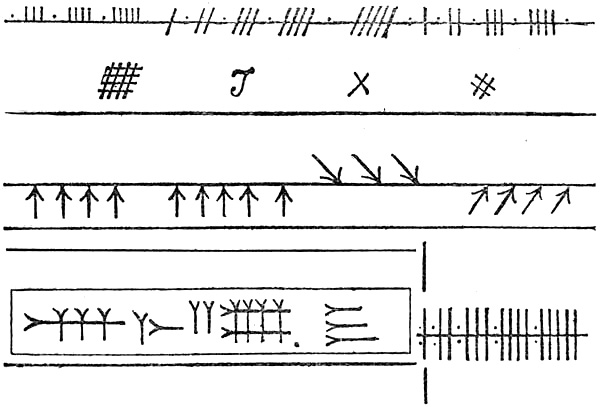
Besides those ordinary letters of the Beth-luis-nion, the Irish made use of various other occult and secret forms of writing, which they called ogham,[475] and of which I insert some specimens.
Among these you perceive the arrow-headed figures whereof I have already advertised you; and the mysterious import of which reminded the initiated of the solemn purchase of salvation by the cross.
These are all peculiar and totally separate from any Phœnician alliance. Instead, therefore, of my being adverse to the moderns as to the Phœnician bubble, I am their auxiliary. But, Mr. Montmorency, are there not other places in the East besides Phœnicia? And may not a people leave the “sunny plains that gave them birth,” from other motives than those of “choice”? And may not “Fidh Inis,” instead of being a name of reproach, such as you affected, by associating it with “wintry and uncultivated wilds,” be one of distinction and of renown? And though to you its authors, as well as the mystery of its import, were an impenetrable secret, may it not, notwithstanding what you see verified now, be made one of the engines exercised in the recovery of truth, to prove the splendour and the refinement of our venerable ancestors?
It is to be hoped, therefore, that after this explanation, we shall hear no more sarcasms upon this favoured spot. Nor would the anticipation be too great, that the whole infidel host, with the gallant colonel himself at their head, becoming alive to the injustice of their former disbelief, would now slacken their virulence, and if they will not join in the acclamations of regenerated history, at least decently withdraw, and let the lovers of truth, in security and happiness, celebrate its triumph.
“The appellation of Britain,” says another goodly (?) champion of this order, “has been tortured for ages by the antiquarians, in order to force a confession of origin and import for it. And erudition, running wild in the mazes of folly, has eagerly deduced it from every word of a similar sound, almost in every known language of the globe. But the Celtic is obviously the only one that can lay any competent claim to it—and the meaning of it may as easily be ascertained as its origin.”—And so, accordingly, he proceeds to show, that “Breatin, Brydain, or Britain,” is derived from a “Celtic word,” which signifies “separation or division!”[476]
It is more than probable that I should have left Mr. Whittaker to his vagaries, or rather his clerical recreations, if he had not been propelled by his all-illuminating reforms, to glance a ray upon us, here, across St. George’s Channel.—“This,” says he, “has equally given denomination to the tribes of Ireland, the nations of Caledonia, and two or three islands on our coasts!”
“The original world is still retained in the Welch, Britain; and the Irish, Breact,—anything divided or striped; in the Irish Bricth, a fraction; the Irish Brisead, a rupture; and the Welch brig, a breach. And it was equally pronounced Brict, or Brit (as the Icitus of Cæsar, or the Itium of Strabo), Bris and Brig; and appears with this variety of terminations, in the usual appellation of the islanders, Britanni, in the present denomination of the Armorican Britons, and their language, Brez and Brezonic, and in the name of Brigantes. Brit is enlarged into Briton, or Brit-an in the plural, and Britan-ec in the relative adjective. And so forms the appellation Britones, Britani, and Britanici; as Brig is either changed into Briges, in the plural, and makes Allobroges, or Allo-broges, the name of a tribe on the continent, and of all the Belgæ in the island, is altered into Brigan and Brigants, and forms the denomination of Brigantes.” And again, “the original word appears to have been equally pronounced Brict, Brits, and Bricth, Breact, Breac, and Brig; and appears to be derived from the Gallic Bresche, a rupture, the Irish Bris, to break, and Brisead, a breach. And the word occurs with all this variety of termination in the Irish Breattain or Breatin, Bretam, and in Breathnach, Briotnach, and Breagnach, a Briton; in the Armorican names of Breton, Breiz, and Brezonnec, for an individual, the country, and the language of Armorica; in the Welch Brython and Brythoneg, the Britons and their language; and in the ancient synonymous appellations of Brigantes and Britanni.”
Doubtless the reader has been highly edified by this Britannic dissertation! He is, I am sure, as thorough master of the subject, now, as Mr. Whittaker himself!—can tell how many fractures, cross-lines, and diagonals have been made upon Britain ever since Noah’s flood! And as he cannot fail, in consequence, being in love with the Reverend Author, I will indulge his fondness by another spark of enlightenment.
“At this period,” he resumes (three hundred years before Christ), “many of the natives relinquishing their ancient seats to the Belgæ, found all the central and northern parts of England already occupied, and transported themselves into the uninhabited isle of Ireland!”
I will now be understood as to the promise made some while ago,[477] in reference to a definition for the word modern. A modern then, be it known, is a philosopher (?), who fancies that until three hundred years before Christ, the whole world was in darkness! physical as well as metaphysical! that it was even in a great measure uninhabited! by other than the brute creation!—but that suddenly when ever any mighty feat was to be achieved (in other words, whenever a modern theory was to be bolstered up) innumerable myrmidons armed cap-à-pié! full accoutred, booted and spurred! used to gush forth from some obscure corner of the earth! A miracle of production, to which even Cadmus’s soldiers can bear no parallel; for while the latter are located to a particular place, and stated to have been generated by regular seed, even though that was nothing more than a tooth of a dragon,[478] the former burst forward, nobody knows whence, nor will their machiners condescend to tell even so much as what may have been the elements of their composition!
To whom, however, is Mr. Whittaker beholden for this intellectual idea? Verily, to a half-senseless poor friar,[479] a few centuries deceased, who was no more competent—and no blame to him from his resources—to analyse this question, than he was to stop the revolutions of the celestial orbs!
Yet jejune and abortive as were Cirencester’s cerebral conceptions, he was not less dogmatic in the utterance of them than was his imitator. “It is most certain,” says he, “that the Damnii, Voluntii, Brigantes, Cangi, and other nations, were descended from the Britons, and passed over thither after Divitiacus, or Claudius, or Ostorius, or other victorious generals had invaded their original countries. Lastly, the ancient language, which resembles the old British and Gallic tongues, affords another argument, as is well known to persons skilled in both languages.”
Now, by what authority, may I ask, is all this “most certain?” And by authority I do not mean any quotation from previous historians. That I waive, and should not here require it, if either proof or probability were tendered of the occurrence. But as none such is vouchsafed—as all is mere assertion—and as I can prove the exact contrary to have been the actual fact, is not dogmatism too mild a name to apply to the scribbler who propounds such nonsense? And is not servility too dignified an epithet to brand upon the copyist, who takes such ipse dixit evidence upon so intricate a proposition as gospel truth? and that too when he must have absolute demonstration, and canvas every other statement, emanating from that fraternity, with the very eye of a Lynceus!
In the first place, then, the name Damnii (to begin with the beginning) is but a monkish Latinisation for Danaans; and these I have established to have been an eastern race, totally and universally distinct from Britain, until upon their overthrow in Ireland they fled for shelter to Scotland, whither on their way some straggling parties, reduced and humiliated, took up their residence in the northern parts of England; where, accordingly, to this hour we find evidences of their worship, such as sculptured crosses,[480] and other emblematic devices, but never a Round Tower, their impoverished circumstances not being now adequate to such an expense.
The Brigantes, again, is another Latin metamorphosis for the inhabitants of Breo-cean, in Spain, where the Phœnicians had fixed a colony, and whence they doubtless had brought some portion with them to work the mines at Cornwall. This Breo-cean the Romans, in conformity with the genius of their language, changed into Bri-gantia, which, however, was a very allowable commutation, the letters c and g being always convertible, and tia nothing more than an ordinary termination.
Seneca well knew that the Brigantes thus imported were a very different extraction from the native Britons.
“Illi Britannos ultra noti littora ponti, Et cœruleos Scuto-Brigantes dare Romuleis,”
says he, in his satirical invective upon the death of Claudius. Here, you will observe, that the Britons and the Brigantes are opposed to one another, and marked out as distinct races. And to specify still further the origin of the Brigantes is the epithet Scuto[481] prefixed thereto, from Scuitte, the ancient mode of spelling Scythia.
Those Scoto-Brigantes were the persons who, having been driven from Spain by the conquests of Sesostris, poured in with multitudinous inundation upon the quietude of our Tuath-de-danaans, and wrested from them an island which, during their blissful reign, had eclipsed in sanctity even their former Iran.[482]
The language which they spoke differed in nothing from the Tuath-de-danaan, but that it was not quite so refined; and this feature of similarity silences at once the conjectures of Stillingfleet, Innes, and their followers, who would make those Scythians to be Scandinavians, merely because the letter S occurs as the initial and final of either name!
Why, sir, when the Scandinavians did really invade Ireland, which was not until the early centuries of the Christian era, the great obstruction to their progress was their ignorance of our tongue; whereas, when the Scythians arrived here, many ages earlier, our legends, our traditions, our histories, and our annals, unanimously and universally attest, that they used the same conversable articulation with that of the established dynasty.[483]
Where is the wonder, then, that we should find all the ancient names in the north of England, correspond to a nicety with those of the Irish? And which made Lhuydh, the author of the Archæologia, himself an Englishman, declare, “how necessary the Irish language is to those who shall undertake to write of the antiquity of the isle of Britain.”
But if Lhuydh was thus candid in the avowal of his conviction, he was not equally successful in the discovery of the relationship. From want of the true touchstone, he went on hypothesising! and came at last to the supposition—“that the Irish must at one time have been in possession of those English localities, and thence removed themselves into Ireland”—the exact opposite having been the fact.
To atone for my long digression from Mr. Whittaker, and his breakages, I will supply to you the derivations, as well of Britain as of Brigantia. The former is compounded of Bruit, tin; and tan, a country abounding in that metal, and corresponding to Cassiteris, assigned to it by the Greeks: and Brigantia, as before explained, being but a formative from Breo-cean, is compounded of Breo, which signifies fire; and cean, a head or promontory, meaning the head-land of fires; or that whereon such used to have been lighted for the convenience of mariners lying out at sea.[484]
Neither the Scythians, therefore, nor the Celts, had connection whatsoever, either of them, with the once-envied celebrity of this “island.”[485] The latter were the persons who, under the name of Fir-Bolgs, erected all the cromleachs spread over the country, the accomplishment of which bespeaks, it is true, an acquaintance with mechanics, of which the present artisans are altogether ignorant. And as the original of their denomination has never been elucidated, I embrace this opportunity of supplying the omission. It comes from bolog, which, in the Irish language signifies a paunch; and fir, a man; so that Fir-Bolg means the big-bellied man, being an evident allusion to their bodily configuration: and to this day Bolcaig is the epithet applied, vernacularly, to individuals of large girth or corpulent robustness, exactly corresponding to what we are told by Cæsar, when describing the tripartite division of Gaul, viz. that the Belgæ, who, in fact, were of the same stock as our Fir-Bolgs, were the stoutest bodied, and the bravest otherwise of all its inhabitants.
The Scythian religion, which was Druidical, accorded with that of the Fir-Bolgs, which was Celtic—not less as to modes of worship, than in mutual aversion to that of the Iranians; and, accordingly, we find, that when both conspired for the recovery of this country from the Iranians, who had themselves wrested it from the Fir-Bolgs, antecedently, these latter branching out into the septs of Cauci and Menapii, corresponding to the kindred and cognominal tribes on the continent; and who, during the occupancy of the Iranians—the interval of Ireland’s Hyperborean renown—had retired to Arran[486] and the northern isles, were restored to a partnership in the possession of the island, in return for the assistance they lent the Scythians for its conquest: and this accounts for that diversity of races which Ptolemy records, but which antiquarian luminaries, unable to comprehend, took upon them to reject as altogether a chimera.
As to the Iranians, the real Hibernians—the true Hyperborean Tuath-de-danaans, or Magic-god Almoners—they were hurled from the throne, their sanctified ceremonials trampled in the dust, their sacred harps, which before used to swell to the praises of their Divinity, were now desecrated for the inspiration of the Scythian warriors; and their divine Boreades, who ere now composed canticles in adoration of Apollo, were degraded to the secular and half-military occupation of Scythian bards.
The name of the island itself, from “Irin,” or the “Sacred island,” was changed into Scuitte, that is, Scotia or Scythia, or the land of the Scythians. Nor was it until the eleventh century of the present era, that, to remove the ambiguity which arose from the circumstance of there being another country also called by this name, Ireland assumed its former name, Irin, as its people did Irenses, instead of Scoti.[487]
Yet in the general transmutation which so great a revolution bespeaks, we behold the strictest regard paid to the literary fame and the mental acquirements of those sages who had been ejected. They were retained as the instructors of the new establishment; and their refined precepts tending gradually to soften the warlike propensities of this ferocious group, the amalgamation became so complete, and the aristocracy of intellect so recognised, that when religious dissensions were all cancelled in the grave, many of them were able to trace their steps backwards to the forfeited monarchy.
Of this number was Connachar-mor-mac-Nessan, that is, Connor the-great-son-of-Nessan, styled indifferently Feidlimidh and Ollamh Fodlah, i.e. the erudite man (the Budhist) and the Doctor of Budland; and Brien, who ascended the Irish throne, A.D. 1014; and who, after a succession of two thousand two hundred years, was the lineal descendant of Brien, head of the Tuath-de-danaans; and this very extraction, in the confusion of the names, was the circumstance which occasioned the popular belief, not yet exploded, of his having been the founder, by magic creation, in one single night, of those Round Towers of his inheritance! The mistake, however, is of value, as it is a collateral evidence that those edifices have been attributed to their real authors; and the anachronism will be excused, seeing that there is nothing more common than to assign to one Hercules the exploits of another.
Others of this colony, who could not brook the yoke, betook themselves on their downfall to Scotland, and built there the two round temples of Brechin and Abernethy, besides others that have disappeared; from thence, however, they were again dislodged by the barbarous Picts, and obliged to fly for shelter to the Highland fastnesses. These are they whom Macculloch and others have misrepresented as Celts. During their sway in that country, they called it also by the name of Iran or Eran, as the Scotch language is, to this day, called Irish, or Erse. The name of Scoitte, i.e. Scotia, was given it afterwards by the Picts, in compliment to this island, which had furnished them with wives, and otherwise joined their fraternity.[488]