THE WYE.
Reading edition
“The Notorious Hill of Plinlimmon”—The Stronghold of Owen Glendower—Llangurig—Rhayader Gwy—Llyn-Gwyn—The Elan, the Ithon, and the Yrfon—Llandrindod—Builth—Aberedw and the Last Prince of Wales—Hay—Clifford Castle and the Fair Rosamond—Hereford—The Lug—“The Wonder”—Ross and John Kyrle—Goodrich Castle—Coldwell Rocks—Symond’s Yat—Monmouth—The Monnow, the Dore, and the Honddu—Wordsworth’s Great Ode—Tintern Abbey—The Wyndcliff—Chepstow—The Lower Reaches.

LIKE many another thing of beauty, the WYE is born amidst surroundings dreary and dismal. Plinlimmon, the monarch of the vast waste of hills that forms the southern portion of the Cambrian system, has three heads. But no one can point the finger of scorn at him on that account, for great are his cares as he stands there in that region of morass and bog, the father of five rivers. His chief head, towering to the sky, gathers from the heavy clouds as they drift across the land the raindrops and the mist, and these, trickling down his shoulders, are gathered into five different courses, and, hurrying on their way, form the five rivers—the Severn, the Wye, the Rheidol, which flows to Aberystwyth, and the Dulas and the Llyffnant, which by different courses flow to the Dovey. Moreover, the rugged, austere mountain has long been spoken lightly of; for a shepherd—it would never do to call him an humble shepherd—who, in the early part of the present century, had the right to sell ale and small beer in his cottage up amongst the mountain-tops, had a board hung out with this modest sentence, which, to be sure, soon became classic, painted upon it: “The notorious hill of Plinlimmon is on these premises, and it will be shown with pleasure to any gentleman travellers who wishes to see it.” So, what with the clouds and mists resting upon his head, the large family of rivers he has to feed, and the slighting language that is held towards him, the “notorious hill of Plinlimmon” is bald and sad and sodden. Unless, therefore, the traveller is fond of dreariness and dankness, he will scarcely find this a profitable journey to make—this climb to the very source of the Wye.
Photos: Hudson.
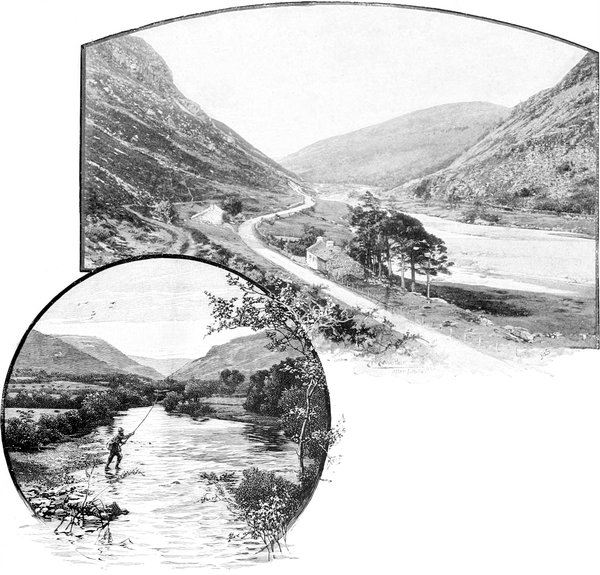
VIEWS IN THE LOWER ELAN VALLEY (p. 128).
Legend, however, weaves a charm over many an else dreary waste, and up amongst the scramble of hills of which Plinlimmon is monarch, legend and history unapocryphal combine to fill the home of mists with interest for all who love a stirring tale. Here, at the very source of the Wye, Owain Glyndwr—the Owen Glendower of Shakespeare’s King Henry IV.—who could call spirits from the vasty deep, had his stronghold, and gathered around him his vicious little band of followers:—
“Three times hath Henry Bolingbroke made head Against my power: thrice from the banks of Wye And sandy-bottomed Severn have I sent him Bootless home, and weather-beaten back.”
This he truthfully told his fellow-conspirators. Plinlimmon and the surrounding country is rich in records and legends concerning this turbulent prince, whose very birth, on May 28th, 1354, is said to have been attended by remarkable premonitions of coming trouble, for it is told that on that eventful night his father’s horses were found in their stalls standing in a bath of blood that reached to their bellies. This is the popular account, but Shakespeare’s imagination created other and farther-reaching warnings to the world concerning the fiery spirit that had been ushered upon the scene:—
“At my nativity The front of Heaven was full of fiery shapes, Of burning cressets; and at my birth The frame and huge foundation of the earth Shak’d like a coward.”
From this lofty region, half earth and half sky—for the Wye can lay claim to trace its source to the very clouds that hang thick upon Plinlimmon’s head—the tiny rivulet bounds down the mountain-side, and the Fates, catching at a myriad of still smaller rills, braid them into the main stream, as the tresses of a maiden’s hair are woven together, till united they form a brook. For a number of miles the land through which the Wye’s course is laid continues to be melancholy in the extreme, and the torrent, like all urchins brought up amidst harsh, inclement surroundings, goes on its way brawling and turbulent, playing leapfrog with rocks, flinging itself over precipices, swirling in little maelstroms, and almost getting blown away in spray; and it is not until the pretty village of Llangurig is reached that it comes in part to its senses, and, although still boisterous, shows itself amenable to the influence of civilisation. Not only does the Wye here meet for the first time with civilisation, but here, too, it becomes acquainted with that which later on in its life is one of its glories, almost its crowning glory—trees. The head and shoulders of mighty Plinlimmon afford no gracious foothold for these children of fat lands and lusty air, scarcely a bush raising its branches in the bog and marsh of the mountain. But up to Llangurig a few of them have straggled, to break the monotony of the mountainous region. Here, too, a bridge—one of the few works of man that sometimes add to rather than detract from the effect of river-scenery, always provided that it is not a modern railway bridge of iron—crosses the young stream; and a church, the first of many on the banks of the Wye, stands near by. A short distance below this village the stream spreads out in its valley, and flows more gently amongst huge boulders that have been hurled down from the sides of the mountains.
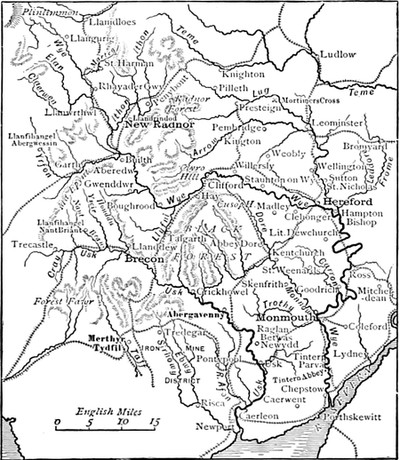
THE WYE AND THE USK.
Between Llangurig and the next village of any importance, Rhayader Gwy, to give it its full name, although most people are content to call it by its “Christian” name only, leaving the “Gwy” to take care of itself—between these two villages the Wye enters Radnorshire; and now the scenery, although still wildly mountainous, is of a more subdued description, trees becoming more plentiful, and the rocks, occasionally shaking their heads free from the thick covering of spongy morass, beginning to stand out bold and picturesque, and to take their proper place in the composition of mountain-scenery. A short distance above Rhayader Gwy the river Marteg pours its tiny volume into the Wye, and here is one of the choicest bits of scenery in all the upper reaches of our stream. Nannerth Rocks, lofty crags, confront the river, and narrow the bed so that the combined waters can only squeeze through at the expense of a mighty uproar and much plunging and dashing and flinging of spray and foam, the brawl of the forced passage being audible for a great distance. After its straitened course between these rocks, the river enters an easier bed and flows sulkily down to Rhayader Gwy.
This village has a situation as wonderful as any in all the kingdom. On every side tower the great hills, not harsh and gloomy now, but clothed with oak forest thick and deep. Not so many years ago there were, as the name of the village bears record, falls at Rhayader Gwy; but in building the bridge that spans the stream the good people, little caring for the picturesqueness of the place, removed the stones and widened the channel, and so reduced the falls to rapids.
Although the place is of little note now, being only a lovely village, once upon a time it was of considerable importance in the country, and saw stirring times. Among other things, it had a strong fortress of its own, erected by Rhys ap Gruffydd, the Prince of South Wales; but this was so thoroughly rased to the ground by Llewelyn, in 1231, that not a vestige remains. At a later day a successor to this stronghold was built, but it, too, fell, in the stormy days of the Parliamentary War, and only a mound marks the spot where it stood. Near to Rhayader Gwy the Wye, like a mountain chief exacting tribute from his weaker neighbours, secures the overflow from a quaint lake, said to be the only beautiful lake in Radnorshire—the Llyn-Gwyn. In olden days many a pilgrim, full of faith in the miraculous powers of this little lake, made his way through the rugged district to bathe in its waters; and there can be little wonder at the hope inspired in their breasts by the sight of Llyn-Gwyn, for it is such a lake as is rarely found, dainty, clear, cool, its high wooded banks rising nearly perpendicularly—a veritable fairies’ ocean. With the overflow from this the Wye tumbles along, soon to find tributaries of much more importance.
The first of these is the Elan. This river receives the Claerwen; and near to the juncture of the two streams is Nantgwillt, a house which, in the momentous year 1812, was occupied by the poet Shelley, while at Cwm Elan lived Harriet Grove. The journey from Rhayader to Cwm Elan, a distance of five miles up the valley of the little river, is very beautiful. Mountains rise on every side, as though guarding the privacy of the delicious glen; inspiring sights are to be seen at every turn, dainty views of the Wye and the Elan pleasantly breaking the green of trees and grass, and the variegated colours of rocks. Further up the valley is the scene chosen for the illustration on this page, where the waters of the Elan splash along over the rocks that bestrew their course, until they come to a sombre and forbidding pool, which might well be bottomless.
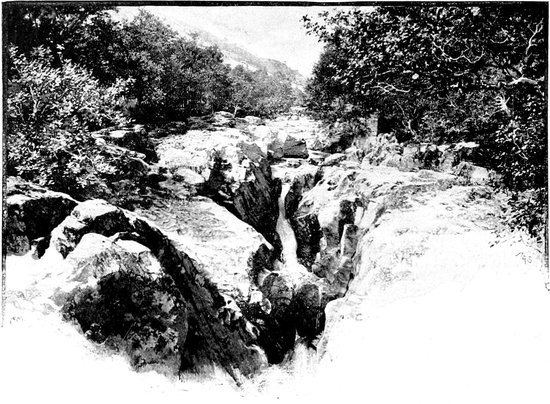
Photo: J. Owen, Newtown, North Wales.
PONT-HYLL-FAN, IN THE ELAN VALLEY.
Next, the Ithon, its waters drawn from the Montgomeryshire hills, flows into the Wye; and then, more considerable by far than any Brecknock tributary, comes the Yrfon, whose fountain-head is some ten miles from Llanwrtyd. Long time ago a cave near to the river-bank harboured Rhys Gethin, an audacious freebooter, who levied contributions from all and sundry, including his Majesty the King himself. At the Wolf’s Leap, a point on the Yrfon worthy of a visit, the river may be said to run on edge, for the rocks close in so that the water, while some 30 feet deep, is only a few inches across. This is the place where, if tradition is to be credited, the last Welsh wolf took matters into his own paws, and committed suicide. The niche of land formed by the junction of the Yrfon with the Wye is pointed to as the spot where Llewelyn, in 1282, made his last stand against Edward I. and his English hosts, and was there slain and buried. About an equal distance from Rhayader and Builth, up the valley of the Ithon, is Llandrindod, long famous for its pure air and healing wells. As long ago as the seventeenth century, the waters of these wells were known to have medicinal properties that made them of peculiar value to those suffering from scrofula and kindred troubles. The water flows out of the rock high up on a hillside, and guests at the pump-house and hotels enjoy a magnificent panoramic view of the valleys of the Wye, Ithon, and Yrfon. In the last century an hotel of extravagant luxury was erected by the side of these wells, but, proving unprofitable, it soon became a favourite resort of gamblers, and continued to be the scandal of the country until a lady of practical piety became possessed of the property, and, so that there should be no doubt about her ideas on the subject of gambling, had the building torn down and utterly removed. That happened long ago, and now other hotels have taken the place of the one of evil repute; and Llandrindod, having railway communication with the outside world, is prospering exceedingly. Let us add that it has not, in its prosperity, come to feel ashamed of its Shaky Bridge—a primitive arrangement of planks and stretched ropes, which will some day, it is to be feared, be displaced by a more “imposing” structure.
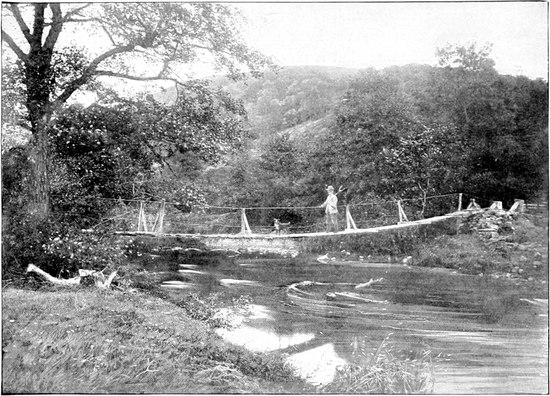
Photo: Hudson.
THE SHAKY BRIDGE, LLANDRINDOD.
Builth, on the Wye, is a fisherman’s paradise. Using the little town as a base, he has within easy reach the waters of the Wye, the Yrfon, the Edw, the Dihonw, and the Chweffru, all waters rich in sporting fish; and in the seasons of the sport about as many artificial as natural flies skim the waters, for anglers come from far and near to a centre so celebrated. The authentic history of Builth reaches back to Roman times; and in later days the Danes came with fire and sword, and levelled the place with the ground. The Castle of Builth was stormed and destroyed as often as it was rebuilt, the partisans of one chief after another wreaking their rage upon it, and now nothing but a mound marks the spot where once a succession of strongholds stood.
History has no more romantic tale to tell, nor one that is more generally known, than that of the ride of the Prince of Wales, Llewelyn, from Aberedw, where on the banks of the Wye he had a castle, towards Builth, which refused to succour him. There is scarce an elementary schoolboy who has not heard of the ingenious blacksmith who hastily nailed to the hoofs of Llewelyn’s horse the shoes reversed, so that the tracks in the snow might mislead those who were in hot pursuit; and alas! heard, too, that the blacksmith, clever as he was at his trade, was not clever enough to keep the secret, but betrayed his prince to the enemy, so that the last authentic Prince of Wales was hounded to his death. It is a story destined to immortality, for it has drifted into folklore, and, like the curiously barbarous tale of Little Red Riding Hood, is crooned to each generation of children until every Welsh child dreams at least once in its lifetime of the harried prince and the foaming steed, the new-fallen snow, and the marks of the seven-nailed shoes running, as it were, backwards. The tale has been transplanted to many quarters of the globe, but the Wye knows that the prince fled along its banks from the castle to the cruel, inhospitable town. Of the castle—Llewelyn’s—to be sure, almost nothing now remains; but the village is delightfully situated, and is much resorted to by anglers, and not by anglers only.
The next place of particular importance is Hay. From the river the streets of this picturesque and thriving little town rise rather too abruptly for the pleasurable convenience of vehicular traffic; but picturesqueness and practicability seldom go hand in hand, and what Hay streets lack in the latter is fully made up in the former virtue. To crown them rises the ivy-clad fragments of the famous castle.
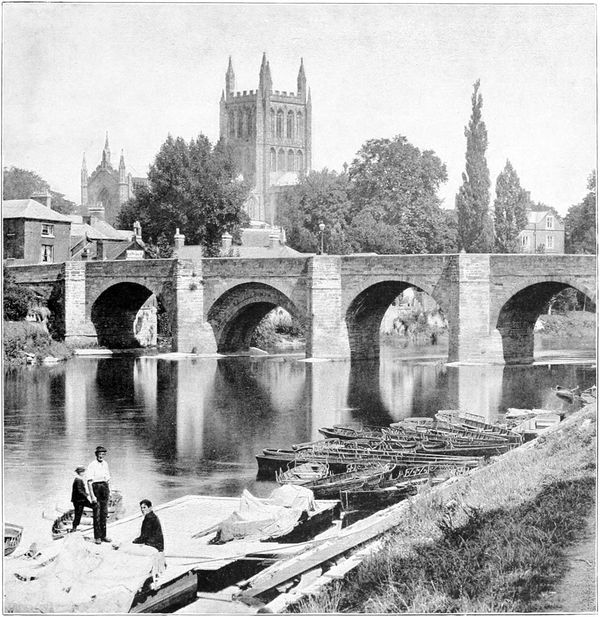
Photo: J. Thirlwall, Hereford.
THE WYE BRIDGE AND HEREFORD CATHEDRAL (p. 134).
It is often found that the same hero ciphers through the history of a country or district with the persistence of a damaged note in an organ, although usually with a less irritating effect. In this quarter of the kingdom, which was once the buffer State between England and Wales, the name of Owen Glendower crops up continually, and at Hay among other places. At the head of his wild men from the hills, he came down like an avalanche upon the castle at Hay; when he retired, the pile was a mass of ruins, and now nothing stands of the ancient fort but a gateway—the very stones grey with age—and part of a tower. Legend, which has a pretty fancy and nimble brain, relates that the castle was built in one night by the celebrated Maud de Saint Wallery, alias Maud de Hain, alias Moll Walbee. “She built the Castle of Hay” (to quote Jones’s “Brecknock”) “in one night, the stones for which she carried in her apron. While she was thus employed, a small pebble, of about nine feet long and one foot thick, dropped into her shoe. This she did not at first regard; but in a short time finding it troublesome, she indignantly threw it over the river Wye into Llowes churchyard, in Radnorshire (about three miles off), where it remains to this day, precisely in the position it fell, a stubborn memorial of the historical fact, to the utter confusion of all sceptics and unbelievers.” Americans have long claimed for their Chicago belles the largest feet; but from this well-substantiated fact it is doubtful if any one of them ever wore so spacious a shoe as the fair Maud on the banks of the Wye. King John, in revenge for succour refused, visited the town with his vengeance; and altogether its early history is as stirring as any to be met with in these parts.
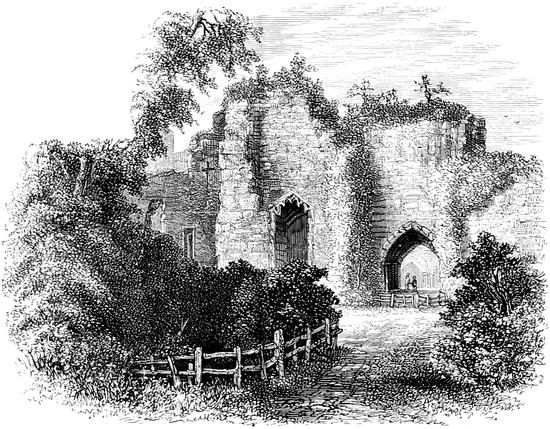
GOODRICH CASTLE (p. 138).
By the time Hay is reached the Wye is fast becoming a stream of considerable size. Now entering Herefordshire, it flows through a broad vale, cultivated and mellow, where Clifford Castle stands a hoary ruin. Here, if history speak true, was born, in the reign of Henry II., one of great and general notoriety, whose name—or nom de guerre, as Dryden has it—is woven richly into the ballads of that and later days; for doubtless her beauty, like her failings, was great, and her death untimely and cruel:—
“Jane Clifford was her name, as books aver; Fair Rosamond was but her nom de guerre.”
Fair Rosamond was born about the year 1140. How much of the story coming to us through the medium of ballads and folk-tales be true, it is now quite impossible to discover, but popular fancy still clings to the idea of a lonely and innocently unfortunate girl installed at Woodstock, protected by a nurse who proved insufficient when pitted against the cunning of a scandalised wife and queen. Fair Rosamond was buried at Godstow, and upon her tomb was carved the famous epitaph:—
“Hic jacet in tumba Rosa Mundi, non Rosa munda: Non redolet, sed olet, quæ redolere solet.”
The railway has not improved the situation of this old castle:—
“Clifford has fallen—howe’er sublime, Mere fragments wrestle still with time; Yet as they perish, sure and slow, And, rolling, dash the stream below, They raise tradition’s glowing scene,— The clue of silk, the wrathful queen; And link in memory’s firmest bond The love-lorn tale of Rosamond.”
Passing between wooded eminences, broad fields, and peaceful farms, the Wye at length reaches the suburbs, and then the ancient city of Hereford.
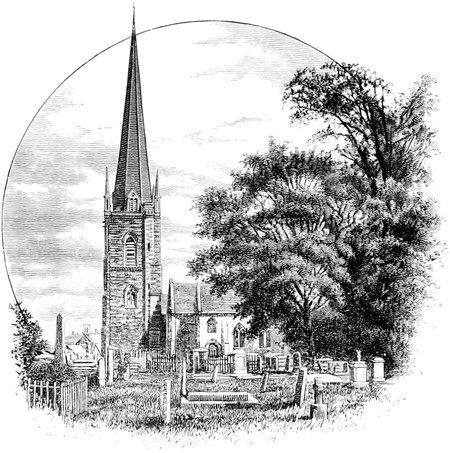
ROSS CHURCH (p. 136).
Hereford was a town of importance even at the dawn of English history. Outside its walls stood the palace of Offa, the greatest of all the Mercian princes; and during the reign of the Mercian kings it was the principal town of Mercia. Ethelfleda, sister of Edward the Elder, governed the place with great skill, and she it was who constructed the castle that guarded the town, and constructed it so well that it proved to be one of the strongest in all England. Leland has this to say of the keep: “High, and very strong, having in the outer wall ten semicircular towers, and one great tower within”; and adds that “it hath been one of the largest, fayrest, and strongest castles in England.”
Here, again, the wily Llewelyn comes upon the scene, for he led his men from the fastness of the Upper Wye, pillaged and burnt the place, murdered the bishop and his assistants, set the cathedral ablaze, and left what had been a fair town a mass of smouldering ruins.
A visitor to this ancient city will find it hard to realise that anything but peace and goodwill ever reigned in all the district, for in these days of bustle and worry it would be difficult to discover in all Great Britain a more placid, steady-going, self-satisfied city than Hereford. Well laid out, clean, at least reasonably well-to-do—although it does not lay claim to be a place of great industry, relying more upon the church and the market than upon the manufactory—there seems to be a perpetual air of Sunday hovering over the town. The very visitors—and they are many—move soberly about the streets, and appear to have become imbued with the spirit of the place. No one can be many minutes in Hereford without detecting that not only the people but the very buildings take their key from the grand cathedral that, calmly gazing into the face of Time, has seen of men and houses generations come and generations go.
Hereford as an ecclesiastical centre is one of the most ancient in Great Britain, but until the commission of Offa’s grievous crime it must have been comparatively unimportant, with a small wooden structure for a church. Offa’s perfidy changed all that. It will be remembered that the ruthless prince treacherously induced Ethelbert, King of the East Angles, to visit his Court, where he had him foully murdered, and buried in the church. Offa, of course, then seized Ethelbert’s crown. Having secured this, and being safely installed in the place of his murdered guest, he found time to repent; and that his repentance might seem the more real, he endowed with great riches the church in which lay the body of his victim, and soon the wooden building gave place to a stone edifice. No doubt the king’s offerings greatly assisted in founding Hereford on a solid ecclesiastical basis, but the effect of his gifts was evanescent, compared with the value of his victim’s bones, as an attraction to the devout. Ethelbert’s remains had not long been buried in the cathedral ere they began to work miracles, and soon great numbers of people from near and from afar sought the good saint’s assistance, so that great riches flowed to the church and town; and from that day to this Hereford has continued to prosper.
For two hundred years the church built over the bones of Ethelbert stood, before the Welsh, as has been told, laid the place in ruins. In 1079 Bishop Robert of Lorraine began to rebuild, and the work was not completed until early in the sixteenth century. This is the building—many times restored—that stands to the present day. More than a hundred years ago (in 1786) the western tower collapsed, bringing down with it most of the west front, and this, as well as many other parts of the cathedral, was rebuilt.
Inside the cathedral are many interesting monuments of men who played large parts in the history of England, and, besides these, the cathedral has a unique treasure in the far-famed “Mappa Mundi,” a production of one De Haldingham, who lived in the fourteenth century. This map, if not the oldest, is at least one of the very oldest in the world. Havergal says of it: “The world is here represented as round, surrounded by the ocean. At the top of the map is represented Paradise, with its rivers and trees; also the eating of the forbidden fruit and the expulsion of our first parents. Above is a remarkable representation of the Day of Judgment, with the Virgin Mary interceding for the faithful, who are seen rising from their graves, and being led within the walls of Heaven. The map is chiefly filled with ideas taken from Herodotus, Solinus, Isidore, Pliny, and other ancient historians. There are numerous figures of towns, animals, birds, and fish, with grotesque customs such as the mediæval geographers believed to exist in different parts of the world. The four great cities are very prominent—Jerusalem as the centre of the world; Babylon, with its famous tower; Rome, the capital of the world ... and Troy.... In Great Britain most of the cathedrals are mentioned, but of Ireland the author seems to have known very little.” Truly a wonderful record of the geographical knowledge of the Middle Ages!
Hereford was the birthplace of Nell Gwynne, orange-seller, actress, and Court favourite—short, red of hair or nearly so, and with feet so small as to cause general amusement. The street in which she was born is now called Gwynne Lane, and the place is still pointed out to tourists who are interested in the story of the famous beauty. David Garrick also was born in the city.
Before leaving Hereford, it may be worth while to note that here, as at many other places, it was once the custom to insert a clause in the indentures of apprentices “that they should not be compelled to live on salmon more than two days in the week.” Needless to say, no such clause is now necessary. In 1234 the wolves became so numerous about the outskirts of the city, that a proclamation called upon all the king’s liege people to assist in destroying them.
And now leaving the cathedral city, our river flows under the Wye Bridge, built so long ago as 1490, with six noble arches, and proceeds on its way towards Ross. Four miles below Hereford, the most important of all the tributaries that spill their floods into the winding Wye is met with. This is the Lug, which itself absorbs the waters of several smaller rivers on its way southwards. The meeting of the Lug with the Wye takes place at the little village of Mordiford, where once upon a time an enormous serpent, winged and awful, used to betake itself from feasting upon men and women and little children to drink of the waters of the Wye. This terrible serpent was destroyed by a malefactor, who was offered a pardon should he accomplish the task of ridding the good people of the sore pest; and it is sad to learn that in killing the serpent he inhaled so much of its poisonous breath that he died almost at the same time as the monster he had brought low. But the results of a later event, almost as important, and awe-inspiring, are to be seen not far from this part of the Wye. They are known as “The Wonder,” a mile and a half from Woolhope, in a parish which, one would think, should be called Miracle, but is really called Marcle. To best describe what “The Wonder” is, we will quote Sir Richard Baker’s “Chronicles of England” as follows:—“In the thirteenth year of Queen Elizabeth a prodigious earthquake happened in the east part of Herefordshire, at a little town called Kinnaston. On the 17th of February, at six o’clock in the evening, the earth began to open, and a hill, with a rock under it, making at first a great hollowing noise which was heard a great way off, lifted itself up and began to travel, bearing along with it the trees that grew upon it, the sheepfolds, and flocks of sheep abiding there at the same time. In the place from whence it was first moved it left a gaping distance 40 foot broad and fourscore ells long: the whole field was about twenty acres. Passing along, it overthrew a chapel standing in the way, removed a yew-tree planted in the churchyard from the west to the east; with the like force it thrust before it highways, sheepfolds, hedges, the trees; made tilled ground pasture, and again turned pasture into tillage. Having walked in this sort from Saturday evening till Monday noon, it then stood still.” Surely, this is a record, even in the land of Saturday-to-Monday trips!
SYMOND’S YAT (p. 140).
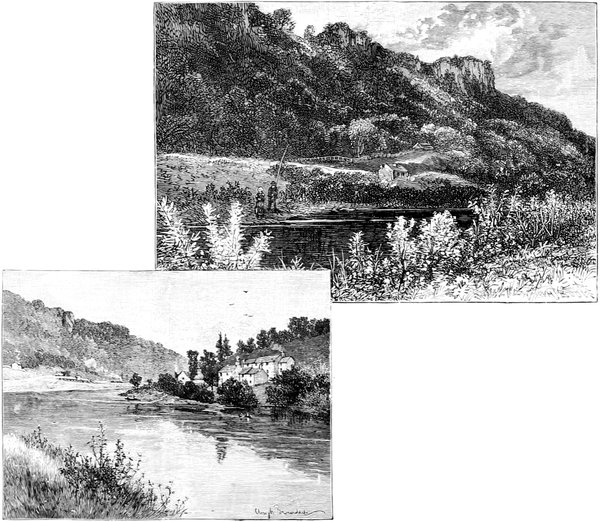
THE FERRY, SYMOND’S YAT.
Between Hereford and Ross the Wye flows quietly, and without many striking features, either as regards the scenery or the stream itself. Upon its breast float pleasure-boats in great numbers, although in the dry season of the year, unless the midmost channel is rigidly adhered to, numbers of shallows interrupt the passage even of skiffs of light draught, for the river occasionally spreads out to a great surface, and runs proportionately shallow over rock and gravel. Indeed, it is not until the ancient town of Ross is reached that the Wye becomes a general favourite with the floating population.
Ross, as seen from the surrounding country, appears to be standing a-tiptoe, trying to touch the sky with the tip of its beautiful spire. The church with its slender spire attracts the eye from a great distance—it is, to all appearances, the one prominent object in all the country round about—and the first sight of it has caused travellers to sigh, for to see it for the first time is to be a long, long way from it. Here in this tiny town of Ross lived and died a man whose name is known, one might say, not at all, but whose descriptive appellation, given to him whilst he was still alive, will be recognised the world over. This is John Kyrle, “The Man of Ross.”
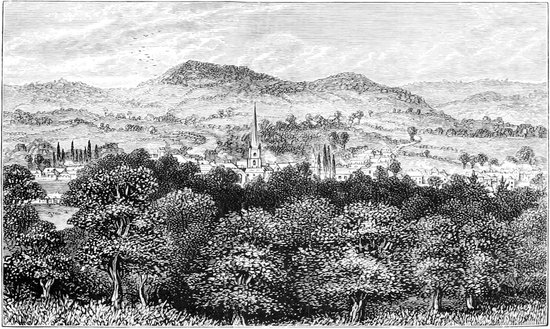
MONMOUTH (p. 141).
The history of the town of Ross is principally a mass of details, authentic and apocryphal, regarding the life, times, and labours, the recreations, walks, works, and ways of “The Man of Ross.” Few places are so entirely given up to the memory of one man as is Ross to the memory of John Kyrle. Everywhere in that quaint and clean little town, “The Man of Ross,” in some form or other, meets the eye. Here his favourite walk, there the park he gave to the people, again the pew in which he worshipped, the house in which he lived, the buildings he reared, the streets he made—everything tells of John Kyrle. He was born in the year 1637, and was educated at Balliol College, Oxford, where is still to be seen a silver tankard bearing his name. As this tankard holds five pints, it is to be inferred that the student who was to become “The Man of Ross” was a lusty drinker, although in after-life he proved himself to be a man of abstemious habits. His long life—he died aged eighty-eight—was devoted to doing good to all whom he could help, improving not only man but town and country as well:—
“But all our praises why should lords engross? Rise, honest Muse! and sing the Man of Ross: Pleased Vaga echoes through her winding bounds, And rapid Severn hoarse applause resounds. Who hung with woods yon mountain’s sultry brow? From the dry rock who bade the waters flow? Not to the skies in useless columns tost, Or in proud falls magnificently lost, But, clear and artless, pouring through the plain, Health to the sick, and solace to the swain. Whose causeway parts the vale with shady rows? Whose seats the weary traveller repose? Who taught the heaven-directed spire to rise? ‘The Man of Ross,’ each lisping babe replies.”
So says Pope in his “Moral Essays,” and, in saying this and much more about the good man, scattered the fame of John Kyrle far and wide. It is pleasant to know that a man who showed himself so solicitous that others should taste of enjoyment was able himself to take great delight in simple things. “He dearly loved a goose,” says Leitch Ritchie, “and was vain of his dexterity in carving it. During the operation, which he invariably took upon himself, he always repeated one of those old sayings and standing witticisms that seem to attach themselves with peculiar preference to the cooked goose. He never had roast beef on his table save and except on Christmas day, and malt liquors and good Hereford cyder were the only beverages ever introduced.”
The good man’s bones rest in Ross Church, the spire of which he had repaired; and to this day are shown the trees that have forced a way through chinks in the wall and floor of the building, so that their branches and leaves might droop as though in the attitude of mourning over his grave. From the churchyard there is to be had a magnificent view of the Wye sweeping in a great curve far below, the waters hastening on to lose themselves in the Severn. From Ross to the mouth of the Wye, those who can afford the time should make the journey by boat. It will be well to discard the use of adjectives and exclamations in taking this trip, for the most gifted in the use of these parts of speech will speedily find themselves at their wits’ end for words to express their admiration of the scenery.
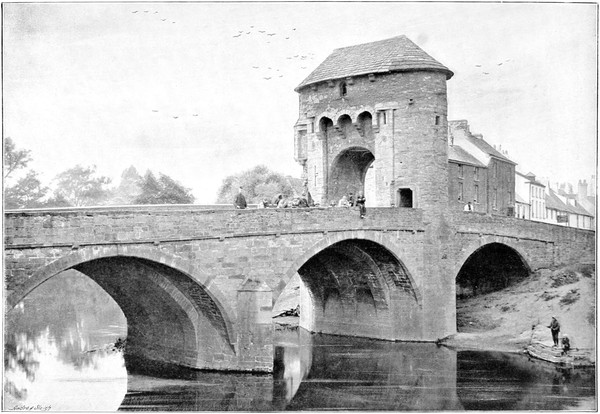
Photo: R. Tudor Williams, Monmouth.
THE MONNOW BRIDGE AND GATE-HOUSE, MONMOUTH (p. 141).
Midway between Ross and Monmouth stands Goodrich Castle, grandly seated upon a steep, heavily-wooded hill—a castle built so long ago that the memory of its beginning is lost, in the haze of ancient days. During the Civil War it was besieged and at length successfully stormed by the Roundheads, in 1646. It is in form a parallelogram, having a tower at each angle, and a keep in the south-west part of the enclosure; and, viewed from the Wye, it is a splendid ruin, trees that cling to the face of the cliffs heightening the effect of the picture. The Wye, flowing swiftly, soon sweeps one’s boat round its many bends, until the district known as the Forest of Dean is reached, lying between the Wye and the Severn. Striking scenes of stream and forest-clad cliffs, of castles and courts, of abbeys haunted by memories of events rich in historical interest, now follow one another as rapidly as changes in a kaleidoscope. Courtfield claims the honour of being the place where Henry V. was nursed; and there is a cradle to substantiate the claim. After passing Mailscot Wood, the river forms itself into a loop like an elongated horseshoe. On one side of the narrow neck of land are the famous Coldwell Rocks, the beginning of the great limestone cliffs that, onward to the sea, hem in the stream, and carry on their rugged sides clinging woods and ivy. Rains and storms have beaten these Coldwell Rocks into fantastic shapes, until to the traveller who first sets eyes upon them they seem to be castles cut out of stone by a race of mighty giants. “Castles and towers, amphitheatres and fortifications, battlements and obelisks, mock the wanderer, who fancies himself transported into the ruins of a city of some extinct race.”[8]
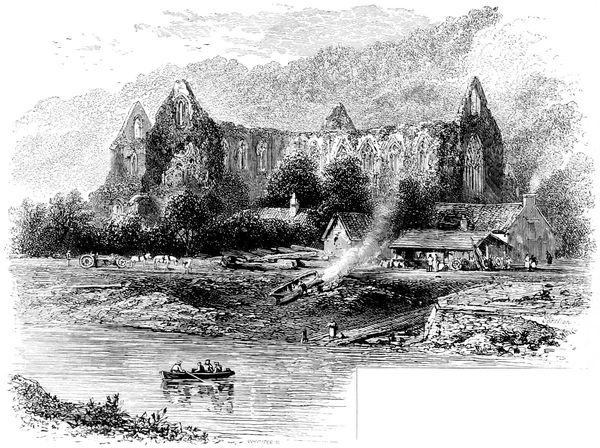
TINTERN ABBEY, FROM THE WYE (p. 145).
Anyone who has seen the beauty of both the Moselle and the Wye must be struck by the similarity between the two rivers. The Moselle, to be sure, is in every way more important than the Wye—in depth and breadth of stream, in height of the bluffs that at many points form the banks, and in the number of castles that crown the hills; but, notwithstanding these differences, they might almost be called twin rivers. There are no neatly-trimmed vineyards sloping down the sides of the Wye heights, but, on the other hand, the Moselle cannot show such grand forests as can the English stream. And each river, at least once in its course, doubles back upon itself, so that the spectator can trace the loop, and see the stream flowing far beneath on either hand. At Symond’s Yat, a little below Coldwell Rocks, the neck of land that divides the Wye from itself is only some 600 yards across; and by standing on the rocky plateau, one may see the river flowing by on both sides. The prospect, one of the finest in all England, embraces large parts of Gloucestershire, Herefordshire, and Monmouthshire, including Coppet Hill, Huntsham, Rocklands, Whitchurch, Goodrich Castle, Coldwell Rocks, the Forest of Dean, Courtfield, and—it is difficult to escape this—the spire of Ross Church.
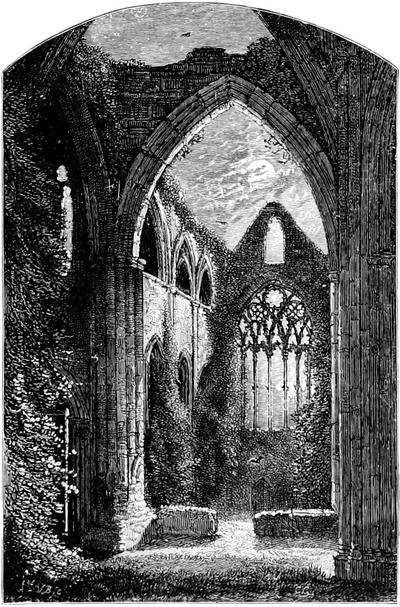
THE NAVE, TINTERN ABBEY.
In hurrying between these gigantic cliffs, and sweeping round the loop, it is only natural that the Wye, born with a turbulent disposition, should have many savage encounters with the rocks; and, now grown so mighty, the waters roar their anger in deep-lunged notes. Many obstacles impede the course of the stream, for storms still continue occasionally to hurl great masses of rock from their positions; and altogether, were one to be given the choice of seeing only one part of the Wye, Symond’s Yat should be the chosen spot.
Passing between Lords Wood and Lady-Park Wood and skirting Greatwood and Newton Court, the Wye arrives at Monmouth. Encircled by hills, and itself seated high, this town, still unspoiled by the modern builder and restorer, occupies a position between the Wye and the Monnow. Monmouth has had its ups and downs; for long before the Conquest a fortress existed here, and to build a castle has ever been to invite a siege. In the days of Henry III. the castle was levelled with the ground so effectively that Lambarde writes: “Thus the glorie of Monmouth had clean perished; ne hade it pleased Gode longe after in that place to give life to the noble King Henry V., who of the same is called Henry of Monmouth.” John of Gaunt lived here, and Henry IV. also, and, as the ancient writer says, Henry V. was born in the castle. This event has not been forgotten, for a statue of the popular king stands opposite the Town Hall in Agincourt Square, the centre of the town. In more ancient days Monmouth was a walled town, and one of the four gates of the wall still stands; and a bridge built in 1272, remarkably narrow, but sturdy and strong, still spans the Monnow; while the meagre ruins of the castle look down from the brow of the river-cliff on the meadows by this tributary stream. St. Mary’s Church has a spire 200 feet in height; St. Thomas’s Chapel, dating from the days of the Normans, stands in the centre of the part of the town which used to be given up to the making of the renowned Monmouth cap, of which Fuller, in his “Worthies,” says: “These were the most ancient, general, warm, and profitable coverings of men’s heads in this island. It is worth our pains to observe the tenderness of our kings to preserve the trade of cap-making, and what long and strong struggling our State had to keep up the using thereof, so many thousands of people being thereby maintained in the land, especially before the invention of fulling-mills, all caps before that time being wrought, beaten, and thickened by the hands and feet of men, till those mills, as they eased many of their labour, outed more of their livelihood.” Not far from the parish church is the picturesque remnant of a Benedictine priory, founded in the reign of Henry I. by Wyhenoe, third Lord of Monmouth; and here it is not improbable that Geoffrey of Monmouth, compiler of the fabulous “History of the Britons,” out of which grew the Poem of the Table Round, was educated.
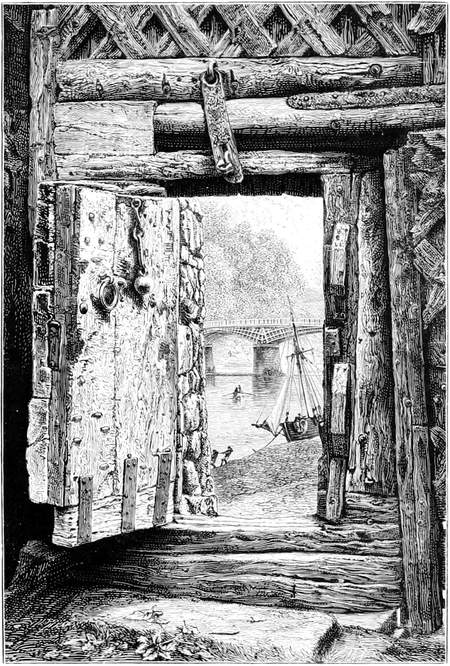
GATEWAY AT CHEPSTOW.
The Monnow, which flows into the Wye below Monmouth, has for its chief tributary the Dore, which winds its way through that delightful region known far and wide as the Golden Valley. This valley is fitly styled Golden, though it has received its designation from a mistaken derivation of its name, which means “water”—that and nothing more—being but a form of the Welsh dwr. Round it ring the hills, not bald and craggy, nor morass-bound, but gentle and lush and green, for the valley lies just out of the grip of the mountainous districts of Wales. Here the fields are fresh, the undulations capped with glorious trees, and the whole valley is chequered with tints; for it is a region rich of soil, and highly cultivated. One of the most interesting places on the banks of the stream is the little village of Abbey Dore, where is the remnant of an ancient abbey, now forming the parish church. It was begun for the Cistercians, by Robert of Ewias, in the reign of Henry I., but was only finished in the days of the third Henry. Not less attractive to the antiquary is the tiny Norman church of Kilpeck, celebrated for the richness of its decorations. Near by there once stood a castle, but of this nothing now remains but the mound, a deep moat, and fragments of the walls.
Another tributary of the Monnow is the Honddu, which flows down through the Vale of Ewias, past the ruins of Llanthony Priory. This famous house seems to have been founded in the early years of the twelfth century by William de Lacy, a Norman knight, and Ernisius, chaplain to Maud, wife of Henry I. At first it had a prosperous career, but the wild Welshmen soon fell upon it, and the Prior and his brethren were forced to betake themselves to the more peaceable regions of Gloucestershire. When men and times became quieter, however, the monks returned. The remains of the Priory are still beautiful. In 1809 Walter Savage Landor purchased the estate on which they stand, and set about making great improvements. Mr. Colvin, in his “Landor,” says: “He imported sheep from Segovia, and applied to Southey and other friends for tenants who should introduce and teach improved methods of cultivation. The inhabitants were drunken, impoverished, and morose: he was bent upon reclaiming and civilising them. The woods had suffered from neglect or malice: he would clothe the sides of the valley with cedars of Lebanon. With that object, he bought two thousand cones, calculated to yield a hundred seeds each, intending to do ten times as much afterwards, and exulting in the thought of the million cedar-trees which he would thus leave for the shelter and the delight of posterity.” All Landor’s schemes, however, came to nought. Before long he found himself in embarrassed circumstances: Llanthony was, by arrangement, taken out of his hands and vested in those of trustees, and his half-built mansion was pulled down.
A little below Monmouth the Trothey, a much smaller stream than the Monnow, also joins the Wye. The banks from Monmouth onwards to the sea are steep and well wooded, and for the greater part of the way a splendid and well-kept road winds along the side of the right bank. Far below, the river is continually appearing and disappearing; and the trees dig their feet into the rocks and seem precariously to cling as they dip down towards the stream. Occasionally a cliff more than usually near to the perpendicular has managed to ward off the encroaching growths of forest and bush and ivy, and to stand bold-faced to the sun; but generally there is foliage to make more refreshing to the sight the precipitous banks.
Rivers have ever attracted to their banks poets, who of all men most closely search the heart of Nature in her peaceful and gentle moods; but few streams have enjoyed the good fortune of the Wye to have their very spirit caught and shaped into imperishable verse. Wordsworth’s noble poem, “Lines composed a few miles above Tintern Abbey, on revisiting the banks of the Wye during a tour, July 13th, 1798,” breathes the inmost soul of river and hills, and of the tranquil, meditative atmosphere that fills the glorious valley. No poet has held his ear so close to Nature’s bosom as Wordsworth, and in these lines he has pictured and glorified the Wye as no pen may hope to picture and glorify it again. To quote but the opening score of lines:—
“Five years have passed; five summers, with the length Of five long winters! and again I hear These waters, rolling from their mountain springs With a sweet inland murmur. Once again Do I behold these steep and lofty cliffs That on a wild secluded scene impress Thoughts of more deep seclusion; and connect The landscape with the quiet of the sky. The day is come when I again repose Here, under this dark sycamore, and view These plots of cottage-ground, these orchard-tufts, Which at this season, with their unripe fruits, Are clad in one green hue, and lose themselves Among the woods and copses, nor disturb The wild green landscape. Once again I see These hedgerows, hardly hedgerows, little lines Of sportive wood run wild; these pastoral farms, Green to the very door; and wreaths of smoke Sent up, in silence, from among the trees!”
Meditation, contemplation, serenity, each not unmixed with pathos, are the keynotes of this part of the Wye valley; and our river would have done well enough if not another poet had ever afterwards sung of its banks and flood. But this was not to be its fate: for has not Tennyson told us in “In Memoriam” how “half the babbling Wye” is hushed by the Severn, whose mightier tide drives back its flood?—
“The Wye is hushed, nor moved along, And hushed my deepest grief of all When filled with tears that, cannot fall I brim with sorrow drowning song. “The tide flows down, the wave again Is vocal in its wooded walls; My deeper anguish also falls, And I can speak a little then.”
It is at the Bargain Pool, past the pretty village of Llandogo, that the Severn tide is first met. Now, although the scenery is sublime, there can be no gainsaying that the rise and fall of the tide mars the beauty of the Wye. Instead of the clear mountain water, the stream is turbid, and at low tide the banks present great stretches of soft mud. For the first time the stream now takes on a commercial aspect, lazy barges floating up and down, and a few enterprising little steamers making their cautious way round the sharp bends.
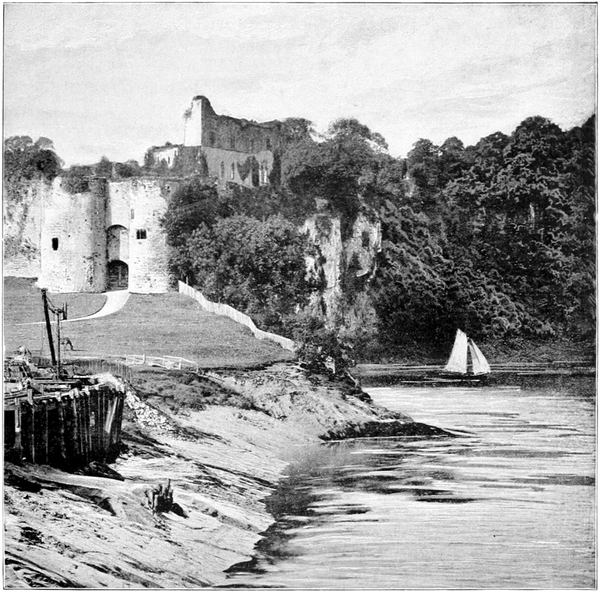
Photo: Harvey Barton, Bristol.
CHEPSTOW CASTLE (p. 146).
But forgetting the blemish, if blemish it be, the traveller can set his thoughts upon and his face towards one of the most inspiring of all the ancient memorials of England’s past, the home of the Cistercian monks dedicated to the Virgin Mary—Tintern Abbey. Coming round a bend in the river one catches sight of the beautiful ruin with startling suddenness. It stands close by the waterside, on what was once a meadow stretching away from the Wye. Here the hills rise in a complete circle, and nestling in the midst of this amphitheatre is the abbey, a ruin, it is true, yet not so mutilated by the hand of Time as to make it impossible or even difficult at this day to imagine it as it stood in all its completeness and beauty. Whether Tintern, unspoiled by Time and neglect, was as impressive as it is in its decay, though the greenest of green grass now grows on the floor once trodden by the white-robed monks, and the rooks sit in a jet-black line on the top of the roofless walls—one may very well doubt. Those who have passed even a day in and about the ancient abbey will find it easy to believe that its history is one of serenity and peace. The hills that ring it round stand like a cordon of mighty giants to beat back all worldliness that would enter the charmed circle. The very air hangs heavy and still, and the river, forgetting its wild youth and stormy middle age, passes by, if one might so describe it, with bared head and hushed breath. Here for hundreds of years lived successive generations of monks, having little, wanting little, passing their days in the deepest peace and solitude; and though they have long since vanished, they have left behind them what is perhaps the finest monastic ruin in the kingdom.
Shortly after the dawn of the twelfth century one Walter de Clare founded Tintern for Cistercian monks, and in the thirteenth century a lord of Chepstow, Roger de Bigod, built the abbey. Cruciform in shape, it was 228 feet in length, 70 feet high, and 37 feet in breadth, with transepts 150 feet long. When King Henry VIII. took possession of the monasteries, he allowed this to fall into rapid decay, and at length presented it to the Earl of Worcester. The ruins now belong to the Duke of Beaufort, and they are watched and guarded from further decay with admirable vigilance, each particular stone being carefully noted, and every moulded arch and mullioned window—indeed, the very ivy and grass—receiving close attention. The magnificent eastern window, 64 feet in breadth, is but one feature of a ruin that attracts multitudes of visitors to the valley of the Wye.
Between Tintern and the little metropolis of the lower Wye, Chepstow, duty to one’s sense of sight requires him to scale the summit of Wyndcliff. Once on top, nine counties, according to Bevan, can be seen—to wit, Gloucester, Somerset, Wilts, Devon, Glamorgan, Monmouth, Brecknock, Hereford, and Worcester. Not only for the curiosity of a prospect which in its sweep takes in so many shires, but also for the beauty of the view, this ascent of the Wyndcliff should not be missed. For an exquisite blending of rock and river, forests, mountains, and plain, towns and villages, ruins and farmhouses, roads like white-silk threads blown upon the face of the land, black railways, drifting ships, it is not too much to say that the finest views in all the land can do no more than claim to be its peer.
After we have passed on the left Llancaut and on the right Pierce Woods, the sturdy old town of Chepstow comes into view. The castle, from the river, seems to have grown out of the living rocks, which here rise sheer from the water to a great height, and form a natural defence that must have rendered the fortress impregnable to all attack from the water. Supposed to have been built in the eleventh and rebuilt in the thirteenth century, it experienced its most stirring times in the days of the Civil War. It was held by the Royalists; and there first appeared before it Colonel Morgan, who, with singular valour and determination, carried it by assault. Later on Sir Nicholas Kemys successfully surprised the place, which action brought before the battlements Cromwell himself, who, however, could not spare the time personally to direct the operations. His substitute, Colonel Ewer, with great skill conducted the siege, and ultimately forced the king’s men to throw open the gates.
VIEW FROM THE WYNDCLIFF.
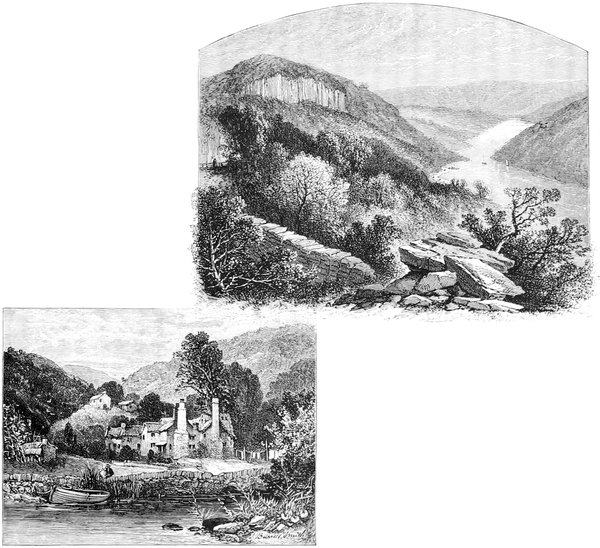
OLD MONASTERY ON THE WYE.
Several parts of an ancient wall that once surrounded Chepstow still remain, with the watch-towers complete; and one gate dating from the sixteenth century—the Town Gate—still stands, a curious archway across the principal street, a thoroughfare that slopes steeply down to the Wye. A church of great antiquity is Chepstow Church, built in the days of the Normans, and containing several monuments of unusual interest, with the grave of Henry Marten, one of the signatories of King Charles’s death-warrant, who spent many long years as a prisoner in Chepstow Castle. One of the towers of the castle is called Marten’s Tower, an unintended commemoration of the Roundhead’s imprisonment within its walls.
Bidding a final good-bye to towns and tributaries, but still retaining its rugged banks and, in a measure, its stately woods, the Wye makes straight for the sea, where this child of the mountains, after swallowing the largess brought down to it by a score of smaller streams, is itself, in turn, swallowed in the greater flood of the Severn. To the very last, however, the Wye retains its individuality and character—picturesque ever, picturesque to the end. From its fount on Plinlimmon to the end of its course of a hundred and thirty miles, where it gracefully rolls into the broad estuary, it has scarcely ever, even for a mile, been commonplace.
E. W. SABEL.
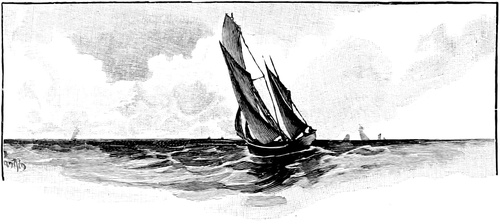
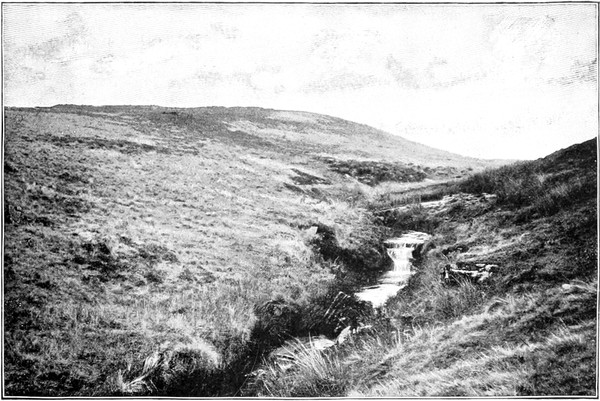
NEAR THE SOURCE OF THE USK, TALSARN-SIDE.