RIVERS OF SOUTH WALES.
Reading edition
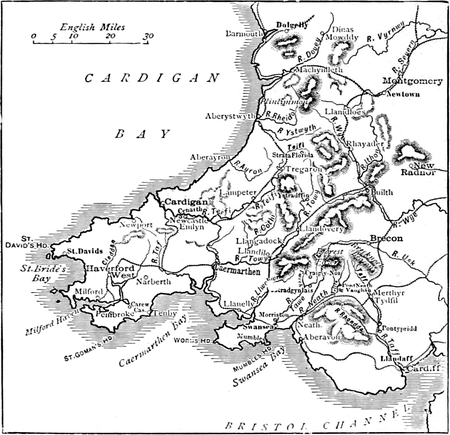
Brecknock Beacons—The TAFF: Taff Fawr and Taff Fechan—Cardiff Reservoirs—Merthyr—The Dowlais Steel and Iron Works—The Rhondda—Pontypridd—Castell Coch—Llandaff and its Cathedral—Cardiff and its Castle. The NEATH: Ystradfellte—The Mellte and its Affluents—The Cwm Porth—Waterfalls and Cascades—The Sychnant—Pont Neath Vaughan—Neath and its Abbey—The Dulas and the Clydach. Swansea and its Docks—Morriston Castle—Swansea Castle—The Mumbles and Swansea Bay. The TAWE: Craig-y-Nos—Lly-Fan Fawr. THE TOWY: Ystradffin—Llandovery—Llandilo—Dynevor Castle—Carmarthen and Richard Steele—Carmarthen Bar. The TAF: Milford Haven—Carew Castle—Pembroke Castle—Monkton Priory—New Milford and Old Milford—Haverfordwest. The TEIFI: Strata Florida Abbey—Newcastle Emlyn—Cenarth—Cardigan. The YSTWITH: The Upper Waters—Aberystwith.
THE bold-headed, ruddy Brecknock Beacons and their neighbouring heights of the Fforest Fawr are, between them, to be held responsible for the nativity of three important streams of South Wales: the Taff, the Neath, and the Tawe. Not one of these streams is navigable, and they all have courses trivial enough compared with the Severn, the Usk, or the Wye. They are, however, quite strangely remarkable for their natural beauty, and for the scars on their beauty due to the mineral wealth of the valleys they drain. Nowhere in Great Britain is there more fascinating glen scenery or more sequestered and picturesque waterfalls than on the Neath and its tributaries. Yet Neath itself is a grimy town, and the river, which, ten miles to the north, wins admiration from everyone, here flows discoloured amid ironworks and coal mines, with all their ugly rubbish heaps. The Taff and the Tawe begin among heather and bracken, loftily and crystal clear; and they end alike, brown as canals in manufacturing districts, the one among the shipping of Cardiff, and the other in the blackest and most forbidding part of Swansea.
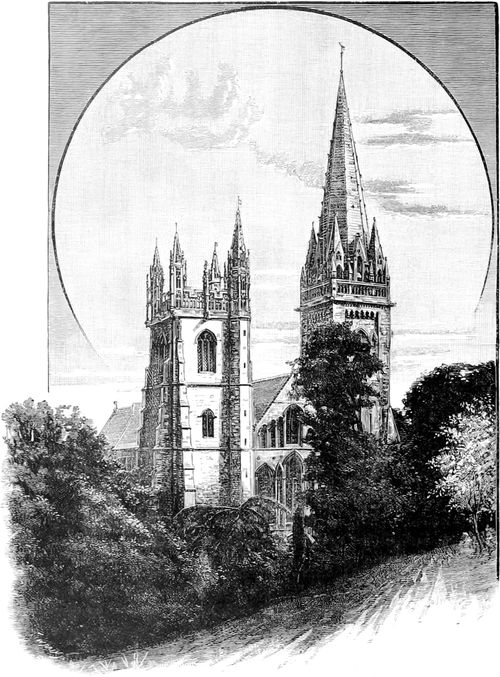
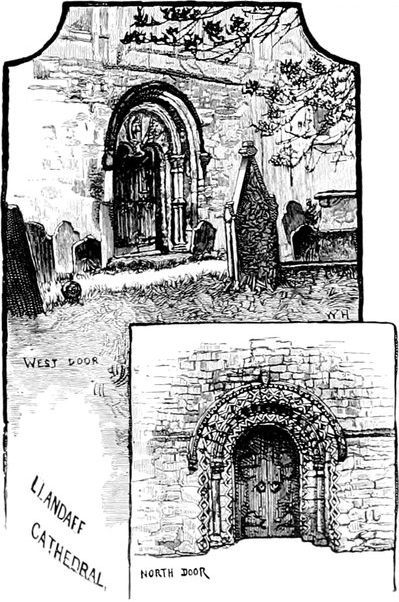
LLANDAFF CATHEDRAL: THE WEST FRONT (p. 164).
In all Wales there is no finer little group of mountain-tops than the Brecknock Beacons, as seen from the south. Pen-y-Fan, the highest summit, stands 2,910 feet above sea-level, and 500 feet less above the town of Brecon, some five miles to the north. The Beacons are an isolated society, separated by the Usk and its valley from the Black Forest Mountains east, and by the deep Glyn Tarel from the irregular mountain mass whence Tawe springs to the light. Their bases lie set among charming pastoral nooks. Above, they are good to see when autumn has made tawny the acres of their bracken; and at the summits they vie with each other in the redness of their precipices, that of Pen-y-Fan rightly winning the day with a sheer slide of rock some 600 feet deep, at an angle of about 70 degrees.
Many are the legends that animate the Beacons. Enough if we believe with certain of the bards that it was here, on Pen-y-Fan, that Arthur called his chivalry together, and initiated the Order of the Knights of the Round Table. In the land of the Red Dragon, centuries ago, there could be no higher dignity than to be associated with him who was to appear for the glory of Britain: “the lamp in darkness”:—
“In forest, mountain, and in camp, Before them moved the Burning Lamp; In blackest night its quenchless rays Beckoned them on to glorious days.”
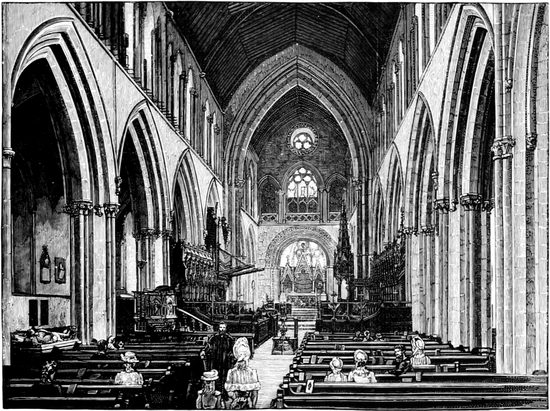
Photo: F. Bedford, by permission of Catherall & Pritchard, Chester.
LLANDAFF CATHEDRAL: THE NAVE AND CHOIR (p. 164).
Having clambered, not without considerable exertion, to Pen-y-Fan, the traveller, if he feels thirsty, has but to turn his back to the north, face the distant smoke clouds above the hills of Merthyr and Rhymney, and walk a few yards down the western slope of the mountain. Here are two ice-cold springs, the parents of baby rivulets. Below you see how briskly these rivulets broaden and unitedly carry the pure water to the south. This is, in fact, one of the two main sources of the Taff. The other also is on the Beacons. The two streams, Taff Fawr and Taff Fechan (the “Great” and “Little” Taff), run parallel, in respective glens, among heather and rocks, for eight or ten miles, to join just above Merthyr. Pollution of all kinds comes to the stream as soon as it is thus fully entitled to be called the Taff.
Even before Merthyr is reached, Taff Fawr has learnt something of the pains and penalties of an industrial district. Ere it has run five miles from its source, it falls into the hands of the Cardiff Corporation. Its valley is here a characteristic mountain glen, with heathery solitudes on either side, and little clefts among the heather by which nameless affluents bring their pure tribute to the main stream. Houses there are none. But of a sudden, in all this loneliness, you come to a huge dam built and building across the valley from east to west, and beyond you perceive the goodly lake of which the rising dam is to be the mighty northern boundary.
RIVERS OF SOUTH WALES.
Yet farther south are other evidences of Cardiff’s great thirst. Our Taff is again enclosed, and flows through a second reservoir, proceeding out of it by a series of prepared waterfalls, not unpicturesque, though they have artificial flagged beds and precise parapets. Here, however, one may almost look one’s last at Taff the pellucid. The area of toil and sophistication is at hand. Yet some four miles above Merthyr the river has one notable reach of beauty. There is a ruined turnpike house to hint of the time of “Rebecca,” when this part of Wales rose in arms and fought toll-bars as ancient Wales fought the Normans of the Marches; and high above the wrecked house are some precipitous limestone cliffs, with jackdaws always circling about their crests. Taff lies in a deep bed here, with woods on the western slopes where its waters wash them. It rose in the old red sandstone of the Beacons: it has now come to the carboniferous limestone and to the coal-measures to which South Wales owes its phenomenal prosperity.
Merthyr would be a pretty place if it were not sullied by smoke beyond redemption. The hills, studded with chimneys, cumber each other; and in all the adjacent hollows, high up and low down, are manufactories. The people wear clogs. As in other such busy centres, they seem happy enough, and by no means tearful about the local desecration of Nature. But it must be admitted that they are grimy, like their environment.
Of all the large manufactories round Merthyr, those of the Dowlais Steel and Iron Works, two miles away (a constant ascent), are the most considerable. One may doubt, perhaps, if these are now the largest of their kind in the world, but they are still very extensive. A recent report tells us that they consist of eighteen blast furnaces, producing about 700 tons of iron and 2,400 tons of steel rails per week, and that their collieries can lift 3,700 tons of coal daily. Founded about a hundred and fifty years ago, they have been a staff of life to millions. Few sights of the kind are more impressive than the manipulation here of the huge cruses of molten steel, and the methodical treatment of the ores, which develop in a few hours into red-hot steel rails from thirty to sixty yards long; or than the cutting of these substantial rails into sections by a serrated disc which makes some 1,600 revolutions a minute.
The “Dowlais Lights,” as they are called, flash at times high over the mountains to the north. The landlord of the little inn at Devynnock called the writer out at night to see them. “It’s a sign of rain, for certain,” he said. Tradition locally lays down this law; but tradition often errs, and on this occasion the Dowlais lights, seen here twenty miles away, were, as it chanced, the augurs of a glorious autumnal morrow.
From Merthyr downwards Taff flows fast, as if anxious to reach the sea from the uncomely rows of colliers’ cottages which rise so thickly above it. It is still hedged about by mountains, but the mountains are not now “things of beauty.” Quaker’s Yard, Aberdare Junction, and Pontypridd are names of industrial value. At each of these places, “coal” railways from lateral valleys join the Taff Vale line. With these tributary railways descend tributaries for the Taff itself, the river Rhondda (which itself bifurcates higher up into the Rhondda Fawr and Fechan) being the most noteworthy for the volume of its water. The scenery of these affluents is, like that of the Taff itself, imposing, with deep glens and wooded dingles, but mercilessly cut about by capitalists.
Pontypridd deserves particular mention for the famous bridge which gives it its name. In the words of a specialist, this bridge “is a perfect segment of a circle, and stretches its magnificent chord of 140 feet across the bed of the Taff, rising like a rainbow from the steep bank on the eastern side of the river, and gracefully resting on the western—the beau idéal of architectural elegance.” It is the supreme achievement of a local stonemason named Edwards, who, a hundred and fifty years ago, devoted himself to the construction of bridges much as a mediæval artist devoted himself to the Madonnas of his canvases or to his crucifixes. South Wales owes much to Edwards the bridge-builder: we shall meet with his work on the Towy and the Teifi as well as here. In 1755 this “beau idéal of architectural elegance” showed to better advantage than now, when it is surrounded by the common buildings of a mining town; but it was never more useful than at present.
Hence, now wide in a shallow bed, and now narrow and rushing deeply between high banks, gaily wooded in places and mere refuse-heaps in others, Taff speeds towards Llandaff. Three or four miles ere it comes to this tranquil spot, a striking crag is seen on its left bank, with glorious beech woods clothing the steep red slopes of the rock. This is an historic spot: Castell Coch, or the Red Castle. It is such a site as in Rhineland would at one time have given a robber-baron a superb base for his depredations. As such, in fact, it was utilised. We read how, in 1158, Ivor Bach of Castell Coch descended upon Cardiff Castle and carried off the Earl and Countess of Gloucester as prisoners: the event is set forth on canvas in the Cardiff Town Hall. Nowadays the turret that rises above the topmost trees of the crag tells of other exploits. Castell Coch belongs to the Marquess of Bute, and it is here that the wine is grown which, in the opinion of some, is convincing proof that England might, if she would, become a viniferous country. In the Cardiff Exhibition of 1896 a stall was devoted to the sale of Castell Coch wines.
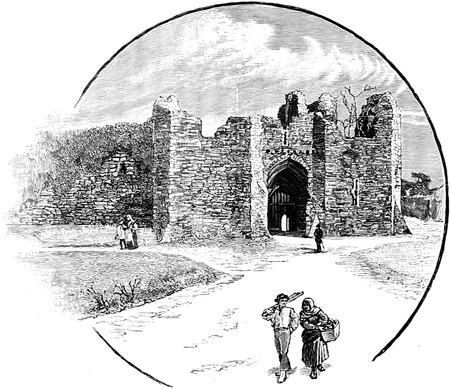
THE PALACE GATEWAY, LLANDAFF (p. 166).
But the graceful spire and tower of Llandaff soon appear, in the midst of green meadows and lofty old trees, to tell of yet other aspirations, with the myriad houses of expanding Cardiff beyond. Its name describes it: Llan-ar-Daf, “the church on the Taff.” It has been spoken of “as the most ancient episcopal see remaining on its original site in Great Britain.” The old records go far to acclaim Llandaff as both venerable and ancient. Lucius, the great-grandson of Caractacus, in the second century A.D., endowed, we are told, four churches from the royal estates, one being Llandaff. A bishop of Llandaff is also said to have died a martyr in the Diocletian persecution. And yet, with such high associations, forty years ago this cathedral was the most desolate and neglected in the land. As it stands, it is eloquent of the whole-hearted labours of two men, chiefly: Dean Conybeare and Dean Williams. Previous to 1857, the cathedral was a picturesque ivied ruin of Perpendicular tower and Early-English roofless walls, with a ghastly eighteenth-century conventicle absorbing what is now half the nave and the east end of the building. The grand old Norman doorways south, north-east, and west, and also the tower, seemed to have outlived their vocation; and the Norman arch of the interior, above the present altar—perhaps the finest thing in Llandaff—was plastered up and totally expunged. The present cathedral owes its origin to the Norman bishop Urban (1107–33), who was dissatisfied with the church—28 feet long, 15 feet broad, and 20 feet high—to the throne of which he had been raised; and its remarkable restoration to the Llandaff architect, John Pritchard, of recent times. It can no longer be described as, by Bishop Bull in 1697, “our sad and miserable cathedral.” Alike within and outside it satisfies by its beauty and good order. The old and the new are well blended here.
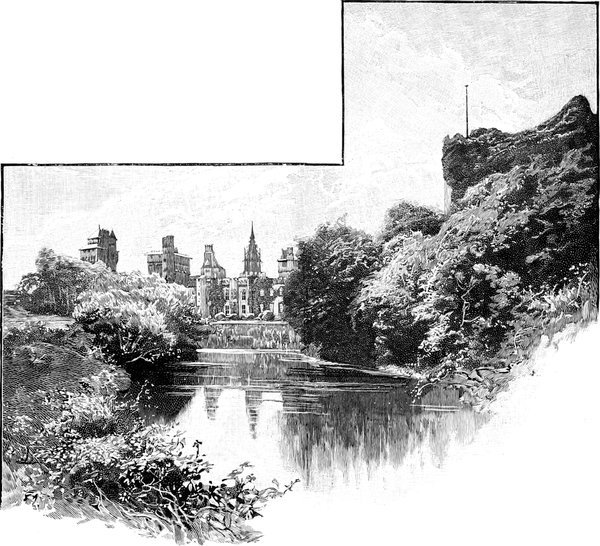
Photo: Alfred Freke, Cardiff.
CARDIFF CASTLE (p. 166).
As a village, Llandaff is now hardly aught except a flourishing suburb of Cardiff. Still, it keeps its individuality, and declines to be incorporated with the great invading town. The remains of the old episcopal palace and the old market-cross consort amicably with the one or two single-storeyed thatched cottages of the village square. The palace gateway has quite a baronial look, but it leads to nothing of particular interest. Bishopscourt, the modern palace, is a more cosy residence than that built by Bishop John de la Zouch early in the fifteenth century, of which this gateway is the most conspicuous relic.
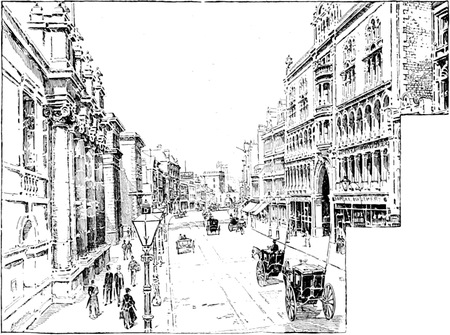
Photo: Valentine & Sons, Dundee.
ST. MARY STREET, CARDIFF.
Of Cardiff, what can be said adequately in few words? It began the century with about a thousand inhabitants; in 1881 its population was 82,671; and now it is about double as much. The Romans had a fort here, which the Welshmen called Caer Didi, or the fort of Didius (Aldus Didius): hence, Caerdydd and Cardiff. Fitzhamon the Norman, about 1095, erected the castle, the substantial fragments of which adorn the grassy courtyard of the mansion of the Marquess of Bute, who—more than Morgan ap Rhys, or Fitzhamon, who dispossessed Morgan—may well be called the lord of Cardiff. The prosperity of the present town began with the canal and sea-lock, early in this century, which enabled Merthyr to send its coal abroad; but it was guaranteed by the enterprise of the father of the actual Marquess of Bute, who expended millions in the construction of docks. Within the memory of men still living there was tidal mud close to the stately, if bizarre, outer wall of the Marquess’s residence, with its glass-eyed effigies of wild beasts perched on the stones. But the “Welsh Metropolis,” as Cardiff loves to call itself, will not again see those times.
One cannot conscientiously say that there is much of romantic or even artistic interest in this thriving town—the castle, with its Asiatic richness of decoration, apart. But the place is at least interesting, in its acres of docks, its prodigious machinery for the control of water-power and for the lading of vessels, and even its long ugly road of mean houses connecting it with the town of Bute Docks. This last is a cosmopolitan district. Coal is in demand everywhere, and it is pre-eminently coal that Cardiff thrives on. In 1849, only 162,829 tons of it were exported hence; in 1895, the amount was 11,067,403 tons. One of the astonishing sights of the Docks is to see a railway truck full of coal lifted by machinery as easily as if it were a penny loaf, emptied into the hold of a ship, and then, in less than a minute, be succeeded by another truck.
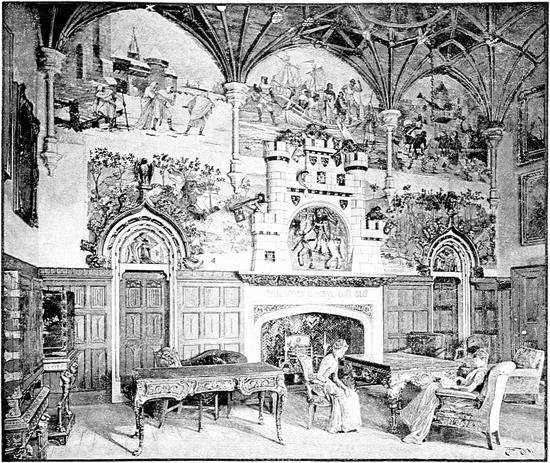
Photo: Mr. Francis Bedford, Camden Road, N.
THE DRAWING ROOM, CARDIFF CASTLE.
Cardiff has every incentive and determination to go ahead. St. Mary’s, the main street, can boast of costly banks and hotels and a very great deal of traffic. It is singularly noisy at night; and that also, we presume, is evidence of the strong modern spirit of the place. The town in 1896 indulged in an Exhibition on such a scale that its loss may be computed in scores of thousands of pounds; but the Exhibition was an investment, and it is a proof of Cardiff’s wealth that it can afford thus to cast expectantly so many thousands upon the waters. The Marquess’s castle is as unique in its splendour as is Cardiff among Welsh towns in its development. Of its external towers, one, the Clock Tower (with many quaint, arrangements for spectacular effect), is as modern as the residential part of the building. The other, or Black Tower (though it is of white limestone), dates from early times. It is also known as the Duke Robert Tower, because it was here that Robert Duke of Normandy was, by his own brother, Robert of Gloucester, son of Henry I., confined for many years.
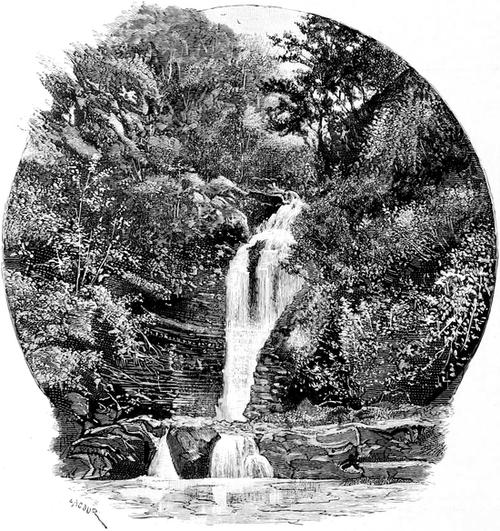
IN THE VALE OF NEATH.
Taff has much to be proud of as it glides into the sea past the castle, though it has, for miles and miles ere this, lost its crystal purity.
The river NEATH, like Taff, rises among lonely mountains, heather, bracken, and the bracing winds of the uplands. The three summits of the Fforest Fawr range—long-backed ridges, woeful to be lost upon—each give names to the tributaries that flow from them, and at Pont Neath Vaughan form the Neath river proper. Y-Fan-Nedd, Y-Fan-Llia, and Y-Fan-Dringarth thus beget the Little Neath (the “dd” in Welsh being equivalent to our “th”), the Llia, and the Dringarth. The two latter, after about five miles of independence, join just above Ystradfellte, where another Castell Coch reminds us that Wales had long ages of intestine and other strife ere she gave up unfurling the Red Dragon on her hilltops. We are here in the “fiery heart of Cambria,” where the rocks and morasses were such mighty fastnesses for the brave Welshmen of old. But these times are long past, and Cambria’s fiery heart may now be said to depend literally upon the fuel in the bowels of the land.
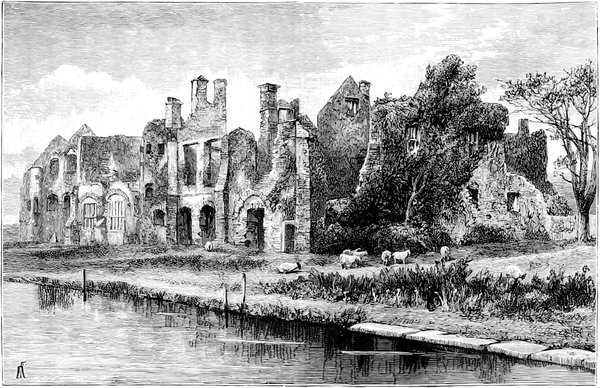
NEATH ABBEY (p. 171).
There is little of exceptional interest in the upper reaches of the Neath’s tributaries. Maen Llia, or the Stone of Llia, is a huge boulder of granite some eleven feet high by the Roman road of Sarn Helen, which, far up near the source of the Llia, crosses the mountains with the recognised audacity of a Roman thoroughfare. But few are the wayfarers, other than reckless tramps, who set eyes on this one among the many monoliths that decorate Wild Wales. It is at Ystradfellte that the wonders of the Neath’s scenery begin. This little village stands more than 900 feet above the sea-level, and the Mellte (as Llia and Dringarth conjoined are named), in its fall of nearly 500 feet in the five miles between Ystradfellte and Pont Neath Vaughan, is a succession of pictures so lovely, and yet so confined, that they excite as much admiration as despair in the mind of the artist who comes to paint them. The Little Neath runs parallel with the Mellte during this course, separated from it by a high ridge, and scarcely a mile apart. This stream also gallops in a rocky bed, with soaring woods on both banks, and with waterfalls here and there of much beauty. But the Mellte and its two affluents, the Hepste and the Sychnant, quite put the Little Neath in the shade in this respect. You may see it for yourself, and also judge by the opinions expressed without reserve by the many colliers and their families who come hither, on picnic bent, from Hirwain and even Merthyr, over the high eastern hills. The Vale of Neath would be accounted a wonder if it were in Middlesex. But its remoteness keeps metropolitan tourists aloof; its charms are for the local colliers, and few besides.
The Cwm Porth, or “river cavern,” a mile below Ystradfellte, is the first of the Mellte’s marked eccentricities. The combination of rocks and water and wood, with the added element of danger in exploring this rugged, echo-haunted perforation in the cliff, are attractive in the extreme to the able-bodied traveller. Mellte, in time of flood, carries a deal of amber-tinted water in its rocky bed, and Cwm Porth is not in the hands of a company who charge for admittance, and guarantee smoothed paths, and ropes and handrails where there is a risk of broken limbs. This, indeed, is just the best of the Mellte: you feel as if you are on virgin soil while scrambling at a venture in its steep woods, now on the edge of the roaring little stream fifty feet sheer above a waterfall, and now midway in the river itself, perched on a rock, with vistas of boisterous water up and down, and the river’s banks, wooded to the sky-line, hundreds of feet on either hand, at an angle of forty-five or fifty degrees. The writer, on one memorable September afternoon, was for hours alone in these woods, passing from waterfall to waterfall, more by instinct than sure guidance, with the gold and bronze and crimson of foliage constantly betwixt him and the blue autumnal sky; nor did he see sign of other human being than himself, nor more than one white farmstead, when he climbed above the topmost trees and returned to the bleak and bare uplands beyond. The squirrels ran from bough to bough, the birds chirped in the infrequent grassy glades, where the sunlight made a bright spot in the midst of this dense, damp shade, and the waters filled the glen with their clamour. In all England there is nothing of its kind so admirable as the seclusion and beauty of this gorge of the Mellte, with its tributary, the Hepste, to the east.
Categorically, the chief waterfalls may be mentioned thus: the Clun Gwyn Falls—Upper, Middle, and Lower—and the two Falls of the Hepste. One cannot describe such things; each of these five has such individuality and beauty that on seeing it you prefer it to the others. Their framing is perfect. Even the heron that gathers up its long legs and whips across the stream out of your way is not wanted to complete your satisfaction in such pictures. Yet in a three miles’ flight a crow would reach coal mines and swart heaps of such refuse as you would not dream could lie within scores of miles of these divine solitudes.
The great Cilhepste Fall, otherwise Ysgwd-yr-Eira (the Spout of Snow), though the best known of the valley’s cascades, is, in the writer’s opinion, the least convincing. The water is tossed in one curve over a ledge of rock, and falls about 45 feet into a basin, whence it moves downwards to the far finer succession of furious white steps known as the Lower Hepste Falls. The woods in autumn clasp it amphitheatrically with their green and gold. There is no fault anywhere. There is also this added eccentricity: you may walk under the Fall from one side of the river to the other. The writer did it in time of heavy flood, and was soaked for his pains. Afterwards he clambered, not easily, down to the Lower Falls, the disarray of which was much more to his taste. The Ysgwd-yr-Eira would please more if it had a flaw. As it is, it looks as if Nature and man had conspired to make a cascade with surroundings that should be a model of their kind. Yet even this criticism—which may well be held to be of the bilious order—will by most be regarded as highly flattering to the Spout of Snow.
After the Mellte, one is not profoundly stirred by the Falls and sylvan graces of the Little Neath and its tributary, the Perddyn. Yet, they, too, are beautiful, especially the cascades of Scwd Gwladys (the Lady’s Fall) and Scwd Einon Gam (Crooked Einon’s Fall), in the latter stream.
The Sychnant, however, is a sensational little river. It joins the Mellte at the foot of a rocky precipice, Craig Dinas, which, even with its mere 170 feet of perpendicular rock, may be warranted to yield a thrill. From the grassy, hawthorned summit of Craig Dinas, one may peer into the deep-cut bed of the Sychnant, where this cleaves through the mountains from Hirwain, and also see its brace of waterfalls. But the glen is well-nigh impassably dense with undergrowth and trees, and bound about with precipices as emphatic, though not as high, as Craig Dinas. Where the Sychnant comes to the light from this dark embedded dingle, it is sadly spoiled by quarry men and others. But even these enterprising gentlemen will fight shy of its higher recesses, especially as they have nothing to gain by the intrusion.
Point Neath Vaughan is a snug little village, with none of the airs it might assume in pride of its position as key to the glories of these glens of the Neath. Its inns are homely, modest buildings. South, for the ten or twelve miles to the sea, the river Neath flows through a broad and lovely valley, with wooded or bare mountains on both sides. From Cefn Hirfynydd (west) and Craig-y-Llyn (east) many a dashing little stream, with miniature cascades, makes great haste to swell the main river. But collieries are here, as well as fascinating scenery, and it is impossible to overlook them and their smoke.
The town of Neath neither gives to nor gains from its river much distinction where this moves through its midst, brown, and with tidal mud on its banks. It is a colliery town, pure and simple, surprisingly furnished with public-houses. The fragments of its castle that survive are pent about by dismal slums, so that a man must have a very keen antiquarian sense to discover them. Nor are they much when found: just a gateway with its towers, the whole prettily hugged by ivy. Richard Grenville, of Bideford, who founded it in the twelfth century, would not care to see it now.
Hence to the much more grandiose ruins of the Cistercian Abbey of St. Mary and the Holy Trinity, which also owed its origin to the same Richard Grenville, is a walk of a mile or more—not a rural walk, by any means. You may, if you will, take a tram-car thither, with collier-lads or their womenfolk for your companions, and with black mud on the roadway. The ruins stand close-girt by canals and mines and ironworks. Leland describes the abbey as, in his day, the fairest in Wales; and in the year 1500 its glories, and especially the sweetness of its convent bells, were bardic themes. Never was there so abject a change; and yet, after the Dissolution, when it fell to the lot of Sir Richard Cromwell, nephew of Henry VIII.’s minister and great-grandfather of Oliver, it was for long an appreciated residence. The white stone mullions of the many windows of the parts of the abbey added by Sir P. Hoby, in 1650 or so, still gleam against the dark gritstone of the walls.
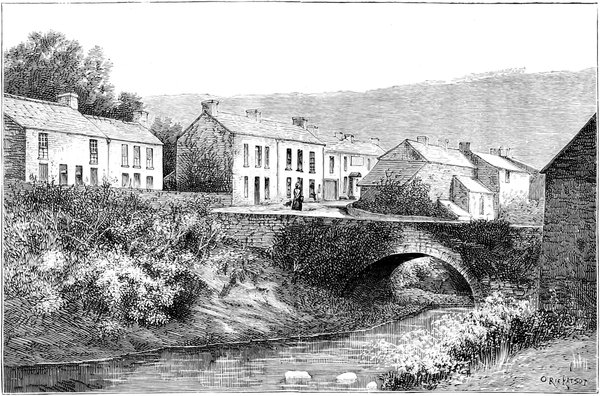
OUTSKIRTS OF NEATH.
In spite of its sordid surroundings, however, Neath Abbey is not despicable. The area of its ruins impresses; the jagged towering ends of the ivied walls of its church, with daws croaking about them, and the long-desolate aisle, tangled with coarse grass and brambles, are also impressive. The ecclesiastics who sleep in Neath Abbey may be said to lie fathoms deep under the accumulated soil. Not a trace of one of them remains above the surface. The dark refectory of their convent, with its pillared roof, stands pretty much as it did in the sixteenth century, and of itself would dignify the ruins. But echo alone feasts in its damp, sombre hall. One remembers that it was here our Edward II. sought shelter after his evasion of Caerphilly Castle, and that it was a Neath monk who betrayed him into that terrible custody of Berkeley Castle, where death awaited him; and, remembering this, one is inclined to be sentimental, and to talk about the curse that broods over the Neath Abbey ruins. In truth, however, smoke is the main brooder here.
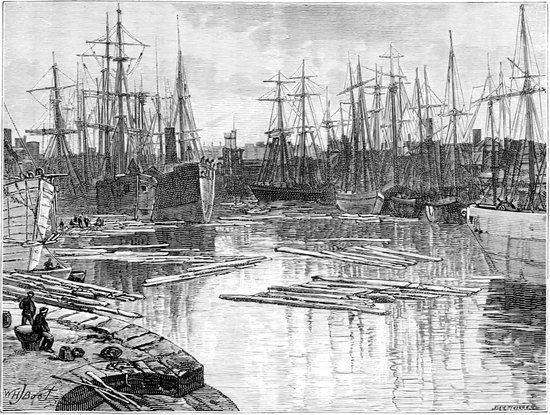
NORTH DOCK, SWANSEA (p. 174).
The river Neath glides on to its estuary by Briton Ferry, some two miles distant from the town. Hills escort it right to the sea—not all with smoking chimneys on them. The town is indeed quite uniquely hemmed round with beauty, as well as ugliness. Up the valleys of the Dulas and the Clydach, slim streams which join the Neath near its mouth, are nooks and recesses as winsome as those of the Mellte itself; and once on the tops of the mountains, in any direction, the pedestrian may readily forget coal and iron.
It is but seven or eight, miles from Neath to Swansea, where the TAWE comes to its end, foully enough, amid ironworks and “coalers.” One may, for convenience sake, make the journey, and later rise with the river to its source. There is more satisfaction in seeing it gradually purify than in watching its progress from pellucidity to pollution; from the sweet-aired heather hills where Adelina Patti has fixed her quiet home, to the sulphureous atmosphere of Landore and Hafod.
Sweyn’s Ea (Sweyne’s Eye or Inlet), Aber Tawe—or Swansea, as we modern English call it—is not what it was when Sweyne the King and Rover was wont to come hither as a base for his forays into the vales of South Cambria. Still, it can, if it cares to, brag stoutly of its ancient enlistment in the service of carbon. In 1305 it received a charter from William de Brews (Breos), great-grandson of the famous Lord Marcher, “to have pit coal.” That was beginning an industrial career early indeed. Four centuries later, in 1709, its jurisdiction as a port extended from Oxwich, in the Gower peninsula, to Chepstow—of course, including the then unborn and unthought—of Cardiff. It began to smelt copper in 1564, thanks to a charter given by Queen Elizabeth; and it is to copper and shipping, quite as much as to its position at the mouth of a great coalfield (estimated still to hold 19,200,000,000 tons of fuel underground), that Swansea owes its fine fortunes and its population of about a hundred thousand.
It seems an ungracious thing to say, but Swansea is apparently somewhat hampered by its antiquity. In the struggle for supremacy with Cardiff, it has not had Cardiff’s free hand in the matter of laying out a new town; nor, one may add, quite that powerful vigour of youth which carries all before it. Hence, it has already been left behind. The Duke of Beaufort is not such a potentate in Swansea as the Marquess of Bute in Cardiff; yet he stands to this city somewhat like the Marquess to Cardiff. It was a Duke of Beaufort who cut the first sod of the North Dock, or Town-Float, in 1852; and his Grace has large representation in the Swansea Harbour Trust, which has charge of the city’s port affairs. The late Lord Swansea, speaking on behalf of this Corporation, once said: “Swansea, you may depend upon it, is destined to become the Ocean Port of England.” Cardiff, at any rate, laughs such words to scorn, and even a layman of England may be allowed to think the prophecy over-sanguine. The North Dock has an area of 14 acres, and is “connected with a half-tide basin of two and a half acres by a lock 160 feet long and 50 feet wide, having at its seaward entrance gates of 60 feet, with a depth of 23 feet over the sill at spring-tides and 16 feet at neaps.” This is, of course, but one of Swansea’s docks, and by no means the most important of them. Cardiff’s docks are undoubtedly finer than Swansea’s, with more gigantic fitments.
Swansea, though ancient, possesses few relics of its past. The castle tower, in the main street, with a clock set in it, is the chief of them. In the large hall of the Royal Institution of South Wales—one of Swansea’s many meritorious establishments—may be seen divers drawings and engravings of the city one, two, and three centuries ago. In all of them the castle towers stand up as if they still had the feudal faith strong in them. Green, pleasant, wooded hills form the invariable background. How changed the landscape now! The green hills are gone; cut bare and covered with mean mechanic tenements or smoking manufactories. On the summit of the most conspicuous of them are a few gaunt walls, which by night may, with the help of a glamorous moon, come near being deceptively picturesque. This is the so-called Morriston Castle, three miles north of the city, yet with the black suburb of Morriston at its feet, an active contributant to Swansea’s fortunes. The “castle’s” history is brief and ignominious. A hundred years ago Sir John Morris, a maker of tin plates, who gives his name to the suburb, erected a lofty and large building on this breezy hilltop, for the accommodation of four-and-twenty of his workmen and their families. Healthier homes these could not then have had within easy reach of their daily labour. But the gradient of the hill soon wore out their enthusiasm, and, one by one, the families moved down on to the level. Then the lodging-house, being abandoned, fell slowly but surely into ruin. The ruin is now Morriston Castle.
Swansea’s castle has a more conventional history. It was built in its final form (which can only be conjectured from its remains) by Bishop Gower of St. David’s, in the fourteenth century. After the usual vicissitudes of disestablished castles, it still, until 1858, offered its dungeons for the confinement of recalcitrant debtors. In that year even these privileges were taken from it, and, ever since, civilisation has tried to crowd it out of existence. Its body is lost in the various buildings and workshops that have encroached upon it, but the graceful arcaded clock-tower remains. It gives a pretty touch to Swansea’s main street, which it commands.
Little more can here be said about Swansea, except that the visitor owes it to himself to leave the city (which was made a suffragan bishopric in 1890) as soon as possible, and make friends with the Mumbles. The five-mile curve of bay thither has been compared to that of the Bay of Naples. The comparison is not a modest one. Nevertheless, there is something uncommonly exhilarating about this Swansea Bay, with the red and white green-topped cliffs of the Mumbles at its south-western horn. You soon get out of reach of the fumes of the city’s copper and other metal works. The shipping of the Mumbles has a nice clean look after that at the mouth of the Tawe. And, save when the wind is north-east, the air is sweet here, as it is bound to be. Mumbles—or Oystermouth, as it used to be called—has an attractive old castle of its own, of the Decorated period. But it is precious chiefly to Swansea for its sea and the lighthouse islets at the extremity of the headland. The view hence towards the busy city, less than four miles across the water, is not gay. Tall chimneys and a dense canopy of smoke: such is the Erebus you behold from the pleasant Mumbles cliffs.
Ere moving up Tawe’s valley, it seems quite worth while to tell of Swansea’s connection with the fortunes of John Murray, the publisher. Gower the poet, Beau Nash, and other celebrities, owed their birth to this city; and it was while living here in 1806 that one Mrs. Randell compiled the “Domestic Cookery,” for which John Murray paid her the solid sum of £2,000, and which, Dr. Smiles tells us, was very profitable to the young publisher, and helped in a great measure to establish his position. It may be added, also, that in the parish churchyard at the Mumbles lies the Dr. Thomas Bowdler who busied himself so strenuously with Shakespeare’s Plays, and gave to our dictionaries an awkward, ugly word.
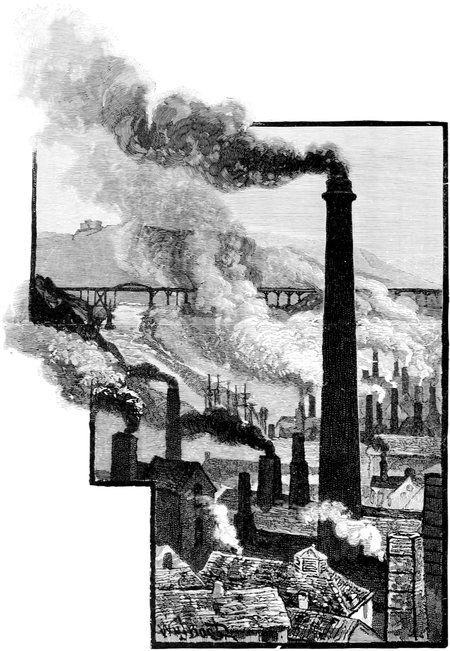
MORRISTON.
The Tawe cannot be much more than twenty-five miles in length, from its source in the lakelet on the Brecknock Van, or summit, of the Fforest Fawr Mountains, to the Swansea Docks. As fully half its course is through a colliery district, it may be supposed that its claims to beauty cannot be of the strongest. But the Neath river has taught us that these South Wales streams cannot be judged thus summarily. One must, therefore, proceed up the long valley of Tawe in the hope of charms other than those that emanate from pit-gear, long chimneys, and factories.
Morriston has already been noticed for its “castle.” It deserves a word also for its bridge over the river. This bears the look of one of Edwards’s constructions; its eyelet holes and graceful single curve remind one of Pontypridd. From Morriston to Ystradgynlais, Tawe is continually trammelled. In one part there is a cañon of slag heaps half a mile long for it to descend through. It is here shallow, and not more tainted than you would expect. The hills rise in high long banks on the outer boundaries of the valley, with wooded reaches above the lofty collieries, and crowned by the naked rock. Just south of Ystradgynlais the river receives its chief affluent, the Twrch, which has as bright and lengthy a youth as Tawe itself, rising under the Carmarthen Van, the rival peak of this Fforest Fawr range, which makes so commanding a mark on the two counties of Brecknock and Carmarthen.
The ascent here begins to be steep, and it is constant to the source. The colliery villages become less and less assertive, and the woods greener. By Coelbren a little stream hurries to the Tawe through one of those deep, thickly-treed glens which the Neath river knows so well. It is an enchanting spot, with the blue and green and russet of Craig-y-Nos across the valley to the north-west. The river gets quite near to the palace of our sweetest singer, whose conservatories can be seen gleaming for miles. In South Wales Patti holds a court other than that assured to her in all the world’s capitals. She is at home here. Her photographs are in the shop-windows of Neath and Swansea, and so are the photographs of the various luxurious rooms of her mountain palace; and she is praised for other virtues than those that proceed from her entrancing throat. People wonder how she can isolate herself here, where collieries are not so remote that they cannot be seen. But that is Adelina Patti’s affair, and has nothing to do with us. She is queen of the Tawe valley, in one sense, as well as the world’s queen regnant of melody. At Craig-y-Nos, which is 700 feet above sea-level, Tawe is distant only five or six mountainous miles from its origin. It begins, like the Taff, with numerous slender rills from red cuttings in the stony sides of the bleak uplands, all hurrying together, as if anxious to compose a little strength with their divided weakness. But its chief source is the lonely tarn (to borrow the North-country word) of Lly-Fan Fawr, which never fails to keep it active. This is on the Brecknock Van. On the Carmarthen Van also there is a lake, Lly-Fan Fach, some two miles from the source of Tawe. From Lly-Fan Fach comes the Sawddy, one of the Towy’s band of tributaries, which enters that river at Llangadock.
SWANSEA CASTLE (p. 174).
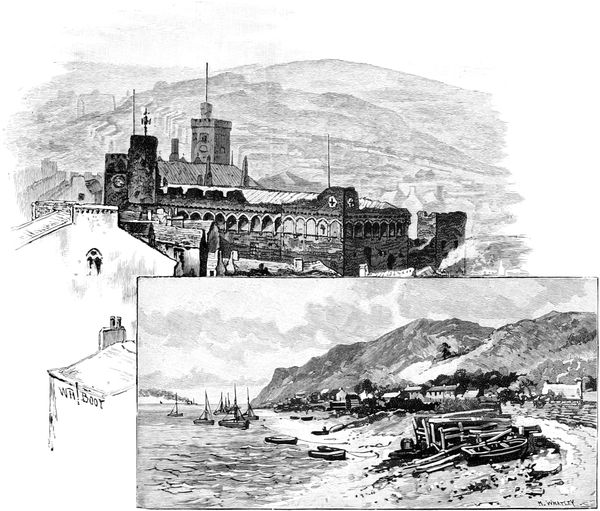
THE MUMBLES (p. 175).
The TOWY, which now claims our notice, in a far nobler river than the others treated in this chapter. From its start in the desolate wet uplands of Cardiganshire (less trodden than any other part of Great Britain) to the long channel south of Carmarthen, where it enters the bay of that name, it knows nothing of such pollution as spoils Tawe, Taff, and Neath. It is rural from first to last: savage almost in its upper reaches, beyond Ystradffin, where it can be explored only at some not inconsiderable risks, and where its first company of eager affluents rush to it from all sides in glens and defiles, as deep, craggy, and yet beautiful, as its own. Of its early affluents, the Doethiau certainly deserves particular mention. Hard by its junction with Towy is a strikingly picturesque wooded hill, one of Wales’s many Dinases.
Ystradffin is scarcely a village, but it boasts of attachment to the memory of a seventeenth-century cattle-raider named Twm Shon Catti (otherwise Tom Jones, the son of Catherine), who made use of a cave in the side of the Dinas by Towy for purposes of concealment. This hero of tradition at length determined to mend his ways, and, we are told, set about it by wooing an heiress. He secured her hand in the literal sense, and vowed to cut it off unless she gave it to him in the matrimonial sense. So stern a courtship was irresistible. Afterwards Twm Shon Catti became respectable, and died holding high office in the county. But the cave over Towy keeps the memory of his naughty youth and early manhood still green.
From Ystradffin the river descends circuitously some eleven miles to the well-known fishing and tourist townlet of Llandovery, gambolling gaily in its rocky pools as if resolved to make the most of its youth ere coming to the long green valley which extends from Llandovery to Carmarthen. Here it receives two voluminous aids in the Bran from the north-east, and the Gwedderig from the east, both yielding pleasant prospects even for the few miles their valleys are visible from Llanymddyfri (i.e. “the Church amid the Waters”), or, as we know it, Llandovery.
Green hills embrace Llandovery as if they loved it. The little town is not so interesting as its situation, apart from its old inn, the “Castle,” a mellow, time-worn house. The very rooms here in which you sup on eggs and bacon (if you are lucky enough) may have known that worthy, the Vicar of Llandingat, who, in the seventeenth century, daily came hither for his ale, attended by a goat as thirsty as himself. One day, it is said, this goat drank well rather than wisely, and thenceforward declined to cross the threshold of the “Castle” with its master. One may hope that the Vicar learnt a lesson from the goat.
Towy is here a great, clear, rapid stream, and so it continues for the remaining thirty miles of its career. Famous view-points on it are the bridges of Llandovery, Llangadock, and Llandilo, the bridges themselves as graceful as the valley. Llandilo stands on a knoll on the west bank of the river, and rejoices in its superiority to Llandovery as a market-town. This, to the stranger, is much less commendatory than its nearness to one of the most beautiful seats in South Wales, Dynevor, where the Barons of that title have long held sway. The ruins of the old Dynevor Castle, on a hill crowded with oak, ash, and beech trees, are from the river quite ideally picturesque. It is a pity that the “common herd” of tourists have so misbehaved themselves that Lord Dynevor has felt compelled to deny free access to so charming a spot. Golden Grove, an estate as winsome as its name, on the other bank of the Towy, opposite Dynevor, has had its attractions sung by Dyer, the poet, who was born in the neighbourhood, and died rector of Coningsby, in Lincolnshire, in 1757: here is the Grongar Hill, where “often, by the murm’ring rill,” one “hears the thrush while all is still.”
Between Llandilo (Llan-Teilo: the Church of St. Teilo, who died Bishop of Llandaff, in A.D. 540) and Carmarthen, Towy’s zigzags are many and eccentric. After Dynevor another castle, that of Dryslwyn, is soon passed. It is a mere ruin on a green hill. The Nelson Monument, high in the distance, on the south side of the river, is a more assertive feature in the landscape, though less welcome. Midway towards Carmarthen, we cross the Cothi, the longest of all Towy’s affluents, and here, near its mouth, as great a stream as the Towy at Llandovery. Looking up it, there is even here some suggestion of its fine upper gorges. At Abergorlech, some ten miles nearer its sources, either artist or angler would find reason to rejoice in it, while higher still it absorbs streamlets right and left as greedily as the Towy itself.
One must, however, resist the temptation to loiter on Cothi’s bridge by Llanegwad. There is nothing of especial mark to see by the way, save Merlin’s grotto, where the Arthurian wizard fell a victim to the wiles of the fairy Viviana, and where he is still imprisoned, and will be for all time. But you must carry a fine faith with you to be fitly moved by the legend, and it will not be inexcusable if you fail to find it.
At the Ivy Bush Hotel of Carmarthen, whence there is a commanding view over the lower part of the valley, one may think tenderly of Sir Richard Steele, who once lived in it. The tablet to his memory in the parish church of St. Peter here describes him as the “first chief promoter of the periodical press of England.” What would he say to the growth of the babe for which he is thus made responsible?
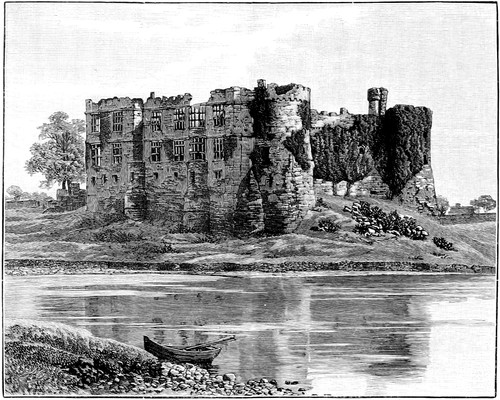
CAREW CASTLE (p. 182).
This capital town, which in the time of Giraldus had walls of burnt brick, is nowadays of the modernest. Its castle, or what was left of it, has been turned into a jail; though you may discern some of its ancient stonework in the adjacent alleys. The town stands well above the river and the seven-arched bridge beneath which Towy now moves with stately ease towards the sea, a navigable stream. There is a small quay here, and a larger one some three miles farther down, for local coasters. For five miles more Towy holds its own against the ocean; and yet another five have to be passed ere, at Carmarthen Bar, the fresh waters gathered from the peaceful and fertile vales of Carmarthenshire are wholly merged in the salt sea.
We have now come to a singular district of Wales—a part of South Wales that is not Wales, but “a little England in Wales.” Close by Towy’s mouth, another river Taf (though with only one “f”) enters the sea very broadly with the body of water yielded to it by the rivers Dewi Fawr, Gynin, Feni, and Marias, which all have bright tortuous courses among the green hills of Pembrokeshire. And four or five miles still farther west, the “Llans” and “Abers” which proclaim the land of the Cymry end, and give place to names Danish, Norwegian, and Norman. This continues until we are at Newgale Bridge, on St. Bride’s Bay, eight miles from the thoroughly reverend and Welsh city of St. David’s. Newgale Bridge has a small ale-house adjacent, where they seem contemptuously ignorant of the existence of the Welsh counties of Carmarthen and Glamorganshire to the east, so positively do they inform you that on one side of the streamlet spanned by the bridge it is England, and on the other side Wales.
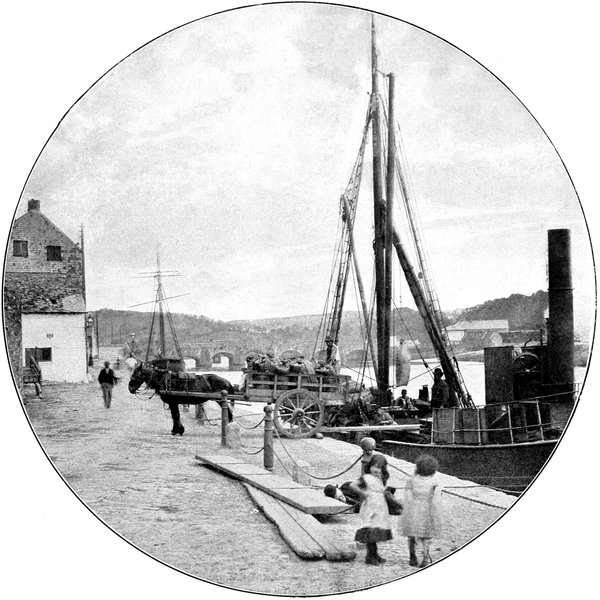
Photo: Hudson.
CARMARTHEN QUAY (p. 180).
The Normans could not, in spite of their sternest efforts, make much impression on Wales as a whole for a century or two after the battle of Senlac. But they could, thanks to Milford Haven, nibble at its south-western extremity. This is what they did, and with the planting here by Henry I. of a large colony of Flemings the earlier stock seems to have been either absorbed or superseded.
Milford Haven, with its arms of tidal water extending twenty miles into the heart of the country, was a grand aid to conquest in these parts. The Norman lords who were invited hither to carve out careers for themselves had much success. They raised castles at the extremities of Milford’s water-ways, and thus assured to themselves broad controlling powers. Enough if mention be made of only the important fortresses of Pembroke, Haverfordwest, and Carew.
The last of these may be first visited. Its situation at the head of a dammed tidal inlet, low-lying and with no prominent hills near, is unworthy of so noble a ruin. But Gerald de Windsor, the Norman lord who built it (having received the land as a dowry with his Welsh wife, Nesta, daughter of Prince Rhys ap Tewdwr of Dinefawr, or Dynevor), probably cared little for the picturesque. The strong western towers still bear witness to him; but to the mere tourist by far the most interesting part of the castle is the east side, over against the water, with its high wall and the lofty great, flaunting skeletons of the windows of the palace above, their white mullions bowing forward with inimitable grace. Unfortunately, one cannot romance about the rooms to which these majestic oriels and bays belonged. This part of the castle is of the sixteenth century, and was left unfinished.
Carew Castle (Caerau = fortified camps) still belongs to the Carews. The Windsors took the name of this possession of theirs, and held the castle for more than three hundred years. Then their line of lordship was interrupted; and it was during this period that the great Sir Rhys ap Thomas (whom Henry VII. made a Knight of the Garter for the part he played before and at Bosworth Field in aid of the House of Tudor) held such revels here as have made Carew almost a by-word. Among other shows was a “feate of arms” of five days’ duration, to which knights flocked from all parts of England and Wales. These guests filled the castle and more: five hundred, “moste of them of goode ranke,” were accommodated with tents in the park adjacent, of which no trace remains. Sir Rhys himself, in gilt armour, on a “goodlie steede,” attended by two pages on horseback and a herald, “was the judge of the jousts.” This same mighty noble received Henry VII. at Carew before Bosworth Field was fought; and, if tradition speak true, with his own hands killed Richard of Gloucester, who would dearly have liked ere then to have killed him. Sir Rhys lies in the parish church of Carmarthen, with about seven feet of armoured stone for a monument; and a very small effigy of a wife lies by his side. With the Civil Wars came the castle’s destruction. The Carews of Crowcombe, in Somersetshire, are now lords of the castle, and anyone may tread its grass and broken stones on payment of a threepenny bit.
Carew had the honour of entertaining Henry VII., but Pembroke had the higher honour of being his birthplace, Margaret Beaufort, his mother, being then only in her fifteenth year. Five months later he was an orphan, and Jasper Tudor, his uncle, began his long, exemplary, and singularly fortunate guardianship. Ere then this great castle, at the tip of the most southerly of Milford Haven’s arms, had had nearly four centuries of existence. The first castle was only “a slender fortress with stakes and turf,” says Giraldus the chronicler. If so, however, it must soon have been ousted by the existing Norman keep, which, with its 70 feet of height and 17 feet of thickness at the base, is anything rather than “a slender fortress.” Throughout England there is no better specimen left to us of a feudal keep than this of Pembroke.
The castle buildings, as a whole, measure some 500 feet by 400 feet within the walls; and, viewed, from the breezy summit of the keep (reached by broken steps and a rope), are, even in their ruin, a very instructive lesson in feudal history. The gate-house and the keep are by far the best preserved parts; these are both little less serviceable than they were in their prime. The central space, or Outer Ward, is now a grass-plot, kept trim for tennis.
One cannot do more than touch on the conventional last scene in this castle’s active history. The building was held for Charles I. by Colonel Laugharne and two other Royalists named Powell and Poyer. As was to be expected, they made a stout resistance even to Cromwell, who came hither in person. Eventually, however, supplies were cut off, and the castle surrendered. “The three leaders were condemned to be shot—though the sentence was reduced to one. Lots were drawn, it is said, by a little girl. Two were marked ‘Life given by God,’ the third was blank, and fell to Poyer, who was shot in Covent Garden, 1649.”
Since then Pembroke Castle has accepted its rôle as a ruin. The very peacocks that strut about its courtyard seem to understand that their haunt is a superb one.
There is little else in Pembroke save two of those pleasant white church-towers which are quite a characteristic, of the shire. Monkton Priory, one of these, has as lengthy a history as the castle. It was founded in 1098, and belonged to a community of Benedictines connected with Jayes in Normandy. Anciently this church, which has a very long back, with the tower about midway in it, was divided by an inner wall between the monks of the priory and the local parishioners. Its Norman nave and Decorated choir are well preserved: indeed, the original builders were as generous of material as they who raised the castle keep. Externally, save for its tower (restored in 1804), and a Norman south doorway, it has a very modern aspect, though its acre or two of gravestones in the churchyard bear witness against appearances.
There are two Pembrokes and two Milfords on Milford Haven; in each case one old and the other new. Our New Pembroke, however, goes by the name of Pater or Pembroke Dock, and a very important little town it is for the United Kingdom, with its building slips, dry dock, and naval stores. If you chance to be going from Old Pembroke to Pater between two and three o’clock any Saturday afternoon, you will be tempted to form an exaggerated idea of the number of hands employed at this State dockyard. In fact, there are about 1,000, though, of course, the figure is a variable one. From Pater the view down the Haven is uninterrupted as far as the watering-place of Dale, eight or nine miles due west, just at the north corner of the entrance. The channel is there nearly two miles in breadth, and fortifications on the small island of Thorn, to the south of Dale, are designed to prevent undesirable interference with British property in the Haven’s recesses.
PEMBROKE CASTLE AND MONKTON PRIORY (p. 183).
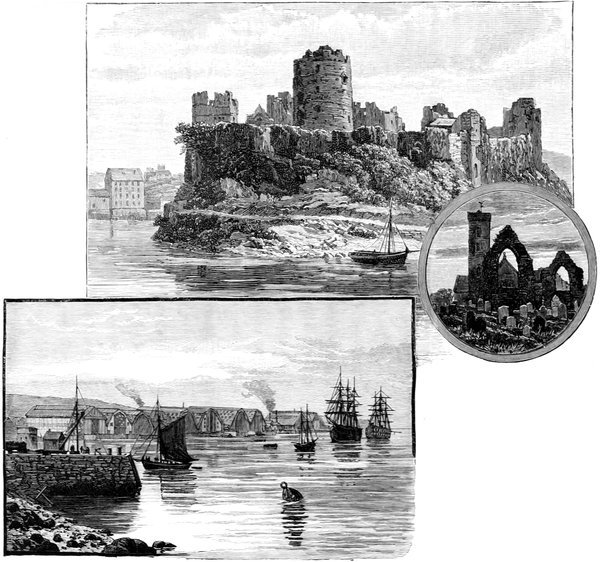
THE ROYAL DOCKYARD, PEMBROKE DOCK.
In less than five minutes you may cross the Haven, by steam ferry, from Pembroke Dock to New Milford or Neyland, which calls for no particular notice. It is a creation of the Great Western Railway, in connection with which steamers ply nightly to Ireland. Hence to Old Milford is a pleasant walk of three miles, with the water continuously to the left. The low green hills of the Haven to the south are not very beautiful, and it is only on exceptional occasions that the great water-way holds more than half a dozen big ships in its midst. One or two ironclads on guard may, however, at all times be looked for. Imogen, in Cymbeline, inquires, as a significant aside—
“by the way, Tell me how Wales is made so happy as To inherit such a haven!”
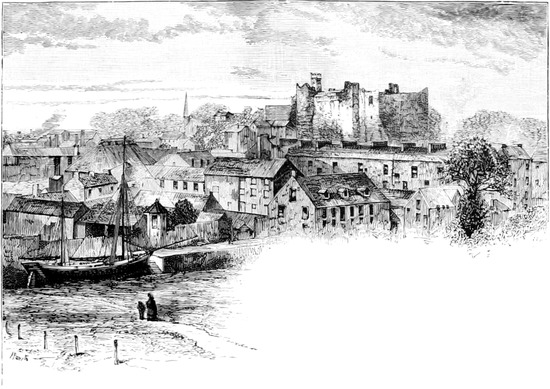
HAVERFORDWEST (p. 186).
But Wales’s happiness in this possession is of the kind that depends more on the expectation of favours to come than on benefits actually enjoyed. Milford Haven was better appreciated in the Middle Ages than it is now. It was only natural, for example, that Henry Tudor should land here in his quest of the English crown. Here too, earlier still, Richard II. set foot, on his anxious return from Ireland, when Henry of Bolingbroke was troubling his realm. The French chronicler, De la Marque, who was at Milford at this time, finds much to praise in the conduct of the Welshmen who were with the unhappy king. Richard’s English retinue deserted him and plundered his baggage, but the Welsh could with difficulty be dissuaded from accompanying him in his march north to Conway, and they fell upon such of the deserters as they could. “What a spirit! God reward them for it!” says De la Marque.
Old Milford is a prettily situated town terraced above the Haven, with quays and embankments on its shore-line, ready for the traffic that is still withheld from it. Master Atkins’s red coat helps to enliven it. The blue water, the green level ridges that run west to the sea, and the Atlantic itself in the distance, all prepossess in its favour. But Liverpool and Holyhead both hold it aloof from the fortune it aspired to.
Before proceeding north to that little known yet seductive river, the Teifi, Haverfordwest, on one of the two Cleddaus, which enter the Haven at its northern and westernmost arms, must be briefly mentioned. It is an ancient town, as its castle—built about 1112 by the father of Richard Strongbow, that eminent castle-builder—testifies. Among its other privileges was that of being county and capital town in one; also of having its own lord-lieutenant. Here the Flemings of the twelfth century most did congregate in this peninsula, and no doubt the little town’s prosperity was largely due to them. Nowadays, however, it is a waning place, in spite of its lively look and, considering its remoteness, its fine buildings. This is proven by the number of its Maiden Assizes in the later years of its independence, before its annexation to Carmarthen for judicial purposes, as well as by other less agreeable tokens. It is, perhaps, the most hilly town in the kingdom. Ere you are half a mile away from it on the road to St. David’s, it is lost to sight; while, approaching it from Milford, its situation seems quite Alpine.
The TEIFI (or Tivy), like the Towy, is little known to Englishmen other than anglers; and again, like the Towy, it well deserves knowing. The two rivers both rise among the heather-clad moors of Cardiganshire; so near, indeed, that you may stand on the watershed and mark the different trend of their streams. Teifi’s chief supply, however, comes from the Teifi pools, three miles from Strata Florida Abbey, a congeries of mountain lakes, the abode of interesting and capricious trout that may be recommended to the traveller with a fishing rod—and a mackintosh. It has as wild an origin as any of the rivers of South Wales. The Cistercians of Strata Florida probably fished these lakes far more than do the moderns.
From the pools Teifi descends impetuously to the mere graveyard that reminds one of the Mynachlog Fawr, or Great Monastery, of which only an archway remains. Either Rhys ap Tewdwr or Rhys ap Gruffydd, royal princes both, was the founder of the abbey, which was so important an establishment that Henry IV. made a special expedition to destroy it. If, as tradition says. Dafydd ap Gwilym—“the greatest genius of the Cimbric race and one of the first poets of the world,” in the opinion of George Borrow—was buried here, one can understand the patriotic influence of such a spot, and Bolingbroke’s ruthlessness. But many are the poets and princes, as well as Dafydd ap Gwilym, who lie in this “Westminster of Wales.” The Strata Florida monks have been made responsible for the Devil’s Bridge, on the Rheidol—that bonne bouche for visitors to Aberystwith. Excavations have recently been made in the abbey precincts, with promising results.
Strata Florida is accessible by railway from the Manchester and Milford station of Pontrhydfendigaid. It must be confessed that some courage is required to alight at this dreary place on a wet autumn day. Teifi traverses dismal bog-land for miles hence: a vast flat of glittering pools and reddish grass and reeds, abounding in hares. One marvels that no serious attempt has been made to drain these thousands of acres: not such a difficult task, surely, considering the steep fall to the west beyond the hills. However, each landlord to his own ideas. Tregaron is passed, and still Teifi is rather a dull stream, though it can be seen that, lower down, the hills are drawing together suggestively. This is a famous district for cattle-drovers and cattle fairs. Your modern Cardigan farmer finds in these fairs one of the main excitements of his life. But the dealers are often far gone in whisky by the end of the fair-day, especially if they have had “bargains.”
So towards Lampeter, leaving on the east Llanddewi Brefi, where, in A.D. 519, was held the Great Synod, attended by St. David, at which Pelagius was adjudged a heretic. Teifi has now become a real river, broad and swift, and a charm to the angler. A column on a hill by Derry Ormond holds the eye. This is a tale told of it. The grandsire of the present owner of the estate wooed a young lady of London, and brought her home; but she pined for the Metropolis, and said either that she could not or would not live where she could not see London. To help her a little in this respect, her husband built the column. History does not inform us whether the wife was won to her allegiance by this proof of marital infatuation.
Teifi does not excel in its auxiliary streams. This is explainable by the nature of the country it traverses. Its watershed is not an extensive one, like Towy’s. The streams that flow to it throughout its course are all insignificant in size, though the two Cletwrs (Fawr and Fach), Afon Cych, and especially the merry little mountain-rivulet that joins it a mile west of Newcastle Emlyn, are not without the customary fascinations of these well-nigh untrodden glens of Wild Wales.
It is when Teifi turns decisively to the west and its home in the long inlet of Port Cardigan that its graces become truly bewitching. From Llandyssil to Newcastle Emlyn it alternates between sweet, green, hill-bounded reaches and contracted gorges which trammel and fret it so that it roars with dissatisfaction. At Newcastle its valley is broad again, with wooded hills on all sides, enclosing the pretty little village and its castle. Put thence to Cardigan it is majestic all the way, zigzagging with glorious curves, and with high, densely-wooded banks in the main. Seen when the tints are on its trees, this part of Teifi’s course makes an enduring mark on the memory. The salmon-fisher who comes once to Teifi here (and it is a prolific river, in spite of the “professionals,” who take heavy tolls at its mouth) will have abundant compensation, even though he have poor sport. There is no railway between Newcastle and Cardigan; but what a nine miles’ drive or walk it is!
At Cenarth, for instance, it is impossible not to pause awhile. Here the river bursts from a confined defile into greater freedom, sweeping under a bridge of the Edwards hall-mark. Cenarth is a lovely little village, out of the world, given up to the woods and the crying waters. And under its bridge, at the side, you may see some of the tiny coracles still in use on this stream. Fashions die hard in these sequestered parts of Wales. Giraldus tells us that the beaver kept its haunt on the Teifi when it was extinct elsewhere in Great Britain.
There is a contenting sameness about Teifi all the way to Cardigan: unchanged perfection. Two miles short of this capital town, however, it speeds to the south, and then turns boldly in its final curve towards the sea. Above it here, on a lofty crag, with woods caressing it, is Kilgerran Castle, which Turner painted. He could hardly have resisted the temptation, having seen it. The castle remains consist of two towers and a gateway, all of the thirteenth century. Historically, little seems known about it.
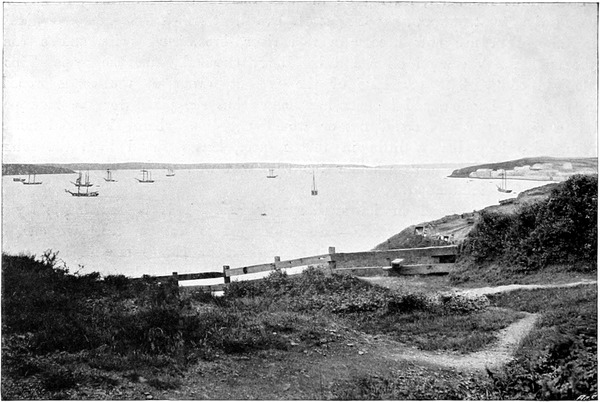
Photo: Hudson.
MILFORD HAVEN (p. 185).
Thence Teifi makes for the defile which ushers it to salt water, past the small yet prosperous county town, which has close sea intercourse with Bristol, and does a good trade in fish. Cardigan, like all these Welsh capitals, has a fragmentary castle; so fragmentary, indeed, that it is hardly discoverable. It has also an old church with a remarkably massive tower, having a buttress like a staircase. From its churchyard tombstones one may learn much, as well as the common lesson of the mortality of mortals. It is, for example, interesting to the stranger to be informed that “Let” is no unusual Christian name for a man here, and “Lettice” for a woman. The town suffers from a complaint nowadays rare among the capitals of British counties, to wit, difficult railway communication with the rest of the land. This will be remedied somewhat when the existing line is continued from Newcastle Emlyn. But one may be excused for hoping that Teifi’s banks may for years to come know nothing of the mauling and devastation that will be inevitable when this takes place.
If you wish to see Teifi, or Tivy, quite to its end, it is worth while to go north another three miles, to Gwbert-on-the-Sea, a distinctly primitive and pleasing watering-place, facing Kemmaes Head, with the mile and a half of Teifi’s mouth (at its widest) intervening.
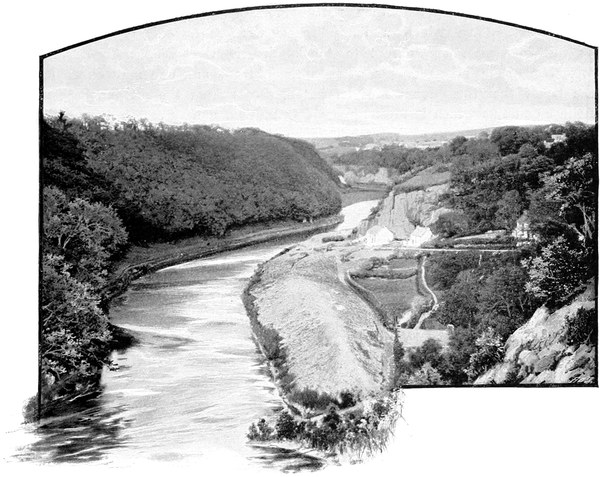
Photo: S. J. Allen, Pembroke Dock.
THE TEIFI AT KILGERRAN.
Bidding farewell to the beauteous Teifi, we must now in few words track the last of our rivers to the same inevitable destination. YSTWITH has had no poets that we are aware of. Not all who visit Aberystwith, indeed, perceive (though they surely might) that it gives its name to this salubrious town. The Rheidol, which also enters the sea at Aberystwith, is treated with distinction. For it there is a solid, handsome bridge, lighted with lamps. But for Ystwith there is only a very commonplace bridge.
The Ystwith rises in the broken upland a few miles south of Plinlimmon, runs in a deep channel for three or four miles, and then, with little hesitation, though infinite sinuosities, rushes due west. Its entire length is not more than thirty miles. Until it comes to the road by Eglwys Newydd, and within four miles of the Devil’s Bridge, on its rival the Rheidol, and even past Hafod, it sees few admirers, though it might have many. People who come to Eglwys Newydd, on their circuitous way to the Devil’s Bridge, do not go out of their path to see the Ystwith, but the Chantrey monument, in memory of Miss Johnes, in this “New Church.” Farther west the Manchester and Milford Railway runs in its valley from Trawscoed, and accompanies it to the sea. Here its beauty is of a superb order. The wooded mountains soar with most impressive effect on its southern side, now and then parting to show an abysmal glen, just as densely wooded, down which a baby stream tumbles towards our Ystwith. It matters not so very much, except to the angler, if the river does suffer from lead-poisoning. The mines do not obtrude themselves; and one may cheat oneself into the belief that the thickness of its waters comes from the melting snows high up on the mountains which it taps. For a few miles one may search the vocabulary for adjectives in eulogy of Ystwith. Then it sobers into comparatively level ground, and green pastures between receded green and heather-clad hills succeed the splendid towering woods. For the rest of its journey, it is an ordinary stream, and as such it slides into the sea just south of the town with a modesty that is almost affecting.
Aberystwith the piered, esplanaded and castled, might well condescend to take a little notice of its humble “godparent,” as well as of the Rheidol, and might gain credit in the condescension. This resort of a certain order of fashion (especially now that there are sweet girl-graduates to give a classic touch to its broad breezy promenade) seems, however, fully content to rely on the seducing charms of its powerful pure air, its tea-gardens on Constitution Hill, and—the Devil’s Bridge.
Wondrous indeed is the power of ozone! It reconciles us to weeks in lodging-houses that are ugly to behold and are in themselves uncomfortable. Not that Aberystwith is worse off in this respect than other places. Indeed, it may be said to be in a better plight than most, since the Esplanade buildings are handsome, once you have accepted their uniformity. Even were it otherwise, it would matter not at all to the sojourner in bracing Aberystwith! He acquires resignation and divers other virtues merely in breathing this pure invigorating air on the broad paved walk between the lodging-houses and the sea.
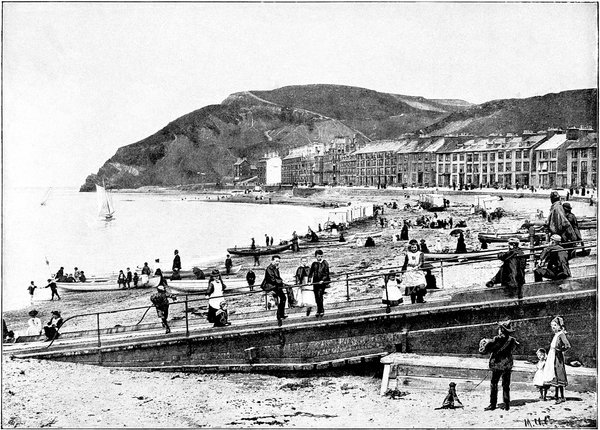
Photo: E. R. Gyde, Aberystwith.
ABERYSTWITH.
Of Aberystwith’s castle it must suffice to say that it dates from the eleventh century, and owes its parentage to Gilbert Strongbow. Cromwell cut its little comb effectually, and now it exists only in fragments. They are, however, attractive morsels, and the little green enclosure which they prettily dignify is a popular resort for visitors. There are seats about it, and you may perch close over the mutilated low cliffs of the coast and watch the breakers rolling in towards the town, while listening with your mind’s ear to the tales told by Time of this downright ancient little place. The University buildings adjoin the castle demesne. They are quite grandiose. One wonders how often in the year the noise of the waves on their stones is so loud that it distracts the academic minds within its stately walls. It has been said authoritatively that “Aberystwith stands out as being far and away the Welshiest of the University Colleges, and Cardiff as the most English.” This is gratifying to those of us who like to see the boundary-lines of nationalities clearly defined. And yet the faces of the students in the streets here do not show their birthright as one would expect.
But enough. One must be very morose or abased in body as well as mind not to perceive the peculiar charms of Aberystwith. To the enterprising, and perhaps jaded, sojourner in this Brighton of Wales it may, moreover, come as welcome news that for a mile or two of its course the Ystwith is of a beauty matchless even in Wales.
CHARLES EDWARDES.
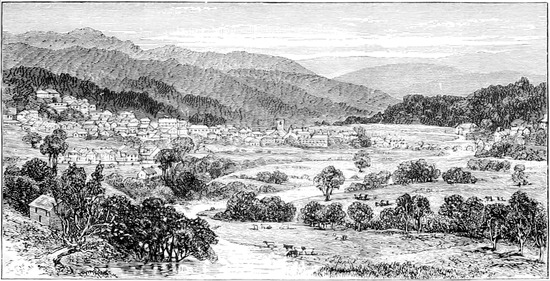
DOLGELLEY (p. 200).