THE PARRET AND THE LOWER AVON.
Reading edition
The PARRET: Its Source—Muchelney Abbey—The Tone and Taunton—Athelney Island and Alfred the Great—Sedgemoor—Bridgewater—Burnham. The LOWER AVON: Escourt Park—Malmesbury—Chippenham—Melksham—Bradford-on-Avon—Bath—The Frome—Beau Nash—Bridges at Bath—The Abbey Church—Bristol—St. Mary Redcliffe and Chatterton—The Cathedral—“The Chasm”—Clifton Suspension Bridge—The Lower Reaches—Avonmonth.
OF the even, placid course of the PARRET one sententious writer has said, “There is nothing remarkable in it, the country being flat.” A spark of imagination and the merest glimmering of historic interest would have spared us this dull commonplace. Surely the stream which saw the dawn of intellect in England, which witnessed the very beginnings of our modern civilisation, which watered the self-same mead where walked the first royal patron of learning that the country boasted, is notable, even if it does not attain to higher rank among our English rivers.
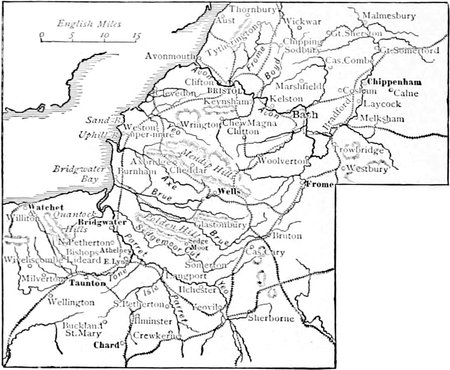
The Parret—Pedred of the Saxon Chronicle—is not of native Somerset birth, since it has its uprising a mile over the southern boundary, at Cheddington Copse, in the Dorsetshire parish of South Perrott. Flowing in a south-easterly direction, by Crewkerne and the Dorsetshire border, its basin occupies that portion of the Bridgwater Level lying between the Mendips and the Quantock Hills. At Crewkerne we have wide glimpses of its broad green valley, the busy little market town itself rising in the midst of the natural amphitheatre formed by the distant, unpretentious hills, lying low, like shadows on the horizon. The fine cruciform church of St. Bartholomew, whose only real rival among Somersetshire churches is that at Ilminster, in precisely the same style of architecture, occupies a pleasant situation westward of the river.
THE PARRET AND THE LOWER AVON.
The ruins of Muchelney Abbey rise above the marshy banks of the river in the hamlet bearing the same name, which the ancient chronicler would have us accept as a facile corruption of “Muckle Eye,” or Great Island. Of Athelstan’s Abbey there are but scant remains, though these are most suggestive of a structure of imposing size and great architectural interest and beauty. By the interesting little town of Langport the dividing hills are broken, and the Parret receives the waters of the Isle from the left, and of the Yeo (so common a river name, with its obvious derivation), or Ivel, from the right. Swollen by these tributaries, the Parret’s lazy waters now creep on under a bridge which unites the banks that marked the limits of the dominions of the Belgic and Danmonian tribes.
Hereabouts we do indeed appear to be at the very beginnings of English history, for but a little below the confluence, at Aller, the Danish king, Guthrum, is said to have received the rite of baptism in the river, his conqueror, Alfred the Great, magnanimously standing sponsor to the fallen foe; whilst eight centuries later a fiercer warrior, filled with zeal for what he conceived to be his righteous cause—Fairfax, to wit—routed the Royalist forces, giving no quarter, as he had asked none. Before we take up the other thread of the historical tale, there is the Tone to be reckoned with. Born in a bog on the Brendon Hills, this most important of the affluents of the Parret is seen at its greatest in the picturesque vale of Taunton Dean. Imparting its name to the handsome town of Taunton, it passes at least one splendid specimen of ecclesiastical architecture in St. Mary’s Church, which rears its lofty tower in the midst of a delightful neighbourhood, of which Taunton is the attractive capital.
Below the hill-top village of Boroughbridge the Tone joins forces with the Parret, and in the slack water at their confluence rises that little plot of ground made for ever sacred in English eyes by reason of its being the remote retreat of Alfred the Great when he sought to escape the slings and arrows of outrageous Fortune. Hurrying thither from his fierce enemies, the Danes—and, if the fable is in the least to be trusted, from the equally-to-be-feared anger of the neatherd’s wife—he found a peaceful haven, where he might heal him of his wounds, recruit his resources, and lay his plans for the meditated rally. And so, by bold forays from this natural stronghold, he regained the confidence of his adherents, won over the waverers, and paved the way for his eventual triumph over the pagan foe and the complete recovery of his power.
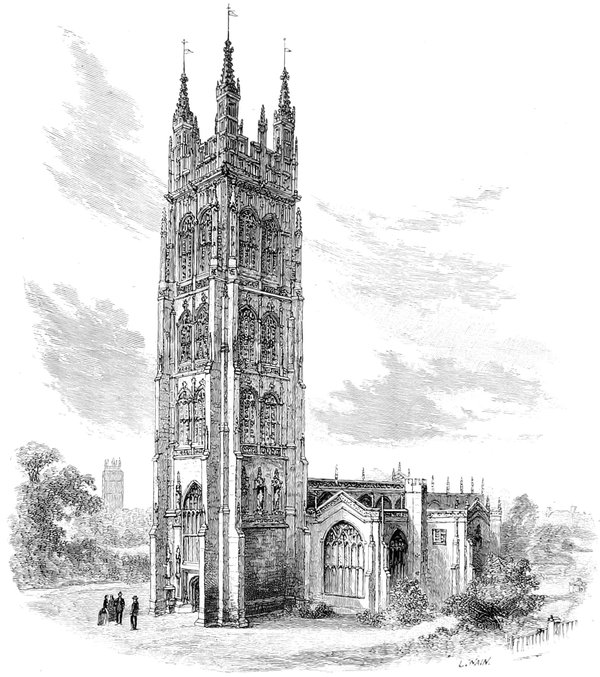
TAUNTON CHURCH (p. 68).
To the honour of St. Saviour and St. Peter, his patron saints, the pious hero of Athelney raised a monastery on the island, where, in their holy orisons, the monks chanted the praises of the God who had so confused the heathen by the shores of the river that stayed its course and stagnated where the reeds and rushes caught the water-sprite, heavy with sleep, in their toils. Barely two acres in William of Malmesbury’s day, yet covered by “a forest of alders of vast extent”(!), the historic spot is now known as Athelney Farm, a stone pillar telling its great story in this concise inscription: “King Alfred the Great, in the year of our Lord 879, having been defeated by the Danes, fled for refuge to the Forest of Athelney, where he lay concealed from his enemies for the space of a whole year. He soon after regained possession of his throne; and, in grateful remembrance of the protection he had received under the favour of Heaven, he erected a monastery on the spot, and endowed it with all the lands contained in the Isle of Athelney. To perpetuate the memory of so remarkable an incident in the history of the illustrious prince, this edifice was founded by John Slade, Esq., of Maunsell, the proprietor of Athelney, and lord of the manor of North Petherton, A.D. 1801.”
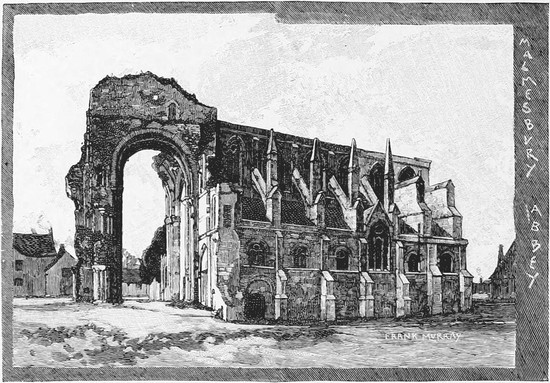
Photo: William Hanks, Malmesbury.
MALMESBURY ABBEY (p. 72).
History in its heroic elements still clings to Parret’s banks, for, as the river flows on near Weston-Zoyland, washing the parish on the south and south-west, Sedgemoor, the Duke of Monmouth’s fatal field, comes into view, and one looks upon the scene of what in Macaulay’s words was “the last fight deserving the name of a battle that has been fought on English ground.” Emerging from the marsh of Sedgemoor, the Parret now takes upon itself the new office of patron and benefactor of populous, busy Bridgwater, two miles to the south-west of “Sowyland.” It is the river which at ebb and flood tide deposits that peculiar sediment of clay and sand that goes to make “the Bath brick,” of which product Bridgwater has the monopoly. But why “Bath”? Well, presumably, because the best market for the brick was originally found in Beau Nash’s town, with the result that it eventually became the principal centre of trading in the commodity. From half a mile above to half a mile below the three-arched bridge which Walter de Briwere—the first of that ilk—commenced, and Sir Thomas Trivet completed, in the reign of Edward I., the brickworks stretch, giving employment to a large number of hands, and forming a source of considerable revenue.
The current which nearly overwhelmed General Fairfax in Bridgwater’s stirring days of 1645 is said to advance with such rapidity and boldness on the Parret as to rise no less than two fathoms on one wave. But, judging from the statement of another authority, this must be but a moderate estimate of the dimensions to which the bore occasionally attains, since it is asserted that the upright wave-phenomenon of the Parret has repeatedly reached nine feet in height! This much, however, is positively ascertained—that spring-tides in the Bristol Channel rise a full 36 feet at the mouth of the Parret.
King John gave Bridgwater its charter in 1200, but the Briwere family, one of whom began the building of the great bridge over the Parret, were the real founders of the town and the actual authors of its commercial prosperity. The most striking landmark in the birthplace of Admiral Blake, the great Republican commander, whose glorious achievement it was to defeat the “invincible” Van Tromp, is the tall tower and fine spire of the parish church of St. Mary, 174 feet in height, and, therefore, one of the loftiest in England. A splendid altar-piece, said to have been taken from a Spanish privateer, is one of the features of the church.
Six miles from the sea at Bridgwater, the Parret, as if loth to lose its individuality, lingers in the rich valley, doubling the distance by its circuitous course to the Bristol Channel. At Burnham, just before the Severn Sea claims them, its waters are still further swollen by those of the Brue, a considerable stream, which, like the Parret, has a wealth of historical association, and is of some commercial significance. To the wharves at Highbridge, above Burnham, vessels of many tons burthen are borne by the tide; here also are the gates and sluice-locks of the Glastonbury canal navigation. Then the united streams fall into that part of the Bristol Channel which is known as Bridgwater Bay. A few miles to the north the Axe indolently pours into Uphill Bay the waters which it has brought from the flanks of the Mendips, where it runs a subterranean course some two miles long before issuing forth in a copious flood from Wookey Hole—a cavern famous for the prehistoric treasures which it has yielded to the explorer—to flow through a picturesque glen, and presently to drain the level plains of West Somerset.
Watering three counties, to the scenic interest and beauty of each of which it lends an infinitude of charms, the LOWER AVON is not to be measured for its importance by its length (seventy-five miles), since there are far longer streams that one would willingly exchange for half the romantic valleys and the rich country of this river, which has its source in a piece of ornamental water at Escourt Park, in the neighbourhood of Great Thurston, where the boundaries of Wiltshire and Gloucestershire almost meet.
Distinction is immediately given to the stream. Just below the village it enters the grounds of Pinckney House, and after it has passed Eastongrey and a dozen little thorpes, the river claims proud association with historic Malmesbury—the British Caer Bladon, and the Anglo-Saxon Ingelburne—which it enters on the west. This ancient town stands on the ridge of a narrow hill, sloping down steeply on its southern and northern sides, and is nearly surrounded by two streams which, uniting at its southern extremity, form the Avon. On the highest point of the ridge are seen the ruins of the famous Malmesbury Abbey, which once covered forty-five acres of ground. Leland, writing in the time of Henry VIII., described it as a “right magnificent thing.” The present remains are small; but the south porch is one of the finest specimens of Norman work in the country. A portion of the structure is still used as a church. Another notable feature of the town in which William of Malmesbury, the historian, was educated, is a quaint fifteenth-century market-cross, to which also Leland gave none but honest praise when he styled it “a righte faire piece of worke.” Malmesbury—which, by the way, was the birthplace of “Leviathan” Hobbes—has been built on the peninsula between the Tetbury stream, flowing down from the Gloucestershire town, and the first beginnings of the Avon, which here accepts its earliest tributary.
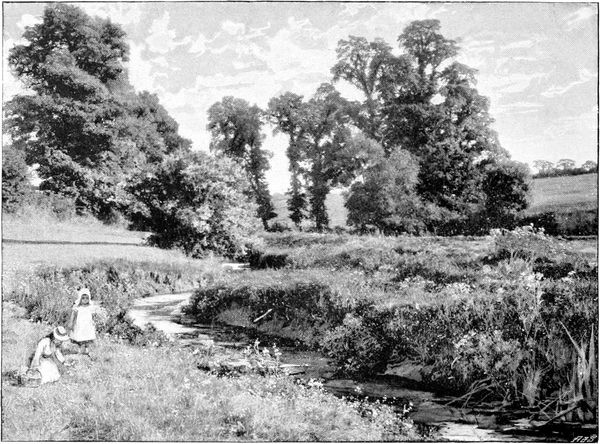
Photo: J. Clark, Tetbury.
THE AVON NEAR TETBURY.
Bending southward at Somerford, another branch is caught up, this subsidiary stream hailing from the neighbourhood of Wootton Bassett. By this time the Avon has become no mean river, and in its course by Dauntsey and Seagry to woody Christian Malford it forms a very prominent feature in the fine landscape that may be viewed from the high hill to the eastward, on the summit of which stood Bradenstoke Priory, now converted to the use—we will not say ignoble—of a comfortable farmhouse. Fast gathering its supplementary forces, the Avon after passing Kellaways and before reaching Chippenham welcomes the waters of the Marlan. Chippenham, pleasant in itself, but made still more interesting by reason of its surroundings in the fertile valley, is well nigh compassed about by the Avon, which here is a clear stream and of sweet savour. Later in its history it may deserve the description of a dark and deep river, except where shallows interfere. In its lower reaches it will be largely affected in colour by storms, Wiltshire floods tinging it with the whitish hue of the chalk hills, and the Somersetshire rains with the red of the ochre beds. But here it is a placid, pleasant stream, which makes a bold sweep round the environs of the town, driving its mill-wheels and lending that dignity and interest which a river peculiarly affords.
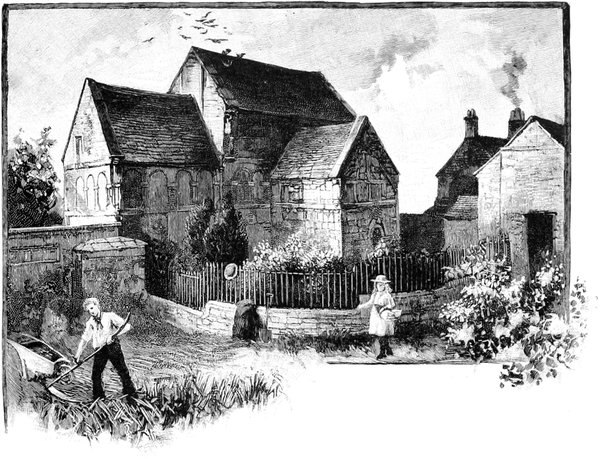
Photo: R. Wilkinson, Trowbridge.
BRADFORD-ON-AVON CHURCH, FROM THE NORTH EAST (p. 74).
Hitherto the Avon’s gliding way has lain by the low-lying dairy lands of North Wiltshire, through peaceful pastoral scenes, its banks clothed with the brightest flowers of the field, and here and there shaded with willows and elms, But now, beyond Chippenham, it embarks upon the chequered and romantic phase of its career. The country becomes more hilly directly we near the clothing district of Wiltshire. For a short space the Avon renders the useful service of a boundary, effectually dividing Wilts and Somerset. The scenery of Chippenham Vale, through which the river flows on to Melksham, Trowbridge, and Bradford—a trio of interesting towns, each watered by the same stream—is extremely beautiful.
Melksham, a town of one long principal street, is flanked by rich meadows, through which meanders the Avon. The quaint, old-fashioned houses are built on the acclivity of an eminence which may fairly be ascribed to the river’s wearing work through the ages; and the inhabitants are not without reason proud of their handsome four-arched bridge.
Again there comes a season of increase, in which the river gains, from this source and that, a considerable addition to its volume. At Broughton Gifford a brook by that name surrenders to the brimming river from the west, whilst from the east enters the Whaddon streamlet. Then, again, near Staverton the little Biss joineth the great Avon. So our river swells with importance as it approaches romantic Bradford-on-Avon. The name of this town—from the “broad ford” over the river—is by no means its only indebtedness to the Avon, for the highly picturesque situation of Leland’s “clooth-making” centre is entirely the outcome of Nature’s handiwork. Immediately on the north side of the river a hill abruptly rises, and it is on the brow and along the sloping declivity of this eminence that most of the tastefully-designed dwellings have been erected. The deep and hollow valley of the Avon now extends between two ranges, the hills here and there richly wooded to their summits; and pretty villages have scattered themselves along these bold acclivities.
Bradford-on-Avon Church is of considerable interest, and is remarkable for the success of its highly sympathetic restoration by Canon Jones, the vicar, a distinguished archæologist. Two bridges here cross the Avon; the most ancient, in the centre of the town, being described by Aubrey, two centuries since, as “a strong handsome bridge, in the midst of which is a chapel for Mass.” Bradford gained its original eminence in the woollen trade mainly from the introduction of “spinners” from Holland in the seventeenth century, and lost it with the development of the greater Bradford of the North, in the midst of the coalfields.
Before, following the more impetuous course of the now considerable river, we quit Bradford and its seductive scenes, the peculiar loveliness of the valley of the Avon in the vicinity of the town, and more particularly at such fascinating spots as Freshfield, Limpley Stoke—just where the river leaves Wiltshire and enters Somerset—and Claverton, to name but a few, must be remarked upon. Then Bladud’s creation, “Queen of all the Spas in the World,” “City of the Waters of the Sun,” “Queen of the West,” “King of the Spas,” gives greeting to the noble river that plays so great a part in the beautification of the historic city lying at the foot of the valley of the Avon, whence it has grown up its steep banks. Below Bradford the Frome has become a tributary of the Avon, bringing, besides its goodly stream, many most interesting reminiscences of its course. After flowing through the lower part of the agreeably situated town to which it gives its name, the Frome adds its charms to the manifold attractions of the scenery of Vallis Bottom. Just half a mile beyond the time-worn Priory of Hinton, which rears its ivy-clad tower amidst a grove of venerable oaks, Frome merges itself in the Avon.
As if Nature were here conspiring to make the river worthy of the city of “Bladud, eighth in descent from Brutus,” at Bathford the Avon receives the Box brook, from the vale of that name in Wiltshire, and, after a loop to the west, is joined at Batheaston by another small stream, the Midford, which has enhanced the romantic interest of the Vale of Claverton; whilst a third brook descends from the heights of Lansdowne, the fatal battlefield of Sir Basil Grenville and his Cornish friends, who lost their lives for the Parliamentary cause under the ill-starred leadership of Sir William Waller.
Approaching the city of “Beau Nash” from the east, and passing between Bathwick and Bath proper, the Avon washes “Aqua Solis” (or “Sulis”) of the Romans on the south, and plays its part in the fair scene which, “viewed under the influence of a meridian sun, and through the medium of an unclouded atmosphere, presents to sight and imagination everything that is united with the idea of perfect beauty.” And yet, with all the natural advantages of its situation, Bath long awaited the touch of the wand of the modern magician—the man of enterprise and speculation. There lay the deep romantic valley, gloriously encircled by the triple band of splendid hills—towering Lansdowne to the north, 813 feet above the sea; Claverton and Bathwick to the east, some 600 and 400 feet in height respectively; with Beechen Cliff, Sham Castle, Camden Crescent, and Lansdowne Crescent, all fine natural view-points, below. Compare with the Bath of to-day the overgrown village to the practical government of which the famous Beau Nash succeeded in 1704, when he followed the notorious gambler, Captain Webster, as Master of the Ceremonies, and you have some idea of the miracle of change and growth which has been performed. It was after the death of Beau Nash that the city, waxing great, extended its borders to Bathwick, on the country side of the river. Towards the close of the seventeenth century, private munificence caused a bridge to be thrown across the river, and Bathwick itself, from being a daisied meadowland, became a thickly populated suburb. And even the bridge thus built was shortly occupied with rows of dwelling houses and shops, so that the connection between Bath and Bathwick was complete. Long prior to the building of this, the Poulteney bridge—nearly five centuries before, in point of fact—the Avon was crossed by the St. Lawrence’s, or the Old Bridge, as it is now usually called. Originally built in 1304, it became a prey to the fever of building speculation which had marked the career of the elder Wood, of the famous family of Bath architects. Out of date, and, we may presume, somewhat out of repair also, it was rebuilt in 1754. The Poulteney Bridge, crossing to Bathwick, followed in 1769; and half a century’s growth of the popular lower suburb revealing the need for further means of communication that would relieve the congested traffic, the Bathwick, or Cleveland, Bridge was added in 1827. Some years later the North Parade Bridge was built. With the advent of the iron horse there had, by this time, arisen a newer necessity still. In comparatively rapid succession the Midland Railway and the Skew Bridge—which justifies its name by the remarkable angle at which it crosses the Avon—with three suspension bridges and a foot-passengers’ bridge near the station, have followed.
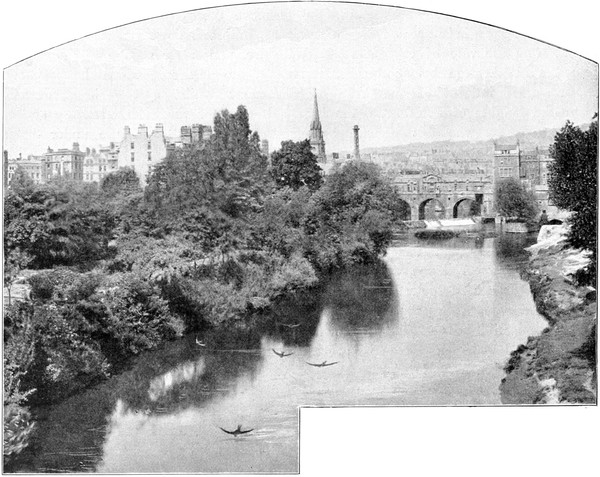
Photo: J. Dugdale & Co., Bath.
THE AVON AT BATH.
Bath boasts at least one ecclesiastical structure of great interest, in the “Lantern of England,” as the tower of the Abbey Church has been styled, because of the unusual number and size of its windows. In the exceptional height of the clerestory and the oblong shape of the tower, the church is also distinguished from the general.
Out by the Western Gate the Avon runs, with Holloway Hill and Beechen Cliff conspicuous landmarks on its left. By Twerton—“the town on the banks of the Avon”—there are large cloth-mills on the riverside, relics of the monastic industries established by the monks of Bath so far back as the fourteenth century. Fielding Terrace, in this town, is the reputed neighbourhood of the residence of the novelist, who is said to have written a part of “Tom Jones” during his stay.
VIEW FROM NORTH PARADE BRIDGE, BATH.
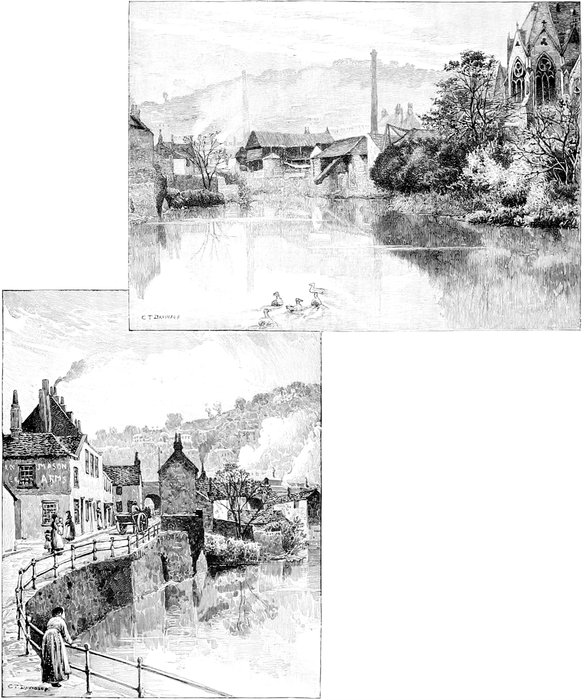
VIEW FROM THE OLD CITY BRIDGE, BATH.
Now the Avon is in its beloved valley, deep and green again. Three miles, or a little more, from the city, a beautiful circling knoll seems to shut in the vale. The hill is crowned with a handsome house, and ornamented with woodland and lawn. Kelston Round Hill, as this impressive eminence is called, is 730 feet above the sea-level, the Avon winding at its foot and the ascending groves of Newton Park reaching to the fine prospect and the highest hill in this part of Somerset. Ere, at this point, we bid a reluctant adieu to the beauties of Bath, it should be pointed out that in most of the commanding and delightful views obtainable from all the vantage points in and about the city the Avon and its fertile valley conspicuously figure, heightening the interest of each entrancing scene. It is no exaggeration to say that the neighbourhood of Bath is rife with scenic charms. The cliffs, ravines, and deep excavations in the strata lend endless variety to the landscape, which is finely compact of hill, vale, rock, wood and water, the striking beauties of the Avon’s course ever and anon lending a crowning grace to the view.
Below Kelston the more expanded vale of the Keynsham Hams succeeds. Flowing round this rich tract of land, the Avon becomes the dividing line between Gloucester and Somerset. Just beyond, within the parish of Keynsham, and midway between the sister cities of Bath and Bristol, the waters of yet another tributary, the Chow, a stream which has come down from the north side of the Mendip Hills, are gathered up.
Contracted in its channel for more than a mile between lofty rocks at Hanham, the Avon, emerging from its straitened circumstances, diverts itself with the strikingly sinuous course which it then follows between Brislington and St. George’s, ere it is sobered and dignified by its contact with the traditional Caer Oder, “the City of the Chasm,” the birthplace of Sebastian Cabot, of Southey, and of Chatterton. Before the river begins to be tidal, it has another, perhaps its greatest, recruit in the Lower Frome. After a picturesque course, the Frome washes the Bishop’s Palace at Stapleton, enters Bristol, and there loses itself in the Lower Avon.
Between modern Bristol and the great port of the “spacious times” the difference is one of degree only, for the commercial spirit is still strong in the sons of Cabot and Canynge; and, amid the thick smoke that overhangs the very centre of the city, there rise e’en to-day the tall spars, fluttering pennons, and the rigging of the ships of the mercantile marine that made the name of the opulent city known in every port and on every sea, and brought to Bristol by the tidal river the trade that trimmed her sails to the breeze of fortune and set her course fair on the voyage to fame and prosperity. One of the earliest chapters of the history of the city is connected with the river. It records the building of the first bridge over the Avon in 1247, an undertaking mentioned in a charter of Henry II. This bridge united the city with what was then the suburb of Redcliffe. To-day, this association is splendidly preserved by that golden historical link, the “finest and stateliest parish church in England,” as Queen Elizabeth pronounced the edifice of St. Mary Redcliffe on her visit to Bristol in 1753. The style is the Early English, though the richly sculptured northern doorway and some other portions belong rather to the Decorated Period. The structure was founded about the year 1300, but was enlarged, beautified, and, in fact, refounded by William Canynge, whose effigy, with that of his wife Joan, will be found at the end of the south transept. The upper part of the stone steeple was struck down by lightning in 1445, and not rebuilt for upwards of four hundred years. It was in the muniment room of this church that young Thomas Chatterton professed to have found a number of curious MSS. in prose and poetry, the boy-poet’s ingenious deception long escaping detection. Such success, which might never have attended the confessed productions of his own precocious genius, gave the gifted lad of seventeen the necessary stimulus, and his growing ambition led him to London, where he became a mere literary hack, and took a life threatened by starvation. A handsome monument in St. Mary Redcliffe churchyard pays Bristol’s tribute to her great, but unhappy, son. Of St. Mary Redcliffe, the “pride of Bristowe,” Camden said it was “the most elegant of all the parish churches I have ever seen.”
The present bridge replaced the thirteenth-century causeway in 1768. It was in 1247 that the course of the Frome was diverted to a new channel. Anciently, the city boundaries were the two confluent rivers which environed it with a natural defence on all sides save one, where a castle stood, protected by a broad deep moat supplied with water from the Frome, which at that time flowed by its northern walls. In Bristol Castle the son of the Conqueror, Robert, was shut up by his brother Henry.
Though it has been justly said of the Cathedral that it is remarkable neither for antiquity nor beauty, being far inferior to St. Mary Redcliffe in at least one of these respects, the Berkeley chapel, forming the north aisle of the choir, is worthy of note as an elegant example of Early English. The spacious nave, with side aisles and clerestory in the Early Decorated style, is a modern addition. Among the animated busts are those of Joseph Butler, of “Analogy” fame—one of Bristol’s famous line of bishops, two of whom were of the “glorious company” of seven—Robert Southey, and the “Dorcas” of the city, Miss Mary Carpenter.
In 1809 our river became a fellow-sufferer with the Frome. The course of the Avon lay through the city, but now a new channel was dug for it on the south side, leaving the river to fall into its original bed at Rownham Ferry. For the rest, the old channels of both the Frome and the Avon were converted into a fine floating harbour, which, at Cumberland Basin, will accommodate some of the largest vessels afloat.
“The Chasm” itself, or, as it is more familiarly known, the Gorge of the Avon, lying just below the Basin, is bridged by a triumph of modern engineering art. The Clifton Suspension Bridge—our English “Bridge of Sighs” for suicides—admits to a magnificent view of the Avon where it flows through the romantic defile of St. Vincent’s Rocks. As the story runs, St. Vincent, a rival, caught the Giant Goram asleep, and once and for ever determined the course of the river by cleaving the ravine through which the Avon now runs to the sea. Brunel’s Bridge, after a remarkably chequered history—its construction being actually suspended for a period of nearly thirty years!—was completed for the visit of the British Association in 1864. The foundations had been laid in 1836. The chains of Hungerford Suspension Bridge at Charing Cross were taken down and here re-hung. The centre span—one of the longest in the world—is 676 feet in extent, and the entire length of the bridge is 1,352 feet. Fifteen hundred tons in weight, the stupendous structure is a wonderful combination of strength and grace, adding a new interest and beauty to the impressive view rather than detracting from its great natural charm.
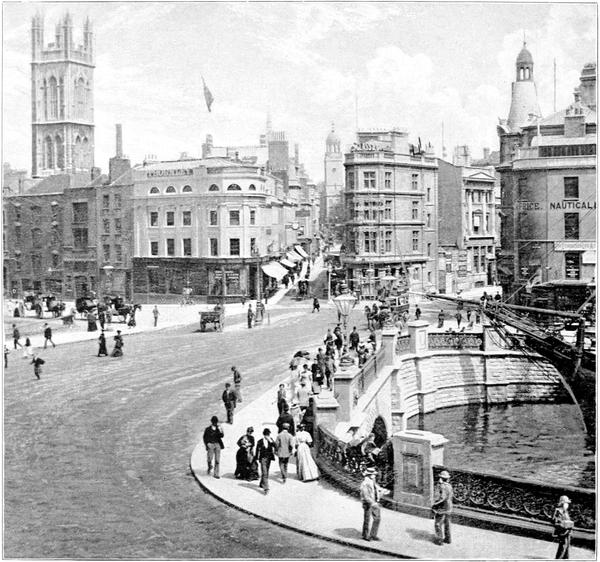
Photo: Harvey Barton, Bristol.
BRISTOL, FROM THE SITE OF THE OLD DRAWBRIDGE ACROSS THE HARBOUR.
When “Cook’s Folly” and the “Pitch and Pay” gate, of mournful memory, have been passed, and we have reached Sea Mills on the right bank, there is a distinct softening in the character of the scenery. Here is the supposed site of the Roman station Abona. The Avon at this point is joined by the small river Trym. Leland, having the St. Vincent legends clearly in remembrance, wrote of it: “Some think a great piece of the depeness of the haven, from St. Vincent to Hungo-rode, hath been made by hande.” As we pass Pill, which furnishes pilots for the port of Bristol, its ancient fish-like smell forces itself upon our attention. Now we near the last reach of the Avon, Broad Pill, where the river widens greatly. Sinuous as well may be, and running between low banks, those “sea-walls” of rich marshland that lie about Birchampton, the river’s course beyond that pretty neighbourhood changes fast, and gathers a new and picturesque interest when the tide comes in. Now we are at the mouth of the Avon, and in that fine roadstead which the loyal Bristol seamen would have styled King’s Road.
From the decks of the great ships that here ride out the light gale in safety a glorious view, up river, along shore, and about the fine anchorage in the estuary of the Avon and the Severn, may be enjoyed. The pier and docks at Avonmouth form another splendid enterprise, which, if it has not come too late, may retain for Bristol something more than a remnant of its ancient glory as the first port of the kingdom, a training ground for the British Navy, the haunt and home of sea-dogs who added many a gallant deed to the proud annals of our island story.
HUGH W. STRONG.
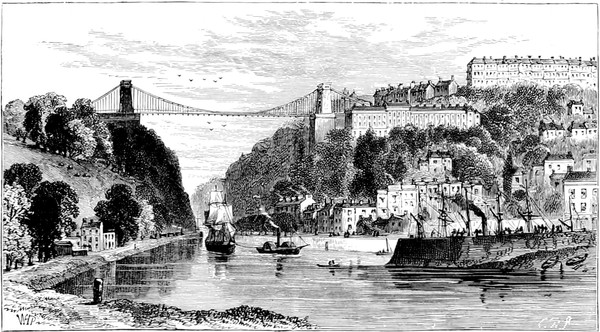
CLIFTON SUSPENSION BRIDGE (p. 79).
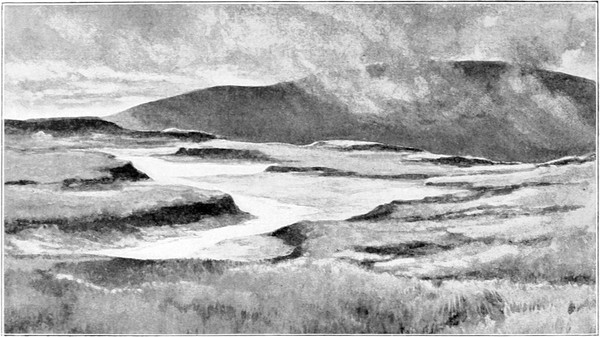
SOURCE OF THE SEVERN, PLINLIMMON.