RIVERS OF AYRSHIRE.
Reading edition
Poetic Association—Headstreams of the Ayrshire Rivers—“The Land of Barns”—The Ayr and the Doon—Sorn—Catrine—Ballochmyle—Mossgiel—Manchline—Barskimming—Coilsfield House and the Fail Water—The Coyl—Auchencruive—Craigie—Ayr—The Doon.
THE rivers of Ayrshire have a corner by themselves in the heart of the Scot, and in the memory of the world. “Bonnie Doon” and “auld hermit Ayr” are better known and more extolled on the banks of the St. Lawrence and of the Ganges than nearer streams incomparably greater in length and volume. Why this should be so, the Philistine who takes no account of the magical power of poetry may find it hard to understand. Those waters of Kyle, Carrick, and Cunningham are short of course and lacking in features of scenery that are in any marked degree impressive or sublime. Their beauty, such as it is, they owe as much to Art as to Nature. None of them can be said to be in any genuine sense navigable. It is true that some among them are centres and outlets of important industries. But even in the sordid affairs of trade their valleys hardly take a first rank among Scottish streams. Commercially, and almost geographically, they might be described as mere tributaries of the wealthy Clyde.
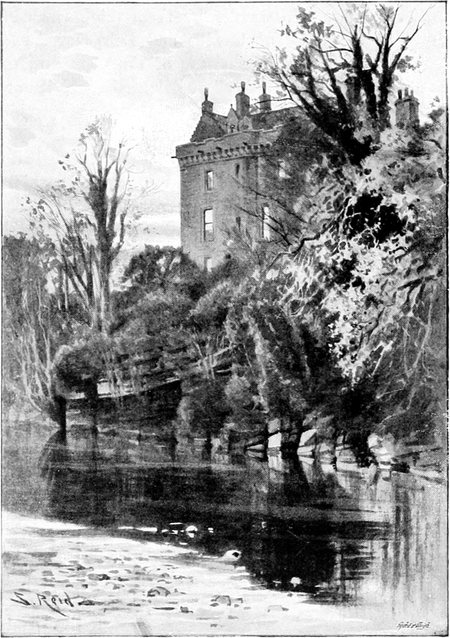
SORN(p. 332).
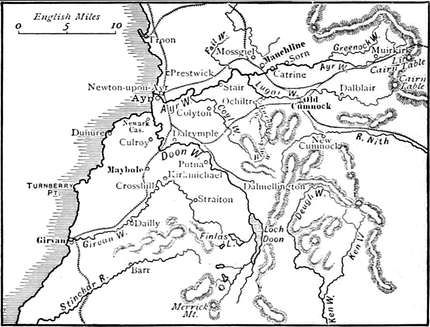
The headsprings of these Ayrshire waters are nowhere more than twenty or thirty miles distant from the shores of the Firth, and their sources as well as their mouths come within the range of view of travellers by that broad highway to the Broomielaw. They rise for the most part in high and featureless moorlands, where the county of Ayr borders with Galloway, Lanark, and Renfrew, and disappear in the folds of a lower country in which one appraiser of the picturesque has discovered a general character of “insipidity”—a character which every true-born son of Ayrshire will vehemently deny as belonging to the landscapes of his county, pointing, as his witnesses, to many a “flowery brae,” bold crag, and richly-wooded dell watered by the clear currents of his native streams. Some of these slip quietly to the sea behind hills of bent and sand, lonely except for the golfer, the salmon-fisher, and the sea-fowl. Others have at their mouths ancient burghs, busy seaports or pleasant Clyde watering-places flanked by breezy links or steep cliff and headland, that look out across sand and wave to the purple peaks of Arran, to the huge columnar stack of Ailsa Craig, to Bute, and the Cumbraes, and the other wonders of those Western seas.
The county might be likened in shape to a boomerang, or to a crescent moon, with horns tapering to a point towards the north and south, the shore-line from Wemyss Bay to Loch Ryan representing the concave inner edge, and the land frontier, roughly approximating to the boundary of the river-basins, standing for the outer surface. To the north the brown moorlands come near to the sea; the streams are correspondingly short, and the strip of fertile coast-territory narrows to nothing. But from the basin of Garnock to that of Doon there extends a diversified plain country, intersected by broad ridges, veined in all directions by roads and railway lines, full of thriving towns and villages, and amply endowed with the charms of wood, water, rock, and hill, as well as with coalfields, pastures, and cornlands. This is the heart of Ayrshire—the classic ground where the Ayr and the Doon are the chief among a host of streams whose currents flow to the music of the choicest of Scotland’s lyric songs. South of Doon lies the broken sea of hills known as Carrick, a country with a poorer surface and a wilder and higher background of green or heathy mountains, yet with many beautiful and some spacious and famous river-valleys opening between its barer uplands, which run down to the coast in bold promontories, crowned with ancient castles, or front it with walls of cliff pierced with caves in which has found refuge many a legend of the Killing or the Smuggling times.
Not, however, by its memorials and traditions of old strifes—or not by these chiefly—are the hearts and the feet of strangers drawn to Ayrshire. It is the “Land of Burns.” The spirit of the song of the Ploughman-Bard has taken possession of the banks of its streams, and has almost silenced all older and harsher strains. Those who wander by them think less about Bruce and Wallace, the grim deeds of the Earls of Cassilis and Lairds of Auchendrane, and the dour faces and pathetic deaths of the martyrs of the Covenant, than of Tam o’ Shanter glowering in at the “winnock-bunker” of Alloway’s auld haunted kirk, of the “Jolly Beggars” feasting and singing round Poosie Nancy’s fireside at Mauchline, and of all the rustic Nells and Jeans, and Nannies and Bessies, and Marys, with whose praises Burns has made the waters of Ayr vocal for all time. But chiefly the music of their currents seems to be a running accompaniment to his own stormy life. It reminds us of his youthful saunterings “adoun some trottin’ burn’s meander” while the voice of poetry in him was yet only struggling for utterance; of his later hours of rapture or of anguish in meetings with his “Bonnie Jean” in the woods of Catrine or Barskimming or Ballochmyle, or in his parting with Highland Mary where the Fail steals by leafy coverts past the Castle o’ Montgomerie to meet the Ayr; and all the other episodes of passionate or pawky love which he turned to song as naturally and spontaneously as do the birds.
RIVERS OF AYRSHIRE.
From his earliest years, as he has told us, the ambition fired him to “gar our streams and burnies shine up wi’ the best.” He lamented that while—
“Yarrow and Tweed to mony a tune Owre Scotland rings; The Irwin, Lugar, Ayr, an’ Doon Naebody sings.”
Gloriously has the wish been fulfilled and the want retrieved. The very names of these rivers have become instinct with the spirit of lyric poetry. To some he returned again and again, and docked them with the freshest and sweetest garlands of his verse. Who has not heard of “bonnie Doon,” of “winding Ayr,” of “crystal Afton,” and the “moors and mosses mony” of stately Lugar? Others, somewhat more removed from the centre of his enchantments, have been immortalised in a line or two of exquisite characterisation. Cessnock and Stinchar, “Girvan’s fairy-haunted stream”; where “well-fed Irwine stately thuds”; where the Greenock “winds his moorland course,” and “haunted Garpal draws his feeble source,” are all parts of “the dear, the native ground” of this master of the notes of rivers and of human hearts.
The AYR and the DOON, in particular, Burns has painted for us in all moods of the mind and of the weather. They murmur and rave with him in his despondency, and lilt gaily in sympathy with the brighter hours he spent beside them. He finds them fresh at dawn, when the dew is hanging clear on the scented birks, and they are “sweet in gloaming.” He traces them from their first rise on the heathery hillside, through hazelly shaw and hanging wood down to the sea—from “Glenbuck to the Ratton Quay.” He is familiar with their aspect in brown autumn and bleak winter, not less than when spring has set their choirs singing, or when summer is in prime. Often must he have stood and watched the effects of spate and storm in his beloved valleys, when, brown and turbid with the rains, or with “snowy wreathes upchoked,” “the burns came down and roared from bank to brae,” and “auld Ayr” itself became “one lengthened tumbling sea.” Nor, after seeing it through the poet’s eyes, can we forget the moonlight scene of frost and glamour in the “Twa Brigs,” wherein, by a marvellous blending of the real and the imaginary, the river spirits foot it featly over the thin platform of the ice as it “creeps, gently-crusting, o’er the glittering stream.”
The description in “Hallowe’en” of the burn where “three lairds’ lands met,” although Doon might claim it as applied especially to some spot not far from where “fairies light on Cassilis Downans dance,” might be drawn as well from scores of nooks by the Ayr and its feeders:—
“Whyles owre a linn the burnie plays, As thro’ the glen it wimpl’t; Whyles round a rocky scaur it strays, Whyles in a wiel it dimpl’t; Whyles glitter’d in the nightly rays, Wi’ bickerin’, dancin’ dazzle; Whyles cookit underneath the braes, Below the spreading hazel, Unseen that nicht.”
Many such might be discovered hidden even in the bare bleak moorlands, bordering upon Clydesdale, where the Ayr has its source. Their brown undulations, nowhere taking any boldness of form, and only in certain lights any beauty of colouring, rise on one hand to the crown of Cairntable, and on the other to Priesthill and its neighbour heights. Stern and moving dramas have been enacted on these bleak hillsides. Priesthill was the home of the “Christian carrier,” John Brown, shot beside his own door by Claverhouse’s dragoons; and on Airds Moss, the heathery ridge between Ayr and Lugar’s mossy fountains, fell Richard Cameron, the “Lion of the Covenant.” If desolate, the district is no longer lonely, for coalpits smoke at the taproots of the Ayr beside the reservoirs that supply water to the mills and factories of Catrine; and Muirkirk—the “Muirkirk of Kyle”—is a considerable village, with iron and chemical works.
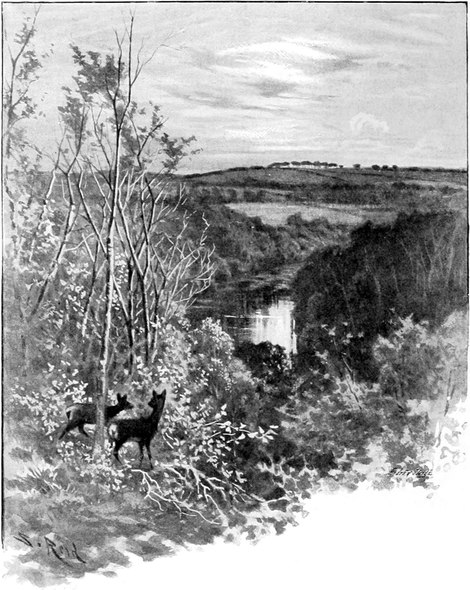
BALLOCHMYLE(p. 334).
Through a cold moorish country the Ayr wanders to Sorn, a place not easy to reach even now, when communication has improved so much since the times when a Scottish king testily declared that if he wanted to give “the devil a job” he would send him on a journey in winter to Sorn. Here the face of the valley changes. It runs betwixt high and wooded banks, often rising precipitously in great red cliffs, patched with lichen and fern, and with birch and oak coppice growing in their crannies, below which the strong dark current rushes tumultuously over its shoals or eddies, and sleeps in its deep “wiels,” or curves majestically round the green margins of level “holms” or haughs. Wiel and holm, crag and hanging wood, continue indeed to be characteristics of the valley landscapes from this point almost to the sea; and, for its short length of course, few streams, either of the Lowlands or Highlands, or none, can compete with “winding Ayr” in the rich beauty and romantic interest of its scenery.
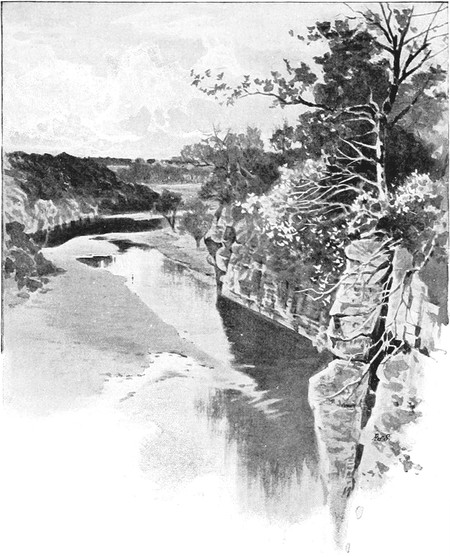
THE AYR AT BARSKIMMING(p. 334).
These features are blended in wonderful and picturesque variety where, at the junction of the Cleuch burn, Sorn Castle looks down from its rock upon the Ayr, with the parish church and the village in close proximity. Here we come upon the footsteps of Peden the Covenanter, who was born in this parish, and had his “cave” in the dell. Memories of Burns, however, thrust those of the fierce withstander of the “Godless” into the background even in his native parish. Catrine House, beautifully placed among its woods on the left bank, is lower down; and there the poet, as guest of Professor Dugald Stewart and his father, first “dinnered with a lord”—had his first glimpse into that polite and lettered society which, as many think, did as much harm as good to the man and his genius. Catrine village, a model home of industry ever since David Dale planted his spinning factories here more than a century ago, is on the opposite side of the river; and adjoining it, and skirting the stream, are the “braes of Ballochmyle,” whose picturesque beauties are worthy of their singer. And Ballochmyle, the seat in Burns’s time and our own of the Alexanders, brings us to the environs of Mauchline, which, next to Ayr and Alloway and Dumfries, may boast of being the locality most closely associated with the poet and his muse. Mossgiel, where he farmed the stiff and thankless soil of the “ridge of Kyle,” is three miles behind the town, on high ground forming the watershed between the Cessnock and the Ayr. There, as Wordsworth sings, the pilgrim may find “the very field where Burns ploughed up the daisy,” and look far and wide over the undulating plain furrowed by many a tuneful stream to where, “descried above sea-clouds, the peaks of Arran rise.” On the road leading down to the clean and thriving little town below, Burns foregathered with Fun and her glum companions on their way to Mauchline “Holy Fair.” In the kirkyard one may find the graves of “Daddy Auld” and of “Nance Tinnock.” Close by, on the site of the ancient priory that had Melrose as its mother house, Burns wrote some of his best known lyrics; while opposite still stands the change-house of “Poosie Nancy,” whose fame has been made immortal by the “Jolly Beggars.” Jean Armour was the daughter of a local mason; and other “Mauchline Belles,” besides his “Bonnie Jean,” attracted his fickle fancy, and spurred his Muse to song. The best and the worst memories of Robert Burns cling about Mauchline.
A mile from the town—a mile also below the railway viaduct that bestrides the river—Ayr is joined by Lugar, and the united streams flow in dark swirls under the picturesque arches of Barskimming Bridge and along the margin of the pretty holm in which Burns is said to have composed his “Man was Made to Mourn.” The stretch of three or four miles from this point down to Failford is perhaps the most beautiful and romantic on the Ayr. The current alternately hurries and pauses in its winding course, now between lofty crags of old red sandstone or steep banks clad with hawthorn and bramble, now through umbrageous woods of oak and beech coming down to the water’s edge, or past the skirts of flat green haughs.
Barskimming House, a square red mansion of last century, occupies a noble and commanding position on a rock overlooking some of the deepest pools of Ayr. Beside it, the river is spanned, high above its darkling eddies, by an elegant balustrated bridge grey with age and green with mosses. A mile below, the river path drawn athwart the stoop brae-sides plunges by a tunnel through a great barrier of red rock that rises sheer from the right bank, and openings in the cliff face give glimpses of the rushing stream, and of the trees climbing the crags opposite to where they are crowned by a mimic porticoed temple.
Hard by, on the Water of Fail, is the Castle o’ Montgomerie, otherwise known as Coilsfield House, where, according to some authorities, Mary Campbell—“Highland Mary”—was dairymaid when Burns was farming at Lochlea, behind the village of Tarbolton, whose “mote hill,” high-standing parish church, and long village street, in which thatched cottages still alternate with more modern dwellings, are only half an hour’s walk away. These “banks and braes and streams” will be associated with this brief and somewhat obscure episode in the poet’s career until song itself is forgotten:—
“Time but the impression stronger makes, As streams their channels deeper wear.”
If we may trust his verse on the point, the last meeting of the lovers was some trysting-place by the Ayr:—
“Ayr, gurgling, kiss’d his pebbled shore, Overhung with wild woods, thick’ning green; The fragrant birch and hawthorn hoar Twin’d am’rous round the raptur’d scene.”
There are scores of spots near the inflow of the Fail to which the description, in “My Mary in Heaven,” of the place of meeting might, apply. But tradition and the poet himself point to the lovely wooded glen of the Fail as the scene of parting; and the very spot, beside a rustic bridge, is shown.
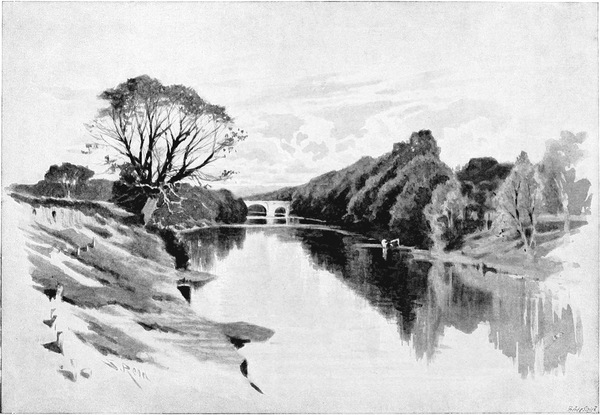
AUCHENCRUIVE.
With many a sweeping curve and abrupt elbow, the Ayr continues to pursue its course by rock and wood and level meadow and factory chimney to the sea; past Coilsholm and the “Dead Man’s Holm,” a name that may preserve the memory of some otherwise forgotten battle; past Stair village and Stair House, now neglected and forlorn, whence the noble and gifted family of Dalrymple have taken their title; past Dalmore and Enterkin, that early seat of the Cunninghames, and Annbank, where the scene of Burns’s “Fête Champêtre” is now obscured by colliery smoke; by Gadsgirth also, whose mansion, standing on a coign of the southern bank, was long the home of the old family of Chalmers; and on to where the river is joined by the Coyle, whose “winding vale,” were we to trace it up, would lead us to the bold cliffs and cascades of Sundrum, to Coylton and the “King’s Steps,” which, too, preserve traditions of “Coil, king of the Britons,” said to have been defeated on the neighbouring uplands by “Fergus, king of the Picts and Scots”; and so to the Crains of Kyle, where, among “the bonnie blooming heather,” one can look down upon the Doon.
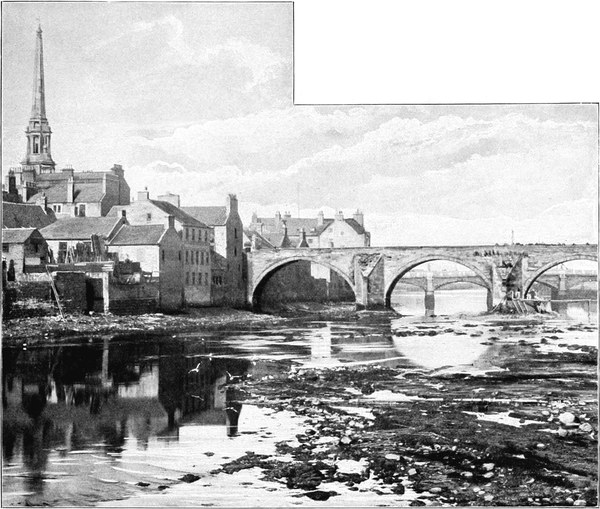
Photo: Bara, Ayr.
THE TWA BRIGS OF AYR (p. 338).
The same scenery—the alternation of pool and shallow, of wood and crag and meadow—continues along the great double curve which the main stream makes past the grounds of Auchencruive. Each wiel and holm has its own name and story; and the woods of Auchencruive, of Laiglan, and of Craigie are full of legends of William Wallace, who here sought shelter when hiding from his English foes, or meditating his attack on the “Barns of Ayr.” Auchencruive, so named from the natural trap dyke which here crosses the river, has a Wallace “Seat” and “Cave.” It is said to have been a possession of a branch of the family of the “Knight of Elderslie,” but passed from them and from their successors, the Cathcarts.
“Sundrum shall sink, and Auchencruive shall fa’, And the name o’ Cathcart shall soon wear awa’.”
From Burns’s day to our own it has been held by the Oswalds. Craigie, too, was for centuries a seat of the Wallaces; and it also has its cave and its well, dedicated to the hero—the mark of his heel is still pointed out on the platform of rock on which he jumped down, and whence rushed, and still rushes, a pure spring of water. And among the trees of Laiglan, Burns tells us that he spent a summer-day tracing the footsteps of the patriot, and in vision saw him “brandish round the deep-dyed steel in sturdy blows.”
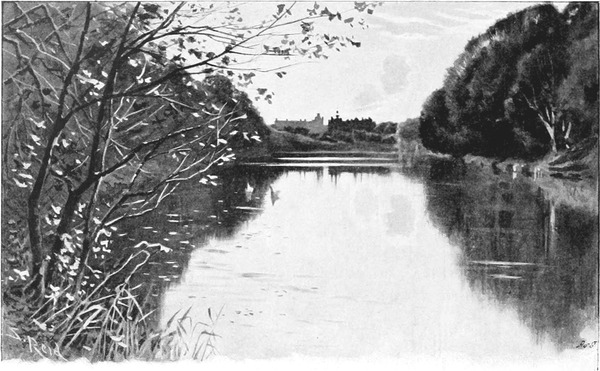
THE DAM AT AYR.
From the summit of these high banks delightful glimpses are had, through the trees, of the ancient burgh of Ayr. “Low in a sandy valley spread”; with spires, towers? and factory stalks rising above the greenery and the masses of houses; its broad and rushing river in the midst of it, crossed by bridges old and new; behind these the sweep of the Bay of Ayr, and, as background towards the south, the dark ridge of Brown Carrick Hill ending seaward in the bold front of the Heads of Ayr—the town shows bravely from a distance. Nor does a nearer view destroy the impression which it makes, especially as seen from the leafy margin of the stream, across the still expanse of the Dam, or from the Railway Bridge. Lower down are the historic arches of the “Twa Brigs” that unite the original Ayr with its northern suburbs of Newtown and Wallacetown. The poet’s prophecy, as the citizens noted with ill-concealed delight, has been, at least in part, fulfilled. The Auld Brig, “the very wrinkles Gothic in its face,” still stands, although reserved for foot-passengers alone; its younger rival, giving way prematurely to the assaults of time and flood, has had to be rebuilt:
“I’ll be a brig when ye’re a shapeless cairn.”
Near the approaches of the Auld Brig are congregated what remains of the old Ayr houses—a diminishing company, as town improvements break in and sweep away narrow closes and grim dwellings with high-pitched roofs and crow-stepped gables; below it are the harbour and the shipping. Of what was memorable and historic in Old Ayr—its monasteries of the Black and the Grey Friars; its castle, where kings and parliaments sat in council; its ancient church, dedicated to St. John the Baptist, wherein great Kirk controversies have been held, and Knox and other Reformers have preached—all have disappeared except the tower of St. John, and even it was reft of its gables last century “to give it a more modern appearance.” Cromwell, to make room for his fort, cleared away church and castle; and the fort itself has followed in its turn.
The high places of Ayr are of more modern date; and chief among them, perhaps, are the Wallace Tower, the imposing front of the Joint Railway Station, and the Hospital and the Poorhouse, heirs and successors of the Lepers’ Home, endowed by The Bruce in gratitude for the ease yielded to him by the waters of St. Helen’s Well at “King’s-ease.” The handsome Town Hall was destroyed by fire in 1897. Round the margin of the town, especially in the direction of the Doon, are streets of handsome villas and open spaces shaded by trees; and the place grows and thrives steadily if slowly. But, more than of its architecture, Ayr is proud of its sons and daughters:—
“Auld Ayr, wham ne’er a toon surpasses, For honest men and bonnie lasses.”
The “auld clay biggin” where, in wild January weather, Burns first saw the light, is two or three miles outside the burgh, close to the Doon and to the haunted Kirk of Alloway. Within the thatched and whitewashed cottage—the shrine of crowds of pilgrims, whose numbers grow with the years—is a little museum of Burns mementoes and curiosities; and the beautiful monument of the poet, a temple raised on lofty fluted columns, overlooks the scene. The road thither leads past the racecourse on the way to Maybole, and crosses the romantic wooded dell through which flows the Water of Doon, by the Auld Brig, the senior by some years of the Brig of Ayr itself. Across its keystone young Robin often trudged on his way to school, after the family had removed to Mount Oliphant, two miles off on the Carrick side. In the churchyard his father, whose portrait is so grandly painted in “The Cotter’s Saturday Night,” is buried. The “cairn above the well,” the “winnock-bunker in the east,” and other places mentioned in the tale of Tam o’ Shanter’s ride, are still pointed out in or near the roofless and ivy-clad kirk. The neighbourhood is haunted by the strong and familiar spirit of Robert Burns.
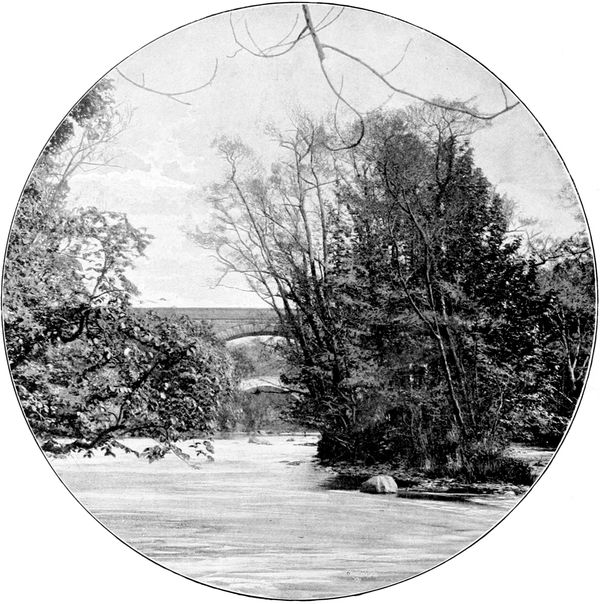
Photo: Bara, Ayr.
THE DOON: THE NEW AND THE AULD BRIG.
Having lingered so long on the Ayr, we can only spare time to glance up “Bonnie Doon,” although its charms are scarce less many and celebrated than those of its twin river. Like the Ayr, the channel of its lower course is carved boldly and deeply into the land. It flows, in pool or shallow, under impending crags and steep banks clothed with coppice and greenwood, or past the margin of fertile haughs. It has its ruined castles and venerable mansion houses, its picturesque old kirks and bridges and mills, and its rich dowry of tradition and song. Like its neighbour, too, the Doon draws its strength from waste and solitary places; only, its cradle is in barer and wilder scenes, and is haunted by wilder legends, than are to be found about the headsprings of Ayr. Its windings would bring us to Auchendrane, the home of James Muir, “The Grey Man,” as gruesome a villain as ever figured in history or romance; to the woods and cliffs and walls of Cassilis, the seat of the head of the Kennedys—those most unruly of the unruly men of Garrick—whence Johnnie Faa, the Gipsy, stole away the lady, and where he and his men afterwards dangled from the “Dool Tree”; to many a spot beside, famous in song and legend, until, through long bare moorlands on which mineral works and villages have intruded, we come, past Dalmellington, to the solitary shores of Loch Doon, its tunnelled outlet, its islands and old castle of the Baliols; and beyond it, to the high green hills of Galloway now rising over against the dark heathery slopes of the Carrick fells. And so we reach the sources of the stream under the brow of Merrick in the desolate wilderness of granite and peat-moss that surrounds Loch Enoch and the “Wolf’s Slock,” a region the wildest in the South of Scotland, where Mr. Crockett has found the scenery of his “Raiders” and his “Men of the Moss Hags.”
JOHN GEDDIE.
AYRMOUTH.